Volume 6 — CHAPTER VII EARLY AND CLASSICAL ORATORIOS
Reading edition
Origin of oratorio in the sacred drama of Italy—Cavalieri: ‘The Representation of Soul and Body’—Carissimi: ‘Jephthah’—Scarlatti; Stradella; other early oratorio writers—Development of oratorio in Germany; Passion-music and its development; Schütz: ‘The Seven Last Words of Christ’; ‘The Passion Oratorio’; ‘The Resurrection’—J. S. Bach: ‘Christmas Oratorio’; ‘Passion according to St. Matthew’; Graun: ‘The Death of Jesus’; other writers of Passion-music—Handel and the oratorio; ‘The Messiah’—‘Israel in Egypt’; ‘Judas Maccabæus’; ‘Samson,’ etc.—Haydn: ‘The Creation’; ‘The Seasons.’
The early oratorio had many of the essential characteristics possessed by its modern derivative. It always dealt with sacred subjects (the modern oratorio, however, frequently concerns itself with secular themes), it was almost always dramatic and its musical apparatus consisted of the usual four solo voices and the chorus with instrumental accompaniment.
In the liturgic drama of the Roman Church must be sought the origin of the oratorio, which, in a musically coherent form, appeared at about the same time with the opera, as the spiritual counterpart of its secular companion, making a devotional and intellectual appeal in place of the sensual. In the mediæval church two forms of the mass were in use side by side: the Roman office, which was mainly celebrated by the priest, and the Gallican Mass, a freer form, in which the people largely participated. Quite naturally the divergence between the two became marked and during the twelfth century the Gallican Mass was reformed with regard to lay participation. In order, however, that the people, who were attached to a form in which they took so direct a part, might be compensated for this exclusion, dramatic representations were devised, based on the Scriptures, all with reference to the great church festivals, especially that of Holy Week. In these the germ of the idea of the oratorio is to be found. These dramatic representations took the form of mysteries and miracle plays—dramatic versions of Scriptural episodes, with music, both sacred and secular, introduced to heighten their effect—as well as moralities, in which Christian virtues and mental qualities were treated allegorically. They included processionals of the type of the ancient Festum Asinorum (‘The Ass’s Festival’), commemorating the flight of the Holy Family into Egypt, which was annually celebrated at Beauvais and Sens as early as the twelfth century, and in which the celebrated carol, Prose de l’Ane (‘Hymn of the Ass’), still preserved, was the central feature.
With the monodic revolution which was inaugurated at the close of the sixteenth century and which marked the beginning of opera, the history of oratorio as a distinctly musical rather than a liturgic art-form may be said to begin. The sacred musical drama was generally staged in the vestry or vestibule of church or convent—its ‘oratory’—and in course of time the term oratorio was applied to this music. In the oratory of St. Filippo Neri’s church in Rome (S. Girolamo della Charità) Animuccia’s settings of laudi spirituali (sacred songs of praise) had already been sung in the sixteenth century; and the fact that these hymns were often used in connection with Biblical recitations is not without direct influence on the development of the form.
I
Yet it was not until the performance of Emilio del Cavalieri’s Rappresentazione di anima e di corpo (Rome, in February, 1600), in which Time, Life, The World, Pleasure, Intellect, The Soul and The Body appeared, that the first actual oratorio was heard in germinal shape, during the same year that witnessed the world première of all opera with Peri’s Euridice, which took place in Florence in December.
There was practically no difference in form between the first operas and the earliest oratorios, a statement borne out by the fact that Domenico Mazzocchi’s Querimonia di S. Maria Maddelena rivalled Monteverdi’s Lamento d’Arianna in popularity. Both opera and oratorio were constructed, musically, in the self-same way. Both were made up of recitative and arias, of choral and instrumental numbers, and both began with an overture. The angelic choruses of the first oratorios were musically synonymous with the bacchic choruses of the early operas. The difference between them lay only in the choice of subject-matter. And throughout the seventeenth century this continued to be the case, speaking generally, despite a certain divergence of viewpoint which had already made itself felt. How ‘operatic’ in character Cavalieri’s sacred score was, is proven by its composer’s employment of children as dramatis personæ, by the division of his work into acts, and by the use of worldly intermezzos, pantomimes and ballets. Interesting is the composer’s anticipation of Wagner at Bayreuth in his stage directions relegating his orchestra to a place ‘behind the scenes’ and out of sight. This orchestra, primitive in character, consisted of a double lyre, a harpsichord, a large guitar and two flutes. The use of the violin was recommended, though it was not insisted upon.
Cavalieri’s stage directions for the performance of his sacred drama are so interesting and throw so much light on the dramatic character of the early oratorio that they are quoted here, nearly in full, from Dr. Burney’s ‘History of Music’:
(1) ‘The words should be printed, with verses correctly arranged, the scenes numbered, and the characters of interlocutors specified.
(2) ‘Instead of the Overture or Symphony to modern musical drama, a madrigal is recommended, as a full piece, with all the parts doubled, and a greater number of instruments.
(3) ‘When the curtain rises, two youths, who recite the Prologue, appear on the stage; and when they have done, Time, one of the Characters in the Morality, comes on, and has the note with which he is to begin given him by the instrumental performers behind the scenes.
(4) ‘The Chorus are to have a place allotted to them on the stage, part sitting and part standing, in sight of the principal characters; and, when they sing, they are to rise and be in motion, with proper gestures.
(5) ‘Pleasure, another imaginary character, and two companions, are to have instruments in their hands, on which they are to play while they sing and perform ritornelles.
(6) ‘Il Corpo, the Body, when these words are uttered, Si che hormia alma mia, etc., may throw away some of his ornaments, as his gold collar, feather from his hat, etc.
(7) ‘The World and Human Life in particular, are to be gaily and richly dressed; and when they are divested of their trappings, to appear very poor and wretched, and at length dead carcasses.
(8) ‘The Symphonies and Ritornelles may be played by a great number of instruments; and, if a violin should play the principal part, it would have a good effect.
(9) ‘The performance may be finished with or without a dance. If without, the last chorus is to be doubled in all its parts, vocal and instrumental; but, if a dance is preferred, a verse beginning thus: Chiostri altissimi e stellati, is to be sung, accompanied sedately and reverently by the dance. These shall succeed other grave steps and figures of the solemn kind. During the ritornelles, the four principal dancers are to form a ballet, saltato con capriole, enlivened with capers or entrechats, without singing, and thus, after each stanza, always varying the steps of the dance; and the four principal dancers may sometimes use the galiard, sometimes the canary, and sometimes the courant step, which will do very well in the ritornelles.
(10) ‘The stanzas of the ballet are to be sung and played by all performers within and without.’
As a matter of fact Cavalieri’s work was in reality a sacred opera, not an oratorio. Contemporaries of Cavalieri, Agostino Manni (Rappresentazione del Figliuol Prodigo), Anerio (Teatro armonico spirituale), Pietro della Valle (Esther, La Purificazione) and, somewhat later, Domenico Mazzocchi, Luigi Rossi, Ludovico Bellanda, Vittorio Loreto (La Pellegrina Constante, Sacre d’Abramo), Francesco Balducci (La Fede) and others, represent tentative gropings toward a more artistically satisfying formal and musical development of the oratorio.
II
The slow revival of choral art quite naturally found in sacred subjects the material best suited to treatment, not alone because of earlier sixteenth century associations, but also because such subjects did not over-encourage dramatic realism. Yet even Carissimi (1604-1674) had but little success in his efforts to establish a loftier spiritual standard in oratorio. He did much to perfect the recitative, and to add charm and variety to the instrumental accompaniment; he set aside the theatrical presentation, often gave dramatic details to a ‘narrator’ and laid more weight on the choral element. His music has real quality and beauty; yet the secular idea persists in his works and defeats his attempts to turn Scriptural dramatic representations into genuine church-music. Despite this, his work is valuable as a stepping stone—he was the first to write music which held out hopes of a future for the oratorio as a distinct art-form.
Giacomo Carissimi, from 1628 to the time of his death choir-master of the Appolinare Church in Rome, was already renowned as a teacher and composer in 1650. It was in this year that Athanasius Kirchner, in his celebrated Musurgia universalis, a quaint mixture of scientific knowledge and childish hearsay, introduced Carissimi, with an analysis of his Jephta, to a wider circle as the perfect oratorio-composer. Nor is it without reason that Carissimi has been termed the Handel of the seventeenth century. His oratorios Jonas, Jephta, Job, Diluvium universalis, etc., he called historie, and the Biblical text on which they were founded was liberally interspersed with poetic supplementary matter to allow for the introduction of little arias and martial, elegiac or popular incidental choruses. The text was still Latin, though after Carissimi’s time the oratorio volgare, so called because it was sung in Italian and was thus distinguished from the Latin oratorio, supplanted the latter in popular favor.
Jephta is, perhaps, Carissimi’s most characteristic work. It employs a Biblical subject, like all his other works of the kind, for Carissimi adhered strictly to this conception of oratorio, though many of his contemporaries shaped their cantatas and oratorios around the life of some saint. In Jephta, too, as in all the composer’s oratorios, the musical stress is laid on the choruses. These are not written in the style of the polyphonic madrigal, but in a simple chordal setting whose rhythm is conditioned by the word-accents. The fugue is absent, imitation and canon are suggested only in the duets. In nearly all cases the chorus serves to develop the dramatic idea. In the oratorio of the time, chorus is, in general, opposed to chorus, with the occasional relief of solo voices. Yet Carissimi secures considerable movement and variety by dividing more extended portions of his text into short sections, first sung by one or more solo voices and then taken up by the choruses en masse. Excellent examples of this procedure are to be found in his Diluvium universalis and Dives malus.
Naturally, the harmonic structure of Jephta and the companion oratorios of Carissimi seems almost pathetically simple to the modern ear, accustomed to the richness of chromatic harmonization. His modulations, save in a few instances, such as the chorus Abit in montes of Jephta, are restricted to the keys of the upper and lower dominant. This lack, however, was not perceptible to listeners of the composer’s own generation. They enjoyed the rhythmic vitality and dramatic truth of his works, the vivid descriptive quality of the shipwreck music in Jonas, the idyllic charm of the two-voice movements to which the playmates of Jephthah’s daughter dance their rounds. And in Jephta the composer often gained a depth of pathos worthy of a really great singer’s rendering. Such a number is the Plorate colles, a model of expressive writing. It was from this Plorate that Handel borrowed twelve measures to use in ‘Hear, Jacob’s God,’ in his ‘Samson.’
All in all, Carissimi may be held to have laid down the lines along which the Handelian oratorio was later to develop. As a contrapuntal writer his great merit lay in the adaptation of the polyphonic idea to the new conceptions of tonality. He stands for the introduction of a more serious musicianship in oratorio work, and his influence was noticeably great and made itself felt in the works of his successors up to Handel’s time. Among these men who carried on his work (though often they were mainly active in the operatic or instrumental fields), two in particular stand forth, Alessandro Stradella (d. 1681) and Alessandro Scarlatti (d. 1725). These two men, in a manner, sum up the activity of many others, of Provencale, Vitali, Colonna, Leonardo Leo, G. B. Bononcini, Bassani, Ristocchi and Polaroli in Italy; of the Italian musicians in Vienna—Bertali, Draghi, Ariosto, Badia and M. A. Bononcini; and in Munich, Pietro Tosi. All of these composers wrote oratorios between the years 1650 and 1750 and developed in them the principles of Carissimi with more or less originality and success.
III
Alessandro Scarlatti, born in 1659 in Trapani, Sicily, the greatest representative of the Neapolitan school, was, it is asserted, a pupil of Carissimi. He wrote operas, cantatas, vocal and instrumental pieces by the hundred, and his oratorios alone number fourteen. Their titles show that he departed from his master’s strict adherence to Biblical subjects for his textual material. We have a Maddalena penitente, a Sacrificio d’Abramo, Agar et Ismaele esiliati, it is true, but also a San Casimiro, rè di Polonia, and a S. Filippo Neri. Like Carissimi he subordinated strict thematic counterpoint to the exigencies of a free and unconstrained leading of the voices, and with an added richness and elaboration of effect. He gave the aria a more definite structure, and made large use of rhythmic melody, in the manner of Gluck, to bring out the dramatic value of highly impassioned scenes, which in spoken drama would have appeared as monologue. Where lesser depths of feeling were to be plumbed, he used accompanied recitative and the recitativo secco mainly for the development of the narrative itself. This general scheme of arrangement has been followed by later composers down to our own day.
Perhaps his oratorio Il trionfo della grazia, composed in 1685, which was a favorite as late as the early years of the eighteenth century, gives us as good a general idea of his sacred music as any other. It was also known under the title of La Conversione di Maddalena, as in it the Magdalen makes her appearance as a species of apple of discord between ‘Youth’ and ‘Penitence.’ In clever contrast such opposites as Gravity and Heedlessness, The World’s Curse and The Joy of Life, are used to enhance the moral and musical effect of the work. The second section of the oratorio takes up the conversion of the penitent sinner, and the music which the Magdalen now sings, full of pathos and gravity, offers a piquant contrast to the jolly melodies, embroidered with coloratura and shakes, which were her part before. Particularly beautiful is an instrumental symphony (in the older sense of the word) which, after the heroine has said the words, ‘A penitent and faithful heart shall see the heavens open,’ is wonderfully suggestive of the kneeling of the penitent woman. Schering calls it a musical pendant to Ribera’s celebrated picture of St. Agnes, in the Dresden galleries.
In another of Scarlatti’s oratorios, Sedecia, rè di Gerusalemme[72] (1706), we meet with a splendidly effective use of orchestral means—always remembering that the orchestra of that day was not our present one. The introductory sinffonie is here nothing more or less than a violin concerto[73] in disguise, and the orchestra—consisting of obbligato and second violins, trumpets, tympani (especially prominent in the military music in Part I of the work) and oboes—takes an important part in the musical development from beginning to end. Among the vocal numbers might be instanced a particularly expressive duo between Anna and her son Ishmael (accompanied by an obbligato oboe); an aria of Ishmael’s, accompanied by two solo violins, and Sedecia’s two arias in Part II.
In this oratorio in particular, Scarlatti speaks with the accents of a master who is consciously striving toward the realization of a new ideal. It offers striking proof of the fact of how great Scarlatti might have become as a composer of oratorio had not opera so largely preëmpted his best efforts. The closing movement of Sedecia, a five-part chorus on broad lines, with incidental solo-quartet sections, recalls in its style the magnificent triumphal choruses of Handel’s oratorios. S. Casimiro, rè di Polonia (1713) also contains arias of great beauty; and written during the master’s last period of creative activity, La Vergine addolorata (1717) must be considered one of his finest works. A ‘Lament of Mary’ printed by Raf. Carreras in his El Oratorio Musical (1906), p. 188, approaches Bach in power and expressiveness.
The austere and serious power which Scarlatti infused into his sacred music was not attained by his immediate successors and contemporaries. But the master’s predilection for brilliancy and effect, when we compare his music with that of Purcell, though its greater dramatic interest and movement is incontestable, brought about, perhaps, a less degree of emotional expression and a less intimate touch in the portrayal of mood pictures.
Alessandro Stradella, born in Naples about 1645, was not as prolific a writer as Scarlatti, yet he left over 150 works (among them ten operas and eight oratorios) at the time of his early death—he is supposed to have been murdered in Genoa in 1681. He has much in common with Scarlatti. In Stradella’s works we find the same recurring suggestion of Handelian breadth and strength, and in general that freedom and grandeur of conceptive outlook which stamps the great composer.
Stradella’s best known oratorio is his S. Giovanni Battista (about 1676). Its great artistic merit lies in its plastic musical portrayals of the characters of Herod and his daughter, and in the happy use of fiery, dramatic melody to limn them in tone; for as a musical character-painter Stradella may be said to have been Scarlatti’s superior, although his influence on the development of the form was not so great as was that of his contemporary. The romantic details regarding his personal life, many of them undoubtedly apocryphal, which recur in every biography, do not seem to call for consideration here. It is his contribution to the music of the oratorio only with which we are concerned, and in this respect he deserves a place beside Scarlatti.
The numerous composers of oratorio who lead from Carissimi, through Scarlatti and Stradella, to Handel and his more immediate German predecessors, have nothing especially new to offer. Scarlatti and Stradella accomplished much in the direction of both musical and purely formal development, but they were unable to establish a distinct line of demarcation between oratorio and opera. Italian oratorio was practically not distinguishable from the Italian opera seria until as late as Mozart’s boyhood.
IV
Italian oratorio, by reason of its descent from the sacred church dramas and its close association with opera, has never been wholly able to break away from the element of recreation that was so conspicuous in its early use as a means of attracting people to attend church. And the complete separation between the recreational and religious elements did not take place until the oratorio passed out of the land of its birth into Germany, when it fused with the spirit of Passion-music and emerged a distinctly religious art-form. The connecting link between Italian oratorio and Germany was Giovanni Gabrieli, who, as the teacher of Heinrich Schütz, the greatest German musician of the seventeenth century, transmitted to his great pupil not only his technical mastery of the best of Netherland and Italian art-methods, but his own remarkable artistic sincerity and religious earnestness. It was Schütz who, from the different standpoint of Protestant faith as nurtured by the Lutheran Reformation, laid the foundations of modern oratorio.
Before tracing the influence of Schütz in shaping the future course of oratorio, it will be in place to sketch the origin and development of the Passion-music. The quasi-dramatic musical presentation of the Passion[74] is even more deeply rooted in the liturgy of the Roman Church than is the oratorio. It represents the artistic amplification of the reading of the Passion of our Lord, according to the evangels as prescribed by the church during Holy Week: on Palm Sunday the Passion according to St. Matthew, on Tuesday, St. Mark, on Wednesday, St. Luke, and on Good Friday, St. John. At an early period it had become customary to assign the narrative text and the words of Christ, of the Apostles, the High Priest and other individual characters to various singers, instead of having them read. During the period of the supremacy of Gregorian plain-song this mode of rendering this part of the liturgy resulted in the Passion chant (cantus passionis). This continued to be the only form used until the principles of polyphony were sufficiently developed to substitute a more elaborate form. Since the year 1200 and probably much earlier, the texts to be sung were divided among three priests, called ‘Deacons of the Passion,’ as follows: one chanted the words of Christ, another the narration of the Evangelist and a third the words of the apostles, the crowd, or others whose words are recorded. Passion-music, it will be observed, is much older than the oratorio and at the time that the latter began to assume shape and coherence, it already could boast of a considerable literature. When the monodic revolution brought about the development of the oratorio along lines similar to those of opera and encouraged the use of legends of the saints and Christian allegory as text matter, the Passion remained strictly bound to its original Biblical text, although the musical treatment of certain text portions in motet form (Passion Motets) was permitted. Not until the second half of the seventeenth century did Passion and oratorio in Italy draw near to each other, and only in the last quarter of the century was the story of the Passion utilized for the first time as subject-matter for a great oratorio.
Attilio Ariosti’s Passione (1693) is probably the first work of its kind in Italy to present this subject with due dramatic emphasis and the use of musically adequate popular choruses. G. A. Perti’s Passione (1685), on the other hand, is one of the type known as sepolcros, intended for devotional performance at a richly decorated Holy Sepulchre and serving principally as an excuse for tearfully exaggerated scenes of sorrow between Mary Magdalene and the disciples. After Ariosti’s Passione Italian Passion music in its best manifestations may be said to have been taken over into the oratorio proper, with little but its text to distinguish it from the latter.
When Luther constructed the liturgy of the Church which followed his religious leadership, he borrowed from the Roman ritual, among other things, the custom of singing to musical accompaniment the story of the trial and death of the Saviour. About the middle of the seventeenth century German composers[75] injected into the existing Italian form a new spiritual and musical fervor, and an emotional expressiveness which was eventually to culminate in the great Passions of Johann Sebastian Bach. By the end of the seventeenth century the Passion existed in three distinct forms—the chant, the motet and the oratorio. Schütz cultivated particularly the last two forms with wonderful results considering the musical vocabulary of his period, but the Passion-oratorio, with its greater musical and dramatic possibilities, was best adapted to serve the deep religious fervor of Bach’s inspiration and to attain its final development at his hands.
Heinrich Schütz (1585-1672), of Dresden, was the greatest of Bach’s predecessors as a composer of church-music. Familiar with the best music of Italy and a master of religious writing, he laid the foundation of the modern German oratorio. His ‘Resurrection,’ ‘Seven Last Words,’ and four ‘Passions’ represent the culmination of the form before Bach. Schütz, who has been called ‘the father of German music,’ was one of the greatest Psalm-writers of all times, though few of these compositions are so named but appear under such titles as ‘spiritual concertos,’ ‘sacred symphonies,’ motets, and ‘sacred choral music.’ Though his work was based on the Italian style, he was greatly influenced by Scandellus, one of his predecessors in Dresden as chapel-master of the Elector Johann Georg of Saxony. His finest choral works are the six mentioned above, all of which come under the general classification of oratorios. One of his greatest works, Historia der fröhlichen und siegreichen Auferstehung unseres einigen Erlösers und Seligmachers Jesu Christi, or ‘Resurrection,’ was written in 1623, for Easter service, it being the custom then, as now, in some of the important churches of Saxony, to sing the Resurrection on Easter day before the sermon, just as the Passion was sung on Good Friday. The vocal parts are accompanied by the organ and four viole da gamba, and the chorus is frequently in six and eight parts. The works of Schütz are characterized by simplicity of themes, which are always expressive and full of color. At times he becomes dramatic, but he is always devotional and reverential, and though he abandons the liturgical forms of Scandellus, many of his themes, though original, are based on liturgical melody or Gregorian chant. All trace of the Italian recreational element disappears; there is no suggestion of the stage or of ‘attractive’ effects and the only object before the composer’s mind is evidently to faithfully portray in music the solemnity and pious grandeur of the texts. This was the point of departure for German Protestant oratorio.
Another important work of Schütz was his setting of the ‘Seven Words of Jesus,’ written and performed in 1645. This departs even more from the liturgical chant, and the part of the Evangelist, instead of being chanted, is treated as a recitative, first for alto, then for tenor, then for soprano and tenor accompanied by the other two voices, thus bringing it into quartet form. The first and last choruses are in five parts and each is called ‘Chorus of the Congregation.’ After the first chorus and before the last (therefore separating the actual scenes from the chorus of the people), an instrumental number called symphonia is inserted, thereby giving more dramatic force to the narration. These two symphonias are in five parts and while the instruments are not indicated, they were probably played by the strings. Parts of the work are very touching and beautifully expressive. For some unknown reason this work was not published until 1873 (228 years after its first production), edited by Carl Riedel.
Possibly his greatest work is his setting of the four Passions entitled Historia des Leidens und Sterbens unseres Herrn und Heylandes Jesu Christi and following the text of the four Evangelists. This was written in 1665-66 but was not published during his lifetime and only the ‘St. John Passion’ exists in manuscript, but a complete copy of the four Passions was made by Grundig in 1690, comparatively soon after the death of Schütz. These Passions are built up largely with short choruses which, though conceived in deep devotion, are at times very dramatic. The parts not given to the chorus are recitatives in liturgical form, sometimes accompanied[76] and sometimes for the voice alone. The texts of some of the choruses were taken from well-known church hymns. The ‘St. Matthew Passion’ is the most fluent melodically. These settings of the Passion comprised the composer’s last works and in them lay the kernel of what was later perfected by Bach and Handel, both of whom completed in their respective lines what Schütz had begun. It has been regarded significant that the year of his birth was exactly one hundred years before that of Bach and Handel.
Schütz was still much under the influence of the Gregorian modes and did not attempt to break away from them in passages of simple recitative, but he also employed for simple harmonized passages many of the chorale melodies that were so popular all over Protestant Germany. But after Schütz plain-song practically disappears from German Passion and oratorio music and the influence of the chorale becomes more distinct and insistent. During the seventeenth and eighteenth centuries Passion music was extensively cultivated in Germany and all her best composers gave it marked attention. Johann Sebastiani in 1672 produced a Passion at Königsberg, in which the narration is set entirely to original music and in which chorales, simply and effectively harmonized, are given more prominence. Thenceforward German church-music, freed from its allegiance to the old modal system, struck out paths of its own, and rapid progress was made. In 1673 Theile’s Deutsche Passion was performed at Lübeck with extraordinary success and Reinhard Keiser, the Hamburg opera-composer, created renewed interest in this form by his setting of the Passion in 1704, which contained an innovation followed by all subsequent German writers of Passion-music. This consisted in what he called soliloquia, which voiced devout reflections on the solemn events of the Gospel narrative.
V
Bach’s extraordinary and single-hearted devotion to the cause of church-music led him very naturally to the door of Passion-music and oratorio, and he brought to the composition of these elaborate forms an unequalled mastery over all the technical devices of contrapuntal writing and a marvellous fertility of invention. A deeply religious and devout nature enriched the natural nobility of his musical speech, and scattered through the four oratorios from his pen that are preserved to us are some of his sublimest thoughts. These four are a Christmas-oratorio and three Passion-oratories—St. Matthew, St. John, and St. Luke (now regarded as genuine, though for many years considered spurious). Through the carelessness of his son Friedemann a St. Mark Passion and probably still another have been lost, for he is known to have written five Passions.
‘Christmas Oratorio.’—This work, written in 1723 and performed a year later, consists of six parts (in reality six separate cantatas) intended for the first, second and third days of the Christmas service, for New Year’s Day, New Year’s Sunday and Epiphany. While these belong together liturgically and are connected by chorales, there have been very few single performances of the entire work because of its very great length. The parts given most frequently are the first two, which are the strongest. The text, the story of the Nativity, is taken from Matthew and Luke, but is elaborated by passages taken from two of his secular works. This was a common procedure in the eighteenth century and as Bach had just written festival music for the birthday of the Queen of Poland and for other court festivities, parts of these joyful compositions easily adapted themselves to the joy of the Christmas season.
The first part opens with a sort of fanfare of trumpets accompanied by drums, which gives a distinct festival atmosphere as the people assemble for the first service; it is followed at once by the chorus Jauchzet, frohlocket, auf, preisset die Tage. The solo tenor narrates the part of the Evangelist and brings the attention of the worshippers to the joy of this specific festival. But Bach sees beyond the Nativity and anticipates the sacrifice and suffering of the Saviour, therefore the words of the Advent hymn, Wie soll ich dich empfangen, are set to the Passion chorale, O Haupt voll Blut und Wunden. This first part contains beautiful, simple melodies interspersed with chorales. An atmosphere, almost of Advent sorrow, pervades the part as a whole and is strongly contrasted with the second part which brings in the real, generally-accepted Christmas atmosphere. The second part opens with the well-known ‘Pastoral Symphony,’ so often played on orchestral programs and so charmingly idyllic, simple and naïve. It is built on two themes, one typical of the shepherds, the other of the angels. At the close of this the Evangelist continues his narrative, which is frequently interrupted by lyric passages and by chorales, such as Brich an, du schönes Morgenlicht. The beautiful tenor solo, Frohe Hirten eilt, following a bass recitative, is one of the most compelling numbers, but probably the finest from both a vocal and an orchestral standpoint is the lovely alto solo, Schlafe, mein Liebster. The part closes with a massive chorus of praise to God in the highest, sung by the angels, shepherds and the congregation.
As the other four parts are rarely performed, no detailed analysis is given here; however, these parts have been given together and are about as long as the combined first two parts. One of the most effective choruses in the last four parts is one in the fifth, Ehre sei dir Gott gesungen.
‘Passion According to St. Matthew.’—This stupendous work, now universally considered the finest work of its kind, was written in 1729 and performed on April 15th of the same year at the afternoon service of Good Friday in the St. Thomas Church, Leipzig, but was later altered and extended so that it was not completed in its present form until 1740. While it was frequently performed in Leipzig until the end of the eighteenth century, it was practically forgotten by the outside world until 1829, just one hundred years after its first production, when it was given on March 11th, in the Singakademie, Berlin, under the direction of Mendelssohn. This generous artist is deserving of the deepest gratitude for his untiring enthusiasm in compelling the world to recognize the grandeur of this work and the greatness of its half-forgotten creator. He was evidently deeply struck with the strangeness of his own relation to the rescuing of the great work from oblivion, for, in commenting on the performance, he made the following reference to his own nationality—the only recorded instance of this kind: ‘It was an actor[77] and a Jew who restored this great Christian work to the people.’ It was not performed in London until April 6th, 1854. The first American performance was by the Handel and Haydn Society in Boston in 1874.
The story of the ‘Passion according to St. Matthew’ was already embodied in the service at Leipzig and it was sung on Palm Sunday each year in choral form. The fact that the Passions were regularly given at church services, added to his own interest in the subject itself, probably inspired Bach to give artistic musical expression to the different versions of the Gospel narratives. While Bach wrote five Passions, four on the four Gospels and one by Picander, the greatest and last was the ‘Matthew Passion.’ The ‘Passion according to St. Luke’ is by many authorities not attributed entirely to Bach, for even though it were a youthful work, there are parts that cannot be reconciled with his general style of that period, though others bear his unmistakable stamp. Of the ‘Passion according to St. Mark’ only five lyric pieces are preserved in the Funeral Ode on the death of Queen Christiane Eberhardine. The Picander Passion is lost. The ‘Passion according to St. John’ was first performed at St. Thomas’ Church on April 7th, 1724, and is musically not much inferior to the great ‘Matthew Passion,’ but in the latter work Bach developed to a larger extent the element characteristic of the oratorio and united more closely the ecclesiastical and the folk-song quality. The fact that he was accustomed to the simple choral setting probably prevented him from giving anything like conscious dramatic effect, yet the complexity of his natural musical expression often led him to a dramatic climax of which he was not conscious, for his Passions were written for the church service only. As Bach was above all a devout Lutheran, he doubtless was imbued with the spirit of offsetting the grandeur of the Roman Mass with the combination of simple and complex forms in which the congregation could take part in the well-known chorales interspersed so artistically. Arthur Mees[78] speaks of Bach’s Passions as ‘the expression of the religious devotion of his own individual self as representative of his fellow-believers. Even the dramatic portions are not the utterances of actors in a drama, but those of the Christian congregation which is carried away in its contemplation of the events to the point of identifying itself with the actual participants in the scene.’
Between the two parts of the Passion it was customary in Bach’s time to have the sermon, as in the days of St. Philip Neri at Rome. As the performance of the Passion consumed more than two hours and the sermon lasted at least two hours, the Good Friday service was a most serious and weighty church event.
The first part of the ‘Matthew Passion’ is divided into three principal sections—Jesus with his disciples and the institution of the Last Supper, Jesus at Gethsemane, and the seizure of Jesus. The second part is divided into four sections—Jesus before the High Priest, Jesus before Pilate, the Crucifixion, and the last, consisting of madrigal-like elaborations of Bible texts. This part contains the famous bass aria, Am Abend als es kühle ward, which with its refined instrumentation is one of the most beautiful in the entire work, almost romantic in atmosphere and remarkably lyric. Among the many notable characteristics of this work is the accompanying of the words of Jesus by the orchestra in place of the usual continuo. The Daughter of Zion, whose words were given by other composers to a definite voice, no longer appears as an individual, but her words are sung in turn by alto, soprano, tenor and bass solos, in duets and in choral form.
While a large part of the text (from chapters XXVI and XXVII of Matthew’s Gospel) was doubtless compiled by Bach himself, he had able assistance from the poet Picander (whose real name was Friedrich Henrici), who wrote many of the hymns and who has already been referred to as the poet of the lost Passion, considered of little value because of the inadequacy of the text.
With Bach’s ‘Matthew Passion’ the development of the Protestant Church music in this form came to an abrupt close for the simple reason that no one since Bach’s time has possessed the necessary technical and musical equipment for further progress. In this glorious work, which next to his own ‘B minor Mass’ is probably his most sublime utterance, he seems to have completely grasped the touching pathos and the poignant sorrow of the scenes unfolded in the Gospel narratives of the Passion and, in interpreting them through the religious experience of a devout believer, to have exhausted the vocabulary of music appropriate to the liturgy of which this Scriptural narrative forms an impressive part. However, other Passions were written after Bach’s settings were made and the most famous of them is Graun’s Der Tod Jesu, which is spoken of in some detail below. Handel made two settings of the Passion, one of which (‘The Passion of Christ’ to a poem by B. H. Brockes of Hamburg) is in existence. It was written probably about 1716 and the composer introduced no fewer than twenty of its numbers into later works, some altered, some transferred bodily. Haydn’s Passion (‘The Seven Words of Our Saviour’) has already been spoken of under cantatas (Chapter IV). An interesting example of later Passion music is Gounod’s unaccompanied Passion-motet, ‘The Seven Last Words of Our Saviour’ (Filiæ Jerusalem), written from the standpoint of the Roman Church service in the style of Palestrina.
Karl Heinrich Graun (1701-1759), a contemporary of Bach, was the last great writer of Passion music. Indeed, the greatest of his works was the Passion-cantata ‘The Death of Jesus,’ text by Ramler, which met with the most monumental success and has been a favorite up to the present day. Performed for the first time on March 26th, 1763, in the Cathedral of Berlin (four years after the death of the composer), it was published immediately and both orchestral and piano scores passed through edition after edition, and the work obtained a very wide hearing. In many places an annual performance of it was given and it was as well known as the ‘Messiah,’ ‘The Creation’ and the Mozart Requiem. Although Graun was first of all a contrapuntist, his harmony was rich and expressive and his style often dramatic. As he was himself an opera singer of splendid attainments, he understood how to produce the best vocal effects. His melodies, if judged from the standpoint of the time in which they were written, are very expressive, though present-day standards would not pronounce them always forceful. This may be partly due to the text, which, though suited to the demands of the time, is not always pliable. Graun, like all German Passion composers of this period, made frequent use of the chorale, sometimes for purposes of narration and sometimes to express the thought of the people. The dramatis personæ are not well defined in the text, hence it is difficult to discern who is speaking, since chorus, solos and chorales serve for different functions. Frederick the Great somewhat humorously spoke of this work as ‘Graun’s best opera’ and there is considerable justification for the statement, especially when considered in connection with the two principal bass arias—one, which comes near the close, ‘Now suddenly by anguish long restrained,’ and the other, which is by far the highest dramatic point in the work, ‘Jerusalem, for slaughter thirsting.’ The latter is most effective, even judged by present-day standards, and has an elaborate accompaniment. This is followed by the chorus, ‘Christ unto us hath left an example,’ in double fugue, the vocal effects of which have made it successful in spite of the commonplace themes employed. This is so well-known that it is often sung by choirs as a separate composition.
VI
The law of compensation has seldom operated so magnificently to the advantage of a great artist defeated in a cherished life enterprise, as in the case of Handel. Rejoicing in the reputation of being one of the greatest opera composers of his time, he might easily have spent the whole productive period of his life in winning the applause of the pleasure-loving opera audiences who regarded the glitter and tinsel of Italian opera as the summum bonum of artistic expression. Fortunately for Handel himself and for the art of music, he was compelled to give up his career as an opera composer and manager because of the jealousy of rivals, the cabals and intrigues of court-cliques and the financial embarrassments brought about by combinations of unpleasant circumstances. It was only after he was fifty years old that he began to write the works that have immortalized him. Several of his early oratorios—‘Esther’ (1718 and 1732), ‘Deborah’ (1733) and ‘Athaliah’ (1733)—had met with great success and popular approval, part of which was no doubt attributable to the unbounded admiration aroused by his performances on the organ between the parts of his oratorios. Practically driven from the operatic stage by adverse circumstances—and all of his operas are forgotten now—he eagerly turned to the more appreciative English oratorio audiences. It was this English love for the sacred drama that encouraged Handel to abandon stage composition (1741) and to give full expression to the deeper things of his rugged, independent, sincere nature through the highest forms of religious music. The result was the production of the stupendous series of oratorios on which his fame now almost wholly rests. ‘Saul’ and ‘Israel in Egypt’ were both performed in 1739, and in 1742 the immortal ‘Messiah’ was given to the world. The enthusiasm with which this great work was received stimulated him to renewed activity along the same line and after the ‘Messiah’ came ‘Samson’ and the ‘Dettingen Te Deum,’ performed in 1743; ‘Semele’ and ‘Joseph,’ performed in 1744; ‘Belshazzar’ and ‘Heracles’ in 1745; the ‘Occasional Oratorio’ and ‘Judas Maccabæus’ in 1747; ‘Joshua’ in 1748, ‘Solomon’ and ‘Susannah’ in 1749, ‘Theodora’ in 1750, ‘The Choice of Hercules’ in 1750, and ‘Jephthah,’ his last oratorio, in 1752. During the composition of ‘Jephthah,’ his failing eyesight became so troublesome that he submitted to several operations for cataract, which, however, were unsuccessful and total blindness ensued.
During the period of about twenty years in which Handel’s oratorios were written, the oratorio itself passed through practically all the phases of development from the simple form in which Carissimi left it to the massive structure of his (Handel’s) later oratorios. During this period he had practically no competition; indeed, in the field of concert oratorio there is no one between Carissimi and Haydn who approaches him in greatness. The early Italian oratorio (including Handel’s earliest ones) consisted largely of vocal solos in the prevalent Italian operatic style. Scant attention was given to the chorus. As Handel delivered himself more and more in this form, he drew the line of demarcation more clearly between oratorio and opera. He elevated the chorus to an exalted position as the most effective and characteristic medium for the utterance of the sublime and epic thoughts so appropriate to the oratorio, and this feature has been largely maintained in oratorio since Handel’s time. To be sure, he frequently employed a distinctly operatic style (as in the familiar aria ‘Rejoice greatly’ from the ‘Messiah’), but in general he differentiated between the two forms and firmly established the permanent lines on which modern oratorio has developed. It should be borne in mind that oratorio is not, and never has been, church-music, but concert-music. Its first use, though frequently associated with church services, was distinctly extra-liturgical. It is not even necessarily religious music and it is worthy of note in this connection that the majority of Handel’s choral works are secular. Several of his early oratorios—‘Esther’ and ‘Deborah,’ as well as the serenata, ‘Acis and Galatea’—were performed, as was the early custom in Italy, with costume and stage scenery and action. English church authorities frowned on this practice, however, and Handel discontinued it, but he retained the dramatic element throughout all of his career as an oratorio writer; in fact ‘Samson’ possesses so much real dramatic action that it might well be staged for full operatic performance.
Handel’s oratorio style differed sharply from Bach’s in that it was less severe and more distinctly vocal. His long experience in writing for the stage led him instinctively to assume a more direct and intimate form of musical speech than that adopted by the great Cantor in his church-music. Next to Bach he was the greatest master of counterpoint of his time and many of his choruses are perfect examples of vocal fugue, but he depended far more than did Bach upon solid chord-movement for some of his most massive and grandiose effects. His general choral style represents a happy combination of the homophonic and contrapuntal principles, both operating in the immediate interests of expressive dramatic utterance, as witness the magnificent ‘Hallelujah’ chorus in the ‘Messiah.’ Deeply expressive arias, often with folk-song simplicity of melody, and massive, highly organized and often elaborately constructed contrapuntal choruses are the two salient musical features of his best oratorio style.
‘Messiah.’—Probably no other musical composition is held in such universal affection as is Handel’s ‘Messiah’ and its popularity (in the best sense of the word) seems to increase with the years. Performances of it have steadily become more and more frequent during the last fifty years and with many choral societies in America, England and Germany, it has become an annual musical event at the Christmas season, though just why this particular season should have been chosen, it would be hard to say. Not only was Handel in many respects the greatest of oratorio writers, but this oratorio was his greatest work, free from traditions or limitations. It was written to a text which he himself selected from the Bible, though it was arranged by Charles Jennens, who had previously collaborated with him on L’Allegro. The very conception of the work itself is one of the sublimest that could engage the attention of the human mind—the great events in the life of the Saviour—and it struck down into the depths of his deeply religious nature. Volumes of sermons and criticisms have been preached and written upon the ‘Messiah’ from every conceivable religious and artistic angle. In England it has taken a place of devout veneration that is almost a fetich. Yet Ernest Walker, the English critic, declares that ‘if it was necessary for us blindly to bow the knee for all time to one single work, no doubt the "Messiah" was our wisest choice.’
This monumental work was begun on the 22nd of August, 1741, and finished on September 14th, therefore in the short space of twenty-three days. It was performed first in Dublin on April 13th, 1742, and it won immediate success. In London it was given for the first time on March 23rd, 1743, and at this performance King George the Second was so stirred during the singing of the words, ‘For the Lord God Omnipotent reigneth,’ that he rose to his feet and the whole audience followed his reverent example. From this incident sprang the familiar custom of rising during the singing of the Hallelujah Chorus. The work was given thirty-four times during Handel’s lifetime and he himself directed it for the last time on April 6th, 1759, only a week before his death. The first really adequate performance of it was given in Westminster Abbey in 1784, when it was given by the largest mass of performers ever assembled up to that time, the orchestra numbering 242 and the chorus 267. This was, however, eclipsed by the performance in the Crystal Palace at the centenary of the composer’s death, when an orchestra of 460 and a choir of 2,700 performed the work.
It is in three parts, the first containing the prophecy of the coming of the Messiah and the narrative of the nativity. It opens after a noble orchestral introduction with a tenor recitative and aria, ‘Comfort ye my people’ and ‘Every valley shall be exalted.’ This, like many of the Handel arias, is very ornate and requires a flexible vocal technique, single syllables being used for long florid passages. A similar illustration of this is found in the bass recitative, ‘Thus saith the Lord,’ and in the middle part of the following pastoral aria, ‘But who may abide,’ where the demands upon a fluent vocal delivery are exceedingly great, especially for the naturally slow-moving bass voice. These vocal demands, however, are not confined to the solos, but appear with equal force in some of the choruses as well, a good illustration of which is the brilliant fugal chorus, ‘And he shall purify.’ This is followed by the favorite contralto solo, ‘O Thou that tellest good tidings to Zion,’ which is taken up at its close and developed by the chorus. One of the most magnificent choruses in the first part is ‘For unto us a child is born’ and this is followed by the exquisite pastoral symphony which precedes the narration of the shepherds. The contralto and soprano arias, ‘He shall feed his flock’ and ‘Come unto Him all ye that labor,’ are among the most beautiful lyric melodies of oratorio literature and these are followed by the fugal chorus which closes the first part, ‘His yoke is easy.’
The second part, depicting the Saviour’s suffering, death and triumph, begins with a noble chorus, ‘Behold the Lamb of God,’ after which the alto sings one of the most expressively beautiful arias ever written, ‘He was despised.’ When Mrs. Cibber sang this aria at the first performance in Dublin, the Reverend Mr. Delany, friend of Dean Swift, who cherished a prejudice against all public singers, was so transported by the pathos of the music that he rapturously exclaimed: ‘Woman, for this be all thy sins forgiven.’ It is followed by the dramatically expressive choruses, ‘Surely He hath borne our griefs,’ ‘And with His stripes’ and ‘All we, like sheep, have gone astray,’ the last closing with a stately chorale, ‘And the Lord hath laid on Him the iniquity of us all.’ One of the most effective choruses in this part is the joyous ‘Lift up your heads, O ye gates,’ but the real climax of the part, and indeed of the whole work, is the ‘Hallelujah’ chorus, of such wondrous power and sustained beauty that everything after it must of necessity take on something of the nature of an anticlimax.
The short third part forms, as it were, a Credo, as expressed by the great soprano aria, ‘I know that my Redeemer liveth.’ The work closes with two of Handel’s finest choruses—‘Worthy is the Lamb,’ of great dignity and nobility, and the triumphant ‘Amen’ fugue, overpowering in its majestic sweep of contrapuntal movement. Speaking of the impression that this deeply religious epic has always produced on audiences in every country, Mr. F. J. Crowest, in ‘The Great Tone Poets,’ exclaims: ‘Where is the prelate who can move our souls as they are moved by Handel’s "Messiah"?’ And what can be added to such praise?
VII
‘Israel in Egypt.’—This work, the most perfect example of the choral oratorio, containing some of the most colossal choruses ever written (twenty-eight double choruses), was composed in October, 1738, in the short interval of twenty-seven days. In addition to the choruses there are only five arias, three duets and some short recitatives, which serve as connecting links in the massive choral chain. The second part (the Exodus) was written first and had evidently been planned as a cantata; however, Handel doubtless realized the possibilities of the vast material at hand and added the first part, which thus became an historical introduction to the work already written. Its first performance took place on April 4th, 1739, at the King’s Theatre, London, and on the 11th it was given again but with some alterations, caused by insertion of songs, and at the third performance on April 17th, the ‘Funeral Anthem’ in memory of Queen Caroline was interpolated. For some reason this excellent work was not successful and was given only nine times during Handel’s lifetime. It was again brought to light in 1849 by the Sacred Harmonic Society of London, when it was peformed as originally written, and in this form it is now given. The text, credited to Handel, was really taken literally from the Bible and arranged by him so as to form a very dramatic narrative.
Facsimile of Handel’s Manuscript: the Last Page of ‘The Messiah’
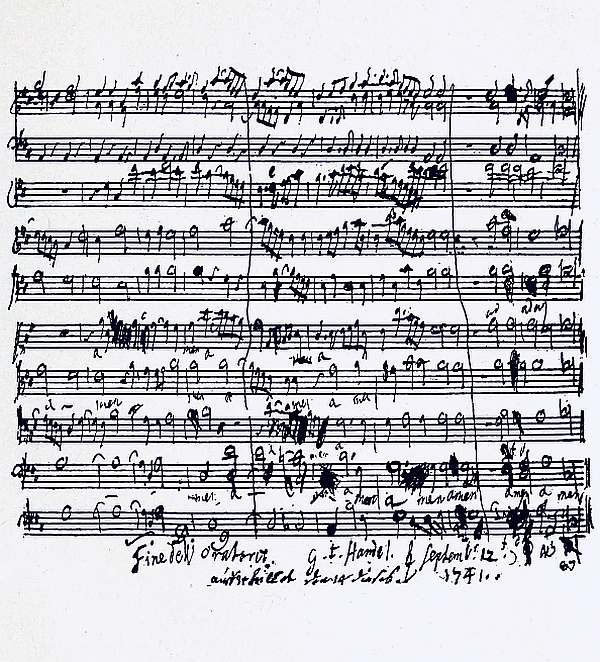
It opens, without an overture, with a few measures of tenor recitative (‘Now there arose a King in Egypt who knew not Joseph’), leading at once to the lament of the Israelites over the cruelties of the Egyptian bondage (‘And the children of Israel sighed’), a double chorus of great dramatic power leading up to the words, ‘And their cry came up unto God.’ After another short recitative for tenor, there follows the series of choruses descriptive of the plagues, in which the composer uses almost modern descriptive means. Thus, the first of the choruses describing the plague of the water turning to blood (‘They loathed to drink of the river’), is fugal and depicts the nauseating effects of the water upon the Egyptians; the hopping of the frogs is naïvely imitated in the accompaniment of the following aria for mezzo-soprano (‘Their land brought forth frogs’); and the plague of insects, a double chorus with a buzzing, restless orchestral accompaniment, is remarkably descriptive of insect motion. Before the dramatic double chorus, ‘He gave them hailstones for rain,’ the orchestra introduces the approaching storm, which, beginning gradually, develops into tremendous force as if the elements had been let loose. After the storm, comes the gloom of the darkness that fell over the land and vague, uncertain tones grope about as the chorus sings, ‘He sent a thick darkness over all the land.’ Then, in the savage fury of righteous retribution, a chorus of unexampled energy (‘He smote all the first-born of Egypt’) describes the swift vengeance of the Most High. The English critic Chorley calls it ‘a fiercely Jewish’ chorus, with ‘a touch of Judith, of Jael, of Deborah in it—no quarter, no delay, no mercy for the enemies of the Most High.’ The passage of the Red Sea follows these stormy descriptive choruses, and another dramatic but jubilant chorus (‘But the waters overwhelmed their enemies’) is succeeded by two short choruses of a devotional character which bring the first part to a close.
The second part, ‘The Song of Moses,’ after a short orchestral introduction, is ushered in by a chorus (‘Moses and the children of Israel sang this song’), after which comes the sublime fugal chorus, a mighty song of praise to the Lord (‘For He hath triumphed gloriously’). In this part is also the famous declamatory duet for two basses, ‘The Lord is a Man of War,’ and the great tenor aria, ‘The enemy said "I will pursue."’ After the exultant song of Miriam, the prophetess, there comes a magnificent triumphal double chorus, splendidly supported by the orchestra—a piling up of voice upon voice, instrument upon instrument, in a pæan of exultation and triumph, which brings the work to a climactic close of tremendous dramatic effectiveness.
‘Judas Maccabæus.’—This oratorio was written at the request of the Prince of Wales for the celebration of the victory of Culloden (April 16th, 1746) and the work, written in thirty-two days (July 9th to August 11th, 1746), was performed on April first, 1747, the festal day celebrating the return of the victorious Duke of Cumberland. The text was prepared by the Reverend Thomas Morell, D.D., who selected the material concerning the events surrounding the Hebrew warrior from the First Book of Maccabees and from Josephus. The first performance at Covent Garden was so successful that the work was repeated six times that year. Handel himself conducted it thirty-eight times, and it gained steadily in popularity, which was further augmented by the enthusiasm of the Jews, who delighted in it because it extolled a proud event in their national history.
The first part (the time is the second century B. C.) opens with the lament of the Israelitish men and women over the death of their leader Mattathias (father of Judas Maccabæus and his brother Simon), who had inspired the Jews to withstand the tyranny of Antiochus Epiphanes, king of Syria, in his effort to deprive them of their freedom and their religious worship. The first chorus, ‘Mourn, ye afflicted children,’ and, after a duet, the chorus ‘For Zion lamentation make,’ establish at once the sombre mood of the whole work. Simon’s militant, ringing aria, ‘Arm, arm, ye brave,’ which is still an effective solo greatly beloved of bass singers, is followed by a short but rousing chorus, ‘We come in bright array.’ The first part closes with one of the most massive and imposing choruses from Handel’s pen, ‘Hear us, O Lord.’
The second part opens with an instrumental prelude descriptive of the battle scenes and the celebration of the initial victories, and leads into the finest chorus in the work, a powerful song of triumph, ‘Fallen is the foe.’ The war of liberation is renewed, Judas rouses the courage of his depressed people and his army departs to meet the enemy, while those who remain behind voice their denunciation of the idolatries of the heathen. The second part closes dramatically with the chorus, ‘We never will bow down to the rude stock or sculptured stone,’ which develops into a vigorous chorale in which is heard the repeated phrase, ‘We worship God alone.’
The third part begins with a prayer, ‘Father of heaven, from Thy eternal throne,’ which is sung by the priest in the recovered and restored temple of Jerusalem. A messenger announces the victory of Judas and, as the youths and maidens go out to meet the returning victor, they sing the world-famous jubilant chorus, ‘See the conquering hero comes,’ which, by the way, was originally composed for ‘Joshua’ as a tribute to Othniel on his return from the capture of Debir, and was later transferred to ‘Judas Maccabæus.’ The oratorio appropriately closes with a Hallelujah chorus which at once celebrates the return of peace and serves as the joyous expression of national thanksgiving.
‘Samson.’—Although this work was written almost at the same time as the ‘Messiah’ (1741), it was not performed until February 18th, 1743, when it was given in London at Covent Garden. Its success was instant. Eight consecutive performances were given—a far more eloquent tribute in Handel’s time than in our own to the popular appreciation with which it was received. Handel himself regarded the work with deep affection, and, when urged to express a preference for either the ‘Messiah’ or ‘Samson,’ declared he was unable to choose between them. During his lifetime ‘Samson’ shared almost equal popularity with the ‘Messiah’ and ‘Judas Maccabæus’—the three most frequently performed. The text, arranged by Newburg Hamilton from Milton’s poem, ‘Samson Agonistes,’ although based upon the Bible narrative of the powerful Samson, does not follow it absolutely. The principal characters are Samson; Micah, his friend; Manoah, his father; Delilah, his wife; and Harapha, a giant of Gath. The scene is laid before the prison of Gaza.
A brilliant overture, stately at first and gradually developing into minuet rhythm, opens the work, which at once reveals the blind captive, Samson, temporarily released from his menial toil because of the feast of Dagon, and lamenting his deplorable plight as he hears the fiery chorus of the priests, ‘Awake the trumpet’s lofty sound.’ His father and his friend come to lament with him just after his touching tenor song (‘Torments, alas!’), and as they ask which of his sorrows is greater, blindness or captivity, Samson sings one of the noblest laments ever written, ‘Total eclipse: no sun, no moon, all dark amidst the blaze of noon,’ a song which touched Handel so deeply in his latter days of blindness that he wept at the performance, as did the audience with him. Samson nobly tells his friends that his punishment is deserved and that there is no hope for him; but at times he furiously denounces his foes, especially in the dramatic outburst, ‘Why does the God of Israel sleep?’ which is followed by an elaborate choral fugue (‘Then shall they know’) on two subjects, one given by the altos, the other by the tenors. The first part closes with a beautiful chorus in which his friends point his thought to the joys of a future life for compensation for all his earthly sorrows.
The second part discloses Delilah trying again to entice her husband, but he now understands her treachery and answers her sensuous song with the emphatic ‘Your charms to ruin led the way.’ He then has a visitation from the giant Harapha who taunts him on his present condition. The colloquy between the giants produces two of the finest arias of the oratorio—Harapha’s dashing and boastful bass aria, ‘Honor and arms scorn such a foe,’ and Samson’s proud answer, ‘My strength is from the living God.’ Micah finally bids Harapha to call on Dagon to ‘dissolve the magic spells that gave our hero strength,’ after which is heard the broad, devout six-part chorus of the Israelites, ‘Hear, Jacob’s God.’ The part closes with a massive double chorus—in which Israelites and Philistines, in choral strife, extol their respective deities.
In the third part, Harapha notifies Samson that he must appear at the feast of Dagon to exhibit his strength and, though he refuses at first, he finally yields because he believes it to be God’s will. Samson calls upon the Spirit which led him formerly and goes to the temple. He takes in each hand one of the pillars which support the roof and with a mighty effort pulls down the temple, crushing the Philistines and burying himself with them. A tender, expressive funeral march is played as Samson is borne away by his people. For this march Handel afterwards substituted the Dead March from ‘Saul’ and both marches now appear in the score. Manoah exhorts the people to lay aside their sorrow and praise God, and this brings the famous trumpet aria, ‘Let the bright Seraphim,’ which is so grateful for both voice and instrument. The brilliant chorus, ‘Let their celestial concerts,’ brings this imposing oratorio to a triumphant close.
VIII
Most of the great composers have frankly built on the achievements of their predecessors, carrying to completion or at least to higher stages of development the forms handed down to them, without much conscious influence from contemporary composers. Some, like Wagner and Schubert, have struck out new lines whose discovery and development cannot be explained wholly as resulting from the operation of preceding artistic forces and principles. Comparatively few of the really great composers have acknowledged their indebtedness to contemporary genius. Such a one, however, was ‘Papa’ Haydn. The youthful Mozart had opened up new visions in symphonic and orchestral music and compelled the veteran Haydn[79] to new effort. And when Haydn heard the ‘Messiah’ for the first time in Westminster Abbey during his first visit to England in 1791, he was so moved by the majesty of the ‘Hallelujah’ chorus that it inspired him to the composition of what is undoubtedly his greatest work, the ‘Creation.’ This work joins with its great artistic inspirer, Handel’s ‘Messiah,’ and with Mendelssohn’s ‘Elijah’ in forming a trio of the world’s most popular oratorios. Of his other two oratorios—the ‘Seasons’ and ‘The Return of Tobias’—only the former claims present-day performance and that far less frequently than its predecessor, the ‘Creation.’ One misses in Haydn’s choral works the massive grandeur of effect and complexity of structure of the Handel oratorios. Haydn was a deeply religious man, but it was not in accord with his happy, sunny, optimistic nature to sound the depths of human emotion. The great charm of the ‘Creation’ lies in the freshness, the artless simplicity, and the evident spontaneity of its melody, and the naturalness and direct expressive power of its choruses.
The ‘Creation’ was begun in 1795, to a libretto given the composer by the London manager, Salomon, and compiled by Lidley from Milton’s ‘Paradise Lost’ and from Genesis. It was completed in 1798, when Haydn was sixty-six years old, and the first performance took place at the Schwarzenberg Palace on the 29th and 30th of April, 1798, with the text translated and much altered by Baron von Swieten. It was first publicly produced at the National Theatre, Vienna, March 19, 1799, and was received with greatest enthusiasm. It soon made its way to the music-centres of Europe, having its first London performance on March 28th, 1800, and its first Paris performance on Dec. 24th, of the same year. Napoleon I was on his way to attend the latter performance when he narrowly escaped death by an infernal machine in the Rue Nicaise. Structurally one is impressed with the large number of arias and the correspondingly small number of choruses, as compared with Handel’s later oratorios. In this respect Haydn was undoubtedly influenced by the form of the Italian concert oratorio, then very popular in Vienna.
It is constructed in the usual three parts, the first two of which are the strongest. The overture is a quaint bit of tone painting; at first monotonous and barren of melody, it attempts to depict chaos; but gradually form begins to appear in the music and the various instruments speak out more clearly, until harmony is established. The first voice is that of Raphael (bass) in a short recitative, ‘In the beginning,’ followed by a chorus which gently whispers the words, ‘And the Spirit of God moved upon the face of the waters,’ closing with a joyous outburst on the words, ‘And there was light.’ The separation of light from darkness follows, Satan and his legions ‘sink into the deep abyss’ and the quiet chorus appears, ‘A new created world springs up.’ The first four days of creation are described in a series of recitatives, arias and choruses, many of which are familiar the world over—the inspiring chorus with soprano obbligato, ‘The marvellous work’; the fine bass aria, ‘Rolling in foaming billows,’ with its lovely limpid refrain, ‘Softly purling’; and the well-known ‘With verdure clad,’ a soprano aria on which Haydn lavished the utmost care, having altered it three times before it entirely satisfied him—all leading up to the magnificent final chorus of the first part, ‘The heavens are telling,’ in which a trio of voices (Gabriel, Uriel and Raphael) is finely contrasted with the majestic choral passages.
The second part describes the creation of animate life on the earth. Beginning with birds, it enumerates the various classes, rising in the scale until the crowning glory of creation is reached in man. The opening aria, ‘On mighty pens’ (Gabriel), pictures the eagle, the lark, the dove and the nightingale, each bird being depicted in a characteristic musical phrase in the accompaniment. One of the most interesting numbers is the description of the roaring lions, with deep growls of the double bassoons, the ‘flexible tiger’ with rapid string passages, the alertness of the stag with a presto movement, the neighing and prancing of the horse, the fluttering and buzzing of swarming insects in the air—in all of which the humor of Haydn is naïvely expressed in comical musical mimicry. The creation of man brings the beautiful tenor aria, ‘In native worth’ (Uriel). The final chorus is the superb fugue, ‘Achieved is the glorious work,’ in the midst of which is set a trio, ‘On Thee each living soul awaits,’ and, after a return to the fugue, closing with a Gloria and Hallelujah of singularly beautiful and majestic outlines. The third part opens with an orchestral introduction picturing the first morning of the completed creation, in which the flutes and horns contribute some beautiful effects. A tender dialogue between Adam and Eve is followed by a charming duet, ‘Graceful consort.’ The closing chorus, ‘Sing the Lord, ye voices all,’ opens in a strain of solemn majesty and gradually unfolds until it leads into a massive fugue, ‘Jehovah’s praise forever shall endure.’ It closes with a mighty pæan of praise, given by the combined chorus, solo voices and orchestra with telling effect.
‘The Seasons.’—Haydn’s last oratorio, ‘The Seasons,’ the words for which were based on Thomson’s poem of the same name and arranged by Baron von Swieten, was written between April, 1798, and April, 1801, and first presented at the Schwarzenberg Palace, Vienna, on April 24th, 1801. Three performances were given in close succession. This work can scarcely be called a real oratorio; it partakes more of the character and form of the sacred cantata, but is more frequently given the first named classification. The ‘Seasons’ represents a distinct decline in the composer’s powers, but it is not to be wondered at, for he was sixty-nine years old when it was completed, and during its composition was greatly harassed and irritated by the nonsensical demands and caprices of the librettist. The characters are Simon, a farmer; Jane, his daughter; and Lucas, a young countryman. These personages do not have any dramatic significance, though the work contains a love scene between Lucas and Jane. That the scene is laid in the country is easily imagined from the subject, and the chorus represents the country-folk.
The first scene depicts early spring and opens with a lively overture and with recitatives from the three principals, expressing joy at the approach of the balmy season, at once followed by the first chorus, ‘Come, gentle spring.’ After the farmer’s aria comes a trio and a fugal chorus, ‘Be propitious, bounteous heaven.’ The chorus, ‘Spring, her lovely charms unfolding,’ is almost redolent with the odor of waxen buds and early blossoms. Following this is the closing fugal chorus, ‘God of light.’
‘Summer’ is introduced with a short prelude leading to a beautiful aria by Simon, ‘From out the fold the shepherd drives,’ and at the appearance of the early sunrise the trio and chorus chant a song of welcome, ‘Hail, O glorious sun!’ The various numbers picture the progress of the day, and after the overwhelming heat of noon, an ominous silence tells of the coming storm. The drums give forth a peal of thunder, followed by a storm-chorus, ‘Hark the deep, tremendous voice.’ The driving rain, the thunder and the lightning-flashes are vividly pictured in the music. With the trio and chorus, ‘Now cease the conflicts,’ the music becomes tranquil again as the night approaches, with the droning of insects, the croaking of the frogs, the song of the quail and the peals from a distant bell-tower—and darkness and slumber drop over the land.
The third part, ‘Autumn,’ depicting the ‘kind rewards’ of Nature, contains the song of Simon, ‘Behold, along the dewy grass,’ which is followed by the famous hunting chorus, ‘Hark! the mountains resound,’ a vivid tonal picture of the chase. A recitative, praising the rich vintage, leads to a scene of revelry, closing with the lively rustic chorus, ‘Joyful the liquor flows,’ in which a rollicking drinking-song, a well-known Austrian dance-melody with suggestions of bagpipe and fiddle, is happily introduced.
‘Winter’ is prefaced by a slow prelude indicative of the fogs creeping in. After the recitative of Simon and Jane’s cavatina, both picturing the approach of the icy season, there is a realistic musical picture of the wayfarer lost in the snow-storm. Simon moralizes on the changing seasons and offers as his conclusion that ‘nought but truth remains.’ A prayer to Heaven for divine guidance brings the pastoral scene to a close.
The eighteenth century came to an end with Handel as the great outstanding figure in oratorio and Haydn just appearing on the scene. England led Europe in its devotion to this form of choral art, though Germany was soon to awaken to its importance. Bach’s magnificent choral works were slumbering on dusty shelves and Italian oratorio was still fatuously allied with operatic ideals, while France gave little heed to the form at all. But another half-century was to witness a more even distribution of interest in large choral forms.
FOOTNOTES: