Volume 6 — CHAPTER V THE CANTATA IN THE NINETEENTH CENTURY
Reading edition
Conflict of tradition and progress—Ludwig van Beethoven: ‘Ruins of Athens,’ ‘Glorious Moment’; Andreas Romberg—C. M. von Weber; Franz Schubert; Ludwig Spohr—Mendelssohn: ‘First Walpurgis Night,’ etc.; 95th Psalm; Lauda Sion, etc.—Hector Berlioz: ‘Damnation of Faust’—Robert Schumann: ‘Paradise and the Peri’; ‘Pilgrimage of the Rose’; Miscellany—Ferdinand Hiller; Niels W. Gade: ‘Crusaders,’ ‘Erl-King’s Daughter,’ ‘Christmas Eve,’ ‘Comala,’ etc.—Félicien David: ‘The Desert’; Minor cantata writers in Germany and England: Benedict, Costa, Macfarren, Smart, Bennett—Anglican ritual-music and the German evangelical motet in the nineteenth century; the part-song.
The student of history will observe that one of the most noticeable effects of the constantly accelerated pace that musical progress assumed after the art had once learned definite articulation, is that the successive periods in which characteristic styles and forms have been developed and perfected have been growing steadily shorter and shorter in duration. The Netherland period of vocal polyphony spanned two full centuries; the next century and a half was concerned with the first stage in the development of dramatic music and oratorio, and with the application of polyphonic principles to instrumental forms; the period of seventy-five years between 1750 and 1825 was memorable chiefly by the appearance and swift development of the sonata and symphony from Haydn to Beethoven, with occasional premonitions of impending revolutionary changes; the half-century from 1825 to 1875 witnessed the rise and full flowering of the remarkable movement of nineteenth-century romanticism; in the years since 1875 new ideas and tendencies, unfolded from the preceding period, have crowded upon the musical arena in such profusion and with such swiftness and persistence that intelligent orientation is beset with perplexing difficulties. The ‘youngest of the arts,’ so backward and slow of speech in its infancy, certainly displays unmistakable symptoms of precocity with advancing years.
From the above statement of the approximate duration of the general periods of musical progress it will be noted that the nineteenth century is divisible into three periods, the first of which merely carried to completion the classical methods of the preceding century. But, while instrumental music responded promptly and vigorously and with far-reaching results to the novel ideals of romanticism, choral music was far more conservative. It exhibited the utmost reserve toward the new influences, and for several decades after these had brought enrichment and expansion to instrumental forms, it admitted them only with a certain timidity, so that on the whole the effective invasion of choral music by romanticism was delayed a full half-century after it had taken possession of instrumental fields. This retardation of choral progress is due largely to the natural limitations of the human voice, which is confronted with obvious difficulties when attempting to adopt for its own peculiar purposes the instrumental standpoint of unrestrained liberty in the use of melodic intervals and harmonic progressions. Choral forms have generally proved to be far less elastic than instrumental forms, and have had to contend with the tendency toward inertia inherited from their early association with ecclesiastical traditions—traditions from which the development of instrumental music has been notably free. Hence, a much longer period was required in choral music than in instrumental music for readjustment to the new viewpoint which nineteenth-century romanticism injected into the whole fabric of art-methods, and the choral literature of the century falls into only two periods. The great majority of the choral works—particularly the smaller choral works—of the first two thirds of the century at least are characterized by general conformity with the classical methods of Handel, Haydn, and Mozart; where romantic influences are admitted they express themselves in terms of greater harmonic warmth and richness, freer melodic outlines, and a more marked avoidance of the older special contrapuntal devices in favor of more direct mood-painting and detailed characterization of the text, but the classical forms and methods are quite uniformly retained.
I
Beethoven’s (1770-1827) contribution to the literature of choral music was relatively small and the most significant part of it was made in the larger forms, as might be expected of a composer possessed of such mighty intellectual endowments. Of the smaller works, two only are selected for detailed comment. The others include ‘Calm Sea and Prosperous Voyage’ (to Goethe’s poem) for mixed chorus and orchestra, written in 1815, and ‘King Stephen, Hungary’s First Benefactor,’ a prologue in one act with overture and choruses, the music for which was composed in 1811 to the text by Kotzebue for the same occasion as ‘The Ruins of Athens.’
‘The Ruins of Athens.’—The music to an allegorical poem with this title by Kotzebue was written in 1811 for the opening of a new theatre at Pesth, Hungary, which took place February 9, 1812. The story of the poem is as follows: Minerva, having incurred the wrath of Jove, has been fettered by him with chains ever since the Golden Age within a rock through which neither the inquiry of man nor the wisdom of the goddess could penetrate. Finally Jove relents and releases the goddess. Minerva then hastens to her beloved Athens, only to find it in ruins and her art debased. She turns sadly away and proceeds to Pesth, where she establishes her temple in the new theatre and presides over a triumphal procession in honor of the emperor, its patron, who is to restore again the Golden Age. The work was presented a second time in Beethoven’s lifetime at the opening of a new theatre in Vienna in 1822. This time it was with a new text by Carl Meisl entitled Die Weihe des Hauses (‘Dedication of the House’), and it was for this occasion that Beethoven composed the overture, which is still frequently performed. The music consists of eight numbers. The overture is very light and deemed even by his friends to be unworthy of the master. The weird, fervid chorus of the Dervishes for male voices in unison and the stirring Turkish March are strongly Oriental in color and treatment. They are strong and effective numbers, as is also the triumphal march and chorus ‘Twine ye a garland.’
‘The Glorious Moment.’—September, 1814, brought to Vienna many potentates and distinguished statesmen for the Vienna Congress, which met to adjust the claims of the European states after the allies had entered Paris. The occasion was a momentous one and was celebrated with great pomp by the Viennese authorities. Beethoven was requested to write for the greeting of the royal guests a cantata, the words of which had been written by Dr. Aloys Weissenbach of Salzburg. It was called Der glorreiche Augenblick or Der heilige Augenblick (‘The Glorious Moment’). The time for writing this work was short in itself and this was much curtailed by disputes between composer and poet, as Beethoven made every effort to have the atrocious text altered so as to lend itself better to a musical setting. The work was begun in September and performed at a concert given for Beethoven’s benefit on November 29th, before a remarkable audience of 6,000 persons. This concert, at which was performed also the recently-composed Seventh Symphony, was a most brilliant affair, and the audience was wildly enthusiastic, especially for ‘The Glorious Moment,’ which was hailed as symbolical of the moment when Europe was to be freed from Napoleonic domination. Incidentally, it may be recorded that the composer reaped much substantial advantage from this great occasion, in that, as a result, he was able to invest 20,000 marks in shares of the Bank of Austria. The cantata, which for obvious reasons is not one of his strongest, is in six numbers. In 1836 it appeared with a new title, Preis der Tonkunst (‘The Praise of Music’), with a new poetical text by Friedrich Rochlitz.
Among the composers of the first quarter of the nineteenth century Andreas Romberg (1767-1821) occupies a worthy place, though not one of large importance. He is the composer of five operas, ten symphonies, twenty violin concertos, etc., now forgotten, much church music, and several cantatas. The ‘Lay of the Bell’ (Das Lied von der Glocke) was the most widely known of all his works, and at present is nearly the only one of them to retain any public notice.
‘The Lay of the Bell.’—Schiller’s famous poem with this title forms the text to which Romberg composed the music of this cantata in 1808. During the last half of the nineteenth century it enjoyed great popularity with the smaller choruses in England, Germany, and America, and is still frequently heard. The work rehearses the various steps in the making of the bell, from lighting the furnace-fire and mixing the metals to the casting of the bell and the breaking of the mold by the master. Each step is used as the basis for the description of scenes which the bell will witness in its life among the people—scenes of youth, young manhood, and old age, of joy and love and sorrow—all the intimate experiences that make up human life. The music is written for mixed chorus, with soprano, tenor, and bass solos, and, while it lacks the harmonic warmth and variety of the cantatas written later under the glow of the romantic spirit, it is full of interest and animation, though light in style throughout.
II
As the founder of the German romantic movement, Weber (1786-1826) was an intense nationalist, and his stirring music, folk-song in character and wholly German in feeling, had a profound political influence in fanning the flame of national and patriotic sentiment that sprang into existence during the period of Napoleonic oppression. His inspiring settings of the patriotic poems in Körner’s Leyer und Schwert, for male voices, made him the idol of the students and young nationalists, and Der Freischütz, the first German opera, created a perfect furor of patriotic feeling. His first cantata was Der erste Ton, written in 1808 for declamation, chorus, and orchestra. Other choral works were the cantata Natur und Liebe (‘Nature and Love’) for two sopranos, two tenors, and two basses with pianoforte accompaniment, composed in 1818, and the hymn In seiner Ordung schafft der Herr (‘In constant order works the Lord’) for solos, chorus, and orchestra, written in 1812.
‘Jubilee Cantata.’—Weber was commissioned by Count Vitzthum in 1818 to write a grand jubilee cantata for a court concert commemorating the fiftieth anniversary of the reign of Friedrich August, king of Saxony, on the 20th of September. The text was written by the poet Friedrich Kind. Before it was completed, however, he was informed that the work would not be required and that other plans had been made. It has been intimated that this change came about through the intrigues of his Italian rivals (he was then Court Musical Director at Dresden). The cantata, however, was given in the Neustadt church for the benefit of the needy peasants in the Hartz Mountains, with Weber himself as conductor. While it is said that a Jubel overture by Weber was performed at the court concert, it is believed by the best authorities that the famous Jubel overture, now known the world over, was entirely independent of the cantata and of later composition. As the original text dealt with events in the life of the king, the work was unsuited for general performance, hence a second text was later supplied by Amadeus Wendt and the title changed to Ernte-Cantate (‘Harvest Cantata’). This is the version in common use at the present time. Still another text was made by Hampdon Napier, and this was given in London under the title of ‘The Festival of Peace’ shortly before Weber’s death, the composer himself conducting. The cantata is written for four solo voices, chorus, and orchestra. Joy at the fullness of the harvest alternates with solemn thanksgiving and praise to the Giver of all good for His bounty. A devotional spirit prevails throughout, except in the ‘storm’ chorus, where a dramatic style appears. The beautiful number for quartet and chorus, ‘Wreathe into garlands the gold of the harvest,’ is frequently detached from the cantata and performed separately.
Kampf und Sieg (‘Battle and Victory’).—While Weber was in Munich in June, 1815, the victory of the allies at Waterloo was announced. The city was at once filled with rejoicing and a large crowd gathered at St. Michael’s Church to hear a Te Deum. Weber, who was present, conceived the idea of a grand cantata to commemorate the victory and he laid the matter before the poet Wohlbrück, whom he had met the same day. Wohlbrück at once shared the composer’s enthusiasm and by the first of August the text was ready. The cantata was brought to a first performance in Prague on December 22d and made a deep impression, not so much by its musical worth as by its appeal to patriotic ardor and by the stirring military character of its vivid battle-descriptions. Weber resorted to the same elements of rather vulgar realism which Beethoven invoked in his ‘Wellington’s Victory’—the noises and crash of battle and national melodies to designate the fighting hosts. Amid the roar of cannon, the cries of the wounded, and the shouts of the soldiers can be heard the revolutionary melody Ça ira from the advancing French, ‘God save the King’ from the English, while the stirring strains of the Austrian and Prussian grenadier marches and the refrain from Weber’s own patriotic song, Lützow’s wilde Jagd, swell the volume of tumultuous sound from the victorious allies. The cantata is written for four solo voices, chorus, and orchestra. Faith (bass), Love (soprano), and Hope (tenor) appear in the lyrical portions of the work; the middle section is given over entirely to the battle scene and the whole closes with a stately chorus, Herr Gott, Dich loben wir.
While Franz Schubert (1797-1828) essayed nearly every musical form, it is as the creator and perfecter of the German art-song that he takes his place among the great and mighty ones of music. His supreme gift as a melodist and song-writer is at once apparent in all of his works. In choral fields he wrote considerable church music and several smaller works, of which the only one of large importance is Miriam’s Siegesgesang (‘The Song of Miriam’). Among the others are the Ninety-second Psalm for baritone solo and mixed chorus (written in 1828 for the synagogue at Vienna); the Twenty-third Psalm for four voices (quartet, or male or female chorus) with pianoforte accompaniment, easy, grateful and song-like in character; two hymns, Herr unser Gott and An dem Heiligen Geist, the latter for eight-part male chorus and orchestra; and Glaube, Hoffnung und Liebe (‘Faith, Hope, and Charity’) for mixed chorus and wood-wind instruments, written in 1816.
Miriam’s Siegesgesang.—This noble cantata, known in English as ‘The Song of Miriam’ or ‘Miriam’s War Song,’ was composed by Schubert in March, 1828, the last year of his short life. It was written for soprano solo and chorus to Grillparzer’s lines paraphrasing the part of the sixteenth chapter of Exodus that sets forth Miriam’s thanksgiving for the escape of the Israelites and the people’s song of triumph as they rejoice over their own deliverance and the destruction of the pursuing Egyptians. Schubert left it with only a pianoforte accompaniment, though intending to score it for orchestra. What death prevented him from doing was supplied a year or two later by his friend Franz Lachner, who at the time was kapellmeister at the Kärnthnerthor Theatre in Vienna. The date of its first performance is in doubt. Nottebohm gives it as January 30, 1829, the occasion being a benefit concert to raise funds for a monument in memory of the composer. A spirited solo and chorus (‘Strike the cymbals’) opens the work. This is followed by a graceful song in which the Lord is described as a shepherd leading his people out of Egypt. In the next number the awe of the Israelites is depicted as they pass unharmed through the divided waters, while Pharaoh’s hosts are engulfed behind them. The sea becomes calm again and the first chorus is repeated, closing with a majestic fugue (‘Mighty is the Lord at all times’). Though the cantata is short, it is replete with passages of enduring charm.
Ludwig Spohr (1784-1859), the celebrated violinist and composer of instrumental music and operas in a style intermediate between the old classical and the new romantic schools, left much choral music which, however, has quite largely lost its early vogue. In the shorter forms are three psalms for solos and double chorus; the Twenty-fourth Psalm for solos and chorus with pianoforte; the One Hundred and Twenty-eighth Psalm for solos and chorus with organ or pianoforte; the Eighty-fourth Psalm (Milton) for solos, chorus, and orchestra; two hymns—‘St. Cecilia’ for soprano solo and chorus, and ‘God, thou art great’ (Gott, du bist gross) for solos, chorus, and orchestra; and a patriotic cantata, Das befreite Deutschland (‘Free Germany’).
III
Felix Mendelssohn-Bartholdy (1809-1847) was the first composer since Handel to rival him in the mastery of choral forms. Gifted and genial as he is in other fields, it is here that he has left the most enduring evidence of his genius. His fine contrapuntal training and his splendid mastery over all the technical resources of polyphonic writing made choral forms especially agreeable to his natural and developed gifts. In general form his choral works follow Handelian models, but his melodies are far more glowing and his harmonies far richer and of warmer texture. Most of his smaller choral works fall under the head of church music. These comprise several anthems and other ritual-music for the Anglican service, the fruit of his long and intimate relations with English musical life, some fine motets (especially the three for female voices written in 1830 for the convent of Trinità de’ Monti in Rome, namely, Veni Domine, Laudate Pueri, and Surrexit Pastor, and the great eight-part motet, ‘Judge me, O God’), several compositions for the Berlin Cathedral, hymns, and nine psalms. He is the first composer in the nineteenth century to give to the psalm the same breadth and seriousness of treatment accorded to the larger choral forms. They rise to the dignity of important works, though all are not equally beautiful. They are: Psalms 115 (‘Not unto us, O Lord’) and 95 (‘O come let us worship’) for solos, chorus, and orchestra; Psalm 114 (‘When Israel out of Egypt came’) for eight-part chorus and orchestra; Psalm 98 (‘Sing to the Lord’) for eight-part chorus and orchestra, written for the festival service in the Berlin Cathedral on New Year’s Day, 1844; Psalm 42 (‘As the hart pants’) for soprano solo, chorus, and organ; Psalms 2, 22, and 47 for eight-part a cappella chorus, written for the Berlin Cathedral; and Psalm 13 (‘Lord, how long wilt Thou forget me’) for alto solo and chorus. The 42d and 95th are the finest of the psalms; the others are seldom performed now. The hymn, ‘Hear my prayer,’ for soprano solo, chorus, and organ, closing with the familiar ‘O for the wings of a dove,’ is one of the most beautiful of Mendelssohn’s devotional inspirations, and has enjoyed, and still enjoys, great popularity with both choirs and choral societies.
‘The First Walpurgis Night.’—While Mendelssohn was travelling in Italy in 1831 he composed music to Goethe’s poem ‘The First Walpurgis Night,’ the dramatic intensity of which made a deep impression on the young composer; but it was not until February 2, 1843, that it was publicly performed at Leipzig, and then much altered from the original draft. St. Walpurgis, to whom May-day eve was dedicated, was an early missionary who had brought Christianity to the Druids of Saxony. The scene of the cantata is the summit of the Brocken and the time May-day eve, when the Druids, taking advantage of the old Northern myth that on this eve the witches hold high revels here, gather to celebrate their rites, while their sentinels, disguised as demons, scare away the Christians with wild gesticulations, clashes of arms, and hideous noises. The music belongs to Mendelssohn’s most important and significant work. The overture, graphically depicting the passage from winter to spring, is followed by a tenor solo and a chorus of Druids, breathing the atmosphere of spring. Next comes a dramatic alto solo, uttering a warning, and after it a stately exhortation by the Druid priest. There ensues a whispering chorus, portraying the sentinels as they quietly take their places. A guard then discloses the plan for frightening away intruders. This leads to a chorus in which the composer uses most grotesque musical effects, both vocal and instrumental, to picture the infernal scene. This weird chaos gives way to an impressive hymn for bass solo and chorus. Following this comes the terrified cry of the Christians, who are driven away, while the Druids and their priest chant a closing hymn of praise.
‘As the Hart Pants.’—Mendelssohn’s setting of the Forty-second Psalm was first presented at a Gewandhaus concert in Leipzig in 1838. It is smaller in form than the ‘Walpurgis Night,’ but is symmetrical and artistic. A sustained introduction leads to a chorus, tender and full of passionate longing, ‘As the hart pants after the water brooks, so panteth my soul for Thee, O God,’ in which the highest point among the choral portions of the work is reached. A beautiful adagio melody is given out by the oboe and repeated as a soprano solo, ‘For my soul thirsteth for God.’ The third number, ‘My tears have been my meat,’ given as a soprano recitative, leads to a march-like chorus for women’s voices, ‘For I had gone with the multitude.’ The male voices then sing in unison ‘Why, my soul, art thou cast down?’ and the female voices answer, ‘Trust thou in God.’ A pathetic soprano recitative follows, beginning ‘O my God! My soul is cast down within me.’ The eighth number is sung by a male quartet with string accompaniment, ‘The Lord will command His loving-kindness in the daytime,’ a beautiful response full of hope and consolation; while through it is heard the saddening strain of the soprano. The closing full chorus repeats the fourth number, ‘Trust thou in God,’ more elaborately developed, and ending in a pæan of praise to God. This Psalm-cantata is one of the finest as well as most frequently performed of Mendelssohn’s shorter choral works and breathes throughout a deeply religious feeling couched in terms of refined romantic sentiment.
‘Come Let Us Sing’ (95th Psalm).—The first performance of this psalm, which is written for tenor solo, chorus, and orchestra, took place at Leipzig on February 21, 1839. It opens with a solo, ‘O come, let us worship,’ the theme of which is immediately taken up and developed by the chorus in jubilant tone, but which sinks at the end to a quiet mood. A solo soprano voice then enunciates the words, ‘Come, let us sing to the Lord,’ and this theme is treated fugally by the chorus in a joyous allegro movement, closing with a strong two-part canon in the octave for the male and female voices. The third number is a graceful duet, ‘In His hands,’ for two sopranos, which is followed by a stately fugal chorus, ‘For His is the sea,’ at the end of which the opening section of the first chorus appears with antiphonal phrases for the tenor solo. The original setting closes with the fifth number, ‘Henceforth, when ye hear His voice,’ for solo and chorus, a movement of fine contrapuntal workmanship, closing with softest tones to the pleading words, ‘Turn not deaf ears and hard hearts.’ An additional number was left by Mendelssohn, written a few weeks after the first performance, with the evident purpose of bringing the psalm to a more complete finish. It consists of another choral setting of the words, ‘For His is the sea,’ in which the theme from the first number again plays an important part and an atmosphere of joy and majestic power is maintained throughout.
Lauda Sion (‘Praise Jehovah’), one of Mendelssohn’s most beautiful cantatas, for four solo voices, chorus, and orchestra, was written for the celebration of the Festival of Corpus Christi by the Church of St. Martin at Liège, where it was performed June 11, 1846, the composer himself being present. The Lauda Sion is a sequence (see page 15) written by Thomas Aquinas about 1264 and is regularly sung at High Mass on this Feast. There is a short introduction and the announcement of the theme Lauda Sion leads to a chorus Laudis thema, of devotional character. In the Sit laus plena, phrases sung by the soprano are repeated by the chorus. Then follows a beautiful quartet, In hac mensa. A solemn chorale in unison leads to a charming soprano arioso, Caro cibus. The seventh and last number is an intensely dramatic solo and chorus, set to the closing lines of the well-known hymn. This is Mendelssohn’s only excursion into the Catholic liturgy.
‘The Gutenberg Festival Cantata.’—Mendelssohn wrote this short festival cantata for the fourth centennial celebration of the invention of printing, observed at Leipzig, June 24, 1840, by the unveiling of Gutenberg’s statue in the public square. The text was written by Adolphus Prölsz, a teacher in the Gymnasium at Freiberg. A stately chorale leads to ‘Fatherland! within thy confines,’ a song[68] written in memory of Gutenberg. Next comes a spirited melody for tenors, ‘And God said, "Let there be Light,"’ followed by a closing chorale, ‘Now, thank God all.’
‘Antigone.’—The incidental music to Sophocles’ Antigone was composed in 1841 in the short space of eleven days, and was privately presented at Potsdam before William IV of Prussia and his court, October 28. Its first public performance was at Leipzig, March 5, 1842. It was written for male chorus and orchestra and consists of seven numbers. Although built along modern lines, Mendelssohn’s felicitous music faithfully represents the spirit of the ancient Greek tragedy.
‘Œdipus at Colonos.’—At the command of the king of Prussia, from whom Mendelssohn had received the commission of chapel-master in 1841, the music to this tragedy by Sophocles was composed in 1843 and its first presentation took place at Potsdam November 1, 1845. The music, sung by two male choruses antiphonally, embraces nine choral numbers, preceded by a short introduction. The third number, closing with an invocation to Neptune by the united choruses, is the gem of the work and has few equals in effective choral writing. It is frequently heard in detached form on the concert stage.
IV
The early romantic movement attracted to itself no more enthusiastic disciple and energetic exponent than Hector Berlioz (1803-1869). Indeed, he was one of the earliest and at the same time one of the most extreme of the romanticists. Eccentric, impatient of formalism of any kind, but gifted with an intensely vivid imagination and a prodigious sense of color, he possessed a creative force of great originality and spontaneity, whose effectiveness, however, was frequently marred by its extravagance of expression. Endowed with an insatiable desire to interline all music with some kind of a descriptive or narrative purpose, he gave a tremendous impetus to ‘program music.’ In attempting to find an effective medium for descriptive effort in striving after the fantastic, he mightily developed the resources of the orchestra and became the real founder of the modern science of orchestration; moreover, he used his orchestra as eloquently in his choral masterpiece, ‘The Damnation of Faust,’ as in his symphonic works. His choral-writing came under the same romantic spell of liberation from formalism as did his instrumental inspirations. His ‘Faust’ is not only the first choral work, but almost the only one until near the end of the nineteenth century, in which the romantic ideal wholly dominates both choral and instrumental forces. If some of the choral numbers suffer in comparison with present-day choral treatment, this is not because of any difference of viewpoint, but because of the inadequacy, which one sometimes feels, of the purely musical vocabulary at his command to express fully what he felt. He frequently used the chorus, as did Beethoven in the ‘Ninth Symphony,’ as an adjunct to his symphonic works, but in distinctly choral forms, he left, in addition to the ‘Faust’ and the works mentioned in Chapter VIII, the cantata La mort de Sardanapale, which was completed amid the uproar of the July Revolution, 1830, and with which he won the Grand Prix de Rome the same year; the cantata Le cinq mai for bass solo, chorus, and orchestra, written in 1834 for the anniversary of Napoleon’s death; the cantata L’Impériale, written in 1855 for the Paris Exhibition; Sara la Baigneuse, a choral ballad; three youthful cantatas, La révolution grecque (1826), Herminie (1828), and La mort de Cléopatre (1829); and a few occasional choruses and choral ballads.
‘The Damnation of Faust.’—This ‘dramatic legend,’ as the composer calls it, is the aftermath of an early and immature work, ‘Eight Scenes from Faust’ (published in 1829 as opus 1), and was composed in 1845 and ‘46, part of it here and there while on a concert tour in Austria and Hungary, the rest in Paris. Its first performance took place at the Opéra-Comique, Paris, December 6, 1846, under the direction of the composer, before a wretchedly small audience and without success. In Germany it was produced at the Royal Opera House, Berlin, June 19, 1847, Berlioz conducting. Though parts of it were frequently given in England, the first complete performance did not take place until February 5, 1880, at the Free Trade Hall in Manchester, when Charles Hallé conducted it. In New York a few days later, on February 12th, it had its first American hearing under the direction of Dr. Leopold Damrosch with the combined Oratorio and Arion Societies. ‘The Damnation of Faust’ is undoubtedly Berlioz’s masterpiece and sums up the best qualities of his exuberant and fantastic style. Both instrumental and choral parts are overlaid with a wealth of romantic and poetic coloring, the orchestration is dazzling, and the chorus is brilliantly handled. Many of its most beautiful and effective numbers were retained almost without alteration from his earlier ‘Eight Scenes from Faust’—the work of a youth of twenty-five years. These include the scene where Faust is lulled to sleep by the sylphs, the peasants’ song, the songs of the rat and the flea, the King of Thule ballad, and Mephistopheles’ serenade.
The work, which has the dimensions of an oratorio, is divided into four parts, the first of which contains three scenes, the second five, the third six, and the fourth six, concluding with a short epilogue and the apotheosis of Marguerite. The persons represented are Marguerite (mezzo-soprano), Faust (tenor), Mephistopheles (bass), and Brander (bass). The story does not closely follow Goethe’s version, as the opening scene discloses Faust alone at sunrise on a plain in Hungary, where Berlioz places him in order to have the opportunity of introducing the Hungarian national march. He sings in tender strain of the joys of spring and the delights of nature, but his reverie is disturbed by a rollicking chorus and dance of peasants. From another part of the plain come warlike sounds of an advancing army to the stirring and brilliant music of the Rákóczy March. The troops pass and Faust retires, unmoved by the scene. The second part opens with Faust in North Germany, alone in his study. He voices his discontent with the world; as he is on the point of drowning his sorrow with poison, the tones of the Easter Hymn (‘Christ is risen from the dead’) strike his ear. He listens in wonderment to the joyful strains and at the end joins in the stately chorus. Repentant and exalted, he resolves to begin anew, when Mephistopheles suddenly appears and mockingly exclaims, ‘Sweet sentiments indeed and fit for any saint!’ Faust is entrapped by his promises and they disappear. The next scene finds them in Auerbach’s cellar in Leipzig amid a band of carousing students who sing a lusty drinking song (‘Oh, it is rare when winter’s storms are loudly roaring’). There follows the drunken Brander’s song of the rat, at the end of which the irreverent students improvise an ironical fugue on the word ‘Amen’ to a motive from the theme of Brander’s song. Mephistopheles adds to the reckless merriment with the song of the flea (‘Once on a time a king, sirs, loved a flea passing well’). Amid the heavy bravos of the drunken students, Faust and Mephistopheles vanish, to appear again in the next scene, the seventh, on the wooded meadows on the banks of the Elbe. Mephistopheles sings a delightful melody (‘Within these bowers’) and summons the spirits of earth and of air to lull his companion to sleep. Faust slumbers while the gnomes and sylphs sing a chorus of ravishing beauty (‘Dream, happy Faust’), closing with an exquisitely delicate orchestral number in waltz-measure, the dance of the sylphs. As they disappear, Faust wakes and relates his vision of Marguerite. Mephistopheles agrees to lead him to her chamber and on the way thither they join a band of jovial soldiers and students marching along the street. The last scene of this part consists of a lively soldiers’ chorus (‘Tower and wall may bar our way’) and a characteristic Latin student-song (Jam nox stellata), the two being cleverly combined at the end.
The action of the third part takes place in Marguerite’s chamber. Faust enters and sings passionately of his love for her (‘Oh, come, calm breathing twilight’). Mephistopheles warns him of her approach and hides him behind a curtain. She enters and in detached phrases tells of her vision of Faust and her love for him. While preparing for slumber, she sings the pathetic ballad, ‘Once in far Thule.’ As its sad strains die away, Mephistopheles summons the evil spirits and the will-o’-the-wisps to encircle her dwelling and lure her to her doom. Then follows the lovely dance of the will-o’-the-wisps, an orchestral minuet which Berlioz has enriched with many a masterly touch of tonal realism. Mephistopheles sings his sardonic serenade (‘Why, fair maid, wilt thou linger’), with frequent choral accompaniment by the will-o’-the-wisps, each stanza closing with a derisive ‘Ha!’ A trio (‘O purest maid’) of great dramatic power and passion brings this part to a close. Faust and Marguerite avow their mutual love, Mephistopheles warns them of approaching danger, while a chorus of neighbors in the street taunts the hapless maiden. As the fourth part opens, Marguerite, alone in her chamber, sings a sad, sweet romance, ‘Alone and heavy-hearted’ (Goethe’s familiar Meine Ruh’ ist hin), at the end of which distant strains of the songs of the soldiers and students are heard. The next scene is Faust’s solemn and powerful invocation to Nature (‘Mysterious Nature! vast and relentless power!’). Mephistopheles appears on the rocky scene, relates Marguerite’s crime and imprisonment, and, playing upon Faust’s desire to rescue her, makes him sign the contract that binds his soul to the Evil One. The ‘Ride to the Abyss’ now begins and Berlioz’s furious music, which only for one short moment relaxes its impetuous galloping rhythm, pictures with relentless realism the terrible scenes as the riders pass horror-stricken peasants praying at the roadside, as they draw into their train monstrous birds, hideous beasts, and leering skeleton-phantoms. With a shout of triumph from Mephistopheles and a cry of horror from Faust, they fall into the abyss, where they are greeted by a chorus of devils (male voices), who sing in a language invented for them by the imaginative Berlioz (Has! Irimiru Karabrao, etc.). The glee and triumph of this fiendish host are uttered in snarling tones of harshest discord, ‘the hellish laugh of fiends exulting in their torture.’ These sounds of pandemonium are followed by a short epilogue ‘On Earth,’ leading into an equally short one ‘In Heaven,’ in which the seraphim plead for Marguerite. The whole work closes with the ‘Apotheosis of Marguerite,’ in which the celestial chorus (‘Thou ransomed soul, rest from thy sorrow!’) with joyful tones welcomes the pardoned maiden to the realms of everlasting light.
V
The achievements of Robert Schumann (1810-1856) in other fields far outshone his choral works, yet the latter are by no means inconsiderable in number or unimportant in quality and influence. But he never mastered the technical details of effective choral-writing as did Mendelssohn. Sonorous and glowing as many of his choruses are, his choral works, even the finest one, ‘Paradise and the Peri,’ make their strongest appeal through the beauty and melodic charm of the solos and their orchestral accompaniments. He wrote nothing that could strictly be called church-music though his compositions include a Mass and a Requiem. Several of his works besides these, however, can be classed as sacred music. They are the ‘Advent Hymn,’ ‘New Year’s Song,’ and a motet (Verzweifle nicht) for double male chorus and organ (1849). His secular choral works are numerous, the most important of which are given detailed mention below. In addition there are the two ballads by Uhland for solos, chorus, and orchestra, ‘The King’s Son’ and ‘The Luck of Edenhall’ (for male voices); ‘The Page and the King’s Daughter,’ a ballad by Geibel written for solos, chorus, and orchestra; a beautiful setting of Hebbel’s ‘Song of Night’ for chorus and orchestra; and a number of romances and ballads, among the best-known of which is ‘Gypsy Life.’ He also wrote incidental music to Byron’s ‘Manfred’ and a set of scenes (grouped into three parts) from Goethe’s ‘Faust,’ the latter intended, not for stage performance, but for concert. Some portions of his ‘Faust’ music are quite equal to ‘Paradise and the Peri’ in melodic beauty and in freshness and sustained power of invention, but the work is uneven, the third part being by far the best.
‘Paradise and the Peri’ was Schumann’s first venture in the field of choral forms with orchestra, yet it is not only his finest choral work, but it marks the real beginning of the secular or ‘romantic’ oratorio as a form of equal worth and importance with the sacred oratorio. He published it, however, without giving any classifying name to its form. The constant use of a narrator seems to ally it to passion-music, as far as its form is concerned, but in other respects, notwithstanding its length, it resembles the dramatic secular cantata. In treating the narrative parts, however, Schumann abandons the older form of recitative and gives to these connecting links almost the same melodic importance as to the main events of the story themselves, thus sacrificing an opportunity for much needed contrast among the vocal elements.
‘Paradise and the Peri’ was written in 1843 and was given its first performance at the Gewandhaus, Leipzig, on December 4th of the same year with the composer conducting. England heard the work for the first time June 23d, 1856, with Mme. Jenny Lind-Goldschmidt singing the part of the Peri and Sterndale Bennett conducting. Schumann found his text in the second poem of Thomas Moore’s ‘Lalla Rookh,’ which he followed very closely. This deals with the beautiful Hindoo legend of the fallen Peri, banished from paradise, who is promised readmission if she succeeds in finding the gift ‘most dear to Heaven.’ She brings in succession the last drop of blood shed by a hero fighting for his country’s liberty, the last sigh of a devoted maiden who sacrificed herself to die by the side of her plague-stricken lover, and the tear of a repentant sinner—which last precious gift alone can move the crystal bar that closes the gate of light. These three quests for the coveted gift constitute the three parts into which the work is divided. The music has many touches of oriental color, but it breathes throughout the warm romantic sentiment, in melody and harmony, which was an inseparable part of Schumann’s individual style. The work discloses some fine choral-writing, but the composer of Frauenliebe und-Leben and Dichterliebe is conspicuously apparent in many an exquisite song, the peers of anything Schumann has written. The persons represented are the Peri (soprano), the angel (alto), the King of Gazna (bass), the youth (tenor), the maiden (soprano), and the horseman (baritone); the part of the narrator is distributed among various voices. There are choruses of Hindoos, angels, houris, and genii of the Nile.
An expressive orchestral introduction is followed by the narrator (alto), who describes the forlorn Peri at the gate of heaven. The Peri sings a beautiful melody (‘How blest seem to me, banished child of air!’), full of tender longing; the angel tells her how she may again be admitted (‘One hope is thine’) and the Peri departs on her quest, singing ‘I know the wealth hidden in every urn.’ The narrator here introduces a quartet (‘Oh, beauteous land’), which is immediately followed by a full chorus (‘But crimson now her rivers ran’). A stirring march-like movement foretells the approach of the tyrant of Gazna; choruses of Hindoos and the conquerors shout defiance at each other; the narrator (tenor) tells of the solitary youth left fighting for his native land; the tyrant and the youth face each other and utter short defiant phrases; the youth shoots his last arrow, it misses its mark and he is slain; and an eight-part chorus cries out in agonized tones, ‘Woe! for false flew the shaft.’ The Peri saw the deed and flew to catch the last drop of blood shed for liberty by the youthful hero. The part closes with a chorus (‘For blood must be holy’), vigorous, broad, exultant, in which the Peri finally joins.
The second part opens with a tenderly expressive strain which accompanies the narrator (tenor) as he tells of the return of the Peri to heaven’s gate with her gift. A short solo for the angel follows (‘Sweet is our welcome’), and the narrator describes the disappointment of the Peri. Without any break in the music the scene suddenly shifts to the banks of the Nile; the spirits of the river in a pianissimo chorus weave their dainty strains around the lament of the Peri (‘O Eden, how longeth for thee my heart’) which rises ever higher and higher. The narrator (tenor) describes at length the pestilence that afflicts Egypt’s land. The Peri weeps at the scene and a solo quartet in beautiful phrases sings the magic power of tears. From this point to the end of the second part there is an unbroken stream of exquisite melody, as the pathetic scene is unfolded of the faithful love of the maiden who gladly dies beside her plague-stricken lover. It contains two of Schumann’s finest lyric inspirations—the solo of the mezzo-soprano narrator (‘Poor youth, thus deserted’) and the deeply-moving love-song of the dying maiden (‘Oh, let me only breathe the air, love!’). The Peri sings a calm, sweet lament over the bodies of the lovers (‘Sleep on’), in which the chorus joins, and this beautiful part is brought to a reposeful close. A graceful chorus of houris (‘Wreathe ye the steps to great Allah’s throne’) opens the third part, in which chorus a pleasing canon for the first and second sopranos is given an important place. The narration is taken up by the tenor (‘Now morn is blushing in the sky’) in very melodious strain. The angel in a short solo again announces that the gift must be far holier. The Peri, full of anguish and disappointment but still not despairing, in a long aria (‘Rejected and sent from Eden’s door’) voices her determination to find the acceptable gift. The narrator, this time a baritone, sings a lengthy but graceful melody (‘And now o’er Syria’s rosy plain’), followed by a beautiful quartet of Peris (‘Say, is it so?’). The baritone resumes the narrative, and, after a short solo by the Peri, this is continued by a tenor who in a long and stirring song describes a scene in Baalbec’s valley—an innocent child playing amid the flowers, a weary, sin-stained horseman who pauses to drink from the near-by fountain. The alto narrator pictures the vesper call to prayer and the child’s instant response. The tenor dwells on the childhood memories aroused in ‘the man of sin’ at the sight. The horseman in a short but heartfelt strain (‘There was a time, thou blessed child’) is touched to repentance. A quartet and chorus (‘Oh, blessed tears of true repentance’) take up the theme in simple, full harmony. The Peri and the tenor narrator describe the scene as the man and the child kneel side by side in prayer. In the final number the Peri in exultant tones (‘Joy, joy forever! My work is done’) sings her happiness at having found the acceptable gift, and from a chorus of the blest there resounds a glad welcome to the redeemed Peri (‘Oh, welcome mid the blest!’).
‘The Pilgrimage of the Rose’ was written for solos, chorus, and orchestra in the spring of 1851 and first performed at Düsseldorf, May 6, 1852. It is founded on a fairy tale by Moritz Horn, the uninspiring and weak text of which is probably responsible for the infrequent performance of this cantata, though individual numbers are occasionally given. The narrative calls for eight personages distributed among the various voices and there are twenty-four numbers. The rather commonplace story relates the wanderings of a rose, who, transformed into a lovely maiden, tastes the joys of pure happiness among mortals. The rose, which she must always carry with her, she finally gives to her infant babe, and, as she dies, she is carried away by angels. Among the most interesting numbers are the opening song in canon-form for two sopranos (‘Of loving will the token’), the chorus of fairies (‘In dancing’), a spirited male chorus (‘In the thick wood hast wandered’), the duet (‘In the smiling valley’), and the two bridal choruses (‘Why sound the horns so gaily?’ and ‘And now at the miller’s’).
‘The Minstrel’s Curse,’ a work for solo voices, chorus, and orchestra, was written and first performed in 1852. It presents the familiar Uhland ballad of the same name, adapted for the composer by Richard Pohl. The original text is not closely followed and several other poems by Uhland are introduced, such as Die drei Lieder, Entsagung, and Hohe Liebe, the singing of which last-named song is made the occasion that leads to the tragedy. The cantata opens with a description of the castle and the proud king by the narrator, after which an alto solo announces the advent of the minstrels. The youth sings a graceful Provençal song and a chorus follows. The stern king angrily objects to the tender themes chosen by the youth and the harper sings in sterner mood. The queen plaintively requests more songs and the youth and the harper again sing of spring and pleasure. The youth then sings passionately of love and the harper and the queen join him in a powerful trio that precedes the tragedy, after which the chorus carries the narration to the end.
‘Advent Hymn.’—This setting of a devotional hymn by Friedrich Rückert for soprano solo, chorus, and orchestra, was made in 1848. It is a short work with only seven numbers, but is broad and impressive in style and is finely illustrative of Schumann’s best choral-writing. The first number is a melodious solo (‘In lowly guise thy King appeareth’) for soprano with answering passages for female chorus, which leads into a strong five-part chorus (‘O King indeed, though no man hail Thee’). This is followed by a soprano solo (‘When Thou the stormy sea art crossing’), concluding with a quiet chorus for female voices. The fourth number is introduced by a short section for male voices (‘Thou Lord of grace and truth unfailing’), which is taken up at once by full chorus in delicate pianissimo and interspersed with frequent five-pulse measures. The fifth number is given to a quartet (‘Need is there for Thyself, returning’), written in free imitative style. The last two numbers are elaborate choruses to which a solo quartet is very effectively joined. The close is massive and stately—a prayer that Christ will quench all strife and bring peace and unity to the peoples of the earth.
Friedrich Rückert’s ‘New Year’s Hymn’ was set to music by Schumann in 1849 for chorus and orchestra, with incidental solos for soprano, alto, and bass. The theme is the familiar one of solemn retrospection over the Old Year and hopeful anticipation for the New. The solo work is slight, the weightier utterances being confided to the chorus. The final chorus (‘O prince, waking throned for a year as of right’) is particularly effective. Beginning in full, pianissimo harmony, it rises to a jubilant close, in which appears the chorale ‘Now thank we all our God,’ at first in the bass contrapuntally treated and then with all the voices in unison.
‘Mignon’s Requiem’ is a cantata of slight and delicate texture, but of rich and varied musical beauty. Very different from many of the texts which Schumann chose for choral settings, this one was especially written for music. It is taken from Goethe’s ‘Wilhelm Meister,’ from the scene in which the obsequies of Mignon occur. The score is full of poetic and mystical touches from the first quiet chorus (‘Who comes to join our silent assembly?’) to the last triumphant chorus (‘Children, haste into life to return’). The work was composed in 1849 for solos, chorus, and orchestra, but the duties of the soloists are light.
VI
The list of choral works of Ferdinand Hiller (1811-1885) is an extensive one. The style in which many of them were written is now obsolete, however, and only one, ‘A Song of Victory,’ has retained its earlier popularity. Next in importance to this is the dramatic cantata, ‘Nala and Damayanti,’ founded on an ancient Hindoo poem and written in 1871. Other choral works are the two oratorios, ‘The Destruction of Jerusalem’ (1839) and ‘Saul’ (1858), and the cantatas O weint um sie (1839), ‘Israel’s Song of Victory’ (1841), ‘Song of the Spirits over the Water’ (1842), ‘Prometheus’ (1843), ‘Rebecca’ (1843), ‘Heloise’ (1844), ‘Loreley’ (1845), and ‘Prince Papagei’ (1872).
‘A Song of Victory.’—The triumph of the German arms in the Franco-Prussian war of 1870 was the occasion that prompted the composition of this cantata, and joy and gratitude for victory are its dominant moods. It was written for soprano solo, chorus, and orchestra, and the Cologne Festival of 1871 was the scene of its first performance. The work opens with a powerful chorus (‘The Lord great wonders for us hath wrought’) beginning with sustained chords, then changing to a movement of great animation. The soprano voice takes up the second number (‘Praise, O Jerusalem, praise the Lord’) and, as the opening phrases are repeated, the chorus adds a soft accompaniment. This is followed by a vigorous and dramatic chorus (‘The heathen are fallen in the pit’), describing the terrors of war and, in contrast, the strong confidence of true believers in the protection of the Lord. A short soprano solo (‘See, it is written in the book of the righteous’), lamenting for the slain, leads into a beautiful three-part chorus for female voices (‘He in tears that soweth’), to which the soprano obbligato is most effectively added. The sixth number (‘Mighty is our God’) is a sustained chorus with massive chords. The last two numbers are for solo and chorus and return to the exultant mood with which the work begins, the last chorus (‘Praise the Lord for His great wonders’) closing with an outburst of joy and hallelujah.
The first important contribution which Denmark made to the literature of music in the larger forms came from the pen of Niels Wilhelm Gade (1817-1890). Although his music shows strong traces of the influence of Schumann and Mendelssohn, especially the latter, his best works are virile, individual, and plainly affected by the harmonies and cadences of the Scandinavian folk-song. Some of his most forceful and characteristic utterances are to be found in choral forms and here he followed Schumann’s example in choosing romantic subjects drawn largely from imaginative and fanciful legends and folklore. Several of the cantatas are chosen for analysis; the remaining ones are ‘Spring Fantasy’ (1850), ‘Kalamus’ (1853), ‘Spring’s Message’ (1853) for chorus and orchestra, and ‘Psyche’ (1856) for solos, chorus, and orchestra.
‘The Crusaders’ is the first[69] secular choral work after ‘Paradise and the Peri’ to compare in importance and in richness of content and treatment with Schumann’s fine composition. It easily takes rank among the strongest and most beautiful of nineteenth-century cantatas. It was written in 1866 and performed in Copenhagen the same year. In 1876 Gade conducted this work as well as his ‘Zion’ at the Birmingham Festival, England. The central motive of the poem by Carl Andersen (much of whose material is drawn from Tasso’s ‘Jerusalem Delivered’) is the temptation of the brave crusader Rinaldo d’Este by the sorceress Armida and her sirens and his triumph over the powers of evil. The personages are three in number, Rinaldo (tenor), Armida (mezzo-soprano), and Peter the Hermit (bass); and the work is divided into three parts—(1) In the desert, (2) Armida, and (3) Towards Jerusalem. The first part opens with a chorus of pilgrims and women from the crusaders’ host, depicting the long, weary march and the sufferings in the struggle to gain the distant goal. The encouraging voice of Peter the Hermit is heard (‘Soon our God success will send us’) and Rinaldo sings the stirring Crusaders’ Song (‘Shine, holy sun, shine on my trusty sword’), to each stanza of which the chorus adds a vigorous, war-like refrain. The Hermit leads the crusaders in an evening prayer of impressive strength, beauty, and exalted devotion, and thus the first part closes. The second part begins with a long orchestral introduction, descriptive of the direful influence of Armida’s magic charms. The spirits of darkness appear and, as they dance, sing a weird pianissimo chorus (‘Silent, creeping so light’). In a fine dramatic solo Armida outlines her plans for the ensnarement of Rinaldo. The sirens, in a three-part chorus, sing a melody of truly wonderful sensuous beauty (‘The wave sweeps my breast’) and their enticing voices are frequently heard in the tumultuous music of the temptation scene that follows. Armida sings in seductive tones ‘O Rinaldo, come to endless joy and rest.’ The brave knight’s senses are enthralled and he is on the point of yielding when he hears a strain of the Crusaders’ Song as from the distance. A powerful concerted number is built up from this point. Rinaldo wavers, the sturdy Crusaders’ Song and the voluptuous music of the sirens and Armida struggle for the mastery. The former becomes more insistent, the magic spell of the sorceress is broken, and Rinaldo, now thoroughly roused, joins fervently in the crusaders’ refrain, ‘Of heaven the faithful soldier am I ever.’ Like Wagner’s ‘Parsifal,’ with which this cantata has many points in common, the first and third parts of ‘The Crusaders’ build a religious frame for the vividly contrasting temptation scene of the middle part. The third part is introduced by a calm and devotional morning hymn of the crusaders, their faces fixed toward Jerusalem. The penitent Rinaldo again vows allegiance to the cross (‘With holy thoughts seek holy things’). His solo leads into the choral March of Pilgrims (‘Forward! O weary feet’), stirring, confident, and exalted. Jerusalem appears in the distance; the Hermit calls the hosts to final combat, the Crusaders’ Song again resounds triumphantly and the work closes with a brilliant choral climax (‘To war! God wills it, up, arouse thee!’).
‘The Erl-King’s Daughter.’—Gade composed the music for this cantata in 1852, the text being founded on Danish legends quite different from the one made famous by Goethe’s familiar poem. The knight, Sir Oluf, has been bewitched by the Erl-King’s daughters as he slept in the twilight on a mound in the forest. Notwithstanding the warning of his mother, he fares forth on the eve of his wedding-day to seek again the alluring maidens. They invite him with enticing songs to join their moonlight revels and offer him a silken robe for his bride and a silver cuirass for himself. He refuses to dance with the fairest of them, she lays her hand upon his brow and predicts his death. He jumps on his steed and madly rushes home, where his mother tremblingly awaits him. In the morning light she sees him riding desperately through the fields without plume or shield; he draws rein at the castle door, briefly greets his terrified mother, and falls dead from his steed. A short epilogue draws a moral that youths who ride through the woods at night should turn aside from the Erl-King’s mound, for ‘danger will ever him betide who heeds the Erl-maidens’ singing!’ There are three solo voices—the Erl-King’s daughter (soprano), Sir Oluf (baritone), and Oluf’s mother (alto). The music throughout is very melodious, graceful, and pleasing. The most interesting numbers are the chorus of Erl-maidens, the enticing song of the Erl-King’s daughter, the morning hymn (‘The sun now mounts the eastern sky’) which opens the third part, and the dramatic finale, a concerted number of much vigor and animation.
‘Christmas Eve’ is a short meditation on the Nativity (poem by August von Platen), set in cantata-form for alto solo, eight-part chorus, and orchestra in 1851. A strongly devotional style is maintained throughout. In the opening number a seraph (alto) bids the hosts of angels to carry earthward the glad tidings of Christ’s coming. The second number is a double chorus of seraphim (‘Behold, a star appeareth’) and shepherds (‘Angelic hosts surround us’), the two uniting in rich and varied combinations. The seraph, in a solo of rare beauty (‘O! with pure devotion’), summons the world to worship the Child, and the chorus softly sings its ‘praise to the newly-born.’ The double chorus is handled antiphonally with great skill and effectiveness. The final number (‘But now a cheerful morning o’er-spreads the weary earth’) is a flowing, hymn-like melody for alto solo, repeated in elaborated form for full eight-part chorus, but sinking quietly to a reposeful close.
‘Comala,’ the earliest of Gade’s choral works, was first performed at Leipzig through Mendelssohn’s influence on March 3, 1843. The dramatic poem to which the music is written follows Ossian and relates the story of the Scottish princess Comala, daughter of Sarno, king of Innistore, whose ardent passion for Fingal, king of Morven, was as ardently returned. Disguised as a youth (in the manner of old Italian opera) she follows him on an expedition against Caracul, king of Lochlin. The royal lovers part before the battle, Fingal promising to return victorious in the evening. Filled with sad forebodings, the princess with her maidens awaits him on a height from which she can witness the battle. A furious storm arises and amid its roaring blasts the spirits of the warriors’ ancestors sweep by to guide home the souls of the slain. Comala imagines that the battle is lost and her lover killed. Overmastered by her grief, she dies, and Fingal, returning with his victorious warriors, hears from the weeping maidens the news of the tragedy. He sorrowfully calls upon the bards to sing her praises, and, with the maidens, they chant a farewell hymn to her as her departing soul is borne to the mansions of her fathers. Music and poetry alike are tinged with the darksome northern colors.
The solo work is distributed among four personages—Comala (soprano), her two maidens Dersagrena and Malicoma (mezzo-sopranos), and Fingal (bass). The graceful and, in the main, obvious character of the music has made this cantata a great favorite for more than a half-century. Many characteristic touches of northern harmony and melody are brought to view, as in the orchestral introduction and in the songs of Comala and the ballads sung by her maids to cheer her (‘There, lonely, sits Comala’ and ‘One day there came from Lochlin’). The parting duet between Fingal and Comala is melodious and sincere; but the main charm of the work springs from the choruses, which are about equally divided between Fingal’s warriors and Comala’s maidens. Of the male choruses the one accompanying Fingal’s victorious return (‘Far fled is the foe’) is particularly stately and forceful. The female chorus is used with fine effect in the agitated scene of Comala’s fatal forebodings and subsequent death. The chorus of spirits (‘Our pathway is the storm’) is weird and sepulchral, but becomes dramatic as the frightened princess raises her voice in supplication to spare her lover. The cantata closes with a full chorus of bards and maidens (‘In the darkness of clouds’), who, in imposing and majestic unison strains, rich in the sombre hues of the northern splendor, commend the soul of ‘the sweet loving maiden’ to the spirits of the fathers.
‘Zion’ is a sacred cantata for baritone solo, chorus, and orchestra, written in 1860 when Gade was at the height of his creative powers. It consists of an introduction (‘Hear, O my flock Israel’) in which the chorus relates how the Lord God heard the groanings and cries of the children of Israel and wrought great wonders in their behalf. This is followed by two choruses—the first describing the departure from Egypt and closing with a tranquil fugal section (‘Like as a flock He hath gently led His people’), and the second portraying the captivity in Babylon. The final number, entitled ‘The Return,’ relates the prophecy of the New Jerusalem. The baritone solo takes up the theme in a dignified aria, followed by a female chorus and closing with an animated full chorus (‘Never shall thy sun be setting’) in impressive, sonorous phrases. The whole work is conceived in a broad oratorio style in which the influence of both Handel and Mendelssohn may be detected.
‘Spring’s Message,’ for chorus and orchestra, is based on a poem by Geibel which depicts Spring as the season of hope, particularly of the Christian’s hope. This mood is maintained throughout and the composer’s gift of tuneful melody has thrown over voice-parts and accompaniment alike a charm that well befits this joyous season. This short work was written in 1853.
VII
Félicien David (1810-1876) was a prominent French composer of the nineteenth century who attained his maximum popularity in the fifties. Though he wrote numerous operas and compositions in various other fields, he is one of those composers whom posterity has remembered almost entirely by a single work, in this case, ‘The Desert,’ a composition of singular beauty and charm. While a comparatively young man David had sojourned for several years in the East, in Constantinople, Egypt, and the Holy Land, and his experiences there made an indelible impression upon his talents. The form of ‘The Desert’ is rather hard to classify. The composer calls it a ‘symphonic ode.’ It consists of orchestral numbers, male choruses, and tenor solos, grouped into three parts and interspersed with short descriptive recitations. The poem by Auguste Colin, which forms the text of the work, made an instant appeal to David and the very spontaneous music for it was composed in three months. When it was first performed in the hall of the Conservatoire, December 8, 1844, it was received with enormous applause and was repeated to crowded houses for a month. The popular estimate then placed upon it has been largely confirmed by its long-continued popularity. David wrote three other choral works—the oratorio ‘Moses on Sinai’ (1846), a second symphonic ode, ‘Christopher Columbus’ (1847), and ‘Eden,’ a ‘mystery’ in two parts, performed at the Grand Opéra in 1848—but none of these received popular approval.
‘The Desert.’—The theme of the work on which David’s fame chiefly rests is the desert with its silent vastness, its gloom, and its grandeur. The human interest is centred on a caravan in various situations, in the description of which the composer, with remarkable success, invokes genuine local color; his Arabs are no mere disguised Frenchmen. Throughout the orchestral introduction a sustained C symbolizes the dreary monotony of the boundless stretches of sand; a fantastic hymn of homage to Allah is sung; the march of the caravan is brilliantly depicted, first by the orchestra and then by the chorus; the caravan battles with a fierce simoon; calm is restored and the march is resumed until evening halts it. The second part, entitled ‘Night,’ opens with a charming tenor solo (‘O night, O lovely night’), after which the orchestra plays an ‘Arab Fantasia’ and a ‘Dance of the Dancing Girls.’ The chorus sings of freedom in the desert and the tenor indulges in an evening meditation, to an accompaniment in Oriental rhythm. The third part (‘Sunrise’) begins with a chant of the muezzin, founded on a real Arabian melody, calling the faithful to prayer, and then the caravan departs on its journey, to the choral music heard in the first part. The opening hymn to Allah, with some modifications, brings the work to a close. The Oriental atmosphere is preserved throughout to an astonishing degree.
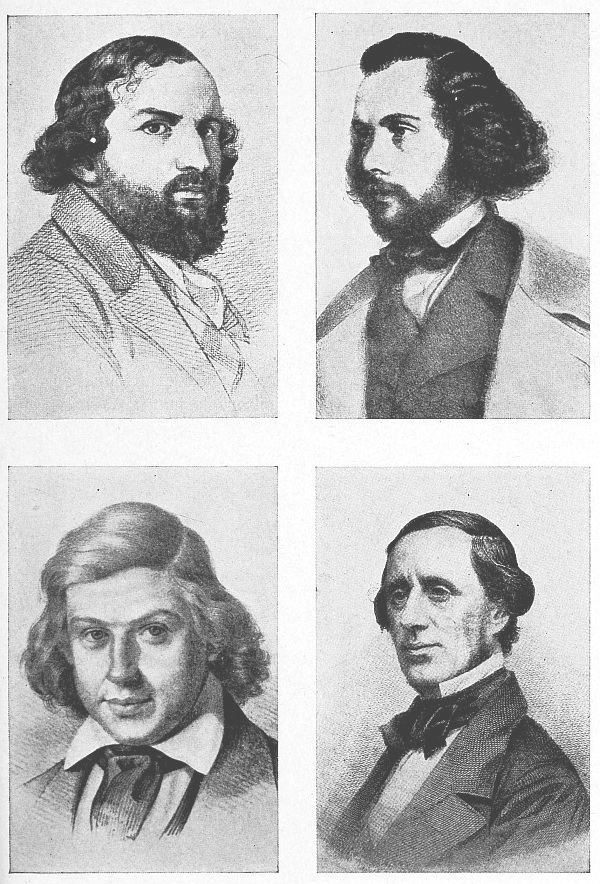
Cantata Writers of the Nineteenth Century:
Top: Ferdinand Hiller and Félicien David Bottom: Niels W. Gade and W. Sterndale Bennett
It will be observed that the Germans have been given by far the most numerous representation among the choral works thus far mentioned, there being among them compositions by only three composers of other nationalities—Gade, a Dane, and Berlioz and David, both Frenchmen. This numerical difference represents a fair statement of the relative importance of choral music in continental countries in the period under present discussion (that is, from 1800 to about 1870). In France choral music was entirely overshadowed in artistic significance by the opera, as, indeed, were all other forms of music. The list of German composers of cantatas and shorter choral works might be even still further extended by the inclusion of Robert Franz (1815-1892), the writer of exquisitely refined songs, who also composed the 117th Psalm for double chorus a cappella, a Kyrie for four-part chorus and solos a cappella, and a Liturgy for the Evangelical service; and Franz Abt (1819-1885), chiefly known by ballads of a folk-song character and a large number of cantatas for female voices and male voices, all written in an easy, flowing, popular style.
In England, cantatas, especially those based on some story or legend, have long been exceedingly popular. The love of choral music has been a national characteristic of the English people for over two centuries. As early as the seventeenth century choral festivals were organized by various cathedral choirs acting conjointly. The celebration of St. Cecilia’s day was made the occasion of some of the earliest of these festivals and ‘The Musical Society’ was organized in London in 1683 in order to conduct them on a more artistic basis. Musical festivals and associations were later formed in the provinces and grew into great favor. As time went on these assumed large dimensions and exerted an artistic influence as in no other country. Some of those now in existence are extremely old, as the ‘Festivals of the Three Choirs’ of Gloucester, Worcester, and Hereford, organized in 1724, and the Birmingham Festival, begun in 1768 by a series of concerts made up almost exclusively of Handel’s works. The tremendous popularity of Handel’s choral works in England not only resulted in the extension of the Handel worship which continued unabated until the frequent visits of Mendelssohn attracted much of its enthusiasm to his own superb oratorios, but caused a substantial increase in the number of choral societies throughout the kingdom. These societies have been unusually generous in giving native works abundant hearing and English composers were not slow to take advantage of the opportunities thus offered. English choral works, therefore, constitute a formidable array. From the time of Purcell until the present generation of composers, however, very few works have been produced that rise much above the general level of mere respectability or amiable reflection of Handelian and Mendelssohnian models that seems to be the chief characteristic of English choral music of the period thus bounded. Indeed, English choral works produced in this period before 1850 are practically a negligible quantity in the literature of this branch of musical art. But among English composers who were active in this field in the third quarter of the nineteenth century there are several who deserve special mention; these are Sir Julius Benedict, Sir Michael Costa, Sir George A. Macfarren, Sir William Sterndale Bennett, and Henry Smart.
Julius Benedict (1804-1885), an eminent German who made England his home during the last fifty years of his life, contributed frequently and successfully to the Norwich Festivals, of which he was the conductor from 1845 to 1878, inclusive. Here in 1860 his beautiful cantata ‘Undine’ was performed, in which the famous singer Clara Novello made her last public appearance. In 1863 at the same festival his cantata ‘Richard Cœur de Lion’ was produced and in 1866 ‘The Legend of St. Cecilia.’ The cantata ‘Graziella,’ intended for the Norwich Festival of 1881 but not completed in time, was produced at the Birmingham Festival of 1882. Of these cantatas, ‘The Legend of St. Cecilia’ is the most important. The poem, written by the English critic and author Henry F. Chorley, presents four characters—Cecilia (soprano), her husband, Valerianus (tenor), the Prefect of Rome (bass), and a Christian Woman (contralto)—and choruses of Roman citizens, Christians, and angels. It sets forth the wedding festivities, the conversion of Valerianus to Christianity by the angelic vision through Cecilia’s prayers, the discovery of his defection by the angry prefect of Rome who had just joined them in wedlock, his trial, the parting and finally the death of the pair—Valerianus by being beheaded and Cecilia by the slow martyrdom of the stake.
Michael Costa (1808-1884), an Italian composer and conductor who lived in England after 1830, was closely identified with English choral music as conductor of the Birmingham Festivals from 1849 to 1882, as conductor of the Sacred Harmonic Society and the Handel Festivals from 1857 to 1880, in which latter capacity he wrote additional accompaniments to most of Handel’s oratorios, and as composer of two important oratorios which will be mentioned in a later chapter, and of several shorter choral works. His serenata, ‘The Dream,’ which was written to a poem by William Bartholomew for the marriage festivities of the Princess Royal of England to Prince Frederick William of Prussia, afterward Emperor Frederick, is a short and delightfully melodious composition for four solo voices, chorus, and orchestra. Oberon (bass) commands the fairies to prepare a car for Queen Mab (alto), who charms the eyes and ears of The Lady (soprano) so that she may in her dreams see the form and hear the tones of adoration of ‘her beloved lover’ (tenor). The principal numbers are a dainty and bright chorus of fairies (‘Make the car of a golden king-cup’), an impassioned serenade by the lover (‘O the joy of truly loving’), and a closing choral serenade (‘Lady, arise! look forth and see’), tuneful and sparkling.
George Alexander Macfarren (1813-1887) was one of the most distinguished and scholarly English musicians of the nineteenth century. He was a prolific composer in many fields and in none was he more successful than in choral-writing. His operas, oratorios, and cantatas are numerous, and in the last-named group his important works are ‘Leonora,’ composed in 1851; ‘May-Day,’ written for the Bradford Festival, 1856; ‘Christmas,’ written in 1859 and first performed at a concert of the Musical Society of London on May 9, 1860; ‘The Lady of the Lake,’ founded on Scott’s poem and produced at the Glasgow Musical Festival, November 15, 1876; ‘Songs in a Cornfield,’ written in 1868 for female voices to words by Christina Rossetti; and ‘Outward Bound’ (1877). John Oxenford, a popular librettist of the period, furnished the texts for ‘Christmas,’ ‘May-Day,’ and ‘Outward Bound.’
‘May-Day,’ for soprano solo, chorus, and orchestra, is a brief cantata full of the jollity of this old-time festival, with its ancient ceremony of choosing the May-Queen and the accompanying rustic revels. It contains many examples of the quaint style of part-writing prevalent in the preceding century, among them the delightful part-song ‘The Hunt’s up.’[70] ‘The Lady of the Lake’ is a work of large dimensions demanding five solo voices—Ellen, the Lady of the Lake (soprano), Blanche of Devan (contralto), James FitzJames, the Knight of Snowdoun (tenor), Roderick Dhu (baritone), and James, Earl of Douglas (bass). The most interesting music in this cantata is assigned to the chorus, and here the composer demonstrates his fine ability in effective part-writing, at the same time introducing many touches borrowed from the idiom of Scottish folk-melodies.
Henry Smart (1813-1879) was one of the earliest of the modern English composers to come under the influence of the romantic movement. He is most widely known for his part-songs, organ music, and anthems and other Anglican ritual-music, but his best work is the cantata ‘The Bride of Dunkerron.’ He produced several other cantatas of less merit—‘King René’s Daughter’ (1871) and ‘The Fishermaidens,’ both for female voices, and the sacred cantata ‘Jacob,’ written for the Glasgow Festival and performed there November 10th, 1873.
‘The Bride of Dunkerron’ was written for the Birmingham Festival of 1864. The poem by Frederick Enoch is founded on a legend concerning a Lord of Dunkerron, whose castle was on the coast of Kerry, who fell in love with a sea-maiden and followed her to her watery home. She seeks the Sea-King’s consent to their union, which he not only refuses to give but condemns her to death for loving a mortal and drives her lover from his realm by a tempest which casts his body upon the shores. There are solo parts for the Sea-Maiden (soprano), Dunkerron (tenor), and the Sea-King (bass). The solos are numerous and uniformly grateful, the most conspicuous ones being Dunkerron’s simple but charming song as he waits on the seashore for the maiden’s appearing (‘The full moon is beaming’), the Sea-King’s aria (‘Oh, the earth is fair in plain and glade’), and the maiden’s graceful song (‘Our home shall be on this bright isle’) which she sings as she departs to win the consent of the Sea-King. The chorus has important work to do and Smart shows conspicuous skill in handling this factor. The opening number is in reality a double chorus of peasants who tell of Dunkerron’s nightly watch by the sea, and sea-maidens who sing the enticing songs that prove to be his undoing. After the long love-duet between Dunkerron and the maiden, there ensues a brisk and stirring chorus which depicts the journey of the lovers through the waters to the maiden’s dwelling-place. The sea-maidens sing several attractive choruses and a chorus of storm-spirits (‘Roar, wind of the tempest, roar’) foretells the impending tragedy and leads to a dramatic trio for the three characters. The king’s angry edict dooms the lovers and the double chorus of peasants and sea-maidens closes the work as it began it, but the mood is now one of sad lament over the tragic dénouement.
‘King René’s Daughter’ is a cantata for female voices, written in 1871. The poem by Frederick Enoch is based on a lyric drama by Henrik Hertz. King René, of Provence, had betrothed his infant daughter Iolanthe to the son of the Count of Vaudemont. She became suddenly blind before she had emerged from babyhood, and, in order to keep from her the realization of her loss, her father brought her up without any knowledge of what sight means. A magician offered to restore her sight, making only the one condition that she first be told of the lost faculty, but this her father refused to do. One day her betrothed passed through the valley where she dwelt, singing his troubadour songs. He beheld Iolanthe for the first time and was fascinated by her beauty. Through the song which he sang to her of the lovely rose she realized the existence of the lost sense, and, this having been disclosed to her and the magician’s condition thus fulfilled, she was healed. There are thirteen numbers in the cantata and the solo parts are Iolanthe (soprano), Martha (mezzo-soprano), and Beatrice (contralto), though other solo voices are added in a trio and later in a quartet which, as narrator, tells of the troubadour’s song to Iolanthe. The entire work is written in a melodious, graceful style and closes with a chorus of exuberant joy at the restoration of sight to ‘King René’s daughter the fair.’
Sterndale Bennett (1816-1875) has not infrequently been called ‘the English Mendelssohn,’ not because he was a conscious imitator of his great German contemporary and intimate friend, but because his music exemplifies the same qualities of polished refinement and exquisite workmanship, although of far less inspirational value and emotional content. Bennett was a ‘shy and reticent’ composer in point of the number of his works, and of these (there are only 46 opera in all) only three were in extended choral forms, namely, an ‘Ode for the Opening of the International Exhibition,’ 1862, to words by Tennyson, ‘The May Queen,’ a pastoral cantata, and ‘The Woman of Samaria,’ a sacred cantata usually classed as an oratorio.
‘The May Queen’ was written for the Leeds Festival of 1858 and, notwithstanding the poorly-written libretto by Henry F. Chorley, is replete with musical beauties of striking power. The solo parts are assigned to the May Queen (soprano), the Queen (alto), the Lover (tenor), and the Captain of the Foresters, as Robin Hood (bass). The story relates the celebration of May-Day in ancient times on the banks of the Thames, which is interrupted by a quarrel between the jealous and despondent lover of the May Queen and Robin Hood, who enters at the head of a band of rollicking foresters and openly makes love to the May Queen. The Queen enters, the lover is arrested for having struck the forester, the May Queen intercedes for his release and thereby reveals her affection for him, the forester is banished for having stooped to woo a peasant girl, the Queen orders the wedding of the May Queen and her lover on the following morning, and everything ends happily. The music (there are ten numbers in the cantata) is characterized throughout by utmost refinement and grace of expression and is distinctly individualized in respect to the different personages. The finest solos are the lament of the disconsolate lover (‘O meadow, clad in early green’) and the forester’s robust song (‘Tis jolly to hunt in the bright moonlight’). The chorus-writing is scholarly, always effective without over-taxing the singers, bright, spirited, and spontaneous. This cantata is to be numbered among the most beautiful compositions of this class.
VIII
Anglican ritual-music of the nineteenth century falls into two natural groups. The first group comprises the compositions up to about 1850 which complete the third period of English church-music (see page 93) overlapping from the preceding century; the second group begins with the evidences of new life that crept into English church-music about the middle of the century and brought to it refreshing vigor and regeneration. Most of the anthems and ‘services’ of the first half of the century repeat the colorless and listless style of the preceding century, yet several composers produced music of real worth, dignity, and solidity. Such were William Crotch (1775-1847); Thomas Attwood (1765-1838), a pupil of Mozart and a close friend of Mendelssohn (to whom the latter dedicated his three preludes and fugues for organ), whose ‘I was glad,’ written for the coronation of George IV with full orchestral accompaniment, is a remarkably fine work of imposing breadth; and Thomas Attwood Walmisley (1814-1856). Among the most representative examples of the work of this group of composers will be found the following anthems: Attwood’s ‘Withdraw not Thou’ and ‘Grant we beseech Thee,’ Walmisley’s ‘Remember, O Lord’ and ‘O give thanks.’ With the melodious music of Sir John Goss (1800-1880) and the notable series of anthems and ‘services’ by Rev. S. S. Wesley (1810-1876) and Sir George A. Macfarren (1813-1887), what might be called the middle modern school of English anthem-music comes to an end. On the whole academic and respectable rather than inspired, the religious music of this period is only the outward expression of the drowsy and apathetic inner life of the Church.
The motets of the nineteenth century and the decades just preceding have, in the main, far closer kinship to the sacred cantata than to the typical form whose name they assume. Beautiful as the motets of Haydn, Mozart, and Cherubini are as music, they are far removed from the old motet in spirit, even though they were written to be sung at High Mass. The best motets written for the German Evangelical service were attempts to revive the glories of Bach’s motet style. In this field Mendelssohn achieved noteworthy success (see page 151) and the well-known motets of Moritz Hauptmann (1792-1868), cantor of the Thomasschule at Leipzig for over twenty years, attest how deeply he imbibed the spirit of his great predecessor. The motets of these two composers represent the best examples of this form in the period covered by this chapter. But as the years move on, the old motet is becoming more and more archaic.
The nineteenth-century part-song had a brilliant history. The enthusiasm with which it was cultivated in Germany under certain patriotic stimuli, later spread to England and France with happy results. The first German choral society made up wholly of amateur singers was the Berlin Singakademie, founded on May 27th, 1791, by Karl Christian Fasch (1736-1800). Male choruses, as much social as musical in nature, had existed in Germany since the seventeenth century, but they did not attain much popularity or influence until Carl Friedrich Zelter (1758-1832) established the first Liedertafel in Berlin in 1808, composed of twenty-four men from the Singakademie. The political effect of Weber’s stirring part-songs, especially his setting of the patriotic songs in Körner’s Leyer und Schwert, as, for example, ‘Bright sword of liberty’ and ‘Lützow’s wild hunt,’ has been already mentioned. The love of choral singing became contagious, and, stimulated by the new feeling of nationalism, both male choruses (Liedertafeln) and choral societies (Gesangvereine) began to multiply rapidly, especially after 1818. Though much of the part-music written for their consumption was weak and tasteless, many of the great composers bountifully contributed of their best ideas. Schubert wrote some fifty pieces of this class, twenty-two of which are for unaccompanied male voices. Among these seldom-sung pieces are many of astonishing beauty, as his setting of Nur wer die Sehnsucht kennt. Schumann wrote about a dozen part-songs for male voices and some twenty for mixed voices, many of them as poetic and charmingly melodic as his songs. Mendelssohn’s part-songs, however, exerted an overpowering influence not only in his own country but especially in England, where he was imitated ad nauseam for nearly fifty years by native composers. Here, however, they were instrumental in creating such a revival of choral singing among the people, well-nigh dead since the old madrigal days, that singing societies were established far and wide throughout the land, even in remote communities. So many of these part-songs of Mendelssohn are familiar household songs in Germany, England, and America that it will be unnecessary to name any here. Among the German part-song writers of less importance are Ignaz Seyfried (1776-1841), Julius Otto (1804-1877), Friedrich Kücken (1810-1882), Friedrich Truhn (1811-1886), Ferdinand Hiller (1811-1885), Robert Franz (1815-1892), Carl Wilhelm (1815-1873), composer of Die Wacht am Rhein, Franz Abt (1819-1885), and Joachim Raff (1822-1882).
Though Mendelssohn’s part-songs set the prevailing style in England for many years, many native compositions of sterling worth were produced. Sterndale Bennett wrote only three, but they are fine examples of this class, especially ‘Come, live with me.’ John L. Hatton (1809-1886), Henry Smart (1813-1879), Sir George A. Macfarren (1813-1887), Henry Leslie (1822-1896), Ciro Pinsuti (1829-1888), and other composers in England have written fine part-songs that have been deservedly popular. But Robert L. de Pearsall (1795-1856), who wrote almost exclusively in this form, succeeded in a remarkable degree in combining the quaintness of the old madrigal with the freedom and grace of the more modern style. He published about sixty madrigals and part-songs, a large proportion of which will remain a permanent part of the literature of this field. Among the finest of these may be mentioned the ten-part song ‘Sir Patrick Spens,’ probably the most elaborate and successful part-song in existence, the genuinely humorous ‘Who shall win my lady fair,’ the melodious ‘When last I strayed,’ ‘Purple glow,’ and ‘O who will o’er the downs so free,’ and others equally masterly.
About 1835 a general movement was started in France for the establishment of singing societies called Orphéon. These were organized in the communal schools, among working people, and at the universities, but were for male singers only. They became very popular and spread with great rapidity. The corporation of Paris recognized their importance and made choral singing one of its municipal departments, in 1852 placing Gounod at the head of the Orphéon. Annual contests and festivals were instituted which attracted choral societies from every part of France. In 1867 these choral societies numbered 3,243 with a membership of 147,500. The rapid increase in interest in choral singing naturally led to the composition of numberless unaccompanied part-songs, which were on the whole more elaborate than the English part-songs and which admitted the dramatic element very frequently. Among French composers who wrote expressly for these societies were Halévy, Adolphe Adam, Félicien David, Ambroise Thomas, Gounod, Delibes, Massenet, Dubois, Bazin, and particularly Laurent de Rillé, whose compositions in this form number over a hundred.
FOOTNOTES: