Chapter V · BEE MANIPULATION.
Reading edition
§ I. HIVING SWARMS.

THE spring is the best period at which to commence an apiary, and swarming time is a good starting-point for the new bee-keeper. The period known as the swarming season is during the months of May and June. With a very forward stock, and in exceedingly fine weather, bees do occasionally swarm in April. The earlier the swarm the greater is its value. If bees swarm in July they seldom gather sufficient to sustain themselves through the winter, though by careful feeding they may easily be kept alive if hived early in the month.
The cause of a swarm leaving the stock hive is that the population has grown too large for it. Swarming is a provision, of Nature for remedying the inconvenience of overcrowding, and is the method whereby the bees seek for space in which to increase their stores. By putting on "super hives" the required relief may, in many cases, be given to them; but should the multiplication of stocks be desired, the bee-keeper will defer increasing the space until the swarm has issued forth.
In many country districts it is a time-honoured custom for the good folks of the village to commence on such occasions a terrible noise of tanging and ringing with frying-pan and key. This is done with the absurd notion that the bees are charmed with the clangorous din, and may by it be induced to settle as near as possible to the source of such sweet sounds. This is, however, quite a mistake: there are other and better means for the purpose. The practice of ringing was originally adopted for a different and far more sensible object—viz., for the purpose of giving notice that a swarm had issued forth, and that the owner was anxious to claim the right of following, even though it should alight on a neighbour's premises. It would be curious to trace how this ancient ceremony has thus got corrupted from the original design.
In case the bees do not speedily after swarming manifest signs of settling, a few handfuls of sand or loose mould may be thrown up into the air so as to fall among the winged throng; they mistake this for rain, and then very quickly determine upon settling. Some persons squirt a little water from a garden engine with the same object. There are, indeed, many ingenious devices used by apiarians for decoying the swarms. Mr. Langstroth mentions a plan of stringing dead bees together, and tying a bunch of them on any shrub or low tree upon which it is desirable that they should alight; another plan is to hang some black woven material near the hive, so that the swarming bees may be led to suppose they see another colony, to which they will hasten to attach themselves. Swarms have a great affinity for each other when they are adrift in the air; but, of course, when the union has been effected, one of the rival queens has to be disposed of. A more ingenious device than any of the above is by means of a mirror to flash a reflection of the sun's rays amongst a swarm, which bewilders the bees and checks their flight. It is manifestly often desirable to use some of these endeavours to induce early settlement, and to prevent, if possible, the bees from clustering in high trees or under the eaves of houses, where it may be difficult to hive them.
Should prompt measures not be taken to hive the bees as soon as the cluster is well formed, there is danger that within one or two hours they may start on a second flight; and this is what the apiarian has so much to dread. If the bees set off a second time it is generally for a long flight, often for miles, so that in such a case it is usually impossible to follow them, and consequently a valuable colony may be irretrievably lost.
Too much care cannot be exercised to keep off the sun from a swarm when it has once settled. If exposed to heat in this way, bees are very likely to decamp. We have frequently stretched matting or sheeting on poles so as to intercept the glare, and thus render their temporary position cool and comfortable. For the same reason the hive used to take them in should not have been standing in the sun.
Two swarms sometimes depart at the same time, and join together; in such a case we recommend that they be treated as one, by putting them into a hive as before described, taking care to give abundant room and not to delay affording access to the super hive or glasses. They will settle their own notions of sovereignty by one queen being destroyed. There are means of separating two swarms, but the operation is a formidable one, and does not always repay even those most accustomed to such manipulation. If after one swarm has started there are signs of another setting out which might mix with it, means may be taken for securing the queen of the second, or sheets may be thrown over the hive.
With regard to preparations for taking a swarm, our advice to the bee-keeper must be the reverse of Mrs. Glass's notable injunction as to the cooking of a hare. Some time before you expect to take a swarm, be sure to have a suitable hive in which to take it, and also every other requisite properly ready. A bee veil or dress will preserve the most sensitive from the possibility of being stung. This article is fully described on page 209. But bees when swarming are in an eminently peaceful frame of mind; having dined sumptuously, they require to be strongly provoked before they will sting. Yet there may be one or two foolish bees who, having neglected to fill their honey-bags, are inclined to vent their ill-humour on the apiarian; or, what is far more likely, the bees of neighbouring hives may be incensed if they see him manifesting unusual excitement. When all is ready the new hive (a straw skep is the most convenient in the first instance, but if that is not at hand a box or anything else will serve as a substitute) is held or placed in an inverted position under the cluster of bees, which the operator detaches from their perch with one or two quick shakes; the floor-board is next placed on the hive, which is then slowly turned up on to its base, and it is well to leave it a short time in the same place, in order to allow of stragglers joining their companions. The operator should make sure that he has not left the queen behind on the branch, as in that case the bees would return to her.
Sometimes swarms alight on trunks of trees or on walls, where it may be difficult to shake or brush them off. The late Mr. Woodbury mentioned an instance of this kind. A swarm clustered among the large branches of a pear tree, just at their point of union with the trunk. In this case he merely supported a straw hive just over the swarm with the left hand, whilst he struck the trunk of the tree with the open palm of the right. The vibration thus produced sent the bees up into the hive with great rapidity, and the entire swarm was speedily hived in the most satisfactory manner. Mr. Langstroth in a similar case fastened a leafy branch above the bees with a gimlet, and then smoked them upwards till clustered upon it. It should be borne in mind that they have always a readier tendency to ascend than to descend. A feather dipped in carbolic acid will very promptly move them, and as they can readily escape from its fumes there is no objection in this case to its use. Another case of settling in an awkward spot is mentioned above (page 78).
If the new swarm is intended for transportation to a distance, it is as well for it to be left at the same spot until evening, provided the sun is shaded from it; but if the hive is meant to stand in or near the same garden, it is better to remove it within half an hour to its permanent position, because so eager are newly swarmed bees for pushing forward the work of furnishing their empty house that they sally forth at once in search of materials. If the removal has been made after they have gone forth they will be unable to find their home in its altered position, in which case they will circle about for hours till they fall and die from exhaustion. But by prompt transference, only the first despatch of scouts will be lost, and these are a good loss, as they might entice the whole colony to desert.
The bee-master should always seek to prevent his labourers from swarming more than once; his policy is rather to encourage the industrious gathering of honey, by keeping a sufficient supply of supers on the hives. Sometimes, however, he may err in putting on the supers too early or unduly late, and the bees will then swarm a second time, instead of making use of the storerooms thus provided. In such a case the clever apiarian, having spread the swarm on the ground, will select the queen, and cause the bees to go back to the hive from whence they came. But this operation requires an amount of apiarian skill which, though it may easily be attained, is greater than is usually possessed.
For a description of the theory and phenomena of swarming, with the signs by which its imminence may be gathered, and a variety of information referring chiefly to the habits and life of the insect, the reader is referred to an earlier article in this work (Chap. I. § xi.).
§ II. TRANSFERRING SWARMS.
Where the permanent hive is of the skep description the swarm may of course be hived into it at once. But with many of the hives now in approved use a process of transference will be necessary. To effect this, place the straw hive, into which we will suppose the bees have been shaken, on the ground, propped up on one side with a brick or a flower-pot, or anything of the sort that may be handy, in order that straggler bees may join the swarm. The spot selected for this should be as shady a one as can be found, near to the place where the swarm settled; or it may be shaded from the rays of the sun by fixing matting on two poles, so as to prevent the heat falling on the hive. Spread a sheet or cloth on the ground where an even surface can be obtained; stake this sheet down at the four corners, to prevent ruts and inequalities, which are great hindrances to the bees going into the hive (Mr. Cheshire's swarming-board, which is simply a large square board to rest on the hive-stand, has its advantages); place the frame hive upon the sheet, without its floor-board, having its front raised on blocks or sticks rather more than an inch long—not more, otherwise the bees will cluster, and attach themselves to the lower part of the frames, instead of going up between. These preparations will perhaps occupy ten minutes, by which time the swarm will have become settled and tolerably quiet. Then, with a sharp rap, precipitate the bees out of the straw hive on to the sheet immediately in front of the frame hive; give the straw hive another knock, so as to dislodge all the bees, and then take it quite away, otherwise they may, if it be left near, perversely choose to go into that, instead of the one desired. In an hour or so, more or less, the whole swarm will have clustered within the frames.
In some cases, as when the swarm has to be brought from a distance and procured from a cottager about whose skill in carrying out these directions there may be misgivings, it is best to give instructions that the swarm be brought home after sunset, and then the foregoing directions for inducing the bees to tenant the frame hive may be better carried out. For ourselves, we much prefer the evening for the purpose. Not after dusk however—in fact no operation of the kind ought to be attempted when it is so dark that the bees, if they should fly, are unable to see where to fly to, for in that case they will be sure to settle upon the operator. A little water sprinkled over them from a watering-pot is likely to induce them to quit the ground and go up into the hive more quickly; a little smoke, or a touch with a twig or feather, may answer the same purpose, and if the feather be dipped in diluted carbolic acid it will more speedily do its work. With a goose wing they may conveniently be swept up. The operator should be protected with the bee dress and other precautions described on page 209.
Mr. Langstroth writes: "If they seem at all reluctant to enter [the new hive], gently scoop up a few of them with a large spoon and shake them close to its entrance. As they go in with fanning wings, they will raise a peculiar note, which communicates to their companions the joyful news that they have found a home; and in a short time the whole swarm will enter, without injury to a single bee." On catching the note the queen speedily follows, and, being longer in limb, she outstrips the others in the race.
In the Journal of Horticulture, Mr. Woodbury says: "If combs be fixed in the frames, the crown-board may be removed and the cluster knocked out of the straw hive on to the top of the exposed frames. The bees will disappear between them with the utmost alacrity, delighted to have met with a ready-furnished dwelling, and the top, or crown-board, having been replaced, the hive should at once be removed to the position it is intended to permanently occupy."
Bees occasionally manifest a dislike to their new hive. The operator will, however, in a very short time be able to ascertain their intentions. If on putting his ear to the hive he catches sounds like gnawing or rubbing, he may be sure that they have commenced work; but if all is still, or they go listlessly about, and hang, as Langstroth puts, it, "with a sort of dogged or supercilious air," it may be gathered that they intend to be off at the first opportunity. In such case, either catch the queen and put her in a cage (page 198), or keep the whole hive in darkness for three days, supplying food, water, and ventilation the while.
If the weather be wet the next day or so after hiving, it will be well to give a little assistance to the new colony in the shape of food, for although, when a swarm leaves a hive, almost every bee composing it has filled itself with honey, we have known not a few instances, in case of very wet weather, in which the whole swarm has been starved for the want of this small but most timely help. A little should be given the first night even in fine weather. Of course, the first work of the bees is to build themselves combs, and these combs being produced by the secretion of wax from honey, a great drain upon their resources immediately begins, and any little outlay at this juncture is therefore abundantly compensated.
§ III. TRANSFERRING OLD STOCKS.
We frequently find that the possessor of a stock of bees in a cottager's common straw hive is desirous of removing the whole stock, with brood and comb, into one of our improved hives, in which the honey may be obtained without the destruction of the bees. We mostly discourage such a transfer, attended as it is with much labour, and requiring a considerable amount of apiarian skill. An old-fashioned hive may very readily be turned into a humane one, simply by cutting out the middle of the top of the hive with a sharp-pointed knife; a piece may thus easily be taken out, so as to leave a round hole two or three inches in diameter, taking care that the knife does not penetrate much below the straw, lest it reach the comb or the bees. There should be ready a round adapting-board, with a corresponding hole, which may be secured on the top by putting four long nails through the same number of holes in the board; then a cap-hive or a glass may be placed on the top, for the purpose of admitting the bees, who will soon crowd therein to work. This hive or glass will form a super or depriving-hive, and can be worked as profitably as most of the improved hives. For the sake of more sightly appearance, an outside case, either of zinc, straw, or wood, may now be dropped over all, and then, if well painted, the whole will form no disfigurement to any flower-garden.
This is, beyond doubt, the easiest way of overcoming the difficulty, but as it may not satisfy all, we will now proceed to describe how a complete transfer of colonies may be effected. No hive offers such facilities for the placing of the combs in a perfectly upright position as does the frame hive. As before remarked, we should be slow to recommend any one to attempt the operation who is not already pretty well accustomed to the handling of bees and acquainted with their habits; but by carefully carrying out the following directions an apt bee-keeper may successfully perform the feat. The first thing is to get the bees away from the combs: there are two ways of doing this—one is by fumigation (see page 207), the other by driving (page 226). Whichever plan may be resorted to, place the bees in the temporary hive on their old stand until you are quite ready to admit them into the frame hive. Have in readiness all the necessary appliances. These consist of a large knife for cutting the hive, a good-sized table on which to lay the brood combs, a basin of water—for washing off honey which may besmear the hands—tape or string to fasten the combs in their frames, a pair of honey-cutters (page 193) for cutting out the combs, jars to hold the honey that runs out, and a feather for brushing off any bees that may remain. It is necessary that the operator should have on his bee dress and india-rubber gloves. If the old skep is not valued the operation will be facilitated by cutting it in half vertically between the two middle combs; but the honey-cutters will accomplish the object without this destruction if it is not desired. Mr. Cheshire's transferring board (page 192) comes in useful here. If one is possessed the frames may be laid upon it, and the combs, which should be cut as large as possible, must then be placed within these. Of course they will not exactly fit, but they must be adjusted, piece by piece, till they bind each other together; the few interstices the bees will soon fill up. If in any of the frames there is not sufficient comb, supply empty comb if it is to hand, and in default of such, fix an additional bottom bar inside the frame—a false bottom as it may be called—at whatever height the supply of comb requires. Drone comb, however, should be used very sparingly, and this only for the outside frames, in which it is not likely to be selected by the queen for breeding purposes, but left for storage of honey. Both filled and partly filled frames must now be made secure by tying pieces of tape or pliable wire (even string will answer) round the whole from top bar to bottom or false bottom; there should be two of these to a frame, or perhaps three if the pieces of comb are small. In two days or so the bees will have made all firm enough for the tape to be dispensed with, which should accordingly be done, as it is in the bees' way. To effect this, dismember first the cells from the tape by means of a sharp knife, and then cut the tape and draw it out. Care should be taken that the combs occupy the same position in the frames as in the hive from which they were extracted, for the cells are not exactly horizontal, but inclined slightly upwards. Supply guide-comb or wax strips to any frames that are wholly unoccupied.
The frames now filled are placed in the hive, when the bees may be let into it in the manner Mr. Woodbury recommends for a swarm (see page 220). It may be as well to keep them confined a few hours, giving them water at the top, by means of a soaked sponge laid on perforated zinc, until they make the combs secure; the object of this being to exclude the bees from other hives, who, if feloniously inclined, might come to rob. For the same reason the operation of adjusting the combs should not be performed in the open air, or the bees from surrounding hives will be sure to come in great numbers to obtain a share of the honey necessarily exposed. It should be done inside a room with the temperature at about 70 degrees—not cold enough to chill the brood, nor yet hot enough to soften the combs. An expert apiarian could perform the operation in less than three-quarters of an hour, and with little loss. A week or so after a swarm has left the old stock is perhaps the very best time for such a removal. In some instances a routing of this kind has a beneficial effect; old stocks of hives that have previously appeared to be dwindling are often aroused to activity by their removal into a fresh domicile. After the winter's doze this is especially the case, say if done on a warm day early in April. We have ourselves frequently shifted the stock from a well-occupied frame hive to a fresh one, in which the bees find a clean floor-board and walls, as well as freedom from insects that may have harboured in crevices during the winter.
§ IV. DRIVING.
Driving is an operation by which bees are induced to vacate an, old settled hive and to enter an empty one. Many apiarians prefer this mode of effecting an exchange of hives to the plan of fumigating the bees. The greatest success attending such a transfer will be in the case of hives well filled with combs that are worked nearly to the floor-board; and it may be remarked that bees are generally so far provident that they leave an open space in which to pass underneath their combs over all the floor of the hive. When the old hive is inverted the bees crawl up the combs, and thus more easily pass up into the new hive, which the operator places over the old one with the intent that they should enter it.
The best time for performing this operation is about the middle of the day, and when the weather is warm: It is essential that the operator be protected with a bee dress and gloves, as before described; and previous to commencing his task he must provide all necessary implements. These are—a couple of hives, both of which should correspond in shape and size with the hive from which the bees are to be driven; a cloth to tie round at the juncture when the new hive is placed on the old one; some string to keep the cloth in its place; an empty pail to receive the top of the old hive, if one of the old conical shape, but if the stock of bees is in a square box-hive with a flat top, a firm stool will be the best; and a tube fumigator with some fungus, which will complete the material of war. The bucket or stool must be placed securely on the ground, about a yard from the place where the full hive stands; then a few puffs of smoke, blown in amongst the bees, will cause them to retreat up amongst the combs. The bee-master must now turn the hive[25] upside down very gently, letting it rest in the pail or on the stool; he then quickly places the empty hive over the full one, and ties the cloth round it, to prevent any escape of the bees. If the cloth be damped it will cling the closer to the hives. The third hive, which should resemble the old one even in colour, is intended to be placed on the stand formerly occupied by the stock, so as to retain the few returning bees which had been absent in the fields. Care must be taken that all crevices through which it is possible for the bees to escape from the united hives should be effectually closed. When the two are fairly united, the operator will proceed by rapping the full hive gently with the hands or a couple of sticks, more particularly on that side where the combs are the most thickly placed—that is, if the hive be not equally filled on all sides. A stock is in the best condition for driving twenty-one days, or thereabouts, after a first swarm has issued; the brood will then have hatched out, the bees will quit more readily, and there will be no loss of larvæ in the cells.
It generally happens that in ten or fifteen minutes the bees regularly commence the ascent; their exodus will be known by the distinct rushing sound which is always noticed when a colony of bees is on the move. The first thing bees do when disturbed is to fill their honey-bags, as they invariably do at swarming time; consequently, after the first rush into the new hive is over, as in the case of a swarm, the "flitting" bees are not much disposed to take wing. When the noise made by the ascending bees has been heard, and has in a great degree subsided, the cloth may be removed, and the old hive, now deserted, may be taken indoors; and if a few bees yet remain they may be brushed off with a feather. An experienced apiarian, on first hearing the rushing noise before mentioned, will not hesitate to tilt the top hive over a little on one side, so that he may watch the bees during the ascent; the queen maybe seen passing up, and if the operator desires to take her away he can secure her by gently taking her between thumb and finger. Those who have become experienced in this operation find that it can safely be performed with the hives fixed open from the first. This is called "open driving," and can be effected with increased facility by sticking two skewers through the ruin of the lower hive in such manner that they shall act as props to keep the upper in a fixed position. Mr. Hunter has, however, devised an improvement upon this, consisting in a wire hinge to connect the two hives, and wire rods to prop them open. The operator thus has both his hands at liberty for other parts of the work.
If the taking of the honey be, the object of the bee-master, then "driving" is manifestly a better plan than resorting to the fumes of sulphur for the purpose; for the bees from whom the store is taken can be joined to stocks that are weak in numbers, with considerable advantage to the future prosperity of the apiary (see next section).
§ V. UNITING COLONIES.
A weak colony may frequently with advantage be added to another, or three may be made into two. And not only may this be done with new swarms, but in autumn, when there is no brood in the combs, it may be carried out also with stocks, the combs that are extracted being taken care of for use when required. After working hours is the best time for this operation. It is not, however, altogether a simple one, as strange bees will not intermix unless measures are taken to overcome their natural hostility to each other. Whatever be the number of hives in an apiary, the bees of each know the smell of their own companions. A single bee that enters the wrong hive will be stung to death, unless possessed of a good booty wherewith to disarm animosity. Similarly on the admixture of entire colonies, if one has some distinct ground of advantage over the other, there must be a method hit upon to deprive it of this or else to purchase its goodwill, for otherwise there will ensue a ferocious and disastrous slaughter. If both are alike frightened all will go well, and the same if both are upon the wing in search of a home; but quite otherwise if one is self-possessed and active in its own abode, while the others are frightened strangers and gorged, and it may be still further demoralised by having lived under an unfertile queen, or with none at all. But if both are cowed alike by a good drumming on the hives, they may be sprinkled so as to possess the same scent, and then taken to a third position and shaken out on to a sheet together, when they will enter the offered hive in harmony. If each colony has a queen, one of them may be searched for and removed.
A slight variation upon this method consists in driving the bees of the one hive (see last section) straightway into the other, having first terrified the bees of the latter by drumming until by their changed note they may be concluded to be thoroughly subdued, and as a consequence gorged with honey; then, before their equanimity is recovered, the others must be joined to them. A third plan is the one usually practised with the Stewarton hive (page 151), and which can be imitated with other hives, by means of ekes or nadirs; this is usually carried out in the evening, when the quietude appears efficacious in settling all differences without the necessity of any other precautions. A fourth is as follows: At dusk, dislodge the bees on to a cloth, sprinkle them with sweet syrup scented with essence of peppermint (as a means of bribing their new hosts to receive them), and place the hive to which it is intended to join them over the mass; they will gradually ascend into the hive placed for them, and early next morning the hive, with its slender stock thus augmented, may be removed to its stand. Should the operator not have been successful in gaining possession of the queen, he may leave it to the bees themselves to decide which queen they will have.
Many persons feel more secure from stinging if they first stupefy the bees by fumigation. These should proceed as follows: Having used the fumigator upon the bees in one hive, as described under that article (page 207), place a sheet on the ground and spread the bees on it; then, with a feather, sort them over, in order to pick out the queen. As soon as she is found, pour the rest of the lethargic swarm from off the sheet back into the inverted hive again. The stupefied bees must now be sprinkled freely with a syrup made of honey and water, or sugar and ale boiled together. Some apiarians recommend a few drops of peppermint to be mixed with the syrup, in order to drown the peculiar odour which is special to each hive of bees; this is more necessary when both hives are fumigated, and whilst under the influence of smoke are well mixed together upon the sheet or board. Such course can be adopted if preferred, and no further instructions will be needed than what are here given; but we will suppose as before that only one is thus operated upon. The hive containing the non-stupefied bees must now be placed on the top of the inverted one, just as the hive was from which the bees in the latter have come. A wet cloth must be fastened round the two hives, so as to prevent any of the bees from escaping. The hives in this position must be placed where they are not likely to be knocked down or meddled with. The fresh bees in the upper hive, attracted by the scent of the bees besmeared with honey, go down and commence licking off the sweets from the sleepy ones. The latter gradually revive, when all get mingled together and ascend in company to the upper hive, where they live as if they had not been separate families. The two hives should be left undisturbed for twenty-four hours, when the upper hive may be removed and placed immediately on the spot from whence it was brought.
The removed queen should be kept alive and fed as long as she will live, in case any harm should befall the sovereign of the other community. If three hives are to be incorporated in two, the only difference will be that the stupefied colony upon the sheet is divided into two empty skeps, the one being covered securely over till the other is adjusted.
§ VI. ARTIFICIAL SWARMING.
Every bee-keeper knows the anxiety he feels in watching and expecting a swarm to come forth, fearful lest his favourites should, "like riches, take wing and fly away"—a mischance that it is desirable to prevent. In our description of natural swarming this will be found fully treated of; we propose here merely to point out how, especially with movable frames, this work of Nature may be assisted. We call it assisted, because artificial swarming should, as nearly as possible, resemble natural swarming; that is, it should be performed at the same time of the year, and when the populous state of the hive makes a division desirable. This is easily known to be the case when bees hang out in clusters at the entrance, wasting their time in enforced idleness instead of being abroad gathering honey. It is also necessary that there should be drones about at the date chosen.
When such is the state of the hive, the advantages of movable-frame hives are strikingly manifested. With the others the bees will often persist in wasting their time as just stated when a swarm would put all to rights; while they are often just as awkward the other way and will send out swarm after swarm which the strength of the hive cannot spare and which in themselves are unable to form colonies capable of self-support and of repelling robber bees. The great expenditure of time and labour by the bee-keeper, with the fear that after all the swarm may come off at a time when he is absent, and thus be perhaps lost, are additional objections to depending upon the natural process. An apiarian may if he pleases give the bees their chance, and then if they do not swarm readily he may resort to artificial means. But if he wishes to dispense with the former altogether he will have to adopt measures of prevention against it, as his forced colony must not be procured till the proper time of natural swarming. Some clip the wings of the queen, which seems a clumsy proceeding at the best—though recommended by high authorities from Virgil to Langstroth—as the royal mother may still wander forth and thus fall to the ground and be lost. Others block the entrance of the hive with some obstruction which only workers can pass, by which means the drones will also be kept at home. If this be the method pursued care must be taken that the obstructions are removed both after sunset and before sunrise to permit of the dragging out of the bodies of such as have fallen among the hourly victims of the gathering season.
The best time for performing the operation is about ten o'clock in the morning of a fine summer's day. The following directions should be carried out: Place ready a counter or bench that is firm and strong, and which has space on it for the inhabited—or, rather, the over-inhabited—frame hive, and the empty one, which is about to be made the receptacle of a separate stock. The operator, attired in his bee dress, and having the other appliances ready, may now open the hive[26] (as described at page 270), and proceed to take out the frames, carefully examining both sides of each comb to find the queen:[27] she is generally in the centre of the hive, so that it is not always needful to take out every one of the frames. As these are examined they may be put into the empty hive, and when the object of the bee-master's search is found he must carefully remove the frame containing her majesty, and may place it temporarily in the empty hive, at one end by itself, or he may make use of the bar-frame holder (Chap. IV. § xi.). Next he must proceed to put the frames back into the old hive, closing up the vacancy caused by the removal of the comb with the queen on it, and leave the empty frame at the end. Then he may place the frame containing the queen, with the few bees that may be upon it, in the centre of the empty hive; and, finally, putting all the other empty frames in, and replacing the lid, he will place this hive in the exact position occupied by the old stock. The bees that are on the' wing will go to the old spot, and, finding the queen there, they will rally round her, and if a time is chosen when a large number are abroad, they will on their return very soon form a sufficient number to constitute a swarm; comb-building will at once begin, the frames will, in a week or so, be filled, and a satisfactory stock will thus be established.
This operation we once performed—exactly as described above except that there was no frame-extracting—with one of our improved cottage hives. Whilst inspecting our bees we caught sight of the queen on the comb in one of the bell glasses. This was a chance not to be missed, and we immediately resolved to form an artificial swarm, for the hive was very full of bees. Besides, being obliged to be away from the apiary most of the week, we were glad of the opportunity of so easily establishing a colony without the uncertainty and trouble of hiving a natural swarm. In the first place we slid a tin under the bell glass, and, removing the stock hive from underneath, we took it a few feet away; then we placed an empty improved cottage hive where the old stock had stood, and put the glass of comb containing the queen and a few bees over one of the holes in the crown of this new empty hive. The bees that were left abroad belonging to the old stock returned as usual to their old entrance as they supposed; soon a sufficient number formed a large cluster in the hive and began comb-building, the queen remaining in the glass until the cells below were sufficiently numerous for her to deposit her eggs in them. The experiment answered exceedingly well. Both hives prospered: the old hive either had some princesses coming forward to supply the loss of the queen, or the bees used the power that they possess of raising a queen from worker brood in the manner we have previously described (page 16).
The foregoing account illustrates the successful formation of an artificial swarm; but, with a cottage hive, gaining possession of the queen is on this method quite a matter of chance. With a movable-frame hive she can at any suitable time be found.
Precisely the same plan is to be adopted with the old stock in the frame hive as we have described in the case of the cottage, that is, to remove it some few paces off: when the hives are in a bee-house a similar result may be obtained by placing the new swarm for a day or two so as to be reached by the same entrance as the old stock, and the latter may be removed to one close by. Some apiarians recommend that a space be left between the two hives, by arranging them on the right and left of the old entrance, in order that too large a proportion of bees should not enter the new hive at the old position, to the impoverishment of the other. But we have found the mode adopted with the cottage hive answer so well that we see no reason for recommending any different plan.
It is the office of the bee-master to assist, not in the least degree to oppose, Nature. We know that when a natural swarm issues forth it has its queen, and when located in a new abode it commences building worker combs, leaving the building of the few requisite drone combs to a later period. But if a division of the hive should be made, by putting half the combs in one hive and half in another, the hive that is either queenless or contains an embryo queen will busy itself with building only drone comb (see page 17); thus a number of receptacles for useless bees are provided, while all the time the colony is rapidly dying off from the wear-and-tear of the working season.
In the plan we have recommended for forming two separate families we nearly follow the natural course of things; the comb that the queen is upon is the only one that is taken from the hive, and this vacancy should be filled in by moving the frames together, so as to leave the empty frame at the end. The swarm under the government of the queen construct the combs, and furnish their new abode, as before stated, with worker cells. By adopting the plan above described, the movable-frame hive will prove far superior to any of the dividing-hives, which provide for equal division of the combs.
There are, however, quite a host of other modes of procedure more or less varied from the above, and their number is doubtless capable of almost unlimited extension. Mr. Langstroth, in the tenth chapter of his "Honey Bee," describes a considerable variety of them, nearly all of which are accomplished wholly or in part by the process of driving. The following he particularly recommends as approaching nearest of any to natural swarming. Two hives exactly alike are placed one above the other with their entrances different ways; they have holes made through their floor-boards to allow of communication from the crown-board of whichever for the time occupies the lower position. Free passage being thus given from one to the other, a number of the young bees will use the upper entrance. After some ten days a swarm is driven from the lower and received into the upper, upon which the positions of the hives are reversed, the forced swarm being put below. Most of the mature bees will unite with the swarm from association with the lower entrance; but the young ones which have habituated themselves to the upper one will now cling to the parent stock and form a sufficient strength to keep it properly going. In the course of a few days the upper hive may be placed by the side of the lower, and then, by successive short steps, removed to any other part of the apiary. If it was found that either hive was too weak the positions should be again reversed.
When driving is the method resorted to, it becomes absolutely essential, in forcing a swarm, that the queen should go with the new colony; but on the other hand it is not in this case the object to drive all the bees from the parent stock, but to leave, say, a quarter to preserve warmth for the brood and to raise a new queen. If therefore the queen is not observed in the ascent of the bees after the drumming, those in the swarm must be turned and shaken over in the skep in order to find her (they will not attempt to fly, but only crawl). An inexperienced eye may still fail to detect her, and in that case it will be best to set both hives upon stands for a short time—the new one on the old stand and the old on some other—when within half an hour the one which is fairly quiet may be judged to be possessed of the royal presence. Should this be the old hive it must be again drummed, or the swarm may be returned to it and the operation renewed on a following day. It is, however, only with skep hives that any difficulty of this kind need be apprehended—there is always the power of capturing and transferring the queen from movable frames. When at last she is in the desired hive the swarm is secured, and the after measures depend on the number of bees that have accompanied her. If the stock retains one-half it may be moved to a new position and the swarm take its place upon the old stand. Whichever occupies this latter post will detach largely from the strength of the other, so that the reduction undergone by the parent stock will not be more than it will probably be able to sustain.
As detailed in the above article on "Driving" (page 226), there is a third hive made use of in this case, which has received the bees that returned home during the operation, and these are now added to whichever hive may most require them. Should too many have gone over with the swarm, this latter may be taken away and set in a cool airy place, while the old hive is carefully restored to its old stand, when the bees which were distractedly flitting in and out of the third hive will at once rush into it, and the impression made upon them by the occurrence will be such that they will now cling to it wherever it is placed. It must be forthwith removed to its intended permanent position, but if still short of bees this must be close at hand, so that if the forced swarm is kept where it is for a day or two a good number may desert to the old stock; its entrance should be closed until sunset as a precaution against robbers, but not so as to stop ventilation. The forced swarm, if not in their permanent hive, must now be treated as an ordinary transfer, and their fixed abode be brought in the evening to the old stand. Some additional covering may be needed at first, and in very cool weather the operation should not be attempted at all. There is no fear of all the bees deserting in the arrangement just suggested, and if inconvenient to complete the operation at once the swarm may be so left, even if there appears no need on account of the old stock.
The process of driving is the only method of obtaining artificial swarms from cottage hives, except in such rare cases of good fortune as the one mentioned on page 236; but even with frame hives it is often practised for the sake of its rapidity. But with an experienced operator the same result can be achieved by simply taking out the frames one by one and jerking off the bees on to the sheet in front of the new permanent hive; that on which the queen is found will be inserted therein just as it is—queen, brood, and workers. If the swarm is being collected in a skep the queen must be taken with the fingers and deposited therein, while the bees from as many frames as are needful must be shaken in after her.
There is sometimes a doubt whether a hive is strong enough to yield a swarm, though apparently overstocked. In such cases there is an excellent plan, devised by Mr. Langstroth and strongly approved by Mr. Cheshire, for obtaining a single swarm out of two hives. On a suitable morning, when large numbers are upon the wing, drum a strong stock till every bee has left it. Place the forced swarm on the old stand: this of course consists of bees in an unfurnished hive, while the old hive has lost all its bees, but retains its brood. Remove this hive to the stand of another strong stock, the hive of which goes to a third spot with the bees inside it at the time. Those of this last which were upon the wing will enter and remain with the first hive and raise a new queen; while sufficient will be transferred with the second stock hive to protect its brood also. Thus the first stock gives no bees to the swarm, but the whole of its brood; the second gives the larger half of its bees. If frame hives are the ones used, the shaking process of the last paragraph may be substituted for drumming; but as it may not be possible to shake off every bee without damaging the combs, a goose wing should be employed to brush off the more tenacious of the occupants.
Other modifications consist in either obtaining one swarm out of four or five hives, or else one less than their own number out of the same. For the former (frame hives) two combs may be taken from each and placed in a new hive, which is then set upon the stand of some strong stock. For the latter, a swarm is forced, after or before working hours, from each of these hives, while another swarm, that has been procured from some bee-keeper a mile or two off, and has been kept in a cool place, is now shaken on to a sheet, sprinkled to keep it from taking wing, and softly scooped up with a saucer and divided equally or as required among the hives that have yielded the swarms. The distance that these bees have come will prevent them from returning to their own home.
§ VII. QUEEN-REARING.
Perhaps the greatest advantage the movable-frame hive possesses is, that a full knowledge, can be attained of its exact state as regards the queen, the population, and the quantity of food in stock. During weather of a genial temperature the combs may on any fine day be inspected, and thus, a knowledge being gained of the deficiency existing in a hive, the necessary means may be adopted for supplying the want. Sometimes such an examination will verify the fears of the bee-keeper, when, having observed that his bees have ceased to carry in pollen, he has thereby received warning that the queen has been lost at some juncture when no successor to the throne could be provided. Such a hive has entered on a downward course and will dwindle away entirely, unless a queen should be given to it, or else some combs containing young brood not many days old (see page 16). By the latter method the bee-keeper will gain an opportunity of seeing the bees set about their wonderful process of raising a queen from the brood thus provided for them. If neither means is practicable the colony must be united to some other hive.
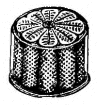
An ingenious little contrivance has been brought into use by continental bee-keepers, especially by Herr Kleine, a German pastor, to prevent the destruction alluded to. It consists of a small wire cage (in fact, a pipe cover), as represented in the annexed illustration, placed over a queen cell to protect it from the mother bee's animosity. It also serves to prevent the young queen, when hatched, from escaping; for she will have the same jealous feeling towards her sister princesses, should there be more in the hive. The bee-master may thus carefully remove and appropriate her.
Particular attention will have to be exercised to affix the cage into the comb by pressure, as far as the middle wall, but at no point must it touch the royal cell itself. As the cage will probably project so as to touch the adjoining comb, a little incision and removal of a portion may be necessary to allow space for it.
This covering need not be put over the cell until the egg is a little more than a week old. The animosity of the reigning queen does not generally manifest itself until the royal brood approaches maturity. These cells are unmolested on the tenth day, but on the eleventh day they may be found tenantless. Notwithstanding the apiarian's care and skill, many disappointments are frequently experienced in endeavouring to establish fertile young queens at the head of colonies.
Hives found to be queenless may be supplied either with matured queens or with queen cells. If the latter are sufficiently numerous, their introduction may easily be effected by exchanging a comb in each hive; if they have to be cut out and placed loosely in the new hive, a triangular piece of comb should then be removed with them, to be used as a block in preventing any pressure coming on them. A space must be cut out of the middle in the centre combs of the hive into which they are to be introduced. They must not be so loose as to be in danger of falling out, but if such seems likely a little melted wax should be applied with a feather. Special care must be exercised not to bruise the royal embryos, as a very slight pressure is likely to be fatal. It is important not to perform the operation till they are within three or four days of coming forth, which may be known to be the case from the brown look of the tops of the cells, the wax having been removed.
It is always easier to introduce royal brood into queenless hives than matured queens, because bees are reluctant to receive stranger queens, whilst they will tolerate one hatched in the hive, who will speedily depart to seek a drone. Bee-masters mostly use small hives for queen-rearing, as explained in the section on "Nucleus Hives" (page 197). It is not however indispensable to use other than the ordinary hives, and Mr. Langstroth gives the following as the very best mode of procedure. Place an empty hive on the top of a well-filled one, giving communication through crown and floor boards and turning their entrances opposite ways (one of his plans, by the bye, for procuring an artificial swarm). The young bees will many of them take to the upper hive—if not they must be enticed into it by food—and when there are sufficient of them, a brood comb with adhering bees must be inserted and the connection closed. After a few days this nucleus hive may be removed, a few steps at a time, and another, if desired, take its place and be raised in the same way. Queen-rearing operations must be confined to warm weather and when drones are abundant.
Royal cells are often built so close together that it is difficult to remove one without injuring another. As a remedy for this Dr. Dzierzon has made the important discovery that any convenient worker cell may be made to produce a queen by the removal to it of some of the royal jelly from an unsealed cell; by placing this on the inner margin of the cell selected, the bees will adopt and rear the larva as desired.
§ VIII. INTRODUCING NEW QUEENS.
This is an operation that is continually being practised for the purpose of Italianising a colony, though there are other occasions for its adoption, as on the loss or the superannuation of the old queen. We will in the first place describe the mode of procedure with a frame hive.
Should the old queen be remaining in the hive, she has first to be removed. Having discovered her, by lifting out and examining the frames (see page 271), place a wineglass over her whilst on the comb, and, with a card passed very carefully underneath, she may, with a few of her subjects, be made a prisoner and easily removed. She should be preserved in a small box till the success of the new introduction is ascertained. Then, having enclosed the new queen, with such of her retinue if any as are with her, in the domed wire cage described at page 199, place this cage upon the comb in a spot where there is a little honey, so that she may be independent of the bees for food, and as near the brood as may be; press it into the comb as far as the middle, and close the hive and leave the bees undisturbed for three days—less will mostly suffice, but it is best to be on the safe side. The royal cells that are sure to have been commenced should now be cut away with a penknife, and then the new queen may be carefully released. If the hive is one that permits it, her reception should be watched. If the bees make way for her and caress her with their antennæ, all will be well, and the comb may be gently restored to its position and the hive shut up. But if they cluster in a ball around her, her death is intended; and if they cannot readily be induced to separate they should be taken out and dropped into lukewarm water (which will hurt none of them), and the queen re-encaged for another day or so—that is, if she has not already met her doom, which is all uncertain: Mr. Langstroth says he has had several queens stung to death before they had quitted his fingers! We prefer effecting her release, then shutting up the hive and leaving the bees quietly to themselves.
We may remark here with regard to these acts of surrounding a new queen, that they evidently arise from a great number rushing upon her at once for the purpose of stinging her, but that very frequently such purpose is frustrated by the immovable position in which the inner bees are held. Suffocation however will soon effect the same end if the ball be not dispersed. There are cases, on the contrary, in which friendly bees surround a queen to protect her from others, and sometimes the knot is made up of members of both parties, perhaps without enclosing the queen at all. The hissing note will at once distinguish a hostile onset from a protecting rally.
With the Renfrewshire cage (page 199 as above) all the variation needed is to place the cage between instead of within the combs, so as to permit of the queen's release at the bottom. The inventor considers that this gives an advantage in introducing her majesty in the first place to those bees that have been engaged in feeding her; but, as already noticed, it is not the feeding, but the familiarising with her presence, which is the great point, and that is surely quite as well accomplished with the other cage as this. There is also here no opportunity, as in the other case, of being certain whether she is well received or not, so that we always put a good-sized board under the entrance, and examine the next day whether she has been thrown out dead or not.
In effecting the exchange with cottage hives, the bees must first be driven out into another hive (as described at page 226), and after the old queen is removed they must be sprinkled with a little water flavoured with a drop of extract of peppermint (to be obtained of any chemist), which overcomes the particular hive-scent, and makes all smell alike; then throw the new queen in among them and place the mass of them back in the hive. If preferred, an eke (page 186) may be placed on the stand, the bees precipitated into it, and the hive of combs placed above, when the bees will ascend. If this is done in the evening the queen will in most cases be well received. As there is no opportunity of excising queen cells, the process should be performed, say, in the middle of October, when breeding has ceased. Stupefying the bees with fungus is a method devised by Huber as applicable in any kind of hive, and it has been highly approved of and declared to be infallible.
A strange queen is generally well received by young bees, whether she be Italian or English—for we have never found the slightest difference in reception, though Mr. Wagner (Langstroth's "Honey Bee," page 325) was of opinion that there is more opposition in the case of the foreigner. The difficulty is to have a sufficient number of such young bees. In the middle of a hot summer's day a stock may be divided and the part with the old queen left in its former position, while the other part, with as many brood combs as it is prudent to take, may be removed a few yards off. The old bees that have been brought with the latter will in three or four hours have most of them returned to their former abode, and the new queen may then with safety be given to the remainder without caging, taking care to introduce her to the young bees on the combs. This task must only be attempted on a warm midsummer day and when the night temperature need not be feared for the young brood in its deserted condition. Stocks may be divided and artificial swarms formed in this way--from the end of May to the beginning of July—if the apiarian has queens in readiness.
§ IX. ITALIANISING.
It requires a considerable amount of apiarian skill to accomplish the union of Italian with common bees, so that we find by experience it is best to send out complete stocks or swarms of the former. This is particularly desirable now that the packing of whole hives is so easily accomplished by us with the aid of bars and frames. We have sent a great number of stocks to all parts by rail. Still, as the introduction of fertile Italian queens is a frequent practice, and we are ourselves large importers of the same, it is only right to add some directions as to the course to be pursued where such union is resolved upon. These queens come over during the summer months, from May to October. They are packed in wooden boxes about five inches square, with a comb of sealed honey in a frame in the centre to feed the queen and the few workers that accompany her on the journey. The old queen should first be removed from the hive, but carefully preserved till it is ascertained whether all goes well with the stranger. The box containing the latter must now be prised open, and this should be done within doors, lest the queen should fly and be lost. On discovering her she must be placed in a queen-cage and gradually introduced to her new subjects in the manner explained under that article (pages 198 and 247).
If this is successfully accomplished all is right so far; but unless considerable pains be taken the off-coming swarms will certainly produce mongrel bees. If none of the neighbouring residents are bee-keepers, the risk may be considerably narrowed by destroying the drones and drone comb in the other hives and rearing Italian queens to place at the head of each of these as speedily as possible. Every one of these queens, even if impregnated from an undesired source, will still produce drones as purely Italian as herself (see page 64), and thus in another year the chance of Italian mates being found for the queens will be further increased: indeed the peculiarity of Italian queens in laying drone eggs in there first year will probably produce this result more speedily. But should some hybrids be the result, as in all probability will be the case, even these are much to be preferred to the common black bee—some say (see page 53) that they are even better than pure Italians for honey-gathering, but they are more irascible.
This course is undoubtedly in opposition to the design of Nature to avoid interbreeding, but we find even Mr. Hunter recommending it, though showing in another place that he perceives it to be a violation of his "law." By commencing with two Italian queens there might be more chance given of escape from the evil—if it really is an evil when not several times repeated. Von Berlepsch, however, informs us of the following method, devised by Dathe and others, by which even this objection may be avoided:—
"When the young queen has left the cell, she is transferred after forty-eight hours, or even earlier, into a cellar or some other dark and cool place. If the drones, by one of which the impregnation is to be accomplished, are not among the colony of the queen, they also must of course be inserted. We now wait for a sunny day free from wind, when the thermometer in the shade is at least 17° above zero [70° Fahr.]; the bees in question, towards five in the afternoon, when drones have completely ceased from flight, are fetched out of their prison, and set up in any spot, if possible where isolated and with the flight-hole exposed to the sun; then, by means of a small syringe or in any other way, direct some liquid honey into the flight-hole. In a minute or two the bees will sport in numbers in the front, and it will not be long before the queen and drones also fly out. At evening the colony is brought back into custody, and the manœuvre is repeated till the young queen has commenced laying, or till her accomplished fructification is made sure by expansion of the abdomen, or, upon return from a flight, by having the more or less torn-off drone penis upon her extremity." Some essential particulars are not here specified, but we interpret the instructions to refer to a nucleus hive in which the queen is hatched with several workers, but with no drones present except those specially introduced. By choosing these, also from their birth, from the progeny of a different queen from the mother of the one in the nucleus, all may apparently be made as straightforward as could be desired. Even Von Berlepsch, who is no friend to the Italians, praises this method as a "beautiful discovery:" it dates only from 1867.
§ X. GENERAL HINTS ON FRAME HIVES.
It may not unnaturally be asked by some, Why all this trouble about frame hives? No one, however, who has carefully read the previous sections of this chapter, and especially those on "Artificial Swarming" and "Queen-Rearing," can require any further answer to such question. Briefly, frame hives stand immeasurably above others from the full command over the bees which they afford. The facility of inspection for ascertaining the strength of the colony or the stock of its honey, or for incidental purposes, such as the detection of disease and the extirpation of enemies such as the bee-moth, and again the facilities provided for giving ventilation or for contracting the dimensions to suit a small population, are among the minor but still great advantages which the use of these hives secures. In skilful hands these advantages may be used successfully; though in the hands of the unpractised and unskilful the contrary may be the result.
It is a great desideratum that all the bars and frames in an apiary should be of precisely the same dimensions, so as to fit every hive. A hive that is weakly may often be advantageously strengthened by having put into it a comb of brood from a populous stock, to which an empty frame from the weak one may be given; no bees must be on the brood-comb—these should be shaken off or gently dislodged with a feather into the hive from which the comb is taken. The frames of combs should then be, one by one, placed so as to fill in the vacancy, leaving, the empty frame nearest the side.
In the British Bee Journal of March 1875, Mr. Cowan gives the following excellent description of his system of working frame hives. He says: "The method is very simple, but is one that requires much attention, which is, however, well repaid by the extra quantity of honey obtained. The hives I use are the ten-frame Woodbury, and thirteen-frame on the Woodbury plan, only longer. In the autumn I transfer the bees into clean hives and leave them seven or eight frames, and should they be short of food or of bees I add those I may take from the cottagers in the neighbourhood. I feed with sugar and water of the strength of two pounds of sugar to a pint of water boiled a few minutes. They are fed up to a weight of thirty pounds. During winter they have ample ventilation—the hives being raised about one-eighth of an inch from the floor-board, and the top board is also raised about the same height, so that there is a constant current of air through the hive. While I am on the subject of wintering I may mention that I have tried several plans. With the above I have always been free from mouldy combs. I have also tried wintering without crown-boards, by merely placing an empty super on the top, and I have done so successfully—in fact, the hive which produced the largest quantity of honey last year was wintered in this way. Condensers I have tried, but give the preference to crown-boards without them. I am trying the quilts on some of my hives, but must reserve my opinion about them until later on.
"I generally supply my bees with plenty of food in the autumn, so that they require no further attention until about the end of February, when, if the weather is fine, the bees are all thoroughly roused into activity and induced to commence and continue breeding until the honey-gathering season commences, by which time every frame in the hive is filled with brood, and the hives are so strong that it is easy to make an artificial swarm and to ensure a good supply of honey besides. If the weather is fine, about the end of February (or if cold, then I defer a little longer) the bees are transferred into clean hives; and in this way I get to know the exact state of the community. Now suppose it is a ten-frame Woodbury hive. I do not return the whole of the eight frames which the bees had for wintering on, but only from five to six of the centre ones, and contract the size of the hive to the six frames. I then unseal the honey-cells of two of the frames, and allow the honey to run down inside the hive. This thoroughly rouses the bees; and the queen at once begins to lay. The running honey is very soon collected and stored; and in a few days I do the same with a couple more frames, and so on until all the frames have been unsealed. I find this a great advantage, as much of the honey that has granulated, and which the bees will not touch, is removed by them out of the hive, and gives them increased space.
"I now commence very gentle feeding, for which purpose I use the very fine strainers found in Loysell's coffee-percolators, and allow each hive from a quarter to half a pint of food a day, of the strength of about three pounds of sugar to a quart of water. When there is sealed brood in three or four of the frames I add two more—making eight—and serve them in the same manner as the rest; then when there are six with sealed brood, the colony will be sufficiently strong to have the remaining frames added. The same plan is adopted with the thirteen-frame hive. They must be constantly watched so as not to allow them to store too much food, which would diminish the space for egg-laying; and if such is found to be the case, food should be withheld for a day or two, or until they are getting short of it. In this way I keep them going from day to day; watch them carefully, or it might happen that a hive full of bees—and at swarming point—might, if not watched and supplied with requisite food for existence, swarm or decamp. So by the time there is an abundance of honey abroad the hives are completely filled with bees and contain brood in every frame hive; and then it is that I put on my supers and discontinue stimulative feeding.
"In the place of the crown-board I place a sheet of five-thirty-second perforated zinc, and supers same size as hive and five inches deep. The supers are provided with bars which are sawn down the centre, enabling me to fix a strip of impressed wax sheet without any difficulty. The bees generally take to these supers at once; and in a day or two the crown-board of super is removed, and I place a second super without top board between the first one and stock hive. The supers are also provided with traps [page 201] to enable bees to leave after they have deposited their load, instead of passing through the stock hive. Now it sometimes happens that for some days the weather is fine and the bees begin storing a large quantity of honey in the supers (as they have no room in the stock hive), when suddenly the weather changes and cold sets in. As soon as this happens I remove the supers and watch the bees, and if they require small quantities of food I give it them, and when the fine weather returns they go again into the supers when replaced on top. In this way it sometimes takes only a week to fill a thirty-eight or forty pound super with some of the best honey that can be obtained in this part of the country [Horsham]. I discard old queens and generally select young and prolific egg-layers."
Agreeing as we do very much with the hints Mr. Cowan gives, we commend them to the careful carrying out of intelligent and painstaking apiarians.
§ XI. REMOVING BEES.
A very great advantage that frame hives afford is the safety and convenience with which a stock of bees can be transported in them to any part of the kingdom or abroad: by a few additional arrangements stocks have even been sent in them to distant countries. In many districts hives are removed to moors and heaths in autumn, for the purpose of gathering heather honey. In this operation the frames are a great support to the combs, very much lessening the risk of a break-down and consequent loss.
The proper course to pursue in this case is to remove the crown-board, and nail across from side to side two strips of wood with smaller pieces fastened on them so as to secure each frame in position. Then nail a sheet of perforated zinc over the top; or in default of that the crown-board may be screwed down, when, if the two strips are not over an eighth Of an inch in thickness, they will secure ventilation without allowing the bees to escape. The combs must be scrupulously carried lengthways, or they will break; and if they are new and the weather is warm, even with that precaution any but the most careful hand carriage is nearly certain to ruin them. If not going far it is best for the hive to be borne between two; but if this is impracticable the vehicle used must at any rate have springs.
It is most urgent in making such a transfer that the most ample ventilation should be allowed. The bees are of course gorged at the time, and in that condition they are most particularly in need of air; while on the other hand the fact of their imprisonment, together with the shaking attendant on carriage, irritates them and causes them to make such a commotion, that without stringent precautions they would very probably be stifled, and of course the finer the colony the greater is the danger.
With an ordinary skep this supply of air cannot be ensured at the top, so that it becomes necessary, if the journey is to last longer than an hour or two, to invert the hive. This must be done with great caution and always in the direction in which the combs run. A sheet of perforated zinc on a board, or a piece of coarse canvas or cheese-cloth, may then be nailed or otherwise fastened with string over the base, thus taking the place of the floor-board, and it is needless to say that this should be done in such a manner that not a single bee can escape. If the journey is likely to be one of more than a few hours it will not do to employ any soft material, as it would in that time be gnawed through; but wire-cloth would answer as well as perforated zinc.
As a preliminary to any remove, smoke should be blown in at the entrance repeatedly during half an hour, after which it may be judged that all on the wing will have returned. For carrying a swarm, either a skep or box or anything will serve, and it must be secured and carried mouth upwards in the same way.
§ XII. SUPPLYING NATURAL COMB.
We have spoken above (page 187) of the great value of sheets or strips of wax for assisting the bees in the building of their combs. But when, through another hive having lost its bees at an early stage, the combs themselves can be supplied them in good and clean condition, the advantage is very much greater. Such combs may be fixed in frame hives exactly in the same plan as is adopted on transferring full honeycomb (page 224).
Generally speaking the bee-keeper may be satisfied if he can simply insert pure white guide-comb with which to start the bees. Every bar, or if the comb is not plentiful, every other bar, should have a piece fixed to it in the following manner: Cut a piece of clean empty comb of the required size, say two inches square, not less; heat a common flat iron, with which slightly warm the bar; then melt a little bees'-wax upon it; draw the comb quickly over the heated iron, hold it down on the centre of the bar, giving a very slight movement backwards and forwards; then leave the wax to grow cold, and, if cleverly managed, the guide will be found firmly attached. Care must be taken that the pitch or inclination of the comb is the same as it is in the hives—upwards from the centre of each comb.
When a hive has been in use many years the combs become very black, and every bee that is bred in a cell leaves a film behind. It may be understood how in this way the cells become contracted, and the bees that are bred in them correspondingly reduced in size. After the lapse of, say, five years it may be necessary to begin removing the old combs. This may be done by cutting away the combs, or by substituting an empty frame for one with old black comb, gradually moving the frames towards each other. By taking two away in this manner in the spring or summer of every season, the combs in course of five years may all be reconstructed, and fresh clean ones be secured for breeding in, instead of the old black ones that otherwise would remain as long as the stock could live in the hive.
Guide-combs can also be used with glasses. These may be filled, with great regularity, by adopting the following directions, which, we believe, have never before appeared in print:—
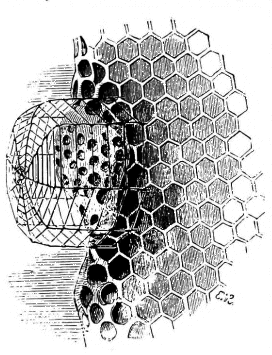
Procure a piece of clean, new, empty, worker honeycomb, which has not had honey in it (because honey will prevent adhesion to the glass); cut it into pieces of about three-quarters of an inch square. Gently warm the exterior of the glass (this we find is best done by holding the glass horizontally for a short time over the flame of a candle); then apply one of the pieces of empty comb inside at the part warmed, taking care, in fixing it, that the pitch or inclination of the cells is upwards—in fact, place the guide-comb in the same relative position that it occupied in the hive or glass from which it was taken. There is some danger of making the glass too warm, which will cause the wax to melt and run down the side, leaving an unsightly appearance on the glass; but a little experience will enable the operator to determine the degree of warmth sufficient to make the comb adhere without any of it being melted. It is hardly necessary to state that only the very whitest combs ought to be used. A short time should be allowed before changing the position of the glass, so that it may cool sufficiently to hold the comb in its place. Six or eight pieces may thus be fixed, so that, when the glass is filled, it will present a star shape, all the combs radiating from the centre. The annexed illustration shows the appearance of a glass as worked by the bees, in which guide-combs were fixed in the manner described above. The drawing was taken from a glass of our own, filled after being thus furnished. In the Old Museum at the Royal Gardens, Kew, may be seen a Taylor's glass, presented by us, some of the combs in which are elongated on the outside to the breadth of six inches.
We believe that not only does a glass present a much handsomer appearance when thus worked—and will, on that account, most fully reward the trouble of fixing guide-comb—but that more honey is stored in the same space and in less time than if the glass be merely placed on the hive in a naked condition for the bees to follow their own course. This mode of fixing guide-comb does not solely apply to the above-shaped glass, but is equally useful for all kinds of glasses. It is introduced in connection with this glass because, from its having a flat top and no knob, the regularity is more clearly apparent.
The working of bees in the bell glasses illustrates how tractable their disposition really is if only scope is allowed for the due exercise of their natural instinct. They have no secrets in their economy, and they do not shrink from our constant observation as they daily pursue their simple policy of continuous thrift and persevering accumulation. Yet it is only owing to the labours of successive inventors that we are now enabled to watch "the very pulse of the machine" of the bee commonwealth.
"Long from the eye of man and face of day, Involved in darkness all their customs lay, Until a sage well versed in Nature's lore, A genius formed all science to explore, Hives well contrived in crystal frames disposed, And there the busy citizens disclosed."
Murphy's Vanière.
§ XIII. APPLYING SUPERS.
Supposing the hive to be a stock (page 81), the super should be applied at the early part of the season, say, if fine and warm, at the latter end of April or beginning of May; but if the weather is then unfavourable it is better to delay doing so until a more genial temperature. If the colony is a swarm of the present year, two or three weeks should be allowed to elapse from the time of tenanting a hive before putting on the super; this delay is necessary to give the bees the opportunity of building combs in their new domicile, and of getting a store of honey for themselves before working for their master. The exact time[28] will, however, depend much upon the weather, and the same applies to the subsequent time occupied by the bees in filling the super. They will be the more incited to commence their work, and having commenced to continue it, if some warm covering is placed over the glass; at night, when much comb-building goes on, it is important to wrap it in flannel or worsted, or some warm material (a baize bag is convenient for bell glasses). A further inducement will be offered by the fixing of a piece of comb to the bars or ventilating tube, as the case may be. The cells on the outside or by the window are always the last to be filled, so that when these are sealed over it is safe to conclude that the rest are also complete.
When it is wished to use a super with a frame hive, the crown-board or roof of the stock hive must be taken away, the thin adapting or honey board, or perforated zinc adapter, taking its place—excepting of course where the crown-board is provided with openings for the purpose. The two long slits at the sides are to give admission to the super. The bees will begin sooner, and work faster, if the bars are each furnished with guide-comb (as described in the previous section). Combs that have been left unfilled may be fixed to the bars, but these must be white and clean, as dark comb should not be used for super hives.
§ XIV. REMOVING SUPERS.
The operation of taking honey is best performed on a fine sunny day. The combs may be extracted singly, if wished, for consumption, substituting an empty bar or comb; or, should the bee-keeper desire to see a handsome super, he must wait until the bees have filled and sealed up all the combs, and then he may proceed to disconnect the super. If a bell glass, he will first pass a table-knife round it underneath the rim; then with a piece of string or fine wire, one end in each hand, he will very slowly sever the remaining connection with the board, so as to allow of the bees getting out of the way. Wait an hour or so for the commotion to subside and to give the bees time to repair broken cells and suck up spilt honey. Then raise the glass and blow in a little smoke, after which the slide that closes the roof of the hive may be inserted, and above it another piece of zinc that will cover the base of the super and hold the bees in it close prisoners. After having confined them in the glass for a short time you must see whether they manifest symptoms of uneasiness, because, if they do not, it may be concluded that the queen is among them. In such a case, replace the glass, and recommence the operation on a future day. It is not often that her majesty is in the depriving-hive or glass; but, this circumstance does sometimes happen, and the removal at such a time must be avoided. When the bees that are prisoners run about in great confusion and restlessness, the operator may conclude that the queen is absent, and that all is right. The glass may be taken away a little distance off, and placed in a flower-pot or other receptacle, where it will be safe when inverted and the tin taken away; the bees will then be glad to make their escape back to their hive. A little tapping at the sides of the glass will render their tarriance uncomfortable, and the glass may then be taken into a darkened room or outhouse, with only a small aperture admitting light, which must be open; the bees, like all insects, make towards the light, and so escape (see description of "Bee-Traps," Chap. IV. § xviii.). The bee-master should brush them off with a feather from the comb as they can be reached; but on no account should the glass or other super be left exposed and unwatched, because the bees that have the opportunity will gorge themselves to their full, and speedily bring a host of others from the adjacent hives, who, in a very little time, would leave only the empty combs. It is truly marvellous how soon they will carry all the store back again, if allowed to do so. Unless the honey season is over, an empty glass should be put on to the hive in place of the full one, as it will attract the bees up, thereby preventing the too close crowding of the hive, and starting them to work more honeycomb.
If a bar or frame super, the first process is with a spatula to loosen the adapting-board from the stock hive after which the string is passed between them as above, putting in wedges on each side to follow the string. The smoking and expulsion of the bees follow as before. Another super will take the place of the one removed, or else the crown-board must be replaced.
Some apiarians, however, are of opinion that deprivation is more easily accomplished by disconnecting the super over night. In this case, after smoking the bees, wedge the super up all round about an inch from the board. Do this just before dusk, and leave it so for the night. The opening in the board remains unclosed, to allow of the bees joining the stock hive below, which they will naturally do for warmth. The super should receive its usual cover, and quite early in the morning, before the bees are much about, it will be ready for removal. The few bees that remain within may be speedily induced to quit. With a super that has an opening at the top it will be worth while to insert the nozzle of a pair of bellows, when a few puffs will be very efficacious in driving the occupants out.
§ XV. REMOVING FRAMES.
It is well for a beginner to practise the directions for opening and shutting up hives, by using an empty hive until he becomes familiar with the handling of the frames. The first thing to do is to loosen the crown-board, or lid, with a knife, drawing a piece of string underneath it, to divide the wax or cement with which the bees make all secure. All this should be done very slowly, so as not to irritate the bees. In hot weather the crown-board may be loosened by a lateral movement; but sometimes, for want of care, this loosening of the lid disturbs the bees, and, as soon as it is removed, a number of them, enraged thereby, rush out and attack the operator. Especial care should be taken not to prise the lid upwards, by way of wrenching it off, for the frames and combs are generally secured thereto, and there is a liability of rending the combs with it; this will greatly irritate the bees, and be otherwise injurious. When a hive of bees is really enraged there is little chance of pacifying them; if the first tokens of anger cannot be appeased it is best to "give in" at once, and not attempt to perform any operation, but to shut the hive up and beat a retreat, benefiting by the experience in order to do better a day or so afterwards. There are various devices for intimidating or conciliating the bees, and one of these, already spoken of, is smoke. So next time the experimenter makes his attempt let him raise the lid an inch or so, and blow a few puffs of smoke into the hive, which will cause the bees to retreat. Previous to this he may give a puff or two at the entrance, which will help to produce the quieting effect. This is best done by using our tube fumigator, with a little of the prepared fungus lighted. Pipes or cigars are not convenient to use for this purpose when the head is enveloped in the dress. As soon as the lid is removed a few bees will fly out to learn the cause of such an interference. Conciliation should then be offered by having at hand a little sweetened water, which may be sprinkled, or rather let drop, from a feather or a brush.[29] The sudden motion of the hand required in the act of sprinkling irritates the bees, so that, instead of making them our friends, they may become our foes. Mr. Langstroth recommends that a fine watering-pot, containing sweetened water, be used for the purpose. Care must be taken not to drench the bees; only just sufficient should be given to run down the sides of the combs, as well as sprinkle the top. As soon as the insects really understand that syrup is being given them, they feast upon it, instead of angrily attacking the operator. Thus pacified, and with gentle treatment, but little difficulty will be found in proceeding with the work required. But the unskilled operator should on no account neglect to put on a bee dress and gloves, as described above. We would err on the side of caution, although there is an old saying that "a cat in gloves catches no mice;" and the apiarian will find that his fingers are not so free to work as he would like, for gloves make them rather clumsy in drawing up the frames.
These must now be gently prised up from front to rear; this may be done with a small screw-driver or other stout instrument with a wedged end to go into the notches. They fit loosely so as to permit of a slight movement from back to front; a lateral or sideway movement might kill the queen, or, if not so fatal as that, might crush some of the bees and injure the brood combs, which must be carefully avoided. Of course much depends upon the nature of the operation that has to be performed, whether or no all the frames should be thus loosened. If it be for making artificial swarms, or for any purpose that requires an interview with her majesty, the whole of them must be loosened, because it may happen that all the combs have to be examined, sometimes twice over, before she can be discovered. Bees are very apt to build their combs in a slightly waving form, and in extracting one it will be needful to make room both for the comb and bees upon it to pass without scraping the next comb, and there will be a difficulty if the apiarian attempts to draw out one comb whilst the other frames are located in their appropriate places. Where a dummy frame is provided the operation becomes simple; but if there is none, let the operator gently proceed to lift, say, the third frame slightly nearer to the fourth frame (allowing it to lodge on the little block that divides the notches),[30] and the second nearer the third, so as to admit of sufficient space to lift out the end one. Very carefully and slowly he should lift the frame by taking hold, with thumb and finger, of the projecting shoulders that rest in the notch; and he must not let it touch or scrape the next frame or the sides of the hive, so as to crush, or irritate any bees.