Chapter I · THE BEE AS AN INSECT.
Reading edition
§ I. CLASSIFICATION.

WHERE is a self-complacency in commencing a subject scientifically, so let us devote our first half-page to defining the place of the bee in the animal kingdom. The common English honey bee, sometimes called the black bee, is known by the name of Apis mellifica; while the new favourite, the Italian or Ligurian bee, has obtained the specific name of ligustica, though naturalists are now satisfied that the two are only varieties of a single species. The genus Apis belongs to the order Hymenoptera, or membrane-winged insects, which some entomologists have subdivided into families and sections: of these, one family will comprise the honey bees, humble bees, etc.; another the wasps, of which the hornet is one; and others respectively the ants, the gall insects, the saw-flies, and certain parasites and other winged creatures of little familiarity. The entire order belongs to the class Insecta, and that to the grand division Articulata, or conjointed animals. In England alone there are 250 native species of bee.
Turning now to the particular insect with which we intend to interest ourselves, we observe that every hive or bee colony comprises in summer three distinct classes of bees, each class having functions peculiar to itself, and essential to the maintenance and well-being of the community. As each bee knows its own proper duties, they all work harmoniously and zealously together for the common weal. Certain apparent exceptions to the good-fellowship of the bees will be hereafter noticed, but these arise out of essential conditions in the social economy of the bee community. That honey bees should live in society, as they do in hives, is absolutely needful. A bee in an isolated condition is a very helpless delicate little creature, soon susceptible of cold, and paralysed thereby unless able to join her companions before night comes on. By congregating in large numbers bees maintain warmth, whatever the external temperature may be.
The three classes of bees are—the queen bee, or perfect female; the working bees, or undeveloped females; and the drones, or male bees.
§ II. THE QUEEN,
appropriately styled, by German bee-keepers, the mother bee, is the only perfectly developed female among the whole population of each separate colony. Thus her majesty indisputably sways her sceptre by a divine right, because she lives and reigns in the hearts of loving children and subjects.
The queen may very readily be distinguished from the rest of the bees by the greater length of her body and the comparative shortness of her wings; her legs are longer, and are not furnished with either brushes or baskets as those of the working bee, for, being constantly fed by the latter, she does not need these implements; the upper surface of her body is of a brighter black than the other bees', whilst her colour underneath is a yellowish brown;[5] her wings, which do not extend more than half the length of her body, are sinewy and strong; her long abdomen tapers nearly to a point; her head is rounder, her tongue more slender, and much shorter, than that of the working bee, and her sting is curved. Her movements in the hive are measured and majestic, though when out of her proper sphere, as at swarming time, she is distinguished, on the contrary, by the rapidity of her steps. She has a peculiar scent, which is so attractive to workers, that Mr. Mahan, of Philadelphia, states he has several times had them alight upon his fingers, a mile away from his apiary, after he had been handling the royal mother.
It is the chief function of the queen to lay the eggs from which all future bees originate, the multiplication of the species being the purpose of her existence; and she follows it up with an assiduity similar to that with which the workers construct combs or collect honey. A queen will lay in the breeding season from 1,000 to 3,000 eggs a day. Both Langstroth and Von Berlepsch have seen queens lay at the rate of six per minute, or more; and the latter observer, on supplying his queen with some new empty comb, found at the end of twenty-four hours that she had laid 3,021 eggs, which at her observed speed she would accomplish in eight hours, and thus have sixteen for rest. She kept up to nearly this rate for twenty days, in which she filled 57,000 cells; and, what is still more surprising, she went on in like style for five years, during which, at the lowest reckoning, she laid. 1,300,000 eggs, or 300,000 per year. But with ordinary queens, says the Baron, 1,200 a day is excellently good work, and this rate from February to September, with allowance for slacker periods, will produce more than 150,000 bees in a year. "Most queens," says Dzierzon, "in spacious hives and at a favourable season, lay 60,000 in a month, ... and a specially fertile queen, in the four years which she on an average lives, lays over a million eggs." This is indeed a vast number; but when there is taken into consideration the multitudes required for swarms, the constant lessening of their strength by death in various ways, and the many casualties attending them in their distant travels in search of the luscious store, it does not seem that the case is overstated.
To keep up these heavy productive duties the queen requires to eat in corresponding proportions, and these she varies, or the bees vary them for her, in the same ratio with the laying itself. She sucks honey from the cells direct, or has it supplied to her by the workers; and, as an important additional fact, the latter regularly nourish her with pollen already partially digested in their own stomachs.
In a glass unicomb hive—which we shall hereafter describe—all the movements of the queen bee may be traced. She may be seen thrusting her head into a cell to discover whether it is occupied with an egg or honey, and, if empty, she turns round in a dignified manner and inserts her long body—so long that she is able to deposit the egg at the bottom of the cell; she then passes on to another, and so continues industriously multiplying her laborious subjects. It not unfrequently happens when the queen is prolific, and if it is an early season, that many eggs are wasted for want of unoccupied cells; for in that case the queen leaves them exposed at the bottom of the hive, where they are greedily devoured by the bees.
The queen bee, unlike the great majority of her subjects, is a stayer at home. On the second or third day of her princess life she usually sets out on the all-important concern of her marriage, and when once this is satisfactorily accomplished she never afterwards leaves the hive, except to lead off an emigrating swarm. Evans, with proper loyalty, has duly furnished a glowing epithalamium for the queen bee, thus:—
"But now, when noontide Sirius glares on high, With him young love ascends the glowing sky, From vein to vein swift shoots prolific fire, And thrills each insect fibril with desire. Thence, Nature, to fulfil thy prime decree, Wheels round in wanton rings the courtier bee; Now shyly distant, now with bolder air, He woos and wins the all-complying fair; Through fields of ether, veiled in vapoury gloom, They seek with amorous haste the nuptial room, As erst the immortal pair on Ida's height Wreathed round their noon of joy ambrosial night."
The loyalty and attachment of bees to their queen is one of their most remarkable characteristics; they constantly supply her with food, and fawn upon and caress her, softly touching her with their antennæ—a favour which she occasionally returns. When she moves about the hive all the bees through whom she successively passes pay her the same homage; she experiences no inconvenience from overcrowding, for though the part of the hive to which she is journeying may be the most populous, way is immediately made, the common bees tumbling over each other to get out of her path, so great is their anxiety not to interfere with the royal progress. A number of them often form a circle round her, none venturing to turn their backs upon her, but all anxious to show that respect and attention due to her rank and station.
The majestic deportment of the queen bee, and the homage paid to her, are, with a little poetic licence, thus described by Evans:—
"But mark, of regal port and awful mien, Where moves with measured pace the insect queen! Twelve chosen guards, with slow and solemn gait, Bend at her nod, and round her person wait. Not eastern despots, of their splendour vain, Can boast, in all their pomp, a brighter train Of fear-bound satraps; not in bonds of love Can loyal Britons more obedient move."
Some modification has to be made, however, in the old ideas on this head, though, so long as it is understood that the reverence of the bees for their queen is an official and not a personal reverence, it may be allowed, except as to the existence of a regular guard, to be for the most part true enough. But the government is a limited and not an absolute monarchy, for the workers often impose their own will upon the sovereign. This homage, moreover, is paid only to matron queens, as Dr. Dunbar noted whilst experimenting on the combative qualities of the queen bee. "So long," says he, "as the queen which survived the rencontre with her rival remained a virgin, not the slightest degree of respect or attention was paid her; not a single bee gave her food; she was obliged, as often as she required it, to help herself; and, in crossing the honey cells for that purpose, she had to scramble, often with difficulty, over the crowd, not an individual of which got out of her way, or seemed to care whether she fed or starved. But no sooner did she become a mother than the scene was changed," and all treated her with due attention.
The sting of the queen bee is utilised in depositing her eggs, and she does not use it for hostile purposes except in combat with her sister queens. Mr. Langstroth remarks that this forbearance apparently arises from the knowledge that the use of the sting might prove fatal to herself, and thus seriously jeopardise the whole hive. He adds that she will carry it to the extent of allowing herself to be torn limb from limb without an attempt at stinging, though if closely held in the hand she will sometimes use her jaws, which, being more powerful than those of other bees, may occasion some discomfort. But she admits of no rival to her throne; almost her first act, on coming forth from the cell, is an attempt to tear open and destroy the cells containing the pupæ of princesses likely to become competitors. Should it so happen that another queen of similar age does exist in the hive at the same time, then, if one be not promptly destroyed by the workers, as is now considered to be the rule, the two are usually brought into contact with each other, in order to fight it out, and decide by a struggle, mortal to one of them, which is to be the ruler; the stronger of course is victorious, and remains supreme, while her rival either falls dead or is left to die.[6] Either of these, it must be admitted, is a wiser method of settling the affair than it would be to range the whole hive under two distinct banners, and so create a civil war, in which the members of the rival bands would kill and destroy each other for matters they individually had little or no concern about. The bees care not which queen it is, so long as they are certain of having one to rule over them and perpetuate the community; indeed, they have been known in some cases to form rings round the respective combatants, and even to force them to the conflict if unaware of each other's presence. But Dr. Bevan tells us that there do exist queens which will not fight. The workers do not always decide: the matter in such case; it is, indeed, nothing uncommon, says Vogel, for two fruitful queens to be allowed to live together; and we have had instances of the same kind ourselves, without being able to give a reason other than that "the exceptions prove the rule." An Italian queen, it is said, is usually assisted in her third year by a younger mother born in her own hive.
These royal duels, though no longer regarded as the invariable routine, have been abundantly testified to by undoubted witnesses, and some of these have deduced a singular law as governing the combatants. Neither queen, it is said, will sting her rival unless she has her at an advantage, and can thrust her body beneath the other's, and inflict the fatal thrust without fear either of receiving another simultaneously, or of being unable to withdraw her own sting. If on the contrary each has grappled the other in readiness for mutual slaughter, they will at once separate and commence the battle anew.
After perusing the description given above of the attachment of bees to their queen, it may be easy to imagine the consternation a hive is thrown into when deprived of her presence. The bees first make a diligent search for their monarch in the hive, and then afterwards rush forth in immense numbers to seek her. If the search is unavailing they will return to the hive and commence what Langstroth calls "a succession of wailings in the minor key," which no experienced bee-master can mistake. When such a commotion is observed in an apiary the competent apiarian will repair the loss by giving a queen. The bees have generally their own remedy for such a calamity, in their power of raising a new queen from amongst their larvæ; but if neither this nor the former means is available, the whole colony gradually dwindles and in time dies off. The following is the method by which working bees provide a successor to the throne when deprived of their queen by accident, or in anticipation of the first swarm, which is always led by the old queen:—
They select, when not more than three days old, an egg previously intended for a worker bee—but a larva will serve, so it be not grown to its full size—and then they enlarge the cell so selected by destroying the surrounding partitions; they thus form a royal cradle, in shape very much like an acorn-cup inverted. The chosen embryo is then fed liberally with a peculiar description of nurture, called by naturalists "royal jelly"—a pungent food composed of honey and digested pollen, and prepared by the worker bees exclusively for those of the larvæ that are destined to become candidates for the honour of royalty. The effect of this is both to perfect and to hasten the development of the future insect, so that instead of a worker being produced at the end of twenty-one days, a queen emerges in the reduced term of sixteen.
But should the deprivation happen at a time when, either from the season or from abnormal circumstances, there is no worker brood in the hive, the bees will then often exhibit a series of curious and even ludicrous struggles, which Von Berlepsch has aptly compared to the clutchings at straws made by a drowning man. Themselves individually are no sufferers; but bees look beyond themselves, and posterity they must have. Their sole preoccupation, therefore, is to raise drones and a queen. Some of them often develop a capacity to lay drone eggs (as explained under § ix.), and most of these they will carefully cherish for their natural purpose, but others they will surround with royal cells and feed with royal jelly, so that the poor things on hatching are soon dosed to death in a frantic effort to change their sex! And if drone eggs are not to hand they will even try to hatch a queen out of a lump of pollen! In more senses than one then we see that when bees have lost their queen they have lost their head.
As curiously dissimilar, though not discordant, instances of the effect of removing the queen from a hive, we may mention that Mr. Langstroth once tried the experiment for only two or three minutes, when he had all in confusion immediately, and found two days after that royal cells had been prepared; while Dr. Bevan once effected the removal so quietly that for eighteen hours all went on as usual, and then on a sudden the fact became known, and everything was changed into agitation and distraction. Should a queen so separated be detained from her subjects, she resents the interference, refuses food, pines, and dies.
The observations upon the queen bee needful to verify the above-mentioned facts can only be made in hives constructed for the purpose, of which the "Unicomb Observatory Hive" is the best. In ordinary hives the queen is scarcely ever to be seen; where there are several rows of comb she invariably keeps between them, both for warmth and for greater security from danger. The writer has frequently observed in stocks which have unfortunately died, that the queen was one of the last to expire; and she is always more difficult to gain possession of than other bees, being by instinct taught that she is indispensable to the welfare of the colony.
The queen enjoys a far longer life than any of her subjects, her age very often extending to four or even five years; her fertility will, however, except in rare cases, have left her long before that term, or she will lay only drone eggs, so that as a general rule a substitute is better found for her when she has entered her third year. Under the next section, and those on "Reproductive Economy" and "Relation of Sex to Cells," as well as in Chapter IV. under "Queen Cages," will be found other information connected with the queen.
§ III. THE DRONE.
The drones are the male bees; they possess no sting, are larger and more hairy than the workers, and may be easily distinguished by their heavy motion, thick-set form, and louder humming. They have a strong odour, which becomes very noticeable if several of them are confined in a box. Evans thus describes the drones:—
"But now, when April smiles through many a tear, And the bright Bull receives the rolling year, Another tribe, to different fates assigned, In ampler cells their giant limbs confined, Burst through the yielding wax, and wheel around On heavier wing, and hum a deeper sound. No sharpened sting they boast; yet, buzzing loud, Before the hive, in threatening circles, crowd The unwieldy drones. Their short proboscis sips No luscious nectar from the wild thyme's lips; From the lime's leaf no amber drops they steal, Nor bear their grooveless thighs the foodful meal; On others' toils, in pampered leisure, thrive The lazy fathers of the industrious hive. Yet oft, we're told, these seeming idlers share The pleasing duties of parental care, With fond attention guard each genial cell, And watch the embryo, bursting from its shell."
But Dr. Evans had been "told" what was not correct when he sought to dignify drones with the office of "nursing fathers" ("brood bees" as the Germans used to call them), for that task is undertaken by the younger of the working bees. Nor are they even utilised in maintaining warmth, for they are expelled just at a time when warmth is most required. No occupation falls to the lot of the drones in gathering honey, nor have they the means provided them by Nature for assisting in the labours of the hive. They are the progenitors of working bees, and nothing more; so far as is known, that is the only purpose of their short existence.
In a well-populated hive the number of drones is computed at from one to two thousand. "Naturalists," says Huber, "have been extremely embarrassed to account for the number of males in most hives, which seem only a burden to the community, since they appear to fulfil no function. But we now begin to discern the object of Nature in multiplying them to such an extent. As fecundation cannot be accomplished within the hive, and as the queen is obliged to traverse the expanse of the atmosphere, it is requisite that the males should be numerous, that she may have the chance of meeting some one of them in her flight. Were only two or three in each hive there would be little probability of their departure at the same instant with the queen, or that they would meet her in their excursions; and most of the females might thus remain sterile." It is important for the safety of the queen bee that her stay in the air should be as brief as possible, as her large size and slowness of flight render her an easy prey to birds. It is not now thought that the queen always pairs with a drone of the same hive, as Huber seems to have supposed. On the contrary, it would appear that with bees, as with so many other animals, there is a provision against such interbreeding. Mr. John Hunter, in his "Manual of Bee-keeping," speaks of this as amounting to a law, and thus represents the fact as diametrically opposite to Huber's conclusion. But we believe the question to be complicated by another—whether the drones that inhabit a particular hive at any given time are regularly born of the same family with that hive, or whether they are not very often to be viewed as "strangers within the gates." At all events, it appears established that the queen and drones within a hive do watch each other's movements when the former is about taking her nuptial flight, and that the union is sometimes consummated close at hand, though certainly never attempted within the precincts of the hive itself. This last circumstance, which by all accounts is absolutely invariable, would seem to be the extent of the provision, and it is one that in ordinary circumstances would preclude the recurrence of in-and-in breeding. A confirmation of these views is afforded from the interesting experience of Captain von Baldenstein with his one Italian stock maintained by itself for seven years, who found that all this time, with one exception, the young queens produced bastard workers, clearly proving that all but that one were impregnated by the drones of other colonies.
The drone that happens to be the selected husband is by no means so favoured as at first sight might appear, for it is a law of Nature that the bridegroom does not survive the wedding-day. His death, however, is doubtless generally instantaneous, whereas in other case it would probably have been one of torture or starvation. In 1867 the German apiarian Von Klipstein was witness of an instance of the wedding ceremony, when a young queen, who was leading a swarm, became detached from it and settled upon a currant bush, where she was joined by a drone; after a few seconds the two flew away together for three yards and then fell to the ground, when the queen disengaged herself, and the drone was found to be dead. But we learn from the American Bee Journal, of March 1861, that two similar cases were observed in the United States some years earlier than this. The latter of these two agreed with the above in showing the immediate death of the male bee, the rule as to which is also confirmed by a fact noticed by Mr. Langstroth, that if a drone is taken between the fingers and squeezed, as one would squeeze a wasp to cause protrusion of the sting, it will give a crack and shrivel up dead as if struck by lightning. The instance in point was also communicated to the Bee Journal through this gentleman, it having been noticed, on a July afternoon in 1860, by his friend Mr. W. W. Gary, of Coleraine, Massachusetts. The queen was returning from a presumably unsuccessful flight, when a drone met her at about three feet from the hive entrance; a sharp snap was heard almost directly, and the male fell to the ground perfectly dead. The other case was witnessed by the Rev. Mr. Millette, of Whitemarsh, Pennsylvania, and occurred in June 1859, during the process of hiving. A young queen—there were four in the swarm—"was observed on the wing, and in a moment after was seized by a drone. After flying about a rod they both came to the ground in close contact; ... the drone was about departing (having broken loose) ... but after crawling about ... in a very few minutes it expired"—the circumstance being probably quite exceptional in this lapse of minutes, and it is unfortunate that we have no information as to the immediate or subsequent effect upon the queen.
As a general rule the royal lady, not meeting drones straightway upon her issue from the hive, spends a little time in reconnoitring her home, and then, often not till her second day's exit, sails away high into the air, and sometimes to a considerable distance horizontally as well. "A Renfrewshire Bee-keeper" states in the British Bee Journal, of May 1877, that an undoubted instance had come to his knowledge in which a common queen, located five miles distant in a bee-line measured upon the Ordnance map, had become impregnated by one of his own Italian drones—these being positively the only Italians in the entire district.
On the queen's return—that is, supposing her object to have been achieved—she will exhibit the male organ adhering to her extremity, and sometimes she is unable to free herself of it, nor can the bee-keeper give her any assistance without the risk of effects as fatal to herself as they were to her spouse. The explanation of this series of phenomena lies in the structure of the organ itself. It is simply the expanded prolongation of the seminal duct, and is attached to the orifice like the sleeve of a coat to the shoulder, but is wholly internal. To be protruded it must therefore be turned literally inside out, and to effect this a powerful inflation is required, in which act the forces of the system are in some way fatally ruptured; while, as Professor Leuckart very rationally deduces—thus clearing up another mystery—it is only when the breathing vessels are filled by motion in the air that the drone is able to accomplish it at all. Then the singular scales and protuberances with which the organ is beset render it when once inserted very difficult of withdrawal, even if its owner were not already dead. Mr. Langstroth remarks as to the design of this seemingly harsh provision that in default of it the queen would be compelled to remain with the drone much longer in the air, thus incurring far greater danger of falling a prey to some passing bird. After all it is undoubtedly one of those instances as to which it may be said of Nature, in Tennyson's words:—
"So careful of the type she seems, So careless of the single life."
Her majesty, although thus left a widowed, is by no means a sorrowful bride, for in from two to three days she becomes the happy mother of a large family. Such at least is the normal rule, but should the season be late in the autumn she may not commence laying till the following spring. It cannot be said that she pays no respect to the memory of her departed lord, for she never marries again. Once impregnated—as is the case with most insects-—the queen bee continues productive during the remainder of her existence.
The swarming season being over—that is about the end of July, when the gathering has materially slackened—-a general massacre of the "lazy fathers" shortly follows. Dr. Bevan observes that now their work is completed, "they are regarded as useless consumers of the fruits of others' labour: love is at once converted into hate, and a general proscription takes place." For it was love, the drones having previously been petted and fed with prepared pollen in the same way as the queen herself. Von Berlepsch describes the work of destruction as commencing with the casting forth of the drone brood just issuing from the cells, after which the larvæ and nymphs are similarly treated. Then the drones themselves are chased from the honey stores, and a watch is kept to prevent their access thereto. On finding it hopeless they crouch away together in corners, till, when thoroughly exhausted by hunger, the workers drive them out one by one, and they die with cold and hunger: very few of them are stung. This work goes on night and day, and occasionally they collect to die in such a heap before the flight-hole that there is a danger of their suffocating the hive. Disabled or useless workers are dealt with in an equally summary fashion; but in the case of a super-annuated queen, the best opinions are that she is allowed to take her own quietus.
Supposing the drones come forth in April or May, which is the usual period, then, as their destruction takes place somewhere about the commencement of August, three or four months will be the ordinary extent of their existence; but should it so happen that the development of the queen has been retarded, or that the hive has by chance been deprived of her, the massacre of the drones is deferred. On the other hand, in case of the cutting short of the gathering season by bad weather, it occasionally happens at an earlier date—even so soon as May. Now and then a drone or two escape, and prolong their lives through the winter.
§ IV. THE WORKER.
The working bees form by far the most numerous of the three classes contained in the hive. They are the smallest of the bees; in colour they are dark brown or nearly black (except the Italians and other foreign varieties), and they are distinguished by their activity upon the wing. As to their numbers in a colony, "an ordinary first swarm from a straw hive," says Von Berlepsch, "contains from twelve to twenty thousand, but I have had large wood hives in which, at a moderate computation, there were living at the end of June about a hundred thousand bees:" from thirty to fifty thousand, however, will better represent the strength of an average stock in an English hive. The worker, though formerly spoken of under the term "neuter," is of the same sex as the queen, but is only partially developed, and thus, with some exceptions (see § ix.), it is incapable of laying eggs. But any egg which would ordinarily produce a worker bee may, by the cell being enlarged and the "royal jelly" supplied to the larva, be hatched into a mature and perfect queen. This most curious fact may be verified in any apiary by most interesting experiments, which are capable of being turned to important use.
The lives of the worker bees vary very greatly, and are much more prolonged during the repose of winter than in the wear and tear of the gathering season. Von Berlepsch describes three careful sets of experiments which he carried out for the purpose of attaining more exact knowledge on this point. In one of these he introduced an Italian queen into an ordinary stock at the beginning of October when all the old brood was hatched; he then found as a result that the last of the common bees had disappeared at the end of May, so that some of them for a certainty lived eight months, and possibly more, though it seems most probable that the last to die were also the latest born. In another case, the queen having died at the commencement of winter, he strictly isolated the hive, and, the season being exceptionally mild, he found that some of the bees continued alive for ten and a half months. His remaining experiment bore upon the summer term of existence, and it resulted in exhibiting six weeks as the average, and three months as the outside possible period of lifetime. Dzierzon points out the difference produced by the character of a bee's employment. To have to fly a long distance to its pasturage will soon wear it out, and so will knocking its wings against sharp leaves, as is the case with the bluebottle, the thick corn amid which this plant grows rendering the effect very much worse. But if, he adds, they pass the summer in entire repose, as a hive without a queen may do, then, if well fed, their lives may be prolonged for a year or even more.
The population of a hive is very small during the winter in comparison with the vast numbers gathering produce in the summer—produce which they themselves live to enjoy but for a short period. So that not only, as of old, may lessons of industry be learned from bees, but they also teach self-denial to mankind, since they labour for the community rather than for themselves. Dr. Bevan, in describing the age of bees, thus adapts the well-known lines of Homer in allusion to the fleeting generations of men:—
"Like leaves on trees the race of bees is found, Now green in youth, now withering on the ground; Another race the spring or fall supplies, They droop successive, and successive rise."
With regard to the functions of worker bees, Huber supposed that there were two distinct classes, one acting as gatherers of store and the other as nurses of brood. This however has been demonstrated to be a mistake, for the distinction is not one of class, but simply of age, the younger workers, for the first two or three weeks of their existence,[7] assuming the whole of the inner or home occupations—viz., those of feeding the larvæ, the queen, and the drones, and of making wax, building comb, and closing the cells, as well as keeping the hive in a state of cleanliness—and these duties they retain until themselves sufficiently vigorous to range the fields in quest of supplies. After this term of apprenticeship they enter upon the labours of adult bees, and collect honey, pollen, and propolis—particulars as to which functions, and that of wax secretion, will be found in the third and fourth sections of our next chapter, and in the sections devoted to these four items in Chapter VI. Water and salt are also brought in to aid in the sustenance of the young brood. The older bees perform the duties of the younger when there are none or insufficient of the latter in the hive; but they will hang about perfectly idle if kept at home by weather when there is a full staff of their younger sisters. These last, on the contrary, cannot possibly supply the places of the older until at the very least they have attained their eleventh or twelfth day.
Another of the varied duties performed by the younger worker bees is that of ventilating the hive by fanning with their wings. On a warm day a number of them may be seen located outside on the alighting-board working these appendages at the utmost velocity so as to drive a current of pure air within; while inside, but not exactly opposite to their comrades, are another troop, who by the same process are engaged in driving the foul air out. Other detachments are in the hottest weather posted in different parts of the interior, and the whole relieve each other in pickets. Huber ascertained that the inside air of a hive is thus preserved nearly as pure as that without.
In older works on the subject we are told of the sentinels of bees, but this idea is now abandoned as a fiction. It arose naturally enough out of the above office of fanners, as well as from the fact that if a rap be given upon the alighting-board a bee will immediately appear without. So too if danger appears, and if any bees are outside either as fanners or for their own relief from the heat, these will promptly perform the duties of sentinels. But as to any of them being posted specially for that purpose, it is sufficient to say that at the season when enemies are most to be feared there are no guards at the gates to be found.
It has been much queried whether bees ever go to sleep during the working season, as it is known that at night, when not gathering abroad, they are engaged in ceaseless activity at home. Huber, however, observed frequent instances of bees placing their heads' in empty cells and remaining perfectly motionless in that position for from fifteen to twenty-five minutes, in his opinion evidently asleep. Von Berlepsch has repeatedly observed similar occurrences both with workers and queens—not with drones, but then, says he, what is the whole life of these but sleep?—and he considers that there can exist upon the point no doubt whatever. "The more active the bees are," he remarks, "the more will they sleep, like every creature."
The following passage from Dzierzon describes in a popular way the round of the bees' concerns as they vary with the seasons: "In spring, when all Nature has awakened to a new life, the activity of the hive is especially directed to the increasing of the stock, the laying of eggs; at first, indeed, none but worker eggs are laid, and at the outset only a few hundred cells in a day, but afterwards thousands, as every hive seeks in the first place to make its own continuance secure. When gradually the number of bees has through the daily augmentation become perceptibly increased, when the pastures have more fully unfolded themselves, and the warmth in the hive has reached a higher degree, then, in the confidence of strength and of a sort of maturity, and having regard to the remoter object of increase through connubial relations, drone brood is also laid. Finally, although not in every case, in greater or less number queen cells are prepared. As soon as one or other of these is sealed over, the old queen feels no longer safe in the hive, and leaves it on a fine day at noon with the so-called 'fore-swarm.'... In most years and most districts the bee store has passed its climax and entered upon its decline after the swarming period. The activity of the bees now takes another direction. In order to leave over as much honey as possible for the provisionless season that stands before them, a system of saving is now pursued. To compensate for the unavoidable loss of population from the journeys abroad, a certain quantity of worker brood is still continually set on, but to a limited extent, while the breeding of drones is not only given up, but the already deposited drone brood is usually thrown out, and the drones themselves, as no longer of any use, are expelled from the hive. Comb-building too, which the bees so eagerly carried on in the spring, now rests entirely, as it would consume honey, and at the first autumn gathering the bees in fact fill all cells to hand with honey, though previously these may for the most part have served for brood-rearing. Their activity is now bent to securing their future position by accumulating the largest possible store of honey, and preserving themselves against draughts and cold by stopping up the holes in their dwelling with propolis, and narrowing the too wide flight-holes; and these cares generally occupy them so long as the temperature is of such a degree that they can still make their flights, which is up to about 13 degrees Réaumur [say 60 Fahr.].... When there is nothing more to gather, the bees, in order to save strength as well as honey, fly out no longer, even on the finest days, but preserve themselves in complete repose, and only undertake, after several days, an occasional sport before the hive on some warm noonday, so as to cleanse themselves once more before the winter."
Dr. Evans addresses and describes the worker bee in two passages of such real beauty that we cannot refrain from giving them a place here:—
"Ye light-winged labourers! hail the auspicious sign, When the twin stars in rival splendour shine! Cheered by their beams, your quickening numbers swell, And pant your nations in the crowded cell. Blithe Maia calls, and bids her jocund train Breathe the warm gale, or softly falling rain; Inhaled at every pore, the dewy flood Spreads the young leaf, and wakes the sleeping bud. Yes, light-winged labourers! still unwearied range From flower to flower, your only love of change! Still be your envied lot, communion rare, To wreathe contentment round the brow of care! No nice distinctions, or of rich or great, Shade the clear sunshine of your peaceful state; Nor Avarice there unfolds her dragon wing, Nor racked Ambition feels the scorpion sting; Your tempered wants an easy wealth dispense, The public store your only affluence: For all alike the busy fervour glows. Alike ye labour, and alike repose;[8] Free as the air, yet in strict order joined, Unnumbered bodies with a single mind. One royal head, with ever-watchful eye, Reins and directs your restless industry. Builds on your love her firm-cemented throne, And with her people's safety seals her own."
Plate I.
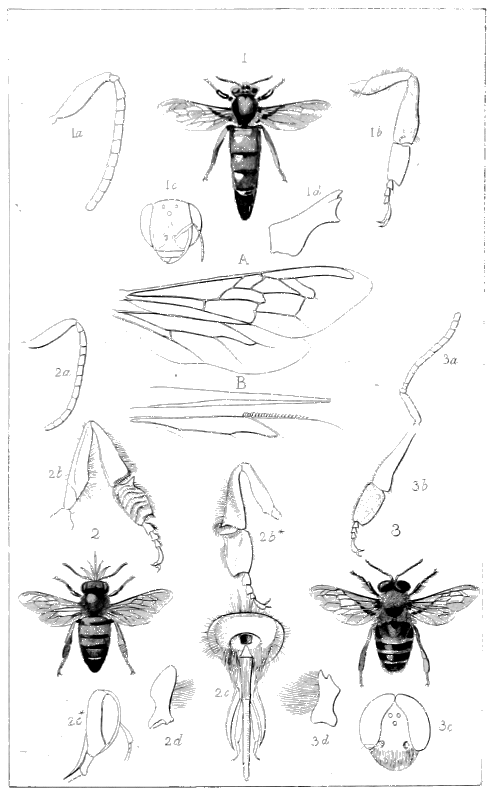
E. W. Robinson, Delt. et Scp. 1865.
§ V. THE ITALIAN OR LIGURIAN BEE.
A new, or rather a re-discovered, variety of bee has recently been brought into practical use amongst apiarians in Germany and America, as well as in this country. It has been called "the Yellow Italian Alp Bee," and was also named "the Ligurian Bee" by the Marquis de Spinola, who found it in Piedmont in 1805; and he considered it to be the principal species known to the Greeks. "There can exist no doubt," says Kleine, in his handbook, "The Italian Bee and its Culture," "that both kinds were known side by side from the earliest times. Even mythology relates that Jupiter, out of gratitude for their having fed him with honey when a new-born god, afterwards made the bee 'brass-coloured' or 'golden-coloured.' Aristotle also noticed the coloured as different from the black bee, and Virgil adduces the same distinction." The latter speaks of the "best kind" of bee as being of a golden colour with ruddy scales. It is stated that it is found also in Spain. Leading apiarians are all but unanimous in pronouncing these bees justly entitled to the high character given them. The special advantages claimed for them are—greater fecundity of the queens, more industry and productiveness, less irascibility, and a more handsome appearance; for, being of a golden colour, they are prettier than our black bees. (See coloured engraving, Plate I. Figs. 1, 2, 3.)
The Italian varies but little from the common bee in its physical characteristics. The difference in appearance consists in the first three rings of the abdomen being of an orange colour instead of a deep brown, except the posterior edge and under portion of the third, which are black: some individuals, however, have less colour about them than others—the younger bees far the most. These orange-coloured parts are transparent when closely examined with the sun shining on them. The drones are more darkly ringed than the workers, and are light-yellow beneath, which is an infallible mark of distinction from the English drones, which are nearly white in that part; many are also a fourth part smaller than the English. The queens vary greatly: "The finest and rarest," says Von Berlepsch, "are bright yellow varying into a bluish. Others rather resemble the workers, exhibiting only yellow rings; and a few are very difficult or impossible to distinguish from our own. From this we see that the Italian is not a constant race, like, e.g., our own or the Egyptian."
It is now over thirty years since attention was recalled to this variety by Captain von Baldenstein, who, when stationed in Italy during a part of the Napoleonic wars, had observed that the bees about Lake Como were of a different colour from ordinary ones. In later years, after his retirement from military life, he became a student of natural history, and, remembering these bees, he procured a colony of them in 1843. This he preserved, through constant disappointments, for seven years, and in 1848 he communicated to the Bienenzeitung the deductions of his experience. From this Dr. Dzierzon was induced to pursue the experiment, and from him the variety became introduced in Germany.
The introduction of this new variety of bee into England was through our agency. M. Hermann, a bee-cultivator at Tamins-by-Chur, Canton Grison, Switzerland, wrote to us on the 5th of July, 1859, offering to supply us with Italian queen bees. The date should be specially noted, because this was the commencement of a new era in bee-keeping in this country. We were always in friendly intercourse with the late Mr. H. Taylor, author of "The Bee-keeper's Manual," and then correspondent on Bee Culture to the Cottage Gardener (since called the Journal of Horticulture); and, being in the practice of frequently discussing apiarian subjects with him, we told him of the offer made us of a new kind of bee. He said he knew nothing about it himself, but asked permission to publish the intelligence in the journal he was connected with, and we assented, entirely for public interest and to gratify him. The letter, or an extract from it, appeared accordingly in the current number of the journal referred to. Prior to this the Italian, or, as many have called it, the "Ligurian" bee, was UNKNOWN IN THIS COUNTRY, except to a few naturalists. The same letter attracted the attention of that intelligent apiarian, the late T. W. Woodbury, Esq., so well known as the "Devonshire Bee-keeper." On the 19th of July, that is, a fortnight after M. Hermann's offer, we received a consignment of Italian bees—the first imported into England. With these Mr. Woodbury also received one queen bee and a few workers, which he introduced into a hive of English bees from which the queen had been removed. His efforts were very successful, and "the spring of 1860 found him in possession of four Ligurianised stocks." His subsequent experience with this new variety he fully described in a communication to the Bath and West of England Agricultural Journal.
Subsequently M. Hermann sent us a copy of his pamphlet entitled "The Italian Alp Bee; or, the Gold-Mine of Husbandry," with the request that we should have it translated from the German, and that copies of it should be printed in the English language. It was speedily published by us accordingly, and, although singular as a literary production, it may be useful for the advanced apiarian.
Certainly the bees are partially of an orange or golden colour, and if one could believe the golden anticipations indulged in by M. Hermann respecting them, these would be sufficient to identify the Italian bee as the species described by Hood in "Miss Kilmansegg"—those which dwelt in
"A golden hive, on a golden bank, Where golden bees, by alchemical prank, Gather gold instead of honey."
In the pamphlet referred to, M. Hermann gives the following description of what he insists on designating as Apis helvetica: "The Yellow Italian Alp bee is a mountain insect; it is found between two mountain chains to the right and left of Lombardy and the Rhetian Alps, and comprises the whole territory of Ticino, Val Tellina, and the southern Grisons.[9] It thrives up to the height of 4,500 feet above the level of the sea, and appears to prefer the northern clime to the warmer, for in the south of Italy it is not found. The Alps are their native country, therefore they are called Yellow Alp or tame house bees, in contradistinction to the black European bees, which we might call common forest bees, and which, on the slightest touch, fly like lightning into your face.[?]
"As all good and noble things in the world are more scarce than common ones, so there are more common black bees than of the noble yellow race, which latter inhabit only a very small piece of country, while the black ones are at home everywhere in Europe, and even in America."
Our own experience with the Italian bee enables us to corroborate the statements which have been made in its favour. We find the queens more prolific than those of the common kind, and the quantity of honey produced is greater. These two facts stand as cause and effect: the bees being multiplied more quickly, the store of honey is accumulated more rapidly, and the Italian bees consume, if anything, less food than the common kind. When of pure Italian blood these bees are, by some apiarians, thought to be hardier than our own. That they forage for stores with greater eagerness, and have little hesitation in paying visits to other hives, we can testify from our own observation. The following anecdote will illustrate their intrusive propensities; Another bee-keeper, who lived in the same neighbourhood, was once inspecting our hives, when, on observing the yellow bees, he exclaimed, "Now I have found out where those strange-looking bees come from; for," said he, "these yellow-jackets are incessant visitors to my hives. I thought they were a species of wasp that had come to rob, and until now I have been unable to account for their appearance at the entrance of my hive, so that I have killed them by hundreds." This was not at all pleasing intelligence for us, and we trust that our neighbour has been more lenient to "the yellow-jackets" since his visit, for such summary capital punishment was wholly unmerited, because when a bee is peaceably received (see page 169) it becomes naturalised, and works side by side with the others in its fresh abode. We are inclined to believe that more visiting takes place amongst bees of different hives than bee-keepers have been accustomed to suppose; but where the Italian and black bees are kept near each other, the foreigners being conspicuous by their lighter colour, there is less difficulty in identifying them when at the entrance of other hives. Von Berlepsch, we find, remarks that there exists during the gathering season a species of "communism of dwellings" between the bees of neighbouring hives.
The Italian bees are more active than common bees when on the wing. They are also observed to work longer hours than other bees both early and late, as well as in seasons when the latter will not stir abroad. Thus altogether they are much more productive. In many seasons we have had more honey from an Italian stock than from any one of our colonies of black bees. From this hive we have taken a glass super containing forty pounds nett of honey, besides having drawn from it an artificial swarm; and after all it remained the strongest hive in our apiary.
In a private letter received from Mr. Langstroth he informed us that in the season of 1865 he bred over 300 Italian queens; these he disseminated to various' bee-masters on the American continent, and the united opinion of apiarians in that country was increasingly in favour of the decided advantage of the cultivation of the Italian bee. At the present date it is literally "all the rage" with bee-keepers there. With ourselves there is a quieter but not less genuine welcome accorded to it. In the British Bee Journal for May 1877, the distinguished apiarian "A Renfrewshire Bee-keeper" writes: "After careful study and comparison of both I found the Italian superior for beauty, prolificness, power, and activity, and (to my view the greatest value of all) for fresh blood."
To the testimonies already cited we will now add that of the late Mr. Woodbury. The following is extracted from the paper contributed by him to the Bath and West of England Agricultural Journal: "From my strongest Ligurian stock I took eight artificial swarms in the spring, besides depriving it of numerous brood-combs. Finding, in June, that the bees were collecting honey so fast that the queen could not find an empty cell in which to lay an egg, I was reluctantly compelled to put on a super. When this had been filled with thirty-eight pounds of the finest honeycomb,[10] I removed it, and as the stock hive (a very large one) could not contain the multitude of bees which issued from it, I formed them into another very large artificial swarm. The foregoing facts speak for themselves; but as information on this point has been very generally asked, I have no hesitation in saying that I believe the Ligurian honey bee infinitely superior in every respect to the only species that we have hitherto been acquainted with."
The chorus of praise is not however universal. Most noticeable is the broad divergence of views between the two greatest apiarians of Germany—Dr. Dzierzon and Baron von Berlepsch. The former pronounces this bee less given to stinging, less sensitive of cold, more prolific, earlier in brood-raising and swarming, forwarder also in comb-building, more industrious and honey-yielding, more courageous in defence of its stores, and prompter in expelling the drones. The Baron examines these and other assertions one by one, and declares emphatically that, after a long course of experience, he has not found them true in a single particular. He calls the bee "the Italian humbug," and sums up as follows: "While it may perhaps be distinguished from our own by a somewhat slighter disposition to sting, but, on the other hand, it begins building drone comb and raising numbers of drones in the first year, and its queens grow unfertile so early, and that mostly at so inopportune a time, it stands manifestly inferior to our own in a relation of economic utility, and has therefore for us no practical value at all."[11]
Though we are unshaken in our adhesion to the Italian bee by these opposite views, it is impossible to treat them as beneath consideration. They are not a mere prejudice, for the Baron was at first as much prepossessed in the strangers' favour as any one. But it would be still less possible to set aside on their account the united testimony of Dzierzon, Langstroth, and a host of others who are above delusion on such a point. How then can we account for this one notable divergence? In the first place, much of Von Berlepsch's data are negative only, and negative evidence can never set aside positive; thus when he tells us that he "has not observed" earlier activity or greater courage or less sensitiveness, while others of unquestioned judgment have observed these points, we cannot hesitate to decide in the favour of the latter. As to less disposition to sting, the positive evidence should be on the Baron's side when he says that they do sting; but in this case, as we have seen, he partly concedes the point. As to productiveness and fecundity, there may be some undetected peculiarity about this bee to which something in the Seebach apiary or neighbourhood is not so congenial as in other parts. At all events. Dr. Dzierzon is unmoved from his faith, for we find him in the present year giving as the result of twenty-five years experience that this bee is "as gentle, diligent, and prolific as it is beautiful;" that it "bears our German climate well, and that its preservation in purity is with some care quite possible."
Still some persons are sure to be disappointed with a foreign bee, just as some will be with a foreign country. Some have had their expectations raised too highly, and expect wonderful results to follow without effort; others, on the contrary, are so wrapt up in the new treasure that they cherish it with vastly greater pains than their other bees, and thus attribute to the bee itself what is partly to be credited to their own superior care. In particular, with regard to the greater fecundity of the queens, we think some allowance ought to be made for the circumstance that in order to meet the demand for Italian queens they are being continuously bred, so that when united to English stocks they are always young and in the prime as to fertility; whilst the common black queens are allowed to exist in the hives their appointed time, as there is nothing to call for encouraging their special propagation. In making comparisons we think this fact has been a little overlooked; but though too much may have been thus credited to the Italians, we think there is a clear balance on this point in their favour, and they retain altogether our most decided preference.
§ VI. OTHER FOREIGN VARIETIES.
1. Carniolan Bees.—In appearance this variety is very much like our English bee. The difference is that the rings on the abdomen are whiter; otherwise (except by a close observer) one would not be known from the other.
Eight years ago the Rev. W. C. Cotton (brother of Lord Justice Cotton and author of "My Bee Book") had a stock of these bees from Austria, where they are largely cultivated, and he left them under our charge. We placed them in our own apiary at Hampstead, where they did very well, working a capital super in the first year, as well as parting with a fine swarm. The second year Mr. Cotton had the swarm sent to his own apiary, near Chester, because he wanted the original queen, which of course this had with it. This swarm had rather a remarkable adventure, and was nearly lost, as related at page 78. The Carniolans have been praised as possessing similar good qualities with the Italians, and though Von Berlepsch laughs at them and calls them "a new grand swindle," yet, as he declares them to be "closely allied, if not altogether identical," with the following variety, for which he has only good reports, his denunciations of these seem reasonably open to qualification.
2. Lower Austrian Bees.—Baron von Berlepsch mentions these as a variety which he found, to his surprise, in the neighbourhood of Vienna, but which must have been the same that Von Ehrenfels had cultivated and described. They scarcely differ from the Carniolan, but about one in fifty is rather strongly marked with red upon the first ring of the back. The Baron speaks of their habitat as "the El Dorado of the Bee," and he declares them wholly free from the vices of the next sort, and thinks they raise fewer drones than ordinary bees. He recommends, as likely to be a profitable breed, a cross of these with our own variety.
3. Heath Bees.—This is a race of a very different character, deriving its name from the district known as Luneburg Heath, and found also about Oldenburg, Schleswig, and Holstein. In form and appearance Heath bees are wholly identical with our own, but they seem like bees in a lower state of civilisation, perpetually swarming without occasion and with unmanageable impulse, and producing principally drones and drone comb even with a queen of the first year. "Undoubtedly," says Von Berlepsch, "this is by far the worst kind of bee existing in Germany."
4. Greek or Cecropian Bees.—In some particulars these are like a cross between the Italian and common bees. The queen is dark bronze on the abdomen as far as the second scale, but the common colour above. Most of the workers have a ring and a half of bronze or a reddish rust-colour; some have two entire rings of this hue. They are stated to be more industrious and productive than common bees, and the drones to be smaller.
This and the two previous varieties we thus briefly notice on the basis of the remarks of Von Berlepsch. We are not aware that either of them has been introduced into this country, nor do they appear to have attained much success in Germany. Thus humorously does our author dismiss this last: "Since 1864, when Deumer sounded his trumpet with distended cheeks, we have heard not so much as a last dying speech from the Cecropian bee, and she seems already in Germany to have gone the way of all flesh. May the earth lie lightly on her!"
5 and 6. Cyprian and Smyrnæan Bees.—"A Country Doctor" writes in the British Bee Journal that he had prepared a translation from the Bienenzeitung of an article by Herr Corri, in which he speaks most highly of the good qualities of the Cyprian bees, and considers them in advance of any other bee that he has cultivated. In this opinion he is borne out by Count Rudolph Kolowrat of Tabor.
"It so frequently happens," proceeds the correspondent, "that the last pet receives the highest honours, and we are so apt to believe that that must have special value which has cost considerable pains to obtain, that a certain amount of caution is advisable in receiving these enthusiastic statements. Herr Corri's opinion, however, is deserving of the highest respect; for both he and the Count have been most perseveringly engaged for many years past in importing various races of bees from their native lands, and making comparative observations as to their merits, and this without being biased by the expectation of commercial gain.
"The bees got from Smyrna (1864) seem to stand next in their estimation. Both the originally imported stocks, and those subsequently raised from them, presented, however, a certain number of black bees, and after the most painstaking attempts to breed them pure the results remained the same. The conclusion come to was that they were of a mixed race."
Our own experience tallies very much with this opinion. We imported from Germany stocks of both the Cyprian and Smyrnæan bees, and exhibited them at the bee shows of the British Bee Association. Previous to doing so we submitted specimens to Mr. F. Smith of the British Museum, and he reported favourably of them—that although resembling the Italian (Apis ligustica), the Cyprian were clearly of a different species, but more nearly approaching the Egyptian (A. fasciata): they certainly possessed the irascible qualities so distinctive of the Egyptians, and used their stilettoes unmercifully on some of the gentlemen connected with the show. We have not been sufficiently enamoured of them to pursue their cultivation further. The resemblance is so close to those bees already domiciled here that we see no special advantage to be gained by doing so.
7. Asiatic Bees.—This bee (Apis dorsata) is a distinct species; it is larger than our own, and exists in a wild state in the woods of India. Mr. Woodbury made considerable exertions to have a colony brought to England, but without success. The stings of these bees, are more formidable than those of the varieties possessed here, and except as a matter of curiosity we can see nothing to recommend their introduction.
8. Egyptian Bees.—These bees, though called Apis fasciata, are considered by many as a variety of the same species as ordinary bees. They are rather smaller and slenderer than our own and the Italian, though closely resembling the latter in appearance. They have white hairs all about them, and the first two and a half rings of the abdomen are of a reddish yellow. The drones are also well marked with similar rings, and the queen is even more beautiful than the Italian. Baron von Berlepsch recommends crossing the handsomest Italian queens with Egyptian drones, with a view solely to the æsthetic purpose of raising the most beautiful breed of bees to be obtained.
The German apiarian Herr Vogel has given special attention to this variety, and has discovered in it some interesting peculiarities. It never gathers propolis, but uses wax in its place; and it seems almost proof against the cold. But the most singular fact that has come to his knowledge is that there exist regularly in an Egyptian colony some twelve or so small drone-laying queens, which would be called fertile workers but that they have a distinctive appearance, consisting in the waxen yellow of their breasts—a feature which is possessed also by the drones of their progeny. This is assuredly one of the most curious discoveries that have ever been made in relation even to this most curious of insects.
The late Mr. Woodbury imported some of these bees, but found them exceedingly vicious, and really to possess no superiority over our English bees. Some years since Mr. Waterhouse Hawkins, the naturalist, bought a stock of Mr. Woodbury, and brought them with him in order to place in the Horticultural Gardens at South Kensington. Being unacquainted with the placing of bees, he asked our aid in doing so. From the experience of them thereby acquired our own idea would be that no one could ever desire such bees; they came out with a rush, and stung everybody within reach, right and left, who was not provided with a veil.[12] This is the kind of bee found in Palestine, and therefore the one which Samson found in the carcase of the lion.
In connection with this species, the Rev. H. B. Tristram, in his valuable book, "The Land of Israel," has an interesting account of the bees in that country. In Palestine bee-keeping is an important item of industry, and every house has a pile of beehives in its yard. Their bee, he says, "is amazingly abundant, both in hives, in rocks, and in old hollow trees. It is smaller than our ordinary bees, with brighter yellow bands on the thorax and abdomen, which is rather wasp like in shape, and with very long antennæ. In its habits, and especially in the immense population of neuters in each community, and in the drones cast forth in autumn, it resembles the other species. Its sting also is quite as sharp. The hives are very simple, consisting of large tubes of sun-dried mud, like gas-pipes, about four feet long, and closed with mud at each end, leaving only an aperture in the centre large enough for two or three bees to pass at a time. The insects appear to frequent both doors equally. The tubes are laid in rows horizontally, and piled in a pyramid. I counted one of these colonies, consisting of seventy-eight tubes, each a distinct hive. Coolness being the great object, the whole is thickly plastered over with mud and covered with boughs, white a branch is stuck in the ground at each end to assist the bees in alighting. At first we took these singular structures for ovens or hen-houses. The barbarous practice of destroying the swarms for their honey is unknown. When the hives are full the clay is removed from the ends of the pipes, and the honey extracted with an iron hook; those pieces of comb which contain young bees being carefully replaced, and the hives then closed up again. Everywhere during our journey we found honey was always to be purchased; and it is used by the natives for many culinary purposes, and especially for the preparation of sweet cakes. It has the delicate aromatic flavour of the thyme-scented honey of Hybla or Hymettus.
"But, however extensive are the bee colonies of the villages, the number of wild bees of the same species is far greater. The innumerable fissures and clefts of the limestone rocks, which everywhere flank the valleys, afford in their recesses secure shelter for any number of swarms; and many of the Bedouin, particularly in the wilderness of Judæa, obtain their subsistence by bee-hunting, bringing into Jerusalem jars of that wild honey on which John the Baptist fed in the wilderness, and which Jonathan had long before unwittingly tasted, when the comb had dropped on the ground from the hollow tree in which it was suspended. The visitor to the Wady Kurn, when he sees the busy multitudes of bees about its cliffs, cannot but recall to mind the promise, 'With honey out of the stony rock would I have satisfied thee.' There is no epithet of the Land of Promise more true to the letter, even to the present day, than this, that it was 'a land flowing with milk and honey.'"
The question as to the worth or worthlessness of the above respective varieties is not yet so decided a matter as it is with the Italians. Those interested in the sale of a particular race will praise it up, while those who have had a single disappointment with it will run it down—and that is nearly the sum of the experience to be gathered from current literature. Thus we find Dathe announcing, "I have discontinued the rearing of Cyprian, Egyptian, and Carniolan bees." That is intelligible; but in the same paper we read, "Between the German and Heath bees there is no particular difference"—which so staggers us after Von Berlepsch's vituperations of the latter that we do not know how much confidence we ought to place in the rest of the sentence, which is given as the summing up of a discussion in that famous bee country, Silesia: "The Egyptian bee ranks after the German and Italian; the Carniolan, at the expense of honey, produces many bees; the Cyprians are diligent, but quite inclined to sting. The Herzegovinian bee is praised. Bees obtained by judicious crossing have the preference over the pure races."
Numbers of other varieties may be expected to crop up from time to time, as for instance the one last named. Della Rocca in the last century spoke of a "dawn-coloured" bee that was brought from Holland and Belgium, and which is probably one of the races included with the Italian. Dr. Gerstäcker thus classifies the varieties: The North European (now spread all over the world), the Italian with black breasts, the Italian with yellow breasts, the Egyptian, the African, and the Madagascar. Three South Asiatic bees he regards as specifically distinct—Apis dorsata, indica, and florea. Mr. F. Smith adds zonata and nigrocincta, and inclines to make a species of fasciata (the Egyptians).
§ VII. FACULTIES AND FUNCTIONS.
It would be trenching too much upon our limits if we were to venture into the inviting field to which this heading might introduce us. Still the extreme interest of the subject renders it perhaps desirable that some succinct allusion should be made to it, even if it be for little more than to remark that the information we have to give is scattered through other sections and chapters. Especially as some might be disposed to skip the unattractive portion on "Anatomy and Physiology," it may be well to state here that in the second section of that chapter will be found a brief account of the sight and other senses of bees, and of the uses of their antennæ, by which they seem to feel, hear, smell, and communicate. A remark upon their power of distinguishing colours, and its practical value, will be found in connection with our description of bee-houses for twelve hives (Chap. IV. § i.). On the senses of taste and smell we have some further observations in the sections of Chapter VI. upon "Stings," "Robbing," and "Bee-keeping in London."
For the functions and habits of bees we must also refer to the passages already instanced, as well as to the sections above on the "The Queen," etc., that on "The Rationale of Swarming" (page 72), and to those in Chapter VI. on the four substances which bees collect or secrete, as well as (though in a less degree) to those headed "Pasturage" and "General Remarks." Those who will favour our book with a consecutive reading will, we trust, find at the conclusion that all the more important and interesting facts of this class are in one or other of these places tolerably though briefly described.
The service that bees perform to flowers is a subject that has attracted much attention of late years. As every one knows, or should know, a flower has its stamens and pistils, which are respectively its male and female organs, and the pollen contained in the anthers, or little knobs on the summits of the stamens, must be conveyed to the pistils, or no seed will be produced. When the anthers burst; the pollen might happen to fall partly on the pistils, or it might not; but the visits of bees (though they do not roll about in the flower, in the manner that some have stated) are found by experience to be efficacious in conveying this dust to the right spot. Owners of fruit trees have noticed, in a season generally unfavourable to the orchard, that if during only one fine forenoon the bees had spread freely amongst the blossoms of a particular tree, that tree would prove more fruitful than its fellows. On this account the orchard is a good place for the apiary, for it seems that the more abundant the honey the better will be the crop of fruit. The whole subject is scientifically treated in Mr. Darwin's remarkable book, "The Fertilisation of Orchids," but we must add to the foregoing how much more urgent are the services of bees in the case of what are termed monœcious and diœcious plants, the former of which have the stamens and pistils in different flowers, and the latter have these flowers upon different roots. A familiar example of the former is found in the nut tree, whose long catkins, hanging like caterpillars in the early spring, are assemblages of male flowers; while the females, from which the nuts develop, may be detected by their crimson pistil-tips (stigmas), and grow in stalkless clusters of two or three in the openings of remote scaly buds. But for the visits or bees, our autumn nutting rambles would thus have but little prospect of success. In the second case, often very considerable distances intervene between the two flowers; for instance, with the common dog mercury (Mercurialis perennis), a botanist may find plantation after plantation containing male flowers by thousands, but not a single female; and at length in some far-off spot he may succeed in finding the females, equally by themselves, yet in full seed. In these cases there is nothing but the visits of pollen-gathering insects which can convey the fertilising dust to the flower for which it is designed. And according to Mr. Darwin all plants are practically diœcious, for he states that the pollen, to have a fertilising effect, must be brought to the pistils of one flower from the stamens of one on another root. Whether this be considered established or not, there remains the fact of the existence of diœcious plants as explaining the admirable design of the provision that a bee in the course of one flight shall gather pollen solely from one species. As far as honey-gathering is concerned the bee is not governed by this rule; but for this other important function it becomes absolutely essential that the right pollen, and that only, should be conveyed to the right flower. The careful observer may note how the dust on the bodies of bees varies from yellow to red and brown according to the kind of flowers from which it has been gathered, and the "socks," as the Germans call them, on the two hind legs will be found always of the same colour.
To no scientific man are we probably more indebted for observations and deductions upon this branch than to Sir John Lubbock. Whilst this edition was in course of preparation it was the writer's privilege to listen to a lecture upon "Relations of Plants and Insects" delivered by this able investigator before the Society of Arts; and the lecture has since been published as a paper in the Fortnightly Review of April 1877. In the course of his remarks Sir John cited many interesting particulars of the ways in which flowers are protected from the incursions of ants, whose visits would be harmful, both from their rifling the stores from the bees, by whom alone they are likely to be fertilised, and from the liability of the latter to desert any species in which their tender probosces were in danger of being seized by ants—it being the nature of an ant to grapple any pointed thing directed towards her. Kerner was referred to as having observed some of the modes by which such results are obviated. In some cases there are chevaux de frise around the flower, in the form of hairs pointing downwards, or other barriers which the ant cannot penetrate or surmount: notably in the corn bluebottle, which is smooth all over except just beneath the flower, and in the thicket heads of some thistles. In others there are glutinous parts which the ant cannot traverse, as was noticed in the Polygonum amphibium, which, when it grows on land, has sticky glands at the extremities of certain hairs, while when in the water, where it is safe already, it is perfectly smooth. Again, there are pendulous flowers, like the snowdrop, which are so slippery on the surface that an ant would immediately slide off, as was humorously illustrated by a sketch prepared with several others by the lecturer's daughter. Facts were also stated showing how the pollen is sometimes preserved by the closing of certain flowers at times when winged insects were not on the move, and the exclusion thereby of such as would not aid in the work of fructification. "It is not too much to say," as Sir John elsewhere expresses himself ("British Wild Flowers in Relation to Insects "), "that if on the one hand flowers are in many cases necessary to insects, insects on the other hand are still more necessary to the very existence of flowers; that if insects have been in many cases modified and adapted with a view to obtain honey and pollen from flowers, flowers in their turn owe their scent and colour, their honey, and even their distinctive forms, to the action of insects."
"And plains sad Chloris how these spoilers steal From her ripe crests the vivifying meal, Pare the thin films that shield her anthered reign, And all her nectared cells insatiate drain? No! kind intruders; all reserved for you She pours through honeyed horn her luscious dew, While, grateful for the rich repast, ye shed Fresh showers prolific round her genial bed." Evans.
§ VIII. EGGS AND TRANSFORMATIONS.
It is necessary that some explanation should be given, as to the existence of the bee before it emerges from the cell.
The eggs (Plate II. Fig. 7) of all the three kinds of bees, when first deposited, are of an oval shape, slightly curved, and of a bluish-white colour. They are glutinous on the surface when laid, which causes them to adhere to the bases of the cells where the queen deposits them. In three or four days the egg changes to a small white worm, and in this stage is known by the names of larva or grub (Plate II. Fig. 8), in which state it remains four to six days more—a drone six and a half; its dimensions enlarge during this period till it appears as a ring at the base of the cell. While in this stage it is fed by the nurse bees with a mixture of farina and honey, a transparent white fluid in which the larva floats, and the supply of which is so exactly apportioned that not a drop remains on its ceasing to be required.
The next transformation is to the nymph or pupa form. The nurse bees now seal up the cells with a preparation similar to wax, leaving them with coverings which, by their greater convexity and darker colour, distinguish them readily from honey cells. The pupa then spins round itself a film or cocoon, just as a silkworm does in its chrysalis state: workers and drones occupy thirty-six hours with this process; princesses, which spin only half-cocoons, finish them in twenty-four. The microscope shows that this cradle-curtain is perforated with very minute holes, through which the baby bee is duly supplied with air. No farther attention on the part of the bees is now requisite, except a proper degree of heat, which they take care to keep up—a position for the breeding cells being selected in the centre of the hive, where the temperature is likely to be most congenial. The cells destined for the rearing of drones are larger than those from which workers will proceed, the former standing nineteen to the square inch against twenty-seven of the latter: the former are also one-third as deep again as the latter, and are made slightly more convex when sealed over. But between the eggs themselves there is externally no difference whatever.
In from nineteen to twenty-one days after the egg is first laid (unless cold weather should have retarded it) the bee quits the pupa state, and, nibbling its way through the waxen covering that has enclosed it, comes forth a winged insect. The eggs of drones require twenty-four or twenty-five days, and those of queens sixteen or seventeen, to arrive at maturity. In the unicomb observatory hives the young bees may distinctly be seen as they literally fight their way into the world, for the other bees do not take the slightest notice, nor afford them any assistance. We have frequently been amused in watching the eager little new comer, now obtruding its head, and anon compelled to withdraw into the cell to escape being trampled on by the apparently unfeeling throng, until at last it has succeeded in making its exit. The little grey creature, after brushing and shaking itself, enters upon its duties in the hive, and after a while issues forth to the more laborious occupation of gathering honey in the fields—thus early illustrating that character for industry which has been proverbial at least since the days of Aristotle, and which has in our day been rendered familiar even to infant minds through the nursery rhymes of Dr. Watts.
§ IX. REPRODUCTIVE ECONOMY.
The fertilisation of the queen and the determination of the sexes of her progeny are two subjects of so much interest that we must make room for some exposition of the discoveries of the past thirty years in relation thereto. What has been already stated on the former of these under the section on "The Drone" consists of facts which were mainly established by Huber; but within the present generation the great German apiarians have returned to the question, and Dzierzon has set forth some most marvellous deductions, which Baron von Berlepsch has followed up with amplification and further proof. It was found that the queen while in a virgin condition was often capable of depositing eggs, and that these eggs, unlike those of poultry laid under somewhat similar conditions, would hatch equally with others, but they all produced drones. From this arose the question. Whence come the drones after the queen has been fertilised? A fact known from the days of Huber and Riem was by some supposed to settle the difficulty. In many hives there exist what are called "fertile workers"—bees having the female organs sufficiently developed to deposit eggs, but not sufficiently so to receive fecundation; and as it was found that the eggs of these fulfilled the conditions required, and invariably produced drone bees, the theory was erected that these fertile workers were the regular producers of that sex. But this plausible solution of the problem did not stand examination. Every fertile queen does habitually lay eggs in drone cells, and from those eggs drones are uniformly developed. Dissection and microscopic analysis had therefore to be resorted to, and the course of investigation commenced by Swammerdam and pursued by Mlle. Jurine was now pushed to a much further extent.
Proceeding from the two ovaries of the queen there are two canals, called oviducts, which presently unite, and immediately beyond their point of juncture is a small globular receptacle which is called the spermatheca. With fertile queens it was found that this appendage is permanently occupied by a fluid identical with that in the reproductive organs of the drones, and that as such it abounds in spermatozoa; while with a virgin queen the fluid is totally destitute of these, and is wholly different in appearance, being thin and transparent. From this discovery the conclusion followed that each egg, as it passes down the oviduct and over the mouth of the spermatheca, may either receive fecundation or not, according as the queen's own will or some other circumstance shall determine. Dzierzon accordingly propounded as the apparent, though still only hypothetical, solution of the enigma, what is known as the doctrine of parthenogenesis or virgin breeding—the law that life is imparted by the mother independently, and that every egg as originally developed in her ovaries is of the male sex, but that whenever fertilised with the male fluid it becomes transformed into a female!
To convert this hypothesis into a demonstration, Von Berlepsch invited to his apiary in succession the two great comparative anatomists Professors Leuckart and Von Siebold, and furnished each with a number of both drone and worker eggs for microscopic examination. Leuckart examined the surfaces of the eggs; Von Siebold, who followed him, tried the interiors, and the latter by this means was triumphantly successful, for, after the most careful preparation of his subjects, he detected in thirty out of forty worker eggs from one to four spermatozoa apiece, while in his twenty-four drone eggs he found not a single one. The exceptions were insufficient to invalidate the results, for the ten worker eggs in which no signs of impregnation were found were only the failures of observation to be naturally expected in so delicate a scrutiny. Thus the fact was established that eggs which produce male bees are descended from the female only—in other words, that drones have no fathers!
Most strikingly has this law been corroborated by a discovery which we owe to the introduction of the Italian bee—a discovery, too, which any bee-keeper can make for himself. If an Italian queen is crossed with an English drone, or vice versa, the workers only of her progeny will be mongrels—the drones will invariably retain the pure blood of the queen, thus proving to demonstration that they owe their origin to her alone. Should a mongrel drone be then observed, it will be a sure sign that a fertile worker is in the hive: the queen will not be its mother. Dr. Dönhoff, we are told, confirmed the same law by a converse method, having in 1855 obtained a worker bee from a drone egg which he had artificially impregnated with the male fluid.
The queen, as we have observed, is capable before fertilisation of becoming the mother of drones, but it is believed by some that if she has once commenced drone-laying it is impossible for her to become subsequently fertilised. Mr. Langstroth, however, mentions an instance to the contrary, where a queen of his, after persistently laying drone eggs for a week or two, became after that the happy mother of a thriving colony of workers. Von Berlepsch alludes to this case (with others like it), but is unconvinced, being suspicious that here again it was a fertile worker and not the queen who laid the drone eggs. But looking to the fact that many permanently unfertile queens lay drone eggs, while others lay no eggs at all, does it not seem reasonable that a similar difference may subsist previous to fecundation? Thus, while the Baron is on firm ground as to the general rule, we incline to a belief that as to the exception the American observer is quite correct.
Dzierzon thus writes: "In general, so long as the young queen continues her wedding flights—which in the warm summer she does at the very most for four weeks, but in the cool spring or autumn, when life and development are slower in the hive, she still pursues for even five or six weeks—she is capable of becoming properly fertile." But some queens continue to fly long after it is hopeless, cases being recorded in which they have gone on for ten or twelve weeks. The same observer speaks of having had several young queens which were either lame in their wings or born in a continued cold season, so that they were prevented from leaving the hive, and thus developed into confirmed drone-breeders. The queen leaves the hive every fine day till her purpose is accomplished, and this led Bevan and others to surmise that she met successively with several drones till one Of them lost his life in consequence; but we do not find in later authorities any confirmation nor even mention of this conjecture, and it may be set down as entirely improbable. In the case observed by Von Klipstein, and referred to above (page 22), as the queen met with her death shortly after, he sent her to Leuckart, who found that from this obviously first impregnation her organs were so completely filled as to imply no need for a second. Leuckart has elsewhere stated that a queen's spermatheca is capable of containing twenty-five millions of spermatozoa, so that there need be no wonder at the fact of a single fecundation being sufficient to answer for her entire term of existence.
The fertile workers, which by their course of adding to the drone stock may prove a terrible nuisance in a hive, were ascertained by Huber to be always hatched in close proximity to the queen cells, whence he conjectured that they obtained by accident a portion of the royal jelly designed for the rearing of princesses. Von Berlepsch and Langstroth prefer the theory that such jelly was purposely given them, and the conversion of their own cells into royal ones commenced, but that the intention was afterwards abandoned, as it is known that bees often, start more of such cells than they ultimately proceed with. They are of only exceptional occurrence in hives in a normal condition, but in a queenless stock they very often appear, sometimes even in considerable numbers, having been probably fostered with the jelly, but at too late a period to convert them into queens. They usually deposit their eggs correctly in drone cells, though drone-breeding queens lay in those of workers and even in royal cells—thus evincing a presence of the will though an absence of the power. To get rid of a fertile worker it has been recommended by Mr. Rorl to "drive" the bees (Chap. V. § iv.) to an empty hive, and place this in a near spot; all will return to their old home except the one to be got rid of, she having probably never flown before, and therefore not knowing her way.
§ X. RELATION OF SEX TO CELLS.
There remains the very interesting question of the connection between sex and cells, which, if it be not paradoxical to say so, is as a general rule invariable; that is to say, when both the queen and the hive are in a normal condition, the eggs laid in each class of cells produce respectively workers and drones without failure or exception. But in abnormal circumstances, as with a drone-breeding queen, the law does not hold, and drones of a diminished size are hatched from worker cells, though the bees, on discovering the state of things, do their best by subsequent elongation to adapt the cradles to their unexpected occupants. Such is the explanation of the existence of "small drones;" but workers hatched in drone cells do not appear to be in any way peculiar. In regard then to the main fact we are confronted with the question, Has the queen a knowledge, at the moment of laying, of the gender of each particular egg? Rather, it would seem, she has the power of making it what gender she pleases by compressing her spermatheca or not at the instant of its passing down her oviduct. We must however refer to an ingenious theory to the contrary, quoted by Langstroth as started by his friend the late Mr. Wagner of Philadelphia, and which has been approved by many in this country and Germany also. It is to the effect that not the queen's own will, but the narrow limits of the worker cells, administer the above compression, while the more spacious drone cells allow her body to be inserted without such effect. Von Berlepsch however, it is safe to say, has absolutely demolished this mechanical explanation; and as some recent writers have quoted the "Wagner theory" with approval, it may be best to give the German observer's principal objections in his own words:—
"This explanation is thoroughly untenable; for—(a) perfectly new worker cells are fully as wide as very old drone cells in which breeding has taken place many times, and yet, as found by experience, female bees come from the former and males from the latter, (b) Many queens are of a strikingly slender form, some of them occasionally so small that they can scarcely be distinguished from workers, and yet they have no proclivity to drone-laying—which must however have been the case if the narrow cell effected the fertilisation of the egg by pressure.... (c) A queen lays even in cells that are scarcely begun, with which, therefore, the proportion of the diameter to the thickness of her body can exercise no influence at all, and yet drones come forth from the drone cells and workers from the worker cells. (d) If there are no drone cells at her command, and the stock is in want of drones, the queen lays male eggs in worker cells, and drones hatch from them.... (i) A fertile queen, if introduced with her colony into a hive containing nothing but drone comb, would naturally [on such hypothesis] furnish the drone cells with eggs as she would worker cells, and make no difficulty about it. But she does make a very great difficulty—for a long time she lays no eggs in the cells at all, but lets them drop, or tries to escape abroad with her entire colony. But at last she does lay in the drone cells, and what ensues? Ordinary worker bees come forth." Instances follow of experiments decisively proving this. It is only fair, however, to add that Mr. Wagner's theory does not necessarily degrade the monarch of the hive into "a mere egg-laying machine," as Von Berlepsch regards it in some of his arguments, for she might still exhibit intelligence in deciding which cells to lay in, even if the determination of the sex of the egg rested finally with the cell which she had chosen.
The queen then exercises a personal control over each egg as she deposits it, but, unless interfered with by irregular circumstances, she adapts her will to the cells and chooses the cells according to the requirements of the hive. But when both drones and workers are in requisition she lays her eggs in each class of cells just as she comes to them, as to which fact the Baron gives abundant evidence, having in one instance observed a queen make no fewer than five changes in a day from worker to drone cells or vice versa without any intermission. Inconsistent as it may appear, she also herself deposits in royal cells the eggs which are to hatch into her rivals—that is, when these cells have been prepared with a view to swarming;—for the preponderance of argument goes against the belief that eggs are ever removed into these by the workers.[13] In addition to determining the sex she is further capable of regulating to a large extent the total number of eggs she lays, and thus of modifying the growth of the population with the character of the season and the condition of the colony; thus a queen that has been transferred from a weak to a strong hive has been know to vary in two or three days from no eggs at all to two thousand a day. She lays during some ten months of the year, suspending the process in November and December. For her first season she lays almost exclusively worker eggs.