Chapter V · BEE MANIPULATION. (continued 2)
Reading edition
After the end comb is thus removed it will be easy to extract the others, as there will now be plenty of room for drawing them out. If the bar-frame holder (page 192) is not at hand an empty hive of the same size will serve; and care should be taken that each comb occupies the same relative position that it did in the hive so that the same order may be afterwards retained when they are replaced.
In handling the frames it should be borne in mind that they are to be held perpendicularly. To gain a view of both sides of the comb when searching for the queen, or for any purpose requiring full inspection, the reverse side may, with a little dexterity in twirling the frame round, be brought to face the operator, without letting the comb break away by its own weight and so fall out of the frame, which it may do if allowed to deviate from its upright or downright position. If the beginner could see an experienced person perform the operation he would quickly understand how combs may thus be handled without any risk of a smash.
The bee-keeper should be on his guard not to tempt the avarice of bees by exposing honey, either in the comb or liquid, and also to be very tardy of opening frame hives in the spring or autumn. If needful to do so, soon after sunrise is the safest, because there will be few bees about, and the hive should be taken, if convenient, to a quiet corner of the garden, many yards away from the other hives, and what is requisite done speedily, so as not to expose the honey to the scent of a host of robbers, who will most unceremoniously pillage and cause a terrible commotion.
When replacing frames in the hive, care must be taken not to crush a bee, and on no account must the frame be let down with a jerk, or the insects will become exceedingly fierce; it should be so slowly deposited in its place that a bee on feeling the slightest pressure may be able to escape unhurt. The crown-board should be replaced by first resting its front edge along the back, and then sliding it forward, so that any bee upon it is pushed away instead of being crushed. Should the hive have its super on, the same directions may be followed. The super with its honey-board may be bodily taken away, and so placed and confined for a time that robber bees cannot find an entrance, and also be far enough from the apiarian to be out of danger of being broken or overturned by him.
It will be sometimes found, in cases in which the bees have not had sufficient storage-room, that they have carried their building operations outside and above the frames, or across from comb to comb. Such cells must be severed and the materials melted down for wax. There are also cases in which fine white combs of honey can be taken from the end frames of the stock hive; but probably not more than one comb could be removed in a season without impoverishing the bees.
§ XVI. EXTRACTING HONEY.
Those of our readers who prefer eating "run honey" to honey in the comb may be glad of some instruction as to the best method of separating the two. Beyond all question they will find this in the use of the honey-extractor (page 193), but in default of such, and for extracting honey from combs made in supers, the following should be the course pursued:—
Take a sharp knife, and slice the combs on both sides, keeping the knife parallel with the partition wall, so that every cell may be laid open. Place these broken combs in a sieve, or on a piece of muslin stretched across and tied round the opening of a pan or large-mouthed jar. Allow the honey to flow out of the combs spontaneously, and reserve the squeezing process for a separate jar, so that the honey of the first-drained jar may be perfectly pure, both in appearance and flavour. That which has pressure put on it will be waxy in flavour and thick. Some persons recommend that the opened combs be placed in the sun, as the heat will cause the honey to run more freely. The great disadvantage of this is the temptation the honey offers to bees, who will be eager to gain a share. Honey, whilst in the combs, keeps remarkably well when left in the supers; if cut out, the combs should be folded in writing paper, and sealed up, so as to effectually prevent the free entrance of air; they should then be placed in a warm dry closet.
§ XVII. MELTING COMBS DOWN.
Comb for which there is no use as such should be melted down into cake wax. Brood comb which has undergone its five years or so of service will probably not repay the trouble, and should therefore be thrown away. But if in good condition it should be put into a clean saucepan with plenty of soft water, and gently boiled or simmered over a clear fire till it is melted, when, the wax will rise to the top. It must then be run through a strainer (never mind a little water going with it) into a stoneware or earthen pan, the sides of which have beep greased to prevent adhesion. The refuse is then collected in a coarse bag and boiled again, a flat iron or other heavy weight being placed upon it to hold it down, and a plate or other false bottom beneath it to prevent its burning. By working this about with a rod or ladle a quantity more of wax will be brought out from it, and more still by applying to the bag a wet rolling-pin upon a board also wet; the additional wax thus obtained may be added to the other, and the whole boiled again with a very little clean water and over a slow fire. Skim off the dross as fast as it appears, and then pour the whole again into the greased pan, and, after letting it cool slowly, scrape off the settlings. The above is in the main Mr. Cheshire's method. Another is that of Mr. Payne, who would pour the original boil into a canvas bag of about a quart, which should be laid on an inclined board in a tub, with cold water in it below the reach of the bag; then, applying the roller, the wax is all expressed at one process, and may be collected on the water and boiled again as before. The operation must be carried on where the bees will not be able to get admittance, or the odour will bring them in great numbers.
Virgin comb, being free from cocoons or other rubbish, will not require the squeezing process, but may simply be melted into the pan, gradually cooled, and melted again. If the cooling is artificially delayed the wax will be all the clearer. If bleaching is desired, melt it again and pour it out so as to form thin streams or plates, and then lay these for a few days in the sun; take care however that they are not melted.
§ XVIII. WEIGHING HIVES.
One of the most effectual modes of ascertaining the condition of a hive is by weighing it. Such knowledge is most important at the close of the gathering season, in order that the bee-keeper may determine whether he ought to give his bees artificial food to enable them to live through the dreary winter. A knowledge of the numerical strength of the colony is also useful in enabling the bee-keeper to decide which hives will be benefited by being joined together, on the method explained in the article on "Uniting Hives."
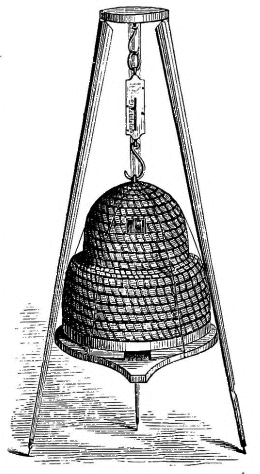
A hive can very easily be weighed if a Salter's spring balance be suspended near the apiary. The hive, having a strap or cord passed under and over it, crossing at right angles on the top, may be hooked on to the balance, so that the weight will be indicated on the dial. The annexed illustration represents a tripod stand, with a weighing-machine of the above-named construction, to which a hive with a super is attached. Such an arrangement will be found convenient for those bee-keepers who may not possess suitable sheds in their gardens where a hive could be thus suspended from a beam. To prevent the hive being swayed to and fro by the wind, three cords (gear ropes) might be attached therefrom to the three legs of the stand. The height of such a stand need not exceed four feet.
This contrivance is both portable and simple, and can be used from time to time; or, if the apiarian desires to have the hive constantly suspended, a water-proof covering might easily be made to drop over, and adapted so as to admit of being raised occasionally for ascertaining the weight shown on the dial. Much interest might be derived by watching the daily or hourly increasing store brought into a hive during the gathering season. Mr. George Fox, of Kingsbridge, and Mr. S. Bevan Fox, of Exeter, have for some years each kept one stock attached to a "Salter's Circular Spring Balance," suspended from a beam under a shed, and, from experience, found that from a hive so balanced a criterion may be formed of what other hives in the apiary are doing through the day.
Some interesting observations have been made upon this point. Baron von Berlepsch has had stocks which brought in twelve pounds of honey in a day; Kader in Mentz had days when one stock brought twenty-one pounds; Pastor Stein in Mentz had days when one stock brought twenty-eight pounds. The sap which a bee's honey-bag holds weighs but a grain, so that the bees, in this last case, must have made in one day over 160,000 journeys.
Many ingenious contrivances will, no doubt, suggest themselves for the observation of hives in this manner. For instance, instead of the cord being tied round the hive, three or four strong irons, with a screw at one end and a ring at the other (known by ironmongers as "eyes"), could be screwed into the floor-boards, to which the attachments might be made fast. It will scarcely be necessary to hint that great care is necessary that full provision should be made securely to support the increasing weight; a fall would be most ruinous, and terribly enrage the bees.
The weight of the hive should be marked on it when empty, so that the exact amount of its contents may at any time be ascertained. Experienced apiarians are able to judge of the weight of a hive by lifting it a few inches from the stand; or by looking in at the window of a stock hive a conclusive opinion may be formed as to the state of the colony. If the combs within view be well filled and sealed, it will be safe to consider that the hive contains sufficient stores to carry the bees through the winter.
§ XIX. FEEDING.
The bee-keeper, after the honey harvest, should ascertain the state of the stock hive, because it sometimes happens that hives which were very strong and productive during summer have been left poorly off for the winter. The bees, no doubt under the impression that those nicely filled supers would prove to them an ample sustenance, have given up the whole stock hive to the queen for breeding. If this be not looked after and rectified the colony will starve off; or possibly on some mild day in winter—even before all is exhausted—they will decamp as if for a swarm.
The apiarian must therefore ascertain the state of the stock hive at Michaelmas by means of a weighing machine. The weight, exclusive of the hive, ought to be from twenty to twenty-four pounds, and if not so, the bees must be fed till that weight is reached. This is done by the feeders above described (page 202), from which they suck the syrup as if honey-gathering, and then store it away, a quart in a day or so. The time of doing this should not be deferred later, as it is important that the food should be placed in the cells and sealed up, and they cannot secrete the wax for this purpose without a warm temperature; if it remained unsealed it would be liable to turn sour and cause disease. Again, at mid-winter and in very cold weather, bees, though they never become torpid like wasps, are in a state of dormant inactivity from which it is better not to arouse them.
On the return of spring it will again be essential to attend to feeding the bees, and this precaution must be exercised till May, when they will be able to take care of themselves. A little food in the spring, even when the store is not all expended, is of value as stimulating the queen to lay more abundantly, for bees are provident and do not rear the young rapidly when supplies are short. In this particular their intelligence is very striking; they have needed no Malthus to teach them that the means of subsistence must regulate the increase of population.
"Part of the wondrous whole by Heaven designed, Blest with some portion of ethereal mind,[31] The prescient female rears her tender brood In strict proportion to the hoarded food." Evans.
Judgment has, however, to be exercised to avoid over-feeding, or else so many cells will be filled with honey that the queen can find none in which to deposit her eggs, and thus the progress of the hive will be seriously interfered with. It may also lead to the formation of drone cells—a thing to be avoided under any circumstances. But if the hive is thoroughly impoverished a more rapid process of feeding becomes necessary, and the honey should be poured between the combs. The bees will lick each other clean after this.
A very good syrup can be made by boiling three pounds of loaf sugar with nearly two pints of water. Sugar-candy and barley-sugar have also been each highly recommended for winter and early spring feeding, when small pieces can easily be pushed in at the top of the stock hive a little at a time. They have the advantage of being unlikely to turn sour or to cause dysentery, as liquid food does when the bees are confined by bad weather.
It is of the most urgent importance that the bees should have water supplied them as soon as laying recommences, which should be early in January; if the weather is such as to prevent their leaving the hive, they must have it given them within. "For preparing the nourishment for the brood," says Dzierzon, "water is to the bees indispensable. Sooner could they dispense for a considerable time with pollen." It is also needful to them for the preparation of wax, and, adds the same writer, "when the egg-laying commences, some amount of wax is usually produced equally soon, the bees requiring it for the covering of the brood cells." For a double reason therefore water must be supplied them; but in their eagerness to obtain it they are often drowned, so that It is well to give it them in shallow vessels containing pebbles for them to alight on. Salt also, says Dr. Bevan, is eagerly partaken of during the early part of the breeding season till the beginning of May, after which they seem wholly indifferent to it.
Such are the instructions for the regular process of feeding, though even this, with good management, should not be needed unless in exceptional circumstances. It has been remarked in the section on "Swarming" that a supply of food is advisable at such occasions also, but this is but an incidental trifle as compared with the other. The task of bringing a hive safely through the winter will undoubtedly dismay some of the inexperienced, and perhaps incline them to a preference for the fire-and-brimstone quieters. But a little attention to directions at the first will soon make the process tolerably simple; while as to the relative profits of the two methods, it must be recollected that the honey left in the stock hive for winter sustenance is not much of it of a saleable quality, and the value of it and of any extra syrup supplied will be far more than made up when in May a swarm comes off, and two colonies are possessed where on the old system there would have been none at all.
§ XX. WINTER PRECAUTIONS.
The most important of these is the one discussed in the preceding section. There are, however, several other points which it is of consequence for the apiarian to observe.
First of all the hive itself must be suitably protected against climate, and if it be not of a description adapted to preserve warmth, a transfer must be made to one that is. Matting or other fencework may be erected to keep off piercing winds, and hay bands may be wound around the hives. Some hives constructed Of glass are unsuited for winter occupation—even when kept within doors success is difficult and doubtful. They must be well wrapped up and covered in, and yet ventilation be allowed, for unless the moisture can pass off it will condense upon the inside of the glass, thus causing the combs to grow mouldy and directly interfering with the health of the bees. The use of such hives as the unicomb is best restricted to four months in the year, when bees are most active and interesting in their operations. An artificial swarm should be put into such a hive in May or June, and taken out again in September—never later, for there are often cold nights in October, when, the bees and brood being in near contact with the glass, and not being able to cluster as is their natural wont, they suffer greatly from the variations of temperature.
The population of each hive must also be well looked to, and if needful the uniting processes (page 229) must be carried out before the Michaelmas feeding. Hives that are to be so united should be gradually brought near together, if not so already.
The innermost combs, having been the ones most employed for breeding, will now be the ones least occupied with honey. It is therefore advisable to transpose them with fuller ones, in order to keep the bees clustered in the centre. They must not, however, have drone comb thus given them. In order to give them communication through the combs, "the apiarian should," says Langstroth, " late in the fall, cut with a penknife a hole an inch in diameter in the centre of each comb, about one-third from the top." This is for the purpose of allowing the bees in cold weather to move in a body, without going outside the frames, from combs where they have consumed the food to others that have honey within reach.
Ventilation is of great moment, but if the hive allows of its being given at the top, the entrance may then be narrowed so as only just to give free passage to the bees. Holes the size of a pin's head will allow the moisture to escape, and these must be reopened as fast as they are propolised by the bees. The occurrence of a thaw is the time when ventilation is needed in its highest degree. It is a good plan to place a bell glass over the hole in the crown-board of a wooden hive, with a zinc trough round it to receive the condensed moisture. It is also requisite to clean the floor-board, say in February; but in this and other operations the bees should not be disturbed, for if they leave the hive when they are unable to fly properly, as is the case in very cold weather, they are likely to be lost.
What further directions belong to this head will be found in the next chapter under "Diseases" and "Enemies."' Mr. Langstroth has this comprehensive sentence, the italics in which are his own. "If the colonies are strong in numbers and stores, have upward ventilation, easy communication from comb to comb, and water when needed, and the hive entrances are sheltered from piercing winds, they have all the conditions essential to wintering successfully in the open air."