REPORTS TO CONGRESS ON THE SUBJECT OF ELECTRO MAGNETIC TELEGRAPHS.
Reading edition
Letter from the Secretary of the Treasury, transmitting a Report upon the subject of a System of Telegraphs for the United States. December 11, 1837.
Treasury Department, December 6, 1837.
Sir: I have the honor to present this report, in compliance with the following resolution, which passed the House of Representatives on the 3d of February last, viz. “Resolved, That the Secretary of the Treasury be requested to report to the House of Representatives, at its next session, upon the propriety of establishing a system of telegraphs for the United States.” Immediately after its passage I prepared a circular, with the view of procuring, from the most intelligent sources, such information as would enable Congress, as well as the Department, to decide upon the propriety of establishing a system of telegraphs.
It seemed also important to unite with the inquiry the procurement of such facts as might show the expense attending different systems; the celerity of communication by each; and the useful objects to be accomplished by their adoption.
A copy of the circular is annexed, (1)
The replies have been numerous, and many of them are very full and interesting. Those deemed material are annexed, numbered 2 to 18, inclusive.
From those communications, and such other investigations as the pressure of business has enabled me to make, I am satisfied that the establishment of a system of telegraphs for the United States would be useful to commerce as well as the Government. It might most properly be made appurtenant to the Post Office Department, and, during war, would prove a most essential aid to the military operations of the country.
The expense, attending it is estimated carefully in some of the documents annexed; but it will depend much upon the kind of system adopted: upon the extent and location of the lines first established; and the charges made to individuals for communicating information through it which may not be of a public character.
On these points, as the Department has not been requested to make a report, no opinion is expressed; but information concerning them was deemed useful as a guide in deciding on the propriety of establishing telegraphs, and was, therefore, requested in the circular before mentioned. Many useful suggestions in relation to the subject will be found in the correspondence annexed, and in the books there referred to.
The Department would take this occasion to express, in respect to the numerous gentlemen whose views are now submitted to Congress, its high appreciation and sincere acknowledgments for the valuable contributions they have made on a subject of so much interest.
I remain, very respectfully, Your obedient servant,
LEVI WOODBURY, Secretary of the Treasury.
The Hon. J. K. Polk, Speaker of the House of Representatives.
No. 1. Circular to certain Collectors of the Customs, Commanders of Revenue Cutters, and other persons.
Treasury Department, March 10, 1837.
With the view of obtaining information in regard to “the propriety of establishing a system of telegraphs for the United States,” in compliance with the request contained in the annexed resolution of the House of Representatives, adopted at its last session, I will thank you to furnish the Department with your opinion upon the subject. If leisure permits, you would oblige me by pointing out the manner, and the various particulars, in which the system may be rendered most useful to the Government of the United States and the public generally. It would be desirable, if in your power, to present a detailed statement as to the proper points for the location, and distance of the stations from each other, with general rules for the regulation of the system, together with your sentiments as to the propriety of connecting it with any existing department of the Government, and some definite idea of the rapidity with which intelligence could ordinarily, and also in urgent cases, be communicated between distant places. I wish you to estimate the probable expense of establishing and supporting telegraphs, upon the most approved system, for any given distance, during any specified period.
It would add to the interest of the subject if you would offer views as to the practicability of uniting with a system of telegraphs for communication in clear weather and in the day time, another for communication in fogs, by cannon, or otherwise; and in the night, by the same mode, or by rockets, fires, &c.
I should be gratified by receiving your reply by the first of October next.
LEVI WOODBURY, Secretary of the Treasury.
No. 2. Letter from S. F. B. Morse, to the Secretary of the Treasury.
New York City University, Sept. 27, 1837.
Dear Sir: In reply to the inquiries which you have done me the honor to make, in asking my opinion “of the propriety of establishing a system of telegraphs for the United States,” I would say, in regard to the general question, that I believe there can scarcely be two opinions, in such a community as ours, in regard to the advantage which would result, both to the Government and the public generally, from the establishment of a system of communication by which the most speedy intercourse may be had between the most distant parts of the country. The mail system, it seems to me, is founded on the universally admitted principle, that the greater the speed with which intelligence can be transmitted from point to point, the greater is the benefit derived to the whole community. The only question that remains, therefore, is, what system is best calculated, from its completeness and cheapness, to effect this desirable end?
With regard to telegraphs constructed on the ordinary principles, however perfected within the limits in which they are necessarily confined, the most perfect of them are liable to one insurmountable objection—they are useless the greater part of the time. In foggy weather, and ordinarily during the night no intelligence can be transmitted. Even when they can transmit, much time is consumed in communicating but little, and that little not always precise.
Having invented an entirely new mode of telegraphic communication, which, so far as experiments have yet been made with it, promises results of almost marvellous character, I beg leave to present to the Department a brief account of its chief characteristics.
About five years ago, on my voyage home from Europe, the electrical experiment of Franklin, upon a wire some four miles in length was casually recalled to my mind in a conversation with one of the passengers, in which experiment it was ascertained that the electricity travelled through the whole circuit in a time not appreciable, but apparently instantaneous. It immediately occurred to me, that if the presence of electricity could be made visible in any desired part of this circuit, it would not be difficult to construct a system of signs by which intelligence could be instantaneously transmitted. The thought, thus conceived, took strong hold of my mind in the leisure which the voyage afforded, and I planned a system of signs and an apparatus to carry it into effect. I cast a species of type, which I had devised for this purpose, the first week after my arrival home; and although the rest of the machinery was planned, yet, from the pressure of unavoidable duties, I was compelled to postpone my experiments, and was not able to test the whole plan until within a few weeks. The result has realized my most sanguine expectations.
As I have contracted with Mr. Alfred Vail to have a complete apparatus made to demonstrate at Washington by the 1st of January, 1838, the practicability and superiority of my mode of telegraphic communication by means of electro magnetism, (an apparatus which I hope to have the pleasure of exhibiting to you,) I will confine myself in this communication to a statement of its peculiar advantages.
First. The fullest and most precise information can be almost instantaneously transmitted between any two or more points, between which a wire conductor is laid: that is to say, no other time is consumed than is necessary to write the intelligence to be conveyed, and to convert the words into the telegraphic numbers. The numbers are then transmitted nearly instantaneously, (or if I have been rightly informed in regard to some recent experiments in the velocity of electricity, two hundred thousand miles in a second,) to any distance, where the numbers are immediately recognised, and reconverted into the words of the intelligence.
Second. The same full intelligence can be communicated at any moment irrespective of the time of day or night, or state of the weather. This single point establishes its superiority to all other modes of telegraphic communication now known.
Third. The whole apparatus will occupy but little space, (scarcely six cubic feet, probably not more than four;)[11] and it may, therefore, be placed without inconvenience, in any house.
Fourth. The record of intelligence is made in a permanent manner and in such a form that it can be at once bound up in volumes convenient for reference, if desired.
Fifth. Communications are secret to all but the persons for whom they are intended.
These are the chief advantages of the Electro Magnetic Telegraph over other kinds of telegraphs, and which must give it the preference, provided the expense and other circumstances are reasonably favorable.
The newness of the whole plan makes it not so easy to estimate the expense, but an approach to a correct estimate can be made.
The principal expense will be the first cost of the wire or metallic conductors, (consisting of four lengths,) and the securing them against injury. The cost of a single copper wire ¹⁄₁₆ of an inch diameter, (and it should not be of less dimensions,) for 400 miles, was recently estimated in Scotland to be about £1,000 sterling, including the solderings of the wire together; that is, about $6 per mile for one wire, or $24 per mile for the four wires. I have recently contracted for twenty miles of copper wire, No. 18, at 40 cents per pound. Each pound, it is estimated, contains 93 feet, which gives a result coinciding with the Scotch estimate, if $1.60 per mile be added for solderings.
The preparation of the wire for being laid, (if in the ground,) comprehends the clothing of the wires with an insulating or non-conducting substance; the encasing them in wood, clay, stone, iron, or other metal; and the trenching of the earth to receive them. In this part of the business I have no experience to guide me, the whole being altogether new. I can, therefore, only make at present a rough estimate. Iron tubes enclosing the wires, and filled in with pitch and resin, would probably be the most eligible mode of securing the conductors from injury, while, at the same time, it would be the most costly. Iron tubes of 1½ inch diameter, I learn, can be obtained at Baltimore, at 28 cents per foot. The trenching will not be more than three cents for 2 feet, or about $75 per mile. This estimate is for a trench 3 feet deep and 1½ wide. There is no grading; the trench may follow the track of any road, over the highest hills or lowest valleys. Across rivers, with bridges, the circuit may easily be carried, enclosed beneath the bridge. Where the stream, is wide, and no bridge, the circuit, enclosed in lead, may be sunk to the bottom.
If the circuit is laid through the air, the first cost would doubtless be much lessened. This plan of making the circuit has some advantages, but there are also some disadvantages; the chief of which latter is, that, being always in sight, the temptation to injure the circuit to mischievously disposed persons, is greater than if it were buried out of sight beneath their feet. As an offset, however, to this, an injury to the circuit is more easily detected. With regard to danger from wantonness, it may be sufficient to say, that the same objection was originally made in the several cases, successively, of water-pipes, gas-pipes, and railroads; and yet we do not hear of wantonness injuring any of these. Stout spars of some thirty feet in height, well planted in the ground, and placed about 350 feet apart, would, in this case, be required, along the tops of which the circuit might be stretched. Fifteen such spars would be wanted to a mile. This mode would be as cheap, probably, as any other, unless the laying of the circuit in water should be found to be most eligible. A series of experiments to ascertain the practicability of this mode, I am about to commence with Professor Gale, of our university, a gentleman of great science, and to whose assistance, in many of my late experiments, I am greatly indebted. We are preparing a circuit of twenty miles. The result of our experiments I will have the honor of reporting to you.
The other machinery, consisting of the apparatus for transmitting and receiving the intelligence, can be made at a very trifling cost. The only parts of the apparatus that waste or consume materials, are the batteries, which consume acid and zinc, and the register, which consumes paper for recording, and pencils or ink for marking.
The cost of printing, in the first instance, of a telegraphic dictionary,[12] should perhaps also be taken into the account, as each officer of the Government, as well as many others, would require a copy, should this mode of telegraphic communication go into effect. This dictionary would contain a vocabulary of all the words in common use in the English language, with the numbers regularly affixed to each word.
The stations in the case of this telegraph may be as numerous as are desired; the only additional expense for that purpose being the adding of the transmitting and receiving apparatus to each station.
The cost of supporting a system of telegraphs on this plan, (when a circuit is once established,) would, in my opinion, be much less than on the common plans; yet, for want of experience in this mode, I would not affirm it positively.
As to “the propriety of connecting the system of telegraphs with any existing department of Government,” it would seem most natural to connect a telegraphic system with the Post Office Department; for, although it does not carry a mail, yet it is another mode of accomplishing the principal object for which the mail is established, to wit: the rapid and regular transmission of intelligence. If my system of telegraphs should be established, it is evident that the telegraph would have but little rest day or night. The advantage of communicating intelligence instantaneously in hundreds of instances of daily occurrence, would warrant such a rate of postage, (if it may be so called,) as would amply defray all expenses of the first cost of establishing the system, and of guarding it, and keeping it in repair.
As every word is numbered, an obvious mode of rating might be, a charge of a certain amount on so many numbers. I presume that five words can certainly be transmitted in a minute; for, with the imperfect machinery I now use, I have recorded at that rate, at the distance of half a mile.
In conclusion, I would say, that if the perfecting of this new system of telegraphs (which may justly be called the American Telegraph, since I can establish my claims to priority in the invention) shall be thought of public utility, and worthy the attention of Government, I shall be ready to make any sacrifice of personal service and of time to aid in its accomplishment.
In the mean time I remain, sir, with sincere respect and high personal esteem,
Your most obedient, humble servant, SAML. F. B. MORSE.
Hon. Levi Woodbury, Secretary of the Treasury.
No. 3. Letter from S. F. B. Morse to the Secretary of the Treasury.
University of the City of New York, November 28, 1837.
My Dear Sir: In my letter to you in answer to the circular respecting telegraphs, which you did me the honor to send me, I promised to advise you of the result of some experiments about to be tried with my electro magnetic telegraph. I informed you that I had succeeded in marking permanently and intelligibly at the distance of half a mile.
Professor Gale, of our university, and Mr. Alfred Vail, of the Speedwell iron-works, near Morristown, New Jersey, are now associated with me in the scientific and mechanical parts of the invention. We have procured several miles of wire, and I am happy to announce to you that our success has thus far, been complete. At a distance of five miles, with a common Cruikshank’s battery of 87 plates, (4 by 3½ inches each plate,) the marking was as perfect on the register as in the first instance of half a mile. We have recently added five miles more, making in all ten miles, with the same result; and we have now no doubt of its effecting a similar result at any distance.
I also stated to you, sir, that machinery was in progress of making, with which, so soon as it should be completed, I intended to proceed to Washington, to exhibit the powers of the invention before you and other members of the Government. I had hoped to be in Washington before the session of Congress, but I find that the execution of new machinery is so uncertain in its time of completion, that I shall be delayed, probably, until the beginning of the year.
What I wish to learn from you, sir, is, “How late in the session can I delay my visit, and yet be in season to meet the subject of telegraphs, when it shall be presented by your report to Congress?”
I am anxious, of course, to show as perfect an instrument as possible, and would wish as much time for the purpose of perfecting it as can be allowed without detriment to my interests as an applicant for the attention of Government to the best plan of a telegraph.
I am, my dear sir, with the greatest respect and personal esteem,
Your most obedient servant, SAML. F. B. MORSE.
Hon. Levi Woodbury, Secretary of the Treasury.
No. 4. [From the New York Journal of Commerce.]
We have received the following note and diagram, with the explanation of the latter, from Mr. Morse:
To the Editors of the Journal of Commerce:
Gentlemen: You had the kindness to assert, a few days ago, my claim to the invention of the electro magnetic telegraph, for which I thank you. As to the priority of my invention, entirely planned and for the most part executed as it was nearly five years ago, I can adduce the amplest proof.
You announced that I was preparing a short circuit, to show to my friends the operation of the telegraph. This circuit I have completed, of the length of 1,700 feet, or about one-third of a mile; and on Saturday, the 2d instant, in presence of Professors Gale and Torrey of this city, and Professor Daubeny of the Oxford (English) University, and several other gentlemen, I tried a preliminary experiment with the register. It recorded the intelligence sufficiently perfect to establish the practicability of the plan, and the superior simplicity of my mode of communication, over any of those proposed by the professors in Europe.
It will be observed that no account has reached us that any of the foreign proposed electric telegraphs have as yet succeeded in transmitting intelligible communications; but it is merely asserted of the most advanced experiment, (the one in London,) that “by means of five wires,” &c. intelligence “may be conveyed.” I have the gratification of sending you a specimen of the writing of my telegraph, the actual transmission of a communication made this morning, in a more complete manner than on Saturday, and through the distance of one-third of a mile.
Thinking it may be gratifying to your readers to see the kind of writing which it performs, I have had it engraved for you, accompanied with an explanation.
Your obedient servant, SAML. F. B. MORSE.
N. Y. City University, September 4, 1837.
No. 5. Specimen of Telegraphic Writing made by means of electricity at the distance of one-third of a mile.
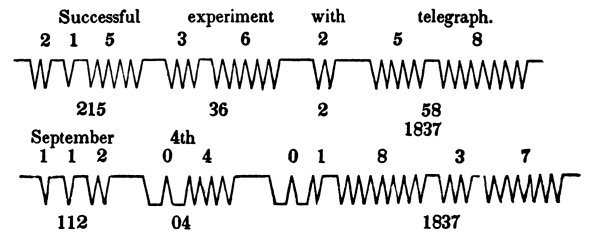
The words in the diagram were the intelligence transmitted.
The numbers (in this instance arbitrary) are the numbers of the words in a telegraphic dictionary.
The points are the markings of the register, each point being marked every time the electric fluid passes.
The register marks but one kind of mark, to wit, (V.) This can be varied two ways. By intervals, thus, (V VV VVV,) signifying one, two, three, &c., and by reversing, thus, (Λ) Examples of both these varieties are seen in the diagram.
The single numbers are separated by short, and the whole numbers by long intervals.
To illustrate by the diagram: the word “successful” is first found in the dictionary, and its telegraphic number, 215, is set up in a species of type prepared for the purpose, and so of the other words. The type then operate upon the machinery, and serve to regulate the times and intervals of the passage of electricity. Each passage of the fluid causes a pencil at the extremity of the wire to mark the points as in the diagram.
To read the marks, count the points at the bottom of each line. It will be perceived that two points come first, separated by a short interval from the next point. Set 2 beneath it. Then comes one point, likewise separated by a short interval. Set 1 beneath it. Then come five points. Set 5 beneath them. But the interval in this case is a long interval: consequently, the three numbers comprise the whole number, 215.
So proceed with the rest, until the numbers are all set down. Then, by referring to the telegraphic dictionary, the words corresponding to the numbers are found, and the communication read. Thus it will be seen that, by means of the changes upon ten characters, all words can be transmitted. But there are two points reversed in the lower line. These are the eleventh character, placed before a number, to signify that it is to be read as a number, and not as the representative of a word.
No. 6. Mr. Smith, from the Committee on Commerce, made the following Report, April 6th, 1838.
The Committee on Commerce to whom the subject was referred, have had the same under consideration, and report:
On the 3d of February, 1837, the House of Representatives passed a resolution requesting the Secretary of the Treasury to report to the House, at its present session, upon the propriety of establishing a system of telegraphs for the United States.
In pursuance of this request, the Secretary of the Treasury, at an early day after the passage of said resolution, addressed a circular of inquiry to numerous scientific and practical individuals in different parts of the Union; and, on the 6th of December last, reported the result of this proceeding to the House.
This report of the Secretary imbodies many useful suggestions on the necessity and practicability of a system of telegraphic despatches, both for public and individual purposes; and the committee cannot doubt that the American public is fully prepared, and even desirous, that every requisite effort be made on the part of Congress to consummate an object of so deep interest to the purposes of Government in peace and in war, and to the enterprise of the age.
Amid the suggestions thus elicited from various sources, and imbodied in the before-mentioned report of the Secretary of the Treasury, a plan for an electro magnetic telegraph is communicated by Professor Morse, of the University of the city of New York, pre-eminently interesting, and even wonderful. See Report, No. 2.
This invention consists in the application, by mechanism, of galvanic electricity to telegraphic purposes, and is claimed by Professor Morse and his associates as original with them; and being so, in fact, as the committee believe, letters-patent have been secured, under the authority of the United States, for the invention. It has, moreover, been subjected to the test of experiment, upon a scale of ten miles distance, by a select committee of the Franklin Institute of the city of Philadelphia, and reported upon by that eminently high tribunal in the most favorable and confident terms. An abstract from the report thus made is hereunto annexed. No. 7.
In additional confirmation of the merits of his proposed system of telegraphs, Professor Morse has exhibited it in operation (by a coil of metallic wire measuring about ten miles in length, rendering the action equal to a telegraph of half that distance) to the Committee on Commerce of the House of Representatives, to the President of the United States, and the several heads of Departments, to members of Congress generally, who have taken interest in the examination, and to a vast number of scientific and practical individuals from various parts of the Union; and all concur, it is believed, and without a dissenting doubt, in admiration of the ingenious and scientific character of the invention, and in the opinion that it is successfully adapted to the purposes of telegraphic despatches, and in a conviction of its great and incalculable practical importance and usefulness to the country, and ultimately to the whole world.
But it would be presumptuous in any one, (and the inventor himself is most sensible of this,) to attempt, at this stage of the invention, to calculate in anticipation, or to hold out promises of what its whole extent of capacity for usefulness may be, in either a political, commercial, or social point of view, if the electrical power upon which it depends for successful action shall prove to be efficient, as is now supposed it will, to carry intelligence through any of the distances of 50, 100, 500, or more miles now contemplated. No such attempt, therefore, will be indulged in this report. It is obvious, however, that the influence of this invention over the political, commercial, and social relations of the people of this widely-extended country, looking to nothing beyond, will, in the event of success, of itself amount to a revolution unsurpassed in moral grandeur by any discovery that has been made in the arts and sciences, from the most distant period to which authentic history extends, to the present day. With the means of almost instantaneous communication of intelligence between the most distant points of the country, and simultaneously between any given number of intermediate points which this invention contemplates, space will be, to all practical purposes of information, completely annihilated between the States of the Union, as also between the individual citizens thereof. The citizen will be invested with, and reduce to daily and familiar use, an approach to the high attribute of ubiquity, in a degree that the human mind until recently, has hardly dared to contemplate seriously as belonging to human agency, from an instinctive feeling of religious reverence and reserve on a power of such awful grandeur.
Referring to the annexed report of the Franklin Institute, already adverted to, and also to the letters of Professor Morse, marked 2, 8 and 9, for other details of the superiority of this system of telegraphs over all other methods heretofore reduced to practice by any individual or Government, the committee agree, unanimously, that it is worthy to engross the attention and means of the Federal Government, to the full extent that may be necessary to put the invention to the most decisive test that can be desirable. The power of the invention, if successful, is so extensive for good and for evil, that the Government alone should possess the right to control and regulate it. The mode of proceeding to test it, as suggested, as also the relations which the inventor and his associates are willing to recognise with the Government on the subject of the future ownership, use, and control of the invention, are succinctly set forth in the annexed letters of Professor Morse, marked 8 and 9.
The probable outlay of an experiment upon a scale equal to fifty miles of telegraph, and equal to a circuit of double that distance, is estimated at $30,000. Two-thirds of this expenditure will be for material, which, whether the experiment shall succeed or fail, will remain uninjured, and of very little diminished value below the price that will be paid for it.
The estimates of Professor Morse, as will be seen by his letter, marked 9, amount to $26,000; but, to meet any contingency not now anticipated, and to guard against any want of requisite funds in an enterprise of such moment to the Government, to the people, and to the scientific world, the committee recommend an appropriation of $30,000, to be expended under the direction of the Secretary of the Treasury; and to this end submit herewith a bill.
It is believed by the committee that the subject is one of such universal interest and importance, that an early action upon it will be deemed desirable by Congress, to enable the inventor to complete his trial of the invention upon the extended scale contemplated, in season to furnish Congress with a full report of the result during its present session, if that shall be practicable.
All which is respectfully submitted.
FRANCIS O. J. SMITH, JAS. M. MASON,
S. C. PHILLIPS, JOHN T. H. WORTHINGTON,
SAMUEL CUSHMAN, WM. H. HUNTER,
JOHN I. DE GRAFF, GEORGE W. TOLAND,
EDWARD CURTIS,
Committee on Commerce, U. S. H. R.
No. 7. Hall of the Franklin Institute, Feb. 8, 1838.
Report of the Franklin Institute Philadelphia.
The sub-committee, from the committee of science and arts, appointed to examine the electro magnetic telegraph of Professor Samuel F. B. Morse, report:
That this instrument was exhibited to them in the hall of the Institute, and every opportunity given by Mr. Morse and his associate, Mr. Alfred Vail, to examine it carefully, and to judge of its operation; and they now present the following as the result of their observations:
* * * * The operation of the telegraph, as exhibited to us, was very satisfactory. The power given to the magnet at the register, through a length of wire of ten miles, was abundantly sufficient for the movements required to mark the signals. The communication of this was instantaneous. The time required to make the signals was as short at least, as that necessary in the ordinary telegraphs. It appears to this committee, therefore, that the possibility of using telegraphs upon this plan, in actual practice, is not to be doubted; though difficulties may be anticipated, which could not be tested by the trials made with the model.
One of these relates to the insulation and protection of the wires, which are to pass over many miles of distance, to form the circuits between the stations. Mr. Morse has proposed several plans: the last being to cover the wires with cotton thread, then varnish them thickly with gum-elastic, and enclose the whole in leaden tubes. More practical and economical means will probably be devised; but the fact is not to be concealed, that any effectual plan must be very expensive.
Doubts have been raised as to the distance to which the electricity of an ordinary battery can be made efficient; but your committee think that no serious difficulty is anticipated as to this point. The experiment with the wire wound in a coil, may not, indeed, be deemed conclusive; but one of the members of the committee assisted in an experiment in which a magnet was very sensibly affected by a battery of a single pair, through an insulated wire of two and three-quarter miles in length, of which the folds were four inches apart; and when a battery of ten pairs was used, water was freely decomposed. An experiment is said to have been made, with success, on the Birmingham and Manchester rail road, through a circuit of thirty miles in length.
It may be proper to state, that the idea of using electricity for telegraphic purposes has presented itself to several individuals, and that it may be difficult to settle among them the question of originality. The celebrated Gauss has a telegraph of this kind in actual operation, for communicating signals between the University of Göttingen and his magnetic observatory in its vicinity. Mr. Wheatstone, of London, has been for some time also engaged in experiments on an electrical telegraph. But the plan of Professor Morse is, so far as the committee are informed, entirely different from any of those devised by other individuals, all of which act by giving different directions to a magnetic needle; and would, therefore, require several circuits of wire between all the stations.
In conclusion, the committee beg leave to state their high gratification with the exhibition of Professor Morse’s telegraph, and their hope that means may be given to him to subject it to the test of an actual experiment, made between stations at a considerable distance from each other. The advantages which this telegraph would present, if successful, over every kind heretofore used, make it worthy the patronage of the Government. These are, that the stations may be at a distance asunder, far exceeding that to which all other telegraphs are limited; and that the signals may be given at night, and in rains, snows, and fogs, when other telegraphs fail.
R. M. PATTERSON, Chairman.
No. 8. From S. F. B, Morse, to the Hon. F. O. J. Smith.
Washington, February 15, 1838.
Dear Sir: In consequence of the conversation had with the committee on the subject of my telegraph, I would state, that I think it desirable that an experiment, on a somewhat extended scale, should first be made to test both the practicability and the facility of communicating intelligence for at least one hundred miles. The experiment may proceed, as to cost, with perfect safety to the Government. First. The wire for this distance, consisting of four lengths, making a total of four hundred miles of wire, might be obtained, and receive its covering of cotton and other insulation. This length would amply suffice to ascertain the law of the propulsive power of voltaic electricity, and previous to any measures being taken for burying it in the earth. So that, if any unforeseen difficulty should occur fatal to its practicability, the wire is not consumed or lost. If the expected success is realized, then, Second. The preparation of the wire might be commenced for burying in the earth, and, being found complete through the whole route, the several portrules, registers, batteries, &c., might be provided to put the telegraph into complete action. This experiment of one hundred miles would furnish the data from which to make the estimates of a more general extension of the system. If no insurmountable obstacles present themselves in a distance of one hundred miles, none may be expected in one thousand or in ten thousand miles; and then will be presented for the consideration of the Government the propriety of completely organizing the new telegraphic system as a part of the Government, attaching it to some department already existing, or creating a new one, which may be called for by the accumulating duties of the present departments.
It is obvious, at the slightest glance, that this mode of instantaneous communication must inevitably become an instrument of immense power, to be wielded for good or for evil, as it shall be properly or improperly directed. In the hands of a company of speculators, who should monopolize it for themselves, it might be the means of enriching the corporation at the expense of the bankruptcy of thousands; and even in the hands of Government alone, it might become a means of working vast mischief to the republic. In considering these prospective evils, I would respectfully suggest a remedy which offers itself to my mind. Let the sole right of using the telegraph belong, in the first place, to the Government, who should grant, for a specified sum or bonus, to any individual or company of individuals who may apply for it, and under such restrictions and regulations as the Government may think proper, the right to lay down a way communication between any two points, for the purpose of transmitting intelligence; and thus would be promoted a general competition. The Government would have a telegraph of its own, and have its modes of communicating with its own officers and agents, independent of private permission, or interference with and interruption to the ordinary transmissions on the private telegraphs. Thus there would be a system of checks and preventives of abuse, operating to restrain the action of this otherwise dangerous power, within those bounds which will permit only the good and neutralize the evil. Should the Government thus take the telegraph solely under its own control, the revenue derived from the bonuses alone, it must be plain, will be of vast amount. From the enterprising character of our countrymen, shown in the manner in which they carry forward any new project which promises private or public advantage, it is not visionary to suppose that it would not be long ere the whole surface of this country would be channelled for those nerves which are to diffuse, with the speed of thought, a knowledge of all that is occurring throughout the land; making, in fact, one neighborhood of the whole country.
If the Government is disposed to test this mode of telegraphic communication by enabling me to give it a fair trial for one hundred miles, I will engage to enter into no arrangements to dispose of my rights as the inventor and patentee for the United States, to any individual or company of individuals, previous to offering it to the Government for such a just and reasonable compensation as shall be mutually agreed upon.[13]
I remain, sir, respectfully, your most obedient servant, SAMUEL F. B. MORSE.
To the Hon. F. O. J. Smith, Chairman of the Committee on Commerce of the House of Representatives.
No. 9. Letter from S. F. B. Morse to Hon. F. O. J. Smith.
Washington, February 22, 1838.
Dear Sir: I have endeavoured to approach a proper estimate of the expense attendant on preparing a complete telegraphic communication for some distance; and taking into consideration the possibility that the experiment may be conclusively tried before the close of the present session of Congress, I have thought that an appropriation for fifty miles of distance would test the practicability of the telegraph quite as satisfactorily as one hundred, because the obstacles necessary to be overcome would not be more proportionally in fifty than in one hundred; while, at the same time, the double circuit necessary in the fifty miles would give a single circuit of one hundred for the purpose of testing the effect of distance upon the passage of electricity. Fifty miles would require a less amount of appropriation, and the experiment could also be sooner brought to a result.
Two hundred miles of wire, or wire for two circuits for fifty miles of distance, including the covering of the wire with cotton, at $100 per mile, $20,000
Other expenses of preparation of the wire, such as caoutchouc, wax, resin, tar, with reels for winding, soldering, &c., say $6 per mile, 1,200
Batteries and registers, with type, &c., for two stations, and materials for experimenting on the best modes of magnets at long distances, 800
Services of Professor Gale in the chemical department; services of Mr. Alfred Vail in the mechanical department; services of assistants in different departments; my own services in superintending and directing the whole—total 4,000
Total, [14] $26,000
This estimate is exclusive of expense necessary to lay down the wire beneath the ground. This is unnecessary until the previous preparations are found satisfactory.
I cannot say what time will be required for the completion of the circuits for fifty miles. If the order could be immediately given for the wire, I think all the other matter connected with it might be completed so that every thing would be in readiness in three months. Much will depend on the punctuality with which contractors fulfil their engagements in furnishing the wire and other apparatus.
I remain, sir, very respectfully, your obedient servant, SAMUEL F. B. MORSE.
To the Hon. F. O. J. Smith, Chairman of the Committee on Commerce. of the House of Representatives.
No. 10. Mr. Ferris, from the Committee on Commerce, made the following Report, December 30, 1842.
That they regard the question, as to the general utility of the telegraphic system, settled by its adoption by the most civilized nations; and experience has fully demonstrated the great advantages which may be derived from its use. Its capability of speedily transmitting intelligence to great distances, for national defence, and for other purposes, where celerity is desirable, is decidedly superior to any of the ordinary modes of communication in use. By it, the first warning of approaching danger, and the appearance of hostile fleets and armies on our coasts and borders, may be announced simultaneously at the most distant points of our widely-extended empire, thus affording time and opportunity for concentrating the military force of the country, for facilitating military and naval movements, and for transmitting orders suitable to the emergency.
In the commercial and social affairs of the community, occasions frequently arise in which the speedy transmission of intelligence may be of the highest importance for the regulation of business transactions, and in relieving the anxious solicitude of friends, as to the health and condition of those in whose fortunes they feel an interest.
The practicability of establishing telegraphs on the electric principle is no longer a question. Wheatstone, of London, and his associates, have been more fortunate than our American inventor, in procuring the means to put his ingenious system into practical use for two or three hundred miles, in Great Britain; and the movements of the cars on the Blackwall rail road are at this time directed with great economy, and perfect safety to life and property, by means of his magnetic needle telegraph. If a system more complicated and less efficient than the American telegraph is operated for great distances in England, with such eminent success and advantage, there can be no reasonable doubt that, if the means be furnished for putting in operation the system of Professor Samuel F. B. Morse, of New York, the original inventor of the electro-magnetic telegraph, the same, if not greater success, will be the result. Your committee are of opinion that it is but justice to Professor Morse, who is alike distinguished for his attainments in science and excellence in the arts of design, and who has patiently devoted many years of unremitting study, and freely spent his private fortune, in inventing and bringing to perfection a system of telegraphs which is calculated to advance the scientific reputation of the country, and to be eminently useful, both to the Government and the people, that he should be furnished with the means of competing with his European rivals.
Professor Morse bases his system upon the two following facts in science:
First. That a current of electricity will pass to any distance along a conductor connecting the two poles of a voltaic battery or generator of electricity, and produce visible effects at any desired points on that conductor.
Second. That magnetism is produced in a piece of soft iron (around which the conductor, in its progress, is made to pass) when the electric current is permitted to flow, and that the magnetism ceases when the current of electricity is prevented from flowing. This current of electricity is produced and destroyed by breaking and closing the galvanic circuit at the pleasure of the operator of the telegraph, who in this manner directs and controls the operation of a simple and compact piece of mechanism, styled the register, which, at the will of the operator at the point of communication, is made to record, at the point of reception, legible characters, on a roll of paper put in motion at the same time with the writing instrument. These characters the inventor has arranged into a conventional alphabet, and which is capable of being learned and used with very little practice.
Professor Morse has submitted his telegraphic plan to the severe scrutiny of European criticism; and the Academy of Sciences, of Paris, the highest scientific tribunal in the world, hailed it with enthusiasm and approbation, when its operation was exhibited, and its principles explained by their distinguished perpetual secretary, M. Arago.
It appears, from documents produced by Professor Morse, that the thanks of several learned bodies in France were voted to him for his invention, and the large medal of honor was awarded to him by the Academy of Industry. It further appears, that several other systems of telegraphs on the electric plan (among which were Wheatstone’s, of London, Steinheil’s, of Munich, and Masson’s, of Caen) had been submitted at various times for the consideration of the French Government, who appointed a commission to examine and report on them all, at the head of which commission was placed the administrator-in-chief of the telegraphs of France, (M. Foy,) who, to a note to Professor Morse, thus writes:
“I take a true pleasure in confirming to you in writing that which I have already had the honor to say to you viva voce—that I have prominently presented to Monsieur the Minister of the Interior your electro magnetic telegraph, as being the system which presents the best chance of a practical application; and I have declared to him that, if some trials are to be made with electric telegraphs, I do not hesitate to recommend that they should be made with your apparatus.”
Your committee, in producing further evidence of the approbation by the scientific world of the system of Professor Morse, would cite the letter of Professor Henry, of Princeton College, well known for his eminent attainments in electrical science, (marked 11,) in the appendix of this report.
More recently, a committee, consisting of some of our most distinguished scientific citizens, was appointed by the American Institute of New York, to examine and report upon this telegraph, who made the report (12) in the appendix. In compliance with the recommendation of this report, the Institute awarded to Professor Morse the gold medal.
Besides the evidence these testimonials furnish of the excellence of Professor Morse’s system, your committee, as well as the greater part of the members of both Houses of Congress, have had a practical demonstration of the operation of the electro magnetic telegraph, and have witnessed the perfect facility and extraordinary rapidity with which a message can be sent by means of it from one extremity of the capitol to the other. This rapidity is not confined in its effects to a few hundred feet, but science makes it certain that the same effects can be produced, at any distance on the globe, between any two given points connected by the conductors.
Your committee have alluded to other electric telegraphs; for, as is not uncommon in the birth of great inventions, scientific minds have, at nearly the same period of time, in various parts of Europe, conceived and planned electric telegraphs; but it is a matter of national pride, that the invention of the first electro magnetic telegraph, by Professor Morse, as well as the first conception of using electricity as the means of transmitting intelligence, by Doctor Franklin, is the offspring of American genius.
Your committee beg leave to refer to the letter of Professor Morse, (marked 13,) in the appendix, to C. G. Ferris, one of the committee, giving, at his request a brief history of the telegraph since it was before Congress, in 1838, for some interesting information concerning it, and for Professor Morse’s estimate of the probable expense of establishing his system of telegraphs for thirty or forty miles.
They would also refer to the House document, No. 15, (December 6, 1837,) and to House report, No. 753, (April 6, 1838,) for valuable information on the subject of telegraphs.
Your committee invite special attention to that part of Professor Morse’s letter which details the plan of a revenue which may be derived from his telegraphic system, when established to an extent sufficient for the purposes of commercial and general intelligence. From these calculations, made upon safe data, it is probable that an income would be derived from its use by merchants and citizens more than sufficient to defray the interest of the capital expended in its establishment. So inviting, indeed, are the prospects of profit to individual enterprise, that it is a matter of serious consideration, whether the Government should not, on this account alone, seize the present opportunity of securing to itself the regulation of a system which, if monopolized by a private company, might be used to the serious injury of the Post Office Department, and which could not be prevented without such an interference with the rights of the inventor and of the stockholders as could not be sustained by justice or public opinion.
After the ordeal to which the electro magnetic telegraph system has been subjected, both in Europe and in America, and the voice of the scientific world in its favor, it is scarcely necessary for your committee to say that they have the fullest confidence in Professor Morse’s plan, and they earnestly recommend the adoption of it by the Government of the United States. They deem it most fortunate that no definite system of telegraphs should hitherto have been adopted by the Government, since it enables them to establish this improved system, which, in the opinion of your committee, is decidedly superior to any other now in use, possessing an advantage over telegraphs depending on vision, inasmuch as it may be used both by night and day, in all weathers, and in all seasons of the year, with equal convenience; and, also, possessing an advantage over electric telegraphs heretofore in use, inasmuch as it records, in permanent legible characters on paper, any communication which may be made by it, without the aid of any agent at the place of recording, except the apparatus which is put in motion at the point of communication. Thus, the recording apparatus, called the register, may be left in a closed chamber, where it will give notice of its commencing to write, by a bell, and the communication may be found, on opening the apartment. Possessing these great advantages, and the means of communication not being liable to interruption by the ordinary contingencies which may impede or prevent the successful action of other telegraphs, the advantages to be derived from it will soon be apparent to the community, and it will become the successful rival of the Post Office, when celerity of communication is desired, and create a revenue from which this system of telegraphs may be extended and ramified through all parts of the country, without imposing any burden upon the people or draughts on the treasury, beyond the outlay for its first establishment.
As a first step towards the adoption of this system of telegraphs by the Government, your committee recommend the appropriation of thirty thousand dollars to be expended under the direction of the Postmaster General, in constructing a line of electro magnetic telegraphs, under the superintendence of Professor Sam’l F. B. Morse, of such length and between such points as shall fully test its practicability and utility; and for this purpose they respectfully submit the following bill:
A bill to test the Practicability of Establishing a System of Electro Magnetic Telegraphs by the United States.
Be it enacted by the Senate and House of Representatives of the United States in Congress assembled, That the sum of thirty thousand dollars be, and is hereby, appropriated, out of any moneys in the treasury not otherwise appropriated, for testing the capacity and usefulness of the system of electro magnetic telegraphs invented by Samuel F. B. Morse, of New York, for the use of the Government of the United States, by constructing a line of said electro magnetic telegraphs, under the superintendence of Professor Samuel F. B. Morse, of such length and between such points as shall fully test its practicability and utility; and that the same shall be expended under the direction of the Postmaster General, upon the application of said Morse.
Sec. 2. And be it further enacted, That the Postmaster General be, and he is hereby, authorized to pay, out of the aforesaid thirty thousand dollars, to the said Samuel F. B. Morse, and the persons employed under him, such sums of money as he may deem to be a fair compensation for the services of the said Samuel F. B. Morse and the persons employed under him, in constructing and in superintending the construction of the said line of telegraphs authorized by this bill.
No. 11. Letter from Professor Henry to Professor Morse.
Princeton College, February 24, 1842.
My dear Sir: I am pleased to learn that you have again petitioned Congress in reference to your telegraph, and I most sincerely hope that you will succeed in convincing our representatives of the importance of the invention. In this you may, perhaps, find some difficulty, since, in the minds of many, the electro magnetic telegraph is associated with the various chimerical projects constantly presented to the public, and particularly with the schemes, so popular a year or two ago, for the application of electricity as moving power in the arts. I have asserted, from the first, that all attempts of this kind are premature, and made without a proper knowledge of scientific principles. The case is, however, entirely different in regard to the electro magnetic telegraph. Science is now fully ripe for this application, and I have not the least doubt, if proper means be afforded, of the perfect success of the invention.
The idea of transmitting intelligence to a distance by means of electrical action, has been suggested by various persons, from the time of Franklin to the present; but until within the last few years, or since the principal discoveries in electro magnetism, all attempts to reduce it to practice were necessarily unsuccessful. The mere suggestion, however, of a scheme of this kind is a matter for which little credit can be claimed, since it is one which would naturally arise in the mind of almost any person familiar with the phenomena of electricity; but the bringing it forward at the proper moment when the developments of science are able to furnish the means of certain success, and the devising a plan for carrying it into practical operation, are the grounds of a just claim to scientific reputation as well as to public patronage.
About the same time with yourself, Professor Wheatstone, of London, and Dr. Steinheil, of Germany, proposed plans of the electro magnetic telegraph, but these differ as much from yours as the nature of the common principle would well permit; and unless some essential improvements have lately been made in these European plans, I should prefer the one invented by yourself.
With my best wishes for your success, I remain, with much esteem yours, truly,
JOSEPH HENRY.
Professor Morse.
No. 12. Report of the American Institute on the Electro Magnetic Telegraph.
New York, September 12, 1842.
The undersigned, the committee of arts and sciences of the American Institute, respectfully report:
That, by virtue of the power of adding to their numbers, they called to their aid the gentlemen whose names are hereunto annexed, with those of the original members of the committee, and proceeded to examine Professor Morse’s electro magnetic telegraph.
Having investigated the scientific principles on which it is founded, inspected the mechanism by which these principles are brought into practical operation, and seen the instruments in use in the transmission and return of various messages, they have come to the conclusion that it is admirably adapted to the purposes for which it is intended, being capable of forming words, numbers, and sentences, nearly as fast as they can be written in ordinary characters, and of transmitting them to great distances with a velocity equal to that of light. They, therefore, beg leave to recommend the telegraph of Professor Morse for such testimonials of the approbation of the American Institute as may in its judgment be due to a most important practical application of high science, brought into successful operation by the exercise of much mechanical skill and ingenuity.
All which is respectfully submitted.
JAMES RENWICK, LL. D., Prof. Chem. and Nat. Phil., Columbia Col., N. Y.
JOHN W. DRAPER, M. D., Prof. Chem. and Min., University, city of New York.
WILLIAM H. ELLET, M. D. Prof. Chem., &c. Col. of Columbia, S. C.
JAMES R. CHILTON, M. D., Chem., &c., New York.
G. C. SCHAEFFER, Associate Prof. Chem., Columbia Col., N. Y.
EDWARD CLARK. CHARLES A. LEE, M. D.
Extract from the minutes of the Institute:
Resolved, That the report be accepted, adopted, and referred to the premium committee, and that the recording secretary be directed to publish the same, at the expense of the Institute.
No. 13. Letter from S. F. B. Morse to the Hon. C. G. Ferris.
New York, December 6, 1842.
Dear Sir: In compliance with your request, I give you a slight history of my electro magnetic telegraph, since it was presented for the consideration of Congress, in the year 1838.
During the session of the 25th Congress, a report was made by the Committee on Commerce of the house, which concluded by unanimously submitting a bill appropriating $30,000 for the purpose of testing my system of electro magnetic telegraphs. The pressure of business at the close of that session prevented any action being taken upon it.
Before the session closed, I visited England and France, for the double purpose of submitting my invention to the test of European criticism, and to secure to myself some remuneration for my large expenditures of time and money in elaborating my invention. In France, after a patent had been secured in that country, my telegraph first attracted the attention of the Academy of Sciences, and its operation was shown, and its principles were explained, by the celebrated philosopher, Arago, in the session of that distinguished body of learned men, on September 10, 1838. Its reception was of the most enthusiastic character. Several other societies, among which were the Academy of Industry and the Philotechnic Society, appointed committees to examine and report upon the invention, from all which I received votes of thanks, and from the former the large medal of honour. The French Government at this time had its attention drawn to the subject of electric telegraphs, several systems having been presented for its consideration, from England, Germany and France. Through the kind offices of our minister at the French Court, General Cass, my telegraph was also submitted; and the Minister of the Interior (M. Montalivet) appointed a commission, at the head of which was placed M. Alphonse Foy, the administrator-in-chief of the telegraphs of France, with directions to examine and report upon all the various systems which had been presented. The result of this examination (in which the ingenious systems of Professor Wheatstone, of London, of Professor Steinheil, of Munich, and Professor Masson, of Caen, passed in review) was a report to the Minister in favor of mine. In a note addressed to me by M. Foy, who had expressed his warmest admiration of my telegraph in my presence, he thus writes:
“I take a true pleasure in confirming to you in writing that which I have already had the honor to say to you viva voce, that I have prominently presented (signalé) to Monsieur the Minister of the Interior your electro magnetic telegraph, as being the system which presents the best chance of a practical application; and I have stated to him that if some trials are to be made with electric telegraphs, I hesitate not to recommend that they should be made with your apparatus.”
In England, my application for a patent for my invention was opposed before the Attorney General by Professor Wheatstone and Mr. Davy, each of whom had systems already patented, essentially like each other, but very different from mine. A patent was denied me by the Attorney General, Sir John Campbell, on a plea which I am confident will not bear a legal examination. But there being no appeal from the Attorney General’s decision, nor remedy, except at enormous expense, I am deprived of all benefit from my invention in England. Other causes than impartial justice evidently operated against me. An interest for my invention, however, sprung up voluntarily, and quite unexpectedly, among the English nobility and gentry in Paris, and, had I possessed the requisite funds to prosecute my rights before the British Parliament, I could scarcely have failed to secure them, so powerfully was I supported by this interest in my favour; and I should be ungrateful did I not take every opportunity to acknowledge the kindness of the several noblemen and gentlemen who volunteered to aid me in obtaining my rights in England, among the foremost of whom were the Earl of Lincoln, the late celebrated Earl of Elgin, and the Hon. Henry Drummond.
I returned to the United States in the spring of 1839, under an engagement entered into in Paris with the Russian Counsellor of State, the Baron Alexandre de Meyendorff, to visit St. Petersburg with a distinguished French savant, M. Amyot, for the purpose of establishing my telegraphic system in that country. The contract, formally entered into, was transmitted to St. Petersburg, for the signature of the Emperor, which I was led to believe would be given without a doubt; and, that no time should be lost in my preparations, the contract, duly signed, was to be transmitted to me in in New York, through the Russian ambassador in the United States, in four or five weeks, at farthest, after my arrival home.
After waiting, in anxious suspense, for as many months, without any intelligence, I learned indirectly that the Emperor, from causes not satisfactorily explained, refused to sign the contract.
These disappointments, (not at all affecting the scientific or practical character of my invention,) combined with the financial depression of the country, compelled me to rest a while from further prosecuting my enterprise. For the last two years, however, under many discouraging circumstances, from want of the requisite funds for more thoroughly investigating some of the principles involved in the invention, I have, nevertheless, been able to resolve all the doubts that lingered in my own mind, in regard to the perfect practicability of establishing my telegraphic system to any extent on the globe. I say, “doubts that lingered in my own mind;” the principle, and, indeed, the only one of a scientific character, which at all troubled me, I will state, and the manner in which it has been resolved:
At an early stage of my experiments, I found that the magnetic power produced in an electro magnet, by a single galvanic pair, diminished rapidly as the length of the conductors increased. Ordinary reasoning on this fact would lead to a conclusion fatal to the whole invention, since at a great distance I could not operate at all, or, in order to operate, I should be compelled to make use of a battery of such a size as would render the whole plan in effect impracticable. I was, indeed, aware, that by multiplying the pairs in the battery—that is, increasing the intensity of its propulsive power, certain effects could be produced at great distances, such as the decomposition of water, a visible spark, and the deflection of the magnetic needle. But as magnetic effects, except in the latter case, had not, to my knowledge been made the subject of careful experiment, and as these various effects of electrical action seemed, in some respects, to be obedient to different laws, I did not feel entirely assured that magnetism could be produced by a multiplication of pairs sufficiently powerful at a great distance to effect my purpose. From a series of experiments which I made, in conjunction with Professor Fisher, during the last summer, upon 33 miles of wire, the interesting fact so favorable to my telegraphic system, was fully verified, that while the distance increased in an arithmetical ratio, an addition to the series of galvanic pairs of plates increased the magnetic power in a geometric ratio. Fifty pairs of plates were used as a constant power. Two miles of conductors at a time, from two to thirty-three, were successively added to the distance. The weight upheld by the magnet from the magnetism produced by 50 pairs, gradually diminished up to the distance of 10 miles; after which, the addition of miles of wire up to 33 miles (the extent to which we were able to try it) caused no further visible diminution of power. The weight then sustained was a constant quantity. The practical deduction from these experiments is the fact that with a very small battery all the effects I desire, and at any distance, can be produced. In the experiments alluded to, the fifty pairs did not occupy a space of more than 8 cubic inches, and they comprised but 50 square inches of active surface.
The practicability of establishing my telegraphic system is thus relieved from all scientific objections.
Let me now turn your attention, sir, one moment to a consideration of the telegraph as a source of revenue. The imperfections of the common systems, particularly their uselessness, on account of the weather, three quarters of the time, have concealed from view so natural a fruit of a perfected telegraphic system. So uncertain are the common telegraphs as to time, and so meager in the quantity of intelligence they can transmit under the most favorable circumstances, that the idea of making them a source of revenue would not be likely to occur. So far, indeed, from being a source of revenue, the systems in common use in Europe are sustained at great expense; an expense which, imperfect as they are, is justified, in the view of the Government, by the great political advantages which they produce. Telegraphs with them are a Government monopoly, and used only for Government purposes. They are in harmony with the genius of those Governments. The people have no advantage from them, except indirectly as the Government is benefitted. Were our mails used solely for the purpose of the Government, and private individuals forbidden to correspond by them, they would furnish a good illustration of the operation of the common European telegraphic systems.
The electro magnetic telegraph, I would fain think, is more in consonance with the political institutions under which we live, and is fitted, like the mail system, to diffuse its benefits alike to the Government and to the people at large.
As a source of revenue, then, to the Government, few, I believe, have seriously computed the great profits to be derived from such a system of telegraphs as I propose; and yet there are sure data already obtained by which they can be demonstrated.
The first fact is, that every minute of the 24 hours is available to send intelligence.
The second fact is, that 12 signs, at least, can be sent in a minute, instantaneously, as any one may have proof by actual demonstration of the fact on the instrument now operating in the capitol.[15]
There can be no doubt that the cases, where such speedy transmission of intelligence from one distant city to another is desirable, are so numerous, that when once the line is made for such transmission, it will be in constant use, and a demand made for a greater number of lines.
The paramount convenience, to commercial agents and others, of thus corresponding at a distance, will authorize a rate of postage proportionate to the distance, on the principle of rating postage by the mails.
To illustrate the operation of the telegraph in increasing the revenue, let us suppose that but 18 hours of the 24 are efficiently used for the actual purposes of revenue; that 6 hours are allowed for repetitions and other purposes, which is a large allowance. This would give, upon a single circuit, 12,960 signs per day, upon which a rate of postage is to be charged. Intelligence of great extent may be comprised in a few signs. Suppose the following commercial communication is to be transmitted from New York to New Orleans:
Yrs., Dec. 21, rec. Buy 25 bales c., at 9, and 300 pork, at 8.
Here are 36 signs, which take three minutes in the transmission from New York to New Orleans, and which informs the New York merchant’s correspondent at New Orleans of the receipt of a certain document, and gives him orders to purchase 25 bales of cotton at 9 cents per pound, and 300 barrels of pork at 8 cents per pound. Thus may be completed, in three minutes, a transaction in business which now would take at least four or five weeks to accomplish.
Suppose that one cent per sign be charged for the first 100 miles, increasing the charge at the rate of half a cent each additional 100 miles, the postage of the above communication would be $2.88 for a distance of 1,500 miles. It would be sent 100 miles for 36 cents. Would any merchant grudge so small a sum for sending such an amount of information in so short a time to such a distance? If time is money, and to save time is to save money, surely such an immense saving of time is the saving of an immense sum of money. A telegraphic line of a single circuit only, from New York to New Orleans, would realize, then, to the Government, daily, in the correspondence between those two cities alone, over one thousand dollars gross receipts, or over $300,000 per annum.
But it is a well-established fact, that, as facilities of intercourse increase between different parts of the country, the greater is that intercourse. Thousands travel, in this day of rail roads and steamboats, who never thought of leaving their homes before. Establish, then, the means of instantaneous communication between the most distant places, and the telegraphic line of a single circuit will very soon be insufficient to supply the demands of the public—they will require more.
Two circuits will of course double the facilities, and double the revenue; but it is an important fact, that the expense of afterwards establishing a second, or any number of circuits, does not proceed on the doubling principle. If a channel for conveying a single circuit be made, in the first instance, of sufficient capacity to contain many more circuits, which can easily be done, additional circuits can be laid as fast as they are called for, at but little more than the cost of the prepared wire. The recent discovery of Professor Fisher and myself, shows that a single wire may be made the common conductor for at least six circuits. How many more we have not yet ascertained. So that, to add another circuit is but to add another wire. Fifty dollars per mile under these circumstances, would therefore add the means of doubling the facilities and the revenue.
Between New York and Philadelphia, for example, the whole cost of laying such an additional circuit would be but $5,000, which would be more than defrayed by two months’ receipts only from the telegraphs between those two cities.
There are two modes of establishing the line of conductors.
The first and cheapest is doubtless that of erecting spars about 30 feet in height and 350 feet apart, extending the conductors along the tops of the spars. This method has some obvious disadvantages. The expense would be from $350 to 400 per mile.
The second method is that of enclosing the conductors in leaden tubes, and laying them in the earth. I have made the following estimate of the cost of this method:
Wire, prepared, per mile, $ 150.00
Lead pipe, with solderings, 250.00
Delivery of the pipe and wire, 25.00
Passing wire into the pipes, 5.00
Excavations and filling in about 1,000 yards per mile,
or 3 feet deep, at 15 cents per square yard, 150.00
Laying down the pipe, 3.00
583.00
One register, with its machinery, comprising a galvanic
battery of four pairs of my double-cup battery, $ 100.00
One battery of 200 pairs, 100.00
Expense for thirty nine miles, $ 22,837.00
Two registers, 200.00
Two batteries, 200.00
Services of chief superintendent of construction, per annum, 2,000.00
Services of three assistants, at $1,500 each, per annum, 4,500.00
$ 29,637.00
As experience alone can determine the best mode of securing the conductors, I should wish the means and opportunity of trying various modes, to such an extent as will demonstrate the best.
Before closing my letter, sir, I ought to give you the proofs I possess that the American telegraph has the priority in the time of its invention.
The two European telegraphs in practical operation are Professor Steinheil’s of Munich, and Professor Wheatstone’s of London. The former is adopted by the Bavarian Government; the latter is established about 200 miles in England, under the direction of a company in London. In a highly interesting paper on the subject of telegraphs, translated and inserted in the London Annals of Electricity, March and April, 1839, Professor Steinheil gives a brief sketch of all the various projects of electric telegraphs, from the time of Franklin’s electrical experiments to the present day. Until the birth of the science of electro magnetism, generated by the important discovery of Oersted, in 1820, of the action of electric currents upon the magnetic needle, the electric telegraph was but a philosophic toy, complicated and practically useless. Let it be here noticed, that, after this discovery of Oersted, the deflection of the needle became the principle upon which the savants of Europe based all their attempts to construct an electric telegraph. The celebrated Ampère, in the same year of Oersted’s discovery, suggested a plan of telegraphs, to consist of a magnetic needle, and a circuit for each letter of the alphabet and the numerals—making it necessary to have some 60 or 70 wires between the two termini of the telegraphic line.
This suggestion of Ampère is doubtless the parent of all the attempts in Europe, both abortive and successful, for constructing an electric telegraph.
Under this head may be arranged the Baron Schilling’s at St. Petersburg, consisting of 36 magnetic needles, and upwards of 60 metallic conductors, and invented, it seems, at the same date with my electro magnetic telegraph, in the autumn of 1832. Under the same head comes that of professors Gauss and Weber, of Göttingen, in 1833, who simplified the plan by using but a single needle and a single circuit. Professor Wheatstone’s of London, invented in 1837, comes under the same category; he employs five needles and six conductors. Professor Steinheil’s, also invented in 1837, employs two needles and two conductors.
But there was another discovery, in the infancy of the science of electro magnetism, by Ampère and Arago, immediately consequent on that of Oersted, namely: the electro magnet, which none of the savants of Europe who have planned electric telegraphs ever thought of applying, until within two years past, for the purpose of signals. My telegraph is essentially based on this latter discovery.
Supposing my telegraph to be based on the same principle with the European electric telegraphs, which it is not, mine, having been invented in 1832, would still have the precedence, by some months at least, of Gauss and Weber’s, to whom Steinheil gives the credit of being the first to simplify and make practicable the electric telegraph. But when it is considered that all the European telegraphs make use of the deflection of the needle to accomplish their results, and that none use the attractive power of the electro magnet to write in legible characters, I think I can claim, without injustice to others, to be the first inventor of the electro magnet telegraph.
In 1839, I visited London, on my return from France, and through the polite solicitations of the Earl of Lincoln, showed and explained its operation at his house, on the 19th of March, 1839, to a large company which he had expressly invited for the purpose, composed of Lords of the Admiralty, members of the Royal Society, and members of both Houses of Parliament.
Professor Wheatstone has announced that he has recently (in 1840) also invented and patented an electro magnetic telegraph, differing altogether from his invention of 1837, which he calls his magnetic needle telegraph. His is, therefore, the first European electro magnetic telegraph, and was invented, as is perceived, eight years subsequent to mine, and one year after my telegraph was exhibited in the public manner described at the Earl of Lincoln’s residence in London.
I am the more minute in adducing this evidence of priority of invention to you, sir, since I have frequently been charged by Europeans, in my own country, with merely imitating long known European inventions. It is, therefore due to my own country, as well as to myself, that in this matter the facts should be known.
Professor Steinheil’s telegraph is the only European telegraph that professes to write the intelligence. He records, however, by the delicate touch of the needle in its deflections, with what practical effect I am unable to say; but I should think that it was too delicate and uncertain, especially as compared with the strong and efficient power which may be produced in any degree by the electro magnet.
I have devoted many years of my life to this invention, sustained in many disappointments by the belief that it is destined eventually to confer immense benefits upon my country and the world.
I am persuaded that whatever facilitates intercourse between the different portions of the human family will have the effect, under guidance of sound moral principles, to promote the best interests of man. I ask of Congress the means of demonstrating its efficiency.
I remain, sir, with great respect, your most obedient servant,
SAM. F. B. MORSE.
Hon. Charles G. Ferris,
Member of the House of Representatives from the city of New York and one of the Committee on Commerce, to whom was referred the subject of the expediency of adopting a system of electro magnetic telegraphs for the United States.
No. 14.
Communication from the Secretary of the Treasury, transmitting the Report of Professor Morse, announcing the completion of the Electro Magnetic Telegraph between the cities of Washington and Baltimore. June 6, 1844. Referred to the Committee on Commerce.
Treasury Department, June 4, 1844.
Sir: I have the honour respectfully to transmit herewith, for information of the House of Representatives, a report, dated the 3d instant, from Professor Sam. F. B. Morse, announcing the completion of the electro magnetic telegraph between Washington and the city of Baltimore, as authorized by the “Act to test the practicability of establishing a system of electro magnetic telegraphs by the United States,” approved the 3d of March, 1843.
I beg leave to state, that the perfect practicability of the system has been fully and satisfactorily established by the work already completed.
The subject is respectfully submitted to the consideration of Congress for such further directions in the matter as may be deemed expedient.
I have the honor to be, very respectfully, your obedient servant,
McCLINTOCK YOUNG, Secretary of the Treasury ad interim.
Hon. John W. Jones, Speaker of the House of Representatives.
No. 15. Letter from Professor Morse to Hon. McClintock Young.
Washington, June 3, 1844.
Sir: I have the honour to report that the experimental essay authorized by the act of Congress on March 3d, 1843, appropriating $30,000 for “testing” my “system of electro magnetic telegraphs, and of such length, and between such points, as shall test its practicability and utility,” has been made between Washington and Baltimore—a distance of forty miles—connecting the capitol in the former city, with the rail road depot in Pratt street, in the latter city.
On the first point proposed to be settled by the experiment—to wit, its practicability—it is scarcely necessary to say (since the public demonstration which has been given of its efficacy, for some days past, during the session of the different conventions in the city of Baltimore) that it is fully proved.
Items of intelligence of all kinds have been transmitted back and forth, from the simple sending of names, to the more lengthened details of the proceedings of Congress and the conventions. One fact will, perhaps, be sufficient to illustrate the efficiency and speed with which intelligence can be communicated by the telegraph.
In the proceedings of the democratic convention at Baltimore for the nomination of a candidate for President of the United States at the next election, the result of the votes in the nomination of the Hon. J. K. Polk was conveyed from the convention to the telegraphic terminus in Baltimore, transmitted to Washington, announced to the hundreds assembled in front of the terminus at the Capitol, and to both Houses of Congress; the reception of the news at Washington was then transmitted to Baltimore, sent to the convention and circulated among its members—all before the nomination of the successful candidate was officially announced by the presiding officer of the convention.
In regard to the utility of the telegraph, time alone can determine and develop the whole capacity for good of so perfect a system. In the few days of its infancy, it has already casually shown its usefulness in the relief, in various ways, of the anxieties of thousands; and, when such a sure means of relief is available to the public at large, the amount of its usefulness becomes incalculable.
An instance or two will best illustrate this quality of the telegraph:
A family in Washington was thrown into great distress by a rumor that one of its members had met with a violent death in Baltimore the evening before. Several hours must have elapsed ere their state of suspense could be relieved by the ordinary means of conveyance. A note was despatched to the telegraph rooms at the Capitol, requesting to have inquiry made at Baltimore. The messenger had occasion to wait but ten minutes, when the proper inquiry was made at Baltimore, and the answer returned that the rumor was without foundation. Thus was a worthy family relieved immediately from a state of distressing suspense.
An inquiry from a person in Baltimore holding the check of a gentleman in Washington, upon the Bank of Washington, was sent by telegraph, to ascertain if the gentleman in question had funds in that bank. A messenger was instantly despatched from the Capitol, who returned in a few minutes with an affirmative answer, which was returned to Baltimore instantly; thus establishing a confidence in a money arrangement, which might have affected unfavorably (for many hours at least) the business transactions of a man in good credit.
Other cases might be given; but these are deemed sufficient to illustrate the point of utility, and to suggest to those who will reflect upon them, thousands of cases in the public business, in commercial operations, and in private and social transactions, which establish beyond a doubt the immense advantages of such a speedy mode of conveying intelligence.
In the construction of this first line of conductors, it was necessary that experiments should be made to ascertain the best mode of establishing them. The plan I first suggested in my letter to the Secretary of the Treasury in 1837, (see the House report, No. 6, April 6, 1838,) of placing my conductors upon posts thirty feet high, and some three hundred feet apart, is, after experiment, proved to be the most eligible. The objection, so strongly urged in the outset, that, by being exposed above ground, the conductors were in danger from evil disposed persons, had such weight with me, in the absence of experience on the subject, as early to turn my whole attention to the practicability of placing my conductors in tubes beneath the earth, as the best means of safety. The adoption of this latter mode, for some thirteen miles in England, by the projectors of the English telegraph, confirmed me in the belief that this would be best. I was thus led to contract for lead pipe sufficient to contain my conductors through the whole route. Experience, however, has shown that this mode is attended with disadvantages far outweighing any advantages from its fancied security beneath the ground. If apparently more secure, an injury once sustained is much more difficult of access, and of repair; while upon posts, if injury is sustained, it is at once seen, and can be repaired, ordinarily almost without cost. But the great advantage of the mode on posts over that beneath the ground, is the cheapness of its construction. This will be manifest from the following comparative estimate of the two modes in England and in America:
Cost of English Telegraph.
In pipe, £287 6s., or $1,275 per mile.
On posts, £149 5s., or $662 per mile.
Cost of American Telegraph, as estimated in House Report, No. 17, 27th Congress, 3d session.
In pipe, $583 per mile.
On posts, from $350 to $400 per mile.
These comparisons also show how much less is the cost of the American telegraph, even at the highest estimate.
But these estimates of the cost of construction, largely exceed the actual cost, under the improved modes recently suggested by experiment, and now adopted; and the cost of the line between Baltimore and Washington, already constructed, involves numerous expenditures of an experimental character, which will not be incident to an extension of the line onward to New York, if that shall be deemed desirable.
Of the appropriation made, there will remain in the treasury, after the settlement of outstanding accounts, about $3,500, which may be needed for contingent liabilities, and for sustaining the line already constructed, until provision by law shall be made for such an organization of a telegraphic department or bureau as shall enable the telegraph at least to support itself, if not to become a profitable source of revenue to the Government.
I will conclude by saying, that I feel grateful for the generous confidence which Congress has thus far extended toward me and my enterprise; and I will cheerfully afford any further and more detailed information on the subject of the telegraph, when desired, and will be prepared to make and execute any desirable arrangements for the extension of it that Congress shall require.
With great respect, your obedient servant,
SAM. F. B. MORSE, Superintendent of Electro Magnetic Telegraph.
To the Hon. McClintock Young, Secretary of the Treasury ad interim.
No. 16.
Letter from the Secretary of the Treasury, transmitting a letter from Professor Morse, relative to the Magnetic Telegraph, Dec’r 23, 1844.
Treasury Department, December 17, 1844.
Sir: In compliance with the request made in your letter of this date, in behalf of the Committee on Commerce of the House of Representatives, for information from this department upon the subject of “Morse’s telegraph,” I have the honour respectfully to transmit herewith a communication from Professor Morse, dated the 12th instant, containing specific information in regard to that work.
I have the honour to be, very respectfully, your obedient servant,
GEO. M. BIBB, Secretary of the Treasury.
Hon. Isaac E. Holmes, Chairman of Committee on Commerce, House of Representatives.
No. 17. Letter from Prof. Morse to the Hon. G. M. Bibb.
Washington, December 12, 1844.
Sir: I have the honour respectfully to submit some facts in relation to the electro magnetic telegraph, bearing upon the bill now before Congress, reported from the Committee on Commerce of the House, for the extension of the telegraphic line from Baltimore to New York.
By a reference to documents in the records of the government, it will appear, that the subject of establishing a system of telegraphs for the use of the United States has been, occasionally, for many years, before Congress; but nothing effective was ever done in relation to the matter, until the Hon. Levi Woodbury, while Secretary of the Treasury, by addressing circular letters to various individuals in the United States, (among which was one to me,) drew forth from me a general description of the advantages of a system of electro magnetic telegraphs which I had invented in 1832, on my passage from France to the United States. For my answer to this circular letter, see No. 2, taken from House report, No. 753, 25th Congress, second session; and I refer to it now, to show that the assertions respecting the practicability and utility of my system have been fully and satisfactorily sustained by the result of the experimental essay, authorized by the government, establishing the line between Washington and Baltimore.
That which seemed to many chimerical at the time, is now completely realized. The most sceptical are convinced; and the daily and hourly operations of the telegraph in transmitting information of any kind are so publicly known, and the public feeling in regard to it so universally expressed, that I need here only give a few instances of its action, further to illustrate its character.
The facts in relation to the transmission of the proceedings of the democratic convention of Baltimore, in May last are well known, and are alluded to in my report to the department, June 3d, 1844, No. 15. Since the adjournment of Congress in June last, and during the summer and the autumn, the telegraph has been in constant readiness for operation, and there has been time to test many points in relation to it, which needed experience to settle.
For more now than eight months, the conductors for the telegraph, carried on elevated posts for 40 miles, have remained undisturbed from the wantonness or evil disposition of any one. Not a single instance of the kind has occurred. In several instances, indeed, the communication has been interrupted by accidents, but then only for a very brief period. One of these was by the great fire in Pratt street, Baltimore, which destroyed one of the posts, and consequently, temporarily stopped the communication; but in two or three hours the damage was repaired, and the first notice of the accident and all the particulars were transmitted to Washington by the telegraph itself.
Another instance of interruption was occasioned by the falling of a tree, which accidently fell across the wires, and at the same time across the rail road track, stopping the cars for a short time, and the telegraphic communication for two hours.
Excepting the time excluded by these, and two or three other similar accidental interruptions, and which, during seven months of its effective existence between the two cities, does not altogether amount to more than 24 hours, the telegraph has been either in operation, or prepared for operation, at any hour of the day or night, irrespective of the state of the weather.
It has transmitted intelligence of great importance. During the troubles in Philadelphia the last summer, sealed despatches were sent by express from the Mayor of Philadelphia to the President of the United States. On the arrival of the express at Baltimore, the purport of the despatches transpired; and while the express train was in preparation for Washington, the intelligence was sent to Washington by telegraph, accompanied by an order from the president of the rail road company to prevent the Washington burden train from leaving until the express should arrive. The order was given and complied with. The express had a clear track, and the President and the Cabinet (being in council) had notice both of the fact that an express was on its way with important despatches to them, and also of the nature of those despatches, so that, when the express arrived, the answer was in readiness for the messenger.
In October, a deserter from the U.S. ship Pennsylvania, lying at Norfolk, who had defrauded also the purser of the ship of some $600 or $700, was supposed to have gone to Baltimore. The purser called at the telegraph office in Washington, stated his case, and wished to give notice in Baltimore, at the same time offering a reward for the apprehension of the culprit. The name and description of the offender’s person, with the offer of the reward, were sent to Baltimore, and in ten minutes the warrant was in the hands of the officers of justice for his arrest; and in half an hour from the time that the purser profferred his request at Washington, it was announced from Baltimore by the telegraph, “The deserter is arrested; he is in jail; what shall be done with him?”
To show the variety of the operations of the telegraph, a game of draughts, and several games of chess, have been played between the cities of Baltimore and Washington, with the same ease as if the players were seated at the same table. To illustrate the independence of the telegraph of the weather, and time of day, I would state that, during the severe storm of the 5th December, when the night was intensely dark, the rain descending in torrents, and the wind blowing a gale, it seemed more than ordinarily mysterious to see a company around a table, in a warm retired chamber, on such a night, in Washington, playing a game of chess with another company similarly situated in Baltimore: the darkness, the rain, and the wind, being no impediment to instantaneous communication.
In regard to the quantity of intelligence which may be sent in a given time, it is perfectly safe to say that thirty characters can be transmitted in a minute by a single instrument; and as these characters are conventional signs, they may mean either numbers, letters, words, or sentences. As an illustration of this point, I will state that nearly a whole column (more than seven-eighths) in the Baltimore Patriot was transmitted in thirty minutes—faster than the reporter in Baltimore could transcribe.
This fact bears upon the ability of producing a revenue from the telegraph; and I would suggest the propriety of permission being granted by Congress to the department, to adjust a tariff of charges on intelligence sent by telegraph, at such a rate of postage as shall at least return to the treasury the interest of the capital expended in the first construction, and after maintenance of the telegraph.
In aid of this view of the subject, I beg to refer to my letter to the chairman of the Committee on Commerce, December 6, 1842, No. 13.
Since that was written, experience has shown that that calculation is far below the real results. Instead of twelve signs in a minute, upon which that computation was based, we must substitute thirty—a column of a newspaper having been transmitted to Baltimore even at the rate of thirty-five signs in a minute. It is, therefore, safe to set down the rate at 30 signs per minute; and it is safe to double the annual receipts, making the gross amount $600,000 per annum.
In the absence of experience, the expense necessary to construct and to maintain a system of electro magnetic telegraphs, was thought to be so great as to present a formidable, if not an insurmountable obstacle to its adoption. But the experiment already made for 40 miles, has shown that the electro magnetic telegraph is far from being expensive, either in its first construction, or after maintenance, especially when its vast superiority over the old system is taken into consideration.