Mohammed, the Founder of the Alhambra.
Reading edition
TO Mohammed the First, the world is indebted for the beautiful and romantic Oriental monument, the Alhambra. This famous monarch was born in Arjou in the year of the Hegira 591 (A.D. 1195), of the noble family of the Beni Nasr, or children of Nasr, and no pains were spared by his parents to fit him for the high station to which the opulence and dignity of his family entitled him. When he reached manhood he was appointed alcayde, or governor of Arjou and Jaen, and gained great popularity by his benignity and justice. Some years afterwards, on the death of Abou Hud, the Moorish power in Spain was broken into factions, and many places declared for Mohammed. Being of a sanguine spirit and lofty ambition, he turned the opportunity to his own purpose, made a progress through the country, and was everywhere received with acclamations. In the year 1232 he entered Granada, and was proclaimed king with every demonstration of joy. Shortly afterwards he became the head of the Moslems in Spain, being the second of the illustrious line of Beni Nasr to sit upon the throne. His reign was such as to render him a blessing to his subjects. He gave the command of his various cities to those who had distinguished themselves by valour and prudence, and had recommended themselves most acceptable to the people. He erected hospitals for the blind, the aged and infirm, and all those incapable of labour, visiting the asylums frequently—not on set days, with pomp and form, so as to give time for everything to be put in order, and every abuse concealed, but suddenly and unexpectedly, informing himself, by actual observation and close enquiry, of the treatment of the sick, and the conduct of those appointed to administer to their relief. He founded schools and colleges, which he visited in the same manner, inspecting personally the instruction of youth. He introduced abundant streams of water into the city, erecting baths and fountains, and constructing aqueducts and canals to irrigate and fertilize the Vega. By these means prosperity and abundance prevailed in this beautiful city, its gates were thronged with commerce, and its warehouses filled with luxuries and merchandise of every country.
While Mohammed was ruling his fair dominions thus wisely and prosperously, he was suddenly menaced with the horrors of war. The Christians, profiting by the dismemberment of the Moslem power, were rapidly regaining their ancient territories. James the Conqueror had subjected all Valencia, and Ferdinand the Saint was carrying his victorious arms into Andalusia. The latter invested the city of Jaen, and swore not to strike his camp until he had gained possession of the place. Mohammed was conscious of the insufficiency of his means to carry on a war with the potent sovereign of Castile. Taking a sudden resolution, therefore, he repaired privately to the Christian camp, and made his unexpected appearance in the presence of King Ferdinand.
“In me,” said he, “you behold Mohammed, king of Granada. I confide in your good faith, and put myself under your protection. Take all I possess, and receive me as your vassal.” So saying, he knelt, and kissed the king’s hand in token of submission. Ferdinand, touched by this instance of confiding faith, determined not to be outdone in generosity. He raised his late rival from the earth, and embraced him as a friend, leaving him sovereign in Granada, on condition of paying a yearly tribute, attending the Cortes as one of the nobles of the empire, and serving him in war with a certain number of horsemen.
It was not long after this that Mohammed was called upon for his military services, to aid King Ferdinand in the siege of Seville. The Moorish king sallied forth with 500 chosen horsemen of Granada, than whom none in the world knew better how to manage a steed or wield the lance. It was a humiliating service, however, to draw the sword against brethren of the faith.
Mohammed gained but a melancholy distinction by his prowess in this renowned campaign, but achieved more true honour by the humane methods which he prevailed upon Ferdinand to introduce into the usages of war. When, in 1428, the famous city of Seville surrendered to the Castilian monarch, Mohammed returned sad, and full of care, to his dominions. He saw the gathering ills that menaced the Moslem cause, and uttered the ejaculation, often used by him in moments of anxiety and trouble: “Que angosta y miserabile seria nuestra vida, sino fuera tan dilatada y espaciosa nuestra esperanza!”—How straitened and wretched would be our lives if our hope were not so spacious and extensive!
Sad and dispirited, the conqueror approached his beloved Granada. The people thronged the streets with impatient joy: like to another Coriolanus, “the dumb men flocked to see him, and the blind to hear him speak;” for they loved him as a benefactor. Arches of triumph were erected in his honour; and as he passed he was hailed with acclamations as Al Ghalib, or the Conqueror. Mohammed shook his head when he heard the appellation.
“Wa la ghalib ila Alá!” exclaimed he—There is no conqueror but God! From that time forward he adopted the exclamation as a motto. He inscribed it on an oblique band—in heraldry, a Bend—across his escutcheon, and it continued to be the motto of his descendants.
Mohammed had purchased peace by submission to the Christians; but he knew that where the elements were so discordant, and the motives for hostility so deep and ancient, it could not be secure or permanent. Acting, therefore, upon an old maxim, “Arm thyself in peace, and clothe thyself in Summer,” he improved the interval of tranquillity by fortifying his dominions, by replenishing his arsenals, and by promoting those useful arts which give wealth and real power to an empire.
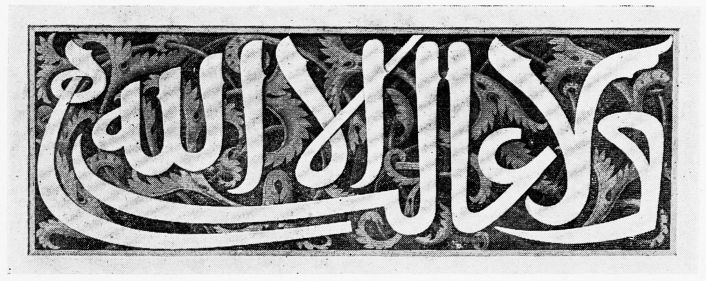
“WA LA GHALIB ILA ALÁ!”—THERE IS NO CONQUEROR BUT GOD!—THE FAMOUS MOTTO, IN KUFIC CHARACTERS, OF MOHAMMED I. AND HIS SUCCESSORS, WHICH IS INSCRIBED ON THE WALLS OF THE ALHAMBRA IN COUNTLESS REPETITION.
He gave premiums and privileges to the best artisans, improved the breed of horses and other domestic animals, encouraged husbandry, and increased the fertility of the soil two-fold by his protection, making the lovely valleys of his kingdom to bloom like gardens. He fostered, also, the growth and fabrication of silk, until the looms of Granada surpassed even those of Syria in the fineness and beauty of their productions. He caused the prolific mines of gold and silver, and other metals of the mountainous regions of his dominions, to be diligently worked, and was the first King of Granada who, as we have seen, struck money with his name, taking great care, moreover, that the coins should be skilfully executed.
It was about this time, towards the middle of the thirteenth century, and just after his return from the siege of Seville (1248), that Mohammed commenced the splendid Palace of the Alhambra, superintending the building of it in person, mingling frequently amongst the artists and workmen, and directing their labour. He stored the gardens with the rarest plants, and with the most beautiful aromatic shrubs and flowers. Amid these scenes he delighted in reading histories, or in causing them to be related to him; and sometimes, in intervals of leisure, employed himself in the instruction of his three sons, for whom he had provided the most learned and virtuous masters. Mohammed ever remained loyal to Ferdinand, giving him repeated proofs of fidelity and attachment. When that renowned monarch died at Seville in 1254, Mohammed sent ambassadors to condole with his successor, Alonzo X., and with them a gallant train of Moorish cavaliers of distinguished rank to attend the obsequies. This grand testimony of respect was repeated by the Moslem monarch during the remainder of his life on each anniversary of the death of King Fernando el Santo, when a hundred Moorish knights repaired to Seville, and took their stations with lighted tapers in the Cathedral, around the tomb of the illustrious deceased.
Mohammed retained his vigour to an advanced age. In his seventy-ninth year he took the field on horseback, accompanied by the flower of his chivalry, to resist an invasion. As the army sallied forth from Granada, one of the adalides, or guides, who rode in the advance, accidentally shivered his lance against the arch of the gate. The counsellors of the king, alarmed by the circumstance, which was considered an evil omen, entreated him to return. The king persisted, and at noontide the omen, say the Moorish chroniclers, was fatally fulfilled. Mohammed was suddenly seen to fall from his horse. He was placed on a litter and borne towards Granada, but his illness increased to such a degree that they were obliged to pitch his tent on the Vega. His physicians were filled with consternation, and in a few hours he died; the Castilian prince, Don Philip, brother of Alonzo X., being by his side when he expired. His body was embalmed, enclosed in a silver coffin, and buried in the Alhambra, in a sepulchre of precious marble, amidst the unfeigned lamentations of his subjects, who bewailed him as a parent.
Such was the enlightened prince who founded the Alhambra, whose name remains emblazoned amongst its most delicate and graceful ornaments, and whose memory is calculated to inspire the loftiest associations in those who tread these fading scenes of his magnificence and glory.