Abu-el-Hejaj (Yúsuf I.), King of Granada, 1333-1354, who completed the Alhambra.
Reading edition
IN the royal Mosque, where the escutcheons of the Moorish kings hang side by side with those of the Castilian sovereigns—for the Mosque was, after the subjugation, consecrated as a Catholic chapel—perished the illustrious Yúsuf Abu-el-Hejaj, the high-minded prince who completed the Alhambra, and who, for his virtues and endowments, deserves almost equal renown with its magnanimous founder. Washington Irving was, perhaps, the first to draw forth, from the obscurity in which it had too long remained, the name of another of those princes of a departed and almost forgotten race, who reigned in elegance and splendour in Andalusia, when all Europe was in comparative barbarism.
To Yúsuf I. the Alhambra owes much of its splendour; he not only constructed the Gate of Justice and the Wine Gate, leading into the Palace, as appears from the inscriptions over their respective archways; but he must also have built, or decorated, many of the interior apartments, for his name appears frequently in The Hall of the Two Sisters, in that of the Baños, in the Court of the Fish-pond, and in the Hall of the Ambassadors.
Yúsuf ascended the throne of Granada in 1333. He is said to have been of noble presence, possessing great bodily strength united to manly beauty. He had the courage common to all generous spirits, but his genius inclined more to peace than to war; and, though repeatedly obliged to take up arms, he was generally unfortunate. Amongst other ill-starred enterprises, he undertook a campaign in conjunction with the King of Morocco, against Castile and Portugal, but was defeated in the memorable battle of Salado; a reverse which nearly proved a death-blow to the Moslem power in Spain.
A long truce, after this defeat, enabled Yúsuf to devote himself to the instruction and improvement of his people. He established schools in the villages, with uniform systems of education; he obliged every hamlet of more than twelve houses to have a Mosque, and reformed abuses which had crept into the religious ceremonies and festivals of the people. The Alhambra was now completed. Yúsuf constructed the beautiful Gate of Justice, forming the grand entrance, which he finished in 1348. He likewise adorned many of the Courts and Halls of the Palace, as may be seen by the inscriptions in which his name repeatedly occurs. He built also the Alcázar, or Citadel of Malaga, of which, alas! only crumbling traces remain.
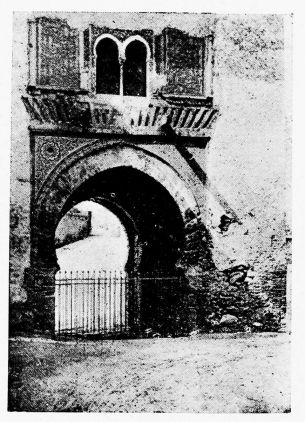
THE WINE GATE, ATTRIBUTED TO YÚSUF I.
The genius of the sovereign stamps a character upon his time. The nobles of Granada, emulating the graceful taste of their monarch, filled the city with magnificent palaces, the halls of which were adorned with mosaics, the ceilings wrought in fretwork, and delicately gilded and painted, or inlaid with precious woods; they had lofty towers of wood or stone, carved and ornamented, and covered with plates of metal that glittered in the sun. So refined was the taste in decoration prevailing amongst this elegant people that, to use the simile of an Arabian writer, “Granada, in the days of Yúsuf, was as a silver vase filled with emeralds and jacynths.”
One anecdote will be sufficient to show the magnanimity of this generous prince. The long truce which succeeded the battle of Salado was at an end, and every effort of Yúsuf to renew it was in vain. His deadly foe, Alonzo XI. of Castile,
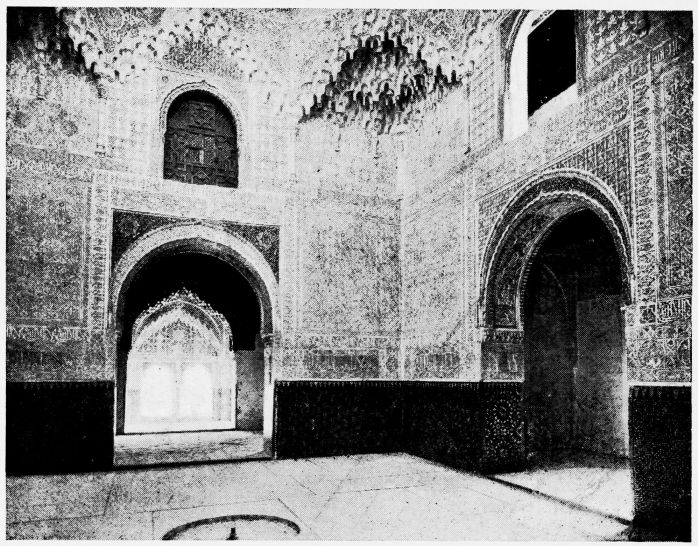
HALL OF THE TWO SISTERS FROM THE ENTRANCE DOOR, BUILT BY YÚSUF I.
took the field with great force, and laid siege to Gibraltar. Yúsuf reluctantly took up arms, and sent troops to the relief of the place; when, in the midst of his anxiety, he received tidings that his dreaded foe had fallen a victim to the plague. Instead of manifesting exultation, Yúsuf called to mind the great qualities of the deceased monarch, and was touched with sorrow—“Alas!” cried he, “the world has lost one of its most excellent princes; a sovereign who knew how to honour merit, whether in friend or foe!” The Spanish chroniclers, themselves, bear witness to this magnanimity: according to their accounts, the Moorish cavaliers shared the sentiment of their king and put on mourning for the death of Alonzo. Even those Moors of Gibraltar, which had been so closely invested, when they learned that the hostile monarch lay dead in his camp, determined that no aggressive movement should be made against the Christians during the observance of his obsequies.
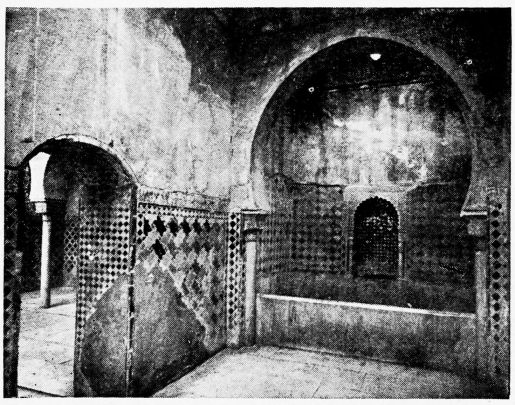
THE SULTAN’S BATH, CONSTRUCTED BY YÚSUF I.
Upon the day on which the camp was broken up, and the army departed bearing the corpse of Alonzo, the Moors issued in multitudes from Gibraltar, and stood mute and melancholy, watching the mournful pageant. The same reverence for the deceased was observed on the frontiers by all the Moorish commanders, who suffered the funeral cortège to pass in safety with the body of the Christian sovereign, from Gibraltar to Seville.
Yúsuf did not long survive the enemy he had so generously deplored. In the year 1354, as he was one day at prayer in the royal Mosque of the Alhambra, a maniac suddenly rushed upon him and plunged a dagger in his side. The cries of the king brought his guards to his assistance: they found him in convulsions, weltering in his blood. He was borne to the royal apartments, and expired almost immediately. The assassin
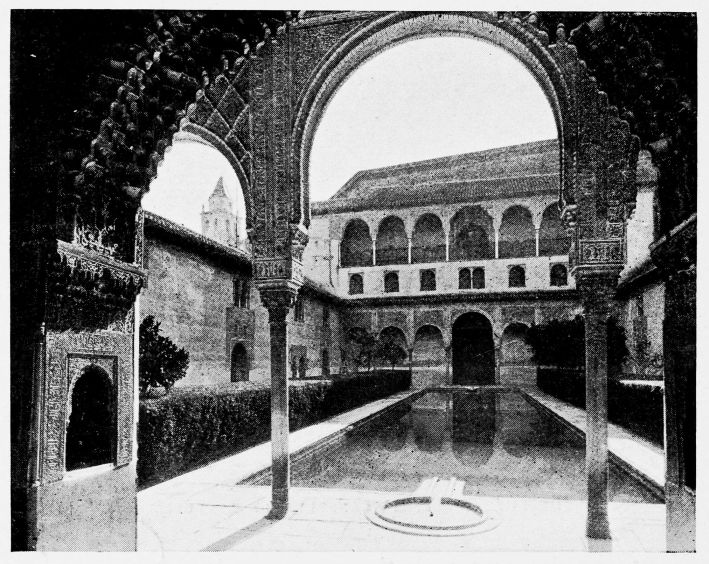
COURT OF MYRTLES, OR THE FISH-POND, FORMED BY YÚSUF I.
was cut to pieces, and his limbs burnt in public, to gratify the fury of the populace.
The assassination of Yúsuf is described by an eye-witness in a letter addressed to Fárris, Sultán of Western Africa, which is printed by Pascual de Gayangos from the chronicle of Al-Makkarí—an elegant Moorish writer who flourished towards the end of the sixteenth century:—“As Abu-el-hejaj (Yúsuf) was performing the last prostration of his prayer, a madman rushed upon him and wounded him with a khanjar, or yataghán. The assassin was immediately secured. The Sultán, who had been mortally wounded, made some signs as if he wished to speak;
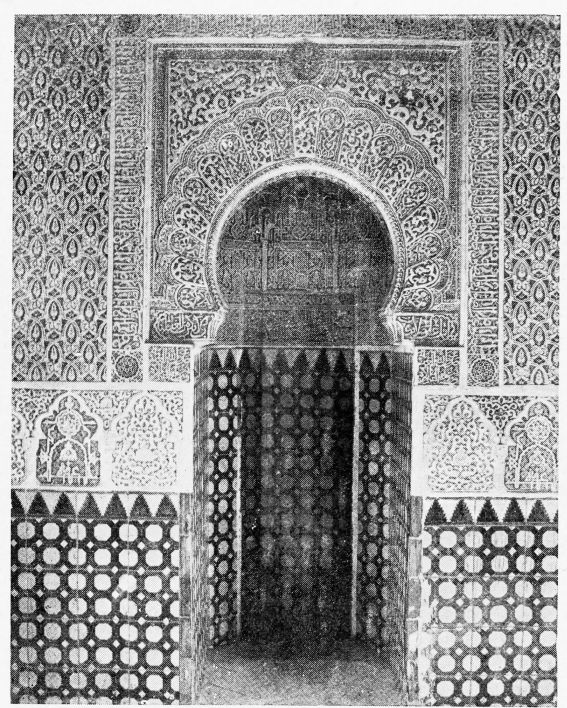
THE KORAN RECESS IN THE MOSQUE, THE SCENE OF YÚSUF’S ASSASSINATION.
but, after uttering some unintelligible words, he was carried senseless to his apartments, where he shortly died. The assassin, meantime, was given up to the infuriated mob, who slew him and burned his body. The Sultán was interred within the Alhambra. He left three sons: Mohammed, who succeeded him; Isma’íl, and Kays.”
The body of Yúsuf was interred in a superb sepulchre of white marble; a long epitaph, in letters of gold upon an azure ground, recorded his virtues: “Here lies a king and martyr, of an illustrious line, gentle, learned and virtuous; renowned for the graces of his person and his manners, whose clemency, piety and benevolence were extolled throughout the kingdom of Granada. He was a great prince; an illustrious captain; a sharp sword of the Moslems; a valiant standard-bearer amongst the most potent monarchs.”
The Mosque, which once resounded with the dying cries of Yúsuf, still remains, but the monument which recorded his virtues has long since disappeared. His name, however, yet abides among the ornaments of the Alhambra, and will be perpetuated in connection with this renowned pile, which it was his pride and delight to adorn.