THE AIR PATROL (continued 5)
Reading edition
At that moment he was more concerned about the fate of the aeroplane than about his own. It would be of no use to the enemy; they would probably destroy it, and that prospect enraged him. For the first time he felt a real desire to fight and slay, and wondered whether, when the enemy came into the open, he might not pick them off one by one. After all, he thought, his position in the hollow gave him some advantage. They could not take good aim at him, whereas if they attempted to rush him across the open space, he could mark them down almost at his leisure.
His reflections were suddenly cut short by a rifle-shot. A bullet struck the ground unpleasantly near him, and sent up a spurt of earth, some of which struck him. He crouched still lower in the hollow. Escape was now out of the question: he must simply wait and take what opening of defending himself offered.
The shot had been fired from the clump of wood. Immediately afterwards the man on the hill-side stood erect in the attitude of taking aim. Lawrence hastily levelled his rifle and took a rough shot at him, with what effect he could not tell, for his attention was at once called off by a rush of the man in the wood, who dashed forward over several yards towards a patch of bush nearer to the hollow. Lawrence felt that his position was even worse than he had supposed. The enemy had scattered with a definite plan. They meant to work their way gradually towards him under cover, distracting him by firing in turn, until they thought it possible to overwhelm him with a final rush from several sides. He wished he had acted on his first impulse to sprint towards the wood on the south. Was it possible even now to do it? A sudden twinge in his ankle gave him the answer. They had him in a trap.
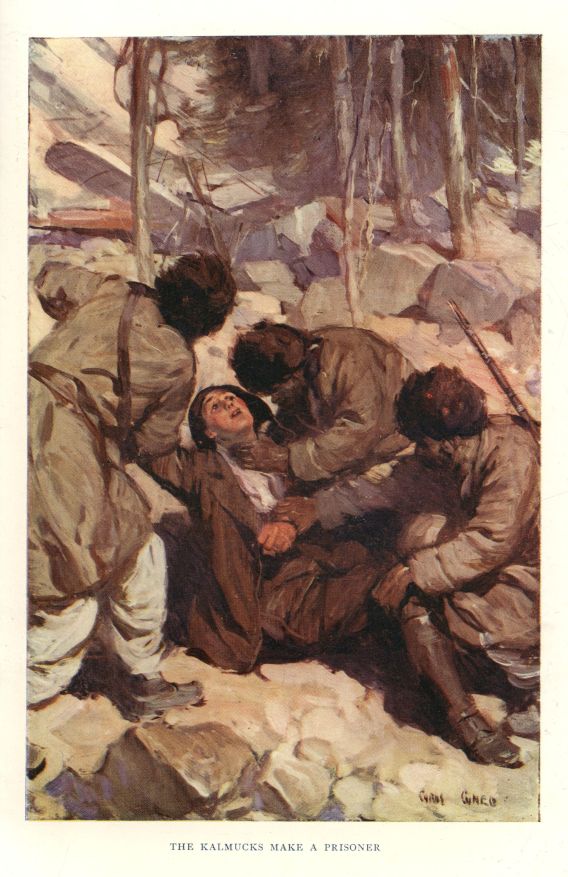
THE KALMUCKS MAKE A PRISONER
And then he saw something flickering by a tree up the hill-side. It seemed to be a piece of cloth. Was it a flag of truce? While he was watching it there was a patter of feet behind him. Three men had risen as it were out of the earth southwards of the hollow. Before he could rise they flung themselves upon him. He was dashed to the ground. He made desperate efforts to free himself, writhing, kicking, trying to free one of his hands to use his revolver. But they pinned him down: one snatched his revolver from him, the others held him firmly by the neck and feet, and when his hopeless struggles ceased they whipped off their leather girdles and tied him up so that he was unable to move. Then they turned him on his back, uttering guttural grunts of satisfaction, and he looked up into the malicious faces of Nurla Bai and Black Jack.
CHAPTER THE TWENTIETH
A FRIEND IN NEED
Even a philosopher, we know, cannot bear the toothache patiently. Every one has at one time or another recognized in himself the unphilosophic tendency to feel irritation at some trivial thing--a speck of mud on one's clean collar, a hair in one's soup. We have all been much more deeply annoyed by a slight blemish or mishap than troubled at a really grave misfortune.
The plight in which Lawrence now found himself was serious enough to justify an access of rage or despair. But it was not his capture or his bonds that inflicted the severest pang upon his self-esteem. It was the sight of Nurla Bai and his dwarfish henchman making free with the sardine sandwiches which Shan Tai had put up for his especial delectation.
When they had bound him, the three Kalmucks glanced around, spied the basket a few feet away, and rushed at it with cries of delight. Lawrence looked on in disgust as they wolfed the eatables--too delicate for their untutored palates, too unsubstantial to appease their ravenous appetite. He felt a thrill of joy when, on the remainder of the party coming up, until there were nine altogether, the new arrivals clamoured for a share, and began to push and snatch just as he had seen a flock of greedy sparrows pecking at one another over a single crust. But though these thieves were falling out, there was no chance of the honest man coming by his own.
The contents of the basket soon disappeared, and the men looked round wolfishly for more. At sight of the aeroplane hope flashed upon them, and with one consent they ran to realize it. Lawrence could no longer see them over the edge of the hollow, but he heard their shouts of glee, the creaking of basket lids, and then the steady smacking of eighteen busy lips as they fell upon the viands provided for Major Endicott and his men. He was very angry. He felt not a touch of sympathy for them in their famishment. To him they were merely gluttons, not starving fellow-creatures.
During their absence he tried to wriggle out of his bonds, but the work had been well done, and he lay still, wondering what was to become of him. They had not killed him: he was suddenly aware of that agreeable fact, though his pleasure in it was damped when he foresaw a possible long captivity. While they gulped and gloated his thoughts ran round a ring. Would they carry him on with them, going southward? Then they would meet Major Endicott, and there would be a fight. If they, fortified by his own food, should get the upper hand, he would still be their helpless prisoner. If they were beaten, it would be consistent with Nurla Bai's ferocious temper to kill him before taking to flight. Either way, his case would be deplorable.
Presently the men came back to him, still munching and smacking their lips. A villainous crew they looked. Besides Nurla Bai and Black Jack, there were two other miners; the rest, differently and more martially clad, were evidently part of the advancing force. They sat down at the edge of the hollow, chewing the cud of excellent victuals and of sweet exaltation of mind. Lawrence writhed as he realized how completely these ruffians had outwitted him. The men in front of him a while ago had been simply holding his attention, while the others crept upon him from behind. It was humiliating--one more proof, he thought, that he was certainly not cut out for a soldier.
At first the men did nothing but grunt, like pigs that have gorged themselves. Their little eyes rested on their prisoner indolently, as though he were an object of no importance. By and by they began to talk to one another, and then to throw taunting and insolent remarks at him. His knowledge of the niceties of abuse of which their tongue was capable was limited, but he understood enough to make his blood boil. But he discreetly held his peace: he would not flatter them by bandying abuse.
When they had thus enjoyed themselves for a while, Nurla Bai rose, and planted himself within a few feet of Lawrence.
"What is the good of the great hummingbird now?" he said with a sneer. "Those that hunt partridges ought not to make a noise."
It flashed upon Lawrence that the man supposed that the aeroplane had been in pursuit of him. Evidently he was unaware that a party was marching down the track towards the mine. It was just as well to flatter his error. Lawrence made no reply.
"The little tins missed their mark," Nurla Bai went on. "Too much haste spoils the hunt. The hawk has broken its wing, I perceive. Perhaps it can be mended?"
Lawrence reflected that by telling the truth he might gain a little time and save the aeroplane from destruction.
"Yes; it can be mended," he said, "but not here. The damage is slight, but the machine is quite useless as it is."
The Kalmuck sat looking at him, apparently following out a train of thought.
"How long might it take a man to learn how to use the wings?" he said at length.
Lawrence caught the drift of the question.
"Perhaps six months, perhaps a year," he said. "It depends on the man."
Nurla Bai looked disappointed; clearly he had hoped to appropriate the machine, get it mended, and then make instant use of it. He considered for a little, and then said--
"The hunter is caught in his own toils. You are now as my servant, to do whatsoever I command. It is a change. Give me the mine: I give you the machine."
"That is foolishness. Bob Sahib will never give up the mine."
"We shall see," said the man with a leer. "When he beholds you in my hands, and knows that if he refuses you will be shot, and the machine broken up, I think he will be wise."
At this Lawrence saw a ray of hope in the situation. If they took him back to the mine as a hostage, Major Endicott would discover the abandoned aeroplane and push on with all speed. But he soon discovered that his captors had no intention of abandoning the aeroplane. Nurla Bai no doubt reckoned on the sight of it in his hands having a very potent effect on the other sahib at the mine. After a consultation among themselves, the men went into the wood, and began to fell some of the smaller trees, and to lop branches from the larger. In a short time they had collected a considerable quantity. They carried these down to the river, and set about binding them into a raft with rushes and rods of osier. When this was done, they hauled the aeroplane to it, placed it in the middle, and proceeded to weave a long grass rope, which they attached to the rear of the raft. Then one of the men, carrying a straight sapling, mounted behind the aeroplane, and the whole contrivance was pushed into the stream.
The Kalmucks gave a shout of satisfaction on seeing the raft float down with the current. Two men held the rope to check its speed in the more rapid reaches of the river. The man upon it used his pole to fend it off rocks and snags. The others fetched their horses from the wood in which they had been tethered. On one of these Lawrence was mounted, with his hands still tied. Black Jack rode alongside, firmly grasping the bridle. Thus, when the afternoon was already far advanced, they began the march in the direction of the mine.
Lawrence had not looked on without expostulation at the handling of the aeroplane, but Nurla Bai ignored his protests. When he saw it swaying and jolting on the raft, he expected it to be irretrievably ruined before it had gone many miles on its course. The river, everywhere rapid, became a torrent in the gorges; and at these narrow places Lawrence anticipated that the raft would be whirled and cast about utterly beyond control, driven on one bank or the other, or smashed on some rock in mid-stream. But he discovered that the Kalmucks had been as much alive to the risks as he was himself, and his opinion of Nurla Bai rose. Just before coming to a gorge, they drew the raft to the bank, lifted the aeroplane, and carried it overland until the river broadened again. The man with the pole remained by the raft until his comrades were a long way in advance; then he let it race down the gorge unchecked and followed it along the bank, to find that it had been recovered at the further end.
The party had been marching for about an hour when they were met by three other Kalmucks, tramping wearily up the track on foot. Lawrence recognized them as miners. They had either not been furnished with horses by the advanced guard beyond the mine, or had had their steeds shot under them during the scamper in the darkness. Nurla Bai gave these hungry men a portion of the provisions that were still left, and they turned about and marched with the rest down-stream. The journey was continued until the growing darkness rendered further advance impossible. Mooring the raft to a tree on the bank, the men prepared to camp for the night, on a moss-covered space just above. Lawrence was lifted from the horse; his feet were again tied; and he was laid in the centre of the encampment. The horses were tethered in a copse hard by, and when a fire had been lighted a few yards northward of the bivouac, the men disposed themselves in a wide circle about their prisoner, and devoted themselves to the remnants of the provisions. No one offered Lawrence a share--a lack of courtesy which did not trouble him. No one spoke to him; but there was no charm in their conversation. They scarcely even looked at him; he suffered nothing from their neglect. He wished they would not eat so noisily; and when, having gobbled the last scraps of the food intended for Major Endicott and his party, they sat with their knees up, and chattered across him in their rasping voices, he felt that no one could be said to have a complete experience of the minor troubles of life who had not been an enforced companion of Kalmucks.
A great deal of what they said was incomprehensible to him, but he caught a phrase now and then that interested him in spite of himself. One concerned his uncle. Nurla Bai was apparently relating, for the benefit of the strangers from the north, the doughty deeds he had recently performed. Among them he ranked the shooting of the Englishman who had been his employer. From what he said, Lawrence gathered that the disappearance of Mr. Appleton was as great a disappointment to the miners as to himself. They joked about it, however; Nurla Bai became facetious as he described the consternation of the fishes as they beheld the body of an Englishman, strange monster, sinking into their midst. It was fortunate that Lawrence did not understand the idiomatic beastliness with which the man depicted the gruesome feast then celebrated on the stony bottom of the river.
Another flight of the Kalmuck's fancy afforded him much amusement. Nurla Bai gave rein to his eloquence in picturing the scenes that Delhi was soon to witness: Ubacha Khan sitting in state on the ancient throne of the Moguls, withering with his frown the throng of cowed and shivering Englishmen who grovelled at his feet, and beslobbered them with tears as they pleaded vainly for mercy. Lawrence heard for the first time of the exquisite tortures which Mongol ingenuity could devise for helpless prisoners; and while he was amused at the picture conjured up of British officers suing a new Mogul emperor for pardon, he was horrified at the mere imagination of the cruelties which these wretches discussed with such gloating inhumanity.
Lying on his back, he could see half the ring of his captors, their squat forms silhouetted against the glow of the camp-fire, their yellow faces blanched by the moonlight now flooding the valley. He raised his eyes to the hills beyond, watching the magical play of the silvery radiance upon the peaks and promontories, making the snow sparkle; searching, as it were, the black crannies and caverns. But he soon found his interest in this wonderful illumination yield to his sense of cold. This region was one of extremes of temperature: the torrid heat of day being succeeded by Arctic cold at night. The Kalmucks did not appear conscious of it; they were inured to the climate; but to Lawrence, compelled to lie motionless, the chilliness became painful, and the warm glow of the camp-fire mocked him tantalizingly.
He was to prove, this night, the contrariness of fate. Twice before, when he had wished above all things to keep awake, drowsiness had overcome him; now, when he would have given anything for the oblivion of sleep, physical discomfort and the burden of his thoughts banished sleep from his eyes. The Kalmucks became less talkative as the night wore on; presently their voices ceased altogether, and they slept. Lawrence preferred their snores to their conversation; they formed a descant to the unvarying ground bass of the river droning below. Every now and then the cry of a night-bird in the mountains added its shrill treble to the harmony.
The moon sank behind the crest of the hills; black darkness stole over the valley; and the untended watch-fire sank lower and lower, until its glow was too faint even to show up the slumbering forms of the Kalmucks. Lawrence might have wondered that they had not set a watch but for his knowledge that they were quite unsuspicious of the enemy higher up the stream, and that his bonds were only too firm. His thoughts flitted to Major Endicott and his little band; where were they now? How did they regard his failure to return to them? Had they, too, encamped for the night? Was there the least possibility that the hours spent in stalking him and in constructing the raft would have given them time to draw so near that with morning light they would come upon the encampment, or overtake the Kalmucks during the ensuing day? And what was to be the final issue of all these strange events? Would he, or Bob, ever come out of the entanglement in which they had been so suddenly involved?
His anxious meditation was broken short by a slight sound behind him. He turned his head--it was the only part of his body that he could move--and stretched his ear towards the spot whence the sound had seemed to come. Perhaps it was one of the Kalmucks stirring in his sleep--rising, possibly, to cast fuel upon the dying fire. He could see nothing. Twisting his neck until it ached, he tried to pierce the blackness, listening keenly for a repetition of the sound. He heard only the regular snores of the men sleeping nine or ten feet away.
But there seemed to be something moving between him and them--a something darker than the night itself, creeping along the ground. It could not be a wild animal; no ibex, nor even a bear unless pressed by hunger, would have come within the scent of him; there were no tigers or leopards in these regions; could it be a man?--one of his own people? Tingling with a flush of hope, he lay perfectly still, fearful lest even the beating of his heart should betray his excitement to the enemy.
There was a rustling movement near him; it seemed to come nearer; then he shuddered involuntarily as he felt something touch him. It flashed upon him that one of the Kalmucks was going to murder him, and for a moment he had to exercise stern control over his nerves to repress a cry. A cold shiver trickled down his back, and he broke out in a clammy sweat as he felt a rough hand pass over him--over his face, aside to his arms, down to his feet. He durst not utter a sound, hope and fear jostling in his brain.
The hand left him. There was a moment of suspense. Then in his ear breathed a whisper.
"Sahib, lie still!"
He felt the hand again, then a pressure upon his arm--a pressure that increased and diminished in rapid alternation. He throbbed with joy. Some one--was it Fazl?--was sawing at his bonds. The sound made by the knife or sword was scarcely perceptible; yet to his feverish apprehension it seemed loud enough to waken the heaviest sleeper. Soon he was conscious that his arms were free, and he ventured to move them stealthily to ease them of their numbness. The pressure was transferred to his feet, and after some moments of quivering anxiety he felt that these also were released from their bonds. Then cold metal touched his hand, and his eager fingers clasped over a grooved hilt.
"Sahib, a minute to rest, then follow me," whispered the voice.
He could hardly endure the waiting, though he knew it was intended to give him command of his limbs.
"Sahib, now!"
He raised himself on all fours, and began to creep after his deliverer, a black form crawling towards the ring of sleeping Kalmucks.
The Gurkha--for it was he--had almost passed between and beyond the two men who lay stretched towards the track, when a hand shot out and gripped him by the ankle. At the same moment the owner of the hand gave a shout, his companions started up, and Bob leapt to his feet. As soon as he felt the touch upon him, Fazl wriggled like a snake, his right hand groping towards the dark form beneath him. There was a groan, and he stood free.
A foot or two behind him, Bob came to a halt when he dimly saw the two figures writhing on the ground. When one of them sprang up, he was not sure for the moment whether it was friend or foe. A murmured word reassured him, and he was ready to go on. But his way was blocked. Roused by their comrade's cry, the Kalmucks hurled themselves in a shouting mass across the open space. One of them kicked up the embers of the expiring fire, and a dull glow illuminated the scene. It lent aid to the fugitives, who were themselves in shadow. But for his sprained ankle Lawrence could have sprinted away into the darkness; Fazl might by this time have been out of harm's way, but the little man, perplexed and anxious at his master's dilatoriness, turned to his assistance. Lawrence had been checked by a man who sprang at him from the left. He had no time to swing round and bring into play the right hand clutching Fazl's knife; but, instinctively shooting out his left hand, by good luck he got home upon his opponent's chin. There was little 'body' in the blow, delivered so rapidly and at such close quarters; yet his muscles were hard, and the man staggered and fell in a heap.
At this moment Fazl rushed to his side, in time to engage a group of the enemy who had now got their bearings and were rushing towards him. That moss-carpeted enclosure was the scene of a struggle as extraordinary as it was short. The little Gurkha twirled and twisted, sprang high, bent low, legs and arms gyrating with a rapidity that the eye of a spectator could scarcely have followed. It was as though some infuriated gnome had sprung out of the bowels of the earth, and was executing a fantastic dance among men bewildered by his demoniacal antics. But it was a dance of death. The red glow of the newly rekindled fire flashed upon a terrible kukuri, which whirled in circles, ovals, parabolas, and fifty unnamed curves, carving intricate luminous patterns on the night. Nor were these evolutions purposeless: every stroke of the keen nimble blade was directed by the keener mind of the man wielding it. Here it struck up a knife, there a rifle; now it pierced a shoulder, now grazed a head; so swift in its darting movements that it seemed multiplied into a dozen weapons each barbed with fire.
While the Gurkha was thus in the ecstasy of sword-play, keeping half the party of Kalmucks urgently engaged, Lawrence was in difficulties. The knife given him by Fazl was no doubt sharp and deadly, but it was a weapon to whose use no Englishman is bred, and demanded, though not so much free space as a sword, yet a certain amount of elbow room for its effective employment. Lawrence had only just felled his first assailant when he was himself beset by two or three at once. Half conscious of stinging sensations in arm and thigh he lashed out with left fist and right hand grasping the knife, but lost his footing, stumbled, and fell to the ground with his aggressors on top of him, snarling like wolves. He found himself with his left hand gripping one of them by the throat: his own right wrist was held as in a vice. Struggling to wrench himself free, he rolled over, dragging the panting enemy with him, their movements carrying them nearer and nearer to the camp-fire; and in a sudden flicker of light he recognized the savage features of Black Jack.
In sheer muscular strength he was no match for the Kalmuck dwarf. Under the crushing pressure of Black Jack's fierce grip his hold on the knife was relaxing: the weapon was slipping from him. His hold upon the man's throat weakened; the Kalmuck was digging his nails into his left arm. As the under dog he was not able to cope with the man pressing him down. The knife dropped to the ground; his wrist was suddenly released; he felt a bony hand at his own throat, and had given himself up for lost, when a wild discordant clamour broke out close by, drowning all other sounds. For an instant Black Jack was perfectly still: then, wrenching himself away, he sprang to his feet and leapt into the darkness.
Lawrence got up more slowly, every muscle and nerve quivering. He had just seen that the space around was empty of living men, when a film seemed to fall upon his eyes. He tottered, and sank fainting upon the ground.
When he reopened his eyes, the flush of morning lay upon the valley. He raised his head.
"That's right," said Major Endicott, stepping from behind him. "How do you feel?"
"Rather groggy, Major," replied Lawrence. "Those fellows struck me, I think."
"A gash or two: nothing to speak of. What bowled you over was hunger and fatigue, I suspect. We've got a few scraps left, which will keep you going until we reach your mine."
"Is Fazl all right?"
"As jolly as a sandboy, though rather dilapidated. It's lucky I carry a case of sticking plaster with me; he's pretty considerably patched--much more than you are. You slept pretty soundly through my amateur surgery."
"And the Kalmucks?"
"Gone elsewhere--all that were left of them. That machine of yours played you false then?"
"Yes, the engine failed, and I had to come down. I was rather bothered with getting rid of my bombs and controlling the thing at the same time, and made a hash of it--sprained my ankle, too. I was waiting for you, and the beggars stalked me. I was a silly ass to let them take me unawares."
"What were they going to do with you?"
"Offer me and the aeroplane in exchange for the mine--as if Bob would listen to any rot like that!
"Well, the aeroplane isn't worth much now, I suspect, but I fancy Bob might be disposed to think you good value for the mine. However, that's all off. The aeroplane's done for, of course?"
"Not a bit of it. We can put it to rights in a day."
"Warrant it?"
"Yes. Our bargain holds if you'll risk it. I'm more than sorry this happened, if it's going to dish your plan, Major."
"It shan't do that. Taking risks is part of my job--and yours too, as it happens."
"I'm jolly glad you came up when you did. In another minute you would have been too late."
"You've got to thank your Gurkha for that. We were marching up pretty briskly--had no trouble from the Afghans--and the Gurkha declared he heard the sound of your bombs far ahead. None of us had heard anything, but the little chap was so positive that I thought we'd be on the safe side and hurry up. Judging by the march we made, the sound must have travelled nearly ten miles--not impossible in this air, I suppose; I confess I was sceptical at first, and only began to feel anxious when you didn't return within the time stated.
"We came upon the tracks of the aeroplane some miles up; there was litter of all sorts about--scraps of food, broken branches and what not, and I feared you'd smashed yourself and your machine, only we couldn't find any pieces of it. But we found your rifle and field-glass in a little hollow, and the Gurkha guessed that you had tumbled among the Kalmucks. An hour after dark we caught sight of the camp-fire. The Gurkha volunteered to creep up and reconnoitre, so the rest of us halted, waiting for his report.
"He's a clever little chap, with a double dose of Gurkha courage. He came back very soon and told me he'd seen you tied up among them, and about the raft and so on. My sowars wanted to rush the place, but it struck me that that might be the end of you. The first instinct of such barbarians would be to knife their prisoner. It was a bit of a quandary--and the Gurkha came out strong again. It was his suggestion that he should creep into the camp and release you before we moved."
"Plucky little chap!" said Lawrence warmly.
"A treasure! The noise of the scuffle brought us up hot-foot, and the only thing I regret is that, as the Gurkha informed me, the ringleaders, those rascally miners of yours, got away.... Now the sooner we get to your mine the better. You had better sit my horse. As all our food is gone, we shall have a strong motive for hurry, so we ought to get home before night. Of course if you think you can't stand it we'll take our time."
"No: I'm fit enough. Your men will look after the raft?"
He explained the method by which the aeroplane had been taken safely past the gorges, and the Major went off to instruct his men.
Lawrence summoned Fazl, who was resting on a grassy knoll overlooking the river.
"I owe you my life; you're a brave fellow, and I thank you," he said.
Fazl's plastered face broadened in a grin.
"Wah! sahib, the Kalmucks are pigs, and their hearts melt like butter. The sahib's servant is unworthy of praise. It is a small thing to do for the heaven-born."
CHAPTER THE TWENTY-FIRST
THE FRONTIER HOUSE
Some ninety miles southward of the tower in which Major Endicott had been besieged, on the bare summit of a low hill, stood a solitary building of stone, known to the British officers of the borderland as a frontier house. It had no pretentions to architectural excellence, consisting of a square tower, somewhat resembling a truncated chimney-stack, crowned by a small turret on a platform, which looked like a square straight-brimmed Quaker hat. Adjoining the tower was a sloping wall twenty feet high, that formed one side of an enclosure, within which were a number of rudely built huts, set up against the inward side of the wall. Neither tower nor wall had any windows, but in the latter a doorway gave entrance to the interior.
One day Dafadar Narrain Khan was squatting with a few of his sowars on the wall of the enclosure, looking out over the country before him. The building commanded a prospect extending for many miles. Its immediate vicinity was barren, stony ground; one scraggy tree raised its wizened branches at the angle of the wall. A narrow track wound through this wilderness from the doorway down the hill to the plain below, meandering northward among boulders and patches of sparse vegetation until it was lost to sight amid the dark pine-trees that covered the lower slopes of the distant hills. Beyond, as far as the eye could reach, these hills stretched, an endless series of scarps and eminences, cleft by tortuous ravines and breaking away here and there into sheer precipices. In the remote distance, a jagged snow-clad ridge flashed with purple and gold in the rays of the sun. In the opposite direction, southward, the country was rugged but less hilly. A metalled road wound away into the distance. At regular intervals on one side of it stood tall posts, carrying a telegraph wire that emerged from a hole in the tower wall.
As the troopers sat there chatting, with their rifles in the hollow of their arms, there was a sudden cry from the sentinel posted alone on the top of the tower.
"Hai, dafadar! I see a speck moving in the sky far away," he shouted.
"How far away, Coja?" called the dafadar.
"Seven kos at least," was the reply.
"The speck is in your own eye, my son," cried the dafadar, and the men about him laughed: Coja was always seeing something!
The sentinel shouted a word of expostulation, then was silent, and the others resumed the conversation he had interrupted.
Half an hour passed away. The time came for changing the guard. One of the men rose, sauntered along the wall, disappeared through a narrow opening in the tower, and presently emerged on the summit. Apparently he had a brief altercation with the man he had relieved. In five minutes Coja came from the tower along the wall.
"Wah! you may mock, dafadar," he said; "but I declare by the beard of my father I saw a speck--a black speck moving."
"You have chewed too much betel, Coja," said the dafadar with composure. "I too have seen dancing specks when my stomach was out of order."
"Yes, but do those motes in the eye grow larger? Do they swell from the size of a pinpoint to the size of a little bird, and then to a great one? I thought at first it was peradventure an eagle of the mountains, but, inshallah! no eagle could look so large such a great way off. Is there a bird bigger than an eagle? Speak out of your great knowledge, dafadar."
"There is none, foolish one--none that flies, though I have heard of a great bird that runs upon the ground swifter than the iron horse that runs on rails; the mem-sahibs wear its feathers in their hats."
"Hai! what was this great thing, then? I saw it, and rubbed my eyes, and lo! when I looked again, it wheeled about, and soared away towards the Afghan country, and passed behind a crag yonder, and I saw it no more."
"Wonderful eyes you have, Coja, and a wonderful tongue! Do we not know your tales? What of the tiger with two heads you saw once in a tree? and the elephant that caught you up and put you on his head? and that time when you swallowed a cherry-stone, and leaves began to sprout among your hair? Wah! we know his stories, my children; we know how the lies flow out of his mouth like water from a spring."
"Mashallah! Do I not speak truth?" cried the man indignantly. He was a by-word for romancing among his fellows, and, like all liars, resented any imputation on his veracity. "There is no wisdom in you. Many a great thing that I have told you you have believed: now when I tell you a little thing, you say 'Wah! he is a liar.'"
"But it was a great thing you saw, Coja-ji--bigger than an eagle, said you, when we know there is nothing bigger than an eagle that flies. Wah! at least when you are on duty, you must resist these promptings of the Evil One, else it will end in Jehannum. And look you, Coja, when your turn for watching comes again, keep your eyes on the ground, my friend; do not look for the stars in daylight."
Highly offended, the man walked away, descended the steps within the wall, and retired to sulk, like Achilles, in his tent.
About an hour later the dafadar and his men, who had scarcely changed their position, were again hailed from the roof.
"A speck on the track, dafadar," cried the sentinel; "moving this way, like a fly crawling, very far off."
"Hai! that is news," said the dafadar, slowly rising to his feet. "A speck on the ground is worth looking at; in the sky it proceeds from overeating." Raising his voice, he called to the sentinel: "Hai, Selim, I come to see."
Followed by several of the troopers, he mounted to the roof, and taking the telescope from Selim's hand, examined the track, tracing it back for miles until he discerned the moving object. So remote was it that even with the telescope he could distinguish it only as a human being: whether shepherd, mendicant, or fakir he could not tell, and a single pedestrian must, he thought, be one of these three.
"Perhaps he is a dak runner from Ennicott Sahib," suggested one of the men. "The sahib went in that direction."
"Wah! a dak runner would run, not crawl," said another. "Let us look through the long glass, dafadar."
The telescope was passed round. No one could as yet identify the figure. They were all keenly interested. For several days they had not seen a solitary man outside the walls, though they had kept unremitting watch, having been instructed to be on the alert to discover any movements of men in that region. The figure approached slowly--too slowly for their impatience. All eyes were riveted upon it, and when Selim with the telescope reported that it was completely clad in khaki uniform and not in shepherd's choga, or the scanty tatters of a mendicant, the troopers' excitement grew.
"Hai! he stops!" cried Selim presently. "He waves a white cloth. It is a signal, dafadar."
Narrain Khan took the telescope and gazed at the figure. He felt a little perplexed as to what he ought to do. In time of peace he would not have hesitated to send out a couple of men to discover who the stranger was; but there were rumours of war, and the Captain Sahib had given orders that no man should be allowed to leave the post except under the gravest circumstances. He wondered whether the present case came within his licence. The man was clad in khaki: that was something in his favour. He was waving a white flag: that was reassuring. He had seated himself on a knoll beside the track: perhaps he wanted help.
The dafadar lowered the telescope and turned to his men.
"Go, you two," he said, "ride out on your ponies and see who the stranger is, and what his business. Have a care, lest there are badmashes lurking near. The stranger may be a decoy. Have a care, I say, for when you have ridden down the slope we cannot protect you."
The men descended through the tower, and were presently seen trotting down the track. Every yard of their progress was followed intently by the garrison. Their diminishing forms were lost to the watchers at intervals through the windings of the track and the inequalities of the ground. Presently they were seen, little more than dots, moving side by side along the straight stretch at the farther end of which the solitary stranger could still be discerned.
They approached him, came to a halt, and dismounted. After a minute or two the party separated. Two men proceeded northward along the track, one on horseback, the other on foot. The third man rode in the opposite direction towards the house.
The whole garrison of eighteen men were now mustered, some on the roof, some on the wall, silent, their eyes fixed on the slowly approaching horseman. By and by it was seen that he was not either of the two who had lately ridden down. Then the dafadar, who had the telescope at his eyes, suddenly exclaimed:
"Mashallah! It is Ennicott Sahib!"
Amid a chorus of ejaculations he hurried down to the courtyard, mounted his horse, and galloped down the track to meet the officer. The strangeness of that meeting formed the theme of a discourse to the men of the garrison later in the day.
"When I came near enough to see the face of the huzur," said Narrain Khan, "I beheld that it was the face of a sick man. His left arm hung straight at his side like the broken leg of a sheep. I was on the point of invoking the mercy of Allah upon the huzur--is he not the light of our eyes?--when his great voice sounded in my ears like the voice of a trumpet, and before even I could make my salaam he cried--what think you were the words of the great one?"
"'Water, for I am athirst,'" suggested one man.
"Wah! does the huzur think of himself? You speak as a witless babe."
"'Is all well?'" said another.
"Wah!" cried the dafadar with scorn and indignation. "Could the heaven-born ask so foolish a question knowing that I, Narrain Khan, am in charge of this house? No: the words of the huzur--and they were very strange--were these: 'Hai, dafadar! have you got any paraffin?'"
"Inshallah! what is paraffin to the heaven-born? And what said you, dafadar?"
"I was so astonished that I could but speak out the simple truth. 'Truly, sahib!' said I, 'we have some few tins with which to replenish our lamps.' And then the huzur commanded me to send six men with one large tin, that one man might easily carry, along the track to the foot of the hills yonder, and give it to a sahib they would find reclining there."
"Another sahib! Who is he?"
"And for what purpose the paraffin, dafadar?"
"That I know not. The huzur did not tell me that, but told me that he had already sent to the sahib those two young men I had ordered to meet him. And you saw how, when the huzur dismounted at the gate, he staggered, and caught me to prop him: and when I asked him to lie down and let us see to his hurt, he made that sound with the lips that the sahibs make when they are impatient, as if I had said some foolish thing, and bade me lead him straightway to the clicking-room, and there he is now: you can hear the clicking-devil, like little hammers tapping. Truly I begin to think there are many strange things to tell the Sirkar far away."
"Hai! I did see a speck in the sky," said Coja solemnly.
Major Endicott, though half fainting with pain and exhaustion, had gone straight to the room in which the telegraph instruments were kept, and shut himself in. For nearly an hour he worked at the keys with a rapidity acquired by much practice. Before he had finished, the second instrument at his side was mechanically recording the answers to his message. Having read these off, he staggered to the door and summoned the dafadar.
"Fenton Sahib will be here in three hours," he said. "There will be also the sahib from the hills. Get some food and a bath ready for him, and tell Hosein to come and see to my arm."
Some two hours later the Major was awakened from a profound sleep by a hubbub among the men on the wall. Going out to them, he found them excitedly watching an aeroplane soaring rapidly towards them from the hills. Coja was loudly proclaiming that the flying object proved his truthfulness: no one could any longer deny that he had seen a speck in the sky.
A few minutes after it had been sighted the aeroplane sank to rest on the open space in front of the tower. Loud cries of wonder broke from the men when there stepped out of it a young sahib, limping slightly, followed by one of the two sowars who had gone out to meet the major. The trooper greeted his comrades with an air of triumph, and swaggered up to them with an ineffable look of importance. They surrounded him, and listened with admiring envy while he detailed his first impressions of flight through the air.
Meanwhile the Major took Lawrence into the officers' room, where he bathed, and ate the lunch Narrain Khan had provided. He had just finished when there was the clatter of hoofs outside, and in a few minutes entered Captain Fenton, who had ridden up with half a dozen sowars from the fort fifteen miles to the south.
"Hullo, major, you look pretty dicky!" said the newcomer, glancing curiously from the major's bandaged arm to Lawrence.
"Yes, I've had a knock. Let me introduce you. Lawrence Appleton--you've heard of Harry Appleton--Captain Fenton."
"I see they've sent us an aeroplane, Endicott," said the captain, shaking hands with Lawrence. "An unexpected gift! I thought all the aeroplanes were scouting Kabul way--all there are; they've got a dozen or so, on paper, and a regiment of airmen, also on paper: most of us believed they weren't born yet! Which way did you come, Mr. Appleton?"
"You'd better sit down and listen, Fenton," the major interposed. "There's a lot to say, and not much time to say it in. We're in for the hottest time since the Mutiny--and if I'm not mistaken, hotter than the Mutiny at its worst: I mean generally, for there won't be any Cawnpores or Lucknows, I hope. You know that the Afghans are up?"
"Yes: we've mobilized along the frontier: they won't get across."
The Major smiled grimly.
"After I'd wired you to come in," he said, "I got into communication with the Chief at Peshawar and the Viceroy at Delhi. The Amir has just fled to Peshawar: Kabul's in the hands of the Mongols."
"By Jove!"
"The cat's out of the bag at last. That huge concentration about Bokhara was not to be launched at Russia after all. I suppose we were too self-assured to twig it--just as in the Mutiny time. Plenty of information, little imagination. But we have it now. There are pretty nearly half a million of the fiercest ruffians in Central Asia marching down on us--almost all mounted, and they're fellows who live on horseback, and are moving with amazing speed. They've cajoled or bought over the best part of the Afghans--silly fools, for if the Mongols beat us they'd swallow Afghanistan for dessert. There are a hundred thousand in and about Kabul."
"It's astonishing that they managed to keep things so quiet. They must have been intriguing and negotiating for months."
"Again, just as in the Mutiny. I've not heard of chapattis passing round, but they've had their secret signs, without doubt. The one good thing about the present circumstances is that the Afghans are not actually on the march yet. They're probably waiting to see how the cat jumps. Of course we've always relied on them more or less as a buffer against Russia, calculating that they'd hold up the invaders at Herat until we'd had time to line the frontier. Anyway, we can't expect any help from them now, for if they're not actually hand in glove with the Mongols they're neutral, for a time. You said we'd mobilized, didn't you? I've been away a fortnight."
"Yes. With the most tremendous exertions we've got 100,000 men across the frontier, and they're holding the passes. Only just in time, evidently. It ought to have been an easy job: and so it was--on paper. But it's years since the paper scheme was drawn up, and they've been paring down in the usual British way--economizing, they call it. The result is that arrangements for transport and supplies are all at sixes and sevens. They've had to reduce the frontier garrisons to mere skeletons in order to make up the strength of the field army."
"The Chief wired me just now that troops are being pushed up from all parts, but the railways are so horribly congested that it'll be weeks before they're on the spot. I fancy I made him jump with my news."
"You've got something fresh then?"
"There are twenty thousand Kalmucks marching up the Nogi valley."
"The Nogi valley! But I've always understood it's impassable. Isn't that where poor old Harry Appleton has his mine? ... Beg pardon, I'm sure," he added, turning to Lawrence. "I forgot he's a relative of yours."
"My uncle," said Lawrence.
"I'm glad to think it is for the moment impassable," said the major, "owing to the pluck and readiness of Appleton here and his brother. But the Kalmucks traded on our self-confidence. No one would have dreamed that any considerable force would try to push its way up that difficult track; they are trying it, and their object, without a doubt, is to cut the communications of the army operating in Afghanistan. If they penetrate to fifty miles this side of the Appleton mine nothing but a whole division can check them. The Chief wired that he can't spare a man at the moment, and said the valley must be held at all costs for a week."
"But man alive, that's impossible! We haven't three hundred men all told within a hundred miles of it. If we rushed them down for all we were worth three hundred couldn't hold off twenty thousand."
"Well no, and you'd never get there. But as it happens the Chief was only acting on something I had told him. It's a long story, and must keep. But the short of it is that Harry Appleton's two nephews--poor chap! he's gone himself--brought out an aeroplane--the one you saw outside: you might be sure it wasn't a service machine! By the merest accident they happened to see this Kalmuck force encamped, and after some pretty stirring passages which I'll tell you some other time, they blocked up the track just below the mine; it will keep the enemy busy for a while."
"Congratulate you," said the captain to Lawrence. "Not in the service, are you?"
"No."
"He is in training, Fenton," said the major with a smile. "By the help of his aeroplane he got me out of a very tight place, and I went down to the mine to see for myself how the land lay. An accident to the aeroplane kept me there for a day. When it was repaired we made a reconnaissance down the river. Near the mine there was a striking force of about a thousand men--as many as could operate with any effect on so narrow a track. Some thirty miles farther down we saw a couple of field guns being dragged up; and the main body of the enemy was still encamped at the mouth of the valley, waiting for the way to be cleared. It was a masterly notion to dynamite the rock; indeed, as far as I could see, Bob Appleton had left nothing undone to secure his position. Of course it's an uncommonly tight place; very likely nine fellows out of ten--or we'll say eight!--wouldn't have attempted to hold it: but you know the Appleton breed, Fenton: and if they can only stick it out for a week, as the Chief wishes, by George! the Government of India will have reason to say thank you."
"Your arm's paining you, I see," said Captain Fenton, as the major winced.
"Nothing to speak of. It was a bit of rank bad luck. Of course, seeing what the game was, I felt I must wire the Chief at once, and Lawrence offered to bring me here in his aeroplane. We came along swimmingly until we had got about half way: saw nothing of the enemy: and then rather suddenly struck a rabble of about two thousand men marching southward. We came down rather too low, to get a good look at them. They opened fire, and one of their shots tore my arm from shoulder to elbow. If we had made a straight course we shouldn't have met trouble: but naturally I wanted to pick up any information I could. Unluckily in going criss-cross we consumed a good deal of petrol, and when it became necessary to replenish the tank from the reserve cans, we found that they'd been bored with holes during our peppering; one was empty, in the other there were a few spoonfuls at the bottom below the level of the hole. This only lasted a few miles, and then we had to come down, in the hills yonder."
"Rough luck!" said Captain Fenton, turning sympathetically to Lawrence. "You must have felt pretty mad. How did you bring the machine in?"
"I happened to mention when we were talking things over that paraffin would do at a pinch, and the major said he was pretty sure they would have some here, and insisted on tramping over to get some sent up."
"Well, you see, he's got a game foot," said the major. "Sprained his ankle two days ago. My legs are sound, at any rate. But I was pretty dead beat before I got here, and was glad enough to borrow the mount of one of the men Narrain sent to meet me. He and the other fellow went on to keep Appleton company, and as soon as the paraffin was sent up, the aeroplane came flying in with the sowar on board as a passenger. He was bubbling with delight, and no doubt will be a hero among the men for the rest of his days."
"Mr. Appleton wants to get back to the mine, of course," said the captain.
"Yes: there's enough paraffin for that. How are matters round the fort, Fenton?"
"The tribes are pretty quiet at present. They've held several jirgahs to discuss what line they shall take. That depends on who scores the first point. If we can only convince them that we're not going to knuckle under, I daresay they'll stick to us. But it wouldn't take much to turn the scale on the other side. The crowd that fired at you are marching this way, you said?"
"They'll be hereabouts some time to-morrow, and probably a lot more, for we caught sight of other parties, not so large, threading the valleys to the west. The whole country north-west of us is rising."
"That's bad. I can't hope to keep the tribes about the fort quiet after these thousands come on the scene."
"I must see what I can do."
"You ought to be in hospital. If you had let me know you'd been hit I'd have brought the medico with me."
"Good thing you didn't. He'd have been so disappointed!"
"No operation required, you mean," said Captain Fenton laughing. "He does love his knife."
"And fork!" added the major drily. "He shall have a look at my arm to-morrow. I propose to return with you to the fort. We must blow this place up. You can hold your own there for some time against a good number, and reinforcements will be hurried up as rapidly as possible. Then I must try the velvet glove with the tribesmen. There won't be much time to do anything with them before those men we saw get south; but if you discourage them with hot lead at the fort it will help.... This is all very hard on you, Appleton."
"That's all right," said Lawrence. "I was only wishing I had brought more of our bombs with me. I might have checked those hillmen and given you more time."
"But that would have involved your remaining in this neighbourhood, and you are wanted at the mine. A bomb or two dropped in flying over would have scattered them for the moment, but they'd have collected again as soon as you were past. I don't know how much paraffin we've got to give you. No: there's better work for you. You'll convey the Chief's message to your brother: hold the gorge for a week at all costs. I'll do my best to get reinforcements through. It's vitally important to keep those Kalmucks in check. The fate of India hangs in the balance."
Preparations were made for the evacuation of the house on the following morning. Having taken on board more than enough paraffin to carry him back to the mine, together with a dozen rifles and several thousand rounds of ammunition, Lawrence bade the officers good-bye, and started immediately after breakfast. A few minutes after his departure a dull boom proclaimed that the tower had been blown up and the garrison was on the march for the south.
Major Endicott had advised him to fly high so as to avoid the risk of further accident if he should encounter the enemy. Some ten miles from the tower he caught sight of them: they appeared like an army of ants crawling on the ground. A few shots were fired at him, but he was far out of effective range, and in a few minutes disappeared from their view.
A little uneasy at first as to the staying power of the paraffin, he was soon reassured. In less than an hour he struck the western extremity of the valley, and he flew down it at full speed, maintaining a great altitude in case Nurla Bai and his party should be still on the track or in the hills above.
He had almost reached the mine when he heard sounds of rapid firing. The attack, then, had begun in earnest.
CHAPTER THE TWENTY-SECOND
DITTA LAL INTERPRETS
During his brother's absence Bob had been energetic in organizing the defence. He threw an entrenchment across the track beneath the shoulder of the cliff, a short distance from the mass of broken rock thrown down by the explosion of dynamite. By this means he hoped to interpose an effective obstacle to the enemy if they, without waiting for the track to be cleared, should attempt to climb round and slip by up the valley. Nurla Bai's swimming feat showed him that the river could be crossed otherwise than by the drawbridge, and the assemblage of any considerable number of men on the southward side might be a serious menace. True, the enemy could hardly cross in daylight in face of opposition from the wall of the compound; but remembering how Nurla Bai had got over and made his way by the cantilever pathway to the mine, Bob saw that a similar movement might be attempted when the attention of the garrison was held by an attack from down-stream. In that case he would have to dispatch men whom he could ill spare to guard the aeroplane platform and perhaps to destroy the pathway constructed with such toil. As a precautionary measure he stationed three men on the aeroplane platform day and night.
Further, in order not to be at too great a disadvantage in case of a sudden rush in the darkness, he contrived a makeshift searchlight out of a large photographic camera of his uncle's and a reflector of polished tin. He hoped that it would not be necessary to use it often, for the stock of calcium carbide was running low, and he had no other illuminant than acetylene gas and paraffin candles.
When Lawrence alighted on the aeroplane platform, Fazl, one of the three men on guard there, informed him that the enemy had opened a brisk fire at daybreak.
"The sahib cannot get to the house to-day," said the man.
"Why not?"
"Because, sahib, when you once get round the shoulder, the path is in sight of the enemy. They will shoot you. It is necessary to wait for night."
"Nonsense! I can't stay here all day. Let me see for myself."
He went across the platform and along a few yards of the path until he reached the bend. There he peeped cautiously round. He forgot his prime object in the anxiety and concern to which the state of affairs down the river gave rise. Being slightly above the level of the track he was able to take a good view of the position. The enemy had cut a new path along the fallen cliff, and had thrown across it a breastwork about thirty feet long, from loopholes in which they were maintaining a hot fire on the northernmost boundary of the compound. The reply of the garrison was astonishingly feeble; the characteristic rattle of the machine gun was not to be heard, and Lawrence saw the havildar standing inactive by the weapon. Bob was near the wall, smoking a cigarette, and it was apparently only when he gave a distinct order that the men fired. Lawrence guessed that he was husbanding his ammunition, and blessed Major Endicott's forethought in sending a supply which would be so welcome.
Recollecting his purpose, Lawrence scanned the wooden pathway narrowly, to see how far Fazl's advice was justified. For forty or fifty yards it was fully exposed to the enemy's marksmen, but beyond that distance it gained some shelter from the buildings in the compound. If the enemy had not already had their attention drawn to it, there was a chance that, in spite of his weak ankle, he might dash across the exposed portion before they noticed him. But after a few seconds he saw with great relief that it was possible to lessen still further the risk of being hit. The pathway being a little higher than the track on the opposite side of the river, he might perhaps crawl along it without being discovered. By lying at full length, and hugging the face of the rock, he would get a certain protection from the outside edge of the pathway.
He returned to the platform.
"Has any one crossed from or to the mine since the enemy began firing?" he asked Fazl.
"No, sahib: it was still dark when we came to relieve the night watch, and none has come or gone since."
"Very well: I am going to crawl. Take care you don't show yourselves."
He was rather astonished at his lack of nervousness; but the events of the last few days had in fact exercised a bracing influence upon him. He crawled on all fours as rapidly as possible along the exposed section of the path, rose to his feet on reaching the spot where the buildings gave him cover, and in another few minutes greeted his brother.
"Well done, old chap!" said Bob heartily. "I hardly expected you to get back yesterday, but it's a great relief to see you. You had no trouble?"
"Not with the machine, but we came across a lot of hillmen marching south, and they potted the major in the arm, and riddled the petrol cans, so that I ran short. But they gave me some paraffin at the tower, and it serves surprisingly well. It's lucky we had a second carburetter."
Just then a bullet sang overhead.
"Can you come to the house for a minute or two?" said Lawrence. "I've got a good deal to tell you, and you can't attend to me and the enemy at the same time."
"All right. I'll leave Gur Buksh in charge. They've done us no harm yet--inside at any rate; but I'll give you all the news. Come on!"
Seated in the house, Lawrence repeated the substance of the conversation between Major Endicott and Captain Fenton. Bob listened in amazement.
"By George! it's a big thing," he exclaimed. "No wonder we were puzzled. It's desperately serious, then."
"Yes, and this is the serious part for us. The major wired all about us to headquarters, and the commander-in-chief wired back that we must hold on at all costs for a week. He made no bones about it: simply said it must be done."
"Well, we'll do it!" cried Bob with flashing eyes. "We'll not cave in after a direct order from the commander-in-chief. It's the best thing that could have happened. Some of the men are getting rather shaky, but I'll tell them the Sirkar depends on them--talk about their known valour, and all that: and it'll buck them up no end."
"Wouldn't the promise of a reward from Government be more effective?"
"I dare say; but it's only a jolly ass who'd give a pledge of that sort for Government. I dare say they mean well, but--no, my boy, it's not safe. We'll rely on moral stimulants. Now look here: this is what I've done----"
"I see you've thrown up a breastwork on the other side, but so have the enemy, and cut a path too."
"Yes, that's one to them, confound them! I had twenty men behind my breastwork, but when the enemy came round the bend this morning they bolted back in a panic. They'd have done better to stick to it, for two of them were shot in the back and killed outright. I'd left the bridge down under a guard, so that the others got back safely, but their retreat had a bad effect on the rest. They need a tonic."
"The major gave me a dozen rifles and a lot of ammunition: that'll help."
"It will indeed: I've had to be sparing."
"Why didn't the enemy occupy your breastwork?"
"No doubt they would have only I built it at such an angle that it can be enfiladed from our wall. It's a great nuisance that they've managed to get so far as they have. I hoped to be able to check them at the bend much longer--at any rate until they'd brought up the two field guns you told me about. When they arrive we shan't be able to hold the wall. We shall have to take refuge in the galleries."
"That means suffocation."
"Well, we won't think of it. We'll hold on as long as we can. You didn't notice perhaps that I've had a shield of boiler plates set up on top of the parapet. I found we couldn't loophole the embankment, and the men couldn't fire without protection of some kind. This metal shield is better than nothing. It's loopholed. I only allow a few men to fire at the enemy, when there's a chance of their doing some good. But to keep up their spirits I let them all have a turn. They come up in squads, so that every man will have a chance of a shot during the day."
"You haven't used the machine gun? Couldn't you batter their breastwork with it?"
"It would be very much like pelting toy bricks with a pea-shooter. Gur Buksh has orders only to fire if there's a rush. What I fancy will happen is this. At night they'll try to rush our breastwork. If they get it they'll push a trench southward along the track until they're opposite us. What they'll do then about crossing the river I don't know. We've got to delay them as long as possible. I've made a ramshackle sort of searchlight out of Uncle's old camera: it may help us a little in the dark. But I must go out and talk to the men. I wish I were a dab at the lingo. Will you do the spouting?"
"You're in command. Get the Babu to interpret for you: what you say won't lose anything in his mouth."
"It may do him good too. He's getting positively thin with funk. Come along!"
While this conversation was in progress in the house, there had fallen a lull in the firing outside. It was clear that the enemy were not prepared for a rush, and had realized the uselessness of continually sniping at a garrison whom they rarely saw. There could be little doubt that they were waiting either for darkness to cover a dash up the track, or for the arrival of their field guns. Whatever the reason, the respite was welcome. Taking advantage of it, Bob left a small guard at the wall, and assembled the rest in the compound.
Lawrence was struck by the altered appearance of Ditta Lal when he came forward at Bob's summons. His fat cheeks had fallen in; his features spoke eloquently of despair; and his clothes hung loosely where formerly they had closely encased his rotundities.
"I should never have believed that a man could lose so much flesh in so little time," said Lawrence in a low tone.
"Do him good," returned Bob unfeelingly. "Ditta Lal, I'm going to speak to the men, and I want you to translate faithfully what I say--no additions or subtractions."
"I will do my best, sir," said the Babu with unwonted simplicity. "My voice is not strong; I am fading away like a flower."
"For goodness' sake say something to buck him up," whispered Lawrence, "or he'll damp their courage with his lugubrious manner."
"Look here, Babu," said Bob, "Major Endicott is telegraphing for reinforcements. They should be here in a week."
"Can I believe my ears?"
"You can believe me. The Government knows all about us. The commander-in-chief himself has asked us to hold the place for a week, and we're going to do it."
"That's jolly bucking, sir," said the Babu in his usual manner. "The hour brings forth the man. The King-Emperor will dub you knight, or at least baronet, for thus stepping into deadly breach, and----"
"We're wasting time," Bob interrupted. "Just tell the men what I say."
"Right-o, sir. My voice is recovering wonted rotundity. Fire away!"
Lawrence's eyes twinkled more than once during the Babu's address to the garrison. Bob's words were simple and direct, with no surplusage of rhetoric: Ditta Lal transformed them into an oration.
"Sikhs and Pathans, Rajputs, Gurkhas and Chitralis," he said, "misfortune makes brothers of us all. In a thunderstorm the lion and the ass are friends. The thunderstorm is about to burst upon us. We have heard the first rumblings; we have seen the lightning flash in the lurid sky; and the huzur having been taken from us by the hand of the Kalmucks, we have lost our chief defence and stay.
"Yet in the blackest night we behold a star of hope. My brother the chota sahib" (the Babu spoke as though translating) "has even now returned from a frontier house where the Sirdar who for one brief day shed the light of his countenance upon us, spoke to the Sirkar along the quivering wire, that carries men's thoughts swifter than speech. The Sirkar far away knows us what we are, and how we, a handful of men, are beset in this narrow valley by a host of evil-doers, in number like the stars of heaven. The Sirkar knows that though we be few, yet are we stout of heart and strong of hand. The lurid storm-cloud does not oppress us, nor does the lightning fire appal our souls. We are not the men to quail before a host of flat-nosed dogs. The order is given that we sharpen our swords and resist to the uttermost, and within a week--such is the word--the Sirkar will send a great army to strengthen our hands and smite the enemy until not one of them is left. I have said that we will do even as the Sirkar has commanded. Will you put me to shame? Will you not rather brace yourselves to the conflict, and oppose yourselves like a wall of adamant to these off-scourings of the plains?"
This was the spirit if not the letter of Bob's appeal, and the whole assembly responded with cheers and passionate ejaculations of loyalty. The Sikhs, some of whom understood English and knew that the Babu had interpolated a good deal, had listened gravely, their inveterate contempt of the unwarlike Bengali yielding to their appreciation of the effect he aimed at. Later on, Ganda Singh spat, and said to Gur Buksh that any one would know the Bengali for a coward, because his words were so big. The more simple miners were as impressible to high-sounding eloquence as any ignorant mob all the world over; and when the Babu, at a word from Lawrence, wound up his speech with the announcement that Major Endicott had sent some service rifles and a large stock of ammunition for their use, they cheered again and again. Those timid ones who had fled from the breastwork earlier in the day shouted the loudest, to ease themselves of their shame.
The Appletons never knew that after the assembly had been dismissed Ditta Lal, in a private audience of some of the Pathans, indulged his fancy in announcements that were quite unauthorised.
"Tidings of our prowess and valour," he said, "will be spoken in the ear of the King-Emperor over the black water, and the august majesty of our great prince will deal bountifully with us and shower his graciousness upon us. He will take the sahibs our masters by the hand and lift them up the steps of his throne, speak them words of comfort and set them on his right hand among his lords; and furthermore, the humblest of us shall be exalted and be bounteously rewarded. A lakh of rupees will be distributed among those who quit themselves well, and we shall be satisfied with a feast of fat things."
As the brothers returned to the house, Bob said:
"I'm very much inclined to make another attempt to hold our breastwork. It's bad tactics to let the enemy have free course between the bend and the bridge. Probably if I lead a detachment myself the men will follow readily enough."
"I daresay you're right on the point of tactics, but you ought to have a good sleep before you try it. You look very fagged; I suppose you've been up all night."
"Pretty nearly."
"Well, go and lie down. I'll take charge. I had a good night's rest at the frontier house. It's clear the enemy are waiting for their guns, and you ought to be able to get at least six hours' sleep before there's any danger. Of course I'll wake you if they make a move."
"Then I'll take your advice. The trouble will begin at night, and there'll be no chance of sleep then."
Left to himself, Lawrence went round the defences, noting the admirable arrangements Bob had made during his absence. As he looked southward up the river, the sight of the pathway along the face of the cliff suggested the necessity of doing something to protect any one who should pass over the portion exposed to the enemy. If they should succeed in pushing their entrenchments southward beyond the bend, they would be able to pick off any man who passed between the mine and the aeroplane platform, and it was essential that access to the latter should be maintained.
After consultation with Gur Buksh, he hit on a means of giving the pathway the security required. Two rows of planks laid on edge along its outer border would completely screen a man crawling along by the rock wall, even from the sight of an enemy on the bank immediately opposite. He collected a number of men who were expert in handling tools, and sent them to construct this parapet. A few shots were fired at them when they began their work, but they were screened by the planks, and the enemy, having nothing to aim at, soon desisted. To hold the parapet firmly in position, uprights were nailed to the planks at intervals, and screwed down on to the timbers of the pathway.
When the work was done Lawrence felt far more at ease regarding the safety of the aeroplane. The guards on the platform could now be relieved more frequently. They could be reinforced from the mine within a few minutes, or withdrawn without risk.
The enemy's continued inactivity confirmed Lawrence in his belief that they were waiting for the field guns. When he saw those being dragged laboriously up the track, he had suggested to Major Endicott to shatter them with a charge of dynamite dropped from the aeroplane. But the Major pointed out that others would immediately be brought up from the main army. Such an attack would be more effective later, when they were nearer to the mine. Their replacement then would be a matter of much longer time.
It occurred to Lawrence now that it would be well to reconnoitre the enemy's position before Bob attempted to reoccupy his entrenchment, or at any rate to cover his movement by a diversion on the part of the aeroplane. Bob could not leave the mine in daylight without exposing himself to the enemy's fire. If he waited for darkness, he might find himself anticipated by them; and even with the searchlight against them they would have far less to fear from the garrison by night than by day. It would be almost impossible to prevent a sudden determined rush. The enemy would lose a number of men; but they could afford to sacrifice some lives in a successful effort to improve their position. Nothing, however, could be done without consultation with Bob, so Lawrence waited patiently until about four o'clock in the afternoon, the time which he had fixed on for awakening his brother.
Remembering the mishap with Major Endicott up the river, he got Fazl to protect the engine and the petrol cans by slinging a number of iron plates under the chassis of the aeroplane. By means of these he hoped to reduce risk from the enemy's rifles when he should start on his reconnaissance. The Kalmucks northward had had no experience of the dynamite bombs, unless indeed some of those whom Bob had chased down the track were among them. But even without any definite fear of the aeroplane they would recognise it as a means of intelligence to the garrison of the mine, and would certainly be eager to put it out of action.
Bob on being awakened at once agreed to Lawrence's suggestion of a reconnaissance.
"I'd like to go myself," he said, "but we can't both go, and I'd better stick to my job. Take Fazl with you. You may have to bombard them if you find the guns close at hand."
"If I do, that will be your best chance of occupying your breastwork again."
"Undoubtedly. I'll lower the drawbridge and have my party ready; and if I hear any explosions I'll make a rush for it. But let us have a clear understanding. You won't drop any bombs unless you find the guns close at hand, or unless the enemy are up to something that looks threatening. There's very little dynamite left. Besides, at this stage it's no good merely to frighten the enemy. It's war now. I shall take it that your explosions mean serious business."
"All right. In any case I shall be back in an hour."
CHAPTER THE TWENTY-THIRD
CAPTURING A GUN
The aeroplane with Lawrence and the Gurkha on board was soon flying down the river, at a much greater height than usual--a wise precaution on Lawrence's part, as was proved in a few moments. Even before it came above the bend it was assailed with a volley, and as it passed Bob was alarmed at the continuous crackle of rifles. It lasted only half a minute, but it was so loud as to smother altogether the hum of the propeller, and he almost repented of having allowed his brother to go when he realised the danger to which he was exposed. He had lost sight of the aeroplane; the fusillade had ceased; and the only indication, and that a negative one, that the machine and its occupants had not been brought to the ground was the absence of clamour beyond the bend. If the enemy had been successful, he thought, surely they would have hailed their triumph with shouts of delight.
Reassured by the comparative silence, he remained behind the parapet, and informed Gur Buksh of his intention to reoccupy the breastwork on the farther bank.
"It is well, sahib," said the veteran quietly.
"Will the men follow me?" asked Bob anxiously.
"To the jaws of the pit, sahib. Where the sahib leads they will follow: even the men who ran away are now eager to wipe out their disgrace."
"Then I will go and form my party. We shall not move until the chota sahib gives a signal."
He found that the havildar had spoken truly. There was no lack of volunteers. He soon arranged his little party of twenty, and posted them in the shelter of the wall until the time should come for letting down the bridge and leading them across it.
The minutes passed very slowly. Lawrence would not think it necessary to push his reconnaissance as far as the enemy's encampment. He might perhaps fly thirty miles, and then return. This would take something less than an hour. If he should discover the field guns within a short distance of the mine, the explosion of his bombs might be expected much earlier.
Half an hour passed. There had been no sound from up stream; no sign of activity among the enemy. Bob began to feel more hopeful. They had apparently met with great obstacles to the passage of the guns. He was momentarily expecting to hear the hum of the returning aeroplane when, with a suddenness that took him all aback, there was a tremendous roar, followed in a second or two by a terrific crash just beyond the Pathan compound. Turning in consternation to discover the cause of it, he saw a great mass of the cliff falling amid a cloud of dust and smoke upon the wooden pathway, and plunging into the river beneath. Such destruction could only be the effect of a shell. Beyond doubt one at least of the field guns had been brought into position behind the enemy's breastwork at the bend.
This fact filled him with as much dismay as amazement. It was not surprising that the enemy had placed their gun without his knowledge. They would, of course, have been careful to mask it until they were ready to open fire. But why had Lawrence or the Gurkha not seen it? Could it be that the aeroplane had been damaged and brought down after all?
While he was in a painful state of anxiety, there was another roar, and a second shell burst on the cliff, just beyond the Pathan gallery. He ran to the northern wall and peered through one of the loopholes. Smoke hung above the enemy's breastwork, but there was not a man to be seen, so that rifle fire was useless. He ordered Gur Buksh to fire the machine gun. The havildar's aim was good; chips of rock flew from the breastwork; and Bob thought he saw the muzzle of a gun disappear. His attention was immediately drawn from it by the sight of the aeroplane flying round the bend, and with the thrill of relief at his brother's safety came the expectation of hearing an explosion and seeing signs of havoc about the breastwork. But the aeroplane flew high over the scene, passed it, and disappeared up the river. There had been no explosion. Why had not Lawrence dropped a bomb?
Hardly had he asked himself this question when a third shell burst from the breastwork. It was better aimed than the other two. Instead of striking the cliff, it hit the northern wall of the compound, carrying away several yards of the metal parapet, scattering jagged fragments of iron and stone in every direction, then flew over the heads of the garrison and plunged into the earthwork at the southern boundary of the compound, within a few yards of the spot where the sortie party were gathered. Bob was almost at his wits' end. No defences could withstand a bombardment at such close quarters. None of the garrison had as yet been wounded, but he could see by their cowering attitude and the terror written upon their faces that their courage had been shocked out of them. Only Gur Buksh and the other Sikhs stood immovable at their posts.
A few minutes after the report of the gun, the aeroplane again came flying down stream. Lawrence, then, had not landed. Bob was in a maze of bewilderment. But he was suddenly aroused from his stupor by a sharp detonation. It was not the report of a gun. Then there were loud cries and yells from the direction of the enemy, and looking through the loophole he saw a smother of dust above the breastwork. Lawrence had dropped a bomb at last, and again was out of sight.
This was to have been the signal for the sortie; but after what had happened Bob felt that it would be sheer madness to lead his men along a stretch of the track commanded by the field guns. He doubted, indeed, whether their courage would face the task. It was only common prudence to wait for a second signal. He could not see what damage the bomb had done; whether it had only temporarily frightened the enemy. But Lawrence would not hesitate to hurl another bomb among them; and believing that, guns or no guns, they must be demoralized if attacked a second time from the air, Bob hastened across the compound, ordered the bridge to be lowered, and went to the twenty men huddling under cover of the wall.
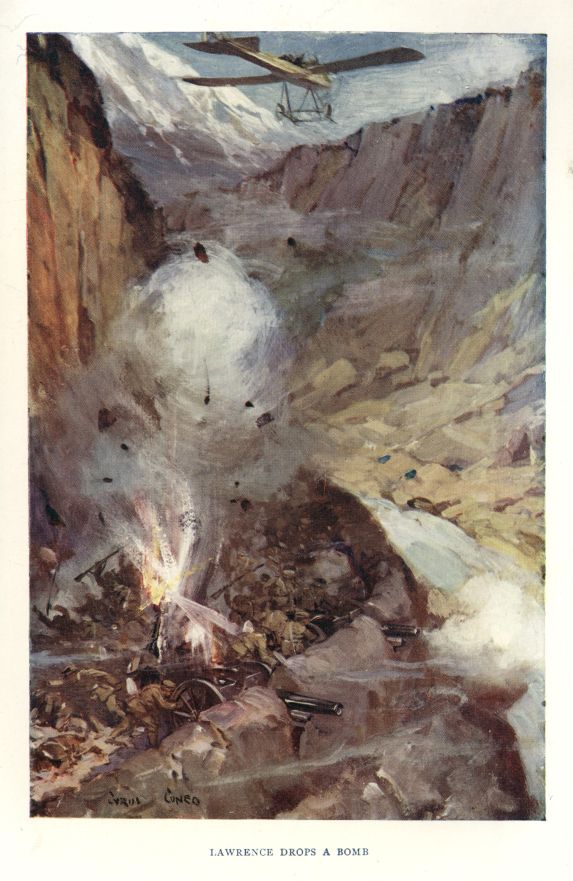
LAWRENCE DROPS A BOMB
He allowed no trace of mental perturbation to show itself in his bearing.
"The time has come!" he said quietly to the men. "Lawrence Sahib is driving the enemy away. There are no more shots from their gun, you see. We shall soon hear another explosion; then you will follow me, and in five minutes we shall be masters of our breastwork."
Ganda Singh, who was among the party, translated his words to the men. The cessation of gun fire and Bob's confident manner somewhat restored their courage. They formed up, grasping their weapons nervously, and waited in panting eagerness, mingled with trepidation, for the expected signal.
It seemed a long time in coming. Bob knew that Lawrence had had to fly several miles down stream before he could turn. It came at last. Again sounded the sharp crash; again the air was filled with cries, in which there was no note of triumph: and Bob, with a cheery "Now, my men!" dashed across the bridge with the swarthy mountaineers at his heels. Reaching the other side, they turned to the left and raced across the open space formerly occupied by the miners' huts. Bob was only half conscious that the aeroplane was flying in the opposite direction high above his head. They were met neither by shells nor by bullets, and only when they sank breathless behind the shelter of the breastwork did a few rifle shots patter around them. Then all was quiet again.
Whatever the cause of the astonishing delay on Lawrence's part, his intervention now had been effectual, at any rate for a time. How far effectual? Bob wondered. He got up and looked over the parapet towards the enemy's breastwork a hundred yards away. They had apparently deserted it. Some, no doubt, had been slain by the explosions. Had the survivors fled in panic far away, or were they merely lying low beyond the bend? Then his eye caught what had escaped his observation from the greater distance of the compound wall. There were two embrasures a foot or two below the top of the breastwork, contrived by removing some of the loose rocks. But he saw no sign of guns. Perhaps the enemy in their retirement had dragged with them the one which had fired.
He heard the hum of the aeroplane again. Lawrence had still not landed, but was returning, perhaps to observe the extent of his work, perhaps to complete it. He was flying much lower than before. A sudden idea flashed into Bob's mind. The enemy's breastwork was only a hundred yards distant. Why not attempt to rush it under cover of the aeroplane; and if in the hurry of their flight they had left their gun, capture it and bring it to the mine?
His thought had hardly crystallized into a resolution when he heard two explosions in rapid succession, followed by yells and one or two rifle shots. The sound seemed to come from some distance beyond the bend. His mind was made up. He told Ganda Singh his intention, and could scarcely wait while the havildar translated his orders. The men responded with a "Hai! hai!" of delight. Like Bob himself they were worked up to a high pitch of excitement. Their rush had been successful. The risks were forgotten, or remembered only to be scorned. They were twenty against an unknown number, but none counted the odds. "Hai! hai!" they shouted, as their leader leapt round the angle of the entrenchment. They followed close upon him as he dashed over the intervening hundred yards of broken ground. No one faltered. In less than half a minute they were in possession of the enemy's breastwork, and at that instant there was another explosion far down the track.
Bob's glance fell first upon a score of prostrate forms scattered on the ground in the neighbourhood. Then with a thrill of delight he saw two field guns. One had been struck from its carriage, and lay near the brink of the stream. The other had apparently been withdrawn from its embrasure, but abandoned under the demoralizing shock of an explosion. Bob ran to the first. A moment's inspection showed him that it was irretrievably ruined. Calling two of the men, with their aid he toppled it into the river. The other was still workable. Looking around, he spied near the breastwork a number of shells which had escaped destruction by the bombs.
"Can you fire a gun?" he asked Ganda Singh eagerly.
"I am a gunner, sahib."
"Then slew it round. We'll turn it on the enemy."
He had remarked a number of the Kalmucks collected on the track some distance away. As he spoke, bullets began to whistle around, and two of his men were hit. Quickly the gun was turned round. Ganda Singh discovered that it was already loaded, and in another few seconds a shell sang on its deadly flight towards the enemy. They fled, to be pursued by another shell as soon as Ganda Singh could reload; and with this second shot the track was cleared for half a mile down stream. And then the aeroplane came whirring past overhead.
As he watched it, Bob became aware that the afternoon was drawing towards evening. In an hour the valley would be gloomy, in two hours it would be shrouded in darkness. For the present, while daylight lasted, there was little fear of the enemy attacking. They would not face their own gun backed by the machine gun of the garrison. But he felt that with the fall of night the circumstances would be changed. His feeble searchlight scarcely illuminated the space between the bridge and the bend; beyond the bend it gave no light whatever. In the darkness the enemy might creep up to within a short distance of their captured breastwork and carry it with a determined rush, in spite of the gun. It was true that the narrowness of the track would allow the approach of only a few men abreast; but they could be supported by a constant succession of reinforcements, coming up like waves of the sea until the defenders were worn out. It seemed to Bob the prudent course to withdraw his men and the gun to the mine, and place the latter in position beside the machine gun. However, it was bad tactics to abandon a defensive position before retirement was absolutely necessary, so he decided to remain where he was for a little while longer, in the hope that Lawrence would land and, joining him, explain the actual condition of affairs down stream.
About a quarter of an hour after the aeroplane had passed, Bob saw Lawrence running down the track towards him.
"That's what I hoped you would do," were Lawrence's first words as they met. "Capture the guns, I mean."
"Yes, we've got one: the other's ruined and in the river. But we've had a narrow escape from being battered to pieces. Why didn't you begin bombing before?"
"I'll tell you. We were pretty well peppered, as you saw, when we flew past here down stream. It may have been because that bothered us, and Fazl was hit--I didn't know it at the time--that we didn't see the guns they had dragged up. Or perhaps it was because they are so like the rocks in colour--and we didn't expect they'd be here already. Anyway, we didn't see them, and it makes me mad to think what a squeak you've had. I ought to have seen them."
"That's bosh! it's precious difficult to see anything at that speed. But go on."
"We saw the men, of course, but we were soon out of range. The planes are simply riddled."
"Fazl not much hurt, I hope?"
"No: the bullet went through the fleshy part of his arm, and he didn't say a word about it till we landed just now. On our way down we saw several teams of ponies at different parts of the track, bringing grub up, no doubt; and several bodies of mounted troops on the march; but never a sign of the guns. I flew on till we came to the place where the Major and I saw them: then thinking I must have missed them, I turned back. You may imagine how I felt when, about two miles away, I suppose, I heard the first shot. It's so different from the sound of the machine gun that I couldn't mistake it. I told Fazl to get ready to drop a bomb as soon as we came up to the guns. He did so, but I didn't hear an explosion. He yelled out that it had fallen into the river, but of course we were past before there was time to shy another. I came back as quickly as I could, and my heart was in my mouth when I saw smoke in the compound. Luckily Fazl's next shots were better, and jolly glad I am that we managed to stampede the fellows and give you a chance."
"You were just in time, old man. They did more damage to the cliff than to us, though."
"Yes: the path is simply heaped with rubbish. Coming back it was like scrambling over shingle. But a few hours' work will clear the lot away. Now what's the next thing?"
"As it's getting dusk I propose to withdraw the gun to the mine. But we must hold this breastwork as long as we can, and it occurs to me that if we alter its angle a little we can enfilade it from our own breastwork when it becomes necessary to fall back on that. It will still protect us from attack down stream, owing to the bend."
"Isn't it worth while to block up the track again?"
"It would use up too much dynamite. Our stock is getting appallingly low. We may want it all for bombs. Besides, if we block up the track farther down we shan't see our enemy."
"But I can always scout in the aeroplane."
"You forget that our petrol isn't unlimited. I had a look in the shed this morning, and there isn't much left. The paraffin you brought only replaced what you lost from the leaky cans. We shall have to economize now, and use the aeroplane only when we must."