THE AIR PATROL (continued 2)
Reading edition
CHAPTER THE FIFTH
THE LIGHT IN THE GALLERY
The cliff pathway being at last completed, the boys cleared the farther ledge of accidental obstructions, and so formed a fairly smooth surface about sixty yards in length by half as many in breadth. While the workmen were erecting a shed at one end of the space, the boys themselves carried over the parts of the aeroplane, and set about putting them together, with the assistance of Fazl the Gurkha. It was a monoplane of a recent type, with a length of thirty feet and a span of forty-three, the area of the main planes being about three hundred and fifty feet. The fabric-covered fuselage was of approximately stream-line form, deep enough forward to accommodate the pilot so that only his head protruded above the cockpit. This was arranged to seat two, the pilot in front, the passenger in his rear. The elevator was of fixed monoplane design, with rotating ailerons. The engine, a four-cylinder machine of 100 h.p., being of the water-cooled variety, a radiator was necessary: this was incorporated with the lower sloping front of the body. Bob had provided himself with a second carburetter, so that paraffin could be used if petrol ran short. The landing chassis was composed of oval section steel tubes, which ran together at two apexes. At each of these, on a universal bearing, was a laminated spring split into two arms at the rear, with a rubber-tyred wheel between them. The forepart of the spring was attached by an elastic rubber shackle to the top of the chassis, and a similar attachment connected the single wheel with the rear-part of the machine. The material employed in the construction of the machine was mainly wood, which was more easily repairable than steel. Its total weight was about 1000 lbs. and its maximum speed seventy miles an hour in still air.
It was a great day at the mine when the young airmen essayed their first flight. Mr. Appleton had looked forward to it with a nervousness he did his best to conceal. He had ceased to joke about the matter, and wore a grave and thoughtful look during the week in which the boys made their final preparations. Their enthusiastic discussion of details at meal-times and in the evening set his nerves on edge; but he was too wise to let his nephews see how they were distressing him, and they did not know until long afterwards how nearly he had come to an absolute prohibition from using their machine. Only as they left him, to try their wings, did he venture on a word of caution.
"I say, you fellows, you'll be careful, you know," he said.
"Of course, Uncle," said Bob. "I've got my certificate, remember."
"And Ditta Lal had his calculations!" he muttered.
"Well, they gave him a night out," said Lawrence, quite unconscious how his light answer jarred upon his uncle.
They walked along the path and disappeared from sight. It was an hour before they were seen again. Then from round the shoulder of the cliff there suddenly came into view a thing resembling a monstrous grasshopper in flight, and through the air sounded a low grinding hum. The servants rushed into the compound; the miners at work in the open uttered a shrill cry, which brought their comrades in a flock from the galleries; and they stood at gaze as the strange machine wheeled into the gorge, and flew, skimming the river, until it was lost to sight.
"Marvellous achievement, sir," said Ditta Lal at Mr. Appleton's elbow.
Mr. Appleton did not answer: there was a look of anxiety upon his face.
"I perceive, sir," said the Babu, "that your countenance is sicklied o'er with pale cast of apprehension. Nothing is here for tears; in short, there is nothing to be afraid of; I have worked it out. Engine makes 1500 revolutions per minute: propeller geared down to 750: ascensional velocity, by my calculations----"
"Your calculations be hanged!" cried Mr. Appleton, whose wonted urbanity gave way under the strain of Ditta Lal's loquacity. "Get out!"
Ditta Lal looked hurt, but tried to smile. It was an hour before the aeroplane reappeared, and another hour before the boys rejoined their uncle.
"We made a splendid flight," said Bob, who was in the highest spirits. "Everything worked perfectly. You must come for a trip yourself, Uncle."
"No, thank you. I am vastly relieved to see you back safe and sound. The Babu has begun calculating again, and got on my nerves."
"Calculating, is he?" said Lawrence. "I should have thought he had had enough of that. I wonder if we can cure him."
He called to Ditta Lal, who was standing at the door of his store-shed.
"What weight do you suppose the aeroplane will carry?" he asked.
"I do not suppose, sir," replied the Babu. "I have worked it out. Permit me to express jubilation at successful trip, sir. You ask about weight." He drew a paper from his pocket. "Here are correct figures. You can carry fifteen hundred and eighty-six pounds six ounces, with four decimals of no account."
"What do you scale, Bob?" asked Lawrence.
"Twelve stone two."
"I'm eleven stone eight: together we make about three hundred and thirty pounds. Ditta Lal, there's just room for you!"
For a moment the Babu looked puzzled. Then he said:
"It is human to err, sir. I must have made trifling error in my additions. I revise my calculations."
And he went away, evidently determined to discover either that the aeroplane would not support so great a load as he had calculated, or that his own weight considerably exceeded twelve hundred pounds.
A daily flight became part of the boys' programme. They did not tell their uncle of the difficulties they had to contend with, but these were real enough. To start from and alight on so narrow a platform as the ledge furnished was in itself a severe test of airmanship; but the problems of actual flight were still more serious. The gorge was so narrow that it gave them little room for evolutions. There were only one or two spots, either up or down stream, at which they could turn with safety; and when the wind came in sudden gusts down the mountain side the act of turning, even in these comparatively open spaces, was attended with much danger. They could only avoid the peril by ascending to altitudes which as yet Bob was unwilling to attempt. But a few weeks' practice developed in them a kind of instinct for dodging the risks to which the circumscribed space rendered them liable; and though they had one or two lucky escapes they met with no real mishap.
All this time they got a good deal of quiet amusement out of their uncle's attitude. At first he affected to regard the aeroplane as a plaything, and a somewhat dangerous plaything, much as an elderly person watching a child playing with fireworks expects him sooner or later to burn his fingers. In the early days of their flying he was indeed genuinely nervous, and tried by means of hints and warnings to wean them from their sport. But as time passed, and none of his fears were realised, they perceived that he was becoming less uneasy and more and more interested. One day he actually accompanied them to the shed, which he had never yet visited, and watched them as they drew the aeroplane out on to the ledge, made a methodical inspection of the engine, and prepared for their flight.
"A neat piece of mechanism," he said. "Much stronger than it looks from a distance."
Lawrence surreptitiously winked at Bob.
"Yes, it's strong enough," said Bob, smiling as he continued his task of cleaning one of the cylinders.
"What load can you carry?" asked Mr. Appleton presently. "I don't trust the Babu's calculations."
"A thousand pounds or more," replied Lawrence, who was examining the gearing of the propeller.
"You've only two seats," Mr. Appleton went on, after an interval of silence. "Some machines will carry three, I suppose."
"Oh yes," answered Bob. "We could easily rig up a third seat. Pity you dislike the thing so much, Uncle."
Mr. Appleton did not reply. When the boys got into their places, he did not warn them to be careful, as his habit was, but bade them good-bye as unconcernedly as if they had been going for a short train journey.
"He's fishing for an invitation," said Lawrence to his brother as they rose into the air. "Bet you what you like we have him with us within a week."
But the period proved to be even shorter. Before leaving the aeroplane that evening, they spent an hour or two in making a third seat. Two days later, when Mr. Appleton again crossed to their ledge to see them fly off, he noticed the addition.
"Who's your second passenger?" he asked.
"Gur Buksh said that he'd like to try a flight," replied Bob: "but knowing how much you disapprove of the machine, he hasn't ventured to ask your permission yet."
"Humph! I don't think I can allow that--at any rate, until I have tried it myself."
"You don't mean it, Uncle!"
"Well, having an hour to spare, I think perhaps--I've a very open mind, you know."
"Come on, sir!" cried Lawrence, slapping him on the back. "That's sporting, upon my word."
"Don't fly away with me," said Mr. Appleton, as he got into his place. "One hour: no more."
But when they were soaring northward down the river, and came to where the valley broadened out into the plains of Turkestan, Mr. Appleton forgot altogether about his time limit. The old adventurous spirit was still strong in him; after the first few minutes he was quite at his ease, and even when Bob "banked" the machine in wheeling round, or when a sudden gust swept through a rent in the mountain and made the aeroplane heel over slightly, he showed no nervousness. The flight lasted two hours, and as they walked back along the pathway, Mr. Appleton said--
"If the country were only flatter, I might be tempted to go in for flying myself. It's most exhilarating. But I'm afraid I'd never be much good at it. I fancy it ought to be learnt young, like golf."
After that both Mr. Appleton and Gur Buksh were occasional passengers with the boys. One day, as Lawrence was watching from the compound the flight of Bob accompanied by the Sikh, Ditta Lal came to his side.
"I am consumed with envy, sir," he said: "envy, eldest born of hell, as blind poet sings."
"Why, what's wrong?"
"Why, sir, that unlettered Sikh learns secrets of empyrean hidden from me, B.A. of Calcutta University."
"Well, we'll take you, any time you like."
"Alas, sir! I am, through no fault of my own, fat and scant of breath, and rapid transit through rarefied atmosphere would blow me out--I mean, put disastrous strain upon my panting lungs."
"D'you know, Babu, I think you're a funk."
"I repel charge with honest indignation, sir. I am bold as a lion, king of beasts--on terra firma, sir."
They had been using the aeroplane for about a fortnight when a convoy of provisions arrived. The leader of the caravan brought news which gave interesting material for discussion at the supper-table, and which was talked over with scarcely less eagerness among the natives. The man reported that he had had great difficulty in getting through. Apparently an embargo had been laid on all food stuffs. Armed and mounted men were flocking south-west from all parts of Mongolia, and the talk of the country was that another great movement against Russia was in preparation.
"They'll have a tougher job this time," said Mr. Appleton, in the quiet hour before bedtime. "It was easy enough to lop off one of the extremities of the empire, but they'll find things more difficult as they near the European border, if that's what they are aiming at. I don't know whether you know anything about history----"
"I know Napoleon's campaigns, not much else," said Bob.
"Well, you can take it from me, then, that when the Mongols were at their strongest they couldn't keep a permanent footing in European Russia. But there's such a lot of them, all mounted, too, that there's just a chance they may sweep across the southern plains as their forefathers did. Russia is in a bad way; they know that, of course. This long war with Germany has broken her credit; she's seething with unrest and rebellion; Finland's in revolt at last, and I shouldn't wonder if the Poles make a move now: they wouldn't before, because they don't love the Germans. It'll be rather curious if the Mongols do cut a slice out of the bloated monster."
A night or two after this, when the caravan had departed, Bob awoke in the small hours, and feeling rather thirsty, got up for a drink. The day had been very hot, and before returning to bed he sat at the open window to inhale the fresh cool breeze that blew along the gorge. Everything was very still. All that he could hear was the gurgling of the stream, now swollen to its full extent by the melted snow from the mountains; and the occasional whinny of a horse from the sheds that served as stables on the other side.
He had sat thus for a few minutes drinking in the beauty of the night when his eye was caught by a faint glow in the distance. It seemed to be near the entrance of the Pathan gallery, his own section of the mine. The glow flickered; it was not strong enough to light up the surroundings.
"That's very curious," he thought, and was on the point of awaking Lawrence, when it occurred to him that he would look rather foolish if it proved to be nothing but a colony of glow-worms. He knew nothing of natural history, or he would not have suspected the possibility of finding glowworms in such a spot. But he was sufficiently curious to feel that he must find out the cause of the light. He could not leave the house without passing through his uncle's room, and unwilling to disturb the household, he made up his mind to climb out of the window, which was at no great distance above the ground. The timbers of the upper part of the house were rough; and a practised climber would find no difficulty in descending by availing himself of their inequalities until he reached the stone part and could drop.
He pulled on his socks, thrust his arms into his smoking jacket, and clambered out. The sound he made in reaching the ground was so faint that it did not disturb the doorkeeper, slumbering Indian fashion on the threshold thirty feet away. Crossing the compound on tiptoe, he came to the fence, and regretted that he had not thought to bring his key of the gate: there was nothing for it but to scale the obstacle. This he did, and crossed the Kalmuck section in the same way, moving very quietly, for he did not wish to attract the attention of the sentry on duty at the drawbridge or to rouse the settlement.
From the time of his dropping from the window until he had crossed the second fence and stood in the Pathan section, the glow had been hidden from him. It now revealed itself as originating in the mine gallery. The glow was diffused through the opening, though the source of light was not visible. No one had any business there after the bugle had sounded the time for ceasing work. Thinking that perhaps the Pathan foreman, Muhammad Din, had forgotten to extinguish one of the torches that were employed for lighting the miners at their work, Bob was about to cross the ground and enter the gallery without precaution. But he was checked by the thought that the explanation might not be so simple. He threw a glance round the compound. All was dark and quiet. Then he stole across to the mouth of the gallery, and after a moment's pause entered it.
Some little distance from the entrance a torch was burning in its socket on the wall. Nobody was in sight. If there was indeed a trespasser in the mine, he was either behind one of the beams supporting the roof, or farther down the gallery. This was straight from the opening up to the torch, which was so placed as to light a further stretch that bent a little inwards. Bob went along carefully, looking behind every beam and into every recess, but without discovering an intruder.
Having come level with the torch, he stopped, and glancing round the curving wall, was surprised to see another light about twenty paces ahead. It was burning but dimly; the ventilating apparatus was not at work; but the illumination was sufficient to reveal the figure of a man bending to the floor, engaged apparently in gathering small fragments of rock. Bob could not identify the man, whose back was towards him. Whatever his object was, there was something suspicious in his having chosen the dead of night for carrying it out; and Bob at once made up his mind to steal upon the man, seize him, and haul him before Mr. Appleton. He crept forward; there were only about a dozen paces between the two. But while he was in the very act of making his leap, he was conscious of a rush of feet behind him. Next moment he was struck by a heavy object, and fell on his face to the floor of the gallery. His head hit the hard rock; there was one instant of intense pain, and then his senses forsook him.
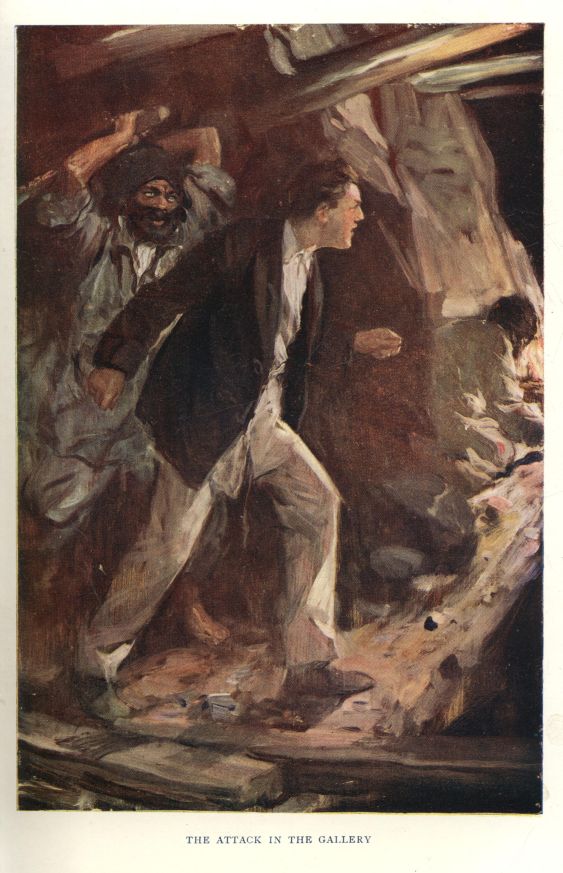
THE ATTACK IN THE GALLERY
CHAPTER THE SIXTH
NURLA BAI DISAPPEARS
Bob never knew how long he lay unconscious on the floor of the gallery. When he came to himself he was in darkness: only the smoky atmosphere remained to bear witness to the reality of the torches. He rose dizzily to his feet, feeling sick and giddy as the result both of his blow and of the close air, and groped his way slowly to the entrance. There the cool breeze somewhat revived him; but he found it difficult to make his way past the obstacles which had given him no trouble before. To scale the fences cost much labour, and he was near fainting by the time he reached the house. Having no key with him, he had to waken the darwan who lay wrapped in rugs on his mat before the door. The man was much surprised to see him, but said nothing as he gave him admittance. Bob crept upstairs quietly; his uncle's door was open, and he managed to cross the room without waking him. Then he dropped on to his bed and nudged his brother.
"You're a juggins," said Lawrence rather unfeelingly, when he had heard the story. "That's the sort of thing they do in the school stories, when the bold bad bully climbs down the gutterpipe and sneaks off to the pub to play cards and swill swipes. But I say, you're not hurt, old man?"
"The whack on the head rather crumpled me up," replied Bob.
Lawrence was out of bed in a trice, lit his candle, and bent over his brother.
"There's a bump as big as a duck's egg," he said. "Jolly lucky your head's hard, old chap! Turn over, and I'll bathe it."
In getting the water-can he stumbled over his boots, making a slight noise.
"It's time you fellows were asleep, came a muffled voice through the door. Mr. Appleton had awoke, and fancied that the boys had not yet settled down for the night.
"Shall we tell him?" said Lawrence.
"I meant to wait till morning, but as he's awake--yes, I think we had better."
Lawrence opened his uncle's door.
"I say, Uncle," he said, "Bob fancied he heard burglars and went prowling without a knuckle-duster----"
"Go to bed," growled Mr. Appleton, only half awake.
"It'll keep till morning, but I think you had better hear it now. I'll tell you through the doorway while I bathe Bob's head."
"What's wrong with his head?"
When Lawrence explained how Bob had seen a glow from the window, in the Pathan section of the mine, Mr. Appleton sat up, now thoroughly awakened. He listened to the rest of the story in silence. At its conclusion he said:
"Just cut downstairs and tell that fellow at the door to hold his tongue about it. Why on earth didn't you wake me at once, Bob, instead of playing that schoolboy trick?"
"I didn't want to disturb you."
"That's all very well, though you wouldn't have hurt an old campaigner like me. You ought to have told me at once, and then we might have caught the rascal. I'm afraid there's trouble ahead, and I've a shrewd suspicion who's at the bottom of it. You didn't recognize the man in the gallery?"
"No; his back was towards me."
"What's it mean, Uncle?" asked Lawrence, returning.
"It means that some one--Nurla Bai, I fancy--suspects that I've found silver, or at any rate something better than copper. You remember how he'd been trespassing on the night you came. But how did he get across? You saw all the men off the premises at bugle call, Bob?"
"Yes."
"Then he's either in league with the sentry, or caught him napping, though I don't understand how Gur Buksh and his men could have slept through the groaning and creaking of the drawbridge."
"Perhaps it wasn't Nurla at all, but some one on this side," suggested Lawrence.
"I don't believe it for a moment. The Sikhs are perfectly trustworthy; the servants too; and the Babu, though as inquisitive as a monkey, is quite honest and knows nothing about ores--though I daresay he wouldn't own it. Look here! we must say nothing whatever about this matter. To refer to it publicly would only stir up unrest among the workmen, and might lead to disturbances between the Pathans and the Kalmucks. Each set would accuse the other. We must keep quiet for a day or two, and watch. You had better not show up to-morrow, Bob. To see you with your head bandaged would set every one talking."
"I shall be all right in the morning," said Bob.
"I hope so. By the way, you were struck from behind, you say?"
"Yes: there are evidently two men in it."
"So much the better. There'll be two quaking in their shoes, and we may be able to spot signs of guilt in their manner. Keep your eye on Nurla and Black Jack, who follows him like a shadow. You made the darwan understand he's not to talk, Lawrence?"
"He won't say a word, I'm sure."
"Then get to bed. I see you've bandaged Bob's head in a workmanlike way. Where did you learn that?"
"Ambulance work in the school cadet corps, Uncle."
"Ah! They manage things better than when I was young. Good-night, boys."
Bob found himself much better in the morning, and declined his uncle's suggestion that he should remain in bed. But his wound was too painful to allow of his wearing a hat, and his appearance bareheaded, and with a strip of sticking plaster on his neck just behind his ear, caused many curious eyes to be turned towards him. Only the Babu made any reference to it. Inquisitiveness was his failing, and he could never keep his tongue still.
"I perceive, sir," he said, "that you are not in your usual salubrity. Your countenance is pale, and I opine from patch upon your neck that all is not O.K. Pardon me, have you abraded the cuticle?"
Bob looked at him.
"Because, sir," the Babu continued with great deference, "I have in my store sticky plaster, powdered alum, gold-beater's skin, sweet olive oil, cold cream scented with roses, all things warranted to make epidermis blooming and good as new. Item and in addition, perhaps a little cooling draught may reduce inflammability and----"
"Oh, shut up!" said Bob, and the Babu went away smiling but sorrowful.
The three Englishmen went about their usual occupations as if nothing had occurred. They watched the workmen narrowly for signs of guilt, but could detect nothing. The Pathans were frankly curious and sympathetic; the faces of the Kalmucks were as expressionless as they always appear to Europeans. Nurla Bai, who was the special object of Mr. Appleton's attention, was inscrutable: there was no change in his demeanour.
Convinced that his assailant had in some way crossed the river in the darkness of the previous night, Bob was at a loss to guess how he had accomplished the feat. In the interval at mid-day, when the men had trooped across the drawbridge for their meal, he suggested to Lawrence that they should walk along the pathway to the ledge on which they kept the aeroplane, and see if there were some fordable place which had escaped their uncle's notice. On the way they examined every foot of the cliff below them. It rose sheer from the bed of the river, so steep and smooth as to afford no foothold for man or beast. Even if the river had been swum or forded, it would have been impossible for any one to climb up to the level platform on which the mine works were situated. Nor could the most hardy and adventurous stranger have approached from above, for the slope was too steep to give foothold to a mountain sheep. In the other direction, down-stream, access was equally impossible, and for a time both the boys felt thoroughly baffled.
At length, however, Lawrence made a discovery. In retracing his steps towards the plank pathway he climbed out upon a huge buttress of rock that projected some feet into the river.
"Take care!" cried Bob, feeling some alarm at the risk his brother was running.
"All right, old man," returned Lawrence. "It's rather a fine view down the gorge from here. You'd better try it yourself when your head's mended."
He picked his way carefully over the somewhat uneven rock, and had gone three parts of the way round its circumference when he suddenly stood fixed, staring at something in front and a little below him.
"By George!" he ejaculated in an undertone. Then he lay flat on the summit of the rock, wriggled forward to the edge, until his head projected, and peered downwards.
"What is it?" asked Bob from his position several yards in the rear.
Lawrence did not answer until he had crawled backward and once more stood erect.
"I've solved the puzzle," he said. "The fellows have got courage at any rate, and must be as agile as monkeys. There's a rope hanging down from the last beam,--down the cliff into the water."
"A rope!"
"Yes, one of our stoutest, cleverly stained so that it's hardly distinguishable from the rock itself. I caught sight of something swaying, and it took me a few seconds to be sure what it was. Whoever it was that knocked you on the head--Tchigin very likely--he must have climbed the rope, twisted himself up on to the planks, and so got to the mine. It's a trick I shouldn't care to attempt."
"But how on earth did he get to the rope from the other side? He couldn't have forded, and the strongest swimmer couldn't get across with the torrent rushing down at something like eight miles an hour."
"That wants thinking out. Meanwhile we'd better get back. If we were seen here we might put somebody on the alert."
"Yes. I tell you what: we'll cross the bridge and stroll up the other side; perhaps we may get a clue there."
They walked back without hurry along the planks, spent some little time in their respective sections of the mine, and then, taking their shot guns, crossed the bridge and walked up the narrow road as they had done many times before when shooting.
"I've been trying to work it out," said Bob as they went. "If I wanted to make for a particular spot on the other side, I should plunge in a good way higher up--you know, where the stream widens and isn't quite so swift. Then I should strike diagonally across and trust the current to carry me where I wanted to go."
"It would sweep you past. You couldn't be sure of hitting the rope."
"I don't know. We'll see when we get opposite it."
They sauntered on side by side, giving no signs of the carefulness with which they were examining the base of the cliff on the farther side. The bank beneath the road on which they were walking was not precipitous like the opposite cliff. Here and there the rocks shelved down to the water's edge, but there was no continuous perpendicular barrier.
Their course brought them presently opposite the buttress by which hung the rope. They did not pause, but as they strolled on Bob said--
"You see that in the angle formed by that buttress and the cliff there's a sort of backwater: not exactly a backwater, of course, but the force of the current is much diminished there. If a swimmer got to that point, he could make headway against the stream."
"That's just where the rope hangs. Did you see it?"
"No; I only took a passing glimpse. We'll turn in a few minutes and take a better look going back."
They went on. Lawrence shot a ptarmigan which would give colour to the ostensible object of their walk. Then they turned and retraced their steps. As they passed the buttress Bob looked carefully for the rope, and could just discern it by its slight motion against the background of rock.
"You might pass a dozen times and never notice it," he said.
Facing in the same direction as the current they were now able to take a more comprehensive view of the gorge.
"Where would you make your plunge if you wanted to swim across?" asked Bob.
Lawrence looked along the bank.
"There!" he said after a little, indicating a rock a few feet below and beyond them, that jutted out into the river.
"Well, let's go and take a look from there."
They left the track, climbed on to the rock, and sat down there with their knees up, flinging pebbles aimlessly into the water.
"I think you're right," said Bob. "Allowing for the strength of the current it's just about here that I should take the plunge. The oblique distance between this and the rope would make the diagonal--parallelogram of forces, you know."
"I don't suppose Nurla knows anything about that," said Lawrence with a smile. "But look here: don't these bushes look as if they'd been disturbed recently?"
He nodded his head towards some scrubby bushes at their right hand.
"You'd think so, certainly," said Bob. "Still, we may be wrong. I remember old Colonel Fanshawe warning us against the danger of seeing what we wanted to see."
After sitting a few minutes longer, keeping up the appearance of aimlessness by careless tossing of pebbles into the water, they rose and resumed their walk. But just at this moment Lawrence caught sight of a dark object among the bushes that grew sparsely on the hillside above the track, twenty yards away. At the distance, partially concealed by the foliage, the nature of the object was not apparent; but Lawrence clambered up by means of the bushes, and discovered a long coil of thin strong cord, lying between two inflated water-skins. He left them where they were, and returned to the track.
"It's clear as daylight," said Bob, when he had heard his report. "The fellow fastened the cord to the rock and held on to it when he took the water. He supported himself on the skins, and when he got to the other side, attached cord and skins to the dangling rope. When he came back, he hauled himself hand over hand against the stream, and pulled in the cord after him. That cord will, metaphorically speaking, hang the fellow, but he's clever enough to have deserved a better fate."
They returned slowly to the compound, well pleased with the result of their investigations.
A few minutes after they had gone, a small figure rose from among the bushes within a few yards of the spot where the cord was placed. Clambering up the hillside, and screening himself as much as possible behind clumps of vegetation, and by the natural inequalities of the ground, the little man made his way rapidly in the same direction as the Englishmen, and descended unseen among the huts of the Kalmuck miners. His narrow little eyes were gleaming with excitement. The men were just returning to work. The Pathans had already crossed the drawbridge; the Kalmucks were crossing. Black Jack pushed his way into the throng, apparently in a great hurry. He overtook Nurla Bai at the entrance to the mine gallery, and together they disappeared.
The boys lost no time in communicating their discoveries to Mr. Appleton.
"This is getting warm," he said. "We can do nothing yet. Act as though nothing had happened: to-night we'll talk things over. You're sure none of the men suspect you?"
"There's no sign of it," said Lawrence. "They saw us go, and come back with a bird: a very ordinary thing, that. I flatter myself that a Scotland Yard detective wouldn't have guessed from our manner that there was any other object in our walk."
The day passed like every other day. At sundown the bugle's note drew the men from their work. They returned to their several quarters, and after their evening meal settled down to their games of chance or skill.
After supper, when pipes were lit, Mr. Appleton returned to the subject.
"I haven't a doubt that Nurla is the man," he said. "You remember his industry when you were building your bridges. The scoundrel's motive is clear. The question is, what is he after? It can't be mere inquisitiveness. He suspects that the Pathans are mining something more valuable than copper, and if he can prove it, he'll sell his knowledge, I suspect, and we shall have trouble. I only hope that your appearance last night disturbed him before he had had time to get any samples."
"If it didn't?" said Bob.
"He'll probably try again. The fact that he hasn't absconded seems to show that he isn't satisfied. If he had got enough for his purpose he would have been over the hills before this. We must keep a strict watch, and if we catch him making any further attempt of the same kind it's the sack at once."
"Wouldn't it be best to sack him now?" Lawrence suggested.
"I'm rather loth to act without definite proof. We should make an enemy of the fellow needlessly, and he has such influence with the Kalmucks that he might call them all out."
"Would that matter? The silver's the thing," said Lawrence.
"Not at all. If I went on mining without them it would be a clear proof that I could afford to leave their gallery unworked, and there'd be trouble all the same. There'll probably be trouble anyhow, but I'd rather keep the Kalmucks working quietly as long as possible. Meantime we'll take precautions. I'll put a Sikh in the Pathan section to keep guard through the night, and withdraw him before dawn, so that nobody is any the wiser."
Early next morning, a few minutes after the bugle had sounded réveille, the Englishmen were disturbed in their dressing by the sound of a great uproar from across the river. They flung on their coats and hurried out. The drawbridge had not been lowered; half an hour would elapse before the bugle called the men to work. But at the farther end the Pathan miners had assembled, and were gesticulating in much excitement, shouting lustily for the huzur. Mr. Appleton ordered the drawbridge to be let down, and hastened across to meet the men.
For some time he found it impossible to gather anything definite from their frenzied clamour. Then, singling out one man as a spokesman, and bidding the rest be silent, he heard a startling story. Muhammad Din, the Pathan foreman, had been discovered in his hut with a knife in his throat. Mr. Appleton had a great liking for the man--a rough uncouth fellow, but an excellent workman and very popular with the men of his race. He at once gave orders that Muhammad should be carried across the bridge to the house, and announced that he would hold an inquiry after breakfast.
In knocking about the world he had picked up a knowledge of rough and ready surgery and medicine, and had more than once treated sick men. A short examination showed that the wound in the unconscious Pathan's throat was serious, though not necessarily mortal, and he set to work at once to cleanse it with antiseptic lotion and to bind it up. While he was still in the midst of this task, more surprising news was brought from the other side.
Quarrels between the Pathans and the Kalmucks had been so frequent in the early days of the settlement that Mr. Appleton had had to devise a plan for minimizing the risk of such outbreaks. The quarters of the two parties were separated by a neutral zone nearly a hundred yards in breadth, which they were strictly forbidden to cross. They used it in common only when going to and from their work, and then at different times, the Pathans leaving first and returning last. If a Pathan wished to go down the river, he had to climb the hillside and come down to the track beyond the Kalmuck camp. If a Kalmuck wished to go up the river, he had to make a similar circuit. The stables were placed in the neutral zone.
When the attack on Muhammad was discovered, and the Pathans rushed to the drawbridge, the Kalmucks were aroused by the din, and flocked to the fence marking the boundary line. But they were unaware of what had happened until their turn came to cross the bridge and they heard the story from the Sikh on duty. A few minutes afterwards, however, it was discovered that neither Nurla Bai nor his dwarf henchman was among their party. No sooner was this reported than the head stableman rushed excitedly across the bridge, to announce that the ponies on which the two boys had ridden to the mine had disappeared. These successive discoveries threw the whole community into a state of seething agitation. Instead of going to their work, the men gathered in groups, discussing the strange thing that had happened to their foreman. Already the Pathans were shouting accusations of Nurla Bai across their fence, and Gur Buksh with his armed squad stood ready to intervene if the wild passions of the miners led from recrimination to blows.
Mr. Appleton did not allow these events to interrupt his ministrations to the injured Pathan. When Muhammad, with his wound well dressed, had recovered consciousness, and was laid in one of the outhouses belonging to the domestic staff, Mr. Appleton and the boys returned to their rooms to finish dressing and breakfast.
"It's all as plain as a pikestaff now," said the elder man. "Nurla has got all he wanted; he must have guessed that he was suspected, and very wisely decamped. And he paid off his old grudge against Muhammad before he left. He's got your ponies too. That's what they call robbery with violence, I think."
"What shall you do, Uncle?" asked Lawrence.
"Go after him, of course. I couldn't otherwise hold the Pathans for an hour. They know I'm just, and as good as my word. If I tell them that Nurla shall be caught and punished they'll believe me and remain as quiet as Gur Buksh can keep them. Otherwise they'd desert in a body and hunt the hills themselves."
"Nurla's got a good start: it won't be easy to catch him," said Lawrence.
"You forget Bob's aeroplane, my boy," said Mr. Appleton.
CHAPTER THE SEVENTH
NURLA AT BAY
If Mr. Appleton had wished to atone for the coldness of his former attitude to airmanship, he could scarcely have shown more eagerness to make use of the aeroplane in hunting down the fugitive malefactor. He was blind to the difficulties. To guard against a disappointment, Bob ventured to point out the disadvantages under which the pursuit would be conducted--the few landing-places and fewer starting-places which the rugged country offered; the ease with which the men, even if discovered, might conceal themselves in some woody ravine or some inaccessible cleft in the mountain side: the likelihood of their escaping notice altogether. There was every chance indeed that they would be espied, if at all, upon some tract of country where to make a descent would be impossible; and before the pursuers could reach a suitable spot, there would be plenty of time for the men to alter their direction and elude the most careful search. The one point in favour of the pursuit was that Nurla was accompanied by Black Jack: it would not be so easy for two as for one to escape notice.
Mr. Appleton ignored all Bob's well-meant hints of failure, and was only anxious to be off. He summoned the Pathans and explained to them what he was about to do, warning them against misbehaviour in his absence. He gave instructions to Gur Buksh to maintain strict discipline, and flattered the Kalmucks into good temper by assuring them of his belief in their loyalty. Then, having arranged that a small party of Pathans should ride northwards down the track, he hurried after the boys, who had already gone to prepare the aeroplane for flight.
He had no doubt that Nurla had fled northward, in the direction of his own people. For at least forty miles the fugitives would be obliged to keep pretty closely to the valley, for, as far as Mr. Appleton and any of his people knew, there was no practicable way over the hills for horses. After that the country began to open out: the river broadened and was fordable in several places, and the fugitives would have the choice of several routes, either to the right or the left. It was therefore necessary to overtake them and hold them up while they were still in this forty-mile stretch of rugged river valley. Mr. Appleton's idea was to fly ahead of them as soon as they had been sighted, land at the first convenient spot, and hold them in check until the mounted party had had time to come up. It was impossible to tell how many hours' start the men had had; but even if they had left the settlement soon after dark their progress along the rough and dangerous track must have been slow, and it seemed hardly likely that they could reach the open country before the swift-flying aeroplane overtook them.
The boys rapidly overhauled the engine and tested the steering and controlling gear. Bob felt a trifle anxious when he noticed how rapidly the clouds were racing before the wind, which blew from the west. Flying in the valley, the aeroplane would be protected from the full lateral force of the wind by the high mountain barrier on each side. But there was considerable danger of encountering gusts and eddies sweeping through clefts and gorges here and there, and it was impossible to calculate at what precise angle the aeroplane might be struck by a sudden blast. However, the conditions were no worse than they had already been in some of his practice trips, and he only felt a little additional nervousness because Mr. Appleton had never yet accompanied him except in absolutely calm weather.
Just as they were preparing to start it occurred to Mr. Appleton that some unforeseen contingency might prolong their absence from the mine.
"Run back," he said to Lawrence, "and tell some of the men to bring over enough food for a couple of days and two or three skins of water, in case we don't get a chance to draw some from the river. You had better tell the Pathans, too, to take food in their saddle-bags. It's just as well to be prepared for emergencies."
All arrangements having been made, they took their places. Chunda Beg and the Babu were among the men who had walked to the ledge to witness and assist in the start.
"I wish good luck and safe return," said the Babu impressively. "As for that villain of deepest dye, I approve of strongest measures. There is varied choice of punishments--pistol, rope, et cetera: the best, in my humble opinion, is to let him dangle from rope until death comes as merciless release."
"If you don't skip, Babu," said Bob, "you'll be caught by our wings, and either be carried up to the heavens or dashed over the edge into the river."
Ditta Lal instantly picked up his skirts and fled, not halting until he reached a safe distance. There he watched the ascent of the aeroplane until it disappeared round a bend in the gorge. Then he returned to the compound, following Chunda Beg, to whose back he discoursed on the velocity of the wind, the native iniquity of the Kalmuck race, and the various tortures to which Nurla Bai might conscientiously be put when he was captured.
Bob steered the machine along the middle of the valley, keeping low in order to avoid the wind. On either side rose the lofty mountain barrier, here overhanging the river, there receding; at some spots an almost perpendicular wall, at others broken into peaks and parapets, with deep hollows in which a scanty vegetation struggled for existence on a thin soil. Now the valley narrowed so that there seemed barely space for the aeroplane to pass: now it widened into a series of rocky terraces, seamed by fissures in every direction. The track on the right bank followed the winding course of the river for many miles, then dipped to a ford and reappeared on the left. Some miles farther on it recrossed the river by a crazy bridge of rope, and continued along the right bank past the foothills and out into an extensive plateau.
Bob as usual acted as pilot. By flying pretty close upon the river he not only avoided danger from gusts, but enabled his companions to keep a sharp observation upon the ground. Here and there, where this wound behind the rocks between the bank and the hillside, he left the river, planed a little higher, and steered a course exactly over the track. The recent invention of planes which could be lengthened or shortened at will rendered it possible to travel at more varied speed than had formerly been the case, and when he was several miles from the mine he reduced speed to the minimum. Even then, however, the aeroplane moved so swiftly that there was some danger of the watchers passing their quarry without perceiving them. This was not likely where the track was closely hemmed in between river and hillside. The risk was greatest where the latter receded from the course of the stream, leaving large areas of rough country, sometimes covered with bush, in which the fugitives could without much difficulty hide out of sight of any one not passing immediately above them.
The ford at which the track crossed the river was about twenty miles from the mine. Coming to that point without having seen the fugitives, Bob followed the track along the left bank. Here the open spaces became more frequent, and it would have been impossible to examine the ground thoroughly without circling. For the present Bob hesitated to do this, feeling that it was more important to keep to the track for so long a distance as the fugitives might have covered had they started at the earliest likely moment, twelve hours before. Another twelve miles brought him to the rope bridge, where he again crossed the river, and so continued until, ten miles farther, the foothills were reached, and the country began to open out.
It was obvious to all three occupants of the aeroplane that the only means of thoroughly searching the comparatively open country at which they had now arrived was to rise to a greater height and sail about in widening circles. Bob therefore adjusted his elevator; and as the machine swept round, the other two peered over on opposite sides, using their glasses to scan the ground beneath. The fugitives being presumably mounted on the stolen ponies could hardly be otherwise than conspicuous; and when, after more than half an hour's careful observation, nothing had been seen of them, the pursuers came to the conclusion that the men could not yet have quitted the valley. This was a very reasonable inference, considering that they had covered in less than an hour a distance of nearly fifty miles, which the fugitives, even on horseback, must take many hours to traverse. The natural conclusion was that the horsemen, warned by the whirring of the propeller, if not by the actual sight of the aeroplane, had taken shelter in one of the more rugged or more thickly wooded places until the pursuers had passed. There was nothing for it but to turn back and hunt up the valley again.
The aeroplane was crossing the plateau obliquely towards the opening of the gorge when Lawrence suddenly caught sight of a number of round objects resembling bee-hives, clustered in a secluded dell. He pointed them out to Mr. Appleton, who examined them through his glass.
"They are akois," he said: "the portable huts used by the nomad tribes in these parts, made of a circular wooden framework covered with felt. But I've never before seen so many in a group."
As they looked, the intervals between the akois became filled with a dense crowd of men, who stood gazing up in astonishment at the strange machine flying high above their heads. The airmen had no particular interest in wheeling about to make a careful inspection of the camp, for it was inconceivable that Nurla and his man had come so far and joined their compatriots, if such these people were. They had soon left it far behind, and descending gradually as they neared the gorge, they re-entered this at an altitude of not more than a hundred feet above the river to renew their search.
Bob found it by no means easy to follow a course that would enable his passengers to obtain a clear view of the more rugged portions of the valley. Here and there, at the wider parts, he was able to wheel round and cover wide areas; but in the narrow stretches he was forced to fly straight ahead without the possibility of turning, unless he should rise to a great height. This would involve a loss of time which could be ill afforded. Once or twice, in attempting to circle, he almost shaved the rocky sides; and deciding that such attempts were too dangerous, he concluded that he had better leave certain parts imperfectly explored rather than risk injury to the aeroplane. He compromised matters by steering a serpentine course, thus covering as much as possible of the ground on both sides of the river.
The aeroplane was approaching the rope bridge when Mr. Appleton suddenly called out that he saw two men on horseback on the track beyond. In another moment he recognized them through his glass as the men of whom they were in pursuit. They were nearly a mile distant, entering a stretch of the gorge that was particularly rugged, and no doubt afforded plenty of cover. It had been prearranged that as soon as the men were sighted Bob should make a descent as near as possible ahead of them--that is, down-stream--but it was no surprise to Bob--indeed, it was only according to the ill-luck that seems to rule on such occasions--that no suitable landing place offered itself.
He remembered, however, that in flying downstream he had noticed, two or three miles above the bridge, a place where the valley widened sufficiently to allow the aeroplane to circle. He decided to fly direct to this spot, turn, follow the men, outstrip them, and land at a spot some distance down-stream, where a landing had seemed feasible. Lawrence suggested that he or his uncle should take a flying shot at the men as they passed above them, but Mr. Appleton would not consent.
"Punishment before trial won't do," he said.
By this time the fugitives had disappeared behind a sort of parapet of rock just above the bridge, which spanned the river at a height of twenty or thirty feet. On first sighting them, Bob had caused the aeroplane to descend until it was almost level with the bridge. As they came to it, Mr. Appleton rose in his seat behind the pilot, to see, if he could, the precise spot in which the fugitives had concealed themselves. He had just done so, and was leaning slightly to the right, when there came in rapid succession the crack, crack of two rifles. And then Lawrence, in the third seat, was horrified to see his uncle pitch forward, lose his grip on the stay he was clutching, and fall headlong into the river. It all happened so instantaneously that the boy had no time even to reach forward. He sprang up, almost over-balancing himself, but before he could stretch out his hand Mr. Appleton was whirling in mid-air.
At the moment of the accident Bob was made aware that something had happened by the lurch which the sudden loss of weight caused the aeroplane to give. A cry from Lawrence apprised him of the nature of the accident. For a few moments both the boys were dazed by the shock of their uncle's disappearance, so sudden, so unexpected, so terrifying. Bob had instinctively moved his controlling lever to counter-act the lurch. As soon as he knew what had happened, instinct again prompted him to bring the aeroplane round; but reason coming to his aid, he corrected the movement just in time to avoid dashing the plane against the rocky barrier on his left hand.
"Keep straight ahead!" shouted Lawrence in terror.
But before the words were out of his mouth the danger of a fatal smash was avoided. The aeroplane flew at full speed up-stream. In a few minutes it would reach the wider space where turning was possible. Only then could the direction of its flight be reversed, and the fate of Mr. Appleton be ascertained.
In their anxiety for their uncle, both the boys had now forgotten the very existence of the Kalmuck miscreants. It did not occur to them that in repassing the same spot on their flight down-stream they might be in danger from the same concealed marksmen. As the aeroplane turned, Lawrence called to his brother to descend still lower, so that they might the more easily see their uncle's body if he were still floating in the stream.
"If I see him, I'll dive in," he said. "You go on, land where you can, and come back to my help."
With his eyes fixed on the water below he was unconscious of anything but the swirling flood, and the intense strain of searching the surface as the aeroplane flashed by. Neither Bob nor Lawrence noticed the movements of the two Kalmucks. They, as soon as they had fired their shots, vaulted into the saddles of the horses that stood beneath a tall rock, and dashed at headlong speed along the track towards the bridge. The horses, urged by their riders, and terrified by the increasing sound of the aeroplane rushing swiftly behind them, took the bits in their teeth and galloped on, completely beyond control. They wheeled on to the bridge. At this moment the aeroplane was only about two hundred yards behind them, and Bob was intending to pass under the bridge. But the weight of the horses was too much for the frail and clumsy structure. It broke in the middle, and horses and riders plunged into the river. Bob had just time to move his elevator and skim over the confused mass of bridge, horses and men.
Only for a moment was Lawrence's attention diverted from his quest. Hitherto he had fixed his eyes from a rapidly diminishing distance upon the spot where his uncle had fallen, and the river beyond. Now he had passed the spot itself, and in a few seconds covered the whole distance down which, even allowing for the speed of the current, the body could have been carried. There was no sign of it, and Lawrence felt with horror and despair that the shot had been only too well aimed--that Mr. Appleton had been killed outright, or so grievously wounded as to be unable to keep himself afloat. He could not endure the suspense and uncertainty.
"I am going in," he cried. "Come back for me."
To make a clean dive from the narrow seat of an aeroplane flying at the rate of thirty miles an hour was impossible. It was a dangerous feat to attempt at all, but Lawrence did not think of that. He fell rather than plunged, at the imminent risk of striking a half-submerged rock in mid-stream. The shock of hitting the water after a haphazard fall of thirty feet was so great that for a time, even after he had risen to the surface, he was too much dazed to be able to distinguish his surroundings. With the instinct of a practised swimmer he trod water until his senses returned to him. Then he saw that he was far below the ruined bridge, and being rapidly carried down-stream. The aeroplane was out of sight. Neither man nor beast was visible on either bank. The Kalmucks must have clambered up the bank and taken to flight. He realized that if his uncle was still in the river he must have overtaken him before the dive was made. It was necessary to husband his strength, and either try to swim against the stream, or make his way to some rock on one side or the other, whence he could watch the current as it flowed past him.
He turned, and for some time breasted the stream until he descried a rocky shelf at the base of the right bank which would prove at once a resting place and a convenient watch post. Nearly exhausted, he dragged himself on to it, and crouched there, intent upon every billow and eddy of the swollen river. Fed by the mountain snows, it flowed on with turbulent tide. The water was bitterly cold, and Lawrence shivered as he waited there minute after minute, hoping, yet dreading, to see his uncle's form rolling past.
Presently he heard the hum of the returning aeroplane. Bob shouted as he sped by, but what he said was indistinguishable. Lawrence felt more and more despairing until with a gleam of hope he wondered whether his uncle had swum to one bank or the other and climbed to safety. He looked at the bank behind him. It was steep, almost perpendicular, but marked by fissures that promised to give him foothold. With teeth chattering and limbs trembling with cold he essayed to clamber up. At another time he would have found the feat easy enough: now he was amazed at the tax it put upon him. Every now and then he stopped, clung on with his hands, and turned his head to glance again at the stream. At last, on gaining the top, he looked along the track in both directions. Nobody was in sight. The aeroplane had again disappeared from view. Hesitating a moment he began to walk up the track. A new fear assailed him: what if the aeroplane had met with an accident! What if the engine had failed, or the pilot had been too venturesome, and in attempting to wheel in too narrow a space had crashed against the rock! Shivering as much from anxiety as from cold, he felt a glow of extravagant delight when he heard a cheery shout, and Bob came hasting towards him from round the corner of a jutting rock.
"Any sign of him?" asked Bob anxiously as he met his brother.
"No. What can have become of him?"
"I fear the worst: but even if--if he is drowned he must come up some time. We had better walk up and down for a bit."
"Where's the machine?"
"A few yards above the bridge. It was a risky thing, coming down there, but I thought I'd venture, and luckily didn't come to grief."
"Let us get our field-glasses. We can then examine every crevice in the other bank. We can't get to the other side and examine this. By the way, how did you get across?"
"One of the ropes that formed the hand-rails of the bridge is uninjured. It sags a bit, but it's just taut enough to swing over by."
For some time they marched up and down, above and below the spot where their uncle had fallen. Bob stripped to his shirt, and swam along with the current below the track, searching every cranny into which he thought the body might have been carried. No discovery rewarded his care except a primitive fishing net, the meshes of which had caught upon the jagged edges of a rock.
"Do you think the Kalmucks got hold of him?" said Lawrence when they again met.
"Upon my word, I had almost forgotten them. They may have done so. It's clear that they got out of the river, and their horses, too. I didn't see them as I flew up. What more can we do?"
"I don't know. I'm dead beat. I can't help thinking that the Kalmucks must have captured him, alive or dead. When we have rested we had better get our rifles and go and meet the Pathans. They ought to be near by this time. With them hunting on horseback and ourselves in the aeroplane we can scour the country. But we must tell our men; it's no good starting without them."
"I think you're right. We'll get something to eat, and by the time you've had a rest, no doubt the men will arrive."
CHAPTER THE EIGHTH
THE EDGE OF THE STORM
They swung themselves across the river hand over hand on the rope. On returning to the aeroplane Bob opened a box of sardines and took out of a biscuit tin some of the flat bread-cakes baked by the Chinese cook. But neither he nor Lawrence had any appetite. After a few minutes Lawrence got up.
"It's no good," he said. "I can't eat, and I can't rest. It would be different if we knew for certain that the old man was gone; it's the uncertainty that's so wearing. Do you see anything of the Pathans?"
Bob took his field-glass and went to the edge of the track, whence he had a scarcely interrupted view of a mile or more of the valley.
"No, they're not in sight," he said after a minute or two. "Shall we go and meet them?"
"I'm more inclined to go down-stream, on the off-chance that we may find something."
"All right. Better take our rifles, perhaps."
"Why? Nurla has got clean away by this time, whether Uncle is with him or not. You may be sure he wouldn't wait about."
"Well, we'll take our revolvers; it's just as well to have something handy. For all we know he may be resting behind some rock."
"With a rifle! Revolvers wouldn't be much use against that."
"Nor would rifles, now you mention it. He'd pot us before we saw him if he wanted to. All the same, we'll take our revolvers."
They swarmed across by the rope, gained the farther bank, and walked slowly down the track, scanning the rocky recesses as narrowly as before. They had scarcely any hope of finding their uncle's body; but while it remained undiscovered they were ready to search again and again. It was now near midday, and the sun beat fiercely upon them. For a time they were unconscious of the heat in the intentness of their occupation, and the foreboding anxiety that filled their minds; so that they had walked much farther than they supposed when they became alive to the fatigue induced by exertion in such a temperature. Then, wiping their perspiring brows, they sank down to rest on a flattish boulder overhanging the stream.
"We must give it up," said Bob wearily. "Unless Nurla has got him he's either at the bottom of the river, or else washed down miles by this time."
"I don't care about caving in altogether," said Lawrence. "It would be some satisfaction--a mournful one--to recover his body and give him decent burial."
"Poor old man! He wouldn't care a bit about that. What's more to the point is to hunt down the blackguards who killed him. That's what I propose to do as soon as our men come up. Some of them are sure to know the country, and with them on horseback and ourselves in the aeroplane, I'd take long odds that we find Nurla in time."
As they talked, they kept their eyes on the river, more from the habit engendered during the previous few hours than with any strong hope of their search being rewarded. Presently Lawrence, following with his eyes the foaming ripples as they swirled down-stream, caught sight of something that caused him to spring to his feet with a sudden ejaculation and lift the field-glass to his eyes.
"What is it?" asked Bob, rising also.
Lawrence handed him the glass. Far away he saw, rounding a bend in the track, a party of horsemen marching slowly in single file towards them. Their costume proclaimed them as Kalmucks, and though they were too far distant for their features to be distinguished, the shape of the foremost seemed to be that of the dwarf, Black Jack.
The watchers suddenly remembered the encampment over which they had flown earlier in the day. The same thought flashed simultaneously through their minds: the stealthy proceedings of Nurla in the mine and his subsequent disappearance had not, then, been prompted by an indefinite hope of gain; they had been deliberately planned, either in the knowledge of the proximity of a body of his fellow countrymen, or even in concert with them. There could hardly be a doubt that, as once before, an attempt was to be made to dispossess Mr. Appleton of his mine.
The boys stood watching only for a moment or two; then they dropped down, feeling instinctively that it behoved them to keep out of sight. But brief though their gaze had been, it was long enough to assure them that the approaching party was a numerous one. They counted a dozen men; others were coming round the bend, and they were strung out along the track. Every man had a fire-arm of some sort, a carbine, or a rifle, or a long musket like the Afghan jazail.
For the moment even the fate of their uncle was obliterated from the boys' minds by this astonishing discovery. They realized that their own lives and the safety of the mine were in danger. Hitherto their anxious thoughts had been fixed on one object alone; now they saw themselves faced with a much more complicated problem.
"We must get back," said Bob, insensibly lowering his tone of voice. "We can do nothing at present for Uncle. We must at least return to the aeroplane and wait to see what happens. I'm pretty sure I'm right: those fellows are being led by the dwarf--and Nurla too, I suspect--to the mine. Luckily we've plenty of time to fly back in the aeroplane and give warning."
"What then? If all those men we saw in the encampment are coming along, we haven't half enough men to prevent anything they like to do."
"I don't care about that. Uncle beat off an attack once, and if those fellows want the mine, by Jove! they shall have a fight for it."
"You're talking through your hat," said Lawrence, whose tastes and temperament were quite unmilitary, and who did not know his brother, perhaps, as well as might have been expected.
"Well, we'll get back, at any rate," rejoined Bob, ignoring the accusation. "And, if possible, without being seen."
They got up, and set off up-stream at a run, keeping as near as possible to the left-hand side of the track in order to escape observation. Only now did they discover how far they had come. The bridge was quite out of sight. They had not timed their walk, and had no means of knowing how many yards or even miles they had to cover before they should reach the aeroplane. The distance was in fact more than two miles, and the Kalmucks were only three-quarters of a mile behind them. The roughness of the track lessened the horsemen's advantage in being mounted; but the boys feared that, if they had been seen, the Kalmucks, pressing on the small, hardy ponies, accustomed to rough country, might overtake them before they had time to make good their escape across the river.
They were not long left in doubt whether they had been seen and were being pursued. They had been bounding along a straight stretch of the track, perhaps half a mile in length. Before they gained the farther end of it they heard the shrill shouts of the Kalmucks rising above the droning bass of the river. As they turned the corner, and passed out of sight, the sharp crack of rifles followed them; but the pursuers had not dismounted to take aim and had fired a thought too late. The only effect of the shots was to make the boys increase their speed, for they knew that the ponies must rapidly gain on them over the straight and fairly level portion of the track which they had just left. They pushed on gamely, hugging the cliffside as closely as possible, but being forced sometimes to diverge towards the river by the nature of the path. They looked anxiously ahead for a sight of the ruined bridge, and felt the shock of dismay, when, catching a partial glimpse of it at last, they found that they had still at least a mile to go.
The pursuers began to close in upon them. A scattered volley proved that they had again been seen. The Kalmucks were firing and loading as they rode--a mere waste of ammunition, as it might have seemed, but for an instant proof that these warriors of the steppes were no mean marksmen, even in full career. Bob's cap was struck from his head, and he discovered only by the blood trickling down his neck that he had been wounded. Lawrence, glancing over his shoulder, saw that it would be quite impossible to reach the bridge before the pursuers came up with them.
"We can't do it!" he gasped.
Bob said nothing. His mouth hardened, and he looked intently ahead. At a few yards' distance a jutting rock encroached upon the track, rendering it only just wide enough for a horseman to pass. On rounding it he halted.
"Down on the ground!" he panted. "Out with your revolver! There's nothing else for it."
They threw themselves down with their faces to the enemy, and covering themselves as well as they could with the corner of the rock, they held their revolvers ready to fire at the foremost of their pursuers.
"Wait till they are within a few yards of us," said Bob. "No good wasting shots at long range. They are bound to go slow."
They waited in breathless excitement. Lawrence the pacific was now as warlike as Bob himself. The enemy drew nearer. The narrowing of the track caused them to reduce their pace from a gallop to a trot, then to a walk. In the ardour of the chase their order had been changed; Black Jack was no longer in front.
The boys had just had time to pull themselves together when the first man came within range.
"Now!" said Bob, springing to his feet.
Showing themselves on the narrow path between the rock and the brink of the river they emptied four barrels rapidly, almost pointblank at the horsemen. The first two men dropped; the others, taken utterly aback, reined up, but were thrown into a huddled mass by the men pressing on behind. There was a moment's pause--a pause emphasized by cries of pain and fear, and the shrill screams of horses. Then the confused throng began to wheel about.
"Hold your fire!" whispered Bob, at the same moment emptying his two remaining barrels into the medley. Another man fell. It was enough. Reckless of everything but his own safety, each man urged his steed back along the track, and in a few moments all had passed out of sight.
"We win the first trick," said Bob, glancing at his brother. "Why, you're as pale as a ghost!"
"So are you," returned Lawrence.
"Well, it's our first experience of war, so I'm not surprised. But we must cut it. For one thing, my revolver's empty, and I've no more cartridges here. For another, those fellows will come back as soon as they've got over their surprise, and even if they funk a frontal attack, I dare say they can manage to clamber round somehow and turn our flank. Our only chance is to make a break for the bridge and get over if we can before they're fit to come on."
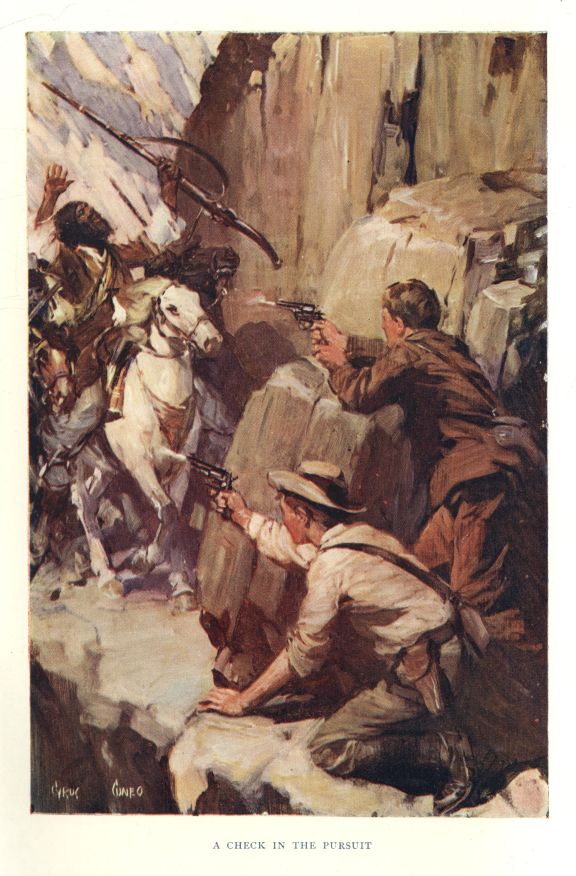
A CHECK IN THE PURSUIT
They started at once, and ran up the track, taking much comfort from the knowledge that the projecting rock would for some distance conceal them from the enemy. But after a few hundred yards the track both ascended and wound slightly to the right, bringing them once more into full view. They had no sooner reached this point than loud shouts behind them announced that the pursuit had been resumed. They glanced back, then ahead, measuring with their eyes the gaps that separated them from safety on the one hand, and capture on the other. A couple of bullets whistled over their heads, but the firing ceased, and they guessed that the enemy were confident of being able to overtake them. Such assurance was misplaced. The track in this part of the ravine, the scene of the morning's disaster, was particularly rugged, and gave no advantage to the mounted men. Moreover, there were at intervals isolated rocks behind which the boys could have posted themselves as they had already done, and the Kalmucks approached these heedfully, reining up until assured that they had no similar ambuscade to fear.
"Lucky they don't know we've only two shots between us," said Bob as he sprinted along by his brother's side. "A good spurt and we're home."
They were both good runners, though their want of training showed itself in a certain shortness of wind. They gained the bridge, saw at a glance that the pursuers were still several hundred yards away, and seizing the rope began to swing themselves hand over hand across the stream. At their previous crossings they had exercised some little caution, in case the rope should break under their weight. Now, however, they put everything to the hazard, realizing that to fall into the stream would be no worse than to be caught.
The Kalmucks had been informed by Nurla of the destruction of the bridge, and had anticipated an easy capture. When they saw the boys swinging themselves across they gave utterance to renewed shouts; some flung themselves from their horses and ran forward to swarm over in the same way: others reined up and once more began to fire. The fugitives were still some few feet from the farther side, and momentarily expected to be hit, when there was a sudden diversion in their favour. They heard shouts in the opposite direction, from beyond the rocks on the other side of the clear space on which the aeroplane rested. Immediately afterwards several rifle shots rang out. For a second they halted in their progress, in the fear that they were the targets of another hostile band. But next instant it flashed into Bob's mind that the volley must have been fired by their own Pathans, whose arrival they had long expected.
"Come on, Law," he cried. "We're all right now."
With three more heaves he was upon the bank. He turned to assist his brother; then both scurried across the open space, past the aeroplane, and dashed into safety behind the screen of rocks, where they were received with shouts of delight by the five stalwart Pathans who lay there in a line with their rifles at their shoulders.
For the moment they were not aware of the effect of the volley. It had brought the Kalmucks to a sudden check. One of those who were scrambling across the rope dropped into the river; the rest swung themselves round and struggled frantically in the opposite direction. Two or three of those who had halted on the track were wounded; and their comrades, realizing that they were helpless against marksmen under cover, wheeled round and made a hurried flight down the river, not drawing rein until they had passed the intervening rocks and were themselves protected. Those who had followed the boys sprang to their saddles and galloped away; but one of them was winged before he had ridden many yards. He fell from his pony, which dashed on in pursuit of the rest and was soon lost to sight, the man rising and limping after.
The Pathans chuckled as they rose to their feet.
"That was well done," said one of them, named Fyz Ali. "But where is the huzur?"
He turned to the boys, who, feeling thoroughly exhausted by the stress and strain of this eventful morning, had flung themselves down, and lay at full length with their heads resting on their arms.
At the man's words Lawrence looked up. He had learnt enough of the Pathan patois to understand and to make himself understood, though he could not yet sustain a lengthy conversation. In a few words, haltingly, he explained what had happened to his uncle. The Pathans threw up their hands in consternation, invoking the name of Allah and pouring out a torrent of curses upon Nurla Bai and the Kalmucks. Mr. Appleton was very popular among them, and the news of his loss, and of the escape of the assassin, filled them with dismay and rage.
"Beyond doubt the huzur is dead," said Fyz Ali, pulling at his beard. "Allah is great! The huzur could not live, falling wounded into the swift water. He sank like a stone, and lies at the bottom. We shall cast dust upon our heads for our father."
"You were just in time to save us," said Lawrence.
"Allah be praised! We were riding down, and came to the wonderful machine, and when we saw that the bridge was broken we knew that we must wait until the huzur returned. Therefore we got off our horses and were resting and eating when we heard shots afar off, and believed the huzur was doing justice upon Nurla Bai. But looking down the stream we perceived the sahibs running, and the accursed Kalmucks after them, and I said we must hide behind the rocks and fire when the time came. And by the mercy of Allah we were able to save the sahibs, and our hearts are glad; but our joy is turned to grief by this heavy news. Our light is become darkness, and we are as little children."
Lawrence then told in detail, as well as he could, the events of the morning. When he spoke of the encampment on the plateau, Fyz Ali at once agreed that Nurla Bai must have known of the proximity of his fellow countrymen, and that an attack upon the mine was clearly intended.
"What are we to do, sahib?" he asked.
Before Lawrence could reply, the air was rent by the crackle of rifles, and a shower of bullets hissed overhead, some pattering upon the rocks. Some of the Pathans had incautiously shown themselves, and the enemy had opened fire from their position down the river. They instantly ducked under cover, and gathered in a group about their young masters, to consult on their course of action.
"How many Kalmucks did you see?" asked Lawrence.
"We did not count them, sahib," said Fyz Ali, "but there must have been nearly thirty. There are not so many now," he added with a grim chuckle.
"And we number seven all told!" said Lawrence. "Look after the men while I talk to my brother."
"We're in a hole," said Bob. "The fellows aren't great marksmen, but we can't move the aeroplane while they command the space in front. They're only about a quarter of a mile away, and with a score of rifles they couldn't help hitting us."
"What was your idea?"
"To get aloft and fly down-stream to reconnoitre. I should like to know whether the rest of them are coming up from the camp. But that's out of the question."
"We're safe for the present, anyhow. They can't cross while we command the bridge."
"That's true. I wonder whether they can climb the hills, and get at us from above. You might ask Fyz Ali whether he knows of a path."
The Pathan consulted with his companions. One of them said that he knew of a rough path a mile lower down the river, which led by a tortuous and difficult course over the hills; but it involved a round of nearly ten miles, and the march would take at least five hours.
"By that time it will be dark," said Bob. "It's something to know that we are safe till then, and it gives us time to think out a plan. The one thing that's clear at present is that we must get back to the mine."
"And Uncle?"
"We can do absolutely nothing more. In spite of what Fyz Ali said, I can't help thinking that he may be still alive. If he were drowned, his body must have come up."
"And the Kalmucks would kill him if they found him."
"I'm not so sure. He'd be a valuable hostage. They might bring him up to the mine, and make our surrender a condition of his release."
"With all my heart I hope it is so. But suppose they haven't got him?"
"We must get back to the mine and do our best to hold it. That's what he'd wish us to do. But look here, old chap, we've eaten next to nothing. It's no good letting ourselves down. Ask Fyz Ali to give us some of his tommy; we can't get our own; and when we've had a feed we'll decide what's to be done."
CHAPTER THE NINTH
A FLIGHT BY NIGHT
The afternoon wore away. For some time there was complete silence except for the gurgling hum of the river, and the low tones of the Pathans as they talked gloomily among themselves. It occurred to Bob that the enemy, finding themselves so completely at a check, might have retreated, to advance again when they should guess that want of food had driven the Englishmen's party back to the mine. But on putting it to the test he found that he was mistaken. He practised the old device of drawing the enemy's fire by means of dummy targets. Two of the Pathans hoisted their turbans on their rifles until they showed just above the rocks. The instant result was a volley from downstream, and one of the turbans on being lowered was found to have several holes drilled in it.
"They don't mean to let us off," said Bob. "I've made up my mind what we must do. When it's dark we'll creep out, you and I, and start the engine. We'll toss who shall fly back to the mine----"
"No, that's your job," said Lawrence. "You can manage the machine better than I."
"Just as you please. Well, I'll go then, and have a talk with old Gur Buksh. You'll stay here and keep watch on the enemy. By their sticking on it looks as if they might try to rush the position in the night: but as they can't get across except as we did, by the rope, you ought to be able to spoil that little game. I'll tell the havildar all about it, and get him to make quiet preparations for an attack. Then I'll fly back. I'll go on down-stream and take a good look at things. The enemy may have sheered off by the morning: in that case we can have another look for Uncle, and then return to the mine. If they've been reinforced from the camp, and look as if they are coming on, we can get back all the same. They'll have to repair the bridge before they can bring their horses over, and the Pathans will be miles towards home before that can be done."
"Don't you think it would be better to bring down some more men and prevent them from repairing the bridge? We could then stave off an attack on the mine--perhaps prevent it altogether."
"Too far from our base, my boy. There's that path over the hills the men know of. We mustn't run the risk of having our rear turned. But I'll send down some reinforcements. Of course without the bridge the enemy can't possibly cross until they reach the ford miles up-stream; but they may be good at mountain climbing, and judging by their pertinacity so far they won't shirk the journey. They've got time on their side: there's no hurry: they know that we're boxed at the mine, and when they get there they've only got to sit tight and intercept our regular convoys of provisions to starve us out in a month or so. Things look pretty black, and our only chance is to strengthen our position and give them so hot a reception that they'll get tired of it."
"There's one thing Uncle ought to have done. He ought to have rigged up a wireless installation, so that we could summon help in an emergency like this."
"My dear chap, what would be the good? We could only get help from India, and they wouldn't send an expedition out on behalf of an obstinate crack-brained adventurer, as they regard him, who's no business here at all. Poor old Uncle, when he settled here, knew very well that he'd taken his life in his hands, and had only himself to rely on. We've got to do everything ourselves."
"Couldn't you fly southward, and see if Major Endicott is within reach?"
"He's back in Rawal Pindi long ago. No, we can't expect any help. By George! I thought I'd lost all chance of seeing some fighting; but it looks now as if I'm to get a good deal more than I should have got if I'd come out with a commission."
"You seem quite cheerful at the prospect. You're a born soldier, Bob."
"And we'll make you one before we've done with you, old man. It's all clear, isn't it?"
"So far as I'm concerned. But there's one thing you don't appear to have thought of: how are you going to alight on our ledge in the dark?"
"Is there no moon to-night?"
"Not till very late, I think; and in any case we get more shadow than shine in the valley, unless the moon happens to be sailing directly above."
"You're right. I hadn't given it a thought. It will be a ticklish job. Owing to that bend the lights in the compound will be invisible from beyond the ledge. But it's got to be done somehow; I'm glad you mentioned it, because I don't think it would have occurred to me, and now I can try to meet the difficulty."
"You won't start back till daylight, I suppose."
"No. If I find the coast clear when I've had a look down the river I shall come back and drop here. If there are only a few of them we'll wait for our reinforcements and then see if we can't drive them off: that will give us another chance of searching for Uncle. On the other hand, supposing a lot more have come up from the encampment--too many for us to tackle--I'll show a red flag, and that'll be the signal for making tracks at once. There's one thing I'd recommend. Get the Pathans to take their horses a little further up-stream out of range. We don't want them to be hit. It's a pity there's no herbage for the beasts to feed on, their bags will be empty by the morning. Still, they'll be back at the mine by midday to-morrow, all being well."
Dusk fell early upon the river. It was gloomy below even while the mountain tops were still glistening in the glow of sunset, and the sky was bright. At last, when the keenest-sighted of the little party could see scarcely two hundred yards down the track on the opposite bank of the stream, Bob decided that it was time to move. He ordered three of the Pathans to creep cautiously out to the end of the bridge, and lie down behind some flat rocks there, keeping a sharp look-out for the appearance of the enemy. They gained their post without attracting attention.
"By the way," said Bob, as he prepared to walk with Lawrence into the open space on which the aeroplane lay, "you'll have to set a guard at the bridge end all night. Let the men take it in turns, two at a time. They're not used to doing sentry-go: I'm afraid you'll have to be with them yourself. If I'd thought of it before you might have got some sleep this afternoon. You mustn't let the enemy rush you."
"All right, I'll manage to keep awake. Hadn't we better try to clear some of these stones away? Otherwise you won't get a very good run off."
"Yes, but we can't wait to clear the ground properly. Every minute increases the risk of not getting away safely."
With the remaining two Pathans the boys moved quickly into the open space, and carefully lifted the larger fragments of rock from a straight stretch of about fifty yards. They were still engaged in this when the Pathans at the bridge end opened fire. Their comrades instantly joined them, and for some minutes the five men fired briskly across the river. The sentries had discovered a number of the enemy creeping stealthily along the track. Their fire was immediately answered, and bullets began to whistle around, striking the rocks with a dull thud. In the gloom both sides were firing almost at random. The Pathans, crouching behind the rocks, escaped injury, and it was unlikely that they themselves had done much damage among the enemy; but their fire had checked the advance, and by the time that the Englishmen had sufficiently cleared the course for the aeroplane the firing ceased.
"I hope you won't be bothered with them any more," said Bob as he got into his seat.
He took his bearings. The aeroplane was facing down-stream. He would have to rise many hundreds of feet before it would be safe to turn.
"They may fire at you and hit you before you're out of range," said Lawrence.
"I must take my chance. Of course they'll see me against the sky if they look up; but it will take them a few seconds at any rate to collect themselves, and I shall be going so fast that I fancy they won't hit me if they try. Here: take your rifle and cartridges. You'll keep strict watch? Look for me in the morning. So long!"
He started the engine: Lawrence stood clear, and the aeroplane darted forward obliquely towards the river. In a second or two it was completely lost to sight, so dense had the darkness become. But in a few seconds more it could be seen like a shadow against the sky, a quarter of a mile down the river and several hundred feet above. There were faint shouts in the distance. The enemy's attention must have been attracted, first by the hum, then by the sight of the strange machine as it soared higher and higher. But there was no sound of firing, and Lawrence breathed freely when he knew that his brother had escaped this first danger. A few minutes later he saw the aeroplane at a great height, sailing rapidly towards the mine.
On running off, Bob adjusted his elevator for the steepest possible ascent in a direct line; the gorge was too narrow to allow of a spiral ascent. He felt that he was starting on a race with the darkness. He had never attempted a flight by night in these regions, and he hoped by rising high to use the last radiance of sunset in shaping his course. Within about half an hour he should arrive at the mine. But he was a good deal more concerned than he had allowed Lawrence to see, at the problem which would face him at the end of his flight. The situation of the mine would be revealed by the camp fires of the labourers on the right bank, and the lights about the various outhouses on the left. But there were no lights on the landing platform beyond, and this, together with all the lower part of the gorge, was already blotted out by the darkness. It would be impossible, however gently he should glide down, to hit the exact position of the platform; and to attempt a landing at random would be madness.
Bob felt much worried as he flew on in the fading light, with an immense black abyss beneath him. The approach of the aeroplane would certainly be heard at the mine, but probably no one would be quick-witted enough to understand his difficulty. It might never occur to them that the darkness would render a landing impossible. Bob suspected that not even Ditta Lal, B.A. of Calcutta University though he was, would be alive to the position. Puzzle as he might, he could not hit upon any solution of the problem, and at length ceased to think about it, hoping that chance or some lucky inspiration, some circumstance that he had not taken into account, would point the way in due time.
The night was calm and windless, and the engine worked well, so that his mind was not harassed by any anxiety about the aeroplane. His body was less comfortable. The air was bitterly cold; he had put on his thick wadded coat and gloves, but his hands were numbed, and more than once he rubbed his nose to prevent it from freezing. He was glad to think that his journey was to be a short one. A little more than half an hour after he started, he discerned the lights of the settlement far away twinkling like glowworms at the bottom of a ditch. He waited a few minutes to make sure of his bearings, then began a gradual descent, looking about him warily as he sank lower in order to avoid grazing a jutting crag where the gorge narrowed. The lights became more distinct: he was able to separate those on his left, in the miners' quarters, from those on the right, in the dwelling houses and the quarters of the garrison. Presently he could just distinguish, in the diffused glow, the river flowing between, and he steered directly for this, so as to pass over the drawbridge. Having shut off the engine for the descent, his approach had probably escaped notice hitherto; but he started it again as soon as he came within thirty or forty feet of the bridge; the sound was immediately heard, and within a minute the whole settlement was aroused. The miners poured from their huts; all the Sikhs of the garrison turned out; the servants left their outhouses, talking shrilly; and even the Babu, who, as he often did, had retired to rest at sundown, was wakened by the noise, and rolling out of bed, threw on a warm dressing-gown of European cut, and toddled out to welcome his master and tender any advice that the occasion seemed to call for.