THE AIR PATROL (continued 4)
Reading edition
How long they would remain stationary Bob could not tell; but he thought he had them sufficiently well in hand to give him time to fly to the mine and act on another idea that had occurred to him. On reaching the house, he ordered Shan Tai to put up in two or three baskets a quantity of food, then scribbled a note bidding Lawrence push forward at his utmost speed. This he placed under the lid of a tin weighted with stones, but free from caps or dynamite. Then telling Gur Buksh to keep a careful watch on the track southward, and fire if the Kalmucks showed themselves at the turn half a mile away, he went back to the aeroplane, carrying the tin, and set off down the river. He was anxious that Lawrence should arrive before dark. In the daylight the dynamite bombs might be relied on to bar the road to the Kalmucks; but they might easily take advantage of the darkness to slip past the mine, if not by the track, at any rate by the hill-path above, and the bombs would lose half their terrors. The possibility of a collision between the Kalmucks and his brother's party filled him with anxiety; for the former, infuriated by their chevying, would wreak their vengeance upon the smaller band coming up-stream.
Bob discovered Lawrence and his men taking a rest about half-way between the mine and the broken bridge. They greeted him with a cheer. He flew for some minutes up- and down-stream in the search for a landing-place, but the track being too narrow here, and the neighbourhood too rugged, he swooped down, and as he passed over the group, he got Fazl to drop his tin within a few feet of them. The Gurkha uttered a cry of incredulous amazement when he heard the order, but Bob hastily explained that the tin contained only a chit. Too busy himself with steering to watch the result, Bob asked Fazl what had happened, and he reported that the tin, rolling down the bank towards the river, had been retrieved by Lawrence Sahib himself.
Bob flew straight back to the mine, thence over the Kalmucks, who were still halted where he had left them, and beyond them to the Pathans. The country was here much less rugged, but it was some little time before he found a spot where he could alight without risk, nearly half a mile south of the party. On landing, he and Fazl between them carried the baskets of food to the Pathans.
"The sahib is a light to our eyes," said the head man. "The men were becoming restless."
"I dare say. Well, here is some food for them. This will keep up their courage. I am glad to see that they have obeyed my orders, and before long I hope we shall all be safe at the mine."
"Allah be praised!" cried the man. "Food is what we need, and my brothers will delight in the sahib's care."
Indeed, Bob could have hit upon no more effective means of attaching the Pathans to his cause. This evidence of the sahib's thoughtfulness profoundly impressed the men, and as they made ravenous onslaught on their rations they were loud in praise of their young master, whom it was good to serve.
By this time Bob was very tired of his continual journeys up and down the river; his petrol, too, was running low, and it was with a feeling of great relief that he set off on what was to be his last flight for many a day. When Lawrence had returned, Bob meant to hold a serious consultation with him as to the possibility of holding the mine. If it were decided that this was hopeless, he would have to make immediate arrangements for evacuation. The thought of leaving the aeroplane gave him a pang. That he must leave it seemed inevitable, for he felt that his presence would be necessary as leader of the march. He might, indeed, fly miles ahead, alight, and wait for his little force to reach him; but it seemed more important to share his brother's difficulties than to secure the safety of the aeroplane.
After replacing the machine in its shed, he returned to the house and called for dinner. For several hours there was nothing to be done. When he had finished his meal, he lit his pipe and settled himself in an easy chair to think over the position. It was the first opportunity of rest and quiet meditation since Nurla Bai's defection had so fatally disturbed the peaceful life of the settlement. Of his uncle he could now think only as of one irrevocably lost. It was the end of mining in the Hindu Kush. Whatever the immediate future might bring forth, it was clear that Lawrence and he must seek some other career. And when he reckoned up the chances, he felt more and more doubtful whether either of them would escape from this valley of tragedy with their lives.
Yet Fate had been kind to them, even through the instrumentality of Nurla Bai. But for that man's villainy, there would have been no pursuit down the river, no discovery of the army encamped forty miles away. They would have had no warning of the approach of this great host, and defence and flight would have been equally impossible. Such chances as they had of weathering the storm were due to Nurla Bai.
Bob's thoughts centred on that wily Kalmuck. His presence among the men halted half a mile off was puzzling. Bob did not guess that Nurla Bai and his henchman had been among a band who had crossed the river in the night, and attacked Lawrence and his Pathans. These two men alone of the party had not recrossed when the rest were beaten back. They had slipped up the bank under cover of the darkness, and marched all night along the track. Warned by the sound of horses' hoofs they had hidden until the Pathan reinforcements had passed, then hurried on to the mine. Arriving there at dawn, they had instigated the attack on the Pathans, of whom Nurla Bai had led the pursuit.
The knowledge that the Kalmuck was within half a mile of him suggested to Bob the possibility of capturing him and bringing him to justice. The punishment of the offender would do more than anything else to tighten the bonds between himself and the Pathans. Remembering the Kalmuck prisoners whom Gur Buksh had taken, Bob hit on a plan for getting Nurla Bai into his power. He would send one of them as a herald to the miners, promising to allow them to depart northwards if they would deliver up their arms and hand over Nurla Bai and Black Jack. With the Sikhs on one side of them, and on the other the Pathans, eager for an opportunity to wipe off old scores, they must recognize their helplessness, and probably would be willing to purchase the safety of the whole band at so cheap a price.
About two o'clock in the afternoon, therefore, Bob sent for one of the prisoners, and with Fazl as interpreter, gave him his instructions. If the terms offered were accepted, Nurla Bai and his man were to come to the mine under escort of not more than four of the party, unarmed. The drawbridge was lowered, and raised again after the man had departed on his errand.
Bob waited patiently for the result of this mission. Lawrence ought to arrive about four o'clock, by hard marching. By that time the Kalmucks should have made up their minds. Of course, under Nurla Bai's influence, they might reject his terms, preferring to wait for darkness to give them an opportunity of creeping past without surrendering either their leader or their arms. In either case Lawrence would then be safe, and the doings of the Kalmucks need give him no further concern. Nurla Bai would escape his deserts, but that could not be helped.
Less than an hour after the envoy's departure, a group of six men were seen approaching the mine from the Kalmucks' encampment. In a few minutes Bob was able to recognize among them Nurla Bai and Black Jack. Somewhat surprised, after all, at their compliance, he congratulated himself on the satisfactory working of his plan. It was not long, however, before he saw that his jubilation was premature. The men were apparently unarmed, but calling Gur Buksh to his side, Bob ordered him as a precautionary measure to place the Sikhs at the inner end of the bridge, and cover the Kalmucks with their rifles, so as to guard against treachery. The whole staff of domestic servants and the few Pathans left at the mine assembled in the compound to watch the proceedings. Bob ordered the Pathans to lay aside their rifles, for their rage against Nurla Bai was such that he could not trust them to refrain from firing on their foe, even though he was unarmed.
The Kalmucks came opposite the bridge. At Bob's command Fazl shouted his instructions across the river. When the drawbridge was lowered, Nurla Bai and his man were to cross. The escort were to return to their companions, and explain that later on, at a signal given by rifle-shots, they were to come forward ten at a time, hand their weapons to the Sikhs stationed at the bridge end to receive them, and pass down the track. The miners made no response, but stood motionless on the farther bank.
At a word from Bob, the bridge-man turned his windlass, and the bridge, with much creaking, began slowly to descend. The end had almost reached the platform on which it rested when, with a suddenness that took everybody by surprise, Nurla Bai and Black Jack dived off the bank into the river, sheltered by the descending bridge. Next moment several rifle-shots rang out; the Sikhs had fired, rather because they felt that they must do something than because there was any real chance of hitting the fugitives. Then they ran along by the wall, to watch for the two men to reappear.
Bob followed them; the crowd of servants and Pathans, shouting with excitement, rushed in the same direction. Ditta Lal waddled breathless in the rear.
At this, the narrowest part of the valley for many miles, the current rushed through the gorge like a mill-race. Nurla Bai had chosen his moment well, reckoning on the rapidity of the stream to bear him out of harm's way. Some seconds passed before a black head was seen bobbing on the surface of the swirling flood a hundred and fifty yards away.
"Don't fire!" shouted Bob.
He was only in the nick of time, for the Sikhs already had their rifles at the shoulder, pointed at the black object in the water. With soldierly obedience they kept their fingers from the trigger, though they were amazed at the order. Bob was astonished at himself. His command had been almost involuntary; only after he had spoken was he conscious of the motive impelling him. It was a sportsman's admiration for pluck and resourcefulness. Of course the Kalmucks had tricked him, but he was young enough to admire their courage more than he resented their trickery.
In another moment the head had disappeared. It was now too late to change his mind, even if he had wished it.
"They are gone!" screamed the Babu. "Sir, you have allowed them to bunk. Why this fatal hesitation? Why this neglect of precious opportunity? You cast pearls before swine, sir--and by pearls I mean mercy and ruth and all that. They will turn again and rend you. Sir, I repeat----"
Here Bob cut in. As a rule he was disposed to humour the Babu, whom he found amusing at times, and whom he believed to be well-intentioned. Now, however, he had neither time nor patience to argue, even if any amount of argument could have made the Bengali understand his point of view.
"Get back to your stores," he said sternly, and Ditta Lal, who was always abashed and rendered speechless by a rebuff, shuffled off disconsolately.
Bob was not disposed to let the two Kalmucks escape altogether. No amount of pluck or cleverness could wipe out his recollection of their crimes. To bring them to justice was a duty he owed himself and the Pathans. Less than a minute after they had disappeared he ordered two of the Sikhs to cross the bridge and pursue them along the track.
"Don't shoot them: march them back to the mine," he said. "There I will deal with them."
The men set off to do his bidding. Meanwhile the four miners of Nurla Bai's escort had remained where they stood when their leader took his plunge. They fell back when they saw the Sikhs approaching them, crying out that they had been ignorant of Nurla's intention. Bob saw no reason to doubt them, but as he sent them back to rejoin their fellows up the river he reflected that he had done wisely in arranging to let only a few men pass at a time.
He had little doubt that the two fugitives would be caught. For a distance the stream ran too swiftly for runners on the bank to keep up with it, but farther north, with the widening of the channel, the rate of the current diminished. Then, whether the men continued swimming or climbed up to the track, they would be equally at the mercy of their pursuers. The threat to shoot them could hardly fail to bring about their surrender; while if they trusted to their speed along the track, they would fall into the hands of Lawrence and his party, who must now be very near. He therefore dismissed the crowd, ordered Gur Buksh to keep good watch both up- and down-stream, and returned to the house to snatch a brief nap until his brother arrived.
It was a few minutes before five when Chunda Beg woke him, and told him that the chota sahib was at hand. He ran down to the bridge, and saw with great thankfulness that Lawrence and all his party were safe. But he was disappointed to notice that, though the two Sikhs were among them, they were without Nurla Bai.
There was great shouting and handshaking among the crowd when the weary men rode over into the compound.
"Jolly glad to see you, old chap," said Bob to his brother. "You look awfully biffed. Chunda Beg has got a good meal ready for you; just cut into the house and have a rest while I dispose of a little matter in hand--then I'll come and tell you what has been going on."
Lawrence was only too glad to rest. He had never in his life felt so utterly tired. The Pathans, too, hardy and capable of long endurance as they were, showed signs of the fatigue of their double march and the fight en route. They took their horses into their own section of the mine, and, throwing themselves on the ground, were soon asleep.
Meanwhile Bob was arranging for the passage of the Kalmucks down-stream. He posted half of the Sikhs at the wall, ordering them, without reserve, to fire on the miners if there was any sign of mutiny among them. Then he sent Gur Buksh with the rest to the farther end of the bridge to receive the men's arms as they came up. Just before half-past five the rifle-shot was fired as a signal to the first batch of ten men to approach. Very soon they were seen marching sullenly towards the mine. They had been without food during the day, and hunger is a famous reducing agent. At the bridge they handed over their weapons without demur to the havildar and his Sikhs, and passed on.
Within an hour the whole party had been thus disarmed and sent on their way. When the last of them had disappeared, Bob sent a Sikh to bring in the Pathans who had been waiting with such patience up-stream. Dusk had already fallen over the depths of the valley, and it was dark before the men marched over the bridge amid uproarious greetings from their friends.
Bob felt that he had reason to be satisfied with his day's work. His brother was back; he was surrounded by Pathans of whose loyalty and devotion he was now assured, and he had got rid peacefully of the malcontents whose presence would have been a continual menace. Only one thing disappointed him: the failure of his men to capture Nurla Bai and Black Jack. The Sikhs had pressed rapidly along the track until they met Lawrence and his party; but neither on land nor water had they caught a glimpse of the fugitives. The Kalmucks had already shown surprising resourcefulness; there could be no doubt that they had discovered some hiding-place in the bank or on the hill-side above the track. As a sportsman, Bob gave them ungrudging admiration: as a soldier he was chagrined, for Nurla Bai not only ought to have received his punishment, but he might have proved a useful hostage in the future.
CHAPTER THE SIXTEENTH
NO THOROUGHFARE
"We seem to have lived an age during the last two days," said Bob on greeting Lawrence again in the dining-room. "'One crowded hour of glorious life,' begad! But why aren't you asleep, young man?"
"I can hardly keep my eyes open, but I shan't sleep till I know where we are. What did your flag mean?"
"Of course, you don't know. It seems stale news to me. There's a whole army corps encamped ten miles beyond the bridge--twenty thousand men at a guess, with field-guns, all complete. I saw hundreds of transport-wagons rolling up, camel caravans too. It's a big thing."
"But what's the game? They don't need an army corps to bag this mine."
"Hanged if I know. It seems clear they intend to march up the valley; it was probably an advanced outpost that we came into conflict with. So far as I know the valley leads only to Afghanistan and--India."
"Those Mongols we have heard about, then, are going to have a slap at Afghanistan?"
"Or India!"
"That's tosh. Twenty thousand men are no good for invading India, and they wouldn't come this way in any case."
"That's just what I said to myself. Of course Afghanistan is much nearer, and they might catch the Amir napping by choosing this unusual road. But after all, what concerns us is our position here."
"Yes. What have you been doing all day?"
"Flying up and down like a swallow--or wasn't it an eagle that dropped something on a Johnny's bald skull--in the classics. I haven't done that exactly, but I've had a little practice in bomb dropping."
He related the manoeuvres by which he had checked the pursuit of the Pathans and driven the Kalmucks down-stream, and the subsequent adventurous flight of Nurla Bai.
"Would you have let them shoot at him?" he asked. "The Babu was mad with me."
"I don't think I would. It wouldn't be cricket, do you think? The Babu wouldn't learn that sort of thing at Calcutta University!"
"Have you had any trouble?"
"Quite enough, I can assure you. In the small hours they tried to cross at the bridge, some of them floating themselves on water-skins. We beat them off at the cost of a few knocks. But some must have got past us over the hills--a mighty big round. We met a crowd of them on foot. Luckily it was all very sudden, and a charge scattered them. We lost one man, but we polished off a lot of them; the Pathans are perfect demons at fighting."
"Well done, old chap! Charging was the very thing. These beggars can't face it. I remember that in the Mutiny our men never charged without success. But what about the future? We've two courses open: to pack up and cut our sticks before the Mongols arrive, or to hang on and make the best defence we can. Candidly, I don't see how we can hold the place with our little lot against such a host."
"What about Thermopylae and Leonidas?"
"Yes, but Xerxes hadn't any artillery. Besides, if I'm not mistaken, Leonidas and his three hundred were cut up, to a man."
"Only because a traitor showed the Persians a way round to their rear. Still, you know best."
"I'll send for old Gur Buksh. He's seen a lot of service, and has a cool head. We're better placed than Leonidas in one respect: traitor or no traitor, we can't be got at from the rear."
When the havildar arrived, Bob put the position to him exactly, omitting no detail, and glossing over none of the difficulties.
"Now, havildar," he said in conclusion, "shall we run, or shall we fight? We ought to have plenty of time to get away. The enemy can't advance in force until they have repaired the bridge, and they'll have to do that thoroughly if they wish to bring their artillery across. It will take them at least a day, probably longer. We can reckon on twenty-four hours' start."
The havildar, a fine soldierly figure, stood in silence before the two lads, pondering deeply.
"The men are very weary, sahib," he said at length. "They could not start before morning. There are not horses for all: the march would be slow, and the journey would be long. We should not be safe for a hundred miles, and if the enemy is so numerous, they would pursue us not only along the track, but over the hills, and outstrip us, and we should not escape."
"And what if we remain here?"
"Who can tell? If we die, we die. But we are safer here, sahib. The enemy cannot haul their guns up the heights opposite. The gorge is narrow; with our gun and our rifles we could prevent them from passing the bend northward--so long as our ammunition lasts."
"And how long will that be? And what provisions have we?"
"There are plenty of cartridges, sahib, and we have those the Kalmucks left behind in their huts. Our provisions would have lasted three weeks for us all; now that the Kalmucks are gone, they will last longer."
"I say, Bob," said Lawrence, "why not block up the track? With a good charge of dynamite we could bring down tons of rock on it, and though that wouldn't block the way for ever against twenty thousand men, it would give them a few days' work to clear it."
"The chota sahib speaks words of wisdom," said Gur Buksh. "The track is narrow where it bends a little to the north--that is the place to do what the sahib says."
"A jolly good notion," said Bob. "We'll set about it to-morrow. Also, havildar, we will strengthen the wall. You have already, I see, lined it with bags of earth, as I ordered. You must throw up behind them a mound of the tailings from the mine. Cover that with earth, and beat it down hard, and we shall have a triple fortification. It won't be very scientific, Lawrie, but it ought to be of some use. Can you think of anything else, havildar?"
"That is all, sahib. Has the sahib told the Pathans what he has told me?"
"Oh yes. The men who were chased by the Kalmucks intended to go home, but I told them everything, and I'm sure they will stick to us. You have arranged the sentries for the night?"
"That is done, sahib."
"Then we'll get to bed, Lawrie. We both want a good sound sleep. Wake us if anything happens, havildar."
But Gur Buksh had not been gone five minutes, and Bob had not yet taken off his boots, when he was struck with a sudden uneasiness.
"I say, Lawrie," he exclaimed, "what if the beggars came up during the night? We couldn't use either the machine-gun or our rifles with any effect in the darkness, and they might easily slip past; not without some loss, of course, but not enough to stagger them."
"But you said yourself just now that it would take them a whole day to repair the bridge. They couldn't get here before morning."
"It would certainly take them a day or longer to make the bridge strong enough to bear their artillery. But we've only the advanced guard to deal with, not the main army, and in two or three hours they could rig up a bridge good enough for themselves and their ponies. They may be only a few hours' march away. I wish we had a searchlight. We could then light up the track at the bend yonder, and give them such a dose that they wouldn't try it again."
"Why not try a bonfire? Light a big one just on this side of the bend. That would give us enough light."
"A good idea! We'll do it, and to make perfectly sure, we'd better blast the rock at once, and not leave it till the morning. I'll see to it, however; you have a good sleep."
"Not a bit of it. I should fall asleep in two ticks if I had nothing to do, but I'm not going to leave you to bear the brunt of everything. We share and share alike."
"Thanks, old chap. You see to the dynamite and get a wire spliced for the current while I get the bonfire started."
GUR BUKSH DEFENDS THE MINE
In a few minutes a large fire was blazing on a ledge of rock a few feet south of the bend, and a number of Pathans were drilling holes in the cliff. An hour's work by experienced miners would suffice, Bob thought, to prepare for the charge of dynamite. Meanwhile, in the compound, under Lawrence's direction, other men were splicing together several lengths of the wire used for conveying the current from the small electric battery to the mine galleries. A number of boxes were broken up to provide fuel for the bonfire, which, however, it would be hardly necessary to keep alight when once the track had been blocked up by the fallen rocks.
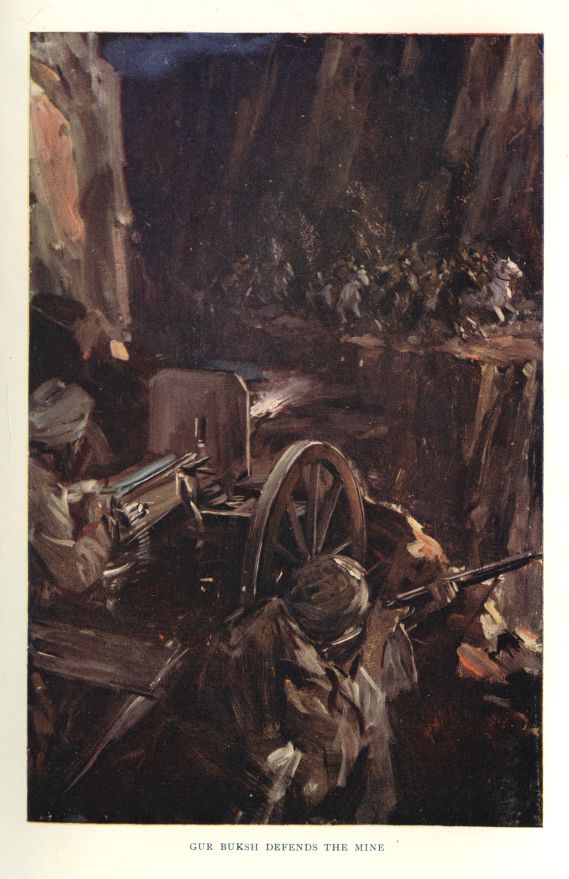
These operations were all in progress when there was a sudden commotion among the men drilling the rock. After a moment's hesitation, they dropped their tools and scampered at the top of their speed towards the mine. They had barely crossed the bridge, and this had only been raised a few feet from its platform, when there came swiftly round the bend a string of horsemen, galloping two abreast. Gur Buksh was at his post by the machine-gun. In a few moments it was rattling its shot in a rapid stream towards the enemy, and at the same time the Sikhs opened fire with their rifles. A number of the enemy were seen to fall, either upon the track or over the brink into the river, and the horses of the men immediately behind them stumbled over the prone bodies and in one or two cases threw their riders. There were a few moments of confusion. The quiet of the night was broken by cries and groans and the rattle and hiss of shots. Then the stream of horsemen suddenly stopped. Shouts were heard from beyond the bend, but no more of the enemy appearing, Bob ordered his men to cease fire.
Everybody in the mine compound had been so intent on what was happening within the area illuminated by the bonfire that only Bob himself and one or two more had noticed that several of the enemy had got past the critical point before fire was opened. They were now in darkness, but the clatter of their horses' hoofs could be heard on the track just beyond the quarters lately occupied by the Pathans. At this sound Bob had much difficulty in preventing his men from blazing away at random at the cliff opposite. To allow it would be merely to waste ammunition, for the enemy were quite invisible; so he peremptorily ordered them to desist after two or three shots had been fired. When quietness was restored, he heard the horsemen retreating up the valley, and soon the sound of their movements died away.
"Lucky we didn't go to bed after all," said Bob to Lawrence. "Is that wire ready?"
"Yes, but the rock isn't drilled yet, is it?"
"We'll soon finish that. The track must be blocked at once, or we may have this going on all night."
He called the miners up, and ordered them to go back to their work.
"Mashallah, sahib, but it is not safe, we shall all be killed," one of them ventured to say.
"Nonsense. They won't come on again."
"But some have got past, sahib. They will come back and shoot us."
"They won't venture within the light of the bonfire, and if they do the Sikhs will shoot them down. Come on: I'll go with you. Give me the dynamite, Lawrence. Fazl, you take the end of the wire. Now then, a few minutes' more work, and we'll tumble a mountain of rock on to the track, and be able to sleep soundly for the rest of the night."
His confident bearing, and the example of his personal leadership, inspired the men with courage. The bridge was again lowered; Bob passed over with Fazl and the miners; Lawrence, Gur Buksh and the Sikhs posted themselves between the bridge head and the southern extremity of the compound to guard against any attack on the part of the men who had gone up the track. They could not number more than a dozen or so at the most, and Bob felt sure that after what had occurred they would not be very ready to approach the spot that had proved so fatal to their comrades.
He ordered the men to move very quietly. On reaching the place where they had flung down their tools, he bade them wait a little. From round the bend came the sound of voices, apparently some distance away. The enemy had not withdrawn altogether: would they have the courage to come on again? The machine-gun was no protection to the working-party, for it could not fire without great risk of hitting them. Bob sent one of the men back to fetch three of the Sikhs; their rifles might at any rate suffice to check a rush long enough for the miners to retreat to the bridge.
As soon as the Sikhs arrived, he ordered the men to resume their drilling, for which the bonfire gave sufficient light. The first sounds attracted the attention of the enemy. They raised their voices, and Bob, grasping his revolver, told the Sikhs to level their rifles and fire if he gave the word. All were concealed from the enemy by the shoulder of the cliff. The work went on without interference from the enemy beyond, but presently shots began to patter on the rocks from the rifles of those who had passed up the valley. The bonfire was now an inconvenience, and the danger was greater to Bob and the Sikhs, who stood erect, than to the miners stretched on the ground. But it was a risk that must be endured, and Bob spoke a cheery word to the men at his side, and urged the miners to hurry on with their work. Unknown to him, at the first shot Lawrence had led the other Sikhs across the bridge and posted them on the track, to repel the Kalmucks if they should venture nearer to get a better aim.
In a quarter of an hour the drilling was finished. Bob sent the miners back, and himself laid the charge of dynamite. Then he inserted the wire, and retreated with Fazl and the Sikhs.
"Good man!" he said to Lawrence when he reached the bridge. "It's all done. We've only to make the contact."
"Nobody hit?" asked Lawrence anxiously.
"Never a man. I think we'd have done better. Now let's get back. In five minutes we'll have a little earthquake."
They crossed into the compound, the bridge was raised, and Bob sent Fazl into the shed where the battery was kept, to complete the electric circuit. The firing had ceased. Nothing was to be heard but the rushing water. In a few minutes there was a dull, sullen rumble; the ground quivered, and immediately afterwards a terrific crash which echoed and re-echoed along the valley. The bonfire was suddenly obliterated as by an extinguisher.
"Another trick to us!" said Bob gleefully. "And now I think we can go to sleep with an easy mind. They won't get past till they've moved a thousand cartloads of rubbish."
"What about those fellows who got past?"
"We can leave Gur Buksh to deal with them. They can't get into the compound; if they did they'd never get out again. I shouldn't wonder if they're wishing they hadn't been in quite such a hurry. Now, my boy, bed: neither you nor I will need any rocking to-night. It's barely eight o'clock: we ought to get a good twelve hours, and I can do with it all."
They felt a strange pang as they passed through their uncle's room. It was the first time they had entered it since the fatal morning when they set out so cheerfully with him in pursuit of Nurla Bai. Neither spoke of him; his loss touched them now with a poignancy of feeling that would not endure expression. Bob closed the door quietly, as if a sleeper lay within; and both undressed in silence.
CHAPTER THE SEVENTEENTH
A CRY IN THE NIGHT
"What say you, friend?--how will this matter end?"
Chunda Beg seated himself on the wall, against which the havildar was leaning, peering out into the darkness. His rifle lay across his arms.
"Hai, Chunda, is that you?" replied Gur Buksh, in a low tone. "I thought you were snoring on your charpoy. 'Tis a chill night."
"I slept indeed a little--forty winks, as the sahibs say; then I rose and came out to seek wisdom of thee, O experienced one. How will this matter end, I ask?"
"Who can tell!" said the havildar with a shrug. "The gods know; I know not."
"You do not know; of course I did not suppose you a soothsayer, a man of double sight, though there are such; I have seen them, and heard them foretell things that most certainly came to pass. But they were fakirs, haggard of cheek and eye, and dirty--mashallah! how dirty! What I meant, friend, was that you, being a man of war, and wise in many things, should enlighten my simplicity, and say what is the blossom and fruit of your meditations on these strange happenings."
Gur Buksh did not turn his head, but gazed steadily out across the stream. On each side one of his men was patrolling the wall; the rest of the Sikhs were sleeping under blankets on the ground a few yards away, ready to spring up at a whisper.
"The Bengali says we shall all be cut into little pieces," Chunda Beg went on. "He will make good carving, being very plump."
"The Bengali is the son and grandson of asses," grunted Gur Buksh. "He reads books!"
"The sahibs read books too," suggested the khansaman.
"That is different. They read the wisdom of their own people; the Bengali reads, and imagines he becomes one of them, and talks foolishness."
"That is true. Yet in this case perhaps it is not foolishness. There are many hungry beasts lurking down the track yonder."
"Hyenas!"
"Twenty thousand of them, says Fazl."
"Flat-nosed Kafirs; what are they to us?"
"That is true; they are of very little account. Still, there is a great number of them, and--correct me if I am wrong, havildar--a hundred hyenas are perhaps a match for one lion."
"Look you, khansaman, we have to make every man here believe that he is a lion. I do not deny that we are in a strait place, but what is that? I have been in strait places before. Hai! was I not one of the thirty with a young sahib in the hills, and did we not defend a post against a monstrous rabble of Khels, and drive them off, and strike such fear into the dogs that they slunk away and troubled us no more?"
The havildar's eyes gleamed as he recalled that fight.
"And are our young sahibs even as that one?" said the khansaman. "The huzur--may he sleep well!--was a good man, but these two striplings are very young."
"Hai! but they have red blood in their veins. They are of the race of the Sirkar: they will never yield. Think you of what they have done in these last days. Are they not quick and ready? Are not their eyes keen and their minds swift? They fear nothing, and overlook nothing. Fyz Ali told me how the chota sahib rode back to help him when he was alone and beset by the Kalmucks, and the chota sahib is no man of war. Of a truth, the sahibs know not what fear is. And Bob Sahib carried food to the Pathans up the river; he thinks of their welfare, and they love him. What is to come we know not, but be sure there will be very great doings here."
"Hark, havildar! What is that?"
Chunda Beg sprang off the wall, and bent over it with the havildar, straining his eyes into the darkness. A faint cry reached them from the other side of the ravine. They listened in silence, waiting for a repetition of the sound. In a few seconds they heard it again.
"A trick of the Kalmucks maybe!" murmured Gur Buksh. "Get you swiftly to the house, khansaman, and rouse the sahib. Say nothing but that I wish to speak with him."
The khansaman hurried away. Passing noiselessly into the boys' bedroom, he touched Bob on the shoulder and gave his message. Bob was awake in an instant.
"Tell him I'm coming," he said.
He slipped on his dressing-gown and boots quietly, so as not to disturb Lawrence, and followed the man across the compound. As he reached the havildar's side, the cry was repeated again.
"What are the sahib's orders?" said Gur Buksh.
"Did you hear what he said?" asked Bob.
"No, sahib; it was like the cry of a man for help."
"Are the Kalmucks playing a trick on us? Have you heard anything of them?"
"Nothing, sahib."
"Let down the bridge. We had better see."
"The sahib will without doubt take lamps?"
"Yes, and your men."
The Sikhs had already been awakened. In a few minutes four of them accompanied Bob across the bridge, the first carrying a candle lamp.
The far side of the bridge rested on a platform constructed on a rock in mid-stream. The rock was connected with the farther bank by a short bridge supported on timbers and resembling a rough wooden jetty. Gur Buksh had said that the cry seemed to have come from the end of the bridge, and Bob searched for some time up and down the track for a few yards in each direction, listening again for the sound. It was not repeated. He proceeded to range the space once occupied by the Pathans' huts, but made no discovery. Puzzled, and still half suspecting that the cry had been a ruse to decoy him from the mine, he returned to the bridge, and was about to cross, when the man who held the lamp uttered a sudden exclamation.
"Behold, sahib; here he is!"
He pointed to a man lying across one of the girders sustaining the platform. Only his head could be seen. Bob knelt down and stooped over, asking the Sikh to lower the lamp. He saw a bearded, turbaned man in uniform, with arms and legs twined about the girder.
"He is unconscious," he said. "Lift him up and bring him into the compound."
The Sikhs had some difficulty in raising the man, who, in spite of his unconsciousness, clung tenaciously to the beam. But they got him up at last, and carried him across the bridge and up to the house. Bob waited to see the bridge lowered again, then hurried back.
"Cold water, khansaman," he said as he entered.
The man brought a mug of water, which he set down on the table. Bob wondered why he did not himself hold it to the stranger's lips, until he guessed that caste was probably the obstacle. He himself gave the man drink, and looked at him with curiosity, which became recognition as he opened his eyes. It was Ganda Singh, the dafadar of the sowars who had accompanied Major Endicott on his mission months before.
"Salaam, sahib," said the man faintly, when he saw that Bob had recognized him.
"Feel better now?" said Bob.
Ganda Singh had closed his eyes again. Bob noticed that he was very pale and haggard, as one exhausted after a long march.
"Just get one of the Sikhs to prepare him some food, khansaman," he said. "I suppose you won't do it yourself?"
"He is a Sikh, sahib."
"Well, cut away to one of his own race, then. He's fit for nothing at present."
He considered whether he should wake Lawrence, but decided to let him sleep on until the man was able to explain his presence. He himself was absolutely unconscious of any feeling of fatigue. Ganda Singh's surprising appearance filled him with overmastering excitement.
Reviving after some hot lentil soup had been poured between his lips, the dafadar raised himself slightly from the couch on which he had been laid. Bob noticed a twinge of pain as he moved his arm.
"Wounded?" he said.
"A shot in the shoulder, sahib--very little."
"As you came down the track?"
"No, sahib; before."
He fumbled in his belt, and produced a small piece of paper, folded. This he handed to Bob, who opened it, and read, scrawled on a leaf torn from a pocket-book, the following lines--
"Get back to India at once. Whole country ablaze.--H. Endicott."
"Where is Endicott Sahib?" he asked quickly.
"In the hills towards the Afghan country, sahib."
"Near where we left him? He has not been there all this time?"
"No, sahib; Endicott Sahib went back to Rawal Pindi, and came again."
"And he is well?"
"In body, sahib, wherein I rejoice; but very sick in mind."
"Tell me all about it; slowly, don't distress yourself. Here, let me strip off your coat, gently, and see what's wrong. Wait a little, though; I must fetch Lawrence Sahib."
Loth as he was to disturb his brother's rest, he felt instinctively that the news brought by Ganda Singh was to affect their destinies vitally.
"Wake up, old chap," he said to Lawrence, prodding him. "Slip on your dressing-gown and come into the dining-room."
"Are they attacking?" asked Lawrence sleepily.
"No. Major Endicott has sent Ganda Singh with a message, telling us to clear out. I'm afraid things are looking very serious. Come on!"
Lawrence waited only to plunge his head into a basin of cold water, then followed his brother into the dining-room.
"Salaam, sahib," said Ganda Singh with a smile of friendliness. Like everybody else he had a warm feeling towards the chota sahib.
"Now, dafadar, tell us all about it; take your time."
He bathed and bound up the wounded arm while Ganda Singh talked.
The story told by him filled the boys' cup of anxiety and dismay. He related how Major Endicott, after pacifying the unruly tribe to which Nagdu belonged, had returned slowly to headquarters, visiting on the way several other tribes within his allotted portion of the borderlands. But he had soon been called away again by news of another outbreak, among the very people whom he had just reduced to quietness. Once more he set off, attended as before by his official escort of twelve troopers. This time he had woefully failed to repress their turbulence, which, indeed, swelled into active hostility. One day, attacked by overwhelming numbers, he had been forced to flee for his life. Before the little party got away, it had lost several in killed and wounded, and the Major, refusing to leave the wounded to the tender mercies of the enemy, had lost his chance of making good his escape. He was headed off, and galloped for refuge to a half-ruined hill-tower some little distance west of his route, where he had been since besieged by the tribesmen.
On the second day of the investment he had scribbled the chit in his pocket-book, torn out the leaf, and given it to the dafadar with orders to leave the tower by night and make all speed to Mr. Appleton's mine. Ganda Singh had crept out and stolen away to the rear, but his movements were detected, and he had run the gauntlet of a fusillade. One shot had taken effect, but the wound was slight, and he had pressed on, eluded the enemy's pickets, and after a long round gained the road that led ultimately to the mine. He had carried very little food with him, and was almost exhausted, rather by fatigue than by loss of blood, when, about two miles from the mine, he stumbled upon a small bivouac of ten or a dozen men. Luckily he had heard their horses stamping and champing their bits while still at some distance from them, and was careful to approach them warily. Having no means of telling whether they were friends or foes, he decided to slip past them quietly in the darkness. He could barely drag himself over the last mile, and on reaching the platform, being thoroughly worn out, he stumbled, and only saved himself from falling into the river by clutching at the girder as he fell.
"How long have you been marching?" asked Bob.
"Three days, sahib."
"And how far have you come?"
"Thirty kos,[#] sahib. It was bad marching, but I came as fast as I could."
[#] About forty-five miles.
"It was good of Endicott Sahib to send you, but why? We are far away from the disturbances on the Afghan border."
"Ah yes, sahib, but there is talk of great doings towards the north-west. They say in the bazaars that the Mongols have made friends with the Afghans, and offered to share the plunder with them when they make their raid into the Punjab. It is foolishness, as Endicott Sahib said: but the badmashes will do much evil, and the sahib said that Appleton Sahib ought to know, so that he might escape to India while there is yet time."
"And what about the sahib himself? He will break through, of course?"
"Hai! The sahib will not leave the wounded."
"He can hold out?"
"Who shall say? The sahib has little food, and the water of the well in the tower is foul. The sahib will assuredly fight as long as he has one cartridge left in his revolver; then.... It is written, sahib; but the huzurs know how to die."
"Good heavens!" ejaculated Lawrence. "Can't he send for help?"
"The nearest post is a hundred miles away, sahib. There would not be time. In one day more, or perhaps two, all the food will be gone. No help could come to him for a week--no force strong enough to drive away the dogs that beset him."
"Why did he think we could escape, then?"
"Because the road is still open, sahib. The tribes are not yet moving towards the frontier, and the hill-tower is far to the west of the road. If the sahibs start at once there is just a chance that they may save themselves--as one leaves a house before the flood comes up and washes it away."
The boys felt overwhelmed by this climax to their embarrassments. There was no certainty that they could reach the nearest British post before the tide of invasion had begun to flow. The way might already be blocked by hordes of tribesmen gathering strength for their swoop upon the Punjab--an adventure which, utterly absurd as it seemed, and foredoomed to disaster, would work havoc on the frontier until it was crushed by the might of the Imperial power. They saw themselves shut up as in a trap between the 20,000 men on the north, and the innumerable host which the scent of plunder would attract to the Afghans' banner.
"We shall have to stick it now, in any case," said Bob to Lawrence. "Khansaman, take Ganda Singh to Gur Buksh: he will find him quarters. Then go to bed. I will ring for you if I want you."
When the two men were gone, Bob threw himself into a chair.
"Light up," he said. "There'll be no more sleep for us to-night."
"What a brick the Major is!" said Lawrence. "Poor old chap! He won't cave in without giving those blackguards something to remember, but if things are as bad as Ganda Singh says it's all up with him. Nothing on earth will induce him to leave his men, or he might make a bolt for it. I wonder if it was too late for him to send for help?"
"There's not much doubt of it. A man couldn't get away quietly enough on horseback with the tower surrounded, and it would take him four or five days to foot it. Then they'd have to get together an expeditionary force, and if they've got wind of what's on, they would hesitate to send out a small light-marching force that might be smothered. These political officers are always taking their lives in their hands. The Major's a good sort. I wish to goodness something could be done for him."
"I say! I've a notion. What about the aeroplane?"
"How do you mean?"
"Fly to help him. A few of those bombs of yours would work wonders."
"That's all very well, I dare say a little dynamite would set the besiegers flying in panic; but to bring the Major away is quite another matter. He's in a hill-tower, and if it's like those we saw occasionally as we came north it'll be perched in the worst possible place for the machine to alight."
"We can find that out from Ganda Singh."
"But there's another thing. Suppose it is possible to come down, will there be time to get the Major out and take him on board before the enemy come back? Their panic won't last long when they find they can only be hit from the air."
"It will take some time to discover that, but I foresee the worst difficulty. That's the sowars. As I said, he won't leave them, especially as some are wounded. And the biggest cowards in creation--and the Afghans are not cowards--would recover their courage and their wits long before you could fly to and fro with the sowars as passengers."
"And they'd smash the machine too. It would be an easy target most of the time. I'm afraid it's no go."
They smoked on in silence, gloomily watching the rings and clouds eddying out into the dark through the open window.
"Look here!" exclaimed Bob suddenly.
"I say!" cried Lawrence at the same moment.
"I'm going to try it," Bob continued.
"That's what I was going to say."
"But----"
"Hold hard! Just listen while I put the case with my usual sweet reasonableness. You're about fed up with patrolling the valley, I should think."
"But----"
"Let me have my say out: your turn by and by. You're a soldier; I'm not. You're the chap to defend this place, and, as you said, we've got to defend it now. You've a head for strategy and all that sort of thing: I'm a fool at it. If one of us has got to go, I can be best spared."
"You're talking perfect----"
"I know, but I haven't done yet. I haven't had quite as much practice in the aeroplane as you, but I've had quite enough for this job. And as for shying dynamite bombs, any ass could do that."
"I back you wouldn't find it easy to hit a mark," Bob got in.
"Perhaps not, but when the mark is a crowd of three or four hundred Afghans I ought to be kicked if I couldn't score at least an outer. Seriously, old man, this is my job. I'm not such a fool as to think it'll be pure fun; it's a desperately tough proposition, as the Yanks say; and of course you'd do it better than I could; but we can't both go, and I'm sure you're the right man to stay here. Now have your fling."
"Well, you've put me in a hole with your beastly logic," grumbled Bob. "I can't admit you're right without sort of making myself out to be a sprouting commander-in-chief! My word! It would be a fine thing to get the Major here! He'd take command, and I'd play second fiddle with the greatest pleasure in life. All right: you go, then."
"Thanks, old man. Just ring for Chunda, will you? I must have a talk with Ganda Singh."
"You'll do nothing of the sort. You'll go straight back to bed. You'll want all your nerve to-morrow, and after what you've gone through you'll be a limp rag in the morning unless you sleep. Go to bed. I'll arrange everything. You'll find everything ready for you in the morning. I think you had better take Fazl with you: in fact, you must, for you'll have quite enough to do with managing the machine without dropping bombs. Cut off!"
"All right. There's only one thing."
"What's that?"
"I hope to goodness the wind won't be blowing a hurricane in the morning."
CHAPTER THE EIGHTEENTH
THE TOWER IN THE HILLS
There was between four and five hours for making the necessary arrangements. Bob soon had different sets of men working at different jobs. Some he ordered to prepare baskets of food and to fill several water-skins--the want of good water was perhaps Major Endicott's greatest peril. Others he instructed to fill more tins with stones and caps, in readiness for the final charge of dynamite, which he would himself place. While all this was in hand, he had a long talk with Gur Buksh and Ganda Singh, who turned out to be old comrades in arms. They both agreed that if the chota sahib should succeed in dispersing the tribesmen now besieging the tower, and in conveying food and water to the defenders, Endicott Sahib might be trusted to extricate himself and his men from their awkward position. That the dispersal was possible Bob had never doubted; no body of men could hold together under the staggering effect of bombs exploding in their midst. And after his talk with the Sikhs he felt reassured as to the further success of the scheme. Major Endicott was a cool-headed veteran, who would take things into his own hands on Lawrence's arrival, so that the plan would not miscarry through Lawrence's lack of military experience.
On leaving the Sikhs, Bob went along the pathway to the aeroplane platform. He could not trust any one but himself to prepare the machine for the morrow's flight. He spent a couple of hours in thoroughly overhauling it: cleaning the engine, examining every inch of the framework and the stays, oiling all the moving parts. Satisfied that all was in good order, he returned to the house. At this hour it was hardly worth while to go to bed, so he bathed, shaved, and dressed, and then sent for Fazl, to give him instructions.
Lawrence joined him at dawn. They went together to the hut where Ganda Singh lay, and the wounded man, refreshed with food and sleep, was able to explain more clearly now the whereabouts of Major Endicott and the operations of his besiegers.
"You'll tell him, of course, how we are situated here," said Bob, as they walked away together. "All being well I shall expect to see him in two or three days. You'll fly back in advance and tell me?"
"I dare say, but I shan't come until I see him safe on the march. I only hope I shan't be too late."
"I don't think you will be. I gather from what Ganda Singh said that starvation is the greatest danger, but they've got their horses in the last resort. There's no wind luckily; you couldn't have a finer day. By the way, keep a look-out for the Kalmucks who got by last night. Don't drop within range of them."
Rumours of what was afoot had run round the camp. Miners and servants were gathering in the compound to witness the departure of the aeroplane. As the boys walked towards the pathway Ditta Lal joined them. He wore his wonted air of cheerfulness.
"On behalf of establishment, sir, I bid you good luck and au revoir," he said. "Clouds have silver lining, sir. If report is true, we shall soon have felicity to see famous warrior in person; with due respect, and no derogation to present company, full-fledged British officer, when he takes command, will put rosy complexion on deplorable situation."
"Paint everything red, you mean?" said Bob gravely.
"Ruddy hue of health, sir," said the Babu, missing the point. "Representative of august king-emperor, British flag, standard of freedom and all that----"
"Good-bye," said Lawrence, cutting him short. "Don't trouble to come any farther."
Bob went with him to the aeroplane platform.
"Good luck, old chap," he said, gripping Lawrence hard by the hand. He waited until the aeroplane had run off and soared out of sight, then returned in mingled hope and fear to the mine.
About a dozen miles up the valley Fazl caught sight of a number of men scuttling to cover among the rocks above the track. There was little doubt that these were the Kalmucks, who, finding themselves effectually cut off from their friends to the north, were probably hastening southward in search of provisions. Except for a few wild animals, the neighbourhood of the valley furnished no means of subsistence. There was a small hill-village about thirty miles from the mine, lying back some distance from the right bank. Perhaps the Kalmucks might find hospitality there.
Lawrence hoped that in the course of forty minutes he would come in sight of the hill-tower in which Major Endicott was besieged. From Ganda Singh's description he thought it must be identical with a tower which he had seen in the distance on one of his early trips with Bob up the river. It was a conspicuous object in the hilly landscape, and he had no fear of missing it, considering the immense expanse of country which lay open to observation from the aeroplane.
In spite of the particulars given by Ganda Singh, Lawrence felt that in approaching the tower his first care must be to reconnoitre the position thoroughly. Everything depended on his finding a convenient spot for landing, and this might be very difficult in such hilly country. The appearance of the aeroplane would of course put the enemy on their guard; but they would not know what to expect, and would probably be rather alarmed and mystified than informed. At the same time it would be a herald of hope to Major Endicott, and prepare him to take instant advantage of any diversion which it might effect in his favour.
When Lawrence had been flying for about twenty minutes he became somewhat uneasy at a sudden freshening of the wind, which blew in uncertain gusts from the mountains on his right. Since passing the Kalmucks he had kept fairly close to the river, but when the machine began to rock under these invisible eddies he thought it the safer course to rise to a considerable height. The morning air was so exhilarating, and the view of endless snow-capped heights and pine-clad ravines so superb, that only the intense cold, of which he was now conscious in spite of the summer sun, checked his ascension. On the left stretched the Pamirs, backed by peak after peak of some of the loftiest and most majestic mountains in the world. In front and on the right the Himalaya range merged into the Hindu Kush. Huge masses of cloud rolled up and down the rugged faces of the mountains, causing moment by moment wonderful changes in their aspect. Some of the peaks seemed to have covered themselves with an umbrella of fleecy billowy wool as a shield against the kindling sunbeams.
The enormous scale of this panorama defied perspective and gave a false idea of distance. Lawrence knew that peaks which, clearly limned against the sky, might be thought to be ten or fifteen miles away, were in reality more than a hundred. But for the urgency of his mission, he felt that he would have liked to sail on and on in this empyrean height, exploring regions never trodden by the foot of man.
All the time, Fazl kept a keen eye on the track and the river, winding along hundreds, even thousands, of feet below. The hill-tower lay somewhat to the west of the road which the Appletons had travelled with Major Endicott several months before, and from this road the track leading to the mine branched. The Gurkha knew the country pretty well. Fast as the aeroplane flew, he distinguished without hesitation the junction of the roads, and at his word Lawrence altered his course and, leaving the valley, steered over the hills on his right hand.
Very soon Fazl was able to descry the hill-tower in the far distance. The aeroplane was flying at the rate of at least a mile a minute; but minute after minute passed, and yet the tower seemed little nearer. When at last Lawrence had come close enough to it to be able to distinguish its general features, he saw that it was a single square-built tower of the usual Afghan type, perched on a small hill that rose sharply from the surrounding country. The side nearest him overhung an almost perpendicular declivity. Though solidly constructed in appearance, it was little more than a ruin. The top had partially fallen away, and in the wall facing him there was a long jagged fissure.
While still at some distance, Lawrence heard rifle-shots, though neither he nor Fazl could as yet see any signs of the enemy. He felt his heart thumping. He was still in time, then; for if all was over the firing would have ceased. Planing down in a long glide, he passed over the tower, still at a considerable altitude, and then suddenly caught sight of an encampment in a nullah on the farther side. In the brief moment of his crossing he was not able to get more than a glimpse of it; the nullah was so deep, and the encampment encompassed so closely by shrubs, dwarf pines, and other trees, that he might have missed it altogether but for a thin column of smoke arising from a fire in the bottom. But his rapid glance was enough for reassurance; the camp would have been struck if the tower was captured; it was clear that the Major was still holding out.
Dropping still lower, he began to sweep round in a circle. Before he reached the nullah again Fazl pointed out to him a number of isolated dots on the rugged surface below, spread over an extensive patch of ground. Some were small, others larger, and as he flew by Fazl explained that they were groups of the enemy, who had posted themselves wherever the nature of the ground gave them cover from the fire of the occupants of the tower. They were disposed in a rough semicircle about the western wall, in which there was a door. The approach on this side was by a steep slope; on the other side the tower was apparently inaccessible.
Between the wall and this semicircle of besiegers were scattered at irregular intervals a number of dark forms.
"Dead!" ejaculated Fazl.
They were evidently the bodies of men who had fallen in attempting to rush the place. Ganda Singh had mentioned that on the day he left the Afghans had made a vigorous assault, but were beaten back with heavy loss.
Bringing the aeroplane round so as to pass again over the encampment, Lawrence noticed a number of horses picketed near the rough huts. The Gurkha cried excitedly that the animals were kicking and straining at their ropes, and men were rushing to hold them. The noise of the engine had thrown them into a state of blind terror. Two or three broke away, and galloped madly up the nullah.
Several shots were fired at the aeroplane. Lawrence was somewhat surprised that the men were not struck with panic, like their horses, at the appearance of this strange booming monster of the air. It did not occur to him until afterwards that rumours of it must have been carried far and wide through the country for months past. Men who had seen it in its flights had described it to their neighbours or to wanderers whom they met in the hills; and although few, perhaps, of these tribesmen now present had actually seen it before, doubtless many of them had heard more or less veracious accounts of it. The frantic terror of the ponies suggested to Lawrence an idea on which he acted immediately. He abandoned his original purpose of making a preliminary reconnaissance of the whole position and then retiring to a distance to work out a plan. To a mounted force there is nothing so demoralizing as the loss of their horses. Lawrence knew this, and in a flash saw also that the Major, if he should escape from the tower, would have little to fear from an enemy pursuing on foot. He resolved therefore to attempt to stampede all the horses, and take advantage of the resulting confusion.
By the time he had come to this determination he was some distance past the nullah. Telling Fazl to drop a bomb among the horses when he again crossed it, he rose rapidly to a height of about a thousand feet, wheeled round, and swooped down in a long incline towards the camp. He scarcely realized that he was taking his life in his hands as he flew almost within point-blank range. Nor had he calculated on the possible effect of the coming explosion on the aeroplane. When he arrested his downward flight he was so near the ground that the bursting of the bomb set the machine rocking violently, and for a few moments he could scarcely control it. Cool-headed marksmen could then have taken fatal aim at him; but the Afghans were fascinated and paralysed by his headlong descent, and while they were still wondering and dreading what it might portend, the explosion of the bomb within a few yards of them struck them with terror.
Lawrence swept round to observe the effect of this bolt from the blue. A great troop of horses was galloping wildly along the nullah to the west. He caught sight of their forms, black, brown and grey, wherever there were breaks among the trees. Farther up the nullah, where the sides were less steep, the frantic animals were dashing across the country in all directions. Beneath, a few lay motionless on the ground. Loth as he was to destroy or maim the unoffending beasts, he felt that this was not an occasion for half measures: there was too much at stake. In their panic flight it was inevitable that many of the horses must dash themselves to pieces in the ravines and fissures with which the country was seamed. To prevent the rallying of the rest, he set off in pursuit. Sweeping the ground like a shepherd's dog after a flock of sheep, he flew backwards and forwards and from side to side at the heels of the terrified animals. No more bombs were necessary. The whirr of the propeller behind them drove them on at the same mad rush, and in a quarter of an hour there was not a living horse within several miles of the encampment.
On returning towards the tower, Lawrence was surprised to see that the groups of Afghans had disappeared from around it. But as he crossed the nullah there were bursts of smoke from among the trees and the undergrowth, and above the hum of the propeller he heard the characteristic whistle of bullets. Later he discovered that several holes had been drilled in the planes. The firing ceased as suddenly as it had begun. Crossing the nullah almost at right angles, the aeroplane was visible for only a few seconds to the men hidden in the bottom.
From an embrasure high up in the tower a white handkerchief was fluttering in the breeze. Lawrence wished that he had some means of communicating instantly with the Major; but the attack from which he had just escaped proved that he could not venture to alight, nor could he be of any further service to the little garrison until the nullah had been cleared. It was necessary to drive the men up the ravine in the same direction as he had already driven the horses. There might be more difficulty in this, for the enemy were completely concealed by the trees and undergrowth, so that he could not tell exactly where they were. The only plan that promised complete success was to fly some distance down the ravine, and then work up it, dropping bombs when he approached the spot where the firing had broken out.
In a few brief sentences he explained his purpose to Fazl. Making a wide sweep he came back to the nullah half a mile to the east; then, reducing speed to the minimum, but keeping at a good altitude, he followed the winding course of the gully. The enemy played into his hands. Another burst of smoke revealed their whereabouts. Fazl instantly dropped a bomb, and turning to watch the effect, cried out that a dense cloud of smoke and dust had arisen from the scene of the explosion. Lawrence wheeled round again, described a wide semicircle, passing immediately above the tower, and, regaining the nullah, repeated the manoeuvre.
This time Fazl reported that he saw men among the trees, running up the ravine. The enemy could scarcely have chosen a less secure shelter. The explosion of a bomb in so constricted a space must be many times more destructive than in the open. But Lawrence had no inclination towards needless slaughter. His object would be achieved if he drove the men away as he had driven the horses. Knowing that they were on the run, he dropped another bomb to speed their flight; then swept round again, and pursued the same tactics as had already proved so effectual. When the enemy reached the less wooded part of the nullah, he found it easy to hover about their rear, and, without the further use of bombs, to impel them to the most desperate exertions by the mere harrying pursuit of the aeroplane.
He was not content until he had driven them many miles up the nullah. Whenever they showed a disposition to break away into the open country to right or left, a swoop of the aeroplane in that direction was sufficient to send them scurrying back. In their haste and panic they did not halt to fire again, and Lawrence was at length satisfied that even if they should recover their nerve and courage, they were too far away to trouble the garrison of the tower for at least a couple of hours.
On nearing the tower, he saw that several figures had emerged from the door at the foot. He glided down to within a few yards of it, and shouted a greeting to Major Endicott, who waved his hand in response. Then he sought for a landing-place. The ground in the immediate vicinity was too broken to allow of a safe descent; but after circling round once or twice, he discovered a space sufficiently flat and open for his purpose about a quarter of a mile away. Alighting there, he left the aeroplane in Fazl's charge, and, feeling very shaky on his legs after the exhausting and nervous work of the past two hours, he walked back to meet the British officer.
CHAPTER THE NINETEENTH
STALKED
"Masterly cattle-driving," were Major Endicott's first words as Lawrence joined him.
No one would have supposed from the simple words and the natural hand-shake that the meeting marked the end of a tense and perilous situation. Five sowars grouped at the door saluted and gave a shout of welcome.
"I'm jolly glad I'm in time," said Lawrence.
"Jolly good of you to come at all--wholly unexpected. I had quite forgotten that you had brought an aeroplane out."
"I say, are you hungry?"
"We are on our second horse. We had to use our own food for the animals. We are desperately thirsty, though. The well water is putrid."
"I've got plenty of food and water in the aeroplane."
"That's more than I hoped. I'll send the men for it. Horse-flesh isn't bad, but it lacks variety; and thirst is torture."
Having dispatched three of the sowars to fetch the provisions, he said--
"I sent the dafadar on the chance of his finding you. Is all well at the mine?"
"We're in the deuce of a fix, Major. There's a regular army of Kalmucks forty miles north of us."
"Kalmucks! An army of them!" said the Major in surprise.
"Yes. Bob estimates the number at twenty thousand."
The Major knit his brows. The news evidently disturbed him.
"Encamped, you say? Any signs of a movement?"
"They intend marching up the valley. We have had two or three brushes with advanced parties."
"That's very serious." He reflected silently for a little; then, as if rousing himself from a reverie, continued--
"You didn't need my warning, then. Your uncle was already preparing to decamp?"
"Uncle's gone!"
"Not left you young-- Why, my dear fellow--you don't mean that he's----"
Lawrence nodded.
"One of our miners shot him," he said briefly.
"Poor old Harry! That's a good fellow gone. I'm awfully sorry for you young fellows. Is your brother getting ready to come away?"
"Bob is still at the mine. It's in a narrow gorge, and we've blocked up the only path, so they can't get at us for some little time. But what are we to do, Major? You and your men will march for the mine, won't you?"
The Major sank again into a brown study. Lawrence watched his grave face anxiously.
"It's a pity, but I haven't time," he said at length. "I must get south as rapidly as possible. What you tell me confirms the rumours that have been flying about. When I started from Rawal Pindi there was talk of risings in different parts of the country, and as I came north I heard about large movements in Central Asia. I thought they were directed against Russia, but it seems pretty clear that the imbeciles are going to break their heads against us. This flanking movement will give us trouble. I must get back to the nearest post and wire the news to headquarters, and they'll want me; I've made an egregious failure here, but I may still be able to do something among the tribes farther south."
"But it's war now, isn't it? Ganda said you had only a few men. You could hardly fight your way back if the enemy were across the road."
"I've those five men you see there, and two of them are wounded. I started with twelve; six were killed. And I almost wish you hadn't stampeded the enemy's horses quite so thoroughly. The enemy collared all but three of ours. We killed two for food. On foot we are at a terrible disadvantage. The only thing for me to do is to ride off alone, and trust to luck. One man might get through safely where a party would fail. I know the ground thoroughly. The one thing that bothers me is my wounded. I was going to suggest that my men should make tracks for your mine; they might be of use to you; but the two wounded fellows can't stand the march."
"I see a way out of that," said Lawrence at once. "I can take them in the aeroplane and be back in a couple of hours or so. I should have to leave my Gurkha, but he would come along with your men."
"The country's clear between here and the mine, I suppose?"
"Practically; a few Kalmucks got past before we blocked up the path--we blasted the rocks with dynamite. There aren't more than a dozen, certainly."
"Armed?"
"Yes, but I fancy they're without food, and in no condition to tackle your men if they meet. Besides, when I get back I can cover their march: I've several bombs left."
"Dynamite again, as I saw. Your mine is rather useful. I'll remain here, then, until you get back, and then leave my men to you."
"But, Major, I don't like to think of you riding alone over ninety or a hundred miles of country that may be overrun by the enemy."
"It wouldn't be the first time one of us has tried it and got through safely. Anyway, I see nothing else for it. This news must be got through to Simla, and while I'm alive I mustn't be out of the way."
"I've an idea. Why not march with the men to the mine? Then Bob or I would carry you across country in the aeroplane. You'd lose a day or two to begin with, but after all you'd get to the post quite as soon as on horseback--without any of the dangers."
"Aeroplane perfectly safe then?" he said with a quizzical smile.
"Well, we've had no trouble with it yet, and Bob would take you, I dare say; he's better at it than I am."
"It's uncommonly good of you to suggest it. How far is your mine from here?"
"Something over forty miles."
"That means two days' march at least, in such rugged country and on foot. Well, I'll close with you. I should like to take stock of the position at your mine. I might make a suggestion, perhaps; and if you or your brother will be good enough to carry me across country, I shall be grateful, and it'll be useful to Government. How far did you drive those Afghans, by the by?"
"Quite six miles, I should think, so you'll have a good start. Even if they buck up and catch their horses, they won't get back here before me, and I don't believe they'll come back at all. They were pretty thoroughly scared by the bombs."
"Very well, then, we shall have to carry my wounded to the aeroplane. They'll be horribly nervous. Can you strap them in?"
"With their own belts. They'll get over their nervousness in a few minutes; it's easier travelling than by railway."
"I'm glad of that. I was afraid I should be squeamish myself. The rest of us will start as soon as you are off."
The sowars had now returned with the baskets of food, and the whole party sat on the ground, with their rifles across their knees, to what was a sumptuous feast after their recent privations. When they had finished the meal, the two wounded men were carried by their comrades to the aeroplane. Fazl quietly obeyed Lawrence's order to give up his seat, though he was clearly disappointed; and the two passengers having been securely strapped in, Bob started, with a cheery "So long!" to the Major.
"Hai, sahib!" said one of the men, who were overawed by these strange proceedings: "that is a terrible thing."
"A godsend to us," said the Major. He then explained to them his purpose. One of them brought his horse from the tower, and ten minutes after Lawrence's departure the little party started, the three sowars having strapped on their backs the water-skins and the baskets, with what was left of the provisions. They made their way down the ravine, to avoid observation from any of the Afghans who might be still lurking in the neighbourhood, the Major's intention being to strike across country to the river as soon as they were out of sight of the surroundings of the tower.
Lawrence's mind was so busily occupied with this latest turn of Fortune's wheel that he forgot, on his flight back to the mine, to keep a look-out for the Kalmucks. He would scarcely have seen them, for they heard the hum of the machine from a considerable distance, and, mindful of former happenings, they concealed themselves behind rocks or among bushes without making any attempt to check its flight with their rifles.
About ten miles from the mine Lawrence had a momentary fright. The engine, which had worked with perfect accuracy ever since the first experiments, now suddenly missed fire. Before he had time to think of what he should do if it failed, however, it recovered itself, and gave him no further anxiety. On coming within sight of the platform, he saw with relief that Bob was there to meet him; it was clear that all was well at present. When he alighted he explained the situation of Major Endicott in a few rapid sentences. Bob walked a few yards along the pathway, round the curve, and hallooed to Gur Buksh to send some of the men to him. These carried the wounded sowars to the compound, and presently returned with more baskets of food, which Bob had ordered to be prepared for the Major's party on the march.
"I say, Bob," said Lawrence during the men's absence, "there was a miss-fire a few miles back."
"Whew! it's beginning to play tricks then. We've been very lucky so far. Need you go back?"
"Oh yes! I told the Major I'd return to cover his march."
"Let me have a look at it."
He opened up the engine, examined all its parts, started it.
"It seems to be working all right. I don't see any grit; if there was any it's been got rid of. If it should happen again you had better plane down and wait till the Major reaches you; but I don't think you'll have any trouble."
As Lawrence got into his place, he recollected the bombs that lay beneath the seat that Fazl had occupied.
"Shift those, Bob, will you?" he said. "It will be rather awkward without Fazl if I have to use them. Put them as closely within reach as you can. I shall have to steer with one hand and drop them with the other."
"Probably you won't have to use them at all. The Major and four men will be more than a match for those Kalmuck fellows, who must be getting famished by this time."
"The Afghans may be in pursuit, though."
"But the mere sight of the aeroplane might be enough for them after what has happened. Still, it's just as well to be prepared. Bluffing sometimes doesn't come off, and the aeroplane is useless for offensive action without the bombs. If you do find the Major fighting a rear-guard action don't be too tender. Strike hard if you strike at all."
"Well, I'll do what I must. Don't expect us before to-morrow night at the earliest. I shall have to come down at times, or the petrol won't last out; and when the Major is within a few miles I'll fly back ahead of him if all's safe. So long!"
Bob watched him out of sight. He felt a little anxious; he would have been alarmed had he known that within five miles of the mine the engine began to give trouble again. Lawrence was in two minds whether to return and have it thoroughly overhauled, or to continue on his course. But he felt that delay might be serious to the Major, and, as before, the engine might soon right itself. He kept straight on. His hopes were flattered when, after a minute or two of fitful explosions, the engine worked normally again.
But he had only flown about half-way to the tower, as he guessed, when the trouble recommenced. Hoping against hope, he continued his flight for a minute or so, until he became convinced that the engine was on the point of breaking down utterly. He had been preparing himself for the possibility, but found himself in a serious difficulty now that the problem actually faced him. The valley at the point which he had reached was broader than at the mine, and not so rocky or broken up as it was in many other parts. But it offered few spots where even the most intrepid and experienced airman would care to risk a descent. The banks of the river were covered with thick scrub and bushes; here and there on the hill-side there were patches of brushwood and small clumps of trees; everywhere the ground was broken. But it was no time for picking and choosing. If he had not begun to plane down by the time the engine finally failed, the chances were that he would be smashed to pieces.
Casting an anxious look on the ground, he decided to make for an open space between two belts of woodland. He could not tell whether it was as level as it seemed; all that he was sure of was that it allowed room for alighting and was free from considerable obstructions.
The problem of descent had so fully occupied him that not until he had actually begun the vol plané did he remember with a thrill of consternation the dynamite bombs at his feet. For a moment his brain seemed paralysed; then, as he realized the full measure of his peril, he braced himself to deal with it. If the ground proved to be less smooth than it seemed, the shock of alighting might well be severe enough to explode the dynamite. Then, instead of a broken chassis or a wrenched stay, and a few bruises--the slight mishaps that had befallen many an airman--the result would be the complete shattering of the aeroplane and himself. The only way of safety was to jettison the bombs, and he instantly stooped to pick them up one by one and cast them over the side. There followed a series of detonations like pistol-shots much magnified, each louder than the one before. The bombs fell behind the aeroplane as it descended in a gliding swoop, and Lawrence was now beset by a new anxiety: whether, maintaining his control of the machine, he could get rid of the bombs fast enough to escape risk of damage by the explosions as he neared the ground. There would have been little or no danger if he had been flying at speed; but his downward course being at a rather large angle, the closer he came to the ground, the nearer he would be to the scene of the last explosion.
A spectator would have had a poor opinion of the airmanship of the pilot whose machine was descending so unsteadily. To control planes, elevator, and rudder; to keep an eye on the ground; and at the same time to cast the bombs overboard: all these simultaneous tasks put a severe strain upon his nerve, agility, and judgment. He got rid of the last bomb within about thirty feet of the ground, and immediately shifted the elevator to avoid a too sudden landing. It was fortunate that he checked the descent when he did; but he was too near the ground to escape altogether. The force of the explosion set the aeroplane rocking as in a gale of wind. He was enveloped in a cloud of smoke and dust and fragments of rock. For a moment or two he lost control of the machine, and instead of alighting evenly, one side hit the ground first, and it toppled over. Lawrence was flung out. As he rose dizzily to his feet, he thought himself lucky to have escaped with a few bruises and a pain in his left ankle, which had apparently been turned over as he fell.
When he regained his scattered wits he limped to the aeroplane, and looked at it ruefully. At first sight it appeared to be wrecked, but on examining it more closely he was relieved to find that the damage was such as could be repaired with a little care. The left side of the chassis was twisted; some of the stays were broken, and the left-hand plane was badly ripped.
"A narrow squeak," he said to himself. "And now what on earth is to be done?"
He sat down and felt his sprained ankle. It was very tender to the touch, and he realized that he could not set off on foot to meet the Major, but must remain until he arrived. At a guess he had come about twenty-five miles from the mine. The Major could not be nearer than ten miles. He could not expect to see him for three hours at least. The whole prospect was gloomy. The aeroplane could only be repaired at the mine, and it was quite impossible for the three sowars and Fazl to transport it over twenty-five miles of a narrow and difficult track. It seemed as if the machine must be left where it lay until men could be fetched from the mine to take it to pieces, and that would need Bob's superintendence. The proposed flight to the British post was out of the question, and he knew the Major well enough to be sure that he would revert to his original intention of making the journey on horseback, alone. Altogether it was a desperately vexatious plight.
And then he remembered the Kalmucks, whom for the time he had forgotten. He had seen nothing of them either going or coming, but unless they had struck across the hills, which was unlikely, they must be very near to where he now was. They could not fail to have heard the successive explosions of the bombs, so that they would be on the alert. They might have seen the descent of the aeroplane from their lurking places among the rocks, and if they should guess that he had come to grief, they would have him at their mercy. As soon as his thoughts took this direction Lawrence got up and unstrapped his rifle from the aeroplane. He took his revolver from his pocket; it was uninjured. Then lifting his field-glass he swept the surrounding country for signs of the enemy.
He had to admit to himself that his position could scarcely be worse. The spot on which he had landed was fairly open, but it was surrounded by broken ground that would give ample cover to an enemy. On two sides, up- and down-stream, the clumps of woodland approached to within a hundred yards. Below him, not far away, was the river, lined on both banks with a thick fringe of brushwood and rushes. Above, the hill rose gently for a great distance, but it was very rugged, broken by contorted fissures, through some of which rivulets zigzagged swiftly down to the river. He swept the country again and again with his glass, and took some comfort from the absence of any sign of man; but there were so many places where the Kalmucks might be in hiding that he thought it wise to seek some secluded spot himself, where he would be better able than on the open ground to guard against surprise.
He rose and limped up the slope of the hill. After a little search, he discovered a hollow about forty yards above the aeroplane, from which he could take a bird's-eye view of the ground, and where he had a certain amount of shelter. Thither he carried his rifle, a basket of food and a flask of water, and lay down to wait with what patience he might for the coming of Major Endicott.
It was now midday, and the sun was very hot. For some time he kept a sharp look-out, examining the country every few minutes through his field-glass, and creeping from side to side of the hollow so as to extend and change his view. Presently, however, the great heat and his failure to discover any trace of the enemy caused him to relax his vigilance. He was very tired; whenever he moved, his ankle gave him much pain; and, as at the bridge during his night watch, an oppressive drowsiness stole upon him, which he found it impossible to shake off. He would nod, recover himself, vow that it should not happen again, and in another minute his head would fall forward, and he opened his eyes bedazed and scarcely realizing where he was. Then once more he raised the glass to his eyes, and gazed around almost mechanically, only to go through the same series of nods and starts again.
Recovering himself after a more prolonged fit of dozing, he rubbed his eyes, pinched himself, and threw a glance around. His sluggish faculties were quickened by the sight of something moving in the thin brushwood at the edge of the northern clump. He quickly lifted his glass and directed it at the spot, but saw nothing suspicious, and supposed that either he had been mistaken, or that the moving object had been some animal which he need not trouble about. But the momentary suspicion banished his drowsiness; now wide awake, he sat with his back against the rock, fixing his eyes on the scene in front of him.
Presently he started. Beyond doubt a figure had run from tree to tree on the hill-side to the right, a little above him. By the time he had levelled his glass on the spot the figure had disappeared. He reached for his rifle, and crouched low in the hollow, peering over its edge. Next moment his attention was again caught by a movement in the clump of wood where he had first noticed it. This time he could see, even with the naked eye, the form of a man bending low. Almost immediately afterwards another half-perceived movement caused him to look towards a spot midway between the wood and the place on the hill-side where he had seen the first form. The top of a skin hat was projecting above a knob of rock there.
"Stalking, by George!" he said to himself.
His first instinct was to seize his rifle; his second to look around for some way of escape. It was possible that the Kalmucks had not yet discovered him, though the aeroplane was full in their view; and if he could only creep among the shrubs into some deep fissure he might yet elude them. He might even make a dash for it, gain the clump of trees to the south, and push on to meet Major Endicott. The enemy would probably waste some time in searching for him--enough to give him a good start. But he saw at a glance that he could not reach the trees without crossing the open ground in sight of the enemy, and partially crippled as he was he could not hope to outstrip them, even if they did not use in the pursuit the horses which they had had when they slipped past the mine. His only course was to stay where he was, hoping with good luck to remain undiscovered. In the last resort he could do some execution among them with his weapons, though the odds of numbers against him precluded any idea of his being able to keep them off permanently.