THE GAMBIA
Reading edition
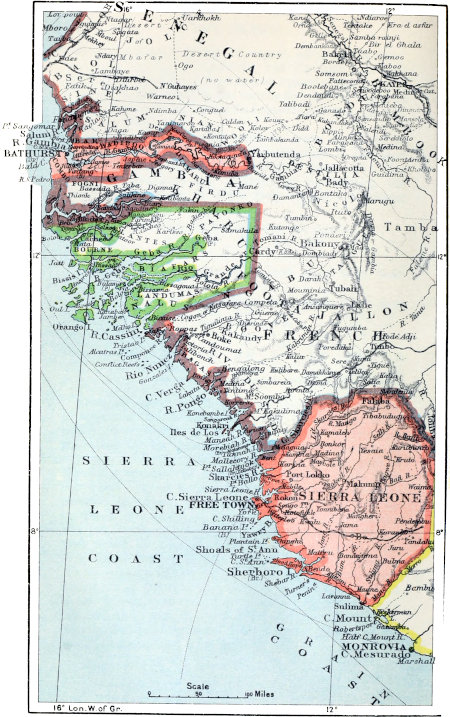
INTRODUCTORY REMARKS. Geographical Position.—The Gambia Colony and Protectorate consists of a narrow tract of country following the winding course of the river from which it takes its name, for a distance of about 250 miles, and extending approximately four miles from the river on both banks.
The whole country lies between 12° 10′ and 13° 15′ north latitude and 13° 50′ and 16° 40′ west longitude. It is the most northerly of the British West African possessions.
Area and Population.—The extent of territory is said to be 3,619 square miles, much of which consists of low-lying land intersected by creeks and rivers, which under tidal influence are often densely afforested with mangroves.
According to the census of 1911 the Colony and Protectorate had populations of 7,700 and 138,401 respectively, totalling 146,101. The total of 90,404 given in the previous census is now admitted to have been below the actual amount. A large migratory farming community exists, coming annually from the adjoining countries, for the purpose of raising groundnut crops. This in 1911 numbered 3,367. Many of these immigrants are reported to have remained and established themselves permanently under the British flag.
Tribes.—The principal tribes inhabiting the Gambia are the Mandingoes, Foulahs, Joloffs, and Jolahs. The first-named are the most numerous, and are, generally speaking, Mohammedans, although there are many “Sonninkis” or spirit drinkers among them. The Foulahs are identical with the Fulanis of the Gold Coast and Northern Nigeria, and are frequently fair-skinned without negroid features. They are said to be strictly Mohammedan, and to have originated from the country near the source of the Senegal river. The Joloffs occupy the northern bank of the Gambia river, and extend well into Senegal. The Jolahs inhabit the province of Fogni, and spread into the confines of French territory towards the Casamance river. They are a curious race, given to living in small family villages, and are said to be vindictive. They are of a lower type than the three other tribes mentioned, and are jealous of their rights.
Political Divisions.—The Protectorate is divided into five districts, each under the control of a Travelling Commissioner. These districts are named in accordance with their positions: North Bank, South Bank, M‘Carthy Island, Kommbo and Fogni, and Upper River.
Natural Conditions.—The climatic conditions of the country are favourable to the breeding of cattle and horses, although in the vicinity of the river and creeks two species of tsetse fly are common. By carefully preventing animals from straying into these infested tracts the spread of fly-borne disease is held in check, and cases are comparatively rare.
During the dry season, which often occupies seven months in the year, from November to May, the highest maximum and the lowest minimum temperatures are recorded; the range being from 41° (lowest minimum, March 1909) to 105° (highest maximum, March 1909 and April 1911). The rainfall, of which official records are kept at Bathurst, varies considerably, as the following extract will serve to show:
1901 45·31 inches 1910 44·00 inches
1902 29·42 „ 1911 28·14 „
1903 57·13 „ 1912 33·99 „
1904 38·02 „ 1913 23·68 „
1905 66·07 „ 1914 48·91 „
1906 64·36 „ 1915 47·64 „
1907 34·00 „ 1916 38·02 „
1908 43·54 „ 1917 37·68 „
1909 56·59 „ 1918 54·03 „
Soil.—The soil generally is of a light sandy nature, becoming stiffer as the undulating regions of the upper river are approached. The low countries are subject to flood in the rainy season, and are only favourable for rice cultivation.
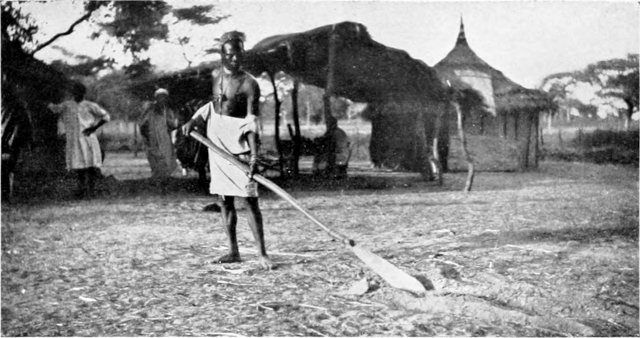
JOLAH WITH NATIVE HAND-PLOUGH, BULLELAI, FOGNI. Fig. 1, p. 3.
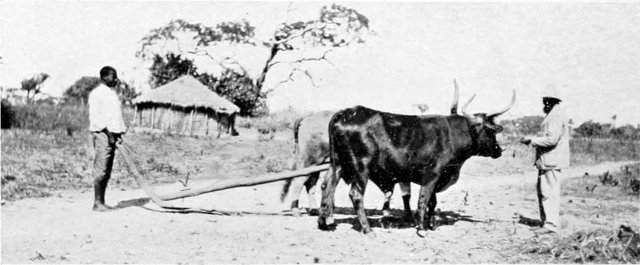
CANARY ISLAND PLOUGH, AGRICULTURAL SCHOOL, ABUKO. Fig. 2, p. 3.
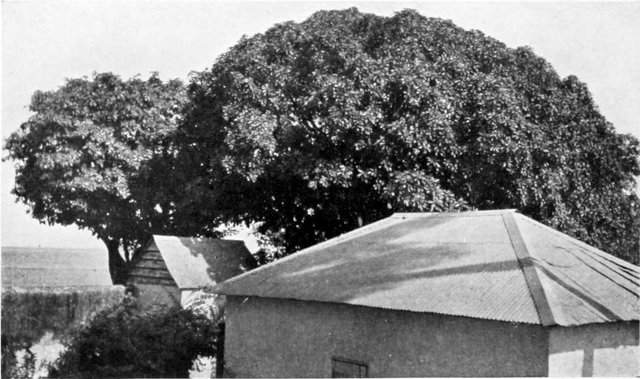
RUBBER TREE (FICUS VOGELII) AT BATHURST. Fig. 3, p. 9.
Chief Crops.—The country is rather sparsely populated, but, on the whole, the people are fair cultivators and prepare their lands in a careful manner. Practically the only crop grown for export is the groundnut, monkey-nut, or earth-pea (Arachis hypogæa), which forms by far the most important article of cultivation. Alternating this with the staple food-crops of the country, namely, guinea-corn, maize, millet, and cassava, a fairly useful form of rotation is obtained.
Implements.—Cultivation among the Mandingoes and Joloffs is performed by means of a large wooden-bladed, iron-shod hoe, with which the loose earth ridges are thrown up. A small iron hoe is used for keeping down weeds and clearing. In the Jolah country a handplough is employed, consisting of a flat blade attached to a pole, and pushed in front of the operator, so as to throw up a shallow ridge. This is shown in the picture which represents a native with the implement at Bullelai (Fig. 1).
Ploughing.—Cattle are plentiful, even to the extent of there being an insufficiency of fodder for them in the dry season in some localities. They are chiefly kept for the purpose of displaying the wealth of their owners, and are not employed for any kind of farm work. Notwithstanding the shortage of manual labour and the successful demonstrations made by the Government, through the agency of the Roman Catholic Fathers at the Abuko Agricultural School, to prove the value of substituting animal draught for manual labour in tilling the land, the prejudice on the part of the natives against the use of their cattle for ploughing or cartage has not been overcome. A photograph is given showing a native with a Canary Island plough drawn by locally-trained bullocks (Fig. 2). Owing to the failure attending the efforts to introduce ploughing and cattle breeding at Abuko, where, for the latter purpose, some Ayrshire bulls were provided, the Govermnent withdrew the provisional subsidy in 1911.
Land Tenure.—Land ownership is hereditary and descends from father to son among the Mandingoes and Joloffs. No fees are paid or presents given to chiefs when a transfer is made. Europeans can rent land from Government in cases where it is not held or claimed by a native. Grants are apparently issued for various periods, but freehold rights are not given.
The rules regarding the itinerant, so-called “strange farmers,” who annually visit the country to plant groundnuts, vary to some extent in different parts of the Protectorate. Where hereditary ruling chiefs exist, a tax of 4s. per head is paid to them. In other places, half of this tax goes to Government, one-quarter to the chief, and one-quarter to the farmer’s landlord. The landowner generally gives the groundnut seed and food as well as a piece of land to be cultivated. In payment for the seed and food, it is a rule to give one-tenth of the crop. During the time the strange farmer is in occupation he is expected to give one or two days’ work each week on the landowner’s own farm.
Labour.—There is no fixed rate paid by the Government for labour. All the work on a farm is done by the owner and his own boys, but occasionally others come in to assist from the neighbouring farms, but no payment is made—only a present of kolas being usually given.
Agricultural Schools.—An agricultural school, previously referred to, was started at Abuko, near Lammin, under the Roman Catholic Fathers there, and a subsidy was granted by the Government especially for the purpose of educating the sons of large cultivators and chiefs in the use of ploughs and other labour-saving implements. A stipulation was made that the work should be inspected by a Government officer from time to time.
In spite of this a fear was expressed at the outset that the attendance at these schools would be disappointing, in view of the fact that Mohammedan chiefs would be restrained by their mallams from sending their children where there might be a risk of their religious conversion. Although it had been specially laid down that no religious teaching would be insisted upon, the fear proved justified and the school never became a success, the attendance being only of a few aliens. Since the closing of this school no renewal of agricultural instruction seems to have been made.
Chief Exports.—The following table gives the average amounts and values of the chief exports for 1900-10, and the individual figures for the remaining years to 1918.
Year Groundnuts tons and value Rubber lbs. and value Beeswax lbs. and value Palm Kernels tons and value
1900-10 Av. 39,000 tons 46,000 lbs. 45,500 lbs. 255 tons
£250,000 £3,500 £2,000 £2,260
1911 47,931 tons 10,733 lbs. 33,871 lbs. 443 tons
£437,472 £836 £1,514 £4,758
1912 64,169 tons 4,335 lbs. 30,830 lbs. 445 tons
£502,069 £409 £1,164 £6,518
1913 67,404 tons 12,995 lbs. 31,518 lbs. 546 tons
£622,098 £1,027 £990 £9,026
1914 66,885 tons 3,548 lbs. 15,513 lbs. 495 tons
£650,461 £102 £473 £7,815
1915 96,152 tons 1,171 lbs. 9,563 lbs. 326 tons
£400,435 £31 £311 £5,457
1916 46,366 tons 355 lbs. 6,950 lbs. 669 tons
£506,098 £23 £104 £14,671
1917 74,300 tons 1,753 lbs. 3,962 lbs. 532 tons
£869,790 £187 £247 £7,994
1918 56,489 tons 564 lbs. 8,626 lbs. 644 tons
£800,319 £40 £501 £9,800
Note.—Cotton exports were 59,828 lbs. and 2,572 lbs. in 1904 and 1905 respectively. None has been exported since.
GROUNDNUTS.—This commodity is by far the most important exported product, and is alone subject to a duty levied by the Administration.
Uses.—The undecorticated nuts are shipped, chiefly, to the French ports and to Hamburg, for the expression of an oil of excellent quality, of which they yield on an average about 30 per cent., estimated on the weight of the raw material. This is equivalent to about 44 per cent. of the weight of the extracted kernels.
The mode of extraction in general employment in France is to grind the kernels into a fine meal, from which the first quality of oil is extracted by cold expression, yielding about 18 per cent. The meal is then moistened with cold water, and at the second expression 6 per cent. more is obtained. Both of these oils are useful for alimentary purposes. A third expression is made from the residue treated with hot water, and gives a further 6 per cent., which is chiefly employed for lighting purposes, lubricating and soap-making. The fine oils are substituted for, or mixed with, the olive-oils of commerce for salad oils, and enter into the manufacture of oleo-margarine. After these expressions of oil have been made, the meal is pressed into cakes and used for cattle-food and manurial purposes.
Classification and Description of the Groundnut Plant.—The groundnut belongs to the Sub-Order Papilionaceæ, of the Order Leguminosæ, and is termed Arachis hypogæa, Linn.
The plant cultivated in Senegal and the Gambia grows in a spreading form, with branches of from 12 to 18 inches in length, and possesses oval leaflets given off in double pairs. A large number of conspicuous yellow flowers appear from the upper leaf axils, but are not capable of fertilisation. Those springing from the lower leaf axils nearest the ground are small and generally hidden, but produce fruitful pods. After fertilisation the stems of these flowers become elongated, and are directed downwards, forcing the ovary into the ground, in which it commences to swell to the mature size, frequently penetrating to a depth of two inches beneath the surface.
The fruit is a pale straw-coloured, irregularly-cylindrical pod, with the surface of the shell pitted and longitudinally ribbed. In the Gambian variety, which is identical with the common Senegalese kind, there are usually two kernels in each pod, but three or one are also found.
The plant is of doubtful origin, but it is generally supposed that it may have been introduced into Africa from Brazil (where the genus Arachis is well represented) nearly four centuries ago, by the Portuguese slave-traders.
About 1840 groundnuts began to attract the attention of European manufacturers, on account of the value of the oil obtained from them, and, in common with the Senegalese, the Gambian natives were induced to undertake cultivation upon a large scale.
The nuts grown in the Gambia and in Saloum, in the French territory adjoining on the north, are classed as of second quality; those from Cayor and Rufisque holding the first, and those from the Casamance and Portuguese Guinea the third, places.
The seeds are sown upon ridges with flattened tops, and the crop occupies the ground for about four months—July to October—corresponding to the period of heavy rainfall in the country. When the branches commence to wither, the whole plant is carefully pulled up, so that the pods, which are then mature, remain attached. The plants are then stacked in the fields, and are often covered over with the leaves of the fan-palm. The green parts dry into a hay, which, when the pods have been beaten out, is used as horse-fodder. The advent of rain after stacking often does great damage to the crop, but the occurrence is so rare that it has been found difficult to induce the native to take common precautions against it. During the last two years, however, the Government have taken steps to enforce a regulation with regard to this, and in consequence drains are now generally cut around the stacks, and coverings of palm-leaves are left on until the nuts are ready to be beaten out.
In the Jolah country raised platforms are constructed for stacking this crop as well as others. After the nuts have been beaten out from the dried plants, they are winnowed by allowing them to fall from a slight elevation in a gentle breeze.
A good crop of nuts in the Gambia is estimated at about 44 bushels per acre, equivalent to over half a ton, but larger yields are frequently obtained. The Government standard bushel is used throughout the country, and may contain from 25 to 31 lbs. of undecorticated nuts.
Experiments have been made from time to time, to establish a three-kernel nut instead of the two-kernel one, but the results obtained have not shown that any advantage could be gained in this way. Other varieties of nuts have been introduced and cultivated, but no extensive planting of new kinds has yet been found worth adoption.
The plant seldom suffers from severe attacks of disease, although a white fungus was prevalent in some localities in 1906. This affection was termed “tio jarankaro” by the Mandingoes. In the succeeding year it completely disappeared, and has not been reported to have occurred since. The extermination of this disease was doubtless in a large measure due to the careful way in which the selection and distribution of seed had been carried out. For several years the Government has been accustomed to purchase a certain quantity of the best nuts each season, and to distribute these at sowing time to the cultivators, on credit. Without this precaution, in a season when the prices for nuts were high, the thriftless native would be induced to sell every nut, reserving nothing for sowing the next year. The system adopted is greatly appreciated by the cultivators and merchants alike, and has without doubt contributed largely to the prosperity of the country. Seed is not only interchanged, in this manner, with advantage between different districts, but fresh seed is sometimes also provided from Senegal.
The immigrant or “strange farmers” are generally welcomed by the land-owners, who usually manage to lease them the fields which require the most cleaning. After the immigrant farmer has reaped his groundnut crop, the field is left in a good state of tilth for the owner to sow his guinea corn.
The occurrence of ruinous competition among merchants at Bathurst induced them to form a “combine” to regulate the buying price of nuts; the purchases being pooled and then divided according to a fixed scale. A recent attempt to divert Gambian nuts to Senegal ports for shipment, by the levy of an import tax at Marseilles, was opposed by the French and British merchants alike, and the fear that the produce might only be diverted to another destination led to its abandonment. For further information regarding the cultivation, varieties and uses of groundnuts, see Bulletin of the Imperial Institute, vol. viii. (1910), pp. 153-72.
RUBBER.—A good quality of rubber is produced in the Jolah country, in particular, from Landolphia Heudelotii, an apocynaceous vine, which grows commonly in the grass lands of Fogni.
The vine is tapped by women, who, after digging a hole near the root of the plant, make a number of transverse cuts upon the root-stem. The latex flows rapidly from such cuts, and is coagulated by throwing salt water on the wound. The scrap rubber which forms is collected the following day, and the pieces are attached to one another, forming an open sponge-like ball of a pinkish-white colour. Sand is often present in these balls owing to the fallen latex being added to the rest.
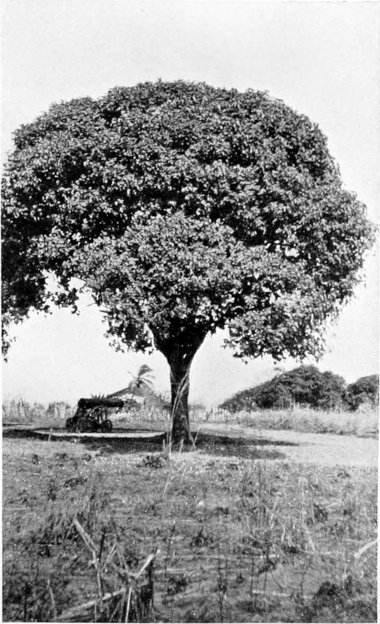
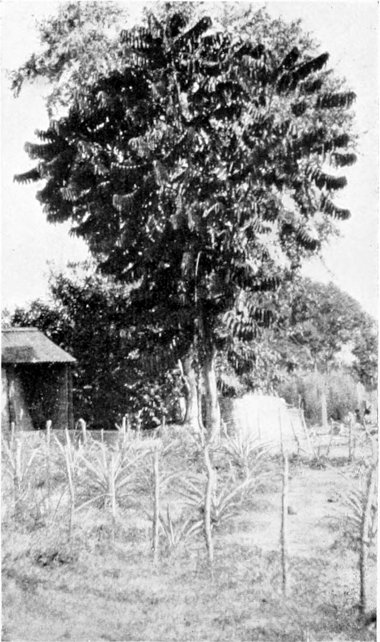
RUBBER VINE (LANDOLPHIA HEUDELOTII) AT KOTOO. Fig. 4. p. 9. CEARA RUBBER TREE (MANIHOT GLAZIOVII) AT BAKAU. Fig. 5, p. 10. RUBBER TREE (CASTILLOA ELASTICA) AT KOTOO. Fig. 6, p. 10.
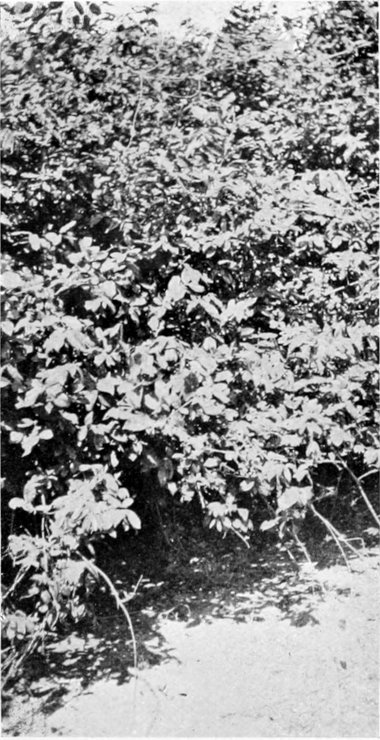
In addition to the inhabitants themselves collecting rubber, natives belonging to a tribe from Portuguese Guinea, called “Manjagos,” travel through the country for the purpose; the rubber which they obtain being sold in the French Colony to the south of the Gambia. The “Manjagos” are said to make a semicircular cut upon the thick vine-stems just above the ground, to induce the better flow of latex. This, they maintain, is not a destructive method, and that, as the root stock is uninjured, the plant continues to yield latex for a long time. At one time the rubber vine must have been plentiful, but the rush for it which occurred at the beginning of the present century has had the effect of exterminating it, except in the more inaccessible places. The export has declined and is now insignificant. The plant is known to the Mandingoes as “Folio.” An illustration is given showing this plant at Kotoo (Fig. 4).
Landolphia florida, Benth., is common in places similar to those where the last-mentioned vine occurs, but the latex is not used in any way to adulterate the good rubber, nor is inferior “paste” rubber made from it, as in other places in West Africa. Ficus Vogelii, known as “Kobbo” (Mandingo), has recently been used for extracting an inferior rubber, which has been shipped in small quantities. This tree is found growing in Bathurst as well as in many of the large towns, where it often attains a large size, and affords an excellent shade for native markets, etc. A view of a tree in Bathurst is shown (Fig. 3). Information regarding the composition and value of the rubber of Ficus Vogelii is given in the Bulletin of the Imperial Institute, vol. vii. (1909), p. 260.
Some of the South American species of rubber trees have been planted at different places, but for the most part the climatic conditions have proved unsuitable for their establishment. An exception to this is the Ceara rubber (Manihot Glaziovii), large trees of which were to be seen in Bathurst and at Bakau, but in the latter locality appear to have been cut down during recent years. It is generally acknowledged that Ceara rubber has not proved successful in plantations made in different parts of West Africa, for, although rubber of the finest quality can be easily prepared from the latex, the tree furnishes an extremely inconstant yield of latex. In the Gambia the tree reproduces readily, and, as far as can be judged, produces a latex capable of being coagulated into good rubber. As a shade tree it is recommended to be grown along public roads, and it might prove expedient in the country to make small experimental plantations, in the manner adopted in Togoland and elsewhere. By this system, tapping is continued for a few years, and whole blocks of trees are cut out as they cease to yield latex—the seedlings which have sprung up beneath these trees being permitted to take the place of the original trees. An illustration showing a Ceara rubber tree at Bakau is given (Fig. 5).
One specimen of Castilloa elastica, of which a photograph is given (Fig. 6), is growing in the Kotoo farm, about 12 miles from Bathurst. This tree has not, so far, proved successful in West Africa, and the example photographed is apparently in better condition than those grown in the Botanic Gardens of the Gold Coast and Southern Nigeria.
Funtumia elastica, the Lagos silk rubber tree, does not thrive in the Gambia, and the rainfall has been found to be insufficiently distributed for the cultivation of the Para rubber tree (Hevea brasiliensis).
The observed facts point to the conclusion that further experimental trials of certain species of rubber trees in the Gambia should be made.
BEESWAX.—It will be observed that a large quantity of beeswax is annually exported, the quality of which is high. The native bee is a small form of Apis mellifera, var. Adansonii. It is found in a wild state forming nests in hollow trees or rock cavities. The Mandingoes collect the wild swarms and confine them in basket-hives, cylindrical in form and sometimes plastered over with mud. These are placed in high trees or in abandoned huts. The wax is sold in a crude form to the Bathurst merchants, who boil it down and strain it previous to shipment. The European market value of the cleaned wax is from £5 to £6 per cwt. A detailed description of methods for the refining of wild bees’ wax for export is published in the Bulletin of the Imperial Institute, vol. viii. (1910), pp. 23-31.
PALM KERNELS.—The West African oil palm, Elæis guineensis, is found commonly in some parts, but the heads produced are small and carry small fruits, containing little oil. This oil is used locally, and the kernels from the nuts alone are shipped. The palm is chiefly valued for the production of palm wine, which is tapped from the base of the fruiting stems into funnelled gourds, hung beneath the holes. The tree is apparently never felled for the purpose, and, by limiting the amount of wine extracted, it survives for a long period.
COTTON.—The Mandingoes and Jolahs cultivate cotton for making the yarn used in their native looms, in which they weave the strips of cloth called “pagns.” These strips are afterwards sewn together along their lateral edges and made into gowns.
The native cotton plant varies somewhat in appearance. In Kommbo, a long straggling form occurs, which is retained for two seasons to produce cotton, but in the Jolah country a small annual is most frequently seen. The former is grown as a mixed crop and the latter in separate patches.
In quality, from the European spinner’s point of view, the Mandingo cotton lint compares favourably with the commercial type called “middling American” as far as length of staple is concerned, although it is not so white, nor is there so much silkiness apparent. It has been rightly remarked that the native variety, if properly cultivated, would probably give a better result than would be obtained from the introduction of American seed. The Jolah cotton is short-stapled and woolly, though whiter than the Mandingo. It would be more difficult to improve this kind sufficiently to suit the European demand.
Egyptian cotton seed was tried in the Gambia about twenty years ago, and the variety was at first considered suitable; the cultivation was, however, not proceeded with, owing to local difficulties.
The obstacles which hindered the development of cotton-growing in the Gambia for export were the same as those experienced in Sierra Leone. The local demand for raw cotton precluded it from being obtained at a sufficiently low price to leave a margin of profit to exporters, and in addition to this, labour was not sufficiently abundant, nor were the natives familiar with labour-saving methods in cultivation. Attempts to establish an interest in the matter produced a fair amount of raw cotton in 1904, but since that year the exported quantity rapidly diminished and has now ceased altogether. For reports on the quality of the cotton produced in the Gambia see Professor Dunstan’s British Cotton Cultivation (Colonial Reports—Miscellaneous Series, Cd. 3997, 1908), p. 26, and Bull. Imp. Inst., 1921. Samples may be seen in the Imperial Institute Collections.
GRAIN CROPS.—No grain is exported, as owing to the work of the scanty population being so largely applied to the cultivation of groundnuts, scarcely sufficient food-stuff is grown for their own requirements. Guinea-corn (Sorghum vulgare), the two most important varieties of which are known as “Bassi” and “Kinto” in the Mandingo language, are commonly used for food, but during recent years, owing to the repeated annual attacks on the crop by Aphis sorghi, maize-growing was substituted in some parts of the country. White maize seed was obtained from Lagos, and yellow maize seed from the Canary Islands, but the grain is not appreciated to the same extent as Guinea corn. Pennisetum typhoideum, the large millet, of which the commonest variety is known in Mandingo as “Sannio,” is alternated with Guinea corn or maize, but is often badly affected by a “smut fungus” (Ustilago sp.), which also attacks the “Kinto” variety of Guinea corn. A small grass is often grown in the millet fields, yielding a crop of fine seed which is made into flour for the preparation of a kind of porridge. This is termed “Findi” locally. Rice (Oryza sativa) is somewhat extensively grown in the swamp lands, but the success of the crop is very largely dependent on the distribution of the rainfall. Whole tracts of rice fields are destroyed in some years, owing to excessive floods, as no precautions are taken to guard against them. It is chiefly on account of the uncertainty of the grain crops, that a large quantity of rice has to be imported annually to supplement that produced in the country. These imports often amount to six or seven thousand tons.
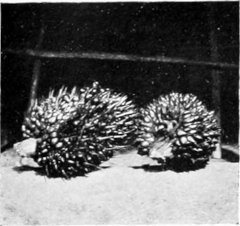
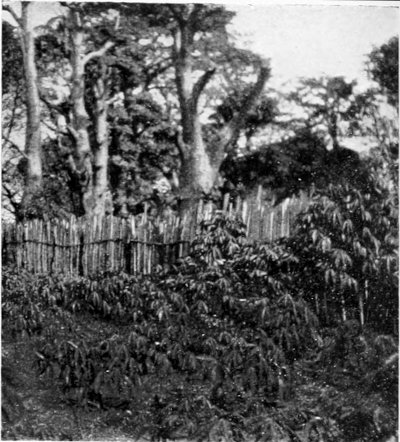
FRUITS OF OIL PALMS, SIERRA LEONE. Fig. 9, p. 21. SWEET CASSAVA, WITH BAOBAB TREES, BAKAU. Fig. 7, p. 13.
INDIGO DYERS, McCARTHY ISLAND. Fig. 8, p. 13.
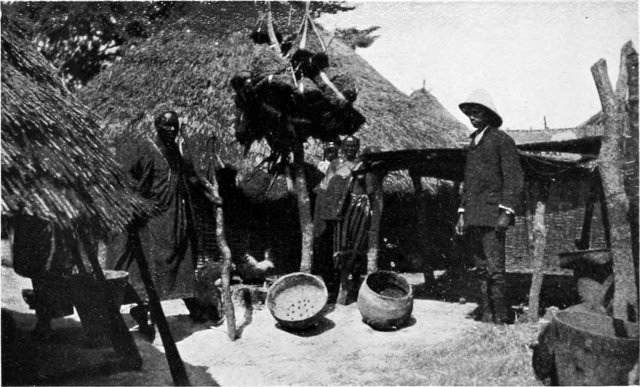
ROOT AND OTHER CROPS.—Sweet cassava (Manihot palmata) is frequently planted as a terminal crop in the crude rotation employed. This variety can be eaten without previously washing or cooking. An illustration of a cassava field is given (Fig. 7). Two or three kinds of beans are planted, though not extensively in spite of a good local demand for them. Okra (Hibiscus esculentus), cultivated for the edible fruit pods, indigo (Indigofera sp.) employed for making the local blue dye, and tobacco (Nicotiana tabacum), are planted near houses. A photograph is given exhibiting the different utensils required for the preparation of indigo, and cakes of the dried and fermented indigo stalks, in the form in which they are preserved, are shown suspended in the illustration (Fig. 8). The tobacco prepared is usually ground into snuff, in which form it is used for chewing as well as for smoking.
TANNING.—Goat-skins are tanned in the manner similar to that employed by the Haussas; Acacia arabica pods being used in the process. The people who perform the work of preparing and working leather are termed “Korankos.” Red and black inks, purchased from the European merchants, are used for staining the leather, which is inferior to that produced in Northern Nigeria (see p. 142).
FIBRES.—The country seems to be plentifully supplied with fibre plants in a wild state, chiefly belonging to different species of Hibiscus. These are of the jute class, and are used throughout the country for making native ropes. Indian jute (Corchorus capsularis) has been tried experimentally at Kotoo, and excellent samples were obtained, but the quantity of fibre per acre turned out to be small, and the working proved to be too expensive.
The preparation of piassava, which had been abandoned for many years, is said to have been taken up again by a British firm in 1915. The fibre is obtained from the leaf sheath of a palm (Raphia vinifera) which grows plentifully along the banks of the Gambia in places. For further information see Selected Reports from the Imperial Institute, Pt. I., Fibres, and Bull. Imp. Inst., 1915.
TIMBER.—There are no trees of commercial importance, accessible for felling for export, although Gambian mahogany (Khaya senegalensis) and Gambian rosewood (Pterocarpus erinaceus) occur in many parts of the country. In some remote districts the former tree is said to attain large dimensions (Bulletin of the Imperial Institute, vol. viii. (1910), p. 244).
TRADE.—The following extracts from the Colonial Reports show the diversion of destination of Gambian exports which has occurred in recent years. For this purpose groundnuts are regarded as representing the whole of the trade, of which they normally constitute about 90 per cent.
Percentages of Exports from the Gambia
Destination 1911 1912 1913 1914 1915 1916 1917
Great Britain and British Possessions 6·30 9·00 6·72 9·92 39·45 53·56 79·56
France and French Possessions 84·80 76·00 59-10 79·34 48·60 36·58 20·35
Holland 3·20 9·00 6·03 — — 4·20 —
Germany — 3·64 24·56 6·80 — — —
Denmark — — — 1·99 7·68 5·63 —
Spain — — — ·35 4·24 — —
Other countries 5·70 2·36 3·59 1·60 0·03 0·03 0·09
100 100 100 100 100 100 100
From the above it will be noted that Germany began to appear in the market in 1912, and, in 1913, had taken nearly one-quarter of the output. This is probably accounted for by the rapid growth of the vegetable oil industry in Germany and the attempt on the part of Hamburg crushers to capture the Gambia trade from Marseilles. It will be seen that a proportionate decrease occurred in exports to French ports coincident with the increased shipments to German ports. The European war put Germany out of the market, and in 1914 France took nearly her normal share. In 1915 and 1916, however, Great Britain felt the lack of imported vegetable oils to such an extent that factories for their extraction sprang up in the country; thus it is seen that in 1915 Great Britain took nearly 40 per cent. against France’s 48½ per cent., and in 1916, Great Britain, for the first time in the last fifty years, took a larger portion of the Gambian groundnut crop than France.
GAMBIA & SIERRA LEONE Stanford’s Geogl. Estabt., London. (Large-size)