PART II.—THE NORTHERN TERRITORIES
Reading edition
Tribes.—The country which is included under the Northern Territories is inhabited by a number of tribes, now chiefly located in the northern half; the central portion being liable to inundation at certain times, and therefore almost unoccupied, and the southern being, perhaps, considered unsafe owing to the proximity to the warlike Ashantis. The more important tribes are the Mamprussis, under the king of Gambaga; the Gonjas, under the king of Kombe; the Walas, under the king of Wa; and two sections of the Dagombas, under the chiefs of Savelugu and Karaga (formerly under the king of Yendi, in German territory). The Lobis, Dagartis, Grunshis, Kussassis, and several others were dispersed by Samory and Barbetu in 1896 and 1898, and have now only nominal chiefs. (See Colonial Reports—Annual, No. 566, “Northern Territories of the Gold Coast,” 1907, p. 8.) The Moshis, whose country extended into the northern limits of the Northern Territories, were employed at one time as native levies, but since they were disbanded they have interfered with the tribes on the Gambaga-Kumassi road, in the Sapari Hills, and made trading by that route unsafe. (See Colonial Reports, loc. cit., p. 10.) Steps have been taken to expel them from the country, and it is hoped that the people living in the hills, who are said to be good agriculturists, will now come into closer contact with civilisation. The Dagombas are apparently the most industrious tribe in the country, and they seem to be numerous.
Although there does not appear to be any actual record of the invasion of the eastern part of the country by the Mohammedan rulers of the Western Sudan, they are said to have overrun the pagan countries between themselves and the region of dense forest on several occasions. In 1483 the kingdom of Mossi (Moshi) was conquered by Sonni Ali, King of Songhay, who was a native of the Eastern Sudan, and had come from Egypt. Two years later he extended his conquest through the mountain territory to the south and far into the pagan belt. Sonni Ali was followed by Askia, who again overran Mossi, in order to abolish paganism and establish the Mohammedan faith. This occurred in about the year 1500, and doubtless the people learnt to adopt the improved methods of agriculture which the conquerors had introduced into the Western Sudan from Egypt and the east. Many of the tribes have relapsed completely into paganism, but amongst others there is a mixture of Mohammedanism and paganism, which is evidence of the impression made. More recently, Samodu Almami of Ouassoulou, generally known as Samory, was driven from his kingdom in the Western Sudan by the French, and overran the Northern Territories with his Sofa troops; subduing Wa, Bole, and the whole of the western part of the country. It is, however, unlikely that agriculture was further improved by his invasion, as large tracts of country were devastated to feed his troops.
FIELD CROPS.—The soil is of a lighter and more sandy nature than that generally found in the forest region, but it is well adapted for the cultivation of many different kinds of crops, notably Guinea corn, millet, groundnuts, and cotton, while it is less satisfactory for yams. The latter are consequently of smaller size.
Cotton.—The cotton grown by the Dagombas is whiter than those found in the south, and the plants are of small stature; the species has a wide-opening pale flower, and has been grown at Labolabo from seed procured in the Northern Territories. The cotton fields are planted with regular lines of plants, and the ground appears to be exclusively used for the crop during the season. The seed is sown upon ridges which have been constructed from the high conical mounds, upon which the combined crop of millet (Pennisetum spp.) or Guinea corn and yams were grown in the previous year. Cultivation is performed by means of a short-handled hoe, and the ridges are kept clear of weeds and grass until the crop is ready. The seed-cotton is sold in the markets, and is in good demand for the manufacture of native cloths. No insect pests have been observed attacking the plants, and it is probable that if an outside demand were established for the produce a large quantity could be grown. It might be necessary to introduce a better variety than that at present cultivated, as this yields a rather coarse and short staple. If cotton from this part of the country is to become an article of export, the difficulties at present experienced in transport will first have to be overcome; indeed, this applies to all the produce capable of being grown in the country. The navigation of the Volta river and the two main branches seems to suggest a means which might be employed, for, although there are several rapids in the course from Daboya and Bole to Labolabo, only one is impassable for canoes, even in the dry season. This rapid is at Krachi where a short line has been laid for transporting loaded canoes. The cost of the hire of canoes for making the journey would probably be prohibitive, but if the British Cotton Growing Association undertook the carriage by their own canoes of the salt and stores required by the merchants who have commenced business in Yeji and Tamale, the freight on these in the journey upwards would probably be found to cover the cost of bringing cotton down-stream, and the export trade in it could be developed in this manner. The British Cotton Growing Association made an effort to act upon the suggestion made here, but discontinued their operations in July 1916, when they handed over their buildings, at Tamale, to the Government, as it was shown that under the existing conditions and with but one European representative to further its interests, cotton-growing in the Northern Territories could not hope to become a remunerative export business (Colonial Reports, Northern Territories, G.C. 1916, No. 956). The irregularity of the rainfall is a matter which must be borne in mind in any future attempts to develop the industry here, but the possibilities of providing artificial irrigation should not be overlooked, as large tracts of flat land exist near the White Volta river capable of becoming fertile under proper irrigation and drainage.
Other Field Crops.—Yams are grown as a primary crop on mounds, and three different kinds are common, probably referable to D. alata, D. sativa, and D. colocasiæfolia, the last being what is termed the water yam and the first the winged yam. Guinea corn is the most important food grain grown, but millet is sometimes planted. A red species of sorghum (S. guineensis, var. robustum) is cultivated on a small scale for use in staining leather, but is not used for food. Rice (Oryza sativa) is grown in the vicinity of the large rivers, but is said to suffer damage from elephants and hippopotami. The variety seems to be similar to the red rice grown in the Gambia and Sierra Leone. Very little maize is planted, but some is grown near Salaga. Cassava is only seen in the south near the forest boundary, and groundnuts are not plentiful, owing, perhaps, to the fact that cooking oil is obtainable from shea butter trees, which are common in a wild state. Pigeon peas are often planted round the borders of fields, and are left to yield more than one crop. This pea is identical with one of the common “Dhalls” of India (Cajanus indicus); the origin of the introduction is obscure. Small beans are grown as well as Indigofera spp. Sweet potatoes, okra, capsicum-peppers, sorrel-hibiscus (H. Sabdariffa), and the Fra-Fra potato (Plectranthus, sp., “Tumuku” of the Haussas) are also grown.
Fibre.—Plants belonging to two species of Hibiscus are used for the extraction of fibre for the preparation of cordage, the cleaned fibre being similar to jute. These plants grow, with perfectly straight stems, to eight or ten feet in height, bearing short thin branches with axillary flowers.
Tobacco.—The tobacco grown is used for smoking or the manufacture of snuff in many parts of the Northern Territories, and is prepared in a special manner. For smoking tobacco the green leaves are pressed into small gourds until a quantity of juice exudes, the mass being rolled in this until it assumes an oval form, in which it is sold in the markets before drying. For snuff it is ground up between heated stones until the requisite fineness has been obtained, and is then mixed with a small quantity of the powdered seeds of Monodora myristica. The tobacco fields are usually confined to small patches near houses, and wood ashes as well as sweepings are applied as a top dressing. This appears to be the only crop to which manure or fertiliser is given. The leaves always seem to be stripped off the stems at one operation, whereby old and immature leaves are mixed with mature.
GUMS.—Two species of Acacia (A. arabica and A. Sieberiana) are found, especially in the uninhabited tracts in the centre of the country, and the last named appears to yield a large flow of gum, which, however, is not collected. Examination of this at the Imperial Institute has shown it to be about equal in quality to inferior Sudan grades; A. arabica does not seem to yield gum with such frequency in this locality as elsewhere. Burkea africana and Pseudocedrela Kotschyi produce a quality of gum comparable with “Talh” from the Sudan. (Cf. Selected Reports from the Imperial Institute, Pt. II., Gums and Resins, pp. 153, 165-7.)
WOOD OIL.—By cutting deeply into the base of a tree known as “Neou” (Dagomba), and “Kawa” (Haussa), a rather copious flow of resinous liquid is induced, which, when solidified, is a resin somewhat similar, but inferior, to copal. The tree from which this is procured is botanically known as Daniellia thurifera, Oliv., and the so-called “oil” obtained was at one time shipped from Northern Nigeria under the name of African Balsam of Copaiba. It is used in the Northern Territories for lighting purposes, as well as medicinally. The tree yields a handsomely grained timber. (Cf. Bull. Imp. Inst., 1915.)
SHEA BUTTER.—A tree known botanically as Butyrospermum Parkii bears a fruit, from the kernel of which this valuable vegetable fat is procured. The fat forms the cooking oil of the ultra-forest country, taking the place of palm oil in this respect. The mode of preparation in the Northern Territories is, doubtless, similar to that employed in Northern Nigeria. The prepared butter is one of the products carried by the Haussa traders, who visit Ashanti for the purpose of purchasing kola, and is much appreciated in Kumassi, where it obtains a high price. A small quantity is carried down the Volta river by the canoes which bring salt from Adda to Yeji and Daboya. An analysis made at the Imperial Institute of Shea butter from the Northern Territories showed that the material is in no way inferior to the better-known “Shea butter” of Northern Nigeria. Cf. Bulletin of the Imperial Institute, vol. vi. (1908), p. 370.
RUBBER.—Recently some species of Landolphia were found growing in the district of Wa and elsewhere, and, upon examination, one of these proved to be L. owariensis, P. Beauv. This was at first thought to occur plentifully, and to assume the underground habits of L. Thollonii, one of the most important sources of root or rhizome rubber in the Congo. Specimens, which were found growing near the south bank of the Black Volta river, in grass land, exhibited a trailing form of growth owing to the absence of supporting trees, but, although the plants were probably dwarfed by the annual grass fires, no development of root growth was observed in excess of that ordinarily produced within the forests. The plant is now reported to occur rather rarely in the Northern Territories; another nearly allied, though useless, species having been mistaken for it.
DYES.—For dyeing the yarn made from the native cotton, indigo is made from a species of Indigofera, or from the young leaves of Lonchocarpus cyanescens, but the process of preparation employed in this country has not been carefully observed. It is, however, probably similar to that in common use in Sierra Leone, Northern Nigeria, and the Gambia.
BEESWAX.—Bees are attracted to hive in calabashes placed in trees, the honey and wax being taken from them and sold in the markets. The bee belongs to a small variety of Apis mellifera, known as var. Adansonii. A sample of beeswax obtained at Tamale was examined at the Imperial Institute, and proved to be of excellent quality and worth £6 15s. per cwt. (Dec. 1908).
LEATHER.—Tanning of sheep and goats’ skins is done to a small extent, the same process as that described for the preparation of Kano leather in Northern Nigeria being followed. The Acacia pods used for the purpose are obtained from trees often found planted in the middle of towns.
CATTLE AND POULTRY.—A large breed of cattle with a dorsal hump exists in the Salaga district, and a straight-backed smaller kind throughout the country to the north. Although “tsetse” flies of three species are common on the stream banks, the cattle seem to be healthy for the most part, and often form part of a caravan travelling to the forest belt, where a good price is said to be obtained for them from the Ashantis. They are usually killed for food very soon after entering the forest, where they can no longer be kept free from the attacks of the three species of “tsetse” (Glossina morsitans, G. palpalis, and G. pallidipes), all of which seem to attack them. Horses are bred in some parts, but not to a large extent. Wire-haired sheep and goats are seen everywhere, and can be obtained in many places at a low price.
Fowls and Guinea-fowls are reared in several villages, and are carried to the south for sale. Long open-work baskets are used, and the fowls are usually conveyed as head-loads. Guinea-fowls, purchasable for threepence each in some of the villages south of Daboya, are sold at four or five shillings each near the coast. No coops seem to be employed in the villages to confine the guinea-fowls, which habitually roost upon the house-tops and which may frequently be seen in the adjoining fields. They are scarcely distinguishable from the wild birds which occur usually in the same localities. There is, however, a marked tendency on the part of the domesticated examples to acquire white feathers upon the breast or wings to a greater or lesser extent.
It should be recorded that a considerable local trade is carried on in the country in the sale of a flour-like substance obtained from the interior of the pods of Parkia filicoidea. This is made up with the seeds of the plant into an edible paste, locally termed “Dawadawa.”
EXPORTS.—Excluding cocoa, which is treated separately in its place, the following table shows the progress of the export trade between 1910 and 1919:—
Kola. Copra. Copal.
Year. Lbs. £ Tons. £ Lbs. £
1910 5,156,500 77,716 755 13,032 53,847 647
1911 5,791,931 93,099 779 13,257 80,042 1,110
1912 7,133,165 134,231 620 11,841 67,133 1,077
1913 7,024,868 144,705 629 14,292 38,205 555
1914 7,862,414 142,190 656 11,825 18,549 265
1915 8,267,100 139,163 770 12,821 28,888 405
1916 6,760,898 130,566 633 14,384 12,549 132
1917 11,985,645 239,134 735 19,916 2,306 24
1918 13,254,538 262,144 99 2,772 1,693 35
1919 16,319,972 350,249 984 30,091 13,748 174
Rubber. Palm Oil. Palm Kernels.
Lbs. £ Galls. £ Tons. £
1910 3,223,265 358,876 2,044,868 161,388 14,182 185,058
1911 2,668,667 219,447 1,610,209 128,916 13,254 175,891
1912 1,990,699 168,729 1,444,432 112,885 14,628 205,365
1913 1,317,369 87,915 860,155 65,652 9,744 159,128
1914 654,133 21,631 495,763 37,646 5,633 88,671
1915 647,982 25,167 330,990 25,769 4,064 50,512
1916 2,215,973 78,865 450,360 38,299 5,857 85,899
1917 2,961,204 110,272 198,900 24,770 4,768 74,911
1918 1,391,097 57,006 670,867 83,689 8,933 152,922
1919 721,588 33,637 938,595 140,163 9,892 253,243
Groundnuts.
Lumber. Cotton. Tons. £
Feet. £ Lbs. £ 1907:
1910 14,938,749 148,122 11,421 263 197 1,815
1911 13,973,396 138,821 9,701 238 not given
1912 23,573,651 228,745 20,395 506 do.
1913 37,391,848 366,094 27,497 688 do.
1914 24,587,217 240,878 23,514 588 do.
1915 9,217,622 90,661 12,016 300 do.
1916 10,334,793 93,980 17,896 447 do.
1917 7,481,468 69,128 43,870 227 do.
1918 14,680,823 137,649 20,640 212 do.
1919 10,432,250 103,238 nil. 7 210
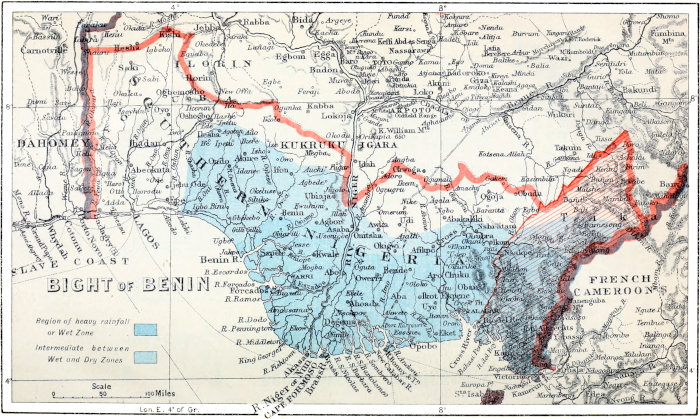
NIGERIA, SOUTHERN PROVINCES Territory held by Great Britain under Mandate is hatched in Red. Stanford’s Geogl. Estabt., London. (Large-size)