Front matter (continued 5)
Reading edition
Doubledick had already begun to clear away the barrels at the end of the stack nearest to the windlass. It was plain that what he had got to do was a secret between himself and the men below; the tub-carriers were ignorant of it. Dick moved silently to the other end of the stack, the place where he had entered, and gazed round to watch the innkeeper's proceedings. Even now, though there appeared to be no danger of detection, the upper part of his face remained covered with a mask. He had removed the lanterns, and placed them on the floor; several of the top row of barrels had been lifted down. His object, without doubt, was to drag Penwarden forth, and lower him by means of the windlass to the men waiting beneath. Dick felt sure that these were the French crew of the lugger that had brought the cargo, and that the "parcel" they were expecting was the old exciseman, whom they were to carry to France.
The innkeeper's pre-occupation was Dick's opportunity. In another second or two the cutting of the prisoner's bonds must be discovered. As Doubledick was rolling a barrel towards the wall, Dick, moving silently on his almost bare feet, rushed like a whirlwind on the man. Doubledick at that moment made a half-turn, as if some instinct warned him of danger, but he was too late to prevent Dick from getting a suffocating grip round his neck. He gasped, groaned, struggled frantically to free himself. Both fell to the floor, knocking over one of the lanterns, and rolling perilously near the open trapdoor. Dick never let go his grip on the inn-keeper's throat, for it was necessary to prevent the men below from suspecting that anything was amiss.
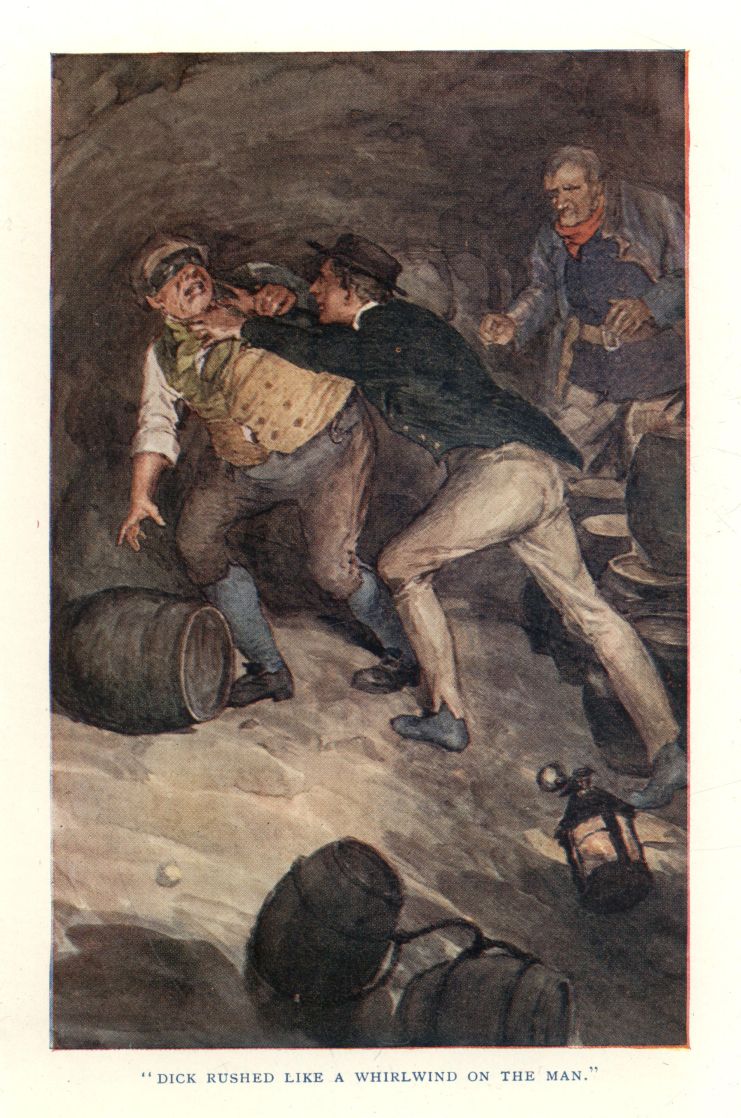
"DICK RUSHED LIKE A WHIRLWIND ON THE MAN."
Meanwhile Penwarden had scrambled painfully to his feet, and limped towards the scene of the struggle. His limbs, cramped and numbed by his bonds, were as yet almost powerless. But seeing Doubledick's legs for an instant disentangled from those of his assailant, the old man suddenly threw himself across them, pinning Doubledick to the floor, and so putting an end to his struggles. Dick raised himself, keeping his hands on the man's throat. The heaving and writhing ceased.
While Dick still held him down, Penwarden hobbled behind the barrels, carrying a lantern, found the gag that had been used on himself, and brought it back to turn it to account with Doubledick. His own hands were still too much numbed to tie an effective knot, but he held the gag between Doubledick's teeth while Dick made it fast.
All this time there had come through the hole in the floor the murmur of voices. Without relaxing his grip, Dick leant over and peered down. He was just able to see that a boat lay beneath; the hole was vertically above the sea.
"Ah, mon Dieu!" cried one of the boat's crew, perceiving Dick's head, "ven come ze—ze packet?"
Dick withdrew.
"Answer," he said to Penwarden.
The old man tried to speak, but could give utterance only to a hoarse whisper. Whereupon Dick, in a voice intended to be an imitation of Doubledick's, replied:
"In a minute."
His imitation was so entirely unsuccessful that he durst not say more.
The Frenchman's question had suggested a means of dealing with Doubledick. In attacking him, Dick had no definite plan in his mind for subsequent action. He was concerned only to prevent Penwarden from being lowered through the trapdoor. But now that Doubledick was in his power, it struck him that it would be simple justice to serve him as he had intended to serve Penwarden. He whispered the suggestion to the old man, who received it with a low chuckle.
"But they fellers down below will know un," he murmured.
"Will they? They are French; Doubledick has never been to France. They won't remove the gag, probably, until they are well out to sea, and if I know them, they won't put back and run the risk of meeting the cutter, even if they do discover their mistake."
"Ze packet, ze packet!" came the impatient cry from below.
No more time was lost. The cords that had bound Penwarden were useless, but there was plenty of sling-stuff on the tubs, and in a few seconds enough was slipped off for the purpose. Both Dick and the exciseman were used to handling rope, and though the latter's fingers were still somewhat numb, he was able to lend some feeble assistance to Dick in securing Doubledick to the plank. At the end of this there was a hook. They attached this to the rope over the windlass, and prepared to lower the innkeeper to the hands waiting below.
At the last moment Penwarden slipped off the crepe mask that still covered Doubledick's face.
"Look 'ee, Maister Dick," he said hoarsely. "You can swear to the feller, so can I. You be goin' to Rusco, you miserable sinner, and if so be you ever come back, I'll swear an information against 'ee for unlawful detainin' of one o' the King's lieges, and Maister Dick will kiss the Book and bear testimony. Good-bye to 'ee, and may the Lord ha' mercy on yer soul."
They let the frenzied man down through the trapdoor, and heard guffaws of laughter from the Frenchmen as they received their expected packet. The boat pulled off towards a lugger that lay a few cables' lengths from the cliff. The prisoner was hauled up the side; the men climbed on board and hoisted the boat in; and in a few minutes the lugger disappeared into the darkness.
It was not the time to enter upon explanations on either side. Penwarden was eager to follow up the tub-carriers, Dick to release Sam. When the exciseman heard of the boy's situation, he yielded with a sigh, and considered with Dick a means of bringing Sam across the shaft. They were not long in deciding that the best plan would be to make use of the quantities of rope at hand, and form a running tackle by which the boy might be drawn over. This was soon done, and taking one of the lanterns, they hastened back to the scene.
"Hoy, Maister, be that thee?" cried Sam out of the darkness when he saw the approaching light.
"Yes, and Mr. Penwarden is with me. We are coming to bring you away."
"Praise and glory be! I did think I'd never see daylight again. Have 'ee got a true and proper bridge?"
"You'll see. Run back to the cave and bring two staves and our guns."
They waited at the brink of the shaft until Sam reappeared.
"Now drive the staves into the floor," cried Dick.
"I can't. It be hard stone."
"Well then, go back to the cave again and bring some of those big pieces of rock on the floor."
Sam went obediently. Instructed by Dick, he arranged a number of the rocks, four or five feet deep, to form a sort of platform.
"Now knot this rope to the staves," said Dick, flinging it across. "Put it behind the rocks, and pile more rocks on top to hold it down."
While this was being done, he made the other end of the double rope fast to a large boulder near the head of the shaft.
"Now, Sam, all you have to do is to clasp the rope and let yourself down. We will do the rest."
"Be it firm and steady?" asked the boy anxiously.
Dick hauled on the rope; it was held firm by the rocks.
"There, you see 'tis quite safe. All you want is a little courage; it will not take half a minute to get you across."
"I'll send summat fust to prove it," said Sam.
He withdrew a few paces into the passage, and returned, carrying a long, flat box. This he hitched to the rope.
"Haul away, Maister Dick, and let me see wi' my own eyes."
The box was drawn to the further side in a few moments.
"Now are you satisfied?" asked Dick.
"Iss, fay; and I've some more boxes that had better go fust."
Four boxes and the two guns were hauled across before Sam consented to venture himself, and then only because he feared he could carry no more when he got to the other side.
"'T'ud be a sin," he said, "to leave all these silks and satins behind."
"How do you know the boxes contain silks and satins?"
"'Cos I opened 'em and felt 'em in the dark. 'Twas like strokin' a cat's back, wi'out no fear o' scratches. You'll be sure and not let me drop into the pit, Maister?"
"Yes. Come along; I want my supper."
"Be-jowned, and so do I. Here I come."
He grasped the rope, let himself gently down, and was hauled to the other side.
"Oh, Maister Penwarden," he cried as he landed, "I be 'nation glad to see 'ee safe and sound. Wheer have 'ee been all this time? You have gied us all a terrible deal o' trouble."
Penwarden growled.
"Never mind about that, Sam," said Dick. "Our trouble is well repaid, and we had better get home as soon as we can."
"True. If you go first and turn the lantern so's it do gie me a light, I'll be able to carr' these boxes wi'out tumblin' and breakin' my head. So for home-along."
On the homeward way Dick related his adventure. The old man said nothing until he heard of the discovery of lace and silks.
"Ah!" said he, "and these boxes that young Sam be carr'in' on his head are filled with silks and laces, I s'pose."
"Iss, fay," cried Sam exultantly, "and noble gowns and pinnies they will make, to be sure."
"Well," said Penwarden, "then I seize 'em in the King's name."
"Rake it all!" exclaimed Sam. "Did the King buy 'em? Did he bury 'em? Did he find 'em? No, the King be a good man, but 'a never did no free-tradin' in his life, I reckon, and we won't part with 'em, will we, Maister Dick?"
"I know my duty," said Penwarden, "and seized they be. Resist at yer peril."
"Daze me if I don't wish ye'd been carr'd to France," cried Sam. "Arter what we've been through for 'ee, too!"
A wordy war ensued that lasted until they reached the door of the Towers, where the boxes were deposited for the night. It required a peremptory command from Mr. Polwhele next day to induce Penwarden to relinquish his claim on them, the old man then being more than ever convinced that the world was a strange mix-up.
CHAPTER THE SEVENTEENTH
Petherick makes a Discovery
About an hour before Doubledick was embarked for Roscoff, a group of men employed by Mr. Polwhele as his assistants stood on the bridge spanning the stream that flowed through the village. It was freezing, and they stamped and swung their arms to keep themselves warm.
"'A said he would jine us by half-past nine o'clock," said one.
"Well, church-clock has tolled the half-hour, and 'tis gashly cold. What shall us do, neighbours?" asked a second.
"Go home-along, say I," a third answered. "He be a true man of his word. Half-past nine, 'a said; half-past nine 'a meant, and if he bean't here 'tis a plain token he bean't a-comin'!"
"I tell 'ee what, neighbours," said the man who had first spoken. "We'll gie un five minutes' law, as near as we can guess it by trampin' forth and back; then we'll wend up-along to Dower House and axe un for orders. I'll be sworn he be fillin' up his inside wi' high meat and noble drink."
"Ay, and maybe figgy pudden or squab-pie," said another, licking his lips. "Do 'ee think, now, we bein' pore men all, they'd gie us a croust and a nibleykin, like the rich gaffer and Lazarus?"
"Jown me if we don't go straight as a line and see. Hey! step out, souls all."
They hurried into the village and up the hill, arriving at the Dower House about ten minutes to ten. The house was brightly lit, and from within came sounds of laughter.
"Sech merry doings bean't for we poor souls," remarked one of the men despondently.
"True, neighbour Pollard, we bean't all portigal sons," said another.
"You be a bufflehead, sure enough. The portigal son in the Book comed home-along a beggar in rags, arter swallerin' pigs' wash."
"Ah well, I must ha' been thinkin' o' some other holy man."
"True; Lazarus was the man. Rap at the door, neighbours, and make a goodish noise, or ye won't be heerd through this yer racket."
Susan came to the door in answer to the knock.
"Please, ma'am, we be come," began Pollard, and then found it necessary to swallow.
"Well I never! What be come for?"
"For Maister Polwhele, wishin' 'ee no harm. 'A said he'd jine us when clock said half-past nine, and we'll be obleeged to 'ee if you'll say as we be come for orders."
"Why, bless me, Mr. Polwhele went away when clock strook nine, and as sober as a jedge."
"Well, souls, 'tis 'nation hard to traipse up that hill for nothing at all. We med as well go home-along and get to our beds. We be sorry to bring 'ee out, ma'am, such a bitter cold night, but 'twas to be."
"I wish 'ee well, poor souls," said Susan.
"A nesh young female," remarked one of the men, as they departed.
"She'd as lief as not ha' gied us some grog if I warn't sech a humble feller of my inches. Hey! theer's a deal lost in this world by modest men like we."
They shambled dolefully down the hill. Half-way down they were met by the boatswain and six seamen from the cutter.
"Ahoy! mates," cried the boatswain, "have ye seen or heard anything of Mr. Mildmay?"
"Neither heerd a cuss nor seed the tip o's nose."
"Ah well, then. I thought you might have, coming along by Mr. Trevanion's house."
"Ha' ye seed or heerd anything o' Maister Polwhele, now?"
"Neither bowsprit nor whistle. No doubt he's with our officer, dancing a hornpipe, or whatever they do at fine gentlemen's parties."
"No, he bean't at Dower House. We've been to call for un. 'A told us he'd jine us on bridge when church-clock strook half-past nine."
"That's curious, because Mr. Mildmay told us the same thing, putting the cutter instead of the bridge. Isn't Mr. Mildmay up there, then?"
"That we don't know. It didn't come into our heads to axe for he."
"Well, we'd better go up and put the question. Step out, messmates."
Mr. Polwhele's men returned with them, in the hope that the bold sailors would ask for the grog, which their modesty had missed. The door was again opened by Susan.
"Now, my dear," said the boatswain, "we won't keep you in the cold. Just answer a little question. Is Mr. Mildmay aboard?"
"Dear life! First Mr. Polwhele, now Mr. Mildmay. No, sailorman, they both wented out together, a minute arter clock strook nine."
"Bless your pretty face! Well, messmates, we've had our cruise for nothing, unless this lovely lass will give us something to drink her health in."
"Here's Maister!" cried Susan, stepping aside hastily as John Trevanion came to the door.
"Well, my men, what's this?" he asked genially.
"Please yer honour," began Pollard.
"Avast there!" cried the boatswain. "Mr. Mildmay was to come aboard by three bells, sir, and seeing he was late, we made bold to come up here for orders."
"Please yer honour," said Pollard, "Maister Polwhele telled we the same, only 'twas nine and a half bells wi' him."
"Well, my men, you're too late. They both left here at nine. But come in: 'tis a cold night, and you won't be the worse of something warm. Susan, bring a full jug and tumblers. No one shall leave the Dower House to-night without drinking success to the mines."
The men tramped in, voluble with thanks. Susan served them each with a tumbler hot, and they left a few minutes later, with a high opinion of Mr. Trevanion's hospitality, and the comfortable feeling that they had not made their journey for nothing.
Sunday morning broke bright, frosty, and clear, the sun shining with a brilliance that belied the cold. About half an hour before church time, as Mr. Carlyon was conning over his sermon for the day, there entered to him the pluralist of the parish, Timothy Petherick, constable, sexton, beadle, and bell-ringer. There was a scowl of annoyance upon his face.
"Well, Petherick, what is it?" said the Vicar, looking up.
"Yer reverence," said the man, "hain't I telled 'ee times wi'out number that the bats and owls do make a roostin' place o' holy church-tower?"
"I believe you have."
"Well, yer reverence, it didn' oughter be," said Petherick, smiting his fist. "They heathen animals didn' oughter take up their habitation in sech a Christian place. 'Like owl in desert,' says the Book, not 'like owl in church-tower.'"
"Clear 'em out, and be hanged to 'em," said the parson. "Yet, after all, they don't do any harm."
"No harm! Dash my bones, yer reverence—God forgi'e me for usin' Saturday words of a Sunday—they do do harm. Do 'ee think I can strike a true Christian note out o' the bell? No, not I; 'tis all clodgy, like the spache of a man that's rum-ripe, and all because some owl or airy-mouse hev made his nest on the clapper, scrounch un."
"Well, go up the ladder and brush it off."
"Theer 'tis, now. What's happened o' the ladder, I'd like to know? Theer bean't no ladder. 'Twas theer yester morn, but not a mossel o' ladder be theer to-day. 'Tis bewitched, sure enough; some pixy or nuggy, or little old man, hev sperited un away in the night, for I squinnied up-along and down-along, and never got a sight o't."
"Well, time is getting on. Do your best, Petherick. Someone has borrowed the ladder, no doubt, and will bring it back to-morrow. You should lock the tower door, and then this sort of thing couldn't happen."
Petherick retired, a man with a grievance. Entering the tower, he pulled at the bell-rope with a scornful air, and, indeed, the sound given out was little like the clear note that ordinarily summoned the Polkerran folk to worship.
They were on the whole good church-goers. At least half the population were regular attendants, some of the other half being Methodists, who preferred going to "meeting." The principal smugglers were sound churchmen to a man, and repeated the responses after the Commandments with great fervour, especially after the eighth, when they glared reproachfully at Mr. Polwhele in his pew by the chancel steps.
In spite of the strangely muffled bell, there was an unusually large congregation on this Sunday morning. The villagers, as their custom was, assembled in the churchyard, waiting until the Squire and his family had passed into the church before they should follow to their seats. Much animation was observable among them this morning, and when Dick walked up the centre path with his parents, he guessed that many of them were discussing the successful run of the previous night, and a smaller number the supposed deportation of Joe Penwarden. There was no sign of perturbation among them, whence he inferred that the disappearance of Doubledick was not yet known. It was not uncommon for the innkeeper, after a run, to absent himself for a day or two, so that, even if it were known that he had not yet returned to the inn, they would feel neither surprise nor alarm. Nor was the failure of their plot against Penwarden suspected. He had not spent the night in his cottage. Dick had insisted that the old man should sleep at the Towers, in order that he might have a good supper, and that Mrs. Trevanion might bathe and anoint his chafed wrists and ankles.
The Squire's large curtained pew was on the north side of the chancel, Mr. Polwhele's next. Opposite, and facing it, was John Trevanion's. The master of the Dower House looked particularly fresh and cheerful when he strode up the aisle to his place. He smiled a greeting to one or two families with whom he was acquainted, carefully avoiding his relatives.
The village folk clattered in; the band in the gallery above the door tuned up their instruments; the toneless bell ceased to ring, and Mr. Carlyon having made his solemn entry, the service began.
The Vicar had just come to the end of the second lesson when, through a postern leading from the tower, came Petherick with a face full of news. He hastened to the reading desk, touched Mr. Carlyon on the sleeve, and said in a church whisper:
"Please, yer reverence——"
"Not now, Petherick," the Vicar whispered back. "Go to your seat."
"I bean't in fault, and say it I woll," said the man. Then in a low tone, which, in the breathless silence of the congregation, penetrated to the remotest corner of the gallery, he added:
"Maister Mildmay and riding-officer was in belfry, tied round the middle to bell."
"God bless my soul!" murmured the astonished Vicar unconsciously. "This is unseemly," he said sternly: "'tis brawling. Go to your place, Petherick."
The beadle marched to his seat under the pulpit with the air of one who had spoken his mind and scorned rebuke. Those of the congregation who had been in the secret tittered when he made his announcement; the larger number, who were vaguely aware that something had happened to the officers, but did not know its nature, gazed at one another with startled looks, which speedily changed to smiles. The occupants of the Squire's pew alone preserved their composure. Mr. Carlyon's stern look silenced the giggles and whispers of the frivolous, and the service proceeded.
The hymn had been sung, the Vicar was in the midst of the prayer for the King's Majesty, and had just recited the words "our most gracious sovereign Lord King George," when a man quietly entered from the outer porch, and stood within the church beneath the gallery. The heads of the congregation were bent forward, so that his presence was unnoticed. The prayer came to an end; everybody said "Amen," but one voice rose above all the rest. It was that of the new-comer. Tonkin, in his pew a few paces down the aisle, started and turned his head like one thunderstruck. A bruise was noticeable on his right cheek. All held their breath as Joe Penwarden marched steadily down the aisle to his seat near the riding-officer's. As he passed the Vicar, he raised his hand to the salute, then knelt quietly at his place, where the coloured sunbeam, streaming in through the south window, lit up his weather-beaten face.
That dramatic scene in the church was talked of in Polkerran for many a long year. A deep hush had fallen upon the whole congregation; even the most fractious and fidgety children felt awed, by they scarcely knew what. Consternation held the smugglers rigid in their seats. John Trevanion's face turned sea-green, and the smile by which he tried to conceal from the congregation the mingled emotions—surprise, rage, even fear—that possessed him, did but reveal them the more clearly to two pair of eyes in the Squire's pew.
Meanwhile the Vicar had turned over a few leaves of his prayer-book. Now, in a peculiarly solemn tone, he began to read the thanksgiving "For peace and deliverance from our enemies." The words rolled through the church: "We yield Thee praise and thanksgiving for our deliverance from these great and apparent dangers wherewith we were compassed"; and at the close Penwarden's voice was again uplifted in a loud and prolonged "Amen."
Mr. Carlyon was a man of tact. He knew very well that his people would be on tenter-hooks until they could discuss these strange incidents. It was no time to preach to them. A sermon was not an essential part of the service. Accordingly he finished the order for morning prayer and gave the Blessing without ascending into the pulpit. The congregation streamed forth. Tonkin and his friends in a knot hurried down to the inn, followed closely by the tub-carriers of the previous night, whom Doubledick had invited to meet him there. John Trevanion came out alone, and walked rapidly homeward, without a word or a look to anyone. The rest went their several ways, except the Squire and his family, and Penwarden, whom Mr. Carlyon invited to the Parsonage. There they found Mr. Mildmay and the riding-officer sitting in the sunlight at an open window, sipping toddy and taking snuff, thoughtfully brought to them by the housekeeper.
"Upon my word," said the Vicar, on beholding their wrathful countenances, "if I had not so lately taken off my surplice I fear I should laugh. What is the meaning of it, gentlemen?"
It is regrettable, but the truth must be told. The two officers, Mrs. Trevanion not having entered the room, let forth a flood of language such as certainly had never before been heard within those walls.
"Come, come," said the Vicar, "remember my cloth. I will change my coat, and then ask you to tell me calmly, as befits the day, all that has happened."
"Your cousin, Squire——" began Mr. Mildmay, on the Vicar's departure, but he choked.
"Is a consummate scoundrel, sir," said Mr. Polwhele for him.
"He hoodwinked us," said the lieutenant.
"He trapped us," cried the riding-officer.
"Calmly, gentlemen," said the Vicar, re-entering. "Now, Mildmay."
"He invited us to his house——"
"And laughed and joked," put in Mr. Polwhele.
"And made himself deuced pleasant," said Mr. Mildmay.
"One would think they were parson and clerk," said the Vicar under his breath.
The hint was taken, and Mr. Mildmay was able to speak a few sentences without interruption.
"Well, we left together, Polwhele and I, at nine o'clock, as we intended. 'Twas pitch dark. We had quitted the grounds but half a minute, and were walking along by that stone hedge near the mine-shaft, when we fell headlong over a rope stretched across the road. Before we could get to our feet, hang me if a crowd of ruffians didn't fling themselves upon us and well-nigh choke the breath out of our bodies. I hit out——"
"So did I," said Mr. Polwhele, his feelings overcoming him.
"So did Polwhele. I barked my knuckles."
"So did I," said Mr. Polwhele.
"So did Polwhele; but we might have been fighting air for all the good we did. The rascals held us down while they gagged and roped us——"
"And never a word said," put in the riding-officer.
"No, confound it all! 'Twas too dark to tell black from white. All the scoundrels were masked, and didn't breathe a word we could identify 'em by. They roped us so that we couldn't move hand or foot, and carried us we didn't know where——"
"Except that it was over plaguey rough ground. I was jarred and jolted till I felt as if all my joints were loose."
"So was I," said Mr. Mildmay. "I knew no more till I found myself being hauled up a ladder, and then, confusion seize them! they lashed me to the bell——"
"Mildmay on one side, I on t'other, the same rope going all round."
"And there they left us all night. I didn't get a wink of sleep——"
"Nor I——"
"Till the morning, and as soon as I dropped oft, that dunderhead Petherick must pull the bell-rope, and I felt a great thwack in the small of my back, and woke in a desperate fright. There was a second thump, and then it stopped, and we had peace for a few minutes."
"That was when Petherick was telling me that I really must clear the tower of owls and bats," said the Vicar.
"Bats!" cried Mr. Polwhele. "They were whisking me in the face all night."
"And the owls were tu-whooing like fog-horns," said Mr. Mildmay. "Then the thumping began again, and I was jarred till I thought I should die. Then there came a horrible noise of fiddles and serpents and clarinets from below, and yowling and growling, and soon after Petherick's head appeared through the hatch, and he had the impudence to laugh in our faces. When he had done cackling, he loosed us, and we crawled down the ladder more dead than alive, and here we are."
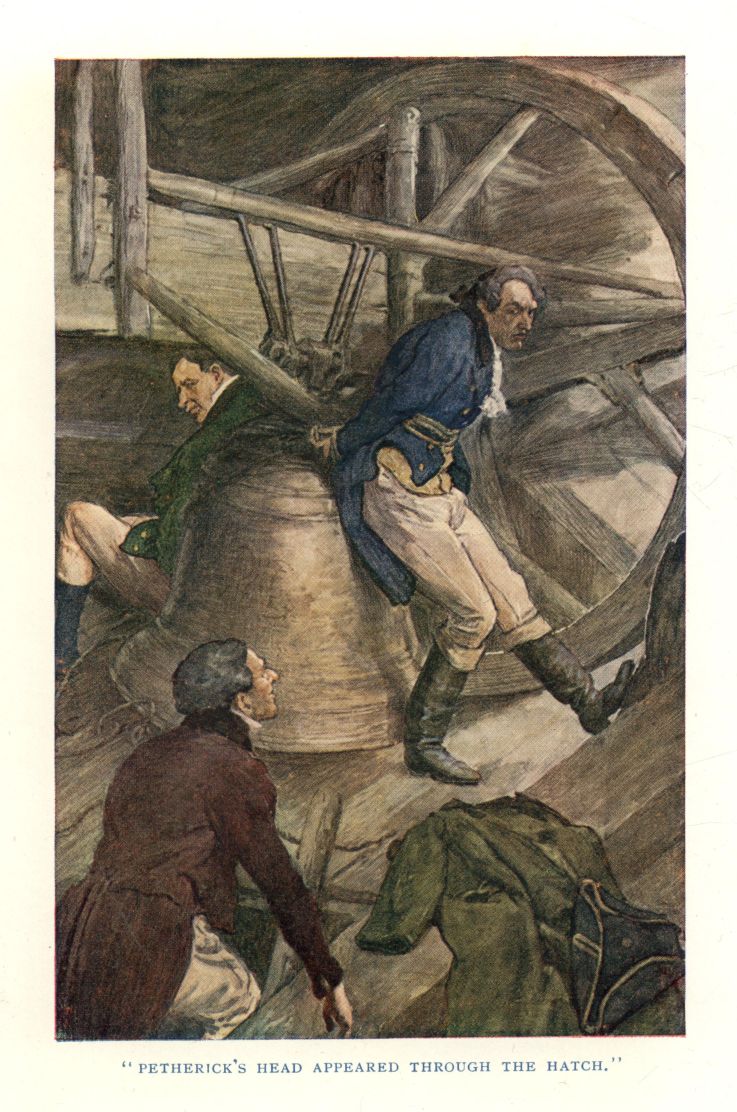
"PETHERICK'S HEAD APPEARED THROUGH THE HATCH."
"And I lay my life 'twas John Trevanion's plot," cried Mr. Polwhele hotly. "Never has such a scandalous outrage been known in Cornwall before. The Judas came to the door and bade us good-night, and said he was sorry we must go, but duty must be done—the detestable hypocrite."
"There was certainly more art in it than the village folks are capable of," said the Vicar. "By——dear me! I am forgetting myself, but it brings back to me the pranks we played at Oxford. I remember——but there, that's best told on a week-day. You'll find it hard to prove anything against John Trevanion, my friends."
"That's the cunning of the villain," said Mr. Mildmay. "But I'll keep a lynx-eye on him for the future, and my gentleman will overreach himself one of these days. No doubt he made a fine haul last night."
"He did so," said Penwarden, who had remained in the background. "The carriers made five trips betwixt the cave and the well, and though I couldn' see 'em, I reckon they ran summat nigh two-hundred tubs."
"Bless my soul, where do you spring from, Joe?" cried the riding-officer.
"Ah, sir, there be no spring left in my aged frame. I bean't what I was in my young days, when I served wi' Lord Admiral Rodney. But I'm not dead yet, thanks to Maister Dick, and I'll be on duty to-morrer, sir, same as ever."
"Come, Joe," said the Vicar, "we must hear all about it. I own I almost forgot where I was when I saw you tramp up the aisle just now."
"The Squire's lady did say I wasn't to get up, Pa'son, but when I woked and found 'em all gone-along to church, I couldn't bide wi'out goin' up to the House of the Lord like holy David, and givin' my humble and hearty thanks to the Almighty."
He related how, at dead of night, he had been hauled from his bed by half-a-dozen masked figures, carried to the well, let down in a basket, and taken to the place where Dick had found him.
"'Twas that 'nation rascal Doubledick at the bottom of it," he said. "When I laid there flat on a plank, wi' a blanket atween my teeth, and a gashly ache in every inch o' my body, I could ha' borne it all like a holy martyr, but for the villain's tormentin' mouth-speech. 'A tried his best to change his tone o' voice, but I knowed un through it all. 'You be agoin' on yer travels,' says he. ''Tis uncommon spry in 'ee at yer time o' life, wonderful brave in a old aged feller. And ye'll lay yer bones in a furrin grave, wheer ye'll bide till Judgment Day, and when the trump wakes 'ee and they axe 'ee what be doin' in a strange heathen land, ye'll have to tell, 'twas because ye couldn't keep yer tongue from evil speakin', nor yer hands from pickin' and stealin'. Ah! 'tis a sorrerful sight to see a old ancient like 'ee goin' the way to everlastin' bonfire for sech ungodly deeds.' So 'a went on a-rantin' and ravin' till I come nigh bustin' wi' the rage inside me. But I reckon he sings another tune now. 'Tis he hev gone on his travels, and he dussn't show his face here no more, for 'twill be transportation if he do."
It was Dick's turn to recount the steps of his discovery, and he learnt from Penwarden the explanation of the only point that still puzzled him: why he had found the front door of the cottage unlocked. Penwarden said that one of the kidnappers had opened the door to keep a look-out. The presumption was that, after locking the back door behind his comrades when the deed was done, he had merely closed the front door, probably because he was in haste to rejoin them.
While Dick told his story, the Vicar was turning over the yellow leaves of an old leather-bound manuscript book.
"Ah! I have it," he exclaimed at length. "This is the diary of William Hammond, vicar of this parish eighty years ago—material for my poor starveling history, Trevanion. You have seen his name on the tablet in church. Listen. 'To-day I read the burial service for seven men of this parish, to wit, Anthony Hallah, Francis Hocking, John Tregurtha, John Maddein, Richard Kelynack, Paul Tonkin, Thomas Rowe, who 'tis supposed were overwhelmed in the late landslip beyond St. Cuby's Cove. Their bodies have not been recovered, but I yielded to the entreaties of their families that I would recite the solemn office of the Church, that their souls might rest in peace.' Do you see the story in this? The poor fellows were smothered while running a cargo into the cave which Dick found blocked up. Naturally the place was shunned by the smugglers, and I daresay it was years before a new generation made for themselves the hiding-place Dick has discovered. No doubt it is in the part of the cliff that bulges over the sea. They must have hollowed out the chamber, and pierced a hole in its floor, and you might have searched for ever, Mr. Mildmay, without perceiving from below the trapdoor with which it was concealed. No doubt, as Dick suggests, they have traded on the superstitions of the people in regard to the ghost at the well, and the fact that they seldom needed to use the hiding-place has helped them to preserve their secret. This will be a terrible blow to the smuggling hereabouts, and 'tis an extraordinary thing that it should be due to Dick, whose intervention has been brought about so strangely."
"Confound it, Dick, you ought to be in my place," said Mr. Mildmay with a rueful look. "Here have I been dashing about in the cutter, and Polwhele riding up and down, and all the fuss and fury not half so effective as your quiet use of your wits. 'Tis a dash to one's proper pride."
"There was a great deal of luck about it, sir," said Dick. "If Sam hadn't overheard the conversation between John Trevanion and Doubledick, we might have puzzled our wits for years without getting at the truth."
"Ah!" said Mr. Carlyon with a chuckle, "and there's a lady in the case as usual. I understand that Sam takes a brotherly interest in Mr. Trevanion's maidservant—a very good girl, behaves well in church, and seems most attentive to my sermons. Upon my word, Squire, we owe something to John Trevanion after all."
"Humph!" grunted the Squire. "What does the Book say, Vicar? 'The wicked diggeth a pit, and falleth into it himself.' That is true in the case of Doubledick, at any rate."
"And he's no loss to us," said Mr. Polwhele. "Without a doubt he hid that ruffian Delarousse. I suppose they'll now be hob-a-nob together in Roscoff. What's that at the window?"
He sprang up and put his head out.
"Do 'ee feel better now, sir?" asked Petherick, sympathetically.
"What are you doing there, Petherick?" asked the Vicar, recognising his voice.
"I wer just a-comin' along to tell 'ee wheer I found ladder, yer reverence. 'Twas in the ditch over beyond the linney, and be-jowned if I wouldn' give a silver sixpence, poor as I be, to know who 'twas carr'd un theer. We must clear out these owls and airy-mouses, to be sure."
"Well, set about it to-morrow," said the Vicar, closing the window.
"I'll be bound the fellow has heard all that we've said," cried Mr. Polwhele.
"Then you may be sure it will be all over the parish to-morrow," said Mr. Carlyon.
CHAPTER THE EIGHTEENTH
A High Dive
The failure of their carefully-laid plan afflicted the smugglers with a numbness of dismay and stupefaction, and robbed them of all power to appreciate the success of the trick played on the revenue officers. Tonkin bitterly reproached himself for leaving the shipment of Penwarden to Doubledick and undertaking the seizure of John Trevanion's guests. Moreover, honest and simple-minded as he was, a tiny seed of suspicion was beginning to germinate in his mind. Before John Trevanion came home, the freighting had been done by Tonkin on a modest scale in co-operation with Delarousse. Now, however, John Trevanion had taken the lead. For some reason, which none knew, and only Doubledick suspected, he had thrown over Delarousse, and did business with a rival and enemy of his in Roscoff. Having more capital than Tonkin, whose recent losses had indeed been crippling, he could buy more largely and employ more men, so that Tonkin found himself in a position of galling subordination. As Trevanion had said to Doubledick, the big man did not care to play second fiddle. He was beginning to wonder whether the jovial master of the Dower House was quite so good a friend as he seemed.
The escape of Penwarden was a blow, the more crushing because so mysterious. After church on Sunday, Tonkin and his fellows foregathered with the tub-carriers in the Five Pilchards, where Mrs. Doubledick attended to them in her husband's absence. The young farm labourers had been in complete ignorance of the presence of Penwarden behind the stacked barrels. His projected deportation was the secret of Tonkin and a few trusty friends, who knew better than to run the risk of being betrayed by an informer. They were still anxious to guard their secret, and being unable to discuss the matter freely in the presence of the carriers, they made themselves so unpleasant that the latter presently betook themselves in dudgeon to the Three Jolly Mariners. But even when the important people had the taproom of the Five Pilchards to themselves, they were at a loss. In Doubledick's absence no light could be thrown on the mystery.
"Do 'ee know wheer yer man be, Mistress?" asked Tonkin of the gaunt woman behind the bar.
"I do not," she replied, "but 'a will come home-along in a day or two, to be sure. He loves his home, does Doubledick."
"Well, you ought to know, if anybody."
"Hey, my sonnies," said a voice at the door, and Petherick entered. "I be come to jine ye in yer laughter and merrymakin'."
"Then you be come the wrong road," said Tonkin gloomily. "We be downcast and dismal."
"Ay, mumchanced and mumblechopped," added Nathan Pendry.
"You do surprise me! Never did I see anything that tickled my ribs so much as they two King's servants lashed to the holy bell. I don't care who the man is, 'twas a merry notion. But good now! I know what yer dark thoughts be. 'T'ud make angels weep and wail, so 'twould. To think that Cuby's ghost will walk never more!"
"Oh, Cuby's ghost be jowned! If ye do know anything, tell it out without hawkin' and spettin', constable," said Tonkin.
"Well, neighbour Doubledick be a lost soul this day, that's sartin," said Petherick.
"My Billy be dead!" shrieked Mrs. Doubledick, sinking into a chair and rocking herself to and fro.
"No, no, Mistress," said Petherick. "It bean't gone so far as that. Dry yer eyes, woman. He bean't a corp, 's far 's I do know, but never will ye see un again, no, never."
"Name it all, constable, don't spin it out so long," said Nathan Pendry. "Put the 'ooman out of her misery."
"Well, I will. Neighbour Doubledick be this day in Rusco."
"Dear life!" exclaimed Mrs. Doubledick.
"How do 'ee know that, constable?" asked Tonkin.
"I heerd it all wi' my own ears. Seems as if Joe Penwarden was to go, but the voyage wer too much for his old aged stummick, so he and young Trevanion sent neighbour Doubledick instead."
He then repeated what he had overheard at the window of the Parsonage, his audience listening in wrath and amazement.
"So ye see," he concluded, "he dussn't show his face hereabouts again, for they two will swear to him afore Sir Bevil, and neither might nor power can save un. Seems to me as ye've met your match in young Squire."
This opened the floodgates of rage, and the room rang with execrations and threats of vengeance. At last Tonkin declared that he would sail to Roscoff next day, hear Doubledick's version of the matter, and learn whether the innkeeper himself admitted the impossibility of returning from his exile. Meanwhile he bound all those present not to disclose their knowledge of what had happened. He felt that the ignominious failure of the scheme would make them all a laughing-stock, which was especially to be avoided now that a score of miners had been imported into the village by John Trevanion. The men loyally kept the secret, even Petherick restraining his gossiping tongue, for he had a wholesome fear of Tonkin.
Next morning, therefore, Tonkin sailed away in his own lugger, beating out against a stiff breeze. An hour or two later, Mr. Mildmay paid a visit in the cutter to the scene of the night's events, seized the tubs still left in the smugglers' den, broke up the windlass, and blocked up the tunnel leading to the well.
Next afternoon Dick and Sam launched their boat, and sailed out to fish at some distance from the point of the Beal. Meeting them on the cliff, Penwarden advised them to keep their eye on the weather. The sky was threatening, and the boat, while safe enough on a calm sea, had not proved her capacity to ride out a storm.
Sam appeared to be in low spirits. Usually talkative, he had scarcely spoken to Dick on the way from the house, and had indeed not been visible since breakfast time.
"What's the matter, Sam?" said Dick, as he sat at the tiller, noticing the boy's gloomy face as he rowed to assist the sail.
"Nawthin'," replied Sam curtly.
"But there is. Your face is as long as a fiddle. Something must have upset you. What is it?"
"Well, if I must tell, I will. My poor heart be broke."
"That's bad. What broke it?"
"The Mistress."
"My mother! What has she done?"
"'Tis not what she does, but what she says. Oh! 'tis terrible hard for poor folks in this world."
"I agree with you. We are all pretty poor at the Towers."
"That's why I feel it. Some poor folks can have noble raiment, others can't, and drown me if I can see the why and wherefore."
"Don't talk rubbish."
"'Tis not rubbish. Hevn't Mistress got a fine new sealskin coat? Didn't she wear it to church yesterday? Didn't she look like a queen, and make all the women's eyes open as wide as saucers? And there was Maidy Susan, poor young thing, lookin' as plain as a sparrer beside her."
"Well, you wouldn't expect to see a servant-maid as fine as the Squire's wife."
"Iss, I would so, when her might be. I showed they silks and satins to Mistress, and telled her I had broughted 'em for Maidy Susan. 'No, indeed,' says she; 'quite unsuitable for a girl in her station o' life.' 'Why for, please 'm?' says I. 'Because I say so,' says she; 'I never heerd o' sech a thing.' Be-jowned if I can see why. Pretty things be fitty for pretty females, and I don't care who the man is, Maidy Susan would look as fine in 'em as Mistress do in her noble sealskin."
"Fine feathers don't make fine birds, they say," remarked Dick with a smile.
"No, nor fine coats don't make old women young and pretty. They only make 'em look fatter."
"Sam, don't be impudent."
"Bean't impedence, leastways, not meant for sech, as you know well. It be truth," insisted Sam. "Can 'ee deny it? I axe 'ee, bean't Susan a pretty maid?"
"She is, I own."
"Well, then, there you are."
This appeared to Sam a clinching argument. Dick laughed.
"I'll speak to Mother," he said. "Perhaps she will let Susan have a little silk for high days and holidays. But you know the story of the jackdaw that dressed up as a peacock and was pecked to death by the peacocks it went amongst?"
"Never heerd o't, and I don't believe it. Peacocks be sech silly mortals. Howsomever, if ye'll speak to Mistress I'll say no more, for she'll do whatever you tell her."
By this time they were far out in the bay. They cast their lines overboard, and caught one or two flat fish; but sport being very slow, and the wind increasing in force, after about an hour they decided to return.
Another boat, meanwhile, had put out for the same purpose. It contained Jake Tonkin and Ike Pendry. The two boats passed within a few yards of each other.
"Afeard of a capful o' wind," said Jake with a sneer to his companion, loud enough to be heard on the other boat.
"Ay, they'll 'eave up afore they get ashore," rejoined Pendry.
Dick paid no attention to them. Running in behind the Beal, which sheltered him from the wind, he found the sea in Trevanion Bay so calm that he began to wonder whether he had not been over-hasty in putting back. They landed, moored the boat, and carried their meagre catch to the Towers.
"They may jeer," said Dick, as he steadied himself against the wind, which on the cliff-top blew with the force of half a gale, "but they'll run in themselves pretty soon, you'll see."
Having handed the fish to Reuben, they left the house again, and made their way along the Beal, somewhat curious to see how the two fisher-lads were faring. Jake's boat, an old tub, as crazy as that of Dick's which had been destroyed, was tossing and rolling in a way that must have rendered fishing a very uncomfortable occupation.
"They're a couple of jackasses," said Dick. "The wind is getting up every minute. Look at that! That gust nearly capsized them."
"I reckon they be showing off," said Sam. "Ah! they're putting back arter all, and 'twas time."
The boat's head was turned for home. Dick and Sam walked to the end of the promontory, whence the sea on both sides was in full view.
"'Twill be a noble sight to see 'em cross the reef," said Sam.
"Oh, they won't try that," said Dick. "The tide is too low. You can see the rocks every now and again through the breakers. They will make for the fairway."
The wind was now blowing with terrific force, the gusts smiting the boys, exposed as they were, like the fists of some unseen gigantic boxer. They kept their feet with difficulty. Sam's hat was whirled away, and rolled and bounded along the Beal at the speed of a hare. The surface of the sea was broken by innumerable little white ridges, and at intervals one of these was seen to be the crest of a huge wave, which reared itself, and before it fell was torn into shreds of spindrift.
Jake Tonkin's boat ran clear of the headland towards the harbour, and, having got what he apparently considered to be sufficient sea-room, he hoisted his lug-sail, and steered direct for the fairway. It seemed to the two watchers on the Beal that the wind had been maliciously awaiting this opportunity of mischief. A more than usually fierce gust ripped the sail loose; the boat staggered, spun round, and drifted broadside to the sea. The two lads in her seized their oars, and after great exertion brought her head once more towards the shore. But in a few moments one of them started baling, then resumed the oars, only to ship them almost instantly afterwards and bale out again.
When the sail was carried away, the boat was about a third of a mile from the spot on which Dick and Sam stood. Her progress towards the harbour had been extraordinarily slow, though the wind was behind her. Dick guessed that she had sprung a leak, and when the baling became continuous, he realised the extreme peril of her occupants. Every moment she was in danger of being swamped. He watched with excitement, not unmixed with anxiety. She drew gradually nearer, but with a sluggish heaviness of movement that bespoke her water-logged condition. Another twenty or thirty yards would bring her within the shelter of the reef, in which case the danger of being swamped would be over, unless the leak gained upon the lad energetically baling.
A shout from the left drew Dick's attention towards the jetty. The lads' plight had been perceived, and a large boat, manned by a crew of four, was pulling off to their assistance. If they could hold their own for five more minutes they would be taken off. But just as Dick, thus calculating the chances, turned from this momentary glance shorewards to watch the labouring boat again, a great wave broke over her, she disappeared, and the lads with her.
A quick look round, then Dick dropped to the ground, unlaced his boots, drew them off, and flung off his coat.
"Go to our den, Sam," he cried, "and fling over the two barrels we use for chairs."
"You be never going to——"
But Sam's protest was unheeded and almost unheard. Dick was clambering down the steep face of the cliff. The fisher-lads could not swim; scarcely a man in Polkerran was more skilled than they; and it was plain that unless assistance came to them at once they must be drowned, for the boat, pulling out against wind and wave, could not reach them in time.
Thirty feet above the sea, and almost exactly over the spot where the boat had capsized, there was a narrow ledge. As a swimmer Dick was self-taught. He usually plunged into the sea from a rock a few feet above the surface; the dive he now prepared to take was at least five times as great as he had ever attempted before. Fortunately the fairway was clear of rocks, although the waves beat roughly against the almost perpendicular cliff. A momentary hesitation, then Dick dived off. He took the water cleanly, but, somewhat dazed by the violence of the shock, he went far deeper than a practised diver would have done. To himself, as to Sam, gazing at him horror-stricken from above, it seemed a terribly long time before he shot up to the surface.
But he emerged at last. Shaking the water from his eyes, he looked round for signs of the fisher-lads. Within twelve yards of him he saw the boat, bottom upwards, and a boy clinging to the rudder. A gust of wind whipped the spindrift into Dick's eyes; for some moments he could see nothing more. But then, five or six yards away, between the boat and the cliff, he caught sight of an arm rising from the sea, only to disappear instantly. He struck out for the spot. In a few seconds a dark mass surged up almost beside him. Another stroke or two enabled him to get a grip upon it before it could sink again. Fortunately both for the drowning lad and his rescuer, the former was by this time unconscious. In the rough sea that tumbled about him Dick could scarcely have fought against the struggles of a frantic man. In a trice he turned the lad face upward, and, firmly grasping his collar with one hand, swam on his back with his legs and one free arm. Surely he could hold out until the boat came up! He heard the shouts of the men and the splash of the oars; it could not be far away.
There was a danger that he might be swept by the waves against the frowning cliff, and knocked senseless. To avoid this, he struck out furiously towards the middle of the fairway, where the empty barrels thrown down by Sam were floating. In a calm sea his strength might easily have endured the fatigue of supporting a dead weight, but he knew that he was being conquered by the tumbling waves, and the blinding, choking spray that swept over him, it seemed without intermission. Again and again he felt that he could never regain his breath. The struggle to do so weakened him far more than the muscular exertion. The dreadful conviction seized him that he, too, was drowning. But his grip never relaxed; even when a dazed and helpless feeling came over him, he kept the lad's collar firmly in his clutch. Then he was dimly conscious of a quiet restfulness and content; and Sam, in frantic terror above, saw his movements cease, and felt an agonising certainty that his young master was lost.
When Dick came to himself, he found himself lying in the bottom of Nathan Pendry's boat, within a few yards of the jetty. The rescuers had come up in the nick of time. Dick and the lad he had saved were hauled into the boat together, and the fingers of the former were so tightly clenched that for some time it was impossible to separate the two. The overturned craft had drifted within a few yards of the cliff, and the other boy still clung to it. He was taken aboard, and meanwhile two of the men used all the means they knew to restore the others to consciousness. Without waiting to secure the capsized boat, they pulled with all speed for the jetty, which was thronged with village folk, whom the news of the accident had brought in hot haste from their houses.
The dripping lads were taken out and carried to the inn, where Mrs. Doubledick had made up a roaring fire, and had blankets and hot brandy awaiting them. Sam, pale as a sheet, forced his way through the crowd at the door towards his master.
"Oh, 'tis good to see 'ee safe!" he cried, almost hugging Dick. "Hev 'ee swallered much?" he asked anxiously.
Dick was too weak to reply. He began to laugh childishly, for within a few feet of him, swathed in a steaming blanket, sat his old enemy, Jake Tonkin, even more feeble than himself.
"'Twas him ye did it for!" cried Sam indignantly. "No one could ha' blamed 'ee if ye'd let the villain drown."
Dick shook his head.
"Now, young Sam Pollex," cried Mrs. Doubledick, "you be off! Maister Trevanion don't want 'ee kiddlin' and quaddlin' about when he do feel bad. Just pick up his clothes out o' that plosh o' water and spread 'em on this chair-back. Then go. We'll send him home-along in a cart or a wheelbarrow when he's better."
"Daze me if I go, Mistress!" cried Sam. "Here I bide till Maister be able to shail along, so I tell 'ee."
"Let the chiel bide," said Nathan Pendry. "They be like two twains in everything, mischief and all, and they 'm best not parted."
"Iss, fay, my brother Ben was twain to me," said Simon Mail, "and 'a quenched away when they took un from me."
"Why, dear life now, neighbour Mail," cried Mrs. Doubledick, "bean't it true, then, that yer brother Ben was shot in the nuddick at some great battle in Egypt, or other furrin land?"
"True, he was; but he couldn't ha' been if he hadn't been parted from I."
"A-course not, ye chucklehead!" said Mrs. Doubledick. "If ye hadn't been parted he would ha' been talkin' foolishness along with 'ee now. Off ye go now, neighbours all. The lads will do better wi'out ye, and there bean't no need to send over to Redruth for a doctor."
"I wish 'ee well, Maister Trevanion," said Pendry as he went out. "Us do hate 'ee like p'ison, that's true; but I don't care who the man is, 'twas a brave deed, and that I'll stand by, so theer!"
The village folk were somewhat divided in their opinion as to their future attitude towards the inmates of the Towers. The better sort, of whom Nathan Pendry may be taken as a representative, were so much struck by Dick's rescue of Jake, that their feelings underwent a change. They were not at first very ready to show their altered sentiments openly, but the leaven was beginning to work. If Dick, who had been so much persecuted, they argued, had the generosity to risk his life on behalf of one of those who had most injured him, it was hardly credible that he should really be the spy and informer he was suspected of being. Others, however, would not agree that the family was less open to suspicion, so far as smuggling was concerned, because of a single plucky act. Their view was supported by John Trevanion, who, having heard of the incident, took care to drop seeds of depreciation in the ears of such of the fishers as he encountered here and there.
The former party received a notable accession on the evening of the rescue. Isaac Tonkin returned home. The first person he met when he set foot on the jetty was Nathan Pendry, who told him what had happened in his absence. Tonkin was so much surprised at the news that he did not wait to give an account of his discoveries in Roscoff, but hurried at once to his house, where, as Pendry had told him, Jake had been put to bed.
"Be ye feelin' bad, my sonny?" he said with rough tenderness, leaning over the boy.
"Not so bad as I did in the water, Feyther," Jake replied.
"'Tis good to hear, my son. You be safe as a trippet, right enough. And 'twas young Squire saved 'ee! Well, there's norra man in the whole parish could ha' done it. I reckon ye gied un a proper word o' thanks?"
Jack did not reply.
"Did 'ee hear what I axed 'ee? A-course ye gied young Squire a good word for 's kindness? Did 'ee, or did 'ee not?"
"I didn'."
"Ye didn'! And why not?"
"Never did it come into my head."
"Well, it better come into yer head now, and quick, or I'll have to ding it in. Pull on your clothes, and go up-along this minute to the Towers, and say as you be tarrible ashamed o' yerself for forgettin' to say thank 'ee. Get on with 'ee!"
Jake had to get up there and then, and set off on his errand. He had not been gone five minutes before his father, who had been walking restlessly about, suddenly went down into his cellar and brought up a keg of brandy and a large canister filled with tobacco. Then he rapped on the wall, and hearing a faint "Hallo!" in answer, he shouted:
"Be that you, Ike Pendry?"
"Iss, 'tis I."
"Come-along in; I want 'ee,"
When the lad entered, Tonkin handed the keg and canister to him, saying:
"Carr' them things up to Towers for me, my son. Axe for Squire, and tell un they be a present from Zacky Tonkin, go along now."
Ten minutes after Ike started with his load, Tonkin, as restless as ever, banged the table with his great fist, startling his meek little wife, and cried:
"Drown me if I don't do it!"
"What, Zacky, my dear?"
"Go up-along myself and thank young Squire. Name it all, hain't he saved our only boy, Betty? A man can't do less than say thank 'ee, I don't care who he is."
He thrust on his hat, and set off in haste. At the top of the hill he overtook Ike, who, laden as he was, had walked slowly.
"Stir your shanks, Ike," said he. "Here now, I'll take keg; you keep canister."
They went on together. At the Dower House they came up with Jake, who was shambling along, feeling anything but comfortable at the thought of the impending interview.
"What, slug-a-stump!" cried his father angrily. "Bean't theer yet?"
"Seeming not," said Jake. "I be tired."
"Well, my son, ye'll just step out a bit quicker, or I'll have to take a loan of the Squire's whip."
All three now proceeded until they came to the Towers.
"Be Squire to home, neighbour Pollex?" asked Tonkin of Reuben, who opened the door.
"Iss sure; but I reckon he don't want to see 'ee, Zacky Tonkin," replied the old man.
"Maybe, but I want to see he, and ye can tell un so."
Reuben departed. In a minute he returned.
"Squire says ye're to step in," he said, sourly. "For me, I'd shet the door in yer face, and well you know why."
Tonkin and his companions were led to the living room, where sat the Squire and his wife.
"Well, Tonkin, what can I do for you?" said the Squire pleasantly.
"Nawthin' as I know on, Squire, thank 'ee kindly. My respects, my lady." He turned his hat awkwardly between his hands. "The truth is, Squire," he went on, "I b'lieve I'm the feyther or an ungrateful young feller. I be real vexed to think he didn' say a word o' thanks to Maister Dick for what he done for un, and he hev got to say it now, or I'll leather un. Med I see young Maister?"
"Not to-night, Tonkin. I sent him to bed, and there he'll stay."
"Then maybe ye'll carr' it for me, sir. Now Jake, make yer bob and say yer say."
Jake touched his forelock, but stood in lubberly silence.
"What, can't 'ee find yer tongue? Now, hearken to me, and say what I say. If you please, Squire——"
"'If you please, Squire——'"
"I be truly thankful——"
"'I be truly thankful——'"
"As Maister Dick saved me from being drownded."
"'As Maister Dick saved me from being drownded.'"
"Purticler as I didn' deserve it."
"'Purticler as I didn' deserve it.'"
"Good now! I mean it, sir, and so do he. And I've brought 'ee a keg of cognac and a tin o' bacca—bought with honest money, Squire; and I axe 'ee to take 'em as a little small offering from a man who's a feyther like as you be."
"Thank you, my man," said the Squire, his face kindling with pleasure. "I appreciate your thanks, and so will Dick: and I shall appreciate your gift, I assure you. Jake isn't much the worse for his ducking, I can see."
"And I hope Maister Dick bean't either," said Tonkin.
"Not a bit. He'll be as well as ever after a night's rest. Jake should learn to swim, you know."
"And I woll, if Maister Dick'll larn me," said Jake suddenly.
"Well, I don't know about that," said the Squire, with a slight reserve in his manner. "You see, there has been some feeling lately——"
"See now, Squire," interrupted Tonkin bluntly, "answer me a plain question, man to man. Did you, or anybody belongin' to 'ee, ever spy or inform on we honest free-traders?"
"That's a question you ought to be ashamed to put to me," said the Squire warmly. "Do you think a Trevanion would ever do such a thing?"
"Well, no, I didn' think so till—— Howsomever, I'll say no more o' that. I axe yer pardon, and I hope ye'll let bygones be bygones, and that's said honest."
"With all my heart." The Squire extended his hand to the smuggler, whose grip made him wince.
"That's brave and comf'able," said Tonkin. "And now I wish 'ee well, sir, and you, ma'am, and if so be as Maister Dick 'll larn Jake to swim, I'll be proud, and so will he."
The Squire showed the three men out, and they returned home well satisfied with their interview. Tonkin was soon the centre of a group of his particular friends in the parlour of the Five Pilchards, to whom, after announcing that he would believe no more "'nation gammut," as he put it, about the Squire and his son, proceeded to relate the issue of his visit to Roscoff.
"I hain't brought Doubledick back wi' me," he said. "For why? 'Cos he warn't theer!"
CHAPTER THE NINETEENTH
A Bargain with the Revenue
About eight o'clock that same evening, while Tonkin was still conversing with his intimates in the parlour of the Five Pilchards, a horseman rode up to the house occupied by Mr. Polwhele on the south cliff. His seat was not that of an accomplished equestrian, and his manner of dismounting would have given some anxiety to anyone who had a regard for him. The long cloak he wore, with the collar turned up almost to the eyes, incommoded his legs, and only by clutching at his patient steed's mane did he avoid a fall.
The house stood alone, and its solitary situation was a source of satisfaction to the traveller. A light within, and a full moon without, gave him a reasonable assurance that the riding-officer was at home. Accordingly he hitched the bridle to a hook placed for that purpose in the wall beside the door, and knocked. Mr. Polwhele was a bachelor, and it happened that the woman who was housekeeper, cook, and housemaid in one, had gone into the village, so that he opened the door himself.
"Well?" he said, peering at the close-wrapped figure that stood on the threshold.
"'Tis I, Maister Polwhele," said the man, at the same time turning down his collar.
"Doubledick!" exclaimed the astonished officer. "Well, of all the——! You'd be safer in France, my man."
"Iss, maybe; but I be come home, and I'd like a word with 'ee, Maister."
"Well, there's no warrant out for your arrest, so I suppose you——; yes, come in. I don't understand this at all."
Doubledick followed the riding-officer into the room where he had been reading. He carefully shut the door behind him, offered Mr. Polwhele a pinch of snuff, and took one himself, then sat down rather stiffly.
Half an hour later he emerged from the house, remounted his horse, and rode away, not northward in the direction of his home, but eastward along a bridle path across the moor. In a quarter of an hour, however, he turned to the left, skirted the village, passing about midway between it and the church, and continued for some time in the same direction. Then once more he struck to the left and came by-and-by to the high-road, at a point between the Towers and the Dower House. He turned into the drive leading to the latter, but instead of reining up at the front entrance, he passed round the house to the back, and having again awkwardly dismounted, he rapped on the kitchen door.
"Oh, 'tis you, Maister Doubledick," said Susan, when she opened to him. "Folks said you'd gone away."
"So I had, my dear; but I be back-along, as you can see wi' yer pretty eyes. Now tell me, be the Maister to home?"
"Yes, he be in his room, rayther poorly."
"And be he alone?"
"Yes, but 'tis not for long, folks say. We'll have a mistress afore long, and i hope she be likeable, that I do."
"Well, now, that's new news, to be sure. And who be the woman?"
"She bean't 'zackly a woman. 'Tis Sir Bevil's darter, seemingly, and she be a maid younger nor I, they say."
"So she be, to be sure. Dear life! And I never heerd o't. Here's a shillin' for your news, to buy 'ee a fairin'."
"Thank 'ee, Maister Doubledick, but I shan't need un for a fairin'. I'm to have a fine gown o' silk, only think o't!"
"A present from Maister John, I s'pose?"
"No; 'tis to be from Sam Pollex, that young boy as lives up at Towers. Didn't 'ee know what a treasure he found?"
"What was it, my dear?"
"Why, he and young Squire were rummagin' in some cave yonder—I don't know 'zackly wheer—and they come upon boxes full o' silks and satins, all the colours o' the rainbow. Young Sam be goin' to gie me enough for a gown—a kind young feller, that he is."
"Well, then, if ye don't mind, my dear, I'll take back that shillin', seein' as ye're so well purvided, and gie 'ee a groat instead. Bean't no good to waste money, be it? And now, will 'ee tell yer maister I be come for a word wi' un?"
Susan went away with a cloud upon her face.
"Maister will see 'ee," she said when she returned. "Take yer groat, Maister Doubledick; some day ye may need it more nor I."
Doubledick pocketed the coin with a chuckle, and followed her along the passage to her master's room.
"This is amazing, Doubledick," cried Trevanion, when the door was shut. "I never expected to see you again."
"Hee! hee! Rusco bean't fitty for everyone, Maister John," replied the innkeeper, with a meaning look. "Ye be took bad, the maidy says."
"Oh, 'tis nothing but a fit of the dismals. How in the world did you get away?"
"It do seem a miracle to 'ee, I s'pose. Why, fust man I seed when they put me on quay was a old friend o' yourn—leastways, 'a used to be sech. He be a good friend o' mine, too, 'cos I did un a good turn a while ago. He don't speak our Christian tongue very well, poor soul, but I made un understand a mistake had been made wi' me, and he showed his true friendship by bringing me over to Megavissey. I rid over from there, and plaguey stiff I be in the jints."
"But you're in great danger; don't you know that? You made a terrible bungle of the job, my man."
"True, but them above had a finger in it. I bean't sorry as I've seed Rusco, not I. And as to danger, well, Maister John, I'll speak to 'ee as a friend. The feller I named—no, to be sure, I didn' name un, but 'tis all one—the Frenchy do seem to be mizzy-mazy in his head. He telled to I of a feller called Robinson, and seemed to have got it in his furrin noddle that 'twas the same name as Trevanion, or fust cousin to 't. He axed a tarrible lot of questions about un, wheer he lived, and what he did wi's days and nights, and seemed to I as if he'd got a rod in pickle for un. Jown me if I didn' think 'a wanted to make a call on this Robinson feller, and 'ud be tarrible wisht if 'a didn' find un to home."
Doubledick kept his eyes fixed upon Trevanion's face, but if he had expected to see any sign of uneasiness, he was disappointed.
"I take no interest in your friend or what he wants," said Trevanion. "I am more concerned about you, Doubledick. You're not safe here, you know."
"That's what I've come to see 'ee about," returned the innkeeper. "But truly I be a bufflehead; I ought to ha' named un to 'ee, in course I ought. His name is Delarousse, Maister. And to tell 'ee the truth, thinkin' he was a bit over coorious in the questions he axed, I telled un a thing or two as wer a trifle crooked, I did. I telled un how this Maister Trevanion as he thought was Robinson was often away from home, and how 'a dwelt in a big house on the cliff called the Towers. He axed I if the Towers was near the top of a hill, and I telled un 'twas a goodish bit away, Maister Robinson—Trevanion, I mean—havin' come into the property. Thinks I to myself, if he comes to Polkerran one fine day a-caprousin' and makin' a stoor, 't'ud be just as well he went up-along to Towers and showed his tantrums to the cussed folk theer. What do 'ee say to that, Maister John?"
"You are talking a deal of nonsense, Doubledick," was the answer. "Don't you understand that as soon as 'tis known you are back in the village you'll be arrested for kidnapping Penwarden?"
"Oh, ay, that's what they say, is it? But don't 'ee think, now, we could persuade the officers o' the law to leave me bide?"
"Quite impossible. Penwarden and my young cousin will swear to you, and there has been such a stir about the matter that Sir Bevil or the Vicar will sign the warrant the moment they hear of your arrival."
"Maybe. But money do make the mare to go, Maister, and seems to I, if so be you'd help, we med put a clapper on evil-speakin' tongues. A-course 't 'ud need a pretty big sum to do it proper, but theer, what's that to 'ee, rollin' in money as you be? And I know well ye'll put yer hand in pocket to help a poor feller in a quag, purticler as he've done summat for 'ee, in Polkerran and Rusco both."
"I'll be hanged if I do," cried Trevanion, at last shaken out of his composure. "You made a wretched bungle of a simple job, and you'll have to take the consequences."
"Good now! I like to hear a man speak fine and brave, but I hev a brave mouth-speech o' my own." Doubledick's tone was as smooth and deferential as it had been throughout the conversation, but an onlooker might now have observed that he was beginning to show his teeth. "Zacky Tonkin, now," he proceeded: "I reckon he'd be fain to know why Delarousse warn't no longer the feller to do trade with: that bit o' knowledge med be worth payin' for. And Sir Bevil: iss sure, his darter be a nesh young female——"
"Confound you! What do you mean by that?" cried Trevanion.
"Ah! little small birds do carr' little small seeds, they do. High persons like Sir Bevil be mighty purticler when 'tis question o' lawful matrimony."
Trevanion, red with anger, rose from his chair and came towards Doubledick threateningly.
"Ah! dear life!" continued the innkeeper, unflinchingly, "and there be Mounseer Delarousse, too, thankful for what I done for him. It did vex me tarrible to mizzle un; but a word can put that right, and let un know the true dwellin' o' that coorious feller Robinson. In course his grudge agen Robinson bean't nothing to I, but he do seem tarrible sour and rampageous. Howsomever, let every man fight his own battles. Now I'll go home-along, and I wish 'ee well, Maister."
He rose, took his hat, and moved towards the door.
Trevanion looked after him for a moment irresolutely, then stretched his hand towards the bell-rope.
"Stay, Doubledick," he said, "you must take a thimbleful before you go."
"Not for me, Maister," replied the innkeeper, with a virtuous expression of countenance.
"Nonsense, man. It won't poison you. You have read me quite wrongly, my friend. Did ever a man take offence so easily! You've come badly out of my little test, but I'll overlook it. I've a deal more patience than you.... Susan, bring the decanter and glasses. Hot, Doubledick?"
"Well, I don't mind if it be, this chilly night. But 'tis gettin' latish; it must be only a nibleykin, Maister."
"Now, Doubledick," said Trevanion, as they sipped their liquor, "I'm not the man to refuse to help a friend, even if he shows himself only a fair-weather friend after all."
"I knowed it," cried Doubledick heartily. "A little small voice inside telled me ye were only a-tryin' me, and 'ud show yerself in yer natural true colour at last. Well, Maister, ten pound won't do it; no, King's servants do hev high notions, be-jowned to 'em. Twenty? I be afeard it wouldn' go far. 'Tis well to do a thing handsome when 'tis to be done. Fifty? Iss, a man can do summat wi' fifty. Fifty pound 'll keep a many tongues quiet, and I'll be dazed if I don't snap my fingers at justices, sheriffs, hangmen, and constables, if I do hev fifty pound to my hand."
Trevanion rose and went to a cabinet in a corner of the room. Unlocking it, he opened a drawer, standing with his back to Doubledick. There was a sound of rustling paper.
"'Tis a monstrous sum," he said, half turning.
"Ah, 'tis, to be sure," said Doubledick feelingly, "but King's officers do hev' a tarrible big swaller."
"Well, here you are," said Trevanion, recrossing the room. "I'm not the man to refuse a friend."
"So ye said afore. Thank 'ee. 'Tis atween us two, in course; my mouth is shet. But there's another thing, Maister. Did 'ee know as old Joe and young Dick brought a heap o' silks and satins out o' the old mine?"
"The deuce they did!" cried Trevanion in astonishment. "Where did they get them from?"
"That I can't say. But old mine do belong to 'ee, surely."
"It does. Whatever they have found is my property. How do you know this, Doubledick?"
"The little small birds, Maister. Well, I've telled 'ee for yer good."
"I'll not forget it. Egad, they shall hear from me."
When Doubledick left the house a few minutes later, he carried the bundle of crisp white notes snug in his breast-pocket. He said good-bye very cordially to his host, and, mounting his horse, rode boldly along the highway and down the hill to the inn.
Most of the smugglers had returned to their homes, but Tonkin, Nathan Pendry, and one or two more still remained in the inn-parlour, with their legs stretched out towards a genial fire, their long churchwarden pipes filling the room with clouds of smoke. Mrs. Doubledick had gone to bed. No other visitors were to be expected at this hour, and the company would let themselves out at their own time. The woman was torn between hope and fear. Tonkin had learnt in Roscoff that Doubledick had left with Delarousse; and Mrs. Doubledick was relieved to know that her husband had escaped the miseries of confinement in a French prison; but she was troubled lest he should fall into equally rigorous hands at home.
Doubledick entered the room quietly.
"Well, neighbours all," he said behind their backs, "a man's home be the fittiest place for un, I b'lieve."
The men sprang up in amazement, grasped his hand, smote him on the back.
"What did I tell 'ee!" said Tonkin. "Didn' I say neighbour Doubledick was a clever feller, and 't 'ud take a deal o' cleverness to get over he?"
"Ye did, there's no denyin' it," said Simon Mail. "Ah, neighbour Doubledick, you was born wi' noble intellects."
"But you be a terrible bold feller," said Pendry. "There'll be a warrant out for 'ee, and ye'll be carr'd to Trura jail, as sure as I be alive."
"If 'tis to be, 'tis; and rayther would I be jailed in Cornwall than in France," replied Doubledick. "But I won't be jailed nowheer, I b'lieve, and I'll tell 'ee why. Theer was only two as seed me—Joe Penwarden and the young tom-holla at the Towers. Well, they dussn't swear to me."
"Why not, neighbour?" said Pendry.
"Because they been up to jiggery theirselves, hee, hee!"
"Speak yer meanin' plain, for the sake o' poor simple I," said Mail.
"Hee, hee! I mind I telled old Joe he'd hev to answer for pickin' and stealin', and so 'a woll. Do 'ee know, neighbours, they brought out o' well a noble store o' raiment, purple and fine linen, as pa'son says?"
"Never!" ejaculated Pendry and Mail together, Tonkin smoking in silence.
"Iss, 'tis true as Gospel. They brought out silks and satins and who knows what all, and look 'ee, friends, that be thievin'!"
"I don't know about that," said Tonkin.
"But I do know," said Doubledick positively. "We hain't used the well for ten year, we all do know that. Last time 'twas only 'bacca and brandy—not a bale o' silk or passel o' lace. Well, then, this stuff bein' buried in the earth, or we'd ha' found it, I reckon it had been theer ever since the landfall, hunderds o' years ago, in yer grandfer's days, Zacky. See then, the true owner o't, arter all this time, be the owner o' the land, and that's Maister John—would ha' been Squire till three months ago. Hee, hee! They ha' stole Maister John's proputty."
"I've heerd tell o' what clever folks call treasure trove," said Mail, "and that belongs to King Jarge."
"King Jarge ha' got quite as much as he can do with up-along to Lunnon," said Doubledick, "and I don't care who the man is, they silks and satins do belong now to Maister John. Well, do 'ee think they wicked robbers will hev the impedence to swear agen a honest free-trader like me? They'll never do it. Maister John will claim the goods and threaten 'em wi' the law, and that'll be enough to keep their mouths shet, trust me."
"How did this wonderful bit o' knowledge come to 'ee neighbour, you bein' away and all?" asked Mail.
"Ah! little birds, Simon, little small birds," replied Doubledick with a knowing look.
"Then maybe you do know another 'mazin' bit o' news," said Pendry.
"Maybe I do. Tell to me, and then I'll tell 'ee."
"Why, young Squire this very day did save young Jake from bein' drownded, didn' he, Zacky?"
"Iss, fay," said Tonkin, "and I went up-along to-night to say thank 'ee, as a true Cornishman oughted. And I tell 'ee what, friend, we been all wrong about Squire informin' and all that. I axed un plain, man to man, and he telled me I oughter be ashamed to think sech a thing, and I believe un."
"But did he deny it?" asked the innkeeper.
"Well, no, I couldn' go so far as to say that."
"Ah, Zacky, you be a simple plum-baked feller, to be sure. Ye don't know the windin's and twistin's o' these high gentry. Plain simple souls like 'ee don't know what eddication do for a man. That young whelp of Squire's do go to pa'son and larn all the wisdom and cleverness of ancient men of old; 'a can twist 'ee round his finger, I b'lieve."
Tonkin looked troubled. Doubledick had such a reputation for knowingness that his opinion carried weight.
"Well, time will show," said Tonkin. "I tell 'ee one thing, that I won't hev a hand no more in anything agen Squire, not till I do know sartin-sure. What do 'ee say, Nathan?"
"Iss, I say the same. Let's be sartin-sure, that's what I say," replied Pendry.
Doubledick puffed his scorn of such simple-mindedness.
"Well, I be tired, neighbours," he said. "Riding a-hoss-back from Megavissey hev well-nigh scat me in jowds" (by which he meant, broken him in pieces), "and I yearn for my bed. We'll see what we will see, I b'lieve."
The company broke up. The fishers went their way; Doubledick closed the door behind them, and raked out the fire. Before he ascended to his bedroom he locked his bundle of banknotes in a strong box which he kept under the stairs, and might have been heard chuckling gleefully.
Next morning the inn was early besieged by a crowd of fishers who had heard of Doubledick's return, and were agog to learn all the circumstances from his own lips. A little later the newly-imported miners arrived, and, later still, as the news travelled farther, farmers, millers, and dairymen flocked into the village. Doubledick rubbed his hands with glee at the trade he was doing. Except to his intimates, he explained very little. To the questions of the others he replied only by nods and winks, and they at last ceased to interrogate him, remarking one to another that he was a real knowing one; nobody could get round him; "a wonderful feller, truly, for see how soon he hev slipped away from France, wheer many a good man hev rotted in prison since these 'nation wars began."
There were many who expected that before the day was out Doubledick would be arrested and carried before Sir Bevil, and a throng of idlers hung about the inn in anticipation of this exciting event. But no constable, soldier, or sheriff's officer appeared, and at nightfall the innkeeper's reputation was higher than ever.
Two men believed that they knew the reason of the authorities' forbearance. John Trevanion fondly supposed that the banknotes with which he had parted had found their way into the pockets of Mr. Mildmay, Mr. Polwhele, and Joe Penwarden. In those days the bribery of revenue officers was not infrequent. Tonkin, on the other hand, suspected that the Squire had persuaded Penwarden not to prosecute, in order to consolidate the better feeling between the village and the Towers to which Dick's rescue of Jake had given birth. The actual reason was known to four men alone: the revenue officers, Penwarden, and Doubledick himself.
About midday Sam Pollex came rushing up to the Towers from the village with the news of Doubledick's return.
"Nonsense," said Dick; "he wouldn't dare show his face again."
"Name it all, Maister, didn' I see un with my own eyes?" cried Sam. "There he be, down-along at his kiddly-wink, more bustious nor ever, or may I never speak again."
Dick hastened instantly to the little white cottage on the cliff, where Penwarden had again taken up his abode.
"Joe," he cried, bursting in like a whirlwind, "Doubledick is back! Come with me to the Parsonage; we'll get a warrant for his arrest."
Penwarden was eating his dinner. He conveyed a piece of fish to his mouth without showing any sign of surprise.
"Back, is he?" he said. "Ah, well! Rusco warn't good for his health, seemingly."
"It would suit him better than Truro jail. Come along; there's just time to get to the Parsonage and back before my dinner."
"Not for a old ancient feller like me."
"Well, I'll go alone then; but they'll want two witnesses, I believe, before any justice will commit him."
"They will, I believe, but I won't be one. No, I couldn' bring myself to 't."
"What on earth do you mean?" cried Dick in amazement. "'Tis your duty to bring the villain to justice."
"Villain he is, and I'd crack his skull as soon as look at him. But as to duty—I knows my duty, Maister Dick, and my duty is to let un bide. Besides, never could I face the stoor of appearin' in a court o' justice. Theer'd be lawyer fellers in wigs and gowns, axin' me this, that, and t'other till I wouldn' know whether I pitched on my head or my heels. But I'd fain fetch un a crack on the nuddick, so as 'a couldn' stir for a fortnight."
"Oh, well, of course 'tis your business," said Dick, somewhat offended. "If you don't prosecute him, I suppose he'll go free. 'Tis no concern of mine."
And he returned to the Towers, and told his father that old Joe hadn't so much spirit as he thought.
Two hours before, Penwarden had received a visit from Mr. Mildmay and Mr. Polwhele. When they informed him that Doubledick had returned, he started up, seized his hat, and declared with great vehemence that he would go straight along to the Parsonage and get Mr. Carlyon's warrant for the villain's arrest. The revenue officers had much ado to appease him, and only when Mr. Mildmay made a strong appeal to his sense of duty as an old Navy man did he agree to the inactive course proposed.
"If 'tis a matter of duty to the King, as ye say, sir," he remarked, "I reckon I do know my duty as well as any man. Hain't I served with Lord Admiral Rodney? Not a man of us but did what he bid at once, or he'd ha' knowed what for. Did I ever tell 'ee how the Lord Admiral spoke to me special one day?"
"Well now, let me see," said Mr. Mildmay, who had heard the story a score of times. "Did you ever hear it, Polwhele?"
"In Jamaica, wasn't it, Joe?" said the riding-officer, who having been on the coast ten times as long as Mr. Mildmay, had probably heard the story ten times as often.
"No, 'twas on Plymouth Hoe, sir. I was cruisin' theer one day when who should I see beatin' up but Lord Admiral Rodney, convoyin' two handsome females—ah! as clippin' craft as ever I seed. While I was standin' by, all of a sudden he put up his helm and steered right across my bows. 'Get out of the way, you cross-eyed son of a sea-cook!' says he, and the two females laughed like a brook in June. Ah! 'tidn' every common mariner as could say he'd been spoke to special by sech a fine man-o'-war as Lord Admiral Rodney."
"You're right, Joe," said Mr. Mildmay. "No admiral at all, let alone a great man like Rodney, ever spoke to me, worse luck. Well then, you'll let matters rest, old fellow, and you won't be sorry for it."
"But I may crack un over the skull if he gets in my way, I s'pose?"
"Well, yes, but not too hard; dead men tell no tales, you know."
"I'll mind o' that, and not gie un a whole broadside. Dear life! What a mix-up of a world it is, to be sure?"
CHAPTER THE TWENTIETH
The Last Deal
For a week or two there was a lull in events. One day the Squire received a letter from John Trevanion's attorney, demanding that he should give up the property of his client which had been feloniously abstracted from the abandoned mine. The Squire swore, a rare occurrence with him, and sent Dick with the letter to his own lawyer in Truro. Dick returned with a piece of news that staggered his father. The attorney had died suddenly a few days before. He was the holder of the mortgage on the Towers and the Beal; it was almost certain that his executors would demand payment of the advance. For the first time the Squire was faced with the absolute loss of his ancestral home. He waited some days in torturing suspense: then the dread letter came. The amount of a hundred pounds must be paid within a month.
The Squire had not even a hundred shillings to spare. In deep distress of mind he walked to Truro to consult another lawyer, and see whether the bond could not be renewed or transferred. He applied to a young solicitor who had recently set up business in the town, and who undertook to do what he could. The Squire placed in his hands also the letter he had received from John Trevanion's attorney.
A correspondence ensued between the two men of law, with great ingenuity of argument and ample quotation of authorities on both sides. It did not terminate until the precise question in dispute was no longer of importance. Meanwhile the Squire retained the silks and satins.
With the approach of Christmas the vigilance of Penwarden and his superiors became incessant. At that season there was a great demand all through the countryside for the wares of the free-traders, and unless precedent was to fail, many a bale and keg would be landed on the coast without paying dues to the King's Government.
One dark night, Tonkin arrived in his lugger at Lunnan Cove, a few miles south of the village, with a fine cargo freighted jointly by John Trevanion and himself. Contrary winds having delayed him, he arrived several hours later than had been arranged, and found that the tub-carriers, evidently tired of waiting, had gone away. He dropped the tubs overboard in the usual manner, taking their bearings carefully, and returned for them on the following night. To his surprise and bitter rage, when he explored the bottom with his creeps, a strong force of tub-carriers waiting on the shore, he failed to find a single tub of the cargo so carefully laid. All had vanished. If he had been on the spot a few hours earlier, he would have seen them hoisted one by one into the revenue-boats, and conveyed to official sanctuary at St. Ives.
The smugglers were furious. Some one must have betrayed them. Occasionally there were traitors among them, but rarely, for the fate of an informer, if discovered, was of such a nature as to deter others. When they returned to the inn to drown their disappointment and talk over the occurrence, Doubledick shrugged.
"What about yer fine friends at the Towers now, Zacky?" he said.
"Good sakes! How could 'em know?" cried the exasperated fisher.
"Oh, you simple soul! Didn' I see yer Jake a-fishin' along wi' young Squire only yesterday?"
"Rabbit it all! Do 'ee mean to say 'tis Jake that split? Why, daze me, the boy didn' know about it hisself, Doubledick; we kept it so close."
"Well, I only tell 'ee what I seed. 'T 'ud be hard to b'lieve sech a miserable dirty thing o' Jake, I own it. In course he never done it, bein' a Tonkin; 'twas only my little bit o' fun. But I don't care who the man is, they folks up at Towers hev turned preventives; norra one of 'ee woll make me b'lieve different."
"Dear life! Won't Maister John be in a gashly passion!" said Simon Mail. "He had more nor you in it, Zacky, I b'lieve!"
"Iss, fay, he did. Neighbour Doubledick loses least; 'tis a mercy for 'ee, neighbour."
"So 'tis, Zacky," said Doubledick. "Ah! I was right to bide quiet a while arter that journey to France. But name it all, I bean't goin' to bide quiet for ever; I'll take a share in the next, be-jowned if I don't, and I hope them above will gie us better luck."
"Ay, Maister John will be in a rare passion," repeated Simon Mail. "He be spendin' money so free that 'twill be a blow to him, to be sure."
"True," said Pendry, "and spendin' for the country, too. Do 'ee think, now, as Boney will come to these parts, neighbour Tonkin?"
"I wouldn' think so myself, but you never can tell," replied Tonkin. "'Tis a little small place, wi' no great riches to tempt un; but that may be a reason for 't. We've no forts nor cannons nor sojers to defend us, and Boney may choose the place according; 't 'ud be easier to land here than at Weymouth, where the King and all his high generals sometimes be."
"What I say is, Maister John be a fine feller," said Mail. "'Tidn' every gentleman as 'ud do what he be doin'. Why, he've had a dozen men from Trura riggin' up iron shetters to his winders, and a cart come t'other day wi' firelocks and pikes, and I seed him only yesterday marchin' his miners up and down in front o' the house, every man of 'em wi' a terrible weapon o' some sort; and when he shouted, up went firelock or pike, and seein' the guns all pointin' at me, I run off as hard as my poor legs 'ud move, for I didn' want to be hurted, not I."