Front matter (continued 2)
Reading edition
Dick went on. In some parts the tunnel was almost impassable with earth and rocks that had fallen in. Step as cautiously as he might, every now and then the rattle of loose earth displaced by his movements caused a cold shiver to run down his back. What if there should be a fall behind him which would cut off his retreat to the cave? The tunnel ought to lead to an opening to the air above, but the way might be blocked, and the possibility of being entombed was daunting. But having come so far Dick was unwilling to give in. The peril might be purely imaginary. Plucking up his courage, he hastened his steps, and after a few minutes came to an enlargement of the tunnel. To his left a second gallery ran downward at a sharp angle with that in which he was; no doubt this also led to some point of the shore. Still advancing, he saw, with some surprise, that the passage was strutted in places, and much freer from obstructions than the portion he had already traversed. About a hundred yards beyond the transverse gallery, however, his progress was suddenly checked: the whole width of the tunnel was filled with a mass of rocks, stones, and loose earth. A few seconds' examination sufficed to show the impossibility of proceeding farther in this direction; accordingly he retraced his steps and, a few yards away, came to another passage, to find, however, after twenty or thirty paces, that he was again brought to a stop.
This time the obstruction was of a different nature. It was a rough door made of stout wooden beams, closed with a heavy bar resting in sockets. He lifted the bar and pulled the creaking door, which came towards him for an inch or two, and then stuck. To open it fully he had to remove from the floor a number of planks and beams, which appeared to be the parts of a broken windlass. Having got the door open and passed through, he found himself in a square chamber that smelt very damp and close, though, on looking upwards, he could see no roof. He concluded that he was at the bottom of a deep shaft. But it had not the look of a mine shaft, which, so far as Dick's experience went, was always timbered. The walls here were cased with stone, moss-grown and damp.
Near the doorway he caught sight of a staple of rusty iron let into the wall; a little above this, a second of the same kind; and at the same interval above the second, a third. Looking up the wall, he perceived that similar staples projected from the stonework as far up as the flickering light of his candle revealed. Their shape, and the intervals between them, indicated that they were steps by which the wall could be climbed. And then it flashed upon him suddenly that he was in an ancient well, known as St. Cuby's Well, though who St. Cuby was nobody knew except, perhaps, Mr. Carlyon, deeply learned in the antiquities of his county. The upper end of the well-shaft opened on the cliff, about a quarter-mile from the cottage of old Joe Penwarden, the exciseman. It was covered by the ivy-grown ruins of a small oratory, whither in times long past the faithful had come to have their children baptised in the water of the holy well, to drink of it for the cure of their diseases, and to offer up vows and repeat prayers before the sacred cross.
Strange as it may seem, Dick's first impulse, when the identity of his whereabouts flashed upon him, was to dash through the doorway and scamper with all imaginable speed back to the cave. He was not more superstitious than other boys of his age; but in those days, before old beliefs and fancies had undergone the cold douche of science, people were credulous of omens and spells, blessings and curses, beneficent influences and the evil eye. From St. Cuby's Well the aroma of sanctity had long since departed; according to village tradition, a murder of peculiar horror had once been committed there; and now it was shunned as a plague spot. No pilgrims came to kneel beneath the sacred roof; no children ever played hide and seek among its picturesque ruins; everybody, from the Squire downwards, avoided it, and at night not a man would have ventured within a hundred yards of its unhallowed precincts. Stories were rife of apparitions seen there; it was these ghosts of which Ike Pendry had spoken to John Trevanion on the night when he had overtaken the trudging pedestrian on the high road.
Dick, of course, had no belief in ghosts, and regarded the stories with as much intellectual contempt as his father gave to the witch's couplet. But his imagination was subject to impressions which his reason scorned; and in the gloom of the well-shaft, which the yellow rays of his candle rendered more awful than complete darkness could have been, these vague conceptions of murder, sacrilege, and midnight hauntings possessed his mind so completely as at first to overwhelm his common-sense. But he resolutely crushed down these figments of his imagination, told himself that such evil traditions might probably be traced to no more real origin than the failure of the spring of water, and decided to go back for his companion and put an end to their captivity by climbing up the iron steps to the surface of the cliff.
"Oh, I am glad to see 'ee," cried Sam, as his young master's head appeared at the brink of the ledge. "I bean't afeard, not I, but 'twas 'nation dark, and I felt a queer wamblin' in the inside o' me, 'cos I'm tarrible hungry, I reckon."
"Well, come along. I've found the way out. The opening leads to St. Cuby's Well, and we can climb to the top in no time."
"St. Cuby's Well! Dash my bones if I go within a mile o't. Dead men's bones, and sperits o' darkness—no, never will I do it."
"Stuff and nonsense!" cried Dick, as stoutly as if he had never felt the least tremor on his own account. "I've seen no bones, and the spirits haven't laid a hand on me. Those silly tales only frighten children."
"And females. Ah, 'tis a pity the mistress won't let me take eggs and things to the Dower House. What I could tell to that nice young female wi' the hole in her rosy cheeks! How they'd go yaller and white when she heerd my tale of blood, and ghosteses in night-gowns, and all the other things o' darkness! Ah, 'twas to be, I s'pose: she'll hear it from some one else, and I shan't get the credit of it."
"No; she'll hear that you were too much of a baby to face 'em, and she'll despise you, instead of thinking well of you as she does now."
"Don't say it, Maister Dick," cried the boy. "Scrounch me if I lose my fame in that miserable way. I'll come, if you'll stand by me, and hold my hand if we hears a noise, and use your finest language to the sperits if they meddle wi' us. I've heerd tell that the Lord's prayer said back'ards will tarrify 'em out of their wits, but I reckon yer head's full of ancient heathen words that go straightfor'ard, and won't put 'ee to such a tarrible tax as turnin' religion topsy-turvy."
This was said as Sam climbed with deliberate care up the ladder. He gained the ledge more easily than Dick had done, having the help of Dick's hand.
"Can we get there afore candle's out?" he said anxiously, when they stood side by side.
"If we make haste," replied Dick, taking off his hat and looking at the inch-and-a-half of candle left, and the mass of tallow that lay on the brim like a small lake of lava. "We can fetch the boat at low-tide to-morrow."
They hurried on, and, Dick knowing the way, reached the shaft in much quicker time than when he had come alone. Sam got behind him at the doorway, peering under his armpits with wide eyes, and taking much comfort when he saw nothing but mossy walls.
"I'm downright shamed o' folks that believe in such gammut," he said, valiantly following Dick into the chamber.
"Well, now we'll climb up. It must be after sunset, or we should see a glimmer of light at the top. I'll go first."
"No, I'd better go first," said Sam hastily, looking round with something of his former air of timorous expectation. "You see, if you go first, the brim of yer hat will shet out all the light, and I'll miss my footing and be nawthin' but scattered members. But if I go first, do 'ee see, and you come close behind me—but not close enough to set my stockings afire—the light will be ekal betwixt us two. Do 'ee see my manin', Maister Dick?"
"Quite plain. I don't mind. We'll try one or two of the staples first, to make sure they are firm in the stonework, and then you can mount, and as your hind foot leaves one step, my fore hand will clutch it."
The staples stood the test of pulling, first by Dick, then by Sam, who also tried them, on the plea that he had more muscle. Then Sam began to climb, followed closely by Dick. After an ascent of perhaps a hundred feet, the former declared that he felt a whiff of fresh air, and immediately afterwards the candle flame was blown out. Looking up past Sam's fore-shortened body, Dick saw one star in the clear dark vault of the sky, and in a few seconds they were both standing on the ground beside the well-head, cooled by the breeze that blew through the ruined walls of the chapel from the sea. The roof had gone long ago; grass grew on the floor, and ivy twined itself in and out of the mullioned windows.
"There!" said Dick. "We are safe, you see. All that talk of ghosts is pure balderdash."
The darkness and the weird associations of the spot combined to make him set his tone of voice to a murmur. At that moment there fell upon the ears of the boys, as they stood side by side to recover breath after their climb, a low sound from somewhere beyond the walls, but not far away. It was like that of a person speaking in hollow, mournful accents. Sam caught Dick by the arm; Dick heard his teeth chatter.
"'Tis he!" whispered the trembling boy. "'Tis the ghost! Oh! let me hide myself afore he see I."
Dick did not reply. He was, it must be confessed, sufficiently startled. The sound ceased; but in a moment or two it recommenced, now being somewhat louder. Dick was in two minds, now thinking that he would run, now wondering whether he had not better stay. The slow droning still approached, and at last he caught articulate words:
"A-deary me! A-deary me! The world's a-cold, a bitter place for——"
The next words were indistinguishable.
"Hark to him!" whispered Sam. "He be in mortal pain, and I do feel that leery all down the small o' my back."
Dick sniffed, and sniffed again. Then he said:
"Ghosts don't smoke, Sam—at any rate, not tobacco. I'm going to see."
"How do 'ee know?" whispered Sam, still holding him by the arm. "I won't be so much afeard of him if he do be smoking bacca, but it may be summat else. It do smell rayther strong for a livin' man."
He followed Dick as he groped his way over fragments of masonry and through close-woven masses of ivy and weeds, until they came into the open. The night was very dark. The first thing they saw, at a distance of about twelve yards, was a small red glow, which brightened and faded at intervals. Drawing nearer to it cautiously, they perceived at the moments of greatest brightness that it lit up for an instant a grizzled chin, a sunken mouth, a quite ordinary nose, a ruddy face with a black patch over one eye, and a black hat over all.
"'Tis old Joe Penwarden," said Dick, in a tone that expressed surprise, relief, and a shame-faced consciousness.
"So 'tis, I do believe," cried Sam. "Be-jowned if 'a didn't ought to be locked up for playing such gashly tricks on poor souls."
"Avast there! Stand, in the King's name!" cried the old man, hearing their voices.
"So we will, so we will," said Sam. "Don't 'ee be afeard, maister; we bean't ghosteses, but just common mortals like yerself."
"Oh! 'tis you, Maister Dick," said Penwarden, as the boys came up to him. "'Pon my life, I was skeered for about a second and a half, never expectin' to see mortal men in this old haunt. What be 'ee doin' at this time o' night, in such a place, too?"
"What time is it, Joe?" asked Dick.
"Time all young things like lambs and birds and boys were abed and asleep. 'Tis past ten."
"Lawk-a-massy, if I didn't think it by the terrible emptiness in my inside," cried Sam, feelingly. "Come home-along, Maister Dick; I be mortal afeard as Feyther will send me to bed wi'out any supper."
"Wait a bit," replied Dick. "Where do you think we've been, Joe?"
"Not night-fishing, for ye've got no tackle. Nor rabbitin', for ye've got no snares. Ah, well! Ye med as well tell me first as last, for I be no good at guessin'."
"We've come up St. Cuby's Well."
"Come up, you say; but you must go down afore ye come up. I wouldn't like to say I don't believe 'ee."
"That would be very unfriendly. The truth is, Joe, we were down in the cave and got shut in by the tide, and to pass the time away we climbed up over a ledge and found ourselves in an old adit, and went along it till we came to the well-shaft. There are iron steps in the wall, and up we came."
"Well, if that bean't the queerest thing I've heerd for many a day. Who would ever ha' thowt it!"
"Didn't you know there were steps down the well side?
"Never heerd tell o' sech a thing."
"But haven't you seen it for yourself? I was thinking that, perhaps, you being here now, you knew all about it, and the idea did cross me that you might be the ghost people talk about, though to be sure you don't look like one."
"Bless 'ee, I've never set foot inside they walls. Sometimes of a night I come ramblin' round to smoke a peaceful pipe and meditate on the days o' my youth afore I turn in, but as for goin' inside—no, I've never thowt o't."
"Was 'ee afeard you med see the ghost, maister?" asked Sam, rejoicing to think that he had a fellow in timorousness.
"Well, no. A ghost is a sperit, they say, and I reckon I've got enough muscle in my aged arm to fend off a thing as has got no body."
"Still, you was talkin' to yerself as if ye was in great pain and sorrer. 'A-deary me,' 'ee said; I heard 'ee twice; and then 'the world's a-cold,'—and I s'pose 'ee felt the need o' takin' a comfortin' pull at yer pipe, for I heerd no more."
"It do show how young small chickerels like 'ee may be mistaken. Whenever I talk like that I be feelin' warmish and contented; remember that, young Sam, and don't traipse about spreadin' false reports about me. Moreover, don't 'ee tell nothing of yer climbing up the well, for 'a don't want the village rampin' round, spoilin' my peacefulness. St. Cuby's ghost hev his uses, and long may he walk."
"Very well, Joe," said Dick, "we'll say nothing about it. There have been no runs yet, I suppose?"
"No; 'tis early days for that. 'Tis true as Mr. Mildmay was called off Morvah way to-day. Maybe they'll try a run there to-night. But it won't be long afore we have trouble here, I reckon, for the pilchurs are late this year, and when they're late, smugglin' is early, 'cos the men get tired o' doin' nothing."
"Well, we had better be going. I usually tell Mother when I expect to be late, fishing or what not, and she'll wonder what has become of me. Are you coming our way, Joe?"
"Not yet, sir. I've a bit more meditation to get through first."
"What do you meditate about?" asked Dick.
"About my days o' youth, when I was a nimble young feller and served the King afloat. Ah! they were days, they were. Lord Admiral Nelson be a fine little chap, but nothing to the admiral I served with."
"Who was that?"
"Lord Admiral Rodney. Never shall I forget the time he spoke to me: yes, lord as he was, he did so. It do warm me of a cold night to think of it. Not every simple mariner could say he'd been spoke to ashore by sech a high person as a admiral."
"What did the lord high admiral say to 'ee?" asked Sam, much impressed.
"Well, 'twas on Plymouth Hoe, and the admiral was walking with two handsome females, showing 'em Drake's Island; Drake was another mariner, you must know, as lived about a thousand year ago, seemingly. Well, I turned round to look at the great man, and that moment he changed his course, put up his helm, ye may say, and ran across my bows. 'Get out o' the way, you cross-eyed son of a sea-cook!' says he to me. Ah! never shall I forget it, nor the tinkly laugh o' they fine females. 'Twas a great honour to be spoke to special by Lord Admiral Rodney, a fine feller of a man."
"I don't wonder it keeps you warm," said Dick, laughing. "Good-night, Joe."
"Good-night to you, sir. And young Sam, mind 'ee o' what I said."
"Make yourself easy, maister," returned Sam. "Oh, dear, what a thing it 'ud be to tell the maidy at the Dower House if on'y Squire warn't so cruel!"
"What are you mumblin' about?"
"Nawthin', Maister Penwarden. I were on'y thinkin' to myself what a lot o' folk 'ud be mazed if they knowed what sorrerful things ye do say when yer happy."
CHAPTER THE SIXTH
Penwarden does his Duty
Late as it was, neither Dick nor Sam was fated to get any sleep for hours. They walked rapidly without speaking across the cliff towards the Towers, being in fact so tired and hungry that the thoughts of both were fixed on supper and bed. There was no path on this part of the cliff, except a faint track which daylight would have revealed, where the grass had been slightly worn by Joe Penwarden in his marchings to and fro. Ordinary pedestrians always avoided the windings of the shore, taking the high road farther inland.
The boys had come within a hundred yards of Penwarden's cottage, when Sam all at once took Dick by the sleeve, saying:
"Look, Maister Dick, there be some one at old Joe's door."
It was too dark to see clearly, but Dick could just distinguish, now that it was pointed out to him, a dark form close against the whitewashed cottage on the side facing the sea.
"It's very odd at this time of night," he said. "We had better go and tell the man, whoever he is, where he can find Joe."
They hurried on, but had not gone more than half-way to the cottage when the figure moved from the door, and walked quickly in the direction of the Towers. There was a footpath at the back of the garden, over which the villagers had an immemorial right of way, though it was really the Squire's private property.
Dick was on the point of calling out when Sam checked him.
"That be Jake Tonkin," he said, quietly: "I know un by his bow legs. What med he want wi' old Joe, now?"
Jake was the son of Isaac Tonkin, the expertest fisher, the boldest seaman, and the most cunning and resourceful smuggler in the village. Isaac was a rough, quick-tempered fellow, violent when roused, but honest according to his lights; and Dick had a certain admiration for him, as every boy must have for a strong man who excels in bold and daring deeds. Once or twice he had gone fishing in Tonkin's smack, and had learnt a good deal from the man's blunt speech and craftsmanlike actions.
It was perfectly well known in the neighbourhood that Tonkin was the ringleader of the smugglers, but owing to his wariness and craft, and to the supineness of the revenue officer who had preceded Mr. Mildmay, nothing had ever been openly proved against him, and he had never been caught in the act. In the previous winter he had narrowly escaped a conflict with Mr. Mildmay, then in his first year of duty at this part of the coast; and it was common talk in the village that he resented the intrusion, as he regarded it, of so zealous an officer, and had promised to give the revenue men a very hot time if they interfered with him. It was he whose presence John Trevanion had remarked as he passed the open door of the tap-room in Doubledick's inn.
Dick was as much surprised as Sam to find that Penwarden's visitor was Tonkin's son. There was naturally no love lost between the exciseman and the free-traders, who had, however, looked upon him with a sort of contemptuous tolerance until Mr. Mildmay came. The old man had been harmless enough in the days of Mr. Curgenven; not that he was remiss in his duty, but that his efforts had been rendered nugatory by his superior's apathy. The advent of Mr. Mildmay acted as a stimulus; Penwarden was in truth fearful of being thought too old for his work, and seemed to set himself deliberately to prove the contrary to the officer. More than once in the previous winter he had prevented a run by his timely warnings; and though the checks were only temporary, the smugglers were annoyed with him for the difficulties he threw in their way. It was therefore strange that young Tonkin should have gone to visit, so late at night, a man from whom the smugglers in general held severely aloof. Suddenly Dick remembered what Penwarden had said about Mr. Mildmay having been summoned to Morvah, twenty-five miles or more down the coast. It was a favourite device of the smugglers, by aid of confederates, to decoy the officers to distant parts when they were intending to make a run, and Dick could not help wondering whether they were putting it in practice on the present occasion. But it did not explain Jake Tonkin's visit, and Dick was now sufficiently interested to think no more of his fatigue and hunger in his desire to ascertain what was afoot. He knew that it was no business of his; the Squire had carefully abstained from taking sides in the perennial quarrel between the smugglers and the revenue men, and had indeed resigned his magistracy, partly because of his reduced circumstances, but quite as much in order to avoid any official action as a county justice. Dick did not intend to break this neutrality; he was simply curious and athirst for excitement.
But he reflected that he could hardly satisfy his curiosity without spying on Jake Tonkin, and this was out of the question. He would have ruefully done nothing more had he not seen that the lad, instead of keeping to the path that ran directly to the village, struck off to the left along a track that led nowhere but to the Dower House. This raised his curiosity to a still higher pitch. What had Tonkin to do with John Trevanion? Knowing that his father and John were on bad terms, and having seen many little indications that the latter was bent on annoying his cousin, it was natural that he should wonder whether the interests of the Squire were in any way affected by the apparent connection between John and the smugglers. After a little hesitation, he sent Sam into the Towers, to reassure his parents and then go to bed, and went on himself after the waddling figure of Jake Tonkin, now almost out of sight.
Walking quickly, he was in time to see Jake enter an outhouse at the rear of the mansion. The door closed behind him, and Dick, taking a look round, and seeing no one, ran swiftly to the building and peeped through the window. The room was lighted by a single candle, whose rays fell on the forms of a dozen men seated on chairs, stools, pails, and the table. All had their faces blackened, and he failed to discover among them the large and massive form, almost impossible to disguise, of Jake's father.
"He be fast asleep," he heard Jake say, evidently in answer to a question. "I knocked once, a little un; then twice, rayther louder; then I tried the door: 'twas locked. I didn't hear un snore, but maybe he sleeps quiet."
"Hee! hee! 'a will sleep quieter in the grave," said a voice, which Dick had no difficulty in recognising as that of Doubledick, the innkeeper, whose conversation was always partial to death and the churchyard and similar cheerful subjects.
"Mildmay would fly in a passion if he knew old Joe were asleep," said a man whose voice Dick could not identify.
"Ay, and so would riding-officer," added a third. He referred to the official so denominated, whose duty it was to work on shore hand in hand with Mr. Mildmay on the sea, and who was in effect in charge of the coast for ten or fifteen miles, acting under the Custom House officer at St. Ives.
"Oh, 't'ud only be a little small passion," said Doubledick, "'cos the summer bean't over, and not a man of 'em will look for us to begin afore pilchur fishin' be past."
"Body o' me, hain't we 'ticed Mildmay away to stop a run?"
"Nay, sonny, 'twas tidings of a French privateer that baited him. 'Tis a proper dark night, and if the wind holds, Zacky will be here a little arter midnight. And the manin' o' that is twenty pound in our pockets, a noble fust lesson to say 'magnify' arter."
Dick sighed inwardly; what a boon twenty pounds would be to his father's impoverished treasury! Like all the gentlemen of the county, the Squire was willing to purchase smuggled goods; it seemed to Dick that there was not a great distinction between the purchaser and the smuggler; and yet he knew that his father would be horrified at the idea of enriching himself in that way. From what he had overheard it was clear that a run, the first of the season, was to be attempted that night, and since this did not concern the Squire, he was about to return home, when he heard the click of a lock, followed by footsteps from the house, and slipped round the angle of the building just in time to escape the eyes of John Trevanion.
The owner of the Dower House joined the smugglers, and Dick heard his loud and hearty greeting.
"Well, my friends, is all clear? No scent for the hounds, eh?"
"Not so much as would cover a penny-piece," cried Doubledick. "Hee! hee! Old Joe's abed."
"I'm glad of it. Mind you, you must not bring the tubs here if there's any interruption. It would never do for the county to know that I'm a freighter."
"Trust we for that, yer honour; we know you must keep up yer high place, and 'tis generous of 'ee to lend us yer cellars."
"Well, Doubledick, here's the key. I shall be abed, of course; I know nothing about your doings, and I can trust you to work quietly and not wake the servants."
"Iss, fay, yer honour," said a man: "ye can trust Billy Doubledick, to be sure. He be a very clever feller: I say it to his face."
"Good night, then. I wish you well."
Dick heard his cousin return to the house and lock the door. So John Trevanion was a freighter: one who bought contraband goods in a foreign port, paid the expenses of shipment and carrying, and received the profits. This was food for reflection. A word to Mr. Mildmay or Mr. Polwhele, the riding-officer, would lead to John Trevanion's arrest. The fate of smugglers caught in the act was five years' service in a man-of-war, or a long term of imprisonment; aiders and abettors also were subject to heavy penalties; and Dick would have liked to rid the neighbourhood of the man who had caused his father such distress. But he could not play the shabby part of informer, and for the first time in his life he wished heartily that the smugglers might be caught, and their connection with Trevanion discovered; hitherto his sympathies had been entirely on their side.
Since there was nothing to be gained by remaining longer at the outhouse, he went quietly away and walked back towards the Towers. But he was so much interested in his strange discovery that he felt it would be impossible to sleep until he knew whether the run proved successful. On reaching home, therefore, he went first to his mother's room to bid her good-night, then to the dining-room to get some supper, and shortly after eleven o'clock stole out again. He had never seen a smuggling run, and the likelihood that this one would be entirely undisturbed promised a peaceful view, without any risk of running into danger, of which he knew that his parents would disapprove.
He had not learnt where the run was to be, but guessed, if the tubs were to be carried to the cellars of the Dower House, that the head of Trevanion Bay would be the chosen spot. It was the most convenient place near to the Dower House, except the little harbour itself, which was not likely to be selected. He made his way, therefore, along the narrow headland known as the Beal, which formed the southern boundary of the bay. Near the end of the headland, overlooking the narrow passage between it and the reef, by which vessels could enter the harbour at low tide, was the favourite playground of his early boyhood. It was a hollow in the cliff, screened from observation seaward by a huge boulder somewhat insecurely poised. Only a few years had passed since Sam and he used to play there at fighting the French. There they had their toy citadel, from which they bombarded Boney's squadrons attempting an invasion. From it, too, they could see on to the decks of vessels passing in and out of the harbour at low tide, and hugging the cliff to avoid the reef. They played also at smuggling, and it is noteworthy that they were always the successful smugglers, and never the baulked and discomfited preventive men. It was a lonely spot, and they had it quite to themselves except for the gulls.
When, as they grew older, they no longer took the same childish delight in playing French and English, they turned the place into a storehouse for fishing gear. In a remote corner of the nook, they scooped out the earth to form a deep recess, lined this with wood, and kept there a reserve supply of hooks, tackle, rope, a spare anchor and sculls, two fowling-pieces, and other articles, by this means often saving themselves a journey back to the Towers. Lonely as the spot was, they often quaked with apprehension lest their secret should be discovered, especially during the pilchard season. At that time the huer, whose duty it was to keep watch, and indicate by flourishing a bush, for the benefit of the fishers below, the direction in which the shoals of fish were swimming, was accustomed to take his stand on the headland. But he naturally chose the highest point, and had no reason to seek the lower level of the cave, where he could neither see nor be seen so well. The boys were always careful to avoid the neighbourhood of their storehouse when the huer was about, and there being nothing to draw any one else to the spot, the secret had remained undiscovered.
It was towards this place that Dick proceeded on leaving the Towers. But when he arrived there, he found at once that if the smugglers' cargo was to be run in the bay it would be impossible to see anything of it. The night was particularly dark; only such moonless nights were chosen by the smugglers for their operations; and even the grey cliffs were almost invisible from where he stood. He determined, therefore, to return along the headland, and make his way down the face of the cliff by the path whereby he had ascended with Sam on the night of their bass fishing. There were recesses at the foot, in one of which he could easily conceal himself and watch all that went on. And as there was no time to lose, if he was to be in hiding before the smugglers arrived, he walked rapidly, and climbed down the steep path at a pace that would have been dangerous to any one who was not well acquainted with it.
He was unaware that a figure was following him. There was no sound of footsteps to attract his attention: he did not look back, and if he had done so he could hardly have seen the form that steadily kept pace with him at the distance of sixty or seventy yards. The second figure descended the path with the same surefooted ease, paused at the foot till Dick was out of sight, and then stole after him and ensconced himself in a hollow of the cliff only about three yards from that in which Dick had stationed himself. These hiding-places were some twenty yards from the bottom of the path.
Neither of the two silent watchers suspected that, on the cliff above them, a third figure was approaching the path by which they had descended, but from the opposite direction. Old Penwarden, so far from being snugly asleep, as Jake Tonkin rashly concluded, had never been more wide-awake in his life. The summoning of Mr. Mildmay to a distance, the lateness of the pilchard season, and the darkness of the night, combined to make him suspicious, and he had resolved to patrol the cliff from St. Cuby's Well to the Beal, to satisfy himself that the smugglers were not already at their tricks. Having smoked through his pipe at the Well, he returned to his cottage, took the telescope, the brace of pistols, the ammunition, the cutlass, and the blue light for giving an alarm which were his regular equipment, and began to march slowly and quietly up and down.
About ten minutes after the lads had taken up their positions, they heard a stone come rattling down the path twenty yards to the left. A few seconds after, they were just able to discern a dark figure emerge on to the beach. This was followed by another, and a third, and soon the whole beach was alive with dusky shapes. The tide was ebbing, but a stiff breeze sent long rollers dashing over the sand, their roar and rustle smothering the low voices of the men as they talked fitfully together.
The watchers saw one of the men drive an iron post firmly into the sand and attach to it the end of a rope. The other end was fastened to a similar post in the earth at the top of the cliff. By this means a rail was formed, to give assistance to the carriers as they climbed up with their burdens.
A little later there came from seaward a faint creak, scarcely distinguishable among the other sounds. The watchers pricked up their ears. Even at low tide there was enough water beneath the cliffs to enable a vessel to run in very close, and the hidden spectators guessed that a lugger was drawing in: at present they could not see it. The shore men were all low down on the beach. In a few minutes the men could be heard splashing in the water as they waded out to the vessel. Then the lugger itself appeared, a dark shape on the surface.
Soon the men could be seen returning in a long line, each one apparently twice as big as before. Each bore two tubs, one in front, one behind, slung over his shoulders by ropes which had been fitted before they left the lugger.
Several of the men had deposited their burdens on the beach, and were going back for more, when there was a noise of scrambling on the path. Work ceased instantly. A figure ran a few yards towards the sea, and spoke to a large man who appeared to be directing the operations. His words were just audible to the watchers.
"Old Joe be comin' along cliff-top, Feyther."
"But they told me you said 'a was asleep."
"So 'a was, but 'a must ha' waked up. He be comin', sure enough."
"You must be a cussed stunpoll, then, to come slitherin' down cliff like that, makin' a rattle to wake the dead. Well, no matter. We can deal wi' old Joe, if so be as he's alone."
"Iss, he be alone. I pulled up the post and brought the rope down-along."
"You've some sense in yer skull, then. Now you, Pendred, and you, Simon Mail, go up cliff and keep a watch. Stand yerselves in that narrow part three-quarters of the way up, and if the old meddler comes, seize un, and choke un, but don't do un a hurt unless he shows fight. We don't want no crowner's quest."
The two men selected to waylay the exciseman set off to climb the cliff, and the work of running the cargo was resumed.
Dick was in a quandary. He had no interest in doing preventive work, and there were many reasons why he should refrain from interfering. But old Penwarden was a friend of his, and a mettlesome old fellow, who would certainly not allow himself to be seized without a struggle. Moreover, being armed, as he doubtless was, he would have a temporary advantage over the smugglers, who, expecting no opposition, would probably have no weapons with them but their knives. But it might well be that in the struggle the smugglers, driven to desperation, would make short work of rushing upon him and flinging him over the cliff; or if the struggle were prolonged, they could summon help from below, overpower him, and truss him up. In either case the old man would be in considerable danger, for the smugglers, when their passions were aroused, would not be over-scrupulous.
These considerations flashed through Dick's mind in a second. He could not let Penwarden run into danger unwarned; yet how was the warning to be given? There was but one way. A few yards to the right of the spot where he stood it was possible to scale the cliff. The ascent was much longer and more arduous than the regular path, and there was the risk that he would not be in time. Unless he gained the cliff-top before Penwarden had passed, he would be too late. There was not a moment to spare.
Dropping down on hands and knees behind a boulder that intercepted the view seaward, he crawled as fast as he could towards a slight indentation of the cliff beyond which he would be invisible to the smugglers, and where the ascent began. He was followed within a few moments by the second watcher. Just as he was beginning to climb he heard a low whisper behind him.
"I be comin' too, Maister Dick."
"You here, Sam? What do you mean by this?"
"Don't 'ee talk, now. I'll tell 'ee when we get to top."
They scrambled up the face of the cliff as actively as goats, clutching at stunted bushes and tufts of coarse grass, dodging awkward corners, fearful lest the stones and loose earth they disturbed should strike upon the boulders below and reveal their presence to the smugglers. Both were active lads with good wind, and their progress was no doubt more rapid, foot for foot, than that of the smugglers on the path a hundred yards to the right, encumbered as they were with their heavy sea-boots. But this advantage in speed was counterbalanced by the greater length of their course, though this in its turn was compensated by the fact that, unless Penwarden had already passed, they would be a hundred yards nearer to him when they reached the top.
In six minutes from the start, panting with their exertions, they heaved themselves over the brink of the cliff and stood erect. Twenty yards to their right, Penwarden was in the act of raising his telescope to spy over the waters of the bay. With trembling limbs they ran towards him, Dick giving him warning of their presence by a low clear whisper. The old exciseman shut up his telescope with a snap, and turned.
"'Tis you, Maister Dick!" he said.
"Yes. Some one saw you. Two men are waiting for you on the path. I can't tell you their names. You'll be knocked over if you try to go down."
"That's the way o't, is it? We'll see about that. Thank'ee for the warning. You didn't tell me they be running a cargo, but I know it. I'll dash their tricks."
"But, Joe—"
"Don't stop me," said Penwarden, shaking off Dick's detaining arm. "'Tis my duty to stop this run, Mr. Mildmay being haled off on a wild-goose chase, and do it I will. But get 'ee home-along, sir, you are best out o' this, though if 'ee were a bit older, dash my bones if I wouldn't call on 'ee to help in the King's name."
Without more ado, he took from his pocket the blue light, struck a spark from his tinder-box, and in a moment the cliff-top for many yards around was illuminated by the brilliant sputtering flame. It was intended to warn the lieutenant of the revenue cutter, if he were within sight, and to draw from their cottages in the village the tidesmen, as they were called, whose duty it was, on the alarm being given, to hasten to the exciseman's assistance. These men were cobblers, tinkers, and other small tradesmen, for the most part Methodists, who were ready to brave the hostility of the smugglers for the sake of good pay and a bounty for every hogshead seized.
Dick was aghast. Things were turning out even worse than he expected. The light would enrage the smugglers, and they would be in no mood to handle the old man gently. Penwarden was already hurrying towards the path. It seemed to Dick sheer madness for one man, and a man no longer young, to attempt to deal with a score of rough and determined smugglers. He was rushing headlong upon destruction. All care for what might be the consequences to himself vanished from Dick's mind; he could not leave the exciseman to his fate. But what could he do to help him, without weapon of any kind? He suddenly bethought him of the fowling-pieces laid up in the little nook on the Beal.
"Come, Sam," he said, and started to run at full speed to fetch them. They passed Penwarden like a flash; there might just be time to return before he encountered the ambushed men. The blue light was now extinguished, and sea and land were covered with the former darkness.
Much fleeter of foot than Sam, Dick outstripped him in a few seconds, and ran on alone to the little cave. He seized the fowling-pieces, and discovered that there was no ammunition; nevertheless, he raced back with them; they might serve to over-awe the smugglers, or in the last resort be used as clubs.
He had only just rejoined Sam when they heard a rough voice call out a command to halt, and Penwarden's answer.
"Stand aside, in the King's name."
Clearly the dauntless old man had arrived at the spot where the smugglers were in wait for him. The boys dashed forward, came to the head of the path, and ran recklessly down, Dick hoping that they might still be in time to prevent mischief. But before they reached the scene of the scuffle, they heard the noise of some heavy body crashing down the cliff, and then the roar of a pistol. Immediately afterwards they caught sight of two figures hurrying down the path.
"They've killed un dead!" muttered Sam.
With his heart in his mouth, Dick ran down the path, slipping, recovering himself, and running again. Sam was close behind. About half-way down a body lay huddled on a projecting ledge, which had broken its fall and prevented it from crashing to the base of the cliff. Dick stooped over it, expecting to see Penwarden shot to the heart. To his intense relief he heard a groan, and turning the man over, he was just able to perceive that his face was blackened. Joe, then, had escaped, and was one of the two who had gone down the path and were now out of sight.
The two boys hurried on. There was a great hubbub below them; having been discovered, the smugglers no longer troubled to preserve silence; and Dick, hearing their angry shouts and curses, feared that Penwarden's quixotic action in attempting to tackle them single-handed would prove his destruction. He took the rest of the path in reckless leaps, and, when he reached the beach, saw that the old exciseman had posted himself beside a row of tubs which he had seized in the King's name.
In the confusion Dick's arrival was unobserved. The smugglers were thronging up the beach with threatening cries. Penwarden's pistol flashed, but next moment a heavy missile, hurled by one of the men, struck him on the head, and he fell.
"Throw un into the sea," shouted a rough voice.
Half-a-dozen men rushed towards the prostrate man and began to drag him towards the water.
"Stand!" cried Dick, dashing forward. "Loose him, or we'll fire."
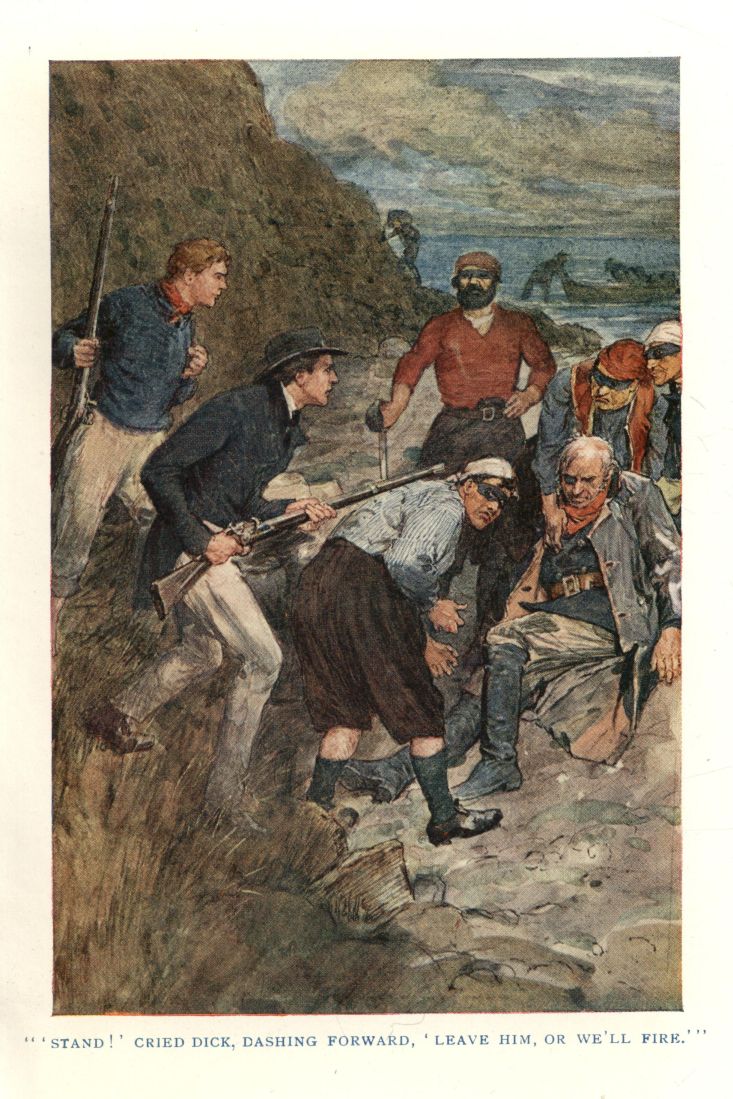
"'STAND!' CRIED DICK, DASHING FORWARD. 'LEAVE HIM, OR WE'LL FIRE.'"
A sudden silence fell upon the scene. The men who held Penwarden's arms stood aside; the others edged away, taken aback by this unexpected intervention; there had not been time for the tidesmen to arrive from the village. Dick and Sam stood over the exciseman, pointing their useless muskets at the crowd. For a moment there was absolute stillness; then one of the men murmured:
"'Tis young Maister Trevanion."
"Yes," cried Dick, "and I warn you that if any of you lays a hand on the old man again I will report you all to Sir Bevil. I know you, for all your black faces. There's Doubledick, and Tonkin, and——"
"Iss, 'tis I, and I don't care who knows it," interrupted Tonkin, pushing forward. "What 'nation call ha' you got to meddle, cuss you!"
"I don't meddle with your trade; it's nothing to me; but I won't see an old fellow killed by a pack of ruffians."
Tonkin cursed again, but some one drew him back and spoke to him in low tones. The fact that the interruption had come from the Squire's son was more daunting than the lads' muskets, which had no terror for armed men accustomed to contend with equal numbers. But the name of Trevanion, in spite of the fallen fortunes of the house, was still a moral power in the country-side, and, further, if any harm befell the Squire's heir, they could not escape a heavy retribution.
After a few moments' colloquy, a man came forward.
"Hark 'ee, sir," he said, and Dick recognised his voice as Doubledick's, in spite of an attempt to disguise it. "We take it hard as you've meddled wi' honest free-traders as never did 'ee no harm. As for old Joe, 'twas only a bit of fun—hee! hee!—he bean't for drownin'. What I says I says for all, and that is, we'll let 'ee take un away if you do give us yer sacred word not to gie our names to Sir Bevil or Mr. Mildmay,—them as you knows."
"I don't want to play informer," replied Dick. "I agree to that."
"Not a word to a soul?"
"No. I've said so."
"That's fair spoke," said the man, turning to the rest.
A murmur of approval broke from them. Dick at once lifted Penwarden, with Sam's help, from the pool of water in which he was lying. It was difficult to keep him on his feet, for he was as yet only partially conscious. Without either assistance or interference from the smugglers they led him slowly to the foot of the path, and, one on each side of him, began to carry, rather than walk, him up the cliff. One of the smugglers dogged them throughout the toilsome ascent. When they came to the place where the man had fallen, after a shrewd thrust from Penwarden's cutlass, they found that he had disappeared, having no doubt made his way homeward.
"Thank 'ee for this, Maister Dick," murmured Penwarden when they paused to rest at the cliff-top. "I'll have the law of those tidesmen for not comin' when they was called."
"No doubt they didn't see your light. And look here, Joe, I promised not to split on the men, so I want you to promise too."
"Daze me if I could split if I tried. I didn't see one of 'em plain, nor hear their voices, and I got this crack on the head afore I could tell one from t'other."
"Do it hurt much, maister?" asked Sam.
"More'n you'd care about, young Sam. But 'tis nawthin' at all to the cracks and wounds we got when we served wi' Lord Admiral Rodney. Have I telled 'ee what 'a said to me purticler one day on Plymouth Hoe?"
"Yes, yes," said Dick, quickly. "The sooner you are in bed the better."
They took him slowly to his cottage, where Dick put him to bed, gave him some brandy, and bathed his wounded head.
"You'll stop with him to-night, Sam," he said. "Don't leave him until Gammer Oliver comes in the morning."
"What'll 'ee say to Feyther, Maister Dick? I'm afeard he'll be in a terrible rage wi' poor me."
"I'll make that right. Now, lock the door when I've gone, and give Mr. Penwarden anything he wants during the night. I'll come over in the morning."
It was nearly two o'clock before Dick got to bed, and day was breaking before he slept. Meanwhile the smugglers finished their work unmolested, and before morning eighty tubs of good French spirits lay in the capacious cellars beneath the Dower House.
CHAPTER THE SEVENTH
The Breach Widens
Next morning John Trevanion, fresh and ruddy, dressed in white breeches and a blue coat with shining buttons, rode gaily down to the Five Pilchards and summoned Doubledick to the door.
"Well, you did the business, I see," he said jovially. "A small beginning: I wish my cellars held more."
"Iss, fay, a little small haul, to be sure; little and good. Hee! hee! But, Maister Trevanion, I've summat plaguey awk'ard to tell 'ee."
"What's that?" said Trevanion, with an uneasy look.
"Why, drown me if old Joe didn' come upon us, and, worse than that, when we'd cracked him on the head, who should come bouncing down-along but Squire's boy and young Sam Pollex, vowin' and swearin' they'd shoot us through the gizzard if we laid a finger on the old man."
"The deuce they did! and you knocked them on the head, of course?"
The look of uneasiness passed from Trevanion's face.
"Well, no, not 'zackly. 'Twas Squire's son, you see."
"What of that? You should have cracked their numskulls together and sent 'em home howling. Afraid of two boys! What did you do, may I ask?"
"Crackin' skulls is all very fine, but we didn' want a crowner's 'quest on young Squire. No, no, we don't want hangman's necklace chokin' the breath out of us. We let 'em take old Joe home-along, arter they'd give their Bible word to be mum as gravestones."
"Then you were a pack of fools. Don't you see the monkeys were spying on you? 'Twas they brought Joe, without a doubt, though I'd like to know how they got wind of the business."
"Well, if I didn' think it! ... Here's Zacky Tonkin. Maister Trevanion was sayin' as they two brats spied on us, Zacky."
"Not they, 'a b'lieve," said Tonkin, who had come up. "Young Squire said he'd no mind to meddle wi' the business, but was only a bit tender over old Joe."
"And you believe that!" said Trevanion, angrily flicking his riding-whip. "Make no mistake, the Squire has turned on you. I happen to know that Mildmay has been twice to the Towers of late; the Squire's as poor as a church mouse, and informer's pay will be riches to him."
"Squire turn informer!" cried Tonkin. "I can't believe it."
"I can, though," said Doubledick. "When a man's as low down in the world as Squire, he'll do a deal o' dirtiness to fill his purse, 'a b'lieve."
"Of course he will," said Trevanion. "You don't know the world, Tonkin. Depend upon it, a good many golden guineas will find their way to the Towers before a week's out."
Tonkin was an honest fellow, save in so far as the King's revenue was concerned, and had that simplicity of soul which is incredulous of trickery in others. He was not proof against the cunning suggestions of Trevanion. Naturally short-tempered and violent, he smote the flank of Trevanion's horse a blow that set it prancing, and cried with a savage oath:—
"Then I'll make 'em pay for 't, as sure as my name be Zack Tonkin. I will so."
"Hee! hee! That 'a will," said Doubledick, rubbing his hands. "They golden guineas 'll be a bad egg, to be sure."
Trevanion smiled. He had laid the train; he could trust his minions to fire it.
"Well, we'll speak no more of that," he said. "I'm riding to Truro: can you tell what for?"
"Not for more furnichy?" said Tonkin.
"Goin' a-courtin', hee! hee!" smirked Doubledick.
"No, no; I shan't trouble the parson yet awhile. I'm going to open the mines again, my men."
"Then I'm sorry for 'ee," said Tonkin bluntly. "Mines were worked out long ago."
"Maybe, maybe not. I'm going to try. I shall begin in quite a small way. I shan't fling my money into the earth as my cousin did. But I mean to try my luck, and within a week or two I shall have a few men at work."
"'Twill be good for the parish," said Doubledick. "The miners are drouthy souls, and have a proper taste for good sperits. Ay, sure, 'twill do us all good."
"You won't give up the trade, sir?" enquired Tonkin.
"Not I. The Polkerran men will do more than ever before. A fig for your Mildmays and Polwheles—Polwhele is still riding-officer, isn't he? My wits against them any day. We'll double our trade with Roscoff this winter."
"If Delarousse bean't nabbed," said Tonkin. "His game of privateerin' will souse him in hot water one o' these days."
"Oh! we can do without Delarousse. There's a man in Roscoff, no friend of his, who will deal with us better than he."
"It do maze me, Maister Trevanion," said Doubledick, "that arter bein' away all these years ye know so much about the trade."
"I keep my eyes open, that's all," replied Trevanion, with a laugh. "Well, I must be off. You can tell the neighbours about the mines. I'm glad to do something for the old village."
He rode away, giving smiling greetings to the people, men and women, whom he passed on the road.
"A fine feller!" said Doubledick, enthusiastically. "'Twill be heyday in village, Zacky; stirring life, and not so much of a tomb as 'tis since Squire became a pauper."
"But I'm sorry he do want us to break with Delarousse. He be a good trader, for a Frenchman. Howsomever, if there be a better, all the better for we, to be sure."
The men parted, to retail to their friends and neighbours the pleasing news of the great things John Trevanion was about to do for the village.
Roscoff, the place mentioned in the course of their conversation, was a little port in Brittany which had become the chief seat of the contraband trade with the south-west of England since a restrictive Act of Parliament had put a stop to it in the Channel Islands. The French Government had made it a free port to smugglers, and in a few years it had grown from a tiny fishing village to a thriving town. There were three classes of people engaged in the contraband trade. The freighters consigned or received the goods, and paid the expenses of their shipment. The boatmen conveyed them from port to port, always on moonless nights, and usually when a strong wind was blowing. The tub-carriers bore them to their destination. The boatmen received a fixed sum for each trip, the tub-carriers for each cargo run, and frequently in addition a portion of the goods, or a small share in the proceeds.
Until John Trevanion reappeared in Polkerran, Isaac Tonkin had been the principal freighter of the village, and was the owner and master of the lugger which plied between it and Roscoff. His dealings were chiefly with a certain Jean Delarousse, a ship-owner of Roscoff, who was notorious also as a daring seaman, and in his privateer vessel preyed on English shipping in the Channel between Poole and the Lizard. Delarousse had never come to Polkerran, but he was well known to Tonkin and the crew of his lugger, the Isaac and Jacob. Tonkin having little capital, the cargoes run at Polkerran were usually small, and were disposed of solely among the innkeepers, farmers, and gentry of the neighbourhood. Now that Trevanion had come home, the Polkerran folk expected great developments in the trade, and looked forward to an exciting and profitable winter. Apart from the monetary gain, the risks of smuggling exercised a fascination upon those engaged in it, providing the only excitement in their otherwise dull and monotonous lives. The fraud on the revenue weighed very lightly on their consciences. In their view they were entitled to the full value of the goods for which they had honestly paid, and the Government officials were thieves and tyrants. To best the Customs and Excise was both a business and a sport.
It was not long before the consequences of Dick's intervention on behalf of Joe Penwarden made themselves felt. Hitherto the smugglers had recognised the Trevanions of the Towers as rather for them than against them, but now, actuated by John Trevanion's malicious suggestion, they looked on them in a different light. For the first time a Trevanion had ranged himself on the side of the representatives of the law, and Tonkin, resenting what he regarded as defection, soon began to show that in threatening vengeance he meant to be as good as his word.
One morning Dick, going down with Sam to inspect the night lines he had set in the waters of Trevanion Bay, discovered with surprise and annoyance that they had been cut. A day or two afterwards they found their boat, which they had drawn up as usual above high-water mark, bumping among the rocks half a mile up the coast. They did not report these occurrences, hoping that they were nothing but a mark of temporary ill-feeling and would soon cease. But when for the third time their lines were tampered with, Dick became seriously concerned. The fish they caught were a very important part of the provisions for the household. What was not required at once was salted and dried for consumption when fishing was over for the season. Without these constant supplies they would have to draw more largely on their pigs and poultry, which they were accustomed to sell. Dick was unwilling to impart his troubles to any one, and for several nights he and Sam kept watch, hoping that if the culprits were caught in the act, the fear of exposure would put a stop to their mischief. On three nights nothing happened: and yet, on the first night when they left the lines unguarded, the same fate befell them.
"This is more than I can bear," cried Dick, in the morning. "I shall tell Petherick."
Petherick was the village constable, who filled also the offices of sexton, bell-ringer, and beadle in the parish church.
"Bless 'ee, you'll waste yer breath," said Sam. "Old Petherick be a crony o' Tonkin, and wouldn' lift a finger against him, without it were murder or arson: and then he'd have to get the sojers to help him. Why, 'tis said he've let 'em keep the tubs in church-tower sometimes when the preventives have been smellin' too close."
"Well, we must put a stop to it somehow. I'll tell Joe, and see what he has to say."
Later in the day he went into the village to buy some new fishing tackle at a general-shop, where the folk could buy tea, sugar, cheese, needles, thread, letter-paper, bootlaces—in short, every small article they needed. On his return, he heard a hubbub proceeding from the village green, where wrestling-bouts, games of quoits, dog-fights, and other sports took place. In the midst was a duck-pond. Bending his steps thither to see what was going on, he beheld Sam with his back against a tree, sturdily defending himself with fists and feet against a crowd of the village lads, among whom the hulking form of Jake Tonkin was conspicuous.
"Heave un in duck-pond," he heard Jake cry.
"You'd better!" he shouted, rushing forward to assist his companion.
The crowd fell back as he forced his way through it, bowling one fellow over like a ninepin, and driving another out of his path with a shove that nearly sent him into the pond. It is probable that his energy, and the prestige attached to him as the Squire's son, would have put an end to the affair; but it chanced that John Trevanion rode by at this moment, and reining up his horse, contrived in some subtle manner to indicate that his sympathy was with the larger party. Only this could explain the sudden change in their attitude. They closed round Dick and Sam with derisive yells.
"Gie un both a duckin'," shouted one, and they made a sudden concerted rush, trying to seize the two boys.
Dick, never having been to school, had never had occasion or opportunity to learn the noble art; but his muscles were in good condition, and the obvious necessity was to make full use of them. Standing beside Sam against the tree, he hit out against any head, trunk, or shoulder that came within reach, Sam making good play as before with feet as well as arms. One young fisher retired with a crimson nose, another with a bump over one eye, a third shouting that his leg was broken. All the time John Trevanion sat his horse, smiling, and flinging out now and then an encouraging word, which might have been intended for either side, but was appropriated by Tonkin's crew.
Courage and the best will in the world cannot prevail over a triple excess of numbers. The fisher-lads were still six when their wounded comrades had retired to the rear. Led by Jake Tonkin they hurled themselves upon the two defenders. For a few minutes there was a brisk scrimmage; many good blows were given and exchanged; then Dick and Sam fell, to be immediately pounced on by the victors, who caught them by legs and arms and began to drag them down to the pond.
They were within a yard of the brink when a loud voice thundered a command to halt, and a riding-whip cracked and curled its thong round the legs and backs of the aggressors. With howls of pain they released their victims and fled across the green. Rising, bruised and muddy, from the ground, the two boys saw Mr. Polwhele, the riding-officer, close by on horseback, his face flushed and stern-set with anger.
"You look on and do nothing!" he said indignantly to John Trevanion.
"My dear sir, why should I interfere? Boys must fight, let them fight it out."
"Three to one—is that your idea of fair play?"
Trevanion shrugged.
"Hadn't you better reserve your whip for stimulating your tidesmen, Mr. Polwhele? They need a little spiriting, if what I hear is true."
And with that as a parting shot Trevanion rode away.
"What was the origin of this?" asked Mr. Polwhele. "I'm sorry to see it, Master Trevanion."
"'Twas like this, sir," said Sam, rubbing his head and legs alternately. "I comed upon they chaps, and Jake Tonkin says to me, 'Catched any fish lately, young Sam?' Says I, ''Tis easier to cut lines, to be sure,' says I, and then they set on me, and they'd ha' melled and mashed me if Maister Dick hadn't come up."
"Have they been cutting your lines, then?"
Dick saw no help for it but to acquaint the riding-officer with the petty persecution he had lately suffered, and the cause of it, which hitherto Mr. Polwhele had not known.
"'Tis rascally, 'pon my soul it is," said the officer, "and I'm sorry Penwarden has brought it on ye. Not but 'twas your own doing, Master Dick; you'd better have kept out of it, though I own 'twas a good deed to old Joe. I'm on my way to see Sir Bevil, and I'll tell him as a magistrate, and he'll engage to commit any ruffian that molests ye."
"Not on my account, if you please, Mr. Polwhele," said Dick earnestly. "There's bad blood between the Towers and the village as it is, and 'twill be ten times worse if Sir Bevil comes into it."
"Maybe you're in the right. Well, I'll see you safe home, and if I may advise ye, keep out of the way o' the village folk. You're not friends with Mr. Trevanion seemingly. Is he backing the smugglers, d'ye know?"
"I can't say anything about that. My father has nothing to do with him."
"Well, well, these family quarrels are common enough. Come along beside me."
Nothing could have been more unfortunate than the intervention of the riding-officer. Purely accidental as it was, the villagers regarded it as another proof of the new alliance between the Towers and the enemy. John Trevanion did not fail to describe to the elder Tonkin, the next time he met him, how savagely Mr. Polwhele had laid his whip upon Jake, and the irate smuggler swore that if he encountered the riding-officer he would make him pay for it.
That evening Dick consulted Joe Penwarden on the situation, as he had intended. Joe was much distressed to think that he was the cause of the bitterness with which the village folk now regarded the family at the Towers.
"I don't know what you can do," said he. "But let things bide; maybe they'll see by long and late they've misread 'ee."
"But we can't have our fishing spoilt time after time, Joe."
"'Tis a pretty stoor, be dazed to it!" said Joe, angrily. "And all for a wambling old carcase like me! Ah! I warn't allus like as I be now. When Lord Admiral Rodney spoke to me on Plymouth Hoe I was as limber a young feller as you'd see in Devon or Cornwall. He was goin' along with two handsome females——but there, I think I've telled 'ee. What I say is, why did Maister John come home, cuss him? There was none o' this afore."
"I don't think that's fair, Joe. They'd have run a cargo all the same, if he were at the ends of the earth; and I couldn't have done differently."
"Ye may say so, but I hold to it, whatever ye say. He's ill-wished 'ee, that's the truth, and a pity it is he ever showed his face here."
Two evenings later, when Dick was struggling with a piece of Latin prose for Mr. Carlyon, there was a knock at the outer door, and Reuben admitted Penwarden, with Jake Tonkin firmly in his clutch.
"Axe Squire if I can have speech with him, Reuby," he said.
Mr. Trevanion came out into the hall.
"Well, what's this, Joe?" he asked.
"I catched this young reptile a-meddlin' wi' Maister Dick's lines, Squire," said Penwarden, "so I brought him up to be dealt with according to law."
"Meddling with his lines, indeed!" cried the Squire in surprise. "Why should he do that? What have you to say for yourself, rascal?"
Jake had nothing to say for himself, but stood with a sullen glower upon his face.
"'Tis not the first time either, Squire, and I be mazed as you didn' know it," Penwarden continued.
"I knew nothing about it. Dick," he called into the room, "come here."
Dick obeyed reluctantly.
"Penwarden tells me," said his father, "that your lines have been tampered with. Is that true?"
"Yes, sir."
"How often?"
"Three or four times within a week or so."
"Why did you not tell me?"
"I didn't want to bother you, sir."
"But this is new; it shows a hostile spirit——. Well, I'll say no more now. As for you, you young scoundrel, I'm not a justice, or I'd commit you. You shall take your choice; a sound flogging, or haled before Sir Bevil: that will mean three months in Truro jail. Which is it to be?"
"I don't want to see Sir Bevil," said Jake, sullenly.
"Strip off your coat, then. Reuben, bring my whip."
Dick went away: he could not remain to see the lad thrashed.
"Now, Reuben, half a dozen lashes," said the Squire when his man returned. "No; I'll do it myself. Stoop!"
Dick pressed his fingers into his ears when at the third or fourth stroke Jake began to howl. The Squire gave him full measure; then bade him begone, and take care not to offend again, declaring that he should not get off so easily next time.
"Now, Dick," he said, returning to the room, "what is the meaning of all this?"
Thereupon Dick made a clean breast of it, telling all that had happened since the rescue of Penwarden. The Squire's face clouded as he listened to the story.
"John Trevanion is at the bottom of this," he cried, thumping the table. "They would never believe I was against them unless their minds had been poisoned. I will see Tonkin to-morrow and get at the truth." Then, with one of the swift changes of mood characteristic of him, he added: "No, I won't do it. I won't gratify that cur; he shall never think I care a snap for him. Tell me if anything of the kind happens again, and I will myself go over to see Sir Bevil. On my life, the toad shall smart if he is proved to be stirring folk against me."
Every succeeding incident in this series did but confirm the village folk in their conviction that the Squire was now their declared enemy, and in staunch alliance with the revenue officers.
CHAPTER THE EIGHTH
A Light on the Moor
Next day everybody in Polkerran knew of Jake Tonkin's thrashing. It was discussed by the men in tap-rooms, on the jetty, in barns and piggeries, in mills and cobblers' work-rooms. Fishwives chattered about it on their doorsteps and at their windows. Boys meeting their playmates asked if they had heard that Jake Tonkin had been walloped by Squire, and Jake, as the victim of two assaults of this nature in succession, was looked upon as something of a hero. Public opinion was dead against the Squire, and was perhaps only the stronger because it was in the wrong.
It was clear that John Trevanion intended to make himself as unpleasant as possible to his relative. In the afternoon a number of men were seen mounting the steep road from the village to the cliff, drawing trolleys laden with short narrow planks of wood. On reaching the green level they proceeded to erect fences on the ground that had formerly been the Squire's, and was now John Trevanion's. By the end of the next day a large portion of the land was enclosed, the effect of these operations being that the inmates of the Towers were cramped in their movements out of doors, being restricted to the high road and the various rights of way, which even the landlord could not close against them.
Sam Pollex hoped that the Squire would retaliate. The Beal, from which the huer was accustomed to show his signals to the pilchard fishers, was still Mr. Trevanion's property, and he could, if he chose, fence it round in the same way. But there was nothing petty in the Squire's nature. He was not the man to take a mean revenge on his neighbours, so that when a fisher reported one evening that he had seen sharks and grampuses some distance out at sea, a sure sign that the pilchards were coming, the villagers went to bed without any fear that access would be forbidden to the usual haunt.
Just before dawn next morning, Nathan Pendry, father of John Trevanion's portmanteau carrier, the most experienced fisher in the village, took his stand at the extremity of the Beal, carrying his bush. Seaward, the sky was gloomy; in the east a pale orange and pink glow on the horizon announced the rising sun. The air was very still, only the slow ripples washing the sand at the foot of the cliff breaking the silence. In the fairway lay three boats, the largest of them a smack of eight tons burden, manned by six oarsmen, together with Tonkin and a fisher nearly as large as he. These men and the occupants of the other boats sat without speaking, their eyes fixed on the huer above. He stood motionless, gazing intently on the surface of the sea. Beyond the promontory the village was as yet asleep; one man stood solitary at the end of the jetty.
Suddenly the huer bent forward, in an attitude of intense expectancy. A few minutes passed; then lifting himself he waved his bush aloft. His experienced eyes had detected a shadow in the water, moving across the bay in a direction parallel with the shore. Instantly the men in the first boat fell to their oars, and Tonkin, standing up in the stern, and making a trumpet of his hands, shouted, "Havar! havar!" towards the single figure on the jetty. This man repeated the cry; it was taken up in the village; and soon from every street and lane a crowd of men, women, and children poured up towards the cliffs, dressing themselves as they ran, and shouting, "Havar! havar! Yo-hoy, hoy, hoy!"
Meanwhile the rowers were tugging at their oars with all their might, Ike Pendry, who was rowing bow, having his eyes fixed on his father, and directing the steersman in accordance with the movements of the bush. The ground behind the huer was now thronged with spectators, no longer shouting, but watching Pendry and the boatmen in tense silence. All at once the huer dropped his bush; the rowers shipped oars; and Tonkin and his mate grasped a long net, which had lain folded ready to their hands, and with a few deft movements shot it overboard.
"Yo-hoy, yo-hoy!" broke from every throat. Then the crowd relapsed into silence, watching the further proceedings in the bay.
The "seine net," as it was called, was a quarter of a mile long and sixteen fathoms broad at the middle. It was fastened on each side to two stout double ropes, and at each corner to four strong warps about fifty fathoms long. Corks were fixed to the upper edge, and leaden weights to the lower. When it was "shot," the corks buoyed up one end to the surface of the water, the leads sank the other perpendicularly to the bottom. The boat meanwhile was rowed round the shoal, following the directions of the huer, until, the two extremities being made fast, the fish were imprisoned in an oblong barrier of network. As Tonkin straightened his back after completing his part of the work, another shout rent the air, and the huer, his task also accomplished, broke through the dignified calm which had hitherto distinguished him, and waved his cap triumphantly.
Now came the turn of the "tuck-boat," one of those that had remained as yet in the fairway. It was rowed within the area enclosed by the seine, and laid close to the seine-boat, to the bows of which one end of a smaller net, called the "tuck," was fastened by a rope. The boat then slowly made the inner circuit of the seine, the tuck being paid out and deftly hooked at intervals to the larger net. Meanwhile the men in the third boat beat the water with their oars, so as to scare the fish into the middle of the enclosure.
Now came the most exciting moment of the day. The cliff-top all round the bay was dark with spectators. Small boys, eager to get in front, dodged and shoved among the legs and skirts of their elders. The village blacksmith was there; cobblers with bent backs and leather aprons; tinkers, tailors, wheelwrights, carpenters, ploughmen, dairymaids, old men with sticks and crutches, old women who could scarcely totter, mothers with babies in their arms: all were agog with excitement to see the final act. Sam Pollex was there, and when he caught sight of the parlourmaid of the Dower House he sidled up to her elbow, listened with delight to her exclamations of "My gracious!" "Look 'ee see, now!" "Lawk-a-massy me!" and by-and-by ventured to instruct her ignorance of the movements passing below.
With the shouts of the boys were now mingled the deeper tones of the seiners as, ranged in a row in their boat, they began to haul on the tuck, calling "Yo, heave ho!" in time with their rhythmic movements. "Pull away, boys!" shouts the huer; "Yo-hoy!" scream the boys. "Up she comes! Look at 'em! Look at 'em!" The water eddies like a mill-race; in the midst is seen a heaving mass of gleaming scales; and from round the point come boats of all sizes, which range themselves in a circle about the shoal. Men lean over the sides, dip their baskets, lift them full of shining fish, empty them into the boats, and dip them again for more. Soon they stand ankle deep in pilchards, and when the boats sink to the gunwales, they are rowed away to the jetty, where men are waiting with shovels and barrows, ready to carry the fish to the salting-house.
Dick Trevanion was among the spectators. He never missed the first haul of the season. But to-day he was acutely conscious of a change. Last year the villagers had greeted him with smiles and cheery words; to-day they lowered their eyes, passed him in silence, and edged away from him as he moved from place to place. He could not but feel bitterly his isolation. Why did they so misjudge him? He had not changed: he knew well that, in any ordinary contest between the smugglers and the revenue officers, his sympathy would have been with the former; friendly as he was with Mr. Mildmay, he would enjoy nothing better than that gentleman's discomfiture, if it were due to fair means and the villagers' wits. Yet, because he had intervened to prevent harm to an old man, he was now regarded by the villagers as their enemy, one who would descend to play the mean part of spy and informer.
With gloomy face he turned away and walked back along the promontory. At the end he met Mr. Carlyon, who had just ridden up on his cob. The parson's ruddy face was suffused with cheerfulness; he knew by the jubilant shouts of the crowd that the catch was a good one, and rejoiced that his parishioners were winning from the deep their means of subsistence for the winter. He marked Dick's clouded face, and, guessing the occasion of it, he tried to cheer him.
"Come, Dick," he said genially, "cheer up, my lad; this haul will put the folk in a good temper, and they will forget their grudge against you."
"I hope they will, sir," replied Dick, "but there's one man who'll try to keep them in mind of it."
"You mean your cousin?"
"Yes."
"But surely he'll not be such a cur. He's a scoundrel—there now, what am I saying? I'll tackle him, my boy. Why, bless my soul, he was in church on Sunday, and my text was 'Love your neighbour as yourself.' I'll ride there now, and get him to give me some breakfast—though I detest the fellow," he added in one of his unconscious asides.
"He is away from home, I believe," said Dick.
"Well, then, I'll put it off till another day, but tackle him I will. I've a bit of news, Dick. The carrier brought me some books last night; that's not the news, though. No. You have heard, maybe, of a Frenchman named Delarousse?"
He looked slyly at Dick; everyone in Polkerran knew the name of the Frenchman with whom the smugglers had such close dealings.
"As a natural enemy of our country I don't pity him," pursued the parson, "but as a—h'm—an honest free-trader I own I feel for him. His privateer was badly knocked about in the Channel by a revenue cruiser a week or two ago, and while she was being repaired, it appears that he tried to run a cargo at Polperro. As ill-luck would have it—dear me! I wonder if I ought to have said that," he added under his breath—"he ran into the arms of the revenue people; they seized his lugger and carried him to Plymouth, where he'll cool his heels for a time until they put him among the other French prisoners on Dartmoor."
"Do they know it in the village yet, sir?"
"Probably not; the carrier was going straight on to Newquay; he had nothing for us except my books. But you may be sure the folk will soon know all about it. The carrier had a glass of brandy with Petherick, and Petherick, as you know, is the biggest gossip in the parish. His brandy is better than mine, the dog! I must ask him where he gets it."
Dick could not help smiling at the parson's unconscious self-revelation.
"That's right; you're feeling better, I see," said Mr. Carlyon cheerily. "Now I'll go on and bespeak my basket. Pilchards of the first catch are the daintiest dish I know. 'Tis a holiday to-day, but I shall see you to-morrow. Good-bye."
He rode on. Dick turned to watch him, and saw Sam Pollex walking beside the maid-servant of the Dower House. When Sam observed his young master he left the girl and came sheepishly towards him.
"I've been tellin' to she the hows and whys of it, Maister Dick," said he.
"Indeed."
"Iss, I have. Bein' a furriner, she be 'mazin simple for such a well-growed female. She axed me why I never brought no more eggs."
"And what did you say?"
"Well, not likin' to hurt her feelings, I telled her our hens be uncommon idle lately, and she said she knows they do have fits that way sometimes. Maister John's gone to Lunnon, to buy things for his mine."
"I wish he'd stay there."
"Her name be Susan."
"Quite a common name."
"She's as nice a female as ever I've seed."
The pilchard fishing was for several days so engrossing an occupation that the villagers had no time for fostering their grievance against the Towers. Dick and Sam, who had formerly been in the thick of it, sometimes as spectators merely, occasionally as participators, kept away, and spent the greater part of their time in fishing quietly some few miles up the coast. One day Dick reverted to the project of hunting seals, which he had temporarily abandoned, partly through the diversion afforded by the discovery of the well, partly because he did not care to kill the parent seals while their offspring were so young. Now, however, the prospect of sport, and the practical wish to obtain a sealskin for his mother, made him resolve to try his luck in the cave, and he laid his plans in consultation with the ever-ready Sam.
He guessed that the seals left the cave at low tide to find food in the deep, and returned when the sea flowed in. Since the cave was at such times inaccessible from the sea, he decided that it must be approached from the well, of which neither he nor Sam had now any remaining dread. One evening they sallied towards it, carrying a well-made rope-ladder, a musket apiece, a large hammer, and several torches, which would give more light than the ancient candle-lantern they had formerly carried. To one end of the rope-ladder they had attached a series of stout meat-hooks borrowed from old Reuben: they could more confidently trust their safety to a number of teeth gripping the rock than to the single fluke of their small boat anchor. They had timed their start so that they would reach the cave just as the tide turned.
It was a dull, murky evening, with a touch of autumn rawness in the air. Twilight had not quite merged into darkness when they arrived at the ruined chapel at the well-head. They looked warily around to make sure that their presence was not observed, then prepared to descend.
"'Tis rayther fearsome," murmured Sam, as he looked into the black shaft. Now that he was on the spot, the tradition of ghostliness in which he had been brought up revived something of his former fears.
"Nonsense," said Dick, "we have laid the ghost for ever, Sam. I will go down first. Don't follow until I come to the door. I will whistle for you. When you hear me, fling down the ladder and the hammer. At a second whistle, come yourself."
Sticking a lighted candle-end into his hatband, and slinging the musket over his shoulder, he stepped backward into the well, and began the descent. He found the successive staples entirely by the sense of touch, the candle throwing a deep shadow below him. At first he felt a little nervous, but gathered confidence after a few steps, and made the latter part of the descent very quickly.
Sam, waiting above, heard a whistle, curiously prolonged by its reverberations from the walls. He threw down the hammer, and gave an involuntary start when he heard it thud upon the bottom. The ladder followed, and the unkindled torches; then, without lighting a candle for his own hat, he stepped over the brink, muttering to himself:
"S'pose I fall! But I won't. S'pose I do though. But Maister Dick didn't. S'pose I do. Well, if 'tis to be, 'tis, so I med as well go cheerful."
In reality he descended more quickly than Dick had done. They gathered up their burdens, and made their way by the light of Dick's candle along the passage until they came to the ledge overlooking the cave.
Here they stopped and peered over. The tide was rather lower than they had expected. Their eyes ranged the cave for a time without discovering any sign of the seals. Then Dick lit a torch, and holding it over the dark space beneath, he suddenly saw two orbs of light, like the eyes of a monstrous cat, in a far corner to the right of him. Moving along the ledge in that direction, he descried two seals, greyish in colour, and much larger than he had supposed them to be, lying on a rock, with the two young ones between them.
"We will only kill one, Sam," he whispered, "and I hope 'twill be the father."
The seals were apparently fascinated by the glare of the torch, for they made no movement, their eight eyes glowing like balls of fire. In order to obtain more light upon his task, Dick kindled two more torches, and stuck all three into crevices of rock in such a way that they illuminated the whole corner of the cave where the seals lay. But now the animals had caught sight of him, and as if instinctively realising that the intruder was an enemy, they scrambled with clumsy movements off the rocks into the water.
"They be goin' out to sea, scrounch 'em!" whispered Sam, whose attitude to all prospective victims was an indignant surprise that they did not wait meekly for their doom.
But the seals, after swimming a yard or two, took up their position behind a larger boulder, above which the tops of their sleek, massive heads could just be seen.
"We shall have to go down to them, Sam," said Dick.
"They be great big creatures," said Sam dubiously. "Wi' those terrible big flappers they could smite us flat as flounders."
"You had better take the hammer in case I miss and they attack us. We must at any rate prevent one of them from getting away."
They retreated to the further end of the ledge, to which the light of their torches scarcely reached, and carefully hooked the ladder to the jagged rock. Then in perfect silence they descended. The water only came to their knees. Wading through it with scarcely more noise than an otter might have made, they drew gradually nearer to the rock behind which the seals had sheltered. Here they found themselves baulked. The rock was close to the wall, and it was impossible to get a shot at the animals without circumventing it, which appeared to Dick a dangerous movement. The surprising quickness with which the seals had shuffled off their former perch showed that, if a shot failed, they might fling their heavy bodies upon the assailants before they could escape. He was considering what to do, when a movement among the seals forced him to act on the instant. The largest of the creatures heaved itself to the top of the rock, and lay there as if on the watch for the enemy, presenting the side of its head to Dick. He raised his musket, a firelock of ancient type, and fired. The reverberations in the hollow vault were broken in upon by a hoarse roar, and through the cloud of smoke the seal slid over the rock into the water, and came swimming towards the two boys. Dick seized Sam's musket, preparing to fire again; his first shot had only enraged the animal. But before he could raise the weapon, the seal threw itself out of the water, and he had just time to spring aside and evade its onset. As it passed, its flipper struck the musket from his grasp, and it fell with a splash into the water.
Sam, for all his fear of ghosts, was brave enough before a real enemy. He was standing a yard or two in Dick's rear. As the seal plunged heavily into the sea, Sam brought the hammer down with all his force upon the creature's head. There was one tremendous convulsion of the water, then the seal's movements ceased and it sank to the bottom.
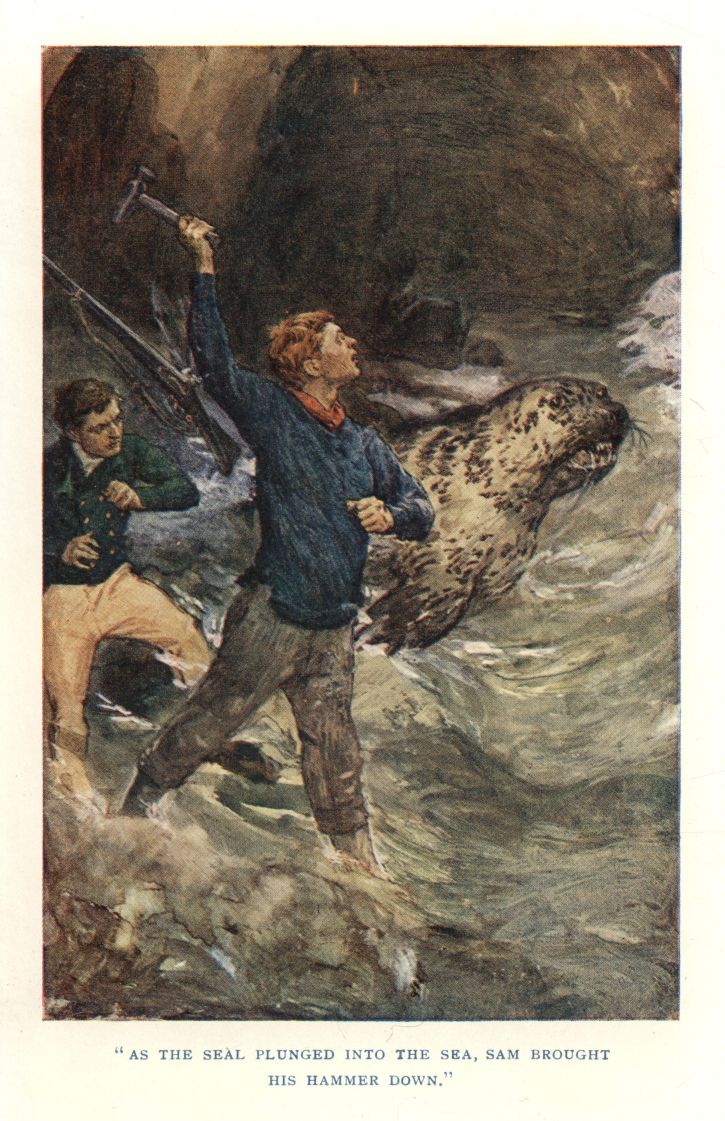
"AS THE SEAL PLUNGED INTO THE SEA, SAM BROUGHT HIS HAMMER DOWN."
Meanwhile, the other animals, scared by the noise, had flung themselves into the water, and were swimming towards the mouth of the tunnel.
"Well done, young Sam!" said Dick. "You did that famously."
"So I did, to be sure," replied Sam, "but I couldn' help it. You shot un, Maister Dick; see his blood."
There was a red tinge upon the water.
"How are we to get him up?" said Dick. "He's a monstrous big fellow."
"We'll wait till tide is down and skin him here. Be his body good to eat?"
"That I don't know; we can try. But the skin is the valuable part of him, and having that we may leave the rest."
In two hours the receding tide had left the dead seal on the sand. The boys took out their knives, and, expert in such work, in another half-hour had removed the skin. Their torches were by this time burning low, so they clambered up to the ledge, and carried their implements and booty as quickly as possible through the adit to the foot of the well, and then up to the surface.
Vastly pleased with the success of their expedition they set off towards home. The night was very dark, and a thin rain was falling, which increased as they proceeded, until it became a steady downpour. They were tired; their burdens, light enough when they started from home, now seemed to be pounds heavier; the rain beat full in their faces, finding out every crevice between their clothes and their skin; and the ground was rough, covered here with tussocks of grass that squelched under their tread, there with fragments of mining gear which threatened to trip them up. They trudged on in silence, feeling the loneliness and the inclemency of the weather the more keenly because it ensued upon the high excitement of their adventure.
As they struck into the path leading by Penwarden's cottage, Sam suddenly declared that he saw a flicker of light to their left, some distance across the moor.
"I can't see it," said Dick, scarcely looking in the direction indicated, "and it doesn't matter to us. I'm tired; this skin is heavy; I want to get home."
"'Tis moving," said Sam a moment later. "Maybe 'tis Maister John comin' back from Lunnon."
"He wouldn't come that way. I see it now; 'tis some belated traveller, no doubt."
"But the light bean't on the road; 'tis too far away."
"Never mind about the light," Dick replied, testily. "Come along."
They soon came to one of John Trevanion's new fences, which compelled them to leave the path and seek the high road. In his moody frame of mind Dick resented this bitterly. They now perceived that the light, spread starwise by the rain, was much nearer to them, and presently heard the creaking of wheels and the dull thud of horses' hoofs on the turf. A minute after they had struck the road a closed travelling carriage, drawn by two horses, turned into it from a byway, scarcely more than a bridle path. On the right of the driver there was a single lamp. Catching sight of the two figures on the road, bending forward under their loads, the driver hailed them and pulled up his horses beside them.