Front matter (continued 4)
Reading edition
"Nor for shipping him," said Mr. Mildmay. "I'll swear they haven't done it yet. My boats were up and down the coast all last night. One of them spied that rascally privateer putting in towards St. Cuby's Cove in the mist this morning, but she sailed away, and though I gave chase, she got off. To-night we'll have the boats patrolling for miles; I defy 'em to slip through us."
"When did they seize him, d'you suppose?" asked the Squire.
"In the early morning, I think, Father," said Dick, "before it was light. The blood stain was quite fresh. They must have hidden him somewhere; they wouldn't carry him away in the daylight, in case some one saw them."
"That wouldn't trouble them, bless you," said Mr. Mildmay. "All Polkerran and most of the folk around are hand-in-glove with them. They could count on the silence of everybody but a few ranters and psalm-singers, who would either be abed and asleep, or going about their business."
"I don't agree with you, Mildmay," said the Squire. "They would have to pass this house on the way to the village, and they know very well that Dick and young Sam are early birds; they wouldn't risk meeting them. No; 'twas done in the dark, depend on it."
"That might be if they took him to the village, but we don't know that," retorted Mr. Mildmay. "No doubt there are any number of underground cellars and secret passages in the village: 'twas in some such place that fellow Delarousse was hidden while the dragoons were searching the inn, you may be sure. But those are not the only possible hiding-places. What with nooks, caves, and adits in the abandoned mines, we might search for a month of Sundays and not find the poor fellow."
"But they won't hold him long, surely," said Dick. "What a trouble it would be to guard him and feed him!"
"True; they would expect to be able to ship him soon. If they are planning a run, and find we're too watchful for them, I'll be bound they'll let him loose before long, and we'll find him one fine morning back again."
"Dick speaks of guarding and feeding," said Mr. Carlyon. "May not that give us a clue? It seems probable, as Mr. Mildmay suggests, that he is not in the village. If he is elsewhere, somebody must leave the village to carry food to him, and a vigilant watch would detect the fellow."
"Bless my life, parson," said Mr. Polwhele, "you don't know these rascals. They're as wary as otters and as slippery as eels. I'll warrant they'd slip us in broad daylight, and as to the darkness of night, why, a regiment of soldiers wouldn't be large enough to net 'em."
"Well, to be practical," said the Squire. "You, Vicar, as a justice, can give Mr. Polwhele a warrant of search. You may unearth him in the village, and I should begin with the inn; Doubledick's name suits him. With the coast closely watched by Mr. Mildmay's men, the kidnappers cannot ship him. Sir Bevil will raise the hue and cry in the neighbourhood inland, and 'tis such a serious matter that I doubt whether any of the yeomen would connive at it. The name of habeas corpus would scare them out of their wits. I'm inclined to think with Mr. Mildmay that the rascals will let him loose in a day or two when they see what a stir they have made; but of course we must not rely on that, but do our best to ferret him out."
"Very well summed up, Squire," said the Vicar. "We cannot do more to-night; and, as 'tis not late, perhaps you and these gentlemen would favour me with a rubber. Polwhele trumped my trick last time," he added, under his breath.
"With all my heart," cried the Squire. "Dick, bring the cards, and ask Reuben to fry some pilchards. All work and no play, Mr. Mildmay, you know——"
The gentlemen were nothing loth to spend an hour or two in this way. They had supper at eight; the officers then left to attend to their nocturnal duties; and as Mr. Carlyon remained to play piquet with the Squire, Dick went to bed early, resolving to take some independent steps in the morning.
CHAPTER THE THIRTEENTH
Cross-Currents
Polkerran next day was the stage upon which a series of dramatic incidents were enacted, pure comedy to the spectators, but with a possible tragedy behind the scenes.
At an early hour a mob of boys and girls, with a sprinkling of aged folk verging on second childhood, followed at the heels of Petherick, the constable, as he shambled through the streets, stopping at the corners to ring his bell, shout "Oyez! Oyez!" and mumble the formal words of Mr. Carlyon's proclamation. He pretended to read them from the sheet of double foolscap that he held at arm's length before him, but being perfectly illiterate, he in reality recited them by heart, the Vicar having devoted two solid hours since dawn in drumming them into the man's head. His duty thus religiously performed, Petherick repaired to the tap-room of the Five Pilchards, where he discoursed for a time on habeas corpus, felo de se, and other magical prescriptions, relieving his dryness so frequently with rum-hot that he was at length overcome with emotion, and mingled his liquor with his tears.
Two hours later, Sir Bevil Portharvan rode down with Mr. John Trevanion, a brother magistrate, and a sheriff's officer from Truro, intending to harangue the populace and impress them with the majesty and terror of the law. But finding that no audience gathered about him except the young and old children aforesaid, a few pallid indoor workmen, and a number of women accompanied by squalling infants in arms—the able-bodied men being, curiously enough, otherwise engaged—he abandoned that part of the programme, and contented himself with solemnly superintending the affixing to the inn-door of a bill, headed with the royal arms, which he had ordered overnight to be printed in Truro.
At noon came Mr. Mildmay, Mr. Polwhele, a posse of excisemen, and a soldier on furlough, who, with the authority of a warrant signed by the Vicar, proceeded to make a thorough search of the houses, beginning with the inn itself. They descended to the cellars, ascended to the lofts; rummaged in clothes presses; turned down beds; rapped at walls for hollow sounds indicating secret passages or receptacles; peeped into horse-troughs, cow-byres, and pigsties; poked in coppers and washtubs; in short, worked themselves into a fine perspiring heat and the village folk into an itching frenzy by the conscientious thoroughness of their inquisition. Some of the men who had been undiscoverable by Sir Bevil were now energetically employed, in advance of the search party, in removing bales, kegs, packets, and canisters, so that when Mr. Mildmay appeared at one end of a street, these interesting objects were collected at the other; and when this end in turn was visited, the barefooted carriers of the articles in question slipped back and replaced them in their former hiding-places.
While Mr. Mildmay and his assistants, after three hours' unremitting toil, stood mopping their brows and venting their honest opinion of the Polkerran folk, John Trevanion rode down the hill. He reined up when he reached the group, and greeted the discomfited representatives of the law.
"How d'ye do, gentlemen?" he cried. "Have you had any success?"
"Confusion seize 'em, Mr. Trevanion!" replied the lieutenant. "We've not seen a sign of the old man, nor discovered a single cask or bundle of contraband. You'd think 'twas the most innocent, duty-paying village in the three kingdoms."
"That's most unfortunate. As to the contraband—well, you know, we all like to get our goods as cheap as we may, I don't disguise it; but old Penwarden is another story. Have you no notion where he is?"
"No more than you, Mr. Trevanion," said the riding-officer, throwing a keen glance on the horseman.
"Then you must be blank indeed," said Trevanion with an easy laugh. "'Tis my belief there's a great deal too much fuss made about old Joe's disappearance. Surely nobody in Polkerran would wish to injure so ancient an institution. 'Tis a prank, depend upon it, and when the prankers have achieved their object—you and I can guess what that is—they'll let him loose as sound as a bell."
Trevanion's debonair frankness disarmed Mr. Mildmay, to whom he was a comparative stranger. It seemed ridiculous that the Squire should harbour such unworthy suspicions of his cousin.
"By the way," continued Trevanion, "I am glad I met you. I am having a few friends in on Saturday night—a bit of a randy; that's our name for it here—and I shall be delighted if you will join us. I haven't seen so much of you as I should like; this mine I'm starting has kept me busy."
"I'm much obliged to you," said Mr. Mildmay, "but I fear——"
"Oh, I know what you would say. But your cutter can spare you for an hour or two. Not for the world would I hinder your duties; to catch that villain Delarousse in particular would be worth a good deal to you; but 'tis dark early; the hour fixed is six; and I won't say a word if you must leave us before we are ripe."
"Well, I will come. Thank you."
"And you too, Mr. Polwhele? The service of your country can spare you for a little while?"
"To be sure. I'll come too, Mr. Trevanion; 'twill be like old times, indeed."
The riding-officer's assent was much more hearty than Mr. Mildmay's, which was perhaps a little surprising in view of the suspicions he had confessed to on the previous day in speaking to Dick.
"That's right," said Trevanion. "I shall be glad to welcome you. The hour is six—did I name it? I hope Penwarden will be found by that time; you'll feel easier, I dare say. Good-bye, then."
When he had ridden away, Mr. Mildmay dismissed the underlings and went off to have a meal with the riding-officer.
"That fellow's too free-and-easy to be the villain the Squire thinks him," said Mr. Mildmay, as they walked southward out of the village.
Mr. Polwhele smiled.
"I'm beginning to think he's the cleverest free-trader the duchy ever bred," he remarked.
"My dear fellow!" expostulated the lieutenant.
"I had my suspicions; this invitation has convinced me," replied Mr. Polwhele. "Bless my life, to think you are so simple, Mildmay! Don't you see the game? They've put Penwarden out of the way. What does that mean? A big run, as sure as I'm alive. But we two are obstacles; they blink at kidnapping us, but they do better. They invite us to a randy, and while we are making merry they slip inshore, run their cargo, liberate Penwarden, and laugh at us for a pair of jackasses."
"That's nonsense, Polwhele. The cutter will be out, though I'm not on it. Besides, didn't he say we can leave when we like?"
"Yes, with the belief that when he has us there, warmth, good liquor, and pleasant company will prove more attractive than hunting rascals in the cold."
"Why did you accept, then?"
"First, to look after you, Mildmay. Second, to keep my eyes open. Third, to make Trevanion think I don't suspect him, so that the smugglers may go forward with their plans. He is playing a deep game, I'm sure of it."
"That's detestably unjust, Polwhele," said Mr. Mildmay, with some heat. "Give a dog a bad name, and——I tell you what. We will both leave at nine; not a minute later. That's several hours before any run took place that ever I heard of. Nine it shall be, and call me jackass if the shore's not as quiet all night as the churchyard."
Meanwhile, what had Dick been doing?
At the hour when Mr. Carlyon was driving the terms of his proclamation into Petherick's reluctant skull, Dick rose from bed, and taking the key of Penwarden's cottage, brought to the Towers by Gammer Oliver, went up the cliff to make a more thorough examination of the premises than he had made on the previous day. He wished that he had thought of doing so before, for there had not only been rain in the night which would help to obliterate any traces that the kidnappers might have left on the ground, but the neighbourhood had been visited by inquisitive boys, dairymaids, farm-hands, and idle folk from the village, who tramped round the cottage, gazed at the door, and peered in at the windows, leaving innumerable footprints on the soil.
Dick was puzzled to think how Joe's captors had obtained entrance to the cottage. It was not by the front door, unless Penwarden had carelessly left it open; its timbers were sound and the lock unbroken; not by the chimney, which was too narrow to admit anything larger than a pigeon. They might have gone through the garden and forced the back door; though they would surely have tried to effect an entrance quietly, while the old man lay asleep.
Arriving at the cottage, Dick unlocked the door, entered, and went through the passage to the back door, which opened on a tiny garden. The lock had not been tampered with. Penwarden was very proud of his garden, devoting many hours a day in the summer, when his duties were light, to the cultivation of peonies, fuchsias, nasturtiums, and other flowering plants, together with onions, artichokes, and vegetable marrows. The flowers were on one side of a narrow path, the vegetables on the other. There was a small gate in the rear fence. At this time of year the ground was bare, Penwarden finding nothing to do but a little rake and spade work.
A glance at the path apprised Dick that the captive had been carried out this way. The pebbles were disturbed; parts of the boxwood borders were trampled down, and over the edge there were prints of heavy boots on the brown earth. Dick examined the kitchen window. The explanation was at once clear to him. There were deep scratches on the sill and the woodwork; the conclusion was irresistible; the kidnappers had climbed into the kitchen and gained the bedroom before Penwarden was aware of their presence. That they had carried their victim out by the back door seemed to show that at any rate they had taken him inland, and not down to the shore. How the front door came to be unlocked was a puzzling circumstance, since they had clearly neither entered nor come out that way.
Dick went again to the back, and sought to trace the footsteps beyond the gate; but the grass there was so beaten down by the rain and the feet of the curious idlers, that the most careful investigation must prove fruitless. He returned into the cottage, to make a thorough search of the bedroom. Gammer Oliver had made the bed, straightened the rug, set the chair on its legs, and washed over the stained plank. It seemed probable that his instruction to her to tidy up had robbed him of any chance of making a discovery. But Dick resolved not to err again through over-haste, and, the small window admitting little light, he found a candle, lit it, and began to prowl methodically round the room. For some time his search met with no reward, but all at once, catching a glint of light reflected from some object on the floor in the angle between a grandfather's clock and the fireplace, he stooped, and picked up a large steel button, to which hung by the broken threads a torn scrap of blue cloth.
Dick felt a thrill of excitement. Penwarden had not been carried away unresisting. He knew that already by the signs of struggle formerly observed. The severed button was an additional proof. No doubt it had been wrenched off in the fight—from whose coat? Not from Joe's; his buttons were the regulation brass buttons of the Government service. Many of the fishers had steel buttons on their winter coats, and one button was like another. But it occurred to Dick that the particular garment which had lost this button might not yet have been repaired, and he wondered whether the Vicar's search-warrant would justify Mr. Mildmay in demanding that all the blue coats in the village should be spread out on the beach for examination. The absurdity of the idea struck him at once. Of course the very garment that was wanted would not appear. But he thought of a better way—one that would arouse no suspicion, though it might prove impossible of execution. He would go down into the village and scrutinise the clothes of all the men he met. The owner of the lost button was probably one of the most active of the smugglers, and not an indoor man, so that there was some chance of meeting him in the street, on the beach, or on the jetty.
He set off at once. On the way he met Sir Bevil and other horsemen riding from the Dower House, where John Trevanion had entertained them after the futile ceremony in the village. The fishers, who were not to be seen when Sir Bevil was burning to address them, now stood smoking at the corners, in front of the inn, on the jetty, and elsewhere. They appeared to be very much amused. Some of them scowled at Dick as he passed; others laughed and spat; one asked him with an oath what he was staring at. Dick was seldom in the village now, and the hostility of the folk's attitude might have made his heart sore had he not been hardened to it.
He walked along as unconcernedly as he could, standing for a few moments to watch some fishers mending nets on the beach, and lingering until their movements brought the front of their coats into view. Some coats were brown, some blue; some had steel buttons, others bone. Not one was lacking. Presently he came to the jetty, where Isaac Tonkin, sitting on an upturned tub, was superintending some repairs to the seine-net in his lugger. He wore a blue coat, but his arms were folded, one hand holding his pipe to his mouth. He threw one glance at Dick, but made no movement, and thenceforth ignored him.
Dick strolled up and down. Excitement utterly possessed him; to his fancy Tonkin was deliberately concealing two out of his four buttons. The two visible were of steel. What could he do to make the man unclasp? But it was not necessary to practise any wile. The simplest causes effected what he desired.
"Feyther," called Jake Tonkin from the lugger, "fling us a quid o' yer bacca."
"'Tis bad for young stummicks," said the father. "Howsomever, here 'ee be."
His right arm fell as he sought his pocket: the front of his coat was revealed; one button was missing.
It is probable that Dick, but for his long waiting and his excitement, would not have yielded to impulse. But as Tonkin threw the tobacco into the lugger, Dick stepped up to him, and, holding out the incriminating button, said:
"This is yours, I believe."
Tonkin stared at him for an instant, blew a cloud from his lips, and held out his hand for the button as if to examine it. In anticipatory triumph Dick handed it to him.
"Did I hear 'ee say as this button do belong to me?" asked the man in a curiously quiet voice.
"Yes, I did say so."
"Well, drown me if I want it," and with a flick between his forefinger and thumb he sent it skimming through the air. It fell into the sea a dozen yards away.
Dick's cheeks flamed with rage at his stupidity in allowing himself to be outwitted. He had had in his possession the sole piece of evidence against the kidnappers, and now it was lost on the sandy bottom of the harbour. Shaken out of his self-control, he said hotly:
"'Twas you that kidnapped Penwarden. Don't think you will escape. There'll be an end to this villainy."
"Go and inform, then, you cussed young slip of a rotted old tree. 'Tis not the first time, neither, you dirty young whelp."
A burst of laughter from the lugger brought Dick to his sober senses. Disdaining to contradict the aspersion, he turned abruptly on his heel, tingling with fury at his own indiscretion. Jibes and jeers pursued him as he walked towards the homeward road; these stung him less than the knowledge that by his own folly he had thrown away a chance of helping Penwarden.
Gloomy thoughts kept him company as he toiled up the hill. Nor was he cheered by the air of malignant triumph manifest on Doubledick's fat face, when, half-way up the hill, he met the inn-keeper waddling down. In imagination he heard the gleeful chuckles with which Doubledick would learn of his discomfiture. After the heroic resolution he had lately come to, it was a sorry thing to have been worsted in the first encounter.
Walking more rapidly on the level road past the Dower House, at a cursory glance to the left he saw a short, thickset form scramble over the fence that bounded the premises, and hasten furtively in the direction of the Towers. The sight struck him with surprise and wrath at once, for the slinking figure was undoubtedly that of Sam Pollex. Being himself partially concealed by the hedge, he thought it probable that Sam had not seen him, so, hurrying along, he turned as soon as possible into the grounds of the Towers, and came face to face with Sam as the boy arrived at a little wicket-gate.
"What do you mean by it?" he demanded angrily, holding the gate so that Sam could not pass through.
Sam blushed and dropped his eyes, looking flustered and perturbed.
"Were you not bidden never to go there again?" Dick continued. "Didn't I say I'd break your head for you if you disobeyed?"
"Iss, you did so," said Sam ruefully. "Ah, well, you'm better do it and get it over."
"What were you doing there?" said Dick, still holding the gate.
Sam looked sidelong, shuffled his feet, then, as with a great effort, replied:
"I didn' go to sell eggs, nor nawthin' o' that sort. If you must haul it out of a poor feller, I rambled there to——"
"Well?"
"To see maidy Susan; now I've said it."
"Then you're a silly ass. She's years older than you. What does a maid of twenty want with a boy of sixteen?"
"Twenty she is, and sixteen be I, but I've a deal more wisdom in my noddle than she, arter all. She's a simple soul about pilchurs, and night-lines, and buildin' boats, and all sorts o' famous things I've knowed since I wer table-high, and she do have a tarrible thirst for high knowledge. She've a clever little head-piece, too, for when I wer tellin' to she how pretty 'tis to see a otter divin' for fish, who should come up-along but Doubledick——"
"Did he see you?" interrupted Dick.
"I wer just agoin' to tell 'ee. No, 'a didn't see me, 'cos I slipped behind Maidy, she being well growed, and says I, 'That feller is my 'nation enemy,' says I, and afore I knowed wheer I wer, she whisked me into a little small cupboard place wi' coats and boots hangin' on the wall, and commanded me, in a feelin' whisper, to bide theer till she toled me out. Drown me if I didn' hear Doubledick go shailin' past wi' Maister John, and then there comed a rumblin' through the wall, and I knowed they two was a-talkin'."
"Did you hear what they said?" asked Dick eagerly.
"Iss, I did. I hadn' nawthin' better to do, so I put my ear to the wall. Iss, I heerd a thing or two."
"Well, what did you hear? Anything about Penwarden?"
Sam had gradually pushed open the gate, and was now walking beside Dick.
"Not a word. I wer so flambustered in bein' poked in that hencoop of a place, and thinkin' what they'd do to me if so be they catched me, that 'twas all mixed up, and I couldn' tell A from B."
"But think: you must have heard something clearly. You didn't lose all your wits, did you?"
"Well, I did hear Maister John say wind was steady, and 'a hoped 't 'ud hold fair for business."
"Yes: what then?"
"Don't 'ee bustle me; then maybe I'll mind o' more. Iss, I mind Doubledick said, 'Hee! hee!' says he; 'if it do hold for another forty-eight hours,' says he;—and be-jowned if I could hear any more o' that piece of reckonin', my poor heart was a-strummin' so."
"Confound your poor heart!" cried Dick. "Do pull yourself together. It may mean salvation to Joe."
Sam scratched his head.
"If you'd only been theer instead o' me!" he muttered. "Ah! 'Twas carriers. Iss: Maister John axed if 'twas settled about carriers. 'A round score,' says Doubledick, if 't wasn't two; 'good fellers all; no wamblin', slack-twisted cripple-toes for this job,' says he."
"What job?"
"That I can't say. But Zacky Tonkin was in it; iss; gie me a minute for rec'lection; iss. Doubledick says, 'Zacky be sour as a green apple.' 'Ha! ha!' laughs Maister John, ''a don't like playin' second fiddle,' says he, which is a passel o' nonsense, 'cos Zacky never played on fiddle, fust, second, nor last either, all his born days, that I do know. ''Tis for 'ee to keep un quiet!' says Maister John. 'He hev his uses, but hain't got a mossel of brains. You've got enough for two, Doubledick,' says he."
Dick was becoming impatient. The conversation as reported was not very enlightening, and surely Doubledick had not visited the Dower House to discuss such trivialities. But Dick had learnt his lesson; he would not err again by being over-hasty; so he schooled himself to endure the slow trickle of information as it oozed from Sam's reluctant memory.
"Didn't they name Penwarden at all?" he asked.
"Never heerd un. The only other names I heerd wer Tom Pennycomequick and Jimmy Nancarrow."
"Ah! what about them?"
Sam reflected.
"Tom Pennycomequick and Jimmy Nancarrow," he repeated, as if the repetition would recall the connection. "Iss; I mind o't. Says Maister John, 'Who be on guard to-day?'"
"'On guard!' Not 'on the watch'?"
"That's what 'a meant, seemingly, but 'a said 'on guard.' 'Tom Pennycomequick and Jimmy Nancarrow,' says Doubledick. There was summat about 'bogeys,' if I could only mind. Iss, fay; I've got un. 'Two,' says Maister John, 'what for?' 'Hee! hee!' goes Doubledick; ''cos they was afeard to go alone,' says he. 'Afeard o' their own bogeys,' says Maister John, and then they both laughed so hearty that daze me if I didn't bust out too, and had to clap the tail of a coat in my jaws so they shouldn' hear. 'T'ud ha' been gashly if they found me, and drawed out o' me how maidy Susan had put me theer, and—well, you bean't a-hearkenin', so I'll say no more."
In truth, Dick's ears were closed; his mind was rapidly piecing together the fragmentary items of information Sam had given him. They had now reached the Towers; Dick went straight to his bedroom, and sat with his elbow on the window-sill, looking out over the grey sullen sea, and striving to bind together these separate strands. The outcome of his meditation was as follows:
Something important was to happen within forty-eight hours, and it depended on the weather. It was now midday on Friday; what was to be done would be done before midday on Sunday. There had been mention of carriers—that implied a smuggling run. Penwarden's name had not been mentioned, but two men had been said to be on guard. Over whom or what? Not over smuggled goods, for the run had not yet taken place. Not over the revenue officers, for the phrase would then have been "on the watch" or something similar. The word "guard" would naturally be used in connection with a prisoner; that prisoner must be Penwarden: where was he? The men on guard were afraid; no doubt the place chosen for his imprisonment was a lonely spot, not in the village, but somewhere remote from the scene of the impending operations, unless, indeed, it was intended to ship him to France in the lugger that brought the cargo. In that case he would probably be in some secure nook near the shore.
Perplexed, Dick wondered whether he had at last discovered a clue. It was at least worth while to follow it up. The men whose names had been mentioned were well known to him. Pennycomequick was a cobbler, Nancarrow a farmer, whose holding was situated about three miles away on the moor. To make direct inquiries might awaken suspicion: how could he discover where they were? An idea struck him. No doubt their guard would be relieved. Trevanion had been surprised to learn that two were on duty; the task, then, was usually undertaken by one. Was it possible to find out if any one left the village secretly during the day?
Suddenly a simple stratagem occurred to him. He took up an old, worn pair of boots, ran downstairs, and called Sam.
"Take these down to Pennycomequick's, and tell him to sole them, and to put a good iron tip on the heels. If he is not there, ask when he will be back. Be sure not to forget that, and be as quick as you can."
"Iss, I woll," said Sam, "for I do have a hankerin' arter dinner."
He hurried away, and returned when Dick was half through his midday meal. Dick heard the boy clumping into the house, but did not go to him at once, being disinclined to enter into explanations with his parents at this stage. He left the table as soon as he could, and found Sam busy with dumpling and gravy in the kitchen.
"Well, Sam?" he said.
"Mistress commands me not to speak wi' my mouth full," mumbled the boy. "Now I can tell 'ee," he went on after a few moments. "Pennycomequick bean't to home. He be gone to Trura to buy leather."
"When will he be back?"
"'Them above alone knows,' says the woman when I axed her. 'He said four, but what Pennycomequick says, and what he do, be as far apart as from here to nowhere.' If that be all you want to know, Maister Dick, I'll continny work on this noble pudden."
Dick was satisfied. He returned to his room, and, about three o'clock, mounted to the roof of one of the towers from which the house took its name. With him he carried an excellent spy-glass which remained to the Squire from his seafaring days. From this lofty eyrie a view could be obtained for miles around. If the cobbler and the farmer were on guard together, it was likely that they would be relieved together, and they could hardly return, the one to the village, the other to his farm on the moor, without coming at some part of their journey within range of vision. Dick felt a momentary damping of the spirits when it occurred to him that Penwarden's place of concealment might be some nook below the cliffs. In that case the sentries would be changed by boat from the harbour, and he would see nothing of them. But even in that case the farmer must ascend the hill and cross the moor, and though he might be concealed at some portions of his road by trees and bushes, he must at length cross open country. Behind the parapet Dick could watch unseen, and he settled himself to wait in patience.
CHAPTER THE FOURTEENTH
Doubledick on Duty
It was a chill, dreary afternoon. The sky weighed upon earth and sea like a canopy of lead. The wind moaned and sighed about the roof; the trees seemed to shiver in their nakedness. From over the cliff came the hollow murmur of the breakers. Northward Penwarden's cottage stood lonely and forlorn; eastward stretched the dark gloomy waste of moorland; southward the village huddled in its cleft as if for warmth, a few thin streamers of smoke flying inland on the wind. Nearer the Dower House a score of men were engaged in erecting sheds and machinery for Trevanion's miners, and the sound of their voices came in mournful cadence to Dick's ears.
For some time there was scarcely a movement on the face of the country. Presently a carrier's cart rumbled down the road, stopping at the Dower House. Through his spy-glass Dick saw Susan's bright face smiling as she spoke to the carrier, who conveyed into the house boxes, baskets, and packets of various shapes and sizes. Dick remembered that on the morrow Trevanion was entertaining a party of friends to celebrate the reopening of the mines. He was miserably conscious of the contrast between his cousin's lot and his own. Why, he asked himself, had Fate dealt so hardly with the Trevanions of the Towers? The cart moved on, no doubt to the Five Pilchards, where the carrier would refresh himself before starting on his return journey to Truro. The workmen shouldered their tools and tramped after it, and when they had disappeared the land was left in its former immobility.
At length, as the gloom was deepening with the dusk, Dick descried, some distance to his left, two figures moving slowly along, one towards him on the high road, the other away from him, crossing a ploughed field towards a footpath that led from the road, some distance behind, across the moor. The sky was so lowering that Dick could not at first, even through his glass, identify the men. The receding figure dwindled, and was by-and-by lost to sight; the advancing one increased, and became recognisable by its crookedness as that of Pennycomequick, the cobbler. But he bore no bundle of leather. He passed the Towers in the direction of the village, and soon he too had vanished.
Dick could not doubt that the other man was the farmer, Jimmy Nancarrow. The path into which he had struck led to his farm. Where had they come from? Not far along the high road, otherwise the farmer would have left it when he reached the path, and have gone the easiest and shortest way home; unless, indeed, he had remained with the cobbler for company's sake. Dick smiled at this thought. Pennycomequick was the most crabbed and crossgrained man in the village; whereas Nancarrow was a hearty, jovial fellow, not the kind of man to walk an extra half-mile and tramp over a ploughed field for the pleasure of the cobbler's society. It seemed more probable that the men had come to the road together from some adjacent spot, and that the farmer had left it at once.
Cold and hungry after his hour of watching, Dick was about to descend into the house when he caught sight of Tonkin's lugger beating up from northward against the south-west wind, and evidently making for the harbour. He gazed at her through his glass. Tonkin and three other men were aboard her. A large fishing-net was heaped on the deck. It was a strange coincidence that these movements on sea and land should have been contemporaneous. Dick went down the stairs to the living-room, then vacant, lay down in front of the fire, and ruminated on what he had seen, until the warmth sent him to sleep.
When he awoke, his father was in the room. Dick considered whether he should speak about the clues which he believed he had discovered, and decided that, since nothing was as yet certain, he would keep silence until he had carried his investigation further. To search for the tracks of the two men, or to follow them up if found, would be impossible that evening; but this was to be his task as soon as there was clear daylight on the morrow.
"Mr. Mildmay is going to the randy at the Dower House to-morrow, I hear," said the Squire.
"Is he, sir?" replied Dick, surprised.
"Yes; I heard it from Mr. Polwhele, who is going too."
"Mr. Mildmay is almost a stranger, and 'tis rather a dull life for him between whiles; but Mr. Polwhele knew John Trevanion years ago, did he not, sir?"
"Oh! he is going as watch-dog. He suspects that the invitation may be a trick to get them out of the way while the smugglers run a cargo, and got Mr. Mildmay to promise to leave promptly at nine. He accompanies him to see that he is not detained."
"Nothing has been heard of old Joe, Father?"
"Nothing at all. I incline to think that we shall soon see him again. With Mr. Polwhele on the alert, and Mr. Mildmay also, let us hope, there can be neither run nor shipment, and the rascals will tire of keeping guard on the old man."
Again Dick was on the point of disclosing what he knew, but was restrained by the same feeling that suspicion must become certainty before any steps were taken.
Next morning, waking before it was light, he rose and dressed, roused Sam, and set off with him to investigate the neighbourhood of the spot where he had first seen Nancarrow and Pennycomequick. The air was crisp and clear, with the first nip of frost, giving promise of a fine morning. There had been rain in the night, but a thin film of ice covered the ruts and pools, and the boys might have been tracked in the darkness by the slight crackling under their feet as the icy layer gave way.
The night was yielding by the time they reached the high-road near the point where Nancarrow had left it. The farmer's tracks were easily discoverable in the ploughed field, for, having been filled up by rain, the prints of his large boots formed a series of white and regular patches in the frost-besprinkled ground. A covey of snipe rose into the air from the sedgy border of a pool at the side of the field, and Sam pointed out a fox with lowered brush slinking along after them beside a hedge of brambles.
"We have other foxes to run to earth—two-legged foxes," said Dick, who had told Sam on the way the occasion and the object of their expedition. Sam had a quick eye for the tracks of birds and beasts, but when they had traced the farmer's footprints back to the road, even he was at a loss. The rain had washed the hard surface of the highway, and obliterated the tracks of footfarers.
Finding their examination of the road likely to prove fruitless, they scrambled through the hedge on the left, and crossed into the rugged and uneven ground that lay between the road and Penwarden's cottage. There were no footprints on the path that ran past the cottage, nor on the coarse grass with which the earth was covered. Returning to the road, they walked for a quarter of a mile further, until they reached the footpath which, in the ordinary course of things, the farmer would have taken. They failed to light upon any more traces.
"I'll work backwards along the other side under the hedge," said Dick. "Nancarrow must have crossed the road. You go back to where we saw his footprints, and I'll keep pace with you. No; we'll change parts; I can easily find the prints; your eyes are quicker than mine to discover new ones."
"That's true," said Sam, gratified by this testimony to his powers. "Wend along, then, Maister Dick, and holla when you come to 'em."
In a few minutes Dick called to Sam to halt. The latter bent towards the road, and scrutinised its hard surface minutely, for several yards in each direction beyond the point opposite to that where Dick stood.
"Neither heel nor toe mark do I see," he said at length. "The road be washed clean."
He stood erect and gazed about him in a puzzled way. All at once his eyes became fixed on one portion of the hedge. Stepping towards it, he stooped and peered among the stiff rime-encrusted leaves.
"Hoy!" he called.
"Hush!" said Dick, hastening towards him. "Speak low; there may be some one about. What have you found?"
"Look' ee see," replied Sam in a mysterious whisper.
Dick stooped; there was a patch of foliage less thick than the hedge around it; some of the leaves had apparently been shaken off, and here and there twigs were broken.
"Some man, fox, or other creeping thing hev squeezed hisself through theer," said Sam. "We'll do the same."
He thrust his body against the hedge, which yielded to his pressure, and without much effort he passed through to the other side.
"Dear life!" he whispered, "here be the line o' fortune. Come through, Maister."
Dick followed him. The softer earth on the seaward side of the hedge, more receptive than the highway, showed distinct traces of the passage of clumping boots. Some were recent; some appeared to be of slightly older date. Looking along the ground towards the sea, they saw that the grass was crushed over a width of two or three feet, though many more goings and comings were needed to make it a beaten path.
This was a discovery indeed.
"We will follow it up," said Dick.
They set off side by side. Dick was surprised to find how frequently, and to all appearance erratically, the track wound to right and left. But after a few moments it became clear that the deviations were not accidental, but purposeful. The general surface of the ground was very uneven, here a bump, there a hollow; now a patch of gorse, then a stretch bare of all but grass. Of these features advantage had been taken by those whose passing had made the track. They had chosen, not the easiest route, but that on which they would be least visible from the direction of the village. Dick noticed that nowhere along the path were the towers of his home in sight, although a few yards to right or left they were completely in view. This explained how it was that Pennycomequick and Nancarrow, if they had come this way from the cliff to the road, had escaped his observation from the parapet.
They had followed the track for perhaps half a mile when the ivy-clad ruins of the chapel above St. Cuby's Well came into view. Instantly recollections, suspicions, deductions linked themselves in Dick's mind. Penwarden had mentioned a hiding-place which the smugglers were believed to have on the shore, but which was seldom used, and had never been discovered. The old mine, with its abandoned workings, would form an ideal temporary store for contraband goods. But how was access to it obtained from the sea? Not by the entrance to the seal cave, for this was unsuitable in itself for a storehouse, and the work of hoisting the tubs up the wall and over the ledge would be very laborious. Dick remembered the transverse gallery which he had passed on his way through the adit to the well; probably the hiding-place would be found at the shoreward end of that, though it was strange that the pertinacity of the revenue officers had never discovered it. Another surprising circumstance was the choice of the well as the channel for the conveyance of goods between the shore and the country. The horror and dread in which it was held by the villagers had seemed genuine; yet, if his reasoning was correct, the fear of ghosts had not been so potent as to prevent the smugglers from entering it. Possibly there was another shaft connecting the hiding-place with the upper ground; but remembering the strutted adit he had traversed, Dick felt sure that the goods were brought to the surface by way of the well. The explanation of this puzzling fact did not occur to him till later.
As they approached the well the boys proceeded with great caution.
"I believe they have got Penwarden down there," said Dick. "Somebody is guarding him; somebody may be watching in the chapel. If we are seen it will be awkward for us, and perhaps still more for old Joe."
"Daze it all, we could run to the Towers and tell of all their wicked doings. But do 'ee think they bean't afeard o' the ghosteses?"
"They don't appear to be."
"Dash my simple soul, I see their manin', I do b'lieve. 'Afeard o' their own bogeys,' says Maister John. They do be the ghosteses their own selves. To think o' their deceivin' ways, tarrifyin' poor simple folks like you and me wi' their feignin'!"
They spoke in whispers, peering ahead, listening for sounds. But there was nothing to alarm eyes or ears, and they came at length beneath the shade of the masonry, and stood on the brink of the well. Here there were clear traces of recent movements—traces which might have escaped them had they come unsuspectingly, but which were evident to their prepared perception. The herbage was slightly trodden; the topmost staple was not so thickly cased with rust as it had been at their last visit; and the mossy coating of the stonework at the edge was darkened at two places, about two feet apart, where the hands of men ascending would have rested for support.
"We must go down and explore the adits," said Dick.
"But we couldn't see a hand's length ahead of us," replied Sam, fumbling in his pocket. "No; there's no candle; have you got one?"
"No. 'Tis a pity. We had better go back for breakfast and come again by-and-by. Just take a look round and see that nobody is about."
Sam left the slight hollow in which the ruins were situated, and mounted to a spot whence the ground sloping up to Penwarden's cottage, and the whole expanse southward to the Towers, could be scanned. No one was in sight, but the boys considered it prudent to return by the road, as they had come, and made the best of their way back. The hour was still early; there were neither vehicles nor pedestrians visible; and they arrived at the Towers considerably excited by their discovery, and with a healthy appetite for breakfast.
While they were still engaged in that meal, John Trevanion issued from the front door of the Dower House. He wore an old shooting-coat and leggings, and carried a fowling-piece slung over his shoulder. Leaving his own grounds, he skirted those of the Towers, gained the road, walked along it for some distance, then struck into the path leading past Penwarden's cottage in the direction of St. Cuby's Well. He sauntered easily along, and although he had apparently come out to shoot, he was not accompanied by a dog, nor did he proceed with that intent watchfulness which a sportsman usually displays.
When he arrived on the crest of rising ground beyond which lay the well at the distance of a quarter-mile, he paused, and looked round in all directions, as a man might look who is either seeking game or admiring a landscape. Then he resumed his walk, but at a much brisker pace than before. On coming within a hundred yards of the ruins, he began with apparent carelessness to whistle a tune. In a few moments the mass of ivy hanging before a doorway parted, and a man appeared. Trevanion threw a swift glance behind him, then advanced, joined the man who was awaiting him, and vanished with him behind the ivy.
"All well, Doubledick?" he asked.
"Iss, well enough, though I shall say 'praise be' with a feelin' heart when 'tis all over."
"You're not afraid of bogeys, Doubledick?"
"Not I. But 'tis lonesome, and never a soul to change a word with."
"Jake Tonkin did not stay with you, then?"
"No. 'A would hev if so be I'd axed un; but when his feyther landed me I seed they two chuckleheads afeard o' their own bogeys—hee! hee! 'tis your sayin', Maister John. I wouldn't lose my fame wi' the likes o' they, so when Jake axed should he bide, I answered un bold as brass, I assure 'ee. Not that I wouldn' ha' been glad o' company, for 'tis a 'nation long time from four o'clock yesterday till midnight to-day."
"It is, but 'twas right not to change guard too often. The less coming and going the better, even by sea. Pennycomequick and Nancarrow returned on the lugger, of course?"
"Well, no. The sea was choppy, and the wind stiff agen 'em, so they come this way to save time and squeamishness."
"Chuckleheads, as you say. I hope they were careful not to be seen."
"Trust 'em for that. Nanky 'ud go straight to farm, and Penny's crooked frame 'ud make nobody mispicious."
"Well, twelve hours will see the end of it. All is planned, and will go like clockwork. The officers are coming at six; they talk of leaving at nine, and I shall not hinder them."
"Hee! hee!" laughed Doubledick.
"Tonkin and his crew will do their part. They won't be back in time to lend a hand here, but we have enough without them. The wind holds; the cutter will not trouble us; and we can go to church to-morrow and sing 'Te Deum' with some satisfaction."
"Ay, true, 'twill be summat noble to talk about to-morrer in churchyard among the tombs."
"Well, I'll go and bag a brace of woodcock on the moor. I'll look in on Nancarrow, too; 'tis just as well to be sure he met nobody."
Trevanion moved to the ancient doorway and pulled aside the screen of ivy. But he let it fall quickly and stepped back.
"Look here, Doubledick," he said in a whisper.
Doubledick went to his side, and peered out through the foliage. Two figures were approaching the spot, not by the track from the road, but across the higher ground. Each carried a fowling-piece.
"Come out shooting, like me," whispered Trevanion.
"They didn' see 'ee?" said Doubledick anxiously.
"Not they. If they had seen me they wouldn't have followed. The last person young Dick would wish to meet would be his cousin."
Themselves concealed behind the ivy, the two men could watch the new-comers without the risk of being seen. They expected the boys to pass by, as nine villagers out of ten would have done, and the expression on their faces changed when Dick and Sam came directly towards the ruins, and, what was still more surprising, straight towards the well. Anger was written on Trevanion's countenance, and alarm on Doubledick's. The boys stood for a moment at the brink of the well. Then Dick, telling Sam to follow him immediately, kindled the candle in his hatband, lowered himself over the edge, and began to descend.
A muffled curse broke from Doubledick's lips. He reached for Trevanion's gun, but Trevanion, now smiling, withdrew it, and signed to the inn-keeper to be silent. They remained where they stood for a minute or two after Sam had disappeared, then went forward to the well and peered down into the depths. The shaft was in darkness. It was clear that the boys had entered the adit.
There was no one to hear the short dialogue that ensued between the two men standing close together at the head of the well. Apparently it was of agreeable tenor, for both smiled, though hardly with amusement. Doubledick took from his pocket a strip of something soft and black, removed his hat, and tied to his face a mask of crape. Then, with no light to guide his footsteps, he made his way downward into the shaft as the boys had done. When he had entirely disappeared, Trevanion shouldered his gun, and sauntered towards the road. Crossing this, he tramped over the moor towards Nancarrow's farm. Rather more than an hour later he was overtaken on the Truro road by Mr. Carlyon, who was riding his cob towards the village.
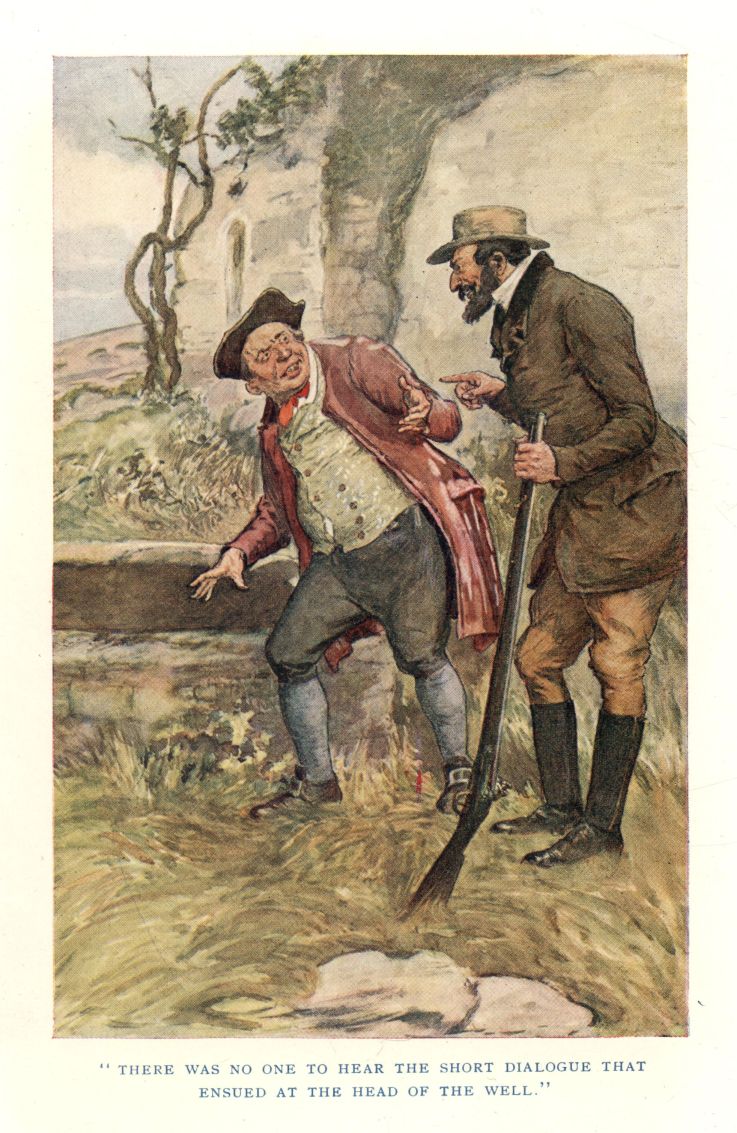
"THERE WAS NO ONE TO HEAR THE SHORT DIALOGUE THAT ENSUED AT THE HEAD OF THE WELL."
"Fine birds, vicar," said Trevanion, holding up a brace of woodcock and a moor-hen. "They'll look smaller on my table a few hours hence."
"Good morning, Mr. Trevanion," said the parson, and rode by.
CHAPTER THE FIFTEENTH
Across the Pit
All unconscious of what was happening behind them, the boys, on reaching the foot of the well, passed through the open doorway into the narrow passage.
"These be rare doings," began Sam; but Dick silenced him.
"Don't speak, Sam," he whispered. "We don't know who is here, or how near."
They passed on their left the passage where Dick had been checked by the landfall on his first approach from the cave. Moving slowly and with great caution, stopping every now and then to listen, they uttered never a word until they arrived at the point where the transverse gallery struck off to the right. Here they halted. It was necessary to decide whether to go straight on, and come by-and-by to the seal cave, or to turn into the passage, which they had never as yet traversed. A moment sufficed for coming to a decision. The light from Dick's candle showed that this passage was strutted, like that along which they had already come.
"This must be the way," whispered Dick, and low as was his tone, the words echoed and re-echoed strangely in the narrow gallery.
They advanced, picking their way still more carefully than before, peering into the darkness ahead, occasionally turning to look behind them. The floor of the adit at first sloped slightly downwards, but at length appeared to become level. The air was close and stuffy. Sam, following his young master, and seeing the weird shadows cast on the walls by the smoking flame, was soon in a cold sweat, not so much of fear as of nervous anticipation. His dread of ghosts had disappeared with knowledge; but it was knowledge of a negative kind. He knew there were no ghosts, but his imagination conjured up nameless terrors. More than once he was tempted to retreat, but he was too apprehensive even to halt long enough to strike a light and kindle his own candle, and the sight of Dick's tall form moving steadily on in front of him helped him to pluck up courage.
When they had been walking for a few minutes, Sam suddenly hurried forward and caught Dick by the arm.
"I heerd summat!" he whispered hoarsely.
Dick stopped. Far from comfortable himself, the touch of Sam's hand made him jump, and the thumping of his heart was almost audible. They listened intently; no sound struck upon their ears.
"It must have been a falling stone," said Dick.
"Suppose the roof fell on us, same as it did in the cave!" murmured Sam.
"'Tis not likely. Don't get jumpy, Sam. Let us go on."
Again they advanced; a few steps brought them to another adit branching to the right; but a glance at this revealing no struts, Dick decided not to change his course until he had thoroughly explored the passage in which he was. In a few minutes he came to another adit, this time on the left, and this also he passed by for the same reason, and because it was narrower than any of those he had hitherto seen. Now the floor seemed to ascend gradually, and shortly afterwards became much more uneven. At length he stopped short, and waited until Sam came up with him.
"Look at this," he whispered.
Sam looked, and saw a narrow plank bridge, about seventeen feet long, spanning a black, yawning chasm.
"'Tis an old mine shaft," said Dick. "We must cross the bridge."
"Will it bear us, think 'ee?" said Sam timorously.
"It will, if it bears smugglers carrying tubs. We must try."
Dick leant forward and probed the planks with the muzzle of his fowling-piece.
"'Tis firm and steady," he said. "I will go first. Don't start until I get across. The candle will give you more light than it gives me."
"I don't like to see 'ee do it," said Sam, almost whimpering. "If ye fall, 'twill be yer grave."
But Dick had already set his foot on the bridge. He trod warily, moving almost by inches until he reached the middle. Then he quickened his pace, and covered the second half in three swift strides.
"'Tis quite safe," he whispered, turning at the end.
"Didn' it wamble?"
"No."
"Not a little teeny bit?"
"Come, come, I am heavier than you."
"Well, I woll."
He moistened his lips, pressed his hat firmly on his head, then started forward and crossed the whole bridge at a run.
"Here I be!" he panted. "Name it all! I'll never do it again."
"Then I shall leave you behind. My word! 'tis close and stuffy here."
They went on. In a minute or two the passage widened, and looking round, they discovered that they were in what appeared to be the entrance to a huge cavern. Still advancing, they were brought up within a few yards by a rough and irregular wall, not wholly of granite, like the wall of the seal cave, but partly of rock, partly of earth. There were small heaps of soil and stones of different sizes on the uneven floor, and the wall was not perpendicular, but inclined like the eaves of a house.
Dick gazed about him in search of a further opening. There was none. The way was blocked, just as it had been in the offshoot of the passage from the seal cave to the well. The general appearance of the place indicated that at some time or other the upper earth had fallen in. To make sure that there was not even the smallest orifice in the wall, Dick moved close along it, carefully examining it by the light of his candle. When about half-way round, he stopped, and placed his hand on something that protruded from the wall, which was here earthen. But this projecting object was neither earth nor rock. In shape it was convex and regular. He passed his hand over it, brushing off some adhering particles of soil.
"Why, Sam," he said wonderingly, "'tis part of a tub."
"Do 'ee tell o't?" said Sam, moving his palm over the surface. "So 'tis, and be-dazed if there bean't a rope on it."
He tugged at the rope, and fell backwards, almost upsetting Dick.
"Rot it all!" he exclaimed.
"'Tis rotted already," said Dick smiling. "It must have been there a long time."
"Cansta pull un out, Maister?" said Sam. "Maybe there's summat inside, and I do be most tarrible dry."
"We'll see; but you shan't drink neat spirit, Sam, so you needn't think it. Lend a hand here."
Between them the boys soon succeeded in working the tub from the loose earth in which it was imbedded. It was a small barrel about fourteen inches in diameter, bound with wooden hoops, exactly similar to those which the smugglers were wont to use. The broken rope, or "sling stuff," as it was called, attached to it proved that it had once formed part of a run cargo. Sam shook it; there was no "glug" of liquor.
"'Tis spiled, sure enough," he said, "but the hoops bean't broke."
"Here's another, Sam," said Dick, who had been looking into the hole left by the removal of the tub. "I can't help thinking we have come to an old haunt of the smugglers; yes, I understand it now. You know there was a landslip hundreds of years ago, just beyond the cove. The earth must have fallen in on a cargo before it could be removed."
"But why didn' they dig 'em out arterwards? And why be the tub as empty as a drum?"
"Yes, 'tis strange they did not dig them out, but the emptiness is easy to understand. The spirit has run away."
"Run away! How could it with the tub sound, not a hole in it? Besides, there bean't no smell, and I don't care who the man is, but if sperits run out, you can smell 'em anywhere."
"I suppose——" began Dick, but his answer was suddenly cut short. From the direction of the passage through which they had come there fell upon their ears a dull rumbling sound, which reverberated for a few seconds, then died away into silence.
The boys stood for a moment in silent bewilderment; then, with a foreboding of evil, Dick hastened back from the cavern along the gallery. In a minute the astounding cause of the noise was explained. The bridge by which they had crossed the shaft was gone. Only the jagged end of it jutted out from the further brink of the chasm. By the flickering light of the candle Dick thought he saw a figure moving backwards through the gallery on the opposite side. He shouted, his voice coming back to him in a hundred echoes. The figure disappeared, if indeed it were not an hallucination: Dick's state of horrified amazement might well predispose him to see visions. He stood on the brink, bathed in chill and clammy perspiration. He realised to the full the situation of himself and his companion. They were trapped in the gallery. Before them was a shaft perhaps hundreds of feet deep; behind, an impenetrable wall.
"I said I'd never do it again, and I never will," sobbed Sam.
"Hoy! hoy!" shouted Dick.
"Yo-hoy, hoy!" Sam repeated in his rougher tones.
But there was no reply; only the mocking, receding echoes.
Dick leant against the wall in dull stupefaction. He had said nothing to his parents about the expedition; he had expressly charged Sam not to speak of it to Reuben. His very caution had proved his undoing. So common was it for him to be all day away from home with Sam that their absence would scarcely be remarked until night, and then, even if it caused alarm, no one would dream of looking for them at the well, still less in one of the passages below. But if Dick's suspicions and inferences were well founded, at some time during the day or night there would be smugglers in one or other of the galleries, and they would surely come within sound of his voice, and not be so base as to refuse to help him. Then it struck him that perhaps such a cry might merely terrify them; that they might believe it to be the utterance of the disembodied spirits that were said to haunt the place. But no; as his first terrors subsided, and he regained his thinking power, a sudden light dawned upon him. The ghosts were the invention of the smugglers themselves! They had taken advantage of ancient tradition and floating rumour for their own purposes, encouraged the credulity of the many in order that the few might preserve the secret of their hiding-place. And then it flashed upon him that his presence near their jealously-guarded lair had been discovered, and that his return had been deliberately cut off, so that they might carry out undisturbed the important operation of which Trevanion and Doubledick had spoken. In that case his incarceration would be temporary, like Penwarden's. As soon as the run had been accomplished, he, like the old exciseman, would be liberated, and the smugglers would gloat over their triumphant strategy.
"How many candles have you got?" he asked suddenly.
Sam rummaged in his pocket, and produced five stumps varying in length.
"They will last about twelve hours," said Dick. "There is no wind here to make them gutter."
"But they won't make us a bridge," groaned Sam.
"Listen to me," said Dick.
Speaking calmly, he told Sam the conclusions to which he had come.
"Now, Sam, you see what we have to do. It was about nine o'clock when we came down the well. It will be twelve hours or more before they attempt the run. We have twelve hours before us; we must get across the shaft and dish them—I don't know how, but we must do it."
"How can we? Rake it all, we shall have no dinner!"
"Don't talk like that," said Dick sternly. "We want all our wits and determination. 'Tis mere folly to think about dinner, or groan and moan because we are hungry. I tell you, young Sam, you must do your best to help, and be cheerful, or you and I will split."
"Well, I'll keep my solemn thoughts to myself and spake out nothing but merry ones, if I can think 'em."
Dick considered for a few moments; then he took from his pocket a knife and a long piece of string, knotted the latter about the haft, and stuck the blade into a lighted candle. This he lowered into the chasm, lying at full length to make the most of the string. But the flame revealed no bottom to the shaft. Even had they seen a floor it seemed impossible to get there, or, getting there, to be in any way profited. At one time, no doubt, there had been a means of ascending and descending the shaft; but the very existence of the bridge showed that the machinery had long since disappeared, and the passage-way by which they had made their entrance was the only exit.
"We had better blow out the candle," said Dick. "We don't know how long we may be here, and you may be glad to eat it before we get out of this."
"That I never could; but 'tis wisdom to save it, when we can't see anything nice to look at, and you can allers meditate better in the dark."
They reclined against the wall of the gallery. For a time they were silent except for sighs that now and then escaped Sam's heaving breast. After one prolonged expiration Dick asked sharply what he was grunting about.
"Don't 'ee laugh, now, if I tell o't," said Sam pleadingly. "My simple thought was, what would Maidy Susan say if she knowed o' this horrible place o' torment? 'There shall be weepin' and gnashin' o' teeth,' says pa'son; 'twill come to that afore long wi' me. There now, 'nation take it! I said I'd spake merry thoughts. Maybe you could put one into my mizzy-mazy head, Maister Dick."
"I'll break it for you if you can't talk sense—— There! Did you hear that?"
"'Twas like the whisk of a rabbit's scut among the furze. Hoy! Yo-hoy! Come and help two poor boys in misery."
"Hoy! hoy!" shouted Dick.
The echoes crossed and clashed, but there was no answer.
Another period of silence. It seemed to last for hours. At length Dick relit the candle and once more scanned the shaft. Could he jump it? He measured it with his eye. He had never been to school; jumping as a sport was unknown to him. In the ordinary course of his outdoor adventures he had sometimes leapt across a stream or from rock to rock, but never a space so wide as this. Realising the impossibility of the feat, he blew out the candle and returned to his place beside Sam.
"I seed yer thought," said the boy, "but Sir Bevil fox-hunting never took a gap like that. A hoss med do it, but not a two-legged body."
Again there was silence. Presently Sam fell asleep, snoring vigorously. Dick pondered and puzzled; to him sleep was impossible. All at once he remembered the barrel he had found in the wall of the cave. A faint hope stirred within him. He wakened Sam, relit the candle, and hurried back through the passage.
"What be goin' to do?" asked Sam.
"To see how many tubs there are," he said.
"If there be a million they bean't no good wi' all the sperits gone a-lost," said Sam. "Howsomever, 'twill be summat to do to count 'em, and keep us from the squitchems."
They regained the cave. Dick, bending so that the light of the candle shone full into the hole in the wall, began to scrape away with his knife the earth that partially concealed the second barrel. Not to be backward, Sam set to work in the same way a little to the right. The second tub was soon unearthed, then a third.
"We must be careful not to disturb the earth above," said Dick, "or we shall have the rest covered up again. I believe there are a good number here."
"All leery," said Sam with a sigh. "But I don't care who the man is, they bean't leerier nor I.... There's my tongue runnin' to vittals again; I reckon 'tis because I hain't done growin'."
After resting a while, they resumed their work. In course of time, they had a row of ten or twelve barrels standing against the wall.
"I wish there was something else," said Dick.
"What yer manin' be 'tis not for me to say," said Sam, "but my feelings be just the same. Why, dash my bones, here be summat else; a box, Maister; look at un."
He drew forth a long flat box, which he shook as he had shaken the barrels.
"Ah! 'tis full o' nothing, seemingly. If 'twas only tay, now, or bacca that we med chaw; but 'tis a'most as light as a feather."
He prised up the lid of the box with his knife. The wood was thin, and crumbled away at the touch of the steel. There was something pink beneath, and the removal of the lid disclosed a quantity of silk, which, when it was unfolded, proved to be many yards in length.
"Only think o't!" said Sam. "Don't it feel plum! Oh! what a noble garment 't'ud make for Maidy Susan!"
"'Tis much too good for her," said Dick. "It would suit Mother better."
"True, 'tis fit for queens and other high females, but the Mistress be gettin' a old ancient person, and 't'ud look more fitty on a nesh young frame. Ah me! it bean't no good for high or low, this side o' that dark fearsome hole in the ground."
"Let us see if there are any more boxes," said Dick. "And let me tell you, Mother is only forty-five, so mind what you say, Sam."
"Well, forty-five is more 'n double twenty, can 'ee deny it? When I be forty-five, I shall be a old aged feller with a beard and a shiny sconce like Feyther, and he don't care a cuss what raiment he do wear."
Further search brought to light several boxes like the first, containing silks of various hue, and laces which even to Dick's inexperience appeared valuable. The materials seemed to be in as good a condition as when they left Lyons or Nice, and without doubt represented a considerable sum of money. But to Dick, as he contemplated them, they suggested a more immediate and urgent use than the turning into money. The wood of the barrels appeared to be sound; it had been preserved from rotting by their spirituous contents. By breaking them up into their separate staves, he would have at his disposal enough timber to make a bridge. The staves were two feet long and about five inches broad; ten or twelve lengths would be required to span the gap, and allow sufficient grip. The "sling-stuff" round the barrels, as he had already proved, was too friable to be of any value for lashing, but the silk, torn into strips, might answer this purpose.
"Take hold of the end of this," he said to Sam, handing him a length of the material, "and pull as hard as you can."
The test proved that the silk was capable of enduring a heavy direct strain, and if this were so in the piece, it would be still stronger when wound many times about the wood.
Dick explained his plan.
"Drown it all!" cried Sam. "What a tarrible deed o' wickedness! Can 'ee abear to think o' this noble shinin' stuff tore to strents and lippets?"
"'Tis a pity, of course, but 'tis more important that we should get over the gap than that any woman, matron or maid, should flaunt it in fine array. We'll set to work at once. Time must be getting on. The candle has nearly gone: that means three hours or so. Light another, Sam."
Dick tore the silk carefully into even strips, while Sam knocked the ends off the tubs, and broke the staves apart. Every now and then the boy paused, heaving a deep sigh.
"'Tis like a knife goin' through my soul every time I hear the hoosh ye do make," he said. "There, I says to myself, there goes the sleeve, and that's the petticoat, and there's this part and that I don't know the true name of. Ah well, Maidy Susan will never know from me, that's one comfort. She'd be cryin' her pretty eyes out, that 'a would, if she did see the deed o' destruction."
When nine or ten barrels had been broken up, and the floor was strewn with strips of silk, pink, blue, green, and other colours, Dick began to arrange the materials for constructing the bridge. It was to be about twenty feet long, to allow for a sufficient overlapping at each end of the gap. When he came to consider the actual details of construction he saw that his first idea, a bridge to cross on foot, was not feasible. The staves were too narrow to afford a secure foothold, and if placed side by side, the risk of their breaking apart was very great. He resolved, therefore, to concentrate his energies on a single pole, formed by binding three layers of staves together, and by means of this, work his way across the gap hand over hand, his legs dangling in the shaft. It would be a ticklish feat; indeed, he was by no means confident of its possibility; but he had the strongest motives for making the attempt, as well as a native doggedness that forbade him to sit idle in the face of difficulty.
The short staves had little curvature. He laid a number of them end to end to form a length of twenty-two feet, placing them alternately so that one had its convex, the other its concave, side to the ground, and with overlapping ends. These he bound very firmly together. Then he laid a second set on the first, in such a way that their joins occurred at different spots. Then he wound the strips of silk as tightly as possible round this double pole, carrying the windings several inches on each side of the joints. When four or five feet of the double pole were finished, he tested its rigidity by endeavouring to snap it across his knee; but though the thin wood bent slightly, the lashings held firmly, and he was well satisfied.
"'Tis very good so far, Sam," he said; "now we must put on a third layer."
"'Nation take it, we shall never be done," cried Sam, stretching his aching body. "I be mortal tired, and hungry!—there now, Maister Dick, spake yer mind like a simple honest feller, wi'out any tongue-twistin', and fine deceivin' language. Bean't 'ee most achin' hungry? Now, tell me true."
"I own I am, but 'tis no good thinking of it."
"No more do I want. You've said it. I reckon you be just as famished as I, if not more, only too proud to own it. Be-jowned if there be any sech lofty pride in me."
They proceeded with the work, lashing the third layer firmly to the other two, and employing, for greater security, the flexible wooden hoops which had held the barrels together. At last the bridge was complete. It had been a long and laborious task: neither of the boys had any idea how many hours it had occupied; they had lighted successive candle-ends mechanically, without taking count of them. The close air of the cave was now impregnated with smoke and tallow fumes, and both longed for a breath of fresh air.
All this time they had neither seen nor heard any person or thing. Indeed, they had been so fully occupied, as scarcely to bestow a thought on what might be going on beyond the gap. It did cross Dick's mind that the noise made by Sam in breaking the barrels might have been heard; but it was a considerable distance from the cave to the gap, and the passage between them was not straight. Nobody could have seen them at work; the sound, if it travelled beyond the gap, could only be a faint, indistinguishable murmur then; and the absence of a bridge was an effectual preventive of interference. It now remained to throw the suspension bridge across the gap. They carried it through the passage, stood it on one end, and lowered it over the opening, Sam holding the bottom end steady while Dick let the structure down by means of a silken rope.
"'Tis too crazy a thing to bear a cat's weight," said Sam gloomily, when it rested in place.
"I don't believe you. At any rate we can't make anything better. I'll go first, being the heavier. If I get safe across you can come after. Hold your end firmly as I go."
"You don't want me to look at 'ee?"
"Why not?"
"Because—because—drown it all!" said the boy, dashing tears from his eyes. "Do 'ee think I could bear it if I seed 'ee drop into this everlastin' pit?"
"You're a good fellow, young Sam; but I shan't drop, please God!"
He took his boots off, so that he could get a firmer grip if he had to scramble up the opposite side. Then, while Sam lay flat on the ground across the end of the pole, Dick swung himself over the shaft, gripping the bridge with both hands extended above his head. He remained motionless for a few moments, testing the strength of his support; then, realising that the quicker he moved the better, since the strain both upon the pole and his own endurance would be less than if he went slowly, he began to advance hand over hand, but as smoothly as possible, towards the other side. As he approached the middle, he saw by the light of the candle in his hatband that the pole was sagging alarmingly, and he felt it sway with his every movement. The further end of it was no longer flat on the floor of the passage, but tilted up at an angle of 30 degrees. Dick shivered as he felt his support apparently slipping downwards into the shaft. But he did not pause, and in a moment he was relieved to find that the downward movement ceased.
Arriving within a foot or two of the wall, he saw that he was some little distance below the level of the passage, and the free end of the pole, now almost perpendicular, was swaying terribly. How was he to get up? There was no projection from the side of the shaft which he could grasp, and it seemed that at any moment the pole might slip off into the gulf, carrying him with it. His arms were aching with the unaccustomed strain; not much longer could they sustain the weight of his body. Groping with his toes on the sheer face of the shaft, he managed to get a slight purchase with one foot. In another moment he obtained a little better grip with the other, though in so doing he had to spread-eagle himself. Now, with his double purchase on the wall, he was able to relieve the weight on his hands, and take breath for the final effort.
The lessening of the strain on the pole reduced the angle of inclination of its free portion to the floor. Dick worked his way inch by inch along; then, drawing his body upwards, he swung his leg over the pole, gripping it firmly with his hands, and in a few moments was able to reach out and grasp the free portion above the brink and haul himself on to the floor.
He flung himself face downward to rest, gasping a murmur of thankfulness. Sam at the other end, though he had at first closed his eyes, opened them almost immediately, unable to resist the fascination of that perilous crossing. He shuddered when he saw the pole bend and sway under Dick's weight, and pressed his lips hard together so that he should not cry out as the further end rose higher and higher from the level. When Dick had safely landed, Sam was too much overcome with emotion to utter a sound. He rubbed the chill moisture from his face and waited.
Presently Dick got up, rekindled the candle, which had been extinguished when he threw himself down, and called across.
"Now 'tis your turn, Sam. You will have an easier passage than I. Drive a couple of staves into the ground and lash the pole to them. I'll hold it firm on this side, so that it will not sway so much as when I crossed."
"No; I can't do it; I'm all of a sweat," said Sam.
"Come, come! you'll not give in, surely."
"Iss, I woll, cheerful. Never could I sink my legs into that gashly hole. It do put me in mind of poor fellers dangling on the drop in Bodmin jail. No; there bean't meat enough in my inside to give me sperit for it, and here I'll bide—I don't care who the man is—till you finds a gangway."
"But you'll be left in the dark. This is the last candle."
"You won't make me afeard if you try. Here I be safe; not a soul can get to me across this hole; and dark or light, I bean't the man for sech a deed. I be truly sorry to leave 'ee, Maister Dick, but you'd rayther see me sound in all my members than here a bit, there a bit."
"Very well. You've lost your nerve, that's clear. Shy over my boots, will you?"
Sam lifted one and cast it; but he was apparently too much shaken to take good aim. The boot fell into the shaft.
"See now! 'Tis plain!" he said forlornly. "My poor wambling arm! Even as yer boot fell, so——"
"Hush!" cried Dick.
There had been no sound of the boot striking on the bottom. After what seemed a long time—it was in fact no more than two or three seconds—from the depths came rumbling reverberations of a splash. The water must have been nearly two hundred feet below. Both the boys were silent as they thought of the terrible fate Dick would have met with if he had fallen.
"Well, good-bye, Sam!" said Dick at last, rousing himself. "One boot is no good without the other, so you can keep it. I'll come back for you as soon as I can."
"I wish 'ee well, Maister."
He stood near the brink, with a piteous expression upon his rugged face, watching Dick's gradually receding form. When a bend in the passage hid his master and comrade from view, he leant against the wall, and buried his face in his hands.
CHAPTER THE SIXTEENTH
A Packet for Rusco
During many hours Dick had been solely preoccupied with the problem how to recross the chasm. Penwarden, the smugglers, even the destroyer of the bridge, were all forgotten. But now all the circumstances of his recent misadventure returned with full force to his mind. A run was to be attempted. The smugglers' hiding-place, which the revenue officers had sought in vain, must be somewhere near at hand, and the person, whosoever it was, that had flung the bridge down the shaft—for its fall could not have been accidental—had done so with the intention of forestalling interference.
Dick considered what he had better do. Should he make his way back to the well, in the hope of being able to climb it secretly and give warning to the officers? He reflected that it might be too late for that. Besides, his presence in these underground passages had been observed by some one early in the morning; that same person might still be lying in wait for him. As this idea occurred to him, he remembered that he had left his gun behind in the cave, and for an instant thought of returning for it; but a slight sound from the other direction made him hastily extinguish the candle, and advance cautiously along the passage; perhaps the bridge-destroyer was coming towards him.
In pitch darkness he stole along, scarcely conscious of the sharp edges and rough projections of the stone floor on which he trod. In a few minutes he saw a faint glimmer of reflected light ahead, the source of which was hidden from him by a bend in the passage. On reaching the bend, he descried, moving across the end of the gallery along a transverse one, a procession of men with candles in their hats, hurrying, at short intervals apart, from the direction of the well. Clinging to the wall, confident that in the black darkness he was wholly invisible, he crept forward. By the time he came within a few yards of the transverse passage, this, too, was in darkness, the last of the line having passed by.
He hastened to the corner, and peeped round to the right. The last man was entering the narrow tunnel, which he had noticed casually as he came by with Sam. The dimness of the flickering light, and the fact that the man's back was towards him, prevented him from forming any conclusion as to the identity of the individual. The light gradually dwindled, until the opening of the tunnel was quite indistinguishable.
Waiting for a moment or two, to listen and look along the passage leading to the well, Dick ventured to creep stealthily in the same direction as the men, and to penetrate into the tunnel. He had advanced in this but a few yards, when he was made to beat a hasty retreat by a faint but growing light at the further end, and the sound of heavy footsteps approaching. As quickly as possible he tiptoed back in the darkness, and regained his former station in the side gallery, where he stood eagerly watching. In a few moments a man crossed from right to left. His face was blackened; before and behind him hung a tub, exactly similar to those which Sam had lately broken up. A second man followed at a short interval, loaded in the same way; then a third, and so on, until twenty-two had passed. They seemed by their dress to be for the most part farm-hands, but the light from their candles was too dim to reveal them clearly.
The light diminished, the sound of footsteps died away, and Dick, emerging once more into the passage, saw the end of the procession on the way to the well. From the other direction there was no sound. Dick felt an overmastering curiosity to discover how the run was being worked, and whence the tubs were brought. He hastened to the tunnel, paused for a little at the entrance, straining his ears for the slightest sound of men returning, then went on.
After a few steps he heard a slight creaking from some point ahead. A glance behind assuring him that there was no present danger in this direction, he was emboldened to proceed. There was a sudden bend in the tunnel; at the far end he saw a light; and, hugging the wall as closely as possible, he crept forward until the scene beyond was clearly in view.
He found himself near the entrance to a small oblong chamber, perhaps twenty feet by sixteen, and scarcely eight feet high. The walls were shored up by thick balks of wood: the roof was supported by rough beams. The place was dimly illuminated by two lanterns standing on the top of a pile of barrels that reached within two feet of the roof. At the far end a man was working a windlass over a hole in the floor. Two barrels, slung on ropes, emerged from the depths, were unhooked by the man, and rolled against the wall on the other side of the chamber. A whiff of cold salt air struck gratefully on Dick's senses; the smugglers' mysterious hiding-place was clearly very near the sea.
Dick was watching the man lower the hooks into the space beneath when he was startled by the sound of footsteps at no great distance behind him. Looking back, he saw a glimmer of light. Regress was barred; in a few moments he would be discovered unless he could find a new place of concealment. There was no time for hesitation. The back of the man at the windlass was towards him; the tackle creaked as more tubs ascended. In the corner of the chamber to the right was the stack of barrels on which the lanterns stood. There appeared to be just squeezing space between them and the wall. With his heart in his mouth Dick stole across to them on tiptoe, and had barely gained their shelter when the man released the tubs which had just ascended, and added them to those that were arranged along the opposite wall.
As Dick was creeping between the barrels and the wall, his foot touched an obstacle, over which he almost stumbled. Fortunately, having no boots on, he made no sound. He stood still, panting, in desperate anxiety. In the urgency of the moment he had made for the first hiding-place that offered itself, without reflecting that the carriers were no doubt returning for these very barrels, and their removal must reveal him without a possibility of escape. A thrill shot through him as he felt a slight movement in the object at his feet, and he edged instinctively away from it, wondering what it could be. The light from the lanterns did not reach the floor; indeed, scarcely illuminated the space behind, they being closed in that direction.
He heard the footsteps drawing nearer, and, peeping through a chink between two barrels, saw, not one, but the whole twenty-two carriers file into the chamber, which they nearly filled. He suspected that they had deposited their burdens at the foot of St. Cuby's Well, whence, in all probability, these were being hoisted to the surface by means of the windlass, which he remembered having seen near the door when he first approached it from the seal cave.
The man at the windlass had raised only a few barrels during their absence, and these having been slung on the shoulders of the men who had first entered, they returned to the entrance of the tunnel, waiting for their comrades in turn to receive their loads.
"Bean't this lot to go, Maister?" said one of the latter, jerking his head towards the stack behind which Dick was concealed. Dick shivered, and prepared to dash forth and force his way through the men grouped at the tunnel, in the hope that their surprise and alarm, and their being encumbered, would give him time at least to escape instant seizure. To his relief the man at the windlass replied sharply:
"No, they bean't. They be for the higher powers; let 'em alone. And you come and hoist; I be tired."
The voice was Doubledick's.
While the tubs were being hoisted, and the waiting men talked quietly among themselves, Dick had leisure to turn his thoughts towards the object at his feet. It could hardly be an animal; otherwise it would long since have betrayed him. He gently moved a foot towards it, and touched it. Again he detected a slight movement. Passing his stockinged toes over a few inches of the obstruction, Dick gave a start as he recognised by the touch a man's boot. It did not move when he pressed it: clearly it was attached to a leg, the leg to a body—and the conviction flashed upon him that, bound and gagged at his feet, lay the lost Joe Penwarden. To assure himself he bent down quickly, and felt his way upward to the face. His hand encountered the shade over the old man's sightless eye: it was Joe indeed.
Penwarden was lying on his back, and Dick very soon discovered that he was bound hand and foot to a plank, so tightly that only the slightest movement was possible. His mouth was heavily gagged, but there was no bandage over his single sound eye. Dick could not see him, and durst not speak even in the lowest whisper, so near was he to the smugglers. But if Penwarden was to be liberated he must be definitely assured in some way that a friend was at work who was himself in danger; otherwise, on being freed, he might make some sound or movement that would betray them both. Then it occurred to Dick that, while he was unable to see Penwarden's features, Penwarden had probably seen his, for the lanterns shed a faint illumination on the upper part of the space behind the barrels, to which his head almost reached. This suggested a means of giving the old man a warning. Raising himself to his full height he looked downwards and pressed his forefinger to his lips. The sign, if observed, would, he knew, be effectual.
Once more he stooped. He drew his knife from his pocket, opened it without clicking, and silently cut the rope binding the prisoner's feet. Then, working upward, always with the same slow care, he severed in turn the ropes that strapped his knees and elbows to the plank, those binding his wrists, and finally the gag over his mouth. This last probably gave the old man the most discomfort, and might have been removed first, but the use of his limbs was of more urgent importance just now than his voice.
By the time that this was done the last of the carriers had received his load, and the creaking or the windlass had ceased.
"That's all," said Doubledick. "Now get 'ee up-along to well, and lend a hand in the hoisting."
"Be we to wait for 'ee, Maister, when the tubs be all up?" asked a man.
"No, no. You'll do best to carr' the tubs off as quick as may be. I'll go straight home-along. To-morrer mornin', after church, if ye like ye can come down-along to inn, where there'll be a nibleykin of rum-hot ready for every man of 'ee."
The carriers tramped into the tunnel, and the sound of their footsteps died away.
A voice came up into the chamber from below.
"Iss," said Doubledick in reply. "Stand by while I let down the passel. Belike ye know enough English to understand that."
Dick fancied that he heard a low chuckle from below, and a foreign voice say, "All right."