ROCK AND MINERAL IDENTIFICATION CHARTS
Reading edition
To help you identify them, various Texas rocks and minerals are listed together in the following charts according to properties that they have in common. Although useful, the identification charts may not always give you perfect results. For example, hardness, which is used as a guide, is not to be completely relied upon in the identification of rocks.
The charts on the following pages pertain only to the rocks and minerals that are described in this book. It is quite possible that you will find rocks and minerals in Texas that are not included in these charts.
If you find a rock or a mineral that you are unable to identify, you can check your local library for reference books that may aid you (several such references are noted on pages 100-101). If you need further help, possibly the science teacher at a nearby public school will be able to identify the specimen for you. Or if a college or university is located in your area (especially one that has a department of geology), you can obtain help there. In Texas, the Bureau of Economic Geology is a mineral information center. Most other states have similar geological research and public-service organizations. Other sources of information might be the gem and mineral societies that are found in a number of communities. Many of the members of these organizations are experts in the identification of rocks and minerals.
How To Use the Mineral Identification Charts
In the mineral identification charts (pp. 26-38), the minerals have been grouped, first of all, on the basis of luster: the first group includes the minerals that appear metallic and almost metallic (submetallic); the second group includes those that appear nonmetallic. Next, the minerals have been arranged within the two groups according to color.
After you have determined the luster and the color of an unknown mineral, turn to the Key to Mineral Identification Charts on page 25. It will direct you to the proper mineral chart.
Mineral Charts 1 through 5, which include the minerals of various colors with metallic and submetallic lusters, are subdivided according to the hardness of the minerals. To determine the hardness of a mineral that has one of these lusters, you can make the following tests:
1. Will the mineral readily leave a mark on paper?
2. If it will not readily leave a mark on paper, will an ordinary pocket knife scratch it?
3. Is it too hard to be scratched by an ordinary pocket knife?
Mineral Charts 6 through 15 are for the nonmetallic minerals of various colors. They, too, are subdivided according to the hardness of the minerals, as follows:
1. Can the mineral be scratched by a fingernail?
2. If it cannot be scratched by a fingernail, can it be scratched by a copper penny?
3. If it cannot be scratched by a copper penny, can it be scratched by an ordinary pocket knife?
4. If it cannot be scratched by an ordinary pocket knife, can it be scratched by a piece of quartz?
5. Is it too hard to be scratched by quartz?
When the luster, color, and hardness of a mineral have been determined, you may find that several minerals on the charts fit the description. To narrow your choice, you can then test other properties of the mineral. Notice the “remarks” column on the charts. In it, is mentioned anything that is distinctive about the mineral.
For more complete mineral identification lists and tables, you can use textbooks, such as Dana’s Manual of Mineralogy, revised by C. S. Hurlbut, Jr., or Mineralogy, by E. H. Kraus, W. F. Hunt, and L. S. Ramsdell.
25
Key to Mineral Identification Charts
If the mineral has a metallic or submetallic luster,
and is: Consult Mineral Chart
white 1
gray 2
yellow 3
brown 4
black 5
If the mineral has a nonmetallic luster,
and is: Consult Mineral Chart
white 6
gray 7
yellow 8
brown 9
black 10
green 11
blue 12
red or pink 13
purple or violet 14
colorless 15
26
Mineral Identification Charts
Chart No. Mineral Streak Remarks Hardness
1. METALLIC luster, WHITE color
A. Does not readily leave mark on paper but can be scratched by ordinary pocket knife
Native silver Shiny silver white, unless tarnished Silver-white color that tarnishes to gray, black, or yellowish brown; heavy; can be flattened when hit with hammer 2½-3
2. METALLIC or SUBMETALLIC luster, GRAY color
A. Will leave mark on paper
Argentite Shiny, blackish to lead gray Lead-gray color that tarnishes to dull black; knife cuts it smoothly; heavy; may occur as masses and coatings 2-2½
Galena Grayish black Shiny lead-gray color; heavy; cube-shaped fragments and crystals 2½
Graphite Black Steel-gray color; greasy feel; very soft; splits into thin flakes 1-2
B. Does not readily leave mark on paper but can be scratched by ordinary pocket knife
Chalcocite Grayish black Shiny lead-gray color that tarnishes to dull black; knife cuts it smoothly; may have black sooty coating; commonly occurs as compact or granular masses 2½-3
Hollandite Black Silvery-gray color; may occur as rounded masses 4-6
C. Cannot be scratched by ordinary pocket knife
Braunite Steel gray or black Dark steel-gray color and submetallic luster 6-6½
Hematite Dark reddish brown Steel-gray color; commonly occurs as granular or compact masses; shiny, scaly variety is specular hematite; notice streak 5½-6½ (may be softer)
Hollandite Black Silvery-gray color; may occur as rounded masses 4-6
3. METALLIC luster, YELLOW color
A. Does not readily leave mark on paper but can be scratched by ordinary pocket knife
Chalcopyrite Greenish black Brass-yellow or golden-yellow color that may tarnish and show rainbow-like colors; commonly massive; notice streak 3½-4
Gold Shiny golden yellow Shiny yellow color; extremely heavy; flattens when hit with hammer; notice streak 2½-3
B. Cannot be scratched by ordinary pocket knife
Pyrite Black, greenish black, or brownish black Shiny, pale golden-yellow or brass-yellow color that may tarnish; occurs as grains, as masses, or as cubes or other crystal shapes; notice hardness and streak 6-6½
27
4. METALLIC or SUBMETALLIC luster, BROWN color
A. Does not readily leave mark on paper but can be scratched by ordinary pocket knife
Limonite Rusty yellowish brown Dark-brown color; some specimens have a shiny black surface; notice streak 5-5½
B. Cannot be scratched by an ordinary pocket knife
Cassiterite Pale brown, pale yellow or white Brown; submetallic; heavy; notice streak 6-7
Hematite Dark reddish brown Dark brown color; commonly occurs as granular or compact masses; notice streak 5½-6½ (may be softer)
Limonite Rusty, yellowish brown Dark brown color; some specimens have a shiny black surface; notice streak 5-5½
5. METALLIC or SUBMETALLIC luster, BLACK color
A. Will leave mark on paper
Argentite Shiny, blackish to lead grey Lead-gray color that tarnishes to dull black; knife cuts it smoothly; heavy; may occur as masses and coatings 2-2½
Graphite Black Greasy feel; very soft; splits into thin flakes 1-2
Pyrolusite Black Very soft; will soil fingers; may be powdery 1-2
B. Does not readily leave mark on paper but can be scratched by an ordinary pocket knife
Chalcocite Grayish black Shiny lead-gray color that tarnishes to dull black; knife cuts it smoothly; may have a black sooty coating; commonly occurs as compact or granular masses 2½-3
Hollandite Black May occur as rounded masses 4-6
Limonite Rusty, yellowish brown Some specimens have shiny black surface; notice streak 5-5½
C. Cannot be scratched by an ordinary pocket knife
Braunite Steel gray or black Luster is submetallic 6-6½
Cassiterite Pale brown, pale yellow, or white Submetallic luster; heavy; notice streak 6-7
Hematite Dark reddish brown Notice streak; commonly occurs as granular or compact masses 5½-6½ (may be softer)
28
Hollandite Black May occur as rounded masses 4-6
Limonite Rusty yellowish brown Some specimens have shiny black surface; notice streak 5-5½
Magnetite Black Fragments cling to a magnet 6
Pitchblende Brownish black Brownish black, greenish black, or black; radioactive; heavy; may appear dull or greasy 5½
6. NONMETALLIC luster, WHITE color
A. Can be scratched by a fingernail
Cerargyrite Shiny white or gray Appears waxy; knife cuts it smoothly; turns violet brown to black when exposed to light 1-1½
Gypsum White Soft; occurs as crystals or as fibrous, granular, compact, or earthy masses 2
Talc White Knife cuts it smoothly; feels soapy or greasy; splits into thin flakes 1
B. Cannot be scratched by a fingernail but can be scratched by a copper penny
Anhydrite White Commonly occurs as sugary-looking masses 3-3½
Barite White Rather heavy; cleavage fragments may be flat and slab-like 3-3½
Calcite White Dilute hydrochloric acid fizzes on calcite; perfect cleavage in 3 directions gives rhomb-shaped fragments 3
Celestite White Not quite as heavy as barite; crystals commonly prism-shaped or flat-looking; some cleavage fragments are flat and slab-like 3-3½
Halite White Salty taste; dissolves in water; cube-shaped cleavage fragments 2½
C. Cannot be scratched by a copper penny but can be scratched by an ordinary pocket knife
Anhydrite White Commonly occurs as sugary-looking masses 3-3½
Barite White Rather heavy; cleavage fragments may be flat and slab-like 3-3½
Celestite White Not quite as heavy as barite; crystals commonly prism-shaped or flat-looking; some cleavage fragments are flat and slab-like 3-3½
29
Dolomite White Commonly occurs as granular masses and as rhomb-shaped crystals; dilute hydrochloric acid may fizz slightly on dolomite 3½-4
Fluorite White Cleavage in 4 directions can give fragments that are shaped like octahedrons; crystals commonly cubes 4
Opal White Curved, conchoidal fracture; may appear glassy, greasy, resinous, or dull; milky white and bluish-white precious opal shows plays of colors 5-6
D. Cannot be scratched by an ordinary pocket knife but can be scratched by quartz
Feldspar White Glassy or pearly luster; good cleavage in 2 directions that meet at an angle of 90° or near 90°; common in granite and pegmatite rocks 6
Opal White Curved, conchoidal fracture; may appear glassy, greasy, resinous, or dull; milky white and bluish-white precious opal shows plays of colors 5-6
Quartz White Curved conchoidal fracture; occurs as milky quartz, chert, and chalcedony; crystals commonly 6-sided prisms with pyramid-like ends 7
7. NONMETALLIC luster, GRAY color
A. Can be scratched by a fingernail
Amphibole asbestos White Made up of slender, flexible fibers that can be pulled apart 1-2½
Cerargyrite Shiny white or gray Appears waxy; knife cuts it smoothly; turns violet brown to black when exposed to light 1-1½
Gypsum White Soft; occurs as crystals or as fibrous, granular, compact, or earthy masses 2
Sulfur White or pale yellow Will burn with a blue flame; commonly found as crystals, crusts, or grains 1½-2½
Talc White Knife cuts it smoothly; feels soapy or greasy; splits into thin flakes 1
B. Cannot be scratched by a fingernail but can be scratched by a copper penny
Amphibole asbestos White Made up of slender, flexible fibers that can be pulled apart 1-2½
Anhydrite White Commonly occurs as sugary-looking masses 3-3½
30
Calcite White Dilute hydrochloric acid fizzes on calcite; perfect cleavage in 3 directions gives rhomb-shaped fragments 3
Celestite White Crystals commonly prism-shaped or flat-looking; some cleavage fragments are flat and slab-like 3-3½
Halite White Salty taste; dissolves in water; cube-shaped cleavage fragments 2½
Sulfur White or pale yellow Will burn with a blue flame; commonly found as crystals, crusts, or grains 1½-2½
C. Cannot be scratched by a copper penny but can be scratched by an ordinary pocket knife
Anhydrite White Commonly occurs as sugary-looking masses 3-3½
Celestite White Crystals commonly prism-shaped or flat-looking; some cleavage fragments are flat and slab-like 3-3½
Dolomite White Commonly occurs as granular masses and as rhomb-shaped crystals; dilute hydrochloric acid may fizz slightly on dolomite 3½-4
Opal White Curved, conchoidal fracture; may appear glassy, greasy, resinous, or dull 5-6
D. Cannot be scratched by an ordinary pocket knife but can be scratched by quartz
Feldspar White Glassy or pearly luster; good cleavage in 2 directions that meet at an angle of 90° or near 90°; common in granite and pegmatite rocks 6
Opal White Curved, conchoidal fracture; may appear glassy, greasy, resinous, or dull 5-6
Quartz White Curved conchoidal fracture; occurs as chert and chalcedony 7
8. NONMETALLIC luster, YELLOW color
A. Can be scratched by a fingernail
Carnotite Yellow Bright canary yellow or lemon yellow; radioactive; occurs as crusts and powdery masses 2
Gypsum White Yellowish; soft; occurs as crystals or as fibrous, granular, compact or earthy masses 2
Limonite Rusty yellowish brown Brownish-yellow color; may be soft and earthy 1+
31
Muscovite (white mica) White Light colored; splits into thin, flat, transparent sheets that will bend without breaking 2-2½
Sulfur White or pale yellow Will burn with a blue flame; commonly found as crystals, crusts, or grains 1½-2½
Uranophane Light yellow to light yellow orange Yellow to yellow-orange color; radioactive 2-3
B. Cannot be scratched by a fingernail but can be scratched by a copper penny
Barite White Rather heavy; cleavage fragments may be flat and slab-like 3-3½
Calcite White Yellowish; dilute hydrochloric acid fizzes on calcite; perfect cleavage in 3 directions gives rhomb-shaped fragments 3
Muscovite (white mica) White Light colored; splits into thin, flat, transparent sheets that will bend without breaking 2-2½
Sulfur White or pale yellow Will burn with a blue flame; commonly found as crystals, crusts, or grains 1½-2½
Uranophane Light yellow to light yellow orange Yellow to yellow-orange color; radioactive 2-3
C. Cannot be scratched by a copper penny but can be scratched by an ordinary pocket knife
Barite White Rather heavy; cleavage fragments may be flat and slab-like 3-3½
Opal White Curved, conchoidal fracture; may appear glassy, greasy, resinous, or dull 5-6
D. Cannot be scratched by an ordinary pocket knife but can be scratched by quartz
Feldspar White Glassy or pearly luster; good cleavage in 2 directions that meet at an angle of 90° or near 90° 6
Garnet White Commonly occurs as crystals 6½-7
Opal White Curved, conchoidal fracture; may appear glassy, greasy, resinous, or dull 5-6
Quartz White Curved conchoidal fracture; brownish-yellow smoky quartz crystals commonly 6-sided prisms with pyramid-like ends; chalcedony and jasper may be a shade of yellow, too 7
32
9. NONMETALLIC luster, BROWN color
A. Can be scratched by a fingernail
Gypsum White Brownish; soft; occurs as crystals or as fibrous, granular, compact or earthy masses 2
Limonite Rusty yellowish brown May be soft and earthy 1+
Muscovite (white mica) White Light colored; splits into thin, flat, transparent sheets that will bend without breaking 2-2½
Sulfur White or pale yellow Will burn with a blue flame; commonly found as crystals, crusts, or grains 1½-2½
B. Cannot be scratched by a fingernail but can be scratched by a copper penny
Barite White Rather heavy; cleavage fragments may be flat and slab-like 3-3½
Biotite (black mica) White Dark brown; splits into thin, flat sheets that will bend without breaking 2½-3
Calcite White Dilute hydrochloric acid fizzes on calcite; perfect cleavage in 3 directions gives rhomb-shaped fragments 3
Halite White Salty taste; dissolves in water; cube-shaped cleavage fragments 2½
Muscovite (white mica) White Light colored; splits into thin, flat, transparent sheets that will bend without breaking 2-2½
Sulfur White or pale yellow Will burn with a blue flame; commonly found as crystals, crusts, or grains 1½-2½
C. Cannot be scratched by a copper penny but can be scratched by an ordinary pocket knife
Barite White Rather heavy; cleavage fragments may be flat and slab-like 3-3½
Dolomite White Commonly occurs as granular masses and as rhomb-shaped crystals; dilute hydrochloric acid may fizz slightly on dolomite 3½-4
Fluorite White Cleavage in 4 directions can give fragments that are shaped like octahedrons; crystals commonly cube-shaped 4
D. Cannot be scratched by an ordinary pocket knife but can be scratched by quartz
Cassiterite Pale brown, pale yellow, or white Brown, reddish brown, or yellowish brown; heavy; dull to brilliant luster 6-7
33
Feldspar White Glassy or pearly luster; good cleavage in 2 directions that meet at an angle of 90° or near 90°; common in granite and pegmatite rocks 6
Garnet White Commonly occurs as crystals 6½-7
Quartz White Curved conchoidal fracture; brown smoky quartz crystals commonly 6-sided prisms with pyramid-like ends; chalcedony, chert, and jasper may be a shade brown, too 7
Tourmaline White Dark brown variety is dravite; notice hardness, striations on crystals, and triangular cross section of some crystals 7-7½
E. Cannot be scratched by quartz
Tourmaline White Dark brown variety is dravite; notice hardness, striations on crystals, and triangular cross section of some crystals 7-7½
10. NONMETALLIC luster, BLACK color
A. Cannot be scratched by a fingernail but can be scratched by a copper penny
Biotite (black mica) White Splits into thin, flat sheets that will bend without breaking 2½-3
B. Cannot be scratched by an ordinary pocket knife but can be scratched by quartz
Garnet White Commonly occurs as crystals 6½-7
Quartz White Curved conchoidal fracture; brownish-black smoky quartz crystals commonly 6-sided prisms with pyramid-like ends; chalcedony and chert may be black, too 7
Tourmaline White Black variety is schorl; notice hardness, striations on crystals, and triangular cross section of some crystals 7-7½
C. Cannot be scratched by quartz
Tourmaline White Black variety is schorl; notice hardness, striations on crystals, and triangular cross section of some crystals 7-7½
11. NONMETALLIC luster, GREEN color
A. Can be scratched by a fingernail
Amphibole asbestos White Made up of slender, flexible fibers that can be pulled apart 1-2½
34
Cerargyrite Shiny white or gray Light greenish color; appears waxy; knife cuts it smoothly; turns violet brown to black when exposed to light 1-1½
Muscovite (white mica) White Light colored; splits into thin, flat, transparent sheets that will bend without breaking 2-2½
Sulfur White or pale yellow Greenish; will burn with a blue flame; commonly found as crystals, crusts, or grains 1½-2½
Talc White Light greenish color; knife cuts it smoothly; feels soapy or greasy; splits into thin flakes 1
B. Cannot be scratched by a fingernail but can be scratched by a copper penny
Amphibole asbestos White Made up of slender, flexible fibers that can be pulled apart 1-2½
Biotite (black mica) White Dark green; splits into thin, flat, translucent sheets that will bend without breaking 2½-3
Calcite White Dilute hydrochloric acid fizzes on calcite; perfect cleavage in 3 directions gives rhomb-shaped fragments 3
Halite White Greenish tint; salty taste; dissolves in water; cube-shaped cleavage fragments 2½
Muscovite (white mica) White Light colored; splits into thin, flat, transparent sheets that will bend without breaking 2-2½
Serpentine White Two kinds: silky and fibrous, waxy and platy 2½-4
Sulfur White or pale yellow Greenish; will burn with a blue flame; commonly found as crystals, crusts, or grains 1½-2½
C. Cannot be scratched by a copper penny but can be scratched by an ordinary pocket knife
Fluorite White Cleavage in 4 directions can give fragments shaped like octahedrons; crystals commonly cubes 4
Malachite Green Bright green color; dilute hydrochloric acid will fizz on malachite 3½-4
Serpentine White Two kinds: silky and fibrous, waxy and platy 2½-4
D. Cannot be scratched by an ordinary pocket knife but can be scratched by quartz
Feldspar White Glassy or pearly luster; good cleavage in 2 directions that meet at an angle of 90° or near 90° 6
Garnet White Commonly occurs as crystals 6½-7
35
12. NONMETALLIC luster, BLUE color
A. Cannot be scratched by a fingernail but can be scratched by a copper penny
Anhydrite White Commonly occurs as sugary-looking masses 3-3½
Barite White Rather heavy; cleavage fragments may be flat and slab-like 3-3½
Calcite White Dilute hydrochloric acid fizzes on calcite; perfect cleavage in 3 directions gives rhomb-shaped fragments 3
Celestite White Not quite as heavy as barite; crystals commonly prism-shaped or flat-looking; some cleavage fragments are flat and slab-like 3-3½
Halite White Salty taste; dissolves in water; cube-shaped cleavage fragments 2½
B. Cannot be scratched by a copper penny but can be scratched by an ordinary pocket knife
Anhydrite White Commonly occurs as sugary-looking masses 3-3½
Azurite Blue Bright, intense blue color; dilute hydrochloric acid will fizz on azurite 3½-4
Barite White Rather heavy; cleavage fragments may be flat and slab-like 3-3½
Celestite White Not quite as heavy as barite; crystals commonly prism-shaped or flat-looking; some cleavage fragments are flat and slab-like 3-3½
Fluorite White Cleavage in 4 directions can give fragments that are shaped like octahedrons; crystals commonly cube-shaped 4
Opal White Curved, conchoidal fracture; may appear glassy, greasy, resinous, or dull; milky white and bluish-white precious opal shows plays of colors 5-6
C. Cannot be scratched by an ordinary pocket knife but can be scratched by quartz
Feldspar White Glassy or pearly luster; good cleavage in 2 directions that meet at an angle of 90° or near 90° 6
Opal White Curved, conchoidal fracture; may appear glassy, greasy, resinous, or dull; milky white and bluish-white precious opal shows plays of colors 5-6
36
Quartz White Curved conchoidal fracture; occurs as crystalline quartz and as bluish chalcedony 7
D. Cannot be scratched by quartz
Topaz White Perfect basal cleavage gives flat, plate-like fragments; notice hardness 8
13. NONMETALLIC luster, RED or PINK color
A. Can be scratched by a fingernail
Gypsum White Reddish; soft; occurs as crystals or as fibrous, granular, compact, or earthy masses 2
Hematite Dark reddish brown Brownish-red color; soft and earthy 1+
Sulfur White or pale yellow Reddish; will burn with blue flame; commonly found as crystals, crusts, or grains 1½-2½
B. Cannot be scratched by a fingernail but can be scratched by a copper penny
Anhydrite White Pinkish tint; commonly occurs as sugary-looking masses 3-3½
Barite White Pinkish tint; rather heavy; cleavage fragments may be flat and slab-like 3-3½
Calcite White Pink color; dilute hydrochloric acid fizzes on calcite; perfect cleavage in 3 directions gives rhomb-shaped fragments 3
Cinnabar Dark red Dark red or bright yellowish-red color; shiny, brilliant luster when pure; dull and earthy when impure; heavy 2½
Halite White Reddish tint; salty taste; dissolves in water; cube-shaped cleavage fragments 2½
Sulfur White or pale yellow Reddish; will burn with blue flame; commonly found as crystals, crusts, or grains 1½-2½
C. Cannot be scratched by a copper penny but can be scratched by an ordinary pocket knife
Anhydrite White Pinkish tint; commonly occurs as sugary-looking masses 3-3½
Barite White Pinkish tint; rather heavy; cleavage fragments may look flat and slab-like 3-3½
Dolomite White Pink color; commonly occurs as granular masses and as rhomb-shaped crystals; dilute hydrochloric acid may fizz slightly on dolomite 3½-4
37
Fluorite White Pink color; cleavage in 4 directions can give fragments that are shaped like octahedrons; crystals commonly cubes 4
Opal White Reddish color; curved, conchoidal fracture; may appear glassy, greasy, resinous, or dull 5-6
D. Cannot be scratched by an ordinary pocket knife but can be scratched by quartz
Feldspar White Glassy or pearly luster; good cleavage in 2 directions that meet at an angle of 90° or near 90° 6
Garnet White Commonly occurs as crystals 6½-7
Opal White Reddish color; curved, conchoidal fracture; may appear glassy, greasy, resinous, or dull 5-6
Quartz White Curved, conchoidal fracture; occurs as rose quartz, as pink chert, and as agate and jasper 7
14. NONMETALLIC luster, PURPLE or VIOLET color
A. Cannot be scratched by a copper penny but can be scratched by an ordinary pocket knife
Fluorite White Cleavage in 4 directions can give fragments that are shaped like octahedrons; crystals commonly cubes 4
B. Cannot be scratched by an ordinary pocket knife but can be scratched by quartz
Quartz, variety: amethyst White Curved, conchoidal fracture; amethyst crystals commonly 6-sided prisms with pyramid-like ends 7
15. NONMETALLIC luster, COLORLESS
A. Can be scratched by a fingernail
Cerargyrite Shiny white or gray Appears waxy; knife cuts it smoothly; turns violet brown to black when exposed to light 1-1½
Gypsum White Transparent selenite variety commonly occurs as flat, diamond-shaped crystals; splits into thin, flat sheets that will not bend without breaking 2
Muscovite (white mica) White Splits into thin, flat, transparent sheets that will bend without breaking 2-2½
38
B. Cannot be scratched by a fingernail but can be scratched by a copper penny
Barite White Rather heavy; cleavage fragments may be flat and slab-like 3-3½
Calcite White Dilute hydrochloric acid fizzes on calcite; perfect cleavage in 3 directions gives rhomb-shaped fragments 3
Celestite White Not quite as heavy as barite; crystals commonly prism-shaped or flat-looking; some cleavage fragments are flat and slab-like 3-3½
Halite White Salty taste; dissolves in water; cube-shaped cleavage fragments 2½
Muscovite (white mica) White Splits into thin, flat, transparent sheets that will bend without breaking 2-2½
C. Cannot be scratched by a copper penny but can be scratched by an ordinary pocket knife
Barite White Rather heavy; cleavage fragments may be flat and slab-like 3-3½
Celestite White Not quite as heavy as barite; crystals commonly prism-shaped or flat-looking; some cleavage fragments are flat and slab-like 3-3½
Dolomite White Commonly occurs as granular masses and as rhomb-shaped crystals; dilute hydrochloric acid may fizz slightly on dolomite 3½-4
Fluorite White Cleavage in 4 directions can give fragments that are shaped like octahedrons; crystals commonly cubes 4
Opal White Curved, conchoidal fracture; transparent hyalite variety resembles ice 5-6
D. Cannot be scratched by an ordinary pocket knife but can be scratched by quartz
Opal White Curved, conchoidal fracture; transparent hyalite variety resembles ice 5-6
Quartz White Curved, conchoidal fracture; rock crystal quartz commonly 6-sided prism with pyramid-like ends 7
E. Cannot be scratched by quartz
Topaz White Perfect basal cleavage gives flat, plate-like fragments; notice hardness 8
39
How To Use the Rock Identification Charts
In the rock identification charts on pages 40-41, the Texas rocks described in this book are arranged in four major groups according to their texture.
1. Glassy (the rocks are smooth, dark, and shiny)
2. Compact, dull, or stony (the rocks are smooth and dull, but the individual grains are too small to be recognized)
3. Granular (at least some of the individual grains of the rocks are large enough to be seen without a magnifying glass)
4. Fragmental (the rocks are made up of fragments that are either loose or cemented together)
Consult Rock Chart 1, if the rock is glassy; Chart 2, if it is compact, dull, or stony; Chart 3, if it is granular; and Chart 4, if it is fragmental.
Two of the rock charts are subdivided. In Rock Chart 2, the compact, dull, or stony rocks are arranged according to hardness as follows:
A. Rocks that can be scratched by a fingernail
B. Rocks that cannot be scratched by a fingernail but can be scratched by an ordinary pocket knife
C. Rocks that cannot be scratched by an ordinary pocket knife
In Rock Chart 3, the granular rocks also are arranged according to hardness into:
A. Rocks that can be scratched by an ordinary pocket knife
B. Rocks that cannot be scratched by an ordinary pocket knife
These harder rocks are subdivided into three groups:
1. Those that have grains of about equal size
2. Those with large easily seen grains that are scattered through a mass of finer grains
3. Those rocks whose grains are arranged in layers
In the “remarks” column of the rock identification charts are included further tests that will aid you in identifying the rock.
For a more complete rock determination chart, you can consult a textbook, such as Rocks and Rock Minerals, by L. V. Pirsson and A. Knopf.
40
Rock Identification Charts
Chart No. Rock Remarks
1. GLASSY appearance (rock is dark, smooth, and shiny)
Obsidian Entire rock is glassy
Vitrophyre Crystalline grains are scattered through the dark glassy mass
2. COMPACT, DULL, OR STONY appearance (individual grains too small to be recognized)
A. Can be scratched by a fingernail
Chalk Dilute hydrochloric acid fizzes on it
Clay Earthy odor when breathed on
Diatomite Crumbly
Rock gypsum Made up of the mineral gypsum
Soapstone Soapy or greasy feel
B. Cannot be scratched by a fingernail but can be scratched by ordinary pocket knife
Dolomite Dilute hydrochloric acid may fizz slightly on it; will fizz if rock is powdered
Limestone Dilute hydrochloric acid fizzes on it
Serpentine rock Commonly some shade of green
Shale Breaks in flat, thin flakes; earthy odor
C. Cannot be scratched by an ordinary pocket knife
Basalt Dark colored and heavy
Chert Hard, smooth, and porcelain-like
Rhyolite Light to dark colored; may show streaks or flow structure
3. GRANULAR appearance (at least some of the individual grains are large enough to be seen without a magnifying glass)
A. Can be scratched by an ordinary pocket knife
Limestone Dilute hydrochloric acid will fizz on it
Marble Dilute hydrochloric acid will fizz on calcite marble, and it may fizz slightly on dolomite marble
Rock gypsum Made up of the mineral gypsum
Rock salt Has a salty taste; made up of the mineral halite
41
B. Generally cannot be scratched by an ordinary pocket knife (some schist is softer)
1. Grains are of about equal size (equigranular)
Granite Quartz and feldspar grains interlock
Pegmatite Large interlocking grains; commonly feldspar, quartz, mica
Quartzite Rock breaks across the quartz grains
Sandstone Rock breaks through the cement but around the sand grains
2. Easily seen grains are scattered through a mass of finer grains
Basalt Dark colored, heavy rock
Llanite Rusty pink feldspar and blue quartz grains embedded in a brownish rock mass
Rhyolite porphyry Light to dark colored rock; may show streaks or flow structure
3. Grains are arranged in layers
Gneiss Interlocking grains are in straight or wavy bands
Schist Splits in thin layers; some schist is soft enough to be scratched by a knife
4. FRAGMENTAL appearance (rocks are made up of fragments that are either loose or cemented together)
Breccia Angular, gravel-size fragments that are cemented together
Conglomerate Rounded, gravel-size fragments that are cemented together
Coquina Shells and shell fragments that are cemented together
Gravel Loose fragments
Pulverulent limestone Loose, powdery fragments; dilute hydrochloric acid fizzes on them
Sand Loose fragments no larger than a pinhead
Sandstone Sand fragments that are cemented together
Volcanic ash Loose, fine, gritty particles
42
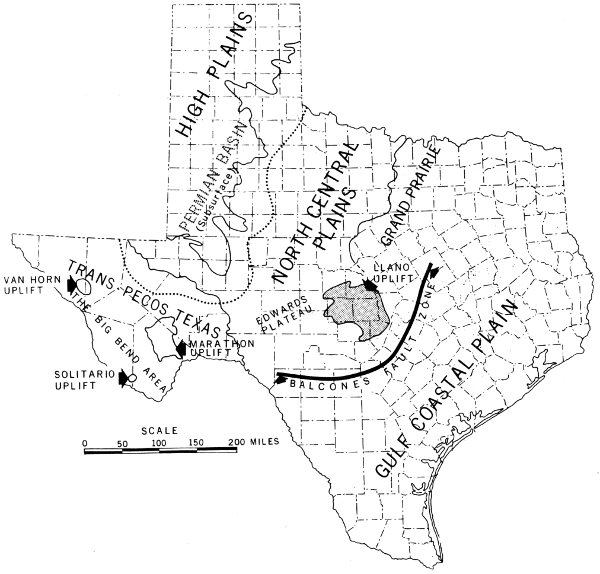
Physiographic outline map of Texas.
43