DESCRIPTIONS OF SOME TEXAS ROCKS AND MINERALS (continued 2)
Reading edition
Pyrite is used as a source of sulfur, and it is produced for this purpose in several states. In Texas, however, no pyrite deposits have been found that are large enough to be mined.
Pyrolusite. See Manganese Minerals.
Quartz
Quartz, silicon dioxide, is one of the most common minerals. It is glassy, waxy, greasy, or dull and is transparent or translucent. Pure quartz is colorless, but impurities make some varieties white, black, or a shade of red, yellow, blue, violet, or brown. Quartz is a hard mineral. It scratches window glass and cannot be scratched by a pocket knife or even by a steel file. It has a specific gravity of 2.65. The curved, conchoidal fracture shown by many specimens helps identify it.
Quartz is plentiful in Texas. It occurs in igneous rocks, such as granite, llanite, and pegmatite; in metamorphic rocks, such as quartzite, schist, and gneiss; and in sedimentary rocks, such as some sandstone, conglomerate, and breccia.
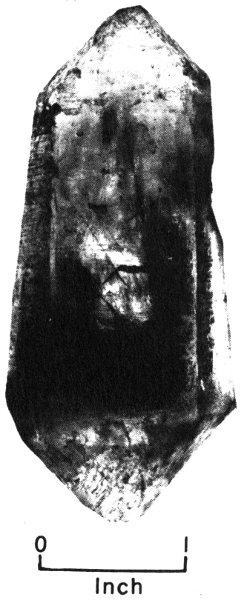
Quartz crystal, with inclusions, from Burnet County, Texas.
Quartz is found as crystals and as masses. Some of the masses are coarsely crystalline, but some are made up of extremely small crystalline particles called cryptocrystalline quartz. Some of the cryptocrystalline varieties of quartz found in Texas are chalcedony, chert, and jasper. Some of the coarsely crystalline varieties 82 found here are amethyst, milky quartz, rose quartz, smoky quartz, and rock crystal.
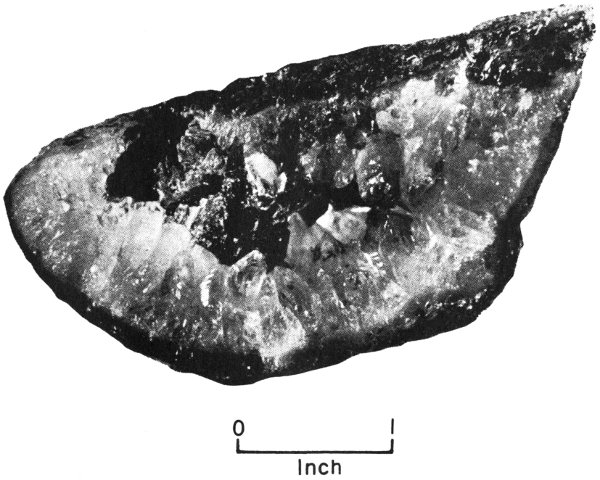
Amethyst geode from the Alpine area of Brewster County, Texas.
A colorless, glassy variety of quartz, called rock crystal, is clear enough to see through. It is found as crystals that are 6-sided prisms with pyramid-like faces on the ends. This variety is commonly associated with igneous rocks, such as those of the Llano uplift area of central Texas and of the Trans-Pecos country of west Texas. It is commonly used as a gemstone and is made into necklaces, earrings, and other jewelry. Some specimens of rock crystal have slender, needle-like crystals of other minerals, such as tourmaline, actinolite, or rutile, enclosed in them.
A clear, glassy variety of quartz, amethyst, has a purple or violet color. It, like rock crystal, is commonly found in 6-sided prisms with pyramid-shaped ends and is also prized as a gemstone. Amethyst has been found in Precambrian rocks in the Llano uplift area of central Texas. (Amethyst Hill, a locality well known to collectors for many years, is in northeastern Gillespie County.) In west Texas, amethyst has been found in Cenozoic igneous rocks in the Sierra Blanca and Quitman Mountains of Hudspeth County and in the Alpine area of Brewster County.
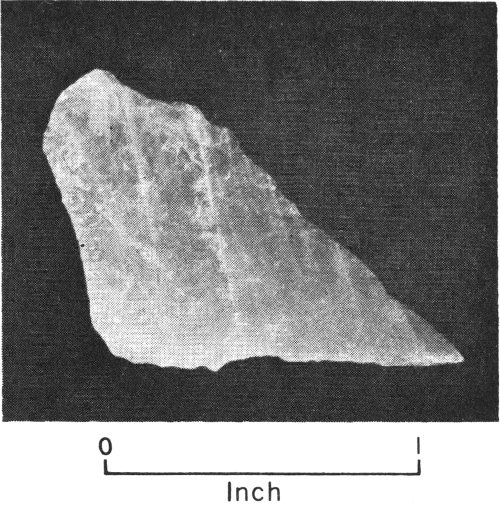
Milky quartz from Burnet County, Texas.
A variety of quartz with a milk-white color and a glassy to greasy luster is called milky quartz. It occurs either as crystals or as crystalline masses. Very little light will pass through it. In central Texas, milky quartz occurs abundantly in the Precambrian 83 rocks of the Llano uplift area in Blanco, Burnet, Gillespie, Llano, and Mason counties. It also is found in some of the rocks of the Trans-Pecos country of west Texas, such as in the Carrizo Mountains of Culberson and Hudspeth counties. Other good places to look for this variety of quartz are in the sands and gravels along many streams in Texas.
Some quartz has a glassy to a greasy luster and a rose or pink color. Rose quartz, as this variety is called, commonly occurs as masses rather than as individual crystals. It can be found along some of the streams in Texas and also in igneous rocks, such as those of the Llano uplift area of central Texas.
A kind of quartz with a smoky brown, a smoky yellow, or a dark brownish-black color is called smoky quartz. Its luster is glassy, and it may be either translucent or transparent. Smoky quartz is commonly found as crystals that are shaped like 6-sided prisms with pyramid-like ends. It is commonly associated with igneous rocks, and beautiful specimens have been found in the Lake Buchanan area of Llano and Burnet counties in central Texas.
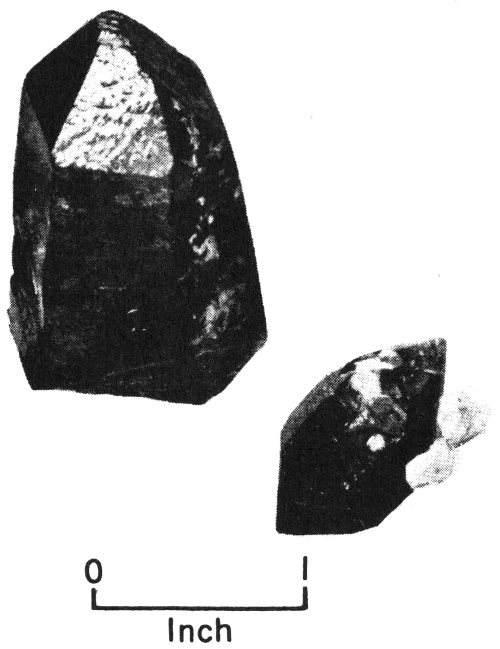
Smoky-quartz crystals from Burnet County, Texas.
A cryptocrystalline variety of quartz, chalcedony, has a waxy to dull luster and a tan, white, gray, or light-blue color. It is translucent but not transparent. Chalcedony does not have its own crystal shape but instead is found in masses that line or fill cracks, pores, and other cavities in rocks. It is formed when water containing silicon slowly seeps into these openings in the rocks and deposits the silicon dioxide there as chalcedony.
Chalcedony commonly occurs in some of the Tertiary rocks of the Gulf Coastal Plain. For example, chalcedony associated with opal is found near Freer in northern Duval County. In the High Plains of west Texas, it is found in alkali-lake deposits, such as at Shafter Lake in Andrews County and at Cedar Lake in Gaines County. In the Trans-Pecos country of west Texas, it can be found filling small cavities in extrusive igneous rocks.
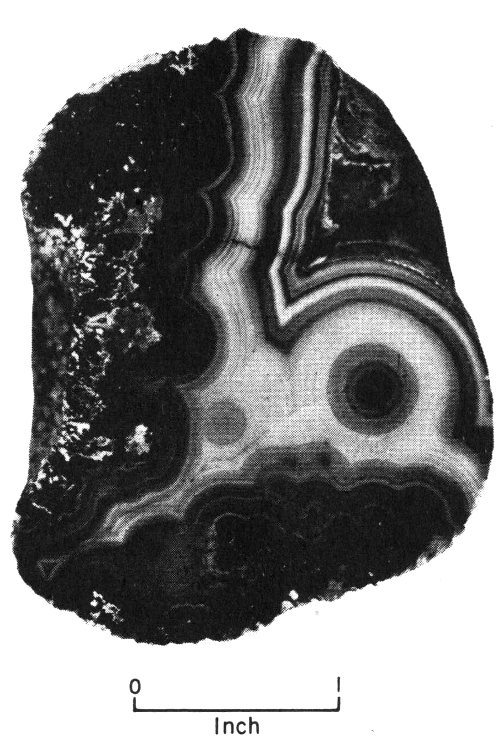
Polished agate from Rio Grande gravels of Zapata County, Texas.
A variety of chalcedony that generally is made up of more than one color is called agate (although agates consisting of several 84 shades of a single color are also found). The colors may be spread out unevenly so that the agate has a cloudy appearance, or they can be arranged in wavy, in straight, or in concentric lines or bands. If the bands are straight and parallel, the specimen is called onyx. Agate that has a moss-like or tree-like design in it is called moss agate. Some agates make attractive gemstones when cut and polished.
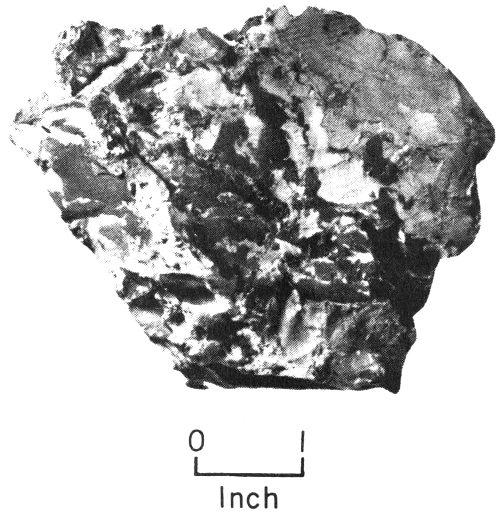
Jasper from Uvalde County, Texas. Dark areas are brownish red; light areas are a yellowish-tan.
Much agate has been found filling cavities in Cenozoic igneous rocks in Brewster, Presidio, and other counties in the Trans-Pecos country of west Texas. It has been found also in an area about 10 to 15 miles wide along the Rio Grande, mostly in southern Webb County and in Zapata and Starr counties.
Trees and other plants have been replaced by agate. Many specimens of agatized wood have been collected from Tertiary formations in Fayette, Gonzales, Lee, Washington, and other counties of the Gulf Coastal Plain. (The agatized wood, along with opalized wood, occurs within about 20 miles of the boundary between no. 2 and no. 3 on the geologic map, pp. 4-5.)
A hard, compact, slightly translucent variety of cryptocrystalline quartz is called jasper. It commonly has a red, brown, or yellow color due to the presence of an iron oxide, such as hematite. Some jasper is made up of irregular bands of more than one of these colors. This variety of quartz often is polished to make attractive gem or ornamental stones. It has been collected at several localities in Texas, particularly from creek and river gravels. Starr and other nearby counties along the Rio Grande have furnished a number of good specimens.
A hard, smooth, compact, translucent rock that is made up mostly of cryptocrystalline quartz is called chert or flint. It is white, black, or some shade of gray, brown, or pink, and its luster is waxy, slightly glassy, or dull. Chert is found in many creek and river gravels in Texas. It also occurs with limestone, such as in the Lower Cretaceous Edwards Limestone of central Texas and in the Ordovician Ellenburger strata in the Llano uplift area. Chert also is found with the Ordovician rocks of the Marathon area of Brewster County.
Geologists do not agree on whether chert and flint are two names for one variety of rock, or whether each is a separate variety. Some, however, now give chert a geological meaning and flint an archaeological meaning. They use the word chert to describe geological formations or rock specimens. They give the name flint to the same rock when it has been used by Indians in making arrowheads, scribers, scrapers, and spearheads.
Quartzite
Quartzite is either a metamorphic rock or a sedimentary rock. (The sedimentary kind of quartzite is described with sand and sandstone on p. 86.) Metamorphic quartzite is made up mostly of quartz. It forms when heat and fluids below the earth’s surface cause the grains and cement of a quartz sandstone to recrystallize. When this happens, the grains interlock and are no longer held together by cement. Metamorphic quartzite, like sedimentary quartzite, is a hard, firm rock that 85 breaks through the quartz grains instead of between them.
Ancient Precambrian metamorphic quartzite occurs at the surface in the Llano uplift area of central Texas, in the Van Horn area of west Texas, and in the Franklin Mountains north of El Paso in extreme west Texas.
Rhyolite
Rhyolite is a fine-grained or glassy igneous rock that commonly is extrusive or volcanic. It has a pink, red, tan, white, gray, purple, or black color. This rock, like granite, is made up chiefly of feldspar and a silica mineral, such as quartz, but other minerals may be present. Both rhyolite and granite form from the same kind of molten rock material. Nevertheless, even though their compositions are the same, these two rocks do not look alike. Their textures differ because granite forms slowly and rhyolite forms quickly.
Much of the Texas rhyolite formed from hot, molten lava. This lava flowed out onto the surface either through volcanic cones or cracks in the ground. Some of the lava cooled and hardened too quickly for mineral grains to develop. This rapidly cooled lava formed a rhyolite rock that is made up, at least partly, of glass. In many of the rhyolites, crystalline mineral grains were able to form, but these grains are extremely small, and you may not be able to distinguish them even with a magnifying glass. Some rhyolite, because it hardened from moving, flowing lava, has streaks and bands of different colors and textures. This rhyolite has flow structure.
One variety of rhyolite has easily seen crystals and grains of minerals, such as feldspar, quartz, and mica, scattered through a mass of the tiny crystalline grains (in much the same way that raisins are scattered through a cake). The easily seen crystals and grains are called phenocrysts, and the rock itself is called a rhyolite porphyry.
Many rhyolites and rhyolite porphyries occur in the Tertiary igneous rocks of the Trans-Pecos country of west Texas. Just a few of these localities include the Barrilla Mountains of Jeff Davis and Reeves counties, the Chisos Mountains of Brewster County, the Chinati Mountains of Presidio County, and the Davis Mountains of Jeff Davis County.
Rock Crystal. See Quartz.
Rock Gypsum. See Gypsum.
Rock Salt. See Halite.
Rose Quartz. See Quartz.
Salt. See Halite.
Sand and Sandstone
Sand is a loose, uncemented sedimentary deposit made up of fragments of weathered rocks and minerals. These fragments must be of a certain size (between ¹/₁₆ millimeter and 2 millimeters in diameter) in order to be called sand grains. The largest sand grains are about the size of a pinhead. Sand grains are smaller than the fragments known as granules; they are larger than those known as silt.
Many sands are made up chiefly of grains of quartz. This mineral is plentiful and does not easily weather away. In addition, rock fragments and many other minerals, such as feldspar, mica, gypsum, magnetite, and garnet, are found as sand grains.
Rains wash many of the sand grains and other weathered rock and mineral fragments into creeks and rivers. These streams may carry the sand and other sediments long distances before depositing them. Today, we find sands along the banks of many creeks and rivers in Texas and along the beaches of the Gulf of Mexico. The sand in the rivers is in transit to the Gulf. In addition, sand occurs at the surface in other Cenozoic formations and in some of the Paleozoic and Mesozoic formations of Texas.
Sand has many uses. Much building sand, which is used in mortar and concrete, is produced from numerous sand and gravel pits in Texas. Pure quartz sand that 86 can be used to make glass is known as glass sand. Some of it is found in north-central Texas in Lower Cretaceous formations. A large glass sand quarry is located at Santa Anna in Coleman County. Along the Gulf Coastal Plain, sand that is used in glassmaking occurs in Eocene Tertiary strata.
A coarse-grained sand, blast sand, is used with compressed air to clean the walls of brick and stone buildings and to carve designs on monument stones, such as marbles. Some coarse sand is also used as a filtering sand in purifying water. These types of sand have been produced from the Gulf Coastal Plain as well as from other areas of Texas.
Sand grains, when nature cements them together, make up the sedimentary rock sandstone. Some sandstones form when underground water carrying dissolved mineral matter moves through loose sand. As the dissolved mineral matter comes out of solution, it forms a cement that binds the sand grains together.
The cement may be material such as calcite (calcium carbonate), quartz, chalcedony, or opal, which are silica minerals, and limonite and hematite, which are iron oxides. Clay also may serve as a cement. It is either deposited along with the sand or is formed from weathered feldspar sand grains.
The color of the cementing material helps determine the color of the rock. Iron oxide cement, for example, causes the sandstone to have a reddish, yellowish, or brownish color. Sandstones also are white, black, gray, green, or cream colored.
Ordinarily, sandstones break through the cementing material, not through the sand grains. Thus, the broken surface of the rock feels rough and gritty. Some quartz sand grains, however, are tightly cemented with silica to form an extremely hard and compact rock. If this rock breaks smoothly through the grains instead of between them, it is known as quartzite. Some of this sedimentary quartzite occurs in the Texas Gulf Coastal Plain in the Tertiary Catahoula strata. (Another kind of quartzite is described on pp. 84-85.)
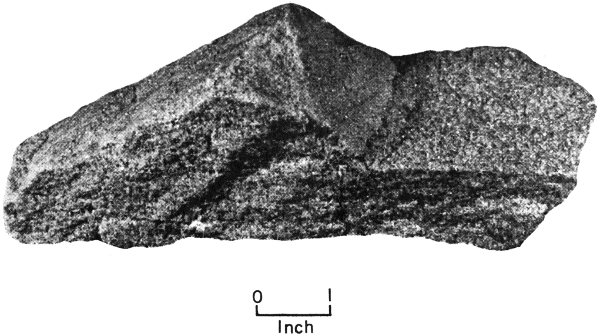
Sandstone from the Eocene Wilcox Group of strata of northwestern Zavala County, Texas.
Ordinary sandstones are seen at the surface in many localities in Texas, and a number of them have been used as building stones. Some of the places where sandstones occur are in the Cambrian and Pennsylvanian formations of the Llano uplift area of central Texas and in the Pennsylvanian, Permian, and Lower Cretaceous formations of north-central Texas. Tertiary sandstones 87 occur in the Texas Gulf Coastal Plain, and Triassic sandstones are found along the edges of the Texas High Plains. Sandstone is also found in many formations of the Trans-Pecos country of west Texas.
Sandstone. See Sand and Sandstone.
Satin Spar. See Gypsum.
Schist
Schist is a metamorphic rock that splits easily along thin, generally parallel layers, called folia. These layers may be either straight or curved, and they are made up of crystalline grains of one or more than one mineral. This structure is called schistosity or foliation. When you examine schist, you will see that many of the mineral grains are flat or long, and that they are lined up in one direction to form the layers. Some schists have fairly large crystals (many with perfect shapes) scattered through them. For example, mica schists may contain beautiful crystals of garnet.
Each kind of schist is named for an outstanding mineral that it contains. Mica schist contains a large amount of mica. We also find hornblende schist, actinolite schist, chlorite schist, talc schist, and graphite schist. (Graphite schist is discussed with graphite on p. 63.)
Schists form from other rocks, such as granite, gabbro, or shale. The rocks are changed into schists by fluids and by heat and pressure below the earth’s surface.
Extremely ancient schists that formed during Precambrian time are exposed at the surface in the Allamoore—Van Horn area of west Texas and in the Llano uplift area of central Texas. Geologists believe that the Packsaddle Schist of the Llano uplift area was once shale. Good exposures of this schist are seen in the Honey Creek area near Packsaddle Mountain in Llano County.
Schorl. See Tourmaline.
Sedimentary Quartzite. See Sand and Sandstone.
Selenite. See Gypsum.
Serpentine
Serpentine is the name given both to a rock and to a mineral. The mineral serpentine (a hydrous magnesium silicate) is found in two different forms. If it is fibrous, it is called chrysotile; if it is layered and platy, it is known as antigorite. Antigorite is brownish green and smooth and waxy looking. Some of it can be split into thin sheets. Chrysotile is made up of greenish, silky fibers, which may be brittle and break apart in large pieces. If, however, the fibers can be pulled apart into soft flexible, little threads, the mineral is called chrysotile asbestos.
Light will pass through both these varieties of serpentine, and both are soft enough to be scratched by a pocket knife. When rubbed across a streak plate, they leave white streaks. Antigorite and chrysotile have no crystal shapes of their own, but several other minerals can alter to form these two varieties of serpentine. Thus antigorite and chrysotile may be found as pseudomorphs in a crystal shape that originally belonged to another mineral.
Antigorite and chrysotile are commonly found closely mixed with dolomite, talc, magnetite, calcite, pyrite, and several other minerals. These minerals make up serpentine rock (also called serpentinite). This rock ordinarily is some shade of green (such as whitish, yellowish, brownish, bluish, or dark blackish green), and it may be mottled. It is brittle or tough and generally is massive. Serpentine rock, like the serpentine minerals, is fairly soft—you can scratch it with a pocket knife.
In the Llano uplift area of central Texas, serpentine rock is found among Precambrian metamorphic rocks, such as gneiss and schist. An especially large deposit in this area is known as the Coal Creek serpentine mass. It is over 3½ miles long, and at one place, it is almost 1½ miles wide. This mass of serpentine extends across the Blanco-Gillespie County line in the extreme northern parts of these two 88 counties. (A little fibrous chrysotile is found here, but it will not break into flexible enough threads to be called chrysotile asbestos.) Several other deposits of serpentine occur in northeastern Gillespie County and in southern Llano County.
It is believed that the Coal Creek serpentine was formed from an igneous rock such as peridotite, which is made up chiefly of grains of the mineral olivine. The peridotite may have been altered into serpentine by underground waters that seeped through it. It is possible, however, that other serpentines in the area were formed when rocks were altered by hot fluids and great pressures far below the earth’s surface.
The Llano area serpentine has been widely used in terrazzo floors. To make these floors, small pieces of serpentine and other colored rocks are put into cement that is spread over a concrete slab. Then, after the cement has hardened, it is ground to a flat, smooth surface and polished. The resulting terrazzo floor is both colorful and durable.
Serpentine rock also is cut into slabs, polished, and used as indoor building stones. Verde antique, a variety often seen in the lobbies of office buildings, consists of green serpentine rock with streaks of white calcite or dolomite in it.
In the Balcones fault zone area (shown on the Texas physiographic outline map, p. 42) from Uvalde County to Williamson County, serpentine occurs with Upper Cretaceous rocks. The serpentine rock is seen at the surface in a few places (such as in Travis and Uvalde counties), but much of it is underground. In several oil fields of this area (as at Thrall field in Williamson County and at Lytton Springs field in Caldwell County), the serpentine rocks contain oil.
Serpentinite. See Serpentine.
Shale
Shale is a sedimentary rock made up of tightly packed clay and mud particles. It has a smooth appearance because it is so fine grained. In fact, most of the particles in it are too small to be distinguished with a magnifying glass. These particles are the weathered remains of earlier rocks. They were carried by creeks and rivers to other parts of the land or to the sea, where they formed layers of clay and mud. Later, other sediments were deposited on top of them. The weight of these new sediments squeezed the clays and muds together to form firm, compact shale.
Shale looks very much like some clays. It, like clay, can be almost any color. If the shale contains animal or plant matter, it is black, gray, or blue. If it contains iron oxide (many minerals containing iron alter to this material), it is a shade of red, yellow, or brown. Shale is soft and can be easily scratched by a knife. It also is brittle and crumbles easily. This rock has a property that will help you to distinguish it from clay: the particles that make up the shale were deposited in layers, and the shale splits into flat, thin flakes along these layers, which clay will not do.
Shale is fairly abundant in Texas, especially in Mississippian, Pennsylvanian, and Cretaceous formations. For example, Pennsylvanian shales are found at the surface in north-central Texas, in the area around the Llano uplift of central Texas, and in the Marathon and Solitario uplifts of west Texas.
Many of shale’s uses are the same as those of clay. Some of it can be used to make brick, tile, and other products, and some is often used instead of clay in making portland cement. Cement plants at Dallas, El Paso, Fort Worth, and Waco are located at places where Cretaceous limestones, which also are used in cement making, and Cretaceous shales are found near each other at the surface.
Oil shale, from which petroleum can be obtained by heating, has been found in central Texas. It occurs in Mississippian formations in Lampasas, McCulloch, and San Saba counties. Because oil is much less expensive to obtain from wells, it is not produced from these shales.
89
Silver Minerals (Argentite, Cerargyrite, Native Silver)
Silver has many uses. Like gold, it is a beautiful metal that long has been used for coins and ornaments. A large amount of silver goes to make articles such as spoons, forks, platters, and trays. The photographic industry uses silver—much of the film for cameras is coated with a silver halide. Doctors and dentists use silver, too. The mixture that a dentist uses to fill teeth contains silver along with several other metals. Doctors sometimes use silver wire to fasten broken bones, and silver compounds and solutions, such as silver nitrate, are used in some kinds of medical treatment.
Perhaps more people have heard of legendary, lost silver mines of Texas than of the actual and important silver deposits found in the Trans-Pecos country of west Texas. Some of the west Texas silver minerals include argentite, cerargyrite, and native silver. Although the argentite and native silver commonly found there are mixed with galena, a lead mineral, or with chalcocite, a copper mineral, they also occur separately.
The element silver is found alone as native silver. When pure, it is rather easy to recognize. It is metallic and has a silver-white color that may tarnish to gray, black, or yellowish brown. Native silver is heavy (it has a specific gravity of 10.5) and soft (a pocket knife scratches it easily). When you rub it across a streak plate, native silver, unless it is tarnished, leaves a shiny, silver-white streak. This metal is so ductile that it can be drawn into a wire. It is also malleable and flattens when hit with a hammer.
Silver occurs as crystals, which are poorly shaped cubes and octahedrons, or as irregular masses. It may have a net-like appearance (called reticulate), or it may be shaped like little needles (described then as acicular). It occurs in wires (then called filiform) or as scales or plates.
Prospector.
Two of the Texas silver minerals, argentite and cerargyrite, do not resemble silver at all. 90 Argentite, a silver sulfide, is also called silver glance. It is a dark, lead-gray mineral with a metallic luster that weathers to a dull black. When you rub it across a streak plate, argentite gives a shiny, blackish to lead-gray streak. This mineral is soft enough to leave a mark on paper. It has a specific gravity of 7.3, and it is sectile enough to be cut smoothly (like soap) with a knife. In some places argentite is found as irregular masses or as a coating on rocks and other minerals.
Another silver mineral, cerargyrite (or horn silver) is a silver chloride. This mineral has a nonmetallic luster and is transparent to translucent. It resembles pearl-gray, white, greenish, or colorless wax. When exposed to the light it turns violet brown or black. Cerargyrite is soft—you can scratch it with a fingernail. Like argentite, it is sectile. This mineral has a specific gravity of 5.5, and it commonly occurs as irregular masses and as crusts.
These silver minerals have been mined at a number of places in Trans-Pecos Texas. The largest silver mine in Texas, the Presidio mine, is located near Shafter in south-central Presidio County. It contains argentite, cerargyrite, and native silver, along with galena and several other minerals. This mine is not open now, but in the years between 1885 and 1942, it produced a large amount of silver along with some lead and gold. There are several other lead-silver mines in this Shafter area, but none has produced as much as the Presidio mine.
In this mine, the silver minerals occur mostly in large, flat deposits in Permian limestone and other sedimentary rocks. The minerals are believed to have been deposited there—probably during Tertiary time—by solutions that came from hot magma far below the rocks. As they moved in along the layers of limestone, the solutions replaced portions of this rock with minerals containing silver, lead, and other elements. Later, water seeped into these deposits and dissolved some of the minerals. This dissolved material was then re-deposited, and it formed most of the minerals we now find there.
No silver is being mined in Texas at present, but it has, in the past, been produced from other Trans-Pecos mines. Galena that contains silver (called argentiferous galena) has been mined at the Bird mine at Altuda Mountain (about 14 miles east of Alpine) in northern Brewster County. It also has been obtained from mines in the Quitman Mountains and in the Eagle Mountains of Hudspeth County. Some cerargyrite has been mined at the Plata Verde mine near the Culberson-Hudspeth County line.
Several mines in the Van Horn area of Culberson and Hudspeth counties have produced silver along with copper. An important silver mine in this area is the now idle and flooded Hazel mine. (This mine is described with copper minerals on p. 52.)
Smoky Quartz. See Quartz.
Soapstone. See Talc and Soapstone.
Specular Hematite. See Hematite.
Sulfur
Sulfur is one of Texas’ most valuable minerals. It consists of only a single element, sulfur. This mineral has a resinous luster and is transparent to translucent. Sulfur ordinarily is yellow, but impurities cause it to look greenish, brownish, reddish, or grayish. When you rub it across a streak plate, it leaves a white or a pale-yellow streak. Sulfur has a specific gravity of 2.04 to 2.09 and is soft enough to be scratched by a copper penny. It breaks with a conchoidal to uneven fracture. When it gets hot enough (478° Fahrenheit), sulfur will burn. For this reason, it often is called brimstone.
Sulfur does not conduct electricity and is a poor conductor of heat. You can test how poorly heat passes through it by holding a fragment of sulfur up to your ear. You may be able to hear a crackling sound. The sound results when the outer part of the fragment expands (due to the heat from your hand) while the inner part 91 (which has received no heat) remains unchanged.
Crystals of sulfur are sometimes found, and most of them have either a double-pyramid shape or a flat, tabular shape. Sulfur also occurs as compact masses, as crusts, and as scattered grains.
Native sulfur deposits are found in two widely separated areas of Texas—one in west Texas and the other along the Gulf Coast in southeast Texas, extending over into Louisiana. In the Gulf Coast area, native sulfur is found on some of the salt domes.
The salt domes are huge (from about half a mile to more than 2 miles across), column-shaped masses made up of halite and some anhydrite. These masses have pushed up toward the surface through thousands of feet of sand, clay, and other sedimentary rocks. On top of many of the salt columns is a covering of limestone (calcite), anhydrite, and gypsum known as the cap-rock. It is in this cap-rock that the sulfur is found.
It is thought that when the masses of halite and anhydrite pushed toward the earth’s surface, some of the upper part of the halite dissolved. The anhydrite, however, did not dissolve, and it remained on top of the salt column. Then, a part of this anhydrite was altered into the gypsum, limestone, and sulfur that now are found in some of the cap-rocks. Laboratory experiments have shown that the sulfur in the cap-rocks likely formed through the action of sulfate-reducing bacteria. These bacteria, in the presence of petroleum, converted the sulfate in some of the anhydrite into hydrogen sulfide. Later, hydrogen sulfide was oxidized—perhaps by reaction with more of the anhydrite—to form the sulfur.
Most of the large cap-rock sulfur deposits are about 1,500 to 2,400 feet underground. At first, an attempt was made to get this sulfur out of the ground by digging shafts down to it, but loose, wet, caving sands and poisonous gases, such as hydrogen sulfide, made this mining method almost impossible. Finally, a chemist, Herman Frasch, found a way to obtain the sulfur by making use of sulfur’s low melting point. When sulfur gets slightly hotter than boiling water (235° to 247° Fahrenheit), it melts and becomes a dark, yellowish-brown liquid.
In the Frasch method of sulfur mining, a well is drilled into the salt-dome cap-rock, and three pipes, one inside the other, are put into the well. Superheated water under pressure (hotter than 212° Fahrenheit, the temperature at which water ordinarily turns into steam) is sent down one of the pipes to melt the sulfur in the cap-rock around the bottom of the well. Then, compressed air is sent down another of the pipes. This air presses against the liquid sulfur and forces it up to the surface through the third pipe. At the surface, the sulfur is poured into bins, where it cools and becomes a solid again, or it is transported molten, in pipelines and tankers.
Sulfur has been obtained from a number of the Texas Gulf Coast salt domes including Bryan Mound, Clemens dome, Damon Mound, and Hoskins Mound in Brazoria County; Palangana dome in Duval County; Long Point dome, Nash dome, and Orchard dome in Fort Bend County; High Island dome in Galveston County; Fannett dome and Spindletop dome in Jefferson County; Moss Bluff dome in Liberty County; Gulf dome in Matagorda County; and Boling dome in Wharton County.
In west Texas, sulfur occurs in Permian rocks both at the surface and underground. A small amount of sulfur has been mined in the Rustler Springs area of northeastern Culberson County and northwestern Reeves County, about 50 miles northwest of Pecos. There, scattered grains, crystals, and irregular masses of sulfur occur in cracks and in dissolved-out openings in the Castile Gypsum and in the surface gravel, gypsum, sand, and clay that cover most of this formation.
Sulfur has many uses. It is used as an insect-killer, thus helping our food crops to grow. It is used in pulp and paper manufacturing and in the vulcanizing of rubber. Some other uses are in the making of paints, dyes, and explosives. A large amount of sulfur goes to make sulfuric acid, which itself has numerous uses in the chemical, steel, oil refining, and other industries.
92
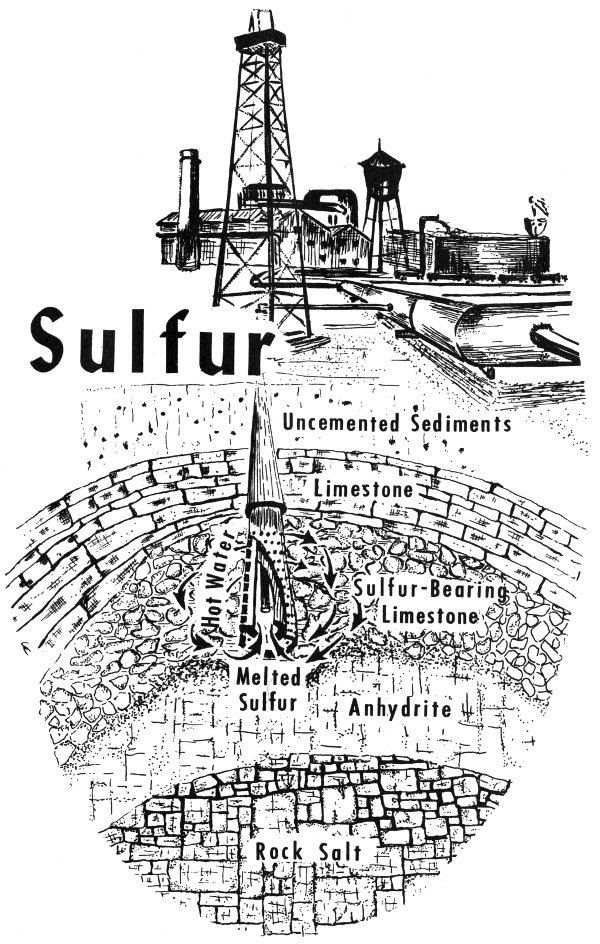
Sulfur is obtained from the cap-rock of Gulf Coastal Plain salt domes by the Frasch process.
Sulfur
Uncemented Sediments
Limestone
Sulfur-Bearing Limestone
Hot Water
Melted Sulfur
Anhydrite
93
Talc and Soapstone
Talc, a hydrous magnesium silicate, is an extremely soft mineral—your fingernail scratches it easily. It has a greasy or a pearly luster, and its color is white, light green, or gray. When rubbed across a streak plate, it leaves a white streak.
Talc cleaves perfectly in one direction, and the cleavage fragments are thin, flat, and sheet-like. Its fracture is uneven. This mineral has a soaplike or greasy feel, and it is sectile—a knife will cut through it. Talc is not particularly heavy—it has a specific gravity of 2.7 to 2.8. This mineral seldom occurs with a crystal shape. More commonly it is massive and is granular or layered.
Talc is not always found as a single, pure mineral. In nature, it commonly occurs mixed with one or more other minerals, such as tremolite, anthophyllite, chlorite, and magnetite. This combination of talc with other minerals forms a soft, greasy or soapy-feeling metamorphic rock called soapstone. The talc in this rock may be difficult to identify without special laboratory tests.
In Texas, talc and soapstone are found in Precambrian metamorphic rocks. In west Texas, talc occurs in an area about 20 miles long (just north of U. S. Highway 80 in the vicinity of Allamoore, Eagle Flat siding, and Talc Rock siding) in Hudspeth County. Some of this talc is mined from open pits and used by the ceramic industry to make wall tile. Some of it is finely ground, mixed with insect poison, and used as insect powders and dusts.
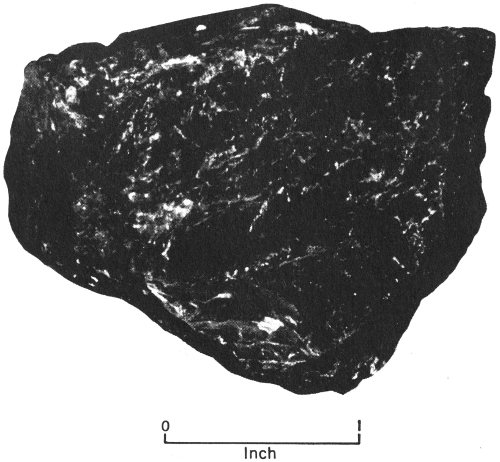
Talc schist from the Allamoore area of Hudspeth County, Texas.
Deposits of soapstone, containing talc, occur in the Llano uplift area of central Texas with schist, gneiss, and serpentine 94 rocks in northeastern Gillespie, northwestern Blanco, and southern Llano counties. Smaller deposits occur in northeastern Mason County and in northwestern and southeastern Llano County.
The Llano uplift area soapstones are light green to light buff. It is thought that some of them were once igneous rocks that contained magnesium minerals. Fluids, along with great heat and pressures below the earth’s surface, changed these igneous rocks into soapstone.
Some of this Llano uplift area soapstone is mined from open pits near Willow City in Gillespie County. It is used mostly in making insect powders and roofing granules. In addition, some of the central Texas soapstones have been used for hearths and for fireplace linings.
Topaz
Topaz, an aluminum fluorosilicate, is a mineral especially prized by collectors because many specimens are gemstones. Topaz is transparent, has a glassy luster, and is quite hard (neither quartz nor a steel file will scratch it). The topaz that has been found in Texas is either colorless, pale blue, or sky blue. This mineral is fairly heavy—its specific gravity is 3.4 to 3.6. It cleaves perfectly in one direction (called basal cleavage), and some of the cleavage fragments have a flat, slabby appearance.
Topaz is commonly found as prism-shaped crystals, as cleavage fragments, and as irregular grains. Some fragments of topaz look like quartz. Topaz, however, is harder and heavier than quartz, and it has perfect basal cleavage, which quartz does not have.
In Texas, crystals, grains, and cleavage fragments of topaz occur in the Llano uplift area of central Texas. They are found near Streeter and Grit in west-central Mason County and near Katemcy in northern Mason County. Here, some of the topaz occurs in Precambrian pegmatite veins that cut through granite rocks. Most of the topaz, however, is found as pebbles in the gravels of nearby creeks, where it has washed after weathering out of the rocks.
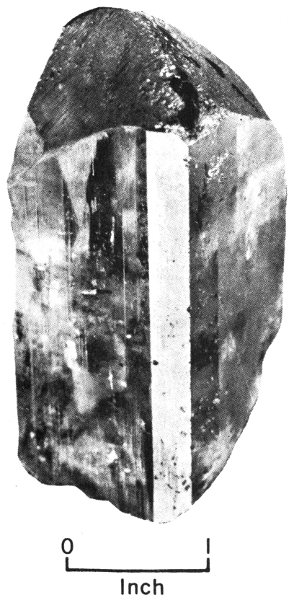
Topaz crystal from near Streeter, Mason County, Texas.
Topaz probably originates when hot fluids move up out of molten magma into cracks and cavities in the surrounding rocks. There, the fluids react with elements in the rocks to form the topaz.
Topaz is a good gemstone because, in addition to its beauty, it is hard and is not easily marred by scratches. The Mason County topaz makes excellent gemstones. Most of it is beautiful and clear and is either colorless or of a pleasing blue color. These stones are cut, polished, and mounted in rings and other jewelry. A number of specimens of this Mason County topaz are displayed in museums.
Tourmaline
Tourmaline is a complex silicate of boron and aluminum. Other elements, such 95 as magnesium, sodium, lithium, calcium, iron, or fluorine, also may be present. This mineral has a glassy to resinous luster. Only the dark-colored varieties of tourmaline have been found in Texas. One is a black variety called schorl, and another is a brown variety called dravite. Other kinds of tourmaline, although not found in Texas, are colorless or some shade of blue, yellow, red, pink, or green. Some crystals even show more than one color.
Tourmaline is too hard to scratch with a steel file, it has a specific gravity of 3 to 3.25, and it has a conchoidal to uneven fracture. Very little light passes through the dark varieties, and some fragments of schorl look like shiny, black coal.
Tourmaline occurs as masses without crystal shapes, but crystals are commonly found. The crystals are prism-shaped and have small vertical grooves, called striations, on the prism faces. When you look at some crystals from an end, you will see that the cross section is a triangle with the sides bowed outward.
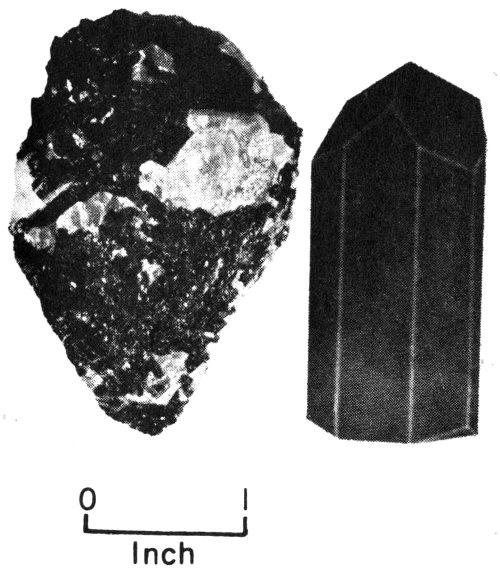
Black tourmaline crystals with milky quartz from north of Llano, Llano County, Texas.
Both the black and the brown varieties of tourmaline have been found at several places in the Llano uplift of central Texas. One well-known locality is at Town Mountain north of Llano in Llano County. Here, the tourmaline occurs in milky quartz that is associated with Precambrian granite rocks. In west Texas, in Culberson and Hudspeth counties, black tourmaline occurs in pegmatite rocks in the Van Horn Mountains, the Carrizo Mountains, and the Wylie Mountains. In the Eagle Mountains of Hudspeth County, it is found in metamorphic rocks as well as in pegmatites.
Some tourmaline formed from hot fluids containing boron that were given off by magmas far below the earth’s surface. These fluids traveled up through cracks and other openings in overlying rocks. As the fluids reacted with other elements and compounds, the tourmaline formed.
The clear, light-colored varieties of tourmaline are much admired, and they are more widely used as gemstones than are the dark-colored varieties. Some collectors, however, find that the dark-colored Texas tourmalines, when cut and polished, make shiny, attractive gemstones.
Some tourmaline is used as grinding material, but no Texas tourmaline is produced for this purpose.
Travertine. See Calcite.
Uranium Minerals (Carnotite, Uranophane, Pitchblende)
In 1945, the world suddenly became aware of the awesome power of atomic energy when the element uranium was used to produce some of the first atomic bombs. Uranium does not occur alone in nature but is found combined with other elements in a number of minerals.
All of the uranium minerals are radioactive. The uranium they contain is gradually breaking down and changing into a series of 13 other elements, called daughter elements. Each daughter element breaks down and changes into the next daughter element of the series. While breaking down, these elements give off particles and rays of energy.
This energy or radioactivity is made up of what are called alpha particles, beta particles, and gamma rays. You cannot see, hear, taste, smell, or feel them. The 96 alpha and beta particles are weak and do not travel far. The gamma rays, however, can travel farther and can pass through seemingly solid material. Scientists have found that these rays can move through about 1 foot of rock, 2½ feet of water, and several hundred feet of air.
Prospectors searching for uranium minerals carry instruments that are able to detect this radioactivity. The uranium itself gives off only alpha particles, but some of its daughter elements give off gamma rays. These daughter elements are normally found with the uranium, and it is their strong gamma rays that the instruments are most apt to detect.
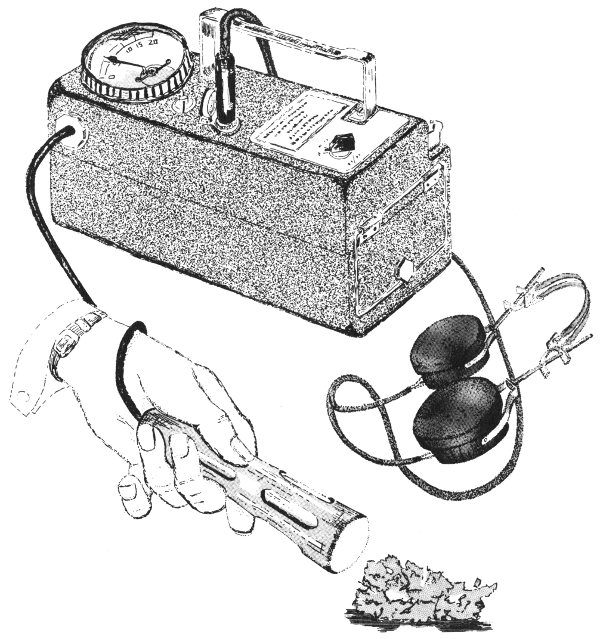
A Geiger counter is used to detect radioactivity.
One of the instruments used is the Geiger counter. It indicates radioactivity by means of a meter, a flashing light, or a clicking sound, which can be heard through earphones. Another instrument for detecting radioactivity is the scintillation counter. It is more sensitive than the Geiger counter and it can detect radioactivity from a greater distance. The scintillation counter can be used from an automobile or an airplane, but the Geiger counter must be quite 97 close to the source of radioactivity to be of use.
Various uranium minerals have been found, mostly in small amounts, in a number of places in Texas. Some of these minerals, such as uraninite or pitchblende, are heavy and dark colored. Others, including carnotite, tyuyamunite, autunite, and uranophane, are a shade of yellow or green. They are quite soft. Deposits of the light-colored uranium minerals have been mined from two areas of Texas. One of these areas is in Garza County on the Texas High Plains, and the other is in Karnes and Live Oak counties in the Gulf Coastal Plain.
One of the light-colored uranium minerals, carnotite, is a potassium-uranium vanadate, which has a bright canary-yellow or lemon-yellow color. This mineral is transparent to translucent and has an earthy or a pearly luster. Carnotite usually is found as crusts and as powdery masses. It is quite soft and can be scratched with a fingernail.
Carnotite, along with tyuyamunite, autunite, and several other soft, yellowish or greenish uranium minerals, is found in the Texas Gulf Coastal Plain. These minerals occur in the Jackson, Catahoula, and Oakville strata (which are Tertiary in age) in an area extending from Gonzales County to the Rio Grande (in parts of the area indicated by no. 2 and no. 3 on the geologic map, pp. 4-5). The largest deposits in this district have been found in the Karnes County area.
The Gulf Coastal Plain uranium minerals occur mostly with sandstones and clays in a sequence of strata that contains volcanic ash. It is believed that small scattered amounts of uranium compounds that were present in the volcanic ash sediments were dissolved by seeping underground water. These waters then moved into the sandstones and clays where they deposited the uranium as carnotite and as other uranium minerals.
Another uranium mineral, uranophane (calcium-uranium silicate), also occurs in Texas. Uranophane has a yellow to yellow-orange color and a pearly to greasy luster. When rubbed across a streak plate, it leaves a light yellow to a light yellow-orange streak. It is soft enough to be scratched by a copper penny. Uranophane has been found in extrusive igneous rocks in northwestern Presidio County in west Texas.
A dark-colored uranium mineral, pitchblende, is a variety of the mineral uraninite, uranium dioxide. Pitchblende does not occur with a crystal shape but rather as rounded and irregular-shaped masses. It is brownish black, greenish black, or black. If you rub it across a streak plate, pitchblende leaves a brownish-black streak. This mineral is heavy (it has a specific gravity of 6.5 to 8.5) and hard (a pocket knife will not scratch it, although a steel file will). Pitchblende has a submetallic luster and looks dull, greasy, or like pitch or tar.
Small amounts of pitchblende have been found at several places in Texas. One of these localities is a few miles west of Burnet in Burnet County in central Texas. Here, the pitchblende occurs in Precambrian igneous rocks that are associated with gneiss. In south Texas, some fine, scattered particles of pitchblende have been found about 325 feet below the surface in Tertiary (Pliocene) sediments that cover the Palangana salt dome in Duval County. No pitchblende is mined in Texas.
Uranophane. See Uranium Minerals.
Vitrophyre. See Obsidian and Vitrophyre.
Volcanic Ash (Pumicite)
Volcanic ash deposits, which also are known as pumicite, are loose and powdery. They are made up mostly of material that is thrown into the air when volcanoes erupt. If a volcano erupts with a violent explosion, the nearby rocks are blown into powder. Molten lava also is hurled into the air, where some of it immediately cools to become tiny bubbles and particles of glass. The winds may carry some of this fine material far away before depositing it.
Deposits of volcanic ash are white, 98 bluish, greenish, yellowish, or grayish, and some of them glisten like snow in the sunlight. They feel rough and gritty. When examined under a microscope, this material shows the tiny curved and sharp-cornered particles of the broken volcanic glass. Deposits of volcanic ash may also contain clay, silt, sand, or other impurities.
Volcanoes, which may have been located in the Davis Mountains and in other areas of west Texas and in northern Mexico, erupted during Tertiary time. The volcanic ash that we find at the surface today in some of the Tertiary formations in Texas could have come from these volcanoes. Tertiary volcanic ash deposits occur in the Texas Gulf Coastal Plain (such as in Brazos, Fayette, Karnes, Polk, Starr, Trinity, and other counties) and in the Trans-Pecos country of west Texas.
Volcanic ash deposits of Quaternary (Pleistocene) age, which are less than a million years old, are found in a number of counties on the Texas High Plains. Farther to the east, ash deposits occur in Baylor, Dickens, Kent, and Wilbarger counties. This volcanic ash may have come from a volcano that erupted in northern New Mexico during Quaternary time.
Volcanic ash or pumicite has several commercial uses. Some is used to make pozzolan cement, and some is used in sweeping compounds, cleansing and scouring powders, and abrasive soaps. Pumicite has been mined in Dickens, Scurry, Starr, and several other counties of Texas.
Wad. See Manganese Minerals.
Wood Opal. See Opal.
99