DESCRIPTIONS OF SOME TEXAS ROCKS AND MINERALS
Reading edition
The pages that follow contain descriptions of Texas rocks and minerals. The descriptions are given in alphabetical order, except that related varieties are described together. For example, agate, amethyst, chert, flint, jasper, onyx, and chalcedony are discussed under quartz, because they are varieties of quartz. The descriptions include the properties of the rock or mineral that will help you identify it and also include information on where the rock or mineral can be found in Texas, some of its uses, and how it may have formed. The chart on page 99 lists chemical composition, specific gravity, and hardness of various Texas minerals.
Agate. See Quartz.
Agatized Wood. See Quartz.
Alabaster. See Gypsum.
Albite. See Feldspar.
Almandite. See Garnet.
Amethyst. See Quartz.
Amphibole Asbestos. See Asbestos.
Anhydrite
Anhydrite, calcium sulfate, is a rather soft mineral that you can scratch with a pocket knife, although not with a fingernail. It has a glassy or a pearly luster and is transparent or translucent. Most anhydrite is white, but impurities cause it to be grayish, bluish, or reddish. When rubbed across a streak plate, anhydrite gives a white streak. This mineral has an uneven fracture, and it cleaves in three directions that are at right angles to each other. It commonly occurs as rectangular cleavage fragments or as sugary crystalline masses.
Anhydrite resembles dolomite, limestone, or gypsum. You can use a hardness test to distinguish it from gypsum (anhydrite is harder) and an acid test to distinguish it from limestone and dolomite. A drop of dilute hydrochloric acid will fizz when you put it on limestone or powdered dolomite. On anhydrite, the acid does not fizz.
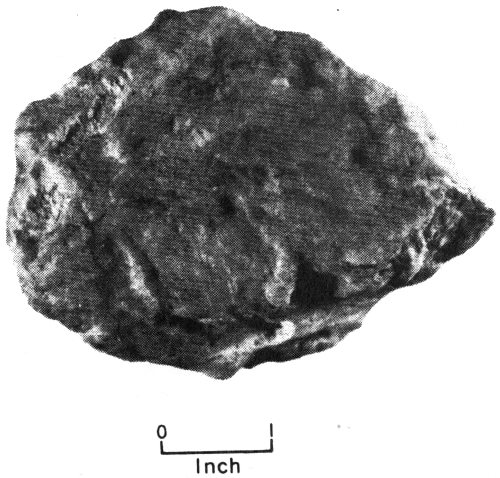
Massive anhydrite.
Anhydrite occurs at several places in Texas. It is, for example, seen in bluffs along the Double Mountain Fork and the Salt Fork of the Brazos River in north-central Texas. Most of the Texas anhydrite, however, occurs underground. In the Gulf Coastal Plain, the anhydrite is found below the surface in salt domes. (Salt domes are described with halite on p. 66 and with sulfur on p. 91.)
Another anhydrite locality is in the subsurface Permian basin of west Texas. Oil wells drilled in this basin penetrate great, thick deposits of massive anhydrite. The anhydrite was deposited during the Permian Period from a sea that covered this area. As the sea gradually evaporated, the mineral matter that was dissolved in it came out of solution to form anhydrite, halite, and several other minerals.
Antigorite. See Serpentine.
Argentite. See Silver Minerals.
Asbestos
Asbestos is not really any one particular mineral. It is the name given to several 44 minerals that occur in masses of slender, delicate fibers. In the more typical kinds of asbestos, these fibers—when pulled apart—resemble soft, fluffy, silk strings.
Several small deposits of amphibole asbestos have been found in the Llano uplift area of central Texas. This asbestos is a variety of the mineral tremolite, a calcium-magnesium silicate. It has fibers that break rather easily, and it has a silky luster. It is a shade of green or gray and gives a white streak when rubbed across a streak plate. When you pull its fibers apart, you actually are breaking the mineral along its two directions of perfect cleavage. This amphibole asbestos is softer than other varieties of the mineral tremolite—a copper penny scratches it easily.
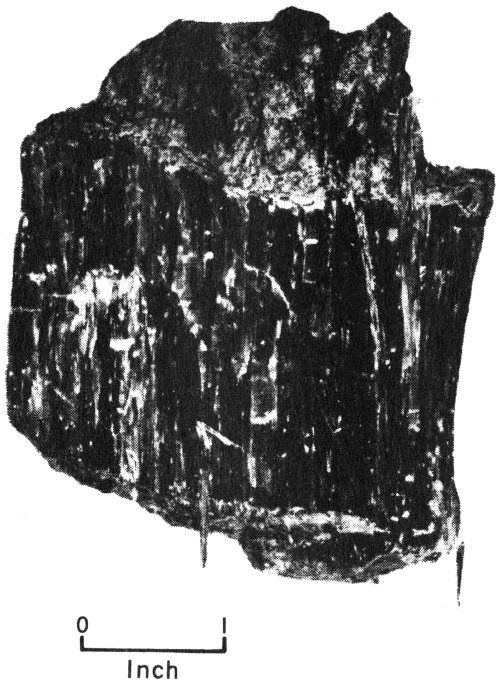
Greenish, silky amphibole asbestos from northeastern Gillespie County, Texas.
The asbestos occurs in veins in Precambrian metamorphic rocks in southern Llano County, northwestern Blanco County, and northeastern Gillespie County. These deposits are small.
A variety of the mineral serpentine called chrysotile asbestos is the kind most used by industry. Its fibers are commonly flexible enough and strong enough to be woven into cloth. This cloth is made into articles, such as fireproof suits, gloves, and theater curtains. Some chrysotile has been found in Precambrian metamorphic rocks in northwestern Blanco County, but it does not break into fibers fine enough or flexible enough to be called asbestos.
Azurite. See Copper Minerals.
Barite
Barite, barium sulfate, is a fairly common mineral in Texas. It has a glassy or a pearly luster, and it is transparent to translucent. Barite is colorless, white, brownish, bluish, yellowish, or reddish. When rubbed across a streak plate, it gives a white streak. It is not extremely hard—you can scratch it with a pocket knife, although not with a fingernail.
Barite is distinctive because of its weight and cleavage. It cleaves in three directions, and some cleavage fragments are flat or platy. For a mineral with a nonmetallic luster, barite is heavy—it has a specific gravity of 4.5.
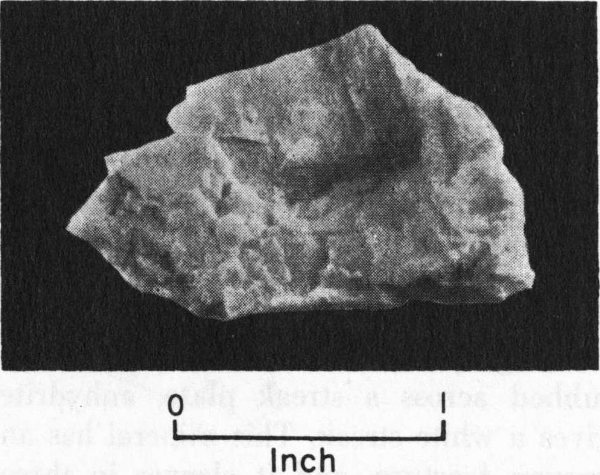
Barite cleavage fragment from west Texas.
Barite commonly occurs as prism-shaped and as flat crystals, as granular masses, as cleavable masses, and as rounded masses called nodules. In Texas, some of it was deposited in sedimentary rocks by underground waters. As the waters seeped through these rocks, mineral matter came 45 out of solution to form the barite. Some of the barite in Texas also formed from solutions that came from hot magmas.
A number of barite deposits have been found in Texas, but many of them are small. Barite occurs in Precambrian metamorphic rocks in Gillespie and Llano counties, in Pennsylvanian shale in Brewster County, in Permian shales in Baylor and Taylor counties, and in Permian limestones in Culberson County. It is found in Triassic red shales in Howard County and in Cretaceous sedimentary rocks in Brewster, Brown, Hudspeth, Jeff Davis, Kinney, and Val Verde counties. In Live Oak County, barite occurs in Tertiary bentonitic clays. Barite is being mined from a deposit in the Seven Heart Gap area northeast of Van Horn in Culberson County.
Barite is used in a number of ways. It is a source of barium chemicals, and it also is powdered and used as an ingredient in paint. The oil industry uses large amounts of barite. In drilling for oil by the rotary method, water and muds are pumped down the hole to aid drilling. Barite is added to these drilling fluids to make them heavy, since high-pressure gases are not as likely to blow heavy fluids out of the hole.
Basalt
Basalt is a heavy igneous rock that is black, dark gray, or dark brown. This rock is made up chiefly of a feldspar mineral, such as labradorite, and a pyroxene mineral, such as augite. Other minerals may be present.
The mineral grains of some basalts are so small that you cannot distinguish them even with a magnifying glass. Other basalts, however, are porphyritic, which means that they contain larger, easily seen crystals and grains of feldspar and pyroxene scattered either through a mass of the small mineral grains or through glassy material.
Some basalts contain many small holes. These holes, called vesicles, were formed when bubbles of gas were trapped in the hardening magma. Later, solutions moving through the rocks may have deposited another mineral—such as calcite or chalcedony—in some of the vesicles.
Basalt forms from molten rock material that hardens either on or beneath the surface—it can be extrusive or intrusive. Much of the basalt now found in the Trans-Pecos country of west Texas formed from lava that flowed out onto the surface during the Tertiary Period. A few of the places where basalt occurs in west Texas are the Chinati Mountains of Presidio County, the Chisos Mountains of Brewster County, the Davis Mountains of Jeff Davis County, and the Van Horn Mountains of Culberson and Hudspeth counties.
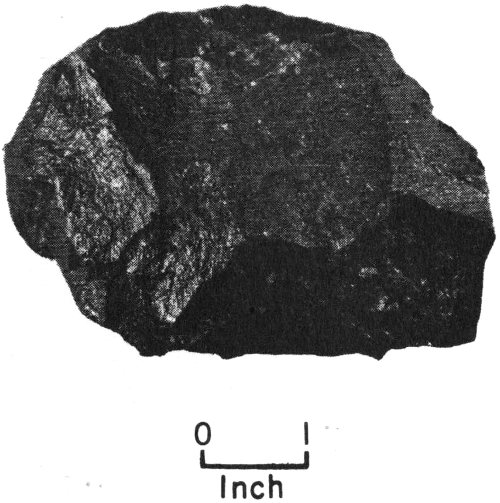
Basalt from Brewster County, Texas.
Several varieties of basalt occur in the Balcones fault region of Bandera, Comal, Hays, Kinney, Medina, Travis, and Uvalde counties. These basalts formed from molten magma that forced its way into rocks just below the earth’s surface.
Some basalt, which is known commercially as trap rock, is produced in Uvalde County. It is crushed and used for railroad ballast, road building material, and as concrete aggregate.
Bentonite. See Clay.
Biotite. See Mica.
Braunite. See Manganese Minerals.
46
Calcite
Calcite, calcium carbonate, is one of the most abundant minerals in Texas. It is the chief mineral in limestone and in some marble. It also serves as the cementing material in many sandstones. Crystals, grains, and cleavable masses of calcite, which have been deposited by underground water, occur in cracks and cavities in many of the igneous, metamorphic, and sedimentary rocks of Texas. Calcite also occurs as cave, spring, and stream deposits and as caliche.
Calcite is transparent or translucent, and—depending on the variety—its luster is glassy to earthy. Most calcite is white or colorless, but it can be a shade of pink, blue, green, brown, yellow, or gray. It gives a white streak when you rub it across a streak plate.
Two properties of calcite to notice are the hardness and the cleavage. This mineral cleaves perfectly in three directions that are not at right angles to each other, and some of the cleavage fragments are rhombohedrons. Calcite is rather soft—you can scratch it with a copper penny but not with a fingernail. A drop or two of dilute hydrochloric acid also will help you to identify this mineral. The acid will readily fizz and bubble when it is placed on calcite.
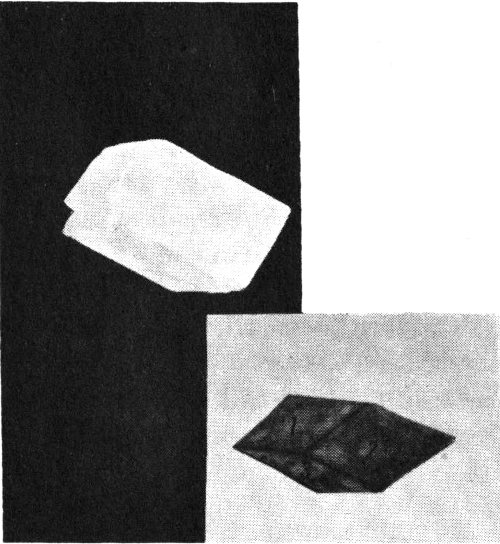
Calcite has perfect rhombohedral cleavage. The three directions of cleavage are not at right angles to each other.
Calcite occurs in more different kinds of crystal shapes than any other mineral. Some of these crystals are flat and tabular; some are rhombohedrons; some are prisms. Pointed crystals, called dog-tooth spar, and twinned crystals have been found in the Terlingua area of Brewster County in west Texas. A somewhat unusual occurrence of calcite crystals is in geodes. Some of these are found in Lower Cretaceous rocks west of Austin in Travis County.
Transparent crystals and cleavage fragments of calcite show a property called double refraction (other minerals show it, too). To test this property, you can mark a single dot on paper. When you look at the dot through a piece of clear calcite, you will see two dots instead of one. This happens because a ray of light is bent (refracted) and is split into two rays as it enters the mineral. These two rays travel through the calcite in slightly different directions, and each carries an image of the dot through the mineral. The two images that you see are at the points where the two rays leave the calcite.
Calcite that is deposited at springs, along river and creek banks, and in caves is known as travertine. Cave forms of travertine, including stalagmites and stalactites, occur in several caves in Texas. Another kind of travertine is called calcareous tufa or calcareous sinter. It is a porous and spongy-looking material deposited from water carrying dissolved limestone and is found around the openings of some springs and along some creek and river banks.
A dull, earthy calcite deposit, known as caliche, occurs in areas of Texas that have scant rainfall, such as the High Plains, west Texas, and the southwestern part of the Gulf Coastal Plain. Caliche commonly is found mixed with other materials, such as clay, sand, or gravel. This substance may be firm and compact or loose and powdery.
It is thought that caliche forms when ground moisture, containing dissolved calcium bicarbonate, moves upward. In dry 47 areas of the country, this moisture evaporates. As it does, it leaves a crust of calcium carbonate in the form of caliche on or near the surface of the ground.
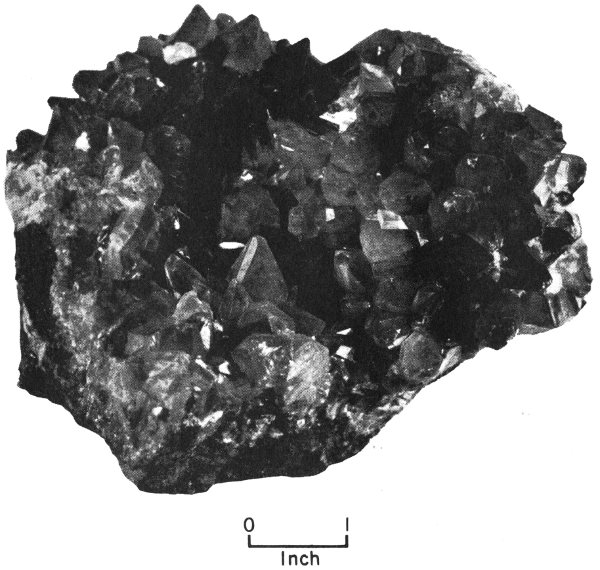
Calcite crystals (dog-tooth spar) from the Terlingua area of Brewster County, Texas.
Caliche is quarried in many counties in Texas and is used chiefly as road material and as an aggregate.
Caliche. See Calcite.
Carnotite. See Uranium Minerals.
Cassiterite
Cassiterite, tin dioxide, is the mineral that serves as the chief source of tin. Tin does not corrode and tarnish, and one of its main uses is in the making of tin cans. (Actually, our tin cans are made from thin sheets of steel that have been coated with a protective layer of tin.)
Cassiterite has either a nonmetallic or a submetallic luster. Some specimens are brilliant and shiny; others are dull. Cassiterite may be translucent to transparent. It may be black, brown, gray, reddish brown, or yellowish brown. When rubbed across a streak plate, this mineral leaves a pale brown, a pale yellow, or a white streak. Cassiterite is quite heavy—it has a specific gravity of 6.8 to 7.1. It is too hard to be scratched by an average pocket knife.
Sometimes, prospectors use a chemical test to help them identify cassiterite. They put small pieces of metallic zinc into a jar or test tube containing dilute hydrochloric acid. Then they add a few fragments of the mineral that they suspect is cassiterite. If the fragments are cassiterite, they become covered with a pale gray coating of metallic tin.
48
Cassiterite’s most common crystal shape is a short, 8-sided prism with pyramids at each end, but perfect crystals are not often found. Most Texas cassiterite does not show a crystal shape. Instead, it occurs as crystalline masses in igneous rocks and as loose pebbles that have weathered out of these rocks.
Cassiterite occurs in a number of places in the United States but not in large quantities. A small amount of cassiterite has been found in quartz veins in Precambrian granite in both central Texas and west Texas. In El Paso County, the cassiterite is found on the east side of the Franklin Mountains a few miles north of El Paso, where some of it has been mined. In central Texas, cassiterite occurs in the Streeter area of Mason County.
When the granite rocks in these areas were formed, probably not all of the hot magmas cooled and hardened at the same time. The fluids given off by the remaining magmas contained tin and several other elements. It is believed that these fluids moved up into cracks in the granite rocks and formed the cassiterite.
Celestite
Celestite is a strontium sulfate mineral. It is colorless, white, yellow, or gray. Light blue specimens of this mineral also are found, and it is because of this sky-like color that celestite gets its name. The word celestite comes from the Latin word caelestis, meaning of the sky.
Celestite has a glassy to a pearly luster, and it is either transparent or translucent. It gives a white streak when rubbed across a streak plate. Celestite has a specific gravity of 3.95 to 3.97. It is, however, lighter than barite, a mineral that it resembles. Celestite is not very hard—a knife will scratch it, although your fingernail will not. It cleaves in three directions, and some of the fragments are flat and slabby.
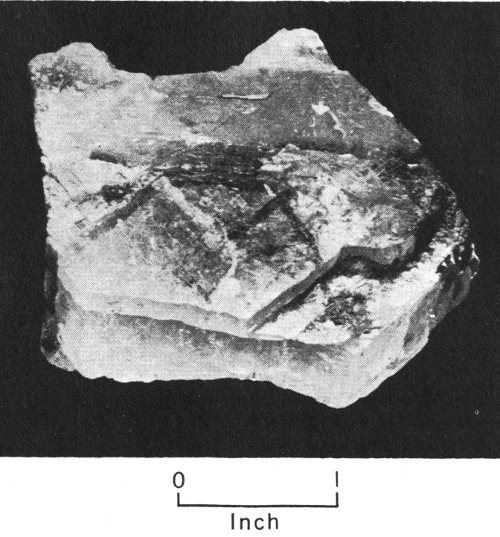
Celestite cleavage fragment from Lampasas County, Texas.
Celestite occurs commonly either as 49 prism-shaped or flat crystals and as cleavable, granular, or fibrous crystalline masses. In Texas, it is found in geodes, as rounded nodules, or as bedded or layer-like deposits in limestones and other sedimentary rocks. In Real County, celestite occurs on the walls of a cave in Cretaceous limestone.
Some celestite may be deposited by sea water, but much of the Texas celestite is believed to have been deposited by underground water that seeped through cracks and pores in the limestones and other sedimentary rocks. This water picked up and dissolved strontium compounds that were scattered in small amounts through the rocks. Then, it re-deposited the strontium in the rocks as celestite.
In Texas, beds of celestite occur in Permian rocks in Coke, Fisher, and Nolan counties and in Lower Cretaceous rocks in Brown, Comanche, and Mills counties. Celestite geodes and nodules are found in Lower Cretaceous limestone rocks in Lampasas, Travis, and Williamson counties, and in Permian rocks in Coke, Fisher, Nolan, and Taylor counties.
Celestite is one of two minerals (the other mineral is strontianite, strontium carbonate) used as a source of strontium. Strontium compounds give a crimson-red color to a flame, so they are used in fireworks, tracer bullets, and flares. Perhaps you have seen a red flare set out on the highway at night to warn motorists that a truck has stalled. The chances are good that the flare’s red flame was due to a strontium compound. Some of the Texas celestite has been mined, but most of the strontium minerals now used in the United States are imported from England and Mexico.
Cerargyrite. See Silver Minerals.
Chalcedony. See Quartz.
Chalcocite. See Copper Minerals.
Chalcopyrite. See Copper Minerals.
Chalk. See Limestone.
Chert (Flint). See Quartz.
Chrysotile. See Asbestos; Serpentine.
Cinnabar
Cinnabar, which is mercuric sulfide, is the most common mercury mineral. It has a dark red or a bright yellowish-red color and is transparent to translucent. When rubbed across a streak plate, it leaves a dark red streak. If pure, cinnabar has a brilliant, shiny, nonmetallic luster. It is, however, commonly found mixed with impurities, such as clay, calcite, iron oxide, or bituminous material, and then it looks dull and earthy. Cinnabar is quite heavy—it has a specific gravity of 8.10. It is rather soft, and you can scratch it with a copper penny.
Some prospectors use a quick chemical test to identify cinnabar. They rub a clean, shiny copper coin with a mineral sample that has been moistened with a drop or two of dilute hydrochloric acid. If the sample is cinnabar, a light silvery-gray coating appears on the coin.
Cinnabar occurs as small crystals or as fine-grained or compact crystalline masses. It is found in veins that fill cracks in rocks and also occurs as crusts and coatings on rocks. It also may be widely scattered through rocks, such as limestones.
Cinnabar occurs in the Terlingua area of Brewster and Presidio counties in west Texas. It has been mined there, off and on, since about 1894, and during this time, mercury worth many millions of dollars has been produced.
Most of this west Texas cinnabar is found in cracks, pores, and breccia-filled cavities of Cretaceous limestones and clays. If you will look at the Texas geologic map (pp. 4-5), you will see that igneous rocks occur in this district. Many millions of years ago during the Tertiary Period, when these igneous rocks were still hot magma, some of them pushed up under the Cretaceous rocks and emitted fluids containing mercury. The fluids moved upward through cracks and pores in the Cretaceous 50 rocks where they deposited the mercury as cinnabar and as other mercury minerals.
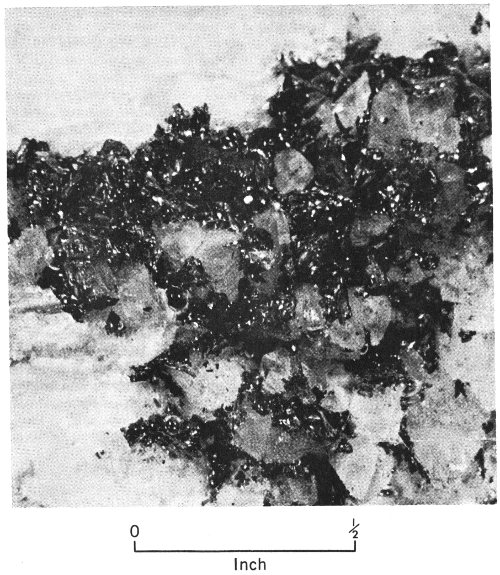
Cinnabar crystals (dark) with calcite crystals (white) from the Terlingua area of Brewster County, Texas.
Mercury is an unusual element. Instead of occurring as a solid metal at ordinary room temperatures, as do gold, silver, and lead, it remains a liquid until it is cooled to 38 degrees below zero Fahrenheit. Because the silvery little drops of liquid mercury roll about as if they were alive, this element long has been called quicksilver.
Mercury is used in a variety of ways. In some noiseless light-switches, a glass tube containing a small ball of mercury tilts when the switch is turned “on.” The mercury then rolls to the end of the tube that contains electrical contacts and quietly completes the electrical circuit. In other uses, mercury is added to silver, tin, and other metals to make fillings for teeth. Some medicines, such as calomel and mercurochrome, contain mercury. Fulminate of mercury helps to set off dynamite and other explosives. Mercury is used in many barometers and thermometers, and farmers use mercury poisons to control insects and fungi.
51
Mercury also commonly is used to obtain gold from its ores. One method of accomplishing this is to pass wet gold-bearing gravel or crushed rock over metal plates that are coated with mercury. The gold particles quickly mix with the mercury to form an amalgam, which later can be scraped off the plates. The gold is then recovered by heating the amalgam to drive off the mercury.
Clay
Clay is a smooth, soft, earthy rock made up of mineral particles no bigger than specks of dust. Some of the particles are clay minerals, which consist of aluminum, silicon, and other elements. In addition, tiny particles of quartz, calcite, and other minerals may also be present in the clay.
The clay particles are all that remain of rocks and of minerals, such as feldspar, that have been broken into fragments or altered into clay minerals by weathering. Some clay remains at the place where it formed, but some is carried away and deposited elsewhere.
Clay is white, tan, brown, red, green, blue, gray—almost any color. When moist, it has an earthy odor. You can moisten a piece of clay enough to notice this just by breathing on it. Most clays, when wet, can be molded into many different shapes—that is, they are plastic, but when they are dry, they are firm and solid.
Clay is abundant in Texas and has a number of uses. Some goes to make portland cement, and some is baked or burned in a kiln to make brick, tile, sewer pipes, pottery, and other products. This kind of clay is obtained from Tertiary formations of the Gulf Coastal Plain, from Upper Cretaceous formations in central Texas, and from Pennsylvanian formations in north-central Texas. (You can locate Tertiary, Cretaceous, and Pennsylvanian rocks on the Texas geologic map, pp. 4-5.)
A special kind of white burning clay that can be used to make chinaware is called kaolin or china clay. It contains particles of the clay mineral kaolinite as well as several other clay minerals. Deposits of china clay occur in southern Jeff Davis County and in Real County near Leakey, but none is being produced.
Another kind of clay, bentonite, forms from weathered volcanic ash. Bentonite contains the clay mineral montmorillonite and looks smooth and soap-like. Fresh samples of this clay are white, pale green, or pale blue, but dried-out or weathered samples are tan, brown, yellow, or reddish. When wet, bentonite absorbs water, swells, and then has a jelly-like appearance.
Surface deposits of bentonite occur chiefly in Eocene Tertiary formations of the Gulf Coastal Plain, in Cretaceous formations of the Big Bend area of west Texas, and in Quaternary formations of the High Plains.
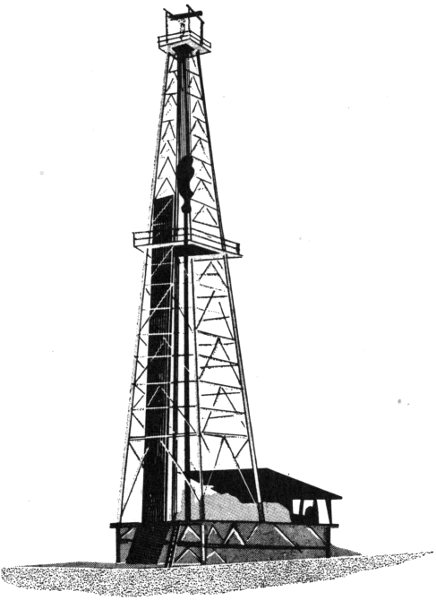
Bentonite is used as a drilling-fluid additive in the rotary method of drilling for petroleum and gas.
Some bentonite is used to absorb unwanted coloring material in petroleum and in vegetable oils. It is then known as a bleaching clay. Bentonite bleaching clay is obtained from some of the Tertiary formations along the Texas Gulf Coastal Plain. 52 It has been produced in Angelina, Fayette, Gonzales, Jasper, Walker, and other counties in this area.
Another important use of bentonite, and of other clay, too, is as drilling mud. In the rotary method of drilling for oil and gas, mud is pumped down into the drilled hole. This mud carries the rock cuttings up to the surface, it cools the drilling tools, and it coats and seals the walls of the hole. Along the Gulf Coastal Plain, drilling clay is obtained from Tertiary formations.
Common Opal. See Opal.
Copper Minerals (Chalcocite, Chalcopyrite, Malachite, Azurite)
A number of minerals containing copper, such as chalcocite, chalcopyrite, malachite, and azurite, occur in small deposits in Texas. They are found chiefly in the Llano uplift area of central Texas, in the Van Horn area of Culberson and Hudspeth counties in west Texas, and in a group of counties in north-central Texas.
Copper is an important element. Because it is an unusually good conductor of electricity (only silver, which costs much more, is a better one), it is used for many kinds of wires for switchboards, generators, motors, telephone and telegraph equipment, and light and power lines.
Manufacturers commonly combine copper with other elements. For example, some copper is mixed with zinc to make brass and with tin and a little zinc to make bronze. These mixtures are called alloys. Many products are made from copper alloys, including tubing, pipes, jewelry, pots, and pans. Even our coins contain copper.
Sometimes, a prospector uses a chemical test to find out if copper is present in a mineral. First, he crushes a small sample of what he believes is a copper mineral (such as chalcocite, chalcopyrite, azurite, or malachite). He then puts the sample in a glass jar or test tube and pours in a small amount of dilute nitric acid (this acid, like hydrochloric acid, is poisonous). After the sample has dissolved in the acid, he adds enough ammonium hydroxide to make the solution alkaline. If the sample is a copper mineral, the solution turns a deep-blue color.
One of the copper minerals, chalcocite, copper sulfide, also is known as copper glance. It is a metallic mineral that commonly tarnishes to a dull black. By chipping off a fragment to obtain a fresh surface, you will see that it has a shiny lead-gray color. Chalcocite is rather soft, and it is sectile, that is, a knife will cut through it as well as scratch it. When you rub chalcocite across a streak plate, it gives a grayish-black streak. This mineral commonly occurs as compact masses or as granular masses.
Chalcocite, with its dark color, does not look at all like copper, which is a bright reddish brown. Chalcocite, however, is the chief copper mineral at the most important copper mine in Texas, the Hazel mine, which is about 15 miles northwest of Van Horn in Culberson County in west Texas. This mine, although now idle and almost filled with water, has produced about one and a half million pounds of copper along with more valuable silver ores. Here, the chalcocite and other minerals occur in material that fills large cracks in red sandstone of the Precambrian Hazel Formation. It is thought that long ago, molten igneous rock material far below the surface sent out hot solutions containing copper and other elements. These solutions moved upward and deposited minerals in the fracture zone in the sandstone.
Chalcocite occurs also in north-central Texas. It is found in Archer, Baylor, Clay, Foard, Hardeman, King, Knox, Stonewall, and several other counties of this area. Here, it occurs in Permian sedimentary rocks (called “red beds”) as rounded masses, as scattered grains, and as petrified wood. Because these deposits are far from any igneous rocks, they apparently did not form in the same way as those at the Hazel mine. These north-central Texas deposits have never really been commercially developed. During the Civil War, however, some copper from this area was made into percussion caps for the Confederacy.
53
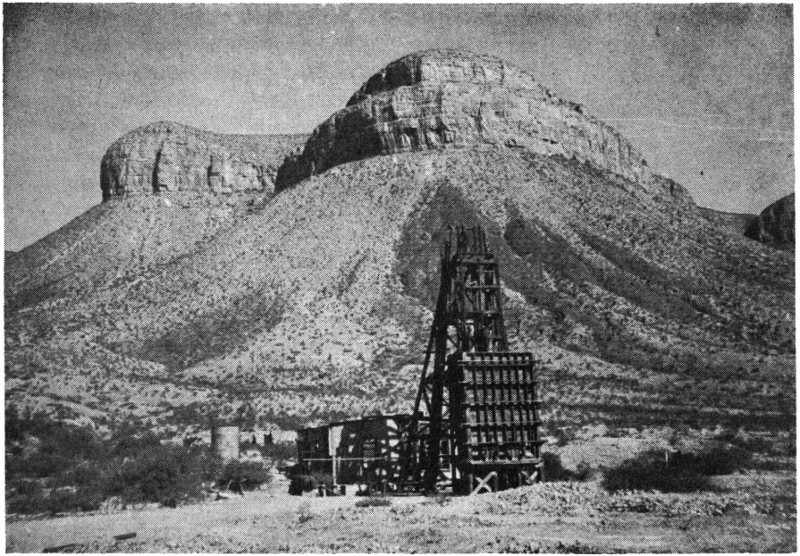
The Hazel copper-silver mine, Culberson County, Texas, as it appeared in 1951. Photograph by P. T. Flawn.
Another copper mineral, chalcopyrite, is a copper-iron sulfide. It also is known as copper pyrites and yellow copper ore. This mineral has a metallic luster and a brass-yellow or a golden-yellow color. When rubbed across a streak plate, it gives a greenish-black streak. Chalcopyrite will tarnish and then has bronze, blue, purple, and other rainbow-like colors. This mineral is fairly soft—you can scratch it with a pocket knife. Because of chalcopyrite’s yellow color, it has often been mistaken for gold. For this reason, it, like iron pyrite, is often called fool’s gold. (See Gold, p. 60, for ways to tell them apart.)
Chalcopyrite commonly is found in compact masses that show no crystal shapes. These masses either are scattered through rocks or occur in material that fills cracks in rocks.
Some chalcopyrite is found in Precambrian sandstone at the Hazel mine and in other deposits in the Van Horn area of Culberson and Hudspeth counties. It also occurs in Precambrian rocks at the Sheridan and Pavitte prospects in Burnet County. These chalcopyrite localities are in districts where igneous rocks occur.
It is likely that, long ago, hot solutions containing copper moved upward, out of deeply buried molten magma. While still far below the surface, the solutions deposited the chalcopyrite in cracks and other openings in the nearby rocks.
Two copper minerals of Texas, azurite and malachite, are copper carbonates. Azurite is commonly called chessylite and blue copper; malachite is called green copper carbonate. Because these minerals are carbonates, a drop of dilute hydrochloric acid will fizz and bubble when placed on either of them.
Azurite has a bright, intense blue color and leaves a blue streak when rubbed across a streak plate. Malachite has a bright green color and leaves a green streak. These minerals have a nonmetallic luster and a glassy to dull appearance. Commonly, they are translucent, although some specimens of azurite are transparent. Both azurite and malachite are fairly soft—a pocket knife will scratch them, but a copper penny will not.
Azurite and malachite occur as individual 54 crystals, but you are more likely to find them as crusts on rocks and on other minerals. Malachite is also found in rounded fibrous masses that resemble bunches of grapes (described then as botryoidal).
Both azurite and malachite are formed in the same way. Underground waters seep through rocks that contain deposits of copper minerals (such as chalcocite and chalcopyrite) and cause chemical reactions which change these minerals into malachite and azurite.
Malachite is more plentiful than azurite, but both minerals can be found together. You can expect to find at least one of them at the same localities where chalcocite, chalcopyrite, and other copper minerals occur.
Coquina. See Limestone.
Diatomite. See Opal.
Dolomite
Dolomite is the name given both to a rock and to a mineral. The mineral is a calcium-magnesium carbonate and has a glassy or a pearly luster. It is any of a number of colors, such as white, pink, brown, or gray, or it can be colorless. Dolomite leaves a white streak on a streak plate and is transparent to translucent. It is not particularly hard and can be scratched with a pocket knife, although not with a copper penny. Dolomite cleaves perfectly in three directions, and some of the cleavage fragments are rhombohedrons. However, the cleavages of the individual mineral grains in specimens of fine-grained massive dolomite are not readily distinguishable.
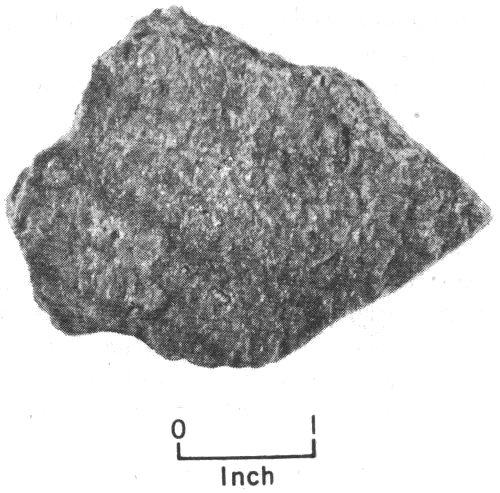
Dolomite rock from the vicinity of Fairland, Burnet County, Texas.
Most Texas dolomite occurs as coarse-, medium-, and fine-grained crystalline masses as the chief mineral in dolomite rock and in dolomitic marble. It is also found as 6-sided crystals that are rhomb-shaped; when the faces are curved, they have a saddle-like appearance.
Crystals of the mineral dolomite commonly occur in cavities in the dolomite rocks. It is believed that they were deposited there by seeping underground waters. The waters dissolved some of the dolomite in the rocks and then re-deposited it as crystals.
Dolomite rock is made up mostly of crystalline grains of the mineral dolomite. In addition, quartz grains, calcite, and other minerals may be present. Dolomite rock is almost any color—white, buff, pink brown, gray. It resembles some limestone, and these two rocks actually are closely related.
To help tell them apart, dilute hydrochloric acid often is used. A few drops of this acid will readily fizz and bubble if the rock you put them on is a limestone. If the rock is dolomite, the acid will effervesce only very little or not at all. (If, however, the acid is put on powdered dolomite, it then will fizz readily.) Dolomite is slightly harder than limestone, and it also is slightly heavier.
Some dolomite rocks formed directly from materials that were dissolved in sea water, and others are altered limestone rocks. Some limestones altered into dolomite on the sea floor by the addition of magnesium from the sea water. Others changed into dolomite much later after the sea had withdrawn and the limestones had become a part of the land; underground waters containing magnesium seeped 55 through these limestones and altered them into dolomite.
Many of the dolomite rocks are found with limestones. In Texas they occur mostly in Cambrian, Ordovician, Mississippian, Pennsylvanian, Permian, and Cretaceous formations. The geologic map (pp. 4-5) indicates where these strata appear at the surface in Texas.
Dolomite is abundant in the Llano uplift area of central Texas—particularly in the Cambrian and Ordovician rocks. A number of these central Texas dolomites have been quarried for use as building stones. Some of them also have been crushed and used as a road-building material and as a stone aggregate that is mixed with cement to make concrete. This dolomite is also used as terrazzo chips (terrazzo floors are described with serpentine on p. 88). In addition, Ellenburger (Ordovician) dolomite from Burnet County was used during World War II as a source of the lightweight metal magnesium.
Dravite. See Tourmaline.
Feldspar
Feldspar is the name given to a group of nonmetallic minerals that are much alike. Several of them are so similar that a petrographic microscope must be used to tell them apart. Each of the feldspar minerals is an aluminum silicate. Each of them contains, in addition, at least one of the following elements: potassium, sodium, calcium, and barium. The feldspar minerals that are found in Texas include albite, a sodium-aluminum silicate, and orthoclase and microcline, which are both potassium-aluminum silicates.
The feldspar minerals are transparent to translucent and have either glassy or pearly lusters. They can be white, cream, or a shade of red, brown, yellow, blue, gray, or green. When you rub a feldspar across a streak plate, it leaves a white streak. The feldspars are rather hard—a pocket knife will not scratch them, although a piece of quartz or a steel file will. These minerals have good cleavage in two directions. The cleavages meet at an angle of about 90°, so that the cleavage fragments have square corners.
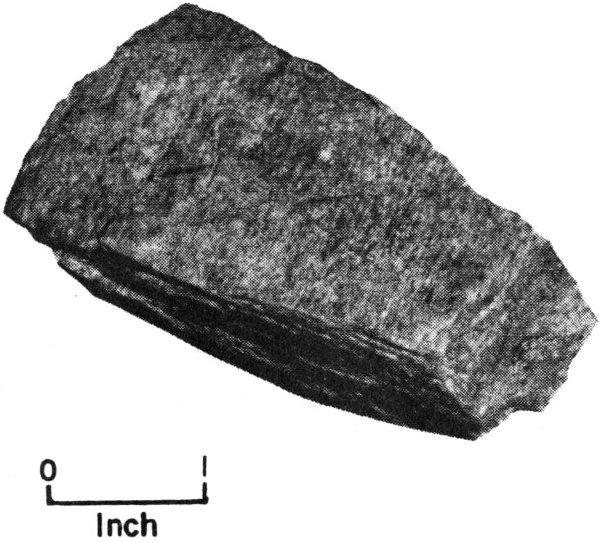
Feldspar cleavage fragment from Llano County, Texas. The two directions of good cleavage meet at an angle of about 90°.
The feldspars are important rock-forming minerals. You can find them in igneous rocks, such as granite or pegmatite, and in metamorphic rocks, such as gneiss. They also occur as fragments in sedimentary rocks, such as some sandstone and conglomerate.
Although the feldspars can originate in other ways, they form mostly from hot magmas that cool and crystallize into igneous rocks. These minerals occur in the rocks as grains, as cleavable masses, and as individual crystals. The crystals may be shaped like prisms, or they may be flat and slabby.
Good places to look for feldspars are in areas where granites, pegmatites, and other intrusive igneous rocks appear at the surface. The pegmatite rocks of Burnet, Gillespie, Llano, and Mason counties in the Llano uplift area of central Texas, and those of the Van Horn Mountains in Hudspeth and Culberson counties in west Texas, are especially good sources of feldspar. Large cleavable masses and crystals that are more than a foot long are found in some of these rocks.
The feldspars have a number of uses. Some of the pegmatite feldspars from Llano County in central Texas have been crushed 56 and used as granules for built-up and composition roofs. In addition, some have been shipped to Mexico for glass-making. Some of the other uses of feldspar are in making porcelain, ceramic glazes, and scouring compounds. A few of the feldspar minerals, such as the variety of microcline known as amazonstone, are used as gemstones.
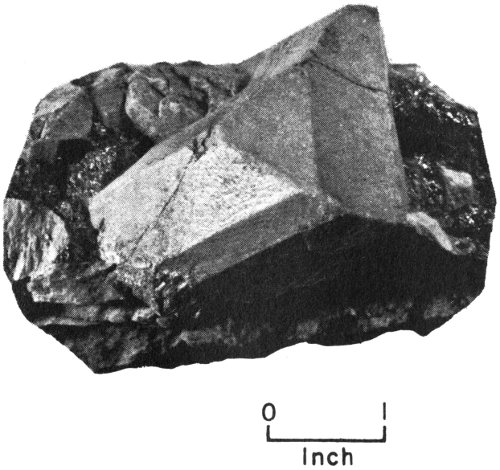
Microcline feldspar crystals from near Granite Shoals Lake, Llano County, Texas.
Fibrous Gypsum. See Gypsum.
Flint. See Quartz.
Fluorite
Fluorite is calcium fluoride. The fluorite that is mined and sent to market, however, commonly is found mixed with quartz, calcite, limestone, or other rocks and minerals. Industry calls this mixture fluorspar.
Fluorite is a transparent to translucent mineral that has a glassy luster. It may be colorless, or it may be white, pink, green, purple, brown, or blue. Some specimens show more than one color. When you rub fluorite across a streak plate, it leaves a white streak. This mineral is not particularly hard—a pocket knife will scratch it, although a copper penny will not. Fluorite has perfect cleavage in four directions. By carefully breaking a specimen, you can obtain cleavage fragments that are shaped like octahedrons.
Fluorite occurs as cleavable masses, as fine or coarse grains, and as crystals. Most of the crystals are cubes, but some may be octahedrons, dodecahedrons, or combinations of these.
Fluorite has been found both in west Texas and in central Texas. In the Llano uplift area of central Texas, it occurs in a number of Precambrian granite, pegmatite, schist, and gneiss rocks. The most important, although small, deposit in this area is near Spring Creek a few miles west of Burnet in Burnet County. Here, prospectors have dug holes and pits in gneiss and schist rocks and found layers of fluorite in them.
The largest known fluorite deposits in Texas (they are not particularly large when you compare them with the deposits in Illinois and Kentucky) are those in the Eagle Mountains of Hudspeth County. This fluorite occurs in both igneous and sedimentary rocks. Many years ago, probably during the late part of the Tertiary Period, hot magma far below the surface gave off liquids and gases containing fluorine. These fluids moved up through large cracks 57 (called faults) in Cretaceous limestones and Tertiary igneous rocks and deposited fluorite in them. In places, beds of limestone have been replaced by fluorite. Some of this west Texas fluorite has been mined and shipped to market.
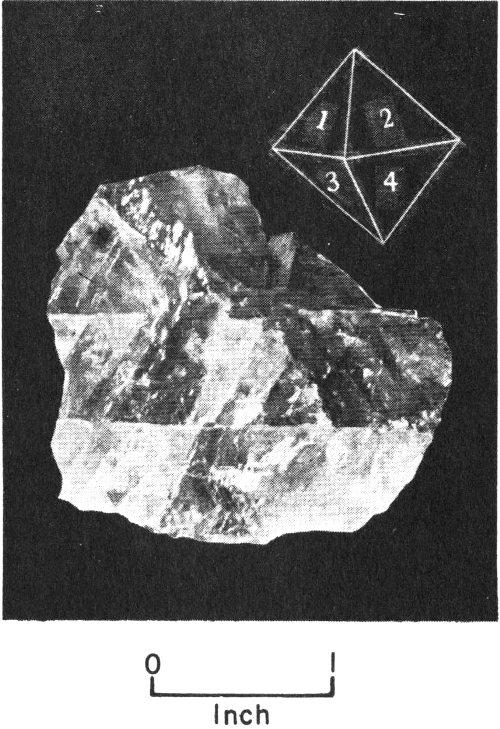
Fluorite has octahedral cleavage. The four directions of perfect cleavage can result in cleavage fragments that are octahedrons.
Fluorite is extremely important as a flux in steel-making to help the ingredients of the molten steel blend together. In addition, it combines with sulfur, phosphorus, and other unwanted substances so that they can be removed from the steel. Other important uses of fluorite are in glass-making and in the manufacture of hydrofluoric acid. This acid is used in the aluminum industry as well as in industries that make high-octane gasoline, insecticides, and refrigerants for refrigerators and freezers.
Galena
Galena, lead sulfide, is a shiny, lead-gray, metallic mineral that has a specific gravity of 7.4 to 7.6. It is soft enough to mark paper, and it leaves a grayish-black streak on a streak plate. This mineral cleaves perfectly in three directions, and the cleavage fragments have square corners—some are cubes.
Galena occurs as cleavable masses, as fine or coarse grains, and as crystals, most of which are cubes. Galena commonly is associated with other minerals; for example, some of the west Texas galena either contains some silver (then called argentiferous galena) or occurs with it. Sphalerite, a zinc mineral, is commonly found with galena.
Galena is an important mineral because it is the chief source of lead. Compounds of lead, called white lead, red lead, and litharge, are used as paint pigments. Automobile batteries contain lead plates, and tetraethyl lead is added to gasoline to keep the car’s motor from knocking. Some other uses of lead are in bullets, type metal, solder, and cable coverings.
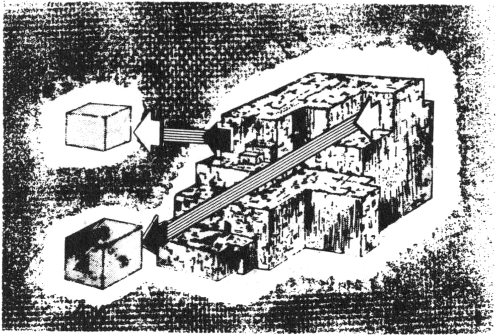
Galena has perfect cubic cleavage. The three directions of cleavage are at right angles to each other resulting in cubic cleavage fragments.
Galena has been found in several areas of Texas and has been mined in central and west Texas. None, however, has been produced in recent years. Most of the galena mined in west Texas was obtained from silver mines, where the galena was a by-product. Some of the west Texas galena deposits are at Altuda Mountain east of Alpine in Brewster County, in the Eagle Mountains and the Quitman Mountains in Hudspeth County, and in the Chinati Mountains and the Shafter area in Presidio County. Most of the mining has been 58 from the Shafter area (this area is described with silver minerals on p. 90).
In central Texas, several small galena deposits have been found in Blanco, Burnet, and other counties of the Llano uplift area. Some galena has been mined at Silver Creek in northwestern Burnet County. Here, galena occurs in cracks and as scattered grains in Cambrian limestones and sandstones.
It is probable that much of the galena in west Texas and in central Texas was formed when hot magma forced out solutions containing lead. These solutions moved up through cracks and other openings in the subsurface rocks and deposited the galena in them.
Small amounts of galena, which likely had a different origin, have been found in Fisher, Foard, Hardeman, and Young counties. A little occurs also in rocks associated with salt in a number of the Gulf Coastal Plain salt domes.
Garnet
Garnet is not one mineral but is the name given to a group of several minerals that are very much alike. In fact, it often is impossible to tell some of them apart without using special laboratory tests.
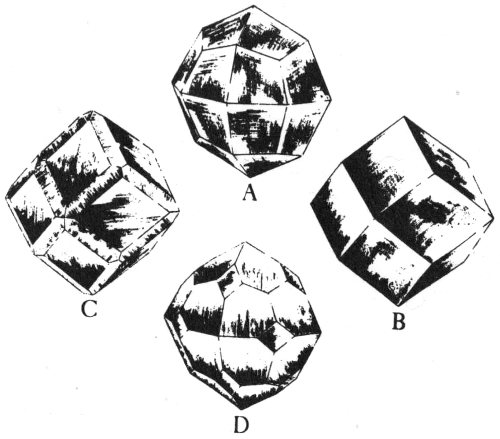
Garnet crystal forms include: A, trapezohedron; B, dodecahedron; C and D, combination trapezohedron and dodecahedron.
The garnet minerals have glassy to resinous lusters and are transparent or translucent. A pocket knife will not scratch them, and some specimens are too hard even for quartz to scratch. Two of the garnet minerals most commonly found in Texas are almandite, an iron-aluminum silicate, and grossularite, a calcium-aluminium silicate. Almandite has a deep-red or a brownish-red color. Grossularite is pale green, brownish yellow, cinnamon brown, or rose red.
Garnet minerals occur as crystals and as masses that are scattered through some of the metamorphic and igneous rocks. After they have weathered out of these rocks, the garnets make up a part of many sands and sandstones. Because these minerals so commonly occur as crystals, it is helpful to learn to recognize the crystal shapes.
Garnet minerals are found in the igneous and metamorphic rocks of both central Texas and west Texas. In central Texas, they occur in ancient Precambrian schist and pegmatite rocks of the Llano uplift area. Some of these central Texas garnet localities are in northeastern Mason County, central and northwestern Llano County, west-central Burnet County, and northeastern Gillespie County.
In west Texas, garnets occur in metamorphic rocks in the Quitman Mountains, which are southwest of Sierra Blanca in Hudspeth County, and in the Mica Mine area, which is south of Van Horn near the Hudspeth-Culberson County line. Garnets also have been found in igneous rocks in the Franklin Mountains a few miles north of El Paso in El Paso County.
Garnets that are found in metamorphic rocks such as schists were formed when great forces squeezed and heated rocks far below the earth’s surface. This heat and pressure caused elements in the rocks to join together into different combinations to form new minerals, such as garnets. Garnets that occur scattered through igneous rocks, such as some pegmatites and granites, cooled and crystallized from hot, igneous fluids when the rocks themselves formed.
Most Texas garnets are not transparent. A few, however, are clear enough to be used as gemstones. These can be cut, polished, 59 and mounted in rings, brooches, bracelets, and earrings. Although some garnet is widely used as an abrasive, none from Texas has been produced for this purpose.
Gneiss
Gneiss is a metamorphic rock that has parallel layers or bands. Some gneiss is made up of the same minerals (chiefly feldspar and quartz) as granite, and it is then called granite gneiss. Several of the other kinds of gneiss are known as mica gneiss, conglomerate gneiss, gabbro gneiss, and hornblende gneiss. In order to be a gneiss, a metamorphic rock has to have bands or layers. These bands may be either straight or wavy and either wide or narrow. In most gneisses, you will find a layer made up of long or flat mineral grains next to a layer made up of the grains of an entirely different mineral. The bands may show color differences, too. For example, a pink layer made up of feldspar grains may be found next to a black layer made up of hornblende grains. The mineral grains interlock as they do in igneous rocks, and they are generally large enough to be seen without a magnifying glass.
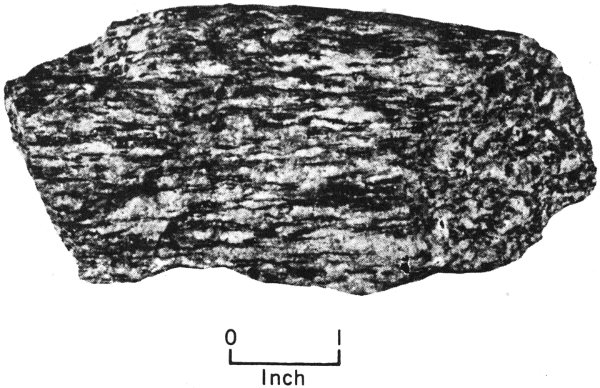
Gneiss from Blanco County, Texas, showing light and dark bands.
Gneiss can form from an igneous rock, such as granite, or from a sedimentary rock, such as sandstone. Heat, fluids, and pressures below the earth’s surface change these rocks into gneiss.
Gneiss that formed during Precambrian time is now seen at the surface in both west Texas and central Texas. In west Texas, it occurs principally in the Van Horn area of Culberson and Hudspeth counties. In central Texas, it is found in Blanco, Burnet, Gillespie, Llano, and Mason counties of the Llano uplift area.
One of the Llano uplift rocks is called the Valley Spring Gneiss. It generally has a light color (much of it is pinkish), and it is believed to have once been a sandstone. Another gneiss of this area, the Big Branch Gneiss, which has a medium to dark gray color, occurs in northern Gillespie and Blanco counties and is an altered igneous rock. Some of the Texas gneiss rocks are suitable for use as building stones.
Gold
Gold commonly occurs in nature as a single element—gold—but much native gold has a small amount of some other element, such as silver, copper, or iron, mixed with it.
Native gold is a shiny, yellow, metallic mineral that does not tarnish, and it leaves 60 a shiny, golden-yellow streak when you rub it across a streak plate. If silver is present, the color and streak have a lighter shade. Pure gold is extremely heavy—its specific gravity is 19.3. Because it is malleable, this mineral will flatten into a thin sheet when hammered. It is ductile enough to be drawn out into wires. Gold is also soft—a pocket knife will scratch it easily. When it is to be used for ornaments and jewelry, gold is usually mixed with other metal, such as silver, copper, nickel, or palladium, to make it harder. The amount of gold that is present is then indicated by carats (or karats). Pure gold is 24 carats. If you have a gold ring that has 14 K stamped inside it, you know that it is made of a mixture of 14 parts gold and 10 parts of other metal.
Gold commonly occurs in nature as plates, scales, or grains. Some of the grains are large enough to be called nuggets. It also is found in a wire-like shape described as filiform, it occurs in a network, called reticulate, and it can have a branching and fern-like shape, described as dendritic. Gold is not often found as individual crystals.
Several other minerals, such as pyrite, chalcopyrite, and mica, are sometimes mistaken for gold. None of these, however, is malleable and ductile, and none is nearly as heavy as gold. Pyrite and chalcopyrite have dark-colored streaks unlike that of gold. Mica cleaves so perfectly that it can be split into thin, flat sheets, but gold has no cleavage at all.
The best places to look for gold are in areas near igneous rocks and along the creeks and rivers that drain these areas. It is thought that most gold originally was carried up from molten igneous rock by hot solutions. The solutions moved into cracks and other openings in nearby rocks and deposited the gold, commonly along with quartz. Later, some of these gold-bearing rocks weathered away. The gold that the rocks contained either remained at the spot or was washed into creeks and rivers. These transported accumulations of loose gold are called placer deposits.
Placer gold in very small quantities has been found in some of the stream gravels of Texas.
No really important gold deposit has ever been found in Texas, although traces and small amounts have been reported in several areas. A little gold has been found in the Llano uplift area of central Texas. It occurs in quartz veinlets that cut through some of the Precambrian metamorphic rocks of Llano, Mason, northeastern Gillespie, and west-central Burnet counties. Many years ago, a small amount of gold was mined northeast of Llano in Llano County from the Heath mine. Some gold also has been found in sands and gravels along streams, such as along Sandy Creek and its tributaries, in parts of this Llano uplift area.
In the Trans-Pecos country of west Texas, small amounts of gold have been found in the Van Horn area of Culberson and Hudspeth counties, in the Quitman Mountains district of Hudspeth County, and in the country around Shafter in Presidio County. Most of the small quantity of gold that was mined in west Texas was obtained as a by-product from the Presidio mine in the Shafter district (described with silver minerals on p. 90).
Small amounts of gold have been reported from other parts of Texas. Some of these localities are in Eocene Tertiary sandstones in the Gulf Coastal Plain, in Cretaceous limestones in Irion, Uvalde, and Williamson counties, and in sand and gravel in Howard and Taylor counties. None of these deposits has been found to have any commercial value.
61
Granite
Granite is an intrusive igneous rock that is made up chiefly of crystalline grains or crystals of quartz and a feldspar mineral, such as orthoclase or microcline. Several other minerals, including mica and hornblende, may also be present.
All of the mineral grains in granite are about the same size, and you can distinguish them without using a magnifying glass. A granite may be coarse grained, medium grained, or fine grained. When you examine this rock, you will see that its grains are not cemented but interlocked like the pieces of a jigsaw puzzle. The color of granite, which is pink, red, gray, or brownish, depends chiefly on the color of its feldspar grains.
Most granites formed from hot, molten magma that slowly cooled and hardened far below the earth’s surface. Because of this slow cooling, fairly large mineral grains were formed.
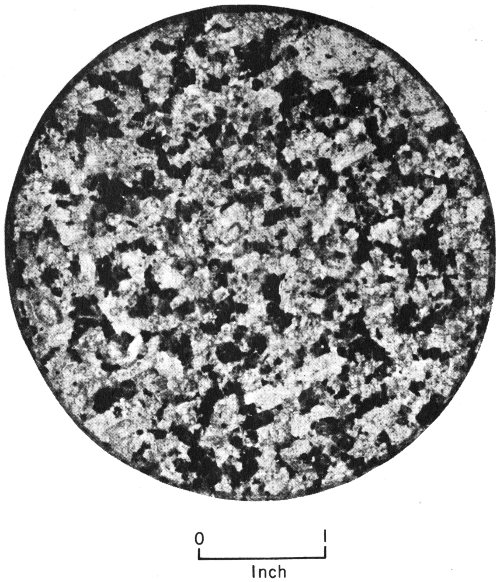
Polished section of pink granite from Gillespie County, Texas.
Granites are now seen at the surface in several areas of Texas. They were gradually uncovered as the areas became higher and the overlying rocks slowly weathered away. One of these areas is the Llano uplift of central Texas where the granites occur in Blanco, Burnet, Gillespie, Llano, and Mason counties. These granites formed during Precambrian time and are believed 62 to be about a billion years old. (Scientists are now able to determine the age of some rocks accurately by very precisely measuring the relative amounts of isotopes produced by decay of radioactive minerals.)

Texas State Capitol building at Austin is made of Burnet County granite obtained from Granite Mountain near Marble Falls, Texas.
Granites also appear at the surface in the Trans-Pecos country of west Texas. Some of these areas include the Franklin Mountains of El Paso County, the Quitman Mountains of Hudspeth County, the Chisos Mountains of Brewster County, and the Chinati Mountains of Presidio County.
Red, pink, and gray granites from quarries in the Llano uplift area are widely used as building stones and monument stones. A large quarry at Granite Mountain just west of Marble Falls in Burnet County has supplied pink granite for buildings in many parts of the United States. The Texas Capitol building and several other State buildings in Austin are made of this granite.
Graphite
Graphite is a mineral that is made up of a single element—carbon. (Diamond, although 63 it does not look at all like graphite, is a crystalline form of carbon.) Graphite is a steel-gray or black mineral that commonly has a metallic luster. It is not heavy and is extremely soft. Graphite will soil your fingers and leave a black mark on paper. This mineral cleaves perfectly in one direction and splits into thin flakes that feel greasy.
To help distinguish graphite from molybdenite, a mineral it resembles, you can use a shiny, glazed surface, such as is found on a saucer or a plate, to test its streak. When rubbed across this kind of surface, graphite will leave a black streak, but molybdenite will leave a greenish one.
Graphite commonly occurs as scales, as sheet-like layers, or as compact masses. It may be found mixed with clay or other impurities, and it then looks dull and earthy. Crystals of graphite, which are seldom found, are 6-sided and flat.
Graphite occurs in Llano, Burnet, and other counties in the Llano uplift area of central Texas. One of the Nation’s most important graphite mines is located in the Clear Creek area several miles northwest of Burnet in Burnet County. Some graphite has also been mined near Lone Grove in Llano County. In addition, a graphite schist, obtained south of Llano in Llano County, has been used as a filtering material.
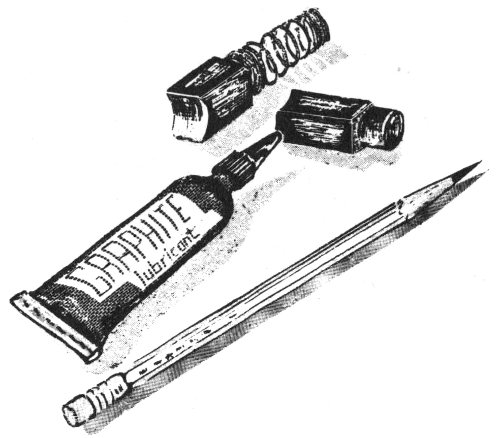
Graphite is used in pencil lead, generator brushes, and lubricants.
All of this graphite occurs in extremely old Precambrian graphite schist rocks that we now see at the surface in this part of Texas. It is believed that the schists were once ancient sedimentary rocks, such as shales, which contained organic matter. Long ago, great forces below the earth’s surface altered these rocks. When this happened, the organic material that they contained changed into the mineral we know as graphite.
Graphite has a number of uses. It is mixed with clay to make the pencil lead that we use for writing. It serves as a lubricant, either alone or mixed with oil, grease, or water. In addition, graphite is used to make generator brushes, stove and shoe polish, and special paints. Because it can stand great heat without melting, some graphite is mixed with clay to make the pots or crucibles that hold molten metals.
Grossularite. See Garnet.
Gypsite. See Gypsum.
Gypsum
Gypsum is a hydrous calcium sulfate. This mineral is normally colorless or white, but impurities cause it to appear gray, brownish, yellowish, or reddish. It is transparent or translucent and is not heavy. When you rub gypsum across a streak plate, it leaves a white streak. This mineral is so soft that a fingernail scratches it easily. Gypsum occurs in several varieties.
The colorless, glassy, and transparent variety of gypsum is called selenite. It is found as cleavable masses and as crystals that are prism-shaped or flat and diamond-shaped. It is not uncommon for two crystals to be joined together so that they have a swallow-tail shape—these crystals are twinned. Groups of flat selenite crystals arranged together so that they resemble flowers are called rosettes. Many of these have been found in Nolan County.
Gypsum has four directions of cleavage. One of these directions is so perfect that some selenite splits into thin, clear sheets that may be mistaken for mica; other selenite cleavage fragments may be mistaken 64 for calcite. You can distinguish selenite sheets from calcite by testing their hardness (selenite is softer) and by putting a drop or two of dilute hydrochloric acid on them. The acid will fizz and bubble on calcite but not on the selenite gypsum. There is also a quick way to distinguish the thin selenite cleavage fragments from mica. After you carefully bend a thin sheet of mica, it will snap back to its original shape without breaking. Selenite gypsum, however, is not elastic. It will bend, but it will break if you try to straighten it again.
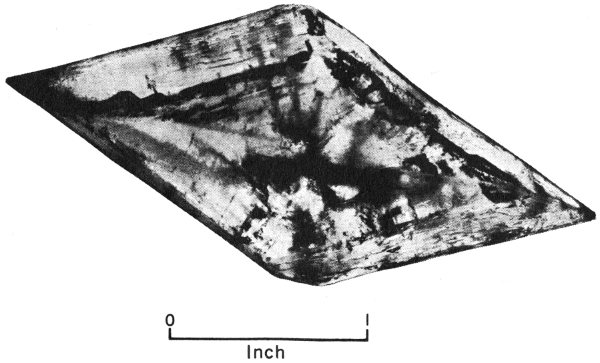
Selenite gypsum crystal from Bastrop County, Texas.
Selenite is found in cracks and cavities in rocks. Good crystals have been collected at Gyp Hill, a salt dome southeast of Falfurrias in Brooks County, and some selenite has been mined there. Selenite crystals also occur scattered through clays, particularly along creek banks, in Lee, Fayette, Bastrop, and several other counties.
Another variety of gypsum is known as fibrous gypsum. It is made up of slender, brittle, needle-like fibers that fill the cracks in some rocks. If fibrous gypsum has a silky or pearly luster, it is called satin spar. One of the places where satin spar occurs is in Permian rocks in Hardeman County.
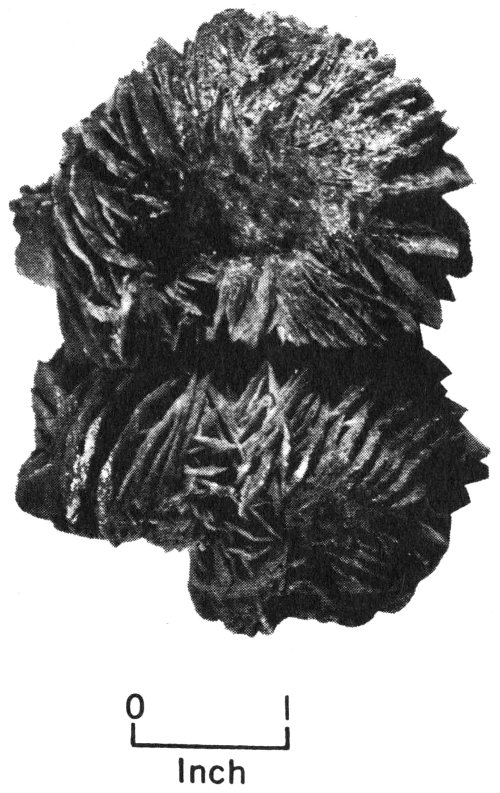
Selenite gypsum rosettes from Nolan County, Texas.
Most of the fibrous gypsum and selenite is formed by solutions. Some of these solutions develop when underground waters, seeping through rocks, pick up and dissolve minerals that contain sulfur (such as pyrite). This dissolved material changes the water into very weak sulfuric acid. 65 When the sulfuric acid meets calcium carbonate (as in limestone or calcite), it combines with the calcium to form the gypsum.
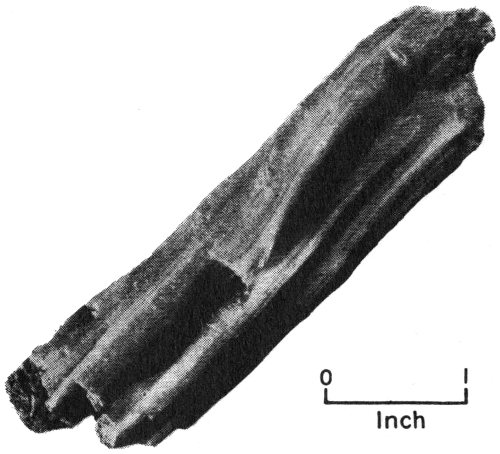
Fibrous gypsum from Terlingua area, Brewster County, Texas.
A massive, fine-grained, and translucent variety of gypsum, known as alabaster, is used for articles such as lamp bases, statuettes, vases, and book-ends.
A loose, earthy, crumbly variety of gypsum, called gypsite, is ordinarily found mixed with other materials, such as clay, sand, and soil. It occurs either at or near the surface of the ground. Gypsite is found in Culberson, Reeves, and other counties in west Texas.
A massive, granular variety of gypsum, called rock gypsum, may occur in large deposits. This is the gypsum that is used for making products such as plaster, wallboard, and some cements.
Deposits of rock gypsum are found both underground and at the surface in Texas. Surface deposits occur in Permian rocks in several counties to the east of the Texas High Plains. They also occur in the area between the Pecos River and the Delaware and Apache Mountains in Culberson and Reeves counties. Some of the other surface deposits are found near the Malone Mountains in Hudspeth County and in Lower Cretaceous rocks in Gillespie and Menard counties. Rock gypsum has been mined from the deposits in Fisher, Gillespie, Hardeman, Hudspeth, and Nolan counties. It also has been produced from the cap-rock at Hockley salt dome in Harris County.
Gypsum and another mineral, anhydrite, have very nearly the same composition. Both are calcium sulfates. Gypsum, however, contains water of crystallization, and anhydrite does not. It is likely that most of the rock-gypsum deposits of Texas originally were beds of anhydrite. By absorbing water that seeped through it, the anhydrite changed into gypsum.
Halite
Halite, sodium chloride, is the table salt you sprinkle on food for seasoning. This mineral ordinarily is white or colorless, but other materials cause it to be tinted red, blue, gray, brown, or green. When you rub halite across a streak plate, it leaves a white streak.
Because halite cleaves in three directions, all at right angles to each other, the cleavage fragments are shaped like cubes. You can see some of them by looking at a few grains of table salt through a magnifying glass.
Halite has a salty taste and dissolves easily in water. It also is transparent to translucent and has a glassy luster. This mineral is soft enough for a copper penny to scratch it. Halite commonly occurs as cubic crystals and as granular or compact masses.
In addition to its use as table salt, much halite goes to make soda ash, chlorine, and other chemicals. A few of its other uses are in leather making, meat packing, and food canning.
Texas has large underground deposits of halite. These deposits, known as rock salt, occur in the Permian subsurface basin of west Texas and in the salt domes of the Gulf Coastal Plain. The Permian basin, which extends under parts of west Texas, New Mexico, Oklahoma, Colorado, and Kansas, is now completely filled with sediments. It appears level and flat when you travel across it and does not look at all like a basin or a valley. During Permian time, however, this area was covered by a salty 66 sea. As the sea gradually dried up, the dissolved material that it contained was deposited as thick beds of halite, anhydrite, and other minerals. Later, these minerals were covered by sedimentary rocks which were deposited on top of them. Now, the minerals are found many hundreds of feet below the surface. In Hutchinson, Mitchell, Ward, and Yoakum counties, some of this Permian basin salt has been produced (as brine) from wells that have been drilled into it.
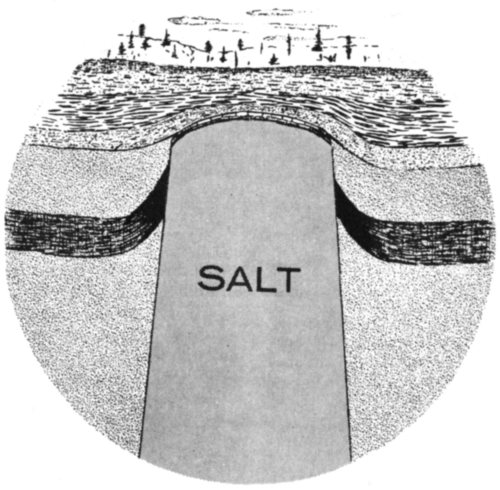
Salt domes, which are huge, underground columns of halite, occur on the Gulf Coastal Plain.
The Gulf Coastal Plain salt domes are huge and almost circular columns of halite, some of which are more than 2 miles wide. Some are less than 300 feet below the surface, but most of them are much deeper. These salt columns pushed upward many thousands of feet from great, deeply buried salt deposits. The halite is mined from shafts dug into the Hockley salt dome in Harris County and into the Grand Saline salt dome in Van Zandt County. Salt brines are produced from wells drilled into several salt domes of this area.
At the surface in Texas, halite occurs in salt lakes in Crane and Hudspeth counties and in alkali lakes on the High Plains. It is found also on the shores of bays and lagoons in Cameron, Kenedy, Kleberg, and Willacy counties, and it occurs at springs and seepages in various places in the State.
Hematite
Hematite, iron oxide, the chief ore of iron, is found in many places in Texas but not in large deposits. This mineral may 67 have a metallic luster and appear reddish brown, dark brown, steel gray, or black or it may occur as a soft, red, earth-like material called red ocher.
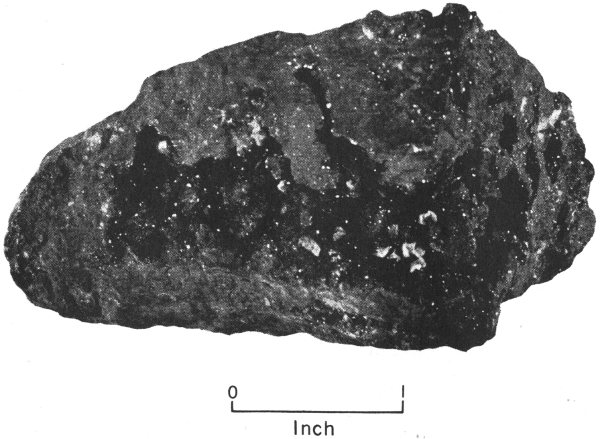
Specular hematite from Carrizo Mountains, Hudspeth County, Texas.
Most metallic hematite is too hard for a pocket knife to scratch, but quartz or a steel file will scratch it. Hematite is fairly heavy, for it has a specific gravity of 5.26. This mineral has no cleavage, but some specimens show three directions of parting that are almost at right angles to each other. A great help in identifying hematite is the dark reddish-brown streak it leaves when you rub it across a streak plate.
Some hematite occurs as rounded masses that resemble kidneys or bunches of grapes (then called kidney ore); it also is found as flat crystals. Most of the Texas hematite occurs as granular or compact masses. One of these massive varieties is composed of shiny scales or plates and is called micaceous or specular hematite. This variety has been found in Hudspeth County and in northeastern Mason County. Hematite also commonly occurs as cementing material in many Texas sandstones.
Some hematite is formed by the alteration of magnetite, another iron mineral. This hematite is known as martite, and some of it still has the crystal shape (an octahedron or a dodecahedron) that belonged to the magnetite. Most of the hematite found in the Llano uplift area of central Texas is believed to be altered magnetite. In this central Texas area, some massive, granular martite has been mined at the Gamble prospect, a few miles southeast of Fredonia in northeastern Mason County, where it occurs as layers in Precambrian gneiss.
Small deposits of hematite occur in other parts of Texas, too. Some of the west Texas localities include Sierra Blanca, the Quitman Mountains, and the Carrizo Mountains of Hudspeth County and the area around Shafter in Presidio County.
Hollandite. See Manganese Minerals.
Hyalite. See Opal.
Jasper. See Quartz.
Kaolin. See Clay.
68
Limestone
Limestone is a sedimentary rock made up chiefly of calcite, a calcium-carbonate mineral. This rock also commonly contains grains of quartz, clay minerals, the mineral dolomite, or other materials. If a large amount of dolomite is present, the rock is called dolomitic limestone. In some limestones, the mineral grains are too small to be distinguished from each other without a magnifying glass or a microscope, but in other limestones, the individual mineral grains are easily seen.
Pure limestone is white, but if it contains clay or plant or animal matter it is light gray, dark gray, or black. Limestone also may be some shade of yellow, brown, or red. It is fairly soft and can be scratched with a knife. Because this rock contains calcite, an easy chemical test will help identify it: a drop or two of dilute hydrochloric acid will quickly fizz and bubble when placed on the limestone.
Limestones form in fresh water, such as in lakes, but most of them form in the seas. As some earlier-formed rocks are weathered, the calcium minerals that they contain are dissolved. Creeks and rivers carry this dissolved material to the sea. There, small animals, such as corals, crinoids, sponges, and foraminifers, take the dissolved material out of the water to build their calcium carbonate shells. Plants, such as algae, can take calcium carbonate out of solution too, and it collects on them. Shells, shell fragments, and plant remains accumulate on the sea floor, forming limy deposits that later become limestone.
Limestones also originate in a slightly different way. When the temperature and chemical composition of the water permit, calcium carbonate precipitates as millions of tiny grains of calcite and forms a limy mud that is converted to limestone. Many limestones contain shell or plant fragments in addition to these tiny grains of calcite.
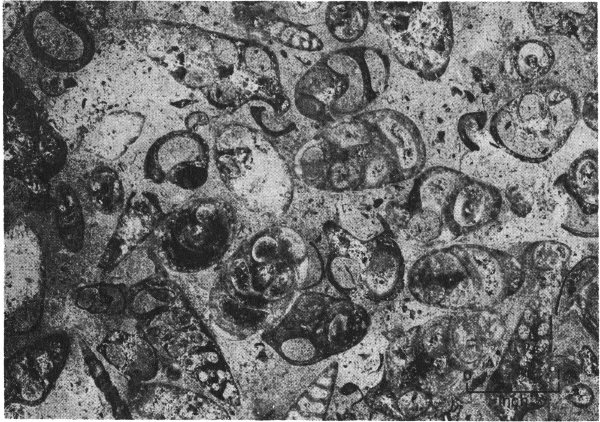
Polished section of Lower Cretaceous Edwards Limestone from Travis County, Texas, containing fossil gastropods.
There are several special kinds of limestone. If the rock is made up of many little rounded calcite grains that resemble fish 69 eggs, it is called öolitic limestone. Another limestone, chalk, is soft, white, and fine grained. It consists mostly of tiny shell fragments and fine-grained calcite. Coquina is a porous limestone made up of loosely cemented shells and shell fragments. Another special kind of limestone, known as lithographic limestone, because it can be used in printing, is smooth, firm, and hard. Its mineral grains are too small to be recognized without a microscope. This kind of limestone breaks with a smooth, sometimes curved, fracture. Still another variety, pulverulent limestone, is loose, soft, powdery, and white. It occurs in the Lower Cretaceous Edwards Limestone in Williamson and Bell counties of central Texas. Some of this limestone is used to polish rice grains, and it is added to livestock feeds to provide calcium for the animals.
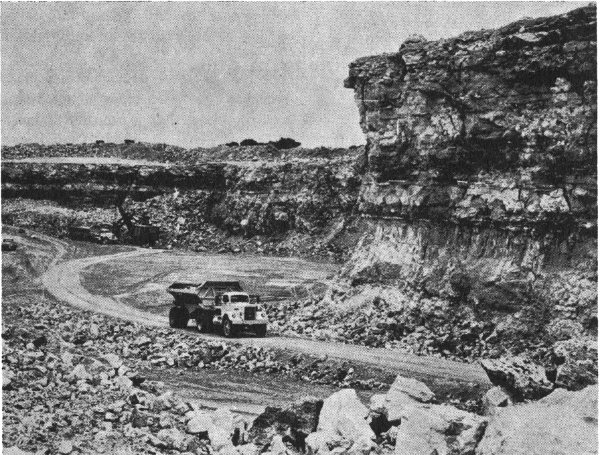
Limestone quarry in Lower Cretaceous Edwards Limestone at Georgetown, Williamson County, Texas.
Much limestone is found at the surface in Texas in Cambrian, Ordovician, Mississippian, Pennsylvanian, Permian, and Cretaceous formations. If you will look at numbers 5, 6, 9, 10, and 11 on the Texas geologic map (pp. 4-5), you will see that these strata appear at the surface in central, north-central, and Trans-Pecos Texas.
Limestone has many important uses. Much Texas limestone is crushed and used as a road-building material and as an aggregate that is mixed with cement to make concrete. Farmers in some areas improve their crops by adding limestone to the soil. Limestone also is sent to the iron furnaces in east Texas to be used in the production of pig iron and steel.
Some of the Texas limestones are heated to a fairly high temperature in order to change them into lime (calcium oxide). Industry uses a large amount of lime in making chemicals, steel, glass, paper, and other products. Builders use it to make plasters, mortars, and stuccos. At plants in Comal, Johnson, Travis, and Williamson counties, lime is made from Cretaceous limestones.
Another important use of limestone is in making portland cement. The limestone is 70 mixed with clay or shale, and the mixture is burned in a kiln until it just begins to melt. Then it is allowed to cool. Next, it is finely ground and in order to keep the finished cement from hardening or setting too quickly when it is used, a retarder, such as gypsum, is added. A number of cement-manufacturing plants in Texas use Cretaceous limestones, shales, and clays.
Many of the Texas limestones make excellent building stones. Some of them are quarried from Pennsylvanian and Cretaceous formations in north-central Texas and from Lower Cretaceous formations in counties near the Llano uplift of central Texas. A large quarry on the Williamson-Travis County line near Cedar Park in central Texas has supplied Cretaceous limestone for many buildings and monuments in the United States and Canada.
Limonite
Limonite is not really a definite mineral but is a mixture of iron oxides containing water. It is believed to be closely related to an iron mineral called goethite. Some limonite may be dull and earthy with the appearance of brownish-yellow or rusty brown clay. This variety is so soft that a fingernail will scratch it easily.
Other limonite has a dark brown or black color and a metallic or almost metallic luster. A copper penny will not scratch it, but a steel file will. This kind of limonite may have a shiny black surface that resembles glossy lacquer. The property that will help you most in identifying limonite is the rusty, yellowish-brown streak it leaves when rubbed across a streak plate.
Limonite has no cleavage and no crystal shape of its own. But crystals of other iron minerals, such as pyrite and magnetite, alter to form limonite. It then occurs with a crystal shape that originally belonged to one of these other minerals. (Such false forms of minerals are called pseudomorphs.) Limonite also occurs as layers in rocks, as hollow or solid concretions, or as coatings on other minerals. It is found mixed with minerals such as clays and serves as the cementing material in some sandstones.
Limonite is found in many localities in Texas including Blanco, Brewster, Burnet, Llano, and San Saba counties. The most important limonite deposits in Texas, however, are in the eastern part of the State, particularly in Anderson, Cass, Cherokee, Henderson, Marion, Morris, Nacogdoches, Smith, and Upshur counties.
The east Texas limonite deposits occur mainly in Weches sedimentary rocks. These rocks, which were deposited in the sea during Eocene Tertiary time, contain clay along with greensands. (Greensands are small, soft grains that contain glauconite, a mineral composed of iron, silicon, and several other elements.) Later, as the sea retreated, these sediments became a part of the land. Waters seeping through the sediments changed into weak solutions of carbonic and sulfuric acid that dissolved the iron out of some of the greensands. When conditions were favorable, this iron was re-deposited as an iron-carbonate mineral called siderite. Siderite was changed to limonite by weathering. Some siderite is still found in east Texas, and it is also mined along with the limonite as an iron ore.
East Texas iron ore has been mined from time to time ever since about 1855, and records show that a number of local iron furnaces once operated. The brown iron ore (as the limonite is also called) now is mined from open pits in Cass, Cherokee, and Morris counties.
This ore, after being washed, goes into blast furnaces at Lone Star (near Daingerfield) and at Houston. In the blast furnaces the ore is changed into metallic iron by mixing it with coke (made from coal) and limestone and blowing in blasts of hot air.
To make steel, the iron from the blast furnace (called pig iron) is put into open-hearth furnaces together with scrap iron, limestone, and other materials. This mixture is heated and melted together to get rid of unwanted substances. Then other elements, such as molybdenum, manganese, 71 or nickel, are added to make steel with the right strength and toughness.
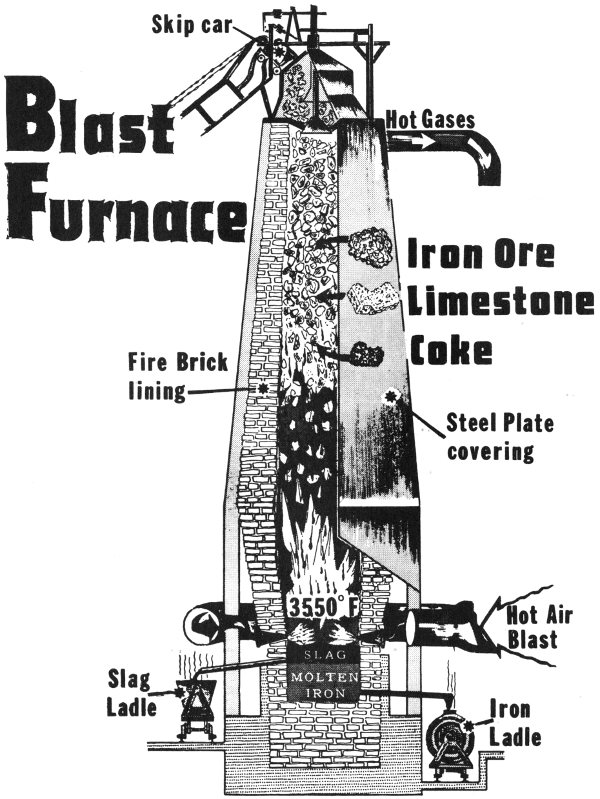
Limonite ore is changed to metallic iron in a blast furnace.
Skip car
Hot Gases
Blast Furnace
Iron Ore
Limestone
Coke
Fire Brick lining
Steel Plate covering
3550°F
Hot Air Blast
Slag
Slag Ladle
Molten Iron
Iron Ladle
Steel mills alongside the furnaces in Texas turn out many products, such as steel plates for oil tanks, ships, and tank cars and steel beams for framework in buildings and bridges. Some of their other products include pipes for the oil and chemical industries and wire for nails and fencing material.
Lithographic Limestone. See Limestone.
Llanite
Llanite is a unique rock that is found only in Llano County in central Texas. 72 This intrusive igneous rock is made up of easily seen crystals and grains of quartz and feldspar that are scattered through a brown-colored mass of extremely small mineral grains. The quartz is beautiful, sky-blue, and opal-like; the feldspar has a rusty pink color. (Because the quartz looks like opal, this rock often is called opaline granite.) The mineral grains that make up the brown-colored mass are so tiny that they can be identified only with a microscope. They are quartz, feldspar, mica, fluorite, and apatite.
Llanite formed during Precambrian time. Molten rock material forced its way upward into cracks that cut across granite and schist rocks while the rocks were still far underground. This hot magma remained in the cracks where it cooled and hardened to form long, narrow, wall-like masses (called dikes) of llanite. We can see some of the llanite dikes exposed at the earth’s surface to the north and northeast of Llano in Llano County because the overlying rocks have weathered away.
Llanite has been quarried from one of the dikes west of Babyhead in northern Llano County. Because llanite is both attractive and strong, it has been used as an ornamental stone and as a monument stone.
Magnetite
Magnetite, iron oxide, is a black, metallic mineral with an outstanding physical property: it is magnetic—fragments of magnetite readily cling to a magnet. It also leaves a black streak when rubbed across a streak plate. Although this mineral is too hard to be scratched by the average pocket knife, a steel file will scratch it. Magnetite is fairly heavy—it has a specific gravity of 5.18.
Magnetite occurs as compact or granular masses, as scattered grains, and as crystals. Most of the crystals are octahedrons, but some dodecahedrons are found. Magnetite helps make up a part of many metamorphic and igneous rocks, and it also occurs as tiny crystals and grains in some sands, sandstones, and other sedimentary rocks.
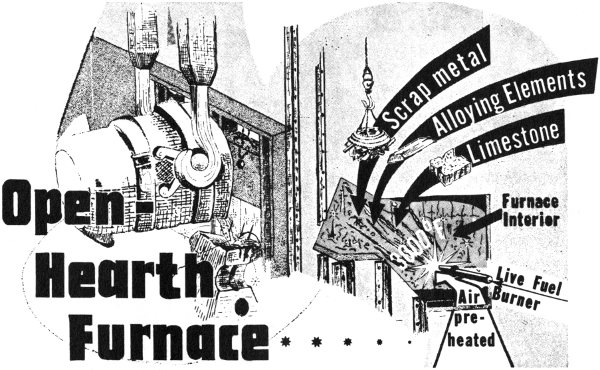
Metallic iron, after leaving the blast furnace, is made into steel in an open-hearth furnace.
Open-Hearth Furnace
Scrap metal
Alloying Elements
Limestone
Furnace Interior
Live Fuel Burner
Air pre-heated
Most of the magnetite that has been found in Texas occurs in Precambrian gneiss and schist rocks of the Llano uplift area of central Texas, particularly in Llano County and in eastern Mason County. It occurs as thin layers, as thick lens-shaped deposits, and as scattered grains in the rocks. Probably at least a billion years ago these gneisses and schists were sedimentary rocks, such as shales and 73 sandstones. Some geologists believe that these rocks could have contained iron sediments (perhaps in the form of glauconite). Great forces below the earth’s surface crumpled and squeezed the sedimentary rocks and changed them into the metamorphic schist and gneiss rocks we see today. As this happened, the iron sediments in the rocks were changed into magnetite.
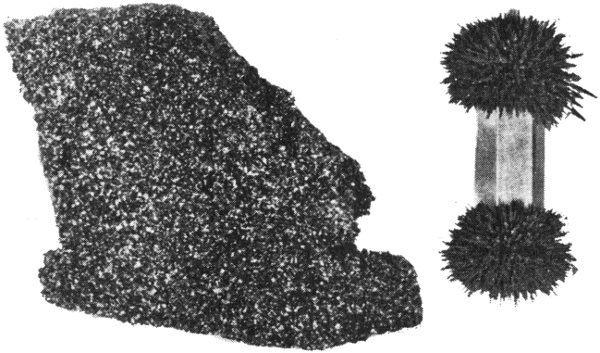
Granular magnetite fragments from northwest of Llano, Llano County, Texas, are attracted to a magnet.
At least some of the magnetite in this area (such as the deposit at Iron Mountain in Llano County) probably had a different sort of origin. Molten igneous rock material containing iron could have moved up into cracks in the ancient sedimentary rocks. Then the magnetite formed from this iron material when the igneous and sedimentary rocks were changed into the schists and gneisses of today.
None of the Llano and Mason County magnetite deposits is really very large. Nevertheless, prospecting and a little mining have been carried on from time to time at several deposits in this area. At Iron Mountain, which is about 12 miles northwest of Llano in Llano County, magnetite has been mined from open pits. Although magnetite is commonly used as a source of iron, the magnetite from this deposit was used as a heavy concrete aggregate.
Malachite. See Copper Minerals.
Manganese Minerals (Braunite, Hollandite, Pyrolusite)
Although manganese does not occur alone in nature as a native element, it makes up a part of many minerals and compounds. This element has an important use in steel making, where it helps rid the steel of unwanted substances, such as oxygen and sulfur, and, in addition, it is used to make tough, hard, manganese steel for armor plate, railroad tracks, safes, and steam shovels. Manganese has various uses outside the steel industry. It is added to copper and nickel to make alloys, it is used in the manufacture of dry-cell batteries, and (as manganese sulfate) it is used as a fertilizer.
Manganese minerals and compounds, such as braunite, hollandite, pyrolusite, and wad, occur in several counties in Texas. No large, commercial deposits have been found here.
Some manganese compounds and minerals are covered with a soft, sooty black material that will soil your fingers. This can help you recognize these minerals; however, a few non-manganese minerals, such as some chalcocite, also have a black coating that soils your fingers in a similar way.
One of the manganese minerals, braunite, is a complex oxide of manganese that contains silica. It has a submetallic luster and is dark steel-gray or black. When rubbed across a streak plate, it leaves a steel-gray or a black streak. This mineral is too hard to be scratched by a pocket knife, but a piece of quartz or a steel file will scratch it. Braunite has a specific gravity of 4.75 to 74 4.82. It has four directions of cleavage that are parallel to the faces of a pyramid.
In the Spiller mine, about 15 miles northeast of Mason in Mason County, masses of braunite occur as lens-shaped layers in Precambrian gneiss and quartzite rocks. This braunite may have formed from another manganese mineral (possibly manganese garnet) that was exposed at the earth’s surface after the overlying rocks eroded away. As this other mineral weathered, it may have altered into braunite, or the braunite could have been deposited from solutions emanating from hot magmas before the great thickness of overlying rock was removed.
The mineral variety hollandite is a rare manganate of manganese and barium. It has a metallic luster, and its color is silvery gray or black. When you rub it across a streak plate, hollandite leaves a black streak. It has a specific gravity of 4.7 to 5. Hollandite is rather hard, but a steel file will scratch it.
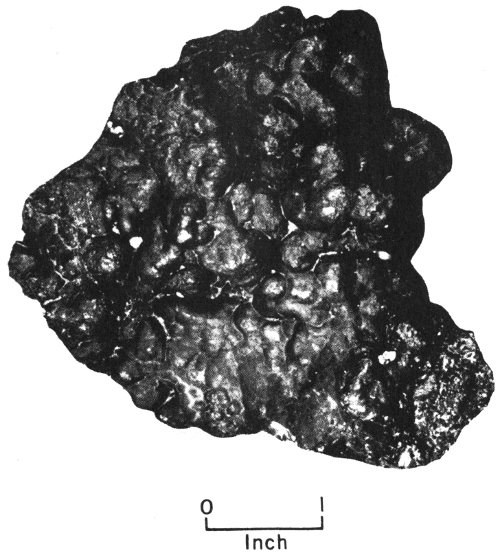
Hollandite from Jeff Davis County, Texas.
Hollandite occurs in western Jeff Davis County in west Texas at what is called the Mayfield prospect. Here, it is found as rounded masses that occur in a vein near a large fault in Lower Cretaceous limestone rocks.
Other manganese compounds, pyrolusite and wad, are found in several important deposits near the Pecos River in western Val Verde County. Pyrolusite is a manganese dioxide mineral. It is black, opaque, and so soft that it rubs off on your fingers like soot. Pyrolusite may be granular and massive or may be powdery. It also occurs as a fern-like coating on rocks. Wad is not really a mineral but is an impure, dull-black or brownish-black mixture of manganese oxide, water, and other substances. It can be soft enough to soil your fingers, or it can be too hard to scratch with a 75 pocket knife. Wad occurs in earthy or compact masses or in crusts or stains on rocks.
In Val Verde County, the wad and pyrolusite are found mixed with soil, clay, gravel, sand, and plant remains. This material fills cracks in Lower Cretaceous limestones, it is scattered through gravels, and it is deposited in low places at the surface. The manganese in these deposits came from limestone rocks that have since weathered away. Rainwater trickled into these rocks and dissolved the manganese minerals they contained. This manganese was washed down toward the Pecos River and was deposited as wad and pyrolusite.
Marble
Marble is a metamorphic rock made up chiefly of sparkling grains of calcite or dolomite, but other minerals may be present. The marble may be fine grained, medium grained, or coarse grained; commonly, all the mineral grains are about the same size.
Marble may be of uniform color, banded, spotted, or streaked. If it is made up only of pure calcite or dolomite, the marble is white. If, however, it contains carbonaceous material, such as graphite, it is grayish or black. Limonite impurities cause the marble to be yellowish brown, and manganese oxides and hematite give it a brownish, pinkish, or reddish color.
Marble is a rather soft rock, and you can scratch it easily with a pocket knife. A few drops of dilute hydrochloric acid will bubble and fizz readily on calcite marble; on dolomite marble, it may fizz slightly.
Marble forms from limestone or from dolomite rock. Heat and pressure below the earth’s surface cause the calcite and dolomite mineral grains in these rocks to recrystallize. A fine-grained limestone can be changed into a coarse-grained calcite marble. The marble is not made up of new and different minerals, but it has a new texture unlike that of the limestone. (To a builder, the word marble has another meaning. He considers rocks such as unaltered limestone, unaltered dolomite, or even serpentine to be marble, if they will take a high polish.)
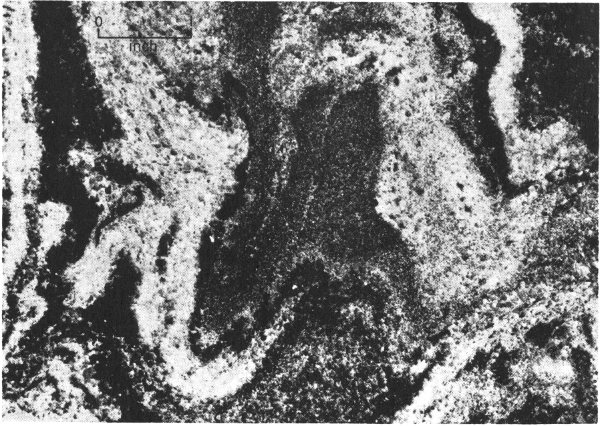
Polished section of Precambrian metamorphic marble from Llano County, Texas.
Metamorphic marbles occur at the surface in central Texas and in west Texas. Some of the west Texas occurrences are in the Van Horn area of Culberson and Hudspeth counties and in the Big Bend 76 area of Brewster County. In central Texas, Precambrian marbles are found in Burnet, Gillespie, Llano, and Mason counties of the Llano uplift area. Many of them are suitable for use as monument and building stones. Some of the Llano County marble is quarried and used as granules for roofs and as terrazzo chips for making colorful floors (described with serpentine on p. 88).
Martite. See Hematite.
Mica
Mica is not just one mineral but is the name given to a group of similar minerals. The mica minerals are easy to recognize. Because they have perfect cleavage in one direction, they split into thin, flat sheets. You can see through some mica sheets, and they are elastic enough to be bent back and forth. (Another mineral, selenite gypsum, also will split into thin, flat, transparent sheets, but selenite sheets break when you bend them.)
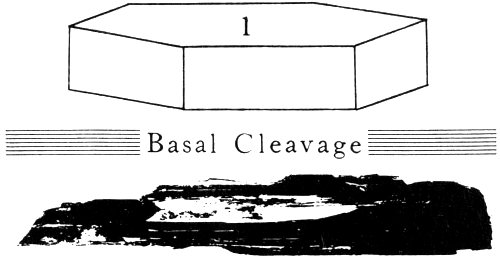
Mica minerals have perfect cleavage in one direction, resulting in thin, sheet-like cleavage fragments.
Basal Cleavage
Two of the mica minerals that you are most likely to find in Texas are muscovite and biotite. Both these minerals are potassium-aluminum silicates, and biotite, in addition, contains magnesium and iron. In general, muscovite is light colored, that is, it has a light brown, yellow, or green tint, or is colorless, and biotite is dark colored, commonly dark green, brown, or black. These minerals have glassy or pearly lusters and are rather soft—a copper penny scratches them. The specific gravity of biotite is 2.8 to 3.2, and that of muscovite is 2.76 to 3.1.
Mica minerals occur in igneous rocks, such as granite and pegmatite, and in metamorphic rocks, such as schist and gneiss. They also are found as tiny flakes in some sandstones, limestones, and other sedimentary rocks. Most of the Texas mica is found in the Llano uplift area (particularly in Llano County) and in the Mica Mine area. (The Mica Mine area is in the Van Horn Mountains about 15 miles south of Van Horn in west Texas.) In both these areas, the mica minerals occur mostly in Precambrian pegmatites and mica schists.
The gleaming mica schists were once igneous rocks or sedimentary rocks such as sandstones and shales. Long ago, great forces beneath the earth’s surface changed the rocks into mica schists. The mica that is found in pegmatites formed from hot fluids of igneous origin when the pegmatite rock itself was formed.
Clusters of mica in the pegmatites are called books, because the thin sheets into which the mica splits look like pages. Some muscovite books up to 8 inches across are found in the Mica Mine area of the Van Horn Mountains.
The books or sheets of muscovite mica that occur in pegmatites are especially valuable to industry. Muscovite can stand great heat without melting, it is tough, it splits into thin sheets, and it lets very little heat and electricity pass through. Because of these properties, muscovite is used in fuses and as insulators in heating elements of electric irons and toasters. (Biotite is not used, because the iron it contains makes it a conductor of electricity.) Sheet muscovite also is widely used by the electronics industry as a non-conducting material in the manufacture of tubes and other products.
Both muscovite and biotite from mica schist rocks, as well as scrap pieces of sheet mica from pegmatites, are ground into flakes or powder. This ground-up mica has many uses, ranging from a powder coating 77 for automobile inner-tubes to Christmas tree “snow.”
Only a small amount of mica has been mined in Texas. A fair grade of sheet mica occurs in the pegmatites at Mica Mine in west Texas, but the deposit is not large. In the pegmatites of the Llano uplift area of central Texas, no sheet mica has been found that is considered good enough for the requirements of industry. Mica suitable for grinding, however, is found in both these Texas areas.
Micaceous Hematite. See Hematite.
Microcline. See Feldspar.
Milky Quartz. See Quartz.
Muscovite. See Mica.
Native Silver. See Silver Minerals.
Obsidian and Vitrophyre
Obsidian is a dark, glassy-looking igneous rock. Most obsidian contains the same chemical elements as granite and rhyolite, since all three of these rocks can form from the same type of molten rock material. Obsidian, however, has no separate minerals, because its chemical elements are not combined in an orderly way. It is a natural glass.
Because it is a glass, we know that obsidian forms very quickly. One way for it to form is from the sudden cooling of hot, molten lava that flows out of volcanoes. If the lava cools and hardens before the separate minerals can crystallize, it becomes a natural glass, such as obsidian.
This rock is smooth and shiny. Most of it is black, but some can be dark green or dark brown. Obsidian allows light to pass through it, and it breaks with a curved, conchoidal fracture. The broken edges are very sharp.
Another glassy igneous rock that forms from fast-cooling lava is vitrophyre. It looks like obsidian except that it has crystals or crystalline mineral grains (which may be light colored) scattered through the dark glassy material.
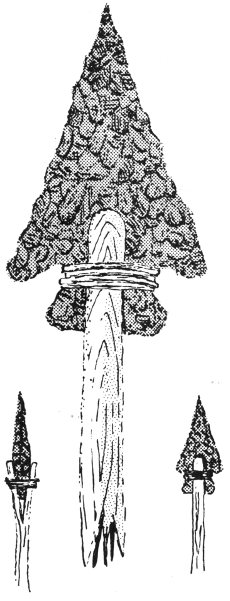
Obsidian was used by the Indians to make arrowheads.
Obsidian and vitrophyre are found in the Big Bend area of Brewster and Presidio counties in west Texas. They occur with other igneous rocks that formed there during Tertiary time.
The Indians who long ago roamed this area used the smooth, shiny vitrophyre and obsidian to make some of their arrowheads and scrapers. Today, rock collectors pick up these attractive rocks for their collections, and some of them cut and polish obsidian and vitrophyre for use as gemstones.
Onyx. See Quartz.
Öolitic Limestone. See Limestone.
78
Opal
Opal is like hardened jelly or gelatin. It has no crystalline inner structure and no crystal shape of its own—it is amorphous. This mineral has almost the same chemical composition as quartz. Both are silicon dioxides (silica), but opal, in addition, contains water.
Opal can be almost any color—red, yellow, blue, brown, gray, white—or it can be colorless. It is transparent or translucent and appears glassy, resinous, greasy, or dull. Opal has a specific gravity of 1.9 to 2.2—this mineral is a little lighter than quartz. It also is softer than quartz. A copper penny will not scratch opal, but quartz will. Opal has a white streak and a curved, conchoidal fracture but no cleavage.
Opal occurs in a number of places in Texas. In the Trans-Pecos country of west Texas, it fills cracks and cavities in some of the extrusive igneous rocks. It occurs on the High Plains of northwest Texas, and it is found in Tertiary formations of the Gulf Coastal Plain where it occurs as masses that fill cracks and cavities in sedimentary rocks, as the cementing material in some sandstones (such as in the Catahoula sandstone), and as opalized wood.
Much opal forms from underground waters that contain silicon. These solutions move through the rocks and deposit the opal in them.
Opal is found in a number of varieties. Some show a beautiful, lustrous play of colors that comes from inside the specimens. These varieties are known as precious opal and are prized as gemstones. In Texas, some precious opal is found near Alpine in Brewster County. It has a milky white to bluish-white color, is translucent, and shows a fiery orange, red, blue, and green play of colors.
The variety known as common opal shows no play of colors. It may be white, gray, bluish, reddish, greenish, or yellowish, and it is only slightly translucent. It is found in Brewster, Jeff Davis, Presidio, and other counties of the Trans-Pecos country of west Texas. It occurs also around some of the wet-weather (playa) lakes on the Texas High Plains. In the Gulf Coastal Plain, common opal is found with chalcedony (a variety of quartz) in Tertiary formations. A south Texas locality sometimes visited by collectors is near Freer in Duval County.
A clear, commonly rounded, variety of opal that looks like ice is called hyalite. Two areas in which it has been found are in Presidio County in west Texas and in Llano County in central Texas.
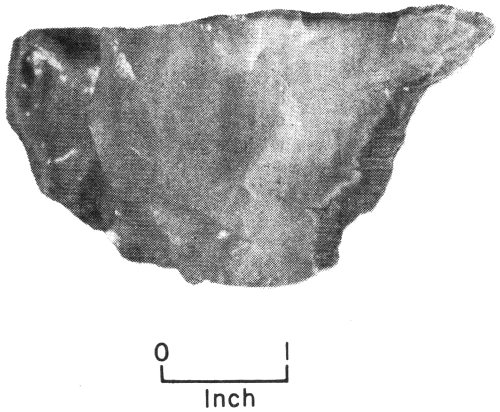
Opalized wood from Washington County, Texas.
A variety of petrified wood, called opalized wood, is opal that replaced the fibers of a piece of wood. Wood opal is found at a number of places in the Gulf Coastal Plain. It occurs there in Tertiary formations within about 20 miles of the boundary line between areas 2 and 3 shown on the geologic map (pp. 4-5).
A soft opaline material called diatomite, or diatomaceous earth, is made up chiefly of the skeletons of diatoms—tiny, one-celled plants that live in fresh or salt water. These little plants are able to take silica from the water to make opal skeletons for themselves. When the diatom skeletons collect at the bottom of a lake or sea, they form the light, crumbly, white, gray, or cream-colored deposit of impure opal known as diatomite. Industry uses this material as a filter, as insulation, as an abrasive, and as a filler.
Diatomite formed in ancient lakes on 79 the Texas High Plains during late Tertiary (Pliocene) and early Quaternary (Pleistocene) times. It is found in Armstrong, Crosby, Dickens, Ector, Hartley, and Lamb counties.
Opaline Granite. See Llanite.
Orthoclase. See Feldspar.
Pegmatite
Pegmatites occur in igneous rock areas, and most geologists consider them intrusive igneous rocks. They are made up of crystals and crystalline mineral grains that fit together—the grains are interlocked. The crystals and grains in pegmatites are larger than those of surrounding rocks, and some are huge, even larger than a man. However, there is a wide range of grain sizes in pegmatite.
Some pegmatites cut through igneous or metamorphic rocks in such a way that they resemble walls (called dikes). Others are found as veins, as flat masses, or as odd-shaped bodies in rocks. Many pegmatites occur in granites and contain feldspar, quartz, mica, and other minerals, as granite does. Some pegmatites occur with other kinds of igneous rocks and contain the same minerals as these rocks. A few pegmatites contain rare and unusual minerals.
Many geologists believe that pegmatites form from hot fluids of igneous origin that are left after other igneous rocks, such as granite, have already formed. These left-over fluids contain large amounts of aluminum, potassium, silicon, sodium, and several other elements. While the granite or other rocks are still far underground, this material pushes up into them, and may even partly dissolve them. Then it slowly cools and hardens into pegmatite. It is believed that, later, more fluids move into cracks in some pegmatites. This new material adds other minerals to the pegmatites and alters some of those minerals already there.
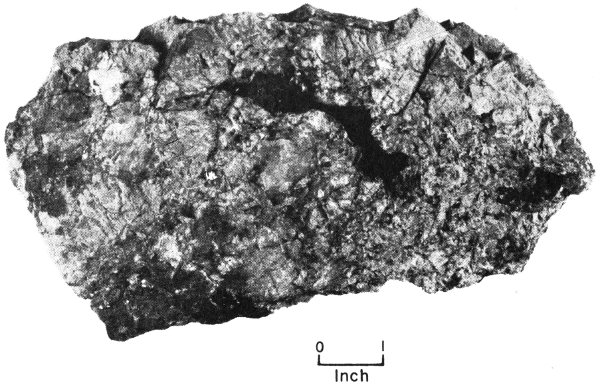
Quartz-feldspar pegmatite from Burnet County, Texas.
Some of the pegmatites we now see at the surface in Texas are probably about a billion years old. They formed during Precambrian time and occur with other extremely old rocks. One well-known Texas pegmatite area is the Mica Mine district of west Texas. It is about 15 miles south of Van Horn in the Van Horn Mountains of Culberson and Hudspeth counties. Another pegmatite area is in the Llano uplift of central Texas. These central Texas pegmatites 80 occur in Burnet, Gillespie, Llano, and Mason counties.
Large crystals and grains of feldspar, mica, and quartz are found in the pegmatites of both these areas. A small amount of mica has been mined from the west Texas pegmatites, and feldspar has been produced from the central Texas pegmatites.
An extremely rare and unusual pegmatite occurs in the Llano uplift area at Baringer Hill, which is west of Burnet in Llano County. This pegmatite was once on the bank of the Colorado River, but when Buchanan Dam was built, the area was flooded. The Baringer Hill pegmatite now lies beneath the water of Lake Buchanan. Many rare minerals, which contain beryllium, cerium, thorium, uranium, yttrium, zirconium, and a number of other elements, occur in this pegmatite. Some of these minerals, such as those containing yttrium and zirconium, glow or incandesce when they are heated. During the early part of this century, before the area was flooded, several of the yttrium minerals were mined and used in making lamp mantles.
Pitchblende. See Uranium Minerals.
Precious Opal. See Opal.
Pulverulent Limestone. See Limestone.
Pumicite. See Volcanic Ash.
Pyrite
Pyrite is a shiny, pale golden-yellow or brassy-yellow metallic mineral. This mineral, an iron disulfide, is so often mistaken for gold that it is widely known by the nickname fool’s gold.
Except for their similar color and luster, pyrite and gold are really very different. When you rub pyrite across a streak plate, it leaves a black, a greenish-black, or a brownish-black streak, but the streak of gold is gold-colored. Pyrite is too hard for the average pocket knife to scratch, but a knife will scratch gold easily. Pyrite is brittle and readily breaks, but gold is malleable and flattens out when hit with a hammer. Pyrite is only about 5 times as heavy as an equal volume of water, but pure gold is over 19 times as heavy. And pyrite may have a brown or a multicolored tarnish on it, but gold never tarnishes.
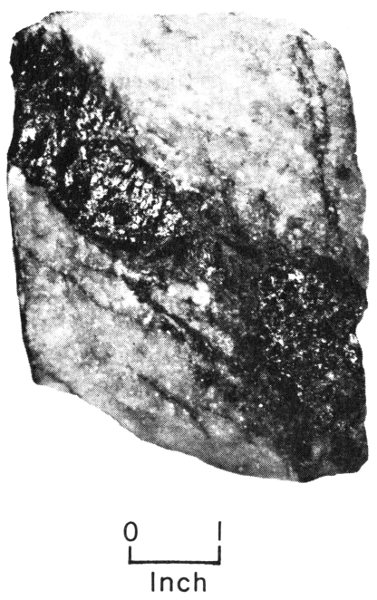
Pyrite veins in white marble from Llano County, Texas.
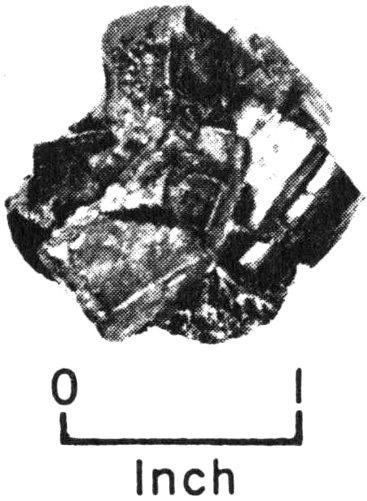
Cubic crystals of pyrite.
Pyrite is a common mineral and is found in many of the igneous, metamorphic, and sedimentary rocks of Texas. It may be scattered through the rocks, or it may fill cracks and cavities in them. This mineral occurs as granular and compact masses, as rounded masses, or as crystals. The crystals are commonly cubes, pyritohedrons, or 81 octahedrons. In some crystals, the shapes are combined (such as a cube with an octahedron or two pyritohedrons grown through each other). You may notice that the sides of some cubes and pyritohedrons have fine, parallel grooves (called striae or striations) on them.
Pyrite originates in a number of different ways. Some of it forms, along with other minerals in igneous rocks, from hot magmas. It also forms in metamorphic rocks by the same processes that produce these rocks. Some of the pyrite in limestone and other sedimentary rocks is formed when the rocks themselves are deposited by seas or streams. Pyrite also is deposited by the hot fluids that are given off by magmas. These fluids travel up into cracks and other openings in rocks and then form pyrite as well as other minerals. Much pyrite forms in still another way. As water seeps through rocks, it dissolves some of the iron minerals that they contain. When, under certain conditions, these iron solutions mix with hydrogen sulfide (this is the gas that makes some water smell like rotten eggs), pyrite is formed.
Pyrite alters easily. Because of this, most builders carefully check the limestone, granite, marble, or whatever other building stone they plan to use to be sure that it does not contain large amounts of pyrite. When exposed to the weather, pyrite changes to limonite and causes an unsightly rust stain.