Chapter XI · Globes of the Second Half of the Seventeenth Century (continued 2)
Reading edition
It has two meridian circles, circles representing the tropics whose outer circumference is 66 cm., polar circles having a circumference of 21 cm., and circles representing the solstitial colures and the equator, the latter having an outer circumference of 72 cm. All circles are graduated, but in the case of the polar circles the numbers of the degrees are not marked. In addition to the above-mentioned circles, there is one representing the zodiac which is exceedingly heavy, on which have been cut the signs of the several constellations and the names of the months.
This assemblage of armillae is adjusted to revolve within a brass circle, the whole resting upon a base of alabaster. At the common center is a small ball mounted on a metallic rod which passes through the poles of the circles. This small terrestrial sphere has a diameter of 8 cm., and around it are two small circles probably intended to represent the path of the moon and of the planet Mercury.
Word has been received of another armillary sphere of about 1700, though undated, constructed by Vitale Giordani (1633-1711), a mathematician of some note in his day. This sphere belongs to the Biblioteca Lancisiana of Rome, which, as noted above, possesses one by Barocci of the year 1570.103
The idea of constructing large manuscript globes, such as were those of Benci and of Moroncelli, was taken up by Giuseppe Scarabelli of Mirandola, who appears to have won special distinction in his day as an engineer.104 Although the large globes, terrestrial and celestial, three braccia (ca. 200 cm.) in diameter, which he is known to have made, assisted by his son Massimo, cannot now be located, we are told that they were of such size and quality that their equal could not be found “in Milan, in Venice, or in Rome.”
In what has been stated above concerning globe makers of Italy in the late seventeenth century and the early eighteenth, it has been noted that a number of those most prominent were members of some one or other of the many monastic orders. Benci and Moroncelli were of the Silvestrin Congregation; Coronelli was a Minorite, being honored with an election to the office of General of the Franciscan Order. It was in the late seventeenth century that Giovanni Battista da Cassine,105 a Capuchin monk, began to achieve distinction as a map and globe maker, in particular, however, through the maps he drafted of the various provinces of his order which he described in his ‘Descrizione cosmografica della Provincie e dei Conventi de FF: Min. Cappuccini di S. Francesco.’106 He was a native of Cassine in the district of Alessandria, and entered in early life into the Convent of the Immaculata Concezzione of Milan. He tells us, in his introduction to his work noted above, that he constructed two globes for the library of his convent in Milan, a terrestrial and a celestial, adding, “Quondam aedificabam, simul et delineabam pro Bibliotheca nostra Immacolatae Conceptionis duos satis grandes Globos nimirum coelestem unum, terrestrem alium.” “I once designed and constructed for our library of the Immaculate Conception, two large globes, one a terrestrial, the other a celestial.” We do not know the exact date of the construction of these globes, but it probably was near 1700.107 It is further probable that these globes were examples of Italy’s best productions within this field. They, however, cannot now be located, having disappeared at the time of the dissolution of the convent in the year 1810.
George Christopher Eimmart (1638-1705), a native of Ravensburg, was one of Germany’s most famous mathematicians of the seventeenth century.108 He is reported to have been for some time associated with Erhard Weigel in the University of Jena, where he won distinction for himself in his mathematical and law studies. It was about the year 1658, after the death of his father, that he became especially interested in the art of copper engraving, and in the year 1660 he established himself in this business in the city of Nürnberg. The study of mathematics, however, continued to interest him, and we soon find him giving especial attention to astronomical science, to the construction of astronomical instruments, such as quadrants, sextants, telescopes, astronomical clocks, and celestial spheres. In one of the fortifications of the city he erected a small observatory, in which he carried on his astronomical studies, evincing, as the months passed, much interest in giving practical instruction to many of the young students of the city, among whom may be named Johannes Philipp Würzelbauer, who later was ennobled by Emperor Leopold on account of his scientific attainments, and who at the time of the reception of this honor changed his name to Wurzelbau. Eimmart counted among his friends, with whom he was in constant communication, Leibnitz, Cassini, La Hire, Flamsteed, Hevel, and others. His correspondence with these distinguished men of science, together with his numerous papers relating to his mathematical and astronomical studies, are still preserved in manuscript, filling no less than fifty-seven volumes.109 In the year 1695 he published a description of an armillary sphere which he had constructed to represent the Copernican system, but this cannot now be located.110 In the year 1705, the year of his death, he issued a pair of globes, an example of each being now kept in the Museo Astronomico of Rome. These spheres of papier-mâché, each having a diameter of about 30 cm., are supplied each with a base of wood, consisting of four turned columns, which support a horizon circle of wood, on which are the usual engraved concentric circles bearing respectively the names of the principal directions or winds, the names of the zodiacal constellations, with their respective figures, the names of the principal festivals, and names of the saints. They are made to revolve within a graduated meridian circle which is adjusted to move within the horizon circle. The globe balls are covered with engraved gore maps, each consisting of twelve sections cut at the equatorial line and in latitude 80 degrees, the polar areas being covered with a circular disc, having the necessary radius of ten degrees.
On the terrestrial globe we find the following author and date legend: “Cum geographica Orbis Terrarum descriptio secundum long. et lat. non nisi vel per peregrinationes marittimas vel observationes coelestes emendatior in dies prodeat, istud autem per experimenta propria (quo ad exiguam saltem partem) perfecisse, e’ mille, vix uni contigat; Oportuit nos Recentiorum accuratissimis observationibus insistore et quatenus cum veritate congruant vel discrepent exactiori tuo judicio relinquest. Nos eadem loca bona fide, nihil immutantes, prout ab auctoribus novissimis accepimus usui tuo exhibibemus. Norimbergae apud G. C. Eimmartum Ao Christi 1705.” “Since the geographical description of the earth according to latitude and longitude, both by maritime voyages and by celestial observations becomes more accurate day by day, it happens to scarcely any one man to perfect (a globe) by his own observations for these can be partial only. Therefore it behooves us to make use of the most accurate modern observations. In so far as they agree with the truth or depart from it it is left for you with your more exact judgment to decide. We, for our part, exhibit for your use the places in all good faith, as we have received them from the latest authorities and have changed nothing. Nürnberg. By G. C. Eimmart, 1705.”
Meridians and parallels are represented at intervals of five degrees, the ecliptic and the equator being graduated. Compass roses are numerous, from which radiate numerous loxodromic lines. The several compass roses are located on the equator, and at latitude 35 degrees and 70 degrees both north and south, where these parallels are crossed by the prime meridian and the meridians of 90 degrees, of 180 degrees, and of 270 degrees.
In the southern hemisphere of the celestial globe is the following inscription: “Loca stellarum coelesti huic Globo insertarum a Jo. Hevelio astronomo insigni ad ann. 1700 complet. sum̄o studio ac diuturnis vigiliis restituta sunt; quae in hujusmodi Typum ad perpetuam Coeli conformitatem juxta modum quem Problema inferius adjectum praescribit noviter redacta a G. C. Eimmarto.” “The position of the stars inscribed on this celestial globe were determined by J. Hevelius, renowned astronomer, and completed to the year 1700 through deep study and nightly vigils. And these observations on this globe are made perpetually to conform, according to the method which is described below, and these have been revised by G. C. Eimmart.”
Attention is called to the stars of the various magnitudes up to the seventh by an appropriate illustration of each placed in a small but artistically designed wreath. Latin names are given to the several constellations and to a number of the individual stars, though one finds an occasional Arabic name. Among the several constellations one notes certain modern names such as “Scutum Subiescianum.”
In addition to the pair referred to above, a copy of the celestial globe may be found in the Biblioteca Civico of Bergamo.
Joseph Moxon (1627-1700) (Fig. 116) was an English mathematician and hydrographer of great distinction.111 His earliest business, dating from about 1655, was that of a maker and vender of mathematical instruments, but he later turned his attention toward the designing of letters and the making of printing types, achieving, for his work in this field, a very remarkable reputation. It was in his early years, when especially interested in making mathematical instruments in his shop in Russell Street, at “The Sign of the Atlas,” that his thought was turned toward geography, astronomy, and navigation; at any rate, he published in the year 1657 an edition of Edward Wright’s ‘Certain errors in navigation detected and corrected.’112 In 1659 he published in London the first edition of his important work which he called ‘A Tutor to Astronomy and Geography, or an easie and speedy way to know the Use of both the Globes, Celestial and Terrestrial.’ This work, frequently reissued during his lifetime, was followed at intervals by a number of publications chiefly relating to the art of printing.113 As to the importance he attached to his own knowledge of globes, he states on the title-page of his book on their uses that he explains therein “More fully and amply than hath yet been set forth, either by Gemma Frisius, Metius, Hues, Wright, Blaeu, or any others that have taught the Use of the Globes: and that so Plainly and Methodically, that the meanest Capacity may at first Reading apprehend it, and with a little Practice grow expert in these Divine Sciences.” In his address “To the Reader,” appearing as an introduction to this same work, he gives us further word not only concerning his own globes, but an interesting insight into what a globe maker of that time conceived as essential points to be noted when directing attention to his own special work. Though somewhat lengthy, it is here quoted as an interesting early statement. He observes in his introductory paragraph that he is writing not “to expert Practitioners but to Learners; to whom Examples may prove more Instructive than Precepts.
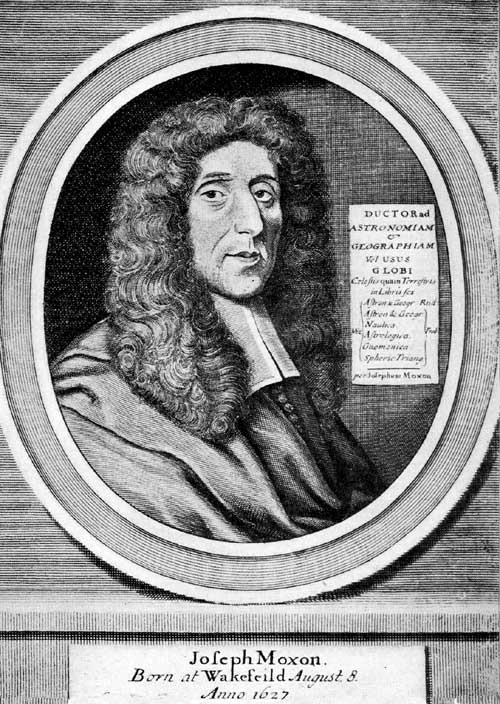
Fig. 116. Portrait of Joseph Moxon.
“Besides,” he states, “I hope to encourage those by an ample liberal plainness to fall in love with the Studies, that formerly have been disheartened by the Crabbed brevity of those Authors that have in Characters as it were rather writ Notes for their own Memories, than sufficient Documents for their Readers Instructions.
“The Globes for which this Book is written are new Globes that I set forth, which as I told you in my Epistle to the Reader of Blaws Book differ somewhat from other Globes; and that both the Celestial and the Terrestrial; mine being the latest done of any, and to the accomplishing of which, I have not only had the help of all or most of the best of other Globes, Maps, Plates, and Sea-drafts of New discoveries that were then extant for the Terrestrial Globe, but also the Advice and directions of divers able Mathematicians both in England and Holland for Tables and Calculations both of Lines and Stars for the Celestial; upon which globe I have placed every Star that was observed by Tycho Brahe and other Observers, one degree of Longitude farther in the Ecliptick than they are on any other Globes: so that whereas on other Globes the places of the Stars were correspondent with their places in Heaven 69 Years ago, when Tycho observed them, and therefore according to his Rule want almost a degree of their true places in Heaven at this Time: I have set every Star one degree farther in the Ecliptick, and rectified them on the Globe according to the true place they had in Heaven in the Year 1671.
“On the Terrestrial Globe I have inserted all the New Discoveries that have been made, either by our own Forraign Navigators, and that bothe in the East, West, North, and South parts of the Earth. In the East Indies we have in the latter Times many spacious places discovered, many Islands inserted, and generally the whole Draught of the Country rectified and amended, even to the Coast of China, Japan, Giloli &c. In the South Sea between the East and West Indies are scattered many Islands, which for the uncertain knowledge former Times had of them are either wholly left out of other Globes, or else laid down so erroneously that little of credit can be attributed unto them. California is found to be an Island, though formerly supposed to be part of the main Continent, whose North-West shoar was imagined to thrust itself forth close to the Coasts of Cathaio, and so make the supposed Straights of Anian. The Western Shoars of the West Indies are more accurately described than formerly, as you may see if you compare my Terrestrial Globe: that I have lately set forth with the Journals of the latest Navigators: And if you compare them with other Globes you will find 5, 6, yea 7 degrees difference in Longitude in most Places of these Coasts. Magellanica which heretofore was thought to be part of the South Continent called Terra Incognita is now also found to be an Island. All that Tract of Land called Terra Incognita I have purposely omitted, because as yet we have no certainty whether it be Land or Sea; unless it be of some parts lately found out by the Dutch, who having a convenient Port at Batavia in Java, have from there sent forth Ships Southward, where they have found several very large countries; one whereof they have called Hollandia Nova, another Zelandia Nova, another Anthoni van Diemans Land; and divers others; some whereof lie near our Antipodes; as you may see by my terrestrial Globes. Again, Far to the Northwards there are some New Discoveries, even within six degrees of the Pole: The Drafts to the North Eastwards I have laid down even as they were described by the Searchers of those parts for a passage into the East Indies. And also the Discoveries of Baffin, Captain James, and Capt. Fox (our own Country-men) that attempted the finding a passage that way into the South Sea.
“I also told you what difference there is in several Authors about placing the first Meridian, which is the beginning of Longitude; that Ptolemy placed it at the Fortunate Islands, which Mr. Hues pag. 4. chap. 1. in his Treatise of Globes proves to be the Islands of Cabo Verde, and not those now called the Canary Islands; because in his Time they were the farthest place of the Discovered World towards the setting of the Sun; Others placed it at Pico in Teneriffa; Others at Corvus and Flora; because under that Meridian the Compass had no Variation, but did then duly respect the North and South; Others for the same Reason begin their Longitude at St. Michaels; and Others between the Islands of Flores and Fayal: And the Spaniards of late by reason of their great Negotiation in the West Indies, have begun their Longitude at Toledo there, and contrary to all others account it Westwards.
“Therefore I, seeing such diversity among all Nations, and as yet an Uniformity at home, chose with our own Country-men to place my First Meridian at the Ile Gratiosa, one of the Iles of Azores.
“By the different placing of this first Meridian it comes to pass that the Longitude of Places are diversely set down in different Tables; For those Globes or Maps that have their first Meridian placed to the Eastwards of Gratiosa, have all places counted Eastwards from the Meridian of Gratiosa, and their first Meridian in a greater number of degrees of Longitude, and that according as the Arch of Difference is.”
At the conclusion of this work we find printed a catalogue of his books, maps, and instruments, including globes celestial and terrestrial of all sizes, and, what is of considerable interest and value, the price of each given.114
We know that the Chinese, very many centuries ago, manifested a considerable interest in astronomy; nor was there wanting with them an interest in geography. It was, however, especially in the former science they may be said to have made contributions of real value. An unreliable record, telling us of the interest exhibited by the Emperor Shun, reigning more than two thousand years before the beginning of the Christian era, notes that he made use of an armillary sphere in his study of the stars. Little is there to assure us that prior to the time of Kúblai Kaan (1216-1294) there were those who turned their attention to the construction of globes. That great Mongol Emperor’s astronomer Ko-Shun-King, having demonstrated the superiority of his astronomical wisdom, was directed to institute reforms in Chinese chronology and to construct for purposes of scientific investigations such instruments as he thought to be necessary. Accordingly he removed from the old observatory “an armillary sphere dating from 1049,” substituting in its place a number of large and small instruments, two of which have survived to our day—an armillary sphere and a celestial globe, which may be said to date from about the year 1274. These instruments of the astronomer Ko-Shun-King had place in an observatory which he had erected on the site of an ancient structure at the southeast corner of the Tartar city wall, being raised above the parapet. There they remained until the year 1673 when the Jesuit astronomer Father Ferdinand Verbiest judged them to be useless and persuaded the Emperor to pull them down and put up new ones of his own contriving.115 The old instruments were stored away at the foot of the terrace, and of these, as before noted, but two now remain.
Le Comte refers to the celestial globe as one well cast, and having a diameter of about three feet, the degrees and minutes being marked both “longitudinally and latitudinally.” An early description tells us that its equator is in the center, equidistant from the two poles, in each case a quarter of a circumference. The ecliptic is elevated above and depressed below the equator, in each case barely twenty-four degrees. The elevations and depressions of the moon in its orbit being variable, a bamboo hoop, divided into degrees equally throughout, is used to verify the intersections with the ecliptic and accordingly is moved from time to time. The globe rests on a square box, the north and south poles being respectively above and below the surface fully forty degrees, half of the globe being visible and half concealed. Toothed wheels, set in motion by machinery concealed within the box, are so adjusted as to cause the globe to revolve.
The armillary sphere (Fig. 117) stands at the east end of the court. It is an instrument of huge dimensions being described in early records somewhat as follows, in each reference there being allusion to its beautiful workmanship, and to its design as possessing remarkable excellence. The supporting base of the piece has a mythological significance. The four dragons, which play such a part in the Chinese geomancy, are here represented as chained to the earth, while upholding the spheres. Its substantial horizon circle, crossed at right angles by a double ring representing an azimuth circle, forms the outer supporting framework. The upper surface of the horizon circle is divided into twelve equal parts, marked by the several Chinese cyclical characters applied to the twelve hours into which the day and night was divided. Around the outside of this horizon circle these twelve characters appear again, with the Chinese names for the several points of the compass. On the inside of this circle one finds the names of the twelve States into which the ancient Empire was divided, each State being thought of as under the influence of a particular quarter of the heavens.
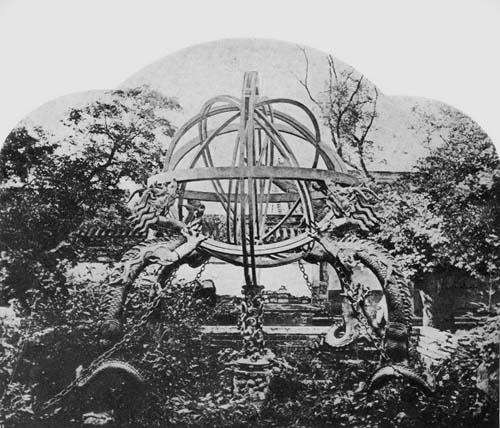
Fig. 117. Ancient Mongolian Armillary Sphere, ca. 1274.
Inside this frame is placed an equatorial circle within which is a series of movable circles made to turn on polar pivots attached to the azimuth circle. These movable circles consist of an equatorial circle, a double ring ecliptic, an equinoctial colure, and a double ring solstitial colure. The equator is divided into twenty-eight unequal portions marked by the names of as many constellations of very ancient origin. The ecliptic is divided into twenty-four equal parts according with the divisions of the year. Within the circles just described there is a double revolving meridian with a double axis and within this a fixed tube for taking sights.
All the circles of this armillary sphere are divided into 365¼ degrees corresponding to the days of the year and each degree is divided into hundreds. At the corners of the base outside the dragons are four miniature rocks in bronze, with the respective inscriptions “Keen Shan,” northwest or celestial mountain; “Kwan Shan,” southwest or terrestrial mountain; “Seuen-Shan,” or southeast mountain; “Kan Shan,” northeast mountain.
When the astronomer Père Ferdinand Verbiest (1623-1688),116 undertook the survey and management of mathematics for the Emperor he, like his predecessor Ko-Shun-King four hundred years before, began his task, as noted above, by ordering the removal of the old instruments from the observatory and the construction of new ones. Six of these are referred to in the records of the period as possessing especial merit, including a zodiacal armillary sphere six feet in diameter, an equinoctial armillary sphere six feet in diameter, a horizon azimuth likewise six feet in diameter, a quadrant having a radius of six feet, a sextant with a radius of eight feet, and a celestial globe having a diameter of six feet.
The armillary spheres have each but four circles, being of excellent workmanship, and having mountings of elaborate Chinese designs.
That which especially interests us here is the celestial globe (Fig. 117a) which Le Compte describes somewhat in detail. “This in my Opinion,” he says, “is the fairest and best fashioned of all the Instruments. The Globe itself is brazen, exactly round and smooth; the Stars well made, and in their true places, and all Circles of proportional breadth and thickness. It is besides so well hung, that the least touch moves it, and tho’ it is above two thousand weight, the least Child may elevate it to any Degree. On its large concave Bases are placed opposite four Dragons, whose Hair standing up on end, support a noble Horizon commendable for its breadth, its several Ornaments, and the delicacy and niceness of the Work. The Meridian in which the Pole is fixed rests upon Clouds that issue out of the Bases, and slides easily between them, its Motion being facilitated by some hidden Wheels, and moves with it the whole Globe to give it the required Elevation. Besides which, the Horizon, Dragons and two brazen Beams, which lie cross in the Center of the Bases Concavity, are all moved at pleasure without stirring the Bases which still remain fixed; this facilitates the due placing of the Horizon, whether in respect of the Natural Horizon, or in respect of the Globe. I wonder how Men who live six thousand Leagues from us could go through such a piece of Work; and I must own, that if all the Circles which are divided, had been corrected by some of our Workmen, nothing could be more perfect in this kind.” This piece, it may be noted, was carried away to Potsdam at the close of the Boxer Rebellion, copies of them being left in the old observatory. The Treaty of Versailles directed that the originals should be returned to their early home.
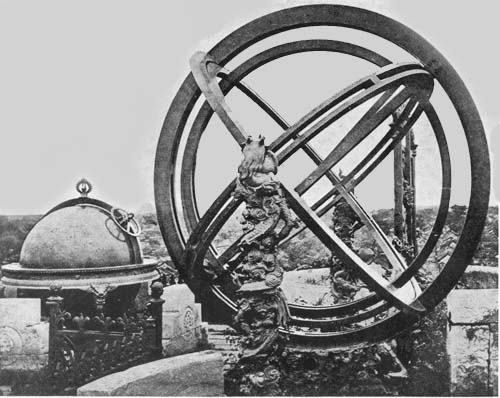
Fig. 117a. Armillary Sphere and Celestial Globe of Ferdinand Verbiest, 1673.