"!Tention" (continued 5)
Reading edition
Just then Pen’s voice was heard, and, quite free now, Punch stepped to the door and took the two muskets that were passed down to him. Then Pen descended with the cartouche-boxes and belts, and handed one to Punch in exchange for a musket, and the two lads stood ready.
The smuggler smiled approval as he saw his young friends’ prompt action, and nodded his head.
“Can you walk?” he said.
Pen nodded.
“And can you fire a few shots on our behalf?”
“Try us,” replied Pen. “But it rather goes against the grain after what we have received. You only came in time.”
“Yes, I know,” replied the smuggler. “But there are many mistakes in war, and we are all friends now.”
The contrabandista turned from him sharply and hurried to the door, where another of his followers appeared, who whispered a few words to him, received an order, and stepped back, while his leader turned to the father and said something, which resulted in the old man joining the two lads and pressing their hands, looking at them sadly.
The next minute the smuggler signed to them to join his follower who was waiting by the door, while he stepped to the King, spoke to him firmly for a few minutes, and then led the way out into the darkness, with the two English lads, who were conscious that they were being followed by the royal fugitive and his men, out along the shelf in the direction of the forest-path, which they had just gained when a distant shot rang out, to be repeated by the echoes and followed by another and another, ample indication that there was danger very near at hand.
The captain said a few words to his follower, and then turned to Pen.
“Keep with this man,” he said, “when I am not here. I must go back and see what is going on.”
The lads heard his steps for a minute amongst the crackling husks of the past year’s chestnuts and parched twigs. Then they were merged with those of the party following.
“I say,” whispered Punch, “how’s your leg?”
“I had almost forgotten it,” replied Pen in a whisper.
“That’s good, comrade. But, I say, all that set a fellow thinking.”
“Yes; don’t talk about it,” replied Pen.
“All right. But I say, isn’t this lovely—on the march again with a loaded gun over your shoulder? If I had got my bugle back, and one’s officer alongside, I should be just happy. Think we shall have a chance of a shot or two?”
The smuggler, who was leading the way, stopped short and turned upon Punch with a deep, low growl.
“Eh?” replied Punch. “It’s no good, comrade; I can’t understand a word.”
The man growled again, and laid his hand sharply upon the boy’s lips.
“Here, don’t do that!” cried Punch. “How do I know when you washed that last?”
“Be quiet, Punch. The man means we may be nearing the enemy.”
“Why don’t he say so, then?” grumbled Punch; and their guide grunted as if satisfied with the effect of Pen’s words, and led on again in and out a rugged, winding path, sometimes ascending, sometimes descending, but never at fault in spite of the darkness.
Sometimes he stopped short to listen as if to find out how near the King’s party were behind, and when satisfied he led on again, giving the two lads a friendly tap or two upon the shoulder after finding that any attempt at other communication was in vain.
At last after what must have been about a couple of hours’ tramp along the extremely rugged path, made profoundly dark by the overhanging low, gnarled trees, he stopped short again and laid his hand in turn upon the lips of the boys, and then touched Pen’s musket, which he made him ground, took hold of his hands in turn and laid them on the muzzle, and then stood still.
“What’s he up to now?” whispered Punch, with his lips close to his comrade’s ear.
“I think he means we are to halt and keep guard.”
“Oh, that’s it, is it?” muttered Punch; and he stood fast, while the smuggler patted him on the shoulder and went off quickly, leaving the boys alone, with Punch muttering and fuming in his intense desire to speak. But he mastered himself and stood firm, listening as the steps of the party behind came nearer and nearer till they were close at hand. This was too much for Punch.
“Lookye here,” he whispered; “they will be ready to march over us directly. How are we going to tell them to halt?”
“Be silent. Perhaps they will have the sense to see that they ought to stop. Most likely there are some amongst them who understand French.”
Pen proved to be right in his surmise, for directly after a portion of the following party were close to them, and the foremost asked a question in Spanish. “Halte!” said Pen sharply, and at a venture; but it proved sufficient. And as he stood in the dim, shadowy, overhung path the word was passed along to the rear, and the dull sound of footsteps died out. “Bravo!” whispered Punch. “They are beginning to understand English after all. I say, ain’t that our chaps coming back?”
Pen heard nothing for a few moments. Then there was the faint crack of a twig breaking beneath some one’s feet, and the smuggler who was acting as their guide rejoined them.
“Los Francéses,” said the man, in a whisper; and he dropped the carbine he carried with its butt upon the stony earth, rested his hands upon the muzzle, and stood in silence gazing right away, and evidently listening and keenly on the alert, for he turned sharply upon Punch, who could not keep his tongue quiet.
“Oh, bother! All right,” growled the boy. “Here, comrade,” he whispered to Pen; “aren’t these ’ere cork-trees?”
“Perhaps. I’m not sure,” whispered his companion impatiently. “Why do you ask? What does it matter now?”
“Lots. Just you cut one of them. Cut a good big bung off and stuff it into my mouth; for I can’t help it, I feel as if I must talk.”
“Urrrrrrr!” growled the guide; and then, “Hist! hist!” for there was a whispering behind, and directly after the contrabandista captain joined them, to ask a low question in Spanish.
“The enemy are in front. They are before us,” said the smuggler in French to Pen.
Then he spoke to his follower, who immediately began to retrace his steps, while the leader followed him with the two lads, who were led back to where the King was waiting in the midst of his followers; and now a short colloquy took place which resulted in all facing round and following the two smugglers, who retraced their path for the next half-hour, and then suddenly struck off along a rugged track whose difficulty was such that it was quite plain to the two lads that they were striking off right up into the mountains.
It was a wearisome route that was only followed with great difficulty, and now it was that Pen’s wounded leg began to give him such intense pain that there were moments when he felt that he must break down.
But it came to an end at last, just before daybreak, in the midst of what seemed to be an amphitheatre of stones, or what might have been some quarry or place where prospecting had taken place in search of some one or other of the minerals which abounded in parts of the sterile land.
And now a halt was made, the smuggler picking out a spot which was rough with bushes; and here he signed to the two lads to lie down and rest, a silent command so welcome that Pen sank at full length at once, the rugged couch seeming to him so welcome that it felt to him like down.
A few specks of orange light high up in the sky told that sunrise was very near at hand, and for a few minutes Pen gazed upwards, rapt in wonder by the beauty of the sight. But as he lay and listened to the low murmur of voices, these gradually grew fainter and apparently more distant, while the ruddy specks of light paled and there seemed to be nothing more, for pain and exhaustion had had their way. Thoughts of Spaniards, officers and men, and the contrabandistas with their arms of knife and carbine, were quite as naught, danger non-existent, and for the time being sleep was lord of all.
Chapter Thirty One.
A Dream of a Ramrod.
It seemed to Pen to be a dream, and then by some kind of mental change it appeared to be all reality. In the first instance he felt that he was lying in the loft over the priest’s room, trying to sleep, but he could not get himself into a comfortable position because Punch had gone down below to clean his musket and wanted him to come down too and submit his weapon to the same process. But it had happened that he wanted to go to sleep horribly, and he had refused to go down; with the consequence that as he lay just over the knot-hole Punch kept on poking his ramrod through the opening to waken him up, and the hard rod was being forced through the dry leaves of the Indian corn to reach his leg exactly where the bullet had ploughed, while in the most aggravating way Punch would keep on sawing the ramrod to and fro and giving him the most acute pain.
Then the boy seemed to leave off in a tiff and tell him that he might sleep for a month for aught he cared, and that he would not try to waken him any more.
Then somehow, as the pain ceased, he did not go to sleep, but went right off up the mountain-side in the darkness, guiding the King and his followers into a place of safety; still it was not so safe but that he could hear the French coming and firing at them now and then.
However, he went on and on, feeling puzzled all the time that he should know the way through the mountains so well, and he took the King to rest under the great chestnut-tree, and then on again to where the French were firing, and one of them brought him down with the bullet that ploughed his leg.
But that did not seem to matter, for, as if he knew every bit of the country by heart, he led the King to the goat-herd’s cottage, and advised him to lie down and have a good rest on the rough bed, because the peasant-girl would be there before long with a basket of food.
The King said that he did not care to sleep because he was so dreadfully thirsty, and what he wanted was a bowl of goat’s-milk. Then somehow he went to where the goat was waiting to be milked, and for a long time the milk would not come, but when it did and he was trying to fill the little wooden seau it was all full of beautiful cold water from the foot of the falls where the trout were rushing about.
Then somehow Punch kept on sawing his ramrod to and fro along the wound in his leg, and the more he tried to catch hold of the iron rod the more Punch kept on snatching it away; and they were going through the darkness again, with the King and his followers close behind, on the way to safety; while Pen felt that he was quite happy now, because he had saved the King, who was so pleased that he made him Sir Arthur Wellesley and gave him command of the British army.
Whereupon Punch exclaimed, “I never saw such a fellow as you are to sleep! Do wake up. Here’s Mr Contrabando waiting to speak to you, and he looks as if he wanted to go away.”
“Punch!” exclaimed Pen, starting up.
“Punch it is. Are you awake now?”
“Awake? Yes. Have I been dreaming?”
“I d’know whether you have been dreaming or not, but you have been snoring till I was ashamed of you, and the more I stirred you up the more you would keep on saying, ‘Ramrod.’”
“Bah! Nonsense!”
“That’s what I thought, comrade. But steady! Here he is again.”
“Ah, my young friend!” said the contrabandista, holding out his hand. “Better after your long sleep?”
“Better? Yes,” replied Pen eagerly. “Leg’s very stiff; but I am ready to go on. Are we to march again?”
“Well, no, there’s not much chance of that, for we are pretty well surrounded by the enemy, and here we shall have to stay unless we can beat them off.”
“Where are we? What place is this?” asked Pen rather confusedly.
“One of our hiding-places, my friend, where we store up our goods and stable the mules when the pass near here is blocked up by snow or the frontier guards. Well, how do you feel now? Ready to go into hiding where you will be safe, or are you ready to help us against your enemies the French?”
“Will there be fighting?” asked Pen eagerly.
“You may be pretty sure of that; but I don’t want to force you two wounded young fellows into taking part therein unless you are willing.”
“I am willing,” said Pen decisively; “but it’s only fair that I should ask my comrade, who is only one of the buglers of my regiment.”
“Oh, of course,” said the smuggler captain, “a non-combatant. He carries a musket, I see, like yourself.”
“Yes,” replied Pen, with a smile, “but it is only a French piece. We belong to a rifle-regiment by rights.”
“Yes; I have heard of it,” said the smuggler.
“Well, I will ask him,” said Pen, “for he doesn’t understand a word we are saying.—Punch,” he continued, addressing the boy, “the contrabandista wants to know whether we will fire a few shots against the French who are trying to take the Spanish King.”
“Where do they want to take him?” cried the boy eagerly.
“Back to prison.”
“Why, of course we will,” said the boy sharply. “What do you want to ask that for?”
“Because he knows that you are not a private soldier, but a bugle-boy.”
“Well, I can’t help that, can I? I am a-growing, and I dare say I could hit a haystack as well as a good many of our chaps. They ain’t all of them so clever because they are a bit older than I am.”
“Well, don’t get into a tiff, Punch. This isn’t a time to show your temper.”
“Who’s a-showing temper? I can’t help being a boy. What does he want to chuck that in a fellow’s teeth for?”
“Quiet! Quiet!” said Pen, smiling. “Then I am to tell him that you are ready to have a shot or two at the enemy?”
“Well, I do call you a pretty comrade!” said the boy indignantly. “I should have thought you would have said yes at once, instead of parlyvooing about it like that.—Right, sir!” cried the boy, catching up his musket, giving it two or three military slaps, and drawing himself up as if he had just heard the command, “Present arms!”
“Bon!” said the smuggler, smiling; and he gave the boy a friendly slap on the shoulder.
“Ah!” ejaculated Punch, “that’s better,” as the smuggler now turned away to speak to a group of his men who were standing keeping watch behind some rocks a short distance away.—“I say, comrade—you did tell me once, but I forgetted it—what does bong mean?”
“Good.”
“Ho! All right. Bong! I shall remember that next time. Fire a few shots! I am game to go on shooting as long as the cartridges last; and my box is full. How’s yours?”
“Only half,” replied Pen.
“Oh, well, fair-play’s a jewel; share and share alike. Here, catch hold. That looks like fair measure. We don’t want to count them, do we?”
“Oh no, that’s quite near enough.”
“Will we fire a few shots at the French?” continued Punch eagerly. “I should just think we will! Father always said to me, ‘Pay your debts, my boy, as long as the money lasts;’ and though it ain’t silver and copper here, it’s cartridges and— There! Ain’t it rum, comrade? Now, I wonder whether you feel the same. The very thought of paying has made the pain in my back come again. I say, how’s your leg?”
Chapter Thirty Two.
A cavernous Breakfast.
“I say, comrade,” whispered Punch; “are we going to begin soon?”
The boys were seated upon a huge block of stone watching the coming and going of the contrabandistas, several of whom formed a group in a nook of the natural amphitheatre-like chasm in which they had made their halt.
This seemed to be the entrance to a gully, down which, as they waited, the lads had seen the smuggler-leader pass to and fro several times over, and as far as they could make out away to their left lay the track by which they had approached during the night; but they could not be sure.
That which had led them to this idea was the fact that it seemed as if sentries had been stationed somewhere down there, one of whom had come hurriedly into the amphitheatre as if in search of his chief.
“I say, comrade,” said Punch, repeating his question rather impatiently, “aren’t we going to begin soon? I feel just like old O’Grady.”
“How’s that, Punch?”
“What he calls ‘spoiling for a fight, me boy.’”
“Oh, you needn’t feel like that, Punch,” said Pen, smiling.
“Well, don’t you?”
“No. I never do. I never want to kill anybody.”
“You don’t? That ain’t being a good soldier.”
“I can’t help that, Punch. Of course, when one’s in for it I fire away like the rest; but when I’m cool I somehow don’t like the feeling that one has killed or wounded some brave man.”
“Oh, get out,” cried the boy, “with your ‘killed or wounded some brave man!’ They ain’t brave men—only Frenchies.”
“Why, Punch, there are as brave men amongst the French as amongst the English.”
“Get out! I don’t believe that,” said the boy. “There can’t be. If there were, how could our General with his little bit of an army drive the big army of Frenchies about as he does? Ask any of our fellows, and they will tell you that one Englishman is worth a dozen Frenchies. Why, you must have heard them say so.”
“Oh yes, I have, Punch,” said Pen, laughing, as he nursed his leg, which reminded him of his wound from time to time. “But I don’t believe it. It’s only bluster and brag, of which I think our fellows ought to be ashamed. Why, you’ve more than once seen the French soldiers drive our men back.”
“Well, yes,” said Punch grudgingly. “But that’s when there have been more of them.”
“Not always, Punch.”
“Why is it, then?”
“Oh, when they have had better positions and our officers have been outflanked.”
“Now you are dodging away from what we were talking about,” said Punch. “You were saying that you didn’t like shooting the men.”
“Well, I don’t.”
“That’s because you don’t understand things,” cried the boy triumphantly. “You see, although I am only a boy, and younger than you are, I am an older soldier.”
“Are you, Punch?” said Pen, smiling.
“Course I am! Why, you’ve only been about a year in the regiment.”
“Yes, about a year.”
“Well,” cried the boy triumphantly, “I was born in it, so I’m just as old a soldier as I am years old. You needn’t mind shooting as many of them as you can. They are the King’s enemies, and it is your duty to. Don’t the song say, ‘God save the King?’ Well, every British soldier has got to help and kill as many enemies as he can. But I say, we are going to fight for the Spanish King, then? Well, all right; he’s our King’s friend. But where is he now? I haven’t seen anything of him this morning. I hope he hasn’t run away and left us to do the fighting.”
“Oh no,” said Pen, “I don’t think so. Our smuggler friend said we were surrounded by the French.”
“Surrounded, eh?” cried Punch. “So much the better! Won’t matter which way we fire then, we shall be sure to bring some one down. Glad you think the Spanish King ain’t run away though. If I was a king I know what I should do, comrade,” continued Punch, nursing his musket and giving it an affectionate rub and pat here and there. “Leg hurt you, comrade?”
“No, only now and then,” said Pen, smiling. “But what would you do if you were a king?”
“Lead my army like a man.”
“Nonsense! What are the generals for?”
“Oh, you would want your generals, of course, and the more brave generals the King has—like Sir Arthur Wellesley—the better. I say, he’s an Irishman, isn’t he?”
“Yes, I believe so,” replied Pen.
“Yes,” continued Punch after a minute. “They are splendid fellows to fight. I wonder whether he’s spoiling for one now. Old O’Grady would say he was. You should hear him sometimes when he’s on the talk. How he let go, my boy, about the Oirish! Well, they are good soldiers, and I wish, my boy, old O was here to help. O, O, and it’s O with me, I am so hungry! Ain’t they going to give us anything to eat?”
“Perhaps not, Punch, for it’s very doubtful whether our friends keep their provisions here.”
“Oh, I say!” cried the boy, with his face resembling that of the brave man in Chevy Chase who was in doleful dump, “that’s a thing I’d see to if I was a king and led my army. I would have my men get a good feed before they advanced. They would fight ever so much better. Yes, if I was a king I’d lead my own men. They’d like seeing him, and fight for him all the better. Of course I wouldn’t have him do all the dirty work, but— Look there, comrade; there’s Mr Contrabando making signals to you. We are going to begin. Come on!”
The boy sprang to his feet, and the companions marched sharply towards the opening where the group of smugglers were gathered.
“Bah!” ejaculated Punch contemptuously. “What a pity it is! I don’t believe that they will do much good with dumpy tools like them;” and the boy literally glared at the short carbines the smugglers had slung across their shoulders. “Of course a rifle would be best, but a good musket and bayonet is worth a dozen of those blunderbusters. What do they call them? Bell-mouthed? Why, they are just like so many trumpet-things out of the band stuck upon a stick. Why, it stands to reason that they can’t go bang. It will only be a sort of a pooh!” And the boy pursed up his lips and held his hand to his mouth as if it were his lost bugle, and emitted a soft, low note—poooooh!
“Déjeuner, mes amis!” said the smuggler, as the boys advanced; and he led the way past a group of his followers along the narrow passage-like opening to where it became a hewn-out tunnel which showed the marks of picks, and on into a rock-chamber of great extent, in one corner of which a fire was blazing cheerfully, with the smoke rising to an outlet in the roof. Directly after the aromatic scent of hot coffee smote the nostrils of the hungry lads, as well as the aroma of newly fried ham, while away at one side to the right they caught sight of the strangers of the past night, Pen recognising at once the now uncloaked leader who had presented a pistol at his head.
“Here, I say,” whispered Punch excitedly, “hold me up, comrade, or I shall faint.”
“What’s the matter?” said Pen anxiously. “You feel that dreadful pain again? Is it your wound?”
“Pain? Yes,” whispered Punch; “but it ain’t there;” and he thrust his hand into his pocket to feel for his knife.
It was a rough meal, roughly served, but so abundant that it was evident that the smugglers were adepts in looking after the commissariat department. In one part of the cavern-like place the King and his followers were being amply supplied, while right on the other side—partly hidden by a couple of stacks piled-up in the centre of the great chamber, and formed in the one case of spirit-kegs, in the other of carefully bound up bales that might have been of silk or velvet—were grouped together near the fire some scores of the contrabandistas who seemed to be always coming and going—coming to receive portions of food, and going to make place for others of the band.
And it was beyond these stacks of smuggled goods that their contrabandista friend signed to the lads to seat themselves. One of the men brought them coffee and freshly fried ham and cake, which the captain shared with them and joined heartily in the meal.
“I say, Pen,” whispered Punch, “do tell him in ‘parlyvoo’ that I say he’s a trump! Fight for him and the King! I should just think we will! D’ye ’ear? Tell him.”
“No,” said Pen. “Let him know what we feel towards him by what we do, Punch, not what we say.”
“All right. Have it your own way,” said the boy. “But, I say, I do like this ham. I suppose it’s made of some of them little pigs we see running about in the woods. Talk about that goat’s mutton! Why, ’tain’t half so good as ours made of sheep, even though they do serve it out and call it kid. Why, when we have had it sometimes for rations, you couldn’t get your teeth into it. Kid, indeed! Grandfather kid! I’m sure of that. I say, pass the coffee, comrade. Only fancy! Milk and sugar too! Oh no, go on; drink first. Age before honesty. I wonder whether this was smuggled.—What’s the matter now?”
For in answer to a shrill whistle that rang loudly in echoes from the roof, every contrabandista in the place sprang up and seized his carbine, their captain setting the example.
“No, no,” he said, turning to the two lads. “Finish your breakfast, and eat well, boys. It may be a long time before you get another chance. There’s plenty of time before the firing begins, and I will come back for you and station you where you can fight for Spain.”
He walked quickly across to where the King’s followers had started up and stood sword in hand, their chief remaining seated upon an upturned keg, looking calm and stern; but at the same time his eyes wandered proudly over the roughly disguised devoted little band who were ready to defend him to the last.
Pen watched the contrabandista as he advanced and saluted the dethroned monarch without a trace of anything servile; the Spanish gentleman spoke as he addressed his sovereign in a low tone, but his words were not audible to the young rifleman. Still the latter could interpret them to himself by the Spaniard’s gestures.
“What’s he a-saying of?” whispered Punch; and as he spoke the boy surreptitiously cut open a cake, turned it into a sandwich, and thrust it into his haversack.
“I can’t hear, Punch,” replied Pen; “and if I could I shouldn’t understand, for he’s speaking in Spanish. But he’s evidently telling him that his people may finish their breakfast in peace, for, like us, they are not wanted yet.”
As Pen spoke the officers sheathed their swords, and two or three of them replaced pistols in their sashes. Then the contrabandista turned and walked sharply across the cavern-like chamber to overtake his men, and as he disappeared, distant but sharp and echoing rap, rap, rap, came the reports of firearms, and Punch looked sharply at his companion.
“Muskets, ain’t they?” he said excitedly.
“I think so,” replied Pen.
“Must be, comrade. Those blunderbusters—trabookoos don’t they call them?—couldn’t go off with a bang like that. All right; we are ready. But, I say, a soldier should always make his hay when the sun shines. Fill your pockets and haversack, comrade.—There they go again! I am glad. It’s like the old days once more. It will be ‘Forward!’ directly—a skirmishing advance. Oh, bad luck, as old O’Grady says, to the spalpeen who stole my bugle! The game’s begun.”
Chapter Thirty Three.
At Bay.
The King’s party remained perfectly still during the first few shots, and then, unable to contain themselves, they seemed to the lads to be preparing for immediate action. The tall, stern-looking Spaniard who had seemed to be their leader the previous night, and who had given the orders which resulted in the boys being dragged down into the priest’s room, now with a due show of deference approached the King, who remained seated, and seemed to be begging his Sovereign to go in the direction he pointed, where a dark passage evidently led onward right into the inner portions of the cavern or deserted mine.
The conversation, which was carried on in Spanish, would not have been comprehended by the two lads even if they had understood that tongue; but in spite of the Spaniard going even so far as to follow up his request and persuasion by catching at the King’s arm and trying to draw him in the direction he indicated, that refugee shook his head violently, wrested his wrist away, drew his sword, placed himself in front of his followers, and signed to them to advance towards the entrance.
“Well done!” whispered Punch. “He is something like a king after all. He means fighting, he does!”
“Hush,” whispered back Pen, “or you will be heard.”
“Not us,” replied Punch, who began busying himself most unnecessarily with his musket, placing the butt between his feet, pulling out the ramrod and running it down the barrel to tap the end of the cartridge as if to make sure that it was well driven home.
Satisfied with this, he drew the iron rod again, thrust it into the loops, threw the piece muzzle forward, opened the pan to see that it was full of powder, shut it down again, and made a careful examination of the flint. For these were the days long prior to the birth of the copper percussion-cap, and plenty of preliminaries had to be gone through before the musket could be fired.
Satisfied now that everything possible had been done, he whispered a suggestion to his companion that he too should make an examination.
“I did,” replied Pen, “a few minutes ago.”
“But hadn’t you better look again?” whispered Punch.
“No, no,” cried his companion impatiently. “Look at them; they are all advancing to the entrance, and we oughtn’t to be left behind.”
“We ain’t a-going to be,” said the boy through his set teeth. “Come on.”
“No,” replied Pen.
“Come on, I say,” cried the boy again. “We have only got muskets, but we are riflemen all the same, and our dooty is to go right in front skirmishing to clear the way.”
“Our orders were,” said Pen, “to wait here till our captain fetched us to the front and did what he told us.”
“But he ain’t come,” protested Punch.
“Not yet,” replied Pen. “Do you want him to come and find that we have broken faith with him and are not here?”
“Course I don’t,” cried the boy, speaking now excitedly. “But suppose he ain’t coming? How do we know that he aren’t got a bullet in him and has gone down? He can’t come then.” Pen was silent.
“And look here,” continued Punch; “when he gave us those orders he told that other lot—the Spaniel reserve, you may call them—to stop yonder till he come. Well, that’s the King, ain’t it? He’s ordered an advance, and he’s leading it hisself. Where’s his cloud of riflemen feeling the way for him? Are we to stop in the rear? I thought you did know better than that, comrade. I do. This comes of you only being a year in the regiment and me going on learning for years and years. I say our place is in the front; so come on.”
“Yes, Punch; you must be right,” said Pen unwillingly, “Forwards then. Double!”
“That’s your sort!” And falling into step and carrying their muskets at the trail, the two lads ran forward, their steps drowned for the moment by the heavy firing going on away beyond the entrance; and they were nearly close up to the little Spanish party before their advance was observed, and then one of the Spaniards shouted a command which resulted in his fellows of the King’s bodyguard of friends turning suddenly upon them to form a chevaux-de-frise of sword-blades for the protection of their Sovereign.
For the moment, in the excitement, the two lads’ lives were in peril; but Pen did not flinch, and, though suffering acute pain from his wound, ran on, his left arm almost brushing the little hedge of sword-points, and only slackening his speed when he was a dozen yards in front and came right upon the smuggler-leader, pistol in one hand, long Spanish knife in the other.
Instead of angrily denouncing them for their disobedience to his order, he signed to them to stop, and ran on to meet the King’s party, holding up his hand; and then, taking the lead, he turned off a little way to his left toward a huge pile of stones and mine-refuse, where he placed them, as it were, behind a bank which would act as a defence if a rush upon them were made from the front.
The two lads watched him, panting the while with excitement, listening as they watched to the fierce burst of firing that was now being sustained.
The King gave way at once to the smuggler’s orders, planting himself with his followers ready for an anticipated assault; and, apparently satisfied, the smuggler waved the hand that grasped his knife and ran forward again with the two young Englishmen.
This time it was the pistol that he waved to them as if bidding them follow, and he ran on some forty or fifty yards to where the entrance widened out and another heap of mine-rubbish offered itself upon the other side as a rough earthwork for defence, and where the two lads could find a temporary parapet which commanded the entry for nearly a hundred yards.
Here he bade the two lads kneel where, perfectly safe themselves, they could do something to protect their Spanish friends behind on their left.
“Do your best,” he said hoarsely. “They are driving my men back fast; but if you can keep up a steady fire, little as it will be, it will act as a surprise and maybe check their advance. But take care and mind not to injure any of my men.”
He said no more, but ran forward again along the still unoccupied way, till a curve of the great rift hid him from their sight.
“What did he say?” whispered Punch excitedly, as Pen now looked round and diagonally across the way to the great chamber, and could see the other rough stonework, above which appeared a little line of swords.
“Said we were to be careful not to hurt him and his friends if they were beaten back.”
“No fear,” said Punch; “we can tell them by their red handkerchiefs round their heads and their little footy guns. We’ve got nothing to do, then, yet.”
“For a while, Punch; but they are coming on fast. Hark at them!” For the firing grew louder and louder, and was evidently coming nearer.
“And only two of us as a covering-party!” muttered Punch. “Oh, don’t I wish all our chaps were here!”
“Or half of them,” said Pen.
“Yes, or half of them, comrade. Why, I’d say thank ye if it was only old O’Grady, me boy. He can load and fire faster than any chap in our company. Here, look at that!” For the sunlight shone plainly upon the red silk handkerchief of a Spaniard who suddenly ran into sight, stopped short, and turned to discharge his carbine as if at some invisible pursuers, and then dropped his piece, threw up his hands, and fell heavily across the way, which was now tenanted by a Spanish defender of the King.
“Only wounded perhaps,” panted Punch; and Pen watched the fallen man hopefully in the expectation of seeing him make an effort to crawl out of the line of fire; but the two lads now became fully conscious of the fact that bullets were pattering faster and faster right into the gully-like passage and striking the walls, some to bury themselves, others to flatten and fall down, bringing with them fragments of stone and dust.
The musketry of the attacking party and the replies of pistol and carbine blended now in a regular roll, but it was evident that the defenders were stubbornly holding their own; while the muskets that rested on the stones in front of the two lads remained silent, and Punch uttered an impatient ejaculation as he looked sharply round at Pen.
“Oh, do give us a chance,” he cried. “Here, comrade, oughtn’t we two to run to cover a little way in advance?”
“No,” said Pen excitedly. “Now then, look out! Here they come!”
As the words left his lips, first one and then another, and directly after three more, of the contrabandistas ran round the curve well into sight and divided, some to one side, some to the other, seeking the shelter of the rocky wall, and fired back apparently at their pursuing enemy before beginning to reload.
They were nearly a hundred yards from the two boys, who crouched, trembling with excitement, waiting impatiently to afford the little help they could by bringing their muskets to bear. Then, as the firing went on, there was another little rush of retiring men, half-a-dozen coming one by one into sight, to turn, seek the cover of the wall, and fire back as if in the hope of checking pursuit. But a couple of these went down, and it soon became evident from the firing that the advance was steadily continued.
Another ten minutes of wild excitement followed, and then there was a rush of the Spaniards, who continued their predecessors’ tactics, firing back and sheltering themselves; but the enemy were still hidden from the two lads.
“Let’s—oh, do let’s cross over to the other side,” cried Punch. “There’s two places there where we could get shelter;” and he pointed to a couple of heaps of stone that diagonally were about forty yards in advance.
But as he spoke there was another rush of their friends round the curve, with the same tactics, while those who had come before now dashed across the great passage and occupied the two rough stoneworks themselves.
“Too late!” muttered Punch amidst the roar of musketry which now seemed to have increased in a vast degree, multiplied as the shots were by echoing repetitions as they crossed and recrossed from wall to wall.
“No!” shouted Pen. “Fire!” For half-a-dozen French chasseurs suddenly came running into sight in pursuit of the last little party of the Spaniards, dropped upon one knee, and, rapidly taking aim, fired at and brought down a couple more of the retreating men.
There was a sharp flash from Punch’s piece, and a report from Pen’s which sounded like an echo from the first, and two of the half-dozen chasseurs rolled over in the dust, while their comrades turned on the instant and ran back out of sight, followed by a tremendous yell of triumph from the Spaniards, who had now manned the two heaps of stones on the other side.
There was another yell, and another which seemed to fill the entry to the old mine with a hundred echoes, while as the boys were busily reloading a figure they did not recognise came running towards their coign of vantage at the top of his speed.
“Quick, Punch! An enemy! Bayonets!” cried Pen.
“Tain’t,” grumbled Punch. “Nearly ready. It’s Contrabando.”
The next minute the Spaniard was behind them, slapping each on the back.
“Bravo! Bravissimo!” he shouted, making his voice heard above the enemy’s firing, for his men now were making no reply. “Continuez! Continuez!” he cried, and then dashed off forward again and, heedless of the flying bullets, crossed to where his men were lying down behind the two farther heaps of stones, evidently encouraging some of them to occupy better places ready for the enemy when they made their attack in force.
Chapter Thirty Four.
Keeping the Bridge.
Slight as was the check—two shots only—the sight of a couple of their men going down was sufficient to stop the advance of the attacking party for a few minutes; but the firing continued in the blind, unreasoning way of excited soldiery until the leaders had forced it upon the notice of their eager men that they were firing down a wide gully-like spot where, consequent on the curve, none of those they sought to shoot down were in sight.
But this state of excitement lasted only a few minutes, and then, headed by an officer, about a dozen of the enemy dashed into view.
“Now then,” whispered Punch; but it was not necessary, for the two muskets the lads had laid ready went off almost as one, and a couple of the French chasseurs stumbled forward and fell headlong almost within touch of their dead or wounded comrades.
Once more that was enough to make the others turn tail and dash back, leaving their leader behind shaking his sword after them as they ran; and then, in contempt and rage, he stopped short and bent down over each of the poor fellows who had fallen.
Pen could see him lay his hand upon their breasts before coolly sheathing his sword and stopping in bravado to take out a cigarette, light it, and then, calmly smoking, turn his back upon his enemies and walk round the curve and disappear.
“There, Punch,” said Pen, finishing the loading of his musket; “don’t you tell me again that the French have no brave men amongst them.”
“Well,” said the boy slowly, “after that I won’t. Do you know, it made me feel queer.”
“It made me feel I don’t know how,” said Pen—“half-choking in the throat.”
“Oh, it didn’t make me feel like that,” said Punch thoughtfully. “I had finished reloading before he had felt all his fellows to see if they were dead, and I could have brought him down as easy as kiss my hand, but somehow I felt as if it would be a shame, like hitting a chap when he’s down, and so I didn’t fire. Then I looked at you, and I could see you hadn’t opened your pan through looking at him. You don’t think I ought to have fired, do you?”
“You know I don’t, Punch,” said Pen shortly. “It would have been cowardly to have fired at a man like that.”
“But I say,” said Punch, “wasn’t it cheek! It was as good as telling us that he didn’t care a button for us.”
“I don’t believe he does,” said Pen thoughtfully; “but, I say, Punch, I shouldn’t like to be one of his men.”
“What, them two as we brought down? Of course not!”
“No, no; I mean those who ran away and left him in the lurch. He’s just the sort of captain who would be ready to lay about him with the flat of his sword.”
“And serve the cowardly beggars right,” cried Punch. “Think they will come on again?”
“Come on again, with such a prize as the Spanish King to be made a prisoner? Yes, and before long too. There, be ready. There’ll be another rush directly.”
There was, and almost before the words were out of Pen’s lips. This time, though, another officer, as far as the lads could make out, was leading the little detachment, which was about twice as strong as the last, and the lads fired once more, with the result that two of the attacking party went down; but instead of the rest turning tail in panic and rushing back, they followed their officer a dozen yards farther. Then they began to waver, checked their pace, and stood hesitating; while, in spite of their officer excitedly shouting and waving his sword to make them advance, they came to a stand, with the brave fellow some distance in front, where the lads could hear him shout and rage before making a dash back at the leading files, evidently with the intention of flogging them into following him.
But, damped by the fate of their fellows, it only wanted the appearance of flight, as they judged the officer’s movement, to set them in motion, and they began to run back in panic, followed by the jeering yells of the contrabandistas, who hurried their pace by sending a scattered volley from their carbines, not a bullet from which took effect.
“Look at that, Punch; there’s another brave fellow!”
“Yes,” cried the boy, finishing loading. “There, go on, load away, I don’t want you to shoot him. Yes, he’s another plucky un. But, my word, look at him! He must be a-cussing and a-swearing like hooray. But I call that stupid. He needn’t have done that. My word, ain’t he in a jolly rage!”
Much to the surprise of Pen, the officer did not imitate his fellow who paused to light a cigarette, but took the point of his sword in his left hand, stooped down with his back to his enemies, broke the blade in half across his knee, dashed the pieces to the ground, and then slowly walked back.
“Poor fellow!” said Pen thoughtfully.
“Yes, and poor sword,” said Punch. “I suppose he will have to pay for that out of his own pocket, or have it stopped out of his pay. Oh no; he’s an officer, and finds his own swords. But he was a stupid. Won’t he be sorry for it when he cools down!”
They were not long kept in suspense as to what would occur next, for just before he disappeared the lookers-on saw the officer suddenly turn aside to close up to the natural wail of the little ravine, giving place to the passage of the stronger party still who came on cheering and yelling as if to disconcert the sharpshooters who were committing such havoc in their little detachments. But their effort was in vain, for at a short interval the two young riflemen once more fired at the dense little party, which it was impossible to miss. Two men in the front went down, three or four of their fellows leaped over their prostrate forms, and then several of those who followed stumbled and fell, panic ensued, and once more the company was in full flight, followed slowly by a couple of despondent-looking officers, one of whom turned while the carbine bullets were flying around him to shake his sword at his enemies, his fellow taking his cue from this act to contemptuously raise his képi in a mocking salute.
“Here, I won’t say anything about the Frenchmen any more,” said Punch. “Why, those officers are splendid! They are just laughing at the contra-what-you-may-call-’ems, and telling them they can’t shoot a bit. It’s just what I thought,” he continued, finishing his loading; “those little dumpy blunderbuss things are no good at all. I suppose that will about sicken them, won’t it?”
Pen shook his head as he closed the pan of his musket with a sharp click.
“The officers will not be satisfied till they have put a stop to our shooting, Punch.”
“Oh, but they can’t,” said the boy, with a laugh. “But, I say, I never thought I could shoot so well as this. Ain’t it easy!”
“No,” said Pen quietly. “I think we shot well at first, but here with our muskets resting steady on the stones in front, and with so many men to shoot at, we can’t help hitting some of them. Hallo! Here comes our friend.”
For now that the little gorge before them lay open the contrabandista joined them, to begin addressing his words of eulogy to Pen.
“Tell your comrade too,” he continued, “how proud I am of the way in which you are holding the enemy in check. I have just come from the King, and he sends a message to you—a message, he says, to the two brave young Englishmen, and he wants to know how he can reward you for all that you have done.”
“Oh, we don’t want rewarding,” said Pen quietly. “But tell me, is there any way by which the enemy can take us in the rear?”
“No,” said the smuggler quietly. “But it would be bad for you—and us—if they could climb up to the top there and throw pieces of rock down. But they would want ladders to do that. I am afraid, though—no,” he added; “there’s nothing to be afraid of—that they will be coming on again, and you must keep up your firing till they are so sick of their losses that they will not be able to get any more of their men to advance.”
“And what then?” said Pen.
“Why, then,” said the smuggler, “we shall have to wait till it’s dark and see if we can’t steal by them and thread our way through the lower pass, leaving them to watch our empty cache.”
Quite a quarter of an hour passed now, and it seemed as if the spirits of the French chasseurs were too much damped for their officers to get them to advance again.
Then there was another rush, with much the same result as before, and again another and another, and this was kept up at intervals for hours, till Pen grew faint and heart-sick, his comrade dull and stubborn; and both were faint too, for the sun had been beating down with torrid violence so that the heated rocks grew too hot to touch, and the burning thirst caused by the want of air made the ravine seem to swim before Pen’s eyes.
But they kept on, and with terrible repetition the scenes of the morning followed, until, as the two lads reloaded, they rested the hot musket-barrels before them upon the heated rock and looked full in each other’s eyes.
“Well, Punch,” said Pen hoarsely, “what are you thinking?”
The boy was silent for a few moments, and then in the horrible stillness which was repeated between each attack he said slowly, “Just the same as you are, comrade.”
“That your old wound throbs and burns just the same as mine does?”
“Oh, it does,” said Punch, “and has for ever so long; but I wasn’t thinking that.”
“Then you were thinking, the same as I was, that you were glad that this horrible business was nearly over, and that these Spanish fellows, who have done nothing to help us, must now finish it themselves?”
“Well, not azackly,” replied the boy. “What I was thinking was that it’s all over now—as soon as we have had another shot apiece.”
“Yes,” said Pen; “one more shot apiece, and we have fired our last cartridges.”
“But look here,” said Punch, “couldn’t we manage with powder and shot from their blunderbusters?”
“I don’t know,” said Pen wearily. “I only know this, that I shall be too heart-sick and tired out to try.”
Chapter Thirty Five.
For the King.
As the evening drew near, it was to the two young riflemen as if Nature had joined hands with the enemy and had seemed to bid them stand back and rest while she took up their work and finished it to the bitter end.
“It’s just as if Nature were fighting against us,” said Pen.
“Nature! Who’s she? What’s she got to do with it?” grumbled Punch. “Phew! Just feel here! The sun’s as low down as that, and here’s my musket-barrel so hot you can hardly touch it. But I don’t know what you mean.”
“Well, it doesn’t matter,” said Pen bitterly. “I only meant that, now the enemy are not coming on, it’s growing hotter and hotter, and one’s so thirsty one feels ready to choke.”
“Oh, I see now. It’s just the same here. But why don’t they come on. Must be half an hour since they made their last charge, and if they don’t come soon my gun will go off all of itself, and then if they come I sha’n’t have a shot for them. Think they will come now?”
“Yes,” said Pen; “but I believe they are waiting till it’s dark and we sha’n’t be able to see to shoot.”
“Why, the cowards!” cried Punch angrily. “The cowardly, mean beggars! Perhaps you are right; but, I say, comrade, they wouldn’t stop till it’s dark if they knew that we had only got one cartridge apiece, and that we were so stupid and giddy that I am sure I couldn’t hit. Why, last time when they came on they seemed to me to be swimming round and round.”
“Yes, it was horrible,” said Pen thoughtfully, as he tried to recollect the varied incidents of the last charge, and gave up in despair. “I wish it was all over, Punch!”
“Well, don’t be in such a hurry about that,” said the boy. “I wish the fighting was over, but to wish it was all over sounds ugly. You see, they must be precious savage with us for shooting as we have, and if they charge home, as you call it, and find that we haven’t got a shot, I want to know what we are going to do then.”
“I don’t feel as if it matters now,” said Pen despondently.
“Oh, don’t you! But I do, comrade. It’s bad enough to be wounded and a prisoner; that’s all in the regular work; but these Frenchies must be horribly wild now, and when we can’t help ourselves it seems to me that we sha’n’t be safe. You are tired, and your wound bothers you, and no wonder. It’s that makes you talk so grumpy. But it seems to me as if it does matter. Course soldiers have to take their chance, even if they are only buglers, and I took mine, and got it. Now my wound’s better, I don’t feel like giving up. I feel as if I hadn’t half had my innings. I haven’t even got to be what you are—full private. But, I say, it ain’t getting dark yet, is it?”
“No, Punch. But I feel so giddy I can hardly see.”
“Look out, then!” cried the boy excitedly. “Here they come; and you are all wrong.”
For the boy had caught sight of another rush being made, with the enemy scattered wildly; and catching up his musket, Punch fired, while it was as if mechanically and hardly knowing what he was about that Pen raised his piece and followed his companion’s example.
What ensued seemed to be part of a nightmare-like dream, during which Pen once more followed his comrade’s example; and, grasping his musket by the heated barrel he clubbed it and struck out wildly for a few minutes before he felt that he was borne down, trampled upon, and then lay half-conscious of what was going on.
He was in no pain, but felt as if he were listening to something that was taking place at a distance. There were defiant shouts, there was the rushing of feet, there was firing. Orders were being given in French; but what it all meant he could not grasp, till all at once it seemed to him that it was very dark, and a hot, wet hand was laid upon his forehead.
Then a voice came—a familiar voice; but this too seemed to be from far away, and it did not seem natural that he should be feeling the touch upon his forehead while the voice came from a distance.
“I say, they haven’t done for you, have they, comrade? Oh, do try to speak. Tell me where it hurts.”
“Hurts! That you, Punch?”
“Course it is. Hooray! Where’s your wound? Speak up, or I can’t make it out in all this row. Where have you got it?”
“Got what?”
“Why, I telled you. The wound.”
“My wound?” said Pen dreamily. Why, you know—in my leg. But it’s better now. So am I. But what does it all mean? Did something hit me on the head?
“I didn’t half see; but you went down a horrid kelch, and must have hit your head against the rocks.”
“Yes, yes, I am beginning to understand now. But where are we? What’s going on? Fighting?”
“Fighting? I should just think there is! Can’t you hear?”
“I can hear the shouting, but I don’t quite understand yet.”
“Never mind, then. I was afraid you were done for.”
“Done for! What, killed?”
“Something of the kind,” grumbled Punch; “but don’t bother about it now.”
“I must,” said Pen, with what was passing around seeming to lighten up. “Here, tell me, are my arms fastened behind me?”
“Yes, and mine too. But I just wriggled one hand out so as to feel for you. We are prisoners, lad, and the Frenchies have chivied right back to where the King and his men have been making a bit of a stand. I can’t tell you all azackly, but that’s something like it, and I think they are fighting now—bad luck to them, as O’Grady would say!—right in yonder where we had our braxfas’. I say, it’s better than I thought, comrade.”
“In what way, Punch?”
“Why, I had made up my mind, though I didn’t like to tell you, that they’d give us both the bay’net. But they haven’t. Perhaps, though, they are keeping us to shoot through the head because they caught us along with the smugglers. That’s what they always do with them.”
“Well,”—began Pen drearily.
“No, ’tain’t. ’Tain’t well, nor anything like it.”
The boy ceased speaking, for the fight that had been raging in the interior of the cavern seemed to be growing fiercer; in fact, it soon became plain to the listeners that the tide of warfare was setting in their direction; the French, who had been driving the contrabandista’s followers backward into the cavern, and apparently carrying all before them, had met with a sudden check. For a fairly brief space they had felt that the day was their own, and eager to make up for the long check they had suffered, principally through the keen firing of the two boys, they had pressed on recklessly, while the undrilled contrabandistas, losing heart in turn, were beginning, in spite of the daring of their leader, who seemed to be in every part of their front at once, to drop back into the cavern, giving way more and more, till at last they had shrunk some distance into the old mine, bearing back with them the royal party, who had struggled to restrain them in vain.
The part of the old workings to which they had retreated was almost in utter darkness, and just when the French were having their own way and the Spanish party were giving up in despair, their enemies came to a stand, the French officers hesitating to continue the pursuit, fearing a trap, or that they might be led into so dangerous a position that they might meet with another reverse.
They felt that where they were they thoroughly commanded the exit, and after a brief colloquy it was decided to give their men breathing-time while a party went back into the great cave, where the fire was still burning, and did what they could to contrive a supply of firebrands or torches before they made another advance.
Fortunately for the Spanish party, the cessation of the attack on the part of the French gave the former breathing-time as well; and, wearied out though he was, and rather badly wounded, the contrabandista hurriedly gathered his men together, and though ready to upbraid them bitterly for the way in which they had yielded to the French attack, he busied himself instead in trying to prepare them for a more stubborn resistance when the encounter was resumed.
He had the advantage of his enemies in this, that they were all thoroughly well acquainted with the ramifications of the old mine, and it would be in his power, he felt, to lead the enemy on by giving way strategically and guiding them where, while they were meeting with great difficulties in tracing their flying foes, these latter would be able to escape through one of the old adits and carry with them the King and his followers.
The contrabandista, too, had this further advantage—that he could easily refresh his exhausted men, who were now suffering cruelly from hunger and thirst. To this end he gave his orders quickly to several, who hurried away, to return at the end of a short time bearing a couple of skins of wine and bread from their regular store. These refreshments were hurriedly distributed, the King and his party not being forgotten; and after all partook most hastily, the men’s leader busied himself in seeing to the worst of the wounded, sending several of these latter into hiding in a long vault where the mules of the party were stabled ready to resume their loads when the next raid was made across the passes.
“Now, my lads,” he said, addressing his men, “I am not going to upbraid you with the want of courage you have shown, only to tell you that when the French come on again it will most likely be with lights. Those are what I believe they are waiting for. The poor fools think that torches will enable them to see us and shoot us down, but they will be to our advantage. We shall be in the darkness; they will be in the light; and I am going to lead you in such an attack that I feel sure if you follow out my instructions we can make them flee. Once get them on the run, it will be your duty to scatter them and not let them stop. Yes,” he added, turning sharply in the darkness to some one who had touched him on the shoulder; “who is it?”
“It is I,” said the officer who had taken the lead in the King’s flight, and to whom the whole of the monarch’s followers looked for direction. “His Majesty wants to speak with you.”
“I’ll come,” replied the contrabandista. “Do you know why he wants me?”
“Yes,” replied the officer briefly.
“I suppose it is to find fault with me for our want of success.”
“I believe that is the case,” said the officer coldly.
“Ha!” ejaculated the contrabandista. “I have as good a right to blame his Majesty for the meagreness of the help his followers have afforded me.”
“I have done my best,” said the officer gravely, “and so have the rest. But this is no time for recriminations. I believe you, sir, are a faithful friend to his Majesty; and I believe you think the same of me.”
“I do,” replied the smuggler, “and his Majesty is not to blame for thinking hard of one who has brought him into such a position as this.”
“Be brief, please,” said the officer, “and be frank with me before you join the King. He feels with me that we are completely trapped, and but a short time back he went so far as to ask me whether the time had not come for us all to make a desperate charge upon the enemy, and die like men.”
The smuggler uttered an ejaculation which the officer misconstrued.
“I meant for us, sir,” he said bitterly, “for I suppose it is possible that you and your men are sufficiently at home in these noisome passages to find hiding-places, and finally escape.”
The smuggler laughed scornfully.
“You speak, sir,” he said, “as if you believe that my men would leave his Majesty to his fate.”
“Their acts to-day have not inspired him with much confidence in them,” said the officer coldly.
“Well, no,” said the smuggler; “but you must consider that my men, who are perfect in their own pursuits and able enough to carry on a guerilla-like fight against the Civil Guards in the mountains, have for the first time in their lives been brought face to face with a body of well-drilled soldiers ten times their number, and armed with weapons far superior to ours.”
“That is true,” said the officer quietly; “but I expected to have seen them do more to-day, and, with this strong place to hold, not so ready to give up as they were.”
“You take it, then,” said the smuggler, “that we are beaten?”
“His Majesty has been the judge, and it is his opinion.”
“His Majesty is a great and good king, then,” said the smuggler, “but a bad judge. We are not beaten. We certainly have the worst of it, and my poor fellows have been a good deal disheartened, and matters would have gone far worse with us if it had not been for the clever marksmanship of those two boys.”
“Ah!” exclaimed the officer, “I may as well come to that. His Majesty speaks bitterly in the extreme about what he calls the cowardice which resulted in those two poor lads being mastered and taken prisoners, perhaps slain, before his eyes.”
“Indeed!” said the smuggler sharply. “But I did not see that his Majesty’s followers did more to save them than my men.”
“There, we had better cease this unfruitful conversation. But before I take you to his Majesty, who is waiting for us, tell me as man to man, perhaps face to face with death, what is really our position? You are beaten, and unable to do more to save the King?”
The smuggler was silent for a few moments, busily tightening a bandage round his arm.
“One moment, sir,” he said. “Would you mind tying this?”
“A wound!” said the officer, starting.
“Yes, and it bleeds more freely than I could wish, for I want every drop of blood to spend in his Majesty’s service.”
The officer sheathed his sword quickly, bent forward, and, in spite of the darkness, carefully tightened the bandage.
“I beg your pardon, Señor el Contrabandista. I trust you more than ever,” he said. “But we are beaten, are we not?”
“Thanks, señor.—Beaten? No! When my fellows have finished their bread and wine they will be more full of fight than ever. We smugglers have plenty of the fox in our nature, and we should not treasure up our rich contraband stores in a cave that has not two holes.”
“Ha! You put life into me,” cried the officer.
“I wish to,” said the smuggler. “Tell his Majesty that in a short time he will see the Frenchmen coming on lighting their way with torches, and that he and his followers will show a good front; but do as we do—keep on retreating farther and farther through the black passages of this old copper-mine.”
“But retreating?” said the officer.
“Yes; they will keep pressing us on, driving us back, as they think, till they can make a rush and capture us to a man—King, noble, and simple smuggler; and when at last they make their final rush they will capture nothing but the darkness, for we shall have doubled round by one of the side-passages and be making our way back into the passes to find liberty and life.”
“But one moment,” said a stern voice from the deeper darkness behind. “What of the entrance to this great cavern-mine? Do you think these French officers are such poor tacticians that they will leave the entrance unguarded by a body of troops?”
“One entrance, sire,” said the smuggler deferentially.
“Your Majesty!” said the officer, “I did not know that you were within hearing.”
“I had grown weary of waiting, Count,” said the King. “I came on, and I have heard all that I wished. Señor Contrabandista, I, your King, ask your pardon. I ask it as a bitterly stricken, hunted man who has been driven by his misfortunes to see enemies on every hand, and who has grown accustomed to lead a weary life, halting ever between doubt and despair.”
“Your Majesty trusts me then,” said the smuggler, sinking upon one knee to seize the hand that was extended to him and pressing it to his lips.
“Ha!” ejaculated the monarch. “Your plans are those of a general; but there is one thing presses hard upon me. For hours I was watching the way in which those two boys held the enemy at bay, fighting in my poor cause like heroes; and again and again as I stood watching, my fingers tingled to grasp my sword and lead my few brave fellows to lend them aid. But it was ever the same: I was hemmed in by those who were ready to give their lives in my defence, and I was forced to yield to their assurances that such an advance would be not merely to throw their lives away and my own, but giving life to the usurper, death to Spain.”
“They spoke the truth, sire,” said the smuggler gravely.
“But tell me,” cried the King with a piteous sigh, “can nothing be done? Your men, you say, will be refreshed. My friends here are as ready as I am. Before you commence the retreat, can we not, say, by a bold dash, drive them past where those two young Englishmen lie prisoners at the back of the little stonework they defended so bravely till the last cartridge was fired away? You do not answer,” said the King.
“Your Majesty stung me to the heart,” said the contrabandista, “in thinking that I played a coward’s part in not rescuing those two lads.”
“I hoped I had condoned all that,” said the King quickly.
“You have, sire, and perhaps it is the weakness and vanity in my nature that makes me say in my defence, I and half-a-dozen of my men made as brave an effort as we could, twice over, when the French made their final rush, and each time my poor fellows helped me back with a bayonet-wound.—Ah! what I expected!” he exclaimed hastily, for there was a flickering light away in front, followed by another and another, and the sound of hurrying feet, accompanied by the clicking of gun and pistol lock as the contrabandistas gathered together, rested and refreshed, and ready for action once again.
Chapter Thirty Six.
In the Rout.
It is one thing—or two things—to make plans mentally or upon paper, and another thing to carry them out. A general lays down his plan of campaign, but a dozen hazards of the war may tend to baffle and spoil courses which seem as they are laid down sure ways leading to success.
The contrabandista chief had made his arrangements in a way that when he explained them made his hearers believe that nothing could be better. His reluctant silence respecting the position of the two lads had impressed the Spanish King with the belief that he considered the young riflemen’s situation to be hopeless, and that he felt that he had done everything possible.
In fact, he doubted their being alive, and the possibility, even if they still breathed where they were struck down, of forcing his way through the strong force of French that occupied the mine, and reaching their side. Above all, he felt that he would not be justified in risking the lives of many men for the sake of two.
And now the flickering lights in the distance told that the French had somehow contrived the means for making their way through the darkness easier. They had evidently been busy breaking up case and keg, starting the brands thoroughly in the fire, and keeping them well alight by their bearers brandishing them to and fro as they advanced, with the full intent of driving the Spaniards into some cul-de-sac among the ancient workings of the mine, and there bayoneting them or forcing them to lay down their arms.
All this was in accordance with the orders given by the French officers, and the chasseurs advanced perfect in their parts and with a bold front. But the contrabandista’s followers and those of the King were also as perfect in what they would do, and they knew exactly that they were to fire and bring down their adversaries as they had an opportunity given them by their exposure in the light, and after firing they were to lead the untouched on by an orderly retreat, thus tempting the enemy farther and farther into the winding intricacies of the old workings.
Those advancing and those in retreat began to carry out their orders with exactitude; the chasseurs cheered and advanced in about equal numbers, torch-bearers and musketeers with fixed bayonets, the former waving their burning brands, and all cheering loudly as in the distance they caught sight of those in retreat; but it was only to find as the rattle and echoing roll of carbine and pistol rang out and smoke began to rise, that they were forming excellent marks for those who fired, and before they had advanced, almost at a run, fifty yards, the mine-floor was becoming dotted with those who were wounded and fell.
The distance between the advancing and retreating lines remained about the same, but the pace began to slacken, the run soon became a walk, and a very short time afterwards a stand on the part of those who attacked, and the smoke of the pieces began to grow more dense as the firing increased.
Orders kept on ringing out as the French officers shouted “Forward!” but in vain, and the light that, as they ran, had flashed brilliantly, as they stood began to pale, and the well-drilled men who now saw a dense black curtain of smoke before them, riven here and there by flashes of light, began to hesitate, then to fall back, slowly at first, and before many paces to the rear had been taken they found the light begin to increase again and more men fell.
That pause had been the turning-point, for from a slow falling back the pace grew swifter, the waving and tossing lights burned more brightly, and those who fired sent ragged volley after volley in amongst the now clearly seen chasseurs; while the Spaniards, forgetful now of the commands they had received, kept on advancing, in fact, pursuers in their turn, firing more eagerly as each few steps took them clear of the cloud of smoke which they left behind.
It was a completely unexpected change of position. The French officers shouted their commands, and the contrabandista captain gave forth his, but in both cases it was in vain, for almost before he could realise the fact a panic had seized upon chasseur and torch-bearer alike, and soon all were in flight—a strangely weird medley of men whose way was lit up by the lights that were borne and blazed fiercely on their side, while their pace was hastened by the firing in their rear.
It was only a matter of some few minutes before the French officers found that all their attempts to check the rout were in vain.
The hurry of the flight increased till the darkness of the mine-passage was left behind and all raced onward through the great store-cavern and out into the narrow gully, now faint in the evening light, and on past the rough stone-piled defences, where the officers once more tried to check the headlong flight.
Here their orders began to have some effect, for there were dead and wounded lying in the way, and some from breathlessness, some from shame, now slackened their pace and stooped to form litters of their muskets, on which some poor wretch who was crying for help with extended hands was placed and carried onward.
And somehow, in the confusion of the flight, as the fallen wounded were snatched up in the semi-darkness from where they lay, the last burning brand having been tossed aside as useless by those who could now see their way, two of the wounded who lay with their arms secured behind them with straps were lifted and borne onward, for those who were now obeying their officers’ orders were too hurried and confused, hastened as they were in their movements by the rattle and crash of firearms in their rear, to scrutinise who the wounded were. It was sufficient for them that they were not wearers of the rough contrabandista’s garb; and so it was that the dark-green uniform of the bandaged wounded was enough, and the two young riflemen became prisoners and participators in the chasseurs’ rout.
Chapter Thirty Seven.
After “Wiggling.”
“Where do you suppose we are, Punch?”
“Don’t quite know,” was the reply. “Chap can’t think with his arms strapped behind him and his wrists aching sometimes as if they were sawn off and at other times being all pins and needles. Can you think?”
“Not very clearly; and it has been too dark to see much. But where should you say we are? Quite in a new part of the country?”
“No; I think we came nearly over the same ground as we were going after we left that good old chap’s cottage; and if we waited till it was quite daylight, and we could start off, I think I could find my way back to where we left the old man.”
“So do I,” said Pen eagerly. “That must be the mountain that the contrabandista captain took us up in the darkness.”
“Why, that’s what I was thinking,” said Punch; “and if we had gone on a little farther I think we should have got to the place where the Frenchies attacked us. Of course I ain’t sure, because it was all in the darkness. But, I say, Mr Contrabando and his fellows have given up the pursuit. I haven’t heard anything of them for hours now.”
“No,” said Pen; “we may be sure that they have given it up, else we shouldn’t be halted here. I fancy, Punch—but, like you, I can’t be sure—that the Frenchmen have been making for the place where they surprised us after being driven down the mountain pass.”
“That’s it,” said Punch; “and our friends, after beating off the enemy, have gone back to their what-you-may-call-it quarters—mine, didn’t they call it?”
“Yes.”
“Well, then, that’s what we have got to do—get away from here and go back and join Mr Contrabando again.”
“Impossible, Punch, even if we were free.”
“Not it! Why, I could do it in the dark if I could only get rid of these straps, now that the Frenchies are beaten.”
“Not beaten, Punch; only driven back, and I feel pretty sure in thinking it out that they have come to a halt here in what I dare say is a good, strong place where they can defend themselves and wait for reinforcements before attacking again.”
“Oh, they won’t do that,” said Punch roughly. “They had such a sickener last night.”
“Well, I can’t be sure,” said Pen; “but as far as I can make out they have a lot of wounded men lying about here in this bit of a valley, and there are hundreds of them camped down about the fires. They wouldn’t have lit those fires if it hadn’t been a strong place.”
“I suppose not,” said Punch. “I never thought of that. Because they would have been afraid to show the smugglers where they were, and it sounded when they were talking as if there were hundreds and hundreds of them—regiments, I think. One couldn’t see in the night, but while I was lying awake I thought there were thousands of them.”
“Say hundreds, Punch. Well, I haven’t spoken to you much lately, for I thought you were asleep.”
“Asleep! Not me! That’s what I thought about you; and I hoped you was, so that you could forget what a muddle we got into. Well, I don’t know how you feel now, but what I want to do is to get away from here.”
“Don’t talk so loud,” said Pen; “there are those fellows on sentry, and they keep on coming very near now and then.”
“That don’t matter,” said Punch, “they can’t understand what we talk about. What do you say to having a go at getting our arms loose?”
“They would find it out, and only bind us up again.”
“Yes, if we stopped to let ’em see.”
“Then you think we could get away, Punch?”
“To be sure I do; only we should have to crawl. And the sooner the better, for once it gets light the sentries will have a shot at us, and we have had enough of that. I say, though, didn’t they pick us up because they thought we were wounded?”
“The men did; and then one of the officers saw our uniforms and that we were the two who had been taken prisoners when they made their rush.”
“Oh, that was it, was it?” said Punch. “Well, what do you say? Hadn’t we better make a start?”
“How?” said Pen. “I have been trying again and again to get my arms loose, and I am growing more helpless than ever.”
Punch gave a low grunt, raised his head a little, and tried to look round and pierce the darkness, seeing very little though but the fact that they were surrounded by wounded men, for the most part asleep, though here and there was one who kept trying to move himself into an easier position, but only to utter a low moan and relapse into a state of semi-insensibility.
About a dozen paces away, though, he could just make out one of the sentries leaning upon his musket and with his back to them. Satisfied with his scrutiny, Punch shifted his position a little, drawing himself into a position where he could get his lips close to his companion’s ear.
“Look here,” he said, “can you bite?”
“Bite! Nonsense! Who could think of eating now?”
“Tchah!” whispered Punch, “who wants to eat? I have been wiggling myself about quietly ever since they set me down, and I have got my hands a bit loose. Now, I am just going to squirm myself a bit farther and turn over when I have got my hands about opposite your mouth, and I want you to set-to with your teeth and try hard to draw the tongue of the strap out of the buckle, for it’s so loose now that I think you could do it.”
“Ah! I’ll try, Punch,” whispered Pen.
“Then if you try,” said the boy, “you’ll do it. I know what you are.”
“Don’t talk, then,” replied Pen excitedly, “but turn over at once. Why didn’t you think of this before? We might have tried at once, and had a better chance, for it will be light before long.”
“Didn’t think of it. My arms hurt so that they made me stupid.”
Giving himself a wrench, the boy managed to move forward a little, turned over, and then worked himself so that he placed his bandaged wrists close to his comrade’s mouth, and then lay perfectly still, for the sentry turned suddenly as if he had heard the movement.
Apparently satisfied, though, that all was well, he changed his position again, and then, to the great satisfaction of the two prisoners, he shouldered his musket and began to pace up and down, coming and going, and halting at last at the far end of his beat.
Then, full of doubt but eager to make an effort, Pen set to work, felt for the buckle, and after several tries got hold of the strap in his teeth, tugging at it fiercely and with his heart sinking more and more at every effort, for he seemed to make no progress.
Twice over, after tremendous efforts that he half-fancied loosened his teeth, he gave up what seemed to be an impossibility; but he was roused upon each occasion by an impatient movement on the part of Punch.
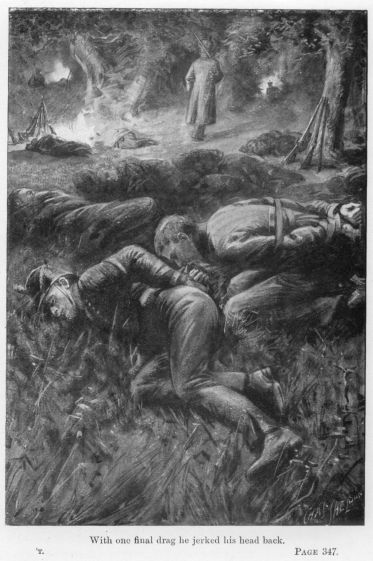
“It’s of no use,” he thought. “I am only punishing myself more and more;” and, fixing his teeth firmly once more in the leather, he gave one shake and tug such as a wild beast might have done in worrying an enemy. With one final drag he jerked his head back and lay still with his jaws throbbing and the sensation upon him that he had injured himself so that several of his teeth had given way.
“It’s no good. It’s of no use, Punch,” he said to himself; for the boy shook his wrists sharply as if to urge him to begin again. “I can’t do it, and I won’t try;” when to his astonishment he felt that his comrade was moving and had forced himself back with a low, dull, rustling sound so that he could place his lips to his ear again; and to Pen’s surprise the boy whispered, “That last did it, and I got the strap quite loose. My! How my wrists do ache! Just wait a bit, and then I will pull you over on to your face and have a turn at yours.”
Pen felt too much confused to believe that his companion had succeeded, but he lay perfectly still, with his teeth still aching violently, till all at once he felt Punch’s hands busy about him, and he was jerked over upon his face.
Then he felt that the boy had raised himself up a little as if to take an observation of their surroundings before busying himself with the straps that bound his numbed wrists.
“Lie still,” was whispered, “don’t flinch; but I have got my knife out, and I am going to shove it under the strap. Don’t holloa if it hurts.”
Pen set his aching teeth hard, and the next minute he felt the point of the long Spanish clasp-knife which his comrade carried being thrust beneath one of the straps.
“He will cut me,” thought Pen, for he knew that the pressure of the strap had made his flesh swell so that the leather was half-bedded in his arm; but setting his teeth harder—the pain he felt there was more intense—while, when the knife-blade was being forced under the strap he only suffered a dull sensation, and then grew conscious that as the knife was being thrust beneath the strap it steadily divided the bond, so that directly after there was a dull sound and the blade had forced its way so thoroughly that the severed portions fell apart; sensation was so much dulled in the numbed limbs that he was hardly conscious of what had been done, but he knew that one extremely tight ligature had ceased its duty, though he could hardly grasp the idea that one of his bonds was cut.
Then a peculiar throbbing sensation came on, so painful that it diverted the lad’s attention from the continuation of Punch’s task, and before he could thoroughly grasp it Pen found that the sharp blade had been thrust under another strap, dividing it so that the leather fell apart, and he was free.
But upon his making an effort to put this to the proof it seemed as if his arms were like two senseless pieces of wood; but only for a few minutes, till they began to prove themselves limbs which were bearers of the most intense agony.
Click! went Punch’s closing knife-blade; and then he whispered, “That’s done it! Now, when you are ready, lead off right between those sleeping chaps. Creep, you know, in case the sentry looks round.”
“A minute first,” whispered Pen; “my arms are like lead.”
“So’s mine. I say, don’t they ache?”
Pen made no reply, but lay breathing hard for a time; and then, raising his head a little so as to make sure of the safest direction to take, he turned towards his comrade and whispered, “Now then: off!”
Chapter Thirty Eight.
“Hear that?”
It was still dark, but there were faint suggestions of the coming day when Pen began to creep in the direction of a black patch which he felt must be forest.
This promised shelter; but he had first to thread his way amongst the wounded who lay sleeping around, and his difficulty was to avoid touching them, for they apparently lay thickest in the direction he had chosen.
Before he was aware of what he was doing he had laid his inert right hand upon an outstretched arm, which was drawn back with a sharp wince, and its owner uttered a groan. Bearing to the left and whispering to Punch to take care, Pen crept on, to find himself almost in contact with another sufferer, who said something incoherently; and then a whisper from Punch checked his companion.
“Come on,” said Pen hastily, “or they will give the alarm.”
“Not they, poor chaps! They are too bad. That sentry isn’t coming, is he?”
Pen glanced in the man’s direction, but he was not visible, for some low bushes intervened.
“I can’t see him,” said Pen.
“Then look here, comrade; now’s our time. It’s all fair in war. Every man for himself.”
“What do you mean? Don’t stop to talk, but come on.”
“All right; but just this,” came back in a whisper. “They can’t help themselves, and won’t take any notice whatever we do, unless they think we are going to kill them. Help yourself, comrade, the same as I do.”
Pen hesitated for a moment. Then, as he saw Punch busily taking possession of musket and cartouche-belt, he followed his example.
“It’s for life, perhaps,” he thought.
He had no difficulty in furnishing himself with the required arms from a pile, and that too without any of the wounded seeming to pay the slightest attention.
“Ready?” whispered Punch. “Got a full box?”
“Yes,” was the answer.
“Sling your musket then. Look sharp, for it’s getting light fast.”
Directly after the two lads were crawling onward painfully upon hands and knees, for every yard sent a pang through Pen’s wrists, and he thoroughly appreciated his comrade’s advice, for there were moments when he felt that had he been carrying the musket he would certainly have left it behind.
He did not breathe freely till he had entered the dark patch of woodland, where it was fairly open, and they had pressed on but a short distance in the direction of the mountain, which high up began to look lighter against the sky, when he started violently, for the clear notes of a bugle rang out from somewhere beyond the spot where the wounded lay, to be answered away to left and right over and over again, teaching plainly enough that it was the reveille, and also that they were in close proximity to a very large body of troops.
“Just in time, comrade,” said Punch coolly, as he rose to his feet.
“Take care!” cried Pen. “It isn’t safe to stand up yet.”
“Think not? Oh, we shall be all right,” replied the boy. “Lead on. Didn’t you know? The reveille was going right behind and off to the left and right; so there’s no troops in front, and all we have got to do is to get on as fast as we can up the mountain yonder. And it’s no good; I must walk. My wristies are so bad that if I try to crawl any more on my hands they will drop off. Ain’t yours bad?”
“Terribly,” replied Pen.
“Come on, then; we must risk it. There, right incline. Can’t you see? There’s a bit of a track yonder.”
“I didn’t see it, Punch,” said Pen, as they bore off to their right, where the way was more open, and they increased their pace now to a steady walk, a glance back showing them that they were apparently well screened by the low growth of trees which flourished in the bottom slopes of the mountains that they could now see more clearly rising in front.
“We’ve done it, comrade,” said Punch cheerily, “and I call this a bit of luck.”
“Don’t talk so loudly.”
“Oh, it don’t matter,” replied the boy. “They’re making too much noise themselves to hear us. Hark at them! Listen to the buzz! Why, it’s just as if there’s thousands of them down there, just as you thought; and we’ve hit on the right way, for those Frenchies wouldn’t come through here unless it was skirmishing with the enemy in front. Their enemy’s all behind, and they’ll be thinking about making their way back to the mine.”
“To see if they can’t make up for yesterday’s reverses. I’m afraid, Punch, it’s all over with the poor King and his followers.”
“Yes,” said Punch thoughtfully, as he trudged on as close as he could get to his companion. “It’s a bad lookout for them, comrade; but somehow I seem to think more of Mr Contrabando. I liked him. Good luck to the poor chap! And when we get a bit farther on we will pitch upon a snug spot where there’s water, and make a bit of breakfast.”
“Breakfast! How?” said Pen, smiling; but, wearied out and faint with his sufferings, it was a very poor exhibition of mirth—a sort of smile and water, like that of a sun-gleam upon a drizzly day. “Breakfast!” he said, half-scornfully, “You are always thinking of eating, Punch.”
“That I ain’t, only at bugle-time, when one blows ‘soup and tater’ for breakfast or dinner. I say, do you know what the cavalry chaps say the trumpet call is for stables?”
“No,” said Pen quietly; and then to humour his companion he tried to smile again, as the boy said, “Oh, I know lots of them! This is what the trumpet says for the morning call:—
“Ye lads that are able Now come to the stable, And give all your horses some water and hay–y–y–y!”
And the boy put his half-crippled fist to his lips and softly rang out the cavalry call.
“Punch!” whispered Pen angrily, “how can you be such a fool?”
“Tchah! Nobody can hear us. I wanted to cheer you up a bit. Well, it has stirred you up. There: all right, comrade. For’ard! We are safe enough here. But, I say, what made you jump upon me and tell me I was always thinking about eating when I said breakfast?”
“Because this is no time to think of eating and drinking.”
“Oh my! Ain’t it?” chuckled the boy. “Why, when you are on the march in the enemy’s country you ought to be always on the forage, and it’s the time to think of breakfast whenever you get the chance.”