"!Tention" (continued 4)
Reading edition
The priest shook his head, bent a little forward so as to well balance his load, and then, setting one hand at liberty, he put his hat on correctly, grasped both Pen’s hands once more, and then began to march out of the forest.
“I’m blessed!” muttered Punch. “Didn’t know they carried pickaback in Spain. The little chap’s as strong as a horse—pony, I mean.—Does it hurt you much, comrade?”
“Not much, Punch. Don’t talk to me, though; only, thank goodness that we have found a friend!” The little priest trudged sturdily on with his load, taking a direction along the edge of the forest, which Punch noted was different from any that he had traversed during his search, while at the same time it became plain to him that their new friend was finding his load rather hard work to carry, for first a little dew began to appear; this dew gradually grew into tiny beads, the tiny beads ran into drops, and the drops gathered together till they began to trickle and run.
At this point the little priest stopped short by the side of a rugged, gnarled tree, and, bending a little lower, rested his hands upon a horizontal branch.
“Look here, sir,” said Punch, “let me have a try now. I ain’t up to it much, but it would give you a rest.”
The priest shook his head, drew a deep breath, and trudged on again, proving his strength to be greater than could have been imagined to exist in such a little, plump, almost dwarf-like form, for with an occasional rest he tramped on for the best part of an hour, till at last he paused just at the edge of a deep slope, and struck off a little way to his left to where a beaten track led to a good-sized cottage.
“Why couldn’t I find all this?” thought Punch, as he gazed down into a valley dotted with huts, evidently a village fairly well inhabited. “Why, it was as easy as easy, only I didn’t know the way.”
“Ah!” ejaculated the priest, as he thrust open the door, stepped into a very humbly furnished room, crossed at once to a rough pallet, and gently lowered his burden upon the simple bed. “The saints be praised!” he said in Latin; and the words and the new position had such a reviving effect upon the wounded rifleman that he caught at one of the priest’s hands and held to it firmly.
“God bless you for this!” he said, for unconsciously the priest’s words had been the opening of the door of communication between him and those he had brought to his home; for though the words possessed a pronunciation that was unfamiliar, the old Latin tongue recalled to Pen years of study in the past, and he snatched at the opportunity of saying a few words that the old man could understand.
A pleasant smile beamed on the utterly wearied out old fellow’s countenance as he bent over Pen and patted him gently on the shoulder.
“Good, good!” he said in Latin; and he set himself about the task of supplying them with food.
This was simple enough, consisting as it did of bread and herbs—just such a repast as might have been expected from some ascetic holy man dwelling in the mountains; but the herbs in this case were silvery-brown skinned Spanish onions with salt.
Then taking up a small earthen jar, he passed out of the dark room into the sunshine; and as soon as the boys were alone Punch turned eagerly to his companion.
“Not worse, are you, comrade?” he said anxiously.
“No, Punch, not worse. But has he gone to fetch water?”
“Yes, I think so. But just you tell me: does your leg hurt you much?”
“Quite enough,” replied Pen, breaking off a portion of the bread and placing a few fragments between his lips. “But don’t talk to me now. I am starving.”
“Yes, I know that,” cried Punch; “and call this ’ere bread! It’s all solid crust, when it ought to be crumb for a chap like you. Look here, you could eat one of these onions, couldn’t you?”
“No, no; not now. Go on; never mind me.”
“But I do mind you,” cried the boy. “And how can I go on eating without you? I say, though, what a chap you are! What was that you said to him?”
“Bless you for this!”
“Yes, I guessed that was it; but how did you say it so as to make him understand? I talked to him enough, but he couldn’t make out a word of what I said. Was that there Spanish?”
“No, Punch; Latin.”
“Ah, you seem to know everything.”
At that moment a shadow fell athwart the door, and the speaker made a dash at one of the muskets he had stood up against the wall on entering the priest’s cottage.
“Oh, I beg your pardon, sir!” he cried hastily. “I didn’t know it was you.”
The old man smiled, and entered with the dripping jar which he had just filled from a neighbouring spring, and held it towards the boy.
“Me drink, sir? Thank ye, sir,” cried Punch; and, taking the jar, he was raising it towards his parched mouth, but before it was half-way there he recollected himself, and carried it to the priest’s pallet, where he went down on his knees and held it to Pen’s lips, so that the poor fellow, who was burning with feverish pain, was able to drink long and deeply.
Pen was still drinking when Punch started and spilt a few drops of the water as he turned hastily to look up at their host, who had laid a soft brown hand upon his head, and was looking down at him with a pleasant smile.
“What did he do that for, comrade?”
“I don’t know,” said Pen, drawing a deep breath, as he withdrew his lips from the water. “Yes, I do,” he added quickly. “He meant that he was pleased because you let me drink first.”
“Course I did. I don’t see anything to be pleased about in that. But have a drop more, comrade. Quick, look sharp, before I go mad and snatches it away from you, for I never felt like this before.”
“Go on then now, Punch.”
“But—”
“Go on then now; I can wait.”
“Ah, then!” ejaculated the boy, with a deep sigh that was almost a groan; and with trembling hands he held the jar to his lips and drank, and recovered his breath and drank again as if it was impossible to satisfy his burning thirst.
Then recovering himself, he held the jar against Pen’s lips.
“Talk about wine,” he said; “why, it ain’t in it! I don’t wonder that he looks so fat and happy, though he is dressed up like an old scarecrow. Fancy living here with a pump of water like this close at hand!—Had enough now?—That’s right. Now you go on breaking off bits of that bread and dipping it in the water while I cuts up one of these.”
He took his knife from his pocket and began to peel one of the onions, when their host placed the little vessel of salt close to his hand.
“Thank you, sir,” cried Punch. “You are a real gentleman.”
The priest smiled and nodded, and watched the two lads as Pen took an earthenware bowl that their host placed close to his hand after half-filling it with water so that he could steep the bread, while Punch deftly peeled one of the onions, not scrupling about littering the floor, and then proceeded to quarter it and then divide the segments again, dipping one in the salt and placing it between his wounded companion’s lips.
“Good! good!” said the priest again, smiling with satisfaction, and laying his hand once more upon Punch’s head. “Bonum! bonum!”
“Bone ’em!” said Punch. “Why, he give it to me!”
“He means it was good, Punch,” said Pen, smiling.
“Good! Yes,” cried the boy, crunching up one of the savoury pieces of vegetable. “That’s what he means, is it? Thought he meant I had stolen it.—Bonum, eh, sir? I should just think it is! Wants a bit more salt; but my word, it’s fine! Have a bit more, comrade. You eat while there’s a chance. Never mind me. I can keep both of us going. Talk about a dinner or a supper; I could keep on till dark! Only wish, though, I’d got one of their Spanish shillings to pay for it; but those French beggars took care of them for me. I can give him my knife, though; and I will too, as soon as I have done with it. How do you feel now, comrade?”
“Better, Punch, better,” replied Pen. “Thank you,” he continued, as his companion broke off more bread for him and then began to peel another onion. “But you are paying more attention to me than you are to yourself.”
“Course I am, comrade. Didn’t you pay more attention to me when I was wounded?”
Then turning to the priest, he pointed to the bread with his knife, and then tapped the onion he had begun to quarter with the blade.
“Splendid, sir,” he said, smiling. “Bonum! bonum!”
The priest nodded, and then rose from where he had been seated watching the boys and walked through the open door, to stand just outside sweeping the scattered houses of the little village with his eyes, and remaining there, so as to leave his two guests to themselves.
“You are beginning to get a bit better, comrade?” asked Punch anxiously.
“Yes, Punch, yes,” was the reply.
“So am I. Feel as if I am growing as strong as a horse again. Why, comrade, it was worth getting as hungry, thirsty, and tired as that, so as to enjoy such a meal. I don’t mean speaking for you, because I know you must be feeling that gnaw, gnaw, grinding pain in your wound. But do go on eating, and when you have had enough you shut-up shop and go off to sleep. Then I will ask that old chap to give me a bit of rag and let me wash and tie up your wound. I say, comrade, I hope he didn’t see me laugh at him. Did you?”
“See you laugh at him? No. Did you?”
“Yes; couldn’t help it, when he was carrying you, bent down like he was, with that queer shako of his. When I was behind he looked something like a bear, and I couldn’t help having a good grin. Mum, though; here he comes.”
The old priest now came slowly in and stood watching the two lads, who hurriedly finished their meal.
“Stand up, Punch,” said Pen.
“What for? I was just going to clear away.”
“Stand up, I tell you!”
“All right;” and the boy rose immediately, staring hard at his companion, as Pen, with a quiver of emotion in his utterance, laid his hand over the remains of the black-bread, and said, gazing hard at the old priest the while, “Benedictus, benedicat. Amen.”
“Ah!” said the priest, with a long-drawn breath of satisfaction; “Benedictus, benedicat Amen.”
Then, taking a step towards them, he laid his hand upon the heads of his two guests in turn and said a few words in an undertone. Next, pointing to the rough pallet-bed, he signed to Punch that he should lie down beside his companion.
“What, take a snooze there, sir?” said Punch. “Thank you, sir. But not yet.—You tell him in your Latin stuff, comrade, that I want to do a bit of doctoring first.”
“I’ll try,” said Pen wearily, already half-asleep; when, to the surprise of both, the old man went outside and returned with a little wooden tub of water which he brought to the bedside, and then, in spite of a half-hearted protestation on the part of Punch, he proceeded to carefully attend to the wound.
“Well, it’s very good of you, sir,” said the boy at last, after doing his best to help, “and I wish I could make you understand what I say. But you have done it a deal better than I could have done, and I am sure if my comrade could have kept himself awake he would be ready enough to say something in Latin that would mean you are a trump, and he’s very much obliged. But, you see, all I know, sir, about Latin—”
“Latin!” said the old priest, beaming upon him with wondering eyes.
“Yes, sir—Latin, sir, as I learnt of him;” and then, pointing to the carefully bandaged limb, “bonum, sir; bonum!”
The priest nodded, as he pointed to the pallet, where there was room for Punch to lie down by his sleeping companion; but the boy shook his head.
“No, sir,” he said, “that’s your roost; I do know that,” And, before his host could interfere, the boy placed one musket within reach of Pen’s hand, the other beside the door, across which he stretched himself.
It was now nearly dark, and after placing his little home in something like order, the old man turned to where Punch had been resting upon one arm a few minutes before, watching his movements, but was now prone upon the beaten-earth floor fast asleep, with a look of restfulness upon his young, sunburnt countenance.
The old man stepped carefully across him, to stand outside peering through the evening gloom down into the silent village before, satisfied and content, he turned back into the hut, closing the door carefully after him, placing across it a heavy oaken bar, before stepping back across Punch, to stand in the middle of the floor deep in thought.
Then his hand began to move, from force of habit, searching for and bringing out from beneath his gown a little, worn snuff-box, which squeaked faintly as he turned the lid and refreshed himself with two pinches of its brown contents.
This was done very slowly and deliberately in the semi-darkness, and finally the box was replaced and a few grains of the dust flicked away.
“Ah!” ejaculated the old man with a long-drawn sigh, as he looked from one to the other of his guests. “English,” he muttered. “Soldiers, but friends and defenders against the French. English—heretics! But,” he added softly, as if recalling something that had passed, “Benedictus, benedicat. Amen!”
Then, crossing softly to one corner of the room, he drew open what seemed to be the door of a cupboard; but it was too dark to show that in place of staircase there was a broad step-ladder.
This the old man ascended, and directly after the ill-fitting boards which formed the ceiling of his humble living-room creaked as he stepped upon them, and then there was a faint rustling as if he were removing leaves and stems of the Indian corn that was laid in company with other stores in what was undoubtedly a little loft, whose air was heavy with various odours suggesting the presence of vegetables and fruit.
The oaken boards creaked once more as if the old man was stretching himself upon them with a sigh of weariness and satisfaction.
“Amen!” he said softly, and directly after a ray of light shot across the place, coming through the wooden bars in the gable of the sloping roof, for the moon had just risen over the shoulder of the mountain to light up the valley beneath, where the priest’s hut clung to its rocky wall; to light up, too, the little loft and its contents, and, above all, the features of the sleeping man, gentle-looking in their repose. And could the lads he had befriended have gazed upon him then they would have seen nothing that appeared grotesque.
Chapter Twenty Four.
Through a Knot-Hole.
“Yes, what is it?” cried Pen, starting up on the bed at a touch from his companion, who had laid his hand gently on the sleeping lad’s forehead, and then sinking back again with a faint ejaculation of pain.
“Don’t be scared, comrade; it’s only me. Does it hurt you?”
“Yes, my leg’s horribly stiff and painful.”
“Poor chap! Never mind. I will bathe it and dress it by-and-by if that old priest don’t do it. When you jumped up like that I thought you fancied it was the French coming.”
“I did, Punch,” said Pen with a faint smile. “I seem to have been dreaming all night that they were after us, and I could not get away because my leg hurt me so.”
“Then lie down again,” said Punch. “Things ain’t so bad as that. But, I say, comrade, I can’t help it; I am as bad as ever again.”
“Bad! Your wound?”
“No, no; that’s getting all right. But that old chap seems to have shut us up here and gone. Didn’t happen to see, did you, where he put the bread and onions? I am quite hollow inside.”
“No, Punch. I fell asleep, and I can’t recollect how or when.”
“That’s a pity, ’cause I know we should be welcome, and I can’t make out where he put the forage when he cleared away.”
It was the sunrise of a bright morning, and the sounds of bleating goats came plainly to the listeners’ ears as the nimble animals were making their way up the valley-side to their pasture.
Then all at once came the sharp creak of a board, and Punch dashed at his musket, caught it up, cocked it, and stood ready to use it in defence of his companion.
There was another creak or two, evidently from overhead, and as Punch stood there on the alert, his brows knit and teeth clenched, Pen softly stole his hand in the direction of his own musket and raised himself up on the bed ready to help.
Again there came a creak or two, a rustling in the corner of the room as of some one descending from above, and, though invisible, the muzzles of the two pieces were slowly lowered in the direction of the noise, till with a crack the door in the corner was thrust inward and the little old priest stood looking wonderingly from one to the other as he raised his hand.
It was as if this were a signal to disarm, when the two muskets were hurriedly replaced, and Punch advanced towards the corner of the room, offering to shake hands.
The priest smiled, took the boy’s fingers, and then, thrusting to the door, he crossed to the bed, felt Pen’s forehead, and afterwards pointed to the wounded leg.
The next minute he went to the door, removed the great bar, and admitted the bright light and fresh air of the morning in company with the louder bleating of the goats, which animals evidently came trotting up to the old man as he stepped back to look searchingly round. Then, after speaking kindly to them, he drove them away, returned into the room directly after with water, and proceeded to busily attend to Pen’s wound.
“That’s good of him,” said Punch petulantly, “and I am glad to see him do it, comrade; but I wish he’d thought to attend to my wound too—I mean, give me the chance to dress it myself with bread and onion poultice. I don’t know when I felt so hollow inside.”
But he had not long to wait, for, evidently well satisfied with the state of Pen’s injury, the priest finished attending to him as tenderly as if his touch were that of a woman, and then Punch was at rest, for the old man placed the last night’s simple fare before them, signed to them to eat, and, leaving them to themselves, went outside again, to sweep the valley below with a long and scrutinising gaze.
Twice over during the next two days Pen made an effort to rise, telling his companion when they were alone that if he had a stick he thought he could manage to limp along a short distance at a time, for it was very evident that the old man, their host, was uneasy in his own mind about their presence.
“He evidently wants to get rid of us, Punch.”
“Think so?” said the boy.
“Yes. See how he keeps fidgeting in and out to go on looking round to see if anybody’s coming.”
“Yes, I have noticed that,” said Punch. “He thinks the French are coming after us, and that he will get into trouble for keeping us here.”
“Yes; it’s plain enough, so let’s go.”
“But you can’t, comrade.”
“Yes, I can.”
“Not without making your wound worse. That’s what you would have said to me.”
“Then I must make it worse,” said Pen angrily. “Next time he comes in I’ll try to make him explain which way we ought to go to find some of our people.”
“Well, we can only try,” replied Punch, “for ’tain’t nice living on anybody when you can’t pay, and I do feel ashamed to eat as I do without being able to find money for it. ’Tain’t as if he was an enemy. I’d let him see then.”
“Go and open the door, Punch, and let the fresh air in. The sun does make this place so hot!”
“Can’t, comrade.”
“Why not?”
“I did try while you was asleep; but he’s locked us in.”
“Nonsense! He fastens the door with that big bar, and there it is standing up by the side.”
“Yes, but there’s another one outside somewhere, for I tried, and the door won’t move. I think he’s gone to tell somebody we are here, and he has shut us up so that we sha’n’t get away while he’s gone.”
“No, no,” said Pen impatiently. “The old man means well to us; I am sure of that.”
“That’s what I keep thinking, comrade; but then I keep thinking, too, that he’s going to get something given him for taking two prisoners to give up to the French.”
“Nonsense! It is cowardly and ungenerous to think so.”
“Then what’s he been gone such a long time for? It’s hours since he went away and shut us in.”
“Hours?”
“Yes; you don’t know, because you sleep so much.”
“Well, I don’t believe he’d betray us. The old man’s too good and generous for that.”
“Then, why has he made prisoners of us?” said Punch sourly. “Why has he shut us up?”
“To keep anybody else from coming in,” said Pen decisively. “What time can it be now?”
“Getting on towards sunset. Pst! Here he comes—or somebody else.”
All doubts as to who it was were put an end to the next minute, for the familiar step of the old priest approached the door. They plainly heard what seemed to be another bar removed, and the old man stood before them with a big basket on his arm, and remained looking back as if to see whether he had been followed.
Then, apparently satisfied, he came in, closed the door, and smilingly placed the contents of the basket before them.
He had evidently been some distance, and looked hot and weary; but he was quite ready to listen to Pen’s lame efforts to make known his desires that they should now say good-bye, and, with his help as to direction, continue their journey.
The little man stood up smiling before Pen, listening patiently to the lad’s blundering Latin, probably not understanding half, and only replying with a word or two from time to time, these words from their pronunciation puzzling Pen in turn; but it was evident to Punch, the listener, that on the whole a mutual understanding was arrived at, for all at once the priest offered Pen his arm, and as the lad took it he helped him to walk across the room and back to the pallet, where he pressed him back so that he sat down in spite of himself, when the old man patted him on the shoulder, smiling gently, and then going down on one knee passed his hand softly over the wound, and, looking up, shook his head sadly.
“What does he mean by that, Punch?” said Pen excitedly, as he sat, looking pinched of face and half-wild with excitement.
“It means, comrade, that you ain’t fit to go on the march. That’s what he means; I can make him out. He is saying as you must give it up, and I don’t think now as he means any harm.—I say, you don’t, do you, old chap?” he continued, turning sharply on the priest.
It seemed as if their host comprehended the boy’s words, for he patted Punch on the shoulder, smiling, and pointed to the basket, which he opened and displayed its contents.
Punch only caught a glimpse thereof; but he saw that there were bread and onions and goat’s-milk cheese before he turned sharply round, startled by a quick tapping at the closed door.
It was not only he who was startled, for the priest turned sharply and hurried to the door.
“Oh, comrade,” cried Punch in an excited whisper, “don’t say that he’s against us after all!”
But with the sturdy boy it was a word and a blow, for he made for his loaded musket and caught it up.
“Hist!” ejaculated the priest, turning upon him and raising one hand.
“Oh, I don’t care for that,” whispered Punch, “and I don’t mind what you are. If you sold us to the enemy you shall have the first shot.”
The priest shook his hand at him as if to bid him be silent; and then, placing his lips close to the door, he said something in Spanish, and listened to a reply that came in a hurried voice.
“Ah!” ejaculated the priest; and then he whispered again.
The next minute he was busy barring the closed door; and this done, he turned to the boys, to cross the room and open wide the cupboard-like door in the corner. Then, returning to Pen, he helped him to rise again, guided his halting steps, and half-carrying him to the step-like ladder urged him with a word or two to climb up.
“What does he mean, comrade?” whispered Punch.
“He means there’s somebody coming, and we are to go upstairs.”
“Let’s stop here, comrade, and fight it out.”
“No, he means well,” replied Pen; and, making a brave effort, he began to climb the ladder, pulling himself up, but panting heavily the while and drawing his breath with pain.
As soon as the old man saw that he was being obeyed he turned to Punch, caught up Pen’s musket, and signed to the boy to follow him.
“Well, you can’t mean to give us up,” said Punch excitedly, “or you wouldn’t want me to keep my gun and his.”
Disposition to resist passed away the next moment, for the old man pressed the second musket into his hand and urged him towards the door.
“Can you get up, comrade?” whispered Punch, who was now all excited action.
“Yes,” came in a hoarse whisper, and a loud creak came from the ceiling.
“Ketch hold of these guns then. He wants me to bring the forage-basket.—Got ’em?” he continued, as he placed the two pieces together and held them up against the ladder.
“Bonum!” ejaculated the priest, who stood close up, as the two muskets were drawn upwards and disappeared.
“Right, sir,” said Punch in answer, and he took hold of the basket, raised it above his head, took a step or two, then whispered, “Basket! Got it, comrade?”
“Yes,” And it was drawn up after the muskets, the boards overhead creaking loudly the while.
“Anything else, master?—What, take this ’ere jar of water? Right! Of course! Here, comrade, you must look out now. Lean down and catch hold of the jar; and take care as you don’t slop it over.”
“Presto!” whispered the priest.
“Hi, presto!” muttered Punch. “That’s what the conjuror said,” he continued to himself, “and it means, ‘Look sharp!’ Got it, comrade?”
“Yes,” came in Pen’s eager whisper.
“Oh, I say,” muttered Punch, “I don’t want my face washed!”
“Bonum! Presto!” whispered the priest, as Punch shrank back with his face dripping; and, pressing the boy into the opening, he closed the door upon him and then hurried to the cottage entrance, took down the bar, throw the door wide, and then began slowly to strike a light, after placing a lamp upon the rough table.
By this time Punch had reached the little loft-like chamber, where Pen was lying beside the water-vessel.
“What game’s this, comrade?” he whispered, breathless with his exertions.
“Hist! Hist!” came from below.
“It’s all very fine,” muttered Punch to himself; and he changed his position, with the result that the boards upon which he knelt creaked once more.
“Hist! Hist!” came again from below.
“Oh, all right then. I hear you,” muttered the boy; and he cautiously drew himself to where he could place his eye to a large hole from which a knot in the plank had fallen out, so that he could now see what was going on below.
“Here, this caps me,” he said to himself. “I don’t want to think he’s a bad un, but he’s took down the bar and shoved the door wide-open. It don’t mean, do it, that he’s sent for some one to come and take us? No, or he wouldn’t have given us our guns.”
Nick, nick, nick, nick, went the flint against the steel; and the boy watched the sparks flying till one of them seemed to settle lightly in the priest’s tinder-box, and the next minute that single spark began to glow as the old man deliberately breathed upon it till the tinder grew plain before the watcher’s eyes, and the shape of the old man’s bald head, with its roll of fat across the back of the neck, stood out like a silhouette.
Then there was a rustling sound, and the boy saw the point of a match applied, and marked that that point was formed of pale yellow brimstone, which began to turn of a lambent blue as it melted and quivered, and anon grew a flame-colour as the burning mineral fired the match.
A deep, heavy breath as of relief rose now through the floor as the old man applied the burning match to the wick of his oil-lamp, and Punch drew back from the knot-hole, for the loft was dimly lit up by the rays which came through the cracks of the badly laid floor, so that it seemed to him as if this could be no hiding-place, for any one in the room below must for certain be aware of the presence of any one in the loft.
In spite of himself, Punch started and extended his hand to catch at his comrade’s arm, for he could see him plainly, though dimly, lying with the muskets on one side, the basket and jar of water upon the other, while half-behind him, where he himself lay, there was the black trap-like opening through which he had climbed.
The boy’s was a very slight movement, but it was sufficient to make a board creak, and a warning “Hist!” came once more from below; while, as he looked downward, the boy found that he could see what the old man was doing, as he drew his lamp across the rough table and bent over a little open book, while he began muttering softly, half-aloud, as he read from his Book of Hours.
Punch softly pressed his comrade’s arm, and then there was a slight movement and the pressure was returned.
“Wonder whether he can see too,” thought Punch; and then in spite of himself he started, and his breath seemed to come thick and short, for plainly from a short distance off came the unmistakable tramp of marching men.
“Then he has sold us after all,” thought the boy, and by slow degrees he strained himself over so that he could look through the knot-hole again. To his great surprise the priest had not stirred, but was bending over his book, and his muttered words rose softly to the boy’s ear, while the old man seemed to be in profound ignorance of the approaching steps.
Chapter Twenty Five.
In the Night.
Nearer and nearer came the sound of marching, and it was all Punch could do to keep from rising to his knees and changing his position; but he mastered himself into a state of content by sending and receiving signals with his companion, each giving and taking a long, firm pressure, as at last the invisible body of approaching men reached the cottage door, and an authoritative voice uttered the sharp command, “Halte!”
Punch’s eye was now glued to the hole. He felt that if anybody looked up he would be sure to see it glittering in the lamplight; but the fascination to learn what was to be their fate was too strong to be resisted.
From his coign of vantage he could command the doorway and the legs of a small detachment of men, two of whom separated themselves and came full into sight, one being an officer, from the sword he bore, the other a rough, clumsy-looking peasant. And now for the first time the little priest appeared to be aware of the presence of strangers, for he slowly lowered the hand which held the book, raised his head, and seemed to be looking wonderingly at his visitors.
“Ah!” he said, as if just awakened from his studies; and he uttered some words, which sounded like a question, to the peasant, who made a rough obeisance and replied in apologetic tones, as if making an excuse for his presence there.
And now the officer uttered an impatient ejaculation and took another step into the room, saying in French, “I am sorry to interrupt your devotions, father; but this fellow tells me that he saw a couple of our English prisoners take refuge here.”
“I do not speak French, my son,” replied the old man calmly.
“Bah! I forgot,” ejaculated the officer; and then in a halting way he stumbled through the same sentence in a very bad translation as he rendered it into Spanish.
“Ah!” said the old man, rising slowly; and Punch saw him look as if wonderingly at the rough peasant, who seemed to shrink back, half-startled, from the priest’s stern gaze.
There was a few moments’ silence, during which the two fugitives clutched each other’s hands so tightly that Punch’s nerves literally quivered as he listened for the sharp cracking of the boards, which he seemed to know must betray them to their pursuers.
But no sound came; and, as the perspiration stood out in big drops upon his face in the close heat of the little loft, both he and his companion could feel the horrible tickling sensation of the beads joining together and trickling down their necks.
Then after what seemed to be quite an interval, the old man’s voice arose in deep, stern tones, as he exclaimed, “What lie is this, my son, that you have uttered to these strangers?”
“I—I, father—” faltered the man, shrinking back a step and dropping the soft cap he was turning in his hands upon the beaten floor, and then stooping hastily to snatch it up again—“I—father—I—”
“I say, what lie is this you have told these strangers for the sake of gaining a few accursed pieces of silver? Go, before I— Ah!” For there was a quick movement on the part of the peasant, and he dashed out of the door.
“Halte!” yelled the French officer, following the peasant outside; and then, giving a sharp command, the scattered reports of some half-dozen muskets rang out on the night-air, the two fugitives starting as at each shot the flash of the musket lit up the loft where they lay. Then a short question or two, and their replies came through the open doorway, and it became evident to the listeners that the peasant had escaped.
“Bah!” ejaculated the officer, as Punch saw him stride through the doorway into the room again. “Look here, father,” he said in his bad Spanish, “I paid this scoundrel to guide me to the place where he said two Englishmen were in hiding; but he did not tell me it was with his priest. As he has brought us here I must search.”
“For the escaped prisoners?” the old man said, drawing himself up with dignity. “I do not speak your language, sir, but I think that is what you mean. Can you repeat your words in Latin? You might make your wishes more plain.”
“Latin? No, I have forgotten all that,” said the officer impatiently in more clumsy Spanish than before. “The English prisoners—my men must search,” And the fugitives, unable though they were to comprehend the words, naturally grasped their meaning and held their breath till they felt they must draw it again with a sound that would betray their presence.
Then, with a slight laugh, the old priest laid his book upon the table and took up the smoky oil-lamp. As he did so, Punch could see his face plainly, for it was lit up by the lamp, and the boy could perceive the mocking mirth in his eyes as he raised it above his head with his left hand, and walked slowly towards the door which covered the ladder-like staircase; and then as Punch felt that all was over, the old man slowly passed the light across and moved to the rough fireplace, and so on all round the room, before raising the light above his head once more, and with a comprehensive movement waving his right hand slowly round the place as if to say, “You see there are no prisoners here.”
“Bah!” ejaculated the French officer, and, turning angrily, he marched out through the open doorway.
Punch was beginning to breathe again, but to his horror the officer marched back into the room, for he had recollected himself. He was the French gentleman still.
“Pardon, mon père!” he said sharply, keeping now to his own tongue. “Bon soir!”
Then, marching out again, he gave a short command, and, from where Punch’s eye was still glued to the opening, he saw the soldiers turn rightabout face, disappear through the open doorway, and then, beat, beat, beat, the sound of marching began again, this time to die slowly away, and he looked and listened till the pressure of Pen’s hand upon his arm grew almost painful. But he did not wince, till a movement on the part of the priest drew his attention to what was passing beneath; and he saw him set down the lamp and cross to the door, which he closed and barred, and then dropped upon his knees, as his head sank down upon his clasped-together hands.
Chapter Twenty Six.
Contrabandistas.
“Think they have gone, comrade?” whispered Punch, after they had listened for some minutes, and the tramp of the French soldiers had quite died away.
“Yes; but speak low. He will come and tell us when he thinks it is safe.”
“All right, I’ll whisper; but I must talk. I can’t bear it any longer, I do feel so savage with myself.”
“Why, what about?”
“To think about that old chap. I wanted to trust him, but I kept on feeling that he was going to sell us; and all the time he’s been doing everything he could for us. But, I say, it was comic to see him carrying you. Here, I mustn’t talk about it, or I shall be bursting out laughing.”
“Hush! Don’t!” whispered Pen.
“All right. But, I say, don’t you think we might have a go at the prog? There’s all sorts of good things in that basket; and I want a drink of water too. But you needn’t have poured a lot of it down my back. I know you couldn’t help it, but it was horrid wet all the same.”
“Don’t touch anything, Punch; and be quiet. He will be coming up soon, I dare say.”
“Wish he’d come, then,” said the boy wearily. “I say, how’s your leg?”
“Hurts,” said Pen curtly.
“Poor old chap! Can’t you turn yourself round?”
“No. It’s worse when I try to move it.”
“That’s bad; but, I say, you see now we couldn’t have gone away unless I carried you.”
“But it seems so unfair to be staying here,” said Pen bitterly. “I believe now I could limp along very slowly.”
“I don’t,” said Punch. “You see, those Frenchies have made up their minds to catch us, and I believe if they caught sight of us creeping along now they would let go at us again; and as we have had a bullet apiece, we don’t want any more.”
“Hist!” whispered Pen; “they think we are here still, and they are coming back.”
“Nonsense! Fancy!”
“Listen.”
“Oh, murder!” whispered Punch. “This is hard!” For he could distinctly hear hurried steps approaching the cottage, and he placed his eye to the knot-hole again to see what effect it was having upon the old man. But he was so still as he crouched there in the lamplight that it seemed as if he had dropped asleep, worn out by his efforts, till all at once the footsteps ceased and there was a sharp tapping on the door, given in a peculiar way, first a rap, then a pause, then two raps close together, another pause, and then rap, rap, rap, quickly.
The old man sprang to his feet, unbarred the door, and seized it to throw it open.
“It’s all over, comrade,” whispered Punch. “Well, let’s fill our pockets with the prog. I don’t want to starve any more.”
He placed his eye to the knot-hole again, and then turned his head to whisper to his companion.
“’Tain’t the Frenchmen,” he said. “It’s one of the Spanish chaps with a red handkercher tied round his head, and him and the old priest is friends, for they are a hugging one another. This chap has got a short gun, and now he’s lighting a cigarette at the lamp. Can you hear me?”
“Yes; go on.”
“There’s four more of them outside the door, and they have all got short guns. One of them’s holding one of them horse-donkeys. Oh, I say, comrade!” continued the boy, as a quick whispering went on and the aromatic, pungent odour of tobacco floated up between the boards.
“What is it, Punch? Oh, go on—tell me! You can see, and I’m lying here on my back and can make out nothing. What does it all mean?”
“Well, I don’t like to tell you, comrade?” whispered the boy huskily.
“Oh yes; tell me. I can bear it.”
“Well, it seems to me, comrade, as we have got out of the frying-pan into the fire.”
“Why, what do you mean?”
“That we thought the old chap was going to sell us to the French when all the time it was to some of those Spanish thieves, and it’s them as has come now to take us away.—Here, wait a minute.”
“I can’t, Punch. I can’t bear it.”
“I’m afraid you will have to, comrade—both on us—like Englishmen. But if we are to be shot for furriners I should like it to have been as soldiers, and by soldiers who know how to use their guns, and not by Spanish what-do-you-call-’ems—robbers and thieves—with little short blunderbusters.”
There was a few moments’ pause, during which hurried talking went on. Then a couple more fierce-looking Spaniards came in, saluted the priest, lit cigarettes at the lamp, and propped the short carbines they carried against the cottage-wall before joining in the conversation.
“What are they doing now, Punch?”
“Talking about shooting or something,” whispered the boy, “and that old ruffian’s laughing and pointing up at the ceiling to tell them he has got us safe. Oh, murder in Irish!” continued the boy. “He’s took up the lamp and he’s showing them the way. Here, Private Gray, try and pull yourself together and let’s make a fight for it, if we only have a shot apiece. They are coming up to fetch us now.”
Pen stretched out his hand in the dim loft to seize his musket, but he could not reach it, while in his excitement the boy did not notice his comrade’s helplessness, but seized his own weapon and stood up ready as the light and shadows danced in the gloomy loft, and prepared to give the armed strangers a warm reception.
And now the door at the foot of the ladder creaked and the light of the lamp struck up as the old man began to ascend the few steps till he could reach up, thrusting the lamp he carried before him, and placing it upon the floor, pushing it farther along towards the two boys; and then, drawing himself up, he lifted the light and held it so that those who followed him could see their way.
At that moment he caught sight of Punch’s attitude, and a smile broke out across his face.
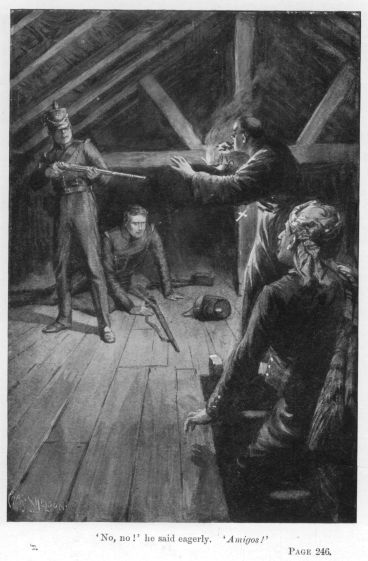
“No, no!” he said eagerly. “Amigos! Contrabandistas.”
“What does he mean by that, Pen?”
“That they are friends.”
And the head of the first friend now appeared above the trap in the shape of the first-comer, a handsome, swarthy-looking Spaniard, whose dark eyes flashed as his face was lit up by the priest’s lamp, which shot the scarlet silk handkerchief about his head with hues of orange.
“Buenos Inglés, amigos,” he cried, as he noted the presented musket; and then volubly he asked if either of them spoke French.
“Yes,” cried Pen eagerly; and the rest was easy, for the man went on in that tongue:
“My friend the priest tells me that you have had a narrow escape from the French soldiers who had shot you down. But you are safe now. We are friends to the English. Do you want to join your people?”
“Yes, yes,” cried Pen eagerly. “Can you help us? Are any of our regiments near?”
“Not very,” replied the Spanish smuggler, “for the French are holding nearly all the passes; but we will help you and get you up into the mountains, where you will be safe with us. But our good friend the padre tells me that one of you is badly hurt, and he wants me to look at your wound.”
“Oh, it’s not very bad,” said Pen warmly.
“Ah, I must see,” said the man, who had seated himself at the edge of the opening up which he had come, and proceeded to light a fresh cigarette.
The next moment, as he began puffing away, he seemed to recollect himself, and drew out a cigar, which he offered with a polite gesture to the old priest.
The old man set down the lamp which he had held for his visitor to light his cigarette, and smiled as he shook his head. Then, thrusting a hand into his gown, he took out his snuff-box, made the lid squeak loudly, and proceeded to help himself to a bounteous pinch.
“It is you who have the wound,” continued the smuggler. “You are, I suppose, an officer and a gentleman?”
“No,” said Pen, “only a common English soldier.”
“But you speak French like a gentleman. Ah, well, no matter. You are wounded—fighting for my country against the brigand French, and we are friends and brothers. I have had many a fight with them, my friend, and I know what their bullets do, so that I perhaps can dress your wound better than the padre—brave old man! He can cure our souls—eh, father?” he added, in Spanish—“but I can cure bodies better than he, sometimes, when the French bullets have not been too bad.—Now, father,” he added, “hold the lamp and let us see.”
The priest nodded as he took up the lamp again in answer to the request made to him in his own tongue; and he now spoke a few words to the smuggler which resulted in the picturesque-looking man shaking his head.
“The good father,” he said to Pen, “asks me if I think the French soldiers will come back; but I think not. If they do we shall have warning from my men, who are watching them, for we are expecting friends to meet us here—friends who may come to-night, perhaps many nights hence—for us to guide them through the passes.”
Then, drawing up his legs, he stepped into the loft and called down the stairway to the men below.
There was a short reply, and steps were heard as if the two men had stepped out into the open.
“Now, my friend,” said the smuggler, as he went down on one knee and leaned over Pen, whose hand he took, afterwards feeling his temples and looking keenly into his eyes as the priest threw the light full in the wounded lad’s face.
“Why,” he said, “you are suffering from something else besides your wound. My men will bring some wine. I see you have water here. You are faint. There, let me place you more comfortably.—That’s better. I’ll see to your wound soon.—And you, my friend,” he continued, turning to Punch, who started and shook his head.
“No parly Frenchy,” he said.
“Never mind,” continued the smuggler. “Your friend can.—Tell him to eat some of the bread and fruit, and I will give him some of our grape medicine as soon as my men bring the skin.—A good hearty draught would do you good too, father,” he added, turning to the old man and laying his hand with an affectionate gesture upon the priest’s arm. “You have been working too hard, and must have had quite a scare. I am very glad we have come.”
A deep-toned voice came now from the room below, the smuggler replied, and there was a sound of ascending steps; then another of the smugglers appeared at the opening in the floor, thrusting something so peculiar and strange through the aperture that, as it subsided upon the edge in the full light cast by the smoky lamp, Punch whispered:
“Why, it’s a raw kid, comrade, and I don’t believe it’s dead!”
Pen laughed, and Punch’s eyes dilated as he saw the smuggler, who was standing with his head and shoulders in the opening, take what looked like a drinking-horn from his breast and place it upon the floor; and then it seemed to the boy that he untied a thong that was about one of the kid’s legs, and the next moment it appeared as if the animal had begun to bleed, its vital juice trickling softly into the horn cup, for it was his first acquaintance with a skin of rich Spanish wine.
“There, my friend,” said the smuggler, taking up the half-filled cup, “they say this is bad for fever, but I never knew it do harm to a man whose lifeblood had been drained. Drink: it will put some spirit in you before I perhaps put you to a good deal of pain.” And the next moment he was holding the wine-cup to the wounded lad’s lips.
“There,” said the smuggler at last, as he finished his self-imposed task, “I think you have borne it bravely.”
“Oh, nonsense,” said Pen quietly. “Surely a soldier should be able to bear a little pain.”
“I suppose so,” said his new surgeon; “but I am afraid that some of my countrymen would have shouted aloud at what I have done to you. I know some of my men have when I have tied them up after they have been unlucky enough to get one of the French Guards’ bullets in them. There now, the best thing you can do is to go to sleep;” and, having improvised a pillow for him with one of his follower’s cloaks, the Spaniard descended to the priest’s room, where several of his men were assembled; and after the priest had seen that Punch had been supplied from the basket, he followed his friend to where the men were gathered, leaving the boys in the semi-darkness, for he took down the lamp, whose rays once more shone up through the knot-hole and between the ill-fitting boards.
“Feel better, comrade?” asked Punch. But there was no reply. “I say, you aren’t gone to sleep already, are you?”
Still no answer, and, creeping closer, Punch passed his hand gently over Pen’s arm and touched his face; but this evoked no movement, only the drawing and expiration of a deep breath which came warmly to the boy’s hand as he whispered:
“Well, he must be better or he wouldn’t have gone to sleep like that. Don’t think I could. And, my word, that chap did serve him out!”
The low sound of voices from below now attracted the boy’s attention; and, turning to the knot-hole, he looked down into the priest’s room to see that it was nearly full of the dark, fierce-looking Spaniards, who were listening to the old padre, whose face shone with animation, lit up as it was by the lamp, while he talked earnestly to those who bent forward to listen to his words.
It was a picturesque scene, for the moon was now shining brightly, its rays striking in through the open door and throwing up the figures of several of the contrabandistas for whom there was no room within the cottage, but who pressed forward as if to listen to the priest’s words.
“Why, he must be preaching to them,” said Punch to himself at last, “but I can’t understand a word. This Spanish seems queer stuff. What does el rey mean, I wonder. Dunno,” he muttered, as he yawned drowsily. “Seems queer that eating and drinking should make you sleepy. Well, I ain’t obliged to listen to what that old fellow says. Wonder whether Private Gray knows what el rey means? Better not ask him, though, now he’s asleep. Phew! It is hot up here! Buzz, buzz, buzz! What is he talking about? Seems to make me sleepier to listen to him.—I say, not awake, are you, comrade?”
There was no reply, and soon after Punch’s heavy breathing was heard in addition to the low murmur of the priest’s voice, for the boy too, worn out with what he had gone through during the past hours, was fast asleep.
Chapter Twenty Seven.
The new Friend.
Punch woke up with a start to find that it was broad daylight, for the sun was up, the goats on the valley-side were bleating, and a loud musical bell was giving forth its constantly iterated sounds.
Punch looked down the knot-hole through which the bright morning rays were streaming up as well as between the ill-fitting boards; but as far as he could make out there was no one below, and he remained peering down for some minutes, recalling all that had taken place overnight, till, turning slightly, he caught sight of the basket of provisions.
“It makes one feel hungry again,” muttered the boy, and his hand was stretched out to draw the basket to his side. “No, no,” he continued, pulling back his hand; “let’s have fair-play.—Awake, comrade?—Fast asleep. That looks well. My word, how I slept after that supper! Wish he would wake up, though. Be no harm in filling up with water,” And, creeping softly to where the jar had been placed for safety, he took a long, deep draught. “Ah!” he ejaculated, “that will keep the hungries quiet for a bit;” and then he chuckled to himself as his eye wandered about the loft, and he noted how the priest used it for a storeroom, one of his chief stores being onions. “And so the French are holding the country everywhere, are they? And we are to lie snug here for a bit, and then that Spanish chap is going to show us the way to get to our regiment again. Well, we have tumbled among friends at last; but I hope we sha’n’t have to lie here till all the fighting’s done, for my comrade and me owe the Frenchies something, and we should both like to get a chance to pay it.—Here, I say, Private Gray, you might wake up now. Water’s only water, after all, and I want my breakfast. I shouldn’t mind if there was none, but it’s aggravating to your inside to see it lying there.—Hallo! There’s somebody coming,” for he heard voices from somewhere outside. “That’s the old father,” muttered the boy. “Yes, and that’s that big Spanish chap. Didn’t he look fine with his silk handkercher round his head and his pistols in his scarf? I suppose he’s captain of the band. What did Gray say they were—smugglers? Why, they couldn’t be. Smugglers have vessels by the seaside. I do know that. There’s no seaside here up in the mountains. What have they got to smuggle?”
“Punch, you there?” came in a sharp whisper.
“Yes,” whispered back the boy. “All right. Wake up. Here’s your doctor coming to see to your wound.”
The next minute the voices sounded from the room below, and the smuggler’s voice was raised and he called up in French:
“Are you awake there, my friends?” And upon receiving an answer in the affirmative he began to ascend the step-ladder cautiously, and apparently quite at home. As soon as he stood stooping in the loft he drew back a rough shutter and admitted a little of the sunshine.
“Good-morning!” he said. “How’s the wound? Kept you awake all night?”
Pen explained that he had only just woke up.
“Well, that means you are getting better,” said the smuggler; and the boys scanned the speaker’s handsome, manly-looking face.
Just then fresh steps were heard upon the ladder, and the pleasant-countenanced priest appeared, carefully bearing a large bowl of water, and with a long strip of coarse linen hanging over his arm.
He smilingly nodded at the two lads, and then knelt by the side of the bowl and watched attentively while Pen’s wound was dressed and carefully bandaged with the coarse strip of linen, after which a few words passed in Spanish between the priest and the smuggler, who directly after addressed Pen.
“He was asking me about getting you down to breakfast, but I tell him that you will be better if you lie quite still for a bit, perhaps for a few days, I don’t think the French will come here again. They are more likely to forget all about you, for they are always on the move; but you could do no good if you came down, and I shall not stir for some days yet, unless my friends come, and I don’t expect they will. It would be too risky. So you lie here patiently and give your wound a chance to get well before I try to take you through the pass. Besides, your friends are a long way off, and they will be sure to come nearer before long. You can make yourself very comfortable here, can’t you, and eat and drink and sleep?”
“But it is not fair to the father,” said Pen, “and we have no money to pay him for our lodging.”
“You Englishmen are brave fellows,” said the smuggler with a merry laugh. “You like to pay your way, while those French thieves plunder and steal and ill-use every one they come near. Don’t you make yourself uncomfortable about that, my lad. As you hinted just now, the holy father is poor, and it may seem to you hard that you should live upon him; but you English are our friends, and so is the father. Make yourselves quite comfortable. You are very welcome, and we are glad to have you as our guests.—Eh, padre mio!” he continued, relapsing into his own tongue. “They are quite welcome, are they not?”
The priest nodded and smiled as he bent down and patted both the lads on the shoulder, Punch contenting himself with what he did not understand, for it seemed very friendly, while Pen took the hand that rested on his shoulder and raised it to his lips.
Then the old man slowly descended, and the smuggler turned and continued talking pleasantly to Pen.
“I have told him,” he said, “that I am going to have breakfast with you here, as my men have gone up to the mountains with the mules, and I don’t want to show myself and get a shot sent after me, for some of the Frenchmen are down in the village still. Be quiet for a day or two, and if my friends come before you are able to march we will get you on one of my mules. Hallo!” he added, “the father’s making a fire to cook us some breakfast. I shouldn’t wonder if he bakes us a cake and makes us a cup of good fragrant coffee. He generally contents himself with bread and herbs and a glass of water; but he knows my weaknesses—and I know his,” added the smuggler, laughing. “He never objects to a glass of good wine.”
The smuggler’s surmises were right, for before very long the old man paid several visits to the loft, and ended by seating himself with the others and partaking of a roughly prepared but excellent breakfast, which included newly made cake, fried bacon and eggs, with a capital bowl of coffee and goat’s-milk.
“Well, my friend,” said the smuggler, turning to Punch, “have you made a good meal?”
Punch looked uncomfortable, gave his head a scratch, and frowned.
“Tell him, comrade, I can’t jabber French,” he said.
“He asks if you have made a good breakfast, Punch.”
“Tell him it’s splendid.”
The wounded lad interpreted between them; while the smuggler now addressed himself to his patient.
“And you?” he said. “I suppose I may tell the father that his breakfast was capital, and that you can make yourself happy here till you get better?”
“Yes; and tell him, please, that our only regret is that we cannot show our gratitude more.”
“Tut, tut! There is no need. The father has helped you because you are brave young Englishmen who are over here risking your lives for our countrymen in trying to drive out the French invaders who have come down like a swarm of locusts upon our land. You understand very well, I suppose,”—continued the Spaniard, rolling up a cigarette and offering it to Pen, who took it and waited while the smuggler rolled up another for Punch and again another for himself before turning and taking a smouldering brand of wood from the priest, who had fetched it from the hearth below—“you understand very well why the French are here?”
“Not very well,” said Pen. “I am an English soldier here with my people to fight against the French, who have placed a French king in your country.”
“Yes,” said the Spaniard, frowning, as he sent a curl of fragrant smoke eddying towards the shutter-opening in the sloping roof, where as it rose soft and grey it began to glow with gold as it reached the sunshine that streamed across the little square; “they have thrust upon us another of the usurper’s kin, and this Napoleon has imprisoned our lawful ruler in Valençay.”
“I didn’t know all this,” replied Pen; “but I like to hear.”
“Good!” said the smuggler, nodding and speaking eagerly. “And you are an Englishman and fighting on our side. I know all this, and that your Wellesley is a brave general who is only waiting his time to sweep our enemies back to their own country. You are a friend who has suffered in our cause, and I can confide in you. You will be glad to hear that the prisoner has escaped.”
“Yes,” said Pen, forgetting the pain of his wound for the time in the interest of what he heard, while Punch yawned and did not seem happy with his cigarette. “But what prisoner?”
“The King, Ferdinand.”
Pen had never heard of any Ferdinand except one that he had read of in Shakespeare; but he said softly, “I am glad.”
“Yes,” said the smuggler, “and I and my friends are glad—glad that, poor smugglers though we are, and no soldiers, we can be of service to his Majesty. He has escaped from the French prison and is on his way to the Pyrenees, where we can help him onward to Madrid. For we as contrabandistas know all the passes through the frontier; and I and my followers are waiting till he reaches the appointed spot, where some of our brothers will bring him on to meet us, who will be ready to guide him and his friends farther on their way to the capital, or place them in safety in one of our hiding-places, our stores, of which we have many here in the mountains. He is long in coming, but he is on his way, and the last news I heard is that he is hidden by my friends at one of our caches a score or so of leagues away. He may be here to-night if the pass seems clear. It may be many nights; but he will come, and if the French arrive—well, they will have to fight,” said the smuggler, with a smile; and he lightly tapped the butt of one of his pistols. “It is hard for a king to have to steal away and hide; but every league he passes through the mountains here he will find more friends; and we shall try, some of us, to guide your English generals to where they can strike at our French foes. Yes, my young friend,” continued the captain, rolling up a fresh cigarette, “and we shall serve our King well in all this, and if some of us fall—well, it will be in a good cause, and better than spending our lives in carrying smuggled goods—silks and laces, eau de vie, cigars and tobacco duty free across these hills. There, we are contrabandistas, and we are used to risking our lives, for on either side of the mountains the Governments shoot us down. But we are patriots all the same, and we are risking our lives for our King just as if we were of the best. So get well, you two brave soldier lads. I see you have your guns, and maybe, as we have helped you, we may ask you to help us. You need not mind, for you will be fighting against your enemies the French. Come, light up your cigarette again. You must be tired of my long story.”
“Tired! No,” said Pen. “I am glad to hear it, for I have often thought and wondered why we English had come here to fight, and all I knew was that Napoleon was conquering everywhere and trying to master the world.”
“Which he will never do,” said the smuggler, laughing. “Strong as he is, and masterful, he will never succeed, and you know why?”
“No, I can’t say that,” replied Pen, wincing.
“Then I will tell you. Because the more he conquers the more enemies he makes, and nowhere friends. There, you are growing weary.”
“Oh no,” cried Pen. “I shrank because I felt my wound a little more. I am glad to hear all this.”
“But your friend—no?” said the contrabandista.
“That’s because he cannot understand what you say; but I shall tell him all that you have said when we are alone, and then he will be as much your friend as I am, and quite as ready to fight in your cause, though he is a boy.”
“Good!” said the Spaniard. “And some day I shall put you both to the proof.”
Chapter Twenty Eight.
Punch proves sturdy.
“Thank you,” said Punch. “I didn’t want to bother you, you know, comrade, only you see I ain’t like you—I don’t know a dozen languages, French and Latin, and all the rest of them; and when you get on talking to that contrabando chap it worries me. Seems as if you are saying all sorts of things about me. He will keep looking at me all the time he’s talking. I’ve got to know a bit now that it’s meant for you, but he will keep fixing his eyes like a pair of gimlets, and screwing them into me; and then he goes on talking, and it makes you feel uncomfortable like. Now, you see, there was the other day, a week—no, it was nine days—ago, when you said when he was telling you all about the Spanish King coming here—”
“Nine days ago, Punch! Nonsense! We can’t have been here nine days.”
“Oh yes, we can. It’s ten, because there was the day before, when he came first and doctored your leg.”
“Well, you seem very sure about it; but I think you are wrong.”
“I ain’t,” said Punch sturdily. “Lookye here,” and he thrust his hand into his pocket and brought it out again full of little pebbles.
“Well, what have they got to do with it?”
“Everything. I puts a fresh one into my pocket every day we stops.”
“What for?”
“To count up with. Each of those means two shillings that we owe the old gentleman for our prog. Knowing what a gentleman you are in your ideas, I says to myself you will want to pay him some day—a shilling apiece a day; that’s what I put it at, and that means we owe him a pound; and if we are going to stop here much longer I must try another dodge, especially if we are going on the march, for I don’t want to go tramping along with half a hundredweight of stones in my pocket.”
“You’re a rum fellow, Punch,” said Pen, smiling.
“That’s what my mother used to say; and I am glad of it. It does a fellow good to see you burst out laughing. Why, I haven’t seen you grin like that not since the day when I went down with the bullet in my back. Here, I know what I’ll do. I’ll chuck all these stones, and make a scratch for every day on the stock of my musket. ’Tain’t as if it was a Bri’sh rifle and the sergeant coming round and giving you hooroar for not keeping your arms in order. That would be a good way, wouldn’t it, because the musket-stock wouldn’t weigh any heavier when you had done than when you had begun.”
“Well, are you satisfied now, Punch, that he isn’t talking about you?”
“Well, you say he ain’t, and that’s enough; but I want to know, all the same, why that there Spanish King don’t come.”
“So does he. You saw how earnest he was yesterday when he came and talked to me, after seeing to my leg, and telling me that he shouldn’t do any more to it.”
“Telled you that, did he? I am glad. And that means it’s nearly well.”
“It means it’s so far well that I am to exercise it all I can.”
“Glad of it. But you ought to have telled me. That is good news. But how are you going to exercise it if we are under orders not to go outside this place for fear of the people seeing us and splitting upon the father?”
“Yes, that is awkward, Punch.”
“Awkward! I call it more than awkward, for we did nearly get the poor old chap into a bad scrape that first night. Tell you what, though. You ask Mr Contrabando to come some night and show us the way.”
“Show us the way where?”
“Anywhere. Up into the passes, as he calls them, right up in the mountains, so that we shall know which way to go when we want to join the Bri’sh army.”
“It would be hardly fair to him, Punch,” said Pen.
“Never mind that. It would be fair to us, and it would be exercising your leg. Pretty muddle we should be in when the order comes to march and your poor old leg won’t go.”
“Ah, well, we shall see, Punch,” said Pen.
“Ah, I would; and soon. It strikes me sometimes that he’s getting rather tired of his job, him and all his chaps too. I’ve watched them when they come here of an evening to ask questions of the father and lay their heads together; and I can’t understand their jibber-jabber, but it’s plain enough to see that they are grumpy and don’t like it, and the way they goes on screwing up those bits of paper and lighting up and smoking away is enough to make you ill to watch them. ’Tain’t as if they were good honest pipes. Why, they must smoke as much paper as they do ’bacco. Think their captain is going to give it up as a bad job?”
“No, Punch.”
“Well, anyhow, I think you might ask him to take us out with him a bit. If you don’t like to do it on account of yourself, because, as you say, he might think it ungrateful, you put it all on to me. Look here. You says, if you can put it into French, as you wouldn’t mind it a bit. You says as it’s your comrade as wants to stretch his legs awful bad. Yes, and you tell him this too, that I keeps on worrying you about having pins and needles in my back.”
“Stuff, Punch!”
“That it ain’t, honour bright. It’s lying on my back so much up there in that there cock-loft. It all goes dead-like where the bullet went in. It’s just as if it lay there still, and swelled up nearly as big as a cannon ball, and that lump goes all dead and dumb in needles and pins like for ever so long. There, you try it on him that way. You say I’m so sick of it as never was.”
“And it was only yesterday, Punch, you told me that you were thoroughly happy and contented here, and the country was so beautiful and we were living so well that you didn’t mind if we stayed here for months.”
“’Twaren’t yesterday. It was the day before the day before that. You have got all the time mixed up. I don’t know where you would have been if I hadn’t counted up.”
“Well, never mind when it was. You can’t deny that you said something like that.”
“Ah, but I wasn’t so tired then. I am all right again now, and so are you, and I want to be at it. Who’s going to be contented shut-up here like a prisoner?”
“Not bad sort of imprisonment, Punch.”
“Oh no, that’s all right enough, comrade; but I want to get back to our chaps. They’ll be crossing us off as killed and wounded, and your people at home will be thinking you are dead. I want to get back to the fighting again. Why, if we go on like this, one of these days they will be sarving out the promotions, and then where do we come in? I say, the captain didn’t come to see us last week. Think he will to-night?”
“I hope so, and bring us news.”
“So do I. But isn’t it about time that Mr Padre came back?”
“Must be very near,” said Pen.
“Quite,” said Punch. “He gets all the fun, going out for his walks, a-roving up and down amongst the trees with his book in his hand. Here, if he don’t volunteer to take us for a walk—something more than a bit of a tramp up and down in the darkness—I shall vote that we run away. There, if you don’t talk to him I shall.”
“Don’t, Punch.”
“Why not?”
“Because I don’t want us to seem ungrateful.”
“Oh, all right then.—I say, here he comes!” cried Punch the next minute; and the old man trudged up to the door with the basket he had taken away empty evidently well-filled again.
The priest looked tired as he came in, and according to his custom looked questioningly at the boys, who could only respond with a shake of the head; and this made the old man sigh.
“Paz!” he said sadly; and, smiling cheerfully, he displayed the contents of his basket, stored the provisions he had brought in, and then according to his wont proceeded to set out the evening meal up in the loft.
This meal seemed to have lost its zest to the weary fugitives, and quite late in the evening, when the lads, after sitting talking together in whispers so as not to awaken the priest, who, evidently tired out by his afternoon expedition, had lain down upon the pallet and was sleeping heavily, were about to follow his example for want of something better to do, he suddenly sprang up, ascended to the loft, and told Punch that he was going out again on the watch to see if the friends expected were coming along the pass, and ended by telling them that they had better lie down to rest.
“That’s settled it for me,” said Punch, as the old man went out and closed the door. “I can’t sleep now. I want to follow him and stretch my legs.”
“But you can’t do that, Punch.”
“Ho! Couldn’t I? Why, I could set off and run like I haven’t done since I was shot down.”
“But you can’t, Punch,” said Pen gravely. “It’s quite possible that the captain may come and ask where the father is. I think we ought to stay.”
“Oh, very well, then, we will stop; but I don’t call this half living. I want to go and attack somebody or have them attack us. Why, it’s like being dead, going on this round—yes, dead, and just as if they had forgot to bury us because they’ve got too much to do. Are you going to lie down to sleep?”
“No,” said Pen, “I feel as wakeful as you are.”
“I say, look at that now! Of course we can’t go to sleep. Well, we might have a walk up and down outside in the dark. No one could see us, and it would make us sleepy again.”
“Very well; only we mustn’t go out of sight of the door, in case the captain should come.”
“Yah! He won’t come,” grumbled Punch; and he descended to the lower room, scraped the faintly glowing wood-ashes together, and then went to the door, peered out, and listened, and afterwards, followed by his comrade, he began to tramp up and down the shelf-like ledge upon which the priest’s cottage was built.
It was very dark, for the sky was so overcast that not a star was visible; and, as if feeling depressed by the silence, neither was disposed for talk, and the consequence was that at the end of about half an hour Pen caught his companion by the arm and stopped short. His reason was plain enough, for Punch uttered a faint “Hist!” and led the way to the cottage door, where they both stopped and listened to a sound which had grown plainer—that of steps coming swiftly towards them. They hardly had time to softly close the door and climb up to the loft before the door was thrown open, there was a quick step below, and a soft whistle which they well knew now was uttered at the foot of the steps.
Pen replied in the way he had learned, and directly after came the question, “Where’s the father?”
“He went out an hour ago,” Pen replied.
“Which way?”
“By the upper pass,” replied Pen.
There was a sharp ejaculation, expressive of impatience, the steps crossed the room again, the door creaked as it was shut to, and then the steps died away.
“There, Punch, you see I was right,” said Pen.
“Who’s to see anybody’s right when it’s as black as your hat?” replied the boy impatiently.
“Well, I think it’s right if you don’t. What shall we do—go to sleep now?”
“Go to sleep?” growled the boy irritably. “Go to wake you mean! I tell you what I am just fit for.”
“Well, what?” said Pen good-humouredly.
“Sentry-go. No fear of anybody catching me asleep who came on his rounds. I used to think that was the very worst part of being a soldier, but I could just enjoy it now. ’Tis miserable work, though, isn’t it?”
“No,” replied Pen thoughtfully.
“But you get very sleepy over it, don’t you?”
“I never did,” said Pen gravely, as they both settled themselves upon the floor of the loft, and the bundles of straw and dried-fern litter which the priest had added for their comfort rustled loudly while they placed themselves in restful postures. “I used to find it a capital time to think, Punch.”
“What about?”
“The old days when I was a boy at school, and the troubles I had had. Then I used to question myself.”
“How did you do that?”
“How did I do that? Why, I used to ask myself questions as to whether I hadn’t done a very foolish thing in enlisting for a soldier.”
“And then of course you used to say no,” cried Punch. “Anybody could answer that question. Why didn’t you ask yourself some good tough questions that you couldn’t answer—regular puzzlers?”
“I always found that puzzle enough, Punch,” said Pen gravely; “and I have never been able to answer it yet.”
“Well, that’s a rum un,” said Punch, with a sort of laugh. “You have often called me a queer fellow. You do puzzle me. Why, of course you did right. You are not down-hearted because we have had a bit of a venture or two? It’s all experience, and you like it as much as I do, even if I do grumble a bit sometimes because it’s so dull. Something’s sure to turn up before long, and— What did you do that for?”
“Pst!” whispered Pen; and Punch was silence itself, for he too caught the hurrying of many feet, and low voices in eager converse coming nearer and nearer; and the next minute there was the heavy thump as of a fist upon the door, which was thrust open so roughly that it banged against the wall.
And then midst the sounds of heavy breathing and the scuffling of feet as of men bearing in a heavy burden, the room below seemed to be rapidly filling up, and the door was closed and barred.
Chapter Twenty Nine.
The Royal Visitor.
The two lads grasped hands as they listened in the intense darkness to what seemed to be a scene of extreme excitement, the actors in it having evidently been hurrying to reach the cottage, which they had gained in a state of exhaustion; for those who spoke gave utterance to their words as if panting and breathless with their exertions, while from their whispering it seemed evident that they were afraid of being overheard.
The two listeners dared not stir, for the least movement would have betrayed them to those below, and before many minutes had elapsed they felt certain that the present invaders of the cottage were strangers.
All at once some one gave vent to a piteous sigh and an ejaculation or two as if of pain; and this was followed by what sounded to be words that were full of pity and compassion, mingled with great deference, towards the sufferer.
Pen could make out nothing more in the hurried and whispered conversation than that it was in Spanish, and for the time being he felt somewhat dazed as to who the new-comers were. He was too much startled to try and puzzle out matters calmly, and for a while he devoted himself to the preservation of utter silence.
At last, though, a few more utterances below, spoken in a deferential tone, followed by a sharp, angry command or two, sent a flash through his brain, and he pressed Punch’s arm with greater energy in an effort to try and convey to his companion the thought that he knew who the fresh-comers must be.
“If they would only strike a light,” he thought to himself, “I might get a peep through the knot-hole”—which was always carefully kept clear for inspection of what took place below—“and I could see then at a glance whether this was the expected King with his followers.”
But the darkness remained profound.
“If it is the escaped Spanish King,” he said to himself, “it will be plain to see. It must be, and they have been pursued by the French, or they wouldn’t be afraid to speak aloud.”
Then he began to doubt again, for the Spanish King and his followers, who needed a guide to lead them through the intricate passes of the mountains, would not have known their way to the cottage.
“Nonsense!” he thought to himself, as fresh doubts arose. “The old priest or the captain must have met them and brought them here.”
Then all was silent for a time, till it was evident that some one was moving by the fireplace; and then there was the sound of some one blowing.
This was followed by a faint glow of light; the blowing sound increased, and it was evident that the wood-ashes possessed sufficient life to be fanned into flame, which increased as the embers were evidently being drawn together by a piece of metal; and before another minute had elapsed Pen made out through the knot-hole that the instrument used for reviving the fire was the blade of a sword.
Then some one sighed deeply and uttered a few words in an imperious tone whose effect was to set some one fanning the fire with more energy, when the cracks in the boarded floor began to show, and the watcher above began to get glimpses of those below him.
A few minutes later the embers began to crackle, the members of the party below grew more visible, and some one uttered a few words in an eager tone—words which evoked an ejaculation or two of satisfaction, followed by an eager conversation that sounded like a dispute.
This was followed by an angry, imperious command, and this again by what sounded to Pen like a word or two of protest. Then the sharp, commanding voice beat down the respectful objection, one of the flaming brands seemed to rise from the hearth, and directly after the smoky wick of the padre’s lamp flamed up.
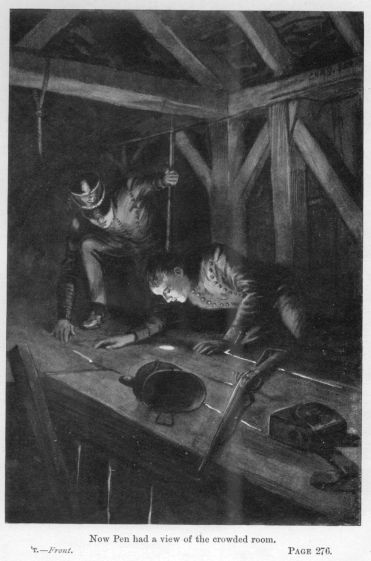
And now Pen had a view of the crowded room which completely dashed his belief in the party being the Spanish King and his followers, for he was looking down upon the heads of a gathering of rough-looking, unshorn, peasant-like men, for the most part in cloaks. Some wore the regular handkerchief tied round their heads and had their sombrero hats held in hand or laid by their sides. All, too, were well armed, wearing swords and rough scarves or belts which contained pistols.
This scene was enough to sweep away all thought of this being a king and his courtiers, for nothing could have been less suggestive thereof, and the lad looked in vain for one of them who might have been wounded or so wearied out that he had been carried in.
Then for a moment Pen let his thoughts run in another direction, but only for a few moments. These were evidently not any of the smuggler’s men. He had seen too many of them during his sojourn at the priest’s hut not to know what they were like—that is to say, men accustomed to the mountains; for they were all in their way jaunty of mien. Their arms, too, were different, and once more the thought began to gain entrance that his former surmise was right, and that these bearers of swords who had spoken in such deferential tones to one of their party were after all faithful followers or courtiers who had assumed disguises that would enable them to pass over the mountains unnoticed. Which then was the King?
“If some of them would speak,” said Pen to himself, “it would be easier to tell.”
But the silence, save for a faint crack or two from the burning wood, remained profound.
At last the watcher was beginning to come to a conclusion and settle in his own mind that one of the party who was bending forward towards the fire with his cloak drawn about his face might be the King; and his belief grew stronger as a flickering flame from the tiny fire played upon this man’s high boots, one of which displayed a rusty spur.
The next minute all doubt was at an end, for one of the men nearest the door uttered a sharp ejaculation which resulted in the occupants of the padre’s dwelling springing to their feet. Swords leapt from their scabbards, and some of the men drew their cloaks about their left arms, while others snatched pistols from their belts, and there followed the sharp clicking of their locks.
It was evident they were on the alert for anticipated danger, and Pen’s eyes glistened, for he could hear no sound. But he noted one thing, and that was that the booted and spurred individual in the cloak did not stir from where he was seated upon the priest’s stool by the fire.
Then, with a gesture of impatience, Pen saw him throw back his cloak and put his hand to his belt to draw forth a pistol which refused to come. Then with an angry word he gave a fierce tug, with the result that the weapon came out so suddenly that its holder’s arm flew up, the pistol exploded with a loud crash, the bullet with which it was loaded passed upward through the boarded ceiling, and Pen started and made a snatch at the spot where his musket was propped up against the wall, while Punch leaped from where he had crouched and came down again upon the ill-fitting boards, which cracked loudly as if the boy were going through.
Chapter Thirty.
An awkward Position.
There was a burst of excitement, hurried ejaculations, and half-a-dozen pistols were rapidly discharged by their holders at the ceiling; while directly after, in obedience to a command uttered by one of the party, a dash was made for the corner door, which was dragged open, and, sword in hand, several of the men climbed to the loft. The boards creaked, there was a hurried scuffle, and first Punch and then Pen were compelled to descend into the room below, dragged before the leader, forced upon their knees, and surrounded by a circle of sword-points, whose bearers gazed at their leader, awaiting his command to strike.
The leader sank back in his seat, nursing the pistol he had accidentally discharged. Then with his eyes half-closed he slowly raised it to take aim at Pen, who gazed at him firmly and without seeming to blench, while Punch uttered a low, growling ejaculation full of rage as he made a struggle to escape, but was forced back upon his knees, to start and wince as he felt the point of a sword touch his neck. Then he cried aloud, “Never mind, comrade! Let ’em see we are Bri’sh soldiers and mean to die game.”
Pen did not withdraw his eyes from the man who held his life in hand, and reached out behind him to grasp Punch’s arm; but his effort was vain.
Just then the seated man seemed to recollect himself, for he threw the empty pistol upon the floor and tugged another from his belt, cocked it, and then swung himself round, directing the pistol at the door, which was dashed open by the old priest, who ran in and stood, panting hard, between the prisoners and the holder of the pistol.
He was too breathless to speak, but he gesticulated violently before grasping Pen’s shoulder with one hand and waving the other round as if to drive back those who held the prisoners upon their knees.
He tried to speak, but the words would not come; and then there was another diversion, for a fresh-comer dashed in through the open door, and, regardless of the swords directed at him, forced his way to where the prisoners were awaiting their fate.
He, too, was breathless with running, for he sank quickly on one knee, caught at the hand which held the pistol and raised it quickly to his lips, as he exclaimed in French:
“No, no, your Majesty! Not that!”
“They are spies,” shouted the tired-looking Spaniard who had given the command which had sent his followers to make the seizure in the loft.
“No spies,” cried the contrabandista. “Our and his Majesty’s friends—wounded English soldiers who had been fighting upon our side.”
There was a burst of ejaculations; swords were sheathed, and the dethroned Spanish monarch uncocked his pistol and thrust it back into his belt.
“They have had a narrow escape,” he said bitterly. “Why were you not here with the friends you promised?”
“They are outside awaiting my orders, your Majesty,” said the smuggler bluntly. “May I remind you that you are not to your time, neither have you come by the pass I promised you to watch.”
“Bah! How could I, when I was driven by these wretched French, who are ten times our number? We had to reach the trysting-place how we could, and it was natural that these boys should be looked upon as spies. Now then, where are you going to take us? The French soldiers cannot be far behind.”
“No, sire; they are very near.”
“And your men—where are they?”
“Out yonder, sire, between you and your pursuers.”
“Then are we to continue our flight to-night?”
“I cannot tell yet, sire. Not if my men can hold the enemy at bay. It may be that they will fall back here, but I cannot say yet. I did intend to lead you through the forest and along a path I know by the mountain-side; but it is possible that the French are there before us.”
“And are these your plans of which you boasted?” cried the King bitterly.
“No, sire,” replied the contrabandista bluntly. “Your Majesty’s delay has upset all those.”
The King made an angry gesticulation.
“How could I help it?” he said bitterly. “Man, we have been hemmed in on all sides. There, I spoke hastily. You are a tried friend. Act as you think best. You must not withdraw your help.”
“Your Majesty trusts me, then, again?”
“Trust you? Of course,” said the King, holding out his hand, which the smuggler took reverently and raised to his lips.
Then dropping it he turned sharply to the priest and the two prisoners.
“All a mistake, my friends. There,” he added, with a smile, “I see you are not afraid;” and noting Punch’s questioning look, he patted him on the shoulder before turning to Pen again. “Where are your guns?” he said.
Pen pointed up to the loft.
“Get them, then, quickly. We shall have to leave here now.”
He had hardly spoken before a murmur arose and swords were drawn, for there was a quick step outside, a voice cried “El rey!” and one of the smuggler’s followers pressed through to whisper a few words.
“Ah!” cried the recipient, who turned and said a few words in Spanish to the King, who rose to his feet, drew his rough cloak around him, and stood as if prepared for anything that might come.