"!Tention" (continued 3)
Reading edition
“Oh, but I just want to tell you this.”
“Tell me to-morrow, Punch. You are growing excited and feverish.”
“How do you know? You ain’t a doctor.”
“No; but I know that your forehead was cold and wet a few minutes ago, and that it is hot and burning now.”
“Well, that only means that it’s getting dry.”
“No; it means doing yourself harm when you want to get well.”
“Well, I must talk,” pleaded the boy.
“Yes, a little.”
“What am I to do? I can’t be always going to sleep.”
“No; but go as much as you can, and you will get well the quicker.”
“All right,” said Punch sadly. “’Bey orders; so here goes. But I do wish that the chap as gave me this bullet had got it hisself. I say, comrade,” added the boy, after lying silent for a few minutes.
“What is it? What do you want?”
“Just unhook that there cord and hang my bugle on that other peg. Ah, that’s better; I can see it now. Stop a minute—give us hold.”
The boy’s eyes brightened as Pen handed him the instrument, and he looked at it with pride, while directly after, obeying the impulse that seized him, he placed the mouthpiece to his lips, drew a deep breath, and with expanding cheeks was about to give forth a blast when Pen snatched it from his hands.
“Whatcher doing of?” cried the boy angrily. “Stopping you from bringing the French down upon us,” cried Pen sharply. “What were you thinking about?”
“I wasn’t thinking at all,” said the boy slowly, as his brow wrinkled up in a puzzled way. “Well, I was a fool! Got a sort of idea in my head that some of our fellows might hear it and come down and find us.”
“I wish they would,” said Pen sadly; “but I don’t think there’s a doubt of it, Punch, we are surrounded by the French. There, I’m sorry I was so rough with you, only you were going to make a mistake.”
“Sarve me jolly well right,” said the boy. “I must have been quite off my chump. There, hang it up. I won’t do it again.”
It was quite dark now, and in the silence Pen soon after heard a low, deep breathing which told him that his wounded companion had once more sunk asleep, while on his part a busy brain and a smarting hand tended to reproduce the evening scene, and with it a series of mental questions as to what would be the result; and so startling were some of the suggestions that came to trouble the watcher that he placed himself by the side of the bed farthest from the door and laid his rifle across the foot ready to hand, as he half-expected to see the dim, oblong square of the open doorway darkened by an approaching enemy stealing upon them, knife-armed and silent, ready to take revenge for the blow, urged thereto by a feeling of jealous hatred against one who had never meant him the slightest harm.
That night Pen never closed his eyes, and it was with a sigh of relief that he saw the first pale light of day stealing down into the rocky vale.
Chapter Fifteen.
Juan’s Revenge.
“Oh, you have come back again, then,” grumbled Punch, as Pen met his weary eyes and the dismal face that was turned sideways to watch the door of the hut. “Thought you had gone for good and forgotten all about a poor fellow.”
“No, you didn’t, Punch,” said Pen, slowly standing his rifle up in a corner close at hand, as he sank utterly exhausted upon the foot of the bed.
“Yes, I did. I expected that you had come across some place where there was plenty to eat, and some one was giving you bottles of Spanish wine, and that you had forgotten all about your poor comrade lying here.”
“There, I am too tired to argue with you, Punch,” said Pen with a sigh. “You have drunk all the water, then?”
“Course I have, hours ago, and eat the last of the bread, and I should have eat that bit of hard, dry cheese, only I let it slip out of my fingers and it bounced like a bit of wood under the bed. Well, whatcher brought for us to eat?”
“Nothing, I am sorry to say.”
“Well, but what are we going to do? We can’t starve.”
“I am afraid we can, Punch, if things are going on like this.”
“But they ain’t to go on like this. I won’t lie here and starve. Nice thing for a poor fellow tied up here so bad that he couldn’t pick up a bit of wittles again as had tumbled down, and you gone off roaming about where you liked, leaving your poor wounded comrade to die! Oh, I do call it a shame!” cried the lad piteously.
“Yes, it does seem a shame, Punch,” said Pen gently; “but I can fetch some water. Are you very thirsty?”
“Thirsty? Course I am! Burnt up! It has been like an oven here all day.”
Pen caught up the wooden seau and hurried out through the wood, to return in a few minutes with the vessel brimful of cold, clear water, which he set down ready, and then after carefully raising the poor boy into a sitting position he lifted the well-filled drinking-cup to his lips and replenished it again twice before the poor fellow would give up.
“Ah!” he sighed, “that’s better! Which way did you go this time?”
“Out there to the west, where the sun goes down, Punch.”
“Well, didn’t you find no farmhouses nor cottages where they’d give you a bit of something to eat?”
“Not one; only rough mountain-land, with a goat here and there.”
“Well, why didn’t you catch one, or drive your bayonet into it? If we couldn’t cook it we could have eaten it raw.”
“I tried to, Punch, but the two or three I saw had been hunted by the enemy till they were perfectly wild, and I never got near one.”
“But you didn’t see no enemy this time, did you?”
“Yes; they are dotted about everywhere, and I have been crawling about all day through the woods so as not to be seen. It’s worse there than in any direction I have been this week. The French are holding the country wherever I have been.”
“Oh, I do call this a nice game,” groaned the wounded boy. “Here, give us another cup of water. It does fill one up, and I have been feeling as hollow as a drum.”
Pen handed him the cup once more, and Punch drank with as much avidity as if it were his first.
“Yes,” he sighed, “I do call it a nice game! I say, though, comrade, don’t you think if you’d waited till it was dark, and then tried, you could have got through their lines to some place and have begged a bit of bread?”
“Perhaps, Punch, if I had not been taken.”
“Well, then, why didn’t you try?”
“Well, we have had that over times enough,” said Pen quietly, “and I think you know.”
“Course I do,” said the boy, changing his tone; “only this wound, and being so hungry, do make me such a beast. If it had been you going on like this, lying wounded here, and it was me waiting on you, and feeding you, and tying you up, I should have been sick of it a week ago, and left you to take your chance.”
“No, you wouldn’t, Punch, old chap; it isn’t in you,” said Pen, “so we won’t argue about that. I only want you to feel that I have done everything I could.”
“’Cept cutting off and leaving me to take my chance. You haven’t done that.”
“No, I haven’t done that, Punch.”
“And I suppose you ain’t going to,” said the boy, “and I ought to tell you you are a fool for your pains.”
“But you are not going to do that, Punch.”
“No, I suppose not; and I wish I wasn’t such a beast—such an ungrateful brute. It is all that sore place; and it don’t get no better. But, I say, why don’t you go out straight and find the first lot of Frenchies you can, and say to them like a man, ‘Here, I give myself up as a prisoner’?”
“I told you, Punch, what I believe,” replied Pen.
“Yes; you said you were afraid that they wouldn’t have me carried away on account of my wound.”
“Well, that’s what I do believe, Punch. I don’t want to be hard on the French, but they are a very rough lot here in this wild mountain-land, and I don’t believe they would burden themselves with wounded.”
“Well, it wouldn’t matter,” said the boy dismally.
“Of course they wouldn’t carry me about; but they would put me out of my misery, and a good job too.”
Pen said nothing, but his face wrinkled up with lines which made him look ten years older, as he laid his hand upon his comrade’s fevered brow.
“Ha!” sighed Punch, “that does a fellow good. I don’t believe any poor chap ever had such a comrade as you are; and I lie here sometimes wondering how you can do so much for such an—”
“Will you be quiet, Punch?” cried Pen, snatching away his hand.
“Yes, yes—please don’t take it away.”
“Then be quiet. You know how I hate you to talk like this.”
“Yes, all right; I have done. But, I say, do you think it’s likely that gal will come again? She must know that what she brought wouldn’t last.”
“I think, poor lass, she must have got into such trouble with her people that she daren’t come again.”
“Her people!” cried the boy. “It’s that ugly black-looking nigger of a sweetheart of hers. You had a good sight of him that night when you took aim with your rifle. Why didn’t you pull the trigger? A chap like that’s no good in the world.”
“Just the same as you would if you had had hold of the rifle yourself, Punch—eh?”
“There you go again,” said the boy sulkily. “What a chap you are! You are always pitching it at me like that. Why, of course I should have shot him like a man.”
“Would you?” said Pen, smiling.
“Oh, well, I don’t know. Perhaps I shouldn’t. Such a chap as that makes you feel as you couldn’t be too hard on him. But it wouldn’t be quite the right thing, I suppose. There, don’t bother. It makes my sore place ache. But, oh, shouldn’t I like to tell him what I think of him! I say, don’t you think she may come to-night?”
“No, Punch; I have almost ceased to hope. Besides, I don’t want to depend on people’s charity, though I like to see it I want to be able to do something for ourselves. No, I don’t think she will come any more.”
“I do,” said the boy confidently. “I am beginning to think that she will come after all. She is sure to. She must know how jolly hungry I should be. She looked so kind. A gal like that wouldn’t leave us to starve. She is a nice, soft-hearted one, she is, though she is Spanish. I wouldn’t take no notice, but I see the tears come in her eyes, and one of them dropped on my hand when she leaned over me and looked so sorry because I was in pain. It’s a pity she ain’t English and lived somewhere at home where one might expect to see her again. It is very sad and shocking to have to live in a country like this.”
“Do you feel so hungry now, Punch?”
“Yes, horrid. Give us a bit of that cheese to nibble. Then I must have another drink, and try and go to sleep. Feel as though I could now you have come back. I was afraid I was never going to see you again.”
“I don’t believe you thought I had forsaken you, Punch.”
“Not me! You couldn’t have done it. ’Tain’t in you, comrade, I know. But I tell you what I did think: that the Frenchies had got hold of you and made you prisoner. Then I lay here feeling that I could not move myself, and trying to work it out as to what you’d do—whether you would try and make them come and fetch me to be a prisoner too, or whether you would think it wouldn’t be safe, and you would be afraid to speak for fear they should come and bayonet me. And so I went on. Oh, I say, comrade, it does make a chap feel queer to lie here without being able to help hisself. I got to think at last that I wished I was dead and out of my misery.”
“Yes, Punch, lad, I know. It was very hard to bear, but I couldn’t help being so long. I was working for you—for both of us—all the time.”
“Course you was, comrade! I know. And now you’ve come back, and it’s all right again. Give us another drink of water. It’s better than nothing—ever so much better, because there’s plenty of it—and I shall go to sleep and do as I did last night when I was so hungry—get dreaming away about there being plenty of good things to eat. I seemed to see a regular feast—roast-meat and fruit and beautiful white bread; only it was as rum as rum. I kept on eating all the time, only nothing seemed to have any taste in it. And, hooray! What did I say! There she is! But,” the boy added, his eager tones of delight seeming to die away in despair, “she ain’t brought no basket!”
For, eager and panting with her exertions, her eyes bright with excitement, the peasant-girl suddenly dashed in through the open door, caught Pen by the breast with one hand, and pointed with the other in the direction from which she had come, as she whispered excitedly, “Los Francéses!”
Then, loosening her grasp, she turned quickly to the boy and passed one hand beneath his neck, signing to Pen to help her raise the wounded lad from the bed, while Pen hurried to the door to look out.
“Yes,” he whispered quickly, as he turned back, “she means the enemy are coming, and wants me to carry you to a place of safety.—All right, my lass; I understand.—Here, Punch, I won’t hurt you more than I can help. Clasp your hands round my neck, and I will carry you.—Here, girl, take my rifle!”
He held out the piece, and the girl caught it in her hand, while Pen drew his companion into a sitting position, stooped down, and turned his back to the bed.
“All right; I won’t squeak, comrade. Up with me. For’ard!”
But the boy could not control his muscles, the contractions in his face showing plainly enough the agony he felt as with one quick movement Pen raised himself, pressing the clinging hands to his breast, and swung the poor fellow upon his back.
The girl nodded sharply, as, rifle in hand, she made for the door, beckoning to Pen to follow quickly; and then, with a look of despair, she stopped short, her actions showing plainly enough what she must be saying, for there was a quick rush among the trees outside, and the young Spaniard dashed to the front of the hut, made a snatch at the rifle the girl was bearing, and tore it from her grasp as he drove her back into the hut and barred the way, uttering a loud hail the while.
“Too late! We are too late, Punch,” said Pen bitterly. “Here they are! Prisoners, my lad. I can do no more.”
For, as he spoke, about a dozen of the enemy doubled up to the front of the hut, and the young Spaniard who had betrayed the two lads stood before Pen, showing his white teeth in a malignant grin of triumph, as he held the girl by the wrist.
Chapter Sixteen.
Prisoners.
“Are you in much pain, Punch?” said Pen, as, with his wrists tied tightly behind him he knelt beside his comrade, who lay now just outside the door of the hut, a couple of French chasseurs on guard.
The officer in command of the little party had taken possession of the hut for temporary bivouac, and his men had lighted a fire, whose flames picturesquely lit up the surrounding trees, beneath which the new-comers had stretched themselves and were now partaking of bread, grapes, and the water a couple of their party had fetched from the stream.
The young Spaniard was seated aloof from the girl, whose back was half-turned from him as she sat there seeming to have lost all interest in the scene and those whom she had tried to warn of the danger they were in.
From time to time the Spanish lad spoke to her, but she only jerked her head away from him, looking more indifferent than ever.
“Are you in much pain, Punch?” asked Pen again; for the boy had not replied, and Pen leaned more towards him, to gaze in his face searchingly.
“Oh, pretty tidy,” replied the boy at last; “but it’s better now. You seemed to wake up my wound, but it’s going to sleep again. I say, though, I didn’t show nothing, did I?”
“No, you bore it bravely.”
“Did I? That’s right. I was afraid, though, that I should have to howl; but I am all right now. And I say, comrade, look here; some chaps miche—you know, sham bad—so as to get into hospital to be fed up and get off duty, and they do it too, you know.”
“Yes, I know,” said Pen, watching the lad anxiously. “But don’t talk so much.”
“Must; I want to tell you, I am going to miche—sham, you know—the other way on.”
“What do you mean?” said Pen.
“Why, make-believe I’m all right. Make these froggies think my wound’s only a scratch. Then perhaps they will march me off along with you as a prisoner. I don’t want them to—you know.”
“March you off!” said Pen bitterly. “Why, you know you can’t stand.”
“Can’t! I’ve got to. You’ll let me hold tight of your arm. I’ve got to, comrade, and I will. It means setting one’s teeth pretty hard. Only wish I had got a bullet to bite. It would come easy then. Look here, wait a bit, and then you back up a bit closer to me. Haven’t tied my hands like yours. Just you edge close so as I can slip my fingers into your box. I want to get out one cartridge for the sake of the bullet.”
“You can’t, Punch. Didn’t you see they slipped off the belt, and that young Spaniard’s got it along with my rifle?”
“So he has! I didn’t know. Now then, wasn’t I right when I said you ought to have fired at him and brought him down? Well, I must have a bullet somehow. I know. I will try and get the girl to get hold of the case; only I don’t know how it’s to be done without knowing what to say. Can’t you put me up to it, comrade?”
“No, Punch.”
“But you might give a fellow a bit of advice.”
“My advice is to lie still and wait.”
“Well, that’s pretty advice, that is, comrade. Wait till they comes and makes an end of a fellow if he breaks down, for I am beginning to think that I sha’n’t be able to go through with it.”
“Let’s wait and see what happens, Punch. We have done our best, and we can do no more.”
Just then Pen’s attention was taken up by the young officer, who came to the door of the hut, yawned, and stood looking about at his men before slowly sauntering round the bivouac as if to see that all was right, the sentries drawing themselves up stiffly as he passed on, till he caught sight of the Spanish girl and the lad seated together in the full light cast by the fire.
Then turning sharply to one of his men, the young officer pointed at the Spaniard and gave an order in a low, imperious tone.
Two of his men advanced to the lit-up group, and one of them gave the lad a sharp clap on the shoulder which made him spring up angrily, while the other chasseur snatched the English rifle from his hand, the first chasseur seizing the cartridge-belt and case.
There was a brief struggle, but it was two to one, and the Spaniard, as Pen watched the encounter eagerly, was sent staggering back, catching his heel in a bush and falling heavily, but only to rebound on the instant, springing up knife now in hand and making at the nearest soldier.
“Ha!” gasped Punch excitedly, as he saw the gleam of the knife; and then he drew in his breath with a hiss, for it was almost momentary: one of the two French soldiers who had approached him to obey his officer’s orders and disarm the informer just raised his musket and made a drive with the butt at the knife-armed Spaniard, who received the metal plate of the stock full in his temple and rolled over, half-stunned, amongst the bushes.
Another order rang out from the officer, and before the young Spaniard could recover himself a couple more of the soldiers had pounced upon him, and a minute later he was firmly bound, as helpless a prisoner as the young rifleman who watched the scene.
“Say, comrade,” whispered Punch, “that’s done me good. But do you see that?”
“See it? Why, of course I saw it. That’s not what he bargained for when he led the Frenchmen here.”
“No, I don’t mean that,” whispered Punch impatiently. “I meant the gal.”
“The girl?” said Pen. “What about her?”
“Where is she?” whispered Punch.
“Why, she was—”
“Yes, was,” whispered Punch again; “but where is she now? She went off like a shot into the woods.”
“Ah!” exclaimed Pen, with a look of relief in his eyes.
“Yes, she’s gone; and now I want to know what’s going to be next. Here comes the officer. What’ll be his first order? To shoot us, and that young Spaniel too?”
“No,” said Pen. “But don’t talk; he’s close here.”
The officer approached his prisoners now, closely followed by one of his men, whose galons showed that he was a sergeant.
“Badly wounded, eh?” said the officer in French.
“Yes, sir; too bad to stand.”
“The worse for him,” said the officer. “Well, we can’t take wounded men with us; we have enough of our own.”
“Yes, sir,” said the sergeant; and Pen felt the blood seem to run cold through his veins.
And then curiously enough there was a feeling of relief in the knowledge that his wounded comrade could not understand the words he had grasped at once.
“We shall go back to camp in half an hour,” continued the officer; and then running his eye over Pen as he sat up by Punch’s side, “This fellow all right?”
“Yes, sir.”
“See to his fastenings. I leave him to you.”
“But surely, sir,” cried Pen, in very good French, “you are not going to have my poor companion shot in cold blood because he has the misfortune to be wounded?”
“Eh, do you understand French?”
“Yes, sir; every word you have said.”
“But you are not an officer?”
“I have my feelings, sir, and I appeal to you as an officer and a gentleman to save that poor fellow. It would be murder, and not the act of a soldier.”
“Humph!” grunted the officer. “You boys should have stayed at home.—Here, sergeant, carry the lad into camp. Find room for him in the ambulance.—There, sir, are you satisfied now?” he continued to Pen.
“Yes, sir,” replied Pen quickly; “satisfied that I am in the presence of a brave French officer. God bless you for this!”
The officer nodded and turned away, the sergeant stopping by the prisoners.
“Here, I say,” whispered Punch, “what was all that talking about?”
“Only arranging about how you were to be carried into camp, Punch,” replied Pen.
“Gammon! Don’t you try and gull me. I know,” panted the boy excitedly. “I could not understand the lingo; but you were begging him not to have me shot, and he gave orders to this ’ere sergeant to carry out what he said. You are trying to hide it from me so as I shouldn’t know. But you needn’t. I should like to have gone out like our other chaps have—shot fair in the field; but if it’s to be shot as a prisoner, well, I mean to take it like a man.”
The boy’s voice faltered for a few moments as he uttered the last words, and then he added almost in a whisper, “I mean, if I can, for I’m awful weak just now. But you’ll stand by me, comrade, and I think I will go through it as I ought. And you will tell the lads when you get back that I didn’t show the white feather, but went out just like a fellow ought?”
“That won’t be now, Punch,” said Pen, leaning over him. “I am not deceiving you. I appealed to the officer, and he gave orders at once that you were to be carried by the men to their camp and placed in one of the ambulance wagons.”
“Honour?” cried Punch excitedly. “Honour bright,” replied Pen. “But that means taking me away from you,” cried the boy, with his voice breaking.
“Yes; but to go into hospital and be well treated.”
“Oh, but I don’t want to go like that,” cried the boy wildly. “Can’t you ask the officer—can’t you tell him that—oh, here—you—we two mustn’t—mustn’t be—” For the sergeant now joined them with a couple of men carrying a rough litter; and as Punch, almost speechless now, caught at his wrist and clung to him tightly, he looked down in the prisoner’s wildly appealing eyes.
“Why, what’s the matter with the boy?” growled the sergeant roughly. “Does he think he’s going to be shot?”
“He’s badly hurt, sir,” said Pen quietly, “and can’t bear being separated from me.”
“Oh, that’s it, is it, sir?” said the sergeant. “My faith, but you speak good French! Tell him that I’ll see that he’s all right. What’s his hurt—bayonet?”
“No,” said Pen, smiling. “A French bullet—one of your men aimed too well.”
“Ha, ha! Yes, we know how to shoot. Poor fellow! Why, I have just such a boy as he.—Lift him up gently, lads.—Humph! He has fainted.”
For poor Punch had held out bravely to the last; but nature was too strong even for his British pluck.
Chapter Seventeen.
In Misery.
“I say, Pen, are you there?”
“Yes, I’m here. What do you want?”
“Want you to turn me round so as I can look out of the door. What made you put me like this?”
“It wasn’t my doing. You were put so that you might be more comfortable.”
“But I am not more comfortable, and it’s so jolly dark. I like to be able to look out of the door if I wake in the night.”
“Hush! Don’t talk so loudly.”
“Why not? There’s nobody to hear. But just turn me over first.”
“Hush! There are three or four other people to hear,” whispered Pen. “You are half-asleep yet. Don’t you understand, Punch?”
“Understand—understand what?” said the poor fellow, subduing his voice in obedience to his companion’s words.
“I must tell you, I suppose.”
“Tell me? Why, of course! Oh, I begin to understand now. Have I been off my head a bit?”
“Yes; you were very much upset when the French officer was with us, and fainted away.”
“Phee-ew!” whistled the boy softly. “Oh, it’s all coming back now. The French came, and knocked over that Spanish chap, and I thought that they were going to take me away and shoot me. Why, they didn’t, then! That’s all right. Yes, I remember now. My head was all in a muddledum. I got thinking I was never going to see you any more. When was it—just now?”
“No, Punch, it was two nights ago, and the doctor thought—”
“The doctor? Why, you have been my doctor. I say—”
“Don’t get excited. Lie quite still, and I will tell you.”
“Ah, do. I am all in a muddle still; only you might turn me round, so that I can look straight out of the door, and I could breathe the fresh air then. I am being quite stuffercated like this.”
“Yes, the hut is dreadfully hot,” said Pen with a sigh. “There are six other poor wounded fellows lying here.”
“Six other wounded fellows lying here! Whatcher talking about?”
“Only this, Punch,” said Pen, with his lips close to the boy’s ear. “You were carried to the little camp where those French came from that made us prisoners, and there you were put in an ambulance wagon with six more poor fellows, and the mules dragged us right away to a village where a detachment of the French army was in occupation. Do you understand?”
“I think so. But you said something about doctors.”
“Yes. There are several surgeons in this village, and wounded men in every hut. There has been fighting going on, and a good many more wounded men were brought in yesterday.”
“Halt!” said Punch in a quick, short whisper. “Steady! Did we win?”
“I don’t know, but I think not. I’ve seen nothing but wounded men and the doctors and the French orderlies. The French officer was very nice, and let me stay with you in the ambulance; and when we came to a halt and I helped to carry you and the other wounded into this hut, one of the doctors ordered me to stop and help, so that I have been able to attend to you as well as the others.”
“Good chap! That was lucky. Then this ain’t our hut at all?”
“No.”
“What’s become of that gal, then?”
“She escaped somewhere in the darkness,” replied Pen.
“And what about that Spanish beggar? Ah, I recollect that now. He brought the French to take us prisoners.”
“I haven’t seen any more of him, Punch, since they led him away.”
“Serve him right! And so I’ve been lying here in this hut ever since?”
“Yes, quite insensible, and I don’t think you even knew when the French surgeon dressed your wound and took out a ragged bit of the cartridge.”
“Took out what?”
“A piece of the wad that was driven in, and kept the wound from healing.”
“Well, you have been carrying on nice games without me knowing of it!” said the boy. “And it hasn’t done me a bit of good.”
“The doctor says it has. He told me yesterday evening that you would soon get right now.”
“And shall I?”
“Yes, I hope so.”
“So do I. But it does seem rum that all this should be done without my knowing of it.”
“Well, you have been quite insensible.”
“I suppose so. But where are we now, then?”
“I don’t know, Punch, except that this is a little Spanish village which the French have been occupying as a sort of hospital.”
“But where’s all the fighting?”
“I don’t know, Punch, much more than you do. There was some firing last night. I heard a good deal of tramping close at hand, as if some more men were marching in, and then more and more came through the night, and I heard firing again about a couple of hours ago; but it seemed to be miles away.”
“And you don’t know who’s beat?”
“I know nothing, I tell you, only that everything has been very quiet for the last hour or so.”
“Perhaps because you have been asleep,” said Punch.
“No; I have been quite awake, fetching water from a mountain-stream here for the poor fellows who keep asking for more and more.”
“Do they know we are English?”
“I don’t think so. Poor fellows! their wounds keep them from thinking about such a thing as that; and, besides, I am just able to understand what they say, and to say a few words when they ask for drink or to be moved a little.”
“Oh,” said Punch, “that comes of being able to talk French. Wish I could. Here, I say, you said the doctor had been doing up my wound again. Think I could walk now?”
“I am sure you couldn’t.”
“I ain’t,” said the boy. “Perhaps I could if I tried.”
“But why do you ask?” said Pen. “Because it’s so jolly nice and dark; and, besides, it’s all so quiet. Couldn’t we slip off and find the way to our troops?”
“That’s what I’ve been thinking, Punch, ever since you have been lying here.”
“Of course you would,” said the boy in an eager whisper. “And why not? I think I could manage it, and I’m game.”
“You must wait, Punch, and with me think ourselves lucky that we are still together. Wait and get strong enough, and then we will try.”
“Oh, all right. I shall do what you tell me. But I say, what’s become of your rifle and belt?”
“I don’t know. I saw them once. They were with some muskets and bayonets laid in the mule-wagon under the straw on one side. But I haven’t seen them since.”
“That’s a pity,” sighed the boy faintly; and soon after Pen found, when he whispered to him, that he was breathing softly and regularly, while his head felt fairly cool in spite of the stifling air of the crowded hut.
Punch did not stir till long after sunrise, and when he did it was to see that, utterly exhausted, his companion had sunk into a deep sleep, for the rest of that terrible night had been spent in trying to assuage the agony of first one and then another of the most badly wounded who were lying around. Every now and then there had been a piteous appeal for water to slake the burning thirst, and twice over the lad had to pass through the terrible experience of holding the hand of some poor fellow who in the darkness had whispered his last few words as he passed away.
Later on a couple more wounded men had been borne in by the light of a lantern, by whose aid a place was found for them in the already too crowded hut, and it became Pen’s duty to hold the dim open lantern and cast the light so that a busy surgeon, who was already exhausted by his long and terrible duties, could do his best to bandage and stop some wound.
It was just at daylight, in the midst of the terrible silence which had now fallen around, that Pen’s head had sunk slowly down till it rested upon Punch’s shoulder; and when the sun rose at last its horizontal rays lit up the dismal scene, with the elder lad’s pallid and besmirched face, consequent upon the help he had been called upon to render, giving him the appearance of being one of the wounded men.
Chapter Eighteen.
War’s Horrors.
But the morning brought not only the horizontal rays of the great sun which lit up the hut with its sad tale of death and suffering, but likewise a renewal of the fight of the previous day, and this time the tide of battle swept much nearer to the encampment of the wounded.
Punch started out of a state of dreamy calm, and wondered why the noise he heard had not roused up his sleeping comrade, for from apparently quite near at hand came the boom of artillery, a sound which for the moment drowned all others, even the hoarse, harshly uttered words of command, as large bodies of men swung past the doorway of the hut, and the fitful bugle-calls which a minute before had fallen on his ear.
“Ah,” he muttered, “it’s a big fight going on out there. I wonder if those are our guns;” and once more the air was rent by the dull, angry roar of artillery. “Pen! Pen! Oh, I can’t let him sleep! Why doesn’t he wake up? Here, I say, comrade!”
“Eh, what is it?” And Pen opened his eyes, to gaze wonderingly at Punch’s excited face.
“Don’t you hear?”
“Hear? Yes, yes,” And the dreamy look vanished from the other’s eyes.
The two lads waited, listening, and then Punch put his lips close to Pen’s ear.
“I am sure we are winning,” he said. “Hear that?”
“How can I help hearing it?”
“Well, it’s English guns, I know.”
“Think so?”
“Yes, and they will be here soon.”
Pen shook his head.
“Afraid not,” he said; “and— Ah, all right.—Punch, lad, I’m wanted.” For just then a man came hurriedly into the hut and made him a sign.
“What does he want?” grumbled Punch.
“It’s the surgeon,” said Pen, and he hurried away.
For some hours—long, hot, weary hours—Punch saw little of his fellow-prisoner, the morning wearing on and the atmosphere of the hovel becoming unbearably close, while all the time outside in the brilliant sunshine, evidently just on the other side of a stretch of purple hilly land, a battle was in progress, the rattle of musketry breaking into the heavy volume of sound made by the field-guns, while every now and again on the sun-baked, dusty stretch which lay beyond the doorway, where the shadows were dark, a mounted man galloped past.
“Wish my comrade would come back,” he muttered; and it was long ere his wish was fulfilled. But the time came at last, and Pen was standing there before him, holding in his hands a tin drinking-cup and a piece of bread.
“Take hold,” he said hoarsely, looking away.
“Where you been?” said Punch.
“Working in the ambulance. I—I—” And Pen staggered, and sat down suddenly on the ground.
“What’s the matter? Not hit?”
“No, no.”
“Had anything yourself?”
“Bother!” said Pen. “Make haste. Toss off that water. I want the cup.”
“Had anything yourself?” repeated Punch firmly.
“Well, no.”
“Then I sha’n’t touch a drop until you have half and take some of that bread.”
“But—”
“It’s no good, Pen. I sha’n’t and I won’t—so there!”
Pen hesitated.
“Very well,” he said; “half.” And he drank some of the water. “It’s very good—makes one feel better,” and he ate a morsel or two of bread. “I had a job to get it.”
“What did that fellow want?” asked Punch as he attacked his share.
“Me to help with the wounded,” said Pen huskily. “So you thought me long?”
“Course I did. But the wounded—are there many?”
“Heaps,” said Pen. “But don’t talk so loudly.”
“Poor chaps,” said Punch, “they can’t hear what we say. How are things going? There, they are at it again.”
“I think the French are giving ground,” said Pen in a whisper.
“Hooray!”
“Hush!”
“What, mayn’t I say hooray?”
“No, you mayn’t. I have picked up a little since I went away. I fancy our men have been coming on to try and take this village, but I couldn’t make out much for the smoke; and, besides, I have been with that surgeon nearly all the time.”
“Yes,” said Punch. “Well, will they do it?”
Pen shook his head.
“Don’t think so,” he said. “They have tried it twice. I heard what was being done. Our people were driven back, and—”
He said no more, but turned to the door; and Punch strained his eyes in the same direction, as from away to the right, beyond a group of cottages, came a bugle-call, shrill, piercing, then again and again, while Punch started upright with a cry, catching Pen’s arm.
“I say, hear that? That’s our charge. Don’t you hear? They are coming on again!”
The effort Punch had made caused a pain so intense that he fell back with a groan.
“You can leave me, Pen, old chap,” he said.
“Don’t mind me; don’t look. But—but it’s the English charge. Go to them. They are coming—they are, I tell you. Don’t look like that, and—and— There, listen!”
The two lads were not the only ones in that hut to listen then and to note that the conflict was drawing nearer and nearer.
Punch, indeed, was right, and a short time after Pen crouched down closer to his companion, for now, quite close at hand, came volley after volley, the zip, zip of the ricochetting bullets seeming to clear the way for the charge.
Then more volleys.
The dust was ploughed up, and Punch started as a bullet came with a soft plug in the hut-wall, and Pen’s heart felt ready to stop beating as there was a hoarse command outside, and half-a-dozen French infantry dashed into the building, to fill the doorway, two lying down and their comrades kneeling and standing.
“Don’t speak,” whispered Pen, for the boy had wrenched himself round and was gazing intently at the backs of the soldiers. “Don’t speak.”
Silence, before a grim happening. Then a roar from outside, exultant and fierce, and in the wide-open space beyond the hut-door the two lads saw a large body of the enemy in retreat before the serried ranks of British infantry who came on at the double, their bayonets flashing in the sun’s rays, and cheering as they swept onward.
The muskets in the doorway flashed, and the hut was filled with smoke.
“Pen, I must whisper it—Hooroar!”
There was a long interval then, with distant shouting and scattered firing, and it was long ere the cloud of smoke was dissipated sufficiently for the two lads to make out that now the doorway was untenanted except by a French chasseur who lay athwart the threshold on his back, his hand still clutching at the sling of his piece.
“Think we have won?” whispered Punch, looking away.
“Don’t know,” muttered Pen; but the knowledge that was wanted came soon enough, for an hour later it became evident that the gallant attempt of the British commander to take the village had been foiled.
The British cheer they had heard still echoed in their ears, but it was not repeated, and it was speedily apparent that the fight had swept away to their left; and from scraps of information dropped by the members of the bearer-party who brought more wounded into the already crowded hut, and took away the silent figure lying prone in the entrance, Pen made out that the French had made a stand and had finally succeeded in driving back their foes.
In obedience to an order from the grim-featured surgeon, he left Punch’s side again soon after, and it was dark ere he returned, to find the boy fast asleep. He sank down and listened, feeling now but little fatigue, starting up, however, once more, every sense on the alert, as there came a series of sharp commands at the hut-door, and he realised that he must have dropped off, for it was late in the evening, and outside the soft moonlight was making the scene look weird and strange.
Chapter Nineteen.
Another Breakdown.
Punch heard the voices too, and he reached out and felt for his comrade’s hand.
“What is it?” he whispered. “Have they won? Not going to shoot me, are they?”
“No, no,” said Pen, “but”—and he dropped his voice—“I think we are all going on.”
He was quite right, and all through that night the slow business of setting a division on the march was under way, and the long, long train of baggage wagons drawn by the little wiry mules of the country began to move.
The ambulance train followed, with its terrible burden heavily increased with the results of the late engagement, while as before—thanks to the service he had been able to render—Pen was able to accompany the heavily laden wagon in which Punch lay.
“So we were beaten,” said the boy sadly—as the wheels of the lumbering vehicle creaked loudly, for the route was rough and stony—and Pen nodded.
“Beaten. Yes,” And his voice was graver than before at the thought of what he had seen since they had been prisoners.
On, on, on, through the dark hours, with Punch falling off every now and again into a fitful sleep—a sleep broken by sudden intervals of half-consciousness, when Pen’s heart was wrung by the broken words uttered by his companion: “Not going to shoot me, are they? Don’t let them do that, comrade.” While, as the weary procession continued its way on to the next village, where they were about to halt, Pen had another distraction, for as he trudged painfully on by the side of the creaking wagon a hand was suddenly placed on his arm.
He turned sharply.
“Eh, what?” he cried.
“Well?” said a half-familiar voice, and in the dim light he recognised the features of the young French captain who had listened to his appeal to save the bugler’s life.
“Rough work, sir,” said Pen.
“Yes. Your fellows played a bold game in trying to dislodge us. Nearly succeeded, ma foi! But we drove them back.”
“Yes,” said Pen.
“How’s your friend?” asked the captain.
“Better.”
“That’s well. And now tell me, where did you learn to speak French so well?”
“From my tutor,” answered Pen.
“Your tutor! And you a simple soldier! Well, well! You English are full of surprises.”
Pen laughed.
“I suppose so,” he said; “but we are not alone in that.”
The French captain chatted a little longer, and then once more Pen was alone—alone but for the strange accompaniment of sounds incident to the night march: the neighing of horses, the scraps of quick talking which fell on his ear, along with that never-ceasing creak, rumble, and jolt of the wagons, a creaking and jolting which seemed to the tired brain as though they would go on for ever and ever.
He was aroused out of a strange waking dream, in which the past and the present were weirdly blended, by a voice which called him by name, and he tried to shake himself free from the tangle of confused thought which hemmed him in.
“Aren’t you there?” came the voice again.
“Yes, Punch, yes. What is it?”
“Ah, that’s all right! I wanted to tell you that I feel such a lot better.”
“Glad to hear it, Punch.”
“Yes, I feel as if I could get out of this now.”
“You had better not try,” said Pen with a forced laugh. “I think—I think—” And then the confusion came again.
“What do you think?” said Punch.
“Think?” cried the other. “I—what do you mean?”
In the darkness of the heavy vehicle, Punch’s face betrayed a feeling of alarm, and he tried to figure it out. Something in Pen’s voice frightened him.
“He is not the same,” he muttered; and his impression was substantiated when a halt was called just about the time of dawn, for Pen dropped like a log by the wagon-side; and when Punch, with great pain to himself, struggled into a sitting position, and then clambered down to his comrade, he found to his horror that his worst fears were realised.
Pen’s forehead was burning, and the poor lad was muttering incoherently, and not in a condition to pay heed to the words of his companion.
“Gray, Gray! Can’t you hear? What’s wrong?”
The village which was the new headquarters was higher up in the mountains; and whether it was the fresher air operating beneficially, or whether the period of natural recovery had arrived, certain it was that Punch found himself able to move about again; and during the days and weeks that followed he it was who took the post of nurse and attended to the wants of Pen—wants, alas! too few, for the sufferer was a victim to something worse than a mere shot-wound susceptible to efficient dressing, for the most dangerous, perhaps, of all fevers had laid him low.
The period passed as in a long dream, and the thought of rejoining the British column had for a time ceased to animate Punch’s brain.
But youth and a strong constitution rose superior in Pen’s case to all the evils of circumstance and environment, and one afternoon the old clear look came back to his eyes.
“Ah, Punch,” he said, “better?”
“Better?” said the boy. “I—I am well; but you—how are you now?”
“I—have I been ill?”
“Ill!” cried Punch, and he turned and looked at an orderly who was hurrying past. “He asks if he has been ill!—Why, Pen, you have had a fever which has lasted for weeks.”
Pen tried to sit up, and he would have dismally failed in the attempt had not Punch encircled him with his arm.
“Why—why,” he said faintly, “I am as weak as weak!”
“Yes, that you are.”
“But, Punch, what has been happening?”
“I don’t know. I can’t understand what all these people say; but they let me fetch water for them and attend to you; and to-day there has been a lot going on—troops marching past.”
“Yes,” said Pen; “that means there has been another fight.”
“No, I don’t think so.”
“Why not?”
“Because I have heard no firing. But hadn’t you better go to sleep again?”
Pen smiled, but he took the advice and lay back.
“Perhaps I had,” he said faintly; and as Punch watched him he fell into a restful doze.
So it was during the days that followed, each one bringing back more strength to the invalid, and likewise each day a further contingent of the wounded in the battle of a month before being passed as fit for service again and drafted to the front; while each day, too, Pen found that the strength that used to be his was returning little by little, and he listened eagerly one night when Punch bent over him and whispered something in his ear.
“You know I have been talking about it to you,” said the boy, “for several nights past; and when I wasn’t talking about it I was thinking of it. But now—now I think the time has come.”
“To escape?” cried Pen eagerly. “You mean it?”
“Yes; I have been watching what has gone on. We are almost alone here, with only wounded and surgeons. The rest have gone; and—and behind this village there is a forest of those scrubby-barked oak-trees.”
“Cork-trees,” said Pen.
“Oh, that’s it!” And the boy drew himself up. “But do you think you are strong enough yet?”
“Strong enough? Of course.” And Pen rose, to stand at his companion’s side. “Do you know the way?”
“Yes,” And Punch felt for and took his companion’s hand, trying to see his face in the pitchy darkness. “It is to the right of the camp.”
“Then let’s go.”
“Wait,” said Punch, and he glided off into the blackness, leaving Pen standing there alone.
But it was not for long. In a minute or two the boy was back once more, and this time he held something in his arms.
“Ready?” he asked in a whisper.
“Yes. What for?”
“Stoop.—That’s it. I watched, and took them—not English ones, but they will shoot, I expect,” And softly he slipped the sling of a musket over Pen’s shoulders, following that by handing him a cartouche-box and belt. “I have got a gun for myself too. Better than a bugle. There!” And in the darkness there was the sound of a belt being tightly drawn through a buckle. “Are you ready?”
“Yes,” said Pen.
“Where’s your hand?”
“Here.”
“Right!” And the younger lad gripped his friend’s extended palm. “Now, it’s this way. I planned it all when you were so ill, and said to myself that it would be the way when you got better. Come along.”
Softly and silently the two slipped off in the darkness, making for the belt of forest where the gloomy leafage made only a slight blur against the black velvet sky.
Chapter Twenty.
Hunted.
“What’s the matter, Punch? Wound beginning to hurt you again?”
“No,” said the boy surlily.
“What is it, then? What are you thinking about?”
“Thinking about you being so grumpy.”
“Grumpy! Well, isn’t it enough to make a fellow feel low-spirited when he has been ill for weeks, wandering about here on these mountain-sides, hunted as if we were wild beasts, almost starving, and afraid to go near any of the people?”
“No,” replied Punch with quite a snarl. “If you had had a bullet in your back like I did there’s something to grumble about. I don’t believe you ever knew how it hurt.”
“Oh yes, I did, Punch,” said Pen quietly, “for many a time I have felt for you when I have seen you wincing and your face twitching with pain.”
“Of course you did. I know. You couldn’t have been nicer than you were. But what have you got to grumble about now you’re better?”
“Our bad luck in not getting back to some of our people.”
“Well, I should like that too, only I don’t much mind. You see, I can’t help feeling as jolly as a sand-boy.”
“I don’t know that sand-boys have anything much to be jolly about, Punch,” said Pen, brightening up.
“More do I—but it’s what people say,” said Punch; “only, I do feel jolly. To be out here in the sunshine—and the moonshine, too, of a night—and having a sort of feeling that I can sit down now without my back aching and smarting, and feeling that I want to run and jump and shout. You know what it is to feel better, now, as well as I do. This ain’t home, of course; but everything looks wonderful nice, and every morning I wake up it all seems to me as if I was having a regular long holiday. I say, do say you are enjoying yourself too.”
“I can’t, Punch. There are too many drawbacks.”
“Oh, never mind them.”
“But I can’t help it. You know I have been dreadfully weak.”
“But you shouldn’t worry about that. I don’t mind a bit now you are getting well.”
“What, not when we are faint with hunger?”
“No, not a bit. It makes me laugh. It seems such a jolly game to think we have got to hunt for our victuals. Oh, I think we are having a regular fine time. It’s a splendid place! Come on.”
“No, no; we had better rest a little more.”
“Not me! Let’s get some chestnuts. Ain’t it a shame to grumble when you get plenty of them as you can eat raw or make a fire and roast them? Starve, indeed! Then look at the grapes we have had; and you never know what we shall find next. Why, it was only yesterday that woman gave us some bread, and pointed to the onions, and told us to take more; leastways she jabbered and kept on pointing again. Of course, we haven’t done as well as we did in the hut, when the girl brought us bread and cheese and milk; but I couldn’t enjoy it then with all that stinging in my back. And everything’s good now except when you look so grumpy.”
“Well, Punch, most of my grumpiness has been on your account, and I will cheer up now. If I could only meet some one to talk to and understand us, so that we could find out where our people are, I wouldn’t care.”
“Well, never mind all that, and don’t care. I don’t. Here we are having a big holiday in the country. We have got away from the French, and we are not prisoners. I am all alive and kicking again, and I feel more than ever that I don’t care for anything now you are getting more and more well. There’s only one thing as would make me as grumpy as you are.”
“What’s that, Punch?”
“To feel that my wound was getting bad again. I say, you don’t think it will, do you?”
“No; why should I? It’s all healing up beautifully.”
“Then I don’t care for anything,” cried the boy joyously. “Yes, I do. I feel horrid wild sometimes to think they took away my bugle; leastways, I suppose they did. I never saw it no more; and it don’t seem natural not to have that to polish up. I have got a musket, though; and, I say, why don’t we have a day’s shooting, and knock over a kid or a pig?”
“Because it would be somebody’s kid or pig, and we should be hunted down worse than ever, for, instead of the French being after us for escaped prisoners, we should rouse the people against us for killing their property.”
“Yes, that would be bad,” said Punch; “but it would only be because we are hungry.”
“Yes, but the people wouldn’t study that.”
“Think they would knife us for it?” said the boy thoughtfully.
“I hope not; but they would treat us as enemies, and it would go bad with us, I feel sure.”
“Well, we are rested now,” said Punch. “Let’s get on again a bit.”
“Which way shall we go?” said Pen.
“I dunno; anywhere so’s not to run against the French. I have had enough of them. Let’s chance it.”
Pen laughed merrily, his comrade’s easy-going, reckless way having its humorous side, and cheering him up at a time when their helpless condition made him ready to despair.
“Well,” he said, “if we are to chance it, Punch, let’s get out of this wood and try to go downhill.”
“What for?”
“Easier travelling,” said Pen. “We may reach another pleasant valley, and find a village where the people will let us beg some bread and fruit.”
“Yes, of course,” said Punch, frowning; “but it don’t seem nice—begging.”
“Well, we have no money to buy. What are we to do?”
“Grab,” said Punch laconically.
“What—steal?” cried Pen.
“Steal! Gammon! Aren’t we soldiers? Soldiers forage. ’Tain’t stealing. We must live in an enemy’s country.”
“But the Spaniards are not our enemies.”
“There, now you are harguing, and I hate to hargue when you are hungry. What I say is, we are soldiers and in a strange country, and that we must take what we want. It’s only foraging; so come on.”
“Come along then, Punch,” said Pen good-humouredly. “But you are spoiling my morals, and—”
“Pst!” whispered Punch. “Lie down.”
He set the example, throwing himself prone amongst the rough growth that sprang up along the mountain-slope; and Pen followed his example.
“What can you see?” he whispered, as he crept closer to his comrade’s side, noting the while that as he lay upon his chest the boy had made ready his musket and prepared to take aim. “You had better not shoot.”
“Then tell them that too,” whispered Punch.
“Them! Who?”
“Didn’t you see?”
“I saw nothing.”
“I did—bayonets, just below yonder. Soldiers marching.”
“Soldiers?” whispered Pen joyfully. “They may be some of our men.”
“That they are not. They are French.”
French they undoubtedly were; for as the lads peered cautiously from their hiding-place, and listened to the rustling and tramp of many feet, an order rang out which betrayed the nationality of what seemed to be a large body of men coming in their direction.
“Keep snug,” whispered Punch, “and they won’t see us. It’s too close here.”
Pen gripped his companion’s arm, and lay trying to catch sight of the marching men for some minutes with a satisfied feeling that the troops were bearing away from them. But his heart sank directly after; a bugle-call rang out, the men again changed their direction, the line extended, and it became plain that they would pass right over the ground where the two lads lay.
“I am afraid they will see us, Punch,” whispered Pen. “What’s to be done?”
“Run for it. Look here, make straight for that wood up the slope,” whispered Punch. “You go first, and I will follow.”
“But that’s uphill,” whispered Pen.
“Bad for them as for us,” replied the boy. “Up with you; right for the wood. Once there, we are safe.”
Punch had said he hated to argue, and it was no time for argument then as to the best course.
Pen gazed in the direction of the approaching party, but they were invisible; and, turning to his comrade, “Now then,” he said, “off!”
Springing up, he started at a quick run in and out amongst the bushes and rocks in the direction of the forest indicated by his companion, conscious the next minute, as he glanced back in turning a block of stone, that Punch was imitating his tactics, carrying his musket at the trail and bending low as he ran.
“Keep your head down, Punch,” he said softly, as the boy raced up alongside. “We can’t see them, so they can’t see us.”
“Don’t talk—run,” whispered Punch. “That’s right—round to your left. Don’t mind me if I hang back a bit. I am short-winded yet. I shall follow you.”
For answer, Pen slackened pace, and let Punch pass him.
“Whatcher doing?” whispered the boy.
“You go first,” replied Pen, “just as fast as you can. I will keep close behind you.”
Punch uttered a low growl, but he did not stop to argue, and they ran on and on, getting out of breath but lighter hearted, as they both felt that every minute carried them nearer to safety, for the risky part where the slope was all stone and low bush was nearly passed, the dense patch of forest nearer at hand offering to them shelter so thick that, once there, their enemies would have hard work to judge which direction had been taken; and then all at once, when all danger seemed to be past, there came a shout from behind, and then a shot.
“Stoop! Stoop, Punch! More to the left!”
“All right. Come on,” was whispered back; and, as Punch bore in the direction indicated by his comrade, there came shout after shout, shot after shot, and the next minute, as the fugitives tore on heedless of everything but their effort to reach the shelter in advance, it was perfectly evident to them that the bullets fired were whizzing in their direction.
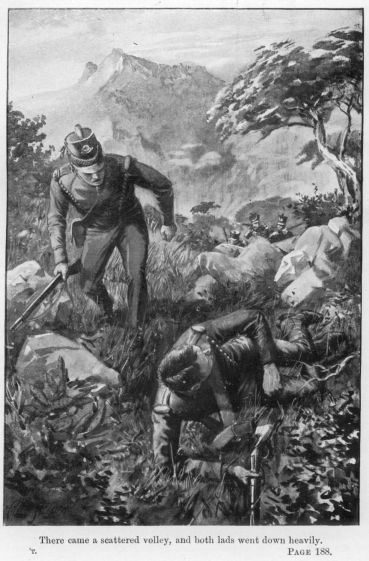
Twigs were cut and fell; there was the loud spat, spat of the bullets striking the rocks; and then, when they were almost within touch of the dark shadows spread by the trees, there came a scattered volley, and both lads went down heavily, disappearing from the sight of their pursuers, who sent up a yell of triumph.
“Punch,” panted Pen, “not hurt?”
The answer was a hoarse utterance, as the boy struggled to his feet and then dropped again on all-fours.
“No, no,” he gasped. “Come on! come on! We are close there.”
Pen was breathing hard as he too followed his comrade’s movements just as if forced thereto by the natural instinct that prompted imitation; but the moment he reached his feet he dropped down again heavily, and then began to crawl awkwardly forward so that he might from time to time catch a glimpse of Punch’s retiring form.
“Come on, come on!” kept reaching his ears; and then he felt dizzy and sick at heart.
It seemed to be growing dark all at once, but he set it down to the closing-in of the overshadowing trees. And then minutes passed of confusion, exertion, and a feeling as of suffocation consequent upon the difficulty of catching his breath.
Then at last—he could not tell how long after—Punch was whispering in his ear as they lay side by side so close together that the boy’s breath came hot upon his cheek.
“Oh, how slow you have been! But this ’ere will do—must do, for we can get no farther. Why, you were worse than me. Hurt yourself when you went down?”
Pen was about to reply, when a French voice shouted, “Forward! Right through the forest!”
There was the trampling of feet, the crackling of dead twigs, and Punch’s hand gripped his companion’s arm with painful force, as the two lads lay breathless, with their faces buried in the thick covering of past years’ dead leaves, till the trampling died away and the fugitives dared to raise their faces a little in the fight for breath.
Chapter Twenty One.
Hide-and-Seek.
“Oh, I say,” whispered Punch, in a half-suffocated tone, “my word! Talk about near as a toucher! It’s all right, comrade; but if I had held my breath half a jiffy longer I should have gone off pop. Don’t you call this a game? Hide-and-seek and whoop is nothing to it! Garn with you, you thick-headed old frog-soup eaters! Wait till I get my breath. I want to laugh.—Can’t hear ’em now; can you?”
“No,” said Pen faintly. “Will they come back?”
“Not they,” replied Punch chuckling. “Couldn’t find the way again if they tried. But we shall have to stay here now till it’s dark. It don’t matter. I want to cool down and get my wind. I say, though, catch your foot on a stone?”
“No,” replied Pen, breathing hard.
“Thought you did. You did go down—quelch! What you breathing like that for? You did get out of breath! Turn over on your back. There’s nobody to see us now. I say, isn’t it nice and shady! Talk about a hiding-place! Look at the beautiful great, long green leaves. Hooray! Chestnuts. We have dropped just into the right place for foraging. Wait a bit and we will creep right into the forest and make a little fire, and have a roast. What? Oh, it’s all right. They have gone straight on and can’t hear me. Here! I say: why, comrade, you did hurt yourself when you went down. Here, what is it? Oh, I am sorry! Ain’t broke anything, have you?”
“My leg, Punch—my leg,” said Pen faintly.
“Broke your leg, comrade?” cried the boy.
“No, no,” said Pen faintly; “not so bad as that. One of the bullets, I think, scraped my leg when they fired.”
“Shot!” cried Punch in an excited voice full of agony. “Oh, comrade, not you! Don’t say that!”
The lad talked fast, but he was acting all the time. Leaving his musket amongst the leaves, he had crept to Pen’s side, and was eagerly examining his comrade’s now helpless leg.
“Can’t help it,” he whispered, as he searched for and drew out his knife. “I will rip it down the seam, and we will sew it up again some time.” And then muttering to himself, “Scraped! It’s a bad wound! We must get the bullet out. No—no bullet here.” And then, making use of the little knowledge he had picked up, Punch tore off strips of cotton from his own and his companion’s garments, and tightly bandaged the bleeding wound.
“It’s a bad job, comrade,” he said cheerily; “but it might have been worse if the Frenchies could shoot. There’s no bones broke, and you are not going to grumble; but I’d have given anything if it hadn’t been your turn now. Hurt much.”
“Quite enough, Punch,” said Pen with a rather piteous smile. “It’s quite right; my turn now; but don’t stop. You’ve stopped the bleeding, so get on.”
“What say?”
“Go on now,” said Pen, “while there’s a chance to escape. Those fellows will be sure to come back this way, and you will lose your opportunity if you wait.”
“Poor chap!” said Punch, as if speaking to himself, and he laid a hand on Pen’s wet forehead. “Look at that now! I have made a nasty mark; but I couldn’t help it, for there was no water here for a wash. But, poor chap, he won’t know. He’s worse than I thought, though; talking like that—quite off his head.”
“I am not, Punch, but you will send me off it if you go on like that. Do as I tell you, boy. Escape while there’s a chance.”
“He’s quite queer,” said Punch, “and getting worse; but I suppose I can’t do anything more.”
“No; you can do no more, so don’t waste your chance of escape. It will be horrible for you to be made prisoner again, so off with you while the coast’s clear. Do you hear me?”
“Hear you! Yes, you needn’t shout and tell the Johnnies that we are hiding here.”
“No, no, of course not; it was very foolish, but the pain of the wound and your obstinacy made me excited. Now then, shake hands, and, there’s a good fellow, go.”
“Likely!” said Punch, wiping the pain-drops from Pen’s face.
“What do you mean by that?” said Pen angrily.
“What do I mean by what? You are a bit cracked like, or else you wouldn’t talk like this.”
“Not tell you to run while there’s a chance?”
“Not tell me to run like this when there’s a chance!” replied Punch. “Jigger the chance! So you just hold your tongue and lie quiet. Sha’n’t go! There.”
“But, Punch, don’t be foolish, there’s a good fellow.”
“No, I won’t; and don’t you be foolish. Pst! Hear that? They are coming back.”
“There’s time still,” said Pen, lowering his voice.
“Oh, is there? You just look here. Here they are, coming nearer and nearer. Do you want them to come and take us both?”
“No, no, no,” whispered Pen.
“Then just you hold your tongue,” said Punch, nestling down close to his comrade’s side, for the rustle and tramp of many feet began to grow nearer again; and as Punch lay upon his back with his eyes turned in the direction of the approaching sound he soon after caught a glimpse or two of sunlight flashed from the barrels of muskets far down the forest aisles, as their bearers seemed to be coming right for where they lay.
“Look here,” said Punch softly, “they look as if they are coming straight here; but there’s a chance for us yet, so let’s take it, and if they don’t find us— Mind, I didn’t want you to be hit; but as you are, and I suppose was to be, I am jolly glad of it, for it gives a fellow a chance. And what’s the good of me talking?” said the boy to himself now. “He’s gone right off, swoonded, as they call it. Poor old chap! It does seem queer. But it might have been worse, as I said before. Wanted me to run away, did you? Likely, wasn’t it? Why, if I had run it would have served me jolly well right if somebody had shot me down again. Not likely, comrade! I mayn’t be a man, but my father was a British soldier, and that’s what’s the matter with me.”
Punch lay talking to himself, but not loudly enough to startle a bird which came flitting from tree to tree in advance of the approaching soldiers, and checked its flight in one of the low branches of a great overhanging chestnut, and then kept on changing its position as it peered down at the two recumbent figures, its movements startling the bugler, who now began in a whisper to address the bird.
“Here,” he said, “what game do you call that? You don’t mean to say you have come here like this to show the Johnny Crapauds where we are, so that they may take us prisoners? No, I thought not. It wouldn’t be fair, and I don’t suppose they have even seen you; but it did look like it. Here they come, though, and in another minute they will see us, and— Oh, poor Gray! It will be bad for him, poor chap; and— No, they don’t. They are wheeling off to the left; but if they look this way they must see us, and if they had been English lads that’s just what they would have done. Why, they couldn’t help seeing us—a set of bat-eyed bull-frogs; that’s what I call them. Yah! Go on home! I don’t think much of you. Now then, they are not coming here, and I don’t care where they go as long as they don’t find us. Now, what’s next to be done? What I want is another goat-herd’s hut, so as I can carry my poor old comrade into shelter. Now, where is it to be found? I don’t know, but it’s got to be done; and ain’t it rum that my poor old mate here should have his dose, and me have to play the nurse twice over!”
Chapter Twenty Two.
“Unlucky Beggars.”
“If one wasn’t in such trouble,” said Punch to himself, as he lay in the growing darkness beneath the great chestnut-tree, “one would have time to think what a beautiful country this is. But of all the unlucky beggars that ever lived, Private Pen Gray and Bugler Bob Punchard is about the two worst. Only think of it: we had just got out of all that trouble with my wound and Gray’s fever, then he gets hit and I got to nurse him all over again. Well, that’s all clear enough.—How are you now, comrade?” he said aloud, as after cautiously gazing round in search of danger, he raised his head and bent over his wounded companion.
There was no reply, and Punch went on softly, “It’s my turn now to say what you said to me. Sleepy, are you? Well, go on, and have plenty of it. It’s the best thing for you. What did you say? Nature sets to work to mend you again? No, he didn’t. I forget now, but that’s what he meant. Now, I wonder whether it’s safe for me to go away and leave him. No, of course it isn’t, for I may tumble up against the French, who will make me a prisoner, and I sha’n’t be able to make them understand that my comrade is lying wounded under this tree, and if I could I don’t want to. That’s one thing. Another is that if I start off and leave him here I sha’n’t be able to find him again. Then, what am I going for? To try and find water, for my throat’s like sand, and something to eat better than these chestnuts, for I don’t believe they are anything like ripe. Oh dear! This is a rum start altogether. I don’t know what to do. This is coming to the wars, and no mistake! There never was really such unlucky chaps as we are. It will be dark before long. Then I shall seem to be quite alone. To be all alone here in a great wood like this is enough to make any fellow feel scared. It’s just the sort of place where the wolves will be. Well, if they do come, we have got two muskets, and if it isn’t too dark I will have two wolves, and that will keep the others off as long as they have got the ones I shot to eat.—Did you speak, comrade?” he whispered, as he once more bent over Pen. “No, he’s fast asleep. Wish I was, so as to forget all about it, for the sun’s quite down now, and I don’t know how I am to get through such a night as this. However, here goes to try. Ugh! How cold it is turning!”
The boy shivered as the wind that came down from the mountains seemed bitterly cold to one who had been drenched in perspiration by the exertion and excitement that he had passed through.
“Poor old Private Gray!” he muttered. “He will be feeling it worse than me if he don’t turn feverish.”
The boy hesitated for a few moments, and then, stripping off his jacket, he crept as close to his wounded companion as he could, and then carefully spread the ragged uniform coat over their breasts.
“Ought to have got his off too,” he muttered, “but I mustn’t. Must make the best of it and try and go to sleep, keeping him warm. But no fellow could go to sleep at a time like this.”
It was a rash assertion, for many minutes had not passed before the boy was sleeping soundly the sleep of utter weariness and exhaustion; and the next time he unclosed his eyes as he lay there upon his back, not having moved since he lay down, it was to gaze wonderingly at the beautiful play of morning light upon the long, glossy, dark-green leaves over his head; for the sun had just risen and was bronzing the leaves with ruddy gold.
The birds were singing somewhere at the edge of the forest, and all seemed so wonderful and strange that the boy muttered to himself as he asked the question, “Where am I?”
So deep had been his sleep that it seemed to be one great puzzle.
He knew it was cold, and he wondered at that, for now and then he felt a faint glow of warm sunshine. Then, like a flash, recollection came back, and he turned his head to gaze at his companion, but only to wrench himself away and roll over and over a yard or two, before sitting up quickly, trembling violently. For he was chilled with horror by the thought that his companion had passed away during the night.
It was some minutes before he dared speak. “Pen!” he whispered, at last. “Gray!” He waited, with the horror deepening, for there his companion lay upon his back motionless, and though he strained his neck towards him he could detect no movement of his breath, while his own staring eyes began to grow dim, and the outstretched figure before him looked misty and strange.
“He’s dead! He’s dead!” groaned the poor fellow. “And me lying sleeping there, never taking any notice of him when he called for help—for he must have called—and me pretending to be his comrade all the time! ’Tain’t how he treated me. Oh, Pen! Pen Gray, old chap! Speak to me, if it’s only just one word! Oh, if I had not laid down! I ought to have stood up and watched him; but I did think it was to keep him warm. No, you didn’t!” he cried angrily, addressing himself. “You did it to warm yourself.”
At last, recovering his nerve somewhat, the boy began to crawl on hands and knees towards the motionless figure, till he was near enough to lay his hand upon his companion’s breast. Then twice over he stretched it out slowly and cautiously, but only to snatch it back, till a feeling of rage at his cowardice ran through him, and he softly lowered it down, let it rest there for a few moments, and then with a thrill of joy he exclaimed, “Why, it’s all fancy! He is alive.”
“Yes, what? Who spoke?”
“I did,” cried Punch, springing to his feet. “Hooray, comrade! It’s all right. I woke up, and began to think— Pst! pst!” he whispered, as he dropped down upon hands and knees again. For there was a rush of feet, and a patch of undergrowth a short distance beyond the spread of the great chestnut boughs was violently agitated.
“Why, it’s only goats,” muttered Punch angrily. “I scared them by jumping up. Wish I had got one of their young uns here.”
“What is it? Who’s that? You, Punch?”
“Yes, comrade; it’s all right. But how are you? All right?”
“Yes—no. I have been asleep and dreaming. What does it all mean, Punch? What’s the matter with my leg?”
“Can’t you recollect, comrade?”
Pen was silent for a few moments, and then: “Yes,” he said softly, “I understand now. I was hurt. Why, it’s morning! I haven’t been to sleep all the night, have I?”
“Yes, comrade, and,”—Punch hesitated for a moment, and then with an effort—“so have I.”
“I am glad of it,” sighed Pen.
Then he winced, for he had made an effort to rise, but sank back again, feeling faint.
“Help me, Punch,” he said.
“Whatcher want?”
“To sit up with my back against the tree.”
Punch hesitated, and then obeyed.
“Ah, that’s better,” sighed Pen. “I am not much hurt.”
“Oh yes, you are,” said Punch, shaking his head.
“Nonsense! I recollect all about it now. Can you get me some water?”
“I’ll try,” was the reply; “but can you really sit up like that?”
“Yes, of course. We shall be able to go on again soon.”
“Wha-at!” cried Punch. “Oh yes, I dare say! You can’t go on. But I know what I am going to do. If the French are gone I am going to hunt round till I find one of them cottages. There must be one somewhere about, because I just started some goats. And look there! Why, of course there must be some people living near here.” And the boy pointed to a dozen or so of pigs busily rooting about amongst the dead leaves of the forest, evidently searching for chestnuts and last year’s acorns shed by the evergreen oaks.
“Now, look here,” continued the boy. “Soon as I am sure that you can sit up and wait, I am just off to look out for some place where I can carry you.”
“I can sit up,” replied Pen. “I have got a nasty wound that will take some time to heal; but it’s nothing to mind, Punch, for it’s the sort of thing that will get well without a doctor. But you must find shelter or beg shelter for us till I can tramp again.”
“But I can carry yer, comrade.”
“A little way perhaps. There, don’t stop to talk. Go and do the best you can.”
“But is it safe to leave you?” protested Punch.
“Yes; there is nothing to mind, unless some of the French fellows find me.”
“That does it, then,” said Punch sturdily. “I sha’n’t go.”
“You must, I tell you.”
“I don’t care; I ain’t going to leave you.”
“Do you want me to starve, or perish with cold in the night.”
“Course I don’t!”
“Then do as I tell you.”
“But suppose the French come?”
“Well, if they do we must chance it; but if you are careful in going and coming I don’t think they will find me; and I don’t suppose you will be long.”
“That I won’t,” cried the boy confidently. “Here goes, then—I am to do it?”
“Yes.”
“Then here’s off.”
“No, don’t do that,” cried Pen.
“Why not? Hadn’t I better take the muskets?”
“No. You are more likely to get help for me if you go without arms; and, besides, Punch,” added Pen, with a faint smile, “I might want the muskets to defend myself against the wolves.”
“All right,” replied the boy, replacing the two clumsy French pieces by his comrade’s side. “Keep up your spirits, old chap; I won’t be long.”
The next minute the boy had plunged into the thicket-like outskirts of the forest, where he stopped short to look back and mentally mark the great chestnut-tree.
“I shall know that,” he said, “from ever so far off. It is easy to ’member by the trunk, which goes up twisted like a screw. Now then, which way had I better go?”
Punch had a look round as far as the density of the foliage would allow him, and then gave his head a scratch.
“Oh dear!” he muttered, “who’s to know which way to go? It’s regular blind-man’s buff. How many horses has your father got? Shut your eyes, comrade. Now then. Three! What colour? Black, white, and grey. Turn round three times and catch who you may.”
The boy, with his eyes tightly closed and his arms spread out on either side, turned round the three times of the game, and then opened his eyes and strode right away.
“There can’t be no better way than chancing it,” he said. “But hold hard! Where’s my tree?”
He was standing close to a beautifully shaped ilex, and for a few moments he could not make out the great spiral-barked chestnut, till, just as he began to fancy that he had lost his way at once, he caught sight of its glossy bronzed leaves behind the greyish green ilex.
“That’s all right,” he said. “Now then, here’s luck.”
It was a bitter fight with grim giant despair as the boy tramped on, and time after time, faint with hunger, suffering from misery, he was about to throw himself down upon the earth, utterly broken in spirit, but he fought on bravely.
“I never saw such a country!” he muttered. “There ought to be plenty of towns and villages and people, but it’s all desert and stones and scrubby trees. Any one would think that you couldn’t walk anywhere without finding something to eat, and there’s nothing but the goats and pigs, and as soon as they catch sight of you away they go.”
Over and over again he climbed hillsides to reach spots where he could look down, in the full expectation of seeing some village or cluster of huts. But it was all the same, there was nothing to be seen; till, growing alarmed lest he should find that he had lost touch with his landmarks, he began to retrace his steps in utter despair, but only to drop down on his knees at last and bury his face in his hands, to give way to the emotion that for a few moments he could not master.
“There,” he muttered, recovering himself, “I could not help it, but there was no one to see. Just like a silly great gal. It is being hungry, I suppose, and weak with my wound; and, my word, it does sting! But there’s some one at last!”
The boy looked sharply round.
“Why, you idgit!” he gasped, “you’ve lost him again. No, it’s all right,” he cried, and he started off at a trot in the direction of a short, plump-looking figure in rusty black, who, bent of head and book in hand, was slowly descending a slope away to his right.
Chapter Twenty Three.
The Use of Latin.
“There! Ahoy!” shouted Punch, and the black figure slowly raised his head and began to look round till he was gazing in quite the opposite direction to where the boy was hurrying towards him, and Punch had a full view of the stranger’s back and a ruddy-brown roll of fat flesh which seemed to be supporting a curious old hat, looking like a rusty old stove-pipe, perched horizontally upon the wearer’s head.
“Hi! Not that way! Look this!” cried Punch as he closed up. “Here, I say, where’s the nearest village?”
The stove-pipe turned slowly round, and Punch found himself face to face with a plump-looking little man who slowly closed the book he carried and tucked it inside his shabby gown.
“Morning!” said Punch.
The little man bowed slowly and with some show of dignity, and then gazed sternly in the boy’s face and waited.
“I said good-morning, sir,” said the boy; and then to himself, “what a rum-looking little chap!—Can you tell me—”
Punch got no further, for the little stranger shook his head, frowned more sternly, and shrugged his shoulders as he made as if to take out his book again.
“I ain’t a beggar, sir,” cried the boy. “I only want you to— Oh, he can’t understand me!” he groaned. “Look here, can you understand this?” And he commenced in dumb motions to give the stranger a difficult problem to solve.
But it proved to be not too difficult, for the little man smiled, nodded his head, and imitated Punch’s suggestive pantomime of eating and drinking. Then, laying one hand upon the boy’s shoulder, he pointed with the other down the slope and tried to guide him in that direction.
“All right,” said Punch, nodding, “I understand. That’s where you live; but not yet. Come this way.” And, catching the little stranger by the arm, Punch pointed towards the forest and tried to draw his companion in that direction.
The plump little man shook his head and suggested that they should go in the other direction.
“Oh, a mercy me!” cried Punch excitedly. “Why, don’t you understand? Look here, sir, I can see what you are. You are a priest. I have seen folks like you more than once. Now, just look here.”
The little man shrugged his shoulders again, shook his head, and then looked compassionately at the boy.
“That’s better,” said Punch. “Now, sir, do try and understand, there’s a good fellow. Just look here!”
The boy tapped him on the shoulder now, and pointed towards the wood.
“Now, look here, sir; it’s like this.”
Punch made-believe to present a musket, after giving a sharp click, click with his tongue in imitation of the cocking of the piece, cried Bang! and then gave a jump, clapped his hand to his right leg, staggered, threw himself down, and then struggled up into a sitting position, to sit up nursing his leg, which he made-believe to bind up with a bandage. Then, holding out his hand to the little priest, he caught hold of him, dragged himself up, but let himself fall back, rolled over, and lay looking at him helplessly.
“Understand that?” he cried, as he sprang to his feet again. “You must be jolly stupid if you can’t. Now then, look here, sir,” he continued, pointing and gesticulating with great energy, “my poor comrade is lying over yonder under a tree, wounded and starving. Come and help me to fetch him, there’s a good old chap.”
The priest looked at him fixedly, and then, taking his cue from the boy, he pointed in the direction Punch had indicated, nodded, clapped the boy on the shoulder, and began to walk by his side.
“There, I thought I could make you understand,” cried Punch eagerly. “But you might say something. Ain’t deaf and dumb, are you?”
The little priest shook his head, muttered to himself, and then, bending down, he tapped his own leg, and looking questioningly in his would-be guide’s face, he began to limp.
“Yes, yes, yes!” cried Punch excitedly. And, imitating his companion, he bent down, tapped his own leg, then limped as if walking with the greatest of difficulty and made-believe to sink down helplessly.
“Good! I understand,” said the little priest in Spanish. “Wounded. Lead on.”
Punch held out his hand, which the little stranger took, and suffered himself to be led in the direction of the great chestnut, shaking his head and looking questioningly more than once at the boy, as Punch hesitated and seemed to be in doubt, and ran here and there trying to make out his bearings, successfully as it happened, for he caught sight at last of the object of his search, hurried back to the little priest’s side, to stand panting and faint, passing his hand over his dripping face, utterly exhausted.
“Can’t help it, sir,” he said piteously. “I have been wounded. Just let me get my breath, and then we will go on again. I am sure now. Oh, I do wish I could make you understand better!” added the boy piteously. “There’s my poor comrade yonder, perhaps dying by this time, and me turning like this!”
For just then he reeled and would have fallen if the little priest had not caught him by the arms and lowered him slowly down.
“Thank you, sir,” said Punch, with a sob half-choking his utterance. “It’s all on account of my wound, sir. There, I’m better now. Come on.”
He tried to struggle up, but the little priest shook his head and pressed him back.
“Thank you, sir. It’s very good of you; but I want to get on. He’s getting tired of waiting, you know.” And Punch pointed excitedly in the direction of the tree.
The journey was continued soon after, with Punch’s arm locked in that of his new-found friend; and in due time Punch staggered through the trees to where Pen lay, now meeting his gaze with a wild look of misery and despair.
“It’s all right, comrade,” cried Punch. “I have found somebody at last. He must live somewhere near here, but I can’t make him understand anything, only that you were lying wounded. Did you think I had forgotten you?”
“No,” said Pen faintly, “I never thought that.”
“Look here,” said Punch, “say something to him in French. Tell him I want to get you to a cottage, and say we are starving.”
Pen obeyed, and faintly muttered a few words in French; but the priest shook his head.
“Francés?” he said.
“No, no,” replied Pen. “Inglés.”
“Ah, Inglés!” said the priest, smiling; and he went down on one knee to softly touch the rough bandage that was about the wounded leg.
Then, to the surprise of both boys, he carefully raised Pen into a sitting position, signed to Punch to hold him up, and then taking off his curiously fashioned hat and hanging it upon a broken branch of the tree, the boys saw that Nature had furnished him with the tonsure of the priest without the barber’s aid, and they had the opportunity now of seeing that it was a pleasantly wrinkled rosy face, with a pair of good-humoured-looking eyes that gazed up in theirs.
“What’s he going to do?” said Punch in a whisper.
He comprehended the next minute, and eagerly lent his aid, for the little priest, twisting up his gown and securing it round his waist, began to prove himself a worthy descendant of the Good Samaritan, though wanting in the ability to set the wounded traveller upon his own ass.
Going down, though, upon one knee, he took hold of first one hand and then the other, and, with Punch’s assistance to his own natural strength, he got Pen upon his back, hitching him up a little, and then a little more, till he had drawn the wounded lad’s arms across his chest.
This done, he knelt there on one knee, panting, before drawing a deep breath prior to rising with his burden. Then he tried to stand up, but without success.
He waited, then tried again; but once more without success, for the weight was greater than he had anticipated.
“Can’t you manage it, sir?” said Punch. “Here, let me try.”
The little priest shook his head, but released one of Pen’s hands and caught hold of Punch by the shoulder.
“Yes, I know, sir,” cried Punch, and after waiting till their new friend was ready, the boy brought his strength to bear as well, and the little priest stood up, gave his load a hitch or two to balance it well upon his shoulders, and then looked sharply at Punch and then at his hat.
“Carry your hat, sir?” cried Punch excitedly, “of course I will. It will be all right.”
The priest shook his head.
“What? Oh, you mean stick it on, sir? All right, sir; I understand. What, is that wrong? Oh, t’other side first! There you are, then, sir. Will that do?”