Front matter (continued 5)
Reading edition
"By the bye, Laird, how did you get on with that beggarly fellow also residing in Galloway?" inquired Captain Dalziel, when Sir Robert had finished speaking. "You may remember the last time I saw you, you were on the point of starting off in pursuit of him. Did you manage to catch him, or is he still lurking in some secret place? if so, we shall ferret him out."
"There are no such proceedings necessary," replied Sir Robert with a grim smile; "we have had many a peck at him since that eventful day, the cowardly skulking fellow that he is. Why, we spent nearly a fortnight in search of him; but, my word! his goods and chattels paid toll for all the annoyance he gave us. I wish you could have seen his wife's face as we ripped up the mattresses, scattered the contents on the floor, and carried off the ticken, as well as every other thing capable of being transported; how she did wring her hands and tear her hair; yet for all we did and threatened to do, she would not betray her husband's lurking-place. Women are so obstinate in cases like these. However, while ransacking the house, we came upon a young damsel, whom we concluded to be the daughter of the person we were in quest of. To all my inquiries regarding her father, she turned a deaf ear, protesting she knew nought of his whereabouts. Determined to try another plan, I then inquired of her where she had spent the previous evening? Entirely thrown off her guard, and suspecting no evil, she answered, in the house of Mrs. ——, naming an elderly gentlewoman, whose name I have at this instant forgotten. Thither we instantly went, and were rewarded for our trouble by the discovery of two other rebels of whom we were also in search. Suspecting the other would not be far distant, we then galloped to the sea-shore and ransacked the caves amongst the rocks, in one of which we came upon our friend, and also another who had taken refuge with him. In accordance with my orders, all four were instantly conveyed to Bangor prison, where the proper authorities tendered to them the oath of abjuration, which was taken by one and refused by the others. Then a court of assize was held and indictments served on the remaining rebels, two of whom also gave in. On being informed that the fourth still held out, I went thither, determined to reduce him to reason. He remained steadfast to his purpose, declaring nothing should tempt him to swerve from his duty, upon hearing which I broke out into a fearful passion, and swore by the bones of my father that if he did not take the oath in the space of five minutes, he should be barking and flying on his way to another world. This produced the desired effect, and the fellow, who seemed most horribly afraid, at length succumbed. But I can tell you it was all they could do to get me to spare his life I was so indignant with the rascal."
Here Sir Robert paused and replenished his goblet.
"Is there any truth in the report that the Whigs are arming themselves in this part of the country?" inquired Captain Bruce of Sir Robert Grierson, who replied in the negative, adding that the sneaking poltroons had suffered too much at the Pentlands and Bothwell Bridge ever to attempt anything like a formal stand against the Government soldiers; besides the stringent measures he had thought proper to adopt in Dumfriesshire and Galloway would effectually prevent any of the opposite faction from attempting aught like retaliation in the neighbourhood. He then proceeded to give them a detailed account of the summary manner in which he had, that morning, dispatched old Elias Henderson—a proceeding on his part which met with unqualified approbation from the assembled revellers, who each in his turn related some memorable exploit in which they had in a special manner signalised themselves by their unheard of atrocities.
"Ha! ha!" shouted Sir Robert Greirson, "what a fine set of fellows we are to be sure! come, let us drink each other's good health in a goblet of sparkling Burgundy. There's myself, whom the rascals have nicknamed 'the bloody Lag.' There's you, my worthy friend on the right, who rejoice in the appellation of 'the fiery Dalziel;' and Bruce, who is termed 'the ungodly;' and you, Livingstone, 'the wicked lieutenant.' And pray, what are you styled?" he added, turning towards Cornet Douglas, who replied with a frightful grimace, "the black cornet," an answer which convulsed the hearers with laughter, as the young man in question rejoiced in an unwonted sallowness of complexion.
"I wonder, Sir Robert," observed Captain Dalziel, after they had duly honoured the proposed pledge, "that you do not feel apprehensive of these exasperated men attacking you some night in this old castle. It strikes me that you are rather incautious in thus making enemies so near your own threshold. This is a wild, solitary place; and were these wandering, psalm-singing fellows to unite together, they might work serious damage ere you could possibly have time to aprize your nearest friends. I am not joking, I assure you," pursued Captain Dalziel; "the idea just came into my head this evening while riding through the glen; more particularly, as I observed some rather grim-looking rascals hovering near the bye-roads. I paused for a moment in order to observe their motions more closely; but guessing my evident intentions, they addressed a few words to each other, and then sauntered carelessly away across the heath.
"What! attack Lag Tower!" cried Sir Robert, with a loud burst of incredulous laughter. "I only wish the knaves would try it. But, no; they are too well aware of what the consequences would be to brave the lion in his den. But should they come, they will find a cold, if not a warm reception; for, in the twinkling of an eye, I can, by means only known to myself, surround the castle with a lake which it would rather puzzle these canting Whigs to get across. Ha! ha! there is nothing I should like better than to see a whole troop of them immersed in such a slough of despond. What say you, Livingstone? would you not think it a transporting sight to see our most worthy friends—all clad in hodden-grey and Kilmarnock bonnets—floundering in the water like so many porpoises, while you stood on the castle-wall with your musket, in readiness to pop them off one by one as they showed their heads above water? On my life, Dalziel, I would willingly lose the best suit of armour in my possession should——"
At this instant, while loud shouts of laughter resounded through the hall, the door was flung open to its widest extent, and John Kirsop, his face haggard with emotion, staggered into the room.
"How now, sirrah!" exclaimed Sir Robert Grierson indignantly; "how darest thou enter our presence after this fashion?"
"Pardon, pardon! Sir Robert," broke in John Kirsop, his voice trembling through apprehension; "but this is no time for ceremony."
"What meanest thou, knave?"
"The rascally Whigs have flown to arms, and even now are but a few paces distant, threatening all manner of vengeance against you and yours. Their present plan, so far as I could learn, is to destroy the castle by fire. This they propose doing this very night."
"Ha!" cried Sir Robert, starting to his feet, an example that was speedily followed by the others; "have the traitors presumed thus far? Saw ye aught of these bold conspirators?" he continued; "how many may they number? Speak out, knave, and let us lose no time in dallying; even now the villains may have commenced their operations. Livingstone, do you run to the loop-hole facing the north, and keep a look out from that quarter; and you, Douglas, hasten to the one on the right hand as you ascend the stair, where you may be able to perceive what is going on; and now, Kirsop, proceed with your narration, and that as briefly us possible."
Thus admonished, Kirsop related all that had befallen him since leaving Drumlanrig. When he came to mention his interview with Walter Henderson, Sir Robert smiled grimly, and nodded his head towards Captain Dalziel, as though he recognised the truth of his warning.
At the conclusion of the story, Sir Robert exclaimed, while filling a goblet with wine, which he handed to the exhausted soldier, "Thou art an honest fellow, Kirsop, and shalt not lose thy reward when once we get this troublesome affair arranged to our satisfaction."
Scarcely had Sir Robert Grierson finished speaking, when Lieutenant Livingstone rushed into the hall, exclaiming in a hurried whisper, "They are here! they are here! even now I perceived them stealing round the corner."
"How many may there be?" demanded Sir Robert.
"A dozen or more, I should fancy," was the reply.
"A dozen!" cried Sir Robert, with a scornful laugh, "why, from the way that fellow Kirsop spoke, one would have imagined that a hundred men at least were at the gates."
"I but told the truth," said Kirsop doggedly; "they numbered a few when they started, but they spoke of reinforcements; and that old Whig, Walter Henderson, declared the whole country-side were in arms in defence of their liberties, so——"
"Enough, enough!" exclaimed Sir Robert impatiently, "and now, my friends, let us hasten to crush these rebels. A dozen men! Why, we ourselves would be sufficient to cope with thrice that number."
"What mean you to do, Sir Robert?" inquired Captain Dalziel.
"Mean to do!" re-echoed the fiery Laird. "Why, roast the knaves alive, to be sure! ay, every mother's son of them."
"Will you open the flood-gates on this occasion?" said Lieutenant Livingstone, laughing as he spoke.
"No, no," was the stern reply; "that were too speedy a death for these undisciplined rascals; a more lingering doom awaits them. Lag Hill shall witness their last agonies." So saying, Sir Robert Grierson strode across the hall, and detaching a sword from a pin on which it hung, fastened it to his belt. While thus engaged, Cornet Douglas entered, and, in addition to Lieutenant Livingstone's information, told Sir Robert that the assailants were even then engaged in piling up huge logs of wood, obtained from the supply set apart for the use of the castle against the outer walls.
"Then no farther time must be lost," broke in Sir Robert. "Do you, Livingstone, Bruce, and Douglas station yourselves at the three windows overlooking the scene of action; and the instant the rascals attempt to set fire to the wood, send a volley amongst them, whilst we steal round by the side postern and attack them on the rear. I think that will settle the business," said Sir Robert with a laugh, as he cautiously descended the stair, closely followed by his companions. In the meantime, as notified by Cornet Douglas, Walter Henderson and his party were proceeding noiselessly and rapidly with their operations, and already a considerable portion of their labour had been accomplished. The increasing darkness of the night favoured their project, the moon, which in the former part of the evening shone with a brilliancy that in some measure threatened to frustrate their schemes, having veiled her brightness behind huge masses of leaden-coloured clouds which slowly drifted along the sky. It formed a strange and striking picture this old castle of Lag, rising, as it did, amid a wide extent of flat, desolate moor-land which stretched away in the distance until relieved by a range of bare irregular looking hills bounding the prospect. So thought one of the party, William Hislop by name, as in common with his comrades, he proceeded leisurely to pile up around the castle walls huge blocks of wood destined, as he imagined, to level it with the ground. In conjunction with this thought, he remarked to one of his companions that it was a lonesome-looking place, and that for his part he did not quite like the task they were engaged in, adding, by way of consolation, "if that old vulture, Lag, gets us atween his claws, it's little flesh we'll hae on our backs when aince we get out o' them."
"Why, then, did you join us if such were your feelings?" said the person addressed. "I am sure had Walter Henderson known you had no love for the undertaking, he would not have pressed you to come hither."
"It's not that I think we are doing anything wrong in burning doon the castle—no, no; the bloody persecutor, as he is, weel deserves it at our hands, and I felt rale brave and anxious about the doing o' the same, when Walter Henderson brought it hame to our souls in the manner he did; but somehow or another the case looks different now, and it's such an eerie-looking bit to be meddling wi' at this time o' night, that——"
"Hear till that, man!" suddenly exclaimed his by no means comfortable companion in a low tone of voice.
"Hear till what?" cried William Hislop, now fairly started out of all composure by this sudden exclamation. "Tush, man," he said after a moment's pause, "it's only an owlet screaming; do you no' see it up by yonder?" and they both stood still a while to observe the bird which wheeled in rapid circles around the castle, screaming and flapping its wings as though to apprise the inmates of the terrible danger that menaced them.
"Do you think that can be ain of Lag's familiar spirits?" he continued, addressing his companion; "for ye ken it is reported through the country that he keeps a wheen evil spirits to tell him all that he wants to know."
"That I canna' pretend to say," answered his comrade, whose eyes still followed the excited bird; "but it seems in a terrible state o' flutter: what can it mean by going on at that gait?"
"Did you see that strange light dancing along the moor as we came across the road?" inquired William Hislop, who was evidently a firm believer in ought that savoured of the supernatural.
"Yes I did," was the reply.
"And what do you think it was?"
"A will-o'-the-wisp, to be sure!"
"Aweel, may be!" was the doubting reply; "truly may I say that never yet has that same twinkling light cam' across my path, but something most terrible has happened to me afterwards!"
"Silence!" cried Walter Henderson in a low stern voice. At this instant a cock, which had taken up its quarters for the night on a neighbouring tree, apparently cheated into the belief from the unusual stir that prevailed around its generally peaceful domicil, that morning had already dawned, gave forth its usual challenge to the sun; a proceeding which so thoroughly alarmed William Hislop, that he exclaimed aloud, regardless of time and place, "Gude save us a'! The cock to be crowing at this time o' night; it's easy seen what 'ill be the end o' this fine work!"
"Have you a mind to ruin yourself and us, that you thus indulge in such untimely remarks?" whispered Walter Henderson, and he grasped William Hislop tightly by the arm as he spoke. "The greatest caution is necessary," he continued, "lest we be discovered and our plans thereby frustrated. Now cease your apologies and attend to me. The wood is all ready; and it but remains for us to apply the light, and our labour will be accomplished. I will advance first, and do you follow; here are the necessary materials;" so saying, he placed a piece of flint and tinder in the trembling hands of William Hislop, who rather unwillingly proceeded to fulfil the duty imposed upon him. But scarcely had the match been ignited, when, according to the commands of Sir Robert Grierson, a volley of musketry was discharged from the windows overhead, which stretched several of the assailants upon the ground. On hearing this dreadful sound, the forerunner of yet more terrifying alarms, the lighted match fell from William Hislop's Land, and giving utterance to a loud exclamation of horror, he fell forward, as though he had been shot, on the pile of wood before him.
"Betrayed! betrayed!" shouted Walter Henderson, drawing his sword as bespoke; "fly, my friends, fly, while there is yet time!"
In obedience to his commands, the panic-stricken men rushed to the outer gate; but scarcely had the foremost reached it, when a firm grasp was laid on his collar, and he found himself a prisoner. The others were captured in a similar manner; the darkness of the night preventing their being able to distinguish friends from foes. The terrible voice of Sir Robert Grierson was then heard, ordering lights to be brought that the faces of the prisoners might be discernible. Eager to do his bidding, several of his retainers rushed to the banqueting hall, and snatching the pine-torches from off the walls, brought them to Sir Robert, who, seizing the one borne by John Kirsop, waved it aloft in the air over the heads of the terrified prisoners, as they stood motionless in the hands of their captors awaiting the doom they feared to be inevitable. By the ruddy glow of the lights, Sir Robert at once distinguished the venerable form of Walter Henderson. "Ha, thou hoary-headed traitor!" he exclaimed in a furious tone; "and is this the way in which you seek to follow after that which is good? Is it by deeds like these that you would fain hope to build up the walls of your crumbling kirk, and patch up anew your broken Covenant! Covenant forsooth! Who would seek to enter into terms with traitors such as you? Not I for one, and that you will learn right speedily; dearly shall all of you rue this night's work. And you thought to catch the lion asleep," he pursued in a mocking tone; "ha, ha! then you made a slight mistake, that is all; and were it not that business, which brooks no delay, requires my presence in another part of the country, to-morrow should witness your final agonies; but ere the sun has thrice completed its circuit of the heavens, shall you, and your partners in iniquity, cease to cumber the earth. Away with the villains," he cried, addressing his retainers, "throw them into the deepest and darkest dungeons beneath the castle, and there, amid the gloom that surrounds them, let them comfort themselves with the thoughts of a speedy doom awaiting them."
"Murderer of my brother!" shouted Walter Henderson, struggling to free himself; "this night's work is a fitting termination to a day so begun; but think not, though thy infernal arts have prevented the completion of our purpose, that thou wilt always escape. No; a terrible day of retribution awaits thee, and when it does arrive, thou wilt remember the innocent blood thou hast shed, and cease to hope. In what had my poor brother wronged thee that thou must basely deprive him of life? In what manner had he infringed the laws that his blood must pay the forfeit? Oh, Judas, that thou art!——"
"How darest thou speak to Sir Robert Grierson thus?" cried Lieutenant Livingstone, at the same time dealing him a buffet on the side of the head.
"Away with the old hypocrite!" thundered forth Sir Robert Grierson with an impatient wave of the hand; "convey him to his quarters, and feed him on coarse bread and water during the remainder of his sojourn on earth; it will, in some measure, cool the fever of his blood, and enable him to view things in a clearer light than he has hitherto done. Kirsop, to your watchful care I commit the prisoner."
"Kirsop!" exclaimed Walter Henderson in a tone of dismay, "ha, that explains it all! Fool, fool that I was to trust him for one moment out of my sight!"
"Don't blame yourself, old fellow," said the soldier with a grin, "because fortune has given the scales a turn in our favour; but rather rejoice in the thoughts that you will leave the world with your conscience freed from the heavy crime which would otherwise have rendered it top-heavy, and prevented your getting out of purgatory quite so soon as you would have wished, had I not escaped from the hands of the person to whose care you commended me."
This last stroke of bad fortune quite overcame Walter Henderson, and muttering "God's will be done!" he suffered his captor to lead him away, to the loathsome dungeon appointed for his reception.
The remains of the unfortunate Covenanters who had perished at the outset of the affair had long been removed from the court yard, and Sir Robert Grierson and his friends were again seated at the festive board, carousing and blaspheming according to their wont; still William Hislop had not yet mustered up courage sufficient to emerge from his hiding-place. It was, to say the least of it, rather a hard bed he had chosen on which to repose his wearied limbs, still, as he himself expressed it, anything was preferable to lying dead on the courtyard or sickening in a dungeon; and it would be the height of ingratitude for him to complain who had, without doubt, fared the best of the party. True he was still, in some measure, within the "Laird's grasp;" yet as he listened to the wild bursts of revelry which ever and anon fell upon his ear, he felt assured that soon the whole party would be laid prostrate beneath the table, and then he might venture forth in safety. An hour or two, which seemed to William Hislop, in his anxious state of mind, like so many ages, passed away without producing the desired change in the banqueting hall; on the contrary, mirth seemed on the increase; and William Hislop, from his hiding-place, could distinctly hear Sir Robert Grierson, whose voice he had reason to remember, deliver a song, which, judging from the uproarious shouts of laughter that followed each verse, seemed of an unusually joyous character.
"The auld vagabond that he is!" muttered the incensed listener, "to be going on in that daft manner just after he has doomed a wheen fellow-creatures to death; it really astonishes me that the walls o' the castle dinna' come doon about his ears and finish him in the midst o' his evil on-goings. Truly the Lord is merciful! Nae wonder cauld water takes to the boil whenever he puts his foot in't! I am sure I wad gin he cam near me, the nasty fellow that he is. My very blood rins cauld till hear him going on at that gait; it's like naething human. Gude sake! how I pity these poor fellows at this moment in the power o' sic a character; indeed, I may just as well pity myself when I'm at it, for I'm no that far out o' the wood that I can afford to waste time in talking to mysel' like some auld spaewife—the more especially when I may be able to do something a hantle better, than a wheen useless words, for my comrades in captivity." So saying, William Hislop thrust aside a huge block of wood which somewhat obstructed his exit, and prepared to issue forth. Scarcely had he ventured a few steps across the courtyard, when, with a loud scream, the owl darted forth from its hiding-place amongst the ivy, and again commenced wheeling in rapid circles around the castle; but this time in such close proximity as almost to strike him with its wings. Horrified beyond measure at the sight of this unexpected apparition, and fully persuaded of its being nothing else than an emissary of Satan's, William Hislop crept back to his retreat amongst the wood, where he lay for several minutes, gazing with distended eyes on the ill-omened bird as it pursued its wayward flight.
"I am a gone man!" he muttered; "a gone man! that owl will be the death o' me! It has discovered I am here, and the next thing will be the Laird coming his ain sell to pull me out o' my hiding-place. Whist ye there wi' your crying! I am sure ye might be contented wi' the lot that has fallen to your share and let me alane. O sirs me! had I but foreseen the tae half o' the misfortunes that were to befall us this dreadful night, I wad hae been sitting by my mother's hearthstane, supping my porritch wi' a thankfu' heart, instead o' lying here, expecting every moment to be my last."
While William Hislop was thus indulging in soliloquy, one of the windows of the banqueting hall was thrown open, and a voice exclaimed, evidently in reply to a question from within, "Morning breaks, and ere another hour has passed, we must be in our saddles;" then the casement was closed, and once more the festivity was resumed.
"Now, William Hislop, now or never!" With these words, addressed to himself, the impatient Covenanter again ventured forth from the place of his concealment. This time the owl kindly forebore screaming; but stationed itself on the branch of a tree overhanging the courtyard, from which elevation it gazed on the intruder with eyes that seemed to emit sparks of fire, as though questioning his right to depart. Creeping cautiously along, under shadow of the wall, William Hislop managed to gain, unobserved, that portion of it which admitted of an easy descent on the other side. This position attained, his courage in some measure revived, and pausing a moment to shake his hand at the owl before taking his final leap, he muttered between his teeth, "There now, ye may gang and tell your hopeful master, from me, that maybe there 'ill be mair company assembled on Lag Hill, on the morning o' the execution, than he wots o'," and with these mysterious words, accompanied by another gesture of defiance, William Hislop darted from off the wall, and rapidly disappeared amidst the gloom of the early morning.
About two miles to the south of the village of Dunscore, in a little valley, sheltered by mountains from every blast that swept over the neighbouring heath, stood the form belonging to the deceased Elias Henderson. The house pertaining to the farm partook of the usual appearance of farm-houses in Scotland, at the period of which we write, and was scrupulously clean and attractive in its exterior; while the well-stocked yard and barns bespoke the thrifty farmer. Indeed, few persons following this precarious occupation could boast of greater success than had fallen to the lot of Elias Henderson.
It was the evening of the second day from that on which our story opens, and the deep air of silence that reigned in and around the farm-house of Westercleugh, told in language more expressive than the most eloquent words, that death had laid its ice-cold hand on one of the inmates. In the kitchen, close to the window, is seated an aged woman, the mother of the deceased; her hands are crossed on her breast, and her eyes remain immovably fixed on the open pages of the Bible lying on her knee. In appearance she is calm and resigned, for more than three-score years and ten have passed over her head, and old age has somewhat chilled the current of human affection, yet she mourns her sad bereavement; and while lamenting that death should have taken him who was in the prime of manhood and spared the aged, she turns to the Word of God for consolation in her affliction. In another corner of the apartment is seated, or rather reclining, for her head is thrown over the back of her chair, the bereaved wife, in an utter abandonment of grief. Her children stand grouped around her; the elder ones sharing their mother's sorrow; while the youngest, an infant of not more than two years old, sits smiling and crowing in its little chair. Silence is everywhere maintained; and the servants belonging to the farm tread with the utmost caution as they go in and out in the execution of their accustomed duties, so truly do they sympathise with their mistress in the loss of her husband, and no less deep and sincere is their grief for the loss of a kind and indulgent master. The rays of the setting sun streamed through the casement, lighting up the venerable features of the matron, as though to comfort her, in midst of her grief, with the blissful promise of a future state, where those for ever separated in this world should be re-united in the bonds of love. After gazing for a moment on the brilliant messenger, she arose from her seat, and putting aside her Bible, crossed over to where Mrs. Henderson lay absorbed in grief, and placing her hand on her shoulder, said in a sad, yet firm voice—"Marion, grieve no more for him who has now gone from amongst us! Rouse yourself from that state of useless sorrow; it is the living who require our sympathy and care—the dead need it not. No amount of weeping ran ever restore those who have once crossed the river of death. But, oh! bethink you, Marion, of the happiness, we may humbly venture to hope, our beloved one is now enjoying in the presence of his Maker, for he was a sincere Christian, and strove to do ins duty manfully. Think not," she continued, "because my poor old eyes refuse to weep, that I lightly esteem the irreparable loss I have sustained. During the long period of years it has pleased the Lord that I should sojourn in this vale of tears, I have seen the young whom I loved and the aged fall around me like the leaves of autumn. And what, think you, has strengthened me in all my affliction? Nothing but the hope of a cloudless hereafter. Think on that, Marion. Think on the promises of the Gospel, and endeavour, while on earth, so to do your duty to yourself and your children, that no link may be awanting in the chain, which will, I trust, unite us all in the regions above." At the mention of her children, Mrs. Henderson started up from her recumbent posture, and throwing her arms around their necks, clasped them to her bosom, weeping passionately, and exclaiming the while, "Oh my poor fatherless children!" In the midst of this ungovernable burst of sorrow, the latch of the outer door was gently lifted, and a slow and cautious footstep was heard advancing along the passage leading to the kitchen. On her turning round, old Mrs. Henderson was surprised, and in some degree terrified, to perceive it was the wife of her son Walter who at that moment entered.
"What has happened, Sarah? in the name of heaven, speak!" she cried, observing the look of hopeless misery with which her daughter-in-law advanced towards her.
"Walter! Walter! have ye seen nought of my Walter?" exclaimed the fainting woman as she sank upon the nearest chair. "He left me on the morning of his brother's death, and has never returned. Yesterday," she continued in a choking voice, "my son set off in search of him, and he, too, has failed to come back. Oh, what shall I do if they also have fallen into the hands of that wicked Lag!"
This sad intelligence struck the hearers dumb, and they remained motionless, gazing on one another with eyes that revealed the horror their tongues refused to express. At length, with a noble effort, the sorrowing mistress of Eastercleugh roused herself from her hitherto inactive grief, and strove, by every means in her power, to alleviate the uncontrollable distress of her sister-in-law, who having recently arisen from a sick bed, was thoroughly exhausted by the fatigue and anxiety she had undergone.
"And have you heard nothing concerning your husband since his departure from home?" inquired old Mrs. Henderson, who stood with her arm supporting the aching head of her daughter-in-law.
"Nothing," was the weeping reply; "but yesterday morning strange reports reached us concerning some desperate encounter that had taken place between the Laird and some of our party. This alarmed me dreadfully, and my son, seeing the sad state to which I was reduced by anxiety regarding the prolonged absence of Walter, went off at an early hour with the intention of seeking him. Up to the time at which I left home he had not returned, and too anxious to remain longer without news of some kind, I instantly resolved, spite of the distance, and my own weakness, to come hither, hoping he might be with you, or that you would be able to give me some information respecting him."
"Now may God, in his infinite mercy, grant that this new and exceeding bitter trial be averted from us," piously exclaimed the venerable matron, throwing her arms around the necks of her weeping daughters; "but let us not murmur, my children, should it be otherwise decreed by Him whose goodness and loving-kindness are beyond all praise. Our heart's dearest treasures are but lent us for a season—soon, soon must they be restored; then let us, recognising the unspeakable love which prompts the removal of our choicest blessings that our thoughts may be weaned from earth to heaven, exclaim with the bereaved King of Israel, 'The Lord gave, and the Lord taketh away; blessed be the name of the Lord!'"
Scarcely had old Mrs. Henderson finished her pious exhortation, ere the door again opened—but this time it was a man's eager footstep which paced the passage, and the voice of Walter Henderson's son that saluted their ears. He entered; his countenance looked worn and haggard, and he tossed back his dishevelled hair from his forehead with an air of despondency that escaped not the eyes of the watchful mother.
"My son! my son!" she exclaimed, throwing herself on his neck; "what of your father? speak, I can bear it all; only speak, my son!"
"You here, mother!" he gasped forth, and his voice died away in a broken murmur.
"Oh, my Walter! I see it all; thou art dead! I, too, am a widow!"
"No, mother, no! he is not yet dead, and while there is life there is hope—comfort yourself, my mother!"
"Where is he, that we may try and save him?" demanded his grandmother.
The young man shook his head as he answered, "He lies in a dungeon beneath Lag Castle, and to-morrow's sunrise sees him suffer on Lag Hill!"
"To-morrow!" screamed forth the distracted wife, and fell prostrate on the floor.
"He shall not die; oh, mother, speak to me!" cried her almost distracted son; and raising her tenderly in his arms, he gazed in her face with a look of unspeakable anguish, fearful lest she too might be snatched from him. Then seeing her recover a little, he continued pouring in words of consolation into her ears, such as were dictated by love and hope.
"Oh! can ye do nought to save him?" cried his aged grandmother, "I fear me her life will go, should he suffer death. Poor thing; oh my helpless children, you have indeed suffered much! God in his mercy succour you, for I fear man can do but little."
"Mother, he shall not die! God will never permit such an atrocious deed to sully the face of his beautiful earth," cried John Henderson, his eyes beaming with renewed hope; "so do not despair—all will yet be well. Yesterday," he continued hurriedly, "I fell in with William Hislop wending his way towards our house. On seeing me he expressed his satisfaction at the meeting, and informed me that my father was a prisoner in Lag Castle. It appeared, from his statement, that, driven to the verge of madness by my uncle's death, my father had determined upon burning the castle to the ground. This he proceeded to do in company with some friends; but information of their coming was conveyed to the Laird by a soldier who had been taken prisoner by my father, and managed to escape, so that he entrapped them all, with the exception of William Hislop, who fortunately succeeded in secreting himself among some wood, from which retreat he overheard the bloody Lag declare his intention of murdering them to-morrow. The hour sun-rise; the place Lag Hill. We are determined, if possible, to prevent this dastardly deed. Even now William Hislop is scouring the country in search of aid, and I have managed to secure some bold youths who are only too willing to assist in so good a cause. Being in this neighbourhood, I came to acquaint you with my purpose, hoping that my dear mother would hear nothing of it until all had been decided; but 'tis better thus, the sight of her pale suffering face has nerved me anew for the combat." So saying, he embraced her tenderly, and again exclaiming "Mother, he shall not die!" rushed forth from the dwelling.
The fatal morning at length arrived; and scarcely had the appearance of a few streaks of red in the east betrayed the early dawn, ere Sir Robert Grierson and his companions were pursuing their way, on horseback, towards Lag Hill, whither the prisoners had already gone. Owing to the unavoidable absence of Captain Bruce, with a considerable portion of the Laird's followers, the guard in charge of the Covenanters was composed of but few men; yet, trusting in the terror of his name, and the secrecy with which the whole affair had been conducted throughout, Sir Robert was not apprehensive of any attempt at rescue being made. On gaining the summit of the hill where stood the prisoners, Sir Robert Grierson, placing his hand on a barrel all stuck round with sharp-pointed weapons, demanded of Walter Henderson how he relished the thoughts of quitting the world in so terrible a manner; adding, with a hoarse laugh in which his companions joined, "that it would enable him to judge whether the Word was indeed sharper than any two-edged sword!"
"Sir Robert Grierson," replied Walter Henderson mildly, "jest not thus with one about to bid farewell to this world, and who would fain compose his mind that he might be able to reflect on the joys pertaining to a better. But before suffering death," he continued, "I would wish to obtain your forgiveness for the sinful attempt I made to destroy your castle. In the darkness and solitude of my dungeon I had time to reflect on the crime I had been guilty of, in taking vengeance into my hand instead of leaving it to Him who hath said, 'Vengeance is mine; I will repay!' but you had foully slain my brother, and I was mad. At the best we are but poor erring mortals; for a time Satan got possession of my heart, and I thirsted for revenge. I am now about to pay the penalty of my presumptuous sin—would God it were alone!—and I would fain leave the world at peace with you and all men."
"Bravo, old hodden-grey!" cried Sir Robert with a loud laugh of derision. "Thou hast mistaken thy vocation; the pulpit were a fitting place for thee, and had I but known of thy talents in this line, I should have had one erected for thee that thou mightest have held forth in a style becoming thy merits."
Walter Henderson turned from the speaker with a look of mingled contempt and pity, and gazing on his companions with the deepest sorrow expressed on his countenance, seemed as if about to address them, when Captain Dalziel interposed, exclaiming in a stern voice, "Now cease your canting nonsense; we want none of your conventicle phrases!"
"No, no," said Sir Robert Grierson; "pray let him go on; I never was at a field-preaching, and should like to hear how they conduct matters there; besides, there is plenty of time, and the rascals will have leisure to examine our playthings. So now, old Round-bonnet, proceed—we are all attention!"
"My friends," said Walter Henderson, heedless alike of their remarks and the jeers that accompanied them, "we have been brought here to suffer death, and I trust we shall meet it with the calm serenity of men who are travellers towards a better country. Of the cruelty of him who hath decreed that we should perish by such unheard-of tortures I shall say nought, lest, by dwelling on the subject, I should forget my recently-acquired spirit of Christian forgiveness, and heap such curses on his head as might endanger my own salvation. Let us not, then, dwell on the sufferings we must experience ere we can win repose in death, but rather let us rejoice that we are thus called upon to suffer, and in the glorious prospect that lies before us of our being accepted in the sight of God." ("Prophesy, prophesy, old fellow!" shouted Cornet Douglas.) "Oh, my friends," pursued the aged Covenanter, his face flushed with enthusiasm, "even now, as I stand at the gates of death, the thin veil which separates the future from us is torn from my sight, and I behold a scene which gladdens my old eyes." ("Out with it, out with it, hurrah!" cried the Laird and his party, amid shouts of laughter.) "I see," he continued, "a prosperous and happy country smiling around me, the inhabitants of which live in peace one with another, and the hand of the persecutor is no longer lifted to smite. The village bell sounds sweetly on the Sabbath morn, and the faithful preacher of the Word of God, no longer fearing to teach his little flock in the sight of all men, instructs his hearers in the simple doctrines of their beloved faith; while aged matrons, as together they cross the peaceful churchyard, pause for a moment, ere entering the house of God, to gaze on the simple stone which marks the Covenanted grave. My brethren, we shall not be forgotten. In the bosoms of our countrymen, we shall live for ever. Till remotest ages, shall our wrongs and our sufferings form a soul-stirring theme; and the aged parent, as with kindling eyes he rehearses in the ears of his children the tales that have descended to him of our untiring zeal in the cause of the Covenant, shall point to the rusted sword hanging sheathed on the wall, and bless God that his forefathers were amongst the number of those who fought and bled in defence of the rights and privileges of the Church of Scotland."
"Thine hour has come!" said Sir Robert Grierson, making a signal for him to prepare for death.
The sun had now arisen, and its bright rays tinted with a roseate hue the summit of the mighty Criffel, and lit up the wild and desolate hill on which the bloody deed was about to be enacted. At the sight of the brilliant luminary, which never more should rise for him, Walter Henderson seemed for an instant overcome, but it was only for an instant, and soon he regained his wonted composure.
"Now, we shall soon see how the old rascal will face death," cried Sir Robert, in a tone of fiendish delight; "here, bring hither the barrel, and see that all the weapons are properly arranged so that he shall lose nothing of his punishment. That's it; in with him, and whenever I fire off this pistol send him head-long down the hill!"
Scarcely had the soldiers advanced to do their leader's bidding, when, with a deafening cheer which awoke the echoes amongst the neighbouring hills, a large body of men, headed by William Hislop and John Henderson, and armed with scythes, pitch-forks, spades, and every other available weapon, rushed in amongst them, and ere they had time to recover from their astonishment, drove them right down the hill.
"Cowards!" shouted Sir Robert, in a transport of rage, on beholding the sudden onslaught made on his retainers, "dare you thus molest us in the rightful discharge of our duty? Dalziel!—Livingstone! stand by me, and we will teach these knaves a lesson."
With these words, Sir Robert Grierson struggled to regain his former position on the summit of the mountain, but all in vain. The dense crowd came pouring on, bearing all before them.
"That's the way; that's the way, my lads, to serve these bloody tyrants!" cried Andrew Hamilton, as several soldiers fell beneath the weapons of their adversaries.
At this instant, his eye encountered the form of John Kirsop, who was vainly endeavouring to force his way towards Sir Robert Grierson. With a cheer of satisfaction he threw himself instantly upon him, and so great was the force of the shock that they both lost their balance and rolled together to the foot of the hill, where they lay cuffing and tearing each other until fairly exhausted by their mutual efforts. The contest was but of short duration. In vain did Sir Robert Grierson threaten with death the first man who evinced a desire to escape. In vain did Captain Dalziel and Lieutenant Livingstone endeavour to recall the panic-stricken soldiers. Fruitless were all their efforts to maintain order. Overpowered by numbers, their followers were driven from the field; while they themselves, unable to make anything like a stand against so superior a force, were also obliged to seek safety in flight.
"Father, O father! and have I then saved you?" cried John Henderson, as he clasped the old man in his arms. "God in heaven be praised for his kindness unto us this day."
"Hurrah!" shouted William Hislop, tossing up his cap in the air, as he gazed after the fugitives, "flee awa, Laird, to your castle; and the next time ye gie orders for an execution see that there's no listeners near to circumvent ye in your evil doings."
Little more remains to be told. But few hours had elapsed since the above scene was enacted ere Mrs. Henderson was weeping on her husband's neck; and their son, as he clasped them alternately in his stalwart arms, cared not to conceal the tears which coursed down his cheeks, while he exclaimed, "Mother, I told you my father should not die!"
It was now considerably past the middle of the day, and the sun was shining in all its wonted splendour. The hedges bursting forth into vernal beauty, and the "lark at heaven's gate singing," together with the melody of less-aspiring songsters, proclaimed the presence of spring; while the soft freshness of the air imparted an invigorating elasticity to the spirits. After a walk of about an hour and a half's duration, I at length arrived at the glen in which Lag Tower is situated. The nearer I advanced to my journey's end, the more wild and solitary the scenery became. The road wound past the foot of a hill—the scene of many of the Laird's wild exploits; for it is related of him that when tired of the comparative tameness of riding upon a level road, he was in the habit of ascending the face of the mountain upon horseback—a circumstance which contributed not a little towards preserving the country people's belief in his supernatural powers.
The ground in the vicinity of the tower is marshy, thereby affording evidence of the truth of the statement, that when Lag was in fear of being attacked in his stronghold, he could, by some secret process, at any time lay the surrounding country under water, thus preventing his enemies from approaching the tower. With affection, still constant amidst decay and ruin, the ivy clings to the old walls of Lag Tower, as though to preserve it from the further inroads of Time. Alas! unavailing protection. The heap of broken fragments which lie strewn around attest the fact that Time—that ruthless destroyer—has marked it for its prey. Whilst indulging in these melancholy reflections, the sound of footsteps behind me caused me to turn my head, in order to discover who thus intruded upon my privacy. The good-humoured face of one of the servant girls belonging to a neighbouring farm, coupled with the inquiry, "Had I come to take a look at the auld toor?"—the steadfast gaze with which I was regarding the said tower might have satisfied her that I had come for that special purpose—disarmed me of any feeling of momentary anger I might have entertained at thus being disturbed in the midst of my pleasing reverie; and I replied that I was there with the intention of seeing all that remained of Lag Tower, adding, "I suppose you find it very lonely here in the long winter nights?"
"Ay," she replied, "it's rale eerie when the owls flee about flapping their wings and screaming from amongst the ivy."
"Do you ever hear any strange sounds in the tower?"
"Many and many a time; every one about here thinks the auld place haunted, and I am certain it is. Often I canna get sleeping at night for the queer sounds ower here."
"Are there any owls now in the ivy?"
"O yes!" she replied; "there is an owl that has built its nest up there, and it has twa wee anes. It flees ower to the wood ye see yonder, and hides there the whole day; then it comes back at night and makes an awfu' disturbance—hissing and the like, so that we are feared to gae oot."
I pursued my inquiries still farther, and heard it was currently reported that whatever liquid Lag raised to his lips turned to blood! and that whenever he put his feet into cold water it boiled! She thought he must have been a dreadfu' man! She said she would now show me the place where he put all the bodies of the people he murdered, and, so saying, she called a man to assist her in removing a stone from the mouth of what had evidently been the draw-well for supplying the inmates of Lag Tower with water. This regular "murder hole" both the girl and her companion evidently regarded with the greatest horror.
"Wasna' that an unco-like place to put the puir bodies in?" inquired the girl, gazing intently in my face, evidently expecting to read there the consternation depicted in her own.
I could not repress a smile, as I answered that I thought Lag would not be so foolish as to pollute with dead bodies the water he and his friends drank in the tower.
"What wad he mind what he took?" replied the girl, evidently rather offended at her statement being doubted. "Na, na; that's just the place where he threw the murdered folk!"
After a little more conversation, she was called away to her work, and I was left alone. There is something indescribably melancholy in wandering among the ruins of some ancient castle, whose inmates, in days gone by, bore a conspicuous part in the annals of their country, when the courtyard, which once resounded with the trampling of steeds and the shrill sound of the trumpet, now only re-echoes to the tread of some passing stranger, whom perchance curiosity has brought out of his way to inspect a ruin leagued with historical associations. I experienced this sensation strongly as I stood gazing on the setting sun pouring its bright rays fully on the old Tower of Lag. A gentle breeze had sprung up, and the ivy bent low its head before the welcome visitor, as if to woo its tender embraces; whilst the low sighing of the wind amongst the crevices and openings in the ruined walls seemed like some departing spirit's wail o'er the bloody deeds of the wicked persecutor.
The adventurous tourist, while exploring the romantic valleys of Dumfriesshire, would do well to visit this solitary spot, where lived the author of many an evil deed, professedly done in the cause of religion, which all who recognise the mild and gentle precepts it inculcates, would be the first to grieve over and condemn.
How pleasing to relate that a lineal descendant of this famous persecutor is revered for her many deeds of Christian charity and active benevolence, throughout the country which formerly rung with the evil doings of the Laird of Lag!
THE SUTOR'S SEAT.
Having ascertained, during a recent visit in Dumfriesshire, that Crichup Linn—celebrated on account of its wild sublimity, but more especially for the refuge it afforded to the Covenanters during the days of their persecution—was distant about seven miles from the house where I was then staying, I set off one fine morning, with a friend, to explore the dark recesses of that romantic spot.
Dear to the heart of the Scottish peasant is the remembrance of those bloody days; when the mountains and valleys of their native country resounded with the voice of lamentation as Claverhouse and his dragoons darted like eagles on their prey; and the incense of praise ascended on high from the lonely hill-side and solitary moor, uttered by the lips of those dauntless men who took up arms in defence of a broken Covenant and persecuted Kirk.
Of the many places of refuge sought after by the Covenanters of Dumfriesshire in their hour of danger, Crichup Linn was the most frequently resorted to by them, as its narrow and tortuous paths afforded little scope for the mounted dragoon; while all along the base of the rocks, which rose dark and frowning from the depths of the abyss, Nature had formed a series of caves, as if with a view of sheltering those suffering children who fled to her bosom for protection.
A guide being procured—in the person of a grey-haired labourer, to point out the precise spots where lurked those hapless defenders of Scotland's spiritual freedom—we entered the sequestered shades of Crichup Linn. Few persons could visit this picturesque solitude without being deeply impressed by the almost terrific grandeur of the scene presented to their view while traversing the narrow path along which we followed our venerable guide, who, staff in hand, strode slowly onwards, with head and eyes bent towards the ground, as though he was ruminating, sadly perhaps, on the vanished past. Above our heads gigantic masses of rock towered upward, dark and menacing in their rugged strength, from whose crevices burst forth some withered-looking trees, which wreathed their distorted limbs into fantastic shapes around the huge blocks of stone to which they clung; while at an immeasurable distance beneath, the water—from whence the linn derives its name—fell with a murmuring sound into the basins Nature had formed to receive it.
Evidently enjoying the delighted surprise with which we gazed on the startling scene, our guide exclaimed, as if in answer to his own thoughts, while he pointed with his stick to the gloomy depths below:—"Yes! beneath the shade of these frowning rocks the persecuted Covenanter—friendless and homeless, heart-sick and weary—could lay himself down to rest in as much security as the sleeping child reposing on its mother's breast!" The old man's colour rose as he gave utterance to these words; his eyes flashed, and he grasped his staff with a firmness which convinced me that he himself, had he lived in those times, would have been a staunch supporter of the Covenanting cause. I ventured to hint as much, upon which he replied—"Maybe, maybe! there is no saying what either of us might have been had we lived in those wild days; but praise be to God! they are gone—I trust never to return in Scotland."
Re-echoing this heartfelt prayer, we pursued our way along the giddy ledge of the precipice which stretched beneath. The farther we advanced, the more wild and gloomy the scenery became, until at length we paused, mutually overcome with the stern sublimity of the, formerly believed to be, haunted linn. By means of fissures in the rocks, worn away in some places so as to resemble huge skeletons, we beheld winding passages and numberless cascades—the noise of whose falling waters alone broke upon the stillness of the scene; while in the abyss beneath, gigantic masses of hyperstein-looking rock, jutting boldly out from each bank, seemed to form, what well might have been, the entrance to some subterranean palace of the Genii. So perfect was the resemblance, that, as we gazed affrighted on the towering portals and listened to the murmurs of the water gurgling along its pebbled bed, we almost feared to see some of its terrible inhabitants issue forth, and with denouncing gestures, compel us to enter their unblest abode. After pointing out for our observation the numerous caves which formerly sheltered the adherents of the Covenant, our guide attracted our attention to a seat, in the form of a chair, hollowed out in the solid rock, remarking, as he did so, "You told me you thought from my appearance that I would have been a Covenanter had I lived in their time, and well might you say so, for my forefathers were staunch in the rightful cause; and for many a long hour did my great-grandfather sit in that seat, when Claverhouse and his dragoons were guarding the entrance to the linn. He was a shoemaker in this parish, and from that circumstance alone it is still known as the 'Sutor's Seat.'"
"Is there any tradition handed down in connection with your great-grandfather?" I inquired.
"Yes, ma'm, there is; and if you would care to hear it, you are welcome to all that I can remember." So saying, the old man seated himself on a neighbouring stone and related the story which, clothed in my own language, is now presented to the reader under the name of the
SUTOR'S SEAT.
It was late on the evening of the first of June, sixteen hundred and seventy-nine, and the wife and family of Abel Armstrong, who resided in the parish of Closeburn, were engaged in offering up fervent supplications at the throne of mercy in behalf of all those who had gone forth to fight the battles of the Lord; but the face of the mother waxed pale, and her lips trembled with emotion as she prayed, more especially for the safety of her husband and her son, who had also enrolled themselves beneath the banners of the Covenant. While thus engaged, a low knocking at the outer door caused them to start hastily to their feet, and they stood gazing on each other with looks of eager alarm, at a loss to comprehend the meaning of this unwelcome summons. Again it was repeated; but this time a feeble voice was heard entreating for admission in the name of God. Unable to withstand this earnest appeal, Mrs. Armstrong ran to the door and undid the bar; it flew open, and an officer of dragoons staggered into the cottage. At the sight of the armed intruder, Mrs. Armstrong and her daughters uttered wild screams of alarm; while the sole male inmate of the kitchen, a youth of not more than fifteen years of age, darted to the farthest, corner where stood a loaded gun, and grasping it in his hand, gazed on the soldier with scowling brows, irresolute how to act.
"Fear nought from me," faintly exclaimed the dragoon, observing the hostile attitude assumed by the boy; "I mean you no harm, nor have I the power to inflict an injury, even had I the inclination."
As he spoke, a stream of blood, welling from a deep wound in his side, dyed the cottage floor with a crimson stain.
"Water! water!" he murmured, and sank fainting into the nearest chair.
With all their womanly sympathies aroused within them at the sight of the helpless condition of the stranger who had thus thrown himself upon their hospitality, Mrs. Armstrong and her eldest daughter, Lucy, ran to his assistance; the one to bathe his forehead with vinegar, and the other to fetch bandages to bind up anew his bleeding wound.
"O but he has a bonnie sweet face o' his ain!" said Mrs. Armstrong in pitying accents, as she undid his helmet and stroked down his long fair hair, which, in obedience to the prevailing custom of the Cavaliers, descended in ringlets to his shoulders, "and so young too! My poor lad, what could have tempted you to leave your home to engage in such unprofitable warfare?"
As she spoke, a faint smile stole over the pallid features of the wounded dragoon; he opened his eyes, and warmly pressing the kind hand at that instant engaged in staunching the blood which still flowed from his side, he murmured the name of mother.
"O, an' it's maybe you have a lady mother who is even now praying for the safety of her darling son, as I have done for that of mine this night!" exclaimed Mrs. Armstrong, the tears coursing down her cheeks as she spoke; "but fear ye nought, for although you are far from home and kindred, and in the house of one who is hostile to your cause, yet are you as safe beneath the humble roof-tree of Abel Armstrong as though you were lying in your stately hall with your mother's arms around your neck."
The exhausted youth again pressed her hand in token of his gratitude for her promised protection, and speedily relapsed into insensibility. Deeply moved on beholding his extreme weakness, Mrs. Armstrong, with the assistance of Lucy, relieved him of his armour, and raising him gently in her arms, conveyed him into their sole remaining apartment, where, according to the usual Scottish custom, two beds were placed in the wall, in one of which they laid the dragoon. Having succeeded, by means of a reviving cordial, in restoring him to consciousness, the tender-hearted woman hastened to examine his bandages, fearful lest they might have slipped during his removal; but their fears proving groundless, they bade God bless him, and left him to repose.
Scarcely had Mrs. Armstrong and her daughter resumed their seats by the kitchen fire, when a low tap on the window pane caused them to tremble anew with apprehension. But soon their fears were allayed when the well-known voice of Abel Armstrong was heard demanding admittance.
With a scream of joy, Mrs. Armstrong darted towards the door which speedily opened to admit her husband and son, accompanied by several others of the Covenanting party.
"My husband! my son!" was all the weeping woman could exclaim, as the clasped them alternately in her arms.
"Father! oh thank God you have returned in safety! but where is William Crosbie? speak!" cried Lucy, as she turned to greet her brother; "Oh, Jamie, is he wounded or dead?"
"Neither!" said her brother, smiling fondly in the face upturned to his with a look of wistful inquiry; "only have patience, and you will see him presently; he is tending his horse, and will be here ere many minutes have elapsed."
"Oh God in heaven be praised for his goodness in thus having lent an attentive ear to the humble petitions of his servants, which ascended from afflicted, yet trusting hearts!" piously exclaimed both mother and daughter; and they gazed upwards with streaming eyes and hearts full of thankfulness for the safe return of those beloved ones whose absence had paled their cheeks and filled their bosoms with apprehensions of evil.
"Yes, let us praise Him!" said Abel Armstrong, uncovering his head as he spoke, "who hath this day upheld the cause of his saints, and scattered their foes as the dust flies before the winds of heaven."
"What mean you, Abel?"
"That our arms have been victorious in battle. This morning we encountered the enemy on the moor of Drumclog. We beheld them advancing towards us with helmets glancing and banners waving. We noticed the proud scorn with which they regarded us as we prayed that our cause might be blessed and our hands guided in the fight; and we marked well the contempt written on their countenances as they beheld us drawn up to meet them. But they knew not our hearts. They could not understand the mighty spell that bound us together, and animated our souls with hopes of victory. The bloody Claverhouse, secure in the power of his might, boasted 'He would soon lay the psalm-singing caitiffs low!' but we, trusting only in One whose arm is mighty to save, commended our cause to Him, and went forth to battle. We met; they were scattered. Some fled; others lay stretched on the plain. Then we raised our standards aloft, and returned thanks to the God of heaven."
"The Lord be praised!" said Mrs. Armstrong, "for he hath indeed showered rich blessings on our sinful heads this day; he hath blessed our arms in the field, and restored those dear ones who went forth to fight in his service. Oh, Abel," she continued, again clasping him in her arms, "God in his mercy grant that you may long be spared; for were you to be taken away from me, the trial would indeed be greater than I could bear."
"Do not speak thus," said Abel Armstrong, fondly returning his wife's embrace: "we are all in the Lord's keeping; that life we enjoy came from him, and at his command we must resign it. We have, therefore, no right to murmur when those we love are taken from us. At all times let us commend ourselves to him, and he will give us strength to endure the severest trials, and cause us to come forth purified from the furnace of affliction."
Scarcely had Abel Armstrong finished speaking, when the door opened, and a young man entered. This was William Crosbie, who, at the time of the breaking out of the religious disturbances then agitating Scotland, had followed the occupation of a shoe-maker in the neighbourhood of Abel Armstrong's cottage. He and Lucy had been lovers since the days of their childhood, and were to have been married some months previously; but on the morning of the day appointed for the wedding, the aged minister, engaged to perform the ceremony, was taken prisoner by some of Claverhouse's dragoons, and lodged in Dumfries jail. As no one could be procured to supply his place, the marriage was necessarily postponed until the return of more tranquil days. The disappointment of his hopes, coupled with the imprisonment of one whom he had always regarded in the light of a parent, so wrought upon the hitherto peaceful disposition of William Crosbie, that he, long taught to regard the measures adopted by the then existing Government as being in the highest degree tyrannical, at length threw up his employment, and went forth to fight on the aide of the Covenanters.
On the entrance of her lover, Lucy darted towards him, and exclaiming—"William, you too are safe!" threw herself sobbing on his neck. With a low cry of pain young Crosbie disengaged himself from Lucy's embrace, and staggered back against the wall; while the excessive pallor overspreading his countenance attested the agony under which he laboured.
"William!" shrieked Lucy, gazing on her lover's face with lips white and trembling as his own, "you are wounded—perhaps mortally!"
"Oh, no, dearest, it is nothing!" replied her lover, struggling manfully to regain his composure; "it is only a mere scratch in the shoulder; but a sudden twinge of pain caused me to wax somewhat faint——"
"Ha, then; he hit you after all!" said Abel Armstrong, his brows contracting as he spoke.
"How chanced it, William? by whom were you wounded?" anxiously inquired Lucy, who had in some measure regained her composure on being assured by one of the men who had proceeded to examine the wound, that it was not of a serious nature—the ball having merely grazed the fleshy part of the arm.
"It was a cowardly dragoon who fired the shot," replied Abel Armstrong; "the fellow fled in this direction, and we pursued him on horses taken from the enemy. William Crosbie, who was far ahead of us all, called upon him to surrender; when, for answer, the dastardly fellow turned round in the saddle, and discharged his pistol at him, wounding him, as it now appears, in the shoulder. We soon lost sight of the fugitive in the darkness; but he seems to have found refuge somewhere in this neighbourhood, for we discovered his horse grazing at no very great distance from hence; but of the dragoon himself we saw nothing.
"Why, how came these things here?" suddenly exclaimed one of the party, pointing, as he spoke, to the pieces of armour Mrs. Armstrong had taken off the person of her wounded guest ere removing him from the kitchen, and which, till that instant, had remained unobserved in a corner of the apartment. Mrs. Armstrong and Lucy exchanged quick glances of alarm, but vouchsafed no answer to the startling inquiry.
"The fellow must be here!" said several of his companions; handling the triggers of their guns in a manner which boded no good to the unfortunate youth, should he fall into their hands.
"Wife!" exclaimed Abel Armstrong in a low stern whisper, "you hear the inquiry—'How came these things here?' Why answer ye not? Speak—I command you."
"Oh, Abel, press me not to tell; indeed I cannot!" said the distracted woman, wringing her hands and gazing beseechingly in her husband's face.
"What!" he cried in wrath; "have you then dared to shelter one of our foes beneath this roof of mine? Woman, you have done me a foul wrong; but tell us instantly where you have concealed him, that we may yet revenge ourselves."
"He lies there," said Mrs. Armstrong in trembling accents, and shrinking from the fiery glance of her husband's eye.
"Ha, then, he dies!" shouted divers others of the party; and they rushed towards the door as they spoke.
"You shall not touch him," cried Mrs. Armstrong, throwing herself on her knees before them, and endeavouring to prevent their egress; "you dare not pollute my threshold with a stranger's blood! Oh, spare his young life!" she continued, in tones of earnest entreaty, "and crush not your own souls with the crime of murder——"
"Woman, prevent us not," was the stern reply; "he is the foe of the Covenant, and as such must die!" and the speaker threw Mrs. Armstrong from him, and darted into the next apartment, followed by several of his companions, eager to wreak their vengeance on the wounded youth.
"Abel! Abel! will you stand idly by and see murder committed beneath your roof. Oh, save him!" and as she uttered these words Mrs. Armstrong seized her husband by the arm, and dragged him from the kitchen. It was a strange wild scene that greeted her eyes on gaining the door of the sleeping apartment. The sterner portion of the Covenanters stood grouped together; their hands grasping their ready muskets, their eyes, whose glances were dark and menacing, glared on the wounded youth, who, aroused from his slumbers by the stormy entrance of the party, sat upright in his bed, and, with undaunted mien, repaid their scowling regards with looks of haughty scorn, while he indignantly exclaimed, "Come you here with the purpose of murder in your hearts that you gaze thus gloomily on me! If so, approach and do your bloody work; I fear you not. It will be a deed worthy of your base-born natures to slay a youth, and he a defenceless one. I despise you from the depths of my heart," he continued, in tones of withering scorn, heedless of the fiery glances and threatening gestures of the infuriated men who surrounded him; "and learn this, if you need an incentive to urge you to the deed, that on the plain of Drumclog my good broadsword caused one or more of your body to bite the dust."
"Ha! boastest thou of thy evil doings! villain, thou diest." And with these words several of the Covenanters rushed towards the undaunted youth, with their guns uplifted, as if to strike him dead where he lay, when Mrs. Armstrong, with a scream of terror, threw her arms around the neck of the wounded dragoon, to shield him from danger, while she exclaimed, "Oh, forbear to slay him! How can you condemn your enemies for their cruelties, if you do such evil deeds as this? Shame on your manhood, ever to dream of harming a defenceless foe, and he a mere boy. You shall not touch him," she cried, pushing back the men who stood nearest her; "he came to my house, wounded and bleeding, and begged admission in the name of God. Could I refuse to listen to the voice of suffering, even when coming from the lips of an enemy? No; I tended him as though he were mine own child. He spoke of his mother. I too am a mother. And I thought on my husband and son, who even at that instant might be entreating aid from the hands of strangers, and my heart melted within me. Will you be less kind—less forgiving? It is true you heard it from his own mouth that this day his hand was raised against the soldiers of the Covenant, and that to the destruction of some of our party; but did you spare those who fell into your hands? Think ye on that, and forgive the part he hath chosen."
As Mrs. Armstrong finished her touching address, William Crosbie, who had been speaking apart with Lucy, advanced towards her, and placing one hand in hers, grasped with the other that of the young soldier, and turning round to his still frowning companions, said in a stern voice, "Now look you, my friends, if I, who this evening barely escaped being killed by the hands of this misguided youth, can say I freely forgive and mean him no injury, surely you may do the same. Mrs. Armstrong is right. It is with men like ourselves we should wage war, and not with beardless boys. On the open field and in the broad daylight we should attack our enemy; not in the darkness of night and beneath the roof of one who hath promised him protection. Let the lad go. Remember with what horror we regard the cold-blooded murders daily committed by those who are opposed to our cause; and in what respect should we differ from them did we yield to the dictates of our baser natures, and stain our hearths with the sacred blood of a guest? No, no; let us act as men who have the fear of God before their eyes, and if an enemy fall into our hands, friendless and wounded, as this poor youth is, let us succour him till he is well, and then bid him go in peace from our dwelling."
"You are right, William," cried Abel Armstrong, dropping his gun on the floor, and motioning on the others to imitate his example, "let us do good even to an enemy; and if this poor lad hath shed some of our blood this day, his own hath flowed freely in exchange. So come, my friends, let us mount and ride; there is yet much for us to perform, and we must hasten to rejoin our comrades, lest they be uneasy concerning our safety. Nay, nay, now; look not thus sullen at being deprived of your revenge! Remember the nobler purpose that brought us together, namely, to fight for the spiritual freedom of Scotland, and abandon all thoughts which would lead away the heart from the mighty end to be accomplished." The men hesitated a moment ere they obeyed the voice of their leader; but the command being repeated in a sterner tone, they reluctantly quitted the room, casting, as they did so, lowering glances in the direction of the young soldier, who, wholly overcome by the excitement of the scene, coupled with his late fearful loss of blood, sunk back exhausted on his pillow. As William Crosbie was preparing to follow his companions, the dragoon called him to his bed-side, and clasping his hand in his, said in a faltering voice,—"Young man, under the providence of God, I this night owe to you a life which is precious to me for my mother's sake. I am her only remaining son, and it would have killed her had anything happened unto me. I will not insult you by offering you money; but, should the chances of war ever throw you into the power of our party, inquire for Lieutenant Musgrave of Claverhouse's dragoons, and display this chain; it will secure you safety and attention in the meanwhile; and if spared to redeem my promise, I will procure your pardon, even should I die to obtain it."
With these words, the grateful youth threw a massive gold chain around the neck of William Crosbie, who, after warmly thanking the dragoon for his promised aid, rejoined his companions.
"God bless and protect you both in the midst of battle," sobbed Mrs. Armstrong, her voice failed her and she turned weeping from the door as her husband and son once more departed from their home to join the Covenanting host.
"And must we then part?" cried Lucy, gazing with tearful eyes in the face of her lover, who had lingered on the threshold to exchange a few parting words with her, as she now clung to him in all the abandonment of grief.
"Yes, dearest; but only for a time; ere the song of the reapers is heard in the fields, I will return—never more to leave you."
As William Crosbie uttered these words, a dark cloud passed over the face of the moon; and as Lucy beheld the sudden eclipse of its bright rays, a sense of coming evil smote her heart, and a shudder passed through her slender frame, as though the hope of future happiness she ventured to entertain was doomed to wither ere it bloomed. The voice of Abel Armstrong was now heard calling on William Crosbie to join the party. On hearing the fatal summons, Lucy clung yet closer to her lover; and her lips trembled as she bade God guard him from all danger and restore him in safety to her, in company with her father and her brother.
"Think on the coming harvest," whispered William Crosbie, as he clasped Lucy again and again to his throbbing heart; then resigning her almost inanimate form into the arms of her mother, he mounted his horse, and without daring to turn his head in the direction of her from whom it was almost death to part, galloped after his companions.
Under the fostering care of his kind hostess and her daughter, the soldier speedily recovered from the effects of his wound; the glow of returning health mantled on his cheek, and in the course of a few days he declared his intention of proceeding to Dumfries, there to join his regiment, commanded by the redoubted Claverhouse in person. Mrs. Armstrong was deeply moved as she bade farewell to the departing dragoon, and said, raising the corner of her apron to her eyes as she spoke, "That although a follower of the bloody Clavers, and a dweller in the tents of the wicked, he had such a kindly heart and gentle manners that she loved him as if he were her own son. And oh!" she exclaimed, gazing imploringly in his face, "should you chance to encounter in battle those who are dearer to rue than life, remember the night you found shelter in my house, and spare them for the sake of one who tended you with a mother's care."
"I will; I will!" answered the soldier, wringing her hand in the fervour of his gratitude. "God is my witness that I will protect them with my latest breath; and rest assured, my sweet maiden," he said, addressing Lucy, "your lover's interference on my behalf, when the hearts of his cowardly companions were intent on my destruction, will never fade from my memory. I have sworn to save him should his life be in danger; and if at any time you think of quitting this part of the country, come to Cumberland; there I will give you a home, and my mother will be the first to welcome those who succoured and befriended her wounded son. Farewell. God grant we may meet again, and that I may be able to testify my gratitude for kindness which can never be repaid and will never be forgotten."
"Farewell, farewell!" said the gentle-hearted women, and with tearful eyes they stood on the threshold gazing after the departing soldier till his nodding plume disappeared in the distance.
Barely three short weeks had elapsed since the victory of Drumclog, when the fatal battle of Bothwell Bridge extinguished, it seemed, almost for ever, the hopes of the Covenanting party in Scotland. A prey to treachery, and divided among themselves, the soldiers of the Covenant were slaughtered without mercy by Claverhouse and his dragoons, who burned to wipe out the stain of their defeat on the moor of Drumclog. Tidings that a great battle had been fought, and the Covenanters defeated, found their way to the sequestered home of Abel Armstrong, filling the minds of both mother and daughter with fearful apprehensions lest those they loved might be among the number of the slain. Each succeeding day beheld Lucy—trembling, yet hopeful—stationed at the door, eager to obtain the first glimpse of their well-known forms—but she looked in vain. At distant intervals a few way-worn Covenanters—fugitives from the disastrous field of Bothwell—might be seen dragging their weary steps along, but all passed on their way, unable to afford any information regarding the missing men. Then hope for ever fled from the mother's breast, and she wept in the solitude of her dwelling for those whom she felt she should never more behold on earth. The younger portion of her children—whose tender years did not permit of their sharing in their mother's grief—stood gazing in wondering silence on beholding her bitter sorrow; while Lucy strove to reassure her by comforting words regarding the speedy return of her father and brother, the tears running down her own pale cheeks as she thought on the probable fate of one still more loved than they. Weeks rolled on. The vernal tints of summer had given place to the more sober hues of autumn, still they came not. Then she too ceased to hope, and mourned for her absent relatives and lover as one mourneth for the dead.
One lovely evening, towards the end of August, Lucy—too wretched to enjoy the childish prattle of her younger brothers and sisters—went forth from the cottage to indulge, in solitude, in her own sad thoughts. She paused on the threshold, overcome with the tranquil beauty of the scene. The sun was slowly sinking behind the distant hills, and its bright rays tinged with a yet richer hue the now golden corn as it slowly waved to and fro in the grateful breeze. With a heart torn with anguish, Lucy recalled her lover's parting words—"Ere the song of the reapers is heard in the fields, I will return!" and she wept, for the harvest was come—but where was he? Unconsciously, as it were, she lifted her eyes to traverse the far-stretching plain, when the figure of a young man, approaching in the direction of the cottage, at once arrested her attention. For the quick eye of affection one glance sufficed. It was William Crosbie who was rapidly advancing towards her. With a scream of "Mother, he is come!" Lucy darted forward to meet him. Already she is within two hundred paces of him. He sees her—he quickens his pace—their arms are outstretched to embrace each other, when, oh, horror! the sun's bright rays flash on the brass helmets of two mounted dragoons as they gallop swiftly across the plain. Paralysed at the sight, Lucy endeavours in vain to apprise her lover of his danger. She warns him back. He notices them not. Thinking only of her, he rushes eagerly forward. Suddenly the stern command—"Halt, in the King's name!" rings out in the silence of the night. He staggers at the awful sound. He turns to fly—too late. The soldiers dismount from their horses, and with unslung carbines, command him to yield—or die!
"O, Lucy! and is it thus we meet?" groaned forth William Crosbie, as the frantic girl rushed madly forward, and throwing herself on her knees before the dragoons, besought them in the most moving terms to free her lover. "For many a weary day, when hungry and homeless, and forced to seek refuge in the caves of the earth, did I comfort myself with thoughts of my return to claim you as mine. I dreamt of it—prayed for it; and now I have seen you, but to lose you for ever."
"Say not so, William! Men, men! you have hearts—God gave you them—hearts to feel—to share in another's sorrow. O think on mine—close not your breasts to the voice of pity; free him—let him go, and I will bless you!" and the distracted girl clung in her agony to the knees of the rude soldiers, who repulsed her with violence, and laughed at all her efforts to move their stern natures to compassion.
"Waste not your breath on us!" one of them exclaimed, "you will require it soon; there are those behind us to whom you may kneel for mercy——"
"But to little purpose I fear," said the other with a laugh, in which his companion joined. "Sir Robert Grierson, not to mention our own worthy leader, is by no means fond of being bothered by praying women when in the discharge of duty; so you need not expect to obtain any favour from him," he said, addressing Lucy, who became deadly pale on hearing those dreadful words, and with one more frantic appeal for mercy, she sank senseless on the ground.
"Lucy! oh heavens, you have killed her by your brutal speech!" cried William Crosbie in an agony of fear, on beholding her death-like countenance, "let me go—let me—men, devils! will you not release me?" and he made violent efforts to free himself from their grasp, but in vain. And incensed by his stout resistance, the soldiers seized him by the throat, and beat him with the butt-end of their muskets till he reeled beneath their blows. At this instant a large party of dragoons, headed by the stern Claverhouse, rode up to the spot.
"What is the meaning of this?" said the dreaded leader, gazing alternately on William Crosbie and Lucy Armstrong, who, in some measure recovered from her faint, lay on the ground, her hair dishevelled, and her eyes fixed on the dragoons with a vacant stare, as though unable to comprehend the nature of the scene.
"Why, most noble Colonel," said one of the soldiers, "as we, in obedience to your commands, were scouring the fields in search of rebels, we came upon this young fellow who was running to meet his sweetheart. It appears he was returning to marry her, and——"
"So, ho! then we have arrived most opportunely to witness a bridal!" said Sir Robert Grierson, who accompanied Claverhouse on this occasion; "what say you, my friend," addressing Sir James Graham, "to hanging them both on a tree, and having a stone placed beneath, bearing this inscription—'They were lovely in their lives, and in death they were not divided?'" And the speaker laughed long and loudly.
"Surely I have seen this fellow before," said Claverhouse, gazing sternly on William Crosbie, who met his eye with a gaze unflinching as his own. "Tell me, young man, were you at Bothwell?"
"I was."
"You confess it?"
"I do."
"And you were one of those who slew the dragoon and bore back your colours from the bridge?"
"I did the deed myself!" said William Crosbie proudly.
"Ha! I thought so! Soldiers, unsling your carbines—he dies!"
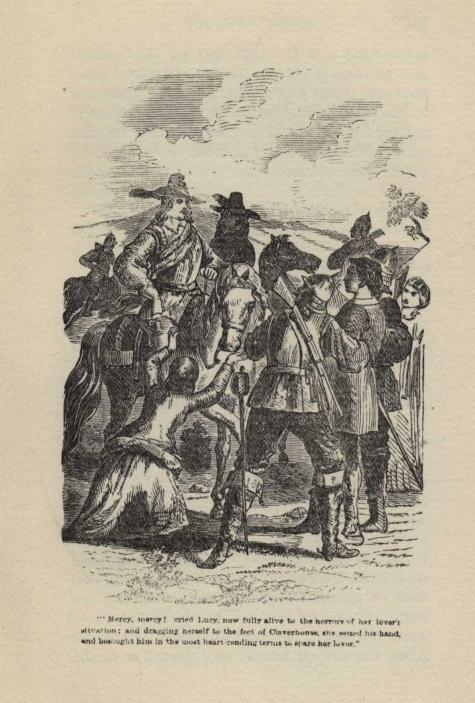
"Mercy, mercy!" cried Lucy, now fully alive to the horrors of her lover's situation; and dragging herself to the feet of Claverhouse, she seized his hand and besought him in the most heart-rending terms to spare her lover.
"Mercy, mercy!" cried Lucy, now fully alive to the horrors of her lover's situation; and dragging herself to the feet of Claverhouse, she seized his hand and besought him in the most heart-rending terms to spare her lover. "He will never more fight against the King," she said, "he was returning here to live in peace—oh let him go!"
With a calm, cold smile, Claverhouse withdrew his hand from her hold, and made a signal to his men to prepare their arms.
"Mother, mother!" shrieked Lucy, as Mrs. Armstrong, almost breathless from her exertions, reached the spot where she knelt, "kneel with me before these men. The sight of your grey hairs may move their hearts to compassion, and they may grant you the mercy they have denied me."
"William!" exclaimed Mrs. Armstrong in faltering accents, "what of my husband and son—where are they?"
Young Crosbie's lips trembled. He sadly shook his head. She was answered—both had fallen at Bothwell Bridge.
"Now may I indeed kneel—kneel in sorrow and in anguish, for I am bereaved!" And with these words the weeping widow threw herself on her knees, and with clasped hands and upturned eyes, besought pardon for the youth about to suffer.
"O!" she exclaimed, "if your hearts still retain one human feeling; if they are not yet wholly seared by the bloody scenes through which you have passed, hearken unto me this night. It is a heart-broken woman who addresses you—one who is sorrowful even unto death. Husband and son have fallen. The lover of my youth, and he who would have been the stay of mine old age, are taken from me; and yet, I trust, in the midst of my affliction, I can say, God's will, not mine, be done! Will not, then, the blood of two suffice you——?"
"Two!" shouted Sir Robert Grierson, "though you had lost twenty such rebellious knaves, what matters it to us? death to all such rascals!"
"Surely," continued the widow, regardless of the interruption, "you will feel for me, and grant my prayer. Kill not the prisoner. I have grown old and gray with affliction, and my time on earth may not be long; but my daughter is young in years, and her happiness is bound up in the life of this young man. O spare her the fearful trial of losing him—bring not down her youthful hairs with sorrow to the grave. Pardon him, I beseech you!"
Claverhouse sternly answered "No!" and impatiently waved his hand for them to be gone.
"Lucy, Lucy!" cried William Crosbie, "let not your mother kneel to these cold-blooded wretches! Do not debase yourself by imploring mercy from creatures who know it not. I can face death like a man. I do not fear it. Farewell, Lucy, we shall, I trust, meet in another and a better world where none can part us." Then bidding the soldiers do their worst, the brave youth uncovered his head, and stood prepared to receive the fatal fire. These last words, uttered in a louder tone, reached the ears of a young officer who stood at some little distance from his companions, as though unwilling to witness the bloody tragedy about to be enacted. He started on hearing the familiar voice; and coming hastily forward, gazed earnestly on the prisoner as he stood bold and erect before the dragoons. A flush passed over the officer's face, and advancing to the spot where Claverhouse stood conversing with Sir Robert Grierson, he requested to speak a few words with him in private. Claverhouse at once complied with the request; and withdrawing his horse a little apart from the others, a long and earnest conversation ensued. The conference seemed to terminate unfavourably, for a darker frown sat upon Claverhouse's brow, and his voice sounded harsh and cruel as he uttered these last words aloud—"I am sorry to refuse your request; but his life is forfeited by the laws of this land, and my conscience would for ever upbraid me should I fail in my duty to my king and my country." The red blood mantled on the cheeks of the supplicant; and he seemed about to make an angry reply, but instantly checking the impulse, he bowed his head, and then added carelessly, "As you please, Colonel; but since the poor fellow must suffer, have I your permission to exchange a few words with him ere he dies? I should like to tell him I have done what I could to procure his pardon, as I promised faithfully to save him."
"Most certainly!" said Claverhouse with a courtly smile, apparently well satisfied to get off with so small a concession. "Soldiers, down muskets! Lieutenant Musgrave wishes to speak with the prisoner."
At mention of the name, Lucy, who had been weeping passionately on her mother's shoulder, raised her head, a ray of hope animated her countenance, and she watched the young officer's movements in breathless anxiety—William Crosbie also looked disturbed and anxious. With a swaggering gait and careless mien, young Musgrave approached the prisoner, and taking him by the arm, led him some little distance apart, when he addressed him as follows:—"I have vainly endeavoured to procure your pardon. I vowed to save you; and my oath must be kept. Therefore listen to me. Accept this purse; you may stand in need of money, and when I say aloud farewell! dart off as quickly as you can in the direction of Crichup Linn. The darkness will favour your escape, and I will, if necessary, prevent the soldiers from following, until you are beyond their reach. Fear not for Lucy! I will protect her as though she were mine own sister. God bless you—farewell!" Scarcely had the word escaped Lieutenant Musgrave's lips, ere William Crosbie was speeding along the plain towards Crichup Linn; and so thoroughly was the whole party overwhelmed with astonishment at this unlooked-for proceeding on the part of the prisoner, that ere the soldiers could mount their horses and set off in pursuit, he was already lost in the gloom. With a cry of thankfulness Lucy fell down on her knees; but not to man she knelt. She was breathing a prayer of gratitude to Heaven for her lover's safety.
"Traitor!" shouted Claverhouse, his eyes sparkling with fury, "how dare you do this? By heavens! you shall answer for it, and that presently."
"When and where you please," said Lieutenant Musgrave haughtily; "you have yourself to blame for what I have done. I begged the young man's life. I told you this good woman and her daughter had sheltered me when wounded, and that William Crosbie had prevented my blood being shed by his companions. In return, I vowed I would protect him if ever he fell into your hands. You refused to listen to my petition. It was the first request I had ever made, and I told you it should be the last; but you scorned my entreaties, and now you have reaped the fruits of your cruel refusal. Disgusted by your cold-blooded murders,——"
"Ha! this insolence to your commanding officer? Consider yourself under arrest! Captain Lennox, relieve Lieutenant Musgrave of his sword."
"Never!" said young Musgrave; "here I resign my commission, and for ever abandon a cause characterised only by cruelty and oppression."