Front matter (continued 2)
Reading edition
The narrow space in which they were enclosed was scarcely of size sufficient to contain a hundred men, and yet nearly thrice that number were thrust in by their unfeeling jailors; men, regardless alike of the safety and misery of those entrusted to their care. Several of the poor fellows were so dreadfully ill, that their more robust companions were obliged to stand upright, in order to afford their sick companions room to stretch their tortured limbs. The prayers and entreaties addressed to the captain by the almost stifled prisoners that some of their party might be allowed to go upon deck, were for a long time unheeded, until at length he was obliged, from the continued indisposition of the men, to accede to their request. Accordingly, about fifty of the strongest were removed to upper deck, where they soon recovered from the sad effects of their late confinement. The weather hitherto had been favourable for their voyage, but soon a succession of fearful storms arose, and the ship seemed entirely at the mercy of the waves. On the tenth of December the crew found themselves lying off Orkney, a coast dreaded by sailors, on account of the stormy sea surrounding it. Perceiving for the first time the full extent of their danger, the captain, as the ship was already within reach of the shore, ordered the sailors to cast anchor, which being done, they awaited with impatience the abating of the storm. But towards evening the hurricane increased in intensity, and about ten o'clock at night the sea, lashed into fury by the terrific violence of the wind, forced the ill-fated ship from its anchor, and dashed it in twain on the rocks. Hearing the dreadful crash, the wretched prisoners, fearing shipwreck, implored to be put on shore, wherever the captain pleased, but their request was denied; and the sailors in terror and dismay tore down the mast, and laying it between the vessel and the rocks, prepared to save themselves from impending shipwreck. "My God," exclaimed William Telford, who was one of those placed upon deck, horrified on seeing that the crew made no attempts to open the hatches, which, chained and locked, confined the suffering inmates in a living tomb, "are you going to leave your prisoners thus?" At this instant a huge wave dashed over the ship, and overwhelming several of the men exposed to its fury in its fearful embrace, consigned them to a watery grave. "Men, fiends!" reiterated young Telford, making frantic efforts to break open the hatches as he spoke, "there will be a fearful reckoning to pay for this night's work." With shouts of derisive laughter, the sailors crossed the prostrate mast, and reached the shore in safety. Some of the poor fellows who imitated their example were thrown back by them into the sea, but about forty, in spite of all efforts made to destroy them, wore successful in their attempt.
Perceiving the imminent danger in remaining where he was, William Telford, having abandoned all hopes of freeing the prisoners, prepared to follow his companions along the mast. On his reaching the beach, one of the sailors strove to prevent his landing, but greatly his superior in strength and agility, young Telford seized the ruffian by the throat, and dashed him senseless on the ground. And now was accomplished one of the most fearful tragedies ever recorded in history. The storm at this moment seemed to have reached the climax of its fury; the thunder rolled, and the blue lightning danced around the sinking vessel, while foam crested waves rose mountains high, and then dashed with terrific violence over her yielding spars. But louder than the crash of the pealing thunder—far above the roaring of the mighty billows was heard the death-wail of the wretched prisoners, as they sunk beneath the heaving tallows; there to remain until that dread day when the murdered and their murderers shall stand before the great white throne—when the sea, at the command of its Creator, shall yield up the dead which have slept for ages in its mighty depths.
Months have elapsed since the fearful event we have just narrated took place, and Jeanie Irving is once more seated by her father's fireside, still pale and exhausted from the effects of her late severe illness. She has heard of the fatal shipwreck—she knows that her lover is no more, and has learned to say with resignation, "Not my will, but thine be done!" It is Sunday evening, and the grey-haired father is seated at the table with the Bible before him, from which he reads aloud words of joy and consolation. It is the fourteenth chapter of John, and Jeanie, her eyes filled with tears, is listening with breathless attention to the beautiful words of inspiration, when a low tap at the door arrests their attention. No answer is vouchsafed in return to the invitation to enter, but a quick step is heard in the passage, it approaches nearer, the door opens, and Jeanie Irving falls fainting into the arms of William Telford.
Now, added Mr. Anderson, at the conclusion of his story, you must not imagine, although I have dwelt at a considerable length on the sufferings causelessly inflicted on the Covenanters, that I altogether take their part, far from it; as I think in some instances they were much to blame. For instance, when they assembled together for the purpose of having divine worship, instead of going quietly and respectably with only their Bibles in their hands as beseemeth Christians, there they were armed with swords and guns, only too ready to use them should occasion require, that was entirely going against the doctrine of St. Paul, who says, "For though we walk in the flesh, we do not war after the flesh. (For the weapons of our warfare are not carnal, but mighty through God to the pulling down of strongholds.") Why, if we were to assemble in that way now-a-days, singing psalms of defiance in the glens, with fire-arms beside us, wouldn't the present government be down upon us in no time? and quite right too, say I; for I am quite of opinion they were as much to blame as the royalists, and if they could, would have been quite as cruel. Look, for instance, at the murder of Archbishop Sharpe, although there can be no doubt he was a cruel, relentless foe to their cause, yet they should have respected his grey hairs, and spared him at the request of his daughter. And, again, I do not believe all the stories told in the Scotch Worthies, such as that one of Peden and some of his friends being saved while on the moors, just at the moment the dragoons were coming down upon them, by his praying that a mist might surround them to the discomfiture of their enemies, and that instantly, on his ceasing to pray, they were enveloped in a fog. I do not mean to say that a mist did not conceal them from their enemies, but that it was chance, and not a miracle, as they pretended. For many a time, when on the heights myself, have I been overtaken by these fogs, which come down so suddenly that there is no escaping from them, and very disagreeable things they are when one is far removed from a house of any kind, and there is not light sufficient to guide one on one's way.
"Ay, ay," said Mrs. Anderson, addressing her husband, "but for all that ye say, Mr. Peden was a great prophet;" then turning towards me, she continued. "when I was a little girl I resided for some time wi' a farmer who lived on the celebrated farm of Wellwood, near Airdsmoss, and used to hear a great deal about Mr. Peden. You must know that he is buried at Cumnock. He was first interred in the Laird of Affleck's aisle (Auchenleck), a mile distant, but was lifted, as he predicted, by soldiers, and conveyed to the foot of Cumnock gallows, which stands near the village. That spot soon came to be used as the public burying-grouud, and, in my younger days, was a very pretty rustic graveyard. But it is said that before his death, Peden stated that after his second burial a thorn bush should grow at his head, and an ash tree at his feet; and when the branches of each met, there should be a bloody battle in Shankson wood (about a mile distant), where the blood would be up to the horse's bridles. The thorn did grow, and is there yet, I believe, and many slips have been taken from it by strangers, but the ash is said to have been pulled up ere it was large enough to touch the thorn, so the battle never took place. And I mind weel o' a strange epitaph that was on an ancient tomb-stone beside Peden's grave, which, if I remember rightly, was something like this:—'Here lies David Dun and Simon Paterson, who was shot in this place for their adherence to the word of God and the covenanting work of reformation, 1685,' (the black year.) There was also another stone, just in front of Peden's grave, but I forget the precise words; they ran, however, nearly as follows:—
'Halt, passengers, and I will tell to thee
For what and how I here did dee,
For always in my station.
Adhering to the work of reformation,
I was in on time of prayer
By Douglas (Colonel) shot;
O, cruelty, ne'er to be forgot.'
Now ye see," she continued, "there are no less than three poor men, there may be more for all that I mind o', lying in Cumnock burying-ground who were shot by the royalists, and I think, Willie," she said, again addressing her husband, "seeing that your own forefathers all fought in the good cause, you need'na say just sae much in favour o' their adversaries."
"Dear me," said Mr. Anderson, in reply to this rebuke, "I am not denying that there were many cruel actions done in these sad times, but I am just saying that I don't believe all the stories told in the Scots' Worthies: do you imagine for one moment that I can credit that one about open, open to the Duke o' Drumlanrig? No, nor any other sensible person."
"What one was that?" I inquired.
"Oh, just some idle tale not worth repeating——"
"Here it is; let the lady read it," interrupted Mrs. Anderson, taking as she spoke a book from the shelf, which, after cleansing off a vast accumulation of dust she handed to me, saying as she did so, "maybe it is true, and maybe it is no, but the like o' us canna pretend to ken onything about it."
After a little research, in which I was aided by Mrs. Anderson's directions, I at length came to the following:—"Concerning the death of the Duke of Drumlanrig alias Queensbury, we have this curious relation—that a young man, perfectly well acquainted with the Duke, (probably one of those he had formerly banished,) being now a sailor, and in foreign countries, while the ship was upon the coast of Naples or Sicily, near one of the burning mountains, one day espied a coach and six all in black going towards the mount with great velocity; when it passed them they were so near that they could perceive the dimensions and features of one that sat in it.
"The young man said to the others, 'If I could believe my own eyes, or if ever I saw one like another, I would say, that is the Duke.' In an instant they heard an audible voice echo from the mount, 'Open to the Duke of Drumlanrig!' upon which the coach, now near the mount, evanished.
"The young man took pen and paper, and marked down the month, day, and hour of the apparition; and upon his return, found it exactly answer the day and hour the Duke died."
THE LAIRD OF CULZEAN.
"I think," said Mrs. Anderson, as she carefully restored the Scots' Worthies to its late position on the book-shelf, "that whoever got the disposal of the souls and bodies of these persecutors after their death seems to have treated them wi' a' the respect becoming their high station in this world, for it was always coaches and six, and coaches and four that came for them. You see, it was a coach and six that came for the Duke o' Drumlanrig, and there was the Laird of Culzean, a wickeder old fellow never lived, and just the same kind o' thing occurred at the time o' his death."
"Tush, nonsense, wife," interrupted Mr. Anderson.
"But it's no nonsense," rejoined the dame, "for my forefathers lived a long time near Culzean Castle, and many and many a time have they told me when a child of what was seen the night the Laird died; and as the lady seems to wish to hear all she can about these things, I'll just give her the account given me by my grandfather, who was as decent an old man as ever lived, though I say it that shouldna' say it."
Having expressed the pleasure I should feel in listening to her story, Mrs. Anderson put away her sewing, and, resting her arms comfortably on her knees, related the following wild tale, which, illustrating as it does the strange superstitions of the times in which these men lived, I here render as nearly as possible in the words of the narrator:—
The old Castle of Culzean, standing as it does on a rock rising two or three hundred feet above the level of the sea, is probably one of the finest marine seats in the kingdom. At the foot of the rock on which the castle stands, there are some romantic caves, more familiarly known as the "Fairy coves of Culzean." Many and many a night have I played about there, when the setting sun caused the dancing waves to glitter like gold, as they rippled over the pebbled beach towards the entrance to the caves. It was said that King Robert Bruce and his followers took refuge there, after landing from Arran, until all was in readiness for their enterprise. They are also particularly mentioned by Burns in his well-known "Hallowe'en." But still, for all that they were so beautiful, there were few o' the country people that cared to venture near them after it was dark, on account of the many strange things that were said to have been done there during the time of the wicked Laird of Culzean. Ay, but it was he that was the cruel man! It would make the very hairs on your head stand on end could ye but hear tell of all the cruelties he practised towards the Covenanters, while permitted to remain on earth. Oh, dearie me, how people in these days could dare to ask the Almighty's blessing on their dark deeds beats my comprehension altogether; but now to begin wi' my tale:—In the parish of Kirkmichael there lived an aged widow, called Mrs. M'Adam, who had an only son named Gilbert; and a nice quiet young man he was, and greatly beloved of his mother, for she was a lone woman, and had no one in the world to look to but him; and well did he repay her affection, poor lad, for there was nothing he thought too good for his mother. When these dreadful religious disturbances broke out, like many other young men who were at all given to think seriously about their spiritual welfare, Gilbert M'Adam was a Covenanter; but he did not join the body, as numbers did, merely for diversion, or from a hatred to the higher authorities, but simply from a sincere belief in the soundness of their doctrine and sympathy for their wrongs. His mother was also o' that way o' thinking, and, being a godly living person, she was greatly respected in the neighbourhood where she resided. Well, one wild stormy night, as Mrs. M'Adam and her son were seated by the side of the kitchen fire, the door opened and in entered their minister, a most worthy man, who had been forced, like many others, to leave his church, and wander up and down the country, teaching and ministering to the spiritual wants of his people whenever an opportunity presented itself. Greeting them with the blessing of peace, Mr. Weir—I think that was the minister's name—proceeded to encumber himself of his dripping cloak, while Gilbert flew to place a chair for him near the blazing hearth, and Mrs. M'Adam proceeded to put on the table the best her store afforded, to succour her esteemed guest. After having partaken of the eatables set before him, Mr. Weir informed his kind entertainers that he intended holding a prayer meeting on the following morning, in a retired glen near Kirkmichael, where he expected a numerous attendance, as the inhabitants of the surrounding districts had been apprized of his intention, and expressed great joy at the intelligence, as they had lately been like sheep without a shepherd. In reply to some anxious inquiries on the part of Mrs. M'Adam, regarding the aspect of affairs throughout the country. Mr. Weir informed her that as yet the hand of the smiter was not stayed, but rather on the contrary, as their persecutors seemed more than ever zealous in their bloody work; and that, in the course of his wanderings in Dumfriesshire, many cruel murders had come under his knowledge, two of which, from the melancholy circumstances attending them, had made an indelible impression on his mind. At the request of Mrs. M'Adam, Mr. Weir related the following:—
"Late one evening, during the month of last February, while an aged woman of the name of Martin, who resides in the parish of Barr, was sitting by her hearth conversing with her son David, and a young man named Edward Kyan, who had but recently come from Galloway, a party of dragoons, under the command of Lieutenant Douglas, surrounded the house. Kyan, on being made aware of their approach, leaped through a side window, and took refuge behind the wall of the cottage. But his retreat being discovered by the soldiers, they dragged him forth into an adjoining yard. After being asked where he lived, without any further questions, or even being allowed to prepare for eternity, the said lieutenant shot him through the head, and then discharging his other pistol, shot him again as he lay on the ground quivering in the agonies of death. Not contented with this, one of the dragoons, pretending he was still alive, shot him again. After having glutted their vengeance on this unfortunate youth—whose only crime was that of concealing himself—the dragoons rushed into the house, and, bringing forth David Martin, tore off his coat, and placed him beside the mangled body of his friend. One of the soldiers more compassionate than the others, and moved at the sight of the mother's tears, besought his officer to spare him another day, and stepped in between the kneeling man and his executioners, who stood with their pieces levelled, awaiting the signal of destruction. After much entreaty, the lieutenant was prevailed upon to spare his life; but so great was the terror of the poor man, that he lost his reason, and is now a helpless bed-ridden maniac. And now," continued Mr. Weir, "the other sad affair I am about to relate—the particulars of which came under my own observation—will serve, in some measure, to enlighten you as to the manner in which these cruel men perform their bloody work:—
"In the course of the same month, I went with a friend, in whose house I was then staying, to attend communion service in a secluded part of the parish of Irongray. The morning was cold and damp, and a dull leaden mist overshadowed the landscape, as if nature had donned her saddest garments on this melancholy occasion—still the meeting was numerously attended. It was indeed an impressive sight to witness these poor people—many of whom seemed overcome with fatigue from the distance they had travelled—assembled on this sequestered heath, to hear the word of God, and partake of his blessed ordinance.
"The service had just commenced, when the sentinels stationed on the heights gave notice that a party of dragoons were approaching.
"On receipt of this warning, the meeting instantly dispersed. Some fled towards the banks of the Cairn, and others towards the moor of Lochen-Kit, in the parish of Uir. Here the six poor men who suffered on this occasion were captured by their pursuers. Four of them were shot dead on the spot. The other two, whose names were Alexander M'Cubbin, of the parish of Glencairn, and Edward Gordon, from Galloway, were taken by the captain to the bridge of Orr, where the Laird of Lag was busily employed in carrying on the work of persecution. Immediately on their arrival, Lag wished to pass sentence of death upon them, because they refused to swear; but the captain insisted that, as four of them had been summarily despatched, an assize should be called to judge and condemn them. Lag swore fiercely that he should call no assizes, still the captain got the matter deferred till another day. On the following morning they were conveyed to the parish of Irongray, by Lag and his party, and hanged on an oak tree near the church of Irongray, at the foot of which they lie interred. When about to suffer death, an acquaintance of M'Cubin's inquired of him if he had any message to send to his wife, upon which he answered, that he commended her and his two children to the care of a merciful God; and, having bestowed his forgiveness on the person employed to hang him, he, with his companion, suffered death with much cheerfulness.
"Immediately on the departure of the soldiers, the bodies of these martyrs received Christian burial, and a simple stone was erected on the solitary heath to mark the spot where they fell."[#]
[#] Epitaph upon a stone in a moor near Lochon-Kit, on the grave of John Gordon, William Stuart, William Heron, and John Wallace, shot by Captain Bruce:—
"Behold here in this Wilderness we lie, Four Witnesses of hellish cruelty. Our eyes and blood could not their ire assuage But when we're dead they did against us rage, That match the like we think ye scarcely can; Except the Turks, or Duke de Alva's men."
Epitaph on the grave-stone lying on Edward Gordon, and Alexander M'Cubin, executed at the Church of Irongray, at the command of the laird of Lag and Captain Bruce:—
"As Lag and bloody Bruce command, We were hung up by hellish hand, And thus their furious rage to stay, We died at Kirk of Irongray. Here now in peace sweet rest we take, Once murder'd for religion's sake."
"Puir murdered things," sobbed forth Mrs. M'Adam at the close of the minister's narration, raising her handkerchief to her eyes as she spoke. "Oh dear, dear! is'na it sad to think that religion, whilk ought to make men sae peaceful and godly in their lives, should, in many cases, just hae the contrary effect. See now at the present time, a' men are set by the ears, and what is it all about?—a mere trifle—just a difference o' opinion. How true are the words of Him that knew all things, 'I am come not to bring peace on earth, but a sword!'"
"Yes," was the reply, "but I am afraid religion is often made a cloak to cover bitter feelings engendered by party strife. No one possessing the meek Christian feeling of brotherly love and charity towards all men, could thus wantonly imbrue his hands in the blood of a fellow-creature."
"'Deed no, Mr. Weir, you say very true; they are no' the richt sort o' Christians who delight in bloodshed and warfare; a wheen apostates are they; wolves in sheep's clothing, whom we are expressly warned against——"
Here Gilbert, who knew from experience that whenever his mother got upon these topics she could continue, without pausing to draw her breath, until pretty near midnight, suggested to her the propriety of Mr. Weir retiring early to rest, as he would need to rise betimes in the following morning. The worthy minister, homeless and ill-provided for as he was, accepted with gratitude the humble accommodation offered to him by the poor but hospitable widow, and shortly afterwards withdrew to his sleeping apartment. By the early hour of six o'clock, Mr. Weir, accompanied by Mrs. M'Adam and her son, was on his way to the place of meeting. The morning was fine, and a numerous concourse of people, many of whom had come from a great distance, were assembled to hear their beloved Clergyman. The incense of praise had been offered up, and Mr. Weir was about to commence his sermon, when a party of soldiers appeared in sight. These proved to be a body of militia, under the command of Sir Archibald Kennedy of Culzean, then scouring the country in search of prey. Mr. Weir on perceiving their approach, closed his Bible, and exhorting his hearers to remain quietly in their seats, went forward to meet the hostile band.
"Why come ye thus to interrupt us in our devotions?" he inquired, when the rapid advance of the soldiers brought them within hearing.
"You shall soon see that, you old canting hypocrite," thundered forth Sir Archibald Kennedy in his fiercest tones. "I'll teach you to come here with your psalm-singing, dismal faced companions. Come, be off with you, or I will this instant send a brace of bullets through that thick head-piece of yours!"
"Not at thy command, thou man of Belial," said Mr. Weir, "shall I abandon my post in the hour of danger! These are the souls the Lord hath committed to my charge, and woe be unto me or any other of my brethren who shall neglect their sacred trust——"
"Cease your prating, you old dotard: soldiers, do your duty;" so saying, the fiery leader wheeled his horse round, and stood with his back purposely placed towards Mr. Weir, who, seizing him by the arm, exclaimed, "Do unto me even as ye list, but let these go their way. Oh, slay them not!"
"Men, do your duty!" was the only answer vouchsafed to this request; and Sir Archibald Kennedy, as if to set an example to his followers, drew his sword from its scabbard, and advanced towards the Covenanters, who, in accordance with their minister's wishes, had remained quietly seated, awaiting the issue in breathless suspense.
"Fly, my children, fly!" cried Mr. Weir, perceiving that offensive measures were about to be taken by the soldiers. "Oh God! it is too late," he exclaimed, as the blood-thirsty men rushed eagerly on the helpless group; and covering his face with his hands, to shut out the bloody scene about to ensue, he remained for a few moments motionless as a statue, while his lips moved, as though he was engaged in prayer.
In the meantime, Gilbert M'Adam, armed with a stout walking-stick, prepared to defend his aged mother, who clung to his arm in an agony of terror; but just as he raised it to ward off a blow from the butt-end of a musket, it was stricken from his grasp, and he was left at the mercy of his foe. Fortunately for his safety, a man stationed near him that instant darted on the soldier, and wrenched the gun out of his hand, which went off in the struggle, wounding a woman standing near the combatants. Perceiving the folly of attempting self-defence, Gilbert M'Adam seized his mother in his arms, and, making his way out of the affray, ran hastily towards a hill, situated a little way off. He had gained the foot of the eminence, when the clatter of a horse's feet behind them causing the young man to turn round, a pistol bullet, discharged by the advancing horseman, entered his brain, and Gilbert M'Adam fell dead at his mother's feet. With a loud laugh of insolent triumph, Sir Archibald Kennedy—for it was he who fired the deadly shot—was about to return to the scene of action, when, with a scream that in its agony resembled nothing earthly, the frenzied mother, with a strength almost supernatural, seized the horse's bridle, and compelled him to remain stationary, while she burst forth thus:—
"Hence to your stronghold, you cruel bird of prey! Back to your proud towers, ye accursed of the Lord! but think not, in the pride of your heart, that this day's work will pass unavenged, for a day of retribution awaits you. In the silence of the night, when the meanest hind in the land is locked in slumber, shall a mother's curse ring in your ears till ye madden at the thought. From this day henceforward life shall be a burden to you: then—then, when the hour of death approaches, shall your horrors be redoubled ten-fold. No priest will be able to quench the ceaseless flames which burn in your bosom, and no words of affection soothe your dying pillow; for the torments of a lost soul will be yours, and in your last moments let the thoughts of this day's work add another drop to your cup of misery."
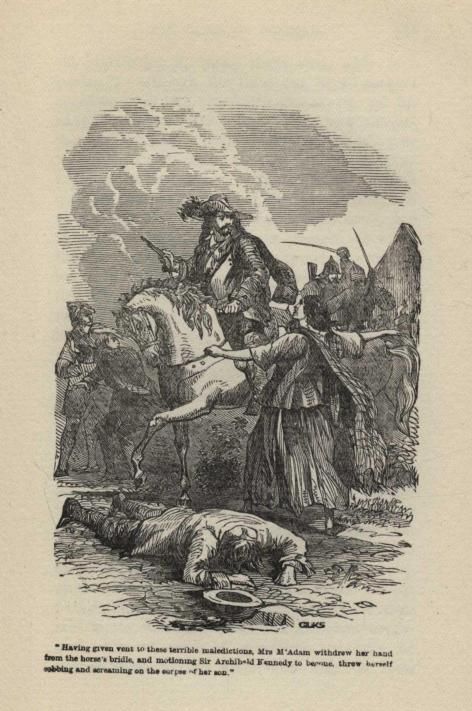
"Having given vent to these terrible maledictions, Mrs M'Adam withdrew her hand from the horse's bridle, and motioning Sir Archbald Kennedy to begone, threw himself sobbing and screaming on the corpse of her son."
Having given vent to these terrible maledictions, Mrs. M'Adam withdrew her hand from the horse's bridle, and motioning Sir Archibald Kennedy to begone, threw herself sobbing and screaming on the corpse of her son. It was noticed by many then present that Sir Archibald looked scared and discomposed on his return to join his men; and that, contrary to his general mode of acting, he contented himself with taking a few prisoners, and rode off at a much slower and more thoughtful pace, than was his wont. Well, the persecuting work went on with unabated zeal, and Sir Archibald Kennedy, or, as he was more commonly styled, the Laird o' Culzean, was a noted man among them all. Wherever blood was to be shed, there was the Laird, grim and dark, wi' the marks o' an evil conscience on his face. (Some people said that the older he got, the more crimes he committed, just to drown his remorse for some cruel deeds he had done in his youth; but if that was the case, it was a queer way he took to do it, for as the old proverb has it, "every single stick adds to a burden.") Although the Laird was, to all outward appearances, as bold and daring like as ever, yet the servants about the house said it was a very different thing wi' him when alone; for many and many a time in the long winter nights, did they see him pacing up and down his hall, as if he would fain, by the loudness of his step, drown the voice of conscience within; and often, when the wind rose louder than usual, and moaned and shrieked through the passages, he would start hastily from his seat and demand in a furious tone what woman it was who dared to scream so within the walls o' Culzean Castle. These are the kind o' things his servants told about him, so my grandfather said; but whether they were true or false, I canna pretend to say. Well, time rolled on, and the decree was sent forth that the wicked Laird o' Culzean must prepare to meet his Maker—a summons which the now aged persecutor seemed in no way anxious to obey, for them that were near him declared that he threatened to knock off the doctors' heads, because they couldna promise him that he should get better. The people who went about his room at that time, recalled to mind the curse of the bereaved widow, for, somehow or another, the story had got about, and many wondered when it came to the push, how the Laird would meet his end. Sir Archibald, as Mrs. M'Adam prophesied, seemed in his last moments to derive comfort from nothing. In vain the physicians exercised their skill to the utmost; in vain the attendant clergymen whispered words of consolation and hope, he scorned them all, and drove them from the room because they could not quench the flames which burned in his breast. (You see the widow's curse was beginning to work.) As the hour of death approached his agony was fearful. The drops of perspiration stood like beads on his brow; and his eyes which seemed like to start from their sockets wi' mortal agony, were fixed wi' a horrible stare on the foot o' his bed. Some who were present at that time said they were convinced that something, not meant for other e'en to see, was standing there, for every now and again he pointed wi' his finger and laughed; but the laugh was like that o' ane in despair. At length he died, and the night o' his death was one of the most fearful that ever occurred in the memory of man. The wind roared round the castle wi' a force that threathened to lay it in ruins; while the thunder rolled, and the lightning flashed in a manner awful to witness. The servants always maintained that the powers of darkness were let loose that night; for at the moment the Laird died, such shrieks of laughter, mingled with wild screams of agony, rang through the whole house, that overwhelmed with fear, they fell on their knees and prayed for protection against the horrors which surrounded them. Then came the day of his funeral; and, by all accounts, sair, sair work they had to get the hearse from the door. First there were four white horses put to the bier; but no sooner were they yoked-to, than one of them fell dead on the spot, and the others kicked and plunged so, they had to be taken out. Then four black ones were put in their place; but still they wadna go, until the coffin was taken from the hearse, and the priest muttered some prayers over it. Then, when they had proceeded a few steps wi' their burden, a dreadful tempest of thunder arose to the terror and amazement of all present—many of whom talked of returning; but the storm having now ceased, they were dissuaded from doing so. However, on nearing the place of interment, it again burst forth in such a fearful manner that the flashes of fire seemed to run along the coffin. Owing to the extreme lightness of the bier after this terrific outburst of the elements, it was conjectured, either that the body had been consumed by the lightning, or that it had been taken away by the master whom the Laird served so well while on earth, from among their hands, ere ever they got to the church-yard.
But now I must tell you o' what took place on the night o' the Laird's death, to the great horror of a ship's crew who chanced to be at sea. Just as they were sailing past the coves of Culzean, the fearful tempest, I mentioned before, arose, and the ship was tossed by the waves in such a manner, that the sailors gave themselves up for lost. Well, in the very midst of this awful turmoil o' the elements, when even the mightiest vessel was in danger of perishing, the man at the helm cried aloud, "a boat, a boat!"
"Nonsense," replied the Captain, "what boat could live in a night like this?"
Just as they were speaking, a fearful flash of lightning lit up the darkness, thereby permitting the terror-stricken crew to perceive a coach and four coming along the sea. Again the blue lightning flew down the mast, while onward pranced the horses, whose black plumes waved, as the ghastly-looking driver urged them onwards. The hair of each individual sailor stood on end as he gazed on the appalling sight; when, just as they were passing the side of the vessel, the Captain hailed the spectral-looking coachman with, "From whence to were?"
And the answer was, "From h—ll to Culzean's burial!"
"Well done," said Mr. Anderson, at the close of this harrowing narration; "this is indeed a most probable story, and quite in keeping with 'open, open to the Duke of Drumlanrig.' Surely," he added more seriously, "you do not believe any such nonsense?"
"Never you mind whether I do or not," replied Mrs. Anderson, evidently enjoying her husband's look of astonishment; "but just go your ways to that small drawer on the left there, and bring me the little box tied round wi' red tape, which you will find in the farthest back corner."
Mr. Anderson, in obedience to his wife's request, proceeded to the drawer, and in a few seconds placed in her hands the wished-for article.
After fumbling for a short space of time amongst its varied contents, Mrs. Anderson succeeded in fishing out, from its mysterious depths, a sheet of paper carefully folded up, which she opened and placed in my hands, saying, "there now, that was written by a friend of mine while studying at the College of Edinburgh." Glancing my eyes over the verses, I perceived that they bore immediate reference to the legend Mrs. A. had just been narrating, and so wrote them down, as an appropriate finish to the Legend of Culzean:—
THE LAIRD OF CULZEAN.
Around Culzean Castle the wild winds did howl,
And the trees bent like leaves to the blast;
Whilst the heavens looked black with an angry scowl,
The wild clouds were careering on fast.
Dark, dark was that night, and yet darker the hour
When Culzean's lord did yield up his breath;
You'd have thought that the fiends of hell had power
To preside o'er the wizard's death!
The thunder roll'd loud, while the lightning flashed,
And by tempest the Castle was shook;
Wild shrieks of despair echo'd loud in the blast,
And from fear none dared upward to look.
The dying man toss'd, and oft did he turn,
But for him was no rest or sleep;
Fierce flames of remorse in his breast did burn,
And his curses were loud and deep.
When reverend fathers sought to cheer,
And smooth down the way to heaven,
He mocked them all with a taunt and jeer;
They from the room were driven.
He died—though for him the black banner wav'd
And nodded the sable plume;
By no rich nor poor was a blessing craved
For him who that night met his doom.
* * * * *
The wild winds rag'd and the lightnings flashed,
While the sea ran mountains high;
And the good ship's crew all stood aghast
As they gaz'd on the stormy sky.
"Haste haste, my men," the bold Captain cried,
"Haste, haste! make no delay!
We'll bravely steer through the foaming tide,
And trust in God our stay."
The death lights do burn this night in Culzean,
The old lord is dead at last;
And the powers of darkness are there I ween.
Careering on the blast!
With a crash the thunder o'er them peal'd,
And its harsh and sullen roar;
Though to fear the sailors hearts were steel'd,
Caus'd them tremble more and more.
"A boat! a boat!" the steersman cried,
"I see by the flashes bright."
"NO BOAT," the Captain quick replied,
"Could live on this awful night!"
Then the heavens burst, and a flood of light
Lit up all with its ghastly glare;
And the ship's crew gaz'd on a fearful sight,
For a funeral train was there!
Four coal-black horses drew each coach,
And they pranced upon the sea;
As each driver caus'd them swift approach,
What a ghastly look had he!
Soon as they reach'd the vessel's side,
That awful train funereal,
"FROM WHENCE—to where?" the Captain cried
"From H—ll to Culzean's burial!"
PEDEN'S STONE.
Having been informed that a stone, familiarly known throughout the country as "Peden's Stone," from the fact that that prime favourite of the Scottish peasantry used there to delight his hearers with his eloquence, was still to be seen on the moor, I determined upon paying a visit to this sequestered spot. It was on a lovely morning in the month of September that I started on my expedition. The sun was shining brightly, and the air was of that exhilarating nature which blends the softness of summer with the least possible tinge of autumn coolness. The Robin red-breast, sole remaining songster of the grove, poured its gushing notes of melody from hedge-row and tree, while, with each motion of the breeze, the now yellow leaves fell trembling on my path.
The reapers, in many places, were yet busy in the fields—the harvest being generally late in this part of Scotland—and their merry bursts of laughter sounded gaily from amid the fields of waving corn. My way again lay through H—— village, near the entrance of which, on precisely the same spot as formerly, stood the previously mentioned pleasant-looking dame, but not alone. Two little olive branches clung for protection to the parent stem, in a manner beautiful to witness. I could not resist a smile as my quondam acquaintance came forward with outstretched hand, exclaiming, while a broad laugh sat upon her honest features, "Losh me, isn't it funny we twa should always foregather on the same bit?"
"Indeed it is!" was the reply.
"And you are still gaun about here?"
"Yes; and picking up all the information I can get about the Covenanters."
"Oh, mam!" was the pathetic response, "had my brother only been living!—but that's by; eh sirs me, but that makes an unco difference wi' us a'! And where may ye be gaun the day?"
"To visit Peden's Stone; likewise to call on a Mr. Brown, who, I understand, is able to give me some information regarding it."
"Peden's Stone," re-echoed Mrs. Black—such she afterwards informed me was her designation—"a weel, mam, it's just up by there, an' a solitary bit it is. Many a one has gone to visit Peden's Stone. There's my daughter; a few weeks ago she was spending the day with some friends that live near there, and they took her away to see it. On her return home, she says to me, 'Oh, mother! just to think o' my being twenty years old, and never to have been at Peden's Stone afore.' 'Hoots, lassie!' says I, 'I'm a hantle mair than that, and I have never seen it! ha, ha, ha!' And so you're going to Sandy Brown's to get information; weel I'll no say but he'll be able to tell you something canny, for folks say that he speaks like ony minister. Aweel, aweel, I mind the day when I could have told you lots o' stories mysel'; but that's a' by! And you're rale ta'en up about the Covenanters, are you?" demanded the loquacious dame, and, without waiting for an answer, away she went on. "Ay, weel, so was I at ae time o' my life; for when I was at the sewing-school in Strathaven, I was rale anxious to see Loudon hill—may be you'll ken Loudon hill, where the battle o' Drumclog was fought? Ay, I thought sae; it's a queer-looking place, I fancy, and I was many a time going to see it, but I never could win, and the time just gaed by. Losh me, but there was a curious story told about that hill—a most ex-tre-orner thing indeed; for, when I was at the sewing-school, many and many a time ha'e I heard tell o' a heap o' siller being buried there; and when any person went to dig it up, an awful voice ahint them cried—'Clog's in a low!' and on their turning round to see what was wrong, the sight o' a great bull rushing at them gar'd them rin, and the hole instantly closed, so that they couldna win at it again. But maybe you'll think that's a lee; and I wadna say but it is."
"Is it true," I inquired, "that your brother, who lives near here, has a sword that belonged to Captain Paton?"
"He has that, he has that! but stop noo, I'm foolish to say sae"—here Mrs. Black put her finger into her mouth and appeared to reflect a little—"Did you say Captain Paton?"
"Yes."
"Weel, I'm no sae sure about that; but I ken brawly he has an 'Andrew Ferrara' that belonged to some o' thae fechting folk. However, ye should just gang and ask him about it, he'll be blythe to see ye, and I'll show ye a heap o' curiosities, for he is rale ta'en up about auld-fashioned things. And ye can just say I sent ye."
Thanking Mrs. Black for her instructions, I proceeded towards the house indicated, and Mr. Graham being within, I was ushered into a room, where a huge sword lay upon the table. From its appearance, I should have judged it rather to be a relic of the forty-five than of the days of persecution. Mr. Graham, in answer to my inquiries, stated that it was said to have been one of Captain Paton's swords, but that he could not give me any true account of it, as it had formerly belonged to his brother, and at his death came into the hands of its present possessor. Amongst other curiosities, Mr. G. produced two coins of the reign of David the First, which had been found with a great many more at the foot of a hill, about a mile or two on the moor at the back of his house. The tradition told concerning them in the neighbourhood is, that a man, whose Christian name was Tom, while returning at that remote period of time from a marriage party, missed his footing, and fell over a quarry which lay in his path, and was killed on the spot, the money falling out of his pocket during his too rapid descent. In consequence of this sad disaster, the spot is known as "Tam's leap" to this day.
While speaking about the persecuting times Mr. Graham informed me that a particular part of the moor was known by the name of the "Headless Cross," and that the circumstance which gave rise to its singular designation was this:—A persecutor of that name, who had rendered himself particularly obnoxious to the Covenanting party, on account of his many cruelties, took refuge from their anger in this part of the moor. The Covenanters, having been apprised of his whereabouts, set off instantly in pursuit of their intended victim. On arriving at the place where they expected to find their enemy, their astonishment may be conceived on seeing him without his head! It appeared that the unfortunate man had fallen into the hands of another hostile party, who, depriving him of his head, rendered him in truth a "Headless Cross." A large stone, likewise on the moor, familiarly known as "Pack Stone," was said to have been thrown down there by the celebrated wizard, Michael Scott, when in4 company with his Satanic majesty. These worthies, it is believed, were employed in carrying stones suitable for the erection of a bridge over the Firth of Forth. During this benevolent employment, a dispute took place between them—words ran high; and Michael Scott, in a fit of rage, threw down the stone then borne on his back, declaring that not one foot further should he carry it. How the quarrel ended is not related; but the stone, which is of an immense size, still remains in confirmation of the truth of this legend. The most probable version of the story is, that there the wearied pedlar used to rest with his pack while journeying between Glasgow and Edinburgh, as the wheel tracts of the old Glasgow Road are still visible near the spot.
After a minute inspection of Mr. Graham's little museum, I set off to visit Mr. Brown. The farm towards which I directed my steps was prettily situated near a "gleaming wood," the trees of which, now clad in autumn's russet brown, peacefully waved over the cottage roof, before the grateful breeze, as it sped along the moor on its trackless way; while a few plants of Indian cress, trained up against the wall evinced a greater predilection for neatness than is generally to be seen in the farm-houses of Scotland. A cleanly-dressed, pleasant-looking woman—whom I afterwards ascertained to be Mrs. Brown—was standing near the entrance; and on my inquiring if Mr. Brown was within, she invited me to take a seat, as he was in the fields, and should be in presently. Availing myself of the kind invitation, I entered, and taking possession of the proffered chair, I amused myself with inspecting the cottage interior, until the arrival of Mr. Brown. It presented the nicest little picture of a moorland farm I had ever seen. Rows of nicely-cleaned dishes, bright pewter plates, and spotless chairs, all indicated the careful housewife.
In a few minutes Mr. Brown entered; and on my informing him of the nature of my visit, he said, with a smile, that he did know a little regarding these times, and should only be too happy were it in his power to give me any information that might chance to be of service. This was encouraging, so I at once began the conversation by remarking, "that this seemed to have been a great part of the country for the Covenanters in former times." Upon which he replied that it was, more particularly the west end of the parish, where Peden and Cargill used to preach, adding, "I suppose you have seen Peden's Stone?" On my informing him that I was then on my way to visit it, he said it was not above a mile distant.
On my inquiring if there had been many conventicles held about there, Mr. Brown informed me of several, more particularly mentioning one held near Bathgate, where a Mr. Riddel officiated. There was a large assemblage present, and just as they were in the middle of their devotions the cry arose that the dragoons were upon them. The soldiers, however, not making their appearance, the Covenanters thought it had been a false alarm, and continued their religious exercises in fancied security. Scarcely had a few minutes elapsed ere a large party of red-coats, under the command of Lieutenant Inglis, then stationed at Mid-Calder, galloped swiftly up to the place of meeting. On perceiving their approach, many of the Covenanters fled through a moss where no horse could follow. But not to be outwitted, the soldiers remained on the opposite side, and fired promiscuously amongst the helpless group, thereby wounding many. One of their bullets pierced the head of an heritor in the parish of Bathgate, named John Davie, and killed him on the spot. Then they carried a great many men and women as prisoners, with an immense quantity of booty, back with them to Mid-Calder, the same as if they had been attacking a foreign enemy, and not men born on British soil.
"Oh, dear me! but the Covenanters were hardly used in these times—were they not, mam?" inquired Mrs. Brown, appealing directly to me, "for you see, a very great number of those who suffered were poor bits o' innocent creatures who had neither the power nor the inclination to do harm to any one. And the power with which Dalziel, Claverhouse, and many others of these cruel men were invested was really dreadful. No person was safe while in their hands. There are men who think that some of the Covenanters were too strict in their opinions, still, as I have often read, it was then that Scotland earned for herself a distinguished name; for at the King's return, every parish had a minister, every village had a school, every family almost had a Bible, and all children of age could read. Now, that was just as it should be."
"I fancy you will have heard all about the murder of Kennoway and Stuart, two of the lifeguard's-men, at Swine Abbey, just down by yonder?" inquired Mr. Brown, at the conclusion of his wife's remarks.
I replied "that I had heard it slightly mentioned, and should be very glad to hear a more lengthened account of the affair," upon which he commenced thus:—
"About Stuart very little or nothing is known, but Kennoway was universally detested on account of his horrid cruelties and shameless exactions from poor people who could but ill afford to pay his unjust demands. Kennoway had displayed great activity under General Dalziel at Pentland, and he it was who captured that zealous preacher Hugh M'Kail, who was executed at the cross of Edinburgh in the twenty-sixth year of his age. He likewise surprised numerous conventicles, and treated the Covenanters with great barbarity. On one occasion he attacked a party of unarmed people who were quietly hearing sermon in a field near East-Calder, and shot one through the leg, beating and robbing several others. At the meeting which took place near Bathgate, his was the hand that shot John Davie; in short, so zealous did he show himself in the cause of persecution that the government showed him great favour, and gave him several commissions to execute. Each day he scoured the country in search of prey, and those unfortunate enough to fell into his hands were treated with such brutality that several people went into Edinburgh to complain to the General of his cruelty. On receipt of a letter from his superior officer threatening him with punishment for his illegal acts, he forced an aged man, whom he had abused most shamefully, under pain of death, to sign a paper, stating that Thomas Kennoway had never injured him in any way whatever. Being greatly addicted to liquor, he would remain for days at the public-house, called Swine Abbey, indulging his evil propensity until all the money he had was spent. On one occasion having imbibed more than he had money to pay for, and the landlord pressing him for a settlement, he went out to the road, along which an old man was coming with a heavy load of oats on his back. Kennoway at once seized on the bag, and threatening the bearer with all manner of punishments if he dared to look after his property, returned to Swine Abbey, and discharged his bill with part of the proceeds, reserving the remainder for the further indulgence of his favourite vice. In the month of November he went into Edinburgh, from whence he returned bearing with him a roll which contained the names of one hundred and fifty persons he was commissioned to apprehend. On alighting at Livingstone he encountered his ill-fated companion, Stuart, to whom he displayed the roll, boasting that in a few days he should be as rich as any laird in the country. On their way to Swine Abbey, he pointed out to Stuart the lands he meant to possess. Arriving there, they commenced drinking, and continued doing so until pretty near the end of the month, when they were killed one night as they were leaving the house. Some thought they had been slain in self-defence, but it was generally supposed that, roused to madness by the continued persecutions of Kennoway, a party of people in the neighbourhood had planned his destruction. So violent were many of the blows exchanged on this occasion that the stone above the door was almost cleft in twain. I have heard it said," continued Mr. Brown, "that one or two persons suspected of having had a hand in the murder were openly rebuked by others of the Covenanting body, for thus having sent a man laden with such crimes into the presence of his Maker without one moment's warning, when long years of penitence would scarce suffice to atone for the evil he had wrought."
"It was a cruel deed," I said in reply to Mr. Brown's inquiry as to what I thought of the affair, "and one of those blameable acts on the part of some of the Covenanters which made their enemies say that a suitable opportunity would have found them only too ready to shed blood."
"Oh, no," was the reply; "that would never have been the case! The thoughts of the Covenanters did not dwell much on the shedding of blood; but rather on the restoration of their rights. No doubt, as there are good and bad in every class, so the Covenanters were not exempted from the rest in this respect; but had amongst them men who thought it no sin to pour forth the blood of the wicked. But still, as a whole, they were a harmless suffering body of Christians."
"Don't you think, mam," said Mrs. Brown, "that some of the clergy did not conduct themselves altogether with the meek Christian spirit becoming their high vocation? for I have often heard it said that, had they evinced a more forbearing disposition towards those—whose only fault consisted in their preferring to hear their own ministers—things would not have gone so hard with the Covenanters. Now, for instance, take Mr. Honeyman, who was at that time curate in Livingstone; what kind of example did he set those who were neither so learned, nor pretended to be so good as himself? one which no real Christian would ever seek to follow."
"Did you ever hear," inquired her husband, "an account of the manner in which he treated some of his parishioners who came to him for assistance in the time of their distress?"
Replying in the negative, Mr. Brown related the following:—"Mr. Honeyman, the then curate in Livingstone, was in truth a terrible scourge to those of his hearers who did not attend his meetings as he could have wished. Whenever any of his flock came under his displeasure, away went an order to Bathgate, and out came, in return, a troop of dragoons, who apprehended all marked down in the curate's black book, as it was styled. The parishes of Livingstone, Calder, Carnwath, and several others, were diligently ransacked by these men; and many remarkable instances occurred in which the Lord heard the prayers of the oppressed, and delivered them from their persecutors. I have heard tell of one young man who escaped from among their hands, for whose apprehension Honeyman had offered a large sum of money. Well, amongst others upon whom Mr. Honeyman sent down the soldiers, the Russels of Fallhouse—whose descendants are still living there—were particularly mentioned in the black book as being worthy of stripes. Fortunately, their horses contented the fierce Highlanders, and they themselves were uninjured. In great distress at the loss of their valuable cattle, the Russels came to Mr. Honeyman, who was their minister—indeed one of them was an elder in his congregation—and besought his interference in their behalf. At first, Mr. Honeyman abused and threatened them most dreadfully for their not appearing at courts, or taking the oath, thereby setting such a bad example to others. The suppliants bore this tirade with great patience; but insisted that he should use his influence for the recovery of their property. After a little while he appeared to yield, and wrote a letter to the commander of the forces stationed at Lanark, which, he gave to them, desiring that they should themselves deliver it. Overjoyed at having succeeded so well with their minister, the Russels set off immediately for Lanark; but, on arriving at Carluke, they chanced to encounter some acquaintances, and adjourned with them to a public-house, in order to procure some refreshment. Having informed their friends of the nature of their errand, these men, being rather suspicious as to the good intentions of Mr. Honeyman, advised the Russels, before proceeding farther, to open the letter. They did so, and found to their consternation, that instead of containing what they expected, namely, an order for the restoration of their horses, it was an injunction to the General to hold the bearers fast, as being two notorious rebels, from whom all that was taken was too little. In a mighty rage against their perfidious minister, and yet thankful to Providence that they had escaped his snare, the Russels speedily returned home, nor did they ever again enter Curate Honeyman's church, except on compulsion."
"Eh, dear!" exclaimed Mrs. Brown at the conclusion of this amusing anecdote, "wasna that an unco like thing for any minister to do, more especially one living in a Christian country; but 'deed these werena' Christian times, so that they may serve as some excuse for the man!"
"By all accounts, the district about Linlithgow seems to have been a great part of the country for conventicles," said I, addressing Mr. Brown, who replied—"Ay, but Linlithgow itself hadna much to boast of in these days; that was indeed a sad falling away!"
"How?" I inquired; "what occurred to distinguish Linlithgow from the other parts of Scotland?"
"What!" exclaimed Mr. Brown, staring at me in amazement, "have you never heard of the disgraceful ceremony of the burning of the Solemn League and Covenant which took place within its walls on the 29th of May, 1661, it being the anniversary of King Charles the Second's birth-day?"
"Never," I replied; upon which Mrs. Brown at once proceeded to the book-shelf, and taking from thence a little old book, she placed it in my hands, saying, "there now, mam; read the two last pages of this work, and see if you can approve of that proceeding."
The book was entitled, "A Cloud of Witnesses for the Royal Prerogatives of Jesus Christ." And turning over to the part indicated, the following description of the affair mentioned by Mr. Brown met my gaze. It was headed, "A Dismal Account of the form of Burning the Solemn League and National Covenant with God and one another, at Linlithgow, May 29th, 1661, being the Birth-day of King Charles the Second," and ran as follows:—
"Divine service being ended, the streets were so filled with bonfires on every side, that it was not without hazard to go along them. The magistrates about four o'clock in the afternoon went to the Earl of Linlithgow's lodging, inviting his Lordship to honour them with his presence at the solemnity of the day. So he came with the magistrates, accompanied by many gentleman, to the market-place, where a table was covered with confections. Then the curate met them, and prayed, and sang a psalm, and so eating some of the confections, they threw the rest among the people; the fountain all that time running French and Spanish wine of divers colours, and continued running for three or four hours. The Earl, the magistrates, and gentlemen, did drink the King and Queen their good health, and all royal healths, not forgetting His Majesty's Commissioner his health, Lord Middleton, and breaking several baskets full of glasses. At the market-place was erected an arch standing upon four pillars, on the one side whereof was placed a statue in form of an old hag mare, having the Covenant in her bands, with this superscription, 'A Glorious Reformation;' on the other side was placed a statue in form of a whiggie mare, having the Remonstrance in her hands, with this superscription, 'No Association with Malignants;' within the arch, on the right hand, was drawn a Committee of Estates, with this superscription, 'An Act for delivering up the King;' upon the left hand was drawn the Commission of the Kirk, with this superscription, 'A Commission of the Kirk, and Committee of Estates, and Act of the West Kirk of Edinburgh;' and upon the top of the arch stood the devil as an angel of light, with this superscription, 'Stand to the Cause;' and on the top of the arch hung a tablet with this—
'From Covenantors, with their uplifted hands;
From Remonstrators, with their associate bands;
From such Committees as govern this nation;
From Kirk Commissions, and from their possession.
Good Lord deliver us.'
"On the pillar of the arch, beneath the Covenants, were drawn kirk-stools, rocks, and reels; upon the pillar, beneath the Remonstrance, were drawn brechams, cogs, and spoons; on the back of the arch was drawn a picture of rebellion in a religious habit, with turned up eyes and with a fanatic gesture, and in its right hand holding Lex Rex, that infamous book maintaining defensive arms, and in the left hand holding that pitiful pamphlet, 'The Causes of God's Wrath,' and about its waste lying all the Acts of Parliament, Committee of Estates, and Acts of General Assemblies, and Commissions of the Kirk, their Protestations and Declarations during these twenty-two years' rebellion,' and above with this superscription, 'Rebellion is as the Sin of Witchcraft.' Then, at the drinking of the King's health, fire was put to the frame, which gave many fine reports, and soon burnt all to ashes; which being consumed, there suddenly appeared a table supported by two angels, carrying this superscription—
'Great Britain's Monarch on this day was born,
And to his kingdom happily restored;
His Queen's arrived, the matter now is known.
Let us rejoice, this day is from the Lord:
Flee hence all traitors that did mar our peace;
Flee hence all schismatics who our church did rent;
Flee hence Covenanting, Remonstrating race;
Let us rejoice that God this day hath sent.'
"Then the magistrates accompanied the noble Earl to his palace, where the said Earl had a bonfire very magnificent. Then the Earl and magistrates, and all the rest, did drink the King and Queen and all royal healths; then the magistrates made procession through the burgh, and saluted every man of account, and so they spent the day rejoicing in their labour."
"Surely," I said, after having perused the above account, "the people of Linlithgow were anything but friends to the cause of the Covenant."
"That they were not," replied Mrs. Brown; "but is it not an extraordinary thing that, some years afterwards, Linlithgow should lose its liberties as a burgh, entirely on account of some of the poor prisoners, while passing through the town on their way from Bothwell to Edinburgh, having been treated with some degree of kindness by the more tender-hearted portion of its inhabitants."
"That was indeed very cruel."
"It was that, mam," replied Mr. Brown, "and just shows the terrible degree of animosity entertained by the government towards the Covenanting party and all inclined to be friendly to it, which is not a thing to be admired."
"Ay, you see," replied her husband, "the Presbyterians made themselves enemies among the great of the land, and there's no doubt but that they were represented to King Charles, who was himself an easy tempered man, as being much more unmanageable and rebellious than they really were, so that he fancied the more severe his measures were, the sooner would all things be put to rights."
After a few general observations, the conversation turned upon Peden, who seems to have retained a strong hold on the affections of the Scottish peasantry. It is universally allowed by them that he possessed, to an uncommon degree, the spirit of prophecy, and many anecdotes are still current of his wonderful foreknowledge of things, either occurring at a considerable distance at the time he was prophecying concerning them, or which were to take place at some future period. As an instance of his extraordinary gift:—In the year 1684, he spent a few days in the house of one John Slowan, who resided in the parish of Conert, in the county of Antrim. One evening while seated by the fire-side conversing with some friends, he suddenly started to his feet, exclaiming—"Go hide yourself, Sandy, for Colonel —— is coming to this house to apprehend you; and I advise every one here to do the same, and that speedily, for they will be here within the hour." Which accordingly came to pass. After the soldiers had made a most diligent search without and within the house, actually passing in their eagerness the very bush where he was lying praying, and want off without their prey, Mr. Peden came in and said, "And this gentleman giving poor Sandy such a fright; for this night's work God will give him such a blow within a a very few days that all the physicians on earth shall not be able to cure." Which also took place, for Colonel —— soon afterwards died in great misery.
Likewise, on the 22d of June, 1679, that day so fatal to the Covenanting party, Mr. Peden was at a place near the borders, distant about sixty miles from Bothwell Bridge. While there, some one came to inform him that vast crowds of people were collected in the hopes of his preaching, it being the Lord's-day, upon which he gave utterance to these remarkable words:—"Let the people go to their prayers; for me, I neither can nor will preach any this day; for our friends are fallen and fled before the enemy at Hamilton, and they are hashing and hagging them down, and their blood is running down like water."
Peden is likewise regarded by his humble admirers as having been peculiarly favoured by the Master whom he so zealously served on earth; and they relate, with sparkling eyes, how the Lord was pleased, at his earnest entreaties, to fill the lagging sails of a boat, which was destined to convey him and several of his companions from Ireland to the then bloody shores of Scotland, with a favourable breeze, whereby they arrived at their destination in safety; while, on his cry to the Lord that the cloak of his almighty power might once more be thrown around him, and those who were then listening to the voice of his petition, when about to fall into the hands of the dragoons, who were rapidly advancing towards them, a thick mist descended on the face of the mountains, and effectually shielded them from their enemies.
Having received from Mr. Brown the necessary directions for finding my way to Peden's Stone, I once more resumed my walk. After leaving the high-road, my way lay along a wide extent of moor, whose only inhabitants were the curlews and pee-wits which flew around my head in rapid circles, uttering their wild and solitary cries. I experienced an indescribable feeling of nameless horror, although it was broad day-light, on arriving at a post stuck in the centre of four cross roads which marked—a suicide's grave. There is something revolting in the idea, that there lies a human being, one like ourselves, who, by the commission of an act, perhaps executed while labouring under a temporary fit of insanity, is put as it were without the pale of humanity. The wretched woman thus consigned to a nameless, dishonoured grave, was the wife of a smith who resided a few miles distant from the spot where she was interred. For a few days before the sad occurrence, which took place some thirty or forty years ago, she was observed by those around her to be rather drooping in spirits, but on the morning of her perpetrating the rash act, she seemed restored to her former cheerfulness, and set about putting the house in order. Towards the middle of the day, one of her children came running into its father's workshop, exclaiming, "Oh, father! come and look at mother, she's standing on the kirn." The smith immediately ran to ascertain the truth of the child's statement, and to his unspeakable horror found his wife hanging suspended by the neck, with her feet resting on the churn. Immediately in the vicinity of her lonely grave, there resided a doctor, who, for the benefit of science, caused her bones to be dug up and conveyed under the cloud of night to his residence, in the garden of which they lay bleaching for days. This circumstance was of itself quite sufficient to excite the superstitious fear of the country people, and immediately that place was invested with "shadows wild and quaint." Indeed, the woman from whom I had the above account, assured me most solemnly that while residing in that neighbourhood, she had frequently observed strange lights dancing about in the woods, when the more natural light of day had departed. Hurrying past the spot with a nervous shudder, I proceeded as swiftly as possible across the moor. The day, as is often the case at this advanced period of the year, had changed considerably since the morning; dark clouds now scudded along the face of the sky, and wild gusts of wind careered over the heath. Not one human being appeared in sight, save a solitary figure clad in the now almost obsolete scarlet mantle of Scotland, who, considerably in advance of me, walked briskly onwards, looking peculiarly witch-like as the voluminous folds of her cloak swayed backwards and forwards in the wind. Had it been Hallowe'en, I should certainly have mistaken her for one of those merry old ladies, who, wearied of the monotony of walking, cleave the air on broomsticks in a manner wonderful to behold; but as that (to children) enchanting day had not yet arrived, I concluded that it was some aged dame either returning from her market-making in H—— village, or bound, like myself, on a pilgrimage to Peden's Stone. The rapid pace at which she was walking soon carried her beyond the range of my vision, and I pursued my way lost in conjecture as to who or what she might be.
Nothing more than an incident of this kind serves to illustrate the startling difference between town and country. Hundreds of such beings might pass and re-pass along the crowded streets of a great city unnoticed and uncared for, and yet one such individual, seen on a quiet country road or solitary heath, often affords matter for speculation and amusement during an entire day. Having now arrived at the farm-house to which I was specially directed as being near the spot where stood the memorable stone, I requested of a female, then busily engaged in farming operations, that I might be shown the precise locality of this venerable relic. Being kindly invited to take a seat until a guide could be procured to conduct me thither, I entered, and certainly was not a little astonished at the unwonted aspect of the interior. The roof of the kitchen consisted entirely of huge beams of wood placed across each other while the chimney, also built of wood, reminded one forcibly of those now seldom seen, save in the ruined halls of bygone generations, so capacious were its dimensions; and on one side of the grate, which was sufficiently distant from the chimney to prevent the catastrophe of ignition, was placed the settle, one reads of in Scottish story. It was indeed a veritable "inglenook." As if in answer to the look of astonishment with which I was regarding the enormous chimney, the female who had followed my footsteps said, with an air of complacency, "Ay, it's no every day ye'll see sic a hoose as this; it's rale auld-fashioned!" Shortly afterwards the young woman who was to act as my conductor on this occasion made her appearance, and we set off on our expedition. Having pointed out to me the locality where lay the object of my search, she returned to the farm, while I pursued my way along the side of Benharr Burn, on the banks of which stood Peden's Stone. It was indeed a solitary spot, and one well suited for the secret meetings of the persecuted Covenanters. No sound broke in upon the almost oppressive silence that reigned around, save the rippling of the water, which washed the base of the huge piece of rock on which formerly stood the mighty preacher. Surrounding heights concealed this sequestered dell from the observation of those seemingly intent on their destruction, and there would the sentinels be stationed who were to apprise those engaged in this forbidden mode of worship of the approach of their foes. There is something in the aspect of this little ravine which must speak forcibly to the imaginations and feelings of those who love to contemplate aught that is connected with a vanished time. The cold grey stone on which I was now gazing seemed to me a link uniting the remote past and the present, over the mighty gulf that intervened. Nearly two hundred years have passed away since this green turf was pressed by the foot of one who stood foremost amongst the champions of the Covenant. Here, as we are told—it might have been on a lovely summer's morn, when even to breathe the free air of heaven seemed happiness too exquisite for sinful man to enjoy—when the blue vault of heaven formed a glorious canopy over their pastor's head, and all nature breathed sweet harmony around; or it might be in the more sober season of autumn, when the deepening russet of the surrounding moor, the falling leaf, and the stillness of the atmosphere—so often perceptible in that season which harbingers the coming winter—seemed more in unison with the gloom which pervaded the Covenanters' souls, there assembled a mighty crowd to listen to the truths which fell from the lips of Peden. And what spot more suited to their holy purpose! On all sides were they surrounded by scenes famous for their connection with the stirring events of that stormy period. Directly opposite, the mighty Grampians towered majestically in the distance, amid whose solitudes, according to the traditions of the times, the Covenanters, while listening to an impassioned discourse of the zealous Wellwood, were protected from their enemies' bullets by a man of lofty stature, who stood in the air with his drawn sword extended over the heads of the panic-stricken hearers of the Word of God; while, stretching away on their right hand, the blue range of the Pentlands, so linked with the misfortunes of the devoted party of the Covenant, stood out in bold relief against the sky; and on their left lay the disastrous plain of Bothwell. The whole scene was pictured as though in a mirror before me. Here stood the dauntless preacher of the Word, his grey hairs floating on the breeze, his eye bright with sacred enthusiasm, and his hand, which clasped the sacred Scriptures, raised aloft to heaven as though invoking the presence of Him who hath promised to bless the assemblies of His servants, while the surrounding heights were peopled by a dense mass of human beings, hushed into breathless silence, save when aroused to passionate bursts of sorrow, as the speaker brought home to their hearts the sufferings of those who fought and bled in defence of the Church of Scotland. While indulging thus in reminiscences of the past, I was somewhat startled by the pressure of a hand on my shoulder, and, turning suddenly round, to my no small astonishment I found myself confronted by the wearer of the scarlet mantle, who, coming from what direction I knew not, proceeded to inquire, while she peered up in my face with two small penetrating eyes, "Whether I had come any great distance that morning?"
Having satisfied her curiosity upon that point, I proceeded to make some reflections on the subject of Peden, evidently to the great delight of the antiquated-looking stranger, for, seizing me by the arm, she exclaimed, with kindling eyes—
"O, mam, it does my old heart good to meet with one in these degenerate days who professes an interest in the old Covenanting stock; for, alas! new-fangled notions are rapidly taking possession of people's minds, old customs are abolished, a love for those sacred rites, so revered by our forefathers, is entertained now but by few, and (a deep sigh) times are changed in Scotland.
"What!" I said, "do you not esteem it an unspeakable blessing that in these days each one is permitted, nay, invited, to enter the house of God, there to worship Him without incurring the risk of imprisonment, ay, even death for doing so?"
The old woman shook her head as she replied, "To say truly, liberty is indeed granted to all who choose to accept of the gracious invitation to hear the Word of God, but few, few there are who avail themselves of the gracious privilege afforded them. Look at your mighty cities; see the multitudes there who never enter a church-door. And of those who do attend, note the very few attracted thither by sentiments of real devotion. No, no; the old spirit of religion is fast dying out of Scotland, and when it becomes extinct, then may we weep for our country. Far different was it thirty years ago," continued the old woman. "Oh, well do I mind one bonnie summer's morning, when the sky was without a cloud, and the caller air cam' blithely over the heather, while the lark was singing sae cheerily aboon our heads, as if it too was joining in the hymn of praise, at that instant ascending from the lips of three thousand people then assembled on this very spot to hear a sermon preached in remembrance of Peden. Oh, that was indeed a glorious sight, and one never to be forgotten. There was the minister, the saut tears trickling down his cheeks as he spoke of him in honour of whose memory they were that day gathered together—of his zeal, and his love for the mighty cause he had espoused; and there were the hearers, so absorbed in listening to his pious exhortations, that a pin might have been heard to fall in that vast assemblage." Here the old woman paused for an instant, and then continued: "Ay, ay, there was mair religion in one's thoughts when seated on the bonnie hill-side, or aneath the shade o' a nodding beach, imbibing the pure gospel truths as given them by some persecuted servant of God, than when seated between four walls of stone and lime, the perishable work o' men's hands."
Here I broke in upon the stranger's half-muttered observations by inquiring of her "if she belonged to that part of the country?"
"Oh, no!" she replied, "I come from Fifeshire, (I no longer wondered at her resemblance to a broomstick lady,) but am at present on a visit to some friends who reside near here."
"Indeed," I said; "yours was a noted part of the country in the time of the Covenanters; no wonder you still retain a strong predilection for aught that savours of the Covenant. And, pray, to what district of Fifeshire do you belong?"
"To the parish of Kinlassie," was the reply.
"Then you will know Inchdarnie?"
"Do I not," replied the old woman, her eyes sparkling with pleasure; "that name recalls to my remembrance all that was pleasing in the time gone by. It is linked with the sweet days of childhood, and the faces of those long vanished from my sight; ay, many and many a day have I roamed along the winding banks of the Lochty, and listened to the songs of the birds in the woods of Inchdarnie; oh, it is a bonnie, bonnie spot!"
"Was there not," I inquired, "a young gentleman of the name of Ayton, who was implicated in the murder of Archbishop Sharpe——?"
"He knew nought of it," interrupted the stranger. "Andrew Ayton was as innocent of that deed, or of any circumstance connected with it, as the babe unborn; no, no," she continued; "poor young man! he hadna the weight of blood on his soul when he gaed to his long account; oh but his was a cruel death!"
"In what light is the memory of Archbishop Sharpe regarded in Fifeshire?" I inquired.
"As that of a Judas; as that of one who was a traitor to the very cause he swore to protect."
"Then you approve of his death?"
"No," said the stranger, "I winna say that; for it is a fearful thing to shed blood. And although he merited but small mercy at the hands of those he would fain have crushed and trampled under foot as one would a poisonous reptile, yet they should have spared his grey hairs and left him to his God; but ye mauna think," she continued, "that those who suffered on account of his death had in reality anything to do with the perpetration of the crime; no. The stone which is still to be seen on Magus Moor covers the bodies of four murdered men, whose souls will yet cry aloud for vengeance on their murderers, for they were indeed innocent. My great-grandfather," pursued the old woman, "was one of the number, and until very lately I had in my possession a letter which effectually cleared his memory of the stain of having shed the blood of the treacherous prelate. Have you ever seen the stone?" she abruptly demanded after a moment's pause.
"No."
"Then you'll not know the epitaph inscribed thereon?"
I answered in the negative, upon which she recited the following:—
"'Cause we at Bothwell did appear,
Perjurious oaths refused to swear;
'Cause we Christ's cause would not condemn,
We were sentenc'd to death by men
Who rag'd against us in such fury,
Our dead bodies they did not bury,
But upon poles did hing us high,
Triumphs of Babel's victory.
Our lives we fear'd not to the death,
But constant prov'd to the last breath."
"And you say these men are buried in Magus Moor?" I inquired, while noting the inscription down in my pocket-book.
"They lie in an adjacent field," replied the old woman; "and many's the time I have stood by the stone when the winter's wind was howling along the heath in such a wild key that I could almost have fancied the spirits of the dead were murmuring around me, and conversing——"
"Probably with the murdered Archbishop!" I ventured to remark.
"May be," said the lady in the scarlet mantle, quite seriously; "there is no saying what takes place in the unseen world!"
I then inquired "if she was at all acquainted with any stories relating to the persecuting period?"
"That I am," said the old woman in reply, then passing her hand thoughtfully across her brow, she exclaimed sadly, "No, no, I daurna trust to my memory—that too has deserted me. Come to Fifeshire," she added after a moment's pause, "and you will gather much information about young Inchdarnie, that may chance to prove interesting!" On a subsequent occasion, I acted on the old woman's suggestion, and the following story is the result of my gleanings.
THE MURDER OF INCHDARNIE.
It was evening, and the rays of the setting sun were gilding the lofty spires of the ancient city of St. Andrews, causing the windows of the venerable university to glance like diamonds in the golden light; while the huge waves, gradually decreasing as they rolled along, broke with a gentle murmur on the shore, creating a harmony in unison with the pensive beauty of the hour. Apparently enjoying this interval of calm repose, a young man—whose extreme youthfulness of features contrasted strangely with the dejection seated on his brow—might have been observed seated in a musing attitude amongst the rocks on the seashore. The eyes of this solitary being were fixed with a melancholy earnest gaze alternately on the setting sun, which, having completed its appointed journey, descended rapidly into the empurpled west, and on the swiftly gliding vessels as they passed proudly on their way, their white sails flapping in the evening breeze. This dreaming youth—for he numbered only seventeen years of age—was Andrew Ayton, younger of Inchdarnie, then studying at the ancient university of St. Andrews. He was a young man possessed of graceful and winning manners—upright and honourable in his conduct; while his constant attention to his studies, and fervent, unobtrusive piety, endeared him alike to his instructors and to his fellow-students. His thoughts, at the moment of his being introduced to the reader, seemed not of that gentle kind which one might have expected from the soft serenity of the surrounding scene, for alternately his face flushed, and then waxed pale as death, according to the nature of the images presented to his mind.
"Oh, my unhappy country!" at length he exclaimed aloud in impassioned anguish, "how long are thy saints called upon to endure the miseries heaped upon them? How long must they continue to fall beneath the oppressor's rod——?"
At this moment a loud derisive burst of laughter grated harshly on his ear, interrupting him in the midst of his reverie. Starting hastily from his seat—his face covered with blushes in being thus detected in his solitary musings—young Ayton turning an inquiring eye in all directions in order to spy out the mocking intruder. For some little time his endeavours proved fruitless, and he was on the point of giving up the search, when a head cautiously protruded from behind a jutting piece of rock disclosed to view the laughing face of his cousin, William Auchmutie, who, perceiving himself detected, came forward and addressed young Ayton thus:—
"Come, come, my gentle coz; art not done dreaming yet, that thou starest so strangely on me, thy well beloved and right trusty cousin, as if forsooth I had indeed come with the intention of shedding some of the precious blood thou wert raving about, as I chanced, so opportunely, to stumble upon thy secret lurking-place? for I am certainly of opinion that another instant had seen thee plunge thyself in the boiling waters, in order to obtain an effectual remedy for thy hapless state of mind. Why, what new crotchet is this that has taken such forcible possession of thy most worshipful brain, that thou seemest so utterly prostrated in soul and body? Art thou rehearsing some bloody ode to excite the commiseration of thy lady-love? or has she turned a deaf ear to thy tenderly-urged suit? Speak, most valiant sir, and——"
"A truce to thy nonsense, William," interrupted his less volatile cousin; "thou knowest right well the reason for my clouded brow—look on this unhappy land——"
Here William Auchmutie gave utterance to a loud laugh, at the same time exclaiming, "and what hast thou got to do with this unhappy country? Dost thou imagine that thy single arm can in any way stay the course of bloodshed, or turn aside the inevitable shafts of fate? Pooh, pooh; give up thy day-dreaming—join in the sports of other young men, and leave thy countrymen to fight it out as they best can."
"Thou talkest foolishly, William," said young Ayton mildly, "can any one possessed of the least spark of religious feeling stand by a careless and unmoved spectator of the fearful scenes daily enacted around him? Look at the sufferings of the poor Covenanters; see how nobly they stand up in defence of their rights and liberties; behold them, as it were, with one voice, one heart, declaring their mighty purpose of suffering death rather than yield submission to the cruel laws imposed upon them. Oh, how I admire and venerate such noble heroism! Trusting in a strength not their own, the brave defenders of a national Covenant go forth from their homes rejoicing in the race set before them, and committing their weeping wives and helpless babes to the care of One who has promised to be a father to the fatherless, and a husband to the widow; relying, I say, on His gracious promise, these soldiers of the cross go forth to fight beneath the banners of the Covenant, and woe be to the man who shall despise them, or the cause for which they fight!"
"Andrew," exclaimed his cousin, scornfully, "thou an what I have long suspected thee to be—a heretic! No true churchman would ever espouse the side of these canting hypocrites, men whom, for my own part, I utterly despise. I have spent too many years in merry England not to have arrived at pretty correct notions regarding the Puritans, and should feel delighted beyond measure were the whole race exterminated from the face of the earth."
"I speak not of the English Puritans," replied young Ayton; "with Cromwell and his party I have little or no sympathy; it is of the poor simple peasantry of Scotland, than whom a more peaceable and orderly class of men does not exist, and yet they are represented by some knaves in office as being all that is vile and despicable, for whom hanging is too good. It is of such wanton cruelties as are now being perpetrated that I complain, outrages which must yet bring a fearful retaliation on the heads of those who so mercilessly use the lash of power——"
"Lash of power," re-echoed William Auchmutie in a deriding tone, "I would it were in my hands for a few short hours, then I would show thee the esteem in which I hold all such rebellious hypocrites. What business have they, I should like to know, with laws and regulations of their own! Anything which the King proposes for their benefit is only too good for the like of them; a set of cropped-eared malignants, whose long dismal faces would sour all the cream in the country——"
"Hold!" cried young Ayton warmly; "use not such intemperate language in my presence; if thou canst not respect the privileges of dear old Scotland, which if not the country of thy birth, is entitled to thy esteem as being the land of thy forefathers, decry them not for love of me. William Auchmutie," continued his cousin, "thou wert born and reared for some few years in England, during which time thou hast imbibed notions and adopted opinions at variance with the more simple manners and customs of our northern clime; but for me—I glory in the land of my birth. Every breeze that is wafted over her heath-clad hills breathes but of freedom and renown. As I gaze on the wild emblem of my country, surrounded by its glorious motto, and reflect, that in defence of that country heroes and patriots died, my heart swells and throbs within me exulting in the thought. Wallace, that mighty chieftain of old, who perished in defence of our civil liberties, has left a glorious example for us to follow. He rose as a giant in his strength, and, under the guidance and protection of a far mightier arm, burst asunder the iron shackles of slavery, which till then had crushed the souls and weighed down the heads of his wretched countrymen. In like manner shall the present defenders of the Covenant, trusting in the righteousness and justice of their cause, trample once more on the tyrant's chains."
"Whom term ye a tyrant?" demanded William Auchmutie haughtily.
"Charles the Second," replied his cousin firmly.
"And wherefore?"
"On account of his base desertion of a party whom he had sworn to protect and maintain to the best of his ability; and for the cruel and heartless measures he has adopted for their destruction. Oh, William," pursued his cousin eagerly, "do not defend such iniquitous proceedings as are now taking place at the instigation of the government! What has Charles' conduct been throughout but one mass of treachery and deceit? Look how the poor Presbyterians rejoiced at his return to the throne of his fathers; who more than they were eager to testify their love and loyalty, trusting as they did in his specious promises; and how were they repaid? by foul treachery and calumny!"