Front matter (continued 3)
Reading edition
"Thou ravest, Andrew," was the cold reply; and after a short pause, during which each seemed engrossed with his own thoughts, William Auchmutie continued: "And I, as thou sayest, not having been born on Scottish soil, cannot boast of that mighty love for her glorious institutions—since thou must needs have them termed such—which seems to animate thy bosom; no, I was born in a more kindly, liberal land, and feel that, to me, the fertile plains of glorious old England are fairer and dearer than the barren hills of gloomy, fanatical Scotland. But hark ye, Andrew," added his cousin, laughing gaily, "a truce to this nonsense; it was not to argue on the merits of either country or cause that I sought out thy tragedy face, O most wise philosopher! but to acquaint thee with the glorious news that my father hath at length consented to my becoming a soldier, and next year I am to don the buff-coat, the lengthy rapier, the steel helmet, and the waving plume of a Scottish cavalier! Ha, there's for you!" exclaimed the exulting youth, tossing his cap up in the air and catching it on the point of his foot as it fell; "oh, won't I make my good sword rattle on the backs of these sour-faced loons, till they bellow, like so many pigs in the shambles, for quarter, but none shall be given them, no; and if I chance to encounter thy worthy self some of these odd mornings, cousin Andrew," pursued the thoughtless boy, "I shall kill thee just for thy having espoused so rascally a cause."
As William Auchmutie gave utterance to these heedless words, a strange, unaccountable feeling took possession of young Ayton's soul, while a cold shiver passed through his frame, and he remained motionless and unable to speak. His emotion was not lost upon his companion, who instantly exclaimed—
"Good gracious, Andrew, what is the matter with thee? thou lookest as scared as though I had spoken in good earnest."
Young Ayton smiled faintly, and muttered some few words by way of a reply, but they were unheard and unheeded by his thoughtless cousin, who at that instant was threading his way up among the rocks, humming some popular cavalier song.
Andrew Ayton remained stationary a while, gazing after the retreating figure of William Auchmutie, until rousing himself, as with a mighty effort, from his momentary fit of abstraction, he murmured, half aloud, "and now for a bitter task;" then pulling his cap still lower over his forehead, he strode off rapidly in a contrary direction to that pursued by his cousin. After proceeding a short distance along the sea-shore, he struck into a narrow path amongst the rocks, which led towards a fine old avenue surrounded by aged elms, whose dusky foliage lent an air of sadness to the scene, in keeping with the impressive silence which reigned around.
The house approached by this avenue was an ancient, venerable-looking edifice, which, during the time of the haughty Cardinal Beaton, had been the residence of one of the popish dignitaries then holding office in the cathedral of St. Andrews. There was an air of monastic seclusion about the mansion which accorded well with the gloomy nature of the approach. The walls were overgrown with ivy, whose luxuriant growth almost concealed from view the windows designed to impart light to its inhabitants, while the dreamy murmurs of a fountain stationed near the entrance attuned the heart of the listener to melancholy yet pleasing reflection. Andrew Ayton stood still a while beneath the shade of one of the lofty elms, to gaze unseen on this picture of peaceful seclusion, until finding his thoughts too painful for long indulgence, he walked hastily onwards, and opening a wicker-gate which stood at some little distance from the mansion, was admitted into the old-fashioned garden belonging to the place, where a youthful maiden was seated, working embroidery, under the umbrageous boughs of one of the apple-trees with which the garden abounded. At sight of the intruder the young girl uttered a cry of joy, and bounded eagerly forward, exclaiming—
"Why so late, Andrew, why so late? Here have I been seated all alone for hours in this dreary old garden, which, with its quaint devices, reminds me so forcibly of the one attached to the convent where I resided in France, only"—but here, for the first time, observing the sad, troubled expression of young Ayton's face, she paused in her description to inquire what ailed him, adding, "I am sure you study far too closely at that nasty university; aunt says so too, but she has been noticing how wretchedly out of spirits you have been for some time past, and wonders what can be the reason of it; do tell me, Andrew," she implored, placing her hand confidingly in his, while two of the loveliest eyes in the world were fixed on his face with a look of tender entreaty impossible to withstand. Andrew Ayton smiled faintly, and pleading some slight excuse for his apparent depression of spirits, passed his hand caressingly over her luxuriant black tresses, which hung in massy folds over her swan-like neck, while he led her towards a seat placed beneath an old yew-tree, whose mournful hue harmonised well with the nature of the communication he was about to make.
"Oh, not there, not there!" exclaimed the young maiden shudderingly, dragging young Ayton away from the tree as she spoke.
"Wherefore?" was the inquiry.
"O, it is so gloomy, and there is a strange tradition told in connection with it which makes me shudder whenever I look on it."
"And pray what is the tradition?" inquired Andrew Ayton, endeavouring by every means in his power to delay the moment of explanation.
"I know not the circumstances which gave rise to the prediction," replied the maiden, "but it bodes approaching death to one or both of those who beneath its venerable boughs breathe of aught save of that pertaining to holy things."
"Why, then, have a seat placed there at all?" said young Ayton, smiling at the strange superstition.
"It has been there from time immemorial," was the reply, "and no one would be found hardy enough to attempt its removal." Then evidently with a wish to change the subject, she said, in a livelier tone, "but come hither, you lagging knight, and see what I have been doing for you in your absence." So saying, she led him by the hand towards the tree where she had herself been seated, and holding up for his admiration the piece of embroidery she had just finished on his entrance, representing a Venetian lady singing her evening hymn to the Virgin, said laughingly, "I have worked this at the request of my worthy aunt, who desires that you will immediately hang it up in your chamber at the university, in order that, by feasting your eyes on this holy subject, and your mind with the thoughts it must give rise to, you may be preserved from the fatal errors of Protestantism."
The lips of her lover—for that Andrew Ayton was such the reader must by this time have discovered—became ashen white during this playful sally of the merry-hearted girl, and, seizing her by the hand, he constrained her to seat herself by his side, while he exclaimed, in a voice rendered husky by intense emotion—
"Mary Cunninghame, is it not true that we have loved each other since the days of our childhood?"
"Yes," was the faint reply of the startled maiden, who sat with her eyes rivetted on the pale face of the inquirer, awaiting the issue of this strange address, in speechless anxiety.
"Ere ever you went to France," continued her lover, "when we roamed hand in hand through the bonnie woods of Craigeholm, seeking for wild flowers with which to adorn thy curling tresses, I sighed for the day which I hoped would see us united. I thought of it—dreamed of it. When you left me to go to France, then was I miserable indeed. My only happiness consisted in re-visiting the old familiar haunts of my happier hours. And yet they seemed changed to me, for the angel presence which diffused a charm around these hallowed spots was gone; and I fled with an aching heart from those scenes which reminded me so forcibly of you. Every trifle bestowed by you on me in these halcyon days was treasured up by me as a gem of the most priceless value. They were watered by my tears—they were the confidants of my sorrows; and look, Mary, I have worn this even till now." So saying, young Ayton took from off his neck a narrow piece of blue ribbon, to which was attached a small amber cross. Mary Cunninghame gazed on this small token of affection with eyes suffused with tears, and, unable to speak, motioned her lover to proceed with his disclosure, which he did as follows:—
"Such being my constancy during your absence, you will in some measure be able to guess the intensity of my happiness on your return. You were restored to me more beautiful than ever—my wildest dreams had never dared to picture aught so fair; and oh, what pleased me more than all, was the knowledge you were still unchanged towards me. I read your affection in one glance of those sweet truthful eyes, and I was overwhelmed with joy. As you may remember, shortly alter your return I came hither, and you—from a desire to be near me, and to enliven with your bright smiles the hours not devoted to study—accepted your aunt's invitation to stay with her during the absence of your parents in England. You came, and expressed your surprise at the change which had taken place in me in the space of the few months we had been separated; then, Mary, was the commencement of the struggle between duty and my love for you. Formerly I was a sincere believer in the doctrines of the Romish Church, and would have repelled the charge with indignation had any one ventured to assert that I should yet be a Protestant. But now things are altered. I chanced one day, during my leisure hours, to take up a pamphlet entitled, 'The Sufferings of God's Children,' and opening it carelessly, I read one or two pages, without reflecting on what I was reading; suddenly a passage struck me with overwhelming force, and becoming then deeply interested, I went on and on, and the farther I proceeded, the more I was convinced of the truth of the statements therein contained. I read of the dreadful cruelties inflicted on the hapless members of the Church of Scotland; how her children are driven to the wilds and fastnesses of their native country, there to worship, in silence and in solitude, the God of their fathers. I wept over the numberless atrocities that have been committed, and I arose from the perusal of the book with the firm resolution of inquiring farther into the doctrines of the Protestant Church, persuaded, as I then was, that they must be of a truly elevating and comforting character thus to render their holders superior to all attempts made to torn them from their revered yet simple faith. Mary," continued young Ayton, "from that day I have been an altered being. At first I was torn with doubts and apprehensions as to the line of conduct I should pursue, knowing, as I did, the love you entertained for the Romish religion; but a voice kept always whispering in mine ear—search, search, and I did search until I found peace and consolation in the blessed light of Protestantism. Mary, I am now a Protestant; are we to part?"
With a sharp cry as though an adder had stung her, Mary Cunninghame darted from her lover's side, her lips quivering with emotion, and her face white as marble, so overcome was she by the shock she had received on hearing this communication.
"Oh!" she wildly exclaimed, pressing her hand to her heart as though to still its beatings, "tell me anything—anything but that. Say you are a beggar; convince me, if you will, that you are no longer worthy of my affection, my esteem, yet I should regard you as I have ever done, but oh! not that you have abandoned the only true Church. Tell me," she continued, the rapidity of her utterance attesting the intense excitement under which she laboured, "that it is false—that you have wilfully, cruelly deceived me, and I shall bless you for the words—speak!"
"Mary," said her lover, calmly and sorrowfully. "I have indeed told you the truth: I am now a convert to Protestantism; and God alone knows the agony I have endured while telling you this, knowing, for I see it in your eyes, that we must part. But Mary, ever fondly-beloved Mary, we are both young; let us therefore pray to God that he may grant us time, and a portion of his Holy Spirit, to do that required of us. You"—here he paused for a moment overcome with emotion—"will be courted by the rich and the great of your own faith, and may soon find one to console you for the lover lost, while I——"
"You!" scornfully interrupted Mary Cunninghame, her eyes flashing with indignation as she spoke, "will, I suppose, comfort yourself in a similar manner; the recreant in religion will soon prove a recreant in love; but learn this, fair sir, that from this day henceforward, Mary Cunninghame ceases to regard Andrew Ayton in any other light than that of a base apostate, and will tear him from her heart as easily as she now tramples under foot what hitherto she had valued above anything in her possession." So saying, the indignant girl hastily withdrew from its hiding-place a ribbon similar to that worn by her lover, to which was attached a small gold heart, a present from him in younger and happier days, and dashed it with violence on the ground.
The lips of Andrew Ayton trembled with agitation during this proceeding on the part of her he loved so fondly, and more than once he was on the point of throwing himself at her feet and surrendering all save his hopes of her, but a higher power restrained him, and he muttered half audibly, "far better thus; if she deems me so faithless she will forget me all the sooner. Poor Mary, she knows not what I suffer; God grant me strength to bear the burden imposed on me." Then turning to Mary Cunninghame, who, more than half repenting of what she had done, stood gazing on the beloved and till that day cherished ornament, as it lay bruised upon the ground, addressed her thus:—"God bless you, my darling Mary, and grant you a lighter heart than I bear away with me this night; and oh! if in his great goodness and mercy he sees fit to turn you from that Church to which you now so fondly cling, send for me, should you feel your heart in any degree softened towards one whose only grief at this moment is his losing you;" so saying, he darted towards her, and seizing her hand ere ever she was made aware of his intention, he pressed it again and again to his lips, gazed for a moment wildly in her face—and tore himself away. For days after this occurrence, Andrew Ayton remained shut up in his chamber, permitting no one to intrude on his privacy save William Auchmutie, who came to take leave of him before quitting St. Andrews. This latter personage was as gay and lively as ever, but not even his brilliant sallies of wit could extract from his cousin the faintest shadow of a smile, so that he soon withdrew in indignation at his failure. Young Ayton was indeed almost broken-hearted at what had taken place. He felt as many others do when similarly situated, that he never knew the real extent of his love for Mary Cunninghame until she was lost to him for ever. The circumstance of her having so carefully preserved the little golden heart he had placed round her neck on the morning of her departure for France, affected him deeply, and the look of indignant grief with which she tore it from its sanctuary during their last interview, was indelibly engraven on his imagination. His only resort now was the sea-shore, where he would sit for hours gazing with vacant eyes on the mighty waves as they dashed with violence against the rock on which the ancient castle of St. Andrews is situated.
One day, while indulging in his wonted reverie, he observed an aged man coming swiftly down amongst the rocks who, when he had seated himself on a neighbouring stone, fixed his eyes with a melancholy gaze on the brilliant sunbeams as they danced on the heaving waters. There was something in the appearance of the stranger at once striking and commanding. In figure he was tall and slender, while a slight stoop at the shoulders indicated a tendency to constitutional delicacy, in some measure counteracted by the bronzed hue of his cheek, which betokened constant exposure to the elements; while the vigorous strides with which he had descended the tortuous path leading to the shore, proved his capabilities for undergoing great and enduring fatigue. Andrew Ayton felt as if attracted by some invisible power towards the venerable stranger, and he gazed on him with a feeling of awe and reverence for which he was in some measure unable to account. After the lapse of a few moments spent thus in meditation, the stranger turned his mild yet penetrating eye full on the face of his companion, and pointing with the stick which he held in his hand towards the glittering sunbeams, addressed him thus:—
"Young man, these sparkling messengers resemble the hopes and joyful aspirations of youth, gladdening with their presence the dull waters of life. The spring-time of existence beneath their bright influence is indeed as a beautiful dream, but ah! how different the awakening. The youthful traveller goes forth into the world eager to run the race and win the goal. All nature seems to rejoice with him in his sweet anticipations regarding the future. The blue sky smiles above him—the green earth teems with glowing beauties around him—the song of the birds is more thrilling and tender; all serves as it were, to feed the fond delusions of youth. But soon there comes a change. Dark threatening clouds obscure the bright sunbeams. The aspect of the heavens is changed; fierce storms arise, the smooth waters swell into mighty billows, and man awakes from the dreams of his youthful hours to arm him for the combat—is it not so?"
"Yes, father," said young Ayton with a deep-drawn sigh, for he felt the full force of the simile.
The dejected air with which these simple words were uttered did not escape the observation of the stranger, for he quickly resumed, eyeing his companion keenly as he spoke: "But, on the other hand again, youth is prone to be easily dejected. According to the bright and sanguine anticipations of that season of hope, so is there a corresponding amount of depression, should anything occur to mar or lessen the amount of happiness we expected to enjoy in our progress through life. But he is not worthy of the prize who thus faints and succumbs at the outset of his career; no, the youthful warrior, like the Christian of old, must arm him for the fight. He must rise superior to all the crosses and afflictions he is called upon to endure. He must fix his thoughts on the mighty end to be achieved, which will guide him as a beacon through the darkness and difficulties which surround his path; and although the object to be attained may seem far beyond his reach, yet assuredly he will triumph in the end."
Andrew Ayton recognised the justice of the stranger's observations, and being desirous to repose implicit confidence in one who seemed, from the wisdom of his counsels, to be able to direct him as to his future walk in life, he recounted to him the history of his love and subsequent conversion to Protestantism.
"My son," exclaimed the stranger, warmly grasping the hand of his companion, "God has indeed been gracious to you in bringing you thus early in life to a knowledge of what is to be desired above all earthly things, and although the sacrifice of your youthful affections may appear at first a burden hard and grievous to be borne, yet He is faithful who promised we will not be tempted above that we we able to bear. We are all called upon to suffer; and it is the duty of the Christian to say with resignation, 'The Lord's will be done.' None of us are exempted from sorrow and trial, and it is wisely ordained that it should be so, in order that we may be prepared for another and a brighter world."
Here the stranger paused for a moment, and then resumed with inquiry, "perhaps you are not aware, my son, that I am a minister of the suffering Church of Scotland?"
"I deemed, father, that you belonged to the Covenanting body," said young Ayton, "from the air of deep sadness seated on your brow."
"Yes," said the stranger sadly; "every true member of the Presbyterian religion must, in these fearful times, bear on their countenances the tokens of a sorrowing heart within. Oh! my son," continued the aged man, "unite with me in prayer that the destruction which at present menaces our beloved Church may be averted, and that God in the greatness of his strength may visit and relieve his people."
Andrew Ayton, deeply overcome at sight of the old man's sorrow, knelt with him on the sand, and prayed that He who had promised grace to help in every time of need might look down from his throne on high, and strengthen those about to go forth in defence of their Covenants.
"O God of Battles," exclaimed the venerable stranger aloud, in the fervour of his devotion, "behold and visit us in our affliction; stretch out thy right hand and save us from the dangers which threaten us, that a remnant may be saved to worship thee according to the ways of our fathers. O heavenly Father, the mighty ones of the earth are arrayed against us, but if thou, our Father, art with us, what have we to fear from the hate and malice of our enemies." The petitioner then went on to pray for those appointed to suffer martyrdom in the cause of their religion, that their faith might be strengthened in the last hours of their sojourn on earth, that no tortures inflicted on them by their merciless persecutors might have the power of inducing them in their agony to yield up their glorious privileges; that those ministers unjustly deprived of their churches might be enabled to preach the blessed doctrine of salvation with comfort and edification to those who hungered and thirsted after the truths of the gospel amongst the mountains and valleys of Scotland; and that the Almighty would be graciously pleased to hear the prayers and petitions of his children. Towards the conclusion of his supplication, he besought the blessing of the Lord on the head of him who had so recently become a convert to Protestantism—that he might long be spared to labour in the Lord's vineyard, and his hands be strengthened for the work he had yet to perform; but if the Almighty, in his wisdom, was pleased to remove him from thence in the spring-time of life, that there might be laid up for him a crown of glory, such as is promised to those who have fought the good fight. Thus prayed the venerable stranger; and it was an affecting sight to view the grey-haired soldier of the cross, who had grown aged in the battles of the Lord, and the golden-haired youth, who had newly donned his armour for the fight, kneeling side by side on the solitary shore, with no ear to hearken to the voice of their petition, save His to whom all hearts are open—all desires known; and no sound to disturb the tenor of their thoughts save the wild roar of ocean, as it rolled along, obedient to the commands of its creator—"Thus far shalt thou come and no farther."
"By what name shall I for the future address one with whom I have become so singularly acquainted?" inquired the stranger on rising from his kneeling posture.
"I am Andrew Ayton; and you?"
"Am styled Walter Denoon."
Young Ayton was delighted beyond measure at having formed a friendship with one whom he had so frequently heard, and expressed an earnest desire that the acquaintanceship so auspiciously commenced might be continued during their lifetime. Mr. Denoon save utterance to a similar wish, adding that he had but a few days to remain in St. Andrews, whither he had come for the purpose of visiting some near and dear friends, before proceeding to Morayshire, where he had much labour to accomplish. In the course of conversation, Andrew Ayton ventured to express a hope that the cause of the Church of Scotland was not so desperate as they had been led to imagine; but in reply to this, Mr. Denoon informed him that, instead of the accounts they had received having been exaggerated, they had in many cases come far short of the sad reality; and the sanguinary acts on the part of the government had everywhere filled men's minds with terror and consternation. As an example of what he alluded to, Mr. Denoon proceeded to make his companion acquainted with much that had taken place during the time he had remained in retirement; how government had placed the price of four hundred pounds sterling on the heads of the most celebrated field-preachers, and issued letters of intercommuning against all those persons who had neglected or declined to appear in court and take the oath of abjuration. How the father was forced to give evidence against the son, and the son against the father—the daughter against the mother, and the husband against the wife; and that driven to madness by the inveterate persecution of the government, the people had forsaken their homes and fled to the wilds and solitudes of their country, or sought in a foreign land that peace and safety no longer to be found in Scotland; preferring to encounter any degree of hardship, even death itself, to the horrors of miserable incarceration in dungeons, or the tortures of perpetual apprehension. "The King," continued Mr. Denoon, "is evidently dreadfully embittered against the Covenanting party, regarding them as morose, sullen, blood-thirsty fanatics, on whom all his benefits are entirely thrown away. He has been led to believe by the prelatic body that the hierarchy is in danger, and is therefore determined to bear the Presbyterians down by every means in his power. They are, as he terms them, the enemies of his unhallowed pleasures, and must needs suffer for being so."
Young Ayton sighed deeply on being made aware of the gloom and dejection which pervaded his beloved country. "Alas!" he cried, "that such things are permitted to take place; but surely," he continued, "sooner or later there must come a day of reckoning."
"There will come a day of retribution," said Mr. Denoon solemnly, "and the consequences thereof may be dreadful. The persecuted adherers of the Covenant may indeed suffer long, but in the end they will turn on their oppressors, and a general rising take place throughout Scotland to repel the invaders of their rights; but God grant that such a fearful alternative may be avoided, and Scotland spared the horrors of a bloody civil war."
"Amen," said his companion; "but should necessity require it, may every true Scotchman be found enrolled beneath the banner of the Covenant!" then he quickly added, while the faltering tones of his voice betrayed his agitation, "Reverend father, I would to heaven you could ever meet with Mary Cunninghame, so persuaded am I that you might under the mercy of God, be the instrument of her conversion. She is young and enthusiastic; ardent and zealous, it is true, in favour of her religion, but then, what other has she ever known? All her friends are Roman Catholics, and have early inculcated in her youthful mind the doctrines of their Church, to the exclusion of all others: but were she instructed by some sincere and devoted servant of God in the pure and glowing truths of our simple faith, she might indeed become a sincere Protestant. Oh, father," he continued, "do this, and you will overwhelm me with gratitude, for every moment that passes over my head is fraught with sweet remembrance of her!"
"My son," said Mr. Denoon in a tone of tender sympathy, "you are very young, and your heart and affection still retain all the exquisite tenderness of one's early days, while the generous feelings of your nature are aroused within you at the thought that she whom you so deeply love must regard you as faithless, and unworthy of the confidence formerly reposed in you; but who amongst us have not, at some period of their lives, been liable to misconception? In many cases all has been made right in the end; and please God, should I have an opportunity, Mary Cunninghame shall not remain long in ignorance of your real worth and steadfast devotion towards her. Remember, however, as I told you before, affliction falls to the lot of every man on earth; and as for me, sorrow has been my companion since childhood. I too loved a maiden with all the fervour of youth, but it pleased the Almighty to remove her from this scene of trial ere ever I had called her mine; while one by one my parents and brethren fell around me, until I stood alone, even as the oak survives the stormy blast which laid its companions prostrate in the dust. But," continued the venerable patriarch, raising his hat reverently as he spoke, and allowing his grey hairs to float in the breeze, "even in the midst of my afflictions I recognised the wisdom and goodness of the hand that smote me; for, deprived at one fell stroke of all whom I loved, perchance too well, on earth, I but clung the more closely to Him who sticketh closer than a brother. Yes, my son, it is when bowed down beneath a load of sorrow, such as seemeth to mortal eyes too grievous to be borne, that the real confiding Christian experiences the unspeakable blessings to be derived from a firm belief in the doctrines of Christianity. Amid the darkness and gloom which surrounds him, he beholds his Father's face bright with pitying love; he recognises the benevolence of the motive even while smarting under the weight of the infliction, and is supported amid the dangers and difficulties which encompass his path through life by the comforting assurance to be derived from the gracious words, 'whom the Lord loveth he chasteneth, and scourgeth every son whom he receiveth.'"
Just at the moment Andrew Ayton had framed a suitable reply to this address on the part of his companion, the hour of three rung out from the city churches. Uttering an exclamation of regret at the arrival of the hour when he must return to the university, he darted hastily from his seat, and expressing his disappointment at this unseasonable interruption to their conference, ventured to express a hope that it would be resumed on the following day. Mr. Denoon having cheerfully responded to the wish, they shook hands and parted.
At an early hour on the following morning, Inchdarnie once more retraced his steps to the sea-shore, where he was shortly afterwards joined by Mr. Denoon. In the course of conversation, Andrew Ayton informed his companion that it was his intention at once to quit the university of St. Andrews, and to endeavour, by every means in his power, to aid those whose cause he now so warmly espoused; adding that it was his most earnest desire that Presbyterian ministers might be induced to visit Fifeshire, in order that those poor people who were deprived of all opportunity of hearing Episcopalian clergymen, might not be altogether left without a preacher. Mr. Denoon replied to this wish on the part of his young friend, by placing in his hands a letter that morning received from the Rev. Mr. Blackader, in which he made known his intention of presiding over a meeting shortly to be held at Divan.
"Oh, merciful Father!" cried Inchdarnie in a transport of joy, "and shall I then have an opportunity of seeing that good and holy man whose noble bearing during his great and unmerited misfortunes has already filled my soul with admiration and esteem, and awakened in my breast the most ardent desire to know him, and if possible receive from him some counsel necessary for the guidance of my own steps through the dark and tangled mazes of life?"
"Yes, my young friend," said Mr. Denoon; "he has indeed given us a bright example to follow. Never shall I forget the holy, pious resignation depicted on his countenance that morning when, with many others of his brethren, he was constrained to abandon the flock the Lord had committed to his care. It was on a Sabbath morn—the last on which he should ever address his parishioners from the pulpit of Traquair Church. Saddened but not utterly cast down, he entered his little garden, there to strengthen himself to bear the burden imposed upon him by private communion with his Maker. In a little while I ventured forth to join him. He was standing in a contemplative attitude, his head leaning on his hand, and his eyes rivetted on the ground. My dear friend!" I exclaimed.
"Hush, hush," he said; "list to these bells—these sacred bells now inviting those to enter the house of God who may never again worship within its walls."
I stood and listened. There they came pealing through the air, these hallowed chimes, the heavy stillness of the atmosphere rendering them painfully distinct, as they knelled forth the expiring liberties of the Church of God. Mr. Blackader remained mute and motionless while they lasted, and then when the last faint note died away on the passing breeze, he started suddenly from his reverie, and ringing my hand convulsively, withdrew to his chamber, there to fortify himself by earnest prayer for the coming trial.
"All the surrounding heights," continued Mr. Denoon, "were thronged with people, eager, and yet afraid to press into the church, lest it might chance to hurt their minister, as it would be termed by their enemies a breach of good order. At length many of them gathered together in small groups in the church-yard, and conversed in whispers, while they anxiously awaited the appearance of their beloved pastor. The object of their solicitude soon came forth from the manse, his step firm, his bearing erect, as that of one who had nought to fear from the malice of men. True, there was deep sorrow written on his brow, but it was mingled with an expression of almost cheerful serenity, for he had placed his faith and hopes in Him whom he had chosen as his guide and ruler even unto death. He ascended the pulpit; he gave forth the psalm in a loud clear voice, and his prayer was delivered with his wonted firmness and composure. As he proceeded with his discourse every eye was moist with tears, and many gave way to involuntary bursts of sorrow. In the midst of the sermon an alarm was raised that a party of soldiers were on their way from Dumfries to seize him, and that already they had crossed the bridge. Upon receipt of this intelligence, Mr. Blackader hastily pronounced the benediction, dismissed the congregation, and withdrew to his manse, there to await the arrival of the soldiers. They came, but contented themselves with merely taking down the names of those who were absent from their own churches, and then returned to head-quarters. After their departure, Mr. Blackader collected the remains of the congregation in his own house, and finished the sermon. The people remained lingering about the door, unwilling to leave their pastor while in danger of being arrested. Some of them implored his b;essing, while others again expressed their willingness to die in his defence. Mr. Blackader thanked them for their ready zeal in his behalf, but conjured them to avoid giving their enemies cause of offence."
"Go," said he, "and fend for yourselves: the hour is come when the shepherd is smitten, and the flock shall by scattered. Many are this day mourning the desolations of Israel, and weeping, like the prophet, between the porch and the altar. God's heritage has become the prey of the spoiler; the mountain of the house of the Lord as the high places of the forest. When the faithful pastors are removed, hirelings will intrude whom the Great Shepherd never sent, who will devour the flock, and tread down the residue with their feet. As for me, I have done my duty, and now there is no time to evade. I recommend you to him who is able to keep you from falling, and am ready, through grace, to be disposed of as the Lord pleases."
"During the following week," continued Mr. Denoon, "a party of rude soldiers attacked the manse of Traquair, and Mr. Blackader was forced to seek safety in flight; since which time he has been wandering through Scotland, preaching the gospel of peace, and everywhere exhorting the people to sobriety and gentleness of conduct."
Young Ayton's face flushed, and he enthusiastically exclaimed, "O that I were accounted worthy to stand at the helm with those mighty leaders who present so dauntless a front to the furious waves which threaten every instant to overwhelm them in destruction!"
"Courage, Inchdarnie," replied his reverend friend; "there is that in you which, through the grace of God, must yet render you distinguished; but be watchful and diligent, and follow the counsels of those who possess knowledge and wisdom sufficient to guide you in the way everlasting."
After much interesting conversation regarding the disturbed aspect of affairs, it was finally agreed upon between them that Mr. Denoon should, on the following Saturday, proceed to Kirkcaldy, there to meet Mr. Blackader and conduct him to Inchdarnie, where young Ayton should be in attendance to receive him. All being thus arranged for their future meeting, the two friends bade each other farewell for the present, as Mr. Denoon was about to proceed to Cupar, there to meet with some other devoted friends of the cause.
While on his way hack to the university, Inchdarnie encountered a young man whom he had frequently seen in the house of Mrs. Cunninghame, the aunt of Mary Cunninghame, and who immediately inquired if he could afford him any information respecting their mutual friends, who had suddenly quitted St. Andrews, and gone, no one knew whither. Young Ayton stammered forth some incoherent reply, and greatly to the astonishment of his friend, who stood staring after him in speechless amazement as if utterly at a loss to comprehend such extraordinary conduct, he broke from him and darted into an adjoining street, where he stood for some minutes leaning against the wall, pale and motionless as a statue. Having at length summoned up strength sufficient to proceed on his way, he regained his apartments, where he gave way to a passionate burst of grief. Mary Cunninghame was gone—gone from him for ever. She had willingly deserted him, and cast him from her thoughts as a thing too worthless to be remembered. It was indeed a bitter pang to hear. He felt his own weakness, and offered up an earnest supplication, in the deep solitude of his chamber, that grace might be given him from above. The hours flew on in their rapid flight, unmarked, unheeded in their progress, for he was seeking for comfort where it alone may be found—at the foot of the cross of Christ.
At a late hour on the same evening a young man, whose form was closely enveloped in the folds of a large cloak, and his cap drawn over his brow, so as in some measure to conceal his features, might have been seen slowly wending his way up the long dark avenue which led to the Priory, the late residence of Mary Cunninghame. This, as the reader may have already conjectured, was no other than Andrew Ayton, who had come in order to take a farewell look at a place linked with so many sad and tender memories. The hour and the scene were alike attuned to melancholy. The rays of the sun, now rapidly sinking behind the distant hills, were transmitted through the leafy boughs of the aged elms, and threw a dim cathedral light over the otherwise darkened avenue. On approaching the house, Inchdarnie was painfully struck with the air of desolation which reigned around. The Naiad still threw upwards a silvery shower of crystal drops from each uplifted hand, but the flowers which once bloomed in rich and grateful profusion now hung their graceful heads disconsolate and forlorn, as if they too were aware that the kind hand which formerly cherished them was gone. The casements were no longer open to admit the grateful breeze which wantoned amongst the ivy-clusters clinging to the walls, and an ill-omened magpie, rendered bold through long possession, now croaked forth a fierce defiance at the unwelcome intruder, from the jessamine bower where formerly he had held sweet converse with Mary Cunninghame. His heart wrung with untold anguish. Inchdarnie advanced with faltering steps towards the little gate which led into the garden. He opened it gently—he entered. All was unchanged, and yet, to him, how changed. Although the garden lay bathed in the glorious light of sunset, it seemed as though light had in reality departed, no more to cheer him with its gladdening beams. There was the seat from which Mary Cunninghame had started with a joyous exclamation to greet him on his entrance that fatal night. The chair remained, but the occupant—where was she? The funereal boughs of the old yew-tree waved noiselessly in the breeze, and seemed, to the excited imagination of young Ayton, like so many demons tossing their great arms to and fro, as if inviting him to enter within the charmed circle of the traditionary yew. At this instant the noise created by the opening of the gate caused Inchdarnie to turn suddenly round, when his eyes fell on the stooping form of an aged woman, who had evidently came with the intention of making all secure for the night.
"Holy Mary!" she exclaimed, crossing herself devoutly on observing the tall shrouded form of Andrew Ayton, who, recognising in her a retainer of the Cunninghames, advanced towards her for the purpose of making inquiries regarding her absent employers.
"The saints above he praised!" cried the aged domestic, "that it is you, Mr. Ayton, and no midnight marauder; oh, how you did startle me! When first I saw you standing beneath the shade of the trees I took you for some robber, who being made aware of the absence of the lady of the house, had taken advantage of the circumstance to steal into the garden with the intention of making his way into the priory. Holy St. Jerome,——"
"Whither has Mrs. Cunninghame gone?" impatiently interrupted Inchdarnie.
"Have you not been made aware?" exclaimed the old woman with an air of astonishment; "but I forget," she added; "you had ceased coming about the house for some little time before Miss Mary took so badly——"
"What!" cried young Ayton in an agonised tone of voice, "was Mary—I mean Miss Cunninghame—ill before she left the priory?"
"Holy mother! yes," was the reply; "so much so, that at one time we feared she never should have been able to quit the house alive."
Inchdarnie smote his hand on his forehead, and paced hurriedly to and fro for the space of a few moments. When he returned, he was, to all appearance, calm and collected, but his voice was husky with emotion, and sounded deep and hollow as he again demanded "whither they had gone?"
"To England," replied his informer, "there to join Miss Cunninghame's parents, who propose taking her to Italy on account of her weak state of health. I this morning," she continued, "received a letter from her aunt, which contained this intelligence, as also that poor Miss Mary was still very weak and languid."
"O God! and have I then killed her?" groaned forth young Ayton, almost frantic at the thought. At this instant he raised his eyes; they encountered the dark green boughs of the sepulchral-looking yew; he started, for the sight of that tree recalled to his memory the doom which, as Mary Cunninghame had informed him, was denounced on the person who ventured within its sacred precincts, or vowed aught save holy vows beneath its hallowed shade. The old woman perceived the steadfast gaze with which he was regarding the gloomy-looking tree, and again she crossed herself devoutly and mumbled over some half-dozen Paternosters, as if for protection against some unseen foe.
"Knowest thou aught concerning the legend told in connection with that yew?" at length inquired young Ayton.
"The saints be between us and harm! for it is not good to speak of things above our comprehension, but still——" Here the old woman paused as though in doubt as to whether she should proceed or not. At length her love for relating aught pertaining to the marvellous overcame all prudential resolves, and she commenced thus:—"You must know that once upon a time it pleased the blessed Mary to appear in a vision by night to St. Regulus, a holy man of Achaia, and inform him that he must instantly set sail for this then benighted country—bearing with him the arm-bone, three fingers, and three toes of the most holy apostle St. Andrew—where work should be given him to do. Delighted beyond measure at having been the instrument chosen by his most blessed patroness to execute so mighty a mission, St. Regulus set sail with some chosen companions in obedience to the celestial mandate. For some days," continued the narrator, "they were wafted on their way by a favouring breeze, but during the latter part of their voyage the foul fiend (jealous no doubt of the devout saint and his precious relics) caused such a hurricane to sweep over the deep that all on board speedily gave themselves up for lost, with the exception of St. Regulus, who again in the watches of the night, was visited by our holy mother, who addressed him in the most comforting terms, and assured him of her gracious protection, adding as she touched the three fingers of the martyred St. Andrew, which glowed at the contact with a lambent flame, 'I have much labour for these to accomplish.' Overcome with joy at this renewed proof of his favour with heaven, St. Regulus lost no time in making his companions aware of his second visitation, who immediately thereupon regained their ancient courage and faith in their leader's mission. After being tossed for many days by the winds and the waves, the ship at length struck on these shores, then named Otholania, but all on board were saved. The then King, on being made acquainted with the arrival of these holy men with their precious relics, instantly gave orders for their being received with all possible honours. Indeed he afterwards bestowed his own palace, which then occupied the present site of the priory, on St. Regulus, and built the church which still bears the name of the saint. Perhaps you are not aware," she continued, "that at that remote period of time all round here was one vast forest, abounding with boars, noted for their immense size and uncommon ferocity. Well, one night as the blessed St. Regulus (Holy Mary protect us!) was walking in the garden which surrounded the house, praising the saints with a joyful voice for their watchful care in bringing him through so many dangers into so safe and comfortable a haven, all of a sudden he was started by observing two large fiery eyes gleaming on him from among the trees. Unable to seek for safety in flight, and no one being within call, the reverend father gave himself up for lost, when, just as the boar was about to spring forth on him, there rose up from his very feet (so the tradition says) this miraculous yew with branches growing down to the ground, so that the saint, recovering his presence of mind, was enabled to ascend the tree, where he remained seated in safety, while an armed warrior, hitherto invisible, darted forth as it were from the root of the tree, at once finished the enraged animal by a stroke from his spear, and then disappeared ere ever St. Regulus had time to recover his astonishment; so sudden had been the whole proceeding. On that same night the blessed Mary again visited the reverend father in a dream, and warned him that that tree must be consecrated and dedicated to the most holy St. Andrew, who had himself appeared in his defence and slain the boar, adding that the yew was possessed of the most miraculous qualities; and that by applying a small piece of one of its branches to any wound or bruise, the sufferer, after having fasted two days and two nights, and given to the Church a portion of his worldly goods, should immediately be cured; but that whenever aught but holy vows had been breathed beneath its hallowed shade, its virtue should depart. St. Regulus, as legends tell, rose in an ecstacy of delight, and lost no time in proceeding at the head of a splendid procession to the tree, which was at once consecrated and dedicated to St. Andrew, who thereupon testified his gratitude by causing the yew to perform the most miraculous cures; indeed to such celebrity did it afterwards attain that pious pilgrims traversed sea and land to obtain evidence of its virtues, having heard in far distant countries that the good and pious King Hergustus had himself been cured, through its wonderful properties, of a malady hitherto deemed incurable. Well, centuries after the blessed St. Regulus had received his heavenly crown, the prior of the holy establishment founded here by order of the departed saint, was one night aroused from slumber by a terrible cry proceeding from the garden. Lost in amazement, he listened for a few seconds in order to hear if it would be repeated, but no, all continued silent; and fancying himself the sport of some evil dream, he returned to his pallet, from whence he was summoned at the dawn of morning by a loud knocking at the door of his chamber. In answer to his invitation, a pious brother entered, apparently overcome with horror, for he remained motionless and unable to speak. The heart of the prior misgave him, and he eagerly demanded what had happened. Father Anselmo said nought, but pointed with his finger to the garden. Fearing he knew not what, the prior rushed forth, in his anxiety oblivious of the fact that the wind was cold and his shaven head defenceless. Holy Mary! and what a sight greeted the eyes of the aged prior! There lay his own nephew, a youth of great promise, and hitherto deemed possessed of superior sanctity, cold and stiff, his hand clasping that of a young and beauteous lady who had shared his fate under the boughs of the sainted yew. The pious men, who then crowded round the sorrow-stricken prior, informed him that when found they were standing upright, and seemed as though they had been struck by a bolt from heaven, as all around the ground was blackened and scorched. Since that sad day," said the old woman with a sigh, "all sacred virtue has departed from the tree; but it is still affirmed and believed that some terrible doom awaits those who dare to murmur vows of earthly love within its consecrated precincts."
"Truly a gloomy enough tale," said young Ayton at the conclusion of the legend, the bare narration of which had chased all colour from the cheeks of the old woman, who again made the sign of the cross, as if in atonement for having yielded to the temptation of relating so horrible a story. Both remained silent for a little while, each being busy with his and her own individual thoughts, until at length the silence was broken by young Ayton's inquiring, in a low tone of voice, "if Miss Cunninghame seemed sorry on leaving the priory?"
"Oh, yes! the poor sweet creature," said the garrulous dame, "she was indeed overwhelmed with sorrow; and just before setting off she came hither and wept, and sobbed most bitterly for longer than I can remember, and always kept exclaiming, 'Farewell happiness! Farewell to all trust and confidence in mankind.' Then she would take something that hung from her neck—probably some sainted relic—kiss it passionately, and then weep more bitterly than before. (This was when she thought no one was observing her.) On her return she seemed crushed-like and broken, but still calm and collected, until entering the carriage, when she again gave way to tears. All this time Mrs. Cunninghame endeavoured to soothe and comfort her to the best of her ability, and whispered words of consolation, but in vain; she seemed deaf to them all. Never while I live shall I forget the look of agony with which she gazed on the house; it was like that of one who should never more behold it."
Here the feelings of Andrew Ayton overcome him; he could listen no longer, and dashing away the tears which almost blinded him, he fled from the spot, greatly to the astonishment of his informer, who gazed after him as if in doubt whether he would return or not. At length she exclaimed, "Holy Mary! could it be that——"
Here she paused for a moment as if lost in thought. Whatever was the result of her cogitations to this day remains a mystery, for on recovering in some measure from her surprise, she simply shrugged her shoulders, and muttering an ave, proceeded leisurely to lock the gate, and with many a weary sigh retraced her steps to the house.
Early on the following morning young Ayton quitted St. Andrews and repaired to Inchdarnie, there to await the coming of Mr. Blackader, who arrived on the day appointed in company with Mr. Denoon. On the ensuing morning (Sunday) they set out for Divan, distant about eight miles, where a great concourse of people were assembled to greet one of whom they had heard so much. Greatly to the astonishment of Mr. Blackader, on arriving at the place of meeting he perceived a large pile of arms lying ready in case of necessity. On demanding the reason for such unusual preparation, he was informed that Prelate Sharpe—at the mention of whose name a groan of execration passed through the assembly—had ordered out a band of militia to apprehend any minister who had the temerity to venture within his bounds. The service then commenced, and while Mr. Blackader was dispensing the holy communion, there arose a cry that the militia were upon them, upon which Balfour of Burly placed himself at the head of a small party of horse, and went forth to obtain a view of the soldiers, who, apprehensive of the Covenanters being armed, kept themselves aloof with the intention of capturing some of the people on the dismissal of the congregation. When the service was finished, and the hearers dispersed, with the exception of the body-guard headed by Inchdarnie, who remained to protect Mr. Blackader, a new alarm was raised that the soldiers were again advancing upon them. On receipt of this intelligence, the Laird of Kinkel and Balfour of Burly, with some few horsemen, rode up the face of the hill where the militia were pouring down in the expectation of making an easy prey of those remaining. The alarm having reached the ears of the young men, who, fancying all danger at an end, were quietly wending their way homewards, they instantly returned and joined themselves to the party commanded by Andrew Ayton, who earnestly entreated Mr. Blackader to be allowed to pursue the soldiers, who had immediately taken to flight on perceiving the preparations made to receive them, which, had he agreed to, the Covenanters must have gained a complete victory, as the militiamen had resolved, if overtaken by their enemies, to throw down their arms and surrender at discretion. But Mr. Blackader strongly opposed all hostile measures, and at length dissuaded them from it. "My friends," said he, "your part is chiefly to defend yourselves from hazard, and not to pursue: your enemies have fled—let their flight sheath your weapons and disarm your passions. I may add, without offence, that men in your case are more formidable to see at a distance than to engage hand in hand. But since you are in a warlike and defensive posture, remain so, at least till your brethren be all dismissed. Conduct them through their enemies, and be their safeguard until they get beyond their reach; but, except in case of violence, offer injury to none." On receiving assurance that the soldiers had fled towards Cupar, the armed Covenanters quietly retired to their homes, with the exception of nine, who remained to conduct Mr. Blackader, to his sleeping quarters, at an inn situated in the parish of Portmoak. Here the three friends parted. Mr. Blackader returned to Edinburgh, Mr. Denoon, after an affectionate farewell with his young friend, set off for Morayshire, and Andrew Ayton, sore distressed at having lost his kind preceptor, once more retraced his steps to Inchdarnie. His parents soon afterwards returned from Perthshire, where they had been visiting some relations; and grieved as they were at the step their son had taken, they forbore addressing him on the subject, being convinced that he had done so from a sincere belief in its rectitude. He was, as his amiable dispositions merited, fondly beloved by them, and in return he strove by every means in his power to testify his filial love and reverence towards the authors of his being. But their domestic happiness was soon to be invaded. The names of those present at so celebrated a conventicle as that recently held at Divan could not, nor was it wished that they should, long remain a secret; and young Ayton was specially mentioned as having been foremost among the hearers on that day. Since then he had made the most strenuous efforts to bring other holy men to Fifeshire, firmly persuaded of the incalculable benefits it would confer on the people in whom he took so deep an interest; consequently he must be punished. One evening on his return from his accustomed ramble in the romantic woods of Inchdarnie, a packet was placed in his hands. He opened it; it contained one of those letters of intercommuning then so fearfully common throughout Scotland. He must therefore fly; the doors of his father's house must henceforward be closed against him—the light of his mother's countenance openly withdrawn from him for ever; for according to these terrible missives, not only the individuals mentioned therein, but those of their relations who showed them the least kindness, or sheltered them when oppressed, were treated with equal severity. In one letter alone, as we read in a book written on these times, "above ninety clergymen, gentlemen, and even ladies of distinction, were interdicted from the common intercourse of social life. All who received them or supplied them with sustenance, intelligence, or relief—who conversed or held communication with them—were made equally criminal." In order to procure evidence of the guilt of those they wished to criminate, all persons were forced, under the highest penalties, to inform against offenders, and made to swear upon oath whatever they knew regarding them. If they refused to do so, they were subject, at the pleasure of the counsel, to fines, incarceration, or banishment to the American plantations. Immediately on receipt of this letter, Andrew Ayton determined upon setting out for Morayshire, where he thought he should be safe from pursuit. In an agony of grief his mother clasped him in her arms, and besought him, for her sake, not to expose himself to needless danger. This be faithfully promised, and after a sad farewell, set out on his journey.
The friends with whom Inchdarnie resided during his sojourn in Morayshire lived near Pluscardine, a ruined priory founded by Alexander the Second in the year 1230. It was dedicated to the honour of St. Andrew, and named Valles St. Andrea. Amongst its sacred ruins did young Ayton love to wander, when the moon's bright beams sparkled like diamonds on the bosom of the river Lossie, which seemed like some silver mirror, so still, so placid were its waters. One lovely morning, while rambling along the soft green walks which surrounded the ancient gardens attached to the priory, he was startled by hearing a footstep behind him. He turned hastily, and perceived Mr. Denoon advancing towards him. Overcome with joy on again beholding his reverend friend, Inchdarnie eagerly advanced to meet him, his eyes sparkling with pleasure, and his hand extended to grasp the one outstretched to meet it. After an interchange of warm and affectionate greetings, Mr. Denoon informed Andrew Ayton that he had been apprized of his arrival in Morayshire while visiting in Elgin, and had lost no time in coming to see him, as he had longed much to converse with him again on the subject that lay nearest his heart; whereupon he gave Inchdarnie a long and circumstantial account of all that he had done and laboured to do since his arrival in Morayshire. How he had frequently preached, both in rooms and on open moors, greatly to the delight of the poor people, who had assembled in crowds to hear him; and that everywhere much sympathy had been expressed and felt on behalf of those of their brethren who had been called upon to suffer for their adherence to the Covenant; and prayers were daily offered up that the Lord might strengthen their hearts and hands, adding, "that both in Cromarty and Morayshire many of the inhabitants evinced a fellow-feeling for the persecuted Covenanters, and that he trusted they would not be backward when the time came for their testifying their faith and determination to do that which was right."
In answer to an inquiry on the part of Mr. Denoon as to how things had fared with himself since last they met, Andrew Ayton informed him regarding the letter of intercommuning which had forced him to visit Morayshire much sooner than he otherwise would have done, being desirous of remaining in Fifeshire some little time longer, in order that he might, if possible, labour in conjunction with others in behalf of those who desired to have the pure gospel preached unto them.
"You are now," said Mr. Denoon with a sigh, "called upon to share in the trials and sorrows of those who have as it were cast the world behind them. But fear not; there is One who will guide thy bark upon the waters, and still the waves which threaten to engulph thee. Cast, therefore, thy care upon Him, and should thy path through life be compassed with thorns, yet thy reward hereafter will be great."
As they walked to and fro amongst the venerable ruins, Mr. Denoon attracted the attention of his youthful companion towards the beautiful and elaborate carving with which the walls of the interior were adorned. "See," said he, "that exquisite tracery on yonder cornice; mark that curiously-defined cross; how strange that such things should still exist, when those who grudged not the time and labour bestowed on perishable works such as these have long been mouldering in the dust. What changes are produced by the flight of years! At no very distant period," he continued, "this priory was inhabited by a body of monks, who, according to their constitution, were obliged to lead a lonely and austere life. For some time they religiously adhered to the rules of their order, until at length grown weary of so restricting themselves, they gave way to riotous excesses, and from being an independent house, Pluscardine was degraded to a cell dependent on the Abbey of Dunfermline. Years rolled on, and the tide of Reformation resistlessly rushed over the hills and valleys of Scotland. All gave way before it. The walls of the monasteries and cathedrals then existing in our country were razed to the ground, the monks fled to less hostile shores, and now"—here Mr. Denoon paused for a moment, as if overwhelmed by painful thoughts—"this green turf once pressed by the sandalled foot, is trod by the feet of those who are at this moment trembling for the safety of that Church our fathers strove to establish in our land."
"Was it not," said Andrew Ayton, "in reference to the gay doings of the monks of Pluscardine that the verses I am about to repeat were written?" So saying, he recited the following:—
A right merry set were the monks of old,
They lived on the best of cheer;
They drank the red wine out of cups of gold,
And hunted the fallow-deer.
Quoth father Anselmo, "I wot that we,
Thrive right well on the faithful's charity."
As they gazed on the walls of their Abbey,
All fair with carved work within,
"'Tis better to live where one may pray,
Than dwell in proud tents of sin."
Quoth father Anselmo, "Yes," said he,
"And thrive on the faithful's charity."
The Prior he raised his glass on high,
With the grape's juice mantling o'er;
He view'd the red wine with a critical eye.
And laughed as he call'd for more.
"Yes, Brother Anselmo, yes," said he,
"We thrive on the faithful's charity!"
Mr. Denoon could scarcely forbear smiling at the satirical nature of the song, as he answered, "that they might indeed be so; the monks no doubt having afforded, by their luxurious style of living, much cause for censure amongst those who were in some measure acquainted with the revelries held within the walls of Pluscardine;" adding, "ay, even within the walls of a sanctuary such as this, where men profess to devote themselves exclusively to the service of God, worldly thoughts and human feelings will intrude."
Inchdarnie, while gazing on the remains of former grandeur, could not help expressing his admiration of the buildings these men erected in honour of their God, and his regret that such splendid cathedrals as existed in Scotland at the time of the Reformation should have been so recklessly destroyed.
"It is certainly to be regretted," said Mr. Denoon in reply; "but at that time strong measures were deemed necessary for the expulsion of the Romish faith from Scotland, and the destruction of all connected therewith was deemed a proceeding requisite for the safety of the people. But, my son," he continued, "it is not the place where one worship, but the heart of the worshipper that God values. Believe me, a heart-felt prayer uttered by a soldier on the bloody field of battle, a few words of earnest supplication breathed on the solitary moor or sequestered glen, are more acceptable in his sight than the prayers of those kneeling in the lofty cathedral aisle, if their souls are not in unison with the scene around them."
In company with his reverend friend, Andrew Ayton visited numbers of the poorer class of people inhabiting the shire of Moray, and attended several meetings where Mr. Denoon officiated as clergyman. Before quitting Elgin, the latter, in accordance with a wish expressed to that effect, made known his intention of holding a conventicle in the ruins of Pluscardine. The morning of the day appointed for the meeting having arrived, Mr. Denoon and Andrew Ayton set off for the ruined priory. The day was beautiful, and on their arrival they found the interior of the ruins thronged with an eager multitude in readiness to receive them. Inchdarnie was impressed beyond imagination with the touching solemnity of the scene, as Mr. Denoon, taking his stand on a huge fragment of stone dislodged from the building by the relentless hand of time, proceeded to address the congregation. The rays of the sun at this moment penetrating through the ivy-clad windows, tinged with a golden lustre his venerable locks, and imparted an air of majesty to his countenance, in harmony with the heavenly messages he was entrusted to deliver. He spoke, and as his voice resounded through the vast space with the force of a trumpet, arousing his hearers to a sense of their danger, young Ayton felt the incapacity of the most gorgeous pageantry to add to the grandeur of words like these. While all eyes and ears were fixed on the preacher with an earnestness that precluded all other sights and sounds, Inchdarnie was startled on observing a strange face, almost shrouded beneath a brass helmet, gazing in at one of the windows. Unable to credit his senses, he kept his eyes fastened on the spot with an eagerness that was almost painful. His suspense was not of long duration. Again the same form presented itself, but this time accompanied by several others, who stationed themselves near every possible outlet, so as to shut out all hopes of escape. His worst fears realised, Andrew Ayton sprung from his seat, and shouting, "Betrayed, betrayed!" he drew his sword, and dashing through the midst of the terror-stricken congregation, placed himself by the side of Mr. Denoon as though determined to share his fate. The latter stood calm and resolute, while those by whom he was surrounded evinced their readiness to fight in their own and his defence. At this instant a soldier, who from his proud bearing and superior style of dress appeared to be the leader of the party, entered, and approaching Mr. Denoon, politely uncovered his head, while he expressed his regret that so unpleasant a duty as that of arresting Mr. Denoon should have devolved upon him; but that, however repugnant it might be to his own feelings to do so, yet his orders must be obeyed, and Mr. Denoon must therefore prepare to accompany them, adding that no harm was intended to any of the congregation, who were at liberty to retire if so inclined.
"Arrest Mr. Denoon!" cried Inchdarnie, "never!" so saying, he raised his sword on high, and was about to rush on the officer, when Mr. Denoon, throwing his arms around him, besought him to forbear; then turning to the commander, he demanded of him whither he had orders to take him?
"To Dundee," was the reply, "there to await further instructions."
"The Lord's will be done!" piously exclaimed Mr. Denoon, raising his hands and eyes to heaven as he spoke; then turning to the people, who loudly expressed their sympathy, he bade them be of good cheer, as the Lord would soon find them another and more zealous pastor.
While parting with Inchdarnie, many tears were shed on both sides, but to all his young friend's entreaties that he would permit him to strike one blow in his defence, he simply replied: "My son, it is the duty of a Christian to suffer, and to suffer meekly; if it please the Lord we shall meet again, and till then farewell;" so saying he expressed his readiness to depart, whereupon the officer, his head still uncovered, courteously led the way to the spot where his men stood armed to receive the prisoner.
For some little time after the departure of the soldiers, Andrew Ayton remained motionless, and apparently overwhelmed with grief. He had lost his kind, sympathising friend, and that at the very moment when he stood most in need of his assistance. What was to be done? At this moment the thought darted through his head, could he not be rescued? Regarding the suggestion as a sunbeam sent by the Almighty to comfort him in the midst of his affliction, and heedless of the numbers who stood around watching his every motion, Inchdarnie knelt for one moment in silent prayer, and then starting to his feet, hurried from the ruins. His resolution was taken; he would follow the soldiers until such time as he could meet with some friends who would aid him in the attempted rescue. Having informed the relations with whom he had been staying, of his intentions, Andrew Ayton threw himself on horseback, and galloped off in the direction pursued by the dragoons. He soon came within sight of the party, and observed, to his great satisfaction, that they were few in number, and evidently not over-anxious regarding the safety of their prisoner, whose venerable form young Ayton could plainly descry stationed in midst of the dragoons. As an Indian unceasingly follows in the track of his intended victim, so Andrew Ayton kept in the wake of the soldiers, riding when they rode, halting when they halted, until at length they arrived at Dundee. After having carefully marked the house, to which Mr. Denoon was conducted, Inchdarnie put spurs to his horse's sides and galloped straight to Cupar, where he expected to obtain the necessary assistance. Having speedily collected together a number of young men eager to undertake anything that promised them some amusement, he retraced his steps to Dundee. All remained the same as when he had left. The two soldiers still kept guard before the house in which Mr. Denoon was confined. Leaving his companions in a little wood near the entrance to the town, Andrew Ayton, having disguised himself so as to preclude all possibility of recognition, proceeded to reconnoitre the premises, in order to discover the most feasible plan for effecting Mr. Denoon's escape. He soon satisfied himself that the back part of the house, which looked into a little garden, was totally defenceless. No soldier was stationed there to keep watch, and the windows were easy of access and without protection of any kind. Having made himself acquainted with these particulars, Inchdarnie rejoined his friends in the wood, where they determined to remain until night should further their scheme. When the shades of evening had closed around them, the party issued from the wood, and advanced singly, so as to excite no suspicions of their real purpose in the breasts of those they might chance to encounter towards the back of the house indicated by Inchdarnie, which, standing as it did a little apart from the others, occupied a position highly favourable for their purpose. Having stationed all his companions save one at the foot of the garden, so as to be ready in case of danger, Andrew Ayton advanced towards one of the lower windows, and with the assistance of his friend succeeded in reaching it. After pausing a moment to recover breath, he gently endeavoured to raise the sash. This was an anxious moment with them all, and the beatings of Andrew Ayton's heart were painfully audible, so fearful was he lest their plan should prove a failure. To their inexpressible delight, however, it yielded to his touch. The first step was now gained, but the worst remained behind. He entered and found himself in a small unfurnished room, having a door at the extreme end; this he also perceived to be open, and marvelling much at the carelessness of those in charge, he threaded his way along a narrow passage, on both sides of which were stationed doors. This was rather puzzling to one unacquainted as young Ayton was with the geography of the house, but summoning up all the courage of which he was possessed, he placed his hand on the handle of the one nearest him; it opened, and he saw at one glance that it was also uninhabited. In like manner he tried another equally yielding to his touch; he entered, and seated by a small wooden table, on which burned a solitary candle, he beheld his venerable friend. With difficulty suppressing a cry of joy at sight of one whom he almost feared was lost to him for ever, Andrew Ayton rushed forward, while Mr. Denoon, equally delighted and astonished at the unexpected appearance of one whom he regarded in the light of a son, started from his seat, and clasping him to his bosom, mingled his tears with his.
"Father!" at length said young Ayton in a whisper, "you must this instant fly with me—all is in readiness; I have faithful friends, who are at this moment waiting my return with anxious impatience. Oh, do not delay, but hasten to gladden their eyes with your presence!"
Mr. Denoon sadly shook his head while he replied, "Would it not be a cowardly action, and unlike that of One who gave up his own life as a ransom for many, were a minister to fly from his earthly foes? Would it not seem as if——?"
"Oh, do not say no, reverend father!" interrupted Inchdarnie: "do not neglect the opportunity God hath given you of making your escape from the hands of your enemies, in order that you may yet preach to those in need of a shepherd. Of what use are you here?" he continued. "What lost souls are there you can reclaim from perdition? and were you once to regain your liberty, what unspeakable comfort might you not be able to render those who require consolation?"
"My son, in that you say truly; there may be much for me to do, and the word liberty soundeth sweet in the ears of a captive;" so saying, Mr. Denoon expressed his willingness to depart.
Rejoicing in the success which had hitherto attended his plan, Inchdarnie conducted Mr. Denoon to the window where his friend was stationed, who received the aged man in his arms and placed him in safety on the ground. Treading as noiselessly as possible, the party, employing the same precautionary measures in their retreat as during their approach, retraced their steps to the wood where horses were ready saddled and bridled to conduct them to Cupar, whither Inchdarnie determined at once to proceed. On their way thither Andrew Ayton apprized Mr. Denoon of all that had taken place since the morning of his capture in the priory, and in his turn was made acquainted with what had befallen his reverend friend since his imprisonment.
"How fortunate," said Mr. Denoon in continuation, "that you should have fixed on this night for effecting my deliverance. Had you delayed another day, I should have been removed from Dundee, to go I know not whither; and to that circumstance is to be attributed the fact of there being so few precautions taken as regarded my safety; for in general every door and window was carefully fastened ere night had closed in."
Inwardly returning thanks to the Almighty for the kindness he had evinced towards them in thus disarming the soldiers of all suspicion of danger, they pursued the rest of their journey in silence. On arriving at Cupar, the two friends deemed it essential for their safety to part. Mr. Denoon determined upon going to St. Andrews, where he had some trusty friends; while Inchdarnie, fearful of remaining longer in Fifeshire, expressed his intention of at once proceeding to Perth, there to visit Mr. Wellwood, whose acquaintance he was most anxious to make.
"God bless and prosper you! my dear young friend," said Mr. Denoon, warmly grasping Andrew Ayton by the hand as he bade him adieu; "under the providence of God I this night owe my life to you; and oh, that I may spend it in the service of Him to whom it by right belongs!"
"Farewell, my noble, kind preceptor," replied Inchdarnie, "and should we never meet again in this valley of time, God grant I may so follow in your steps that we may spend eternity together;" so saying, they parted—and for ever. As Andrew Ayton pursued his solitary way towards Perth, he was attracted by sounds of lamentation which appeared to proceed from a house situated at a short distance from the road along which he was proceeding. Always ready to hearken to the voice of suffering—and judging that in this case some assistance might be necessary—he leapt from his horse and knocked gently at the door. Finding that no notice was being taken of his repeated demands for admission, he fastened the impatient animal to a ring in the wall, and, raising the latch, entered the house, where he beheld a sight that made him tremble. Stretched on the cottage floor lay the apparently lifeless body of a man bathed in a pool of blood, while at his head sat an aged female ghastly with despair. No wail of sorrow burst from her bloodless lips, but her eyes were fixed on the face of the dead man with that stony gaze which bespeaks the bitterest anguish, and near her was seated the wife of the deceased, whose passionate bursts of sorrow had first attracted the notice of Andrew Ayton.
"Good God!" he exclaimed, on beholding this terrible spectacle; "what means this?"
On hearing the voice of a stranger, the younger female lifted her head, but unable to speak, she merely pointed to the deceased, and then burying her face in her hands, gave way to fresh bursts of sorrow.
"O do not grieve thus," said Inchdarnie, "but tell me, in heaven's name, who has been the author of this bloody outrage; and if it should be in my power to render you any assistance——"
"Assistance!" screamed the old woman in a shrill voice of agony, and starting to her feet as she spoke, "can you restore us the dead? Can you bring back light to the eyeballs, and life to the stiffening frame? Can you blast with heaven's lightning——?"
"Oh, hush mother, hush! use not these awful words!" exclaimed the anguished wife; "it is not for us to curse our——"
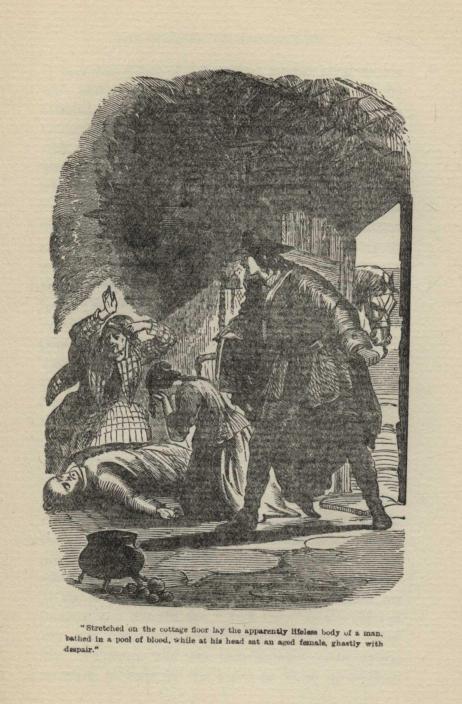
"Stretched on the cottage floor lay the apparently lifeless body of a man, bathed in a pool of blood, while at his head sat an aged female, ghastly with despair."
"Interrupt me not!" cried the aged matron. "Can you blast with heaven's lightnings," she continued, "the mitred head of him who ordered the deed to be done—that rendered me childless in my old age? O may the curses of a bereaved mother cling to his soul, and drag him down—down! But I will be avenged," she continued, the frenzied light of madness blazing in her sunken eyes, "I will be avenged, and that right soon; God has promised it; the heavens frown not in wrath when I cry for revenge! And when that day comes, when he, the bloody prelate, kneels in the very dust begging for that mercy he this day denied to me, then—then will he know the bitterness of kneeling at the foot of man, and kneeling in vain." Here, thoroughly exhausted by her own violence, the heart-stricken mother threw herself on the body of her child, screaming aloud, "My son! my son!"
Overcome with horror at the wretched scene, and perceiving that assistance could not be of any avail, Andrew Ayton, after he had thrust some money into the passive hand of the more gentle mourner, quickly regained the door, and mounting his horse, which stood pawing the ground with impatience to be gone, galloped hastily onwards to Perth. Now that the excitement which had hitherto sustained him had in some measure subsided, Andrew Ayton began to experience the effects of the fatigue arising from the scenes through which he had passed, and to realise the necessity there was of his obtaining some repose; accordingly he alighted at the first public-house that afforded hopes of entertainment for man and beast. In the course of the following morning he resumed his journey, and entered the "Fair City" as the light of day was departing. Being very desirous of seeing Mr. Wellwood, who was then thought to be dying, he made at once for the house in which he resided. It was a humble apartment into which he was ushered; no signs of luxury, barely of comfort, greeted the stranger's eye. The ceiling was low and dark, and the casement small; yet through that narrow aperture the sun's rays entered wooingly and kissed the pallid brow of a young man—sole tenant of the solitary apartment—who instantly rose from his chair and advanced a few steps, although with apparent difficulty, so much was he wasted by sickness, to welcome Andrew Ayton. As each of the young men had heard frequent and favourable mention made of the other, both paused for one moment as if by mutual consent, and earnestly gazed in each other's face. What a contrast did they at this moment present! There stood young Ayton, his long fair hair hanging in waving masses on his shoulders; youth written on his brow—his blue eyes bright with enthusiasm, and his tall elegant figure erect and bold; while opposite to him was one on whose forehead the cold band of death had set its seal. Although comparatively young in years, he was old with anxiety and suffering; his flushed cheek and lustrous eye, his damp forehead and short dry cough, all attesting the fatal presence of consumption. To gaze on them thus was to imagine a meeting between life and death, or that between two warriors; the one bravely arming for the coming fight, and the other, weary of the strife, about to repose after having borne the burden and heat of the day. At length Mr. Wellwood spoke, and his voice was low and sweet as he expressed the pleasure it gave him to see Mr. Ayton; while the latter grieved beyond measure on beholding Mr. Wellwood so feeble and attenuated, could scarce command his voice sufficiently to make a suitable reply. After the lapse of some little time, during which both sat silent, Mr. Wellwood, who had been gazing in a dreamy manner on the few blighted flowers adorning his window, emblems of his own untimely fate, demanded of Andrew Ayton if Archbishop Sharpe had committed any further outrages on the Presbyterians.
"Oh! Mr. Wellwood," burst forth Inchdarnie, "words cannot paint the deep hatred that haughty prelate bears towards us; he would, if possible, blot our names from the book of life; the wholesale murders committed by his orders are terrible beyond imagination; and not contented with what has been already done, he daily devises fresh means of torture. Had you seen what I witnessed while coming hither, it would never have been effaced from your memory; the lifeless corpse, the bereaved wife, and the maniac mother—all are before me even now. That such men are permitted to live only to commit crimes revolting to humanity is indeed strange!"
As Mr. Wellwood gazed on the countenance of the noble youth, which glowed with a beauty almost unearthly in its brightness, and marked as it was by an expression of melancholy sometimes seen on the faces of those who are not destined to remain long in this world, the mysterious veil which conceals the future from our sight was for one moment drawn aside. His dying eyes beheld what was soon to be accomplished, and he exclaimed, "You will shortly be quit of him; he will get a sudden and sharp off-going, and you will be the first to take the news of his death to heaven."
Inchdarnie reverently bowed his head in token of submission to the decrees of the Almighty. So pleased was he with the gentle bearing and pious exhortations of Mr. Well wood, that he remained with him until pretty near his decease, which occurred not long afterwards, when he was obliged to return to Inchdarnie, there to comfort with his presence his beloved mother, then labouring under severe indisposition. In danger of being imprisoned should his presence be discovered in the neighbourhood, Andrew Ayton durst not continue long in his father's house; but during the winter months and the ensuing spring he kept himself concealed in one of the cottar's houses, where he ran little risk of being detected.
It was now the fifth of May, 1679, and Andrew Ayton still lurked in the neighbourhood of Inchdarnie. On the morning of the day in question, a letter was placed in his hands; he glanced at the superscription, turned pale as death, and tearing it open, perused its contents with eyes whose wild expression would have terrified the beholder, while the trembling of the paper attested the agitation under which he laboured. The contents were as follows:—
MY DEAREST ANDREW,—I have struggled, and struggled in vain, to banish your image from my heart; wherever I have been, in England or in Italy, still you were present, and the words you last uttered on that fearful night have rung in my ears till they almost maddened me. All this weary time, in spite of my better judgment, I indulged in the fond delusion that you would endeavour to find me out, and that all should be made right again—vain hope. Months rolled on without any proof on your part of continued affection, and at last I was constrained to believe you had indeed forgotten me. In spite of all my assumed composure, despair took possession of my heart. Numberless suitors addressed me in all the glowing language of the sunny south, but I turned a deaf ear to their honied vows, and sighed in secret over the remembrance of one still too dear to me. At length, greatly to my delight, we returned to Scotland; and in the expectation of seeing you, I accompanied my aunt to the dear old priory. You were gone, but I heard from Deborah of your grief in the garden, and my heart melted within me at the recital. Again, I encountered one day during my accustomed walk a dear friend of yours, named Mr. Denoon (here Andrew Ayton's face glowed with delight); he seemed to know me—how I cannot tell—for he stopt and spoke to me of you. O! what sweet words of comfort he breathed to my anguished soul! He did not seek to undermine my faith (and for that I love him), but he told me of your love, your sorrow, and unaltered constancy, and prayed me to relent. Dear old man; he said although he grieved for my sake that I was not a Protestant, yet that should not prove an obstacle to our earthly happiness, for (and this rejoiced me more than anything) although the outward forms of our religion were so wholly at variance with each other, yet if our hearts were right in the sight of God, and we were sincere in our love towards him, they should always be acceptable in his sight. O Inchdarnie! whether it was that I really believed him or wished to do so for your dear sake, I know not, but I wept from joy; and he, dear, kind old man, was almost as much affected as myself. He then told me of your having aided his escape, and I listened with pride to the narration. We parted, soon to meet again. With the knowledge of my friends, I flew to your dear, venerable aunt, the Lady Murdocairnie (in whose house I am now residing), and told her of all that had passed between us, upon which she took me in her arms and blessed me, and advised me to write you, stating my unaltered love and anxiety to behold you. Come then, Inchdarnie; gladden me once more with your presence, and tell me with your own lips whether you will forgive, your loving
MARY CUNNINGHAME.
With a cry of joy Andrew Ayton started to his feet, rushed to the stable, and too impatient to wait for the tardy groom, he saddled his horse, sprang on its back, and darted off as if on the wings of the wind. Away he sped on his errand of love. The birds sung sweet above his head, he felt as blythe as they; he was going to join his Mary—his darling Mary. On, on, on; mountains, streams, and fields seemed to rush madly past him, so rapid was his course. All grief for him was at an end; Mary had forgiven him—Mary still loved him—they should yet be happy—alas!
Andrew Ayton, while lurking in the peaceful shades of Inchdarnie, was not made aware of the late fearful event, news of which at that instant was resounding through the land, convulsing England with horror, and ringing at the gates of heaven. Andrew Ayton knew not that two days previously Archbishop Sharpe had been slain—murdered on the lonely Magus Moor. Wholly ignorant of the affair, and of the pursuit to which it had given rise, young Ayton dashed onwards full of hope and joy, when an abrupt turning of the road revealed to his gaze a party of dragoons riding furiously towards Cupar. Anxious if possible to avoid encountering so numerous a body, Andrew Ayton quitted the high-road and galloped briskly through some fields, hoping thereby to escape notice; when suddenly a horseman detaches himself from the party and darts across the plain in pursuit of him. A flash, followed by a report, and the horse which bears young Ayton rears in the air; another and another, and he himself is mortally wounded. This done, the soldier without question or challenge of any kind, rejoins his comrades, exulting in the success of his exploit. The poor young man thus stricken down at the very moment in which life seemed most desirable, in spite of his dreadful wounds, managed, although with great difficulty, to preserve his seat on horseback until he arrived at the nearest house, where he alighted and begged that he might have a bed, also that his uncle, Sir John Ayton of Ayton, whose house was in the immediate neighbourhood, might be apprized of his condition. Deeply grieved on beholding the fatal injuries he had received. the mistress of the house supported his fainting form, and conducting him to her bust bedroom, made him as comfortable as circumstances would permit, until his uncle should arrive. On receipt of this sad intelligence. Sir John Ayton lost not a moment in hastening to his nephew's bedside; and so shocked was he at the appearance he presented, that he ordered a man-servant whom he had brought with him to start instantly for Cupar, and fetch a surgeon. The man returned with the intelligence that the dragoons had given positive orders to the effect that no medical man was to leave Cupar on any pretext whatever; upon which Sir John Ayton, frantic at the delay, despatched another messenger to appeal to the dragoons in behalf of the dying man. In answer to this, a party of soldiers was sent with instructions to convey him to Cupar. In vain Sir John Ayton protested against the cruelty, not to say impossibility, of removing a man in his condition to Cupar, which was distant three miles; in vain he offered them bail, or to entertain them until surgeons were brought who could advise them what to do. Deaf to all his entreaties, and utterly regardless of the consequences, they placed the unfortunate young man on horseback and hurried him away to Cupar. Four times during the journey Andrew Ayton fainted through loss of blood, but still no emotions of pity were excited in the breasts of his conductor. On arriving at their destination, the magistrates, in consideration of his enfeebled state of health, permitted him to be conveyed to an inn, instead of a prison. Mr. and Mrs. Ayton, who had also been made aware of what had happened, set off instantly for Cupar. On entering the room where her son lay apparently in the agonies of death, Mrs. Ayton's fortitude gave way, and she threw herself on his breast, sobbing as if her heart would break.