Volume 1 — KING SHAH BAKHT AND HIS WAZIR AL-RAHWAN.[295]
Richard Francis Burton translation · Edition 2
KING SHAH BAKHT AND HIS WAZIR AL-RAHWAN.[295]
They relate that there was once, in days of yore and in bygone ages and times long gone before, a king of the kings of the time, Shah Bakht hight, who had troops and servants and guards in hosts and a Wazir called Al-Rahwán, who was learned, understanding, a loyal counsellor and a cheerful acceptor of the commandments of Almighty Allah, to whom belong Honour and Glory. The king committed to this Minister the affairs of his kingdom and his lieges and spake according to his word, and in this way he abode a long space of time. Now this Wazir had many foes, who envied his position and sought to do him harm, but thereunto found no way and the Lord, in His immemorial foreknowledge and His fore-ordinance decreed that the king dreamt that the Minister Al-Rahwan gave him a fruit from off a tree and he ate it and died. So he awoke, startled and troubled, and when the Wazir had presented himself before him and had retired and the king was alone with those in whom he trusted, he related to them his vision and they advised him to send for the astrologers and interpreters and commended to him a Sage, whose skill and wisdom they attested. 192Accordingly the king bade him be brought and entreated him with honour and made him draw near to himself. Now there had been in private intercourse with that Sage a company of the Wazir’s enemies, who besought him to slander the Minister to the king and counsel him to do him dead, in view of what they promised him of much wealth; and he made agreement with them on this and acquainted the king that the Minister would slay him within the coming month and bade him hasten to put him to death, else would he surely be killed. Presently, the Wazir entered and the king signed to him to clear the place. So he signed to those who were present to withdraw, and they withdrew; whereupon quoth the king to him, “How deemest thou, O Minister of loyal counsel in all manner of contrivance, concerning a vision I have seen in my sleep?” “What is it, O king?” asked the Wazir, and Shah Bakht related to him his dream, adding, “And indeed the Sage interpreted it to me and said to me:—An thou do not the Wazir dead within a month, assuredly he will slay thee. Now to put the like of thee to death, I am loath exceedingly, yet to leave thee on life do I sorely fear. How then dost thou advise me act in this affair?” The Wazir bowed his head earthwards awhile, then raised it and said, “Allah prosper the king! Verily, it availeth not to continue him on life of whom the king is afraid, and my counsel is that thou hasten to put me out of the world.” When the king heard his speech and dove into the depths of his meaning, he turned to him and said, “’Tis grievous to me, O Wazir of good rede;” and he told him that the other sages had attested the wit and wisdom of the astrophil. Now hearing these words Al-Rahwan sighed and knew that the king went in fear of him; but he showed him fortitude and said to him, “Allah assain the sovran! My rede is that the king carry out his commandment and his decree be dight, for that needs must death be and ’tis fainer to me that I die oppressed, than that I die an oppressor. But, an the king judge proper to postpone the putting of me to death till the 193morrow and will pass this night with me and farewell me whenas the morning cometh, the king shall do whatso he willeth.” Then he wept till he wetted his gray hairs and the king was moved to ruth for him and granted him that which he craved and vouchsafed him a respite for that night.[296]
194
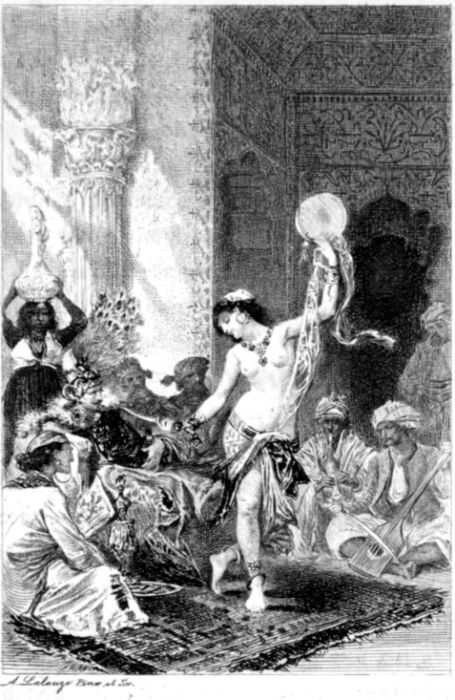
The First Night of the Month.
When it was eventide, the king caused clear his sitting chamber and summoned the Wazir, who presented himself and making his obeisance to the king, kissed ground before him and related to him
THE TALE OF THE MAN OF KHORASAN, HIS SON AND HIS TUTOR.
There was once a man of Khorasan and he had a son, whose moral weal he ardently wished; but the young man sought to be alone and far from the eye of his father, so he might give himself up to pleasuring and pleasance. Accordingly he sought of his sire leave to make the pilgrimage to the Holy House of Allah and to visit the tomb of the Prophet (whom Allah save and assain!). Now between them and Meccah was a journey of five hundred parasangs; but his father could not contrary him, for that the Holy Law had made pilgrimage[297] incumbent on him and because of that which he hoped for him of improvement. So he joined unto him a tutor, in whom he trusted, and gave him much money and took leave of him. The son set out with his governor on the holy pilgrimage,[298] and abode on the like wise, spending freely and using not thrift. Also there was in his neighbourhood a poor man, who had a slave-girl of passing beauty and grace, and the youth conceived a desire for her and suffered sore cark and care 195for the love of her and her loveliness, so that he was like to perish for passion; and she also loved him with a love yet greater than his love for her. Accordingly, the damsel summoned an old woman who used to visit her and acquainted her with her case, saying, “An I foregather not with him, I shall die.” The crone promised her that she would do her best to bring her to her desire; so she veiled herself and repairing to the young man, saluted him with the salam and acquainted him with the girl’s case, saying, “Her master is a greedy wight; so do thou invite him and lure him with lucre, and he will sell thee the handmaiden.” Accordingly, he made a banquet, and standing in the man’s way, invited him[299] and brought him to his house, where they sat down and ate and drank and abode in talk. Presently, the young man said to the other, “I hear thou hast with thee a slave-girl, whom thou desirest to sell;” but he said, “By Allah, O my lord, I have no mind to sell her!” Quoth the youth, “I have heard that she cost thee a thousand dinars, and I will give thee six hundred over and above that sum;” and quoth the other, “I sell her to thee at that price.” So they fetched notaries who wrote out the contract of sale, and the young man weighed to the girl’s master half the purchase money, saying, “Let her be with thee till I complete to thee the rest of the price and take my hand-maid.” The owner consented to this and took of him a written bond for the rest of the money, and the girl abode with her master, on deposit.[300] As for the youth, he gave his governor a thousand dirhams and sent him to his sire, to fetch money from him, so he might pay the rest of the hand-maid’s price, saying to him, “Be not long away.” But the tutor said in his mind, “How shall I fare to his father and say to him, Thy son hath wasted thy 196money and made love with it?[301] With what eye shall I look on him and, indeed, I am he in whom he confided and to whom he hath entrusted his son? Verily, this were ill rede. Nay, I will fare on with this pilgrimage-caravan[302] in despite of my fool of a youth; and when he is weary of waiting, he will demand back his money and return to his father, and I shall be quit of travail and trouble.” So he went on with the pilgrimage-caravan[303] and took up his abode there.[304] Meanwhile, the youth tarried expecting his tutor’s return, but he returned not; wherefore concern and chagrin grew upon him because of his mistress, and his yearning for her redoubled and he was like to kill himself. She became aware of this and sent him a messenger, bidding him visit her. Accordingly he went to her, and she questioned him of the case; when he told her what was to do of the matter of his tutor, and she said to him, “With me is longing the like of that which is with thee, and I doubt me thy messenger hath perished or thy father hath slain him; but I will give thee all my jewellery and my dresses, and do thou sell them and weigh out the rest of my price, and we will go, I and thou, to thy sire.” So she handed to him all she had and he sold it and paid the rest of her price; after which there remained to him for spending-money an hundred dirhams. These he spent and lay that night with the damsel in all delight of life, and his sprite was like to fly for joy: but when he arose in the morning, he sat weeping and the damsel said to him, “What causeth thee to weep?” Said he, “I know not an my father be dead, and he hath none other heir 197save myself; but how shall I get to him, seeing I own not a dirham?” Quoth she, “I have a bangle; sell it and buy seed-pearls with the price: then round them and fashion them into great unions[305] and thereby thou shalt gain much money, with the which we may find our way to thy country.” So he took the bangle and repairing to a goldsmith, said to him, “Break up this bracelet and sell it;” but he said, “The king seeketh a perfect bracelet: I will go to him and bring thee its price.” Presently he bore the bangle to the Sultan and it pleased him greatly by reason of its goodly workmanship. Then he called an old woman, who was in his palace, and said to her, “Needs must I have the mistress of this bracelet though but for a single night, or I shall die;” and the old woman replied, “I will bring her to thee.” Thereupon she donned a devotee’s dress and betaking herself to the goldsmith, said to him, “To whom belongeth the bangle which is now with the king?” and said he, “It belongeth to a stranger, who hath bought him a slave-girl from this city and lodgeth with her in such a place.” Upon this the old woman repaired to the young man’s house and knocked at the door. The damsel opened to her and seeing her clad in devotee’s garb,[306] saluted her with the salam and asked her saying, “Haply thou hast some need of us?” Answered the old woman, “Yes, I desire a private place, where I can perform the Wuzu-ablution;” and quoth the girl, “Enter.” So she entered and did her requirement and made the ablution and prayed:[307] then she brought out a rosary and began to tell her beads thereon, and the damsel said to her, 198“Whence comest thou, O pilgrimess?”[308] Said she, “From visiting the Idol of the Absent in such a church.[309] There standeth up no woman before him[310], who hath a distant friend and discloseth to him her desire, but he acquainteth her with her case and giveth her news of her absent one.” Said the damsel “O pilgrimess, we have an absent one, and my lord’s heart cleaveth to him and I desire to go question the Idol of him.” Quoth the crone, “Do thou wait till to-morrow and ask leave of thy spouse, and I will come to thee and fare with thee in weal and welfare.” Then she went away, and when the girl’s master came, she sought his permission to go with the old trot, and he gave her leave. So the beldame came and took her and carried her to the king’s door, she, unknowing whither she went. The damsel entered with her and beheld a goodly house and decorated apartments which were no idol’s chamber. Then came the king and seeing her beauty and loveliness, went up to her to buss her; whereupon she fell down in a fainting fit and struck out with her hands and feet.[311] When he saw this, he held aloof from her in ruth and left her; but the matter was grievous to her and she refused meat and drink, and as often as the king drew near to her, she fled from him in fear, so he swore by Allah that he would not approach her save with her consent and fell to presenting her with ornaments and raiment; but her aversion to him only increased. Meanwhile, the youth her master abode expecting her; but she returned not and his heart already tasted the bitter draught of separation; so he went forth at hap-hazard, distracted and knowing not what he should do, and began strewing dust upon his head and crying out, “The 199old woman hath taken her and gone away!” The little boys followed him with stones and pelted him, crying, “A madman! A madman!” Presently, the king’s Chamberlain, who was a personage of years and worth, met him, and when he saw this youth, he forbade the boys and drave them away from him, after which he accosted him and asked him of his affair. So he told him his tale and the Chamberlain said to him, “Fear not! I will deliver thy slave-girl for thee; so calm thy concern.” And he went on to speak him fair and comfort him, till he had firm reliance on his word. Then he carried him to his home and stripping him of his clothes, clad him in rags; after which he called an old woman, who was his housekeeper,[312] and said to her, “Take this youth and bind on his neck yon iron chain and go round about with him in all the great thoroughfares of the city, and when thou hast done this, go up with him to the palace of the king.” And he said to the youth, “In whatsoever stead thou seest the damsel, speak not a syllable, but acquaint me with her place and thou shalt owe her deliverance to none save to me.” The youth thanked him and went with the old woman in such fashion as the Chamberlain bade him. She fared on with him till they entered the city, and walked all about it; after which she went up to the palace of the king and fell to saying, “O fortune’s favourites, look on a youth whom the devils take twice in the day and pray to be preserved from such affliction!” And she ceased not to go round with him till she came to the eastern wing[313] of the palace, whereupon the slave-girls hurried out to look upon him and when they saw him they were amazed at his beauty and loveliness and wept for him. Then they informed the damsel, who came forth and considered him and knew him not; but he knew her; so he drooped his head and shed tears. She was moved to pity for him 200and gave him somewhat and went back to her place, whilst the youth returned with the housekeeper to the Chamberlain and told him that she was in the king’s mansion, whereat he was chagrined and said, “By Allah, I will assuredly devise a device for her and deliver her!” Whereupon the youth kissed his hands and feet. Then he turned to the old woman and bade her change her habit and her semblance. Now this ancient dame was sweet of speech and winsome of wit; so he gave her costly and delicious ottars and said to her, “Get thee to the king’s slave-girls and sell them these essences and win thy way to the damsel and ask her if she desire her master or not.” So the old woman went out and making her way to the palace, went in to the hand-maid and drew near her and recited these couplets:—
Allah preserve our Union-days and their delights. ✿ Ah me! How sweet was life! how joys were ever new!
May he not be who cursed us twain with parting day; ✿ How many a bone he brake, how many a life he slew!
He shed my faultless tear-floods and my sinless blood; ✿ And beggaring me of love himself no richer grew.
When the damsel heard the old woman’s verses, she wept till her clothes were drenched and drew near the speaker, who asked her, “Knowest thou such-an-one?” And she wept and answered, “He is my lord. Whence knowest thou him?” Rejoined the old woman, “O my lady, sawest thou not the madman who came hither yesterday with the old woman? He was thy lord,” presently adding, “But this is no time for talk. When ’tis night, get thee to the top of the palace and wait on the terrace till thy lord come to thee and compass thy deliverance.” Then she gave her what she would of perfumes and returning to the Chamberlain, acquainted him with whatso had passed, and he told the youth. Now as soon as it was evening, the Chamberlain bade bring two hackneys and great store of water and provaunt and a riding-camel and a fellow to show them the way. These he ambushed without the town 201whilst he and the young man, taking with them a long rope, made fast to a staple, went and stood below the palace. Whenas they came thither, they looked and behold, the damsel was standing on the terrace-roof, so they threw her the rope and the staple, which she made fast, and tucking up her sleeves above her wrists, slid down and landed with them. They carried her without the town, where they mounted, she and her lord, and fared on, with the guide in front,[314] directing them on the way, and they ceased not faring night and day till they entered his father’s house. The young man greeted his sire, who was gladdened in him, and to whom he related all that had befallen him, whereupon he rejoiced in his safety. As for the tutor, he wasted whatso was with him and returned to the city, where he saw the youth and excused himself. Then he questioned him of what had betided him and he told him, whereat he admired and returned to companionship with him; but the youth ceased to have regard for him and gave him nor solde nor ration as was his wont, neither discovered to him aught of his secrets. When the tutor saw that there was no profit from him he returned to the king, the ravisher of the slave-girl, and recounted to him what the Chamberlain had done and counselled him to slay that official and egged him on to recover the damsel, promising to give his friend a poison-draught and return. Accordingly the king sent for the Chamberlain and chid him for the deed he had done; whereat the king’s servants incontinently fell upon the Chamberlain and put him to death. Meanwhile the tutor returned to the youth, who asked him of his absence, and he told him that he had been in the city of the king who had taken the slave-girl. When the youth heard this, he misdoubted of his governor and never again trusted him in anything but was always on 202his guard against him. Then the tutor without stay or delay caused prepare great store of sweetmeats and put in them deadly poison and presented them to the youth, who, when he saw those sweetmeats, said to himself, “This is an extraordinary thing of the tutor! Needs must there be in this sweetmeat some mischief, and I will make proof of his confectionery upon himself.” Accordingly he got ready food and set amongst it a portion of the sweetmeat, and inviting the governor to his house placed the provaunt before him. He ate, and amongst the rest which they brought him, the poisoned sweetmeat; so while in the act of eating he died; whereby the youth knew that this was a plot against himself and said, “Whoso seeketh his fortune by his own force[315] attaineth a failure.” “Nor,” continued the Wazir, “is this, O king of the age, stranger than the story of the Druggist and his Wife and the Singer.” When King Shah Bakht heard the tale of Al-Rahwan he gave him leave to withdraw to his own house and he tarried there the rest of the night and the next day till eventide evened.
203
The Second Night of the Month.
When the evening evened, the king sat private in his sitting-chamber and his mind was occupied with the story of the Singer and the Druggist. So he called the Wazir and bade him tell the tale. Answered he, “I will well. They recount, O my lord, the following
TALE OF THE SINGER AND THE DRUGGIST.”
There was once in the city of Hamadán[316] a young man of seemly semblance and skilled in singing to the lute; wherefore he was well seen of the citizens. He went forth one day of his home with intent to travel, and gave not over journeying till his travel brought him to a town and a goodly. Now he had with him a lute and its appurtenance,[317] so he entered and went round about the streets till he happened upon a druggist who, when he espied him, called to him. So he went up to him and he bade him sit down; accordingly, the youth sat down by his side, and the druggist questioned him of his case. The singer told him what was in his mind, and the pharmacist took him up into his shop and bought him food and fed him. Then said he to him, “Rise and take up thy lute and beg about the streets, and whenas thou smellest the reek of wine, break in upon the drinkers and say to them, I am a singer. They will laugh and cry, Come in to us. And when thou singest, the folk will know thee and speak one to other of thee; so shalt thou become known about town, and thou shalt better thy business.” He went round about, as the druggist bade him, 204till the sun waxed hot, but found none drinking. Then he entered a lane, that he might take rest, and seeing there a handsome house and a lofty, stood in its shade and fell to observing the excellence of its edification. Now while he was thus engaged, behold, a casement opened and there appeared thereat a face, as it were the moon. Quoth the owner of the face, “What aileth thee to stand there? Dost thou want aught?” And quoth he, “I am a stranger,” and acquainted her with his adventure; whereupon asked she, “What sayst thou to meat and drink and the enjoyment of a fair face and getting thee spending-money?” And he answered, “O mistress mine, this is my desire whereof I am going about in quest!” So she opened the door to him and brought him in: then she seated him at the upper end of the room and served him with food. He ate and drank and lay with her and futtered her. This ended, she sat down in his lap and they toyed and laughed and exchanged kisses till the day was half done, when her husband came home and she had no recourse but to hide the singer in a mat[318], in which she rolled him up. The husband entered and seeing the battle-place[319] disordered and smelling the reek of liquor questioned her of this. Quoth she, “I had with me a bosom friend of mine and I conjured her to crack a cup with me; and so we drank a jar full, I and she, and but now, before thy coming in, she fared forth.” Her husband deemed her words true and went away to his shop, he being none other than the singer’s friend the druggist, who had invited him and fed him; whereupon the lover came forth and he and the lady returned to their pleasant pastime and abode on this wise till evening, when she gave him money and said to him, “To-morrow in the forenoon come hither to me.” He replied, “Yes,” and departed; and at nightfall 205he went to the Hammam-bath. On the morrow, he betook himself to the shop of his friend the druggist, who welcomed him as soon as he saw him, and questioned him of his case and how he had fared that day. Quoth the singer, “Allah requite thee with welfare, O my brother, for indeed thou hast directed me to a restful life!” Then he acquainted him with his adventure and told him the tale of the woman, till he came to the mention of her husband, when he said, “And at midday came the horned cuckold,[320] her husband, and knocked at the door. So she wrapped me in the mat, and when he had wended his ways I came forth and we returned to our pleasant play.” This was grievous to the druggist, and he repented of having taught him how he should do and suspected his wife. Accordingly he asked the singer, “And what said she to thee at thy going away?” and the other answered, “She said, Come back to me on the morrow. So, behold, I am off to her and I came not hither but that I might acquaint thee with this, lest thy thoughts be pre-occupied with me.” Then he farewelled him, and walked out. As soon as the druggist was assured that he had reached the house, he cast the net[321] over his shop and made for his home, in some suspicion of his wife, and knocked at the door. Now the singer had entered and the druggist’s wife said to him, “Up with thee and enter this chest.” Accordingly he entered it and she shut it down on him and opened to her husband, who came in all distraught, and searched the house but found none and overlooked the chest. Hereat he said in his mind “The house[322] is one which favoureth my house and the woman is 206one who favoureth my wife,” and returned to his shop; whereupon the singer came forth of the chest and falling upon the druggist’s wife, had his wicked will of her and spent upon her what was her due, and weighed down the scale for her with full measure. Then they ate and drank and kissed and clipped necks, and in this way they abode till the evening, when she gave him money, because she found his weaving nice and good,[323] and made him promise to come to her on the morrow. So he left her and slept his night and on the morrow he returned to the shop of his friend the druggist and saluted him. The other welcomed him and questioned him of his case; whereat he told his tale till he ended with the mention of the woman’s husband, when he said, “Then came the horned cuckold, her mate and she stowed me away in the chest and shut down the lid upon me, whilst her addlepated pander[324] of a husband went about the house, top and bottom; and when he had gone his way, we returned to our pleasant pastime.” With this, the druggist was assured that the house was his house and the wife his wife, and quoth he, “Now what wilt thou do to-day?” Quoth the singer, “I shall return to her and weave for her and full her yarn[325], and I came not[326] save to thank thee for thy dealing with me.” Then he went away, whilst the fire was loosed in the heart of the druggist and he shut his shop and returning to his house, rapped at the door. Said the singer, “Let me jump into the chest, for he saw me not yesterday;” but said she, “No! wrap thyself up in the mat.” So he wrapped himself up and stood in a corner of the room, whilst the druggist entered and went no whither else save 207to the chest, but found naught inside. Then he walked round about the house and searched it, top and bottom, but came upon nothing and no one and abode between belief and disbelief, and said to himself, “Haply, I suspect my wife of what is not in her.” So he was certified of her innocence and going forth content, returned to his shop, whereupon out came the singer and they resumed their former little game, as was their wont, till eventide when she gave him one of her husband’s shirts and he took it and going away, nighted in his own lodging. Next morning he repaired to the druggist, who saluted him with the salam and came to meet him and rejoiced in him and smiled in his face, deeming his wife innocent. Then he questioned him of his case on yesterday and he told him how he had fared, saying, “O my brother, when the cornute knocked at the door, I would have jumped into the chest; but his wife forbade me and rolled me up in the mat. The man entered and thought of nothing save the chest; so he brake it open and woned like one jinn-mad, going up and coming down. Then he went about his business and I came out and we abode on our accustomed case till eventide, when she gave me this shirt of her husband’s; and behold, I am now off to her.” When the druggist heard the singer’s words, he was assured of the adventure and knew that the calamity, all of it, was in his own house and that the wife was his wife; and he considered the shirt, whereupon he redoubled in assuredness and said to the singer, “Art thou now going to her?” Said he, “Yes, O my brother,” and taking leave of him, went away; whereupon the druggist started up, as he were stark mad, and dismantled his shop.[327] Whilst he was thus doing, the singer won to the house, and presently up came the druggist and knocked at the door. The lover would have wrapped himself up in the mat, but she forbade him and said, “Get thee down to the ground floor of the house and 208enter the oven-jar[328] and close the cover upon thyself.” So he did her bidding and she went down to her husband and opened the door to him, whereupon he came in and went round the house, but found no one and overlooked the oven-jar. Then he stood musing and sware that he would not again go forth of the house till the morrow. As for the singer, when his stay in the oven-jar grew longsome upon him, he came forth therefrom, thinking that her husband had gone away; and he went up to the terrace-roof and looking down, beheld his friend the druggist: whereat he was sore concerned and said in himself, “Alas, the disgrace, ah! This is my friend the druggist, who of me was fain and dealt me fair and I have paid him with foul.” He feared to return to the druggist; so he stepped down and opened the first door and would have gone out at a venture, unseen of the husband; but, when he came to the outer door, he found it locked and saw not the key. Hereat he returned to the terrace and began dropping from roof to roof till the people of the house heard him and hastened to fall upon him, deeming him a thief. Now that house belonged to a Persian man; so they laid hands on him and the house-master fell to beating him, saying to him, “Thou art a thief.” He replied, “No I am not a thief, but a singing-man, a stranger who, hearing your voices, came to sing to you.” When the folk heard his words, they talked of letting him go; but the Persian said, “O folk, let not his speech cozen you. This one is none other than a thief who knoweth how to sing, and when he cometh upon the like of us, he is a singer.” Said they, “O our lord, this man is a stranger, and needs we must release him.” Quoth he, “By Allah, my heart heaveth at this fellow! Let me kill him with beating;” but quoth they, “Thou mayst no ways do that.” So they delivered the singer from the Persian, the master 209of the house, and seated him amongst them, whereupon he began singing to them and they rejoiced in him. Now the Persian had a Mameluke,[329] as he were the full moon, and he arose and went out, and the singer followed him and wept before him, professing lustful love to him and kissing his hands and feet. The Mameluke took compassion on him and said to him, “When the night cometh and my master entereth the Harim and the folk fare away, I will grant thee thy desire; and I sleep in such a place.” Then the singer returned and sat with the cup-companions, and the Persian rose and went out with the Mameluke by his side. Now[330] the singer knew the place which the Mameluke occupied at the first of the night; but it chanced that the youth rose from his stead and the waxen taper went out. The Persian, who was drunk, fell over on his face, and the singer supposing him to be the Mameluke, said, “By Allah, ’tis good!” and threw himself upon him and began to work at his bag-trousers till the string was loosed; then he brought out[331] his prickle upon which he spat and slipped it into him. Thereupon the Persian started up, crying out and, laying hands on the singer, pinioned him and beat him a grievous beating, after which he bound him to a tree that stood in the house-court. Now there was in the house a beautiful singing-girl and when she saw the singer tight pinioned and tied to the tree, she waited till the Persian lay down on his couch, when she arose and going up to the singer, fell to condoling with him over what had betided him and making eyes at him and handling his yard and rubbing it, till it rose upright. Then said she to him, “Do with me the deed of kind and I will loose thy pinion-bonds, lest he 210return and beat thee again; for he purposeth thee an ill purpose.” Quoth he, “Loose me and I will do it;” but quoth she, “I fear that, an I loose thee, thou wilt not do it. But I will do it and thou have me standing; and when I have done, I will loose thee.” So saying, she opened her clothes and introducing the singer’s prickle, fell to toing and froing.[332] Now there was in the house a fighting-ram, which the Persian had trained to butting,[333] and when he saw what the woman was doing, he thought she wished to do battle with him; so he broke his halter and running at her, butted her and split her skull. She fell on her back and shrieked; whereupon the Persian started up hastily from sleep and seeing the singing-girl on her back and the singer with yard on end, cried to him, “O accursed, doth not what thou hast erewhile done suffice thee?” Then he beat him a shrewd beating and opening the door, thrust him out in the middle of the night. He lay the rest of the dark hours in one of the ruins, and when he arose in the morning, he said, “None is in fault! I, for one, sought my own good, and he is no fool who seeketh good for himself; and the druggist’s wife also sought good for herself; but Predestination overcometh Precaution and for me there remaineth no tarrying in this town.” So he went forth from the place. “Nor” (continued the Wazir), “is this story, strange though it be, stranger than that of the King and his Son and that which betided them of wonders and rare marvels.” When the king heard this story, he deemed it 211pretty and pleasant and said, “This tale is near unto that which I know and ’tis my rede I should do well to have patience and hasten not to slay my Minister, so I may get of him the profitable story of the King and his Son.” Then he gave the Wazir leave to go away to his own house; so he thanked him and tarried in his home all that day.
212
The Third Night of the Month.
When it was supper-time the king sought the sitting-chamber; and, summoning the Wazir, sought of him the story he had promised him; and the Minister said, “They tell, O king,
THE TALE OF THE KING WHO KENNED THE QUINTESSENCE[334] OF THINGS.”
There came to a king of the kings, in his old age, a son, who grew up comely, quick-witted, clever: and, when he reached years of discretion and became a young man, his father said to him, “Take this realm and rule it in lieu of me, for I desire to flee from the sin of sovranty[335] to Allah the Most High and don the woollen dress and devote all my time to devotion.” Quoth the Prince, “And I am another who desireth to take refuge with the Almighty.” So the king said, “Arise, let us flee forth and make for the mountains and there worship in shame before God the Most Great.” Accordingly, the twain gat them gear of wool and clothing themselves therewith, fared forth and wandered in the wolds and wastes; but, when some days had passed over them, both became weak for hunger and repented them of that they had done whenas penitence profited them not, and the Prince complained to his father of weariness and hunger. Cried the king, “Dear my son, I did with thee that which behoved me,[336] but thou wouldst not hearken to me, 213and now there is no means of returning to thy former estate, for that another hath taken the kingdom and defendeth it from all foes: but indeed I will counsel thee of somewhat, wherein do thou pleasure me by compliance.” The Prince asked, “What is it?” and his father answered, “Take me and go with me to the market-street and sell me and receive my price and do with it whatso thou willest, and I shall become the property of one who shall provide for my wants.” The Prince enquired, “Who will buy thee of me, seeing thou art a very old man? Nay, do thou rather sell me, inasmuch as the demand for me will be more.” But the king replied, “An thou wert king, thou wouldest require service of me.” Accordingly the youth obeyed his father’s bidding and taking him, carried him to the slave-dealer and said, “Sell me this old man.” Said the dealer, “Who will buy this wight, and he a son of eighty years?”[337] Then quoth he to the king, “In what crafts art thou cunning?” and quoth he, “I ken the quintessence of jewels and I ken the quintessence of horses and I ken the quintessence of men; brief, I ken the quintessence of all things.” So the slave-dealer took him and went about, offering him for sale to the folk; but none would buy. Presently, up came the Chef of the Sultan’s kitchen and asked, “What is this man?” and the dealer answered, “This be a Mameluke for sale.” The kitchener marvelled at this and bought the king, after questioning him of what he could do, for ten thousand dirhams. Then he weighed out the money and carried him to his house, but dared not employ him in aught of service; so he appointed him an allowance, a modicum sufficient for his maintenance, and repented him of having bought him, saying, “What shall I do with the like of this wight?” Presently, the king of the city was minded to go forth to his garden,[338] a-pleasuring, and bade the cook precede him and appoint in his 214stead one who should dress the royal meat, so that, when he returned, he might find the meal ready. The Chef fell to thinking of whom he should appoint and was perplexed concerning his affair. As he was thus, the Shaykh came to him, and seeing him distraught as to how he should do, said to him, “Tell me what is in thy mind; haply I may bring thee relief.” So he acquainted him with the king’s wishes and he said, “Have no care for this, but leave me one of the serving-men and do thou go companying thy lord in peace and surety, for I will suffice thee of this.” Hereat the cook departed with the king, after he had brought the old man what he needed and left him a man of the guards; and when he was gone, the Shaykh bade the trooper wash the kitchen-battery and made ready food exceedingly fine. When the king returned he set the meat before him, and he tasted dishes whose like he had never savoured; whereat he was startled and asked who had dressed it. Accordingly they acquainted him with the Shaykh’s case and he summoned him to his presence and asking him anent the mystery, increased his allowance of rations;[339] moreover, he bade that they should cook together, he and the kitchener, and the old man obeyed his bidding. Some time after this, there came two merchants to the king with two pearls of price and each of them declared that his pearl was worth a thousand dinars, but the folk was incompetent to value them. Then said the cook, “Allah prosper the king! Verily, the Shaykh whom I bought affirmed that he knew the quintessence of jewels and that he was skilled in cookery. We have tried him in his cuisine, and have found him the most knowing of men; and now, if we send after him and prove him on jewels, his second claim will be made manifest to us, whether true or false.” So the king bade fetch the Shaykh and he came and stood before the Sultan, who showed him the two pearls. Quoth he, “Now for this one, ’tis worth a thousand dinars;” and 215quoth the king, “So saith its owner.” “But for this other,” continued the old man, “’tis worth only five hundred.” The people laughed and admired his saying, and the merchant who owned the second pearl asked him, “How can this, which is bigger of bulk and worthier for water and righter of rondure, be less of value than that?” and the old man answered, “I have said what is with me.”[340] Then quoth the king to him, “Indeed, the outer semblance thereof is like that of the other pearl; why then is it worth but the half of its price?” and quoth the old man, “Yes, but its inward is corrupt.” Asked the merchant, “Hath a pearl then an inward and an outward?” and the Shaykh answered, “Yea! In its interior is a teredo, a boring worm; but the other pearl is sound and secure against breakage.” The merchant continued, “Give us approof of this thy knowledge and confirm to us the truth of thy saying;” and the old man rejoined, “We will break it: an I prove a liar, here is my head, and if I speak sooth, thou wilt have lost thy pearl;” and the merchant said, “I agree to that.” So they brake the pearl and it was even as the old man had declared, to wit, in the heart of it was a boring worm. The king marvelled at what he saw and questioned him of how he came by the knowledge of this. The Shaykh replied, “O king, this kind of jewel is engendered in the belly of a creature called the oyster[341] and its origin is a drop of rain and it resisteth the touch and groweth not warm whilst hent in hand:[342] so, when its outer coat became tepid to my touch, I knew that it harboured some living thing, for that things of life thrive not save in heat.” Therefore the king said to the cook, “Increase his allowance;” and the Chef appointed to him 216fresh rations. Now some time after this, two merchants presented themselves to the king with two horses, and one said, “I ask a thousand ducats for my horse,” and the other, “I seek five thousand ducats for mine.” Quoth the cook, “We are now familiar with the old man’s just judgment; what deemeth the king of fetching him?” So the king bade fetch him, and when he saw the two horses,[343] he said, “This is worth a thousand and that two thousand ducats.” Quoth the folk, “This horse thou misjudgest is evidently a thoroughbred and he is younger and faster and compacter of limb and finer of head and clearer of colour and skin than the other;” presently adding, “What assurance hast thou of the sooth of thy saying?” And the old man said, “This ye state is true, all true; but his sire is old and this other is the son of a young horse. Now, when the son of an old horse standeth still a-breathing, his breath returneth not to him and his rider falleth into the hand of him who followeth after him; but the son of a young horse, an thou put him to speed and after making him run, alight from him, thou wilt find him, by reason of his robustness, untired.” Quoth the merchant, “’Tis even as the Shaykh avoucheth and he is an excellent judge.” And the king said, “Increase his allowance.” But the Shaykh stood still and did not go away; so the king asked him, “Why dost thou not go about thy business?” and he answered, “My business is with the king.” Said the king, “Name what thou wouldest have,” and the other replied, “I would have thee question me of the quintessence of men, even as thou hast questioned me of the quintessence of horses.” Quoth the king, “We have no occasion to question thee thereof;” but quoth the old man, “I have occasion to acquaint thee.” “Say what thou wilt,” rejoined the king, and the Shaykh said, “Verily, the king is the son of a baker.” Cried the king, “How and whereby 217kennest thou that?” and the Shaykh replied, “Know, O king, that I have examined into degrees and dignities[344] and have learned this.” Thereupon the king went in to his mother and asked her anent his sire, and she told him that the king her husband was impotent;[345] “So,” quoth she, “I feared for the kingdom, lest it pass away, after his death; wherefore I yielded my person to a young man, a baker, and conceived by him and bare a man-child;[346] and the kingship came into the hand of my son, that is, thyself.” So the king returned to the Shaykh and said to him, “I am indeed the son of a baker; so do thou expound to me the means whereby thou knewest me for this.” Quoth the other, “I knew that, hadst thou been the son of a king, thou wouldst have gifted me with things of price, such as rubies and the like; and wert thou the son of a Kazi, thou hadst given largesse of a dirham or two dirhams, and wert thou the son of any of the merchants, thou hadst given me muchel of money. But I saw that thou bestowedst upon me naught save two bannocks of bread and other rations, wherefore I knew thee to be the son of a baker;” and quoth the king, “Thou hast hit the mark.” Then he gave him wealth galore and advanced him to high estate. The tale aforesaid pleased King Shah Bakht and he marvelled thereat; but the Wazir said to him, “This story is not stranger than that of the Richard who married his beautiful daughter to the poor Shaykh.” The king’s mind was occupied with the promised tale and he bade the Wazir withdraw to his lodging; so he went and abode there the rest of the night and the whole of the following day.
218
The Fourth Night of the Month.
When the evening evened, the king sat private in his sitting-chamber and bade fetch the Wazir. When he presented himself before him, he said to him, “Tell me the tale of the Richard.” The Minister replied, “I will. Hear, O puissant king,
THE TALE OF THE RICHARD WHO MARRIED HIS BEAUTIFUL DAUGHTER TO THE POOR OLD MAN.”
A certain rich merchant had a beautiful daughter, who was as the full moon, and when she attained the age of fifteen, her father betook himself to an old man and spreading him a carpet in his sitting-chamber, gave him to eat and conversed and caroused with him. Then said he to him, “I desire to marry thee to my daughter.” The other drew back, because of his poverty, and said to him, “I am no husband for her nor am I a match for thee.” The merchant was urgent with him, but he repeated his answer to him, saying, “I will not consent to this till thou acquaint me with the cause of thy desire for me. An I find it reasonable, I will fall in with thy wish; and if not, I will not do this ever.” Quoth the merchant, “Thou must know that I am a man from the land of China and was in my youth well-favoured and well-to-do. Now I made no account of womankind, one and all, but followed after youths[347], and one night I saw, in a dream, as it were a balance set up, and hard by it a voice said, ‘This is the portion of Such-an-one.’ I listened and presently I heard my own name; so I looked and behold, there stood a woman loathly to the uttermost; whereupon I awoke in fear and cried, ‘I will never marry, lest haply this 219fulsome female fall to my lot.’ Then I set out for this city with merchandise and the journey was pleasant to me and the sojourn here, so that I took up my abode in the place for a length of time and gat me friends and factors. At last I sold all my stock-in-trade and collected its price and there was left me nothing to occupy me till the folk[348] should depart and I depart with them. One day, I changed my clothes and putting gold into my sleeve, sallied forth to inspect the holes and corners of this city, and as I was wandering about, I saw a handsome house: its seemliness pleased me; so I stood looking on it and beheld a lovely woman at the window. When she saw me, she made haste and descended, whilst I abode confounded. Then I betook myself to a tailor there and questioned him of the house and anent whose it was.” Quoth he, “It belongeth to Such-an-one the Notary,[349] God damn him!” I asked, “Is he her sire?” and he answered, “Yes.” So I repaired in great hurry to a man, with whom I had been wont to deposit my goods for sale, and told him I desired to gain access to Such-an-one the Notary. Accordingly he assembled his friends and we betook ourselves to the Notary’s house. When we came in to him, we saluted him and sat with him, and I said to him, “I come to thee as a suitor, desiring in marriage the hand of thy daughter.” He replied, “I have no daughter befitting this man;” and I rejoined, “Allah aid thee! My desire is for thee and not for her.”[350] But he still refused and his friends said to him, “This is an honourable match and a man thine equal, nor is it lawful to thee that thou hinder the young lady of her good luck.” Quoth he to them, “She will not suit him!” nevertheless they were instant with him till at last he said, “Verily, my daughter whom ye seek 220is passing ill-favoured and in her are all blamed qualities of person.” And I said, “I accept her, though she be as thou sayest.” Then said the folk, “Extolled be Allah! Cease we to talk of a thing settled; so say the word, how much wilt thou have to her marriage-settlement?” Quoth he, “I must have four thousand sequins;” and I said, “To hear is to obey!” Accordingly the affair was concluded and we drew up the contract of marriage and I made the bride-feast; but on the wedding-night I beheld a thing[351] than which never made Allah Almighty aught more fulsome. Methought her folk had devised this freak byway of fun; so I laughed and looked for my mistress, whom I had seen at the window, to make her appearance; but saw her not. When the affair was prolonged and I found none but her, I was like to lose my wits for vexation and fell to beseeching my Lord and humbling myself in supplication before Him that He would deliver me from her. When I arose in the morning, there came the chamberwoman and said to me, “Hast thou need of the bath[352]?” I replied, “No”; and she asked, “Art thou for breakfast?” But I still answered “No;” and on this wise I abode three days, tasting neither meat nor drink. When the young woman my wife saw me in this plight, she said to me, “O man, tell me thy tale, for, by Allah, if I may effect thy deliverance, I will assuredly further thee thereto.” I gave ear to her speech and put faith in her sooth and acquainted her with the adventure of the damsel whom I had seen at the window and how I had fallen in love with her; whereupon quoth she, “An that girl belong to me, whatso I possess is thine, and if she belong to my sire, I will demand her of him and detain her from him and deliver her to thee.” Then she fell to summoning hand-maid after hand-maid and showing them to me, till I saw the damsel whom I loved and said, “This is she.” Quoth my wife, “Let not thy heart 221be troubled, for this is my slave-girl. My father gave her to me and I give her to thee:[353] so comfort thyself and be of good cheer and of eyes cool and clear.” Then, when it was night, she brought the girl to me, after she had adorned her and perfumed her, and said to her, “Cross not this thy lord in aught and every that he shall seek of thee.” When she came to bed with me, I said in myself, “Verily, this my spouse is more generous than I!” Then I sent away the slave-girl and drew not near her, but arose forthwith and betaking myself to my wife, lay with her and abated her maidenhead. She conceived by me at the first bout; and, accomplishing the time of her pregnancy, gave birth to this dear little daughter; in whom I rejoiced, for that she was beautiful exceedingly, and she hath inherited her mother’s sound sense and the comeliness of her sire. Indeed, many of the notables of the people have sought her of me in wedlock, but I would not wed her to any, because I saw in a dream, one night, that same balance set up and men and women being therein weighed, one against other, and meseemed I saw thee and her and the voice said to me, ‘This is such a man, the portion of such a woman.’[354] Wherefore I knew that Almighty Allah had allotted unto her none other than thyself, and I choose rather to marry thee to her in my lifetime than that thou shouldst marry her after my death.” When the poor man heard the merchant’s story, he became desirous of wedding his daughter: so he took her to wife and was blessed of her with exceeding love. “Nor” (continued the Wazir), “is this story on any wise stranger or this tale rarer than that of the Sage and his three Sons.” When the king heard his Minister’s story, he was assured that he would not slay him and said, “I will have patience with him, so I may get of him the story of the Sage and his three Sons.” And he bade him depart to his own house.
222
The Fifth Night of the Month.
When the evening evened, the king sat private in his chamber and summoning the Wazir, required of him the promised story. So Al-Rahwan said, “Hear, O king,
THE TALE OF THE SAGE AND HIS THREE SONS.”[355]
There was once a Sage of the sages, who had three sons and sons’ sons, and when they waxed many and their seed multiplied, there befel dissension between them. So he assembled them and said to them, “Be ye single-handed against all others and despise not one another lest the folk despise you, and know that your case is the case of the man and the rope which he cut easily, when it was single; then he doubled it and could not cut it: on this wise is division and union.[356] And beware lest ye seek help of others against your own selves or ye will fall into perdition, for by what means soever ye win your wish at his hand, his word will rank higher than your word. Now I have money which I will presently bury in a certain place, that it may be a store for you against the time of your need.” Then they left him and dispersed and one of the sons fell to spying upon his sire, so that he saw him hide the hoard outside the city. When he had made an end of burying it, the Sage returned to his house; and as soon as the morning morrowed, his son repaired to the place where he had seen his father bury 223the treasure and dug and took all the wealth he found and fared forth. When the old man felt that his death[357] drew nigh, he called his sons to him and acquainted them with the place where he had hidden his hoard. As soon as he was dead, they went and dug up the treasure and came upon much wealth, for that the money, which the first son had taken singly and by stealth, was on the surface and he knew not that under it were other monies. So they carried it off and divided it and the first son claimed his share with the rest and added it to that which he had before taken, behind the backs of his father and his brethren. Then he married his cousin, the daughter of his father’s brother and was blessed through her with a male-child, who was the goodliest of the folk of his time. When the boy grew up, his father feared for him poverty and decline of case, so he said to him, “Dear my son, know that during my green days I wronged my brothers in the matter of our father’s good, and I see thee in weal; but, an thou come to want, ask not one of them nor any other than they, for I have laid up for thee in yonder chamber a treasure; but do not thou open it until thou come to lack thy daily bread.” Then the man died, and his money, which was a great matter, fell to his son. The young man had not patience to wait till he had made an end of that which was with him, but rose and opened the chamber, and behold, it was empty and its walls were whitened, and in its midst was a rope hanging down as for a bucket and ten bricks, one upon other, and a scroll, wherein was written, “There is no help against death; so hang thyself and beg not of any, but kick away the bricks with thy toes, that there may be no escape for thy life, and thou shalt be at rest from the exultation of enemies and enviers and the bitterness of beggary.” Now when the youth saw 224this, he marvelled at that which his father had done and said, “This is an ill treasure.” Then he went forth and fell to eating and drinking with the folk, till naught was left him and he passed two days without tasting food, at the end of which time he took a handkerchief and selling it for two dirhams, bought bread and milk with the price and left it on the shelf and went out. Whilst he was gone, a dog came and seized the bread and polluted the milk, and when the young man returned and saw this, he beat his face, and fared forth distraught. Presently, he met a friend, to whom he discovered his case, and the other said to him, “Art thou not ashamed to talk thus? How hast thou wasted all this wealth and now comest telling lies and saying, The dog hath mounted on the shelf, and talking such nonsense?” And he reviled him. So the youth returned to his house, and verily the world had waxed black in his eyes and he cried, “My sire said sooth.” Then he opened the chamber door and piling up the bricks under his feet, put the rope about his neck and kicked away the bricks and swung himself off; whereupon the rope gave way with him and he fell to the ground and the ceiling clave asunder and there poured down on him a world of wealth. So he knew that his sire meant to chasten him by means of this and he invoked Allah’s mercy on him. Then he got him again that which he had sold of lands and houses and what not else and became once more in good case; his friends also returned to him and he entertained them for some time. Then said he to them one day, “There was with us bread and the locusts ate it; so we set in its place a stone, one cubit long and the like broad, and the locusts came and nibbled away the stone, because of the smell of the bread.” Quoth one of his friends (and it was he who had given him the lie concerning the dog and the bread and milk), “Marvel not at this, for rats and mice do more than that.” Thereupon he said, “Get ye home! In the days of my poverty I was a liar when I told you of the dogs jumping upon the shelf and 225eating the bread and defiling the milk; and to-day, because I am rich again, I say sooth when I tell you that locusts devoured a stone one cubit long and one cubit broad.” They were abashed by his speech and departed from him; and the youth’s good prospered and his case was amended. “Nor” (continued the Wazir), “is this stranger or more seld-seen than the story of the Prince who fell in love with the Picture.” Quoth the king, Shah Bakht, “Haply, an I hear this story, I shall gain wisdom from it: so I will not hasten in the slaying of this Minister, nor will I do him die before the thirty days have expired.” Then he gave him leave to withdraw, and he hied away to his own house.
226
The Sixth Night of the Month.
When the day absconded and the evening arrived, the king sat private in his chamber and, summoning the Wazir, who presented himself to him, questioned him of the story. So the Minister said, “Hear, O auspicious king,
THE TALE OF THE PRINCE WHO FELL IN LOVE WITH THE PICTURE.”
There was once, in a province of Persia, a king of the kings, who was great of degree, a magnifico, endowed with majesty and girt by soldiery; but he was childless. Towards the end of his life, his Lord vouchsafed him a male-child, and that boy grew up and was comely and learned all manner of lere. He made him a private place, which was a towering palace, edified with coloured marbles and jewels and paintings. When the Prince entered the palace, he saw in its ceiling the picture of a maiden, than whom he had never beheld a fairer of aspect, and she was surrounded by slave-girls; whereupon he fell down in a fainting fit and became distracted for love of her. Then he sat under the picture till his father came in to him one day, and finding him lean of limb and changed of complexion (which was by reason of his continual looking on that picture), imagined that he was ill and summoned the sages and the leaches, that they might medicine him. He also said to one of his cup-companions, “An thou canst learn what aileth my son, thou shalt have of me the white hand.”[358] Thereupon he went in to him and spake him fair and cajoled him, till he confessed to him that his malady was caused by the picture. 227Then the courtier returned to the king and told him what ailed his son, whereupon he transported the Prince to another palace and made his former lodging the guest-house; and whoso of the Arabs was entertained therein, him he questioned of the picture, but none could give him tidings thereof, till one day, when there came a wayfarer who seeing the picture, cried, “There is no god but the God! My brother painted this portrait.” So the king sent for him and questioned him of the affair of the picture and where was he who had painted it. He replied, “O my lord, we are two brothers and one of us went to the land of Hind and fell in love with the Indian king’s daughter, and ’tis she who is the original of the portrait. He is wont in every city he entereth to limn her likeness, and I follow him, and longsome is my way.” When the king’s son heard this, he said, “Needs must I travel to this damsel.” So he took all manner rare store and riches galore and journeyed days and nights till he entered the land of Hind, nor did he reach it save after sore travail. Then he asked of the King of Hind who also heard of him, and invited him to the palace. When the Prince came before him, he sought of him his daughter in marriage, and the king said, “Indeed, thou art her match, but there is one objection, to wit, none dare name a male before her because of her hate for men.” So he pitched his tents under her palace windows, till one day of the days he gat hold of a girl, one of her favourite slave-girls, and gave her a mint of money. Quoth she to him, “Hast thou a need?” and quoth he, “Yes,” and presently acquainted her with his case; when she said, “In very sooth, thou puttest thyself in peril.” Then he tarried, flattering himself with false hopes, till all that he had with him was gone and the servants fled from him; whereupon he said to one in whom he trusted, “I am minded to repair to my country and fetch what may suffice me and return hither.” The other answered, “’Tis for thee to judge.” So they set out to return, but the way was long to them and all that the Prince had with him 228was spent and his company died and there abode but one with him whom he loaded with the little that remained of the victual and they left the rest and fared on. Then there came out a lion and devoured the servant, and the king’s son found himself alone. He went on, till his hackney stood still, whereupon he left it and walked till his feet swelled. Presently he came to the land of the Turks,[359] and he naked, hungry, nor having with him aught but somewhat of jewels, bound about his fore-arm.[360] So he went to the bazar of the goldsmiths and calling one of the brokers gave him the gems. The broker looked and seeing two great rubies, said to him, “Follow me.” Accordingly, he followed him, till he brought him to a goldsmith, to whom he gave the jewels, saying, “Buy these.” He asked, “Whence hadst thou these?” and the broker answered, “This youth is the owner of them.” Then said the goldsmith to the Prince, “Whence hadst thou these rubies?” and he told him all that had befallen him and that he was a king’s son. The goldsmith sat astounded at his adventures and bought of him the rubies for a thousand gold pieces. Then said the Prince to him, “Equip thyself to go with me to my country.” So he made ready and went with him till the king’s son drew near the frontiers of his sire’s kingdom, where the people received him with most honourable reception and sent to acquaint his father with his son’s arrival. The king came out to meet him and they entreated the goldsmith with respect and regard. The Prince abode awhile with his sire, then set out, he and the goldsmith, to return to the country of the fair one, the daughter of the king of Hind; but there met him highwaymen by the way and he 229fought the sorest of fights and was slain. The goldsmith buried him and set a mark[361] on his grave and returned to his own country sorrowing and distraught, without telling any of the Prince’s violent death. Such was the case of the king’s son and the goldsmith; but as regards the Indian king’s daughter of whom the Prince went in quest and on whose account he was slain, she had been wont to look out from the topmost terrace of her palace and to gaze on the youth and on his beauty and loveliness; so she said to her slave-girl one day, “Out on thee! What is become of the troops which were camped beside my palace?” The maid replied, “They were the troops of the youth, son to the Persian king, who came to demand thee in wedlock, and wearied himself on thine account, but thou hadst no ruth on him.” Cried the Princess, “Woe to thee! Why didst thou not tell me?” and the damsel replied, “I feared thy fury.” Then she sought an audience of the king her sire and said to him, “By Allah, I will go in quest of him, even as he came in quest of me; else should I not do him justice as due.” So she equipped herself and setting out, traversed the wastes and spent treasures till she came to Sistan, where she called a goldsmith to make her somewhat of ornaments. Now as soon as the goldsmith saw her, he knew her (for that the Prince had talked with him of her and had depictured her to him), so he questioned her of her case, and she acquainted him with her errand, whereupon he buffeted his face and rent his raiment and hove dust on his head and fell a-weeping. Quoth she, “Why dost thou all this?” And he acquainted her with the Prince’s case and how he was his comrade and told her that he was dead; whereat she grieved for him and faring on to his father and mother, acquainted them with the case. Thereupon the Prince’s father and his uncle and his mother and the lords of the land repaired to 230his grave and the Princess made mourning over him, crying aloud. She abode by the tomb a whole month; then she caused fetch painters and bade them limn her likeness and the portraiture of the king’s son. She also set down in writing their story and that which had befallen them of perils and afflictions and placed it, together with the pictures, at the head of the grave; and after a little, they departed from the spot. “Nor” (continued the Wazir), “is this stranger, O king of the age, than the story of the Fuller and his Wife and the Trooper and what passed between them.” With this the king bade the Minister hie away to his lodging, and when he arose in the morning, he abode his day in his house.
231
The Seventh Night of the Month.
At eventide the king sat in his wonted seat and sending for the Wazir, said to him, “Tell me the story of the Fuller and his Wife.” The Minister replied, “With joy and goodly gree!” So he came forward and said, “Hear, O king of the age,
THE TALE OF THE FULLER AND HIS WIFE AND THE TROOPER.”[362]
There was once in a city of the cities a woman fair of favour, who took to lover a trooper wight. Her husband was a fuller, and when he went out to his work, the trooper used to come to her and tarry with her till the time of the fuller’s return, when he would go away. After this fashion they abode awhile, till one day the trooper said to his mistress, “I mean to take me a tenement close to thine and dig a Sardáb-souterrain from my house to thy house, and do thou say to thy spouse:—My sister hath been absent with her husband and now they have returned from their travels; and I have made her home herself in my neighbourhood, in order that I may foregather with her at all times. So go thou to her mate the trooper and offer him thy wares for sale, and thou wilt see my sister with him and wilt see that she is I and I am she, without a doubt. Now, Allah, Allah,[363] go to my sister’s husband and give 232ear to that which he shall say to thee.” So the trooper bought him a house near hand and made therein a tunnel abutting upon his mistress’s house. When he had accomplished his affair, the wife bespoke her husband as her lover had lessoned her and he went out to go to the trooper’s house, but turned back by the way, whereupon said she to him, “By Allah, go at once, for my sister asketh of thee.” The fool of a fuller went out and made for the trooper’s house, whilst his wife forewent him thither by the underground passage, and going up, sat down beside the soldier her leman. Presently, the fuller entered and saluted the trooper and salamed to his own wife and was confounded at the coincidence of the case.[364] Then, doubt befalling him, he returned in haste to his dwelling; but she preceded him by the Sardab to her chamber and donning her wonted clothes, sat awaiting him and said to him, “Did I not bid thee go to my sister and greet her husband and make friends with them?” Quoth he, “I did this, but I misdoubted of my affair, when I saw his wife;” and quoth she, “Did I not tell thee that she favoureth me and I her, and there is naught to distinguish between us but our clothes? Go back to her and make sure.” Accordingly, of the heaviness of his wit, he believed her, and returning on his way, went in to the trooper; but she had foregone him, and when he saw her by the side of her lover, he began looking on her and pondering. Then he saluted her and she returned him the salam; and when she spoke he was clean bewildered. So the trooper asked him, “What aileth thee to be thus?” and he answered, “This woman is my wife, and the speech is her speech.” Then he rose in haste and, returning to his own house, saw his wife, who had preceded him by the secret passage. So he went back to the trooper’s house and found her sitting as before; whereupon he was abashed in her presence and 233seating himself in the trooper’s sitting-chamber, ate and drank with him and became drunken and abode senseless all that day till nightfall, when the trooper arose and, the fuller’s hair being long and flowing, he shaved off a portion of it after the fashion of the Turks,[365] clipped the rest short and clapped a Tarbúsh on his head. Then he thrust his feet into walking-boots and girt him with a sword and a girdle and bound about his middle a quiver and a bow and arrows. He also put some silvers in his poke and thrust into his sleeve letters-patent addressed to the governor of Ispahan, bidding him assign to Rustam Khamártakani a monthly allowance of an hundred dirhams and ten pounds of bread and five pounds of meat and enrol him among the Turks under his commandment. After which he took him up and carrying him forth, left him in one of the mosques. The fuller ceased not sleeping till sunrise, when he awoke and finding himself in this plight, misdoubted of his affair and fancied that he was a Turk and fell a-putting one foot forward and drawing the other back. Then said he in himself, “I will go to my dwelling, and if my wife know me, then am I Ahmad the fuller; but an she know me not, I am a Turk.” So he betook himself to his house; but when his wife, the cunning witch, saw him, she cried out in his face, saying, “Whither now, O trooper? Wilt thou break into the house of Ahmad the fuller, and he a man of repute, having a brother-in-law a Turk, a man of rank with the Sultan? An thou depart not, I will acquaint my husband and he will requite thee thy deed.” When he heard her words, the dregs of his drink wobbled in his brain and he fancied that he was indeed a Turk. So he went out from her and putting his hand to his sleeve, found therein a writ and gave it to one who 234read it to him. When he heard that which was in the scroll, his mind was confirmed in his phantasy; but he said to himself, “My wife may be seeking to put a cheat on me; so I will go to my fellows the fullers; and if they recognise me not, then am I for sure Khamartakani the Turk.” So he betook himself to the fullers and when they espied him afar off, they thought that he was really Khamartakani or one of the Turks, who used to send their washing to them without payment and give them never a stiver. Now they had complained of them aforetime to the Sultan, and he said, “If any one of the Turks come to you, pelt him with stones.” Accordingly, when they saw the fuller, they fell upon him with sticks and stones and pelted him; whereupon quoth he, “Verily, I am a Turk and knew it not.” Then he took of the dirhams in his pouch and bought him victual for the way and hired a hackney and set out for Ispahan, leaving his wife to the trooper. “Nor,” continued the Wazir, “is this stranger than the story of the Merchant and the Crone and the King.” The Minister’s tale pleased King Shah Bakht and his heart clave to the story of the merchant and the old woman; so he bade Al-Rahwan withdraw to his lodging, and he went away to his house and abode there the next day till he should be summoned to the presence.
235
The Eighth Night of the Month.
When the evening evened, the king sat private in his chamber and bade fetch the Wazir, who presented himself before him, and the king required of him the story. So the Wazir answered “With love and gladness. Hear, O king,
THE TALE OF THE MERCHANT, THE CRONE, AND THE KING.”
There was once a family of affluence and distinction, in a city of Khorasan, and the townsfolk used to envy them for that which Allah had vouchsafed them. As time went on, their fortune ceased from them and they passed away, till there remained of them but one old woman. When she grew feeble and decrepit, the townsfolk succoured her not with aught, but thrust her forth of the city, saying, “This old woman shall not neighbour with us, for that we do good to her and she requiteth us with evil.”[366] So she took shelter in a ruined place and strangers used to bestow alms upon her, and in this way she tarried a length of time. Now the king of that city had aforetime contended for the kingship with his uncle’s son, and the people disliked the king; but Allah Almighty decreed that he should overcome his cousin. However, jealousy of him abode in his heart and he acquainted the Wazir, who hid it not and sent him money. Furthermore, he 236fell to summoning all strangers who came to the town, man after man, and questioning them of their creed and their goods, and whoso answered him not satisfactory, he took his wealth.[367] Now a certain wealthy man of the Moslems was wayfaring, without knowing aught of this, and it befel that he arrived at that city by night, and coming to the ruin, gave the old woman money and said to her, “No harm upon thee.” Whereupon she lifted up her voice and blessed him: so he set down his merchandise by her and abode with her the rest of the night and the next day. Now highwaymen had followed him that they might rob him of his monies, but succeeded not in aught: wherefore he went up to the old woman and kissed her head and exceeded in bounty to her. Then she warned him of that which awaited strangers entering the town and said to him, “I like not this for thee and I fear mischief for thee from these questions that the Wazir hath appointed for addressing the ignorant.” And she expounded to him the case according to its conditions: then said she to him, “But have thou no concern: only carry me with thee to thy lodging, and if he question thee of aught enigmatical, whilst I am with thee, I will expound the answers to thee.” So he carried the crone with him to the city and lodged her in his lodging and entreated her honourably. Presently, the Wazir heard of the merchant’s coming; so he sent to him and bade bring him to his house and talked with him awhile of his travels and of whatso had befallen him therein, and the merchant answered his queries. Then said the Minister, “I will put certain critical questions to thee, which an thou answer me, ’twill be well for thee,” and the merchant rose and made him no answer. Quoth the Wazir, “What is the weight of the elephant?” The merchant was perplexed and returned him no reply, giving himself up for lost; however, at last he said, “Grant me three days of delay.” The minister granted him 237the time he sought and he returned to his lodging and related what had passed to the old woman, who said, “When the morrow cometh, go to the Wazir and say to him, Make a ship and launch it on the sea and put in it an elephant, and when it sinketh in the water, mark the place whereunto the water riseth. Then take out the elephant and cast in stones in its place, till the ship sink to that same mark; whereupon do thou take out the stones and weigh them and thou wilt presently know the weight of the elephant.”[368] Accordingly, when he arose in the morning, he went to the Wazir and repeated to him that which the old woman had taught him; whereat the Minister marvelled and said to him, “What sayest thou of a man, who seeth in his house four holes, and in each hole a viper offering to sally out upon him and slay him, and in his house are four sticks and each hole may not be stopped but with the ends of two sticks? How, then, shall he stop all the holes and deliver himself from the vipers?” When the merchant heard this, there befel him such concern that it garred him forget the first and he said to the Wazir, “Grant me delay, so I may reflect on the reply”; and the Minister cried, “Go out, and bring me the answer, or I will seize thy monies.” The merchant fared forth and returned to the old woman who, seeing him changed of complexion, said to him, “What did his hoariness ask thee?” So he acquainted her with the case and she cried, “Fear not; I will bring thee forth of this strait.” Quoth he, “Allah requite thee with weal!” Then quoth she, “To-morrow go to him with a stout heart and say:—The answer to that whereof thou asketh me is this. Put the heads of two sticks into one of the holes; then take the other two sticks and lay them across the middle of the first two and stop with their two heads the second hole and with their ferrules the fourth hole. Then take the ferrules 238of the first two sticks and stop with them the third hole.”[369] So he repaired to the Wazir and repeated to him the answer; and he marvelled at its justness and said to him, “Go; by Allah; I will ask thee no more questions, for thou with thy skill marrest my foundation.”[370] Then he treated him as a friend and the merchant acquainted him with the affair of the old woman; whereupon quoth the Wazir, “Needs must the intelligent company with the intelligent.” Thus did this weak woman restore to that man his life and his monies on the easiest wise; “Nor,” continued the Wazir, “is this stranger than the story of the Simpleton Husband.” When the king heard this, he said, “How like it must be to this our own case!” Then he bade the Minister retire to his lodging; so he withdrew and on the morrow he abode at home till the king should summon him to his presence.
239
The Ninth Night of the Month.
When the night came, the king sat private in his chamber and sending after the Wazir, sought of him the story; and he said, “Hear, O august king,
THE TALE OF THE SIMPLETON HUSBAND.”[371]
There was once in olden time a foolish man and an ignorant, who had abounding wealth, and his wife was a beautiful woman, who loved a handsome youth. The Cicisbeo used to watch for her husband’s absence and come to her, and on this wise he abode a long while. One day of the days, as the woman was closeted with her lover, he said to her, “O my lady and my beloved, an thou desire me and love me, give me possession of thy person and satisfy my need in the presence of thy husband; otherwise I will never again come to thee nor draw near thee while I live my life.” Now she loved him with exceeding love and could not suffer his separation an hour nor could endure to anger him; so, when she heard his words, she said to him, “Bismillah, so be it, in Allah’s name, 240O my darling and coolth of mine eyes: may he not live who would vex thee!” Quoth he, “To-day?” and quoth she, “Yes, by thy life,” and made an appointment with him for this. When her husband came home, she said to him, “I want to go a-pleasuring,” and he said, “With all my heart.” So he went, till he came to a goodly place, abounding in vines and water, whither he carried her and pitched her a tent by the side of a tall tree; and she betook herself to a place alongside the tent and made her there a Sardáb, in which she hid her lover. Then said she to her husband, “I want to climb this tree[372]”; and he said, “Do so.” So she clomb it and when she came to the tree-top, she cried out and slapped her face, saying, “O thou lecher, are these thy lewd ways? Thou swarest faith to me, and thou liedest.” And she repeated her speech twice and thrice. Then she came down from the tree and rent her raiment and said, “O lecher, an these be thy dealings with me before my eyes, how dost thou when thou art absent from me?” Quoth he, “What aileth thee?” and quoth she, “I saw thee futter the woman before my very eyes.” Cried he, “Not so, by Allah! But hold thy peace till I go up and see.” So he clomb the tree and no sooner did he begin to do so than out came the lover from his hiding-place and taking the woman by the legs, fell to shagging her. When the husband came to the top of the tree, he looked and beheld a man futtering his wife; so he called out, “O whore, what doings are these?” and he made haste to come down from the tree to the ground. But meanwhile the lover had returned to his hiding-place and his wife asked him, “What sawest thou?” and he answered, “I saw a man shag thee;” but she said, “Thou liest; thou sawest naught and sayst this only by way of phantasy.” The same they did three several times, and every time he clomb the tree the lover came up out of the underground place and 241mounted her, whilst her husband looked on and she still said, “Seest thou aught, O liar?” “Yes,” would he answer, and came down in haste, but saw no one and she said to him, “By my life, look and speak naught but sooth!” Then he cried to her, “Arise, let us depart this place, for ’tis full of Jinn and Marids.”[373] Accordingly, they returned to their house and nighted there, and the man arose in the morning, assured that this was all but phantasy and fascination. And so the lover won his wicked will. “Nor, O king of the age,” continued the Wazir, “is this stranger than the story of the King and the Tither.” When the king heard this from the Minister, he bade him go away, and he went.
242
The Tenth Night of the Month.
When it was eventide, the king summoned the Wazir and sought of him the story of the King and the Tither, and he said, “Hear, O king,
THE TALE OF THE UNJUST KING AND THE TITHER.”
There was once a king of the kings of the earth, who dwelt in a flourishing city, abounding in good; but he wronged its people and entreated them foully, so that he ruined the city; and he was named naught else but tyrant and oppressor. Now he was wont, wheneas he heard of a violent man in another land, to send after him and lure him with lucre to take service with him; and there was a certain Tither, who exceeded all other Tithers in oppression of the people and foul dealing. So the king sent after him and when he stood before him, he found him a man of mighty fine presence and said to him, “Thou hast been described to me, but I see thou surpassest the description. Set out to me some of thy doings and sayings, so I may be dispensed therewith from enquiring into the whole of thy case.” Answered the other, “With all my heart! Know, O King, that I oppress the folk and people the land, whilst other than I ruineth it and peopleth it not.” Now the king was leaning back: but presently he sat upright and said, “Tell me of this.” The Tither replied, “’Tis well: I go to the man whom I purpose to tithe and cozen him and feign to be busied with certain business, so that I seclude myself therewith from the people; and meanwhile the man is squeezed with the foulest of extortion, till naught of money is left him. Then I appear and they come in to me and questions arise concerning him and I say:—Indeed, I was ordered worse than this, for some one (may Allah curse him!) hath 243slandered him to the king. Presently I take half of his good and return him the rest publicly before the folk and dismiss him to his house, in all honour and worship, and he garreth the money returned be carried before him, whilst he blesseth me and all who are with him also bless me. So is it bruited abroad in the city that I have restored to him his monies and he himself notifieth the like, to the intent that he may have a claim on me for the favour due to those who praise me. On this wise I keep half his property. Then I seem to forget him till the year[374] hath passed over him, when I send for him and recall to him somewhat of that which hath befallen aforetime and require of him somewhat of money in secret; accordingly he doth this and hasteneth to his house and forwardeth whatso I bid him, with a contented heart. Then I send to another man, between whom and the first is enmity, and lay hands upon him and feign to the other man that it is he who hath slandered him to the king and hath taken the half of his good; and the people praise me.”[375] The King wondered at this and at his wily dealing and clever contrivance and made him controller of all his affairs and of his kingdom and the land was placed under his governance, and he said to him, “Take and people.”[376] One day, the Tither went out and saw an old man, a woodcutter, and with him wood; so he said to him, “Pay a dirham tithe for thy load.” Quoth the Shaykh, “Behold, thou killest me and killest my family;” and quoth the Tither, “What? Who killeth the folk?” And the oldster answered, “An thou let me enter the city, I shall there sell the load for three dirhams, whereof I will give thee one and buy with the other two silvers what will support my family; 244but, an thou press me for the tithe outside the city, the load will sell but for one dirham and thou wilt take it and I shall abide without food, I and my family. Indeed, thou and I in this circumstance are like unto David and Solomon (on the twain be the Peace!”) “How so?” asked the Tither, and the woodcutter answered, “Do thou hear