The City of St. John and Lower St. John River
Reading edition
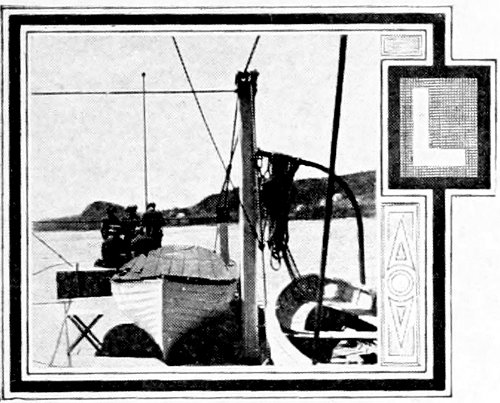
Leaving Fredericton at 8 o’clock in the morning, a start is made on the trip down the river to the city of St. John, the commercial centre of the province and greatest shipping port on the Bay of Fundy.
The journey is full of interest and variety. There are numerous stops on each side of the river, and few daylight trips of eight or nine hours can be taken elsewhere that will compare with this in pleasure. As the boat cleaves the waters of the winding and continually-widening waterway, new incidents mark each mile of its progress.
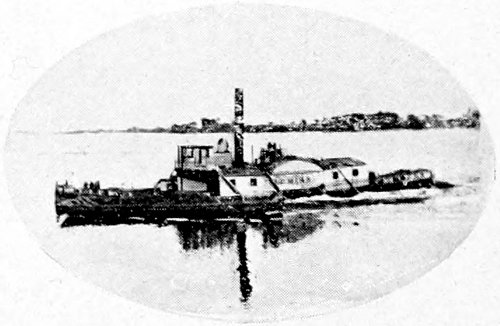
Here is a small tug whose engine capacity is out of all proportion to its size. It is towing a huge raft of timber, and, notwithstanding the heavy pull, is making good progress upstream and against the current. Now, the deep and wide Oromocto River is reached, and a busy scene is enacted at the wharf as all hands on the steamer are pressed into the work of loading produce of every kind on board.
We go only a short distance across stream before reaching another landing, where squash, cucumbers and other vegetables by the barrel, and in immense quantities, are loaded on the lower decks.
Now a wharf is neared where, it so happens, there are no passengers awaiting the steamer, and none to get off. A man puts off in a small boat and makes fast to our boat, well out in the river, transfers some crates of tomatoes—the vessel still in motion and pushes back to the shore.
Nearing a spot where meadow and rolling upland mark a particularly rich agricultural district, a great flat barge or hay-boat is almost ahead, and the steamer slows up to give the boat an opportunity for coming alongside. She is loaded with fine-looking pressed hay, fresh from the fields and done up in the usual bales 174 which are piled on the low boat to such a height as almost to be level with the decks of the large river steamer. No sooner is the barge made fast than men pour out on to the hay, and, while we are still proceeding on our downward course the product of the meadow is quickly stowed away below. It seems only a minute or two before the empty float rises high out of the water, and saluting the two men with a wave of the hand as they cast off, we go ahead under full steam.
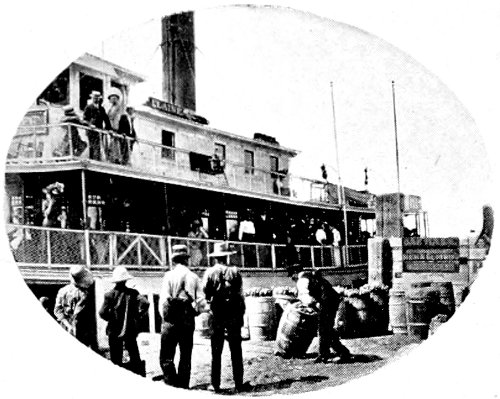
A garden country now comes into view, where fair plots of all kinds of vegetable growth greet the eye in great profusion as we pull inshore. The wharf is stacked with hundreds of barrels of fresh corn and other produce destined for St. John as a consuming and distributing point. There is barely room to move about, but the united forces of steamer crew and wharf gang make short work of the huge stack, and in a few minutes all is nicely stowed away on the lower decks. Ingenious packers they must be down there to stow away such immense quantities so quickly.
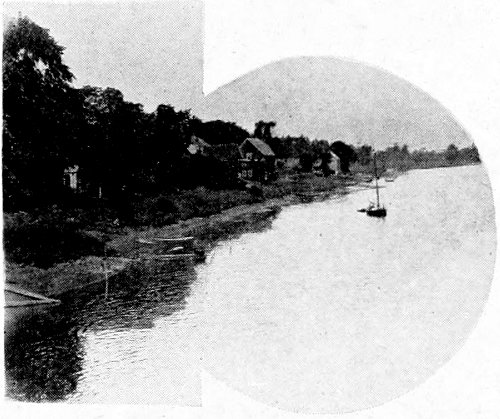
Here a delightful little point is passed, dotted with bungalows and having trim yachts and smart launches moored offshore in a snug little cove. A very pretty picture of comfort, cool breezes and aquatic pleasures it makes, and we are just turning out into midstream when a mellow-toned salute from an upstream passenger boat greets the ear. Passing to the offshore side of our boat a fine full view is had of a St. John River steamboat churning a way to Fredericton at full speed, freighted with a goodly company of happy people all engaged with the superb views of the noble river.
And now a trading sloop passes by so close that we can call to and converse with her crew; and here, as elsewhere, evidence is found of the general courtesy and happy disposition of Maritime Province people, for the men of the small craft crowd to her side and wave their hands in pleasant greeting—as much as to say, “You are on the famous St. John; enjoy it as we do that have been on it all our lives, and love it dearly.”
175
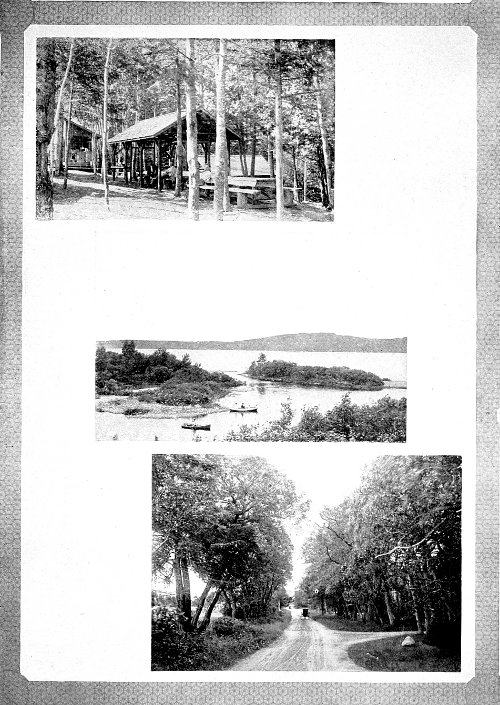
ST. JOHN RIVER
1. Bluff Camp, near Fredericton
2. Westfield, St. John River
3. Willow Avenue, Rothesay
176
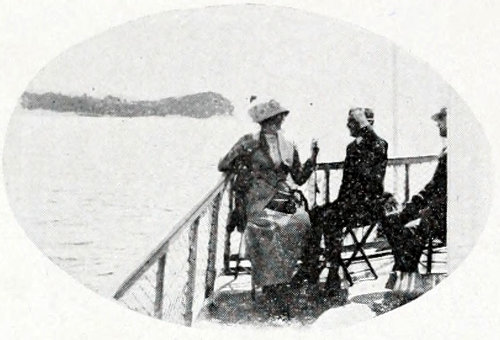
A word to the happy brides and devoted grooms who spread off over summer highways and byways from June to September, and who appreciate ideal and romantic scenery on routes that are not too crowded for comfort, and who like, at times, a little isolation. The St. John River steamers are roomy and capacious, and they have many little nooks and corners where there is just room for two, with a little squeezing, and from which the scenery may be enjoyed with that quiet and ideal environment so suited for the “two hearts that beat like one.” The little spot near the Captain’s wheelhouse deserves to be called “Bride’s Corner.” It is so used, again and again, and from this delightful coign a full view of the river may be had, and it is also a quiet point of observation for viewing life on the forward deck of the steamer.
What if it is breezy at times, so that a wisp of golden hair passes feathery fingers over the bronzed cheek of the happy groom! What if summer gusts festoon her chiffon veil so that clearer view of peachy cheeks is revealed, and what if that filmy and insubstantial shoulder-wrap is displaced by a particularly lively current that comes from the nearby valley! Surely the happy man does not object to the delightful opportunities thus given for adjusting refractory draperies, and for holding them in place with his arm around her shoulder when the gusts are heaviest. Ah! me.... “Bless you, my children,” we whisper in benediction. “May your life ever be like a voyage on the tranquil St. John.”
Here is a charming spot, Camp Bedford, only seventeen miles from St. John, and just the place for the summer homes or bungalows of those who like some social life, and who do not wish to “commune with nature” alone in some more remote spot. A number of pleasant cottages line the heights by the shore, and as the occupants throng the wharf to greet us, the enjoyment they find in life is reflected in their happy faces.
And so with the numerous choice spots that now follow quickly as our destination looms up more nearly. Here the great river widens out to large proportions; and as we pass the frowning cliffs and massive rocks that mark a way to the harbor, it is apparent that few ports have such fine approaches as this, few rivers can match this for scenery—scenery that is unique and all its own. The 177 steamer ties up at St. John at what is locally known as Indian-town.
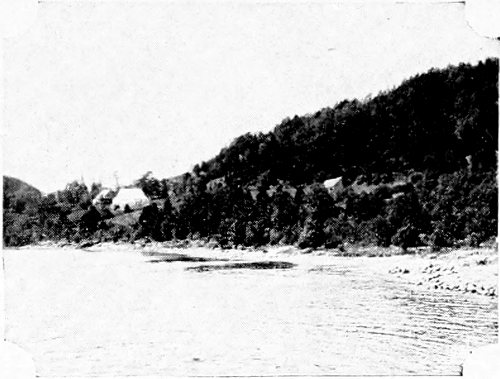
The St. John may fairly be termed an Imperial River, for at different times in the past it has “annexed” large portions of other great rivers, and turned their waters into her own. Both the Restigouche and Miramichi Rivers lost heavily in this way. The length of the river is nearly 450 miles, and no better trip could be planned anywhere than one up to the head waters of this great waterway.
The city of St. John was formerly called Parr Town, but was finally named from the great stream whose mouth it guards. De Monts and Champlain discovered and named the St. John River in the year 1604, or some seventy years after Jacques Cartier’s exploration of the St. Lawrence. That arm of the Atlantic in front of St. John, and known as the Bay of Fundy, was originally named La Baye Françoise by De Monts. On Dochet’s Island in Passamaquoddy Bay the exploration party under De Monts passed a severe winter. The following summer they left the neighborhood and founded a colony at Port Royal in a protected basin on the south shore of the Bay of Fundy. Nearly thirty years later a fort was built near the mouth of the St. John River by Charles La Tour, a man who had much to do with the development of the then French province of Acadia, and whose wife Frances earned undying fame by her noble defense of the St. John Fort while La Tour was absent in Boston.
“Of all the gallant Frenchmen whose names and deeds endure In old Acadian annals, the greatest was Latour.
* * * * *
He built a potent fortress beside that harbor deep, Thro’ which the broad and strong St. John flows with a mighty sweep.
* * * * *
178
Strong were its earthen bastions, its palisades were tall, Heavy and great the cannon that frowned above the wall; And bold and true its soldiers, all men of fair Rochelle— Stout Huguenots who knew no fear, but loved Latour full well.
* * * * *
But none within that fortress, tho’ tried in many a fray— Sons of the gallant men who fought on Ivry’s bloody day— Possessed more dauntless courage to dare or to endure, So kind and yet so brave a heart, as the wife of Lord Latour.”
The French occupation gave way to the English about the middle of the eighteenth century, but the real settlement of St. John was made by United Empire Loyalists, or expatriated loyalists from New England, at the close of the American Revolutionary War.
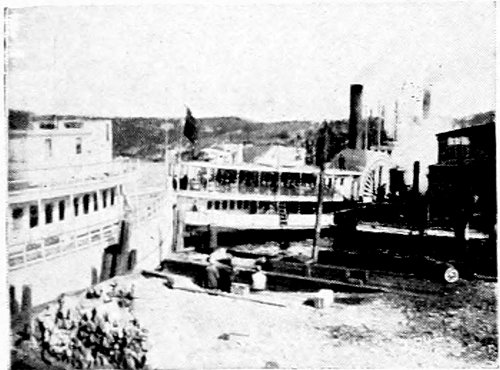
St. John is a very homelike and pleasant city where cool sea breezes may be enjoyed all through the summer. It has restful small park areas or squares, as well as extensive outlying parks and public gardens, and it is surrounded by a wealth of drives, resorts, boating places, beaches and places where all kinds of outdoor sport may be enjoyed. In addition, over one hundred outlying places of much interest are readily accessible from it as a centre, and for fishing and hunting it occupies a position only exceeded by those of the great sporting districts. For maritime pleasures, deep-sea fishing, etc., it shares supremacy with two or three other places such as Halifax and Sydney. It has good hotel and other accommodation, and for chance wet days it has a most excellent public library. In this connection may also be mentioned the Museum of the Natural History Society on Union Street.
It was at the foot of what is now King Street, the principal store thoroughfare, that the American Loyalists landed in 1783 and founded the city. What are presumed to be the remains of earthworks marking the site of Fort La Tour may be seen in West St. John at the foot of Middle Street. It was here that La Tour’s wife, the “Heroine of Acadia,” made such a gallant defense of her husband’s cause. She is supposed to have been buried somewhere near where Governor Villebon is known to have been interred. In this connection the old French cannon on Queen Square is believed to have been taken from the French fortifications, and it is altogether likely to have been one of those to which Whittier referred in his poem, “St. John,” on Charles La Tour and the noble Lady La Tour:
179
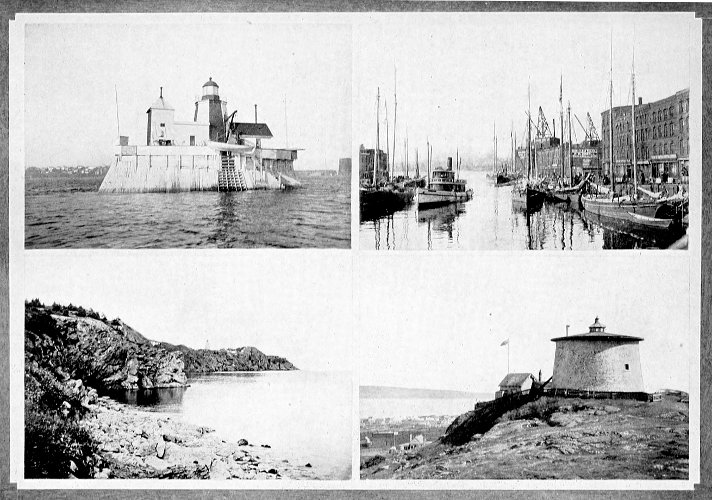
ST. JOHN HARBOR
1. Beacon in St. John Harbor
2. Market Slip, St. John, High Water
3. North Head, Grand Manan
4. Martello Tower
180
“Half-veiled in the smoke-cloud, Her hand grasped thy pennon, While her dark tresses swayed In the hot breath of cannon!”
Fort Frederick, built by the British, and now generally known as the “Old Fort,” stands on the site of the former Fort La Tour. On the Carleton Heights stands a Martello Tower erected by the British about one hundred years ago. It is well worth a visit, and the caretaker has an interesting collection on view inside. There is an excellent view from the top of the tower. At Jemseg up the river an old French fort was occupied by Villebon, before he abandoned it for the fort he built on the Nashwaak, opposite Fredericton.
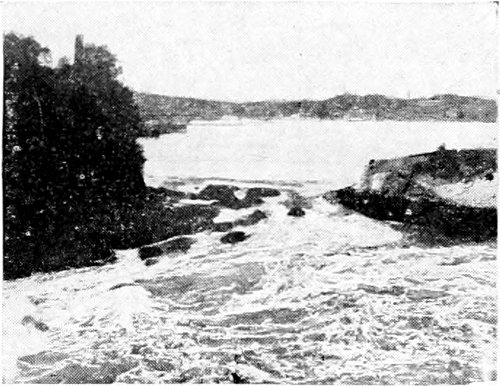
The harbor of St. John is deep and large, and shipping from all parts of the world may regularly be seen at its wharves. Its waters have been the scene of many a naval engagement in times long gone by. The famous “Reversing Falls,” the only phenomenon of the kind in all the world, may be seen at the huge rocky pass where the St. John pours out its great flood into the harbor. An immense body of water passes through this channel, representing the natural river drainage of over 25,000 square miles of country. It is not a fall as ordinarily understood, nor a sheer drop from high to low level. The outlet, though wide, is not sufficiently large to admit the inflow of the tidal water. The tide packs up, therefore, and falls into the river. In the same way the tide recedes in the harbor much faster than it can escape from the river channel, and at such time the fall is outward. Apart from the curiosity of such a strange sight, there is much beauty in the view from the Suspension Bridge. The view of the river from the Fairville side is very good, and the general scene from Prospect Point is also excellent.
181
There is a spot below the Fall where a rocky cavity causes a whirlpool effect at times. It was known in La Tour’s time, and was called the “Pot.” Floating timber was often caught in it and confined in a floating circle for days and weeks. One great tree is known to have been impounded there for many years. In connection with that tree it is told that the Indians called it Manitou, or “the Devil.” To propitiate the evil spirit that lodged—as they thought—within it, they offered homage of beaver skins, which they attached to the tree with an arrow head made of sharpened moose bone.
Rockwood Park is quite close to the city, and is a delightful place in which to spend summer days. It is quite extensive, and is particularly interesting from the fact that it is full of natural beauty, having hill and dale, little glens and waterfalls, ponds, bridges, terraces, etc., and a variety of features that make it an attractive spot. There is rarely any crowd there, and those who love pleasant walks under shady trees, with a fine prospect in addition, may take a book and enjoy country repose on the very threshold of the city. Lily Lake is a pleasant sheet of water, within the park and not far from the entrance. The rocky fall at one end of it is very picturesque, and the climb down reveals a pretty scene. Five other lakes have been constructed to form a feeding chain for the park lake, and these, with the numerous paths and roads that are laid out to them and through the rocks, glens and lakes, add greatly to the recreational resources of the park. If it is visited several times, a complete circuit of its beauties may gradually be made, and the views of the surrounding country, and those of the Bay of Fundy waters, will well repay all who engage in the delightful occupation. The opportunities for rambles, secluded walks, and for discovering many a charming spot, are almost unlimited.
The Public Gardens are at the west end of the park, and a pleasant hour or two may be well spent in either ramble or rest, to view the floral clusters so tastefully displayed.
There are golf, tennis and yachting clubs in or near the city; and unlimited opportunities for the enjoyment of sailing, yachting, 182 boating and canoeing are found on different nearby waters suited to each preferred form of aquatic recreation.
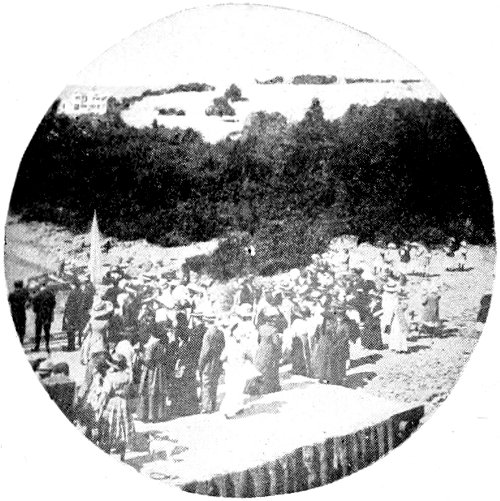
Nearby Bay Shore beaches are found at Seaside Park, Blue Rock, Broad View and Bay Shore. These are all reached quite easily by street railway or ferry.
Trout fishing is free at the fine expanse of lakes known as Loch Lomond. There are hotels at which to stop and from which boats may be hired. A drive of about eleven miles is necessary to reach the first lake. There are many other choice lakes and streams where the fishing rights are private. As a general statement permission to fish in many of the private waters may be obtained on application at the Tourist Bureau in the city.
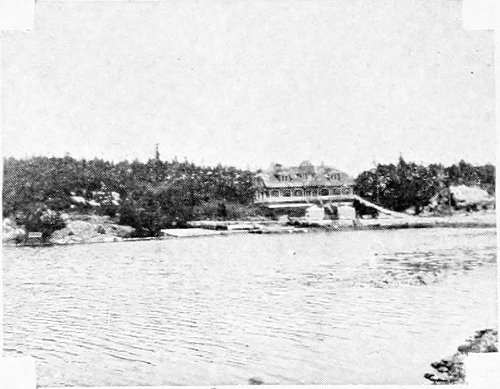
There are many pretty drives along the country roads to nearby places. One of these is by way of Adelaide Street to Milledgeville on the Kennebecasis River, where will be found the club house of the Royal Kennebecasis Yacht Club. The return may be made by Ragged Point, for the sake of the fine view from there of river and islands with boats and vessels of every description passing in all directions. Another is to Indian Town, Pleasant Point, Fairville, the Suspension Bridge and Reversing Fall; crossing the bridge and returning by way of Douglas Avenue with its lawns and comfortable homes. By crossing on the Carleton Ferry many pleasant roads are available, and in this direction the Bay Shore may be reached where there are pleasant coves and bathing places. Still another is to ‘Three Mile House,’ and Rothesay on the Kennebecasis River. Then Adam’s and McConnell Lakes, Loch Lomond, Golden Grove and Chamber’s Lake, as well as the Bay of Fundy, by way of Black River Road and Enchanted Lake, are pleasant drives. Good views of the city are obtained from Fort Howe Hill and from the heights of Mt. Pleasant.
183
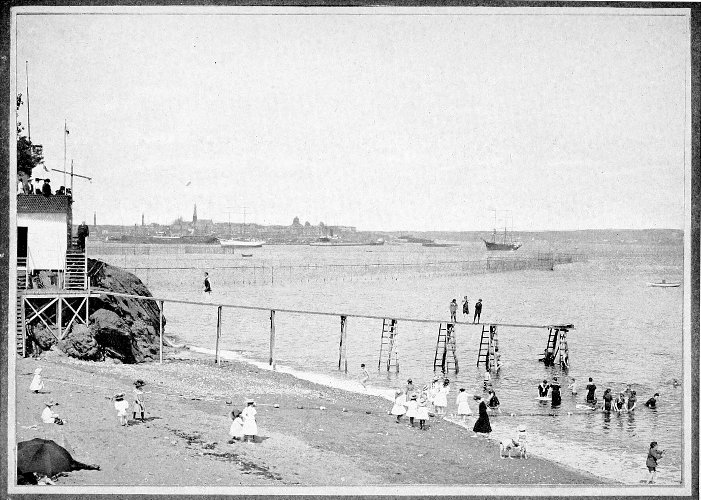
Beaty’s Beach, St. John
184
The best way to enjoy all that St. John contains is to settle down quietly in a comfortable hotel or other stopping-place, call at the Tourist Bureau, register and obtain their St. John Booklet with map, purchase McAlpine’s Road Map of St. John, N.B., and County, and then become familiar with the city and environs by using the street railway, and taking rambles from place to place. Helpful maps also are the St. John River Steamship Co.’s, showing the places on the river as far up as Fredericton; the Kennebecasis Steamship Co.’s, showing the Kennebecasis River as far as Hampton, and the May Queen Steamship Co.’s, showing Grand and Washademoak Lakes, and the places between St. John and Chipman. With these at hand the surrounding topography will soon be known, and a logical plan of operations can soon be planned out. There are other river steamboats with short runs, and still others that make occasional excursions; but particulars relating to these are best obtained on the spot.
The favorite sea trips are those to Digby by Dominion Atlantic ferry Prince Rupert, and to lovely Campobello, pleasant Eastport and picturesque Grand Manan (island of bold and romantic cliffs) by the Grand Manan Steamboat Co. There are trips also to Parrsboro and Kingsport on the Minas Basin at the head of the Bay of Fundy.
Many of those who reach St. John by sea, principally from the West, make it the whole object of their trip, sojourning there, taking local excursions and finally returning over the route by which they came. Others, of course, make a stay there, and then visit the interior by way of the St. John River to Fredericton, going over the Intercolonial Railway from thence to Miramichi Bay and Bay of Chaleur, and so on to Quebec and the St. Lawrence. Or they pass over the St. John-Moncton division of the Intercolonial to Nova Scotia, Prince Edward Island or Cape Breton. Wherever they go they will find Indian villages and encampments; and a few words on this feature of Maritime Province life will not be amiss here.
Visitors who wish to enjoy their vacation to its full extent should not make the mistake of taking a flying trip through an Indian village. Our life would not be understood by a stranger who took only a momentary glimpse of it, and this is true in a much greater degree of Indian life. The Indian does not live nearly so much on the surface as we do, for he is silent and uncommunicative; and we are apt to err in judging from superficial observation that there is little in his life worthy of note.
The Indian has to be drawn out. Gain his confidence—let the newness of strangership wear off gradually—go and be piloted by him over many a foaming rapid—go with him in the woods—share a tent with him under the moon by night—put up your own tent near his village, and visit his humble little home—do all this, and you will learn much.
185
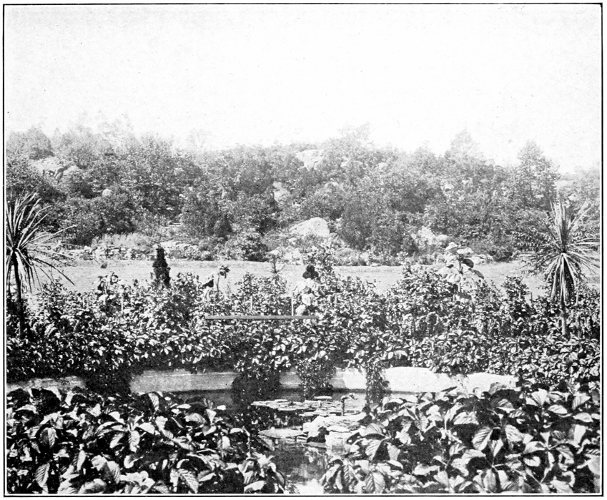
Public Gardens, St. John
“He makes his way with speed and ease Through woods that show the noonday star, The moss-grown trunks of oldest trees His lettered guide books are.
Needs he a fire? The kindling spark He bids the chafed wood reveal. Lacks he a boat? Of birchen bark He frames a lightsome keel.”
Some of the older Indians have a natural dignity and beauty of expression that is wonderful. In time you will hear many quaint incidents of their lives; and if you are patient and gain their confidence, tales they have heard and the traditions of their fathers will gradually be yours.
186
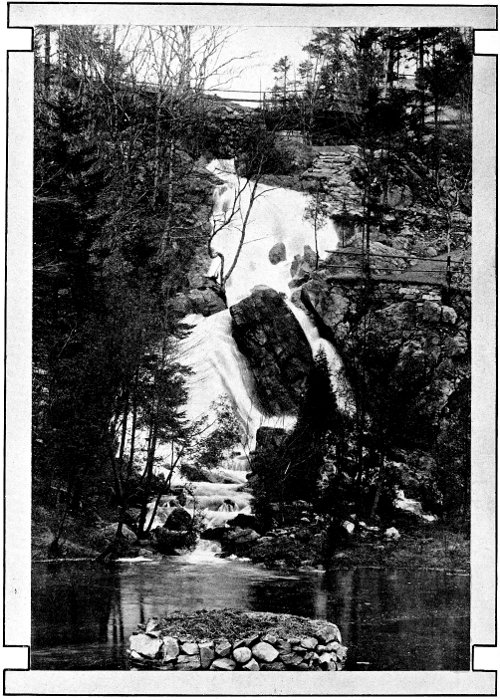
In Rockwood Park, St. John
187
It is, of course, difficult to understand an Indian properly in any tongue other than his own. His English is often broken and peculiar. Here is a “snake story” just as told by a Maliceet: “From dis landin’, ’bout tree, may be four mile, I s’pose, dere’s a loggin’ road. ’Bout nine years ago, in de fall, I was goin’ down dat road with Archy Lodge, when we saw big pine log lyin’ right cross de road. Archy he say, ‘s’pose we have chop dat log to get team by.’ I say, ‘Yes, s’pose’; an’ Archy he get off an’ go to git de axe. Den dat tree he move right out de road, an’ go trough de brush like de devil, an’ break down maple saplin’s big’s my arm. So ’twas a big snake!”
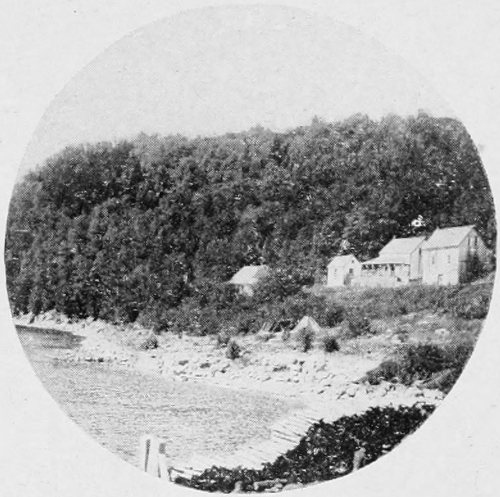
Maliceet Indians are now found chiefly on the St. John River and its tributaries. The Micmacs are found in eastern parts of New Brunswick, and in Nova Scotia and Prince Edward Island. The Micmacs are not a cross between the Irish and Scotch—as has been humorously remarked might be thought from their name. Both Maliceet and Micmac trace their descent from the great Algonquin nation.
Indians are eloquent. Read the reply of the old Maliceet chief to the Government Commissioners who were sent to dispossess the Indians of their lands at Medoctec on the St. John. The commissioners asked: “By what right or title do you hold these lands?” The old chief, with knowledge of right on his side, pointed to the little enclosures by the river as he gravely said, “There are the graves of our grandfathers! There are the graves of our fathers! There are the graves of our children!” To this argument the commissioners could make no reply, and the Indians were left in possession.
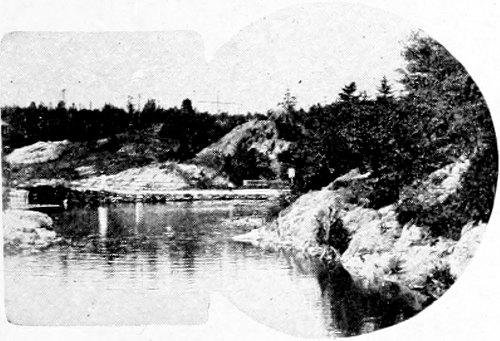
188
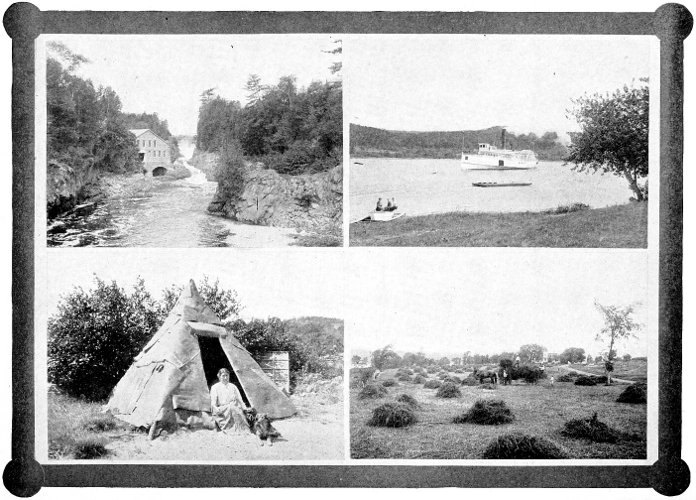
ST. JOHN RIVER
1. St. George Falls, N.B.
2. Evanisle, St. John River
3. Indian Camp, St. John River
4. Haying at Lakesie, N.B.
189
An Indian courtship was formerly a very simple affair. If a young brave decided to marry—his relatives approving—he would go into the wigwam where an “eligible” maiden lived, and look at her without saying one word. If he liked her appearance he tossed a chip into her lap. This was “popping the question.” The maiden would shyly pretend to examine it closely while taking covert glances to “size up” her admirer. If “smitten,” she would throw the chip at him with a pleasant smile, and then nothing was wanting but the service of the priest to bind the marriage tie. If, however, the young brave was not a man to her liking, the chip would be tossed aside with a frown, and he would then be obliged to seek elsewhere.
A full wedding ceremony took place in the following way. On the appointed day the happy brave, accompanied by his relatives, went to the bride and her assembled friends. She was “given away” by her father, and was then dressed in a handsome costume, a present from the groom. All then took their way to the village green to participate in the wedding dance, at which the whole village was present. The following day the newly-wedded pair started on a canoe honeymoon trip. At some choice spot, chosen for its beauty and romantic surroundings, both knelt together and made vows of unending affection, The neighborhood of some great rock was always preferred, and the enduring rock was invoked to witness the vows thus made. A tree was rarely chosen because of its being more perishable than a rock.
The superior civilization of the Indian knows little of infidelity, and nothing of divorce.
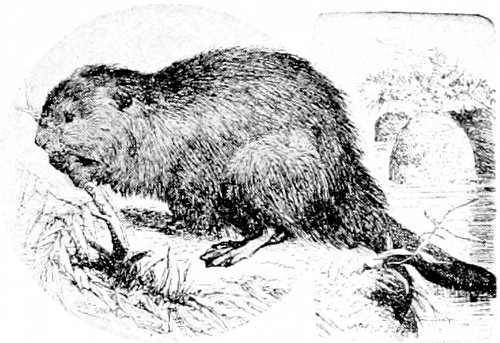
All the Indian peoples of Canada had, and still have, superstitious and strange fancies. Animals, plants, mountains, rivers and great rocks were supposed to have indwelling spirits. They were, therefore, treated with respect. Even to animals of the chase, such as bear and beaver, etc., they would offer an apology for the necessary pursuit. Fishing-nets were even included in a ceremony which consisted of an address to the fish begging them to take courage and be caught, soothing them also by the promise that due respect should be paid to their bones. Plants had souls, the Indians believed; and, in addition, they held the belief that elves and fairies of great beauty and marvellous powers dwelt in hill and valley. The high mountain tops were supposed to be inhabited by gods with wonderful attributes; and the sound of thunder, the voice of the rapid, and the roar of the great cataract were all manifestations 190 to them of individual divinities. Above all was the overruling Manitou or Great Spirit.
The Indian settlements on the St. John River and elsewhere in New Brunswick, as well as in Nova Scotia, etc., are well worth a visit; and all who wish to understand the life and ways of those who have so well been named “Children of the Forest,” should give some time to a pleasing form of recreation that is sure to bring many hours of happiness in its train.
191
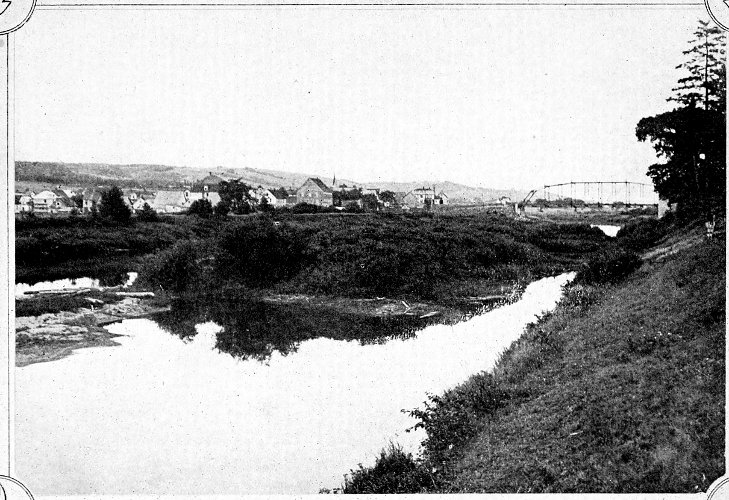
Kennebecasis River
192
