St. John to Moncton and Point du Chene
Reading edition

The trip by steamboat from St. John up the Kennebecasis will have given many a view, distant and near, of the beautiful valley and the garden country surrounding it. The course of the river steamboat is to the west of Long Island, and hence of such pretty suburbs as Renforth and Rothesay only distant glimpses may be had. Hampton is the head of steam navigation; but the river runs up to Norton, Apohaqui, Sussex and beyond, in all of which places pretty views may be seen. These places, therefore, are best seen from the Intercolonial Railway, which passes through the heart of the several districts; and, in addition, the road runs up to Petitcodiac village and along by the river of that name as far as Moncton.
Renforth, Rothesay, Hampton and the various summer resort in the vicinity of St. John lying on or near the Kennebecasis are all pleasant vacation spots, justly prized by the inhabitants of the prosperous city for which they provide such convenient and delightfully situated country places.
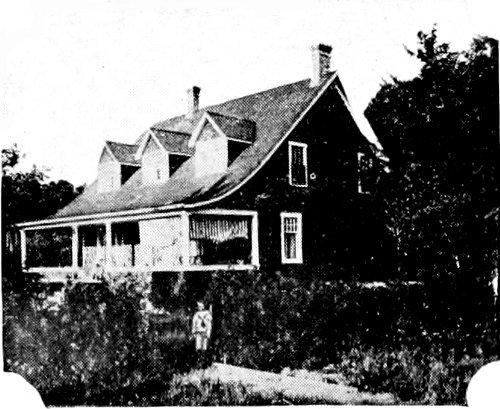
At Renforth there is a choice little cove or bay where summer cottages face riverwards along a breezy ridge that follows the course of the stream at this point; while at Rothesay the bungalows are very prettily disposed in the woods by the shore, and on the pleasant slopes above. At both of these places good boating, sailing, and canoeing may be had, as well as motor boating. River bathing is enjoyed by nearly all who summer in these charming spots. While not so cool as seaside places, they are appreciably cooler than town or city, and on that account they have become 193 favorite resorts for St. John people, as well as for others from more distant points.
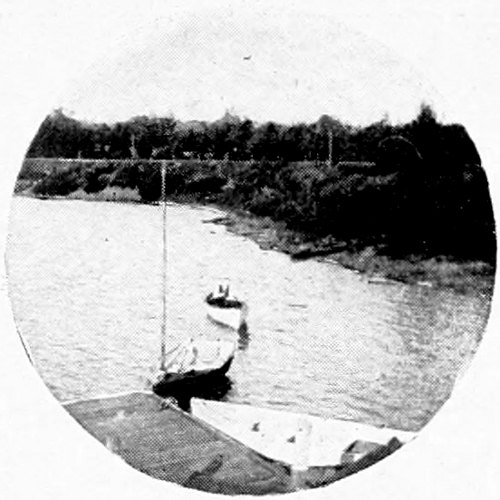
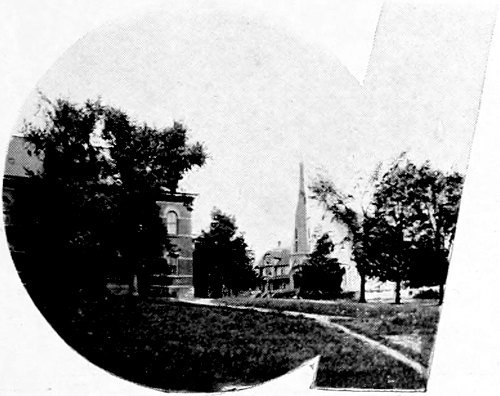
Above Rothesay the railroad strikes inland a mile or two from the river, but at Jubilee and Nauwigewauk it resumes its river course and holds it until near Hampton, where it is about a mile from the part of the village that fronts on the water. Hampton, however, may be said to run almost from the station to the river, and with the pleasant inn or summer hotel close by the station, the pretty village, the Court-House green, and the splendid view from the hills, together with the many shady walks, this part of the village has many attractions.
Hampton is the head of Kennebecasis River navigation for steamboats; and as all the pleasant resorts just named are either on the river or near it, those who summer in this neighborhood will soon become familiar with the enjoyable scenery of the Kennebecasis. At Hampton-by-the-River, it should be added, there is a comfortable homelike hotel or stopping-place. The surroundings of the whole village are all picturesque, and such as conduce to pleasure in walks, drives and rambles.
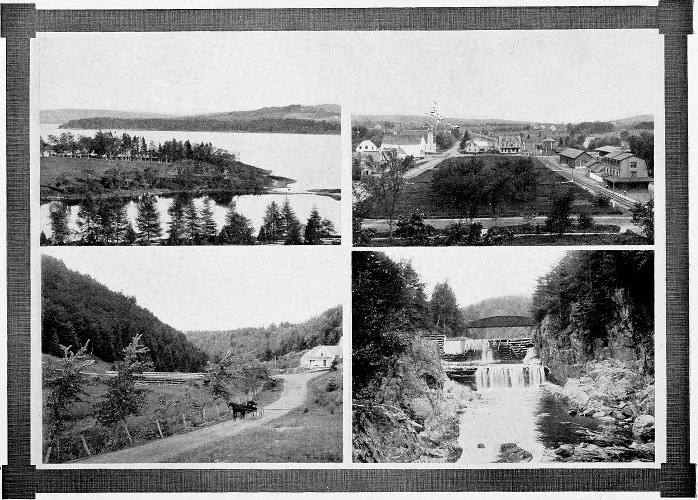
An enjoyable water outing may be taken on the river by boarding the steamboat at Hampton and going downstream to St. John. At first a way is threaded through the meadows by a varied channel that makes it necessary to “double” and often head in an opposite direction, to pass some island or follow the devious windings of a stream that makes bends and turns and double-bends in its course. At last the meadows are passed, however, and a typical river course with regular channel is entered. Here high hills and steep ridges line the way. The view at Clifton is very fine, and at Moss Glen and Chapel Grove it is almost equally good. As St. John is neared the steamboat passes into the waters of the larger river and takes its way past the Boar’s Head, and round south to the Indiantown Wharves.
194
ST. JOHN TO MONCTON
195
From Hampton a short railroad runs to St. Martin’s and Quaco on the Bay of Fundy shore. St. Martin’s is a favorite excursion point that is readily reached by a short sea journey from St. John. Quaco, almost immediately joining on the south, has a very pretty harbor. Bold cliffs and little stony beaches are prominent features in its attractive scenery.
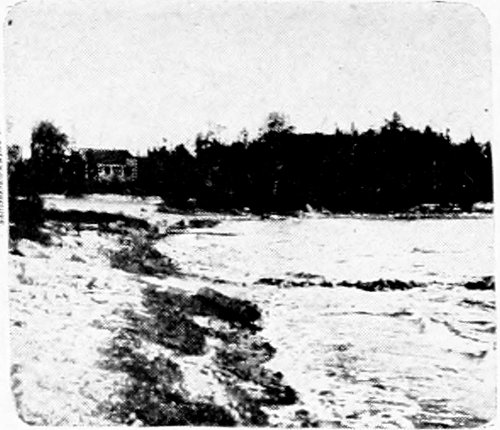
Journeying north-east from Hampton along the line of the Intercolonial Railway the course of the upper Kennebecasis River is approximately followed by way of Norton, Apohaqui and Sussex through a very pleasant pastoral country. These are all excellent summer places, and from nearly all of them fishing is within easy reach. From Norton a short railroad runs through choice country to Grand Lake, Chipman and the Salmon and Gaspereau Rivers. Apohaqui has a favorable situation at the mouth of the branching Millstream, while the smart little town of Sussex has a delightful site with its own pretty little waterway stretching off through the Sussex Vale to the southeast.
After leaving Penobsquis the railroad soon crosses North River, and the upper waters of the Petitcodiac; then following a course first west and then north of the Petitcodiac River, it reaches Moncton. Petitcodiac is not only a pretty village itself, but it has much romantic scenery surrounding it. The Pollet River Falls to the south-east are well worth seeing, and the river itself invites to many a ramble.
At Salisbury a short railroad runs east to Hillsboro on the Petitcodiac River, and from thence in a southerly direction along the west shore of Chignecto Bay to Albert, Harvey and Alma. The country round about Albert is very picturesque, and Alma on the Bay Shore is an attractive village. The peculiar Hopewell Cape Rocks are generally reached by driving from Hillsboro. Ample recreation is found through this district in fishing, walking, and driving; and there is boating on Chignecto Bay, etc.
Few would recognize the progressive and prosperous city of Moncton as the place that originally came into being under the modest name of “The Bend.” The name applied to the river, Petitcodiac, which seems a blending of French and Indian, means a “bend.” Soon after the middle of the eighteenth century the place 196 was named after General Monckton, once Lieutenant-General of Nova Scotia, who had served at Louisbourg, served also as second in command under General Wolfe at the taking of Quebec, and who later was British Governor of New York.
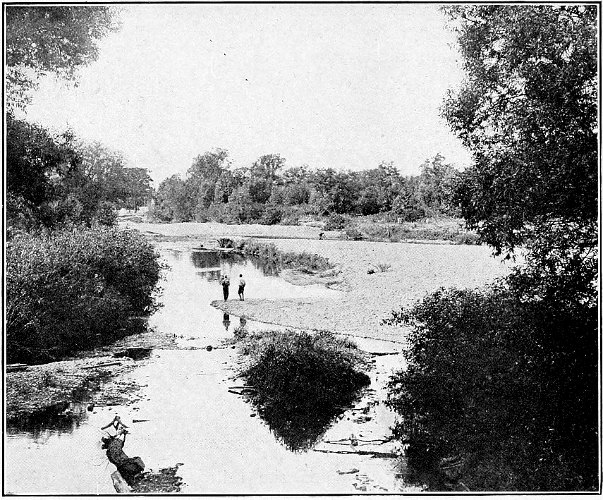
On the Kennebecasis River
Some of the early settlers of “The Bend,” as Moncton was then known, came from Philadelphia and the Delaware River in pre-revolutionary days. One of these early settlers built a log house on the spot where now stands the railway round-house. Some United Empire Loyalists assisted in the settlement later on. The place had a gradual growth until 1872, when it commenced a new life by becoming an Intercolonial Railway centre, with workshops, etc., and to-day, as a consequence, it is an important town, full of life and vitality.
197
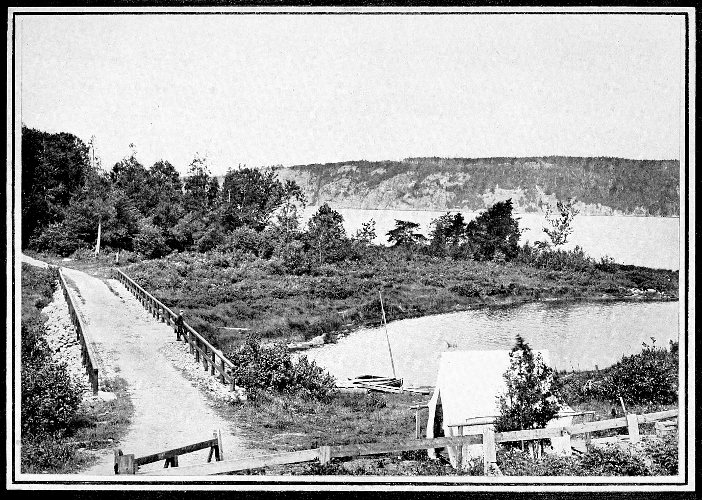
Rothesay Park Bridge
198
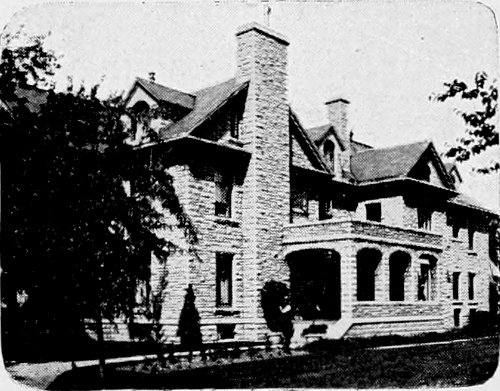
Moncton—General Offices of the Intercolonial Railway through the Trees
The management and administration of the Intercolonial Railway, as well as the clerical, constructive and auxiliary staffs, all centre in Moncton. As a consequence, about 2500 of the town’s population are in Intercolonial employ.
The General Offices of the Railway occupy a prominent position adjoining the station grounds. The building has recently been extended to give much needed room, and with its pleasant surroundings gives comfortable quarters for the working staff of the system.
The city bears on its face every evidence of prosperity, and it has many excellent stores and pleasant residential streets.
The Moncton and Buctouche Railway has its headquarters here; and Moncton is also the eastern terminus of one of Canada’s trans-continental railway systems, the Grand Trunk Pacific.
The phenomenon of the Bay of Fundy “Tidal Bore” is best seen on the Petitcodiac River at Moncton. The rise and fall of the tide here shows a difference of thirty feet between extreme high and extreme low. At favorable times the height of the incoming 199 wall of water, or “bore,” is between four and five feet. At such times it is a very wonderful and interesting sight.
There are a number of pleasant walks and drives in and around the city, with drives of a more extended character to Shediac and Hopewell Cape and Rocks. By rail, too, it is easy to reach many pleasant spots in a very short time.
Many will be surprised to learn that there are splendid oil and gas fields in the neighborhood of Moncton. A number of wells have been drilled, and some are exceedingly productive.
The importance of this development will be understood from the mere statement of the present capacity of the gas wells, which is fifty millions of cubic feet daily; nor does this represent a maximum capacity, for the industry is just in its infancy; the first public consumption of gas in Moncton dating only from the year 1912.
The Intercolonial Railway uses nearly two million feet of gas daily in its workshops, and manufacturing plants generally are hastening to adopt gas as a substitute for coal. As is well known, gas is much more efficient and economical than coal as a fuel; and the product of the local gas wells is of excellent quality, its thermal value being high. A striking modern example of the use of gas fuel is demonstrated in Moncton, for here the electric power for street railway purposes, for the pumping station at the waterworks and for street and domestic lighting is all generated economically through the use of gas as a fuel.
Although natural gas is used so generally by manufacturers and residents of Moncton, and is also piped into the village of Hillsboro, in Albert County, its use is less than ten per cent. of the yielding capacity of the present gas wells. It is also believed that other wells will be discovered, and many experts are of the opinion that the gas field has merely been tapped on the fringe.
The early expansion of Moncton as a manufacturing and residential centre will be apparent to those who study economic conditions, for in addition to the low cost of gas as a fuel for manufacturing and general power purposes, the use of it as a substitute for coal in the important detail of house heating in winter shows a saving of over eighty-five per cent.
It will be remembered that from Newcastle and Chatham Junction a course by the Miramichi River was traced, followed by another along the Nashwaak to Fredericton. From that point a further course was traced down the lower St. John River to the 200 city of St. John, and thence to Rothesay, Hampton, Sussex and Petitcodiac to Moncton.
Starting now from the Miramichi River and Chatham Junction and proceeding along the main line to Moncton, a section of country is traversed that is inland from the Northumberland Straits Coast a varying distance of twenty to twenty-five miles. The railway line in its progress crosses the main Barnaby River as well as its upper waters, bridges the Kouchibouguac, the Kouchibouguacis and the Richibucto Rivers, and passes over the headwaters of the Canaan, Buctouche, Cocagne and North streams. At Kent Junction railroad connection is made for Richibucto and St. Louis; and from Moncton a line runs to Buctouche.
Richibucto and St. Louis are Acadian settlements, the former a prosperous place from which timber is shipped. There is bathing not far from Richibucto, with boating and other shore recreation.
Some of the small streams between the Barnaby River and Moncton are used for logging in the spring, the headwaters of some of them being not over twelve feet wide. In places where the river has not risen high enough, the logs may be seen packed side-by-side, like matches, or piled high in a confused heap with projecting timbers, presenting the appearance of a chevaux-de-frise. With a heavy rainfall, however, these streams swell to considerable proportions; and the logs are easily borne down to the mills, and to the coast, with some attention here and there to free the timber when it jams.
Buctouche, at the mouth of the river of that name, is a little Acadian watering place about two hours’ run from Moncton over the Moncton and Buctouche Railway.
In a north-easterly direction from Moncton the line of the Intercolonial Railway reaches Painsec Junction. The main line here passes to the east, after throwing off a short branch that leads to Shediac and Point du Chêne.
Shediac is a pleasant town situated on a broad harbor, sheltered by Shediac Island. It has a good sand beach, and is celebrated for its fine oysters. There is excellent fishing here, both in fresh and salt water. The place was once strongly garrisoned by French troops.
201
North of Shediac is a large Acadian settlement, the Cocagnes, reached by coast road, or by boat around Cocagne Cape and into the mouth of the Cocagne River. East of Shediac are other interesting Acadian villages; these also are accessible by coast road and boat.
Point du Chêne is well placed as a pleasant little Summer place for boating, etc., but it is chiefly known as the place of departure for the passenger steamships crossing the Northumberland Straits to Summerside, Prince Edward Island. Steamships for other parts of the same island leave from Pictou, some 140 miles east; but the Point du Chêne route is preferable for all but those who come from Cape Breton, Halifax, etc., and the comfortable and smart-looking steamships of the Prince Edward Island Navigation Co. that cross from Point du Chêne to Summerside leave nothing to be desired in the way of equipment and speed.
202
203
