Moncton to the Atlantic over the Halifax Division
Reading edition
Going from Moncton, and turning east at Painsec Junction, the main line of the Intercolonial Railway to Truro and Halifax may now be followed. The line soon dips south and crosses the peninsula that juts out into Chignecto Bay. Dorchester and Sackville are thus reached, and then the boundary line is passed that marks an entrance into the province of Nova Scotia.
The first district thus traversed is that of the Memramcook Valley, with its interesting Acadian villages. The scenery of the almost level valley and its high wooded ridges is very pleasant. Dorchester, with its excellent farming land, has water communication with and is almost on the Chignecto Bay. Sackville is a growing and prosperous place at the mouth of the Tantramar River. It is widely known for the excellent educational advantages it provides for the acquirement of many branches of learning, by both sexes. The University of Mount Allison College grants degrees in Divinity and Arts, and has honor courses in Classics, Mathematics, Science, Philosophy and English Language and Literature. In the study of Law it has an affiliation with the Dalhousie Law School. The Academy and Commercial College is well equipped for good work, and the Ladies’ College has a splendid music department (Conservatory of Music) with every facility for thorough study, including a fine three-manual pipe organ. The Owens’ Museum of Fine Arts, in connection with the Owens’ Art Institution, has a notable collection of over four hundred works of art. All of these institutions have an excellent reputation, and they enjoy a liberal patronage from all over the provinces. The Tantramar River also empties into Chignecto Bay. The Tantramar marshes are widely known for their enormous crops of excellent hay. Heavy shipments are made of fine cattle that have been raised in this district.
230
“Tantramar! Tantramar! I see thy cool green plains afar. Thy dykes where grey sea-grasses are, Mine eyes behold them yet.”
A short railway line runs from Sackville to Cape Tormentine.
In winter the Northumberland Strait is frozen in heavy ice, through which the regular summer steamships cannot force their way. Special ice-breaking steamers are therefore placed on the most open route between Pictou and Charlottetown or Georgetown; but the ice is occasionally so thick that even these powerful vessels are unable to force their way across the frozen strait. At such times the short crossing from Cape Tormentine to Cape Traverse is used, and the mail is carried in ice-boats with double keels made to act as “runners.” These are pushed by hand over the ice, and put into open water as required. An account of a trip in this novel kind of “ferry” forms part of the description under the heading “Prince Edward Island.”
The Missiguash River being now passed, and the province of Nova Scotia entered, a brief description of the main features of the seaboard province is here given.
The peninsula of Nova Scotia is so nearly surrounded by water that it is frequently termed an island. It is connected to New Brunswick and the mainland by a comparatively narrow isthmus at the head of Chignecto Bay. The province of Nova Scotia is made up of this peninsula and the adjoining island of Cape Breton to the northeast, separated only by the Strait of Canso, which is not much more than a mile in width at its narrowest part.
As has already been stated, the four provinces of Quebec, New Brunswick, Prince Edward Island, and Nova Scotia offer wonderful contrasts in scenery and natural configuration. They also offer a pleasing variety of climate. As would be expected, it is cooler the nearer the approach to the open Atlantic shore; and it is cooler again the farther east and north one proceeds along the Atlantic seaboard. From this it will be understood that on the north, or Bay of Fundy and Northumberland Strait shore, it is warmer than on the south or open Atlantic side. On the north the climate approximates closely to that of the Lower St. Lawrence and southern part of New Brunswick. The south shore, then, is the coolest part of the Maritime Provinces, and on the south shore itself an increasingly lower temperature may be enjoyed as progress is made up the coast in an easterly direction. It is important to remember this, for out 231 of the variety thus provided it is possible to choose a climate suited to almost every need. In the chapter “Where to go—Recommended Places,” these features are clearly explained.
The peninsular part of Nova Scotia is not nearly so mountainous as the sister provinces of Quebec and New Brunswick, although it is much more so than Prince Edward Island; but the island part of Nova Scotia, Cape Breton, has ample variety of mountain and vale, and has in many parts of it all the bold features found in rugged and mountainous countries. The peninsula is not without its own mountains and chains of hills; but its bold and striking scenery is found chiefly on the Atlantic coast side, the rocky bays and headlands of which receive the full force of the fierce winter gales.
Nova Scotia has a coast line of over one thousand miles, and it is rich in bays, inlets and fine harbors. Its rivers, though numerous, are not large. No great system of intercommunicating waterways is found in the province, but the peninsula is so well watered by lake, river, and stream that fully one fifth of its area is thus occupied. In Cape Breton, for instance, the inland sea known as the Bras d’Or Lake is about fifty miles long. It fully answers the purposes of great intercommunicating waterways, for this enclosed sea has an interior reach over a very large extent of country. Peninsular Nova Scotia has numerous lakes, mostly of moderate and small dimensions, although Rossignol Lake and a few others are quite large.
The province is bountifully blessed with many beautiful bays. The easterly extension of the Bay of Fundy, known as Minas Basin, reaches inland some sixty miles; and here the equinoctial tides have been known to show the wonderful difference in level of forty to fifty feet.
The Maritime Provinces are bound together by the strongest ties. Each province has its own advantages peculiar to its situation and natural resources. In many cases what one has the other has not; and climate and beauty of scene will be found in such delightful contrast in passing from one province to the other that few not acquainted with these facts could believe.
It is now matter of general knowledge that the early settlement of Nova Scotia was made by the French. De Monts and Champlain explored parts of the south shore, entered the Annapolis Basin, 232 made choice of a site there for settlement, and explored the Minas Basin. Later they founded Port Royal, in the year 1605, but abandoned it a few years after. Some Scottish settlers endeavored to open up the country. They made little progress, and it was the French who increased most in numbers. Then came the Acadian Expulsion, followed by a more rapid general settlement; for by this time Halifax had been founded, German colonists began to arrive, and, in later years, disbanded British regiments and United Empire Loyalists commenced to swell the population. In the meantime the province as part of Acadia, and later as Nova Scotia, had several times been owned in turn by the French and English; but finally after the taking of Quebec by Wolfe, and after the close of the American Revolutionary War, a lasting peace ensued, and Nova Scotia, as part of Canada and the British Empire, has prospered. Other details of history that are of sufficient importance are brought out in connection with the descriptions of localities.
Resuming the description of the country traversed by, and that tributary to, the Intercolonial Railway, at the boundary line of the two provinces of New Brunswick and Nova Scotia, the railway, immediately after crossing the line, reaches Amherst, not far from Cumberland Basin.
The bright and prosperous town of Amherst is a pleasant centre for a number of other interesting places. To the north is Tidnish on the Northumberland Straits, a little watering place where good boating and deep-sea fishing may be enjoyed. Stages run N.E. to Head of Amherst, and there are other places, remote from the railroad, that are quite interesting.
The works of the Chignecto Marine Transport Railway are within easy reach by carriage. This abandoned project was intended to lift ships of a thousand tons, place them on huge ship-carriages by means of hydraulic power, and then haul them by locomotives to the terminus on the Northumberland Straits near Tidnish, where they were again to be put in the water and so save the great distance a vessel must now go to reach the St. Lawrence from the Bay of Fundy.
A few miles north-west of Amherst are the ruins of Fort Cumberland beyond the Aulac River. On this site formerly stood the French fort of Beausejour. It was from Fort St. Lawrence, also in the immediate neighborhood, that the attack was made on the 233 French fort that resulted in its capture. In revolutionary times the Americans attacked Fort Cumberland after it had passed into the possession of the British. The attack failed, and the Colonials were compelled to give up and retire on the St. John River. The view of Fort Cumberland is still an interesting one, and many Acadian relics have been found in the vicinity. The view from the bastions of the old fort is superb and far-reaching.
At Maccan Station coaches may be taken to Minudie and Joggins. It will come as a surprise to many when they learn that the “Elysian Fields” are near here. But such is the case, for that is the name of the rich meadows near Minudie on the Chignecto Peninsula. The Joggins Shore is not far from Minudie. It received its odd name from the remarkable configuration of the cliffs which “jog in” and out so wonderfully that many have been attracted here to study the phenomenon. The cliffs are strikingly bold, often approaching four hundred feet in height. Fine views may also be seen by taking the long drive to Apple River. Advocate Harbor is another quaint and distant place, well worth a visit. Good fishing is found on the upper waters of the Apple River which reach out to Caribou Plains.
At Springhill Junction a short railroad leads west and south to Parrsboro on the north shore of the Minas Basin. Here will be found a pleasant little summer resort where boating and fishing may be enjoyed, with good hunting in season. Fine views are obtained from Partridge Island in front of the harbor. There are also good roads and pleasant drives to places nearby. Moose River and Five Islands to the east may be reached in this way, as well as Advocate Harbor and Cap d’Or on the west. Massive Cape Blomidon, the end of the North Mountain chain, is only eight miles distant on the projection that makes out from the opposite or southern shore of Minas, and excellent views of it may be had from the steamboat running between Parrsboro’ and Kingsport.
At River Philip and Oxford Junction, on the Intercolonial Railway, a very pretty country is found, and both for fishing and country rambles the district is an excellent one.
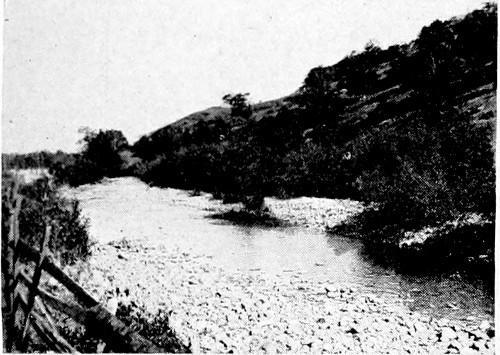
The country between Westchester and Folleigh Lake is remarkably beautiful, and this, the Wentworth Valley, is one of the garden spots of Canada. Many pretty views are had from the train as it climbs the Cobequid Mountains which here run from east to west.
234
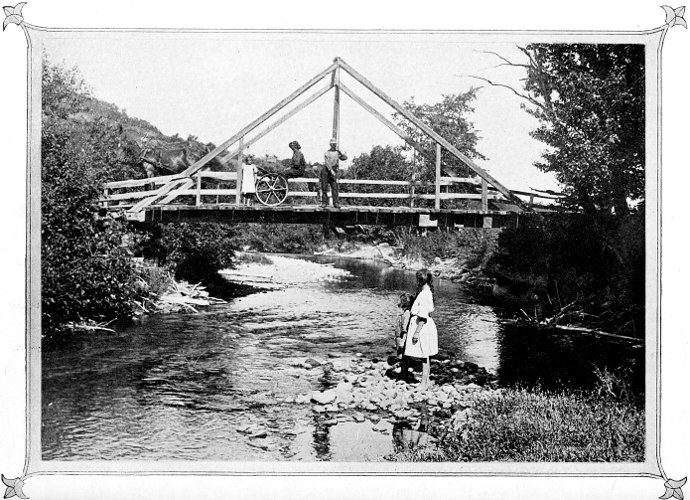
Wallace River, Wentworth Valley
235
A drive or, better still, a walk through the valley will bring a hundred pleasures to those who love nature and the beautiful. Here is the winding Wallace River, and here, too, are fifty tiny streams, waterfalls and brooks. Some are dashing headlong and sparkling in the sun; others, with white foam shaded to a cream by the overhanging trees, have inner depths that the eye cannot fathom until accustomed to the narrow limits of light and shade.
The air is musical with falling and rippling water, so here let us take a seat by the side of this merry cascade and listen to Nature’s harmonies. So various are the notes, each waterfall having its own, it is not difficult to select sounds that make melodies. But whatever the melody, the dominant harmony is that of joy and gladness, and as the eye views mountain, valley, woodland, river, waterfall and plashing brook, surely no fairer scene could well be imagined.
And listen to the birds as they add their merry roundelay.
“Break out and sing, ye happy birds! Your tender music needs no words To tell us everything.”
But the green shade of the woodland is inviting, and following the gayest and most dashing of little streams that ever ran from mountain side to woodland depths, we trace a path by the wild flowers, and pass in, deeper and deeper. Right at the threshold is the daisy.
“No shame feels she, though in lowly place, No envy of rivals gorgeously clad, Contentment gleams from her pure, fresh face, And her glance can gladden a heart that’s sad By its radiant grace.”
But deeper in we go. What splendid solitude. How quickly every fibre responds to the thrilling call of nature. The faintly rustling leaves, the plash of the brook, now subdued to becoming solemnity, the distant silvery note of the bird at the edge of the 236 forest, the shade and restful monotone of the filtered light, the delightful air, the unbroken calm, and above all the mysterious note of life and creation that emanates from the very ground—all these compel thought and enjoyment of the kind that ever leaves an ineffaceable imprint on the memory.
What noble trees! Here is one that throws lofty arms far out, and covers with a fresh green roof a space that is rich in violets and many of the humbler flowers. And see! in sheltered spot, far in and screened from the mellow light, this tiny orchid beneath the shelter of her giant brother:
“Nestled at his root Is beauty, such as blooms not in the glare Of the broad sun.”
But now in company with our little woodland stream we pass out into the more open valley. As we do so a sound as of a swelling echo from the mountain range to the left falls on the ear, like unto the great forest murmur of the bending pines when under the influence of a strong upland breeze. It increases more and more, until suddenly it is apparent that the sound comes from the twin-mountain chain to the right. Looking up, and following the wave of sound with straining eyes, we search for the cause, without perceiving it. Far up we gaze, where the trees and the fleecy white clouds are outlined against the deep blue of the sky; and then we realize that an Intercolonial train has passed high up in the air, somewhere between sky and valley, but entirely concealed by the dense forest growth—so much so that not even a trace of smoke or vapor can be seen, so effectually have they been filtered and dissipated by the thick woodland screen.
“Oh! tenderly deepen the woodland glooms, And merrily sway the beeches; Breathe delicately the willow blooms, And the pines rehearse new speeches; The elms toss high till they reach the sky, Pale catkins the yellow birch launches, But the tree I love all the greenwood above Is the maple of sunny branches.”
237
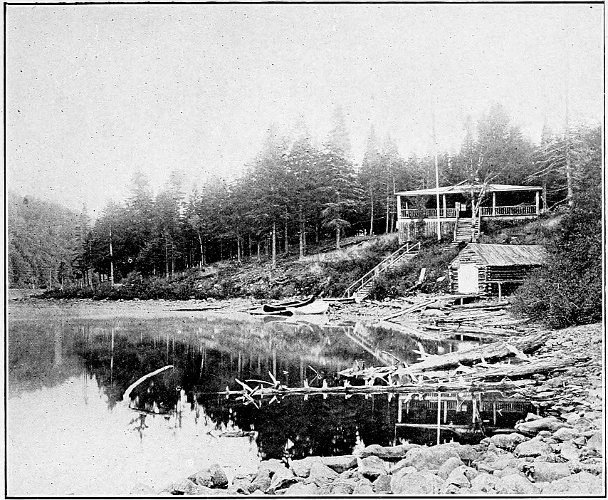
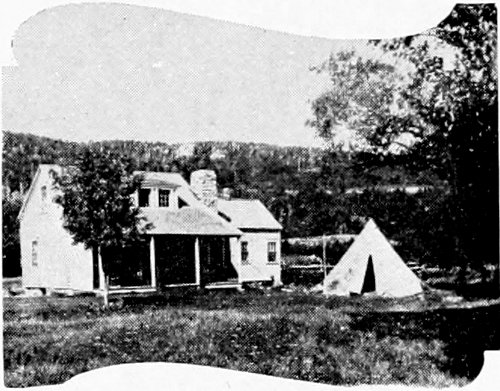
Bungalow, Folleigh Lake
Climbing the hills to reach the level of Folleigh Lake brings a reward in the form of a gorgeous sunset; and if sunset is entrancing in this quiet spot, what may be said of a row over the lake in the early morning in time to see the golden sunrise of a bright August day. There is calm for the minds of those who stay here in bungalow or cottage along the margin of the lake, and the pleasant vista of wooded banks and beautiful sheet of water in front lays immediate siege to the heart. How everything sparkles in this beautiful mountain, and how delightfully fresh and green are all the surroundings. It is one of the few places where railway station and water tank strike no discordant note in the general scene, so strong is it in simple beauty. The long bright lines of rail that plunge abruptly into the forest and disappear so mysteriously—leaving no trace of their whereabouts—look like lines of beauty; and they soothe by their presence, for we know that in good season we can regain the outer world when the all-too-brief vacation has been spent.
238
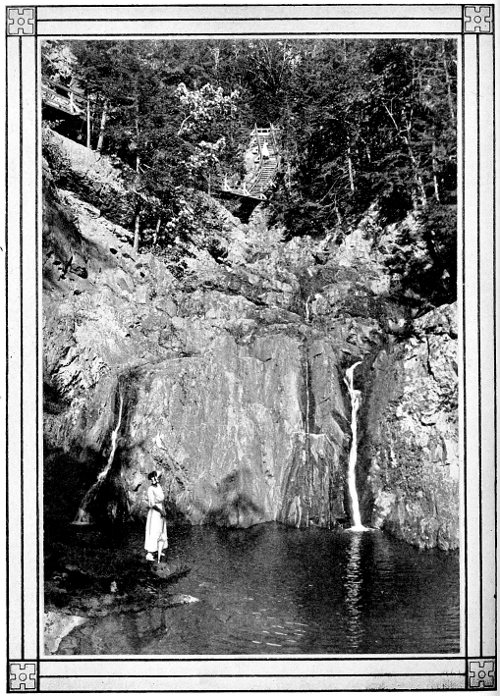
Truro Park—A Romantic Spot
239
But mountain days are over for the present, and so leaving the lake behind, and with it the invigorating air of the heights, we gradually pass through Londonderry, over the Folleigh River and into Truro, obtaining many pleasant glimpses of Cobequid Bay along the route thus taken.
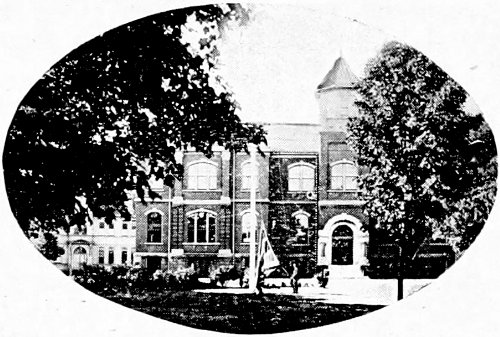
Although Truro is a prosperous manufacturing town, and an important Intercolonial centre as well, it is yet one of the prettiest and most homelike places in Nova Scotia. A pleasant river runs nearby, and it is surrounded by graceful and well-wooded hills. The streets are well laid out and have abundance of shade; and the public buildings, the stores, and the general appearance of the smart town make a strong impression from the first. It is within a mile or two of Cobequid Bay, and the farming land round about is excellent.
Acadian French once lived here, but the real settlement of Truro dates from a few years after the “Expulsion.”
Truro is a very pleasant inland town in which to spend a vacation. There is beautiful and romantic country on every hand, with excellent roads. The fishing round about is fair; the hunting, in season, excellent. There are many interesting places within easy reach, both by road and rail; and the town offers a pleasant social life that is very enjoyable for those who like to summer in a country town where comfort and some variety in life may be had.
On the meadow-lands traces have been found of the dykes thrown up by the Acadians. Willows planted by them have survived to this day.
The joy and pride of Truro is her beautiful pleasure ground, usually called Victoria Park; but just as often termed the Joe Howe Park, from the fact that it contains the Howe Falls, named after him, and also because it is proposed to erect a Howe memorial there later on. The park has been described as “Nature’s fairyland, . . . . with its groves, its deep ravines and its beautiful waterfall.” This is about as good a brief description as could be made. The park is so beautiful that merely to describe it as one of the best in the province is to rob it of its just due. It has really all the characteristics of a great park, deserves to be classed with the chief pleasure grounds of Canada, and is, in fact, superior in natural beauty to any of the well-known North American parks. It is surely only a question of time before excursion trains will bring people from all over to enjoy the delights of this picturesque place.
240
The entrance to Victoria park is at the front door of the town, for it is close to the Intercolonial Railway Station. Scarcely anything has been done here to alter the approach or surroundings. It has been left almost as found, and the result is very satisfactory. The deep ravine that runs through the park, and contributes so much to its romantic aspect, has its opening at the place selected for an entrance, and a pretty little stream winds its way in the channel thus provided. A carriage drive penetrates for some distance, but the strong feature that pleases all who visit here is the multitude of walks and romantic by-paths that lead off in every direction.
Here are innumerable little dells with banks of brightest green; and under shady birches or maples are comfortable seats for three or four people—generally holding two, however—where with a pleasant book, or dainty fancy work, many enjoyable hours may be spent in delightful company with birds and flowers. Yonder is a rocky bluff, tipped with green, and down its face trickles a little rill, wetting the projecting edges of the rock and causing them to glisten like silver. Just opposite are even bolder heights that are clothed in a wealth of woodland growth reaching up to the very top.
Here the park brook turns off into more secluded ways, and following it, instead of the road, a charming sylvan dale is found where not one sound intrudes save the music of the birds and the gentle ripple of the water—surely a fit retreat for artist, poet or dreamer. Here where “nature reigns”:
“Within its banks this little stream includes A world remote from all the world of men; And hides a kingdom far from mortal ken, In the green depths, where never foot intrudes.”
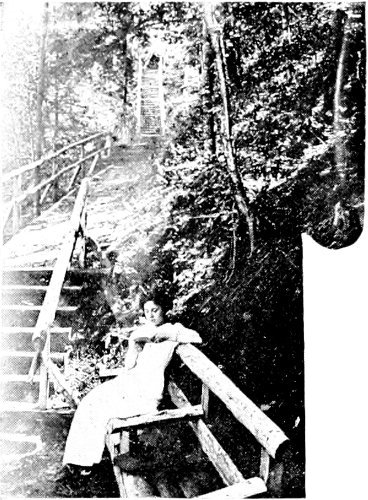
Would you stand by the “Wishing Well,” and give expression to your fondest day-dreams? The well is here, up a gentle slope where all is tranquil and secluded. Would you climb “Jacob’s Ladder”—steps up to heaven—and land with your head in yon fleecy cloud? Here are the rustic steps reaching to the top of the height. Would you visit the “Holy Well,” where Acadian infants 241 were christened in the long ago? Bible Hill is a little distant, so here in the park is a “Holy Well” from which, by no stretch of imagination, the same water flows.
Perhaps you are anxious to keep your youth, and to stave off the days of grey hairs, wrinkles and rheumatism? Pray sit in the “Rejuvenating Seat” by the Joe Howe Falls, and if you do not grow younger as you watch the lovely sight—nothing else can stay the hand of time.
Then possibly you wish to test your self-control by peering over the brink of the “Sheer-Drop” without shuddering; or you would entrench yourself on the heights of “Spion-Kop,” ask important questions of the “Sphinx,” from the bridge nearby, walk along the “Observation Gallery,” or pass to the lower depths by “Muir’s Descent.”
In your walks about, the beauty of everything has taken complete possession of you. The noble trees spreading a magnificent canopy over your head bring to mind the words of Bryant, for here nature has “hewn the shaft, laid the architrave and spread the roof above.” In such a cathedral the mind soars upward:
“Ah, why Should we, in the world’s riper years, neglect God’s ancient sanctuaries, and adore Only among the crowd, and under roofs That our frail hands have raised?”
But here comes a maiden on her way to the “Nymph’s Grotto.” She is too young, and floats along too buoyantly, to have come by way of the rustic “Bridge of Sighs.” Barely eighteen, she cannot have interrupted her tripping course to rest in the “Widow’s Proposal Seat”; but in all probability she has stopped at the “Lily Cauldron” to admire the virgin bloom:
“The white water-lilies, they sleep on the lake, Till over the mountain the sun bids them wake.
At the rose-tinted touch of the long, level ray, Each pure, perfect blossom unfolds to the day.
Each affluent pearl outstretched and uncurled To the glory and gladness and shine of the world.”
242
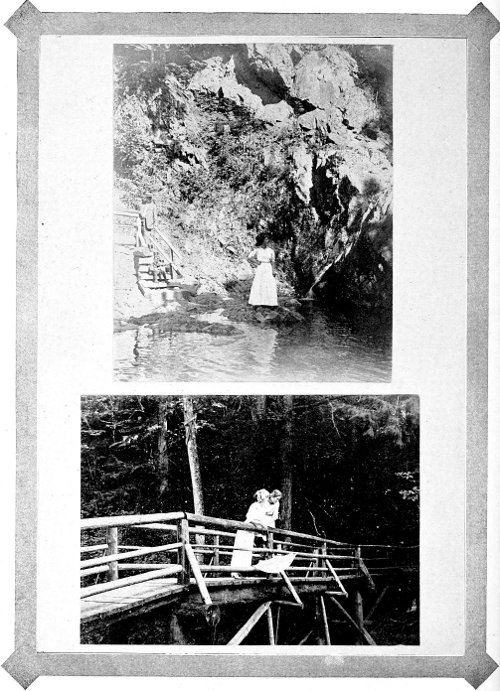
Scenes in TRURO PARK
1. Below the Falls
2. “What Have You Found?”
243
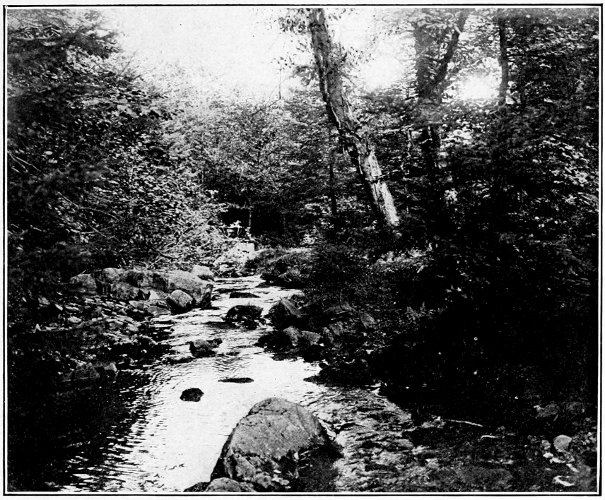
In Victoria Park, Truro
As the Truro vision in white, with happy lace and the light exulting step of early youth, passes by, it is evident she will never need to sit in the “Leap Year Engagement Seat,” where “no man may say ‘no’ to a self-respecting, modest woman.” Let us hope that the heart of the male to whom the leap-year question is here “popped” will not be affected by the “Cold Chamber” nearby. And see, our pretty maiden does not stop and rest in the “Irresistible Engagement Seat”; for is she not irresistibly engaging herself, without art or other allurement.
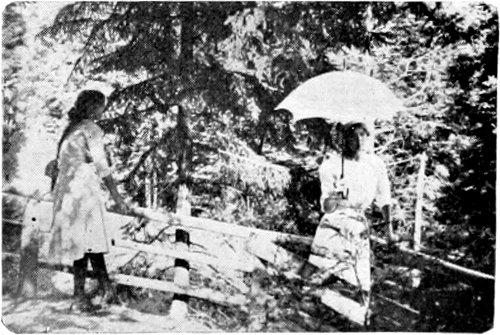
And now by a happy inspiration we guess her name. She is “Phyllis,” of course, and she is on her way to her own seat high up and tree-embowered, where her lover has long and impatiently waited her coming, as all true-lovers ever have done.
244
“Thou art a fool, said my head to my heart, Yea, the greatest of fools, thou art, To be caught with a trick of a tress; By a smiling face or a ribbon smart— And my heart was in sore distress.
Then Phyllis came by and her face was fair, And the sun shone bright on her golden hair, And her lips they were rosy red. Then my heart spake out with a brave, bold air— Thou art worse than a fool, O head!”
In the park will be found a spacious, amphitheatre-like picnic dell with tables and conveniences for those who must indulge in the prosaic occupation of eating. It is a delightful spot, and too much cannot be said in its praise.
And finally, far in the woodland depths, where a fine tree has fallen across the ravine, there will be found a choice spot known only to the favored few at present, but which will be sought out by increasing numbers as it becomes known. It is called “Toll-Bridge,” and here, unobserved of prying eyes, the happy lover has the right to exact “toll” from his inamorata, or sweetheart, for assisting her over. Not a single maiden has been known to cross “unassisted,” and none may successfully resist the payment of toll in true-lover’s coin.
In proceeding from Truro to Halifax, the train passes not far from the pleasant little village of Stewiacke. It then meets the Shubenacadie River and stops at the busy little village of that name. From this centre many places east of Halifax may conveniently be reached by stage. Maitland, Gay’s River, Upper and Middle Musquodoboit, and even Guysboro and eastern shore points may all be reached in this manner. Passing by the shore of Grand Lake, stopping at Windsor Junction—from which place the picturesque village of Waverley may be reached, as well as Annapolis Valley and north-shore points—and proceeding along the shore of the beautiful Bedford Basin, the city of Halifax soon comes into view, and the outer Atlantic shore has been reached.
245
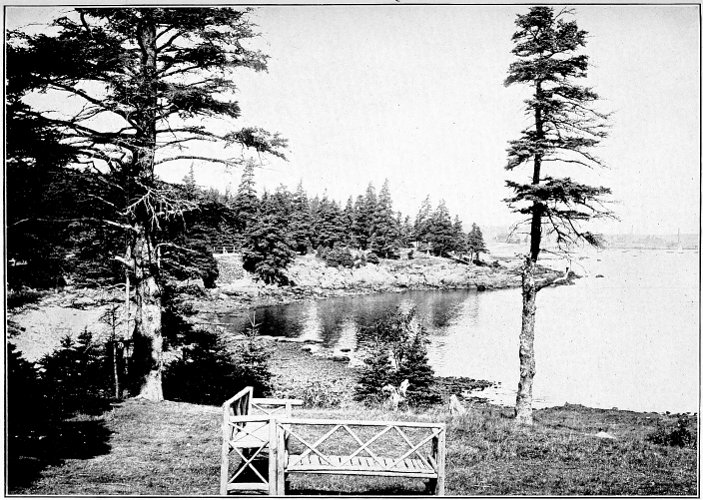
In Point Pleasant Park, Halifax.
246
