SUBSPECIATION
Reading edition
Dipodomys ordii is, without question, a valid species if one accepts Mayr's (1942:120) definition that "Species are groups of actually or potentially interbreeding natural populations, which are reproductively isolated from other such groups." D. ordii is not known to hybridize with other species where their geographic ranges are adjacent or overlap. The first part of the definition "actually or potentially interbreeding populations" is substantiated by the 35 recognizable subspecies which can be defined as "a complex of interbreeding and completely fertile individuals which are morphologically identical or vary only within the limits of individual, ecological and seasonal variability. The typical characters of this group of individuals are genetically fixed and no other geographic race of the same species occurs within the same range" (after Rensch, 1934; from Mayr, 1942:106). Thus we find that certain populations of individuals differ from others and that in geographic areas between two of these populations, individuals (intergrades) are found which resemble those of both populations. In another instance, a population may be geographically isolated yet in its characters it may be recognizable as a subspecies without actual intergradation because of slight degrees of difference, or a group may be different from another without being geographically separated and may or may not show intergradation.
Subspeciation in Dipodomys ordii almost certainly has been effected, by means of mutations, under the influence of natural selection. Natural selection enhanced by geographic and ecologic isolation, probably has retained mutations of evolutionary significance, thus permitting the development of the many recognizable subspecies.
In the subspecies of Dipodomys ordii the color ranges from pale to dark. The difference in color is as pronounced as that between the full species D. deserti and D. heermanni. The lightest-colored subspecies are Dipodomys ordii celeripes, D. o. extractus and D. o. compactus; the darkest are D. o. obscurus and D. o. palmeri.
There is a marked tendency for intergrades between a light-colored subspecies, such as D. o. celeripes, and a dark-colored kind, such as D. o. utahensis, to show varying degrees of blending in color. The insular population, D. o. compactus, has, however, two distinct color phases, a light phase and a slightly darker phase, and shows no tendency toward blending. In other kinds of mammals, blending of color is known to be the result of the action of multiple alleles, but in the insular kangaroo rat (D. o. compactus) the color appears to be the result of either a reduced multiple allelomorphic complex or even a unit factor. The two color phases of this insular subspecies, which might be an expression of a unit factor, more probably are specializations in which the multiple alleles for color have been reduced. The probability that there is either a unit factor or a reduced number of alleles at work is suggested by the taking of more dark-colored than light-colored animals and by the absence of blending of color. This insular population has undoubtedly been derived from the mainland kangaroo rat, D. o. sennetti, which has the usual range of variation but, to my knowledge, there are no individuals of D. o. sennetti so light as the darkest animals of D. o. compactus from the islands.
Populations from a given locality are remarkably stable in color except the animals from Samalayuca, Chihuahua, which vary in color from individuals almost as light as D. o. compactus to animals that approach D. o. ordii in darkness of pelage.
The subspecies of D. ordii show no noticeable variation in the extent of the hip stripe, supraorbital and postauricular spots, basal white ring of the tail, lateral stripes of the tail or the extent of white on the venter and feet. There is, however, variation in the degree and extent of the arietiform facial markings. In Dipodomys ordii utahensis, D. o. cupidineus, D. o. obscurus and D. o. fuscus these markings are pronounced. In D. o. celeripes, D. o. pallidus, D. o. compactus and D. o. attenuatus these markings are either obliterated or nearly so.
In Dipodomys ordii, color does not seem to be correlated with amount of moisture or geography, but rather with color of soil. For example, all animals from the Bonneville Basin of western Utah, are light colored as are the soils; animals from the San Rafael Desert of eastern Utah are reddish, as is the soil. More striking extremes of this are shown by D. o. compactus of Padre and Mustang islands, Texas, which is pale-colored as is the sand on which it lives, and D. o. medius from east-central New Mexico and western Texas, which is reddish as is the soil there, which is derived from Permian rocks. In localities where alkaline soils are present, kangaroo rats may be found with a roseaceous cast to the pelage as a result of the action of the alkaline salts on the pigment of the hair. The roseaceous color is lost when the animal sheds the old pelage.
In the dorsal and ventral stripes of the tail, I find as much variation in the species D. ordii as Grinnell (1922:Fig. E, p. 14) recorded in the whole genus. In D. o. obscurus, D. o. fuscus and D. o. utahensis the stripes are complete to the distal end of the tail and dark, whereas in D. o. pallidus and D. o. celeripes the ventral stripe is either absent or nearly so and the dorsal stripe is pale.
Color as a taxonomic character is valuable in a broad sense, and is useful in placing an individual or a group of individuals in the subspecies to which they pertain. In most subspecies studied, color was quite uniform throughout the range of the animals, but in D. o. ordii and D. o. columbianus color is so variable that cranial features were relied on almost exclusively for the final diagnosis.
Among the subspecies of Dipodomys ordii there is relatively little variation in the length of the head and body. The smallest measurement is 95.5 mm. in D. o. idoneus and the largest is 118.3 mm. in D. o. richardsoni. The shortest tail is found to be 112.0 mm. in D. o. celeripes and the longest is 154.7 mm. in D. o. terrosus. The length of the hind foot varies from 35.0 mm. in D. o. idoneus to 44.5 mm. in D. o. nexilis.
Allen's Rule is not operative in the species D. ordii. According to this rule, shorter tails and smaller feet in conjunction with a large body would be expected as the more northerly limits of the species are approached, and conversely, smaller body and larger appendages would be expected as the southerly limits of the species are approached. This is not the case, however, since the subspecies D. o. terrosus ranges farthest north and has the longest tail, whereas D. o. celeripes, found in the central part of the range of the species, has the shortest tail. Again, in regard to the hind foot, the shortest is found in D. o. idoneus which is at the extreme south of the range of the species, whereas the longest hind foot is found in D. o. nexilis which occupies a nearly central position in the range.
Long tail and long hind foot would seem to be specializations for saltation and the two would be expected to be correlated. Actually there is no significant correlation in D. ordii. D. o. celeripes, in which the hind foot is near the mean for the species (39.8 as opposed to the mean of 40.7), has the shortest tail. D. o. compactus has a short tail (117.0 mm.) but a medium-sized hind foot. D. o. nexilis and D. o. terrosus have both a long hind foot and long tail.
Cranial measurements vary less, probably because one person can measure a series with a uniformly subjective error. External measurements, however, are liable to a greater degree of subjective error. The total length of the skull varies from 35.4 mm. in D. o. attenuatus to 41.3 mm. in D. o. terrosus. In no one series of adults from one locality, however, is the variation so marked as it is for the species as a whole. The usual range of variation in length of skull in any given series is not, as a rule, more than 2.5 mm.
Cranial indices (breadth across bullae/length of skull × 100) as established for random samples of the different species of the genus (exclusive of D. ordii) ranged from 60.8 to 67.6. In the subspecies of D. ordii the same index varies from 59.7 to 65.2 with an average of 63.4. In other words, the degree of specialization indicated by this one index, in a few subspecies of D. ordii, is almost as great as that in Dipodomys deserti, which on the basis of total morphology appears to be the most specialized species in the genus. Also, on the basis of this same index, some subspecies of D. ordii are more generalized than is any other species in the genus.
There is a general tendency for the nasals to decrease in length and the rostrum to decrease in width as the southern limits of the range of D. ordii are approached. In ascertaining the decrease in length of the nasals an index was obtained as follows: nasals/interorbital width × 100 (see Table 4). The width of the rostrum, however, does not decrease in the same degree, nor at the same rate, as does the length of the nasals. This decrease in length of the nasals and in width of the rostrum may be correlated with the mean annual relative humidity of the environment. It is known (Howell and Gersh, 1936:8) that desert rodents, more exactly kangaroo rats, have a water retention mechanism in the kidneys and walls of the urinary bladder which enables them more efficiently to conserve metabolic water. The significance of the decrease of the area of the nasal mucosa, which seems to be related to relative aridity, is not yet properly understood.
In no cranial feature other than shortened nasals and narrowed rostrum, does Dipodomys ordii show a gradation such that it might be termed a cline. Other parts of the skull that were measured do not vary greatly.
Perhaps the greatest amount of variation in the skull is in features which are not readily measurable by the usual physical means. The shape and size of the pterygoid fossae vary from almost round to rather ovoid in a given series of animals from one locality; the size and configuration of the zygomatic arches vary from slender to robust and from straight to curved laterally; the size of the lacrimal processes varies much in any given series, as do also the degree of expansion of the distal end of the nasals, the convexity of the braincase and the curvature of the upper incisors. In all instances where these features varied much, one size or shape was more pronounced in the series than any other size or shape. Thus, when comparisons were made, the size and certain shapes were the criteria used in assigning the animals under consideration to a given subspecies.
Subspeciation in Dipodomys ordii seems to have been influenced by water barriers. It is known (Grinnell, 1922:28) that kangaroo rats lack the ability to swim. Large stable rivers such as the Colorado, Snake and Columbia serve as effective barriers to further dispersal of kangaroo rats. Streams that freeze over in the winter months, however, are not efficient barriers. This is indicated by the "blending" of morphological characters of D. o. nexilis and D. o. sanrafaeli along the Green River which freezes over.
Any mountain which has vegetational belts above the Transition Life-zone would serve as a barrier to the dispersal of these animals. The Uinta Mountains, lying in an east-west direction, are interposed between the ranges of D. o. priscus and D. o. uintensis. The high Wasatch Mountains and their associated outliers, lying in a north-south direction in Utah, serve as an efficient barrier to the east-west movement of kangaroo rats and as a result, the subspecies east of the mountain mass are remarkably different from those to the west.
TABLE 4
Proportionate Decrease of Nasals
Width of rostrum Length of nasals Least interorbital width Nasals Interorbital × 100
terrosus 4.1 14.75 13.5 91.6
luteolus 4.35 13.9 12.95 93.1
evexus 4.3 14.35 13.75 94.8
montanus 4.1 13.5 12.65 93.8
ordii 3.5 13.3 13.0 97.7
idoneus 3.7 13.2 13.75 103.5
palmeri 3.3 12.8 13.0 101.1
The first three columns represent the actual measurements of the various elements; the fourth column is the index established.
Six different complexes (groups) of subspecies of D. ordii have probably arisen as a result of geographical separation.
The Great Plains complex consisting of D. o. richardsoni, D. o. oklahomae, D. o. evexus, D. o. terrosus, D. o. luteolus, D. o. priscus and D. o. medius are, with the exception of D. o. priscus, inhabitants of the high plains grassland habitat. D. o. priscus inhabits the red Desert of Wyoming.
The Gulf Coast complex, comprising D. o. sennetti and D. o. compactus are separable from all others by small auditory bullae and short tail. D. o. compactus probably has differentiated from D. o. sennetti since the cutting off, by wave action, from the mainland, of the islands on which D. o. compactus lives.
The Mexican complex consisting of D. o. obscurus, D. o. fuscus, D. o. idoneus and D. o. palmeri have probably differentiated by natural selection acting on fortuitous variations, but I lack first hand knowledge of the region concerned.
The southwestern complex consists of D. o. chapmani, D. o. extractus, D. o. attenuatus and D. o. ordii. D. o. attenuatus and D. o. chapmani are subspecifically distinct owing to geographic isolation, although both kinds show intergradation where their ranges approach that of D. o. ordii.
The western desert complex, composed of D. o. monoensis, utahensis, cineraceus, columbianus, cinderensis, fetosus, celeripes, marshalli, inaquosus, pallidus, panguitchensis and fremonti was isolated from the other complexes of D. ordii by the Quaternary uplift of the Wasatch Mountain mass, consisting of the Wasatch, Fish Lake and San Pitch mountains and the Wasatch, Aquarius, Paunsaugunt and Kaiparowits plateaus, and the concurrent reëstablishment of drainage systems. The drainages are those of the Colorado and Columbia rivers and that of the Snake River from Blackfoot, Idaho, to the junction with the Columbia. D. o. fremonti has been isolated on the upper reaches of the Fremont River which arises from the eastern side of the Wasatch Divide. D. o. panguitchensis has been isolated in Panguitch Valley as a result of the canyons formed by the Sevier River in Utah. D. o. cineraceus, although its subspecific and insular status are in doubt, appears to have been isolated on Dolphin Island, Great Salt Lake, Utah.
The intermontane complex consisting of D. o. montanus, longipes, cupidineus, nexilis, sanrafaeli and uintensis, like the western desert complex, has become separated from the remainder of the subspecies of the species D. ordii by Quaternary geologic events. D. o. cupidineus has been cut off by the gorges of the Colorado River to the south and the Virgin River to the north. D. o. sanrafaeli is separated from D. o. uintensis by the Tavaputs Plateau and by the Roan and Book cliffs, and is separated from the range of D. o. nexilis by the Colorado River although there is intergradation between D. o. nexilis and D. o. sanrafaeli. D. o. longipes has been separated from the rest of this intermontane complex by the San Juan and Colorado rivers, but to the east it intergrades freely with adjacent subspecies. D. o. montanus has been relatively isolated in the San Luis Valley of Colorado and New Mexico, but in the southern part of its range it does show intergradation with other subspecies.
Fig. 22. An arrangement, according to morphological indices, of the subspecies of Dipodomys ordii.
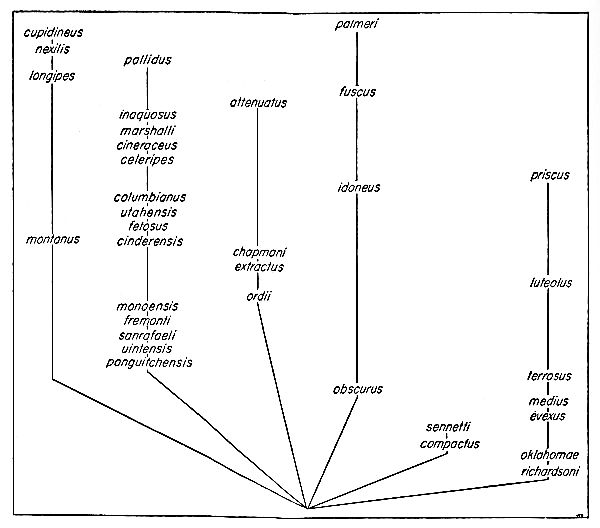
The complexes mentioned above are represented graphically in Figure 22, in a way that expresses some of my ideas as to their genetic relationships.
The indices used to determine the amount of specialization that each complex of subspecies has undergone are as follows:
The Body index (head and body/length of tail × 100) is the expression of the elongation of the tail as an organ of balance while the length of the head and body remain relatively constant. As the tail elongates the index decreases and as the tail becomes shorter the index increases.
The Pedal index (hind foot/head and body × 100) is the expression of the development of the hind foot as an element essential for the saltatorial habit. As the hind foot elongates the index will increase; elongation of the hind foot is interpreted as a specialization.
The Cranial index (breadth across bullae/length of the skull × 100) reflects the degree of development of the tympanic or mastoid region, or both, and is thought to be an adaptation for more acute hearing and possibly for more delicate balance. Inflation of the tympanic bullae is thought to be a specialization. As the auditory bullae become more inflated, the index increases toward 100.
The Bullar index (width of maxillary arches/breadth across bullae × 100) also expresses the degree of inflation of the auditory bullae. In a generalized mammal, at least in the heteromyids, the index would be 100, but as the auditory bullae become larger the index will decrease from 100.
In attempting to arrange the subspecies of D. ordii according to degree of specialization, the geographic positions of the subspecies have been considered along with the information provided by the above-mentioned indices. These indices were used in the same way as were the indices for the species of the genus. In Tables 5 and 6 and in the accounts and maps the subspecies are arranged from the least specialized to the most specialized.
TABLE 5
Indices for the Subspecies of DIPODOMYS ORDII
Body Pedal Cranial Bullar
richardsoni 88.85 34.35 60.95 88.25
oklahomae 86.75 35.5 61.7 90.25
compactus 127.7 37.25 59.75 88.35
sennetti 94.25 34.0 62.85 85.95
evexus 80.1 35.7 60.5 92.9
medius 80.4 33.7 63.55 85.9
obscurus 62.95 86.4
terrosus 75.25 35.05 61.6 86.85
fremonti 80.55 34.7 62.9 85.5
uintensis 77.2 35.3 62.3 86.0
monoensis 85.4 36.4 63.4 85.6
ordii 79.05 37.6 62.75 86.9
luteolus 75.0 37.05 62.35 86.3
extractus 83.65 34.35 64.3 84.25
chapmani 75.05 36.35 62.9 85.65
montanus 80.4 36.15 64.25 82.5
cinderensis 85.1 37.2 65.15 84.75
fetosus 81.8 38.85 63.95 83.95
utahensis 80.2 36.95 64.45 84.35
columbianus 78.5 37.55 64.25 84.9
idoneus 72.3 36.6 64.2 85.0
priscus 74.9 39.45 62.3 84.95
celeripes 91.85 38.75 65.0 84.25
cineraceus 75.5 39.1 63.9 84.8
marshalli 81.5 37.3 65.2 83.0
inaquosus 78.05 37.9 64.25 83.05
attenuatus 73.5 37.35 64.0 83.4
fuscus 79.8 39.0 64.3 83.2
longipes 75.7 37.1 64.3 82.75
pallidus 76.9 40.75 64.35 84.65
nexilis 77.1 40.7 64.95 78.45
cupidineus 73.15 39.1 64.1 80.85
palmeri 72.25 37.15 65.1 80.45
TABLE 6
Numerals (derived from Table 5) are Indicative of the Relative Degree of Specialization of the Subspecies of DIPODOMYS ORDII
Body Pedal Cranial Bullar Average
richardsoni 4 3 3 4 3.5
oklahomae 5 8 5 2 5.0
compactus 1 19 1 3 6.0
sennetti 2 2 10 10 6.0
evexus 15 8 2 1 6.5
medius 12 1 15 11 9.75
obscurus 12 7 10.0
terrosus 25 6 4 6 10.25
fremonti 11 5 12 14 10.5
uintensis 20 7 7 9 10.75
monoensis 6 12 14 13 11.25
ordii 17 23 9 5 13.5
luteolus 27 15 8 8 14.5
extractus 8 4 25 22 14,75
chapmani 26 11 11 12 15.0
montanus 13 10 23 30 19.0
cinderensis 7 18 32 19 19.0
fetosus 9 26 17 24 19.0
utahensis 14 14 28 21 19.25
columbianus 18 22 21 17 19.5
idoneus 31 13 20 15 19.75
priscus 28 30 6 16 20.0
celeripes 3 25 30 23 20.25
cineraceus 24 28 16 18 21.5
marshalli 10 20 33 28 22.75
inaquosus 19 24 22 27 23.0
attenuatus 29 21 18 25 23.25
fuscus 16 27 24 26 23.25
longipes 23 16 26 29 23.5
pallidus 22 32 27 20 25.25
nexilis 21 31 29 33 26.0
cupidineus 30 29 19 31 27.25
palmeri 32 17 31 32 28.0
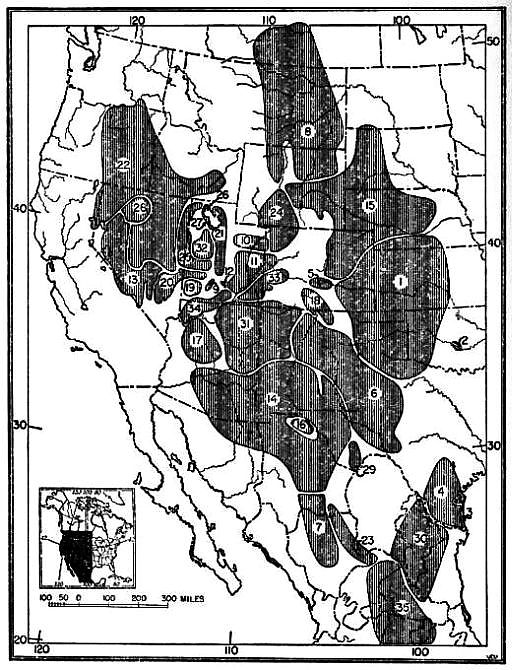
Fig. 23. Distribution of subspecies of Dipodomys ordii. 1. D. o. richardsoni 13. D. o. monoensis 25. D. o. celeripes 2. D. o. oklahomae 14. D. o. ordii 26. D. o. cineraceus 3. D. o. compactus 15. D. o. luteolus 27. D. o. marshalli 4. D. o. sennetti 16. D. o. extractus 28. D. o. inaquosus 5. D. o. evexus 17. D. o. chapmani 29. D. o. attenuatus 6. D. o. medius 18. D. o. montanus 30. D. o. fuscus 7. D. o. obscurus 19. D. o. cinderensis 31. D. o. longipes 8. D. o. terrosus 20. D. o. fetosus 32. D. o. pallidus 9. D. o. panguitchensis 21. D. o. utahensis 33. D. o. nexilis 10. D. o. uintensis 22. D. o. columbianus 34. D. o. cupidineus 11. D. o. sanrafaeli 23. D. o. idoneus 35. D. o. palmeri 12. D. o. fremonti 24. D. o. priscus
Dipodomys ordii
Ord Kangaroo Rat
Dipodomys ordii is a medium sized, relatively short-tailed, five-toed species of a color about average for the genus. As in other members of the genus, the hind legs and feet are disproportionately long as an adaptation to the saltatorial mode of progression. The upperparts are buffy, reddish or blackish, depending on the subspecies, but the entire ventral surface, dorsal surfaces of the hind feet, supraorbital and postauricular spots, forelimbs, hip stripes, lateral stripes of the tail and the tail at the base are pure white. The skull has a relatively short rostrum, moderate to large auditory bullae, relatively wide interparietal, relatively wide maxillary arches and grooved upper incisors.
The only other five-toed kangaroo rats with which Dipodomys ordii, at places, shares its geographic range, are Dipodomys panamintinus and Dipodomys microps. Dipodomys ordii can be distinguished from Dipodomys panamintinus by smaller size (for instance the hind foot is shorter instead of longer than, 44 mm.) and narrower expanse of maxillary arches in relation to breadth across the auditory bullae, and from Dipodomys microps by the awl-shaped, instead of chisel-shaped, lower incisors.
The species D. ordii is divisible into 35 subspecies, accounts of which follow:
Dipodomys ordii richardsoni (Allen)
Dipodops richardsoni Allen, Bull. Amer. Mus. Nat. Hist., 3:277, June 30, 1891.
Dipodomys phillippi, Knox, Trans. Kansas Acad. Sci., 4:22, 1875, (part—the part from Osborne, Kansas).
Dipodomys phillipsi ordi, Coues and Allen, Monogr. North American Rodentia, p. 542, 1877 (part—the part from Ft. Cobb, Oklahoma).
Perodipus richardsoni, Allen, Bull. Amer. Mus. Nat. Hist., 7:260, August 21, 1895 (part—the part from Pendennis, Kansas).
Cricetodipus richardsoni, Trouessart, Catalogus Mammalium, 1:581, 1897.
Perodipus montanus richardsoni, (Bailey, N. Amer. Fauna, 25:144, October 1905 (part—the part from Canadian, Texas).
Perodipus ordii richardsoni, Goldman, Proc. Biol. Soc. Washington, 30:113, May 23, 1917.
Dipodomys ordii richardsoni, Grinnell, Journ. Mamm., 2:96, May 2, 1921.
Type.—Male, no. 3025/2345, Amer. Mus. Nat. Hist.; on one of the sources of the Beaver River, Beaver County, Oklahoma; obtained on October 26, 1887, by Jenness Richardson and John Rowley, Jr. (After Allen, original description, type not seen.)
Range.—Southwestern Nebraska, eastern Colorado, northeastern New Mexico, Panhandle of Texas, and western parts of Oklahoma and Kansas; marginal localities are: in Nebraska: Bladen, Haigler; in Colorado: Olney; in New Mexico: Clayton; in Texas: 6 mi. S and 1 mi. W Quitaque, Vernon; in Oklahoma: 3 mi. S Cleo Springs; in Kansas: Medora.
Diagnosis.—Size large (see measurements). Color dark; entire dorsal surface Cinnamon-Buff, purest on sides and flanks, upper parts suffused with black; arietiform markings, pinnae of ears, plantar surfaces of hind feet, dorsal and ventral stripes of tail, blackish; in some specimens the ventral stripe of tail does not extend to tip of pencil. Skull large; rostrum short and wide; nasals long; zygomata relatively heavy; auditory bullae well inflated and wide; thus with short rostrum giving appearance of nearly equilateral triangle; upper incisors long and robust.
Comparisons.—From Dipodomys ordii luteolus, D. o. richardsoni differs as follows: Size smaller in external measurements except length of body which is longer; color darker, except on plantar surfaces of hind feet and dorsal and ventral stripes of the tail which are lighter; ventral stripe of tail, in most specimens, continuous to end of pencil, whereas in D. o. luteolus ventral stripe is present on only proximal two-thirds; skull larger in all measurements taken; zygomatic arch heavier; auditory bullae relatively as well as actually more inflated; external auditory meatus egg-shaped as contrasted to nearly round in D. o. luteolus; pterygoid fossae rounded as compared to ovate in D. o. luteolus.
From Dipodomys ordii oklahomae, D. o. richardsoni differs as follows: Size larger in all measurements taken; color darker in all pigmented areas; skull larger in all respects; auditory bullae larger and more inflated ventrally; jugal straight or nearly so instead of bowed laterad; pterygoid fossae smaller; nasals straight instead of inflated as a "bulb" distally.
For comparisons with D. o. montanus and D. o. evexus, see accounts of those subspecies.
Remarks.—This race of Dipodomys ordii is readily distinguished from Dipodomys ordii evexus, from the valley of the upper Arkansas River, by larger size, larger skull and lighter color. Intergradation with Dipodomys ordii luteolus occurs rather freely in northeastern Colorado, as indicated by specimens from 3 miles northeast of Fitzsimmons, 6 miles east and 1 mile north of Denver and Barr Lake. These specimens resemble D. o. richardsoni in light color, greater inflation of the auditory bullae and the shape of the pterygoid fossae but resemble D. o. luteolus, to which they are here referred, in the length of the nasals, the least interorbital width and in the external measurements. In the southern part of the range of D. o. richardsoni intergradation occurs with Dipodomys ordii medius, as at 6 miles southwest of Muleshoe, Texas. Specimens from there have the long, wide rostrum and narrow skull of D. o. richardsoni but in the sum total of their characters more closely resemble D. o. medius. At Texline, Texas, the animals show intergradation in the length and shape of the nasals and degree of convexity of the cranium but are referable to D. o. richardsoni.
In fine, intergradation occurs at all points where the range of D. o. richardsoni touches that of any other geographic race. No one series of it is as uniform as are most series of specimens of other known races. Dipodomys ordii richardsoni shows a mixture of characters. Nevertheless, each of the populations studied has characters in most of the animals that make this form recognizable as a taxonomic unit—a unit that seems, as yet, not to have become stabilized even in the central parts of its range.
Coues and Allen (1877:542) list specimens from Fort Cobb, Arkansas. It is known that the Post Office Department, for administrative purposes, attached certain towns and military installations in Indian Territory (now Oklahoma) to the State of Arkansas. Thus it is apparent that Fort Cobb, Arkansas, as recorded by Coues and Allen (loc. cit.) is Fort Cobb, Oklahoma. Specimens from Fort Cobb would be expected to be D. o. richardsoni.
Specimens examined.—Total, 351, distributed as follows:
Nebraska: Adams County: Bladen, 10 (AMNH). Dundy County: Haigler, 1 (USBS).
Colorado: Crowley County: Olney, 1 (USBS). Kiowa County: Chivington, 3 (USBS). Otero County: 18 mi. S La Junta, 4 (AMNH); Higbee, 1 (USBS). Bent County: 4 mi. SE Las Animas, 4100 ft., 3 (MVZ). Prowers County: Lamar, 9 (LACM); 1 mi. S Lamar, 4000 ft., 11 (KU). Baca County: Gaumes Ranch, 4600 ft., NW Corner, 1 (USBS).
Kansas: Cheyenne County: 23 mi. NW St. Francis, 5 (KU). Rawlins County: 2 mi. NE Ludell, 2 (KU); 1-1/2 mi. W Ludell, 1 (KU). Wallace County: Lacey Ranch, 4-1/2 mi. E and 9 mi. S Wallace, 1 (KU); unspecified, 2 (KU). Logan County: 5 mi. W Elkader, 2 (KU); unspecified, 1 (UM). Gove County: unspecified, 1 (KU). Trego County: Banner, 8 (USNM); Parrington Ranch, 12 mi. S Collyer, 2 (KU); unspecified, 8 (USNM). Ellis County: Ellis, 1 (USBS). Lane County: Pendennis, 10 (USBS). Hamilton County: Coolidge, 2 (CNHM); 1 mi. E Coolidge, 5 (KU). Pawnee County: 1 mi. S Larned, 4 (KU); 2 mi. S and 1/4 mi. W Larned, 2 (KU); 3 mi. S and 1-1/2 mi. W Larned, 10 (KU). Edwards County: Kinsley, 3 (USBS); 3-1/2 mi. E Kinsley, 5 (KU); S side Arkansas River, 2 mi. S Kinsley, 1 (KU); 1 mi. W and 3-1/2 mi. S Kinsley, 9 (KU). Stafford County: Little Salt Marsh, 15 mi. N and 3 mi. E Stafford, 2 (KU). Reno County: Medora, 1 (UM); 2 mi. W and 1/2 mi. S Medora, 4 (KU). Kiowa County: 5 mi. N Belvidere, 1(KU). Pratt County: Cairo, 2 (USBS). Sedgwick County: Wichita, 6 (AMNH). Morton County: 10 mi. N and 3 mi. E Elkhart, 34-1/2 (KU). Seward County: 1 mi. E Arkalon, 7 (KU); Liberal, 1 (KU); unspecified, 1 (KU). Meade County: Meade, 1 (USNM); 13 mi. SW Meade, 13 (6 AMNH; 7 KU); 17 mi. SW Meade, 2 (KU). Clark County: 12 mi. S Ashland, 1 (UM); unspecified, 3 (KU). Barber County: Medicine Lodge, 4 (USBS); 1 mi. W Aetna, 3 (KU); 1/2 mi. W Aetna, 2 (KU); Aetna, 3 (KU); 1 mi. SW Aetna, 1 (KU); 1-1/2 mi. SW Aetna, 1 (KU); 1 mi. S Aetna, 5 (KU); unspecified, 2 (KU). Harper County: 4-1/2 mi. NE Danville, 12 (KU); 2 mi. NE Runnymede, 3 (KU).
New Mexico: Union County: Clayton, Apache Canyon, 1 (USBS). Quay County: Glenrio, 10 (LACM).
Oklahoma: Cimmaron County: Kenton, 1 (CM). Beaver County: 1-1/2 mi. N Beaver, 7 (KU); Beaver River, 8 (7 AMNH; 1 CNHM). Harper County: 3 mi. S of Englewood, Kansas, 2 (MVZ); 4-1/2 mi. N Laverne, 1 (UM). Woods County: 2 mi. W Edith, 1 (USBS); Alva, 12 (UM); Waynoka, 18 (UM); 3 mi. SW Waynoka, 1 (USBS). Alfalfa County: 4 mi. SE Cherokee, 1 (USBS). Ellis County: Shattuck, 1 (USBS). Woodward County: Woodward, 9 (USBS). Major County: 3 mi. S Cleo Springs, 1 (USBS).
Texas: Dallam County: Texline, 8 (USBS). Lipscomb County: Lipscomb, 8 (USBS). Hemphill County: 17 mi. NE Canadian, 1 (MVZ); 1 mi. W Canadian, along Red Deer River, 12 (MVZ); 1/2 mi. W Canadian, along Red Deer River, 7 (MVZ); Canadian, 5 (USBS). Oldham County: Tascosa, 6 (USBS). Wheeler County: 1 mi. W Mobeetie, 2 (MVZ); Mobeetie, 8 (USBS); Wallace Ranch, SW Wheeler County, 1 (TCWC). Hall County: Newlin, 1 (USBS). Wilbarger County: Vernon, 5 (USBS). Floyd County: 6 mi. S and 1 mi. W Quitaque, 1 (UM).
Dipodomys ordii oklahomae Trowbridge and Whitaker
Dipodomys oklahomae Trowbridge and Whitaker, Journ. Mamm., 21:343, August 14, 1940.
Dipodomys ordii oklahomae, Davis, Journ. Mamm., 23:332, August 14, 1942.
Type.—Female, young adult, no. 265454, U. S. Nat. Mus., Biol. Surv. Coll. (formerly Univ. of Oklahoma, Mus. Zool., no. 14517); north bank of South Canadian River, 2-1/4 mi. S Norman, Cleveland County, Oklahoma; obtained on March 16, 1934, by H. L. Whitaker, original no., X-catalog no. 29312 of U. S. Nat. Mus.
Range.—Known only from the South Canadian River Valley west of Minco, Canadian County; and east to Lexington, Cleveland County, Oklahoma.
Diagnosis.—Size medium (see measurements). Color light, entire dorsal surface near (c) Vinaceous-Buff, paler on sides with great suffusion of white; arietiform markings, pinnae of ears, plantar surfaces of hind feet, proximal ventral portion of tail and dorsal stripe on tail, brownish. Skull of medium size; rostrum wide; nasals short, projecting but slightly anteriorly to incisors; zygomatic processes of maxillae heavy; bullae not greatly inflated.
Comparisons.—Dipodomys ordii oklahomae differs from D. o. richardsoni as follows: Size smaller; color lighter in all pigmented areas; ventral stripe of tail extending only one-fourth the length rather than three fourths or to end of tail; skull smaller in all measurements taken; rostrum heavier; auditory bullae less inflated; pterygoid fossae larger; braincase slightly more inflated; nasals more expanded distally; interparietal region wider.
From Dipodomys ordii ordii, D. o. oklahomae differs in: Size larger in all measurements taken; color lighter in all pigmented areas; ventral stripe of tail extending one fourth length of tail rather than to end; skull larger in all respects; rostrum heavier; zygomatic arches heavier; bullae more inflated ventrally; cutting edge of upper incisors wider; pterygoid fossae larger; braincase more vaulted; nasals more expanded distally; orbital region larger; interparietal region wider.
Remarks.—Trowbridge and Whitaker named this kangaroo rat as a full species. The diagnostic characters were the length and breadth of the rostrum and the relatively great inflation of the auditory bullae. Also, Dipodomys oklahomae was not known to intergrade with any other named kinds. Davis (1942:332) treated D. oklahomae as a subspecies of the earlier named species Dipodomys ordii. Certain characters in specimens from the type series of both D. o. richardsoni and D. oklahomae, such as the shape and configuration of the nasals, the over-all proportion of the skull, tooth pattern and body proportions through individual variation overlap and indicate that these two groups of animals belong to the same species, even though animals from intermediate geographic areas are not available to show actual intergradation. My findings corroborate Davis' conclusion that D. oklahomae should stand as Dipodomys ordii oklahomae. In spite of the great similarities shown by the two groups of animals there are still sufficient diagnostic characters between the two groups to enable them to be segregated easily as valid subspecies.
Dipodomys ordii oklahomae is, for some unknown reason, restricted to a limited geographic range. Specimens examined from the upper reaches of the South Canadian River, farther westward, are all referable to D. o. richardsoni rather than, as would be expected, to D. o. oklahomae since the habitat for these animals is continuous from the type locality of D. o. oklahomae to the upper reaches of the South Canadian River. In length and shape of the nasals, degree of inflation of the auditory bullae and width of the interorbital region these specimens from the upper reaches of the South Canadian River are intergrades between D. o. richardsoni and D. o. medius. The range of D. o. medius lies to the south of that of D. o. richardsoni and to the southwest of that of D. o. oklahomae.
The present range of D. o. oklahomae, as now understood, is the most eastern part of the range of the species Dipodomys ordii and of the genus Dipodomys. The existence of D. o. oklahomae in this area is a precarious one since its habitat is limited in extent and is periodically flooded.
Although no specimens are known from the area where intergradation between D. o. oklahomae and D. o. richardsoni would be expected to occur, it would seem that when animals from this region become available, intergradation will be shown to occur.
Specimens examined.—Total, 8, all from Oklahoma, distributed as follows: Grady County: 4 mi. N Minco, 1 (USBS). Cleveland County: 2-1/4 mi. S Norman, 7 (6 OU; 1 USBS).
Dipodomys ordii compactus True
Dipodomys compactus True, Proc. U. S. Nat. Mus., 11:160, January 5, 1889.
Cricetodipus compactus, Trouessart, Catalogus Mammalium, 1:581, 1897.
Perodipus compactus, Elliot, Field Columbian Museum, Zool. Ser., 2:240, 1901.
Dipodomys ordii compactus, Davis, Journ. Mamm., 23:332, August 14, 1942.
Type.—None designated but Poole and Schantz (1942:406) assumed it to be a female, no. 19665/35227, only the skin found, from Padre Island, Cameron County, Texas. April 3, 1888. Purchased from C. K. Worthen.
Range.—Padre and Mustang islands, Cameron County, Texas.
Diagnosis.—Size medium (see measurements); tail short. Color light; entire dorsal surface Light Ochraceous-Buff, purest on sides and flanks, upper parts but lightly suffused with black. A lighter color phase has entire dorsal surface Cartridge Buff, purest on sides and flanks, upper parts but lightly washed with black. In both phases, cheeks white; pinnae of ears, plantar surfaces of hind feet, dorsal stripe of tail, ventral stripe of tail (in most specimens) present on proximal third of tail only, brownish. Skull small; rostrum narrow and long; nasals long; auditory bullae inflated, but greatest breadth across bullae only slightly more than breadth across zygomatic processes of maxillae; interparietal region wide.
Comparisons.—From Dipodomys ordii sennetti, D. o. compactus differs in: Size slightly less; color lighter in all pigmented areas; skull smaller; auditory bullae slightly less inflated; interorbital width less; interparietal region wider; nasals longer.
From Dipodomys ordii attenuatus, D. o. compactus differs in: Body larger; tail shorter; normal color phase darker, and lighter color phase lighter; skull larger; rostrum wider and longer; nasals longer; interorbital region wider; auditory bullae relatively as well as actually less inflated; interparietal region wider; pterygoid fossae large and round as opposed to small and ovoid.
Compared with Dipodomys ordii medius and Dipodomys ordii ordii, D. o. compactus is smaller, lighter in color, and has less inflated auditory bullae and a smaller skull.
Remarks.—This subspecies of Dipodomys ordii was originally described as Dipodomys compactus by True in 1889 and stood as a full species until Davis (1942:332) relegated it to subspecific status under Dipodomys ordii. Davis (op. cit.) observed close resemblances in external proportions, size of mastoid bullae, width of supraoccipital, and size and shape of the interparietal, between Dipodomys ordii and Dipodomys sennetti and therefore concluded that they were only subspecies of one species. He observed that the difference between Dipodomys compactus and Dipodomys sennetti was of approximately the same degree as that between Dipodomys sennetti and Dipodomys ordii. From this he concluded that all three were subspecies of the one species Dipodomys ordii.
In any sizeable sample of Dipodomys sennetti there are crania closely resembling those of Dipodomys ordii ordii and others closely resembling those of Dipodomys compactus. The external proportions of both D. sennetti and D. compactus are duplicated in D. ordii from El Paso and conversely, specimens with the proportions of typical D. o. ordii occur in populations of D. sennetti and D. compactus. Thus, it appears that Davis' usage of the name Dipodomys ordii compactus should stand although there may be a hiatus in geographic occurrence between D. ordii and D. sennetti, as of course there is between D. sennetti and D. compactus.
In D. o. compactus there is a complete enamel ring around the occlusal surface of each molariform tooth; in D. o. ordii this ring is incomplete lingually on each of the molariform teeth and labially on the first three, and in some individuals of D. o. sennetti the enamel ring is complete and in others it is incomplete labially and lingually as in D. o. ordii.
Specimens examined.—Total, 44, all from Texas, distributed as follows: Nueces County: 19 mi. S Port Aransas, Mustang Island, 27 (17 TCWC; 10 MVZ); Mustang Island, 17 (LACM).
Dipodomys ordii sennetti (Allen)
Dipodops sennetti Allen, Bull. Amer. Mus. Nat. Hist., 3:226, April 29, 1891.
Cricetodipus sennetti, Trouessart, Catalogus Mammalium, 1:581, 1897.
Perodipus sennetti, Elliott, Field Columbian Museum, Zool. Ser., 2:239, 1901.
Dipodomys ordii sennetti, Davis, Journ. Mamm., 23:332, August 14, 1942.
Type.—Male, no. 3478/2733. Amer. Mus. Nat. Hist.; near Brownsville, Cameron County, Texas; obtained on March 9, 1888, by J. M. Priour. (After Allen, original description, type not seen.) Type locality recorded by Bailey (1905:145) as "Santa Rosa, 85 mi. SW Corpus Christi."
Range.—Southern Texas, south of Corpus Christi; marginal localities, all in Texas are: Somerset, 8 mi. NE Los Angeles, 8 mi. E Encinal, Santa Rosa, 28 mi. E Raymondville, 2 mi. S Riviera.
Diagnosis.—Size small (see measurements). Color dark, entire dorsal surface (c) between Pinkish Buff and Cinnamon-Buff, purest on sides and flanks, upper parts mixed with black; arietiform markings, pinnae of ears, dorsal and ventral stripes of tail, plantar surfaces of hindfeet, brownish-black. Skull small; auditory bullae but slightly inflated in relation to size of skull; nasals slightly flaring distally; premaxillae extending but slightly posterior to nasals; interorbital width relatively great; external auditory meatus small; rostrum relatively long and wide; zygomatic arches relatively heavy.
Comparisons.—From Dipodomys ordii ordii, D. o. sennetti differs in: Size smaller, tail shorter; color darker; skull smaller; nasals longer; rostrum wider; auditory bullae less inflated; external auditory meatus smaller; pterygoid fossae more rounded; zygomatic arches heavier.
From Dipodomys ordii medius, D. o. sennetti differs as follows: Size smaller; color darker, but with less red in pelage; skull markedly smaller in all respects.
From Dipodomys ordii compactus, D. o. sennetti differs in: Size somewhat less; color darker; skull with total length greater; orbit smaller; least interorbital width greater; braincase more inflated; width across auditory bullae more; interparietal region wider; external auditory meatus larger; medial part of audital portion (see Howell, 1932) of auditory bullae larger.
Remarks.—Dipodomys sennetti, along with Dipodomys compactus, was regarded by Davis as conspecific with Dipodomys ordii. Reasons for placing these two kinds of kangaroo rats as subspecies of D. ordii are given in the account of Dipodomys ordii compactus.
This subspecies is known only from north of the Rio Grande which may serve as a barrier to the spread of the animal into northern Tamaulipas.
Specimens examined.—Total, 20, all from Texas, distributed as follows: Atascosa County: Somerset, 2 (TCWC). LaSalle County: 8 mi. NE Los Angeles, 1 (TCWC); 8 mi. E Encinal, 1 (TCWC). Kleberg County: 2 mi. S Riviera, 9 (TCWC). Jim Hogg County: Hebronville, 8 (LACM). Brooks County: Falfurrias, 2 (LACM). Willacy County: 28 mi. E Raymondville, 2 (TCWC).
Dipodomys ordii evexus Goldman
Dipodomys ordii evexus Goldman, Journ. Washington Acad. Sci., 23:468, October 15, 1933.
Perodipus montanus richardsoni Warren, Mammals of Colorado, p. 76, 1910 (part—the part from Salida, Colorado).
Type.—Male, adult, no. 150990, U. S. Nat. Mus. Biol. Surv. Coll.; Salida, Chaffee County, Colorado (altitude 7000 ft.); obtained on November 10, 1907, by Merritt Cary, original no. 1245.
Range.—Upper Arkansas River Valley of south-central Colorado, from Salida to Pueblo.
Diagnosis.—Size large (see measurements). Color dark, entire dorsal surface between (16") Pinkish Cinnamon and Cinnamon-Buff, purest on sides and flanks, upper parts strongly suffused with black; arietiform markings, pinnae of ears, plantar surfaces of hind feet and dorsal and ventral stripes of tail, blackish. Skull of medium size; rostrum short and wide; nasals short; auditory bullae but slightly inflated; braincase but slightly vaulted.
Comparisons.—From Dipodomys ordii richardsoni, D. o. evexus differs as follows: Size smaller in all measurements taken; color darker; ears darker, dorsal and ventral stripes on tail darker, arietiform markings darker and more distinct, plantar surfaces of hind feet darker; skull smaller in all measurements; length, as expressed in percentage of width of skull, greater in D. o. evexus (66 per cent in D. o. evexus, 62 per cent in D. o. richardsoni which gives the appearance of a long, narrow skull as contrasted with a rather short, wide skull); auditory bullae less expanded laterally, posteriorly and ventrally; interparietal region relatively wider in proportion to greatest width across auditory bullae; cutting edge of upper incisors narrower; pterygoid fossae smaller and more nearly circular.
Compared with Dipodomys ordii luteolus, D. o. evexus differs as follows: Size somewhat smaller in external measurements; color darker in all pigmented areas; skull smaller in two of the seven measurements taken but in the other five measurements somewhat larger; auditory bullae less inflated; cutting edge of upper incisors narrower; zygomatic arch heavier; pterygoid fossae smaller and more nearly circular; external auditory meatus ovoid as contrasted to nearly circular; paroccipital processes smaller.
From Dipodomys ordii nexilis, D. o. evexus differs in: Color darker; rostrum wider and shorter; interorbital region wider; breadth across maxillary arches greater; auditory bullae less inflated; interparietal region larger; zygomatic arches heavy and bowed laterad; molariform teeth smaller; cutting edge of upper incisors narrower.
For comparison with Dipodomys ordii montanus see account of that subspecies.
Remarks.—This race of kangaroo rat, described from the upper Arkansas River Valley, closely resembles Dipodomys ordii luteolus but differs in darker color, slightly smaller body and larger skull.
No evidence of intergradation with any other race was noted. To the south the range of D. o. evexus is separated from that of D. o. montanus by a high, transverse ridge of the Rocky Mountains which is inhospitable to these animals. Much territory inhospitable to Dipodomys intervenes also between the ranges of D. o. evexus and 3883D. o. luteolus, but there are areas connecting the northern part of the range of D. o. evexus and the southwestern part of the known range of D. o. luteolus, in which Dipodomys may occur. If kangaroo rats occur in these areas it is to be expected that they will show intergradation between the two subspecies concerned.
Specimens examined.—Total, 24, all from Colorado, distributed as follows: Chaffee County: Salida, 10 (3 USBS; 7 AMNH). Fremont County: Canyon City, 13 (USBS). Pueblo County: Pueblo, 1 (USBS).
Dipodomys ordii medius new subspecies
Perodipus montanus richardsoni, Bailey, N. Amer. Fauna, 25:144, October, 1905 (part—the part from Santa Rosa, New Mexico).
Type.—Male, no. 118526, U. S. Nat. Mus. Biol. Surv. Coll.; Santa Rosa, Guadalupe County, New Mexico; obtained on October 5, 1902, by Jas. H. Grant, original no. 565.
Range.—From north-central New Mexico, southeastward to west-central Texas; marginal localities are, in New Mexico: 15 mi. N Ojo Caliente, Gallina Mts., Deer Creek, San Pedro; in Texas: 20 mi. N Monahans, Colorado, 7 mi. E Post, 6 mi. SW Muleshoe.
Diagnosis.—Size medium (see measurements). Color dark; entire dorsal surface (14") between Orange-Cinnamon and Cinnamon, purest on sides and flanks, dorsal surface lightly washed with black; arietiform markings, pinnae of ears, plantar surfaces of hind feet, dorsal and ventral stripes of tail, brownish-black. Skull of medium size; nasals long; medial mastoid portion of auditory bullae well inflated caudad; braincase vaulted; external auditory meatus small; rostrum short and truncate; medial auditory portion of auditory bullae relatively little inflated; pterygoid fossae ovate; zygomatic arches slender and relatively straight; junction of jugal and zygomatic process of maxilla heavy.
Comparisons.—From Dipodomys ordii richardsoni, D. o. medius differs as follows: Tail longer; hind foot shorter; color darker; arietiform markings more distinct; white lateral stripes of tail narrower; ventral stripe of tail in most specimens complete to end of pencil; postauricular spots less pronounced; hip stripe narrower and in some specimens almost obliterated; skull smaller in all measurements taken; angle of dorsal extension of premaxilla with zygomatic process of maxilla more nearly 90°; braincase more vaulted; medial mastoid portion of auditory bullae more inflated, and coming to more of a point; medial auditory portion of auditory bullae more inflated ventrally; rostrum shorter and narrower; external auditory meatus smaller.
From Dipodomys ordii montanus, D. o. medius differs in: Color lighter in all pigmented areas; skull larger in all respects; rostrum shorter and heavier; bullae more inflated; zygomata, while nearly straight, are bowed slightly laterally; pterygoid fossae more ovate; foramen magnum larger; pterygoid foramina smaller.
Compared with Dipodomys ordii ordii and Dipodomys ordii sennetti, D. o. medius is larger and darker. The skull is also larger in all measurements taken.
Compared with Dipodomys ordii longipes, D. o. medius is darker and smaller.
Remarks.—This hitherto undescribed race of Dipodomys ordii can readily be distinguished from any of its near neighbors by the characters set forth under diagnosis and comparisons.
Intergradation is noted with D. o. ordii, D. o. longipes, D. o. montanus and D. o. richardsoni. Among named races D. o. medius shows closest affinities with D. o. richardsoni but the two are easily separable. The northwestern extremity of the range of D. o. medius is an area of intergradation in which no specimens are clearly of one subspecies or the other. In specimens from 5 miles east of Abiquiu, New Mexico, three-way intergradation occurs. These animals are like D. o. medius in size, D. o. longipes in color and their cranial proportions are as in D. o. montanus. At Deer Creek, New Mexico, and at Monahans, Texas, the animals show intergradation in size of body and agree with D. o. ordii in cranial proportions. In specimens from 6 miles southwest of Muleshoe, Texas, intergradation with D. o. richardsoni in the shape of the skull and width of the rostrum is noted. In the sum total of characters studied, however, these specimens are referable to D. o. medius.
Specimens examined.—Total, 129, distributed as follows:
New Mexico: Rio Arriba County: 2 mi. SE El Rito, 2 (KU); Rio Alamosa, 15 mi. N Ojo Caliente, 1 (USBS); 6 mi. E Abiquiu, 4 (USBS); Rinconada, 5 (USBS); Espanola, 6 (USBS). Sandoval County: 12 mi. NW Alameda, 5500 ft., 3 (MVZ). Santa Fe County: Seton's Ranch, near Santa Fe, 1 (USBS); 8 mi. SW Santa Fe, 8 (KU); San Pedro, 3 (USBS). San Miguel County: Pecos, 2 (USBS); 3 mi. S Pecos, 2 (USBS); Rowe, 6 (LACM). Bernallilo County: Bear Canyon, Sandia Mountains, 7 (USBS); Pajarito, 3 (MVZ). Guadalupe County: Santa Rosa, 10 (USBS). Lincoln County: 44 mi. NW Roswell, 5 (MVZ). De Baca County: 8 mi. N Fort Sumner, 9 (USBS). Roosevelt County: Kenna, 4 (LACM). Curry County: 4 mi. W and 2-3/4 mi. N Clovis, 1 (MVZ). Chaves County: 40 mi. N Roswell, 2 (USBS); 35 mi. N Roswell, 2 (USBS); 15 mi. NE Roswell, 8 (LACM); Stinking Springs Lake, 3 (USBS).
Texas: Bailey County: 6 mi. SW Muleshoe, 5 (UM); 9 mi. SW Muleshoe, 2 (UM). Garza County: 7 mi. E Post, 5 (UM). Martin County: Stanton, 4 (USBS). Howard County: 6 mi. NE Coahoma, 7 (UM); 1 mi. S Coahoma, 1 (UM); 5 mi. W Big Springs, 2400 ft., 1 (MVZ). Mitchell County: Colorado, 5 (USBS). Winkler County: 20 mi. N Monahans, 1 (USBS). Ward County: Monahans, 1 (USBS).
Dipodomys ordii obscurus (Allen)
Perodipus obscurus Allen, Bull. Amer. Mus. Nat. Hist., 19:603, November 12, 1903.
Dipodomys ordii obscurus, Grinnell, Journ. Mamm., 2:96, May 2, 1921.
Type.—Male, adult, no. 20957, Amer. Mus. Nat. Hist.; Rio Sestin, northwestern Durango, Mexico; obtained on April 13, 1903, by J. H. Batty. (Type not seen.)
Range.—Northwestern and northern Durango, Mexico; marginal localities are: Rosario, Rio Sestin, Mt. San Gabriel, Rio del Bocas, Villa Ocampo.
Diagnosis.—Size small (see measurements). Color dark, entire dorsal surface (16") between Pinkish Cinnamon and Cinnamon-Buff, purest on sides, flanks and cheeks, upper parts strongly suffused with black; arietiform markings, plantar surfaces of hind feet, pinnae of ears, dorsal and ventral stripes of tail, brownish. Skull of medium size, nasals long and flared distally; rostrum long and narrow; interorbital region relatively narrow; auditory bullae less inflated than in Dipodomys ordii palmeri; interparietal region narrow; zygomatic arches heavy and bowed laterad; pterygoid fossae ovoid; braincase but slightly vaulted.
Comparisons.—From Dipodomys ordii palmeri, D. o. obscurus differs in: Size larger; color lighter; nasals shorter and more flared distally; interorbital width less; lacrimal processes larger; auditory bullae less inflated; pterygoid fossae ovoid as opposed to subcircular; zygomatic arches heavier; rostrum shorter and wider.
From Dipodomys ordii ordii, D. o. obscurus differs as follows: Size smaller; color darker; skull smaller; nasals longer; rostrum narrower and shorter; interorbital width greater; interparietal region narrower; narrower across auditory bullae; zygomatic arches heavier and more bowed laterally; pterygoid fossae more ovoid; breadth across maxillary arches greater; external auditory meatus smaller.
With Dipodomys ordii attenuatus and Dipodomys ordii sennetti, D. o. obscurus needs no comparison since it is larger and darker than either of those subspecies and can readily be told from the latter by the greater expansion of the auditory bullae.
For comparison with Dipodomys ordii fuscus see account of that subspecies.
Remarks.—D. o. obscurus seemingly is not a far-ranging subspecies. The only examples referable to it come from a relatively restricted area of Durango, Mexico. One specimen from Rio del Bocas, Durango, is not typical and shows the characters described for the animals from Chihuahua City and from Casas Grandes. I have considered the possibility that this specimen is an intergrade between D. o. obscurus and an unnamed subspecies ranging to the northeastward. The other specimens in the series from Rio del Bocas are typical of D. o. obscurus.
Specimens examined.—Total, 69, all from Durango, distributed as follows: Rosario, 20 (AMNH); Villa Ocampo, 5 (AMNH); Rio Sestin, 30 (28 AMNH; 2 CNHM); Mt. San Gabriel, 2 (AMNH); Rio del Bocas, 11 (AMNH); Rancho Santuario, 1 (AMNH).
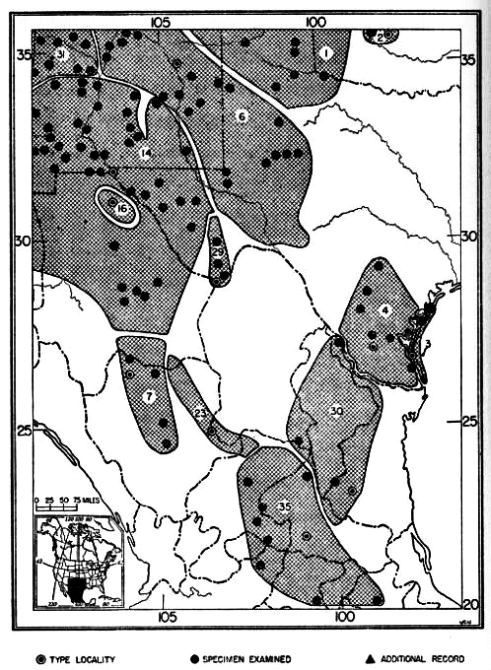
Fig. 24. Known occurrences and probable geographic range of the subspecies of Dipodomys ordii in the southeastern fourth of the range of the species. 1. D. o. richardsoni 7. D. o. obscurus 30. D. o. fuscus 2. D. o. oklahomae 14. D. o. ordii 31. D. o. longipes 3. D. o. compactus 16. D. o. extractus 35. D. o. palmeri 4. D. o. sennetti 23. D. o. idoneus 6. D. o. medius 29. D. o. attenuatus
Dipodomys ordii terrosus Hoffmeister
Dipodomys ordii terrosus Hoffmeister, Proc. Biol. Soc. Washington, 55:165, December 31, 1942.
Dipodomys phillipsi ordi, Coues and Allen, Monogr. North American Rodentia, p. 541, August, 1877 (part—the part from Yellowstone River, Montana).
Perodipus montanus richardsoni, Cary, N. Amer. Fauna, 49:124, December, 1926 (part—the part from Glendive, Montana).
Type.—Male, no. 93477, Mus. Vert. Zool., Univ. California; Yellowstone River, 5 mi. W Forsyth, 2,750 ft., Rosebud County, Montana; obtained on June 2, 1940, by J. R. Alcorn, original no. 1528.
Range.—Extreme southwestern Saskatchewan and southeastern Alberta, eastern half of Montana, northern Wyoming and probably extreme western North Dakota; marginal localities are: 50 mi. W Swift Current, Saskatchewan; "near Medicine Hat," Alberta; in Wyoming, Sheep Creek, and 23 mi. SW Newcastle; in Montana, Medicine Rocks (14 mi. NE Ekalaka), and Glendive.
Diagnosis.—Size large (see measurements). Color dark, entire dorsal surface near (c) Ochraceous-Buff, purest on sides and flanks; upper parts mixed with black; arietiform markings, pinnae of ears, dorsal and ventral stripes of tail and plantar surfaces of hind feet brownish-black. Skull large; rostrum short, wide and deep; braincase slightly vaulted; auditory bullae markedly inflated ventrally; zygomatic arches heavy and bowed laterad; upper incisors long and robust.
Comparisons.—From Dipodomys ordii priscus, D. o. terrosus differs as follows: Size larger in all measurements taken, except for length of hind feet, which is less; color darker in all pigmented areas; skull larger in all parts measured except width of interparietal, which is less; auditory bullae more inflated ventrally; zygomatic processes of maxillae wider; rostrum deeper and shorter.
From Dipodomys ordii richardsoni, D. o. terrosus differs as follows: Size larger; color darker in all pigmented areas; ventral stripe of tail extending farther distally; skull larger except in width across auditory bullae, which is the same.
For comparison with Dipodomys ordii luteolus see account of that subspecies.
Remarks.—As noted in the comparisons, D. o. terrosus is larger and darker than D. o. priscus, D. o. luteolus or D. o. richardsoni, its closest geographic neighbors, and does not resemble any of them, but rather resembles D. o. longipes and D. o. evexus in size and appearance, both of which are distantly removed geographically.
Like other subspecies of the species D. ordii, D. o. terrosus prefers sandy soils to those of any other type. Two miles east and 1 mile south of Forsyth, Montana, animals were trapped on lenses of sandy soil. These lenses alternated with areas of black loam of similar size. It was noteworthy that burrows were found only in the areas of sandy soil, although paths used by the rats when foraging did extend onto and several crossed the lenses of black loam. We were not permitted to excavate any of these burrows, but conversation with farmers of the immediate vicinity indicated that the burrows were not deep. An eight-inch disc would frequently plow out nests and food caches. It was said that each of several caches contained as much as a peck of wheat.
Intergradation was noted in animals from 23 miles southwest of Newcastle and Arvada, Wyoming. In animals from both localities the pterygoid fossae are more as in D. o. luteolus but referable to D. o. terrosus. The specimens from Arvada, although immature, possessed cranial characters which were intermediate between those of D. o. terrosus and D. o. luteolus but the specimens are referable to the former.
Specimens examined.—Total, 74, distributed as follows:
Montana: Petroleum County: 24 mi. N Roundup, 8 mi. SW Flatwillow, 2 (UM). Garfield County: Jordan, 10 (1 UM; 2 MVZ; 7 AMNH). Dawson County: Glendive, 9 (USNM). Musselshell County: Harvey Ranch, Melstone, 3 (MVZ). Rosebud County: Yellowstone River, 5 mi. W Forsyth, 2750 ft., 7 (MVZ); 2 mi. E and 1 mi. S Forsyth, 2600 ft., 8 (KU). Custer County: Miles City, 1 (USBS). Yellowstone County: Billings, 2 (1 USBS; 1 MVZ). Big Horn County: Fort Custer, 1 (USBS); Crow Agency, 1 (USBS). Powder River County: Powderville, 4 (USBS). Carter County: Medicine Rocks, 15 mi. N Ekalaka, 2 (USBS); Medicine Rocks, 14 mi. N Ekalaka, 2 (USBS); Clark's Fork, 1 (USBS).
Wyoming: Big Horn County: Dry Creek, 10 mi. W Germania, 1 (USBS); 3 mi. E Germania, 1 (USBS); Greybull, 2 (USBS); Bighorn Basin, 1 (USBS). Sheridan County: Arvada, 8 (USBS). Campbell County: Little Powder River, 1 (USBS). Weston County: Newcastle, 2 (USBS); 23 mi. SW Newcastle, 4 (USBS). Fremont County: Wilson's Ranch, Sheep Creek, S base Owl Creek Mountains, 1 (USBS).
Additional records.—Canada (Anderson, 1946:131): Alberta: near Medicine Hat, 1; Saskatchewan: near Shackleton, 45-50 mi. NW Swift Current, 1; near Tompkins, 50 mi. W Swift Current, 1.
Dipodomys ordii fremonti Durrant and Setzer
Dipodomys ordii fremonti Durrant and Setzer, Bull. Univ. Utah, 35 (no. 26):21, June 30, 1945.
Type.—Female, no. 15661, Carnegie Museum, Pittsburgh, Pennsylvania; Torrey, 7000 ft., Wayne County, Utah; obtained on July 19, 1938, by W. F. and F. H. Wood, original no. 1562.
Range.—Known only from the type locality.
Diagnosis.—Size small (see measurements). Color dark, entire dorsal surface Cinnamon-Buff, purest on sides, flanks and cheeks; upper parts strongly suffused with black; arietiform markings, pinnae of ears, plantar surfaces of hind feet, dorsal and ventral stripes of tail, brownish. Skull small; upper incisors long; rostrum deep; jugal bowed laterally; diastema long; upper molariform tooth-row long.
Comparisons.—From Dipodomys ordii panguitchensis, D. o. fremonti differs in: Color lighter in all pigmented areas, particularly ears which are light brown in D. o. fremonti and black in D. o. panguitchensis; skull larger in all measurements taken; upper incisors longer; rostrum deeper; auditory bullae deeper; jugal bowed laterally rather than straight; diastema longer.
From Dipodomys ordii cupidineus, longipes, nexilis, uintensis and sanrafaeli, D. o. fremonti can readily be distinguished by its smaller size and generally darker color.
Remarks.—This subspecies of Dipodomys ordii inhabits the upper reaches of the Fremont River in west-central Wayne County, Utah. D. o. fremonti appears to be isolated and is known only from the type locality. D. o. fremonti is so remarkably different from any other subspecies of Dipodomys ordii that a long period of isolation from the ancestral stock (which probably gave rise also to Dipodomys ordii utahensis and Dipodomys ordii panguitchensis) is indicated. Although intergradation is not known to occur with other kinds, differentiation has not progressed far enough for these animals to be recognized as a distinct species.
The subspecies closest, geographically, to D. o. fremonti is D. o. cupidineus from which D. o. fremonti differs more than from any of the other named forms.
Specimens examined.—Total, 9, from Utah, as follows: Wayne County: Torrey, 7000 ft., 9 (CM).
Dipodomys ordii uintensis Durrant and Setzer
Dipodomys ordii uintensis Durrant and Setzer, Bull. Univ. Utah, 35 (no. 26):27, June 30, 1945.
Perodipus longipes, Allen, Bull. Amer. Mus. Nat. Hist., 8:246, November 1896 (part—the part from Uncompahgre Indian Reservation, Utah).
Dipodomys ordii luteolus, Moore, Journ. Mamm., 11:88, February, 1930 (part—the part from Vernal, Utah).
Type.—Male, adult, no. 11634, Carnegie Museum, Pittsburgh, Pennsylvania; Red Creek, 6,700 ft., 2 mi. N Fruitland, Duchesne County, Utah; obtained on August 15, 1936, by J. K. and M. T. Doutt, original no. 3433.
Range.—Uinta basin of the White, Green and Duchesne river drainage in northeastern Utah; marginal occurrences are: 2 mi. N Fruitland, 10 mi. S Ouray, Vernal.
Diagnosis.—Size large (see measurements); hind foot short. Color dark; entire dorsal surface, near (c) Cinnamon-Buff, purest on sides and flanks, with moderate suffusion of black on upper parts; cheeks white; arietiform markings, pinnae of ears, plantar surfaces of hind feet, dorsal and ventral stripes of tail, brownish. Skull large; frontomaxillary suture convex mediad; lacrimal process large; styloid process projects, on ventral surface of tympanic bulla, beyond middle of external auditory meatus; nasals flared distally.
Comparisons.—From Dipodomys ordii priscus, D. o. uintensis differs in: Hind foot shorter; color darker; styloid process projects on ventral part of tympanic bulla well anterior to middle of external auditory meatus as opposed to projecting to middle; depth of foramen magnum, expressed in percentage of width across posterior margin of occipital condyles, greater (86 per cent in D. o. uintensis and 81 per cent in D. o. priscus); frontomaxillary suture convex mediad as opposed to nearly straight; lacrimal processes larger; nasals more flared distally.
From Dipodomys ordii nexilis, D. o. uintensis differs as follows: Size smaller; color lighter; interorbital breadth greater; frontomaxillary suture convex mediad as opposed to concave; lacrimal processes larger; nasals more flared distally; narrower across auditory bullae; basal length greater; zygomatic arches bowed laterad as opposed to relatively straight.
From Dipodomys ordii longipes, D. o. uintensis differs as follows: Size smaller; color darker; auditory bullae wider, longer and deeper; frontomaxillary suture convex mediad as opposed to nearly straight; greatest breadth across auditory bullae less.
For comparison with Dipodomys ordii sanrafaeli see account of that subspecies.
Remarks.—This large, rather dark race inhabits the desert valleys of the White, Green and Duchesne rivers in northeastern Utah. The race nearest geographically, as well as morphologically, is Dipodomys ordii priscus. Intergradation occurs with the latter subspecies at Vernal, Uintah County, in cranial measurements and in color. On the basis of color alone D. o. uintensis can be distinguished from D. o. sanrafaeli, the geographic race to the south. Specimens from Jensen are intermediate in color and cranial measurements between Dipodomys ordii nexilis and D. o. uintensis but are referable to the latter.
Specimens examined.—Total, 40, all from Utah, distributed as follows: Duchesne County: Red Creek, 6700 ft., 2 mi. N Fruitland, 4 (CM); 10 mi. S Myton, 1 (UU); 20 mi. S Myton, 1 (RH). Uintah County: Vernal, 1 (BYU); 20 mi. E Ouray, 5 (CM); Junction Green and White rivers, 4800 ft., 2 mi. S Ouray, 5 (CM); Pariette Bench, 5000 ft., 8 mi. S Ouray, 8 (CM); Desert Springs, 10 mi. S Ouray, 4 (CM); Pariette Bench, 12 mi. S Ouray, 2 (CM); Jensen, 5 (BYU); E side Green River, 3 mi. S Jensen, 4 (CM).
Dipodomys ordii sanrafaeli Durrant and Setzer
Dipodomys ordii sanrafaeli Durrant and Setzer, Bull. Univ. Utah, 35 (no. 26):26, June 30, 1945.
Dipodomys ordii longipes, Stanford, Journ. Mamm., 12:360, November, 1931 (part—the part from King's Ranch, Utah).
Type.—Female, adult, no. 4612, Museum of Zoology, University of Utah; 1-1/2 mi. N Price, 5567 ft., Carbon County, Utah; obtained on June 5, 1940, by Ross Hardy and H. Higgins, original no. 1901.
Range.—East-central Utah, east into west-central Colorado. Marginal occurrences are: in Utah, 12 mi. E Price, 1-1/2 mi. N Price, Notom, King's Ranch, 12 mi. SW Green River, 16 mi. NW Moab; in Colorado, State Line and Grand Junction.
Diagnosis.—Size large (see measurements). Color dark, entire dorsal surface Cinnamon-Buff, purest on sides and flanks with but slight suffusion of black on upper parts; cheeks white; arietiform markings, pinnae of ears, plantar surfaces of hind feet, dorsal and ventral stripes of tail, brownish-black. Skull large; pterygoid fossae ovoid; lacrimal processes small; width across maxillary arches relatively great; auditory bullae well inflated; diastema short.
Comparisons.—From Dipodomys ordii longipes, D. o. sanrafaeli differs as follows: Size smaller; color lighter, more cinnamon, pinnae of ears lighter; skull smaller; auditory bullae smaller; pterygoid fossae ovoid rather than round; wider across occipital condyles; narrower across zygomatic processes of maxillae.
From Dipodomys ordii cupidineus, D. o. sanrafaeli can be recognized by its larger size, lighter color and larger skull.
For comparisons with Dipodomys ordii nexilis, Dipodomys ordii priscus and Dipodomys ordii uintensis see accounts of those subspecies.
Remarks.—Intergradation between Dipodomys ordii cupidineus and D. o. sanrafaeli is noted in the intermediate size of body in a single specimen from Notom. Intergradation in color and cranial characters occurs between Dipodomys ordii nexilis and D. o. sanrafaeli in specimens from 16 miles northwest of Moab. All these specimens, however, are referable to D. o. sanrafaeli.
Animals from that part of the range of D. o. sanrafaeli west of the Green River are typical while those to the east of the river are all intergrades. Animals from 16 miles northwest of Moab, Utah, and from three localities in Colorado, even though intergrades with D. o. nexilis, are all referable to D. o. sanrafaeli. It appears that the Green River does not act as a complete barrier in this area since in the winter it occasionally freezes over, thus allowing the animals to cross. It is thought that kangaroo rats do not hibernate but remain more or less active throughout the winter. Man-made conveniences, such as bridges, might also serve as means of dispersal, permitting these animals to cross otherwise prohibitive barriers. Where there are no bridges across the Green River, farther to the south, the rats apparently do not cross the river; steep, rocky canyon-walls and the lack of ice on the water in winter lessen the chances of small mammals crossing from one side to the other.
Specimens examined.—Total, 30, distributed as follows:
Utah: Carbon County: 12 mi. NE Price, 2 (CM); 3 mi. NE Price, 1 (RH); 1-1/2 mi. N Price, 2 (1 RH; 1 UU); Wellington, 1 (RH). Emery County: "San Rafael, 21 mi. out," 1 (USAC); 12 mi. SW Green River, 2 (CM). Grand County: 1 mi. E Green River, 1 (MVZ); 16 mi. NW Moab, 2 (CM). Wayne County: Notom, 1 (BYU). Garfield County: King's Ranch, 4800 ft., 3 (2 UU; 1 USAC).
Colorado: Mesa County: State Line, 11 (MVZ); Fruita, 1 (USBS); Grand Junction, 2 (USBS).
Dipodomys ordii panguitchensis Hardy
Dipodomys ordii panguitchensis Hardy, Proc. Biol. Soc. Washington, 55:90, June 25, 1942.
Type.—Male, adult, no. 4375, Museum of Zoology, University of Utah; one mile south of Panguitch, 6666 ft., Garfield County, Utah; obtained on August 31, 1940, by Ross Hardy, original no. 2151.
Range.—Known only from the type locality.
Diagnosis.—Size small (see measurements). Color dark, entire dorsal surface near Olive-Brown, purest on sides and flanks, upper parts strongly suffused with black; cheeks white; arietiform markings, pinnae of ears, plantar surfaces of hind feet, dorsal and ventral stripes of tail which are wider than white lateral stripes, blackish. Skull small; rostrum relatively short and wide; interorbital region wide; interparietal region wide; foramen magnum elongate dorsoventrally; pterygoid fossae ovoid.
Comparisons.—From Dipodomys ordii utahensis, which it closely resembles, D. o. panguitchensis differs in: Size larger; color darker; interparietal region wider; foramen magnum elongate dorsoventrally as opposed to nearly round; pterygoid fossae ovoid as opposed to nearly round.
This subspecies can be distinguished from Dipodomys ordii fetosus, Dipodomys ordii celeripes and Dipodomys ordii cupidineus by its darker color and generally larger size.
For comparisons with Dipodomys ordii cinderensis and Dipodomys ordii fremonti see accounts of those subspecies.
Remarks.—This geographic race inhabits the upper reaches of the Sevier River Valley in the vicinity of Panguitch, Utah. Natural barriers to kangaroo rats, such as the Cedar Mountains to the west, high plateau country to the south, the Paunsaugunt Plateau to the east and the narrow canyons of the Sevier River to the north prevent these animals from extending their range or from coming into physical contact with any adjacent geographic races. This isolation has resulted in a fairly stable population. Some animals, however, show characters, such as the width of the rostrum, and the shape and length of the nasals which are intermediate between those of topotypes of D. o. utahensis and the type series of D. o. panguitchensis.
Specimens examined.—Total, 3, all from Utah, distributed as follows: Garfield County: 1 mi. S Panguitch, 6666 ft., 3 (2 RH; 1 UU).
Dipodomys ordii monoensis (Grinnell)
Perodipus monoensis Grinnell, Univ. California Publ. Zool., 21:46, March 29, 1919.
Dipodomys ordii monoensis, Grinnell, Journ. Mamm., 2:96, May 2, 1921.
Type.—Female, adult, no. 27002, Museum of Vertebrate Zoology, University of California; Pellisier Ranch, 5 mi. N Benton Station, 5600 ft., Mono County, California; obtained on September 21, 1917, by J. Dixon, original no. 6384.
Range.—Northeastern Inyo and Mono counties, California, north to southern Pershing County and east to eastern Nye County, Nevada; marginal occurrences are: in California, 5 mi. N Benton Station and Deep Spring Valley; in Nevada, Arlemont, 2 mi. NW Palmetto, 1 mi. N Beatty, 5 mi. W White Rock Spring, Big Creek at Quinn Canyon Mts., 2-1/2 mi. S Lock's Ranch, 2 mi. S Millett P. O., 13-1/2 mi. NW Goldfield, Fingerrock Wash, Eastgate, 1/2 mi. NE Toulon, 21 mi. W and 2 mi. N Lovelock, 1/2 mi. S Pyramid Lake, West Walker River in Smith's Valley, and 10 mi. S Yerington.
Diagnosis.—Size medium (see measurements). Color pale, entire dorsal surface (c) between Pinkish Buff and Cinnamon-Buff, purest on sides, flanks and cheeks, with but slight suffusion of black in upper parts; pinnae of ears, plantar surfaces of hind feet, dorsal and ventral stripes of tail, brownish. Skull medium in size; rostrum relatively long and narrow; nasals relatively short; interorbital region narrow; interparietal region relatively wide; lacrimal processes small; auditory bullae relatively small; pterygoid fossae circular; zygomatic arches robust and relatively straight; foramen magnum nearly circular.
Comparisons.—From Dipodomys ordii columbianus, D. o. monoensis differs as follows: Size larger; color lighter; skull larger; rostrum longer and narrower; interorbital region narrower; breadth across auditory bullae less; lacrimal processes larger; braincase less vaulted; auditory bullae more inflated ventrally; pterygoid fossae smaller; zygomatic arches more robust; cutting edge of upper incisors wider.
From Dipodomys ordii fetosus, D. o. monoensis differs in: Hind foot shorter; color lighter; skull smaller; rostrum shorter and narrower; interorbital width less; interparietal region larger; lacrimal processes smaller; auditory bullae less inflated.
For comparison with Dipodomys ordii inaquosus see account of that subspecies.
Remarks.—This subspecies retains all of its diagnostic characters throughout nearly all parts of its geographic range. Intergradation occurs in animals from the southern end of Pyramid Lake, Big Smoky Valley and near Toquima Peak, Nevada; these animals, although typical of D. o. monoensis in coloration, resemble D. o. columbianus cranially. Three-way intergradation between D. o. columbianus, D. o. fetosus and D. o. monoensis is noted in animals from east-central Nye County, Nevada. These animals resemble D. o. monoensis in size, D. o. fetosus in color and resemble D. o. columbianus in certain cranial features. These animals are referred to D. o. monoensis. Animals from Toulon, Nevada, in the inflation of the auditory bullae, the vault of the braincase, the color and the total length show intergradation with D. o. inaquosus but are referable to D. o. monoensis.
Specimens examined.—Total, 264, distributed as follows:
California: Mono County: Pellisier Ranch, 5 mi. N Benton Station, 17 (7 DRD; 10 MVZ); Benton, 5639 ft., 2 (1 LACM; 1 MVZ); Taylor Ranch, 2 mi. S Benton Station, 5300 ft., 2 (MVZ). Inyo County: Deep Springs Valley, 1 (LACM).
Nevada: Washoe County: 1/2 mi. S Pyramid Lake, 3950 ft., 1 (MVZ); 1-1/2 mi. N Wadsworth, 4100 ft., 2 (MVZ). Pershing County: 21 mi. W and 2 mi. N Lovelock, 4000 ft., 2 (MVZ); 3-1/4 mi. NNE Toulon, 3900 ft., 1 (MVZ); 3 mi. NNE Toulon, 3900 ft., 6 (MVZ); 1/2 mi. NE Toulon, 1 (MVZ); Toulon, 3930 ft., 5 (MVZ). Churchill County: Truckee Canal, 2 mi. SW Hazen, 4000 ft., 1 (MVZ); 1 mi. NW Soda Lake, 4000 ft., 2 (MVZ); 1 mi. S Soda Lake, 4000 ft., 1 (MVZ); 5 mi. W Fallon, 1 (MVZ); 4 mi. W Fallon, 4000 ft., 3 (MVZ); 1 mi. W Mountain Well, 5350 ft., 3 (MVZ); Eastgate, 4400 ft., 13 (MVZ). Lyon County: 6 mi. N Fernley, 1 (MVZ); 1 mi. SE Wadsworth, 4200 ft., 7 (MVZ); 3/4 mi. N Fernley Underpass, Fernley, 1 (MVZ); 1/2 mi. N Fernley Underpass, Fernley, 1 (MVZ); Wilson Canyon, 8 mi. NE Wellington, 4700 ft., 1 (MVZ); West Walker River, Smith's Valley, 4700 ft., 4 (MVZ); 10 mi. S Yerington, Mason Valley, 4500 ft., 6 (MVZ). Mineral County: 8 mi. SE Schurz, 4100 ft., 18 (MVZ); Fingerrock Wash, Stewart Valley, 5400 ft., 4 (MVZ); Cat Creek, 4 mi. W Hawthorne, 4500 ft., 1 (MVZ); Huntoon Valley, 5700 ft., 1 (MVZ). Nye County: 2 mi. S Millett P. O., 5500 ft., 1 (MVZ); 4 mi. SE Millett P. O., 5500 ft., 11 (MVZ); 5 mi. SE Millett P. O., 5500 ft., 5 (MVZ); 4 mi. S Millett P. O., 5500 ft., 2 (MVZ); Millman Ranch, Moore Creek, 6400 ft., 19 mi. SE Millett P. O., 9 (MVZ); Meadow Creek Ranger Station, Toquima Mts., 2 (MVZ); Monitor Valley, 9 mi. E Toquima Mts., 7000 ft., 19 (MVZ); Fish Spring Valley, 1/2 mi. N Fish Lake, 6500 ft., 2 (MVZ); Railroad Valley, 2-1/2 mi. S Lock's Ranch, 5000 ft., 5 (MVZ); Hot Creek Valley 3-1/2 mi. E Hot Creek, 5650 ft., 1 (MVZ); Hot Creek Valley, 4/5 mi. S Hot Creek, 5900 ft., 1 (MVZ); 5-1/2 mi. NE San Antonio, 5700 ft., 1 (MVZ); San Antonio, 5400 ft., 2 (MVZ); 9 mi. W and 3 mi. S Tybo, 6200 ft., 2 (MVZ); Ralston Valley, 15-1/2 mi. NE Tonopah, 5800 ft., 2 (MVZ); Railroad Valley, 2-1/2 mi. S Lock's Ranch, 5000 ft., 5 (MVZ); Hot Creek Valley Creek, 5800 ft., 1 (MVZ); Ralston Valley, 34 mi. E and 1 mi. N Tonopah, 5650 ft., 2 (MVZ); Old Mill, N end Reveille Valley, 6200 ft., 6 (MVZ); 1-1/2 mi. S Silverbow, Kawich Mountains, 1 (MVZ); 5 7/10 mi. SE Kawich, 2 (MVZ); 5 mi. W White Rock Spring, 6950 ft., Belted Range, 2 (MVZ); 1 mi. N Beatty, 1 (DRD). Esmeralda County: 13-1/2 mi. NW Goldfield, 4850 ft., 3 (MVZ); 7 mi. N Arlemont, 5500 ft., 6 (MVZ); Arlemont, 11 (MVZ); Mouth Palmetto Wash, 7 (DRD); 2 mi. NW Palmetto, 7 (DRD); 1 mi. NW Palmetto, 1 (DRD); Palmetto, 7 (DRD); 1 mi. SE Palmetto, 7 (DRD); Pigeon Spring, 6400 ft., 1 (MVZ); Indian Spring, Mt. Magruder, 20 (DRD).
Dipodomys ordii ordii Woodhouse
D(ipodomys) ordii Woodhouse, Proc. Acad. Nat. Sci. Philadelphia, 6:224, 1853.
Dipodomys phillipsi ordi, Coues and Allen, Monogr. North American Rodentia, p. 541, 1877 (part—the part from El Paso, Texas).
Dipodops ordii, Merriam, N. Amer. Fauna, 4:42, October, 1890 (part—the part from El Paso, Texas).
Cricetodipus ordii, Trouessart, Catalogus Mammalium, 1:581, 1897.
Perodipus ordi, Elliot, Field Columbian Museum, Zool. Ser., 2:238, 1901.
Perodipus montanus richardsoni, Bailey, N. Amer. Fauna, 25:144, October, 1905 (part—the part from Carlsbad, New Mexico).
Perodipus ordii, Goldman, Proc. Biol. Soc. Washington, 30:113, May 23, 1917.
Type.—None designated. Species characterized from specimens obtained by Dr. Woodhouse at El Paso, Texas.
Range.—Southeastern Arizona, southern New Mexico, western Texas and north-central Mexico; marginal occurrences are: in Arizona, 20 mi. NE Calva, Oracle and Calabasas; in Sonora, Nogales; in Chihuahua, Casas Grandes, Corralitos and Santa Rosalia; in Texas, 16 mi. E Van Horn and 30 mi. N Van Horn; in New Mexico, 40 mi. N Roswell, 40 mi. SE Corona and Mangos Valley.
Diagnosis.—Size small (see measurements). Color dark, entire dorsal surface (16") between Pinkish Cinnamon and Cinnamon-Buff, purest on sides and flanks, upper parts suffused with black; arietiform markings, pinnae of ears, plantar surfaces of hind feet, dorsal and ventral stripes of tail, brownish-black. Skull of medium size; rostrum narrow and relatively long; braincase flattened; auditory bullae but slightly inflated; zygomatic arches slender and straight; upper incisors short and narrow.
Comparisons.—From Dipodomys ordii richardsoni, D. o. ordii differs as follows: Size smaller; color somewhat lighter; dorsal and ventral stripes of tail brownish instead of blackish; skull smaller in all measurements taken.
From Dipodomys ordii montanus, D. o. ordii differs in: Size smaller; color lighter; skull narrower across bullae and rostrum; wider interorbitally; all other measurements taken the same, thus imparting to the skull, in dorsal view, a longer, narrower appearance.
From Dipodomys ordii chapmani, D. o. ordii differs in: Size smaller; color lighter; skull smaller; zygomatic arches narrower at suture of jugal and zygomatic process of maxillary; rostrum narrower; upper incisors smaller; nasals shorter; least interorbital width less.
For comparisons with Dipodomys ordii sennetti and Dipodomys ordii compactus see accounts of those subspecies.
Remarks.—Intergradation occurs with Dipodomys ordii chapmani, Dipodomys ordii longipes, Dipodomys ordii medius and Dipodomys ordii attenuatus. Only along the Rio Grande near El Paso, Texas, are individuals of a population uniform. On the periphery of the range, specimens from a given locality may resemble D. o. ordii or D. o. longipes or may be intermediate between these two subspecies.
Animals from the Organ Mountains near Globe Springs, 20 miles north of Cliff, New Mexico, and those labeled with reference to Van Horn, Texas, on the average are darker, have a wider expanse across the auditory bullae, a wider interorbital region and, in most specimens, more distally flared nasals than the norm of other populations. This deviation from the normal is interpreted not as intergradation with any other subspecies but rather as individual variation in a given population.
Specimens from 40 miles southeast of Corona and 10 miles northeast of Socorro, New Mexico, show intergradation between D. o. ordii and D. o. montanus in size of body, configuration of nasals and cranial size. For a discussion of intergradation with D. o. longipes, D. o. medius and D. o. chapmani see the remarks in the accounts of those subspecies.
Specimens from Cananea and Santa Cruz, Sonora, Casas Grandes Viejo, Chihuahua City and Colonia Diaz, Chihuahua, are not typical of D. o. ordii but rather show the influence of some race probably to the southeast that is as yet unknown. In a series of nine specimens from near Casas Grandes Viejo, Chihuahua, four individuals are typically D. o. ordii, four resemble an apparently undescribed form and one specimen is intermediate between D. o. ordii and the unnamed subspecies. This unnamed race differs from D. o. ordii in having darker pelage, darker dorsal stripe on tail, larger body, wider interorbital region, longer skull, greater breadth across the bullae, less vaulted braincase, more robust zygomatic arches and the foramen magnum more deeply notched on both the dorsal and ventral rims. It seems that these animals mentioned above should be referred to D. o. ordii at least until such time as material becomes available from eastern Chihuahua, northern Coahuila and northeastern Durango.
Specimens examined.—Total, 451, distributed as follows:
Arizona: Gila County: Rice, 2 (USBS). Maricopa County: Marinette, 8 (CAS). Pinal County: Oracle, 4 (USBS). Graham County: 20 mi. NE Calva, 5 (USBS); Fort Grant, 11 (7 USBS; 4 MVZ). Pima County: Ft. Lowell, 3 (DRD); 11-1/2 mi. S Tucson, 1 (MVZ); Continental, 20 (8 USBS; 12 DRD); La Osa, 11 (USNM); Babiquivari Mountains 10 mi. N International Boundary, 1 (DRD). Santa Cruz County: 2 mi. S Tumacacori Mission, 1 (DRD); 7 mi. N Patagonia, 4500 ft., 12 (CAS); 3 mi. N Patagonia, 1 (CAS); Calabasas, 7 (6 USBS; 1 USNM). Cochise County: 8 mi. W Bowie, 1 (LACM); Wilcox, 4163 ft., 25 (12 USBS; 5 UM; 4 MVZ; 4 USNM); 12 mi. SE Dos Cabezos, 2 (UM); 1 mi. WSW Chiricahua National Monument, 5000 ft., 1 (MVZ); Portal, 4500 ft., 2 (USBS); Fairbank, 8 (3 AMNH; 5 CNHM); Mouth Pinery Canyon, 4 (USBS).
New Mexico: Torrance County: Gran Quivira, Mesa Jumanes, 6 (USBS). Catron County: Mangos Valley, 3 (USBS); Alma, 3 (USBS); Pleasanton, 7 (USBS). Socorro County: Gallina Mountains, 1 (USBS); 10 mi. NE Socorro, 2 (USBS); 3 mi. N Socorro, 3 (MVZ); Socerro, 1 (USBS); Range, 2 mi. SW Socerro, 4700 ft., 2 (MVZ); Lava Mesa; S Clyde, 4300 ft., 1 (MVZ); Dry Creek, 3 (USBS); San Augustine Plain, 12 mi. N Monica Springs, 2 (USBS). Lincoln County: Guyo Canyon, 40 mi. SE Corona, 1 (USBS); 4 mi. W Carrizozo, 2 (UM). Grant County: Gila, 5 (USBS); Cactus Flat, 20 mi. N Cliff, 3 (USBS); Cliff, Gila River, 4470 ft., 1 (USBS); Silver City, 2 (USBS); Redrock, 2 (USBS); 9 mi. N Faywood, 2 (USBS); Hachita, 1 (USBS); Dog Spring, 11 (USNM); Deer Creek, Culberson Ranch, 2 (USBS). Sierra County: Fairview, 6500 ft., 1 (USBS); Cuchillo, 4700 ft., 3 (USBS); Lake Valley, 5000 ft., 3 (USBS). Otero County: Tularosa, 5 (USBS); 10 mi. SW Tularosa, 2 (CNHM); Quartz Sands, SW Tularosa, 2 (MVZ); White Sands, 12 mi. W Alamogordo, 1 (MVZ); 2 mi. S Alamogordo, 2 (UM); 3 mi. S Alamogordo, 1 (UM); 5 mi. S Alamogordo, 1 (UM); 9 mi. SW Alamogordo, 1 (UM); 12 mi. SW Alamogordo, 2 (UM); 15 mi. SW Alamogordo, 1 (LACM); White Sands, 18 mi. SW Alamogordo, 7 (MVZ); 19 mi. SW Alamogordo, 3 (UM); White Sands National Monument, 24 (13 CNHM; 11 LACM); 1/2 mi. SW Escondido, 4000 ft., 2 (MVZ); Jarilla, 1 (USBS). Hidalgo County: 10 mi. NW Lordsburg, 6 (LACM); 4 mi. NW San Luis Pass, 5200 ft., Animas Valley, 5 (MVZ). Luna County: Deming, 11 (USBS). Dona Ana County: Garfield, 4 (USBS); 6 to 8 mi. NE Las Cruces, 1 (CAS); 15 mi. W Las Cruces, 1 (LACM); 11 mi. W Las Cruces, 2 (CAS); Las Cruces, 3 (USBS); Organ Mountains, near Globe Springs, 2 (USBS); Coe's Ranch, El Paso Road, 35 mi. N El Paso, Texas, 2 (USBS); 1/4 mi. N Strauss, 2 (CAS); 1 mi. E Strauss, 4100 ft., 7 (MVZ); 35 mi. W El Paso, Texas, 2 (USNM); 20 mi. W El Paso, Texas, 1 (USNM); 10 mi. W El Paso, Texas, 1 (USNM); Mexican Boundary, near monument 5, Lat. 31° 47'; Long. 30° 15', 13 (USNM). Eddy County: 3 mi. NW Carlsbad, 7 (MVZ); 2 mi. E Carlsbad, 1 (KU); Eddy, 10 (USBS).
Texas: El Paso County: 3 mi. NE City Limits, El Paso, 3764 ft., 15 (12 MVZ; 3 TCWC); El Paso, 3 (USBS); near El Paso, 7 (USNM). Hudspeth County: 1 mi. NW old Fort Hancock, 3900 ft., 3 (MVZ); Fort Hancock, 4 (USNM); 4 mi. NW Sierra Blanca, 1 (LACM). Culberson County: 35 mi. N Van Horn, 5 (TCWC); 30 mi. N Van Horn, 1 (TCWC); 16 mi. E Van Horn, 3 (TCWC); 16 mi. SE Van Horn, 5 (TCWC); Kent, 1 (USBS). Reeves County: 5 mi. E Toyahvale, 1 (USBS). Jeff Davis County: 14-1/2 mi. S Fort Davis, 2 (UM). Presidio County: 10 mi. NE Marfa, 1 (UM).
Sonora: Nogales, 2 (USNM); Santa Cruz, 4 (USNM); 5 mi. N Cananea, 4750 ft., 4 (MVZ); Alamo Wash, 35 mi. NW Magdalena, 5 (DRD); Sonora, 2 (AMNH).
Chihuahua: 4.3 mi. W Casas Grandes Viejo, 5000 ft., 8 (MVZ); 1.5 mi. W Casas Grandes Viejo, 1 (MVZ); Casas Grandes, 2 (USBS); Gallego, 1 (USBS); Colonia Diaz, 6 (USBS); Las Trincheras, 9 mi. S by road Boquillos de Condios, 4 (MVZ); Santa Rosalia, 6 (USBS); Chihuahua, 7 (USBS); 5 mi. SE Chihuahua, 5250 ft., 4 (MVZ); Corallitos, 4 (1 USBS; 3 MVZ).
Dipodomys ordii luteolus (Goldman)
Perodipus ordii luteolus Goldman, Proc. Biol. Soc. Washington, 30:112, May 23, 1917.
Dipodomys phillipsi ordi, Coues and Allen, Monogr. of N. Amer. Rodentia, p. 541, August, 1877 (part—the part from Niobrara River, Nebraska).
Perodipus montanus richardsoni, Cary, N. Amer. Fauna, 33:141, August 17, 1911 (part—the part from Sterling, Colorado).
Dipodomys ordii luteolus, Grinnell, Journ. Mamm., 2:96, May 2, 1921.
Type.—Male, adult, no. 160408, U. S. Nat. Mus. Biol. Surv. Coll.; Casper, Natrona County, Wyoming; obtained on September 2, 1909, by Merritt Cary, original no. 1690.
Range.—Southeastern Wyoming, northeastern Colorado, northwestern half of Nebraska and southwestern South Dakota; marginal occurrences are: in Wyoming, Casper, Sun and Ft. Steele; in Colorado, Loveland, Hugo and Akron; in Nebraska, Birdwood Creek, Neligh and Valentine; in South Dakota, Batesland and Buffalo Gap.
Diagnosis.—Size medium (see measurements). Color light, entire dorsal surface between Light Ochraceous-Buff and Ochraceous-Buff, purest on sides and flanks; upper parts but lightly washed with black; arietiform markings, plantar surfaces of hind feet, pinnae of ears and dorsal and ventral stripes of tail, blackish. Skull medium in size; jugal weak; braincase slightly inflated; nasals slightly flared distally.
Comparisons.—From Dipodomys ordii terrosus, D. o. luteolus differs as follows: Size smaller, except that tail and ear are longer; color lighter in all pigmented areas; skull smaller in every measurement taken; auditory bullae less inflated; zygomatic processes of maxillae smaller; cutting edge of upper incisors narrower; zygomatic arch weaker.
From Dipodomys ordii priscus, D. o. luteolus differs in: Size larger except hind foot which is shorter; dorsal and ventral stripes of tail, plantar surfaces of hind feet, arietiform markings and pinnae of ears, in most specimens, darker; auditory bullae less inflated; nasals shorter; rostrum wider; total length of skull shorter; zygomatic arch weaker; foramen magnum more ovate.
From Dipodomys ordii evexus, D. o. luteolus differs as follows: Hind foot longer; color lighter in all pigmented areas; auditory bullae more inflated; pterygoid fossae more expanded laterally; width across maxillary arches less; interorbital region narrower; zygomatic arch weaker; external auditory meatus almost round as opposed to ovoid.
Comparison with Dipodomys ordii richardsoni is made in account of that subspecies.
Remarks.—Dipodomys ordii luteolus resembles D. o. priscus in size and color but can readily be told from it and D. o. richardsoni when specimens from the central portions of the ranges of the subspecies are compared. At and near the periphery of the range, especially in that part which adjoins the range of D. o. richardsoni, intergradation occurs. Specimens from Kennedy, Perch and Neligh, Nebraska, approach D. o. richardsoni in the shape of the pterygoid fossae and nasal bones, but in all other characters they resemble D. o. luteolus to which subspecies they are here referred. Specimens from Loveland and 20 miles east of Avalo, Colorado, show intergradation with D. o. richardsoni in the width of the rostrum and size of the zygomatic arch but are referable to D. o. luteolus.
No specimens here referred to D. o. luteolus were found to intergrade with D. o. priscus.
Specimens examined.—Total, 250, distributed as follows:
South Dakota: Perkins County: 9 mi. N Bison, 8 (MVZ). Meade County: Smithsville, 2 (USBS). Jackson County: 20 mi. SSE Phillip, in Haakon County, 1 (MVZ). Custer County: Elk Mountain, 1 (MHS); Buffalo Gap, 2 (USNM). Bennett County: Big Spring Canyon, Batesland, 7 (CNHM); Rosebud Indian Agency, 1 (USBS).
Wyoming: Fremont County: 2-1/2 mi. W Shoshoni, 80 (KU); Granite Mountain, 1 (UM). Natrona County: 1 mi. NE Casper, 19 (KU); Casper, 7 (USBS); Sun, 8 (USBS). Converse County: Douglas, 2 (USBS). Niobrara County: Van Tassel Creek, 1 (CM). Carbon County: Fort Steele, 1 (USBS). Goshen County: Rawhide Butte, 1 (USBS).
Nebraska: Sioux County: Warbonnet Canyon, 6 (MHS); Glen, 1 (MHS); Agate, 3 (1 UM; 2 CNHM); Jim Creek, 1 (MHS). Box Butte County: 16 mi. NE Alliance, 4 (UM). Sheridan County: 12 mi. S Gordon, 3 (MVZ); 5 mi. N Antioch, 4 (UM); 4 mi. N Antioch, 3 (UM). Cherry County: Valentine, 9 (6 USBS; 2 USNM; 1 NU); 15 mi. E Gordon, 1 (CNHM); Niobrara River, 3 (USBS); 18 mi. NW Kennedy, 3 (2 USBS; 1 MHS); Valentine Lake Refuge, 1 (NU); Kennedy, 10 (3 MVZ; 5 USBS; 2 USNM); 30 mi. S Wood Lake, 4 (CNHM); Cherry, 7 (NU); near Clark's Canyon, 7 (USBS). Rock County: Perch, 12 (10 AMNH; 2 CNHM). Antelope County: Neligh, 8 (1 USBS; 7 MHS). Scotts Bluff County: Mitchell, 1 (MHS). Hooker County: Kelso, 5 (UM). Thomas County: Halsey, 1 (MHS); Dismal River, 2 (USBS). Custer County: 1 mi. NW Gavin, 6 (2 MVZ; 4 UM); Gavin, 3 (UM); 8 mi. NW Anselmo, 1 (UM); 7 mi. NW Anselmo, 1 (UM). Lincoln County: Birdwood Creek, 2 (USBS); Brady, 4 (NU); Hackberry Lake, 13 (UM).
Colorado: Larimer County: Loveland, 8 (USBS). Weld County: 20 mi. E Avalo, 3 (USBS); 8 mi. E Pawnee Buttes, 1 (USBS); Greeley, 1 (USBS). Morgan County: 30 mi. S Fort Morgan, 1 (UM). Logan County: Sterling, 8 (USBS). Adams County: Barr Lake, 4 (CMNH); 6 mi. E and 1 mi. N Denver, 1 (CMNH); 3 mi. NE Fitzsimons, 1 (CMNH). Washington County: Akron, 2 (UM). Lincoln County: Limon, 1 (USBS); Hugo, 1 (USBS). El Paso County: Colorado Springs, 2 (MVZ).
Dipodomys ordii extractus new subspecies
Type.—Male, adult, no. 76562, Museum of Vertebrate Zoology, University of California; 1 mi. E Samalayuca, 4500 ft., Chihuahua, Mexico; obtained on May 15, 1937, by William B. Richardson, original no. 2148.
Range.—Known only from the type locality.
Diagnosis.—Size medium (see measurements). Color pale, entire dorsal surface Pinkish Buff, purest on sides and flanks, dorsal surface but slightly suffused with black; pinnae of ears, plantar surfaces of hind feet, dorsal and ventral stripes of tail light-brownish. Skull medium in size; nasals long; rostrum relatively as well as actually wide; least interorbital breadth wide; auditory bullae relatively little inflated; braincase but slightly vaulted; external auditory meatus ovoid; zygomatic arches relatively robust and but slightly bowed laterad; pterygoid fossae subcircular; lacrimal processes small; foramen magnum deeply notched on dorsal border.
Comparisons.—From Dipodomys ordii ordii, D. o. extractus differs as follows: Size larger; color lighter; arietiform marks absent in D. o. extractus but pronounced in D. o. ordii; skull larger; rostrum wider; nasals longer; maxillary arches wider; auditory bullae more inflated laterally; braincase less vaulted; pterygoid fossae subcircular as opposed to circular; foramen magnum more deeply evaginated dorsally and ventrally.
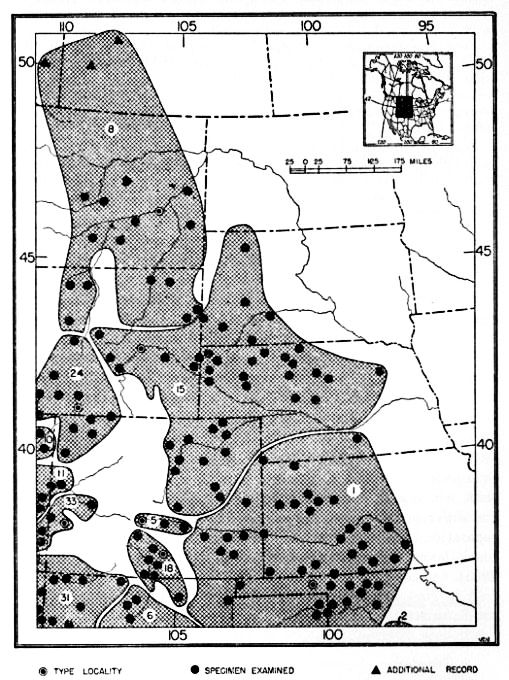
Fig. 25. Known occurrences and probable geographic range of the subspecies of Dipodomys ordii in the northeastern fourth of the range of the species. 1. D. o. richardsoni 8. D. o. terrosus 18. D. o. montanus 2. D. o. oklahomae 10. D. o. uintensis 24. D. o. priscus 5. D. o. evexus 11. D. o. sanrafaeli 31. D. o. longipes 6. D. o. medius 15. D. o. luteolus 33. D. o. nexilis
From Dipodomys ordii obscurus, D. o. extractus differs as follows: Size larger; color lighter; skull larger in all respects, notably in least interorbital width, greatest length of skull and breadth across auditory bullae; zygomatic arches less robust and straight as opposed to robust and bowed laterally; pterygoid fossae subcircular as opposed to circular; auditory bullae more inflated ventrally.
From Dipodomys ordii idoneus, D. o. extractus differs in: Size larger; color lighter; skull larger in all measurements taken except least interorbital width and breadth across maxillary arches which are smaller; nasals longer and narrower; braincase less vaulted; zygomatic arches less robust and more nearly straight; auditory bullae less inflated ventrally.
Remarks.—This subspecies of Dipodomys ordii is the palest of any of the known races from Mexico. It inhabits an area of light-colored sandy soil at the type locality.
The only subspecies with which D. o. extractus really needs comparison is Dipodomys ordii ordii from which it differs as described above. The series which is herein described contains two individuals that resemble D. o. ordii cranially and three that resemble it in color although they are somewhat paler. One specimen, MVZ no. 76560, is the palest of any of the series, has a short tail and in these respects resembles the pale form of Dipodomys ordii compactus. It is apparent from the skull of this latter individual that it is not D. o. compactus but D. o. extractus.
Dipodomys ordii ordii inhabits, in most of its range, dark-colored soils, whereas D. o. extractus inhabits light-colored soils. Possibly the differentiation that has occurred is a result of an ecological separation much as occurs with Perognathus on the white sands and black lavas of the Tularosa Basin of New Mexico (see Benson, 1933).
Specimens examined.—Total, 14, all from Chihuahua, as follows: 1 mi. E Samalayuca, 4500 ft., 14 (MVZ).
Dipodomys ordii chapmani Mearns
Dipodomys chapmani Mearns, Bull. Amer. Mus. Nat. Hist., 2:291, February 21, 1890.
Cricetodipus chapmani, Trouessart, Catalogus Mammalium, 1:581, 1897.
Perodipus chapmani, Elliot, Field Columbian Museum, Zool. Ser., 2:237, 1901.
Perodipus ordii chapmani, Goldman, Proc. Biol. Soc. Washington, 30:113, May 23, 1917.
Dipodomys ordii chapmani, Grinnell, Journ. Mamm., 2:96, May 2, 1921.
Cotypes.—Male, no. 2400, and female, no. 2398, Amer. Mus. Nat. Hist.; Fort Verde, Yavapai County, Arizona; obtained on January 26, 1887, and 49October 1, 1885, respectively, by Edgar A. Mearns. (Type not seen.)
Range.—Central Arizona from the Grand Canyon of the Colorado River, southeastward to, and probably beyond, Fort Verde; marginal occurrences are: lower end Prespect Valley, Kirkland, Prescott, Camp Verde, Bill Williams Mountain.
Diagnosis.—Size medium (see measurements). Color dark; entire dorsal surface between (10") Pinkish Cinnamon and Cinnamon-Buff, purest on sides and flanks, upper parts strongly suffused with black; arietiform markings, pinnae of ears, plantar surfaces of hind feet, dorsal and ventral stripes of tail, blackish. Skull medium in size; rostrum long and narrow; nasals long; auditory bullae slightly distended; braincase vaulted.
Comparisons.—For comparisons with Dipodomys ordii cupidineus, Dipodomys ordii longipes and Dipodomys ordii ordii see accounts of those subspecies.
Remarks.—This subspecies of Dipodomys ordii is relatively isolated from other subspecies of the species. The Colorado River with its deep canyons is interposed between the ranges of D. o. chapmani and D. o. cupidineus. A high range of mountains separates D. o. chapmani from the range of D. o. longipes. The only race with which D. o. chapmani probably comes into contact is D. o. ordii to the southeast. No specimens are available from the southeastern part of the range of D. o. chapmani. Animals from the northwestern part of the range of D. o. ordii, without exception, have dark-colored pelage which is characteristic of D. o. chapmani. In the shape of the nasals, vault of the braincase, interorbital width and auditory bullae, animals from Rice, Arizona, resemble D. o. chapmani, but in other characters resemble D. o. ordii to which subspecies they are referred. Animals from 20 miles northeast of Calva, Arizona, are dark-colored and are intermediate between the dark D. o. chapmani and the pale D. o. ordii in size of the cranium and body but are referable to D. o. ordii. In the northwestern part of the range of D. o. chapmani the animals are not typical in that they have a shorter, wider rostrum and a heavier zygomatic arch than topotypes.
Specimens examined.—Total, 90, all from Arizona, distributed as follows: Mohave County: lower end Prospect Valley, 4500 ft., Grand Canyon, 7 (USBS); Kingman, 9 (LACM). Coconino County: Aubrey Valley, 10 mi. S Pine Spring, 4 (USBS); Bill Williams Mountain, 1 (USNM). Yavapai County: 3 mi. N Fort Whipple, 11 (USBS); Fort Whipple, 4 (2 USBS; 2 USNM); Willow Creek, 4 mi. N Prescott, 4 (MVZ); 1 mi. W Camp Verde, 1 (MVZ); Camp Verde, 33 (15 USBS; 3 MVZ; 3 AMNH; 9 LACM; 3 DRD); 1/2 mi. S Camp Verde, 4 (MVZ); Kirkland, 9 (USBS); Turkey Creek, 3 (USBS).
Dipodomys ordii montanus Baird
Dipodomys montanus Baird, Proc. Acad. Nat. Sci. Philadelphia, 7:334, April, 1855.
Perodipus montanus, Merriam, Proc. Biol. Soc. Washington, 17:140, July 14, 1904.
Perodipus ordii montanus, Goldman, Proc. Biol. Soc. Washington, 30:113, May 23, 1917.
Dipodomys ordii montanus, Grinnell, Journ. Mamm., 2:96, May 2, 1921.
Type.—Male, no. 490/1631, U. S. Nat. Mus.; near Fort Massachusetts, Costilla County, Colorado; obtained in 1853 by F. Kreutzfeldt (Pacific Railroad Survey).
Range.—The San Luis Valley of south-central Colorado and north-central New Mexico; marginal occurrence are: in Colorado, 22 mi. E Mosca, Saguache, Alamosa and Antonito; in New Mexico, 4 mi. SW Cimmaron.
Diagnosis.—Size small (see measurements). Color dark, entire dorsal surface between (c) Vinaceous-Buff and Avellaneous, purest on sides and flanks, upper parts strongly suffused with black; arietiform markings, pinnae of ears, plantar surfaces of hind feet and dorsal and ventral stripes of tail, blackish. Skull small; rostrum slender; interorbital width narrow; auditory bullae strongly inflated; braincase but slightly vaulted; interparietal region wide; zygomatic arch bowed laterally.
Comparisons.—From Dipodomys ordii richardsoni, D. o. montanus differs as follows: Size smaller; color darker in all pigmented areas; ventral stripe of tail continuous to end of pencil in all specimens, whereas in D. o. richardsoni the stripe is incomplete in most specimens. In all specimens the dorsal and ventral stripes of the tail are darker in D. o. montanus; skull smaller in all measurements taken; jugal straight or nearly so, as contrasted to bowed laterally; pterygoid fossae shallower and more ovoid, that is to say, wings of pterygoid flare laterally; ventral projection of auditory bullae more pronounced; rostrum, immediately in front of zygomatic process of maxilla, nearly parallel to median plane along long axis of skull, while in D. o. richardsoni this union forms a decided obtuse angle; paroccipital processes smaller; foramen magnum smaller and more ovoid as opposed to larger and more circular.