SUBSPECIATION (continued 2)
Reading edition
From Dipodomys ordii evexus, D. o. montanus differs as follows: Size smaller in all measurements taken except width across auditory bullae which is greater; color darker, ventral stripe of tail continuous to end of pencil; least width of supraoccipital less (2.5 mm. in D. o. montanus and 3.5 mm. in D. o. evexus); extension of premaxillae posterior to nasals greater; braincase more inflated dorsally; bullae relatively as well as actually larger and more inflated ventrally; pterygoid fossae narrower anteroposteriorly and wider laterally than in D. o. evexus; jugal straight or nearly so as contrasted to bowed laterally; lacrimal processes smaller.
For comparison with Dipodomys ordii medius see account of that subspecies.
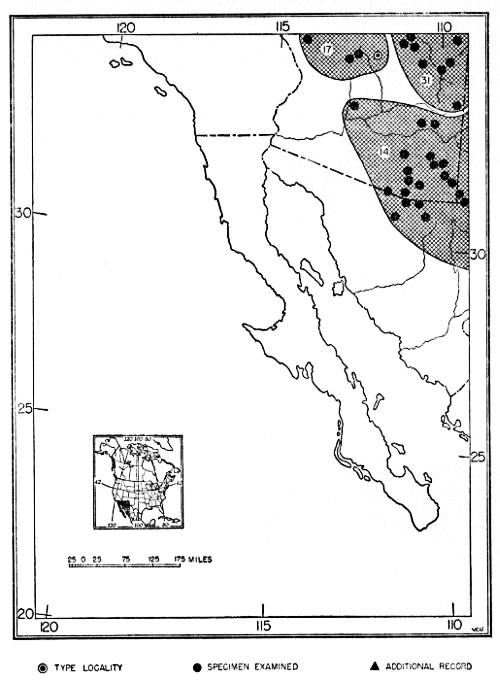
Fig. 26. Known occurrences and probable geographic range of the subspecies of Dipodomys ordii in the southwestern fourth of the range of the species. 14. D. o. ordii 17. D. o. chapmani 31. D. o. longipes
Remarks.—This subspecies of Dipodomys ordii appears to be restricted to the San Luis Valley of Colorado and New Mexico. Intergradation, between Dipodomys ordii ordii and D. o. montanus, is noted in animals from Gran Quivira, Mesa Jumanes, New Mexico. These animals have the frontomaxillary suture and extension of the premaxilla as in D. o. ordii and the nasals and inflation of the auditory bullae as in D. o. montanus. In the majority of characters they are, however, referable to the latter. Intergradation is noted also in animals from 4 miles southwest of Cimmaron, New Mexico, in that they resemble D. o. richardsoni in the shape of the nasals and the width and length of the rostrum but in the remainder of the characters studied resemble D. o. montanus to which they are referred.
Baird, in the original description, gives "near Fort Massachusetts" as the type locality for this subspecies. Miller (1923) lists the type locality as "Fort Massachusetts (now Fort Garland)." Fort Massachusetts and Fort Garland are two different ex-army posts. Old Fort Massachusetts was situated on what is now the Trinchera Ranch which is north of the town of Fort Garland. Old Fort Garland is approximately one-half mile south of the town of Fort Garland. The two abandoned army posts were no more than twelve miles apart. In 1946, at neither abandoned post could I find any habitat suitable for kangaroo rats.
Specimens examined.—Total, 148, distributed as follows:
Colorado: Saguache County: Saguache, 1 (USBS). Alamosa County: 1.6 mi. NE Medano Springs Ranch Headquarters, 8 (MVZ); Great Sand Dunes National Monument, 10 (MVZ); 8 mi. S Great Sand Dunes National Monument, 4 (MVZ); Medano Ranch, 15 mi. NE Mosca, 11 (2 USBS; 9 MVZ); 22 mi. E Mosca, 5 (AMNH); Alamosa, 1 (UM). Conejos County: Antonito, 1 (USBS); 7 mi. E Antonito, 3 (USBS); 12 mi. E Antonito, 2 (USBS). Costilla County: 4-1/2 mi. N Blanca, 8100 ft., 3 (MVZ); 1 mi. NE Blanca, 7950 ft., 1 (MVZ); 3 mi. NW Fort Garland, 6 (CMNH); 1 mi. NW Fort Garland, 3 (MVZ); 15 mi. W Fort Garland, 7800 ft., 4 (KU); Fort Garland, 64 (31 USBS; 28 LACM; 5 MVZ); 5 mi. SSE Fort Garland, 4 (AMNH); 5 mi. S Fort Garland, 2 (AMNH).
New Mexico: Colfax County: 4 mi. SW Cimmaron, 5 (AMNH); 3 mi. SE Cimmaron, 8 (AMNH); 1-1/2 mi. W Philmont Ranch Headquarters, 2 (AMNH).
Dipodomys ordii cinderensis Hardy
Dipodomys ordii cinderensis Hardy, Proc. Biol. Soc. Washington, 57:53, October 31, 1944.
Type.—Male, no. 4611, Mus. Zool., Univ. Utah; at approximately 4,000 ft. on sandy soil, immediately north of the northern of two large cinder cones in Diamond Valley, 10 mi. N St. George, Washington County, Utah; obtained on February 13, 1944, by Ross Hardy, original no. 2690.
Range.—Diamond Valley, Washington County, Utah, north through Mountain Meadows, east as far as Cedar City, Iron County, Utah, north through the Escalante Desert to Lund, Iron County, and west almost to the Utah-Nevada boundary; marginal occurrences, all in Utah are: 11 mi. SE Lund; N end Mountain Meadows; Diamond Valley; 10 mi. W Cedar City; 4-1/2 mi. NW Summit and 6 mi. W Parowan.
Diagnosis.—Size small (see measurements). Color dark, upper parts near Buffy Brown, strongly suffused with black, purest on sides and flanks; pinnae of ears, plantar surfaces of hind feet, dorsal and ventral stripes of tail, arietiform markings, black. Skull small; rostrum narrow; auditory bullae relatively as well as actually well inflated; external auditory meatus small; interparietal region narrow.
Comparisons.—From Dipodomys ordii fetosus, D. o. cinderensis differs in: Size smaller; color darker; skull smaller in all measurements taken.
From Dipodomys ordii panguitchensis, D. o. cinderensis differs as follows: Size smaller; color lighter; skull smaller except for auditory bullae which are larger; external auditory meatus smaller; maxillary tooth-row longer.
Compared with Dipodomys ordii longipes and Dipodomys ordii cupidineus, D. o. cinderensis is smaller, darker and can easily be distinguished.
For comparisons with Dipodomys ordii celeripes and Dipodomys ordii utahensis see accounts of those subspecies.
Remarks.—This race confined to Utah, and inhabiting northern Washington County and most of Iron County, is restricted almost exclusively to areas of loose shifting sand. Intergradation with Dipodomys ordii fetosus occurs near Lund. The animals from this locality intergrade in size of body and in color, but in the majority of cranial characters resemble D. o. cinderensis. In all characters studied D. o. cinderensis appears to be more closely related to Dipodomys ordii utahensis than to any other subspecies with which it comes into actual contact.
Animals from near Parowan have both cranial and external characters by which they could be referred to either D. o. panguitchensis or D. o. cinderensis. Owing to the existence of the physical barrier (Cedar Mountains) separating the two populations, they are referred to D. o. cinderensis. Dipodomys ordii cinderensis is not a well differentiated race but appears to possess characters sufficiently diagnostic to distinguish it from contiguous forms.
Specimens examined.—Total, 74, all from Utah, distributed as follows: Iron County: 11 mi. SE Lund, 50 (46 RH; 4 MVZ); 4-1/2 mi. NW Summit and 6 mi. W Parowan, 9 (RH); 10 mi. W Cedar City, 1 (USAC); 5 mi. W Cedar City, 1 (USAC); Cedar City, 2 (BYU). Washington County: Diamond Valley, 9 (RH); N end Mountain Meadows, 2 (RH).
Dipodomys ordii fetosus Durrant and Setzer
Dipodomys ordii fetosus Durrant and Hall, Mammalia, 3:14, March, 1939.
Type.—Female, adult, no. 48451, Museum of Vertebrate Zoology, University of California; 2 mi. N Panaca, 4,800 ft., Lincoln County, Nevada; obtained on June 24, 1931, by Ward C. Russell, original no. 1658.
Range.—Southeastern Nevada and western Beaver and Millard counties, Utah; marginal occurrences in Nevada, 2 mi. SE Pioche, 15 mi. WSW Sunnyside, 16-1/2 mi. WSW Sunnyside, 14 mi. NNE Sharp, 8-1/2 mi. NE Sharp, 15 mi. S Groom Baldy, 10 mi. E Crystal Spring, Panaca; in Utah, Pine Valley, 50 mi. W Milford and 5 mi. S Garrison.
Diagnosis.—Size medium (see measurements). Color dark, entire dorsal surface (16") between Pinkish Cinnamon and Cinnamon-Buff, purest on sides and flanks with strong admixture of black in upper parts; cheeks white; pinnae of ears, arietiform markings, plantar surfaces of hind feet, dorsal and ventral stripes of tail, blackish. Skull medium in size; rostrum wide and short; interorbital region narrow; braincase but slightly vaulted; lacrimal processes large; zygomatic arches weak and bowed laterally; pterygoid fossae large and subcircular.
Comparisons.—From Dipodomys ordii utahensis, D. o. fetosus differs as follows: Hind foot longer; color lighter; skull larger; rostrum, relatively as well as actually, shorter and wider; nasals longer and wider; interorbital region narrower; braincase less vaulted; interparietal region narrower; auditory bullae more inflated laterally, posteriorly and ventrally; foramen magnum smaller.
From Dipodomys ordii celeripes, D. o. fetosus differs as follows: Larger; color darker; arietiform markings present; skull larger; rostrum longer and wider; nasals longer and less inflated distally; interorbital region wider; auditory bullae somewhat more inflated; zygomatic arches more robust.
For comparisons with Dipodomys ordii monoensis, D. o. columbianus, D. o. pallidus, D. o. panguitchensis and D. o. cinderensis see accounts of those subspecies.
Remarks.—Dipodomys ordii fetosus has a small geographic range. Hall (1946:416) points out that the interorbital breadth in topotypes is less than in those from any other part of the range. This feature, therefore, is not useful in characterizing this subspecies. Intergradation with Dipodomys ordii columbianus is noted in the greater total length and the somewhat darker color in animals from Coal Valley and Garden Valley, Nevada. In the part of the range which lies in Utah, none of the animals is typical and all are intergrades in color and cranial characters with Dipodomys ordii celeripes.
Specimens examined.—Total, 136, distributed as follows:
Nevada: Nye County: White River Valley, 15 mi. WSW Sunnyside, 5500 ft., 26 (MVZ); White River Valley, 16-1/2 mi. WSW Sunnyside, 5500 ft., 6 (MVZ); 14 mi. NNE Sharp, 1 (MVZ); Garden Valley, 15 mi. NE Sharp, 1 (MVZ); Garden Valley, 14-1/2 mi. NE Sharp, 3 (MVZ); 8-1/2 mi. NE Sharp, 17 (MVZ). Lincoln County: E side Coal Valley, 14 mi. N Seeman Pass, 4850 ft., 4 (MVZ); 2 mi. SE Pioche, 1 (MVZ); E side Coal Valley, 10 mi. N Seeman Pass, 1 (MVZ); Desert Valley, 20 mi. SW Pioche, 1 (MVZ); 2 mi. N Panaca, 4800 ft., 17 (16 MVZ; 1 CAS); Desert Valley, 21 mi. W Panaca, 10 (MVZ); Crystal Spring, Pahranagat Valley, 4000 ft., 2 (MVZ); 10 mi. E Crystal Springs, 5000 ft., 1 (MVZ); 15 mi. S Groom Baldy, 1 (MVZ).
Utah: Millard County: 5 mi. S Garrison, 5400 ft., 12 (MVZ); Pine Valley, Sec. 33, T. 25 S, R. 17 W, 5000 ft., 16 (UU); Warm Cove, Sec. 34, T. 25 S, R. 18 W, 5500 ft., 2 (UU); Desert Range Experiment Station, 50 mi. W Milford, 5252 ft., 10 (9 UU; 1 BYU).
Dipodomys ordii utahensis (Merriam)
Perodipus montanus utahensis Merriam, Proc. Biol. Soc. Washington, 17:143, July 14, 1904.
Perodipus ordii utahensis, Goldman, Proc. Biol. Soc. Washington, 30:113, May 23, 1917.
Dipodomys ordii columbianus, Grinnell, Journ. Mamm., 2:96, May 2, 1921.
Dipodomys ordii columbianus, Hall, Univ. California Publ. Zool., 37:5, April 10, 1931 (part—the part from Ogden, Utah.)
Type.—Male, adult, no. 55115, U. S. Nat. Mus. Biol. Surv. Coll.; Ogden, Weber County, Utah; obtained on July 15, 1893, by Vernon Bailey, original no. 4085.
Range.—Between Great Salt Lake and the Wasatch Mountains from extreme northern Utah, south to northern Sevier County, Utah; marginal occurrences, all in Utah, are: Promontory Point, Ogden, St. John, Cedar Valley, Nephi, Aurora, Spring City, Provo and 4 mi. N Draper.
Diagnosis.—Size small (see measurements). Color dark, entire dorsal surface (a) between Cinnamon-Buff and Clay Color, purest on sides, flanks and cheeks, with heavy admixture of black in upper parts; arietiform markings, pinnae of ears, plantar surfaces of hind feet, dorsal and ventral stripes of tail blackish. Skull small; rostrum short and narrow; interorbital region moderately wide; interparietal large, spatulate anteriorly; lacrimal processes relatively large; braincase vaulted; zygomatic arches robust and straight; auditory bullae relatively, as well as actually, greatly inflated.
Comparisons.—From Dipodomys ordii marshalli, D. o. utahensis differs as follows: Size smaller; color darker; skull smaller; rostrum longer and narrower; interorbital region wider; lacrimal processes larger; interparietal region larger; auditory bullae less inflated; palate longer and narrower.
From Dipodomys ordii pallidus, D. o. utahensis differs in: Size smaller; color darker; skull smaller; rostrum shorter and narrower; interorbital region narrower; auditory bullae less inflated laterally, posteriorly and ventrally; interparietal region larger; lacrimal processes smaller; foramen magnum with ventral notch as opposed to rounded ventrally; pterygoid fossae circular as opposed to subcircular; palate longer and narrower.
From Dipodomys ordii cinderensis, D. o. utahensis differs as follows: Size larger, except hind foot which is shorter; color somewhat lighter, more reddish; skull larger; rostrum longer; nasals longer; braincase more vaulted; pterygoid fossae circular as opposed to subcircular; auditory bullae less inflated laterally but more inflated ventrally.
For comparisons with Dipodomys ordii columbianus, D. o. fetosus, D. o. marshalli, D. o. panguitchensis and D. o. cineraceus see accounts of those subspecies.
Remarks.—The systematic status of D. o. utahensis has long been in doubt. Several workers have, at various times, considered it to be indistinguishable from Dipodomys ordii columbianus. Durrant and Setzer (1945:29) recognized it as a valid subspecies and gave diagnostic characters by which it could be distinguished from D. o. columbianus.
Intergradation has been noted in specimens from the eastern and southeastern shores of Great Salt Lake. In color and the width of the auditory bullae these specimens are intermediate between D. o. utahensis and Dipodomys ordii marshalli but in the sum total of characters are referable to the latter. Specimens from 20 miles southwest of Nephi and from U. B. (Yuba) Dam are darker and intermediate in rostral width and breadth of the auditory bullae but are referable to Dipodomys ordii celeripes.
Specimens examined.—Total, 91, all from Utah, distributed as follows: Box Elder County: Promontory Point, 1 (USNM). Weber County: Ogden, 4293 ft., 20 (7 BYU; 7 MVZ; 4 USNM); Little Mountain, 1 (USNM). Davis County: Antelope Island, Great Salt Lake, 4250 ft., 5 (USNM). Tooele County: Bauer, 4500 ft., 6 (UU); St. John, 4300 ft., 4 (UU); Little Valley, Sheeprock Mountains, 5500 ft., 1 (UU); Clover Creek, Onaqui Mountains, 5500 ft., 1 (UU). Salt Lake County: Plain, 4 mi. N Draper, 4500 ft., 1 (UU). Utah County: Fairfield, Cedar Valley, 4800 ft., 15 (9 BYU; 6 UU); W Lake Mountains, 9 (BYU); Provo, 4510 ft., 10 (MVZ); Sand Dunes W Curtis Station, 4 (BYU). Juab County: Nephi, 2 (1 USNM; 1 MVZ); 4 mi. W Nephi, 1 (RH). San Pete County: Spring City, 4 (LACM). Sevier County: 1 mi. W Aurora, 5190 ft., 6 (5 UU; 1 USNM).
Dipodomys ordii columbianus (Merriam)
Perodipus ordi columbianus Merriam, Proc. Biol. Soc. Washington, 9:115, June 21, 1894.
Dipodomys phillipii, Baird, U. S. P. R. R. Expl. and Surveys, Gen. Rept., p. 412, 1857 (part—the part from Ft. Walla Walla, O. T.).
Cricetodipus ordii columbianus, Trouessart, Catalogus Mammalium, 1:581, 1897.
Perodipus ordii columbianus, Goldman, Proc. Biol. Soc. Washington, 30:113, May 23, 1917.
Dipodomys ordii columbianus, Grinnell, Journ. Mamm., 2:96, May 2, 1921.
Type.—Female, adult, no. 24181/31594, U. S. Nat. Mus., Dept. of Agriculture, Coll.; Umatilla, Plains of Columbia, Umatilla County, Oregon; obtained on October 18, 1890, by Clark P. Streator, original no. 386.
Range.—Southeastern Washington, eastern Oregon, southwestern Idaho, northwestern, northern and most of northeastern Nevada; marginal occurrences are: in Washington, 2 mi. SW Paterson, 4 mi. E Burbank and Wallula; in Oregon, 7 mi. E Madras, 2 mi. E Prineville and Guano Valley; in California, Eagleville, Red Rock, Observation Peak, 5 mi. E Litchfield, Honey Lake, Vinton; in Nevada, 3-1/2 mi. E Flanigan, 6 mi. S Pahrum Peak, 2-1/2 mi. E and 11 mi. N Gerlach, 2 mi. SW Quinn River Crossing, 1 mi. SE Tuscarora, 5 mi. N Beowawe, 1/2 mi. S Beowawe, 2-1/2 mi. NE Smiths Creek Ranch, Bells Ranch, 5 mi. W Austin, 8 mi. W Eureka, 4 mi. S Shoshone, 5 mi. SE Greens Ranch, and 22 mi. N Deeth; in Idaho, 8 mi. W Rodgerson, 6 mi. SW American Falls, 4 mi. NE American Falls, 5 mi. NW Michaud, Arco, Hammett and Payette; in Oregon, Umatilla.
Diagnosis.—Size medium (see measurements). Color dark, entire dorsal surface (16") between Pinkish Cinnamon and Cinnamon-Buff, purest on sides and flanks with strong admixture of black on upper parts; cheeks white; arietiform markings, pinnae of ears, plantar surfaces of hind feet, dorsal and ventral stripes of tail, blackish. Skull medium in size; rostrum relatively long and narrow; nasals long and expanded distally; interorbital region narrow; lacrimal processes small; braincase but slightly vaulted; auditory bullae relatively greatly inflated; pterygoid fossae circular; zygomatic arches robust.
Comparisons.—From Dipodomys ordii utahensis, D. o. columbianus differs as follows: Color lighter, dorsal and ventral stripes of tail brownish as opposed to black; ventral stripe of tail, in most specimens, incomplete to end of pencil as opposed to complete; lacrimal processes smaller; extension of premaxillae dorsad wider; interparietal generally narrower, smaller, quadrangular and truncate anteriorly, as opposed to spatulate and rounded anteriorly; braincase less vaulted; zygomatic arches bowed laterally as opposed to straight; styloid processes larger; cutting edge of upper incisors narrower.
From Dipodomys ordii fetosus, D. o. columbianus differs in: Hind foot shorter; color generally darker; skull larger; rostrum shorter and wider; nasals somewhat shorter; braincase more vaulted; auditory bullae less inflated; interparietal region wider; ventral border of foramen magnum more rounded (less indented); zygomatic arches straight as opposed to bowed laterally.
For comparisons with Dipodomys ordii inaquosus, Dipodomys ordii monoensis and Dipodomys ordii celeripes see accounts of those subspecies.
Remarks.—In most subspecies of Dipodomys ordii having large geographic ranges, there is a certain amount of variation, but D. o. columbianus remains relatively stable throughout its large range. Where extreme variation is noted in D. o. columbianus it is obviously the result of intergradation. This intergradation is noted between Dipodomys ordii monoensis and D. o. columbianus in Lyon County, Nevada, where the animals are referable to the former race cranially but to the latter on the basis of color. Animals from Kelton, Utah, are in color as Dipodomys ordii marshalli and cranially combine characters of D. o. columbianus, D. o. utahensis and D. o. marshalli. The sum total of their characters places them with D. o. marshalli. Durrant and Setzer (1945:29), and the present writer in this account, do not record any animals from Utah as belonging to D. o. columbianus. Nevertheless, the influence of D. o. columbianus is seen in the animals from Kelton, Utah.
Specimens examined.—Total, 588, distributed as follows:
Washington: Benton County: Blalock Island, 2 mi. SW Paterson, 2 (MVZ). Walla Walla County: 4 mi. E Burbank, 4 (MVZ); 2 mi. SSE Burbank, 27 (MVZ); Wallula, 7 (4 MVZ; 3 DRD).
Oregon: Gilliam County: Arlington, 1 (MVZ). Morrow County: 2-1/2 mi. SW Irigon, 6 (MVZ); Cecil, 1 (MVZ). Umatilla County: Umatilla, 10 (MVZ). Jefferson County: 7 mi. E Madras, 2 (DRD). Crook County: 2 mi. NE Prineville, 1 (MVZ); 7 mi. W Prineville, 8 (MVZ); 4 mi. SW Prineville, 23 (MVZ); Crooked River, at mouth of Bear Creek, 8 (MVZ). Lake County: Fort Rock, 1 (DRD); NE edge Alkali Lake, 8 (MVZ); 9 mi. S Adel, mouth 20 Mile Creek, 1 (MVZ); Guano Ranch, Guano Valley, 2 (DRD). Harney County: Malheur Lake, 9 (LACM); Narrows, 1 (DRD); 1 mi. S Narrows, 3 (MVZ); 5 mi. SW Narrows, 19 (MVZ); Smith Creek, 10 mi. SE Diamond, 1 (MVZ); Lake Alvord, 1 (MVZ); 1-1/2 mi. E Denio, 4 (MVZ). Malheur County: 3 mi. N Vale, 2 (MVZ); 8 mi. N Jordan Valley, 1 (MVZ); 1/2 mi. S Rome, 5 (MVZ); 1 mi. S Rome, 11 (MVZ).
Idaho: Payette County: Payette, 1 (DRD). Butte County: Arco, 1 (MVZ). Elmore County: Hammett, 1 (MVZ). Bingham County: 5 mi. E Shelley, 1 (MVZ); Blackfoot, 5 (MVZ); 3 mi. S Blackfoot, 6 (MVZ); Aberdeen, 1 (MVZ). Owyhee County: S bank Snake River, Homedale, 13 (MVZ); Indian Cove, 4 (MVZ); 5 mi. SE Murphy, 3 (MVZ); Castle Creek, 8 mi. S Oreana, 1 (MVZ); S Fork Owyhee River, 12 mi. N Nevada line, 1 (MVZ). Minidoka County: Acequia, 8 (MVZ); 4 mi. N Rupert, 2 (MVZ). Twin Falls County: Salmon Creek, 8 mi. W Rodgerson, 7 (MVZ). Power County: 5 mi. NW Michaud, 4 (MVZ); 4 mi. NE American Falls, 4 (MVZ); 6 mi. SW American Falls, 10 (MVZ).
California: Modoc County: Eagleville, 12 (CAS); 2 mi. E Eagleville, 7 (CAS); 2-1/2 mi. E Eagleville, 24 (CAS); 3 mi. E Eagleville, 6 (CAS); 5 mi. E Eagleville, 3 (CAS). Lassen County: 2 mi. W Red Rock P. O., 1 (MVZ); 1 mi. W Red Rock P. O., 4 (MVZ); Dransfield, 6 mi. E Ravendale, 5300 ft., 4 (CAS); 7 mi. E Ravendale, 1 (MVZ); 7 mi. N Observation Peak, 21 (MVZ); 6 mi. N Observation Peak, 7 (MVZ); Observation Peak, 31 (MVZ); Pete's Valley, 4 (MVZ); 5 mi. E Litchfield, 12 (MVZ); 6 mi. W Wendell, 3975 ft., 3 (CAS); 8 mi. SW Wendell, 5 (CAS); Honey Lake, 2 (LACM); 4-1/2 mi. WNW Stacy, 5 (MVZ); 3 mi. NW Warm Springs, 1 (MVZ). Plumas County: Beckwith, 1 (DRD); 2 mi. WNW Vinton, 2 (MVZ); Vinton, 18 (14 LACM; 4 MVZ); 1 mi. E Vinton, 7 (MVZ); near Vinton, 21 (DRD).
Nevada: Washoe County: 3 mi. N Vya, 3 (MVZ); 4-1/2 mi. NE Painted Point, 4 (MVZ); 8-1/2 mi. E Vya, 1 (MVZ); 3 mi. E Painted Point, 1 (MVZ); Long Valley Ranch, 3 mi. S Vya, 1 (MVZ); 10-1/2 mi. S Vya, 1 (MVZ); 11 mi. S Vya, 2 (MVZ); 13 mi. S Vya, 4 (MVZ); Hausen, 4800 ft., 8 (MVZ); 10 mi. SE Hausen, 4675 ft., 7 (MVZ); 2-1/2 mi. E and 11 mi. N Gerlach, 4050 ft., 4 (MVZ); Smoke Creek, 9 mi. E California line, 3900 ft., 5 (MVZ); 40° 28' N Lat., 6 mi. E California line, 4000 ft., 3 (MVZ); Horse Canyon, 3 mi. NW Pahrum Peak, 5000 ft., 1 (MVZ); Fox Canyon, 6 mi. S Pahrum Peak, 4800 ft., 4 (MVZ); N side Sand Pass, 3950 ft., 2 (MVZ); 4 mi. NW Flanigan, 4200 ft., 1 (MVZ); 3-1/2 mi. NW Flanigan, 4200 ft., 1 (MVZ); 3-1/2 mi. E Flanigan, 2 (MVZ); 2-3/4 mi. SW Pyramid, 4300 ft., 2 (MVZ). Humboldt County: 1 mi. S Denio, Oregon, 4200 ft., 6 (MVZ); Quinn River Crossing, 4100 ft., 1 (MVZ). Elko County: Mary's River, 22 mi. N Deeth, 3 (MVZ); 1 mi. SE Tuscarora, 5900 ft., 2 (MVZ); 5 mi. W Halleck, 5200 ft., 7 (MVZ); 3 mi. W Halleck, 5300 ft., 2 (MVZ). Lander County: 1 mi. E Battle Mountain, 1 (MVZ); Reese River Valley, 6 mi. N Austin, 2 (MVZ); Malloy Ranch, 5 mi. W Austin, 3 (MVZ); 2-1/2 mi. NE Smiths Creek Ranch, 5800 ft., 1 (MVZ); Campbell Creek, 6900 ft., 3 (MVZ); Campbell Creek Ranch, 5500 ft., 8 (MVZ). Eureka County: 5 mi. N Beowawe, 7 (MVZ); 1/2 mi. S Beowawe, 1 (MVZ); Pine Creek, 2 mi. E Palisades, 7 (MVZ); Evans, 4 (MVZ); Winzell, 3 (MVZ); 4 mi. SE Romano, Diamond Valley, 1 (MVZ); 8 mi. W Eureka, 12 (MVZ). White Pine County: 5 mi. SE Greens Ranch, Steptoe Valley, 1 (MVZ); Cherry Creek, 6600 ft., 2 (MVZ); 1 mi. E Illipah, 6100 ft., 3 (MVZ); 5-1/2 mi. SE Ely, 6500 ft., 5 (MVZ); Spring Valley, 5900 ft., 4 mi. S Shoshone, 6 (MVZ). Nye County: Bells Ranch, Reese River, 6890 ft., 1 (MVZ).
Dipodomys ordii idoneus new subspecies
Type.—Male, adult, no. 90029, Museum of Zoology, University of Michigan; San Juan, 12 mi. W Lerdo, 3,800 ft., Durango, Mexico; obtained on March 1, 1946, by F. and F. Hammerstrom.
Range.—Known only from the type locality.
Diagnosis.—Size small (see measurements). Color pale, entire dorsal surface (c) between Light Ochraceous-Buff and Ochraceous-Buff, purest on sides, flanks and cheeks; upper parts but slightly washed with black; arietiform markings, lateral parts of pinnae of ears, plantar surfaces of hind feet, dorsal and ventral stripes of tail, brownish; medial part of pinnae of ears flesh-colored. Skull medium in size; rostrum wide and relatively long; braincase but slightly inflated; least interorbital width great; interparietal region relatively narrow; upper incisors strongly recurved; zygomatic arches relatively heavy and slightly bowed laterally; auditory bullae greatly inflated ventrally, laterally and posteriorly.
Comparisons.—From Dipodomys ordii ordii, D. o. idoneus differs in: Size smaller; color lighter; skull larger; nasals longer and somewhat more inflated distally as opposed to straight; interorbital width greater; breadth across maxillary arches greater; interparietal region narrower; auditory bullae more inflated posteriorly, laterally and ventrally and projecting anteriorly into orbit; extension of nasals anterior to upper incisors less; zygomatic arches heavier and more bowed laterally; paroccipital processes smaller; foramen magnum elongate as opposed to nearly circular.
From Dipodomys ordii obscurus, D. o. idoneus differs as follows: Size smaller; color lighter; skull larger, rostrum wider; nasals shorter and more expanded distally; interorbital region wider; width across maxillary arches greater; interparietal region narrower; auditory bullae more inflated laterally, posteriorly and ventrally; zygomatic arches shorter, heavier and less bowed laterally.
From Dipodomys ordii palmeri, D.o. idoneus differs in: Size smaller; color lighter; skull larger; rostrum shorter and wider; nasals shorter and more expanded distally; interorbital region wider; auditory bullae more inflated laterally, posteriorly and ventrally; zygomatic arches heavier.
From Dipodomys ordii fuscus, D. o. idoneus differs as follows: Size smaller; color lighter; skull smaller; rostrum narrower and shorter; interorbital width greater; braincase more vaulted; nasals longer; interparietal region generally wider; auditory bullae less inflated; breadth across maxillary arches greater; zygomatic arches heavier and more bowed laterally; pterygoid fossae ovoid as opposed to subcircular; occipital condyles more anterior to dorsal evagination when viewed ventrally.
Dipodomys ordii idoneus differs from Dipodomys ordii attenuatus in larger size, generally darker color and larger skull.
Remarks.—This subspecies of Dipodomys ordii is paler than either of the subspecies with adjoining geographic ranges. Measurements of the skull, in proportion to external measurements, are larger than in any other subspecies of Dipodomys ordii. Cranially, this new subspecies is more closely allied to Dipodomys ordii fuscus but in color appears to be much closer to Dipodomys ordii attenuatus from which it differs markedly in cranial features.
Specimens examined.—Total, 3, all from Durango, distributed as follows: San Juan, 12 mi. W Lerdo, 3 (UM).
Dipodomys ordii priscus Hoffmeister
Dipodomys ordii priscus Hoffmeister, Proc. Biol. Soc. Washington, 55:167, December 31, 1942.
Perodipus longipes, Allen, Bull. Amer. Mus. Nat, Hist., 8:246, November, 1896 (part—the part from Kinney Ranch, Wyoming).
Perodipus montanus richardsoni, Cary, N. Amer. Fauna, 33:141, August 17, 1911 (part—the part from Lay, Colorado).
Periodipus [Dipodomys] ordii luteolus, Svihla, Journ. Mamm.; 12:262, August, 1931 (part—the part from Linwood, Utah).
Type.—Male, no. 89119, Mus. Vert. Zool., Univ. California; Kinney Ranch, 21 mi. S Bitter Creek, 7100 ft., Sweetwater County, Wyoming; obtained on September 16, 1939, by Donald T. Tappe, original no. 766.
Range.—Southwestern Wyoming, extreme northeastern Utah and northwestern Colorado; marginal occurrences are: in Wyoming, 7 mi. N Ft. Washakie and 10 mi. SW Granger; in Colorado, Lay and Snake River south of Sunny Peak.
Diagnosis.—Size medium (see measurements). Color light, entire dorsal surface between (c) Light Ochraceous-Buff and Ochraceous-Buff, purest on sides, flanks and cheeks; upper parts slightly suffused with black; arietiform markings, pinnae of ears, plantar surfaces of hind feet, dorsal and ventral stripes of tail, grayish to blackish in different individuals. Skull medium in size; rostrum long and narrow; nasals long; auditory bullae relatively narrow and skull long, giving appearance of much narrower skull than is actually the case; zygomata weak; upper incisors moderately wide at cutting edge.
Comparisons.—From Dipodomys ordii uintensis, D. o. priscus differs as follows: Hind foot longer; color lighter in all pigmented areas, and skull smaller in all measurements taken.
From Dipodomys ordii sanrafaeli, D. o. priscus differs in: Color decidedly less red in upper parts; ventral stripe of tail not continuous to end of pencil; nasals longer; auditory bullae less inflated.
For comparisons with Dipodomys ordii luteolus and Dipodomys ordii terrosus see accounts of those subspecies.
Remarks.—The characters of this subspecies are stable throughout most of its geographic range. It is not known to intergrade with adjacent forms. One specimen, a male, available from the Snake River, south of Sunny Peak, Colorado, however, is not typical of D. o. priscus, in that it has a wider and deeper rostrum than any other specimen from the entire range. Between D. o. priscus and D. o. luteolus, the skull, but not the color, provides diagnostic differences.
The Red Desert of Wyoming is mostly sandy but there are large exposures of rock and gravel. At the type locality of D. o. priscus rockier soil predominates but is interspersed with stabilized sand dunes where the kangaroo rats are abundant. Traps set on the rocky soils, in a continuous line between the dunes, yielded no kangaroo rats.
Kangaroo rats in the area of the Kinney Ranch, Wyoming, apparently form a good source of food for owls, since many bones (jaws and limb elements) were found in owl pellets at the bases of cliffs approximately 5 miles northeast of the ranch buildings.
Specimens examined.—Total, 72, distributed as follows:
Wyoming: Fremont County: 7 mi. N Fort Washakie, 1 (USBS); Fort Washakie, 1 (USBS); Wind River, 1 (USBS). Sweetwater County: Eden, 1 (USBS); 5 mi. E Rock Springs, 1 (UM); 10 mi. SW Granger, 13 (UM); Bitter Creek, 9 (6 AMNH; 3 CNHM); Kinney Ranch, 21 mi. S Bitter Creek, 18 (MVZ); Shell Creek, 25 mi. S Bitter Creek, 3 (CM); 30 mi. S Bitter Creek, 3 (KU); 33 mi. S Bitter Creek, 8 (KU). Carbon County: 20 mi. W Baggs, 2 (USBS).
Utah: Daggett County: E bank Green River, 4 mi. E Linwood, 4 (CM).
Colorado: Moffat County: Snake River, south of Sunny Peak, 1 (USBS); 20 mi. NW Sunbeam, 4 (CM); Bear River, Lay, 1 (USBS). Rio Blanco County: W side White River, 1 mi. N Rangely, 1 (CM).
Dipodomys ordii celeripes Durrant and Hall
Dipodomys ordii celeripes Durrant and Hall, Mammalia, 3:10, March, 1939.
Dipodomys ordii columbianus, Hall, Univ. California Publ. Zool., 37:5, April 10, 1931.
Type.—Male, adult, no. 1956, Museum of Zoology, University of Utah; Trout Creek, 4600 ft., Juab County, Utah; obtained on May 5, 1937, by Stephen D. Durrant, original no. 1168.
Range.—Eastern Nevada, western and west-central Utah, east to eastern Sevier County, Utah; marginal occurrences are: in Nevada, Tecoma, Cobre and 8 mi. SE Mt. Moriah; in Utah, E side Clear Lake, U. B. (Yuba) Dam, 10 mi. SW Nephi, and Trout Creek.
Diagnosis.—Size small (see measurements). Color pale, entire dorsal surface Pinkish Buff, purest on sides, flanks and cheeks, with but slight suffusion of black in upper parts; pinnae of ears, plantar surfaces of hind feet, dorsal and ventral stripes of tail, brownish. Skull small; rostrum relatively short and wide; nasals relatively short; lacrimal processes small; braincase but slightly vaulted; auditory bullae but little inflated; interorbital region narrow; styloid processes project on ventral surface of auditory bullae beyond middle of external auditory meatus; zygomatic arches robust and bowed laterally; pterygoid fossae ovoid.
Comparisons.—From Dipodomys ordii marshalli, D. o. celeripes differs as follows: Size smaller, hind foot longer, tail shorter; color lighter; skull smaller; rostrum wider and shorter; interorbital region narrower; auditory bullae less inflated; lacrimal processes smaller; palate shorter; pterygoid fossae larger.
From Dipodomys ordii cinderensis, D. o. celeripes differs as follows: Size smaller, tail shorter; color lighter; rostrum wider and shorter; nasals shorter; interorbital width less; auditory bullae less inflated; foramen magnum wider and shorter; pterygoid fossae more circular.
From Dipodomys ordii columbianus, D. o. celeripes differs in: Size smaller; color lighter; rostrum wider and shorter; interorbital width less; interparietal region wider; auditory bullae, generally, less inflated; upper incisors longer and more robust; pterygoid fossae larger.
For comparisons with Dipodomys ordii fetosus, Dipodomys ordii pallidus and Dipodomys ordii panguitchensis see accounts of those subspecies.
Remarks.—It appears that wherever the range of D. o. celeripes meets that of an adjoining race, intergradation occurs freely. Practically all of the Nevadan specimens referable to this subspecies are intergrades with Dipodomys ordii columbianus in size and color. Specimens from west of Delta, Utah, are intermediate in size between Dipodomys ordii pallidus and D. o. celeripes but their cranial characters are more as in D. o. celeripes. Intergrades with Dipodomys ordii utahensis are discussed under the account of that subspecies.
The characters differentiating D. o. celeripes from any contiguous subspecies are not present in every specimen even in the type series.
Specimens examined.-Total, 96, distributed as follows:
Nevada: Elko County: 13 mi. N Montello, 5000 ft., 2 (MVZ); 1-1/2 mi. N Tecoma, 4900 ft., 6 (MVZ); Tecoma, 4900 ft., 8 (MVZ); Cobre, 6100 ft., 3 (MVZ); Salt Springs, 4200 ft., 1 (MVZ). White Pine County: 2 mi. W Smith Creek Cave, 6300 ft., Mt. Moriah, 2 (MVZ); Hendry Creek, 8 mi. SE Mt. Moriah, 6200 ft., 1 (MVZ).
Utah: Tooele County: Clifton Flat, 7 mi. SW Gold Hill, 6149 ft., 4 (UU); Parrish Ranch, 5 mi. N Ibapah, 5175 ft., 1 (UU); Ibapah, 5000 ft., 23 (UU). Juab County: Trout Creek, 4600 ft., 21 (19 UU; 1 USAC; 1 MVZ); 20 mi. SW Nephi, 2 (UU); U. B. (Yuba) Dam, Sevier River, 5000 ft., 10 (UU). Millard County: 4 mi. S Gandy, 5000 ft., 1 (MVZ); Smith Creek, 6 mi. S Gandy, 5400 ft., 2 (MVZ); Hendry Creek, 5000 ft., 17 mi. S Gandy, 4 (MVZ); Oak City, 5000 ft., 1 (UU); White Valley, 60 mi. W Delta, 1 (UU); 35 mi. W Delta, 1 (UU); East side Clear Lake, 4600 ft., 4 (3 UU; 1 USAC); 2 mi. E Clear Lake, 4600 ft., 2 (UU).
Dipodomys ordii cineraceus Goldman
Dipodomys ordii cineraceus Goldman, Journ. Mamm., 20:352, August 14, 1939.
Type.—Male, no. 263890, U. S. Nat. Mus. Biol. Surv. Coll.; Dolphin Island, Great Salt Lake, 4250 ft., Box Elder County, Utah; obtained on June 4, 1938, by William H. Marshall, original no. 57.
Range.—Dolphin Island, Great Salt Lake, Utah.
Diagnosis.—Size medium (see measurements). Color pale, upper parts near Pale Pinkish Buff, but lightly washed with black, purest on sides and flanks; arietiform markings, pinnae of ears, plantar surfaces of hind feet, dorsal and ventral stripes of tail, brownish. Skull medium in size; rostrum short; nasals relatively short; interparietal region relatively wide; auditory bullae but slightly inflated.
Comparisons.—From Dipodomys ordii utahensis, D. o. cineraceus differs in: Size smaller; color lighter; nasals longer; auditory bullae larger; total length of skull greater.
From Dipodomys ordii marshalli, D. o. cineraceus differs in: Size smaller; color darker; skull larger in all measurements taken.
Remarks.—The race D. o. cineraceus along with Dipodomys microps russeolus is found on Dolphin Island, Great Salt Lake, Utah. Dolphin Island is connected with the mainland by a bar that could allow animals from the island to disperse onto the mainland. There are no animals from the mainland, however, that are referable to D. o. cineraceus or to D. m. russeolus. The animals available from the mainland, at Kelton, although geographically near Dolphin Island, are referable to D. o. marshalli and to D. m. bonnevillei. The paucity of material from the mainland, adjacent to Dolphin Island, may be significant. Future trapping in this area is needed before we can be certain that D. o. cineraceus is isolated.
Specimens examined.—Total, 2, both from Utah, as follows: Box Elder County: Dolphin Island, Great Salt Lake, 4250 ft., 2 (USNM).
Dipodomys ordii marshalli Goldman
Dipodomys ordii marshalli Goldman, Proc. Biol. Soc. Washington, 50:223, December 28, 1937.
Type.—Female, adult, no. 262655, U. S. Nat. Mus. Biol. Surv. Coll.; Bird Island, Great Salt Lake, 4,300 ft., Tooele County, Utah; obtained on June 22, 1937, by W. H. Marshall, X-catalog no. 27969.
Range.—Bird, Carrington, Badger and Stansbury islands, Great Salt Lake; around western edge of Great Salt Lake north to Kelton, Box Elder County, Utah; around southern and southeastern edge of the lake to mouth of the Jordan River; marginal occurrences are: all in Utah, Kelton, 2 mi. W Grantsville, 14 mi. W Salt Lake City and Bird Island, Great Salt Lake.
Diagnosis.—Size medium (see measurements). Color pale, entire dorsal surface near Pinkish Buff, purest on sides, flanks and cheeks with but slight suffusion of black on upper parts; arietiform markings, pinnae of ears, plantar surfaces of hind feet, and dorsal and ventral stripes of tail, brownish. Skull medium in size; rostrum narrow and long; pterygoid fossae ovoid; cutting edge of upper incisors narrow; external auditory meatus round and small; jugal straight or nearly so.
Comparisons.—From Dipodomys ordii pallidus, D. o. marshalli differs in: Hind foot smaller; color darker, arietiform markings more distinct; dorsal and ventral stripes of tail more pronounced; skull smaller; palate shorter and wider; jugals lighter; external auditory meatus smaller; cutting edge of upper incisors narrower; nasals shorter and less flared distally.
From Dipodomys ordii utahensis, D. o. marshalli differs in: Size smaller; color lighter; skull smaller, except least interorbital width and depth of auditory bullae which are greater; cutting edge of upper incisors narrower; nasals less flared distally.
For comparison with Dipodomys ordii celeripes see account of that subspecies.
Remarks.—This subspecies was described from Bird Island, Great Salt Lake, and was thought by Marshall (1940:153), who collected the specimens, to be restricted to that island. However, specimens taken over a period of years on the nearby mainland, by students from the University of Utah, are referable to this subspecies. Although these animals from the mainland are referable to D. o. marshalli, they have some characteristics of D. o. utahensis from the eastern and southern mainland. Four specimens from Kelton, also on the mainland, are not typical of D. o. marshalli; nevertheless, more than half of their characters of taxonomic worth are as in D. o. marshalli to which the animals are referred.
Great Salt Lake has not been so effective in isolating the animals living on the islands as heretofore has been thought. After these supposedly isolated kinds of animals from Great Salt Lake were named, some other workers have shown several of the kinds to have extensive ranges on the mainland. Some of the kinds ranging also on the mainland are: Dipodomys ordii marshalli, Dipodomys microps subtenuis and Peromyscus crinitus pergracilis. Of the animals named from the islands, I suppose that those which require the semiarid habitat found in this area will all be found to have large ranges on the adjacent mainland and that each of the kinds of animals which do not require the above habitat, and which lived in this region during the Pleistocene, will be found to be restricted to the island from which it was named.
Specimens examined.—Total, 47, all from Utah, distributed as follows: Box Elder County: Kelton, 4300 ft., 7 (5 MVZ; 2 UU). Tooele County: 2 mi. W Grantsville, 1 (CAS); Bird Island, Great Salt Lake, 4300 ft., 1 (USNM); Carrington Island, Great Salt Lake, 4300 ft., 1 (USNM); Stansbury Island, Great Salt Lake, 4300 ft., 10 (6 UU; 4 USNM). Salt Lake County: 18 mi. W Salt Lake City, 4260 ft., 16 (UU); 17 mi. W Salt Lake City, 4320 ft., 7 (UU); 16 mi. W Salt Lake City, 4300 ft., 3 (UU); 14 mi. W Salt Lake City, 4300 ft., 1 (UU).
Dipodomys ordii inaquosus Hall
Dipodomys ordii inaquosus Hall, Proc. Biol. Soc. Washington, 54:58, May 20, 1941.
Type.—Male, adult, no. 73580, Museum of Vertebrate Zoology, University of California; 11 mi. E and 1 mi. N Jungo, 4,200 ft., Humboldt County, Nevada; obtained on July 26, 1936, by Ward C. Russell, original no. 5026.
Range.—Southeastern Humboldt and northern Lander counties, Nevada; marginal occurrences, all in Nevada, are: 7 mi. N Winnemucca, 8 mi. E and 1 mi. N Jungo, 15 mi. SW Winnemucca, 23 mi. NW Battle Mountain, Izenhood, and 18 mi. NE Iron Point.
Diagnosis.—Size medium (see measurements). Color pale, entire dorsal surface Pinkish Buff, purest on sides and flanks with but slight suffusion of black on the upper parts; cheeks white; arietiform marks indistinct, pinnae of ears, plantar surfaces of hind feet, dorsal and ventral stripes of tail, brownish. Skull medium in size; rostrum short and wide; nasals relatively long and expanded distally; braincase but slightly vaulted; interorbital width narrow; extension of premaxillae posterior to nasals relatively great; interparietal relatively large; pterygoid fossae subcircular; foramen magnum ovoid; auditory bullae relatively greatly expanded ventrally.
Comparisons.—From Dipodomys ordii columbianus, D. o. inaquosus differs as follows: Size larger; color lighter; skull larger; nasals longer; rostrum longer and wider; interorbital region narrower; braincase more vaulted; interparietal larger; auditory bullae more inflated ventrally; pterygoid fossae subcircular as opposed to nearly circular; zygomatic arches more robust.
From Dipodomys ordii monoensis, D. o. inaquosus differs in: Size larger; color lighter; skull larger; nasals longer; rostrum wider; interorbital width greater; braincase more vaulted; auditory bullae more inflated laterally, ventrally and posteriorly; interparietal region narrower; pterygoid fossae subcircular as opposed to circular; lacrimal processes larger; foramen magnum ovoid as opposed to circular.
Remarks.—In pallor D. o. inaquosus closely approaches Dipodomys ordii celeripes from eastern Nevada and western Utah. The two populations are separated, however, by a large area inhabited by the darker Dipodomys ordii columbianus. Specimens from 18 mi. NE Iron Point, Nevada, which Hall (1946:413) refers to D. o. columbianus, are intergrades in color, size and cranial characters and here are referred to D. o. inaquosus instead of to D. o. columbianus. Animals from Toulon are intergrades between D. o. inaquosus and Dipodomys ordii monoensis but are referable to the latter.
Specimens examined.—Total, 47, all from Nevada, distributed as follows: Humboldt County: 18 mi. NE Iron Point, 4600 ft., 1 (MVZ); 7 mi. N Winnemucca, 4400 ft., 4 (MVZ); 1 mi. N Winnemucca, 4600 ft., 8 (MVZ); 5 mi. NE Golconda, 7 (MVZ); 3 mi. SW Winnemucca, 4500 ft., 1 (MVZ); 4 mi. SW Winnemucca, 4500 ft., 1 (MVZ); 5 mi. SW Winnemucca, 4600 ft., 2 (MVZ); 8 mi. E and 1 mi. N Jungo, 4200 ft., 6 (MVZ); 11 mi. E and 1 mi. N Jungo, 4200 ft., 7 (MVZ); 10 mi. SW Winnemucca, 4500 ft., 1 (MVZ); 23 mi. NW Battle Mountain, 4 (MVZ). Pershing County: 15 mi. SW Winnemucca, 1 (MVZ). Lander County: Izenhood, 2 (MVZ); 3 mi. S Izenhood, 2 (MVZ).
Dipodomys ordii attenuatus Bryant
Dipodomys ordii attenuatus Bryant, Occas. Papers, Museum of Zool., Louisiana State Univ., no. 5:65, November 10, 1939.
Type.—Male, no. 80429, Museum of Vertebrate Zoology, University of California; Mouth of Santa Helena Canyon, 2146 ft., Big Bend of the Rio Grande, Brewster County, Texas; obtained on November 19, 1938, by Adrey E. Borell, original no. 5581.
Range.—Big Bend region of Brewster County, Texas.
Diagnosis.—Size small (see measurements). Color light, entire dorsal surface between Pinkish Buff and Pinkish Cinnamon, purest on sides and flanks, upper parts but lightly mixed with black; cheeks and narrow outer margin of ear, pure white; arietiform markings absent; pinnae of ears, dorsal and ventral stripes of tail, brownish; plantar surfaces of hind feet, blackish. Skull small; rostrum long and narrow; nasals short; interparietal longer than wide; auditory bullae longer than deep.
Comparisons.—Compared with Dipodomys ordii ordii, D. o. attenuatus differs in: Size smaller; color lighter; skull smaller; nasals thinner; rostrum narrower; auditory bullae less inflated.
From Dipodomys ordii richardsoni, D. o. attenuatus differs in smaller size and lighter color. Skull smaller in all respects.
For comparison with Dipodomys ordii sennetti see account of that subspecies.
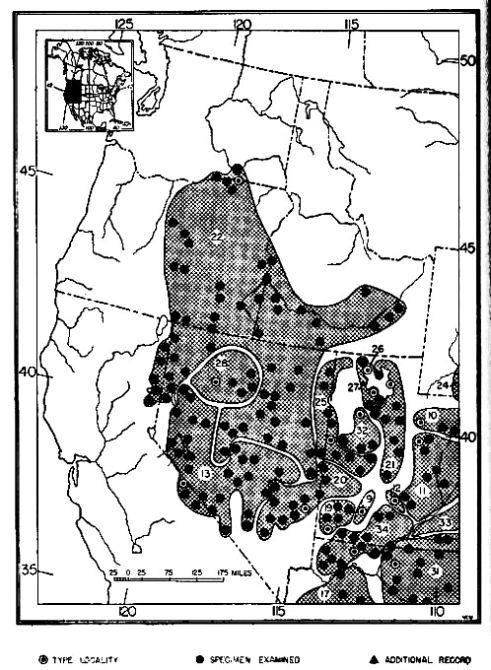
Fig. 27. Known occurrences and probable geographic range of the subspecies of Dipodomys ordii in the northwestern fourth of the range of the species. 9. D. o. panguitchensis 20. D. o. fetosus 28. D. o. inaquosus 10. D. o. uintensis 21. D. o. utahensis 31. D. o. longipes 11. D. o. sanrafaeli 22. D. o. columbianus 32. D. o. pallidus 12. D. o. fremonti 24. D. o. priscus 33. D. o. nexilis 13. D. o. monoensis 25. D. o. celeripes 34. D. o. cupidineus 17. D. o. chapmani 26. D. o. cineraceus 19. D. o. cinderensis 27. D. o. marshalli
Remarks.—This small race of Dipodomys ordii was known formerly only from the type locality. This study has shown it to range northward and slightly westward. At four places, 6, 20, and 47 miles south of Marathon and 10 miles west of San Vicente, Texas, this race can be said to be typical, in that specimens from these places agree with those from the type locality. At two other localities, 5 miles east of Toyahvale and Kent, Texas, animals show an intergrading tendency toward Dipodomys ordii ordii. The animals from these latter places are darker colored and are intermediate in size and cranial characters. Since these animals show more resemblance to D. o. ordii in the majority of characters they are referred to that race, rather than to D. o. attenuatus.
Specimens examined.—Total, 14, all from Texas, distributed as follows: Brewster County: 6 mi. S Marathon, 1 (USBS); 20 mi. S Marathon, 1 (USBS); Cooper's Well, 47 mi. S Marathon, 4 (MVZ); 10 mi. W San Vicente, 1 (UM); Johnson's Ranch, Big Bend Rio Grande, 4 (2 TCWC; 2 UM); mouth Santa Helena Canyon, 3 (1 TCWC; 2 MVZ).
Dipodomys ordii fuscus new subspecies
Type.—Male, adult, no. 93886, U. S. Nat. Mus., Biol. Surv. Coll.; Juamave, Tamaulipas, Mexico; obtained on June 3, 1898, by E. W. Nelson and E. A. Goldman, original no. 12437.
Range.—Nuevo León, extreme northern Zacatecas, Tamaulipas and northern San Luis Potosí, Mexico; marginal occurrences are: Coahuila, La Ventura; Tamaulipas, Tula, Juamave and Nuevo Laredo.
Diagnosis.—Size medium (see measurements). Color dark, entire dorsal surface (a) between Cinnamon-Buff and Clay Color, purest on sides, flanks and cheeks, upper parts strongly suffused with black; posterior surfaces and fold of pinnae of ears, white; arietiform markings, plantar surfaces of hind feet, inside of pinnae of ears, dorsal and ventral stripes of tail, blackish. Skull of medium size; nasals relatively short; interorbital width narrow; auditory bullae relatively as well as actually greatly inflated posteriorly, laterally and ventrally; braincase vaulted; zygomatic arches light and straight; pterygoid fossae ovoid; rostrum short and wide.
Comparisons.—From Dipodomys ordii palmeri, D. o. fuscus differs in: Size larger; color lighter; skull larger; rostrum shorter and wider; interorbital width less; nasals shorter; auditory bullae more expanded laterally, posteriorly and ventrally; interparietal region narrower; pterygoid fossae more circular; upper incisors wider at cutting edge; zygomatic arches straight rather than bowed laterally.
From Dipodomys ordii obscurus, D. o. fuscus differs as follows: Size larger; color lighter; skull larger; rostrum wider and shorter; interorbital region wider; width across maxillary arches greater; auditory bullae more expanded laterally, posteriorly and ventrally; zygomatic arches light and straight instead of heavy and bowed laterally; pterygoid fossae more nearly circular; braincase more vaulted; foramen magnum smaller.
From Dipodomys ordii ordii, D. o. fuscus differs in: Size larger; color darker; skull larger; rostrum shorter and wider; nasals short and more flared distally; interorbital width greater; auditory bullae more inflated posteriorly, laterally and ventrally; interparietal region narrower; width across maxillary arches greater; pterygoid fossae larger and more nearly circular; braincase more vaulted.
From Dipodomys ordii sennetti, D. o. fuscus can be distinguished by larger size, longer tail, darker color, and cranially by larger auditory bullae, longer nasals, wider interorbital region and greater width across maxillary arches.
Remarks.—This dark subspecies of Dipodomys ordii is most closely allied to Dipodomys ordii palmeri from, which it can be distinguished by the characters set forth under comparisons.
It seems that the Rio Grande serves as a barrier to the dispersal southward of kangaroo rats from the north side and vice versa. D. o. fuscus ranges from the type locality to Nuevo Laredo and has not been found on the north side of the river, being replaced there, up-river, by Dipodomys ordii medius and down-river by Dipodomys ordii sennetti.
Specimens examined.—Total, 53, distributed as follows:
Coahuila: San Juan Neponuceno, 5 mi. N La Ventura, 4 (MVZ); La Ventura, 7 (USBS).
Tamaulipas: Nuevo Laredo, 2 (USBS); Miquihuana, 14 (4 USBS; 9 MVZ; 1 AMNH); Juamave, 8 (USBS); Tula, 5 (UM); 3 mi. N Lulú, 5 (MVZ): Lulú, 8 (MVZ).
Dipodomys ordii longipes (Merriam)
Dipodops longipes Merriam, N. Amer. Fauna, 3:72, September 11, 1890.
Perodipus ordii, Allen, Bull. Amer. Mus. Nat. Hist., 5:71, April 28, 1893 (part—the part from Bluff, Utah).
Cricetodipus longipes, Trouessart, Catalogus Mammalium, 1:581, 1897.
Perodipus longipes, Elliot, Field Columbian Museum, Zool. Ser., 2:239, 1901.
Perodipus ordii longipes, Goldman, Proc. Biol. Soc. Washington, 30:113, May 23, 1917.
Dipodomys ordii longipes, Grinnell, Journ. Mamm., 2:96, May 2, 1921.
Dipodomys ordii cleomophila Goldman, Journ. Washington Acad. Sci., 23:469, October 15, 1933, type from 5 miles northeast of Winona, Coconino County, Arizona.
Type.—Male, no. 17703/24639, U. S. Nat. Mus. Dept. Agric. Coll.; foot of Echo Cliffs, Painted Desert, Arizona; obtained on September 22, 1889, by C. Hart Merriam, original no. 512.
Range.—Southeastern Utah, northeastern Arizona to immediately south of the Little Colorado River, northwestern New Mexico and extreme southwestern Colorado; marginal occurrences are: in Arizona, 20 mi. NE Lees Ferry, Foot Echo Cliffs in Painted Desert, 5 mi. NE Winona, Winslow and Holbrook; in New Mexico, 10 mi. SW Quemado, Riley, Laguna, Chama Canyon and Shiprock.
Diagnosis.—Size large (see measurements). Color dark, entire dorsal surface between (16") Pinkish Cinnamon and Cinnamon-Buff, purest on sides and flanks with but slight suffusion of black on upper parts; cheeks white; arietiform markings, pinnae of ears, plantar surfaces of hind feet, dorsal and ventral stripes of tail, brownish. Skull large; rostrum long and narrow; nasals long and thin; auditory bullae greatly inflated; styloid processes project on ventral surface of auditory bullae beyond middle of external auditory meatus.
Comparisons.—From Dipodomys ordii chapmani, D. o. longipes differs as follows: Size larger; color lighter; skull larger in all measurements taken; auditory bullae much more inflated.
From Dipodomys ordii cupidineus, D. o. longipes differs in: Size larger; color lighter; rostrum longer and narrower; nasals longer; interorbital width greater; breadth across zygomatic processes of maxillae greater; auditory bullae more inflated; zygomatic arches heavier and more bowed laterally.
For comparisons with Dipodomys ordii medius and Dipodomys ordii nexilis see accounts of those subspecies.
Remarks.—The large reddish Dipodomys ordii longipes is notably distinct from those subspecies which have adjoining ranges. The subspecies closest, geographically and morphologically, is Dipodomys ordii nexilis with which D. o. longipes intergrades, in size of body and color of pelage, north of the San Juan River, Utah. This intergradation is probably the result of a migration of D. o. longipes around the head waters of, or above the place in, the river where there is constantly flowing water. It is probably impossible for these animals to cross a constantly flowing stream as wide as the San Juan is in its lower reaches. The San Juan River, however, in 1896, and again in 1934, was so low that it ceased to flow below Aneth (Gregory, 1938:6, 19). Consequently, at these times, Dipodomys could have crossed the river from one side to the other, at least above the Goosenecks. Intergradation is noted also with Dipodomys ordii medius at Chama Canyon, New Mexico, where the color is like that of D. o. medius, although the cranial characters are as in D. o. longipes; specimens from Chama Canyon are referred to the latter. Ten miles southwest of Quemado and at Riley, New Mexico, intergradation with Dipodomys ordii ordii occurs in the shape of the nasals and the intermediate size of the skull. In color and external measurements these animals more closely resemble D. o. longipes.
Goldman (1933:469) described Dipodomys ordii cleomophila from 5 miles northeast of Winona, Coconino County, Arizona, and gave as distinctive characters "upper parts distinctly darker, ... black facial markings more distinct; skull slightly different." These comparative statements were made in reference to Dipodomys ordii longipes. While it is true that the animals which Goldman examined are darker and show some slight cranial differences, these animals, in my opinion, are not sufficiently distinct to warrant their separation from D. o. longipes. In the degree of expansion of the auditory bullae, the width of the rostrum, the length of the nasals and interorbital width, animals from 5 miles northeast of Winona (2 specimens) are within the range of individual variation shown by D. o. longipes. The color is darker, being more as in Dipodomys ordii chapmani. Specimens examined from 10 miles north of Angell, Springerville, Tanner Tank and Cedar Ranch Wash, Arizona (listed by Goldman as referable to D. o. cleomophila), and those from Wupatki Ruins, Arizona, agree with D. o. longipes except that the width across the maxillary arches is greater. This greater width across the maxillary arches and the darker color of animals from Winona and Wupatki Ruins, in my opinion, afford insufficient basis for the recognition of the subspecies Dipodomys ordii cleomophila Goldman which, therefore, is placed as a synonym of Dipodomys ordii longipes (Merriam).
Specimens examined.—Total, 244, distributed as follows:
Utah: San Juan County: 1 mi. N Bluff, 3500 ft., 1 (UU); 1/2 mi. N Bluff, 3300 ft., 7 (UU); Bluff, 2 (UU); Johns Canyon, San Juan River, 5150 ft., 2 (UU).
Arizona: Coconino County: 20 mi. NE Lees Ferry, 1 (USNM); 2 mi. S Endische, 2 (MVZ); 2 mi. SE Endische Spring, Navajo Mountain, 1 (MVZ); 1/2 mi. W Navajo Spring, Echo Cliffs, 4 (MVZ); 5 mi. S Navajo Mountain, 2 (MVZ); 7 mi. SE Navajo Mountain, 1 (MVZ); Moa Vae, 10 (MVZ); 2 mi. S Grand Canyon Bridge, 1 (USBS); Tuba, 4 (1 USBS; 3 AMNH); 12 mi. above mouth of Moencopi Wash, 2 (USBS); 14 mi. NW Cedar Ridge, 1 (USBS); 5 mi. N Cameron, 1 (MVZ); Painted Desert, 6 mi. NE Cameron, 1 (MVZ); 5 mi. E Little Colorado River on Tuba road, 2 (MVZ); Cameron, 4200 ft., 17 (8 LACM; 9 MVZ); Wupatki Ruins, 4 (MVZ); Deadmans Flat, 6400 ft., NE San Francisco Mt., 3 (MVZ); 3 mi. NW Winona, 4 (USBS); 5 mi. NE Winona, 2 (USBS); 10 mi. N Angell, Walnut Tank, 8 (USBS); Cedar Ranch Wash, 3 mi. above mouth, 5 (USBS); Tanner Tank, 2 (USBS); Tanners Crossing, Painted Desert, 1 (USBS). Navajo County: Right fork, Segi-ot-Sosie Canyon, 11 mi. NW Kayenta, 2 (MVZ); Bat Woman Canyon, 13 mi. W Kayenta, 1 (MVZ); Kayenta, 4 (USBS); Segi Canyon, 12 mi. WSW Kayenta, 1 (MVZ); Segi Canyon, 13 mi. WSW Kayenta, 1 (MVZ); Oraibi, 6000 ft., 9 (4 USBS; 5 MVZ); Walpi, 2 (USBS); Keam Canyon, 12 (6 USBS; 3 USNM; 3 MVZ); Winslow, 6 (USBS); Zuni Well, 7-1/2 mi. N Adamana, 9 (MVZ); Holbrook, 10 (USBS); Long Canyon, 3 (AMNH); Bubbling Springs, 2 (AMNH). Apache County: Dinnehotso, 5000 ft., 3 (MVZ); Lukachukai, 1 (USBS); Chin Lee, 6 (USBS); 9 mi. SW Chin Lee, 1 (USBS); 7 mi. from mouth, Canyon de Chelly, 1 (USBS); Fort Defiance, 2 (USNM); Ganado, 1 (USBS); Springerville, 2 (USBS); 3 mi. SE Springerville, 5 (USBS); unspecified, 4 (2 USBS; 2 USNM); Trash Tank, Grand Canyon, 2 (USBS).
New Mexico: San Juan County: Ship Rock, 4 (USBS); Fruitland, 9 (USBS); Blanco, 1 (USBS); Chaco Canyon National Monument, 4 (MVZ). Rio Arriba County: Chama Canyon, 1 (USBS). McKinley County: 2 mi. W Mariano Lake, 3 (MVZ); Gallup, 6 (USBS); Wingate, 6 (USBS); Thoreau, 2 (USBS); Zuni River, 1 (USBS). Sandoval County: Juan Tafoya, 1 (USBS). Valencia County: 8 mi. SE Grants, 7 (UM); 9 mi. SSE Grants, 5 (UM); 2-1/2 mi. E El Morro P. O., Zuni Mts., 1 (LACM); Laguna, 1 (USBS); Laguna Indian Reservation, 7 (LACM). Catron County: Cougar Ranch, NE Adams Diggings, 1 (CAS); 10 mi. SW Quemado, 1 (USBS). Socorro County: 1 mi. S Bernardo, 1 (MVZ); Riley, 1 (USBS).
Dipodomys ordii pallidus Durrant and Setzer
Dipodomys ordii pallidus Durrant and Setzer, Bull. Univ. Utah, 35 (no. 26):24, June 30, 1945.
Type.—Male, adult, no. 3526, Museum of Zoology, University of Utah; Old Lincoln Highway, 18 mi. SW Orr's Ranch in Skull Valley, 4,400 ft., Tooele County, Utah; obtained on June 6, 1940, by S. D. Durrant, original no. 1905.
Range.—Low valleys of west-central Utah in Tooele, Juab and Millard counties; marginal occurrences are: all in Utah, 18 mi. SW Orr's Ranch, 7 mi. S Fish Springs, Hinckley and Lynndyl.
Diagnosis.—Size medium (see measurements). Color light, entire dorsal surface Light Pinkish Cinnamon, purest on sides and flanks, with but slight suffusion of black on upper parts; cheeks white; arietiform markings, pinnae of ears, plantar surfaces of hind feet, dorsal and ventral stripes of tail, brownish. Skull large; auditory bullae long, wide and well inflated; external auditory meatus elongate with a notch on the dorsal border; nasals long and flaring distally.
Comparisons.—From Dipodomys ordii celeripes, D. o. pallidus differs in: Size larger; color generally darker, although some specimens are lighter; skull larger; nasals longer and more flared distally; interorbital width greater; auditory bullae larger; external auditory meatus larger.
From Dipodomys ordii fetosus, D. o. pallidus differs in: Size larger; color lighter; ventral stripe of tail indistinct as opposed to pronounced; skull larger; nasals longer and more flared distally; auditory bullae larger; external auditory meatus larger; palate shorter and broader.
For comparisons with Dipodomys ordii marshalli and Dipodomys ordii utahensis see accounts of those subspecies.
Remarks.—Among named subspecies of Dipodomys ordii, D. o. pallidus most closely resembles, morphologically, D. a. marshalli, its nearest geographic neighbor to the north and east. Intergradation with Dipodomys ordii utahensis is noted in color and intermediacy of body size of specimens from Clover Creek. The majority of cranial characters, however, show these animals to be referable to D. o. utahensis rather than to D. o. pallidus. Specimens taken at Lynndyl and Hinckley show intergradation in size of body, length and configuration of the nasals and the degree of inflation of the auditory bullae between Dipodomys ordii celeripes and D. o. pallidus. The majority of characters studied show these latter animals to be referable to D. o. pallidus. Specimens from 35 and 60 miles west of Delta, in size of body and shape and inflation of the auditory bullae, are intermediate between D. o. pallidus and D. o. celeripes. These specimens are here referred to D. o. celeripes.
Specimens examined.—Total, 34, all from Utah, distributed as follows: Tooele County: Old Lincoln Highway, 18 mi. SW Orr's Ranch in Skull Valley, 4400 ft., 9 (UU). Juab County: Fish Springs, 4400 ft., 4 (UU); 7 mi. S Fish Springs, 4400 ft., 4 (UU). Millard County: 1 mi. N Lynndyl, 4768 ft., 5 (UU); Lynndyl, 4768 ft., 1 (UU); Hinckley, 4600 ft., 11 (UU).
Dipodomys ordii nexilis Goldman
Dipodomys ordii nexilis Goldman, Journ. Washington, Acad. Sci., 23:470, October 5, 1933.
Perodipus longipes, Warren, Mammals of Colorado, p. 77, 1910 (part—the part from Coventry, Colorado).
Dipodomys ordii longipes, Moore, Journ. Mamm., 10:260, August, 1929 (part—the part from Monticello, Utah).
Type.—Male, adult, no. 149938, U. S. Nat. Mus. Biol. Surv. Coll.; 5 mi. W Naturita, Montrose County, Colorado; obtained on July 20, 1907, by Merritt Cary, original no. 1068.
Range.—West-central Colorado, southwest into San Juan County, Utah, north of the San Juan River; northwest into Grand County, Utah, to the Colorado River; and westward probably as far as the Colorado River; marginal occurrences are: in Utah, Cisco, 18 mi. NE Moab, and Blanding; in Colorado, 5 mi. W Naturita, and Coventry.
Diagnosis.—Size medium (see measurements). Color dark, entire dorsal surface between (a) Cinnamon-Buff and Clay Color, purest on sides and flanks, upper parts strongly suffused with black; arietiform markings, pinnae of ears, plantar surfaces of hind feet, dorsal and ventral tail-stripes blackish. Lateral white stripes of tail less than one fourth of diameter of tail. Skull large; rostrum long and narrow; nasals long; auditory bullae strongly inflated; braincase not inflated; pterygoid fossae ovoid.
Comparisons.—From Dipodomys ordii sanrafaeli, D. o. nexilis differs in: Color darker; skull smaller in all measurements taken; auditory bullae noticeably smaller; width across zygomatic processes of maxillae less.
From Dipodomys ordii longipes, D. o. nexilis differs in: Size smaller; color darker in all respects; rostrum wider; breadth across auditory bullae less; interorbital width greater; breadth across zygomatic processes of maxillae less; cutting edge of upper incisors wider; zygomatic arch lighter and more nearly straight.
Comparison with Dipodomys ordii evexus is made in account of that subspecies.
Remarks.—This animal is apparently not abundant at any place in its range. Two different attempts, by me, to obtain topotypes were unsuccessful. A single specimen was obtained and that was only a skull saved from a mutilated animal that was taken away from a rattlesnake. The habitat at the type locality is such that a person would not expect it to be inhabited by kangaroo rats. The soil is a heavy clay with a generous admixture of stones but in isolated spots there are light sandy soils which should be suitable for kangaroo rats. Even so, 500 traps set in the area of the type locality over a period of two nights yielded no Dipodomys.
This subspecies of Dipodomys ordii, inhabiting west-central Colorado and southeastern Utah, is darker than any other subspecies with which its range comes in contact. The races to both the north and south are larger, with the exception of the hind foot which is longer in D. o. nexilis than in either D. o. sanrafaeli or D. o. longipes. The affinities of D. o. nexilis are with D. o. longipes rather than with any of the other known subspecies of Dipodomys ordii.
Intergradation between D. o. nexilis and D. o. longipes is shown by animals from Bluff, San Juan County, Utah, which, however, are referable to the latter. In animals from sixteen miles northwest of Moab, Grand County, Utah, there is intergradation in size of skull and in color between D. o. nexilis and D. o. sanrafaeli. The specimens are referred to D. o. sanrafaeli.
D. o. nexilis is apparently prevented from extending its range to the northward by the presence there of D. o. sanrafaeli. To the south D. o. nexilis encounters D. o. longipes and the San Juan River. To the east it is limited by the Rocky Mountains and to the west by the deep canyons of the Colorado River.
Warren (1942:183) did not apply the name D. o. nexilis to Ord kangaroo rats in Colorado. He listed specimens from Montrose, Montezuma and Mesa counties as being referable to D. o. longipes. The specimens from Montezuma County, Colorado, probably are D. o. longipes and those from Montrose and Mesa counties (for which Warren gives no precise localities) are D. o. nexilis.
Specimens examined.—Total, 35, distributed as follows:
Utah: Grand County: Cisco, 4 (CM); 18 mi. NE Moab, 6000 ft., 1 (UU). San Juan County: 15 mi. N Monticello, 4 (MVZ); Blanding, 1 (UU).
Colorado: Delta County: Hotchkiss, 1 (USBS). Montrose County: Paradox, 1 (DRD); Bedrock, 4 (AMNH); 5 mi. W Naturita, 2 (USBS); Coventry, 3 (1 USBS; 2 AMNH).
Dipodomys ordii cupidineus Goldman
Dipodomys ordii cupidineus Goldman, Journ. Washington Acad. Sci., 14:372, September 19, 1924.
Type.—Male, no. 243093, U. S. Nat. Mus. Biol. Surv. Coll.; Kanab Wash, at southern boundary of Kaibab Indian Reservation, Arizona; obtained on October 12, 1922, by E. A. Goldman, original no. 23384.
Range.—Northeastern Arizona and south-central Utah; marginal occurrences are: in Utah, Escalante, near Paria and S of Virgin; in Arizona, 6 mi. N Wolf Hole, 20 mi. S Wolf Hole, 5 mi. S Trumbull Spring and 10 mi. S Jacobs Pools in Houserock Valley.
Diagnosis.—Size large (see measurements). Color relatively dark, entire dorsal surface between (16") Pinkish Cinnamon and Cinnamon-Buff, purest on sides and flanks, upper parts washed with black; arietiform markings, pinnae of ears, dorsal and ventral stripes of tail, plantar surfaces of hind feet, blackish. Skull large; auditory bullae well inflated; interorbital width relatively narrow; rostrum long and narrow; nasals long and slightly flared distally; pterygoid fossae ovoid; external auditory meatus small and ovoid; jugal light and relatively straight.
Comparisons.—From Dipodomys ordii chapmani, D. o. cupidineus differs in: Size larger; color lighter in all pigmented areas; skull larger; rostrum shorter and wider; nasals shorter; auditory bullae more inflated, particularly median tympanic portion; least interorbital width less.
From Dipodomys ordii nexilis, D. o. cupidineus differs as follows: Size smaller; color lighter in all pigmented areas; skull smaller; rostrum relatively longer and narrower; least interorbital width less; auditory bullae less inflated; breadth across maxillary arches less; foramen magnum circular as opposed to ovoid; cutting edge of upper incisors narrower; zygomatic arches lighter.
For comparisons with Dipodomys ordii cinderensis, Dipodomys ordii panguitchensis and Dipodomys ordii longipes see accounts of those subspecies.
Remarks.-This subspecies is prevented from intergrading, to the east, with D. o. longipes by the deep canyons of the Colorado River, with D. o. cinderensis by the Virgin River and with D. o. panguitchensis by a series of high mountain ranges. Intergradation does, however, occur with D. o. sanrafaeli in animals from Escalante, Garfield County, Utah, but they are referable to D. o. cupidineus. The Colorado River, farther to the north, again serves as a barrier in preventing intergradation between D. o. nexilis and D. o. cupidineus.
Specimens examined.—Total, 122, distributed as follows:
Utah: Garfield County: Mouth of Calf Creek, Escalante River, 3 (BYU); Ten Mile Spring, 3 (BYU); Escalante, 3 (BYU). Washington County: near Short Creek road, south of town of Virgin, 18 (RH). Kane County: near Paria, 1 (UU); Willow Tank Springs, 7 (BYU); 8 mi. NW Kanab, 4800 ft., 1 (UU); near Sand Dunes, 7 (RH); Kanab, 15 (12 MVZ; 2 BYU; 1 UU); 1 mi. S Kanab, 4400 ft., 2 (UU).
Arizona: Mohave County: near S Boundary Kaibab Indian Reservation, 4 (MVZ); 6 mi. N Wolf Hole, 8 (MVZ); 4 mi. N Wolf Hole; 3 mi. NW Diamond Butte, 7 (USBS); 20 mi. S Wolf Hole, 1 (USBS); 1 mi. W Diamond Butte, 1 (USBS); 6 mi. N Mt. Trumbull, 1 (USBS); Nixon Springs, 6250 ft., W Base Mt. Trumbull, 6 (3 USBS; 3 MVZ); 5 mi. S Trumbull Spring, 1 (USBS). Coconino County: Fredonia, 3 (USBS); 2 mi. W Lees Ferry, 3 (MVZ); Jacobs Pools, 4000 ft., Houserock Valley, 15 (MVZ); 10 mi. S Jacobs Pools, Houserock Valley, 2 (MVZ); Houserock Valley, 10 (USBS).
Dipodomys ordii palmeri (Allen)
Dipodops ordii palmeri Allen, Bull. Mus. Comp. Zool., 8:187, 1881.
Cricetodipus ordii palmeri, Trouessart, Catalogus Mammalium, 1:581, 1897.
Perodipus ordii palmeri, Goldman, Proc. Biol. Soc. Washington, 30:113, May 23, 1917.
Dipodomys ordii palmeri, Grinnell, Journ. Mamm., 2:96, May 2, 1921.
Cotypes.—Two males, adults, nos. 5886 and 5887, Mus. Comp. Zool.; San Luis Potosí, Mexico; obtained on May 1, 1878, and September 1, 1878, respectively, by Dr. Edward Palmer. (Types not seen.)
Range.—Eastern Zacatecas, Aguascaliente, northern Jalisco, San Luis Potosí, Hidalgo, and probably Querétaro; marginal occurrences are: Zacatecas, Canitas and Berriozobal; Aguascaliente, 1 mi. N Chicalote; Jalisco, 9 mi. N Encarnación; Guanajuato, Celaya; Hidalgo, Irolo.
Diagnosis.—Size small (see measurements). Color dark, entire dorsal surface (h) between Cinnamon and Sayal Brown, purest on sides and flanks, upper parts strongly suffused with black; posterior surfaces and fold of pinnae of ears, white; arietiform markings, plantar surfaces of hind feet, inside of pinnae of ears, dorsal and ventral stripes of tail, blackish. Skull small; nasals long; rostrum long and narrow; interorbital region relatively wide; degree of inflation of auditory bullae about average for species; zygomatic arches light and bowed laterally; pterygoid fossae subcircular; braincase but slightly vaulted.
Comparisons.—From Dipodomys ordii ordii, D. o. palmeri differs as follows: Size somewhat larger; color darker; skull larger; nasals longer and flaring distally; interorbital width greater; narrower across auditory bullae; interparietal region narrower; breadth across maxillary arches greater; zygomatic arches bowed laterally as opposed to relatively straight; pterygoid fossae more nearly circular; rostrum longer and narrower.
From Dipodomys ordii sennetti, D. o. palmeri differs in larger size, darker color, longer tail and longer skull.
For comparisons with Dipodomys ordii obscurus and Dipodomys ordii fuscus see accounts of those subspecies.
Remarks.—Specimens from Berriozobal, Zacatecas, in the width of the rostrum and the configuration of the nasals, are intermediate between Dipodomys ordii fuscus and D. o. palmeri. In color these animals are more nearly like typical representatives of D. o. palmeri. The animals from Jalisco and Guanajuato are not typical but the characters differentiating them from D. o. palmeri are merely modifications of such slight degree that they all have been placed with that subspecies.
Specimens examined.—Total, 56, distributed as follows:
Zacatecas: Canitas, 3 (USBS); Berriozobal, 10 (USBS).
San Luis Potosí: Potrero Santa Ana, 7.6 mi. S Matehuala, 2 (MVZ); Jesus Maria, 12 (USBS); 2 mi. NW San Luis Potosí, 8 (MVZ).
Aguascalientes: 1 mi. N Chicalote, 1900 m., 4 (MVZ).
Jalisco: 9 mi. N Encarnación, 1900 m., 1 (MVZ).
Guanajuato: Celaya, 8 (USBS).
Hidalgo: Ixmiquilpan, 1 (USBS); Irolo, 12 (USBS).