PHYLOGENY OF THE SPECIES OF THE GENUS
Reading edition
Representatives of nine species of Dipodomys were dissected in an attempt to determine the degree of specialization and the relative systematic position of each species.
The myology was found to agree in detail as to origin, insertion and innervation with that of Dipodomys spectabilis as reported by Howell (1932). The only variation noted in the muscular system was the size of the individual muscles in those animals of widely divergent body size.
Dipodomys ordii is the most generalized and Dipodomys deserti is the most specialized of the kangaroo rats (see Table 1), as judged by the osteology. Information gained by the study of the viscera of the various species supports this judgment. The visceral mass is relatively loose in D. ordii, but is markedly compact in D. deserti. This compactness appears to be brought about by the foreshortening of the mesenteries which support the entire gut and by the closer apposition of the large intestine to the caecum; both the intestine and caecum occupy a ventral position in the abdominal cavity. In Dipodomys ordii the entire visceral mass is loosely interconnected and the caecum is relatively small as compared to the tightly compact viscera and the large caecum in Dipodomys deserti. Another striking feature is the size, proportion and position of the liver. In all animals dissected, even in D. deserti, the right lobe of the liver descends and forms a capsule around the anterior end of the right kidney. In the Ord kangaroo rat, the bulk of the liver lies on the right side of the body cavity. That is to say, there is a greater bulk of the liver on the right side and it is situated more dorsad than in any of the other species examined. In the most specialized condition, as in Dipodomys deserti, the bulk of the liver is almost equal on the right and left sides, and instead of having the greater bulk situated dorsally as in D. ordii it is cup-shaped, with the dorsal and ventral parts of approximately equal size and situated on almost the same transverse plane. The entire mass of the liver is concave posteriorly.
TABLE 1
Skeletal Indices of Dipodomys
Humeroradial Intermembral Crural Tibioradial Femorotarsal-metatarsal Humero-Cranial
ordii 144.5 57.2 127.75 60.55 88.4 63.4
microps 138.5 56.17 132.3 57.27 90.95 60.8
panamintinus 146.1 55.3 132.0 57.5 90.5 60.8
agilis 147.0 56.05 133.65 57.25 94.55 62.65
heermanni 142.9 54.2 135.9 55.35 92.2 60.93
ingens 142.9 54.1 130.6 56.2 89.65 66.2
spectabilis 140.9 53.05 133.9 54.2 95.6 64.6
phillipsii 163.4 55.05 137.85 58.97 101.5 64.5
merriami 160.75 53.85 137.5 57.36 99.75 63.9
nitratoides 155.0 54.1 137.4 57.0 98.25 65.5
deserti 149.5 53.4 139.4 54.9 96.6 67.6
The right kidney is variable in position in reference to the left. In all species the right kidney lies anterior to the left but in some, D. deserti and D. ingens, it is markedly anterior.
In Dipodomys agilis, D. merriami and D. deserti there are small to large patches of lymphoid tissue on the caecum. These patches were not noted in any of the other species examined and I do not know their function. In the three above mentioned species, however, the large intestine is shorter in proportion to the small intestine than in any other species except D. heermanni (see Table 2) and with the exception of D. heermanni, D. venustus and D. ordii the actual measurements are less.
Inasmuch as little is known of the food habits of the various species of kangaroo rats, any ascription of adaptive significance to the varying proportions of the digestive system would be only speculative.
Midgley (1938) describes the visceral anatomy of D. ordii and D. microps. Except for the differences here noted the description of the viscera as given by Midgley (loc. cit.) applies to the rest of the species studied.
TABLE 2
Visceral Measurements (in Millimeters) of Dipodomys
heermanni merriami agilis deserti ordii spectabilis venustus panamintinus ingens
Large intestine 432 290 464 397 237 413 374 419 430
Small intestine 165 126 220 195 131 228 207 255 274
Percent of small to large intestine 38.2 43.4 47.5 49.2 55.2 55.3 55.4 60.9 63.7
From the differences noted in the skeleton, in the entire visceral mass, and in the shape and position of the liver it appears that as a saltator becomes more specialized skeletally, there is a concurrent compacting and aligning of the viscera into a more or less bilaterally balanced mass. It seems that this alignment is for a stabilization in leaping. It seems reasonable that the individual that has a loose and unconsolidated visceral mass, or in which the viscera or at least the heaviest part of the viscera is relatively unilateral, would be thrown slightly off balance at the end of the jump. This would place the animal at a slight disadvantage before being able to make the next jump. Howell (1944:40) comments on the fact that kangaroo rats often land off balance, "owing apparently to clumsy use of the tail." Possibly the unilaterality of the visceral mass plus a shorter tail and a more clumsy use of that organ accounts for the off balance landings which Howell has observed.
The skeleton, particularly of the appendages, shows the most modification, ranging from a relatively generalized to a specialized condition. Skeletal indices, as established by Howell (1944:199) have been used in estimating the amount of such specialization.
These indices are obtained by dividing the length of one segment of a limb by the length of another segment and are expressed in percentages. The Femorotarsal-metatarsal and Cranial indices are not from Howell (loc. cit.).
The Humeroradial index (radius/humerus ×100) in the generalized animal is theoretically 100 because the humerus and radius are of the same length. In kangaroo rats, which are saltators, the index rises to more than 100 owing to the lengthening of the radial component.
The Intermembral index (humerus and radius/femur and tibia ×100) in a generalized animal is theoretically 100, but, as Howell (1944:205) points out, the index in generalized mammals is probably nearer 75. If the hind leg elongates at the expense of the forelimb the animal will be a better saltator and the skeletal elements will yield a lower intermembral index.
The Femorotibial or Crural index (tibia/femur ×100) expresses the development of the tibia as an adaptation to the saltatorial habit and in generalized animals would be expected to be 100. As an adaptation to saltation the tibia would elongate at the expense of the femur and the index would be more than 100. The degree of divergence from 100 would be an expression of the degree of saltatorial ability.
The Tibioradial index (radius/tibia ×100) in the generalized animal also would be expected to approximate 100 but it is doubtful if any living mammals, except brachiating kinds, yield an index of more than 75. In saltators, the index is low because of the elongation of the hind appendages, whereas the forelimbs do not change their length or are shortened.
The Femorotarsalmetatarsal index (tarsometatarus/femur ×100) in the generalized condition would be less than 50 and an index approaching 100 would indicate a specialization for saltation owing to the elongation of the tarsometatarsal elements.
The Cranial index (breadth across bullae/length of skull ×100) reflects the development of the auditory or mastoid region of the skull as an adaptation for more acute hearing and possibly for more delicate balance. In heteromyids, the generalized condition would be represented by an index of 50 or less, and as the width across the bullae increases, the index rises toward 100.
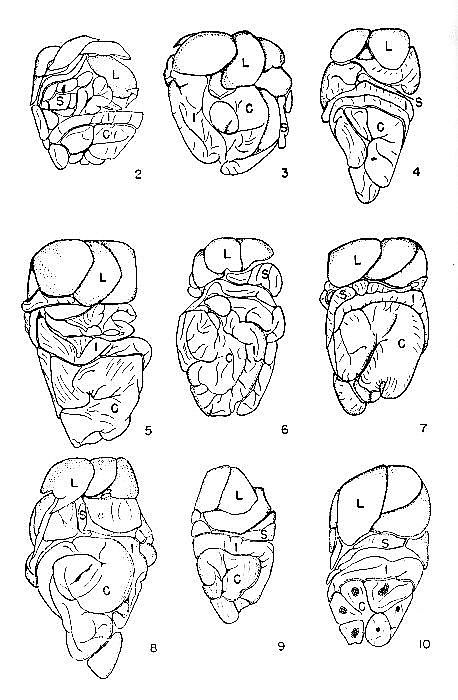
Figs. 2-10. Showing the compacting of the visceral mass; liver at the top, small intestine and caecum at the bottom. All figures approximately × 1. Fig. 2. Dipodomys ordii inaquosus, [M], adult, no. 23365, KU; 7 mi. W Fallon, Churchill County, Nevada; trapped 27 October, 1945. Fig. 3. Dipodomys panamintinus mohavensis, [M], adult, no. 22094, KU; 1-1/2 mi. N Mojave, Kern County, California; 3 February, 1948. Fig. 4. Dipodomys heermanni morroensis, [M], adult, no. 22082, KU; S side Morro Bay, 4 mi. S Morro, San Luis Obispo County, California; 25 January, 1948. Fig. 5. Dipodomys ingens, [F], adult, no. 22069, KU; 25 mi. SW Mendota, San Benito County, California; 2 February, 1948. Fig. 6. Dipodomys agilis perplexus, [F], adult, no. 22091, KU; 1-3/10 mi. N Monolith, Kern County, California; 3 February, 1948. Fig. 7. Dipodomys venustus sanctiluciae, [M], adult, no. 22071, KU; 1-1/2 mi. S Jolon, Monterey County, California; 26 January, 1948. Fig. 8. Dipodomys spectabilis spectabilis, [F], adult, no. 22110, KU; 5 mi. NE Willcox, Cochise County, Arizona; 19 January, 1948. Fig. 9. Dipodomys merriami merriami, [F], adult, no. 23366, KU; E side Carson Lake, Churchill County, Nevada; 2 October, 1945. Fig. 10. Dipodomys deserti deserti, [M], adult, no. 23364, KU; 15 mi. WSW Fallon, Churchill County, Nevada; 3 November, 1945.
TABLE 3
Relative Specializations of the Species for each Index
Humeroradial Intermembral Crural Tibioradial Femorotarsal-metatarsal Cranial Average
ordii 5 1 1 1 1 5 2.33
microps 1 2 4 5 4 2 3.0
panamintinus 6 3 3 3 3 1 3.1
agilis 7 4 5 6 6 4 5.3
heermanni 3 6 7 9 5 3 5.5
ingens 4 7 2 8 2 10 5.5
spectabilis 2 11 6 11 7 8 7.5
phillipsii 11 5 10 2 11 7 7.6
merriami 10 9 9 4 10 6 8.0
nitratoides 9 8 8 7 9 9 8.5
deserti 8 10 11 10 8 11 9.6
The figure 1 represents the least specialized condition for the index, while the figure 11 represents the most specialized condition. The remainder of the numbers indicate the relative degree of specialization of each species for each index.
The species that have been examined are listed in Table 3 in increasing order of specialization from top to bottom.
Usually animals of extreme morphological specialization are much restricted environmentally. Attempts to correlate the relative evolutionary position of the various species, as indicated by the degree of specialization interpreted from the indices with that of habitus has proven unsuccessful. For example, Dipodomys merriami, which is third from the top in the list as arranged above, is neither restricted to loose sandy soil as is D. deserti nor to brush as are D. agilis and D. venustus. D. merriami does, nevertheless, inhabit a variety of habitats from loose sandy soils to rather hard rocky ground. Throughout the genus there is, however, a general trend toward increased specialization as the animals adopt the more open desert environment, as is indicated by the elongation of the tail and hind appendage and increase in size of the auditory region of the skull. A marked difference is noted in the size of the pinna of the ear in the various species. Generally, those species having small pinnae inhabit open desert country while those with large pinnae inhabit brushy country. This is in direct contradistinction to the hares and rabbits in which the small-eared kinds are brush dwellers whereas the large-eared kinds are inhabitants of open country. Three possible explanations for hares and rabbits having this specialization of the pinnae are: (1) To enable the open-dwelling animals with the larger pinnae to hear more readily the approach of an enemy when it is yet far away, while the brush-living forms, which rely for escape on a short dash into cover, do not need so large a "funnel"; (2) large pinnae have been developed by those animals which live in the open desert as an aid in dissipating the body heat; (3) large pinnae in brush-dwelling animals would be a decided disadvantage in rapid movement through the brush. Grinnell (1922:20) points out that animals with large pinnae usually have small auditory bullae and conversely, animals with small pinnae have large bullae. This compensatory factor, implying an auditory function, appears to be inoperative in D. panamintinus mohavensis which has small ears and small bullae and in D. elephantinus which has large ears and large auditory bullae. Grinnell (loc. cit.) suggests that several additional factors enter into the problem, such as the amount of digging each species must do to gain safety, the texture of the soil for burrowing, the extent of forage area and the type of cover in connection with the mode of attack of predators. Of these factors, perhaps the most important are the two first mentioned.
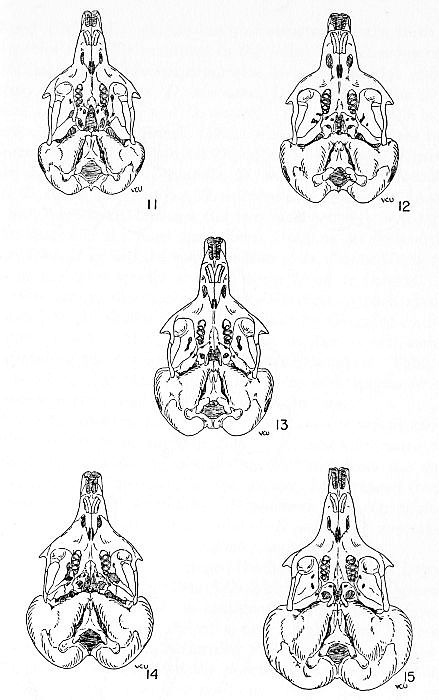
Figs. 11-15. Ventral views of skulls showing the degree of development of the auditory bullae and the configuration of the pterygoid fossae. All figures approximately × 1. Fig. 11. Dipodomys ordii compactus, [M], adult, no. 646, TCWC; 19 mi. S Port Aransas, Mustang Island, Nueces County, Texas; 24 April, 1939. Fig. 12. Dipodomys ordii oklahomae, [F], adult, no. 265456, USBS; 2-1/4 mi. S Norman, Cleveland County, Oklahoma; 21 March, 1934. Fig. 13. Dipodomys ordii richardsoni, [F], adult, no. 15995, KU; 1 mi. S Lamar, Prowers County, Colorado; 8 September, 1945. Fig. 14. Dipodomys ordii nexilis, [F], adult, no. 149941, USBS; 5 mi. W. Naturita, Montrose County, Colorado; 20 July, 1907. Fig. 15. Dipodomys deserti deserti, [F], adult, no. 18670, KU; 14 mi. WSW Fallon, Churchill County, Nevada; 3 November, 1945.
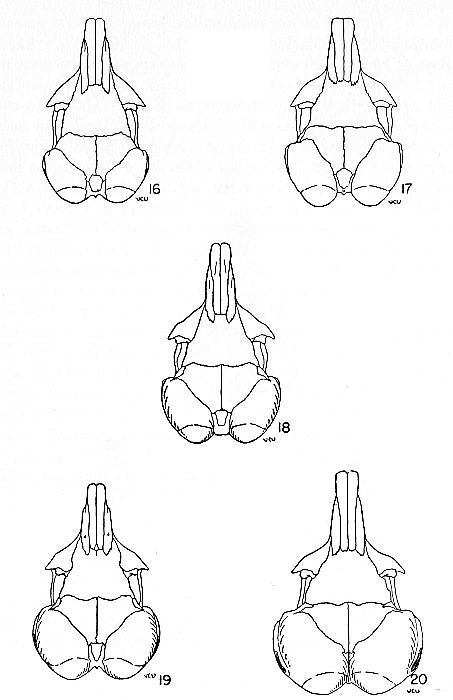
Figs. 16-20. Dorsal views of skulls showing the degrees of inflation of the auditory bullae and the correlation of large bullae with small interparietal. All figures approximately × 1. Fig. 16. Dipodomys ordii compactus, for data see Fig. 11. Fig. 17. Dipodomys ordii oklahomae, for data see Fig. 12. Fig. 18. Dipodomys ordii richardsoni, for data see Fig. 13. Fig. 19. Dipodomys ordii nexilis, for data see Fig. 14. Fig. 20. Dipodomys deserti deserti, for data see Fig. 15.
Wood (1935:155), on the basis of structure of the teeth, listed the species which he examined in the following increasing order of specialization: Dipodomys compactus (now Dipodomys ordii compactus), D. nitratoides, D. merriami, D. ordii, D. agilis, D. herrmanni, D. spectabilis, and D. deserti. This arrangement is at variance with that of Grinnell (1922) who listed the species in order of increasing specialization as: Dipodomys herrmanni, D. panamintinus, D. ingens, D. spectabilis, D. merriami, D. nitratoides, D. ordii, D. agilis, D. venustus, D. microps and D. deserti. As noted, the only agreement between the two arrangements is the placing of D. deserti as the most specialized. Relying on skeletal indices alone, I would accord the same position to D. deserti but would not arrange the other species as have either Wood or Grinnell.
In this study, the amount of specialization of each species, as indicated by the skeleton, was determined by assigning consecutive numbers from 1 to 11 to each species in its place in each index, and then totaling and averaging these arbitrary numbers (Table 3). It will be noted that there is a tendency for each species to occupy the same relative position in each of the indices.
It is felt, however, that a more nearly correct arrangement, according to degree of specialization, is obtained by using the six skeletal indices plus the information obtained from the study of the viscera. On this basis the species may be arranged from least to most specialized as follows: Dipodomys ordii, D. microps, D. panamintinus, D. agilis, D. herrmanni, D. ingens, D. spectabilis, D. phillipsii, D. merriami, D. nitratoides and D. deserti.
Grinnell (1922:95-96) arranged the Recent species of Dipodomys in nine groups. Davis (1942:332) also proposed an arrangement of nine groups in which he combined the Compactus and Ordii groups of Grinnell, established a new Elator group by removing Dipodomys elator from Grinnell's Phillipsii group, and in linear arrangement, Davis shifted the Spectabilis and what remained of the Phillipsii groups to new positions. Burt (1936:152) arranged Grinnell's groups into three (unnamed) groups solely on the basis of the structure of the baculum. In the arrangement proposed by Grinnell, two of his nine groups contained only one species each, one other, the Microps group, has since been shown to contain only one species and another, the Compactus group, contained only kinds which are, by me, regarded only as subspecies of Dipodomys ordii. To my mind neither Davis nor Burt added to or fundamentally changed the basic concepts as set forth in 1922 by Grinnell. Owing to the paucity of material at that time, especially from areas of intergradation, Grinnell's groupings and arrangement were as nearly natural as could be expected. With the accumulation of additional material and with the knowledge that certain kinds treated by Grinnell as full species are in actuality subspecies, it is felt that the several species of kangaroo rats can best be arranged in six groups which, from the least to the most specialized, are as follows:
Ordii Group.—Composed of the subspecies of Dipodomys ordii and Dipodomys microps. Grinnell placed these two species in separate groups; Burt on characters of the baculum alone placed D. microps with Dipodomys deserti and Dipodomys spectabilis. Within the single species D. ordii, I find that the difference in shape and size of the baculum between the subspecies of D. ordii is as great as the difference which Burt (1936:154-155) found between the full species D. agilis and D. microps. The characters of the baculum are an aid, but not in and of themselves an adequate basis, for determining the natural relationships of the groups of species. Certainly the remainder of the morphological differences between D. deserti and D. microps are so great that I doubt that the similarity in the baculum is significant, at least in this one instance. The chisel-shaped lower incisors of D. microps appear to be a specialization. They may enable D. microps to utilize more woody types of vegetation than can D. ordii. Both species occupy the same territory over much of their geographic range, probably because they eat different kinds of food.
Panamintinus Group.—Composed of all the now known subspecies of Dipodomys panamintinus and the species Dipodomys stephensi, if the latter is a full species. This group was included by Grinnell in the Heermanni group, with which it agrees in broadness of the maxillary arches and the configuration of the penis bone, but on the basis of the degree of specialization, as indicated by the indices (see Table 1), I feel that the Panamintinus group is more properly placed after the Ordii group and should be separated from the Heermanni group. Actually, animals in the Panamintinus group are intermediate between those of the Ordii and Heermanni groups.
Heermanni Group.—Composed of the subspecies of Dipodomys heermanni and Dipodomys agilis, the species Dipodomys ingens, Dipodomys venustus and Dipodomys elephantinus. D. ingens even though larger in linear measurements than any of the other kinds included in this group, has almost the same degree of specialization as does D. heermanni. D. agilis, even though somewhat less specialized than the other kinds placed in this group, by the general nature of the indices, by the form of the visceral mass and to some degree by the shape of the baculum, shows itself properly to belong with this group. The species D. venustus, judged by characters of the visceral anatomy, also belongs here rather than with some other group or as a separate group. From the appearance of the visceral mass, D. venustus is somewhat more specialized than either D. heermanni or D. agilis, but D. venustus does show its affinities with this group. The species D. elephantinus has not been examined as thoroughly as have the other species but the external morphology and the configuration of the cranium place it with this group.
Spectabilis Group.—Composed of the subspecies of Dipodomys spectabilis. In two of the six indices, D. spectabilis shows a high degree of specialization toward saltation, but in the other four indices it shows a relatively low degree of specialization or is average for the genus. Burt (1936:155) placed D. spectabilis with D. deserti on the basis of the baculum alone. I have not examined D. nelsoni but place it with this group as did also Grinnell and Davis.
Merriami Group.—Composed of the subspecies of Dipodomys merriami, Dipodomys nitratoides and Dipodomys phillipsii, and the species Dipodomys platycephalus, Dipodomys margaritae, Dipodomys insularis, Dipodomys mitchelli, Dipodomys ornatus and Dipodomys elator. I have not examined five of these species. However, the indices and characters of the viscera indicate that the three species first mentioned are closely allied. Owing to the lack of known intergradation between the three, I judge that they should be retained as full species, but the difference in degree of morphological specialization is no more than would be expected between subspecies. I have examined no specimens of Dipodomys elator but from what I know of its morphology, I think that Grinnell better indicated its relations in allying it with D. phillipsii than did Davis in erecting a new group for it on the basis of linear measurements.
Deserti Group.—Composed of Dipodomys deserti which has only two subspecies. In all morphological respects, D. deserti is the most specialized species in the genus as shown by the reduced number (4) of toes on the hind foot, the bilateral arrangement of the viscera, the extreme development of the auditory region of the skull and by developing, early in life, the hiatus in the enamel wall of each molariform tooth.
The parallel arrangement below emphasizes the differences and similarities between Grinnell's (1922) arrangement and the one proposed in the present paper.
Grinnell's arrangement Present arrangement
Heermanni Group Heermanni Group
Dipodomys heermanni Dipodomys heermanni
Dipodomys morroensis Dipodomys agilis
Dipodomys mohavensis Dipodomys ingens
Dipodomys leucogenys Dipodomys venustus
Dipodomys panamintinus Dipodomys elephantinus
Dipodomys stephensi
Dipodomys ingens
Spectabilis Group Spectabilis Group
Dipodomys spectabilis Dipodomys nelsoni
Dipodomys spectabilis Dipodomys nelsoni
Phillipsii Group Now in Merriami Group Below
Dipodomys phillipsii
Dipodomys perotensis
Dipodomys ornatus
Dipodomys elator
Merriami Group Merriami Group
Dipodomys merriami Dipodomys merriami
Dipodomys nitratoides Dipodomys nitratoides
Dipodomys platycephalus Dipodomys platycephalus
Dipodomys margaritae Dipodomys margaritae
Dipodomys insularis Dipodomys insularis
Dipodomys mitchelli Dipodomys mitchelli
Dipodomys phillipsii
Dipodomys ornatus
Dipodomys elator
Ordii Group Ordii Group
Dipodomys ordii Dipodomys ordii
Dipodomys microps
Compactus Group Now in Ordii Group Above
Dipodomys compactus
Dipodomys sennetti
Agilis Group Now in Heermanni Group Above
Dipodomys agilis
Dipodomys venustus
Dipodomys elephantinus
Microps Group Now in Ordii Group Above
Dipodomys microps
Dipodomys levipes
Deserti Group Deserti Group
Dipodomys deserti Dipodomys deserti
Were in Heermanii Group Above Panamintinus Group
Dipodomys panamintinus
Dipodomys stephensi
Names of the subspecies are omitted from the groups named above and only the names of full species, as understood by Grinnell and as understood now, have been used. It will be noted that the phylogenetic order follows that of Grinnell rather than the one proposed herein.
The fossil record of the kangaroo rats is so scanty that one can but speculate on the evolutionary sequence. Wood (1935) presented a diagnosis of the early phyletic history up to and through Cupidinimus; this is probably as correct as can be made. I cannot, however, share his view that the recent species of Dipodomys have originated from a descendant of Cupidinimus nebraskensis; instead, I think that the Recent species originated from some unknown ancestor in the southwest.
Fig. 21. Diagrammatic representation of the relationships and history of the Recent species Dipodomys.
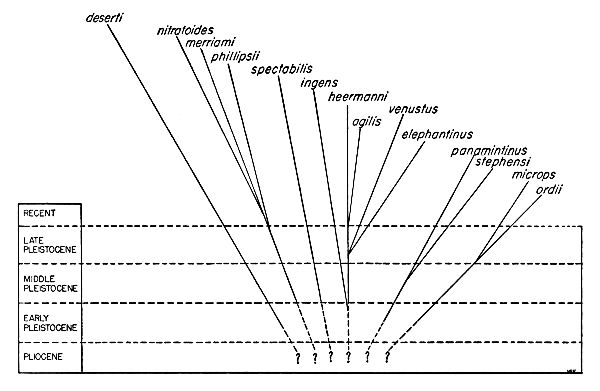
In view of the foregoing evidence it seems best to estimate the relationships and history of the various species and groups of species only as far back as the early Pleistocene (see Figure 21). Inasmuch as faunas of fossil mammals from the mid-Pleistocene contain few, if any, Recent species (see Hibbard, 1937:193), the living species of Dipodomys have probably had a geologic history no longer than the period of time which has elapsed since the middle Pleistocene, or at the earliest the early Pleistocene. Of the Recent species, only Dipodomys agilis is known as a fossil; it was found in the late Pleistocene tar pits of California. Under the heading "Dipodomys near ingens," however, Schultz (1938:206) recorded remains of kangaroo rats from the tar seeps of McKittrick in the San Joaquin Valley of California.