Front matter (continued 4)
Reading edition
"Go and seek help at Branksome Hall, for ye shall get none from me—seek help where ye paid blackmail, for, man, never did ye pay me any."
James turned him about, his eyes blinded with tears. "Never shall I pay blackmail again to Elliot. My hounds may all run masterless, my hawks may fly as they will from tree to tree, and my lord may seize the lands of his vassal, for never shall I see again the fair Dodhead."
He turned him to Tiviotside and made as fast as he could for Coultart cleugh, and there he shouted aloud until out came old Jock Grieve, and asked who it was that made such a noise.
"It is I, Jamie Telfer, of the fair Dodhead, and a harried man am I, for nothing is left at fair Dodhead but a weeping wife and three bairnies, and six poor calves stand in the stall crying aloud for their mothers."
"Alack!" quoth Jock Grieve, "alack, my heart is sore for thee! for I married the eldest of three sisters, and you married the youngest."
So he took out his bonny black horse, right well fed with corn and hay, and set Jamie Telfer on his back, to take his troubles to Catslockhill. When he came to Catslockhill he shouted aloud until out came William's Wat to ask what was the matter.
"It is I, Jamie Telfer, of the fair Dodhead, and a harried man am I. The Captain of Bewcastle has driven away my gear; for God's sake rise and help me."
"Alas and alack," quoth William's Wat, "my heart is sore for thee. Never did I yet come to the fair Dodhead and found thy basket bare."
He set his two sons on coal-black steeds, and he himself mounted a freckled grey, and with Jamie they rode to Branksome Hall, where they shouted so loud and high that old Buccleuch came out to ask what was the matter.
"It is I, Jamie Telfer, of the fair Dodhead, and a harried man am I; there is nought left at fair Dodhead but a weeping wife and three bairnies."
"Alack," quoth the good old lord, "my heart is sorry for thee; go call Willie, my son, to come speedily. Go call up hastily the men that live by the waterside. They who will not ride for Telfer's cattle, let them never again look me in the face. Call up Wat o'Harden and his sons, call up Borthwick Water, Gaudilands and Allanhaugh, call Gilmanscleugh and Commonside; ride by the gate at Priesthaughswire and call the Currors of the Lee, and call brave Willie of Gorrinberry as ye come down the Hermitage slack."
So the Scotts rode and ran bravely and steadily, shouting "Ride for Branksome," and when Willie looked ahead he saw the cattle being driven fast up the Frostylee brook, and to the plain.
"Who drives yon cattle?" cried Willie Scott, "to make us a laughing stock?" "'Tis I, the Captain of Bewcastle; I will not hide my name from thee."
"Let Telfer's cattle go back, or by the faith of my body," said Willie, "I'll ware my dame's calf-skin on thee."
"I will not let the cattle go back neither for thy love nor fear; I will drive Jamie Telfer's cattle in spite of all your company of Scotts."
"Set on them, lads!" cried Willie; "set on them cruelly; there will be many an empty saddle before they come to Ritterford."
So they set to with heart and hand, and blows fell like hail until many were slain and many a horse ran masterless. But Willie was struck by a sword through the headpiece and fell to the ground, and auld Wat of Harden wept for rage when he saw that his son was slain. He took off his steel cap and waved it thrice, and the snow on the Dinlay mountain was never whiter than the locks of his hair.
"Revenge! revenge!" he cried; "lay on them, lads. Willie's death shall be revenged or we will never see Teviotside again."
The lances flew into splinters, and many another brave rider fell, and before the Kershope ford was reached, the Scots had got the victory. John of Brigham was slain, and John of Barlow, and thirty more of the Captain's men lay bleeding on the ground. The Captain himself was run through the right thigh and the bone broken, and never would woman love him again, if he should live a hundred years.
"Take back the kye!" said he; "they are dear kye to some of us; never will a fair lady smile on me if I should live to be a hundred."
Word came to the Captain's bride in her bower, that her lord had been taken prisoner. "I would rather have had a winding-sheet," said she, "and helped to put it over his head than that he should have been disgraced by the Border Scot when he led his men over Liddel."
There was a wild gallant there named Watty Wudspurs (Madspurs) who cried, "Let us on to his house in Stanegirthside, if any man will ride with us!"
So they came to Stanegirthside, pulled down the trees, burst open the door, and drove out all the Captain's kye before them.
An old woman of the Captain's kin cried, "Who dare loose the Captain's kye, or answer to him and his men?"
"It is I, Watty Wudspurs, that loose the kye; I will not hide my name from thee; and I will loose them in spite of him and his men."
When they came to the fair Dodhead they were a welcome sight, for instead of his own ten milk kye Jamie Telfer had now got thirty-three. He paid the rescue shot in gold and silver, and at Willie Scott's burial, there were many weeping eyes.
Chapter XXXVIII
Muckle-mou'd Meg
The Scott family was very powerful on the Border in the days of Queen Elizabeth, the bravest and strongest of them being the bold Lord of Buccleuch. His name is often mentioned in Border history, and so is that of another Scott, "auld Wat Scott of Harden." He was a fit man for these wild times, being both brave and canny. He married a beautiful Border lass, "the Flower of Yarrow," and it is surprising how many able men have descended from this marriage. Not only did Sir Walter Scott and Robert Louis Stevenson claim descent from this fine old freebooter; his daughter Maggie married Gilbert Elliot of Stobs, nicknamed "Gibbie wi' the Golden Garters," and from them were descended George Augustus Elliot (Lord Heathfield), famous for his splendid defence of Gibraltar, worthy of the best Border traditions, and also the Elliots of Minto, who have twice been Viceroys of India, once late in the eighteenth and once early in the twentieth century.
But on one occasion one of the sons of Scott of Harden came perilously near to finding out how far his neck was capable of carrying the weight of his body. It was late in Queen Elizabeth's reign, and King James VI. of Scotland was extra anxious to live at peace with England, for he expected now very soon to be King over both countries. So he told his Warden, the bold Buccleuch, to restrain the wild Scotch freebooters; and you may imagine that the order was little to their liking. Young Willie Scott, Scott of Harden's son, quickly determined that cattle he must steal anyhow; he was his father's son, and did not his father once say, as he gazed longingly at a fine English haystack, "if only ye'd got four legs, haystack, ye would not be standing there!" So as Willie Scott was forbidden to steal English cattle, he decided to steal Scotch.
Sir Gideon Murray, of Elibank Castle, was an old enemy of the Scott family, having once been told off to punish them for some audacious act of theirs. And Sir Gideon had some cattle that would make any Borderer's mouth water and his arm itch to drive them home. So Willie and a few boon companions started off one night for Elibank. But a warning voice had reached Sir Gideon, and Willie received a warm reception, and was taken prisoner. He lay in the castle dungeon all night, reflecting on the folly of being caught, and fully expecting to be hanged very early next morning, perhaps without even his breakfast to comfort him!
But early on the fatal morning, Lady Murray startled her husband by asking him if he really meant to hang Willie Scott. He looked at her as if she were mad; of course, what else was there to do? Then she unfolded her scheme. She had a very plain-looking daughter known as "Muckle mou'd Meg," or Margaret with the extremely large mouth. Young Scott was handsome and of good family, and poor Meg would never again have such a chance of getting a good husband. Why not release Willie Scott, if only he would marry Mucklemou'd Meg?
They were men of action in those days, and the priest was instantly sent for. Then, all being ready, the prisoner was brought forth. He was shown on the one hand the priest and the girl, and on the other hand the tree and the noose, and was asked to take his choice. His first proud feeling was that he would be mocked at if he married such a girl on such terms, and he walked bravely towards the rope. But the nearer he got to it the uglier it looked. He had to confess to himself that it was not at all a comfortable looking rope; he had a nasty feeling round his neck from merely looking at it, and thought it would probably feel worse when it got round his throat. Then he looked at the girl; she certainly was not as beautiful as his mother, the lovely Flower of Yarrow; and a Borderer loved a beautiful wife. But if he hanged he would have no wife at all! Then he suggested that he should have three days to think it over, but Murray said no, neither priest nor noose was prepared to wait, he must decide at once. Then he looked again at Meg and saw a kind glance in her eye; she felt sorry for the handsome young fellow. Then he knew she had a good heart, and that decided the matter; he went up and kissed her with a good grace, and the priest married them straight away.
Afterwards he became Sir William Scott, and an important man on the Border. And, best of all, Meg proved to be a real good wife to him, and he never regretted the day when he elected to suffer the knot to be tied by the priest instead of by the hangman.
Chapter XXXIX
The Dowie Dens of Yarrow
This is one of the most famous and widely known of all the Border ballads, and has proved a source of inspiration to several poets, including Wordsworth, who wrote three poems upon the subject. The bard does not relate the full particulars, but gives only the barest outlines of facts, which were well known in his day, and still live in tradition. The story tells of a duel between two brothers-in-law. The very spot where it took place is still pointed out, a low muir on the Yarrow banks. The slain knight was apparently Walter Scott, one of the ancestors of Lord Napier. His murderer was his brother-in-law, John Scott. "Dowie" means melancholy, and "den" is a word used to describe a narrow, rocky valley, usually wildly beautiful.
Late at e'en drinking the wine,
And e'er they paid the lawing,
They set a combat them between,
To fight it in the dawing.[#]
[#] Dawn.
"O stay at home my noble lord,
O stay at home my marrow.
My cruel brother will you betray,
On the dowie houms[#] of Yarrow."
[#] Hillocks.
"O fare ye well, my lady gay!
O fare ye well, my Sarah!
For I must go, though I ne'er return
From the dowie banks of Yarrow."
She kissed his cheek, she combed his hair,
As oft she had done before, O,
She belted him with his noble brand,
"And he's away to Yarrow."
As he gaed up the Tennies bank
I wot he gaed with sorrow,
Till down in a den he spied nine armed men,
On the dowie houms of Yarrow.
"O come ye here to part your land,
The bonnie forest thorough?
Or come ye here to wield your brand,
On the dowie houms of Yarrow?"
"I come not here to part my land,
And neither to beg nor borrow,
I come to wield my noble brand
On the bonnie banks of Yarrow.
"If I see all, ye're nine to ane;
And that's an unequal marrow;
Yet will I fight, while lasts my brand,
On the bonnie banks of Yarrow."
Four has he hurt, and five has slain,
On the bloody braes of Yarrow,
Till that stubborn knight came him behind,
And ran his body thorough.
"Gae hame, gae hame, good brother John,
And tell your sister Sarah,
To come and lift her leafu'[#] lord;
He's sleepin' sound on Yarrow."
[#] Lawful.
"Yestreen I dreamed a dolefu' dream,
I fear there will be sorrow!
I dreamed I pu'd the heather green,
Wi' my true love on Yarrow.
"O gentle wind, that bloweth south,
From where my love repaireth,
Convey a kiss from his dear mouth,
And tell me how he fareth!
"But in the glen strive armed men;
They've wrought me dole and sorrow;
They've slain—the comeliest knight they've slain,
He bleeding lies on Yarrow."
As she sped down yon high, high hill,
She gaed wi' dole and sorrow,
And in the den spied ten slain men,
On the dowie banks of Yarrow.
She kissed his cheek, she kaim'd his hair,
She searched his wounds all thorough,
She kiss'd them till her lips grew red,
On the dowie houms of Yarrow.
"Now haud[#] your tongue, my daughter dear,
For a' this breeds but sorrow;
I'll wed ye to a better lord,
Than him ye lost on Yarrow."
[#] Hold.
"O haud your tongue, my father dear!
Ye mind me but of sorrow;
A fairer rose did never bloom
Than now lies cropp'd on Yarrow."
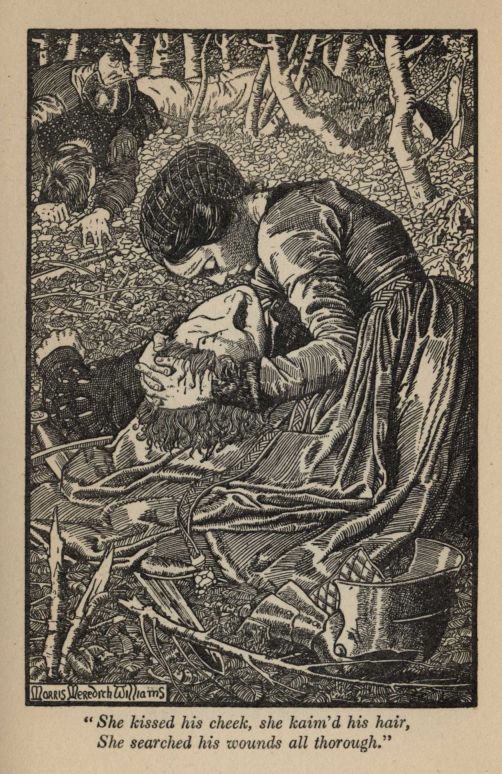
"She kissed his cheek, she kaim'd his hair, She searched his wounds all thorough."
Chapter XL
Belted Will and the Baronry of Gilsland
"When for the lists they sought the plain
The stately lady's silken rein
Did noble Howard hold;
Unarmed by her side he walk'd
And much, in courteous phrase they talk'd
Of feats of arms of old.
Costly his garb; his Flemish ruff
Fell o'er his doublet, shaped of buff,
With satin slashed and lined;
Tawny his boot and gold his spur,
His cloak was all of Poland fur,
His hose with silver twined.
His Bilboa blade, by Marchmen felt,
Hung in a broad and studded belt;
Hence, in rude phrase, the Borderers still
Call'd noble Howard, Belted Will."
SCOTT, Lay of the Last Minstrel.
One of the many picturesque figures of Border history was "Belted Will," or to call him by his proper name and title, Lord William Howard, a younger son of the powerful Duke of Norfolk.
His mother had died when he was an infant, and his father, the foremost Roman Catholic nobleman in England, took up the cause of Mary Queen of Scots, whom he wished to marry. For this treason against Queen Elizabeth he was beheaded in 1572, when young Lord William was only nine years old. At the age of fourteen the young lord's guardians arranged for him a marriage with Elizabeth Dacre, a member of a powerful Border family, and heiress to the Baronry of Gilsland. As the bride was even younger than her boy-husband, let us hope that they both went to school again immediately after the marriage!
When he grew to manhood, Lord William warmly supported the Roman Catholic cause and was imprisoned by Elizabeth; but when James became King, he was released and restored to his estates on the Border. Throughout the remainder of his career he was the most notable man of his district. He knew how to make himself respected by his wild neighbours. His fame and power were great. He founded the fortunes of his family so surely that he it is who is usually thought of as the ancestor of the Earls of Carlisle, though his great-grandson was the first to hold the title.
Lord William had great energy and many interests, and was remarkable as being an "all-round" man. He was equally a leader of men and a lover of books; no detail in the management of his estates was too small for him to study; he was a good husband to his wife, and a splendid father to his fifteen children. He selected the most beautiful of his several castles, that of Naworth, and repaired and almost rebuilt it; he took there the fine old oak ceiling from the ancient castle of Kirkoswald, which was ornamented with portraits of all the kings of England. Visitors to Naworth can see to-day the "hall of Belted Will," by kind permission of the present Earl of Carlisle.
He was something of a poet and very much of an antiquarian. His estates were full of interesting things, and none knew them better than he. There were miles of the Roman wall, still in excellent condition; there were many Roman altars and inscriptions, which he copied and translated; quite near him, at Coome Crags, was a Roman quarry, which can still be seen to-day, with marks of Roman tools on its stones. It stands in a beautiful wood by the side of the lovely river Irthing. And only a little further on, standing on a fine cliff overlooking the river, is the old Roman station of Amboglanna, a fort that covered five and a half acres, with walls that were once five feet thick, the main foundations of which are still standing, clear enough for anyone to trace them out. It is quieter there to-day than it was in Roman times, or in the stirring days of Belted Will!
It is good to think that this broad-shouldered, gallant, powerful nobleman, who could ride, shoot, fight and keep this wild district in order, was at the same time such a clever student and book-worm. They tell a story that he was once sitting in his library intent on a book when his men brought in a robber whom they had caught red-handed, and asked Lord William to try him. Belted Will, angry at being interrupted, cried out:—"Don't disturb me; hang him!" Half an hour later he rose and came down to try the man, but finding that he was already hanged he went on with his book. It is only fair to add that robbers in those days expected no mercy when caught.
One of the many clever things that Lord William did was to have figures carved in oak to represent soldiers; these he placed on the top of his high towers, and deceived the Scots into thinking that he had a large and very watchful garrison! These figures can still be seen at Naworth. Near Naworth Castle is Lanercost Priory, where King Edward I. stayed on his way to Scotland. There is a secret passage from Naworth tower which is supposed to run under the river to Lanercost. No one is allowed to go through it, as it is considered dangerous; the people of the district say that the last man to do so was Oliver Cromwell.
Visitors to Naworth to-day should certainly go on to Gilsland itself, the picturesque straggling little town, which was the head of the Baronry which Elizabeth Dacre brought to her boy-husband. The Irthing at Gilsland runs through a wonderfully beautiful gorge, rocky and wooded, wild and romantic. Stand on the venturesome stepping stones near the old church, with the river rushing at your very feet, and see if this is an exaggeration of the beauties of the scene. Right in the midst of the glen you can see the "Popping-stone" where Sir Walter Scott walked with the lady of his choice and asked her to marry him. Readers of "Guy Mannering" can see in Over Denton church near Gilsland the grave of Meg Merrilees, who died here at the age of ninety-eight. The town is also interesting for the fact that the county border is at Gilsland, and there is an inn so built that it stands in both counties, and contains a bed in which you can sleep with your head in Northumberland and your feet in Cumberland!
There is a story of Belted Will that tells eloquently of the strength of his character. When he was released from prison by King James he found his estates so ruined by careless management that he knew that great care was needed to put things right again; so until he got his affairs into order, all the pocket-money that he would allow himself was twenty shillings per month!
Bold William, Belted Will, gallant Lord Howard, as you will, died at Naworth in 1640 aged seventy-seven, one year after the death of his devoted wife. His descendants were, like himself, students and men of action; the present Earl of Carlisle is directly sprung from him, and is very proud of the fact.
Chapter XLI
Gilderoy
Gilderoy was a celebrated and most daring highwayman, who roamed far, and was well-known all over Scotland and indeed in London. His death inspired a very striking ballad, but this is hardly a Border Lowland ballad, but refers chiefly to another Border district, namely, that between the Lowlands and Highlands. Just as the Scottish Lowlanders thought the English their legitimate quarry, so the Highlanders in turn looked upon the Lowlanders as created to supply them with all they lacked. There is a story on record of a Highland chief who, finding his men had carelessly robbed another Highlander, returned the spoil with a handsome apology, and issued stringent orders that in future nothing was to be taken except in the Lowlands, "where all men make their prey."
Among the robber clans of the Highlands, the MacGregors stand easily in the first rank. In a long series of Scottish Acts of Parliament, they are habitually referred to as "the wicked clan Gregor, so long continuing in blood, slaughter, theft, and robbery." One of their most famous exploits was the battle of Glenfruin, when they defeated their enemies, the Colquhouns, and slew two hundred of them. The Colquhouns appeared before the King at Stirling with the bloody shirts stripped off their dead, and the law was put in motion against the MacGregors more vigorously than ever. This was in 1603. The execution of Gilderoy, as described in our poem, took place in 1638. His real name was Patrick MacGregor, and the fact that he belonged to this Ishmaelite clan, whose hand was directed against every man, and whose very name had been solemnly abolished, may well serve as an excuse for his career of crime. Gilderoy, in Gaelic, means the red-haired gillie or lad, and besides the name there are many other points of similarity between him and Rob Roy, who was the head of the Clan MacGregor in the following century. Both Gilderoy and Rob Roy were professional blackmailers, that is, they could be relied on never to plunder anyone who was prudent enough to buy them off by paying a fixed contribution. This is what is meant in the following lines of the ballad—
"All these did honestly possess
He never did annoy,
Who never failed to pay their cess
To my love, Gilderoy."
The "cess" is the blackmail, or insurance against robbery. The widespread reputation of Gilderoy is attested by the many legends of him which are printed in the old chap-books and "Lives of the Highwaymen." According to these authorities, Gilderoy once robbed Oliver Cromwell near Glasgow; but an even more romantic episode of his career was a roaming trip upon the continent, in the course of which he is said to have picked Cardinal Richelieu's pocket while he was celebrating mass in the King's presence, at the church of St Denis in Paris. He made his way even to Madrid, where he succeeded in carrying off the Duke of Medina-Cell's plate. Altogether a most notorious and dashing cateran. The ballad is supposed to be spoken by a young woman who had all her life been attached to him.
"Gilderoy was a bonnie boy,
Had roses to his shoon;[#]
His stockings were of silken soy,
With garters hanging down.
It was, I ween, a comely sight
To see so trim a boy;
He was my jo, and heart's delight,
My handsome Gilderoy.
* * * * *
My Gilderoy and I were born
Both in one town together;
We scant were seven years before
We 'gan to love each other.
Our daddies and our mammies they
Were filled with meikle joy,
To think upon the bridal day
Of me and Gilderoy."
[#] Shoes.
But there intervened the spirit of adventure which had ever been the birthright of all of his surname,
"Oh, that he still had been content
With me to lead his life!
But ah! his manful heart was bent
To stir in deeds of strife;
And he in many a venturous deed
His courage bold would try;
And now this gars[#] my heart to bleed
For my dear Gilderoy."
[#] Makes.
No doubt those who knew Gilderoy personally would have agreed, as was actually said of Rob Roy, that he was a benevolent and humane man "in his way."
"My Gilderoy, both far and near,
Was feared in every town;
And boldly bore away the gear
Of many a Lowland loun,
For man to man durst meet him none,
He was so brave a boy;
At length with numbers he was ta'en,
My winsome Gilderoy."
He was not so fortunate as Rob Roy, who ultimately died peacefully in his bed. Gilderoy had lost the game, and he had to pay the stakes.
"Of Gilderoy so feared they were,
They bound him fast and strong;
To Edinbro' they led him there,
And on a gallows hung.
They hung him high above the rest,
He was so trim a boy;
There died the youth whom I loved best,
My handsome Gilderoy."
Thus perished one of the characteristic products of an age whose standards were so different from ours that we can hardly judge him fairly. He was banned before his birth, a scion of a race so indomitably and innately ferocious that the law attempted to extirpate them, root and branch. The very name of Gregor could be given by no clergyman at baptism, under penalty of deprivation and banishment. Cunning and politic neighbours were not slow to take advantage of the stubborn disposition of the MacGregors, and gradually stripped them of their once extensive lands in Argyle and Perthshire. Gilderoy might well consider that he was "an honester man than stood on any of their shanks," and we may be excused for feeling a very lively sympathy with him, and for echoing in our inmost hearts the exquisitely feminine point of view expressed by the lady composer of the ballad.
"If Gilderoy had done amiss,
He might have banished been;
Ah! what sore cruelty is this
To hang such handsome men!
To hang the flower of Scottish land,
So sweet and fair a boy!
No lady had so white a hand
As thee, my Gilderoy!
When he had yielded up his breath
I bare his corpse away;
With tears, that trickled for his death,
I washt his comely clay;
And sicker[#] in a grave sae deep
I laid the dear lo'ed boy;
And now for ever maun I weep,
My winsome Gilderoy."
[#] Safely.
Chapter XLII
Archie Armstrong's Oath
"And oft since then, to England's King,
The story he has told;
And aye, when he 'gan rock and sing,
Charlie his sides would hold."
Archie Armstrong lived in Eskdale, where he did his best to keep up the grand reputation of his family as being among the very boldest sheep-stealers of the Border. His house was at Stubholm, where the Wauchope stream runs into the river Esk, near where the picturesque town of Langholm now stands. Living in the reign of Charles I., after the union of crowns, the profession of freebooter was far less honourable than of old. He could not now plead that he was a Border soldier, fighting against his nation's enemy. The wild Border blood in him might cry out for the old adventurous career, but he could no longer hope for the aid of powerful Border families. When cornered, his sole protector would be his own wits, and woe betide him if they failed!
Archie's house was about eight miles from the Border, and he could not help strolling towards the fascinating line and tasting the sweetness of temptation. When the chance came that seemed to him sufficiently safe, he would go home in company though he had walked out alone; the "company" being a good fat English sheep. One night a shepherd had marked him lingering about, and had watched him, and raised an alarm. Away went stout Archie at a Marathon pace; half way home he passed Gilnockie tower, where his ancestor bold Johnie Armstrong lived so gaily. "Alas!" thought Archie, dolefully, "he too was hanged in the end!"
He got home well in front of his pursuers, but his wife gave him small encouragement. With typical Scottish dourness she remarked to him, "Ye will be ta'en this night and hanged i' the morning."
But Archie put a braw face on it, and declared that he would never hang for one silly sheep. Quicker than any butcher he skinned and roughly trimmed the dead animal, throwing the rejected parts into the swift stream. Then rejoicing in the fact that his child was away with its aunt, he put the carcase carefully in the cradle and began rocking it and singing a lullaby to it, as if he were the most loving father in all the British Isles.
The pursuers now rushed in, and began to accuse Archie triumphantly; but he rebuked them for making so much noise, telling them that his child was at death's door! As for stealing their sheep, he took a solemn oath that if he had done such a thing he would ask to be doomed to "eat the flesh this very cradle holds!"
Such an oath on the Borders was a very serious matter; they little knew that the only flesh in the cradle was sheep's flesh, which Archie asked nothing better than to devour!
Impressed but not convinced, his enemies carefully searched the whole of Archie's house and garden; it was only with very great unwillingness that they at last decided that they must miss the supreme pleasure of hanging him! They went away saying that they must have been deluded by the devil or by witches; and the shepherd resolved to hang a branch of rowan-tree (mountain-ash) by his fold, for that was well-known to have the power to keep witches away.
As soon as they were all on their road to England again, Archie skipped about like a dancing fiddler. "Wife," he said, "I never knew before that I would make such a good nurse."
After this Archie wandered down to London, and his wild jests becoming famous, he was made Court Jester by King Charles I. And many a time he acted the story to the King, rocking a pretended cradle, and singing a persuasive lullaby, to the King's intense amusement.
Nevertheless, Archie lost his place by his boldness. These were the days of Archbishop Laud (1637), who was hated by the Scots. One day, as the archbishop was about to say grace before dinner, Archie asked the King's permission to say grace instead. The King consented, and the jester's double-meaning words were as follows:—
"All praise to God, and little laud to the devil!"
The archbishop, in many senses a little man, had Archie dismissed in disgrace. But, such were the chances of these uncertain times, the archbishop was executed in the end, while the sheepstealer escaped that fate!
Chapter XLIII
Christie's Will
The resourceful Archie, whose tale we have just told, was not the only one of the reckless Armstrongs to keep up the old freebooting habits in the reign of Charles I. There lived at Gilnockie tower (the old residence of the famous Johnie Armstrong) in the parish of Cannobie, a notorious Willie Armstrong, known as Christie's Will. Like Archie, he more than once owed his life to his ready wit. He was shut up in Jedburgh jail when the Earl of Traquair, Lord High Treasurer, paid the prison an official visit. When he asked Will the cause of his being there, the freebooter answered:—
"For stealing two halters, my lord."
Traquair was surprised, but Will afterwards owned that there was a fine colt at the end of each halter.
Traquair was amused and pleased by the boldness of the man, and had him set free.
Some little time afterwards Traquair was involved in a law-suit which was set down to be decided by Lord Durie, who seems to have let it be known before-hand what his opinion was upon the case. Nothing would save Traquair's interests except that Durie must be got out of the way before the case began. But how was it to be done?
Christie's Will was appealed to, and merely said "Leave it to me."
It was the judge's habit to take horseback exercise on the sands of Leith without any attendant. One morning, whilst so riding, a well-dressed and gentlemanly stranger, on a good horse, happened to overtake him; a courteous greeting led to a friendly conversation, in which the stranger proved himself so affable and entertaining that the judge rode on by his side without suspicion. Suddenly, when they had come to a lonely spot, Lord Durie found himself seized by this muscular gentleman, smothered up in a big cloak, whisked off his horse and on to the stranger's, who galloped off, mischief knows where! It was Christie's Will, carrying out his promise.
The judge's horse galloped home, riderless. Search was made, but the judge could not be found. It could only be supposed that he had been thrown off into the sea. His successor was appointed, and Lord Traquair's case was heard and won!
Lord Durie had languished for several months in a dreary underground vault. I wonder if he thought of the many poor wretches he had sentenced to a similar fate? Suddenly at midnight he was roughly awakened, muffled up as before, and carried away again by his captor on horseback. Next morning, by the light of the newly-risen sun, he found himself on the very spot by the sands of Leith from which he had been kidnapped! We will hope that every one, including his successor, was glad when he thus came to life again.
When the Civil War began, the Earl of Traquair was faithful to King Charles I. Having some papers of importance that he wished to have given into the King's own hands, he entrusted these to the bold freebooter. Christie's Will did his errand, and received an equally important answer. But spies at Court had given Cromwell word of the matter, and the command was sent up to Carlisle that Will Armstrong must be intercepted there. Not knowing his danger, Will halted in the town to refresh his horse, then pushed forward to the bridge which crossed the Eden on the Northern boundary of the city. Cromwell's soldiers were waiting for him; the bridge was high and narrow, the broad Eden waters were swirling in high flood.
Christie's Will, without one second's hesitation, spurred his horse over the parapet. He sank ... he came up ... he sank ... he came up ... he sank ... he came up, this time at the very bank. He cut his heavy, dripping cloak from his shoulders; relieved of the weight, his horse struggled to the land. Away went Will, away went the troopers after him. It was a hard race to the river Esk, and this also Will had to swim. But now he was in Scotland, and his friends were at hand; gaily Will turned to his pursuers, who dared not cross the water; "Good friends," cried he, "come over and drink with me!" But they showed him their backs, and their horses's tails, and he saw no more of them.
Such were the exploits of Christie's Will; he was the last of the free-booters, but he certainly knew how to live up to their boldest traditions.
Chapter XLIV
Northumberland at the time of the Civil War
During the stormy days of King Charles I., the Borders, and especially Northumberland, saw many stirring scenes. It must be remembered that shortly before the Long Parliament was elected, King Charles almost came to war with the Scottish Presbyterians, because they would not obey the harsh rule of Archbishop Laud. The Scots raised an army under the lead of shrewd general Alexander Leslie, the "old, little, crooked soldier," of great experience, trained by the great Gustavus of Sweden. In 1639 Charles sent ships up to the Forth, in reply to which Leslie marched his army to threaten the border. The old quarrel between the two countries began to blaze up again. King Charles led an army to the border and was received with splendid applause at Newcastle. Many joined his army, and shouted with joy at the thought of meeting the Scots in battle. But they were an untrained disorderly crew, who fired their guns off at random and kept no military order whatever. Gallant Leslie marched his men down to Duns Law, in South Berwickshire, and was ready to fight. But King Charles would not trust his army that length; he made terms with his opponents, promising them the reforms they set their hearts upon, and the two armies melted away like school-boys at the end of the term.
Things were soon as bad as before. Lord Conway was sent by the King to put Newcastle into a strong defensive state. His greatest difficulty was to get money for the purpose, for the King's quarrel with his various Parliaments had deprived him of supplies. The badly paid troops mutinied, and the ring-leader was shot. Very soon the Scottish army came across the Tweed, the Highlanders armed with bows and arrows.
They pitched their camp on Heddon Law, and soon proved to the country folk that they had not come for plunder, but would pay for all they wanted to eat. This re-assured the country people, who had no real quarrel with the Scots, and even became most friendly to them.
With Lord Conway it was otherwise; he was the King's officer, and was bound to offer resistance. His opinion was that if once the Scots crossed the Tyne, and attacked Newcastle from the south or Gateshead side, they were sure of victory. Accordingly, leaving a strong garrison to protect the town, he marched out with two thousand or more foot and fully one thousand horse to command the important ford across the Tyne at Newburn, a place five or six miles due west of Newcastle. It is interesting to remember that here also the Romans had had fortifications, along the line of the wall, and the very spot where the Scots and English fought may well have been the scene of contests between the Roman Legions and the wild Picts.
The English arrived first, on the south bank of the river, and threw up earth-works hastily. Very soon they saw the Scots march into Newburn village, on the north bank, where they employed themselves by hauling their cannon up to the church tower. Remarkable cannon they were, made out of bar-iron hooped together with cord and wet, raw hides! But they were not required to carry any distance, the foe was only on the other side of the Tyne. All the morning the enemies looked at one another across the river, each hesitating to fire the first shot of the war. At last an English officer shot a Scotch officer, and the fight began. The Scots were on the higher ground, and their cannon, rough as they were, sent heavy shot on to the English. Then when the river tide went down, the Scots rushed across the ford, and the battle was soon won, the royal standard being taken. English runaways rushed through the woods and into Newcastle, crying, "Fly for your lives, naked devils have destroyed us!" Whether they referred to kilted Highlanders is uncertain. Anyway, Leslie and his Scots entered Newcastle in triumph, but were afterwards bought off with a payment of £60,000 and recrossed the Tweed into Scotland.
This was in 1641, a year in which King Charles was quarrelling bitterly with his Long Parliament, though the actual civil war in England did not begin till 1642. Early in 1642 it was decided that so important a town as Newcastle ought to be put in a stronger state of defence.
William Cavendish, Earl of Newcastle, was made governor of the town, but he was much hindered in his plans by lack of money. King Charles, however, promoted him from Earl to Marquis of Newcastle, and the lack of funds he made up as best he was able. However, the Governor of Holy Island, off the Northumberland shore, found himself left for sixteen months without any pay! He wrote to the King's treasury a protest in verse, beginning:—
"The great commander o' the Cormorants,
The geese and ganders of these hallowed lands,
Where Lindisfarne and Holy Island stands,
These worthless lines sends to your worthy hands."
The allusion in the first two lines is to the fact that Holy Island and the Farne Islands were then, and are still to-day, so thinly peopled that sea-birds gather there in large numbers, adding greatly to the wild beauties of these islets and rocks.
In January 1644 a serious struggle began. Leslie and his soldiers crossed the Tweed at Berwick bridge and again entered Northumberland. General Bayly marched his men from Kelso across the frozen river and joined Leslie at Alnwick. Warkworth Castle, though it contained cannon and provisions, surrendered at once. The Scottish general gravely told Bemerton, the governor, that if he had learnt to fight as well as he had learnt to dance his castle could never have been taken! The country districts of Northumberland had no quarrel with the Scots, and it was soon evident that the real fight would be at Newcastle, bravely held by the Marquis and by the Mayor, Sir John Marley.
The Scottish "murthering pieces," as the cannon were called, were brought down by sea, and the obstinate conflict began. Despite the terrible weather of a very rough February, frequent skirmishes took place, while the Scots closed nearer and nearer round the gallantly defended town. Leslie soon found that the defences had been put into good order; the ditch round the town was dug deep, and close to the walls; the walls themselves were strongly underpinned. The battlements were strengthened by stone and lime, but the top stones were loosened so as to slip if the enemy attempted to mount them. Every cannon was placed carefully, to the best advantage.
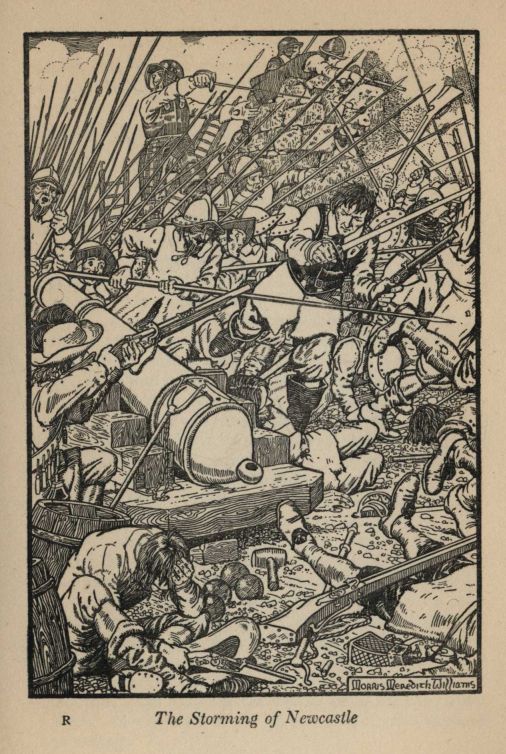
The Storming of Newcastle
But the Marquis of Newcastle was called southward by the needs of his King. With him were his thousand brave "White coats," so called because they wore white coats which they promised to dye in the blood of the enemy. But they met the terrible Ironsides at Marston Moor, and in a conflict of furious bravery on both sides, all of the gallant thousand except thirty were slain on the field of battle.
This was in July of 1644, but it did not affect the siege of Newcastle, which still dragged obstinately on, under the skilful guidance of the dauntless Mayor. By October, Sir John Marley was so buoyed up by his success that he sent a letter to General Leslie to ask if he was still alive! This the Scots took to be an insult, and a grand assault was begun. The Scots were furious, and the defence was desperate. The roar of the cannon and the rattle of the musketry were succeeded, as the assault got nearer and nearer to its aim, by the clashing of swords and the clanging of pikes. At last, the regiments of Loudoun and Buccleugh succeeded in forcing their way into the town. In vain the defenders made their last gallant charge; their cause was now hopeless, and soon the market-place was filled with fugitives, who flung down their arms and cried aloud for quarter at the hands of the triumphant Scots.
In these days the defender was often made to feel the anger of the victors, who in the flush and cruelty of victory avenged their dead, only too terribly, upon the losing side. Not so at Newcastle. Prominent in its day, it stands out because of the mercy of the Scottish conquerors as much as for the heroism of its defence. In this, the last great struggle on English ground between Scots and English, it is pleasing indeed to recall facts that redound to the high honour of both parties.
Chapter XLV
Montrose and Lesly
James Graham, the great Marquis of Montrose who at first sided with the Scottish Covenanters against Charles I., was so out of sympathy with the extreme turn which affairs took later against that unhappy monarch that he went over to the King's side. Gathering the Highland Clans under his standard, he marched Southward and defeated the Covenanters in a series of brilliantly fought battles. He occupied Edinburgh, and laid great plans to complete the conquest of Scotland by subduing the Borderland.
If the Borders had remained in their old fighting state no doubt many a Border chief would have joined Montrose's army and aided his bold plans. But, unfortunately for King Charles, the Borders had been tamed and disarmed since the union of England and Scotland under James I. Only a few adventurous spirits like Christie's Will remained as examples of the old wild days.
The remnant of the army of the Covenanters was commanded by the stern General David Lesly (not the Alexander Leslie who figures in the preceding chapter), and was somewhere in the Border district. Gay Gallant Montrose did not bother as to exactly where this army was; he despised it too heartily. He himself was at Selkirk, while his army was encamped on the neighbouring plain of Philiphaugh.
Montrose was busy writing a cheering message to King Charles to the effect that he had now no enemy left in Scotland who could offer an effective resistance to his arms. Little did he think that General Lesly was gradually creeping nearer, nearer, and was now actually within four miles of his army. With the advantage of a thick Scotch mist, Lesly's men actually burst upon Montrose's infantry without a single scout having seen them to give warning of their approach! In such confusion, Montrose's men had no chance whatever.
The Marquis galloped up, only to find his soldiers hopelessly defeated and great numbers slain. There was nothing left but for those to escape who could. The Marquis succeeded in cutting his way through, and gathered his troops to fight again later on; but his efforts were doomed to failure.
A popular ditty of these days, sung to a stirring tune, was called "Lesly's March." Sir Walter Scott seems to regard this as wholly serious, and ranks it as a Covenanter song. It appears to me, however, that many of the lines have a very sarcastic flavour; no doubt the Covenanters did really think that
"There's none in the right but we,
Of the old Scottish nation";
but they would probably have phrased it a little less baldly. To me it appears as if this song were the work of an onlooker and not a partisan; one ready to see the faults of both sides, and very much inclined to hold back his final opinion till he saw which was going to win. But let the March speak for itself.
LESLY'S MARCH
March! march:
Why the de'il do ye na march?
Stand to your arms, my lads,
Fight in good order;
Front about, ye musketeers all,
Till ye come to the English Border;
Stand till 't, and fight like men,
True gospel to maintain.
The parliament's blythe to see us a' coming!
When to the kirk we come,
We'll purge it ilka room,
Frae popish relics, and a' sic innovation,
That a' the world may see,
There's nane in the right but we,
Of the auld Scottish nation.
A truly partisan ballad of the day describes the battle of Philiphaugh and exults in the defeat of Montrose, "our cruel enemy," it calls him. As a ballad it has no great poetic merit; the very sober Covenanters probably regarded ballad-making as a frivolity. But it describes rather graphically how an "aged father," from the country-side, led Lesly's army very cautiously and wisely to the very tents of the foe. These details are no doubt accurate; though the ballad-writer (whoever he was) displays his ignorance of other matters by making the old soldier say that he was at the battle of Solway Moss (which took place one hundred years before) and at that of Dunbar, which was not fought till five years later!
The following are the opening verses of the ballad, giving an idea of its plain, straightforward style:—
On Philiphaugh a fray began,
At Hairhead-wood it ended;
The Scots out o'er the Graemes they ran,
Sae merrily they bended;
Sir David frae the Border came,
Wi' heart an' hand came he;
Wi' him three thousand bonny Scots,
To bear him company.
Wi' him three thousand valiant men,
A noble sight to see!
A cloud o' mist them weel conceal'd,
As close as e'er might be.
When they came to the Shaw burn,
Said he, "Sae weel we frame.
I think it is convenient
That we should sing a psalm."
It is not necessary to quote more of it, but it may be remarked that in place of the last line as given here, the unregenerate substituted,
"That we should take a dram."
In point of actual fact, both versions are probably true!
Chapter XLVI
The Death of Montrose
During the imprisonment of King Charles I., at a time when active war on his behalf might do the unhappy monarch more harm than good, the gallant Montrose had retired to France. His bright military fame, his courteous manners, and manly bearing made him friends everywhere, and when he visited Germany the Emperor conferred on him the rank of Marshal. Hearing of the execution of Charles I., Montrose at once placed himself at the disposal of Charles II., now a fugitive in Holland. This prince named him Captain General of Scotland, and the daring hero set out for the Orkney Islands with about five hundred paid soldiers, mostly adventurous Germans and Dutchmen. Only a reckless spirit like Montrose would have undertaken so wild a commission.
Scotland was heartily sick of war, and learnt with consternation of the arrival of this firebrand. Lesly was sent forward with four thousand men to attack Montrose's five hundred! Colonel Strachan led the advanced guard, which fell unexpectedly upon the invading army, and, after a brief, fierce struggle, totally defeated it.
Montrose, disguised as a peasant, entrusted his life to one he believed to be his friend, M'Leod, Laird of Assaint. But this unworthy man betrayed him to his bitterest enemy, General Lesly. Thus, at last, this brilliant commander was in the hands of the bitter Covenanters, into whose hearts his brilliant victories had once spread such terror. Their treatment of him is a black stain upon their memory. For days he was led about in the peasant's disguise, which he had put on; he was carted through the streets of Edinburgh, accompanied by such insults that the populace cried shame upon his captors.
When tried before the Scottish Parliament for treason, he made a most eloquent defence, one of the most notable of his assertions being that he had never stained his victories by slaughtering his foes in cold blood after the battle. In this he was far above his enemies, who had disgraced their victory of Philiphaugh by many an execution, and who were now bent upon taking the life of Montrose himself. The sentence against him was probably decided before his defence had been heard; it ran thus:—
"That James Graham should next day be carried to Edinburgh cross and there hanged on a gibbet 30 feet high for the space of three hours; then to be taken down, his head to be struck off on a scaffold and affixed to the prison; his arms and legs to be stuck up on the four chief towns of the Kingdom, his body to be buried in the place set aside for common criminals."
To this sentence the great Marquis haughtily replied that he would rather have his head so placed than his picture in the King's bedchamber, and that he wished he had limbs enough to be dispersed into all the cities of Christendom, to prove his dying attachment to his king. And in the one evening of life that still remained to him, this accomplished and fearless nobleman employed his time in turning these loyal sentiments into verse.
Despite the fact that he triumphed undaunted over all the mean inventions of their malice, his enemies persisted to the end.
The executioner tied mockingly round his neck the book that had been published describing his victories; Montrose thanked him, saying that he wore it with more pride than he had ever worn the garter of honour. He uttered a short prayer; then asking them what more indignities they had prepared for him, he patiently and with unbroken spirit yielded his life to the hangman, at the too early age of thirty-eight.
Whatever opinions we may have as to the rights and wrongs of the quarrel, this brutal killing of a gallant soldier and accomplished gentleman can only rank as a hideous blot upon all concerned in it. Every insult hurled at Montrose has returned in the verdict of time with redoubled force against the malice of those who stooped to such vindictiveness. The execution of a soldier who has violated no rule of war is at any time a thing that revolts the human conscience, and a sentence hoarse with the vile taunts of its utterers has so far lost all semblance of justice that it is needless to argue upon it.
In the verdict of history, the great Marquis of Montrose, whether right or wrong in his political views, lived and died like a man of honour.
The ballad of the "Gallant Grahams," written about this time, reflects very sincerely and touchingly the devotion and affection surrounding the great Marquis, accompanied by the very Scottish feeling that in addition to his own personal power and genius, he was also the head of the great Border family of Grahams.
THE GALLANT GRAHAMS
Now, fare thee well, sweet Ennerdale![#]
Baith kith and countrie I bid adieu;
For I maun away, and I may not stay,
To some uncouth land which I never knew.
[#] A corruption of Endrickdale. The principal and most ancient possessions of the Montrose family lie along the water of Endrick, in Dumbartonshire.
To wear the blue I think it best,
Of all the colours that I see;
And I'll wear it for the gallant Grahams,
That are banished from their countrie.
I have no gold, I have no land,
I have no pearl nor precious stane;
But I wald sell my silken snood,
To see the gallant Grahams come hame.
In Wallace days, when they began,
Sir John the Graham[#] did bear the gree
Through all the lands of Scotland wide:
He was lord of the south countrie.
[#] The faithful friend and adherent of the immortal Wallace slain at the battle of Falkirk.
And so was seen full many a time;
For the summer flowers did never spring,
But every Graham, in armour bright,
Would then appear before the king.
They were all drest in armour sheen,
Upon the pleasant banks of Tay;
Before a king they might be seen,
These gallant Grahams in their array.
At the Goukhead our camp we set,
Our leaguer down there for to lay;
And, in the bonny summer light,
We rode our white horse and our gray.
Our false commander sold our king,
Unto his deadly enemie,
Who was the traitor, Cromwell, then;
So I care not what they do with me.
They have betray'd our noble prince,
And banished him from his royal crown;'
But the gallant Grahams have ta'en in hand
For to command those traitors down.
In Glen-Prosen[#] we rendezvous'd,
March'd to Glenshie by night and day.
And took the town of Aberdeen,
And met the Campbells in their array.
[#] Glen-Prosen is in Angusshire, usually called Forfarshire. The Glenshee road, over the Grampians, is the highest road in Great Britain.
Five thousand men, in armour strong,
Did meet the gallant Grahams that day
At Inverlochie, where war began,
And scarce two thousand men were they.
Gallant Montrose, that chieftan bold,
Courageous in the best degree,
Did for the king fight well that day;—
The Lord preserve his majestie!
Then woe to Strachan, and Ilacket baith!
And, Lesly, ill death may thou die!
For ye have betray'd the gallant Grahams,
Who aye were true to majestie.
And the Laird of Assaint has seized Montrose,
And had him into Edinburgh town;
And frae his body taken the head,
And quarter'd him upon a trone,
And Huntly's[#] gone the self-same way,
And our noble king is also gone;
He suffer'd death for our nation,
Our mourning tears can ne'er be done.
[#] The Marquis of Huntly, one of the few Scottish nobles who never wavered in his devotion to King Charles I., was beheaded by the sentence of the Parliament of Scotland.
But our brave young king is now come home,
King Charles the Second in degree;
The Lord send peace into his time,
And God preserve his majestie!
The ballad-writer's reference to the "coming home" of Charles II. probably means his signing of the Covenant and placing himself entirely at the mercy of the violent bigots who had killed his most faithful servant, Montrose. To this was Charles reduced by the desperate nature of his fortunes. But this course of action entirely severed the Scottish Covenanters from the English Puritans, and admirers of the gallant Montrose can take a grim pleasure in the fact that his arch-enemy, General Lesly, was most disastrously defeated by Cromwell at the battle of Dunbar.
Chapter XLVII
The Borderers and the Jacobites
During the Jacobite Rising, many of the Border chiefs took up arms in the Stuart cause. Two of these, Lord Derwentwater and Viscount Kenmure, were beheaded on Tower Hill for their part in the unsuccessful rising of 1715, and another, Lord Nithsdale, was only saved from the same fate by the courage of his wife.
This brave woman travelled in the depth of winter from Scotland, but when she reached York the snow was so deep that the stage coach could go no further. She continued her journey alone, though the snow was above the horse's knees, and by good luck she reached London and the Tower in safety, where, by bribing the guards, she managed to see her husband.
She then resolved to petition the King for his life, and she herself tells in a letter to her sister how she waited in the ante-room to see the King (George I.), and how she threw herself at his feet to present the petition. The King tried to get away from her, but she seized hold of his coat, and was dragged on her knees along the floor. This scene produced no result, and as other efforts to procure Nithsdale's release also failed, the Countess determined to save him by a stratagem. She again bribed the guards to let her in, telling them she had joyful news for her husband about the petition. She dressed him in woman's clothes, which she had smuggled in for the occasion, and painted his face, and brought him out, speaking to him as to the woman friend who had accompanied her, but who had already left the prison, calling him "Mrs Betty," and asking him for the love of God to go as quickly as he could to her lodging and fetch her maid, as she wished to go and present her final petition for the release.
All went well, and Nithsdale escaped to France; but the King was highly incensed and declared that the Countess cost him more trouble than any woman in Europe.
Her adventures were not yet over, however. In spite of the fact that the King had wished for her arrest, she travelled to Scotland to fetch her son, and the valuable papers which she had taken the precaution to bury underground on her departure for London.
She was successful in this second journey, and, after concealing herself and her son, until no further search was made for them, this noble and enterprising woman escaped to France and joined her husband. They afterwards went to Rome, where they lived happily for many years.
In an old ballad called "Lord Nithsdale's Dream," he is described as dreaming in the Tower the night before his execution, after having said farewell to his beloved wife.
"Farewell to thee, Winifred, pride of thy kind,
Sole ray in my darkness, sole joy in my pain."
He listens for the last sound of her footfall, and catches the last glimpse of her robe at the door, and then all joy and gladness depart out of his life, and he prays alone in his dungeon, thinking of the dreadful dawn that awaits him.
He falls asleep and dreams that he is a frolicsome boy again, playing amongst the bracken on the braes of the Nith, bathing in its waters and treading joyfully the green heather. Or again he is riding to the hunt on his gallant grey steed, with a plume in his bonnet and a star on his breast, chasing the red deer and the wild mountain roe.
The vision changes, and he dreams that he is telling his love to Winifred, and swearing to be faithful to her, watching the red blushes rise on her cheeks at his words of love, and hearing her sweet voice replying.
Again he is riding at the head of his gallant band.
"For the pibroch was heard on the hills far away,
And the clans were all gathered from mountain and glen.
For the darling of Scotland, their exile adored,
They raised the loud slogan—they rushed to the strife;
Unfurl'd was the banner, unsheathed was the sword,
For the cause of their heart, that was dearer than life."
And now the darksome morn has come, the priest is standing by his side, saying the prayers for the dead. He hears the muffled drum and the bells tolling his death knell; the block is prepared, the headsman comes; and the victim is led bare-headed from his cell.
Waking, he turns on his straw pallet, and sees, by the pale, misty light of a taper, the form of his wife.
"'Tis I, 'tis thy Winifred!" softly she said,
"Arouse thee and follow, be bold, never fear,
There was danger ahead, but my errand has sped,
I promised to save thee, and lo! I am here!"
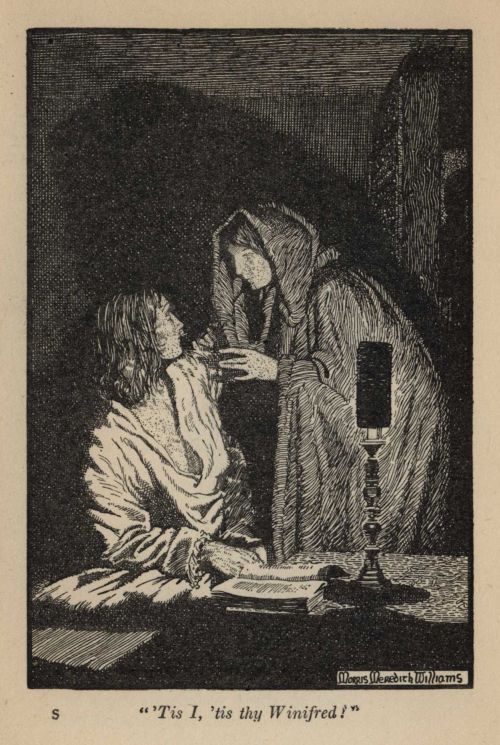
"'Tis I, 'tis thy Winifred!"
Then she puts woman's garb upon him, and together they pass the unsuspecting guards and weary sentinels.
* * * * *
When the peasantry on the Nithsdale estates heard of their Lord's escape their joy was unbounded.
One of the songs published and sung everywhere at the time, begins:—
"What news to me, carlin'?
What news to me?"
"What news!" quo' the carlin',
The best that God can gie."
The speaker asks if the true king has come to his own, and the carlin' answers.
"Our ain Lord Nithsdale
Will soon be 'mang us here.
Then the speaker says:—
"Brush me my coat, carlin',
Brush me my shoon;
I'll awa and meet Lord Nithsdale,
When he comes to our town."
"Alack-a-day," says the carlin'. "He has escaped to France, with scarce a penny."
"Then," says the first speaker, "we'll sell our corn and everything we have and send the money to our lord, and we'll make the pipers blow and lads and maidens dance, and we'll all be glad and joyful and play 'The Stuarts back again,' and make the Whigs go mad."
* * * * *
Lord Derwentwater's fate was not so happy as that of Lord Nithsdale, though Lady Derwentwater made a desperate effort to save him.
It was she indeed who had urged him to throw in his lot with the Stuarts, saying that it was not good that he should hide his head when other gentlemen were mustering for the cause.
The peasantry still think that Lady Derwentwater sits on her ruined tower lamenting the evil counsel she gave her husband, and they hasten by in fear when they see her lamp-light flickering.
Derwentwater is described in the old ballads, as "a bonny lord," with hair of gold, and kind love dwelling in his hawk-like eyes.
He passionately loved his beautiful home in Tynedale, the foundations of which may still be seen. The wooded glen below the castle, with the little burn running through it, spanned by a grey bridge is romantically beautiful.
His "Farewell" to all this beauty is pathetic.
"Farewell to pleasant Ditson Hall,
My father's ancient seat;
A stranger now must call thee his,
Which gars[#] my heart to greet.[#]
Farewell each kindly well-known face,
My heart has held so dear:
My tenants now must leave their lands,
Or hold their lives in fear.
[#] makes. [#] weep.
No more along the banks of Tyne,
I'll rove in autumn grey;
No more I'll hear, at early dawn,
The lav'rocks[#] wake the day:
Then fare thee well, brave Witherington,
And Forster ever true.
Dear Shaftsbury and Errington,
Receive my last adieu.
[#] larks.
And fare thee well, George Collingwood,
Since fate has put us down,
If thou and I have lost our lives,
Our King has lost his crown.
Farewell, farewell, my lady dear,
Ill, ill thou counsell'dst me:
I never more may see thy babe
That smiles upon thy knee.
And fare thee well, my bonny grey steed,
That carried me aye so free;
I wish I had been asleep in my bed,
The last time I mounted thee.
The warning bell now bids me cease;
My troubles nearly o'er;
Yon sun that rises from the sea,
Shall rise on me no more.
Albeit that here in London town
It is my fate to die,
O carry me to Northumberland,
In my father's grave to lie:
There chant my solemn requiem
In Hexham's holy towers,
And let six maids of fair Tynedale
Scatter my grave with flowers.
And when the head that wears the crown,
Shall be laid low like mine,
Some honest hearts may then lament
For Radcliff's fallen line.
Farewell to pleasant Ditson Hall,
My father's ancient seat;
A stranger now must call thee his,
Which gars my heart to greet."
Before his death, Earl Derwentwater signed a paper acknowledging "King James the Third" as his sovereign, and saying that he hoped his death would contribute to the service of his King.
He is said to have looked closely at the block, and to have asked the executioner to chip off a rough place that might hurt his neck. Then, pulling off his coat and waistcoat, he tried if the block would fit his head, and told the executioner that when he had repeated "Lord Jesus receive my soul" for the third time, he was to do his office, which the executioner accordingly did at one blow.
History tells that Derwentwater was brave and open-hearted and generous, and that his fate drew tears from the spectators, and was a great misfortune to his country. He was kind to the people on his estates, to the poor, the widow and the orphan.
His request to be buried with his ancestors was refused, and he was interred at St Giles, Holborn, but his corpse was afterwards removed and carried secretly to Northumberland, where it was deposited in Dilston Chapel. The aurora borealis, which appeared remarkably vivid on the night of his execution, was long called in that part of the country "Lord Derwentwater's Lights."
Immediately after Derwentwater's execution, Lord Kenmure also suffered death. After his execution, a letter was found in his pocket addressed to the Pretender, by the title of King James, saying that he died in his faithful service, and asking him to provide for his wife and children.
The following ballad describes his rising in the Stuart cause—
"O Kenmure's on and awa', Willie,
O Kenmure's on and awa';
And Kenmure's lord's the bravest lord
That ever Galloway saw.
Success to Kenmure's band, Willie!
Success to Kenmure's band!
There's no a heart that fears a Whig,
That rides by Kenmure's hand.
His lady's cheek was red, Willie,
His lady's cheek was red,
When she saw his steely jupes[#] put on,
Which smell'd o' deadly feud.
Here's Kenmure's health in wine, Willie,
Here's Kenmure's health in wine;
There ne'er was a coward o' Kenmure's blude,
Nor yet o' Gordon's line.
[#] armour.
There's a rose in Kenmure's cap, Willie,
There's a rose in Kenmure's cap,
He'll steep it red in ruddie heart's blade,
Afore the battle drap.
Here's him that's far awa', Willie,
Here's him that's far awa',
And here's the flower that I lo'e best,
The rose that's like the snaw.
O Kenmure's lads are men, Willie,
O Kenmure's lads are men,
Their hearts and swords are metal true,
And that their foes shall ken.
They'll live, or die wi' fame, Willie,
They'll live, or die wi' fame,
And soon wi' sound o' victorie
May Kenmure's lord come hame."
Chapter XLVIII
The Nine Nicks o' Thirlwall
If you stand upon Rose Hill, which rises from the banks of the river Irthing just where Northumberland meets Cumberland, you have lying around you one of the finest wild prospects in the United Kingdom. Hills to the north, stretching away into Scotland; hills to the east, broken into picturesque valleys, especially the great gap through which rushes the young Tyne; hills to the south, dominated by the powerful head of Cross Fell, a great sprawling mountain, not a peaked one, the highest stretch of which is nearly three thousand feet above sea level.
But while drinking in the glories of the distances, the eye will note with curiosity a strange-looking but picturesque hill only a couple of miles to the South-east, with a long rocky ridge at its top deeply cut into or "nicked" in nine different places, this giving it a very wild appearance. It is one of these hills which tempts the keen observer to go on and explore it. If we cut direct to it, over the fields, it is rough going, but the view is good all the way. And there are four special objects of interest, all close together; the rushing Tipalt river, Thirlwall Castle, the Roman wall, and the Nine Nicks.
Thirlwall Castle rises tall, square, and stern, with a dark fir-wood behind it at the foot of the hill, where a bend in the river makes a natural moat. Approaching it from Rose Hill, it looks as if the building were still nearly complete, but the south side has almost entirely fallen away and all the floors and the roof are out. Edward I. slept in this Castle when it was newly built, in 1306; but now it is grass-grown and moss-grown, and its three bare walls rise gaunt and grim to the sky. It is entirely built out of stones with Roman chisel marks, taken from the great Roman wall, which unfortunately was once regarded as a handy stone-quarry for anyone to take from.
The name "Thirlwall" means "Drill-wall," and marks the spot as that at which the wild Northern tribes first "drilled" or broke through the wall. The name was, of course, given to the place long before this castle was built.
To mount from Thirlwall Castle to the top of the Nine Nicks is an easy enough task for any vigorous person. It is just a fine healthy scramble. When at the top, it becomes evident that some sort of fortification once existed there. In point of fact this was the important Roman station called "Magna" which stood at about the middle of the Roman Wall. The wall ran from sea to sea, that is to say, from the mouth of the Tyne to the Solway. Thus it was nearly eighty miles long, and a very elaborate structure indeed.
It consisted of three distinct portions:—
1. The main stone wall, with a ditch to the north of it.
2. An earth-work to the south of this, consisting of either two or three ramparts about seventy feet apart, with a ditch between.
8. Stations, Castles and Watch-towers. Sometimes these were to the north of the wall, sometimes in the middle, sometimes south, according to the nature of the country.
The height of the main wall was from sixteen to twenty feet, including battlements. It was six to nine feet thick. Fancy a powerful military wall of about eighteen feet high stretching nearly eighty miles right across England! It hardly seems possible that the Romans could undertake such a work. The square strong stones were carefully selected and often brought from quarries at a distance. These stones flanked the outsides of the wall, and in between was strong concrete which was poured in while in liquid.
The second wall was of earth and stones, and, of course, lower than the first. Then there was a castle every mile, some of which can still be clearly traced, and a "station," about every four miles, of which several interesting ruins remain. There was a road eighteen feet wide between the two walls.
Those who have the energy to toil on for a full dozen miles of rough walking, along the wall, eastward from Thirlwall, will be rewarded by some of the most romantic scenes in Britain. They will see the wall at its best. They will pass Whinshields, the highest point in the wall, 1230 feet above sea level. The wild Northumbrian lakes will lie at their feet; if the day is fine, the Solway will be seen glistening, thirty miles to the west; and on the east the eye follows the Tyne almost to the sea. The Pennine Ridge bars the view twenty miles to the south, while on the North the High Cheviot is clear and strong, thirty miles away.
Passing Whinshields, it is not far to Borcovicus (often called Housteads) where lie the remains of a large Roman Station, wonderful remains, showing the whole outline with startling clearness. This station covered five acres, and here was quartered a cohort of the Tungrian infantry, consisting of a thousand brave soldiers, servants of Imperial Rome.
But, after all, nothing is so impressive as the remains of the wall itself. Stand at the top either of Whinshields or of the Nine Nicks, and try to imagine what it looked like in Roman days. Eastward along the Tyne valley and westward along the Irthing valley ran this wonderful work, this powerful girdle of stone. The very spot was chosen with great judgment, for these valleys gave the Romans a district protected by the bleak hills, where they could live and where they could keep cattle and grow grain. But the hilly nature of the ground must have added to the difficulty of the builders. The wall had to run up steep hill sides and cling to the edge of cliffs, and precipices; it had to be carried by bridges over roaring torrents, and when it reached low-lying ground it had to avoid the treacherous swamps and morasses. And yet, despite every obstacle, the great wall ran on its direct way, as strong and persistent as the great people who built it.
It withstood the shock of war, it was not flung down by soldiers marching against it. But to the people who wanted to build castles or houses or farms, or even to mend roads, the wall offered a mass of material ready to hand, and it suffered not from man's energy so much as from his laziness. Century after century it was robbed of its stones; to-day a series of long grass-grown mounds, a few feet high, running across the meadows, are nearly all that remain of one of the most wonderful pieces of building that was ever erected in Great Britain. Even today, in its decay, it is one of the most romantic features of a highly romantic district.
Chapter XLIX
In Wild Northumberland To-day
These tales of the Borders would hardly be complete without a few concluding words about the great romantic charm which still invests the Borderline. Let us, for example, make a brief survey of some of the haunting spots in wild Northumberland. We will pass over such towns as Warkworth, Alnwick, Alnmouth; beautiful as they are, they have moved with the times and are too modern to be more than mentioned here. But in a place like Holy Island we feel the call of the old days, and the charm that was theirs. This Island was the scene of the first efforts of Christianity to curb the wild and warlike Northumbrians; St Aidan, and St Cuthbert, both men of remarkable genius and great influence, taught there lessons of peace and justice without which every warlike state would descend into mere savagery. The island is about two miles square, and at low tide it is easy to walk across the sands to or from the mainland of Northumberland. The distance is two and a half miles, and it is necessary to take off shoes and stockings, for the water on the sands will often be six inches deep. A row of posts marks the way, and some of them have ladders, reaching up to a barrel on the top, so that any caught by the tide can find a safe harbour wherein they will suffer nothing more serious than a long wait! The island is inhabited by fishing folk, living simple healthy lives. There are fine rocks and splendid sands; beautiful flowers and lovely shells. The seabirds are wonderful. The ruins of the old Cathedral and castle are very interesting, it is a delightful old-world place, out of the rush and hurry of modern life.
Retracing our steps to the mainland, and proceeding westward for a dozen or so miles as the crow flies, we reach the River Till, and the field of Flodden. Here we are near to the big wild wall of the Cheviot hills, and to keep on the English side of the border we need to turn due south. It is then about thirty miles of rough walking through these grandly rugged hills before we come to the field of Otterburn.
But we realise in that walk how it was that the district produced and still produces a hardy race of hunters and sheep-farmers, and why it is that the towns and farms nestle in the valleys, so that the Borderers, when they meant to say, "Rouse the neighbourhood," used the phrase, "Raise the water" (meaning, of course, the houses along the waterside). Further south, still going among splendid shaggy hills, we reach the North Tyne River, and soon afterwards some highly interesting Roman remains, including the arches of a fine bridge over the river at the Roman Station of Cilurnum, near Chollerford. This is on the Roman Wall, which has already been described under the heading of Thirlwall. A few miles to the west would bring us to the picturesque but little-known Northumberland Lakes, where the wild swans nest. If we continue south and south-west we can follow the beautiful valleys of the Allan or the South Tyne. This is a district of hills, roads, and castles; the domain of the fated Lord Derwentwater was near here. For beauty the whole of this neighbourhood would be hard to beat; yet it is too little known.
If we still go south, the scenery grows wilder and wilder as we approach the huge mountain of Cross Fell. We may cross into south-east Cumberland and visit the quaint old town of Alston, one of the highest towns in England. Here were once the royal silver mines, when English coins were made from Alston silver. Lead is chiefly mined there now, and the mines are worth a visit. Near Cross Fell also is a rough road called the "Maiden Way," and an old legend says it was made by women, who carried the stones in their aprons! The western slope of the Fell is famous for a specially violent wind called the "Helm wind," which rages there at certain seasons. It is just as if it were rushing fiercely down the hill, with a roaring noise and strength enough to overturn a horse and cart, and to beat the grass and grain till it is black! But though it does a deal of damage it is very exhilarating, making people feel merry in spite of themselves. And on Cross Fell slopes can be seen the beautiful River Tees, which can be followed to its grand waterfalls of the the Cauldron and the High Force. In the first the water dashes on to huge rocks, and is thrown back on itself, roaring, foaming, and fighting; in the second, it tumbles sheer down a dark and noble cliff. And everywhere on the heights there are splendid views.
In making any such excursions as the ones here outlined, into the out-of-the-way parts of Northumberland and the Borders, we find an added pleasure in the character of the people. The Borderers are still a grand race; big men, vigorous, honest, courteous, hospitable, free from all that is mean and small. In some districts you can hear "thou" and "thee" still used, and meet old men who have never seen a railway. One dear old farmer, a real picture of a simple honest man, hearing I had come from London, asked me if the London men had got their hay-crop in yet! One typical Northumbrian, of great natural intelligence, bearing a name famous on the Borders, is station-master at a local station that stands in a wood, and between trains, studies bird and wild-flower till he has made himself a most interesting naturalist. A stranger who has lost his way will find these courteous folk ready to walk a mile or two with him, out of their own way, just to set him right; and he who is tired and hungry will be invited to step in and eat, and perhaps find himself introduced to all the family and treated like an honoured guest; then, not a penny of payment taken, they will set him on his way with a bunch of the best flowers from the garden! For hearts on the Border are very human and warm. So that in due time he who knows the Borderers will delight to hear the unmistakeable Northumbrian or the pronounced Border accent. And he will say to himself: Splendid is the Border scenery, and stirring are the Border ballads, but best of all are the Border men.
* * * * * * * *
TOLD THROUGH THE AGES
Legends of Greece and Rome Favourite Greek Myths Stories of Robin Hood and his Merry Outlaws Stories of King Arthur and his Knights Stories from Herodotus Stories from Wagner Britain Long Ago Stories from Scottish History Stories from Greek Tragedy Stories from Dickens Stories from the Earthly Paradise Stories from the Æneid The Book of Rustem Stories from Chaucer Stories from the Old Testament Stories from the Odyssey Stories from the Iliad Told by the Northmen Stories from Don Quixote The Story of Roland Stories from Thucydides The Story of Hereward Stories from the Faerie Queene Cuchulain: The Hound of Ulster Stories from Xenophon Old Greek Nature Stories Stories from Shakespeare Stories from Dante Famous Voyages of the Great Discoverers The Story of Napoleon Stories of Pendennis and the Charterhouse Sir Guy of Warwick Heroes of the Middle Ages The Story of the Crusades The Story of Nelson Stories from George Eliot Froissart's Chronicles Shakespeare's Stories of the English Kings Heroes of Modern Europe The Story of King Robert the Bruce Stories of the Scottish Border The Story of the French Revolution The Story of Lord Kitchener Stories of the Saints The Story of St Elizabeth of Hungary In Feudal Times The High Deeds of Finn Early English Travel and Discovery Legends of Ancient Egypt The Story of the Renaissance Boyhood Stories of Famous Men Stories from French History Stories from English History Famous English Books and their Stories Women of the Classics In the Days of the Guilds Science through the Ages
Other volumes in active preparation