Front matter (continued 3)
Reading edition
"Go warn me Perthshire and Angus," cried the King, "go warn Fife up and down and the three Lothians, and harness my own horse, for I will myself to Ettrick Forest."
When the Outlaw heard that the King was coming to his country to conquer him and his lands:
"I make a vow," said he. "I make a vow, and that truly, that the King's coming shall be a dear one."
Then he called messengers and sent them in haste hither and thither.
"One of you go to Halliday, Laird of Corehead, my sister's son. Tell him to come quickly to my aid, for that the King comes to Ettrick Forest, and we shall all be landless."
"What news? What news, man, from thy master?" said Halliday.
"No news thou carest to hear; I come seeking your aid; the King is his mortal enemy."
"By my troth, I am sorry for that; if Murray lose fair Ettrick Forest, the King will take Moffatdale from me. I'll meet him with five hundred men, and more if need be, and before he gets to Ettrick Forest, we will all die on Newark Lee."
Another messenger went from the Outlaw to Andrew Murray of Cockpool, his dear cousin, to desire him to come and help him with all the power he could get together.
"It is hard," said Andrew Murray, "very hard to go against a crowned King and put my lands in jeopardy; but if I come not by day I shall be there at night."
A messenger went also to Sir James Murray of Traquair.
"What news? What news, man, from your master to me?" said James Murray.
"What need I tell? Well ye know that the King is his mortal enemy and that he is coming to Ettrick Forest to make ye all landless men."
"By my troth," said James Murray, "with yonder Outlaw will I live and die; the King has long ago given away my lands, so matters can be no worse for me."
So the King came on with five thousand men through Caddon Ford. They saw the dark forest before them and thought it awesome to look upon, and Lord Hamilton begged that the King should take counsel of his nobles and should desire the Outlaw to meet him at Permanscore with four of his company and that the King should go there also accompanied by five Earls. "If he refuse to do that, we'll conquer both him and his lands; there shall never a Murray after him hold lands free in Ettrick Forest."
The Laird of Buckscleuth, a man stalwart and stern, thought it beneath the state and dignity of a King to go and meet an Outlaw. "The man that lives in yonder forest, lives by robbery and felony! wherefore, ride on, my liege; we will follow thee with fire and sword; or if your courtier lords fall back, our Borderers will make the onset."
But the King spoke forth, casting a wily glance around. "Thou mayest hold thy tongue, Sir Walter Scott, nor speak more of robbery and felony, for if every honest man had his own cattle thy clan would be a poor one."
The King then called to him a gentleman, a royal banner-bearer, James Hoppringle of Torsonse by name, who came and knelt before him. "Welcome, James Pringle of Torsonse, ye must take a message for me; go to yonder Outlaw Murray, where he bideth so boldly; bid him meet me at Permanscore with four of his company, I myself will come to him with five Earls. If he refuse, bid him look for no favour from me. There shall never a Murray after him have free land in Ettrick Forest."
So James Pringle came before the Outlaw. "Welcome James Pringle of Torsonse! What message bringst thou from the King to me?"
"He bids ye meet him at Permanscore, with four of your company, and he will go there himself with no more than five Earls. If you refuse, he will cast down your bonny castle, make a widow of your gay lady, and loose on you the bloodhound Borderers to harry you with fire and sword. Never shall a Murray after you hold free land in Ettrick Forest."
"It goes hard with me," said the Outlaw; "judge if it go not very hard. I mind not the losing of myself, but when I think of my offspring after me, my merry men's lives, my widow's tears, that is the pang that pinches me. Yonder castle will be right dreary when I am laid in bloody earth. Auld Halliday, young Halliday, ye two shall go with me, with Andrew and James Murray."
When they came before the King they fell on their knees. "Mercy, mercy, noble King, for His sake who died on the Cross."
"Such mercy shall ye have; ye shall be hanged on the gallows."
"May God forbid, and may your mercy be better than that, else, when ye come to the port of Edinburgh, ye shall be thinly guarded. These lands of fair Ettrick Forest I won from the Southrons, and as I won them so will I keep them, against all the Kings in Christendom."
The nobles round the King thought it a pity that he should die.
"Grant me mercy, sovereign prince, and extend me favour. If thou wilt make me Sheriff of Ettrick Forest, and my offspring after me, I will give thee the keys of my castle, and the blessing of my gay lady."
"If thou wilt give me thy castle keys and the blessing of thy gay lady, I'll make thee Sheriff of Ettrick Forest as long as the trees grow upward, and never shalt thou forfeit it, if thou be not a traitor to the King."
"But Prince, what shall become of my men? When I go back they will call me traitor. I had rather lose both life and land than be rebuked by my merry-men."
"I will pardon them all if they amend their lives. Name thy lands where they lie, and I will render them back to thee."
"Philiphaugh and Lewinhope are mine by right, Newark, Foulshiells and Tinnies I won by my bow and arrow. I have farms at Newark Lee and Hangingshaw which are mine by birth, and I have many farms in the Forest whose names I do not know." Thereupon he gave the King the key of his castle, with the blessing of his fair lady, and the King made him Sheriff of Ettrick Forest for as long as the trees should grow upward, never to be forfeited while he and his descendants remained faithful to the King. Much of this land belongs to Murray's heirs, even to this day.
"Wha ever heard in, in ony times,
Sicken an outlaw in his degré,
Sic favour got befor a King,
As did the Outlaw Murray of the Foreste free?"
Chapter XXIII
Johnie Armstrong
"When Johnie came before the King,
With all his men so brave to see,
The King he moved his bonnet to him;
He knew he was a King as well as he."
In 1529 James V. visited the Border country to execute justice on the wild freebooters. Of these the chief was Johnie Armstrong of Gilnockie, who levied blackmail for many miles round his residence at the Hollows, and spread the terror of his name as far as Newcastle. Acting on the evil counsel of false friends, Johnie presented himself before the King in all the pomp of Border chivalry.
According to the old ballad the King wrote with his own hand a loving letter to Johnie Armstrong, Laird of Gilnockie, bidding him come and speak with him speedily. Whereupon the Elliots and Armstrongs convened a meeting, to which they came in gallant company, and decided to ride out to meet the King and bring him to Gilnockie.
"Make ready rabbits and capon and venison in plenty," said Johnie, "and we'll welcome home our royal King to dine at Gilnockie."
So they ran out their horses on Langholm Down, and broke their spears, and the ladies, looking from their high windows, cried "God send our men safe home again."
When Johnie came before the King with all his brave fellows, the King took off his bonnet to him as to an equal.
"My name is Johnie Armstrong," said the freebooter, "your subject, my liege; let me find grace for my loyal men and me."
But the King cried, "Away with thee, thou traitor, out of my sight! Never have I granted a traitor's life, nor will I now begin with thee!"
"Grant me my life, my King, and I will give thee a bonnie gift—four-and-twenty milk-white steeds, newly foaled—I'll give thee four-and-twenty milk-white steeds that prance and neigh at a spear, and as much English gold as four of their broad backs are able to bear."
"Away with thee, thou traitor, out of my sight! Never have I granted a traitor's life, nor will I now begin with thee!"
"Grant me my life, my King, and I will give thee a bonnie gift—four-and-twenty mills that are working all the year round for me—four-and-twenty mills that shall go for thee all the year round, and as much good red wheat as all their happers are able to bear."
"Away with thee, thou traitor, out of my sight! Never have I granted a traitor's life, nor will I now begin with thee!"
"Grant me my life, my King, and I will give thee a great gift—four-and-twenty sisters' sons shall fight for thee though all should flee."
"Away with thee, thou traitor, out of my sight! Never have I granted a traitor's life, nor will I now begin with thee!"
"Grant me my life, my King, and I will give thee a brave gift. All between here and Newcastle town shall pay thee yearly rent."
"Away with thee, thou traitor, out of my sight! Never have I granted a traitor's life, nor will I now begin with thee!"
"Ye lie, calling me traitor; ye lie now, King, although ye be King and Prince. Well dare I say it, that all my life I have loved naught but honesty, a fleet horse, a fair woman, and two bonny dogs to kill a deer; yet had I lived for another hundred years, England should have still found me meal and malt and plenty of beef and mutton. Never would a Scot's wife have been able to say that I robbed her of aught. But surely it is great folly to seek for hot water beneath cold ice. I have asked grace of a graceless King, but there is none for me and my men. But had I known before I came how unkind thou wouldst prove to me, I would have kept the Borderside in spite of thee and thy nobles. How glad would be England's King if he but knew that I was taken, for once I slew his sister's son and broke a tree over his breastbone."
Now Johnie had a girdle round his waist embroidered and spangled with burning gold, very beautiful to look upon, and from his hat hung down nine tassels, each worth three hundred pounds. "What wants that knave that a King should have, but the sword of honour and the crown?" cried the King.
"Where did ye get those tassels, Johnie, that shine so bravely above your brow?"
"I got them fighting in the field where thou darest not be," replied Johnie. "And had I now my horse and good harness, and were I riding as I am used to do, this meeting between us should have been told these hundred years. God be with thee, my brother Christy, long shalt thou live Laird of Mangertown on the Border-side ere thou see thy brother ride by again. God be with thee, my son Christy, where thou sitst on thy nurse's knee; thou'lt ne'er be a better man than thy father, though thou live a hundred years. Farewell, bonnie Hall of Gilnockie, standing strong on Eskside; if I had lived but seven more years, I would have gilded thee round about."
Then Johnie Armstrong was slain by the King's orders at Carlinrigg with all his gallant company, and Scotland's heart was sad to see the death of so many brave men, who had saved their country from the Englishmen. None were so brave as they, and while Johnie lived on the Border-side no Englishman durst come near his stronghold.
Chapter XXIV
The Lament of the Border Widow
How King James V. of Scotland, in 1529, set forth to strike terror into the Border freebooters, has been already told in the account of Johnie Armstrong. A less celebrated moss-trooper, Cockburne of Henderland, was hanged by the pitiless King over the gate of his own tower. The wife of Cockburne loved him most dearly, and when she found the King would show no mercy, fled away to the rocks behind the castle whilst the cruel sentence was carried out. She sat by a roaring torrent of the Henderland burn, the noise of which in her ears drowned the savage shouts of the King's soldiers. The beautiful song which describes the grief of this loving woman is one of the gems of ancient poetry, and is here printed entire.
THE LAMENT OF THE BORDER WIDOW
My love he built me a bonny bower,
And clad it a' wi' lilye flower,
A brawer bower ye ne'er did see,
Than my true love he built for me.
There came a man by middle day,
He spied his sport, and went away;
And brought the King that very night,
Who brake my bower, and slew my knight.
He slew my knight to me sae dear;
He slew my knight, and took his gear;
My servants all for life did flee,
And left me in extremitie.
I sew'd his sheet, making my moan;
I watch'd the corpse, myself alone;
I watch'd his body, night and day;
No living creature came that way.
I took his body on my back,
And whiles I gaed, and whiles I sat;
I digg'd a grave, and laid him in,
And happ'd him with the sod sae green.
But think na ye my heart was sair,
When I laid the moul' on his yellow hair;
O think na ye my heart was wae,
When I turn'd about, away to gae?
Nae living man I'll love again,
Since that my lovely knight was slain,
Wi' ae lock of his yellow hair,
I'll chain my heart for evermair.
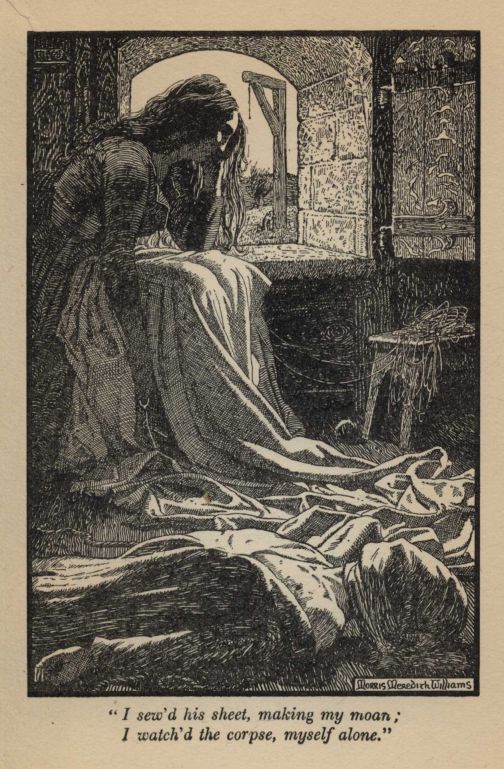
"I sew'd his sheet, making my moan; I watch'd the corpse, myself alone."
Chapter XXV
The Raid of the Kers
The spirited ballad that describes this raid is quite modern, since it was written by Hogg, "the Ettrick Shepherd," in 1830. But the rash raid it describes took place in 1549. The Kers were an important Border family, the leaders of whom afterwards became Earls of Roxburgh. Sir Andrew Ker was warden of the Border at the time of the raid, but he proved that it took place without his consent. The Kers were all left-handed men, and puzzled their enemies by their left-handed swordsmanship. Even to-day in some parts of the borders a left-handed man is called "Ker-handed."
On a fine September evening Tam Ker rode out, with fifty in his company. They were armed for a fight and their swords were keen; they rode by the Maiden Crags and down the Osway burn, going carefully till the daylight closed, for they were soon in Northumberland. Their bold plan was to get down the valley of the Coquet even as far as Rothbury where Withrington, the English warden, kept a magnificent herd of cattle. They had one castle to pass, that of Biddleston, which had been held by the Selby family since the reign of Henry III., and still belongs to them to this day. Biddleston Castle guarded the Allanton or Alwinton ford, where the Alwin stream enters the Coquet. So they sent the reckless Mark Ker first, to scout along by the ford, and told him to set up marks on the cairns to show his progress. Having nothing else to mark with, he tore the shirt off his back, and left strips of it on the cairns. At the ford a sentry challenged him, and he answered that he had a message for Withrington. The sentry demanded his sealed warrant, and the Scot drew his sword. They fought bravely and long before the Englishman was killed, and the Scot marvelled that a common soldier should so withstand him, for he was the best swordsman of his race. On he galloped, on and on, till he met a comely maiden, and addressing her he tried to imitate the Northumberland speech, saying that he had lost his way. She told him at once that she knew he was a Scot, but so also was she. She had been taken captive, but word had came by an English spy that the Kers were out upon a raid, and while the English had set a hundred soldiers to guard their cattle she had slipped away to warn the Scots and to return with them. Being a gallant after the manner of that day, he sprang from his horse, kissed her, and invited her to mount his saddle even if he had to run beside till he could capture another steed. But an English soldier came up and warned him roughly off the road. Mark Ker had been brought up to answer rough words with rougher blows; out leapt his sword, and he cut the rude words short by slashing the man's head off. Then he disguised the maid in the dead man's clothes, and they retraced their steps that he might warn his companions. They very soon came upon them, and all together hid in the lowest dell of the Larbottle burn while they made their plans. Tam Ker, with twenty of the men, was to draw off the English, while Mark with thirty others slipped round and drove off the cattle unperceived. This was done, and till after midnight, Tam, aided by the darkness and by the difficulties of the wild locality, held the English at bay.
Then he heard the bugle signal, and knew that Mark was well on the road with the beasts, and that he must follow quickly. But Withrington also guessed what the signal meant, and pursued with all the speed he knew. Mark had not long crossed the ford at Biddleston before the English were on him. First Mark and Withrington fought in single combat, hand to hand, all their men watching eagerly; it was still very dark, but the clash of sword against sword lit the air with sparks. Withrington was badly wounded, but Mark was killed. With desperate shouts the Scots fell upon the English; then up came Tam and his men from behind to help the Scots, but the Captain of Biddleston had also been awakened, and galloped down with his men to aid the English. Tam smote his head off with his sword, but the horse galloped on with his headless body right into the ranks of the Scots. They thought it must be a demon and began to scatter in full flight to the Border. Tam was slain, trying to follow them, and his men, seeing that they had work enough to gallop for their lives, slew the cattle they could no longer hope to steal. On and on the hard-pressed remnant spurred their weary horses. It was daylight now, and the English along the road shot arrows at them as they galloped past. Out of fifty-one hardy, healthy Kers who had started forth in the raid, only seventeen, weary and wounded, saw their homes again.
And back in the south country, the comely Scottish maiden lay dead across the breast of the gallant Mark, their hearts' blood mingling in a common stream. Small wonder that a Scot should make a ballad of the story and that Borderers should sing it even to this day.
Chapter XXVI
Merrie Carlisle
The city of Carlisle stands in the midst of a beautiful and fertile district with pleasant but not too steep hills around. In the old days an easy water-supply was a first essential, and at Carlisle three rivers meet, the Caldew and the Petterill running here into the broad stream of the Eden. These three rivers almost enclose the ground upon which the city is built, so that it is most probable that there was an ancient British settlement upon so advantageous a site, before the Roman invasion. Our earliest record, however, goes back no further than Roman days, and it is certain there was then a Roman city here called Luguvallium (the trench of the legion). Even to-day, when new gas-pipes are being laid in the ground, it is by no means rare to dig up Roman relics. The long Roman name became gradually corrupted into "Luel," or "Liel," and the Britons added their word "Caer," which means a city, hence "Caer-luel"—an earlier form of the modern Carlisle. The Roman city stood, as might be expected, by the great Roman wall, guarding the spot where the wall crossed the river Eden. And visitors may see to-day that the centre of Carlisle consists of a market-place with two main streets leading therefrom, the usual plan in cities of Roman origin.
Carlisle was destined to have a stormy history. Draw a line from the Solway eastward, straight through Carlisle, and it will be seen that here the mainland of Britain is about at its narrowest, hardly so much as seventy miles wide, as the crow flies. Note, too, that the wild hills of the Pennines and the Cheviots fill in most of this narrow district, and that the mainland of Scotland strikes sharply off to the west. It is plain from these facts that Carlisle commands the main road between Scotland and England, and they provide the reason why at the present day seven different railways, most of them important ones, run their trains into Carlisle station. The very same reason was responsible for the fact that in the good old times no English town was more often burnt down by enemies than "Merrie Carlisle."
Even in Roman days, during the reign of Nero, Carlisle was burnt down at least once by the wild Picts, who were brave enough to venture against the well-armed troops of Rome. After the Romans left Britain this town was one of the strongholds of King Arthur; to be sure, nothing very definite is known about this romantic king, but the old ballads tell us that he was victorious over Gauls, Dacians, Spaniards, and Romans. This sounds very unlikely to those who do not realise that when Rome called home her best men for her own defence she may have left behind many rough soldiers, of various nations, to guard the wall. Although we know nothing about King Arthur save what is vague and legendary, we do know that the Roman legions were recruited from all the provinces of the empire. Cumberland had many connexions with King Arthur; within twenty miles of Carlisle, near Penrith, is a big round hill called "King Arthur's Table"; while nearer still, on the Penrith and Carlisle road, is shown the spot where stood Tearne-Wadling Lake and Castle, where King Arthur was bewitched and taken prisoner by the "foul, discourteous knight," only to be released provided one of his men would consent to marry the hideous lady with hair like serpents! When at last Sir Gawaine married this hag for his King's sake, she, of course, changed at once into a beautiful young woman! This does not sound very convincing, it is true, but in the old days many tales just as unlikely were told of famous men. At any rate the ballad begins with the lilting line:—
"King Arthur lives in merrie Carleile,"
and all that concerns us at the moment is that perhaps he really did live there, and did do some very real fighting along the debateable line of the wall.
We next learn of Carlisle that King Egfrid of Northumbria rebuilt the city about the year 675, wherefore we can only suppose that it had suffered its somewhat usual fate, perhaps at the hands of that savage Saxon warrior called The Burner. But in any case, Carlisle never belonged to the Northumbrians for any considerable space of time, but was the capital of the Celtic or Welsh kingdom of Cumbria, from which the present name of Cumberland is derived.
In 875 the Danes had a turn at pillaging and harrying Carlisle, which was again in sorry plight. Both Cumbria and Northumbria were faring very badly in the struggle between the various kingdoms which then divided up Britain, and for a while it looked as if the energetic kings of the Scots would annex both these northern dominions. But the coming of the strong-handed Normans altered all this; and by far the most noteworthy event in the history of Carlisle was the fact that during 1092 and 1093 William Rufus seized Cumberland, and for the first time added it definitely to England.
Recognising at once the strength and value of Carlisle, Rufus caused a strong Norman castle to be built where the old Roman fort used to stand. To-day, despite the many rough adventures which have befallen this northern city, there yet remain portions of William Rufus's castle, side by side with fragments of the old Roman walls. Many of the modern buildings put up in King George's day are crumbling, but the old Norman and Roman remains are firm as a rock!
The castle was strengthened by King Henry I., but this did not prevent its seizure in 1135 by King David of Scotland, who added to it in turn. The Scots held the keep till 1157, when it was retaken by Henry II., but a few years later, in 1173, William the Lion, King of Scotland, besieged it, and for the next fifty years it changed hands several times, according to the fortunes of war. It is significant that a main street in the northern part of Carlisle is called "Scotch Street," while another in the southern part is called "English Street!"
Edward I. held a parliament here after defeating Wallace at Falkirk; and it was from Carlisle that this English King conducted his later operations against Scotland. It is a pathetic picture, that of this stern warrior in his old age, on his last march, trying to carry out his pet scheme of uniting the entire island under one rule. He was so ill that he had to be carried in a litter as far as Carlisle. Finding himself again so near the border, he felt the old fire glow within him, and sprang upon his horse—but at Burgh-on-Sands, on the shore of the Solway, whence he could view the goal of his ambition, the brave King died.
During the next thirty years Carlisle was frequently attacked by the Scots, but they were usually defeated. In 1337, however, they partly, and in 1345 almost entirely burnt it down. Again in 1380 they burnt part of what had been rebuilt! Had there been fire insurance in these wild days, the premiums in Carlisle would have been heavy!
After the Wars of the Roses, the city seemed to settle down somewhat, and was chiefly known on the Border as the place where Scottish freebooters were hanged if caught. In one of the Border villages there is a famous churchyard where of old only the graves of women and children were to be seen. The explanation was given to a passing traveller by an old woman, who said that the men were all buried "in merrie Carlisle," meaning, that is, that they had all been hanged there!
In 1537 there was a rising in England known as the "Pilgrimage of Grace," in opposition to the savage policy of Henry's minister, Thomas Cromwell, and no less than eighty thousand insurgents are said to have attacked Carlisle; but after much fighting the rebels were defeated and seventy-four of their leaders were executed on the city walls.
When Mary Queen of Scots was imprisoned in Carlisle in 1568 it was vainly besieged by a force that sought to rescue her; but less than thirty years afterwards, in 1596, by a bold stroke of daring, Lord Scott of Buccleuch succeeded in surprising the castle and in liberating the well-known freebooter, "Kinmont Willie."
When King James united England and Scotland, the troubles of Carlisle might have been thought to be over. But in the civil war between King and Parliament it was again a storm centre, and was held alternately by each of the parties.
The last warlike operations against this much-besieged city were undertaken in 1745, when it was first taken by Prince Charlie, who made a triumphal entry without any serious fighting, and afterwards retaken almost as easily by the cruel Duke of Cumberland, whose entry into the place was followed, as usual, by a series of executions.
Among those who suffered was Sir A. Primrose, a gallant ancestor of the present Lord Rosebery. The victims were executed, with the cruelties of the old law against treason, on the celebrated Gallows Hill, at Harraby, and were buried in nameless graves in the Kirkyard of St Cuthbert's. Passing down the Botchergate (the London Road), past the site of the old Roman cemetery, the wayfarer may see Gallows Hill rise where a deep cut has been made to avoid a steep rise in the road. It was just outside the boundary of old Carlisle, and executions were witnessed from the walls, by men and women alike. Climb the hill—it is worth while. The little river Petteril sparkles at our feet; the view, fresh and green, stretches away nobly to the Pennines and the Border Hills. Keep a warm thought in your heart for all the gallant fellows who met death bravely in this place.
No history of Carlisle could omit to mention the Cathedral. English cathedrals are shaped like a cross lying on the ground; the long stem of the cross is the nave of the cathedral; the two arms are the transepts; and the upper end that continues the main stem is the choir. Where choir, nave and transepts meet, the tower rises. But unlike every other English cathedral, that of Carlisle has height and width, but is too short in length, two-thirds of the nave having been hurled down by the Scots!
Every cathedral has its history written in its stones, for those who know how to read it. That of Carlisle shows a stormy history, stormier than any other. It is not a peaceful building carried out very much in one style and undisturbed. It is a building full of signs of disturbance, the builders of which were interrupted in their plans by war and frequently had their building seriously damaged by their enemies. It is a mixture of styles, a mass of re-buildings and afterthoughts, but for that very reason it is a fitting symbol of the much-harassed city. With all its signs of storm and stress it has much beauty, and possesses the finest window in all England, one of the finest in the world. Just outside the Cathedral is a noble stretch of the old West Wall of the city, which gives a vivid idea of its strength in the old days.
The bishops of Carlisle live at Rose Castle, five miles south of the Cathedral. This has been their residence for over six hundred years. No doubt they thought it advisable not to live in the "merrie city"!
In this castle King Edward I. stayed. It was once partly burnt by Bruce, and again partly by the Puritans, but this is a comparatively clean record for such a district! In 1745 Captain Macdonald and his Scots came down to besiege it, but hearing that the bishop's baby daughter was about to be christened, the gallant captain would not let warfare spoil so peaceful a ceremony, and not only withdrew his men, but also left a white cockade behind him as a sign that the place was not to be molested. In all this he showed that true courtesy that always marks the real Highland gentleman.
Standing to-day in this bustling, breezy, pleasant little city, it is not easy to realise the wild scenes it has witnessed. The charming rivers that hem it in show no traces of the bloodshed of the past. Yet here have contended painted Pict and war-trained Roman; here the most skilful leaders of the Celts, Saxons, and Danes have led their brave and sturdy men to battle; here Norman knight has fought with hardy Scot, and fierce Border factions have wrangled and sought speedy justice; Puritan has fought Cavalier, and Jacobite has faced Hanoverian; kings, generals, and warriors of many centuries have found a fitting meeting-place before or behind the walls of Carlisle.
An open, airy, quaint city. There is not very much that is old in it, for the old was not allowed to stand long enough! But on the top of its principal hill the tall truncated Cathedral presents a picturesque figure, and if we stand there or by the castle the eye commands fine, ancient walls and very delightful distances. It is a place of lingering memories, and if these are chiefly of strife and bloodshed we do not forget that to the Border folk the city was "Merrie Carlisle."
Chapter XXVII
Kinmont Willie
"O have ye not heard of the false Sakelde,
O have ye not heard of the keen Lord Scroope,
How they have taken bold Kinmont Willie
On Haribee to hang him oop?"
The story of this famous freebooter, William Armstrong of Kinmonth, belongs to the time of Queen Elizabeth, when Lord Scroope was Warden of the Western Marches, and Mr Sakelde of Corby Castle was his Deputy.
Kinmont Willie was a descendant of the famous Johnie Armstrong of Gilnockie, and his capture was a violation of the existing truce between Scroope and Buccleuch, the Keeper of Liddesdale. Elizabeth was indignant at Buccleuch's action in rescuing Willie, and as the Scots at that time were very anxious not to offend her, Buccleuch was sent to England and came before the Queen, who asked him how he dared to undertake such an adventure. "What is it," answered he, "that a man dare not do?"
"With ten thousand such men," said Elizabeth, turning to a lord-in-waiting, "our brother of Scotland might shake the firmest throne of Europe."
The ballad tells of the capture of Kinmont Willie, and how the false Sakelde and his men treacherously seized him.
They bound his legs beneath his horse, and tied his hands behind his back, and with five men on each side to guard him, brought him over Liddel ford and through Carlisle sands to Carlisle castle.
When he arrived there, Willie addressed his captor in these words:
"My hands are tied, but my tongue is free. Who will avow this deed or answer for it to bold Buccleuch?"
"Hold thy tongue, thou rank robber! Never a Scot shall set thee free. Ye shall take farewell of me before ye cross my castle gate," said Scroope.
"Fear ye not that, my lord," answers Willie, "for by the faith of my body, never did I yet lodge in a hostelry but that I paid my reckoning before I went."
Word was sent to Branksome Hall to the Keeper of Liddesdale that Lord Scroope had captured Kinmont Willie, whereupon the Keeper smote the table with his hand till the red wine sprang on high, "A curse on my head," he cried, "if I be not avenged of Lord Scroope. Is my helmet a widow's cap, or my lance a twig from a willow-tree, or my fist a lady's lily hand, that an English lord should appraise me so lightly? Have they taken Kinmont Willie in spite of the truce, and forgotten that the bold Buccleuch is Keeper on the Scottish side? Have they taken Kinmont Willie so fearlessly, and forgotten that the bold Buccleuch can back a steed and wield a weapon? Were there but war between the lands, then would I slight Carlisle Castle though it were built of marble; I would set it on fire and drench it with English blood. But since there is peace and not war, I'll set the Kinmont free yet never harm English lad or lass!"
So Buccleuch called forty bold Marchmen, all of his own name and kin except one, Sir Gilbert Elliot, Laird of Stobs. They came spur on heel and armour on shoulder, with gloves of green and feathers of blue. Five and five came first with hunting-horns and bugles; five and five more came with Buccleuch like Warden's men arrayed for battle; five and five came like a gang of masons, carrying long high ladders; and five and five came like broken men, and so they reached Woodhouselee.
When they had crossed to the English side, the first man they met was the false Sakelde.
"Where are ye going, ye keen hunters?" quoth Sakelde.
"We go to hunt an English stag that has trespassed on Scottish ground."
"Where are ye going, ye martial men?"
"We go to catch a rank robber that has broken faith with the bold Buccleuch."
"Where are ye going, ye mason lads, with all these long high ladders?"
"We go to harry a corbie's nest not far from here."
"Where are ye going, ye broken men?" said false Sakelde.
But Dickie of Dryhope, leader of the broken men, had never a word of learning, and answered nothing.
"Why trespass ye on the English side? Stand! ye raw-footed outlaws!"
Never a word yet said Dickie, but for answer ran his lance clean through the body of the false Sakelde.
On then they went to Carlisle town, crossing the Eden at Staneshaw-bank, nor lost they either horse or man, though the water was high in flood.
When they reached Staneshaw-bank the wind was rising, and the Laird ordered them to leave there their horses for fear they should stamp and neigh. The wind blew loudly enough then, but when they came beneath the castle wall there was wind and rain and flying sleet. On they crept on their knees and held their breath till they placed the ladders against the wall. Buccleuch himself mounted first, took the watchman by the throat and flung him down upon the leads. "Thou hadst gone on the other side," said he, "had there not been peace between our lands."
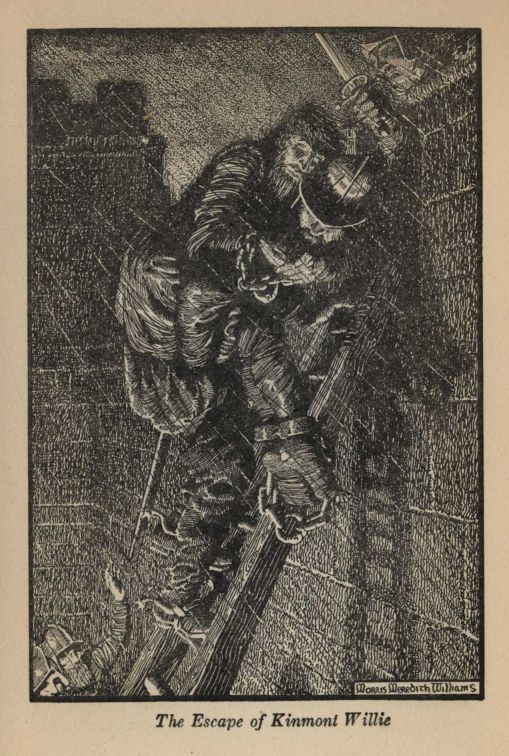
The Escape of Kinmont Willie
"Sound out the trumpets!" quoth he; "let's wake up Lord Scroope!" Then loud blew the Warden's trumpet to the tune of "O wha dare meddle wi' me?"
To work they went speedily, and cut a hole through the lead, gaining thus the castle hall.
Those inside thought the castle had been taken by King James and all his men, yet it was only twenty Scots and ten that had put a thousand in such a stir. They hammered and banged at the bars until they came to the inner prison, where lay Kinmont Willie.
"Do ye sleep or wake, Kinmont Willie, on the morn when ye shall die?"
"O I sleep lightly and wake often; it's long since sleep was frightened from me. Give my service to my wife and bairns and all good fellows that enquire after me."
Red Rowan, the strongest man in Teviotdale, lifted him up. "Stay now, Red Rowan, till I take farewell of Lord Scroope. Farewell, farewell, my good Lord Scroope," he cried. "I will pay ye for my lodging when first we meet on the Border."
With shout and cry Red Rowan bore him on his shoulders down the long ladder, the irons clanking at every stride.
"Many a time," said Kinmont Willie, "have I ridden a horse both wild and unruly, but never have my legs bestrode a rougher beast than Red Rowan. Many a time have I pricked a horse over the furrows, but never since I backed a steed have I worn such cumbrous spurs."
Scarcely had they won the Staneshaw-bank when all the bells in Carlisle were ringing and Lord Scroope was after them with a thousand men on horse and on foot. But—
"Buccleuch has turn'd to Eden water
Even where it flowed frae bank to brim,
And he has plunged in wi' a' his band,
And safely swam them through the stream.
He turn'd him on the other side,
And at Lord Scroope his glove flung he—
'If ye like na my visit to merry England,
In fair Scotland come visit me!'
All sore astonished stood Lord Scroope,
He stood as still as rock of stane;
He scarcely dared to trew[#] his eyes,
When through the water they had gane.
[#] Trust
'He is either himsell a devil frae hell,
Or else his mother a witch maun be;
I wadna have ridden that wan water,
For a' the gowd[#] in Christentie.'"
[#] Gold
Chapter XXVIII
Dick o' the Cow
"Fair Johnie Armstrong to Willie did say
'Billie, a-riding we will gae.'"
The ballad of this name, a popular one in Liddesdale, relates, like that of Kinmont Willie, to the time when Lord Scroope was Warden of the West Marches and Governor of Carlisle. Dick o' the Cow seems to have been his fool or jester. Dickie, some years after the events described in the ballad, fell a victim to the vengeance of the Armstrongs.
There had been no raids from Liddesdale for a considerable time, and no riding, and the horses had all grown so fat that they dare scarcely stir out of the stall. Then fair Johnie Armstrong said to his brother Willie, "Brother, we will go a-riding. We have long been at feud with England, and perhaps we shall find some spoil."
So they rode to Hulton Hall and round about it, but the laird, a wise man, had left neither goods nor cattle outside to steal, except six sheep in a meadow. Said Johnie, "I'd rather die in England than take those six sheep to Liddesdale."
"But who was that man we last met as we came over the hill?"
"Oh, he is an innocent fool, and men call him Dick o' the Cow."
"That fool has three good cows of his own, as good as there are in Cumberland. Betide me life or death, they shall go to Liddesdale with me!"
So they came to the house of the poor fool, broke down his thick wall, loosed his three cows, and took also three coverlets from his wife's bed.
In the morning at daylight when the loss was discovered, there were loud lamentations. "Hold thy tongue, wife," said Dickie, "and stop thy crying. I'll bring thee back three cows for each one that thou hast lost."
So Dickie went to Lord Scroope. "Hold thy tongue, fool," said Scroope. "I have no time for jesting."
"A shame on your jesting, my lord!" said Dickie, "jesting agrees not with me. Liddesdale was in my house last night and has taken my three cows. I can no longer dwell in Cumberland as your poor faithful fool, unless you give me leave to steal in Liddesdale."
"I give thee leave, fool!" said Scroope; "but thou speakest against me and my honour unless thou give me thy hand and pledge that thou wilt steal from none but those who stole from thee."
"There is my right hand and pledge! May my head hang on Haribee, and may I never again cross Carlisle sands if I steal from any man who stole not from me.",
Dickie joyfully took leave of his lord and master, and went and bought a bridle and a pair of new spurs which he packed up in the thigh of his breeches, then he came on as fast as he could to Pudding-burn house, where were thirty-three Armstrongs.
"O what has come to me now?" said Dickie, "what great trouble is this? For here is but one innocent fool against thirty-three Armstrongs?" Yet he went courteously up to the Hall board.
"Well may ye be, my good Laird's Jock, but the devil bless all your company. I'm come to complain of your man, Johnie Armstrong, and of his brother Willie, that they came to my house last night and took away my three cows."
Quoth fair Johnie Armstrong, "We'll hang him."
"Nay," said Willie, "we'll slay him."
But up spoke another young Armstrong, "We'll give him a thrashing and let him go."
Then up spoke the good Laird's Jock, the best fellow in all the company, "Sit down a while, Dickie, and we'll give thee a bit of thine own cow's thigh."
Dickie's heart was so sore that he could not eat a bit, but he went and lay down in an old peat-house where he thought to sleep the night, and all the prayers the poor fool prayed were, "I wish I had amends for my three good cows."
Now it was the custom of Pudding-burn house and of the house of Mangerton, whose laird was chief of the Armstrong clan, that any who came not to the table at the first summons got no more meat till the next meal, so some of the lads, hungry and weary, had thrown the key of the stable above the door-head. Dickie took good notice of that to turn it to his own account, went into the stable where stood thirty-three horses and tied thirty of them with St Mary's knot, tight to their stalls.
Of the remaining three, Dickie took two, which belonged to Johnie and Willie Armstrong, and the one belonging to the Laird's Jock he left loose in the stable. Leaping on one, he took the other along with him, and rode off as fast as he could.
When day came, there were great shouts and cries.
"Who has done this," quoth the good Laird's Jock; "see that ye tell me the truth."
"It is Dickie that has been in the stable last night, and has taken the horses."
"Ye never would listen to me," said the good Laird's Jock, "though I told ye true tales. Ye would never stay out of England but would steal everything, till ye were crooked and blind."
"Lend me thy bay," said fair Johnie; "he is the only horse loose in the stable, and I'll either fetch back Dick o' the Cow, or he shall die."
"Lend thee my bay!" said Jock; "he is worth gold and good money. Dick o' the Cow has taken two horses; I would not ye make them three."
Johnie, however, took the Laird's steel jacket on his back, and a two-handed sword by his side, and a steel cap on his head, and galloped after Dickie, who was barely three miles from the town when Johnie overtook him on Cannobie Lee, on the borders of Liddesdale.
"Abide, abide, thou traitor thief!" cried Armstrong; "the day is come that thou shalt die!"
Dickie looked over his left shoulder and said, "Johnie, hast thou no more in thy company? There is a preacher in our chapel who teaches all the livelong day, and when day is gone and night has come, there are only three words I remember—the first and second are Faith and Conscience—the third is 'Ne'er let a traitor free.' What faith and conscience was thine, Johnie, when thou tookest away my three cows? And when thou hadst taken them away, thou wast not satisfied. Thou sentest thy brother Willie, and took away three coverlets off my wife's bed!"
Then Johnie let his spear fall low by his side, and thought he would have killed Dickie, but the powers above were stronger than he, and he only succeeded in running through the fool's jerkin. Dickie out with his sword and ran after him, and when he could not get at him with the blade, he felled him with the butt-end over the eye, felled Johnie Armstrong, the finest man in the south country. "Gramercy," said Dickie, "I had but two horses, thou hast made them three!"—and he took Johnie's steel jacket off his back and his two-handed sword, and his steel cap. "Farewell, Johnie," said he, "I'll tell my master I met thee."
When Johnie wakened out of his swoon, he was a sad man. "Art thou gone, Dickie?" he said. "Then the shame and woe are left with me. Art thou gone? Then, Dickie, the devil go in thy company, for if I live to be a hundred, I'll never again fight with a fool."
Dickie came home to the good Lord Scroope as fast as he could. "Now, Dickie, I'll neither eat nor drink till thou art hanged on high." "Shame speed the liars, my lord," said Dickie, "this was not the promise ye made me, for I would never have gone to Liddesdale to steal if I had not got leave from thee." "But why did ye steal the Laird's Jock's horse? Ye might have lived long in Cumberland before the Laird's Jock had stolen from thee."
"Indeed, I knew ye lied, my lord. I won the horse from fair Johnie Armstrong hand to hand on Cannobie Lee. There is the jacket that was on his back, and the two-handed sword that hung by his side, and the steel cap that was on his head. I brought all these tokens to show thee."
"If that be true that thou tellest me (and I think thou durst not lie) I'll give thee fifteen pounds for the horse, all told out in the lap of thy cloak; I'll give thee one of my best milk cows to maintain thy wife and three children, and they will be as good as any two of thine would be."
"Shame speed the liars, my lord!" said Dickie. "Do ye think aye to make a fool of me? I'll either have twenty pounds for the horse or else I'll take him to Mortan fair."
So Scroope gave him twenty pounds for the horse, all in gold and good money, and one of his best milk cows to maintain his wife and three children.
Then Dickie rode as fast as he could through Carlisle town, and the first man he met was my lord's brother, Ralph Scroope, Bailiff of Glozenburrie.
"Well be ye met, Ralph Scroope!" said Dickie.
"Welcome, my brother's fool!" said Ralph. "Where did ye get Johnie Armstrong's horse?"
"Where did I get him? I stole him," said Dickie.
"Wilt thou sell me the bonny horse?"
"Ay, if thou count out the money in the lap of my cloak, for never a penny will I trust thee."
"I'll give thee ten pounds for the horse and count it into the lap of thy cloak, and one of my best milk cows to maintain thy wife and three children."
"Shame speed the liars, my lord! Do ye think aye to make a fool of me? I'll either have twenty pounds for the horse, or I'll take him to Mortan fair."
So Ralph gave him twenty pounds for the horse, all in gold and good money, and one of his milk cows to maintain his wife and three children.
Then Dickie leaped and laughed, and cried, "May the neck of the third horse be broken if either of the two were better than he!"
So he came home to his wife and ye may judge how the poor fool had succeeded. For her three stolen coverlets he gave her two score English pounds, and two cows as good as her own three. "And here," said he, "is a white-footed nag that I reckon will carry us both. But if I stay longer in Cumberland the Armstrongs will hang me." So Dickie took leave of his lord and went to live at Burgh under Stanmuir.
Chapter XXIX
The Lochmaben Harper
The castle of Lochmaben is said to have been the residence of Robert Bruce while Lord of Allandale. Hence, as a royal fortress, the keeping of it was always granted to some powerful lord. There is extant a grant giving to one of these, Robert Lauder, the office of Captain and Keeper of Lochmaben Castle for seven years, and among his perquisites were "lands stolen from the King"!
The inhabitants of four small villages near the castle have each still to this day a right to a small piece of ground. These people are descendants of Robert Bruce's retainers, to whom he assigned these portions of land in reward for faithful service, and there are still to be found some families (e.g. the Richardsons of Lochmaben) who hold their lands direct from the times of Bruce without a break.
"O heard ye na o' the silly blind Harper,
How long he lived in Lochmaben town?
And how he wad gang to fair England,
To steal the Lord Warden's Wanton Brown?
But first he gaed to his gude wyfe,
Wi' a' the haste that he could thole[#]
'This wark,' quo' he, 'will ne'er gae well
Without a mare that has a foal.'
[#] Suffer.
Quoth his wife, "Thou hast a good grey mare that can jump both high and low; so set thee on her back and leave the foal at home with me." Away went the Harper to England as fast as he might, and when he came to Carlisle gate, who should be there but the Warden himself?
"'Come into my hall, thou silly blind Harper,
And of thy harping let me hear!'
'O, by my sooth,' quo' the silly blind Harper,
'I wad rather hae stabling for my mare."
The Warden looked o'er his left shoulder,
And said unto his stable groom—
'Gae take the silly blind Harper's mare,
And tie her beside my Wanton Brown.'"
So the Harper harped and sang, the lordlings danced, and so sweet was the music that the groom forgot all about the stable door. Still the Harper harped on till all the nobles were fast asleep, when he quickly took off his shoes, crept softly down the stair, and hied with light tread to the stable door, which he opened and entered. He found there three-and-thirty steeds. He took a colt's halter which he had hidden in his hose, slipped it over Wanton Brown, tied it to the grey mare's tail, and turned them both loose at the castle gate.
Away they went over moor and moss and dale, and the mare never let Wanton rest a moment, but kept him galloping home to her foal. So swift of foot was she, and knew her way so well, that she reached Lochmaben a good three hours before daybreak.
When she came to the Harper's door, she neighed and snorted. "Rise up," shouted the Harper's wife, "thou lazy lass, and let in thy master and his mare." The lass rose up, put on her clothes and looked through the lock-hole. "By my sooth," cried she, "our mare has got a fine brown foal!"
"Hold thy tongue, thou foolish wench, the light is dazzling thine eyes. I'll wager all I have against a groat that it's bigger than ever our foal will be."
Still in merry Carlisle the Harper harped to high and low, and nought could they do but listen to him until day-dawn. But when it was daylight they discovered that Wanton Brown was gone and also the poor blind Harper's mare.
"Alas! alas!" cried the cunning old Harper, "alas that I came here; in Scotland I have lost a brown colt foal and in England they have stolen my good grey mare."
"Cease thy lamenting, thou silly blind Harper, and go on harping; we'll pay thee well for the loss of thy colt foal and thou shalt have a far better mare." So the harper harped and sang, and so sweet were his harpings that he was paid for the foal he never had lost and three times over for the gray mare.
Chapter XXX
The Rookhope Ride
This Durham border song is supposed to be spoken by a Weardale man, who begins by denouncing the inhabitants of the Tyne valley, "and all their companies there about" as false thieves,
"minded to do mischief
And at their stealing stands not out."
It must be confessed that the Tynedale men had an unenviable reputation. They were such lawless desperadoes, so addicted to rapine, that during more than two centuries the merchants of Newcastle regularly refused to take an apprentice born in that district. The date is December 1572. The rebel Earl of Northumberland, who had taken up arms for Mary Queen of Scots, and for the old religion, had been betrayed by the Scots and beheaded at York. Owing to this rebellion there was great confusion in the northern counties, hence the time was well chosen by the "limmer thieves" of Tynedale to make a predatory raid on their neighbours. They gathered together the stoutest men of arms and the best in gear, a hundred or more in number, and in the forenoon, about eleven o'clock, they came into a "bye-fell" and stopped for a meal—the last which some of them would eat. When they had eaten, they chose their captains, Harry Corbyl, Simon Fell, and Martin Ridley. Then they rode on over the moss, "with many a brank and whew," saying to one another that they were men enough,
"For Weardale-men have a journey ta'en,
They are so far out o'er yon fell,
That some of them's with the two earls,
And others fast in Bernard castell.
There we shall get gear enough,
For there is nane but women at hame;
The sorrowful fend that they can make.
Is loudly cries as they were slain."
They came in at Rookhope Head, which is the top of a rocky valley, about five miles long, at the end of which Rookhope Burn empties itself into the river Wear. This valley is as wild and open to-day as it was then. In some four hours they gathered together about six hundred sheep and they were engaged in "shifting" the horses, when the hue and cry was raised by one Rowley, whose horse they tried to take. He was the first man to see them. The cry spread rapidly down Rookhope burn and through Weardale, and word came to the bailiff's house at the East-gate. He was out, but his wife had his horse saddled and sent it to him, together with his sword, spear, and jacket quilted with iron plates, the sort of harness worn by the moss-troopers and other light horsemen of the time. The bailiff had already heard the bad news, and was sorely troubled thereby. His own brother had been attacked three days before by marauders, and lay sick with nineteen wounds. Yet the bailiff shrank not at all, but hied fast after the sheep-stealers, with as many of the neighbours as he could gather to bear him company.
The pursuers overtook the thieves in Nuketon Cleugh, and gave them all the fighting they wanted. Not one of them ever thought to see his wife again. They bore three banners against the Weardale men, "as if the world had been all their own." The fray lasted only an hour, but many a tall man lay weaponless and sore wounded before that hour was done, and four of the Northumbrian prickers were slain, including Harry Corbyl whom they had chosen to be their captain. Eleven of them were taken prisoners. Only one of the Weardale men fell but—
"These Weardale-men, they have good hearts,
They are as stiff as any tree;
For, if they'd everyone been slain,
Never a foot back man would flee.
And such a storm amongst them fell,
As I think you never heard the like;
For he that bears his head on high,
He oft-tymes falls into the dyke.
And now I do entreat you all,
As many as are present here,
To pray for the singer of this song,
For he sings to make blythe your cheer."
Chapter XXXI
Barthram's Dirge
The story of how this ballad came to be preserved to us is a very interesting one. A Mr Surtees, who was very interested in the old ballads, used to give work to a poor old Scotswoman to weed in his garden. Finding that she had learnt ballads in her young days, he encouraged her to talk about them, and this was amongst those which she recited to him. She told him that it referred to a young man named Bertram or Barthrum, who made love to a young lady against the wish of her brothers. The cruel brothers slew him, but the lady had him buried at the very spot where he was wont to come to visit her in the days of their love. Sir Walter Scott thinks that perhaps Barthram was an Englishman and the lady was Scottish, and that the anger of the lady's brothers against him was partly on that account.
It must be remembered that in those stormy days, when Border rivalry was keen, and all the Border chiefs, on both sides, were men of war-like mould, intermarriage between the two races was punishable by Border law. Each side felt equally that such mixed marriages would sooner or later produce a race that was neither loyal English nor loyal Scotch. A spirit of aloofness and rivalry was deliberately encouraged, right up to the time of the union of the two countries under one king.
BARTHRAM'S DIRGE
They shot him dead at the Nine-Stone Rig,
Beside the Headless Cross,
And they left him lying in his blood,
Upon the moor and moss.
* * * * *
They made a bier of the broken bough,
The sauch and the aspin gray,
And they bore him to the Lady Chapel,
And waked him there all day.
A lady came to that lonely bower,
And threw her robes aside,
She tore her long yellow hair,
And knelt at Barthram's side.
She bathed him in the Lady-Well,
His wounds so deep and sair,
And she plaited a garland for his breast,
And a garland for his hair.
They rowed him in a lily-sheet,
And bare him to his earth,
And the Gray Friars sung the dead man's mass,
As they pass'd the Chapel Garth.
They buried him at the mirk midnight,
When the dew fell cold and still,
When the aspin gray forgot to play,
And the mist clung to the hill.
They dug his grave but a bare foot deep,
By the edge of the Ninestone Burn,
And they covered him o'er with the heather-flower,
The moss and the Lady fern.
A Gray Friar staid upon the grave,
And sang till the morning tide,
And a friar shall sing for Barthram's soul,
While the Headless Cross shall bide.[#]
[#] Mr Surtees observes, on this passage, that in the return made by the commissioners, on the dissolution of Newminster Abbey, there is an item of a Chauntery, for one priest to sing daily ad crucem lapideam. Probably many of these crosses had the like expiatory solemnities for persons slain there. They certainly did bury, in former days, near the Ninestone Burn, for Sir Walter Scott found there, lying among the heather, a small monumental cross, with initials, which he reverently placed upright.
Chapter XXXII
Queen Mary and the Borders
The brief reign of Mary, Queen of Scots, was so crowded with incident that she was left with little time to visit the disturbed borderland of her kingdom. None-the-less her few visits to this district were fraught with important consequences. In 1565, when she married her cousin Lord Darnley, the head of the Douglas faction and a Roman Catholic, the Protestant nobles took up arms. In her very honeymoon she headed her soldiers, pursued the rebels to Dumfries, entered the town with a pistol in each hand, and laughed heartily at the fun of making her enemies "skip like rabbits" over the Border. She was only twenty-two years old—a fearless, dashing, attractive woman, with a clever head, a strong will, and a wild and lawless disposition.
In the next year she again visited the Border, but on a very different errand. Mary had developed an extreme fancy for that bold Border Lord, the Earl of Bothwell, whose Castle of Hermitage commanded the picturesque and important valley of the Liddel. The Queen had given him authority to control the fierce Borderers; and when the earl was riding out he met the most lawless of them, Jock Elliot, of whom the couplet—
"My name is little Jock Elliot
And who dare meddle wi' me?"
Bothwell fired straight at Elliot with his pistol, wounding him in the leg. Elliot aimed a mighty blow at Bothwell with his two-handed sword, giving the earl so sore a wound that he was glad enough to gallop home while there was yet time to save his life.
Mary was holding solemn court at Jedburgh when she heard of her favourite's danger. She straightway took horse and rode to Hermitage, a hard cross-country ride of twenty miles, through a district infested with reckless men. When she galloped back to Jedburgh, she was in high fever and nearly died. Later on, in the misery of her long imprisonment, she often said, "Would I had died at Jedburgh!" Years later, a broken piece of a silver spur was found at Queensmire, on this difficult and dangerous road, just where Queen Mary's horse was said to have come to grief.
Yet another time Queen Mary came to the Border, this time to cross it—after her imprisonment at Lochleven, her escape, and the disastrous rout of her followers at Langside. Daring and resourceful as ever, she fled across the Solway in an open boat; Scotland had failed her, she sought the protection of England. She landed at Cockermouth, and was led to Carlisle by Sir R. Lowther, and kept there, in reality a prisoner, while Elizabeth was musing of the dangers of the position. The Earls of Northumberland and Westmoreland took up Mary's cause and attempted to rescue her, but the Warden of Carlisle, Lord Scroope, defended the town successfully against the two earls, and they were soon in flight, eastward for their very lives. After this attempt at rescue Mary was, for greater safety, sent down to Bolton Castle in Yorkshire.
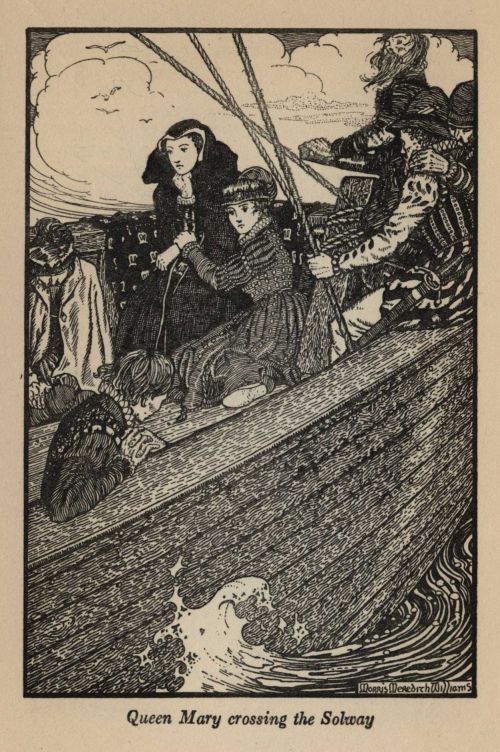
Queen Mary crossing the Solway
Leonard Dacre, a member of the powerful Cumberland family of the Dacres, seems to have played a treacherous part, first promising the earls his help, and then betraying them to Elizabeth. He seized Nawarth Castle, which properly belonged to his young niece, and collected together three thousand men to the old Border war-cry, "A Red Bull, a Red Bull!" (probably the nickname of some fierce red-haired Celtic champion). The defeated earls came to Nawarth for shelter, and Dacre refused to harbour them. But by this time Elizabeth was convinced of Dacre's treason, and ordered Lord Hudson, the Governor of Berwick, to arrest him.
Hudson appears to have marched by rather a round-about way, for Dacre met him at Geltbridge, on the west of Nawarth. A bridge is always a good point of vantage for meeting an enemy, especially when the river runs, as the Gelt does, through a deep and wooded gorge. The enemy has only a narrow way by which to approach, and no doubt Dacre posted his archers behind the trees and among the great rocks. The fight was a desperate one, but Hudson's men prevailed and pursued their foes far up the hill of Gelt, scuffling fiercely among the forest trees and dyeing a deeper hue the red sandstone cliffs and quarries.
All the rebels who could escape fled across the Border to Scotland, where the Borderers, who were till then their enemies, received them with that open and fair hospitality which was one of their many great qualities. Elizabeth demanded that the leading noblemen should be given up to her; but although the Scottish Regent, Murray, made a pretence of trying to secure the Earl of Westmoreland, the Scots had too much sense of honour to allow him to proceed.
The Earl of Northumberland, was however betrayed to the Scottish Regent by Hector Armstrong of Harelaw; but this the gallant Borderers held to be shameful, and Armstrong was a ruined man from that day forth.
Two years later, this Earl was actually sold to Elizabeth and beheaded at York. Thus ended this small rebellion, called in history the Rising of the North, but which is known locally in Cumberland as Dacre's Raid.
There is a little stream which rushes down a deep and beautiful glade to join the river Gelt above Geltbridge; this stream is known as "Hellbeck," and villagers tell us that the reason for this name is that it was stained with blood for two whole days after some battle that took place there. This battle is probably the one spoken of here.
A wicket gate by Geltbridge leads us to the path through Gelt woods. The noble gorge is deeply cleft through the grand red sandstone rocks. Below roars and dashes the impetuous river; the path winds, sometimes high, sometimes low, through wonderful weeds, carpeted with beautiful mosses, gemmed with delightful flowers. On one of the rocks is an inscription carved by a Roman soldier, over fifteen hundred years ago. Follow the river, up, up, till the little Hellbeck is seen trickling down from the east; cross the little bridge and follow the streamlet on its opposite bank, along a path so little trod as to be scarcely visible; wander among ferns along one of the loneliest glens in the whole of Britain, passing the great railway bridge (under if the stream be low or over if it be high) till you join the main road again. There is no spot more beautiful or more peaceful. Yet this is the Hellbeck where men fought and hacked, and slashed and slew, among these woods, up and down these steep hillsides. These old trees, when young, have felt warm blood at their roots; and all because of a young, wild wilful queen, who fascinated men's hearts then, and the memory of whom fascinates them still.
Chapter XXXIII
The Raid of the Reidswire
"To deal with proud men is but pain,
For either must ye fight or flee,
Or else no answer make again,
But play the beast, and let them be."
Reidswire, the name of a place about ten miles from Jedburgh, means the Red Swire. Swire is an old northern term for the descent of a hill, and the epithet red may refer to the colour of the heath.
The affair about which we are to tell took place on the 7th of July 1575, at a meeting held, on a day of truce, by the Wardens of the Marches, for redressing wrongs and adjusting difficulties which could not be prevented from arising upon the Border. The Scottish Warden was Sir John Carmichael, and among his following were the Armstrongs and Elliots, Douglas of Cavers (a descendant of the Douglas who fell at Otterbourne), Cranstoun, whose ferocious motto was "Ye shall want ere I want," Gladstain, "good at need," and the ancient head of the Rutherfoords, called in tradition the Cock of Hunthill, "with his nine sons him about." The English Warden was the haughty Sir John Forster, and he had full fifteen hundred men with him, chiefly Northumbrians, Tynedale, and Reedsdale men, who looked with scorn upon the much smaller array of their hereditary foes.
The meeting, however, began meekly enough, with merriment and jests. Such Border meetings of truce, though they might wind up in blood, as was to happen now, always began as occasions of marketing and revelry. Both parties came fully armed to such a tryst, yet intermixed in mutual sports and familiar intercourse,
"Some gaed to drink, and some stood still,
And some to cards and dice them sped."
The Scots planted their pavilions or tents and feared no ill, even when they saw five hundred Fenwicks (a powerful Northumbrian clan) "marching in a flock." The clerk began to call the rolls, and to deal with one complaint after another for the loss of cows or ewes or other property. In the course of the proceedings an accusation was raised against an English freebooter named Farnstein, at the instance of a Scotch complainant. A "true bill" was found against the man, which means that he ought to be handed over to justice. But the English Warden alleged that he had fled, and could not be found. Carmichael, considering this as a pretext to avoid making compensation for the felony, bade the Northumbrians speak out plainly, and "cloke no cause for ill nor good." Upon this Sir John Forster, a proud and insolent man, "began to reckon kin and blood," by which picturesque phrase the ballad probably means that he swiftly added up his forces. Then he drew himself up, backed by his Dalesmen, all fingering their bows, and with insulting expressions against Carmichael's kin he bade him "match with his equals." The men of Tynedale, who only wanted a pretext for a quarrel, drew their bows and let off a flight of arrows among the Scots. The more moderate men on both sides at first tried to quell the tumult, but in vain. The fight was bound to come.
"Then there was naught but bow and spear,
And every man pulled out a brand."
The English showed their usual dexterity with the bow. The Scots, for some reason, never took to this weapon; they had fire-arms, pistolets, and the like. The terrible cloth-yard arrows "from tackles flew," and the old proverb bade fair to justify itself, that every English archer carried twenty-four Scots under his belt—an allusion to his bundle of shafts. Success seemed certain for the English side; some of the foremost men among the Scots fell, and even Carmichael was thrown to the ground and was within an ace of being made a prisoner. The air resounded with the rallying cries of the English, the names of their captains, "A Shaftoe! A Shaftoe!" "A Fenwick! A Fenwick!" The Scots had little harness among them, only a few had the jack which served them as a defence for the body. Nevertheless, they laid about them sturdily, with "dints full dour," and there was many a cracked crown. Then suddenly a shout was heard. "Jedburgh's here!" A body of Jedburgh burgesses appear to have arrived just in the nick of time to add to the outnumbered force of Scots. They probably wore armour and what were called "white hats," that is steel caps. Meanwhile, the English, too confident of easy victory, instead of slaying more Scots and turning the repulse into a rout, thought only to plunder the unhappy merchants, who, trusting to the truce which had been proclaimed, had attached themselves to the meeting. Had it not been for the English greed, the Scots would have been defeated. As it was, the Tynedale men, throwing themselves on the merchants' packs, fell into disorder, their adversaries recovered from their surprise, and the timely arrival of the Jedburgh men turned the tables. A short, sharp bout ended in the triumph of the Scots and the Northumbrians fled, "Down ower the brae, like clogged bees." The Scots took many prisoners, amongst whom were the English Warden, and his son-in-law, Sir Francis Russell; but the most gallant soldier taken that day was that courteous knight, Sir Cuthbert Collingwood, to whose family Admiral Collingwood belonged. Several of those "Fenwicks fierce," who had turned up five hundred strong at the commencement of the fray, had the mortification of being carried off in triumph by their enemies. All these prisoners were sent to the Earl of Morton, Regent of Scotland, who detained them at Dalkeith for some days, until the bitter feeling natural after such an affair had died down, at any rate in part, and by this prudent precaution the Regent is thought to have probably averted a war between the two kingdoms. He ultimately permitted them to return to their own country, parting from them with great expressions of regard. The interest taken in the matter by Queen Elizabeth, and the representations of her Ambassador at Edinburgh, no doubt had something to do with this happy issue.
It will probably occur to the careful reader of this book as somewhat strange to find the ruling powers of England and Scotland both so set upon peace; but it must be remembered that at this period in the reign of Queen Elizabeth the heir-apparent to the English throne was the young James VI., King of Scotland, who would naturally not wish for any quarrel with the country which he hoped later on to rule. Elizabeth, on the other hand, had Mary Queen of Scots as her prisoner, and did not wish in any further way to strain the already delicate relations between the two countries.
The Carmichael mentioned in this ballad, known in full as Sir John Carmichael of Edrom, Scottish Warden of the Middle Marches, was afterwards murdered by one of the wild Armstrongs, who is said to have composed, the night before his execution, the following manly and pathetic "Good-night." The third and fourth lines show clearly the disrepute into which this once honoured clan was falling; the seventh and eighth lines could only have been written by one who, despite his faults, had the true gallant instincts deep in his blood.
ARMSTRONG'S GOOD-NIGHT
"This night is my departing night,
For here nae langer must I stay;
There's neither friend nor foe o' mine,
But wishes me away.
What I have done thro' lack of wit,
I never, never can recall;
I hope ye're a' my friends as yet;
Good-night and joy be with you all!"
Chapter XXXIV
Jock o' the Side
"He is well kend, John of the Syde,
A greater thief did never ryde."
The subject of this ballad bears some resemblance to Kinmont Willie, and such adventures were not uncommon in those turbulent times. The events we are to relate originated in a raid ridden by the famous Liddesdale spearmen (the hardiest of the Scotch moss-troopers) upon English ground.
"They had better hae staid at home," for the outcome was that one of their best men, Michael of Winfield, was killed, and Jock o' the Side, nephew to the Laird of Mangerton, was taken prisoner, and promptly lodged in Newcastle Jail. When the news reached Jock's mother she kilted her coats up to her knee, and ran down the water with the tears falling in torrents from her eyes. She ran to Mangerton House, on the banks of the Liddel, and told her brother, the good old lord, the bad news. "Michael is killed, and they have taken my son John." "Never fear, sister," quoth Mangerton, "I have eighty-three yokes of oxen, my barns, my byres, my folds are all filled, I'll part with them all ere Johnie shall die." Then he thought out his plan. "Three men I'll send to set him free, all harnessed in the best steel; the English loons shall feel the weight of their broad swords. The Laird's Jock shall be one, the Laird's Wat two, and Hobbie Noble, thou must be the third. Thy coat is blue, and since England banished thee thou hast been true to me." Now this Hobbie was an Englishman, born in Bewcastledale, the wildest district in Cumberland. Like numerous other English outlaws, he had made his own country too hot to hold him; his misdeeds had banished him to Liddesdale, and he was now in high favour with the Laird of Mangerton. The Laird gave the dauntless three orders to reverse the shoes of their horses, so that anyone crossing their trail might think they were proceeding in a contrary direction. He also warned them not to seem gentlemen, but to look like corn-carriers; not to show their good armour, nor appear like men of war, but to be arrayed as country lads, with halter and cart-collar on each mare. So Hobbie mounted his grey, Jack his lively bay, and Wat his white horse, and they rode for Tyne water. When they reached the Tyne they lighted down at a ford, and by the moonlight they cut a tree, with fifteen nogs on each side, to serve them as a scaling ladder, to climb Newcastle wall with. However, when they came to Newcastle town and alighted at the wall, their tree proved three ells too short, and there was nothing for it but to force the gates. At the gate a proud porter attempted to withstand them. The Armstrongs wrung his neck, took his life and his keys at once, and cast his body behind the wall. Soon they reached the jail, and called to the prisoner,
"Sleeps thou, wakes thou, Jock o' the Side,
Or art thou weary of thy thrall?"
Jock answered dolefully, "Often I wake, nay, sleep seldom comes to me—but who's this knows my name so well?" Then out and spoke the Laird's Jock, his cousin and namesake, "Now fear ye not, my billie!" quoth he; "for here are the Laird's Jock, the Laird's Wat, and Hobbie Noble the Englishman come to set you free." Jock o' the Side did not think it possible that they could effect his release. "Now hold thy tongue, my good cousin," said he. "This cannot be—
'For if all Liddesdale were here the night,
The morn's the day that I must die.'
They have laid full fifteen stone of Spanish iron on me, I am fast bound with locks and keys in this dark and dreary dungeon." But the Laird's Jock replied. "Fear not that; faint heart never won fair lady. Work thou within, we'll work without, and I'll be sworn we'll set thee free." They loosed the first strong door without a key, the next chained door they split to flinders. The Laird's Jock got the prisoner on his back, irons and all, and brought him down the stairs with no small speed and joy. Hobbie Noble offered to bear some of his weight, but the Laird's Jock said that he was lighter than a flea. When they had all gone out at the gates, the prisoner was set on horseback, and they all joked wantonly. "O Jock," they cried, "you ride like a winsome lady, with your feet all on one side." The night was wet, but they did not mind. They hied them on full merrily until they came to the ford at Cholerford, above Hexham. There the water was running mountains high. They asked an old man, "Honest man, tell us in haste, will the water ride?" "I've lived here thirty years and three," replied he, "and I never saw the Tyne so big, nor running so like a sea." The Laird's Wat counselled them to halt. "We need not try it, the day is come we all must die!" "Poor faint-hearted thief!" cried the Laird's Jock. "There'll no man die but him that's fated; I'll guide you safely through; lift the prisoner behind me." With that they took to the water and managed to swim through. "Here we are all safe," said the Laird's Jock triumphantly. "Poor faint Wat, what think ye now?" They now saw twenty men pursuing them, sent from Newcastle, all English lads, stout and true. But when their leader saw the water he shook his head. "It won't ride, my lads," said he. Then he cried to the party of Scots: "Take the prisoner, but leave me my fetters." But the Laird's Jock was not a Scot for nothing. "I wat weel no," he shouted back, "I'll keep them, they'll make horse-shoes for my mare—for I am sure she's bought them right dear from thee." Then they went on their way to Liddesdale, as fast as they could, and did not rest until they had brought the rescued prisoner to his own fireside, and made him free of his irons.
Chapter XXXV
Hobbie Noble
"Keep ye weel frae the traitor Mains!
For gold and gear he'll sell ye a'."
In the ballad of "Jock o' the Side," we have seen Hobbie Noble act a distinguished part in the deliverance from captivity of Jock, cousin of the Laird of Mangerton, chief of the Armstrong clan. Now in the following ballad we shall learn how ungrateful the Armstrongs were for his faithful services. The Armstrongs were one of those outlawed or broken clans, whose hand was against every man, and living as they did in what was called the Debateable Land, on the frontier between Liddesdale and England, these stark cattle-lifters and arrant thieves levied tribute from English and Scotch alike. Halbert or Hobbie Noble was an Englishman, a Cumbrian born and bred, but his misdeeds were so great, they banished him never to return, and he established himself among the Armstrongs. From their territory he continued his depredations upon the English, in resentment of which they at length offered a bribe to the Armstrongs to decoy him into England under pretence of inviting him to join them in a foray.
"At Kershope foot the tryst was set,
Kershope of the lily lee,"
and the name of the chief traitor and leader of the gang was Sim o' the Mains. Hobbie harnessed himself "both with the iron and with the steel," buckled spur on his heel and belted brand to his side, leaped upon his "fringed grey," and rode down the banks of the Liddel. As soon as he saw the others, "Well be ye met, my comrades five," he cried. "Now, what is your will with me?" They all answered, with one consent, "Thou'rt welcome here, brave Noble; wilt thou ride with us into England, and we will be thy safe warrant? If we get a horse worth a hundred pounds thou shalt soon be upon its back." But Hobbie said that he dared not ride into England by day, as he had a feud with the Land-Sergeant (an officer under the Warden, to whom was entrusted the arrest of delinquents).
"But will ye stay till the day gae down,
Until the night come o'er the ground,
And I'll be a guide worth any two
That may in Liddesdale be found?
Though the night be black as pitch and tar,
I'll guide ye o'er yon hill so high;
And bring ye all in safety back,
If ye'll be true and follow me."
They let him guide them over moss and moor, over hill and hope, and over many a down, until they came to the Foulbogshiel. But meanwhile word was gone to the Land-Sergeant, in Askerton, about seventeen miles from Carlisle. "The deer that you have hunted so long, is in Bewcastle Waste this day." The Sergeant understood at once. Quoth he, "Hobbie Noble is that deer! He carries the style full high. He has often driven our bloodhounds back. Now go, warn the bows of Hartlie Burn, see they sharpen their arrows on the wall! Warn Willeva and Speir Edom, take word to them that they meet me on the Rodric-haugh at break of day. We will on to Conscouthart-green, for there, I think, we'll get our quarry." In the meantime Hobbie had alighted and was sleeping in the Foulbogshiel. He dreamed that his horse was shot beneath him, and he himself was hard put to it to get away. The cocks crowed, the day dawned, and if Hobbie had not wakened he would have been taken or slain in his sleep.
"Awake, awake, my comrades five!
I trow here makes a full ill day;
Yet the worst cloak o' this company
I hope shall cross the Waste this day,"
Thus cried he to his companions, thinking the gates were clear. But alas! it was not so. They were beset by the Land-Sergeant's men, cruel and keen, and while the Englishmen came before, the traitor Sim o' the Mains came behind. Had Noble been as masterful a champion as Wallace himself, he could not have won under such untoward circumstances. He had but a laddie's sword, but he did more than a laddie's deeds, for that sword would have cleared Conscouthart-green had it not broken over one of the English heads. So his treacherous companions delivered Hobbie up to the officers of justice; they bound him with his own bowstring, but what made his heart feel sorest of all, was that it was his own five who bound him. They took him on to Carlisle. They asked him mockingly if he knew the way. He thought much, but said little, though he knew it as well as they did. As they took him up the Carlisle streets, the old wives cast their windows wide, every woman whispering to another, "That's the man loosed Jock o' the Side." The poor fellow cried out, "Fie on ye, women! why call ye me man? It's no like a man that I'm used, but like a beaten hound that's been fighting in the gutter." They had him up through Carlisle town, and set him by a chimney fire, where they gave him a wheaten loaf to eat, and a can of beer. "Confess my lord's horse, Hobbie," they said, "and to-morrow in Carlisle thou shalt not die." "How can I confess them," says the poor man, "when I never saw them." And he swore a great oath, by the day that he was born, that he had never had anything of my lord's. He had but short shrift and they hung him the next morning.
According to the ballad, his last words were of manly pride:—
"Yet wad I rather be ca'd Hobbie Noble,
In Carlisle, where he suffers for his fault,
Than I'd be ca'd the traitor Mains,
That eats and drinks o' meal and malt."
Thus died the doughty Noble. It is proper to add, however, that the Armstrong's chief, Lord Mangerton, with whom Hobbie had been a favourite, took a severe revenge on the traitors who betrayed him. The contriver of the scheme, Sim o' the Mains, fled into England to escape the resentment of his chief, and was there caught by the English, and himself executed at Carlisle, two months after Hobbie's death in the same place! Such is, at least, the tradition of Liddesdale.
Chapter XXXVI
The Laird o' Logie
In 1592, the Earl of Bothwell, Francis Stuart, failed in an attempt against King James VI., whom he tried to surprise in the palace of Falkland. Amongst his adherents, whom he sought about the King's person, was the hero of this ballad, the Laird of Logie, who was taken prisoner and laid in Edinburgh chapel in the keeping of Sir John Carmichael, the hero of the ballad called the "Raid of Reidswire." Carmichael was at this time captain of the King's Guard, and had the keeping of State criminals.
I will sing, if ye will hearken,
If ye will hearken unto me;
The King has ta'en a poor prisoner,
The wanton laird o' young Logie.
Young Logie's laid in Edinburgh chapel,
Carmichael's the keeper o' the key;
And may Margaret's lamenting sair,
A' for the love of young Logie.
"Lament, lament na, may Margaret,
And of your weeping let me be;
For ye maun to the King himsell,
To seek the life of young Logie."
May Margaret has kilted her green cleiding,[#]
And she has curl'd back her yellow hair—
"If I canna get young Logie's life,
Farewell to Scotland for evermair."
[#] Clothing.
When she came before the King,
She kneelit lowly on her knee—
"O what's the matter, may Margaret?
And what needs a' this courtesie?"
"A boon, a boon, my noble liege,
A boon, a boon, I beg o' thee!
And the first boon that I come to crave,
Is to grant me the life of young Logie."
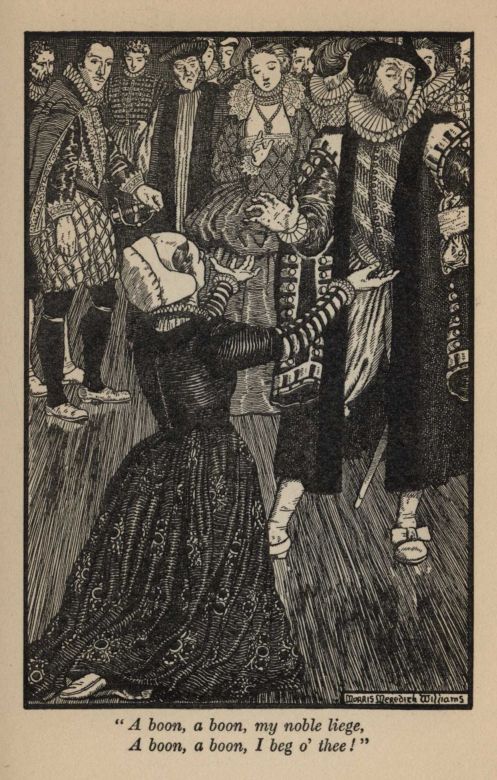
"A boon, a boon, my noble liege, A boon, a boon, I beg o' thee!"
"O na, O na, may Margaret,
Forsooth, and so it mauna be;
For a' the gowd o' fair Scotland
Shall not save the life of young Logie."
But she has stown[#] the King's redding kaim,[#]
Likewise the Queen her wedding knife,
And sent the tokens to Carmichael,
To cause young Logie get his life.
[#] Stolen. [#] Dressing comb.
She sent him a purse of the red gowd,
Another o' the white monie;
She sent him a pistol for each hand,
And bade him shoot when he gat free.
When he came to the Tolbooth stair,
There he let his volley flee;
It made the King in his chamber start,
E'en in the bed where he might be.
"Gae out, gae out, my merrymen a',
And bid Carmichael come speak to me;
For I'll lay my life the pledge o' that,
That yon's the shot o' young Logie."
When Carmichael came before the King,
He fell low down upon his knee;
The very first word that the King spake,
Was—"Where's the laird of young Logie?"
Carmichael turn'd him round about
(I wot the tear blinded his ee),
"There came a token frae your grace,
Has ta'en away the laird frae me."
"Hast thou play'd me that, Carmichael?
And hast thou play'd me that?" quoth he;
"The morn the justice-court's to stand,
And Logie's place ye maun supplie."
Carmichael's awa to Margaret's bower,
Even as fast as he may dree—
"O if young Logie be within,
Tell him to come and speak with me!"
May Margaret turn'd her round about
(I wot a loud laugh laughed she),
"The egg is chipp'd, the bird is flown,
Ye'll see nae mair of young Logie."
Chapter XXXVII
Jamie Telfer of the Fair Dodhead
"'Tis I, Jamie Telfer, of the fair Dodhead,
And a harried man I think I be!
There's nothing left at the fair Dodhead
But a woeful wife and bairnies three!"
About Martinmas time, when Border steeds get corn and hay, the Captain of Bewcastle rode over to Tividale to forage. And first he met a guide high up in Hardhaughswire, and next he met a guide low down in Borthwick water.
"What tidings, what tidings, my trusty guide?" "No tidings have I—yet if ye go to the fair Dodhead, I'll let ye see many a cow's calf." Right hastily they came to the fair Dodhead, loosed the cows and ransacked the house.
Jamie Telfer's[#] heart was sore when he saw this, and the tears ran down his cheeks, and he pleaded with the Captain to give him back his gear, or else he would have revenge upon him. But the Captain only laughed and said, "Man, there's nothing in thy house but an old sword without a sheath that could scarcely kill a mouse."
[#] The Telfers, though they had become Scotch at the time of this ballad, were originally a Norman family, descended from the knight "Taille-fer" (cut-iron), who came over with William the Conqueror.
The sun was not up though the moon had gone down, and there was a sprinkling of new-fallen snow upon the ground when Jamie Telfer ran ten miles a-foot between the Dodhead and Stob's Hall. When he came to the tower gate he shouted aloud, and old Gibby Elliot came out and asked the meaning of such disturbance.
"It is I, Jamie Telfer, of the fair Dodhead, and a harried man am I, for nothing is left at fair Dodhead but a sad wife and three bairnies."