Front matter (continued 2)
Reading edition
Till her pale colour was gone;
With rosy cheek, and ruby lip,
She smiled her love upon.
"A morsel of your bread, my lord,
And one glass of your wine;
For I have fasted these three lang days,
All for your sake and mine.
Gae hame, gae hame, my seven bauld brothers,
Gae hame and blaw your horn!
I trow[#] ye wad hae gi'en me the skaith,[#]
But I've gi'en you the scorn.
[#] reckon. [#] harm.
Commend me to my grey father,
That wished my soul gude rest;
But wae be to my cruel step-dame,
Garred burn me on the breast."
"Ah! woe to you, you light woman!
And ill death may ye die!
For we left father and sisters at hame,
Breaking their hearts for thee."
Chapter X
The Corbies
Two ancient songs have come down to us in which the principal speakers are supposed to be Corbies, carrion-crows or ravens, birds which feed on the flesh of the dead. In both songs the birds discuss a dead knight upon whose rich body they wish to feed. But deep interest lies in the fact that the two song-writers present entirely different views of the case. One appeals to our feelings with a beautiful and touching picture of devotion, the knight's companions proving true to him in death. The other is far more grim, and causes us to shudder at the utter loneliness of the dead man, deserted by all those who in life were beholden to his friendship. Both are powerful and striking examples of ancient vigour and directness.
THE TWA CORBIES
As I was walking all alane,
I heard twa corbies making a mane;[#]
The tane unto the t'other say,
"Where sall we gang and dine to-day?"—
[#] moan.
"In behint yon auld fail dyke,
I wot there lies a new-slain knight;
And naebody kens that he lies there,
But his hawk, his hound, and lady fair.
His hound is to the hunting gane,
His hawk, to fetch the wild-fowl hame,
His lady's ta'en another mate,
Sa we may mak our dinner sweet.
Ye'll sit on his white hause-bane,[#]
And I'll pick out his bonny blue een:
Wi' ae lock o' his gowden hair,
We'll theek[#] our nest when it grows bare.[#]
[#] neck. [#] thatch. [#] Variant reading—"We'll theek our nest—it's a' blawn hare."
Mony a one for him makes mane,
But nane sall ken where he is gane;
O'er his white banes, when they are bare,
The wind sall blaw for evermair."
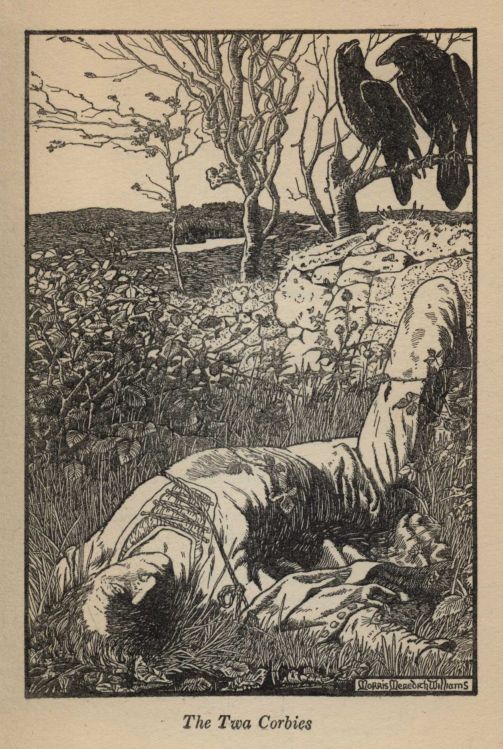
The Twa Corbies
THE THREE RAVENS
There were three ravens sat on a tre,
They were as black as they might be:
The one of them said to his mate,
"Where shall we our breakfast take?"—
"Downe in yonder greene field,
There lies a knight slain under his shield;
"His hounds they lie downe at his feete,
So well they their master keepe;
"His hawkes they flie so eagerlie,
There's no fowle dare come him nie.
"Down there comes a fallow doe,
As great with yong as she might goe.
"She lift up his bloudy hed,
And kist his wounds that were so red.
"She got him up upon her backe,
And carried him to earthen lake.
"She buried him before the prime,
She was dead her selfe ere even song time.
"God send every gentleman,
Such hawkes, such houndes, and such a leman."
Chapter XI
Otterbourne and Chevy Chase
"It fell about the Lammas-tide,
When moor-men win their hay,
The doughty Douglas bound him to ride
Into England, to drive a prey."
The ballads of Otterbourne and Chevy Chase record the Scottish and English versions of a most stubborn Border battle. Whichever of the two contains the greater amount of truth, it is clear that the day was a bloody one, and that, moreover, it was fought on both sides with a chivalrous admiration for the powers of the other which is characteristic of those strife-loving days. Sir Philip Sidney wrote of it: "I never heard the old song of Percy and Douglas, that I found not my heart moved more than with a trumpet."
The ballad of Chevy Chase is of later date than its rival, and it contains certainly one misstatement of historical fact, since Hotspur outlived the fight at Chevy Chase (1388) and was slain some fifteen years later at the battle of Shrewsbury (1403).
The Scottish version of the battle of Otterbourne tells us that it was about the Lammas-tide or haymaking time of the year 1388 when the brave Earl of Douglas, with his brother, the Earl of Murray, made a foray into England, with a gay band of Gordons, Graemes, and Lindsays. He burned Tynedale and half of Bamborough and Otterdale, and marching up to Newcastle, rode round about the castle, crying, "Who is lord of this castle, and who is its lady?"
Then up spake proud Lord Percy, known as Hotspur, and said, "I am the lord of this castle, and my wife is the gay lady of it."
"That pleases me well," answered Douglas, "yet, ere I cross the Border hills, one of us shall die."
Then Percy took his long spear, shod with metal, and rode right furiously at the Douglas; but his lady, looking from the castle wall, grew pale as she saw her proud lord go down before the Scottish spear.
"Had we two been alone, with never an eye to see, I would have slain thee, but thy lance I will carry with me," said Douglas, and, to complete the disgrace, this lance bore attached to it the Percy pennon.
"Go then to Otterbourne," said Percy, "and wait there for me, and if I come not before the end of three days, call me a false knight."
"Otterbourne is a pleasant and a bonny place," answered Douglas; "but though the deer run wild among the hills and dales, and the birds fly wild from tree to tree, yet is there neither bread nor kale nor aught else to feed me and my men. Yet will I wait thee at Otterbourne to give thee welcome, and if thou come not in three days' time, false lord, will I call thee!"
"By the might of Our Lady, I will come," cried the proud Percy. "And I," answered Douglas, "plight thee my troth that I will meet thee there."
So Douglas and his men encamped at Otterbourne, and sent out their horses to pasture.
But before the peep of dawn, up spake a little page: "Waken ye, waken ye, my good lord; the Percy is upon us!" "Ye lie, ye lie," shouted Douglas; "yesterday, Percy had not men enough to fight us. But if thou lie not, the finest bower in Otterbourne shall be thy reward, and if what thou sayest prove false, thou shalt be hanged on the highest tree in Otterbourne. Yet I have dreamed a dreary dream; I dreamed that a dead man won a battle and that I was that dead man."
So Douglas belted on his good broadsword, and ran to the field, but forgot his helmet, and Percy and the Douglas fought with their swords together till the blood ran down like rain, and the Douglas fell, wounded on the brow.
Then he called to him his little foot-page and told him to run quickly and bring to him his sister's son, Sir Hugh Montgomery.
"My good nephew," said Douglas, "the death of one matters not; last night I dreamed a dreary dream, but yet I know the day is thine. My wound is deep; take thou the vanguard; bury me in the bracken high that grows on yonder lea, and let no man living know that a Scot lies there. And know that I am glad to die in battle, like my good forefathers, and not on a bed of sickness."
Montgomery lifted up his noble lord, while his eyes wept salt tears, and hid him in the bracken bush that his followers might not see, and before daylight the Scots slew many a gallant Englishman. The good Gordons steeped hose and shoes in the blood of the English; the Lindsays flew about like fire till the battle was ended, and Percy and Montgomery fought till the blood ran down between them.
"Now, yield thee, yield thee, Percy," cried Sir Hugh, "or I vow I will lay thee low!"
"Since it must be so," quoth Earl Percy, "to whom shall I yield?"
"Thou shalt not yield to me or to any lord, but to the bracken bush that grows on yonder lea!"
"I will not yield to briar or bracken bush, but I would yield to Lord Douglas or to Sir Hugh Montgomery, if he were here."
Then Montgomery made himself known, and as soon as Percy knew that it was Montgomery, he struck the point of his sword into the ground, and Montgomery, who was a courteous knight, took him up by the hand.
This deed was done at Otterbourne at daybreak, where Earl Douglas was buried by the bracken bush, and Percy led captive into Scotland, and it is said that Hotspur, for his ransom, built for Montgomery the castle of Penoon, in Ayrshire.
But the English version of these stirring events can also claim to be heard; the ballad upon it is called Chevy Chase, which means the Chase on the Cheviots; and so popular was this ballad that its name was given to a boys' game, which is so called even to this day. It tells how the Percy, from his castle in Northumberland, vowed that within three days he would hunt on the mountains of Cheviot in spite of the doughty Douglas and his men, and that he would kill and carry away the fattest deer in Cheviot.
"By my faith," said Douglas, when he heard of the boast, "but I will hinder his hunting."
Percy left Bamborough Castle with a mighty company, no less than fifteen hundred bold archers chosen out of three shires.
The foray began on a Monday morning in the high Cheviot Hills, and many a child yet unborn was to rue the day.
The drivers went through the woods and raised the deer, and the bowmen shot them with their broad arrows. Then the wild deer rushed through the woods, only to be met and killed by the greyhounds, and before noontide a hundred fat deer lay dead. The bugles sounded, "A mort!" and on all sides Percy and his men assembled to see the cutting up of the venison.
Said Percy: "The Douglas promised to meet me here this day, yet right well did I know that he would fail." But a Northumberland squire saw the doughty Douglas coming with a mighty company, with spear and batter-axe and sword. Never were men hardier of heart and hand seen in Christendom—two thousand spearmen born along the banks of the Tweed and Teviotdale. Then said Lord Percy: "Now leave off the cutting of the deer, and take good heed to your bows, for never had ye more need of them since ye were born."
Earl Douglas rode before his men, his armour glittering like a burning coal, and never was such a bold baron. "Tell me whose men ye are," said he, "and who gave ye leave to hunt in Cheviot without word asked of me?"
Then answered Lord Percy, "We will not tell thee whose men we are, and we will hunt here in spite of thee. We have killed the fattest harts in Cheviot and will carry them away."
"By my troth," said Douglas, "one of us shall die this day. Yet it were great pity to kill all these guiltless men. Thou, Percy, art a lord of land, and I am called an earl in my country; let our men stand by, and we will fight together."
"Now a curse on his crown, who says nay to that," cried Lord Percy. "By my troth, Douglas, thou shalt never see the day either in England, Scotland, or France, when I fear to meet one, man to man."
Then spoke Richard Witherington, a squire of Northumberland. "Never shall this be told in England, to the shame of good King Harry the Fourth. I wot ye be two great lords, and I but a poor squire, yet would I never stand and look on while my captain fought. While I can wield a weapon, I will not fail, both heart and hand."
So the English with good heart bent their bows, and slew seven score spearmen with the first arrows they shot.
Earl Douglas stayed on the field, but that he was a good captain was truly seen, for he wrought great woe and mischief. He parted his host in three like a proud chieftain, and they came in on every side with their mighty spears, wounding the English archers and slaying many a brave man.
Then the English pulled out their brands, and it was a heavy sight to see the bright swords light on the helmets, striking through the rich mail, and the cloth of many folds under it, and laying many low.
At last the Douglas and the Percy met and fought with swords of Milan steel till the blood spurted like rain and hail from their helmets.
"Hold thee, Percy," said Douglas, "and I will bring thee to James, our Scottish king, where thou shalt have an earl's wages and free ransom, for thou art the manfullest man that ever yet I conquered fighting in the field."
"Nay, then," said Lord Percy. "I told thee before that never would I yield to any man of woman born."
With that there came an arrow hastily from a mighty man, and struck Earl Douglas through the breast bone, and never more did he speak a word but only this: "Fight, my merry men, while ye may—my life's days are done."
Then Percy leaned on his hand, and when he saw the Douglas die, he said, "Woe is me. I would have parted with my land for three years to have saved thy life, for a better man of heart and hand was not in all the north country."
But Sir Hugh Montgomery, a Scottish knight, when he saw the Douglas done to death, grasped a spear and rode through a hundred archers, never slackening his pace till he came to Lord Percy, whom he set upon, sending his mighty spear clean through his body, so that a man might see a long cloth-yard and more at the other side. There were no two better captains in Christendom than were that day slain.
When one of the Northumberland archers saw this, he drew an arrow to his bow and set upon Montgomery, until the swan feathers of his arrows were wet with his heart's blood.
Not one man gave way, but still they stood hewing at each other, while they were able.
This battle began in Cheviot, an hour before noon, nor was it half done at evensong, but they fought on by moonlight though many had scarce the strength to stand. Of fifteen hundred English archers only fifty-three remained, and of two thousand Scottish spearmen only fifty-five remained, all the rest being slain in Cheviot.
With Lord Percy were slain, Sir John of Agerstone, Sir Roger the gentle Hartly, Sir William the bold Heron, Sir George the worthy Lovel, a renowned knight, and Sir Ralph the rich Rugby. Woe was it that Witherington was slain, for when both his legs were hewn in two he kneeled and fought on his knees.
With the brave Douglas were slain Sir Hugh Montgomery, and worthy Sir Davy Liddle, that was his sister's son; Sir Charles, a Murray who refused to flee, and Sir Hugh Maxwell. On the morrow they made biers of birch and grey hazel, and many widows bore weeping from the field the bodies of their dead husbands. Well may Teviotdale and Northumberland wail and moan for two such great captains.
Word came to James the Scottish king at Edinburgh, that the brave Douglas, Lieutenant of the Marches, lay slain in Cheviot, and he wept and wrung his hands, and said, "Alas! Woe is me; there will never be such another captain in Scotland."
Word came also to London, to Harry the Fourth, that Lord Percy, Lieutenant of the Marches, lay slain in Cheviot. "God have mercy on his soul," said King Harry; "I have a hundred captains in England as good as he, yet I wager my life that his death shall be well avenged"; and this vow he kept, at the Battle of Homildon Hill, where he beat down six and thirty Scottish knights on one day.
But so real to the Borderers was their grief over their dead that the ballad ends with a quaint but heartfelt appeal to the Prince of Peace:—
"Jesus Christ our ills abate,
And to His bliss us bring!
Thus was the hunting of the Cheviot;
God send us all good ending!"
Chapter XII
The Douglas Clan
The Douglas clan was at one time the strongest of all the great Scotch families on the Border; they were wild and proud and recklessly brave, and no account of the Borders would be complete without the broad details of their tragic history.
The first to raise the fame of the family to the highest place in honour was the brave Sir James Douglas, the friend of Bruce, and, after Bruce himself, the greatest hero among the Scots of that stormy period. He was a powerful, black-haired man with a dark complexion, and was called by the English "The Black Douglas." So great was the terror of his name that English mothers on the Border, when their children were naughty, would tell them that the Black Douglas would get them, or if they were fretful they would comfort them with the assurance—
"Hush ye, hush ye, little pet ye,
Hush ye, hush ye, do not fret ye,
The Black Douglas shall not get ye."
Sir Walter Scott relates how, when the garrison of Roxburgh Castle were making merry at Shrovetide, the castle was surprised by the Douglas, who mounted to the ramparts where a woman was crooning the refrain to her babe. "You are not so sure of that," he said, laying his hand upon her shoulder. It is pleasant to read that on this occasion the Black Douglas did not turn out so black as he was painted, and beyond her fright the woman came to no harm at the hands of Sir James and his followers.
At one time the English had seized the Douglas castle in Lanarkshire, and Sir James and his men disguised themselves and came to church on Palm Sunday, when the English soldiers were worshipping there. Suddenly in the midst of the service Douglas dropped his cloak and drew his sword and shouted: "A Douglas! a Douglas!"
The English soldiers were taken by surprise, and were killed before they could recover themselves. This deed brought Douglas great fame, but after all it was hardly a fair fight.
In 1327, when Edward III. was only fifteen years old, Douglas led a raid into Northumberland and Durham which did the English much damage. Edward came after them with an English army, and the Scots, being outnumbered, were compelled to dodge up and down in order to avoid a pitched battle. But in one bold night attack, Douglas and five hundred of the Scots penetrated to the king's tent, and almost succeeded in taking him prisoner. Failing in this, they returned unharmed to their own country, and shortly afterwards, at the Treaty of Northampton in 1328, King Edward III. agreed to acknowledge Robert Bruce as King of Scotland, and the long war between Scotland and England ended.
A year later Bruce died, but after a romantic custom of that day he bequeathed his heart to his gallant friend, Sir James Douglas. Douglas had this heart enclosed in a silver casket and carried it hung about his neck. The war with England being over, this restless knight sought adventures in Spain, fighting against the Saracen followers of Mahomet. In one fierce battle, he and his men were surrounded by their enemies. Douglas, probably realising that this was his last fight, took the casket and flung it into the midst of his foes, crying: "Go first in fight, as thou wert used to do; Douglas will follow thee or die!" He then rushed desperately after it, fighting his way on till at last his dead body fell on this dearly prized relic, which he guarded to the end. The casket lies buried in the Abbey of Melrose, but Douglas's body was laid in his own church.
Of the bold Earl Douglas who fought and died at Otterbourne the tale is told in our last chapter. We may pass on to another famous Douglas, this time a heroine, who lived in the reign of James I. of Scotland (quite a different king from James I. of England). When James was only twelve years old, he was taken prisoner by Henry IV. of England, and kept captive till he was thirty. But he was given an education fit for a king, and in England he met the lady he devotedly loved, Lady Joan Beaufort, daughter of the Earl of Somerset. He addressed a beautiful poem to her and married her, and these two always most dearly loved one another. When at last his long captivity came to an end, he got back to Scotland to find the kingdom in disorder, and the nobles defying the law and acting as they pleased. James, a strong and able king, set his strength against their strength, and gradually got his whole kingdom into order and ruled with wisdom and justice.
But in these days it was impossible to be firm without sternness, and James made enemies. When he was staying at Perth one Christmas-time, these enemies, led by a bold villain called Sir Robert Graham, secretly encircled the house where he was staying. The unarmed king only heard of their presence when they were advancing, fully armed, to his room. He tore up a plank in the floor, seeking thus to find a hiding-place. The enemies were almost at the door, and it was necessary to delay their entrance, for one minute might save his life. All the bars of the door had been removed beforehand, but a brave heroine, Kate Douglas, thrust her arm through the staples. The villains were angered to find the door barred against them, and hurled their weight upon it.
The Douglas heroine stood there, her pale face set hard, without a cry, as the crash broke the bone of her brave strong arm, and the would-be murderers staggered in. But alas! the sacrifice of Kate Douglas availed nothing except to place her name upon the immortal roll of the heroes of the ages, for after a brief search the murderers found the king and slew him.
The queen, who had loved James with the utmost devotion, found her love give added fierceness to her hate against his murderers. They were all tracked down, and she caused them to die with terrible tortures, the cruellest of which she reserved for Graham. Thus did great King James's "milk-white dove" revenge the slaying of the husband she loved dearer than life itself.
Till this time it had seemed as if the Douglases were devoted to the good of Scotland. But in those wild, reckless times qualities that were strong for good could also be strong for evil.
When James I. of Scotland was murdered, his young son was only six years old. This meant that for many years there would be no strong king able to cope with the lawless spirit of the nobles, strongest among whom were the proud, bold Douglases.
The lawlessness of the times is well shown by an act of foul treachery committed by Sir William Crichton, Governor of Edinburgh, and an enemy of the Douglas family. He invited one of the earls to dinner at the castle, and while there had him seized and beheaded. It is said that a bull's head was placed on the dish in front of Douglas, this being a sign that he was to be killed. The people called this "Douglas's black dinner," and sang of the wicked deed in sorrowful verse:—
"Edinburgh Castle, town and tower
God grant thou sink for sin!
And even for that black dinner
Earl Douglas got therein."
But the new King James found, before he was twenty years old, that the Douglases themselves could act with equal cruelty and lawlessness.
The king was fond of a brave young soldier named Maclellan, who, having some quarrel with Earl Douglas, was thrown by him into a dungeon in his castle. So the king wrote a letter to Douglas, saying he must set Maclellan free, and sent this letter by Maclellan's uncle, Sir Patrick Gray. When Douglas saw Gray riding up to his castle, he at once guessed the errand. So he came out as though he were delighted to see him, and insisted on his sitting down and having dinner with him, before the king's letter was opened and discussed. But the treacherous earl had given secret orders that Maclellan should be beheaded while they were dining, so that after dinner was over, and the letter was read, he could say that this had been done before he had seen the king's message.
Gray dared not show his anger, for fear he too should be killed. He mounted his swift horse and rode away, but the moment he was outside the castle walls he shook his mailed fist at Douglas and cried out—
"Treacherous earl, disgrace to knighthood, some day you shall pay for this black, base deed!"
Douglas mounted his men, and they pursued Gray almost to the gates of Edinburgh; but he rode for his life, and faster than they.
When Douglas and the king next met there was a stormy scene. The earl was so proud and wilful that he would not bend to any of the king's wishes or heed the king's anger in the least. So King James, mad with rage, stabbed the reckless earl with his dagger, and Sir Patrick Gray, seeing this, struck him a death-blow with his axe.
The king was in Stirling Castle, a powerful fortress at the top of a steep hill, when the new earl, the younger brother of the murdered man, rode up with six hundred followers, and burnt and plundered the town before the king's very eyes, and added to the insult by publicly declaring that King James II. was a law-breaker.
For three years the quarrel went on between the king and the Douglases, but it was then evident that there could be no peace between them. So at last the king's army attacked the collected forces of the strong Douglas family at a place on the Borders then called Arkinholm, where the picturesque little town of Langholm now stands. Here the beautiful river Esk receives the water of two smaller streams, and so it was a good place to make a stand for a fight. The battle was long and desperate; three brothers of the bold black Douglases were there, and they withstood the king's men till the rivers ran red; but their cause was hopeless. One was slain in battle; one was taken and executed; one escaped into England; and the power of the Black Douglases was gone.
Thus it was that the strongest and most famous family of the Borders was broken up, because its proud leaders dared to dictate to the king himself.
Chapter XIII
Alnwick Castle and the Percies
The castle of Alnwick stands on a hill on the south bank of the river Alne; being protected on one side by the river and on another by a deep gorge, it stands in a strong natural position. There are traces of earthworks that seem to show that the spot was fortified in the old British days, but the earliest fact which we know certainly is that there was a Saxon fortress here, held by a Gilbert Tyson, when William the Conqueror claimed England. Tyson hastened south to fight on Harold's side, and was killed at the battle of Hastings.
The fortress seems to have got into the hands of a Norman knight, Ivo de Vesci, who married the grand-daughter of Gilbert Tyson. King Malcolm of Scotland was killed in front of it, in 1093, with three thousand of his men. De Vesci's son-in-law was probably the knight who rebuilt the castle in the Norman style, some portions of which still remain.
In 1174, William the Lion, King of Scotland, who had claimed Northumberland as his own, attacked the castles of Wark and of Alnwick. Wark was defended by a gallant knight named Roger de Stuteville. William's brave men tried in vain to force their way through the portcullis, but were beaten back. Then William ordered up his perière, a machine made for hurling stones. "This," said the king, "will soon smash down the gate for us!" With great expectations the machine was set in motion, but it acted so badly that it threw the stones on to William's own men, and nearly killed one of his best knights! William raved in his fury, and swore he would rather have been captured in fair fight than be made to look so foolish in the eyes of his enemies. He gave word to burn the castle, but the wind was in the wrong quarter and blew back the flames. So he had to give up the siege. Stuteville, like a gallant enemy, told his men not to shout taunts and jeers at the departing Scots. But instead they blew trumpets and horns, and sang songs, and called out a very loud and hearty "Good-bye."
Shortly afterwards, William came before Alnwick, and it was then De Vesci's turn. It was Saturday morning on a hot July day, and the Scottish king's knights flatteringly told him that the English were bound to give way to him, and Northumberland would be his. The king was dining in front of the castle, with no helmet on, when suddenly a part of the English army made a surprise attack. The bold king leapt on to his grey charger, and unhorsed the first knight he met. So quick and brave were the Scots that they had almost defeated the English when an English foot-soldier stabbed the king's horse with his lance, and it fell, bringing William down to the ground and pinning him there. This turned the course of battle; the Scots were beaten back, and William taken prisoner.
In was in 1309 that the great Percy family first obtained possession of Alnwick and its domain. Henry Percy purchased it from Anthony Bek, Bishop of Durham, who had somehow obtained power over it, and the brave De Vesci family disappear. About this date Northumberland was in a miserable condition; it was the reign of the feeble Edward II., and Bruce had invaded the four northernmost counties of England, and was exacting tribute from them. The English were safe only within their fortresses.
However, the brave Sir Thomas Gray, who held Norham Castle, did much to uphold the falling honour of England, and Henry Percy almost rebuilt the castle of Alnwick, which in his son's time successfully withstood a siege. But at last peace was restored by the Treaty of Northampton in 1328, by the terms of which the English king renounced all claim to Scotland.
The Percy family were of Norman origin, deriving their name from a Norman village. William de Percy crossed to England just after the battle of Hastings, and received grants of land in Yorkshire. Agnes de Percy married Jocelin, Count of Louvain, and their son Henry took his mother's surname. From that year onward, the the Christian name of Henry was always given to the eldest son; there were fourteen Henry Percies!
Even in these wild times the Percies were distinguished by the boldness of their spirits. One of the Counts of Louvain, grandfather of the first Henry Percy, shocked the men of his day by hanging some of his enemies with the church bell-ropes. It was not the hanging that was objected to—hanging was common enough; but the use of church-ropes for the purpose was thought very wicked!
After they had rebuilt Alnwick Castle and settled down there, the Percies soon established their power in the North. At the coronation of Richard II., in 1377, a Henry Percy was Marshal of England, and he was then made Earl of Northumberland. His son, "Hotspur," was the most famous of all the Percies. In their time, the battles of Otterbourne and Homildon Hill were fought. But they rebelled against Henry IV. and Hotspur was killed at the battle of Shrewsbury (1403), while his father was slain a few years later at Bramham Moor, his head set up on London Bridge, and quarters of his body on the gates of Berwick, Newcastle, Lincoln, and London, to discourage others from following in his footsteps!
Henry, son of "Hotspur," was the second earl. He repaired and added to the castle and was present at the battle of Agincourt. It was not the habit of the Percies to die in their beds, and this one was killed in the Wars of the Roses, at the first battle of St Albans, in 1455.
The fact of their having taken the losing Lancastrian side in these wars kept the family under a cloud for a number of years. One of them deserted Richard III. on Bosworth field in 1485; one of them was beheaded at York in 1572, for taking part in the "Rising of the North"; one of them was found shot in his bed in 1585, and another died in the Tower in 1632. So that the family could hardly be said to be quieting down.
They sided with Parliament during the Civil War, but later on they favoured the Restoration. At last there came a time when there were no male heirs left in this great line, but only a daughter, Elizabeth. She married the Duke of Somerset, and had thirteen children, the eldest surviving of whom was created Earl of Northumberland in 1748. But he died the year after, leaving only a daughter, who had married a very able baronet, to whom was given the title of Duke of Northumberland in 1766. He very wisely took the surname of Percy, and again restored the castle of Alnwick, putting the family estates and affairs in good order. So that the Percies of Alnwick Castle are Dukes of Northumberland to this day.
Chapter XIV
Hexham and Queen Margaret
The town of Hexham stands on the south bank of the Tyne, rising gradually up the hill and presenting a most picturesque appearance. About two miles above Hexham the North and the South Tyne meet, and the combined river is broad and noble, and the hills around Hexham give strength and beauty to the scene. The commanding appearance and central position of the priory church adds its note of dignity, and the total effect of the town is very pleasing to the eye.
There is no doubt that from very early times there was a town in this fine natural position. The burial-grounds of primitive races have been discovered here, with stone and bronze implements. The Romans had a town here of some importance, although it was four miles south of their great wall. A Roman tombstone was discovered here, nine feet by three and a half feet, showing a Roman officer on horseback, overthrowing in fierce fight a savage and scowling foe. This fine relic is set up in the church, and is not the only thing to see there. The original church upon this spot was built in 674, in the reign of King Egfrid of Northumbria. Wilfrid, the very able and influential Bishop of York, was the man who presided at the building of it, and there were bishops at Hexham for a couple of centuries. In 875 the Danes ruthlessly burnt the town; and nearly one thousand years later, in 1832, there was found buried in the ground a bronze vessel containing about nine thousand Saxon coins of the eighth and ninth century, evidently buried to protect this treasure from the invaders. Those who buried them were probably slain before they had time to dig them up again. There was a legend of another treasure hidden between Hexham and Corbridge, and King John came to Hexham in 1201 to search for it. He returned in 1208 and in 1212, but found nothing. Time passed, and this tale of hidden treasure ceased even to be local gossip, but in 1735 by accident it was found.
The present handsome priory church must have been built about the time of King John's visits to Hexham. It is a noble building, well worth a visit. In 1725, when some work was being done in the church, a wonderful discovery was made. It was found that there was an old Saxon crypt, a narrow vault with several passages, underneath the church! This was so carefully hidden that it was evidently intended as a place of refuge in danger. It was built of Roman stones, several of which have Roman inscriptions.
The Scots several times attacked Hexham. Once Sir William Wallace came there with his army, but he would not let his Scots damage the church, so that Hexham, on the whole, had a less stormy life than many of the Border towns, although in 1537, when Henry VIII. caused the monastery to be suppressed, the prior and five of the leading monks were hanged before the gates as a gentle reminder that they were to live there no longer.
But by far the most stirring event in Hexham's history was the battle which raged there in 1464. The Wars of the Roses do not form a pleasing episode in English history. They were pitiless, and treachery was mingled with bloodshed; desertions and executions were the accompaniment of every battle. Edward IV. was coldly cruel and unscrupulous, one of the blackest figures of a black time. But romance centres round Queen Margaret, the dauntless and resourceful wife of the feeble King Henry VI., with whom Edward disputed the throne. She it was who, making up for her husband's weakness, urged ever bravely and hopefully the cause of her son. Thus she pressed on to the very end, till that son, worthy of his heroic mother, proudly answered the taunts of his base enemies, even though in their power, preferring speedy death to any lessening of his tragic dignity, and dying before the eyes of the successful and exultant Edward.
In this fierce drama, Hexham was but an episode. The Lancastrians had scattered after their heavy defeat at Towton. Margaret in person had begged a little help of the King of Scotland, a little more of the King of France. The Borderland was favourable to her, and she gathered her forces together there, King Henry VI. staying in Alnwick Castle.
Lord Montague, brother to the powerful but crafty Earl of Warwick, was warden of the East Marches for Edward, and he hastily collected the Yorkist forces. He was swift, able, and unscrupulous. He attacked a small body of Lancastrians on Hedgeley Moor, only ten miles from Alnwick, and defeated them, killing their leader, Sir Ralph Percy, son of Hotspur. As this gallant man died he consoled himself by saying, "I have saved the bird in my bosom," by which poetical phrase he meant that he had saved his honour by being true to his queen. In May the greater battle of Hexham was fought. King Henry was there in person, with the dauntless Queen Margaret and her son, and their brave general, the Duke of Somerset. They marched out of Hexham to attack Lord Montague; the battle began by the village of Linnels, on the south side of the Devil's Water, a stream that runs into the Tyne. The fight was desperate, for both sides knew that no quarter would be given. It is said by some that the Scots, having no interest in the war, deserted Margaret; anyway, bit by bit the Lancastrians were forced back, to the very streets of Hexham itself, two miles away. In these narrow streets, in the quarter that is still called Battle Hill, the last desperate fighters on the side of the Red Rose made their final and unavailing stand.
At last the remnant fled, and no doubt many a Hexham maid and dame, at the risk of her own life or limb, hid that day some devoted follower of Margaret.
The gallant Duke of Somerset was taken prisoner, and there and then was brought to the block in the market-place and beheaded. The cruel Montague had not the true soldier's respect for a brave enemy, whose blood thus mingled with that of his men. Other nobles were taken as prisoners to Newcastle, but Edward also was devoid of mercy, and all perished.
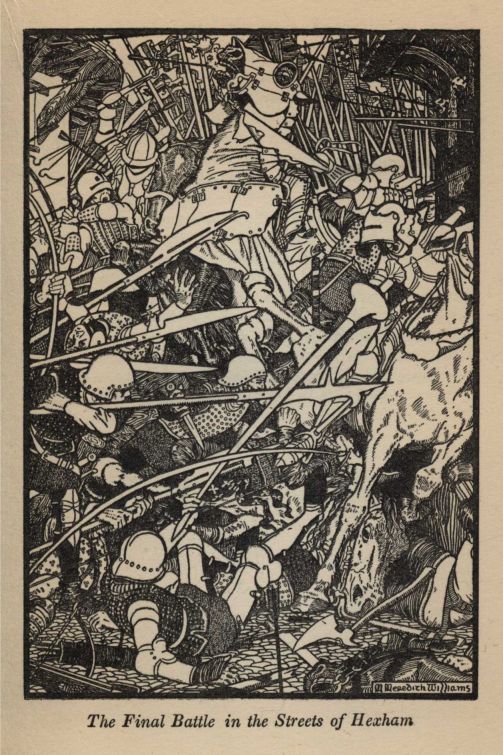
The Final Battle in the Streets of Hexham
Till the last moment the queen hoped on. She was not daunted by scenes of strife and bloodshed. When defeat was an accomplished fact, she and her young son fled to the Dipton Woods, where they fell into the hands of rough men, some say a party of Yorkist stragglers. Whilst these men were eagerly dividing and quarrelling over the queen's jewels, she and the prince slipped away. Deeper into the dangerous woods they had to go, for worse than robbers were hunting for them around Hexham. Suddenly an outlaw stood in their path with drawn sword. Even after that day of stir and terror Margaret's courage did not fail her. She boldly declared to the man that she was the Queen of England, and with her was her only son. Now, if he chose to betray them he could do so; but if he had that natural nobility that hailed gladly great chances to do great deeds, now was his time to prove himself a man, and to save the ill-fated prince and his queen.
The robber bowed before her as though she were on her throne, and as if the trees were her army around her. He swore to die a hundred deaths rather than betray his rightful sovereign and her prince. He honourably kept his word; and through his safe guidance and steady devotion, both queen and prince were able to join King Henry in Scotland, to which place he had safely escaped.
Thus the bandit of Hexham proved himself to be a truer man than either Lord Montague, or Warwick, the King-maker, or King Edward IV. of England.
Chapter XV
Fair Helen of Kirkconnell
Very simple, very touching, is the story of fair Helen of Kirkconnell. This beautiful maiden had two lovers, one rich, one poor. Her friends favoured the rich one, she loved the poor one. She and her chosen lover used to meet secretly in the romantic churchyard of Kirkconnell, by the side of the river Kirtle. Learning this, the rejected lover crept up one evening, with his carbine, to shoot his luckier rival; Helen saw him at the moment of firing, and threw herself forward to receive the shot in her bosom, and so save her lover's life at the cost of her own.
The ballad describing the grief of her lover is one of the most beautiful and touching pieces of poetry in existence, and must be given here entire.
FAIR HELEN
I wish I were where Helen lies;
Night and day on me she cries;
O that I were where Helen lies,
On fair Kirkconnell Lee!
Curst be the heart that thought the thought,
And curst the hand that shot the shot,
When in my arms burd Helen dropt,
And died to succour me.
O think ye not my heart was sair,
When my love dropt and spak nae mair!
There did she swoon wi' meikle care,
On fair Kirkconnell Lee.
As I went down the water-side,
None but my foe to be my guide,
None but my foe to be my guide,
On fair Kirkconnell Lee!
I lighted down my sword to draw,
I hacked him in pieces sma',
I hacked him in pieces sma',
For her sake that died for me.
O Helen fair beyond compare,
I'll make a garland of thy hair,
Shall bind my heart for evermair,
Until the day I die.
O that I were where Helen lies,
Night and day on me she cries;
Out of my bed she bids me rise,
Says, "Haste and come to me!"
O Helen fair! O Helen chaste!
If I were with thee, I were blest,
Where thou lies low, and takes thy rest,
On fair Kirkconnell Lee.
O that my grave were growing green,
A winding sheet drawn ower my een,
And I in Helen's arms were lying,
On fair Kirkconnell Lee!
I wish I were where Helen lies!
Night and day on me she cries,
And I am weary of the skies,
For her sake that died for me.
Chapter XVI
Johnie of Breadislee
Johnie of Breadislee, outlaw and deer-stealer, was one of the "broken men," as they were called, the Ishmaels of the Border. Johnie rose up one May morning, and called for water to wash his hands. He ordered to be unleashed his good grey dogs, that were bound with iron chains. When his mother heard that he had called for the dogs, she wrung her hands. "O Johnie!" she cried, "for my blessing, do not go to the greenwood to-day. Ye have enough of good wheat bread, enough blood-red wine, therefore, Johnie, I pray, stir not from home for any venison." But despite his mother's tears, Johnie busked up his good bent bow, and his arrows, and went off to Durrisdeer to hunt down the dun deer. As he came by Merriemass he espied a deer lying beneath a bush of furze. Johnie let fly an arrow, and the deer leapt as the pitiless shaft found its mark, and between the water and the brae his good hounds "laid her pride." So Johnie cut up the venison, giving the liver and lungs to his faithful hounds, as if they had been earl's sons. With such zest did they eat and drink that Johnie and the dogs fell asleep, as if they had been dead. Then as they lay, there came by a silly old man, and, as soon as he saw the poachers, he ran away to Hislinton, where the Seven Foresters were. "What news?" they asked. "What news bring ye, ye grey-headed carle?" "I bring no news," said the grey-headed carle, "save what my eyes did see. As I came down by Merrimass among the stunted trees, the bonniest child I ever saw lay asleep among his dogs. The shirt upon his back was of fine Holland, his doubtlet, over that, was of Lincoln twine, his buttons were of the good gold, the mouths of his good grey hounds were dyed with blood."
Now Johnie, like many another free-hearted outlaw, was a well-liked man. So the chief forester said, "If this be Johnie of Breadislee we will draw no nearer." But this was not the spirit of his men. Quoth the sixth Forester, "If it indeed be he, rather let us slay him." Cautiously they went through the thicket, and when they saw their man, asleep and helpless, they shot a flight of arrows. Johnie sprang up, sore wounded on the knee. The seventh forester cried out, "The next flight will kill him," but little chance did the outlaw give them for such an easy victory. He set his back against an oak and propped his wounded leg upon a stone; with bow or with sword he was a better man by far than any of his foes.
In the short, sharp fight that followed, he killed six of the foresters, some with arrow, and some with steel; and when the seventh turned to flee, Johnie seized him from behind and threw him on to the ground with a force that broke three of his ribs. Then he laid him on his steed, and bade him carry the tidings home.
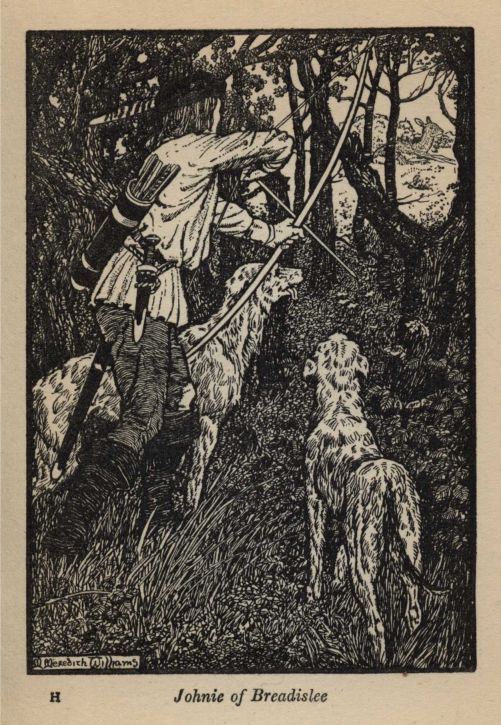
Johnie of Breadislee
But Johnie himself was hurt to death. "Is there no bonnie singing bird," he cried, "that can fly to my mother's bower and tell her to fetch Johnie away?" A starling flew to his mother's window sill, and sang and whistled, and the burden of its tune was ever the same. "Johnie tarries long." So the men made a litter from rods of the hazel bush and of the thorn and fetched Johnie away. Then his old mother's tears flowed fast, and she said, "Ye would not be warned, my son Johnie, to bide away from the hunting. Oft have I brought to Breadislee the less or greater gear, but never what grieved my heart so sorely. But woe betide that silly old grey-headed carle! An ill death shall he die! The highest tree in Merriemass shall be his reward."
"Now Johnie's gude bent bow is brake,
And his gude grey dogs are slain,
And his body lies dead in Durrisdeer,
And his hunting it is done."
Chapter XVII
Katharine Janfarie
This ballad is evidently the original of Sir Walter Scott's "Lochinvar," though Sir Walter reversed the names of the two leading male characters. In "Katharine Janfarie" Lochinvar plays the part of the craven bridegroom.
There was a may,[#] and a weel-far'd may,
Lived high up in yon glen;
Her name was Katharine Janfarie,
She was courted by mony men.
[#] maiden.
Up there came Lord Lauderdale,
Up frae the Lowland Border,
And he has come to court this may,
A' mounted in good order.
He told na her father, he told na her mother,
And he told na ane o' her kin,
But he whispered the bonnie lassie hersell,
And has her favour won.
But out there cam Lord Lochinvar,
Out frae the English Border,
All for to court this bonny may,
Weel mounted, and in order.
He told her father, he told her mother,
And a' the lave[#] o' her kin;
But he told na the bonny may hersell,
Till on her wedding e'en.
[#] rest.
She sent to the Lord o' Lauderdale,
Gin[#] he wad come and see,
And he has sent back word again,
Weel answered he suld[#] be.
[#] if. [#] should.
And he has sent a messenger
Right quickly through the land,
And raised mony an armed man
To be at his command.
The bride looked out at a high window,
Beneath baith dale and down,
And she was aware of her first true love,
With riders mony a one.
She scoffed him, and scorned him,
Upon her wedding-day;
And said, "It was the Fairy Court,
To see him in array!
"O come ye here to fight, young lord,
Or come ye here to play?
Or come ye here to drink good wine,
Upon the wedding-day?"
"I come na here to fight," he said,
"I come na here to play,
I'll but lead a dance wi' the bonny bride,
And mount, and go my way."
It is a glass of the blood-red wine
Was filled up them between,
And aye she drank to Lauderdale,
Wha[#] her true love had been.
[#] who.
He's taen[#] her by the milk-white hand,
And by the grass-green sleeve;
He's mounted her hie behind himsell,
At her kinsmen speired[#] na leave.
[#] taken. [#] asked.
"Now take your bride, Lord Lochinvar!
Now take her if ye may!
But if you take your bride again,
We'll call it but foul play."
There were four-and-twenty bonnie boys,
A' clad in the Johnstone grey;
They said they would take the bride again,
By the strong hand, if they may.
Some o' them were right willing men,
But they were na willing a';
And four-and-twenty Leader lads
Bid them mount and ride awa'.
Then whingers flew frae gentles' sides,
And swords flew frae the shea's,[#]
And red and rosy was the blood
Ran down the lily braes.
[#] sheathes.
The blood ran down by Caddon bank,
And down by Caddon brae,
And, sighing, said the bonnie bride—
"O wae's me for foul play."
My blessing on your heart, sweet thing!
Wae to your wilfu' will!
There's mony a gallant gentleman
Whae's bluid ye have garred[#] to spill.
[#] caused.
Now a' the lords of fair England,
And that dwell by the English Border,
Come never here to seek a wife,
For fear of sic[#] disorder.
[#] such.
They'll track ye up, and settle ye bye,
Till on your wedding-day;
Then gie ye frogs instead of fish,
And play ye foul foul play.
LOCHINVAR
In Sir Walter Scott's poem, Lochinvar is the hero, and the story has a happier ending. The song was supposed to have been sung to James IV. by Lady Heron at Holyrood shortly before the fatal battle of Flodden.
O young Lochinvar has come out of the west,
Through all the wide border his steel was the best;
And save his good broadsword, he weapons had none,
He rode all unarmed, and he rode all alone,
So faithful in love, and so dauntless in war,
There never was knight like the young Lochinvar.
He staid not for brake, and he stopped not for stone,
He swam the Eske river where ford there was none,
But ere he alighted at Netherby gate,
The bride had consented, the gallant came late;
For a laggard in love, and a dastard in war,
Was to wed the fair Ellen of brave Lochinvar.
So boldly he entered the Netherby Hall,
Among bride's men, and kinsmen, and brothers, and all,
Then spoke the bride's father, his hand on his sword
(For the poor craven bridegroom said never a word),
"O come ye in peace here, or come ye in war,
Or to dance at our bridal, young Lord Lochinvar?"
"I long wooed your daughter, my suit you denied;
Love swells like the Solway, but ebbs like its tide,
And now am I come, with this lost love of mine,
To lead but one measure, drink one cup of wine,
There are maidens in Scotland, more lovely by far,
That would gladly be bride to the young Lochinvar."
The bride kissed the goblet; the knight took it up,
He quaffed off the wine, and he threw down the cup.
She looked down to blush, and she looked up to sigh,
With a smile on her lips, and a tear in her eye.
He took her soft hand, ere her mother could bar,
"Now tread we a measure!" said young Lochinvar.
So stately her form, and so lovely her face,
That never a hall such a galliard did grace;
While her brother did fret, and her father did fume,
And the bridgroom stood dangling his bonnet and plume,
And the bride-maidens whispered, "'Twere better by far,
To have matched our fair cousin with young Lochinvar."
One touch to her hand, and one word in her ear,
When they reached the hall-door, and the charger stood near;
So light to the croupe the fair lady he swung,
So light to the saddle before her he sprung!
"She is won! we have gone over bank, bush, and scaur;
They'll have fleet steeds that follow," quoth young Lochinvar.
There was mounting 'mong Graemes of the Netherby clan;
Fosters, Fenwicks, and Musgraves, they rode and they ran,
There was racing and chasing, on Cannobie Lee,
But the lost bride of Netherby ne'er did they see.
So daring in love, and so dauntless in war,
Have ye e'er heard of gallant like young Lochinvar?
Chapter XVIII
By Lauder Bridge
The Ancient Royal Burgh of Lauder, a quaint little border town with hardly more than one street, is on the banks of the river Leader, on the high road between Edinburgh and Kelso. It stands very picturesquely, among the bold hills and fine woods of Berwickshire, and the valley is called Lauderdale, extending to where the Leader joins the Tweed, just below Melrose. Peacefully beautiful is the spot; and yet it was once the scene of a harsh, grim tragedy.
It was in the reign of King James III. of Scotland, who offended his subjects in two particulars.
First, to get wealth for himself, he mixed brass and lead with his silver money, and put it into circulation as pure silver; next, he chose favourites from the common people, and set these above the proud noblemen of Scotland.
This latter would not have been so bad a fault if the king had always chosen wisely; but, as often in such cases, he was led by flatterers rather than by worthy men.
In 1482 the king declared war against England, and, as in these warlike days the nobles were the leaders of the army, this brought the discontented lords together.
When the Scottish army reached Lauder in their southward march, the proud nobles met in Lauder church; all were angry with the king, yet each was afraid to make the first move. So Lord Gray told them a mocking fable.
"Do you remember," said he, "how all the mice got together and agreed that it would be a splendid thing if a bell were hung round the cat's neck, so that wherever she went she could be heard; the only difficulty was to find a mouse to bell the cat!"
These warlike nobles did not like to be spoken of as if they were mice, and it roused them to deeper rage.
Then out spoke Archibald Douglas, Earl of Angus, the head of the younger branch of the Douglas family. "Trust me, I'll bell the cat!"
There was a knock at the door; Cochrane, the architect, whom the nobles said had been a mason, but was now the king's chief favourite, entered, dressed in black velvet, with a heavy chain of gold round his neck, a horn of gold tipped with precious stones, and all his attire of the costliest. Angus caught the chain in his hands and said, "A rope would suit that neck better!"
Then the nobles laid violent hands on all the king's low-born favourites and hanged them by the bridge of Lauder, in front of the king's very eyes! Cochrane was proud and brave to the last. He said that as the king had made him an earl he should be hanged with a rope made of silk; little did the nobles care for his protests, the halter of a horse was in their opinion good enough for him.
From this time onward the headstrong Earl of Angus was known by the nick-name of "Bell-the-Cat." It may be taken for granted that neither he nor the nobles who supported him would have dared to act so arrogantly and violently unless they felt quite sure that the king had not the power to punish them. He returned sullenly to Edinburgh, more the captive of the nobles than their master.
A parliament appointed the Duke of Albany lieutenant-general of the kingdom, but he in turn soon lost favour, for he was suspected of too great a friendship for Edward IV., King of England, and fled for safety to France, giving James another chance to govern his kingdom for himself.
This weak and unhappy monarch, however, was not destined to have much peace. Before very long, another quarrel with his nobles led to their taking up arms with a view of deposing him and placing his son on the throne. The king and his nobles met in battle near Stirling, but, at the very beginning of the fight, James was thrown from his horse and stabbed by a soldier, whose name remained unknown. Thus died this weak but amiable and unfortunate king.
Chapter XIX
The Battle of Flodden Field
One of the most tragic episodes in the History of the Borders was the battle of Flodden Field, when the flower of the Scottish nobility fell around their sovereign, James IV., while fighting against the English under Surrey.
The causes of the war were many. Henry of England refused to give up the jewels which had been promised as the dowry of his sister Margaret on her marriage with James IV.
The Lord High Admiral of England, Sir Edmund Howard, had attacked and taken two Scottish ships, and slain their captain, Sir Andrew Barton. James, who was fond of Barton, demanded redress, but Henry insolently replied that kings should not quarrel about pirates.
But the immediate cause was the friendship between France and Scotland. Henry was preparing for war with France, and James stood by his ally, declaring that if Henry warred with France, he would lead an army into England. The Queen of France sent James a turquoise ring, asking him to carry out his threat to serve her interests.
James had been warned that his action would have terrible consequences. A man appeared to him at Linlithgow, clad in a long blue gown, with bare head, and carrying a pikestaff, and having told the king that his dead mother had sent him to warn him not to go to war against England, he disappeared as suddenly as he had come.
Also at the dead of night a voice had been heard proclaiming aloud at the market Cross in Edinburgh the names of those who, within forty days, would be no more. It was thought at the time that these happenings were instigated by Queen Margaret, but the king still persisted in his policy, and led his army across the Border, in spite of the warnings of his counsellors and his queen.
A fine description of his army is given by Sir Walter Scott, when Lord Marmion watches the scene from Blackford Hill.
"Thousand pavilions, white as snow,
Spread all the Borough-moor below,
Upland, and dale, and down:—
A thousand, did I say? I ween,
Thousands and thousands, there were seen,
That chequer'd all the heath between
The streamlet and the town;
In crossing ranks extending far,
Forming a camp irregular;
Oft giving way, where still there stood
Some relics of the old oak wood,
That darkly huge did intervene,
And tamed the glaring white with green,
In these extended lines there lay,
A martial kingdom's vast array.
For from Hebudes, dark with rain,
To eastern Lodon's fertile plain,
And from the southern Redswire edge,
To farthest Rosse's rocky ledge,
From west to east, from south to north,
Scotland sent all her warriors forth,
Marmion might hear the mingled hum,
Of myriads up the mountain come;
The horses' tramp, and tingling clank,
Where chiefs reviewed their vassal rank,
And charger's shrilling neigh;
And see the shifting lines advance
Whilst frequent flash'd, from shield and lance,
The sun's reflected ray.
* * * * *
They saw, slow rolling on the plain,
Full many a baggage-cart and wain,
And dire artillery's clumsy car.
By sluggish oxen tugg'd to war;
* * * * *
Nor mark'd they less, where in the air
A thousand streamers flaunted fair,
Various in shape, device, and hue,
Green, sanguine, purple, red, and blue,
Broad, narrow, swallow-tailed, and square,
Scroll, pennon, pensil, bandrol,[#] there
O'er the pavilions flew.
Highest and midmost, was descried
The royal banner floating wide;
The staff, a pine-tree, strong and straight,
Pitch'd deeply in a massive stone,
Which still in memory is shown,
Yet bent beneath the standard's weight.
Whene'er the western breeze unroll'd,
With toil, the huge and cumbrous fold,
And gave to view the dazzling field,
Where, in proud Scotland's royal shield,
The ruddy lion ramp'd in gold."
[#] Each feudal ensign intimated the rank of those who displayed them.
Marmion wondered that with such a glorious army at his back anyone should try to dissuade James from battle, yet Sir David Lindesay of the Mount answered him,
"'twere good
That Kings would think withal,
When peace and wealth their land has bless'd,
'Tis better to sit still at rest,
Than rise, perchance to fall."
Men-at-arms were there, sheathed in plate armour, with battle-axe and spear, and mounted on Flemish steeds. Young knights and squires practised their chargers on the plain. Hardy burghers marched on foot, armed with long pikes and two-handed swords and bright bucklers.
The yeoman, too, was on foot, dressed in steel-jack quilted well with iron, and bearing at his back, provisions for forty days. He seemed sad of cheer, and loth to leave his humble cottage, wondering who would till the land during his absence.
There, too, was the Borderer:—
"bred to war,
He knew the battle's din afar,
And joy'd to hear it swell.
His peaceful day was slothful ease,
Nor harp nor pipe his ear could please
Like the loud slogan yell."
for
"War's the Borderer's game,
Their gain, their glory, their delight,
To sleep the day, maraud the night,
O'er mountain, moss, and moor."
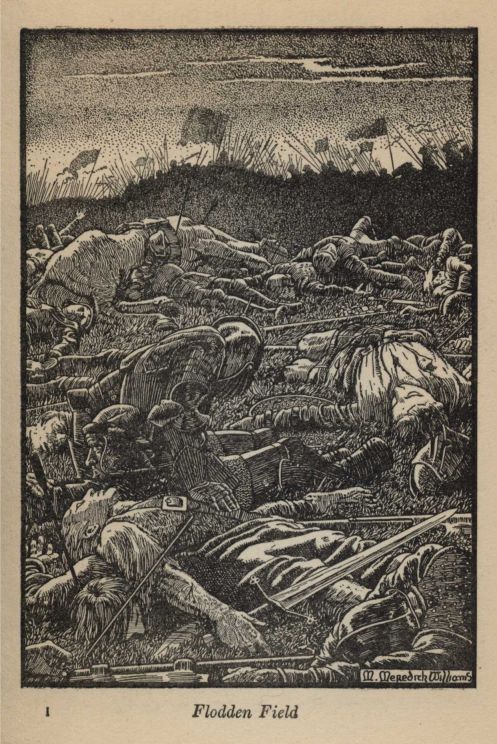
Flodden Field
There, too, were the Celts, with savage eyes looking out wildly through red and sable hair, with sinewy frames and legs bare above the knees, their chiefs known by the eagle's plumage. They wore the skin of the red deer, a graceful bonnet, and a plaid hung from the shoulders, and carried as weapons a broadsword, a dagger, and quivers, bows, and shafts.
The Isles-men, too, were there, carrying the ancient Danish battle-axe. While the army was mustering together, James feasted the chiefs in Holyrood Palace, for at dawn they were to march southward.
"Well loved that splendid monarch aye
The banquet and the song,
By day the tourney, and by night
The merry dance, traced fast and light,
The maskers quaint, the pageant bright,
The revel loud and long.
This feast outshone his banquets past;
It was his blithest and his last."
And hazel was his eagle eye,
And auburn of the darkest dye,
His short curl'd beard and hair.
Light was his footstep in the dance,
And firm his stirrup in the lists;
And oh! he had that merry glance,
That seldom lady's heart resists."
Yet no fair lady was as dear to James as his own Queen Margaret, who sat alone in the tower of Linlithgow weeping for the war against her native country, and for the danger of her lord.
On the morrow, James marched south, crossed the Tweed, and encamped on the banks of the Till, near Twisel Bridge. The Scottish army moved down the side of the Tweed to Flodden Hill taking Norham Castle, and the Border towns of Etal, Wark, and Ford. Much time was wasted in these petty enterprises, time which should have been spent in marching to Newcastle before the English were prepared to offer resistance. When the castle of Ford was stormed, Lady Heron, wife of Sir William Heron, then a prisoner in Scotland, was taken, and this beautiful and artful woman induced James to idle away his time until all chance was lost of defeating the enemy.
The army suffered severely from want of provisions, and many of the Highlanders and Isles-men returned home, many who had come only for booty, deserted, and the numbers were reduced to about thirty thousand.
Meanwhile, the Earl of Surrey had raised twenty-six thousand men, and received other enforcements as he came north from Durham. He therefore challenged James to fight, and charged him with violating the treaty of peace between the two kingdoms.
The Scottish nobles were unwilling to fight, and said it was impossible to remain in a country so plundered; also, if fight the king must, he would fight to much greater advantage in his own country, to whose welfare the loss of this battle would be fatal; while he had sufficiently indicated his honour by crossing the Border.
James would not listen to the counsel of his nobles, though even the aged Earl of Angus expostulated with him. To this old warrior he angrily said, "Angus, if you are afraid, you may go home," at which insult the aged Earl burst into tears.
The English army crossed the Till by Twisel Bridge and pressed on while the Scottish army stood idly by, the Scottish nobles in vain entreating the king to attack the English while they were crossing.
When the English army had drawn up in order of battle on the left bank of the river, the Scots, setting fire to their temporary huts, came down the ridge of Flodden. The clouds of smoke from the burning huts were driven into the face of the English, so that the Scots had got to within a quarter of a mile of them before they perceived them.
"No martial shout, nor minstrel tone,
Announced their march; their tread alone,
At times one warning trumpet blown,
At times a stifled hum,
Told England, from his mountain-throne,
King James did rushing come:
Scarce could they hear or see their foes
Until at weapon-point they close."
With clanging blows and arrows that fell like rain, with yelling and clamour and sword-sway and lance-thrust, the battle continued until the evening, and when even fell, the Scots still fought in an unbroken ring round their king. But when darkness came, and Surrey withdrew his men, the flower of Scotland's chivalry had fallen, and the king lay dead on the field.
"Afar, the royal standard flies,
And round it toils and bleeds and dies.
Our Caledonian pride!"
* * * * *
But yet, though thick the shafts as now,
Though charging knights like whirlwinds go,
Though billmen ply the ghastly bow,
Unbroken was the ring.
The stubborn spearmen still made good
Their dark impenetrable wood,
Each stepping where his comrade stood
The instant that he fell.
No thought was there of dastard flight:
Link'd in the serried phalanx tight,
Groom fought like noble, squire like knight,
As fearlessly and well;
Till utter darkness closed her wing
O'er their thin host and wounded King.
Then skilful Surrey's sage commands
Led back from strife his shattered bands;
And from the charge they drew,
As mountain-waves, from wasted lands,
Sweep back to ocean blue.
Then did their loss his foemen know;
Their King, their lords, their mightiest low,
They melted from the field as snow,
When streams are swoln and south winds blow
Dissolves in silent dew.
* * * * *
Still from the sire the son shall hear
Of the stern fight and carnage drear
Of Flodden's fatal field,
Where shiver'd was fair Scotland's spear,
And broken was her shield!
* * * * *
And well in death his trusty brand,
Firm clench'd within his manly hand
Beseem'd the Monarch slain."
Chapter XX
After Flodden
So deeply did the tragic result of Flodden touch the hearts of the Scottish people that no Scot could for many a long day hear it mentioned without a heart-thrill.
Many are the songs written about it, the most famous perhaps, being the "Flowers of the Forest," written two centuries later, though partly founded upon an older and almost forgotten song.
THE FLOWERS OF THE FOREST
I've heard them lilting, at our ewe-milking,
Lasses a' lilting, before dawn o' day;
But now they are moaning on ilka green loaning[#]
The Flowers of the Forest are a' wede away.
[#] a broad grassy lane used as milking-ground.
At bughts, in the morning, nae blythe lads are scorning;[#]
The lasses are lonely, and dowie, and wae;
Wae daffing,[#] nae gabbing,[#] but sighing and sabbing;
Ilk ane lifts her leglin,[#] and hies her away.
[#] rallying. [#] joking. [#] chatting. [#] milking-pail.
In hair'st, at the shearing, nae youths now are jeering,
The bandsters[#] are runkled,[#] and lyart[#] or gray;
At fair, or at preaching, nae wooing, nae fleeching;[#]
The Flowers of the Forest are a' wede away.
[#] sheaf-binders. [#] wrinkled. [#] inclining to grey. [#] coaxing.
At e'en, in the gloaming, nae younkers are roaming
'Bout stacks with the lasses at bogle to play;
But ilk maid sits dreary, lamenting her deary—
The Flowers of the Forest are a' wede away.
Dool and wae for the order, sent our lads to the Border!
The English, for ance, by guile wan the day:
The Flowers of the Forest, that fought aye the foremost,
The prime of our land, are cauld in the clay.
We'll hear nae mair lilting at the ewe-milking;
Women and bairns are heartless and wae:
Sighing and moaning on ilka green loaning—
The Flowers of the Forest are a' wede away.
JEAN ELLIOT (1727-1805).
The following poem also gives eloquent and touching expression to the deep gloom which descended upon the Border after the fatal battle, and tells of the despair felt in almost every Ettrick home:—
SELKIRK AFTER FLODDEN
(A WIDOW'S DIRGE, OCTOBER 1513)
It's but a month the morn
Sin' a' was peace and plenty;
Oor hairst was halflins shorn,
Eident men and lasses denty.
But noo it's a' distress—
Never mair a merry meetin ';
For half the bairns are faitherless,
And a' the women greetin'.
O Flodden Field!
Miles and miles round Selkirk toun,
Where forest flow'rs are fairest,
Ilka lassie's stricken doun,
Wi' the fate that fa's the sairest.
A' the lads they used to meet
By Ettrick braes or Yarrow
Lyin' thrammelt head and feet
In Brankstone's deadly barrow!
O Flodden Field!
Frae every cleuch and clan
The best o' the braid Border
Rose like a single man
To meet the royal order.
Oor Burgh toun itsel'
Sent its seventy doun the glen;
Ask Fletcher[#] how they fell,
Bravely fechtin', ane to ten!
O Flodden Field!
[#] This was the man who brought an English flag back to Selkirk from Flodden. Four brothers of that name are said to have perished in the battle.
Round about their gallant king,
For country and for croun,
Stude the dauntless Border ring,
Till the last was hackit doun.
I blame na what has been—
They maun fa' that canna flee—
But oh, to see what I hae seen,
To see what now I see!
O Flodden Field!
The souters a' fu' croose,
O'er their leather and their lingle,
Wi' their shoon in ilka hoose,
Sat contentit round the ingle.
Noo there's naething left but dool,—
Never mair their work will cheer them;
In Flodden's bluidy pool
They'll neither wait nor wear them!
O Flodden Field!
Whar the weavers used to meet,
In ilka bieldy corner,
Noo there's nane in a' the street,
Savin' here and there a mourner,
Walkin' lonely as a wraith,
Or if she meet anither,
Just a word below their braith
O' some slauchtered son or brither!
O Flodden Field!
There stands the gudeman's loom
That used tae gang sae cheerie,
Untentit noo, and toom,
Makin' a' the hoose sae eerie,
Till the sicht I canna dree;
For the shuttles lyin' dumb
Speak the loudlier to me
O' him that wunna come.
O Flodden Field!
Sae at nicht I cover't o'er,
Just to haud it frae my een,
But I haena yet the pow'r
To forget what it has been;
And I listen through the hoose
For the chappin o' the lay,
Till the scrapin' o' a moose
Tak's my very braith away.
O Flodden Field!
Then I turn to sister Jean,
And my airms aboot her twine,
And I kiss her sleepless een,
For her heart's as sair as mine,—
A heart ance fu' o' fun,
And hands that ne'er were idle,
Wi' a' her cleedin' spun
Against her Jamie's bridal.
O Flodden Field!
Noo we've naether hands nor hairt—
In oor grief the wark's forgotten,
Though it's wantit every airt,
And the craps are lyin' rotten.
War's awsome blast's gane bye,
And left a land forlorn;
In daith's dool hairst they lie,
The shearers and the shorn.
O Flodden Field.
Wi' winter creepin' near us,
When the nichts are drear and lang,
Nane to help us, nane to hear us,
On the weary gate we gang!
Lord o' the quick an' deed,
Sin' oor ain we canna see,
In mercy mak gude speed,
And bring us whar they be,
Far, far, frae Flodden Field!
"J. B. Selkirk" (JAMES B. BROWN).
By permission of W. Cuthbertson, Esq.
Another lyric, relating to the fatal battle of Flodden, refers to the gallantry of the Souters, or shoemakers of Selkirk, who, to the number of eighty, and headed by their town-clerk, joined the army as it entered England. They distinguished themselves greatly, and few returned. The "yellow and green" are the liveries of the house of Home, taxed by some with being the cause of the defeat.
THE SOUTERS OF SELKIRK
Up wi' the Souters of Selkirk,
And doun wi' the Earl of Home;
And up wi' a' the braw lads
That sew the single-soled shoon.
Fye upon yellow and yellow,
And fye upon yellow and green,
But up wi' the true blue and scarlet,
And up wi' the single-soled sheen.
Up wi' the Souters of Selkirk,
For they are baith trusty and leal;
And up wi' the men o' the Forest,
And doun wi' the Merse to the deil.
In Aytoun's "Lays of the Scottish Cavaliers," the following well-known poem tells how the news of the disaster at Flodden Field was received in Edinburgh:—
EDINBURGH AFTER FLODDEN
I
News of battle! news of battle!
Hark! 'tis ringing down the street:
And the archways and the pavement
Bear the clang of hurrying feet.
News of battle! Who hath brought it?
News of triumph! Who should bring
Tidings from our noble army,
Greetings from our gallant King?
All last night we watched the beacons
Blazing on the hills afar,
Each one bearing, as it kindled,
Message of the opened war.
All night long the northern streamers
Shot across the trembling sky:
Fearful lights that never beckon
Save when kings or heroes die.
II
News of battle! Who hath brought it?
All are thronging to the gate;
"Warder—warder! open quickly!
Man—is this a time to wait?"
And the heavy gates are opened;
Then a murmur long and loud,
And a cry of fear and wonder
Bursts from out the bending crowd.
For they see in battered harness
Only one hard-stricken man;
And his weary steed is wounded,
And his cheek is pale and wan.
Spearless hangs a bloody banner
In his weak and drooping hand—
God! can that be Randolph Murray,
Captain of the city band?
III
Round him crush the people, crying,
"Tell us all—oh, tell us true!
Where are they who went to battle,
Randolph Murray, sworn to you?
Where are they, our brothers—children?
Have they met the English foe?
Why art thou alone, unfollowed?
Is it weal, or is it woe?"
Like a corpse the grisly warrior
Looks from out his helm of steel;
But no word he speaks in answer—
Only with his armèd heel
Chides his weary steed, and onward
Up the city streets they ride;
Fathers, sisters, mothers, children,
Shrieking, praying by his side.
"By the God that made thee, Randolph!
Tell us what mischance hath come."
Then he lifts his riven banner,
And the asker's voice is dumb.
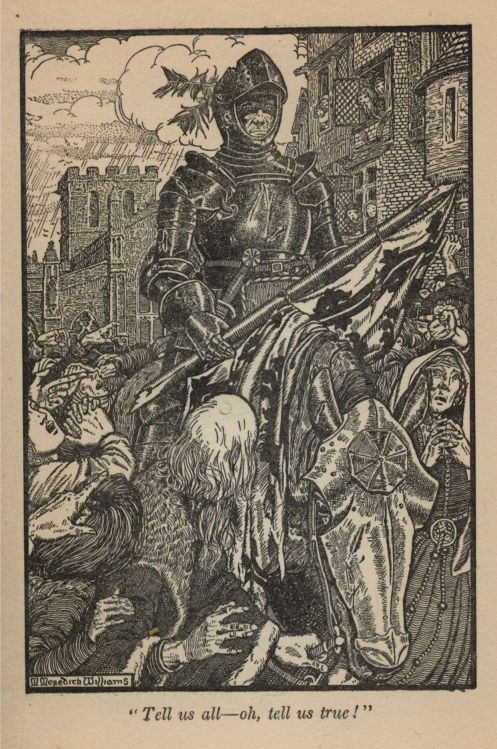
"Tell us all—oh, tell us true!"
IV
The elders of the city
Have met within their hall—
The men whom good King James had charged
To watch the tower and wall.
"Your hands are weak with age," he said,
"Your hearts are stout and true;
So bide ye in the maiden town,
While others fight for you.
My trumpet from the Border-side
Shall send a blast so clear,
That all who wait within the gate
That stirring sound may hear.
Or, if it be the will of Heaven
That back I never come,
And if, instead of Scottish shout,
Ye hear the English drum,
Then let the warning bells ring out,
Then gird you to the fray,
Then man the walls like burghers stout,
And fight while fight you may.
'Twere better that in fiery flame
The roofs should thunder down,
Than that the foot of foreign foe
Should trample in the town!"
V
Then in came Randolph Murray,
His step was slow and weak,
And, as he doffed his dinted helm,
The tears ran down his cheek:
They fell upon his corslet
And on his mailed hand,
As he gazed around him wistfully,
Leaning sorely on his brand.
And none who then beheld him
But straight were smote with fear,
For a bolder and a sterner man
Had never couched a spear.
They knew so sad a messenger
Some ghastly news must bring;
And all of them were fathers,
And their sons were with the King.
VI
And up then rose the Provost—
A brave old man was he,
Of ancient name, and knightly fame,
And chivalrous degree.
He ruled our city like a Lord
Who brooked no equal here,
And ever for the townsmen's rights
Stood up 'gainst prince and peer.
And he had seen the Scottish host
March from the Borough muir,
With music-storm and clamorous shout,
And all the din that thunders out
When youth's of victory sure.
But yet a dearer thought had he;—
For, with a father's pride,
He saw his last remaining son
Go forth by Randolph's side,
With casque on head and spur on heel,
All keen to do and dare;
And proudly did that gallant boy
Dunedin's banner bear.
Oh! woeful now was the old man's look,
And he spake right heavily—
"Now, Randolph, tell thy tidings,
However sharp they be!
Woe is written on thy visage,
Death is looking from thy face;
Speak! though it be of overthrow—
It cannot be disgrace!"
VII
Right bitter was the agony
That wrung that soldier proud;
Thrice did he strive to answer,
And thrice he groaned aloud.
Then he gave the riven banner
To the old man's shaking hand,
Saying—"That is all I bring ye
From the bravest of the land!
Ay! ye may look upon it—
It was guarded well and long,
By your brothers and your children,
By the valiant and the strong.
One by one they fell around it,
As the archers laid them low,
Grimly dying, still unconquered,
With their faces to the foe.
Ay! ye may well look upon it—
There is more than honour there,
Else, be sure, I had not brought it
From the field of dark despair.
Never yet was royal banner
Steeped in such a costly dye;
It hath lain upon a bosom
Where no other shroud shall lie.
Sirs! I charge you, keep it holy;
Keep it as a sacred thing,
For the stain ye see upon it
Was the life-blood of your King!"
VIII
Woe and woe and lamentation!
What a piteous cry was there!
Widows, maidens, mothers, children,
Shrieking, sobbing in despair!
Through the streets the death-word rushes,
Spreading terror, sweeping on.
"Jesu Christ! our King has fallen—
O Great God, King James is gone!
Holy mother Mary, shield us,
Thou who erst did lose thy Son!
O the blackest day for Scotland
That she ever knew before!
O our King—the good, the noble,
Shall we see him never more?
Woe to us, and woe to Scotland!
O our sons, our sons and men!
Surely some have 'scaped the Southron,
Surely some will come again!"
Randolph Murray describes how the monarch lies dead on the field with his nobles round him.
"All so thick they lay together,
When the stars lit up the sky,
That I knew not who were stricken,
Or who yet remained to die."
A hollow knell is rung and the miserere is sung, and all is terror and disorder until the Provost rouses them.
"If our King be taken from us,
We are left to guard his son.
* * * * *
Up! and haste ye through the city,
Stir the burghers stout and true!
Gather all our scattered people,
Fling the banner out once more—
Randolph Murray! do thou bear it,
As it erst was borne before:
Never Scottish heart will leave it,
When they see their monarch's gore!"
Chapter XXI
Graeme and Bewick
Good Lord Graeme and Sir Robert Bewick were friends. They met one day in Carlisle, and went arm in arm to the wine, and, as was too oft the custom of these days, they stayed and drank till they were both merry. Good Lord Graeme took up the cup. "Sir Robert, and here's to thee!" he said, "and here's to our two sons at home, for they like us best in our own country."
"O were your son a lad like mine," answered Bewick, boastfully, "and learnt some books that he could read, they might be two brothers in arms, and lord it over the Borderside.
'But your son's a lad, and he's but bad,
And billie[#] to my son he cannot be.'
[#] Comrade, or brother-in-arms.
You sent him to school, and he would not learn; you bought him books, and he would not read!"
Lord Graeme called angrily for the reckoning. "My blessing shall he never earn," said he, "till I see how his arm can defend his head." He threw down a crown, and went to the stable, took his horse, and rode home. "Welcome, my old father," said his son, Christie Graeme, "but where were ye so long from home?" "I have been at Carlisle town, and a shamed man I am by thee," answered his father with a black look; "I have been at Carlisle town, where Sir Robert Bewick met me. He says you are but a bad, wild youth, and can never be billie to his boy. I sent you to the school, and you would not learn. I bought you books, and you would not read; therefore you shall never have my blessing till I see you save your head in fight with young Bewick." "Now God forbid, my old father, that ever such a thing should be! Billie Bewick was my master, and I his scholar, in spite of the pains he wasted in teaching me." "O hold thy tongue, thou foolish lad! If thou dost not soon end this quarrel, there's my glove, I'll fight with thee myself."
Then Christie Graeme stooped low. "Father, put on your glove again, the wind has blown it from your hand."
"What's that, thou sayst, thou limmer loon?
How darest thou stand to speak to me?
If thou do not end this quarrel soon,
There's my right hand, thou'lt fight with me!"
Then went Christie to his chamber, to consider what should happen. Should he fight with his own father, or with his brother-in-arms, Bewick?
"If I should kill my billie dear,
God's blessing I shall never win;
But if I strike at my auld father,
I think 'twould be a mortal sin.
But if I kill my billie dear
It is God's will, so let it be;
But I make a vow, ere I go from home,
That I shall be the next man's die."
He put a good old jack or quilted doublet on his back, and on his head he put a cap of steel, and well did he become them with his sword and buckler by his side!
Now young Bewick had taken his father's sword under his arm, and walked about his father's close. He looked between himself and the sun, to see some approaching object, and was aware of a man in bright armour, riding that way most hastily.
"O who is yon, that comes this way,
So hastily that hither came?
I think it be my brother dear,
I think it be young Christie Graeme.
Your welcome here, my billie dear,
And thrice you're welcome unto me."
Christie explained that he was come to fight, that his father had been to Carlisle, and had met with the elder Bewick. He retailed what had passed, "and so I'll never earn my father's blessing, till he sees how my arm can guard my head in fight against thee."
"O God forbid, my billie dear,
That ever such a thing should be!
We'll take three men on either side,
And see if we can our fathers agree."
Christie shook his head. He knew that it was useless. "O hold thy tongue, billie Bewick. If thou'rt a man, as I'm sure thou art, come over the dyke and fight with me."
"But I have no harness, billie, as I see you have."
"As little harness as is on your back shall be on mine."
With that Christie threw off his coat of mail and cap of steel, stuck his spear into the ground, and tied his horse up to a tree. Bewick threw off his cloak, and cast aside his psalter book. He laid his hand upon the dyke, and vaulted over. The two fought for two long hours. The sweat dropped fast from them both, but not a drop of blood could be seen to satisfy the requirements of honour. At last Graeme hit Bewick under the left breast, and he fell to the ground wounded mortally.
"Rise up, rise up, now, billie dear,
Arise and speak three words to me!
Whether thou's gotten thy deadly wound,
Or if God and good leeching[#] may succour thee?"
[#] Doctoring.
Bewick groaned. "Get to horse, billie Graeme, and get thee hence speedily. Get thee out of this country—that none may know who has done this." "O have I slain thee, billie Bewick? But I made a vow, ere I came from home, that I would be the next man to die!" Thereupon he pitched his sword hilt downwards into a mole-hill, took a run of some three and twenty feet, and on his own sword's point he fell to the ground dead.
Then up came Sir Robert Bewick. "Rise up, my son," he said, "for I think you have got the victory."
"O hold your tongue, my father dear. Let me be spared your prideful talking. You might have drunken your wine in peace, and let me and my billie be! Go dig a grave, both wide and deep, and a grave to hold us both; but lay Christie Graeme on the sunny side, for full sure I know that the victory was to him."
"Alas," cried old Bewick, "I've lost the liveliest lad that ever was born unto my name." "Alas," quoth good Lord Graeme, "my loss is the greater.
'I've lost my hopes, I've lost my joy,
I've lost the key, but and the lock;
I durst have ridden the world around,
Had Christie Graeme been at my back!'"
Chapter XXII
The Song of the Outlaw Murray
"Word is gone to our noble king,
In Edinburgh where that he lay,
That there was an Outlaw in Ettrick Forest
Counted him nought, nor all his Court so gay."
The King mentioned in the ballad is supposed to have been either James IV. or James V. This places the date somewhere in the early part of the sixteenth century.
The Outlaw Murray and his lady kept royal state in Ettrick Forest. Here he lived with five hundred men, all gaily clad in livery of Lincoln green. His castle, built of lime and stone, stood fair and pleasantly in the midst of the Forest, surrounded by pine trees under which wandered many a hart and hind, many a doe and roe and other wild creatures. In the forefront of the castle stood two unicorns, with the picture of a knight and lady with green holly above their brows.
The King in Edinburgh heard of all this royal state and that the Outlaw in Ettrick Forest cared nought for the King of Scotland and his court.
"I make a vow," said the King, "that either I shall be King of Ettrick Forest, or the Outlaw shall be King of Scotland."
Then up spoke Lord Hamilton to the noble King, "my sovereign prince, take counsel of your nobles and of me. I counsel ye to send to the fine Outlaw and see if he will come and be your man and hold the Forest in fee from you. If he refuse, we will conquer both him and his lands, throw his castle down, and make a widow of his gay lady."
Then the King called to him James Boyd, son of the Earl of Arran, and when Boyd came and knelt before him, "Welcome, James Boyd," said the noble King; "you must go for me to Ettrick Forest where bides yonder Outlaw, ask him of whom he holds his lands, and who is his master, and desire him to come and be my man, and hold the Forest free from me. I will give him safe warrant to and from Edinburgh, and if he refuse we will conquer him and his lands, and throw down his castle, and make a widow of his gay lady; and hang his merry men pair by pair wherever we see them."
James Boyd took leave of the King and went blithely on his way, until he came to the fair Ettrick Forest, the first view of which he got coming down Birkendale Brae. He saw the doe and roe, the hart and hind and wild beasts in plenty, and heard blows ringing boldly, and arrows whizzing near by him.
He saw, too, the fair castle, the like of which he had never seen before, with the two gay unicorns on the forefront, and the picture of the knight and lady with the green holly above their brow.
Then he spied the five hundred men, all clad in livery of Lincoln green, and shooting with their bows on Newark Lee. In the midst of them was a knight armed from head to foot, mounted on a milk-white steed, with bended bow, all fine to look upon; whom Boyd knew at once to be the Outlaw himself.
"God save thee, brave Outlaw Murray, thy lady, and all thy chivalry!"
"Marry, thou art welcome, gentleman; thou seemst to be a King's messenger."
"The King of Scotland sent me here, good Outlaw, to know of whom you hold your lands, and who is your master."
"These lands are mine. I know no King in Christendom. I won this Forest from the English when neither the King nor his knights were there to see."
"The King desires that you come to Edinburgh, and hold the Forest then of him. If you refuse, he will conquer your lands and you, and he has vowed to throw down your castle, make a widow of your gay lady, and hang your knights pair by pair wherever he finds them."
"Ay, by my troth! I should indeed be far behind. Before the King should get my fair native land, many of his nobles would be cold, and their ladies right weary."
Then spoke the lady of the Outlaw, fair of face. "That an Outlaw should come before the King without my consent makes me fear much that there is treason. Bid him be good to his lords at home, for my lord shall ne'er see Edinburgh."
James Boyd took leave of the bold Outlaw and went back to Edinburgh, and when he came to the King, knelt lowly on his knee.
"Welcome, James Boyd," said the noble King, "of whom is Ettrick Forest held?"
"Ettrick Forest is the fairest forest that ever man saw. There are doe and roe and hart and hind and wild beasts in plenty; there's a fine castle of lime and stone standing there pleasantly, and in the forefront of the castle two unicorns all fine to see, with a picture of a knight and a lady, and the green holly above their brows. There the Outlaw keeps a royal company—five hundred merry men, all gaily clad in Lincoln green, and the Outlaw and his lady in purple. Surely they live right royally. He says that the forest is his own, that he won it from the English, and that as he won it, so will he keep it against all the Kings in Christendom."