Front matter
Reading edition
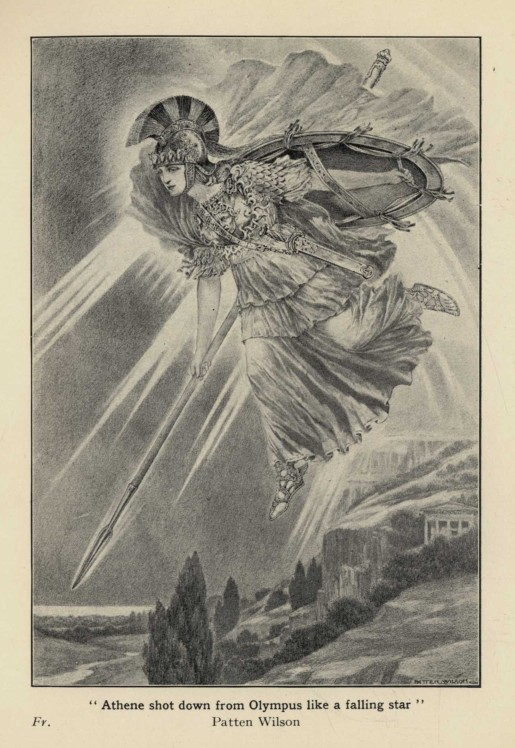
"Athene shot down from Olympus like a falling star" (Patten Wilson)
STORIES FROM THE ILIAD
RETOLD BY
H. L. HAVELL B.A.
AUTHOR OF "STORIES FROM HERODOTUS" "STORIES FROM GREEK TRAGEDY" "STORIES FROM THE ÆNEID" "STORIES FROM THE ODYSSEY" "STORIES FROM DON QUIXOTE" "STORIES FROM THUCYDIDES" "STORIES FROM XENOPHON"
"A nation without fancy, without some romance, never did never can, never will, hold a great place under the sun.... What enchanted us in our childhood, and is captivating a million of young fancies now, has, at the same blessed time of life, enchanted vast hosts of men and women who have done their long day's work and laid their grey heads down to rest."
CHARLES DICKENS
GEORGE G. HARRAP & CO. LTD. LONDON BOMBAY SYDNEY
First published February 1908 by GEORGE G. HARRAP & COMPANY 39-41 Parker Street, Kingsway, London, W.C.2
Reprinted: August 1908; February 1909; May 1910; July 1913; July 1916; July 1917; August 1919; April 1922; April 1924; March 1926; April 1928; November 1929
Printed in Great Britain by The Riverside Press Limited Edinburgh
CONTENTS
Introduction—
I. The Story II. The Divine Characters III. The Human Characters IV. The Similes
The Quarrel
The Dream: The Muster of Greeks
Greeks and Trojans Face to Face: The Duel
The Breaking of the Truce
The Exploits of Diomede
The Battle continued: Hector and Andromache
Second Battle: Repulse of the Greeks
The Embassy to Achilles
The Night Raid on the Trojan Camp
The Brave Deeds of Agamemnon: Reverses of the Greeks
The Attack on the Grecian Camp
Poseidon aids the Greeks
Zeus is Beguiled by Hera
The Last Battle by the Ships
Achilles sends Patroclus to Battle
The Fight for the Body of Patroclus
The News is brought to Achilles
The Shield of Achilles
The Reconciliation
Achilles in the Battlefield
The Death of Hector
The Funeral Games of Patroclus
Priam Ransoms the Body of Hector
Pronouncing List of Names
ILLUSTRATIONS
"Athene shot down from Olympus like a falling star" (Patten Wilson) Frontispiece
The Leaders of the Greeks (Christian G. Heyne)
Paris (Vatican, Rome)
Helen on the Walls of Troy (Lord Leighton)
Hector's Farewell (Friedrich Preller, Jr.)
Menelaus (Vatican, Rome)
Homer Hymning the Fall of Troy (Baron H. de Triqueti)
Captive Andromache (Lord Leighton)
INTRODUCTION
I. THE STORY
In order to understand the structure of the Iliad, we must keep fast hold of the guiding clue which is supplied by the author in the first line of his poem. The subject, he tells us, is the Wrath of Achilles. The motive of the greatest of epics is wrath—blind, unreasoning fury, which knows no law, and acknowledges no right. Keeping this in view, we are able to explain what seems at first sight to be a strange anomaly in the conduct of the story—the absence of the hero from the scene of action during three-fourths of the narrative. For Achilles is not less the hero of the Iliad than Odysseus is the hero of the Odyssey, and in both cases the character of the man determines the structure of the poem. Odysseus is a man of middle age, in the maturity of his splendid powers, with his judgment refined by experience, and his passions cooled by time. From the moment when he sets sail from Troy he remains faithful to the fixed desire of his heart. All the malice of Poseidon, all the spells of Circe, all the loveliness of Calypso, cannot shake him from his resolve to return to his home in Ithaca, and live out his life in calm domestic happiness and peace. Yet he is entirely free from the narrowness which commonly belongs to a fixed idea. He knows the uncertainty which attaches to all human hopes, and is as ready to enjoy the passing hour as the youngest sailor of his crew. He has the hungry intellect, which would fain take all knowledge into its compass, and the spirit of soaring enterprise, which delights in discovery and daring adventure. But above all he has the patient, constant human heart, faithful through all turns of fortune to one sober ideal. It is this steadfastness of purpose and sweet reasonableness in the hero which gives to the narrative of the Odyssey its smooth and pellucid flow, and makes it the most delightful of all story-books.
Achilles, on the other hand, is the incarnation of the spirit of youth, with its passionate pride, its acute sensibility, and its absorption in self. He is like one of the great forces of nature—unreasoning, elemental, mighty to create or destroy. His inaction is as tremendous as his action. He is offended, and the Greeks, deprived of his aid, are brought to the brink of ruin—his friend is slain by Hector, and the current of his fury, thus directed into a new channel, sweeps the whole Trojan army before it in havoc and rout.
This, then, is the plan of the Iliad—to describe the effects of Achilles' anger, first on the Greeks, then on the Trojans. A brief review of the story will show how the plan is worked out. In the ninth year of the war, the Greeks have taken a small town in the neighbourhood of Troy, and Agamemnon has received a maiden named Chryseis as his share of the spoil. Chryses, the maiden's father, comes to the Grecian camp to ransom his child, but he is rudely repulsed by Agamemnon, and invokes the vengeance of Apollo, whose priest he is, on the Greeks. Apollo sends a pestilence on the camp, and Agamemnon is compelled in consequence to restore Chryseis, but he recompenses himself by seizing another maiden, named Briseis, awarded to Achilles as a prize at the capture of the same city. Achilles vows vengeance on the whole Greek army for this outrage, and Thetis, his mother, obtains a promise from Zeus, the supreme god of Olympus, that her son's vow shall be fulfilled to the letter. Accordingly Zeus sends a false dream to Agamemnon, bidding him lead the whole army against Troy, with the assurance of a decisive victory. Agamemnon obeys the summons in all good faith, and the two armies meet on the plain before the city. But just as the general encounter is about to begin, Paris offers to meet Menelaus in single combat, and a truce is made in order that the duel may take place. They fight, and Menelaus is victorious, but Paris is saved from death or capture by the intervention of Aphrodite.
Menelaus now claims the fulfilment of the conditions of the truce—the restoration of Helen with all her wealth. But before the point can be debated, Pandarus, a Trojan, at the instigation of Athene, aims an arrow at Menelaus, and wounds him in the side. This treacherous act leads to an immediate renewal of hostilities, and in the battle which follows the Trojans are reduced to such straits by the powers of Diomede that Hector goes on a mission to the city, to institute a solemn supplication in the temple of Athene, in the vain hope of diverting her anger from the Trojans. Having accomplished his errand, he returns to the field, bringing with him Paris, who, since his defeat by Menelaus, has been dallying in Helen's bower; and then follows a duel between Hector and Ajax, in which the Greek champion has the advantage. At the suggestion of Nestor, the Greeks fortify their camp with a moat and rampart; and this brings us to the end of the seventh book.
Hitherto the Greeks have had a decided advantage in battle with the Trojans, and nothing has been done to carry out the promise which Zeus made to Thetis. But now the father of gods and men begins to take decisive measures to fulfil his pledge; the gods are forbidden to interfere between the rival armies, and in the next day's battle the Greeks are driven back in panic to their camp, while the Trojans, contrary to their custom, keep the field all night, intending to attack the Greek stronghold in full force next day. So despondent are the Greeks that an embassy is sent with an offer of magnificent gifts to Achilles, if he will lay aside his anger and come to the help of his distressed countrymen. Achilles refuses all compromise, and the rest of the night is occupied by the bold raid undertaken by Diomede and Odysseus on the Thracian camp.
At the opening of the eleventh book our attention is concentrated on the valorous exploits of Agamemnon, who is at length compelled to retire by a severe wound in the arm; Diomede is pierced through the foot by an arrow from the bow of Paris, and Odysseus, Machaon, and Eurypylus are also disabled. Patroclus is sent by Achilles to inquire of Nestor concerning the fortunes of the Greeks, and Nestor then makes the suggestion which marks the turning-point in the first act of the great epic drama: if, he says, Achilles will not go to the field himself, at least let him send Patroclus to lead the Myrmidons[1] against the Trojans. Nothing comes of the proposal for the present, but it is to bear fatal fruit both for Patroclus and Achilles in the near future. The Greeks are again driven behind their defences, and a furious struggle ensues, at the end of which the gates of the camp are demolished, and the Trojans, led by Hector, are on the point of setting fire to the ships.
At this moment the attention of Zeus is withdrawn from the battle, and Poseidon seizes the opportunity to interfere in favour of the Greeks. By his influence the scale is turned again, Hector receives fearful injuries from a huge stone hurled by Ajax, and the Trojans are driven headlong across the plain. Zeus is lulled to sleep by the contrivance of Hera, and when he awakens it is to find his whole scheme of vengeance on the point of being frustrated. In great anger he sends a peremptory message to Poseidon to withdraw from the battle, and lays his commands on Apollo, who brings back Hector, healed and whole, to the field, and leads the Trojans once more to the assault of the camp. In spite of the desperate valour of Ajax, the Greeks are driven back to their ships, and the Trojans bring torches, with the intention of burning the whole fleet.
Then at last Achilles, yielding to the earnest entreaty of Patroclus, sends him to the aid of the Greeks, equipped in his own armour, and leading the whole force of the Myrmidons. Patroclus easily drives the Trojans back from the camp, and slays Sarpedon, one of the bravest warriors among the allies of Troy; but he himself falls by Hector's hand, and the armour of Achilles passes into the possession of his slayer. A tremendous struggle ensues over the body of Patroclus, which is only ended by the appearance of Achilles himself, who comes, attended by strange prodigies, to the wall, and, by the mere terror of his presence, scares the Trojans from the field, and saves his friend's body from outrage.
The rest of the story may be briefly told. By the intercession of Thetis, Hephæstus, the divine smith, makes a splendid suit of armour for Achilles, and, after a solemn scene of reconciliation with Agamemnon, Achilles leads the Greeks to battle. The whole torrent of his fury is now turned upon the Trojans, and, after a wholesale massacre of lesser victims, he meets Hector in single combat, slays him, and drags his body behind his chariot to the camp. The funeral obsequies of Patroclus are celebrated with great pomp, and then Achilles, who is possessed by a demon of rage and grief, continues for a space of twelve days to wreak his vengeance on the lifeless body of Hector, which he drags repeatedly behind his car round the tomb of Patroclus. The gods interpose to make an end of this senseless fury, and Hector's body, which has been miraculously preserved from harm, is restored to Priam, who comes in the night, under the conduct of Hermes, and redeems the corpse with a heavy ransom. With the burial of Hector the poem reaches its conclusion.
Such, in the briefest and baldest outline, is the story of the Iliad. Space does not allow us to discuss the various objections which have been raised against some of the details of the narrative, still less to enumerate the reconstructions and mutilations to which the great epic has been subjected in the dissecting-room of criticism. Where opinion is still so much divided, we may be allowed to state our conviction that the Iliad, though wanting the structural perfection of the Odyssey, is one poem, and the work of one master mind.
II. THE DIVINE CHARACTERS
The gods in the Iliad play a very active and human part, and indeed they may be said in a sense to be more human than the men themselves. They are passionate, sensual, vindictive; they have no sense of fair play, but are always ready to help their favourites by all means, fair or foul. When Patroclus is to die, he is stripped of his armour and beaten half senseless by Apollo, and delivered over in this helpless state to Euphorbus and Hector; and Hector, in his turn, is cheated and beguiled to his death by Athene. In the chariot race which is described in the twenty-third book Athene wrecks the car of Eumelus to secure the victory for Diomede; and the same goddess interferes in the foot race on behalf of Odysseus, whom she loves like a mother. We have already remarked, in the Introduction to the Odyssey, that the only humorous scenes in the Iliad are those in which the gods play the chief or sole part. And, in fact, the want of dignity and decorum which we find in these mighty beings is simply astonishing. The battle of the gods, which is introduced with such pomp and parade, ends in the broadest farce. In the fifth book, Ares roars and bellows like a beast when he is wounded by the spear of Diomede, and Aphrodite, whose hand has been scratched, goes whimpering and whining to her mother for comfort. Only in a few passages do we find a great and worthy conception of the divine nature—as in the famous lines in the first book, when Zeus nods his immortal head confirming his oath to Thetis, and in the sublime description of Poseidon at the beginning of the thirteenth book.
At the head of the Olympian hierarchy stands Zeus the lord of the sky, who divides with his brothers, Hades and Poseidon, the empire of the universe. He is the highest in power and authority, and with him rests the final decision in all the disputes of Olympus. But this genial and patriarchal deity is not without his troubles: he rules over a disorderly household, and his purposes are constantly thwarted by the lesser powers who reign under him. In his heart of hearts he favours Priam and the Trojans, but he is a fond and indulgent father and husband, and Hera, his wife, and Athene, his daughter, cherish an implacable hatred against Troy and all things Trojan. The reason for this bitter animosity does not appear: for the judgment of Paris, which is the cause assigned by later legends, is only mentioned in one passage, of doubtful authenticity. Hera is described as a lady of shrewish and vixenish temper; she will never be satisfied, says Zeus, until she has gone down into Troy and eaten Priam and all his people raw! Her human counterpart is Hecuba, who would like, she says, to tear out the heart of Achilles, and devour it. On the side of the Trojans are Apollo, Artemis, Hephæstus, the river-god Scamander, and Leto.
Such are the gods of Homer, and such the national divinities of Greece. For the poems of Homer and Hesiod, as Herodotus informs us, are the chief sources of the popular theology. Small wonder, then, that the more earnest minds of a later age were much occupied by the endeavour to raise and purify the accepted mythology, or that Plato excludes Homer, "the great magician," from his scheme of reformed education.
III. THE HUMAN CHARACTERS
Of Achilles and Odysseus we have already spoken at some length, so that we have only to notice briefly the other chief characters. At the head of the Greek army stands Agamemnon, whose authority rests on his personal prowess, his vast wealth, and the extent of his dominions. In the absence of Achilles he shares with Ajax and Diomede the highest place among the warriors of Greece. A certain strain of weakness runs through his character. He is jealous of his authority, and somewhat covetous, and at moments of crisis and peril he is always foremost in the counsels of despair. Next to him in rank comes Menelaus, his brother, an amiable but somewhat feeble prince, to whom the poet shows a certain playful tenderness, such as is felt by chivalrous natures towards a woman or a child.
The most knightly figure on the Greek side is the young Diomede, whose wonderful exploits fill so large a space in the earlier part of the poem. His gallant and buoyant spirit shines brightest when the fortunes of the Greeks are at their lowest ebb; and the beautiful episode of his meeting with Glaucus on the battlefield is a rare exception to the savage ferocity of Homeric warfare.
After Achilles, the mightiest champion of Greece is the great Telamonian Ajax. He is a giant in stature and strength, and is the chief bulwark of the Greeks against the impetuous valour of Hector. In character, he is modest and unassuming; he lacks the brilliant qualities of Achilles, though equal to him in sheer physical force. He is the type of the rugged soldier, such as we find among the Spartans of a later date, loyal to his prince, a faithful comrade, ever at the post of danger, ever prompt to help where the need is sorest. His plain, frank nature views with contempt the fantastic pride of Achilles, whose frightful egoism, and indifference to the sufferings of his countrymen, revolt and disgust him.
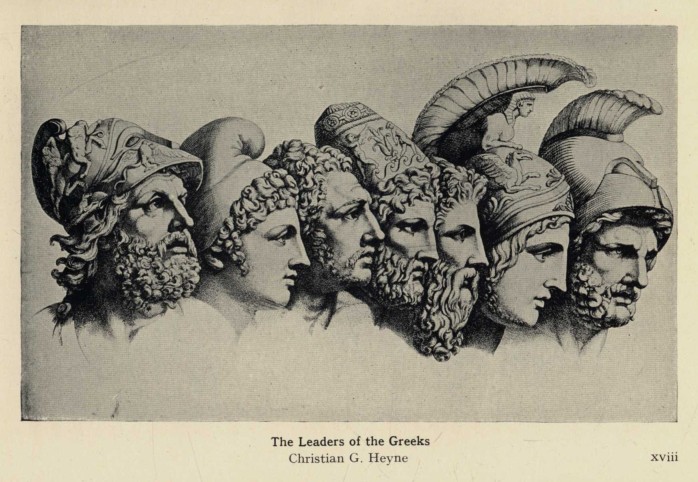
The Leaders of the Greeks (Christian G. Heyne)
This list may fitly be closed with the name of Nestor, "the clear-voiced orator, from whose lips flowed eloquence sweeter than honey." As becomes his age, he assumes the office of peacemaker between Agamemnon and Achilles; in spite of his eighty years, he still takes the field and fights in the van, though his arm is now of less value than his head. With regard to his eloquence, it can hardly be said, judging by the specimen preserved, that he is quite worthy of his reputation. He is, in fact, garrulous, rambling, and tedious—though in these qualities he is even surpassed by the aged Phœnix, who has played the part of male nurse to Achilles, and excels in a style of oratory dear to the professional guardians of childhood.
The great champion of the Trojans is Hector, the son of Priam and Hecuba. His character is, in every respect, a contrast to that of Achilles. With him the claims of king and country ever come first, though he is not indifferent to personal distinction. He falls very far short of the ideal knight—without fear and without reproach. In these qualities he seems to be eclipsed by Glaucus and Sarpedon, the princes of Lycia, whose beautiful friendship finds its most illustrious record in the immortal lines of the twelfth book,[2] the finest exposition in the world of the principle involved in the words noblesse oblige. Hector, on the other hand, is full of weakness: at one time he is faint-hearted, and has to be recalled to the duties of his great position by the reproaches of those who serve under him; at another time he is overbold, and his rashness brings upon the Trojans overwhelming disaster. Yet with all this, his character is full of interest. In his greater moments he rises to sublime heights of heroism. He does not shrink from the consequences of his actions, but goes to certain death with the spirit of a patriot and martyr. He is the mirror of knightly courtesy, kind and gentle even to the guilty and the fallen; and his last meeting with Andromache is hardly to be matched for beauty and pathos in all literature.
A bare mention must suffice for Priam, the white-haired King, and the most tragic figure in the poem; Paris, the curled darling of Aphrodite, a mere beautiful animal, without soul or conscience, and the lovely passion-stricken Helen, whose strange story seems to have a closer affinity with mediæval romance than with classical antiquity.
IV. THE SIMILES
One word must be added on the frequent comparisons, or similes, which form one of the most characteristic features of the poem. At least half the Iliad is occupied with descriptions of battle, and Homeric warfare is exceedingly simple and uniform, consisting almost entirely of single combats between individual chieftains, or wholesale slaughter wrought by some puissant arm on the promiscuous herd of soldiers. To render so unpromising a theme interesting and attractive must have taxed the skill and invention of the poet to their utmost limit; and his principal resources for attaining this end is in the lavish use of the simile. In those parts of the poem where much is to be told in little space this ornament occurs rarely, or not at all. In the first book, which is crowded with incidents, not a single simile is used. But where the action is to be delayed or elaborated, and especially in the battle pieces, the similes are flung broadcast, shining like stars among the racing clouds of a stormy sky. Every corner of nature, and every province of human life, are ransacked to furnish illustrations of the eternal drama of "battle, and murder, and sudden death." In a moment we are rapt by the magic of the poet from the steam and squalor of slaughter to some busy scene of human industry, or some living picture, grand, lovely, or terrible, drawn from the great panorama of nature. Nothing is too great, nothing too little, to furnish material for this splendid treasury of poetry. It would be easy to discourse for pages on this fascinating subject; but we must content ourselves with the above brief hint, and will conclude our remarks by declaring our full agreement with those who regard the similes in the Iliad as the chief glory and beauty in the first and greatest of epic poems.
STORIES FROM THE ILIAD
The Quarrel
I
The scene of our story is laid in the north-western corner of Asia Minor, where the blue waters of the Hellespont mingle with the waves of the Ægæan. The whole coast is lined with a multitude of war galleys, drawn up, row behind row, for a space of several miles; and behind them are thousands and thousands of wooden huts, affording shelter to a whole nation of warriors, with their slaves and followers. For nine years the Greeks have lain here encamped, striving in vain to sack the ancient city of Troy, whose towers and battlements, some five miles distant, can be seen from the elevated parts of the camp. The whole surrounding country has been laid waste, and town after town has been visited by all the horrors of war; but the walls of Troy still stand firm against all assault, and the end seems as far off as ever.
The chiefs are assembled in council, and in their midst sits Agamemnon, the mightiest prince in Greece, whose nod a hundred thousand warriors obey. Suddenly, a voice is heard on the outskirts of the crowd which surrounds the circle of elders, and an aged man, clad in the long flowing robes of a priest, is led into the royal presence. In his hand he carries a rod, adorned with studs of gold, and wreathed with olive leaves. "A boon, great king, a boon!" he cries, lifting the rod on high. "Speak," answers Agamemnon. "What wouldst thou have of me?" "Give me back my child, my daughter Chryseis," answers the priest. "Thou hast sacked my city, thou hast burnt my home; restore unto me my child, and leave me not altogether desolate in mine old age."
Dark was the brow of Agamemnon when he heard these words, and short and stern was his answer. "Let me not find thee," he said, "lingering here in the camp, and come not hither again on such an errand. Thy daughter thou shall not see again; she is mine, the captive of my bow and of my spear, and shall be my slave until the day of her death." In vain the old man urged him with entreaty, and offered a rich ransom to redeem his child from bondage. "Talk not to me of ransom," answered Agamemnon: "not all the gold of thy temple shall purchase liberty for the maiden, for she hath found favour in my sight. Get thee gone at once, and provoke me no further."
Then the priest, whose name was Chryses, feared for his own life, and fled from the angry face of the King. Down to the margin of the sea he went, and gazing with tear-dimmed eyes over the heaving waters, thus he prayed to Apollo, his protector and lord: "Hear me, god of the silver bow, whose altar steams day and night with offerings from the choicest of the flock. Remember my faithful service, and let thine arrows avenge my tears on the Greeks."
So he prayed, and Apollo heard him, and down from the peaks of Olympus he sped. In his hand he bare his mighty bow, and the arrows in his quiver made an angry rattling as he swooped down on the Grecian camp, swift and sudden as the southern night. He took his stand on a hill, and loosed an arrow from the string; and dire was the twang of the silver bow. First, he sent his shafts among the dogs and mules; then he changed his aim, and rained destruction among the men; and the whole place was filled with the smoke of funeral pyres.
For nine days the deadly shower fell without ceasing; but on the tenth, Achilles summoned a general gathering of the host, to inquire into the causes of the calamity which had fallen on his countrymen. The chiefs met in full conclave, and about them were gathered the meaner sort in their tens of thousands. When the clamorous cries of the multitude were stilled, Achilles rose in his place, and addressing himself directly to Agamemnon said: "Son of Atreus, how long wilt thou suffer thy people to perish? Is it not enough that our blood is poured forth every day in battle with thy foes, but must pestilence also make havoc among our ranks? This is Apollo's work, and it is time to ask some priest or soothsayer how we have offended the god, that we may appease his anger with the fat of goats and lambs, and save ourselves from further harm."
Among the elders sat Calchas, the chief seer of the Greeks; who knew all things—what was, and had been, and was to come—and was the chosen leader of the army in matters of religion. Seeing all eyes turned upon him he stood up and answered the challenge of Achilles, though with manifest reluctance and constraint.
"Illustrious chieftain," he said, "thou hast asked the cause of Apollo's anger, and I know that thou lookest to me for an answer. But swear unto me first that thou wilt defend me in word and in deed; for I fear that, by revealing the counsels of the god whom I serve, I shall offend one who is the greatest and mightiest among us."
"Tell us what thou knowest, and fear nothing," answered Achilles; "while I live no one shall lift his hand against thee, no, not Agamemnon himself."
Thus encouraged, Calchas spoke out, and declared that the only means of staying the pestilence was by sending back Chryseis to her father, without price or ransom, and offering a costly sacrifice of atonement to Apollo in his temple at Chrysa. It was not without reason that the prudent seer had appealed to Achilles for protection; for no sooner had his words been uttered than Agamemnon sprang from his seat, with fury in his looks, and overwhelmed the prophet with a torrent of reproaches. "Ill fare thy prophecies, thou prophet of ill!" he cried. "Not one good word have I ever heard from thy lips; but this is the worst that ever thou hast spoken. Hard and bitter is the charge which thou hast laid upon me, bidding me restore this maiden, fairer and dearer to me than Clytæmnestra, my wedded wife. Nevertheless I will send her back, if I cannot save my people otherwise; but look ye to it, princes and councillors of Greece, that I find fit recompense for my loss; for she was a choice prize of war, set apart for me as a gift of privilege and honour."
"And thinkest thou," said Achilles, roused at once to opposition by this unwarrantable claim, "that it befits thine honour as a king to be covetous of thy people's goods? Be generous; let thy prize go, and when next we divide the spoil of a captured town we will repay thee threefold and fourfold for thy loss."
"Payment I will have, and that right speedily," answered Agamemnon, with darkening brow. "See that ye find means to fill the place of this maiden, or one of you shall yield up his prize to me, whether it be Ajax, or Odysseus, or thou Achilles, who art so bold of speech, that thou mayest learn that I am king indeed. But concerning this we can speak again hereafter; our present task is to restore Chryseis to her father, and appease the god with sacrifice."
Agamemnon thought perhaps by his last words to avert the anger of the fiery young prince, whose eyes flashed fire when he heard the King's threat. But if such was his purpose it failed altogether. No sooner had he ended than the full tempest of Achilles' wrath fell upon his head. "Thou soul of avarice!" he cried, "clad in shamelessness as with a garment, was it for thee that we crossed all those weary leagues of water to make war on the men of Troy? I have no quarrel with the Trojans; they have not lifted my cattle, or driven off my horses, for my home is far beyond their reach, divided from Asia by shadowy mountains and sounding seas. For thee, thou dog, and for thy brother have I toiled, and in the division of the spoil 'tis but little that I win as the price of my sweat and my blood; and thou seekest to rob me of that little, to add to thine own monstrous hoard. I will go back forthwith to my native land of Phthia, for I have no mind to abide here in dishonour and heap up treasure for thee."
"Go when thou wilt," answered Agamemnon, in scornful tones. "Heaven forbid that I should hinder thee! Most hateful to me art thou of all the chivalry of Greece, for thou hast a heart full of hatred and malice. Go and lord it over thine own tribe; I am the master here, and as sure as I am a crowned and anointed king I will take thy prize, even the maiden Briseis, and lead her to my tent, that thou mayest learn to curb thy saucy tongue in the presence of thy lord."
Thus publicly insulted and defied, Achilles sat speechless with rage, fighting against the passion which shook his mighty frame. At last it seemed that he had resolved to let his fury have full scope; slowly he drew his sword from its scabbard, his mouth was opened for the battle cry, and in another moment the haughty King would have lain weltering in his blood; but in the very act of springing on his foe he felt himself restrained from behind, and turning to confront this new assailant he stood face to face with the goddess Athene. Unseen and unheard by the rest, the grey-eyed goddess spoke, bidding him to desist from his murderous purpose. "Put up thy sword," she said; "speak daggers to him, if thou wilt, but use none. Thine honour is safe in the hands of Zeus, and the day of reckoning shall come, when that proud head shall be humbled to the very dust before thee."
To those who were looking on it seemed that Achilles had fallen into a sudden trance of thought, from which he started abruptly, and, thrusting back his sword into its sheath, resumed the war of words with Agamemnon. "Thou drunkard," he cried, "with eye of dog and heart of deer, foremost in the revel and last in the fray! Thou of the itching palm, who lovest the chink of stolen gold, but turnest pale at the clash of steel! False shepherd, that devourest thy flock! Cowardly master of cowardly sheep! Now by this sceptre I swear, by this symbol of justice which the elders hold in their hands when they give judgment before the people, the day is not far distant when all this host shall be filled with longing for me, to save them from Hector's destroying arm, when their bravest and their strongest are falling beneath his spear. Then shalt thou learn thy folly too late, and drink to the dregs the bitter cup which thou hast filled for me."
With that he flung the sceptre at Agamemnon's feet, and sat down again in his place. Then arose Nestor, the clear-voiced orator of Pylos, from whose lips flowed eloquence sweeter than honey. Two generations of men had lived and died since his birth, and he still dwelt in kingly honour among the third. And thus he spake, striving to make peace between the two angry chieftains: "Alas! what sorrow has come upon the sons of Greece!—sorrow to us, but joy unto Priam and the sons of Priam, when they hear of the feud which hath arisen between ye twain. Be guided by me; I am older than ye, and before ye were born I moved as an equal among heroes mightier than ye, and was second to none in council and in fight. Hearken therefore to me, even as they did. Seek not, Agamemnon, to take from Achilles his prize of honour; and thou, Achilles, provoke not the King to anger by thy bitter words, for as thou art our bulwark in war, so he sits higher than thou in sceptred majesty."
"Thou sayest well," answered Agamemnon, "but this man's insolence is not to be borne. Because he is a stout spearman he thinks that he can lord it over us all. But there are some here who will not brook his tyranny."
"There is one here," retorted Achilles, "who refuses to be thy slave. But enough of this—I will waste no more words on thee. Come and take away my prize, if those who stand here suffer thee to do this wrong; but touch not aught else of my possessions, or thy blood shall pay the price."
With these words the stormy debate, so fruitful in disaster to the Greeks, came to an end.
II
Agamemnon's first task, when he returned to his tent, was to send back Chryseis, under the charge of Odysseus, to her father. This done, he at once took steps to secure possession of Briseis, the captive maiden who had been bestowed on Achilles as his prize of honour. Talthybius and Eurybates, the royal heralds, were sent to the quarters of Achilles to demand the surrender of Briseis. "And if he will not give her up to you," added the King, "I will come myself and take her by force." So they went with slow and reluctant steps on their thankless errand; and they found Achilles sitting alone by his ship, where it was drawn up on the beach. Awestruck and silent they stood in the presence of that great chief, unable to utter a sound; but he knew full well why they had come, and greeted them with courtesy and kindness. "Draw near," he said, "and fear nothing from me. I respect your office, and impute not to you your master's guilt. Patroclus my comrade shall deliver unto you the maiden, and be ye my witnesses in this matter, when it is asked why I threw down my sword and refused to fight any longer in Agamemnon's cause."
So saying he summoned Patroclus, and bade him bring forth Briseis from the tent; and Patroclus went, and presently returned, leading the weeping maiden by the hand, and gave her in charge of the heralds. When they were gone, Achilles wandered away by the margin of the sea, nursing his wounded spirit, and full of angry and bitter thoughts. Presently he came to a stand, and, stretching out his hands towards the sea, cried like a child in pain to Thetis, his mother: "Short is the term of years which Fate has vouchsafed to me, and therefore thou hast promised me honour from the hands of Zeus. But now is mine honour turned to infamy, and I am become a very scorn of men, and an outcast among the people." His words were broken by sobs and tears, for he was but a boy in years, and was smarting with an agony of wounded pride. And his mother heard him where she sat in her crystal cave in the depths of the sea; for she was a goddess, and daughter of the sea-god, Nereus. Swiftly she rose, "like an exhalation," to the surface of the sea, and came and stood by her young hero's side. "Why weepest thou, my child?" she asked, with a tender caress. "Tell thy mother all thy pain, that she may bear the burden with thee."
"Thou knowest full well," replied Achilles, with a groan; "what boots it to repeat to thee the story of my shame?" Nevertheless he went on to pour out all the tale of injury and outrage; for sorrow grows lighter in the telling. "Thou alone," he added, when he had finished the recital, "canst heal this deadly hurt to mine honour. I have often heard thee boast of an old service rendered to Zeus, when the other Olympians rose up in revolt against him, and he was in sore straits. Go, therefore, to Olympus, and remind him of the debt which he owes unto thee, and ask him in requital to lend aid to the Trojans, that the Greeks may be hurled back in rout upon their ships, and Agamemnon may learn what it means to deal despitefully with the best warrior in his camp."
"It shall be done as thou sayest," answered Thetis; "Leave everything in my hands, and thou shalt have atonement in full measure. Until twelve days are passed I can do nothing, for Zeus has gone on a far journey, to partake of a banquet in the land of the Ethiopians. When he returns I will lay thy case before him; and meanwhile sit thou idle here, and go not into battle, but leave me to champion thy cause." With this promise she left him, and he sat down to digest his anger, and wait for the day of redress.
III
On the dawn of the twelfth day Thetis rose again from her cavern into mid-air, and was borne by the breezes unto Olympus. She found the lord of heaven sitting apart on the topmost peak of the mountain, and kneeling before him she preferred her request. When Zeus heard what she desired he fell into a muse, and answered not a word; but Thetis remained kneeling at his feet, and, clinging to him with both hands, repeated her prayer. Being urged thus with importunity, at last the sire opened his mouth, and answered in heavy tones: "Thou wilt put enmity between me and Hera, my wife; already she upbraids me for showing favour to the Trojans, and thou askest me to take sides openly with them against the Greeks. But go to, what care I for the wrath of Hera? Nevertheless, get thee gone speedily, lest she find us together. Howbeit, thou shalt have thy wish; behold, I swear it, and confirm it with my nod, and whatsoever I have thus confirmed cannot be annulled or unfulfilled."
Thereupon the monarch of the sky bowed his immortal head, with all its dark and waving locks, and shook the mountain to its base.
Having thus attained her purpose, Thetis departed, and as soon as she was gone Zeus joined the assembly of the gods in the high palace of Olympus. All the gods rose from their seats to pay him homage as he entered and took his place on the royal throne. But the sharp eyes of Hera had spied out his conference with Thetis, and forthwith she assailed her indulgent lord in mocking tones: "What plot hast thou been hatching now, thou god of craft? I know that thou art keeping some mischief from me, thy lawful wife."
"Daughter of Cronos," answered Zeus, avoiding her piercing glance, "thou canst not expect that I should share all my counsels with thee. Whatever it is meet for thee to know thou shall learn; but I have some secrets which are not for thy ear."
"Thou must keep thy secrets more carefully," said Hera, with a bitter smile, "if thou wouldst deceive me. Listen, ye gods, while I tell you this fine secret! Zeus has promised Thetis that the Greeks shall suffer defeat, to avenge the insult put upon her son."
"And if such be my will, who shall say me nay?" replied Zeus, with a stern look. "I warn thee not to thwart my purpose, or all the gods who sit here shall not save thee from chastisement."
Then fear fell upon Hera, and she sat biting her lips, venturing no reply. And all the gods sat silent, glancing anxiously at one another, when they heard the angry tones of the Olympian sire.
At last Hephæstus, the lame god of fire, came to his mother's relief. Rising from his seat, he took a goblet of nectar from the hands of Hebe, who was serving drink to the gods, and went hobbling to the place where Hera sat. "Mother mine," said, he, as he offered her the cup, "I counsel thee to give way, and not provoke our father to anger. Shall we, the sons and daughters of heaven, brawl over our cups for the sake of miserable mortals? Let Zeus have his way—for what can we do against him? Hast thou forgotten how he served me when I presumed to stand between thee and his ire?—how he caught me by the foot, and flung me forth from the open portals of Olympus, as a boy slings a stone? From morn till eve I fell, and at the setting of the sun I struck on Lemnos, the Ægæan isle."
Hera smiled at her ungainly son; and when she had drunk of the nectar he took the cup, and went limping round the circle of the gods, offering them to drink. And all the immortals laughed loud and long, to see the huge, hairy god engaged in the office of the lovely Hebe. Then music and song came to crown the banquet, as Apollo led the choir of the Muses on his golden harp.
The Dream: The Muster of Greeks
I
Agamemnon lay sleeping in his tent, and in a dream he saw Nestor, the son of Neleus, who addressed him in these words: "Sleepest thou, son of Atreus? It is not meet that thou, on whom lies the weight of a mighty monarchy, shouldst slumber all night long. Hearken now to my words: I am the bearer of a message from Zeus, who bids thee summon the whole host of Greeks, and lead them against Troy. Her hour is come at last, and the gods with one consent have decided that she shall fall."
Agamemnon awoke, and behold it was a dream. But the words had sunk deep into his heart, and he deemed that the vision had spoken truth. In that vain belief he arose from his couch, clothed himself in a fair linen tunic and a woollen robe, and, taking his sceptre in his hand, went to rouse Nestor and tell him his dream. Then the whole body of the chiefs met in council, and the heralds were sent round to proclaim a general assembly of the army. The people came flocking at the summons, numberless as bees which hover round the flowers in spring; and nine heralds went about among the multitude, marshalling the clamorous commons in their places, and commanding silence, that the counsel of the King might be heard.
As this was a great occasion, it had been resolved, in the private meeting of the elders, to try the temper of the people before disclosing to them the real purpose of their leaders. Accordingly, when silence had been obtained, Agamemnon rose up in his place, holding in his hand his ancestral sceptre, the symbol of his great office, which had descended from father to son since the days of Pelops, the founder of the royal house of Argos. Planting the sceptre firmly before him, and leaning upon it, thus spake the King, to prove the heart of his people.
"Friends and comrades in war, I have heavy news to tell you. Zeus brought us hither under a solemn promise that in the end we should take the sacred city of Priam. But now he hath revoked his promise, and bids us sail back to Greece, for all our toil is vain. Shame and dishonour must be our portion, now and hereafter, when our sons' sons shall hear how we, the embattled host of Greece, outnumbering the citizens of Troy by ten to one, fought against them for nine long years, and then departed, as beaten and broken men. But such is the will of Zeus, and none can gainsay it. Therefore I bid you hoist sail and away, for we are not destined to take the town of Troy."
At these words of the King there arose a wild commotion among his hearers, and the vast multitude swayed to and fro like the waves of the Ægæan driven this way and that by shifting gusts of wind. Then, as a wide field of corn bends down before the strong breath of the west, the whole host turned seaward, and with a mighty shout they rushed downward to the shore, and began to launch their ships.
Agamemnon, and those who were in his confidence, were thunderstruck by the tremendous effect of his speech, and stood helpless and amazed in the midst of this scene of tumult. The first to recover himself was Odysseus, the wisest and the firmest spirit among all the chieftains. Flinging off his mantle he went to Agamemnon, and took from his hand the royal sceptre. Armed with this symbol of authority he hurried hither and thither among the excited throng, urging each man by threats or entreaties to return to the place of assembly, and wait there for further instructions from the recognised leaders of the host.
To those of rank and character he spoke courteously, urging them to use their influence among their followers, and check the general flight; while with the baser sort he used rougher means of persuasion, striking them with the sceptre and rebuking them fiercely. Others among the chiefs followed his example, and at length the tumult was stayed, and the fickle mob swept back into the camp with a roar like the billows breaking on a long line of rocky shore.
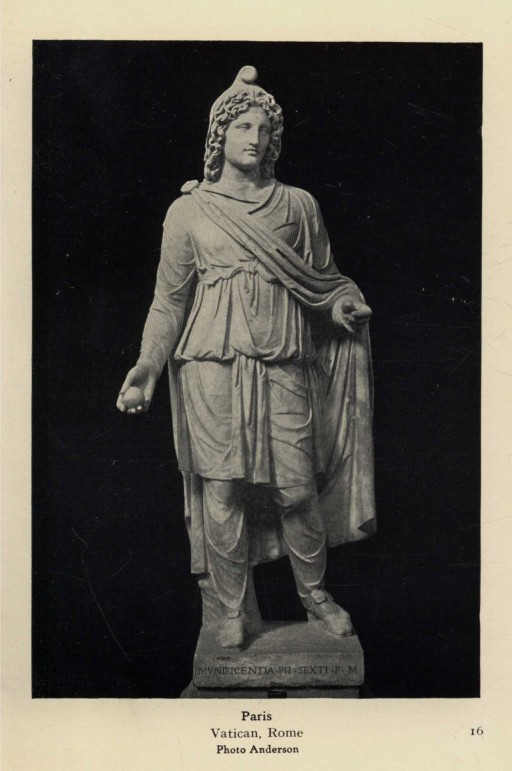
Paris. Vatican, Rome. Photo Anderson
At length that vast audience was seated, and waiting attentively to hear the counsels of the King. But one unruly knave remained standing, and poured out a torrent of abuse against Agamemnon and the other chiefs. This fellow's name was Thersites, and of all the Greeks who came up against Troy he was the foulest, both in aspect and in speech. His huge misshapen head, sparsely covered with thin, downy hair, sat awry on his stooping shoulders. He was bandy-legged, and lame of one foot. And he was the sworn enemy of the valiant, the noble, and the wise. This low-born railer now began to shriek out insults in a hideous voice against Agamemnon, his sovereign lord. "Son of Atreus," he bawled, "what lackest thou yet? Thy tents are full of gold, and crowded with slaves, which we have won for thee with our swords and our spears. Lustest thou yet after more gold, the ransom of Trojan captives? Or dost thou want more Trojan dames to be thy handmaids? Up, sirs, let us be gone, lest we be called women, and not men, if we remain here to heap up riches for this greedy tyrant. Have we not seen him put public dishonour on our bravest warrior, taking from him his lawful prize? Surely Achilles lacks gall to make oppression bitter, seeing that he has suffered this bitter wrong to go unavenged. Were he of like mind with me, the ruffian king would not have survived to commit further outrages."
A stern voice here broke in upon the seditious harangue, and Thersites perceived with alarm that Odysseus was standing by him, staff in hand. "Peace, saucy knave!" said the Prince of Ithaca, in threatening tones. "How darest thou, the very scum and refuse of the army, to hold such language against our exalted leader? If I find thee uttering thy mad folly again, may my head be smitten from my shoulders, and may I never more be called the father of Telemachus, if I do not strip thee naked and drive thee forth from among the people with blows like this." And suiting the action to the word he laid the heavy staff with no gentle hand across the deformed shoulders of Thersites. The wretch shrank beneath the blow with a cry of pain, and the golden staff left its print in a crimson weal on his back. So he sat huddled together, with distorted face, wiping away his tears, and spoke not another word.
Having thus silenced that loose tongue, Odysseus mounted a platform, whence he could be seen and heard of all the host, and lifting up his mighty voice he began to rebuke the people for their weakness and want of faith. "Must I speak to you," he said, "as to homesick women and children, or as to veteran warriors bound by an oath to follow their great captain for weal or for woe? Not that I blame you overmuch, for indeed your service has been both long and hard. For nine long years we have toiled in vain, and the cordage of our ships is rotten, and their timbers are warped. Nevertheless, endure yet a little while, until we have learnt whether the son of Cronos is a true prophet or no. Ye cannot have forgotten the day when our ships were assembled at Aulis, or the portents vouchsafed us there at a solemn sacrifice to the gods. The altar was raised in the shadow of a goodly plane-tree, near a running water; and in the tree was a nest of sparrows, a mother with eight young, cheeping and cowering beneath the leaves. Just as we were kindling the altar fire, a great serpent, with blood-red back, darted up from the altar into the tree and pounced upon the sparrows' nest. The mother-bird fluttered anxiously around, uttering piteous cries to see the monster devouring her young; and the serpent, when he had swallowed up the nestlings, caught their mother by the wing as she hovered near, and swallowed her also. Then we beheld a wonder: for the serpent, when he came down from the tree, was turned into a stone. And while we stood amazed Calchas declared unto us the meaning of that omen: "Why stand ye thus amazed, ye warriors of Greece? That which ye have seen is a sign from Zeus, and this is the interpretation thereof: the nine birds are the nine years, during which we shall lay siege to Troy, and the serpent is the tenth year, in which Troy shall fall! Therefore abide steadfast, my comrades, for the nine years are passed, and we are nearing the end of our labours."
Odysseus ended, and a great roar of acclamation went up from a hundred thousand throats, and rolled like thunder along the hollow shore. The next speaker was Nestor, who addressed Agamemnon, and bade him command an immediate muster of the whole army, and lead a general attack upon the Trojans. "Let the people," said he, "be ordered according to their several tribes and clans, that thou mayest distinguish the faint-hearted from the loyal and valiant. Thus shall thou learn, if disaster befalleth thee, to whom it is due—whether to adverse heaven, or to the cowardice and weakness of thine allies."
"Thou speakest ever to the purpose," answered Agamemnon; "and would that I had ten such counsellers as thee! Then would Priam's royal city soon bow her head, sunk in the dust beneath our victorious hands. But the son of Cronos hath sown division among us, and put enmity between me and my bravest champion. But to our task: let the people now get their morning meal, and then prepare for battle. Let every man whet his spear, and look to the fastenings of his shield; let every steed be fed, and every chariot set in order, that we may fight all day till the going down of the sun. There shall be no rest or respite till darkness puts an end to the fray. Many a shield strap shall drip with sweat, and many a hand ache with holding the spear, and the steeds shall droop with weariness, ere the day be done. And if I find any man skulking among the ships, I will give his flesh to feed the dogs and vultures."
Then the people arose and scattered among their tents, and soon the smoke of a thousand fires went eddying up into the still morning air. And every warrior lifted up his heart in prayer to heaven, that he might return safe and sound from the great perils which lay before him.
Agamemnon slaughtered an ox five years old, and summoned the noblest of the chiefs, among whom were Nestor, Idomeneus, the two princes named Ajax, Diomede, and Odysseus, to take their meal with him. In those days every meal was a sacrifice, and this was the manner in which it was performed: the company stood round the ox, holding in their hands a portion of barleymeal. Then the giver of the feast addressed a prayer to Zeus, the meal was sprinkled between the horns of the victim, and after that the beast was slaughtered and flayed. Portions of the meat were then cut off from the carcass, wrapped in a double layer of fat, and burnt as an offering to the gods. When all religious rites had been duly paid, the choicer parts of the meat were broiled in thin slices over the fire, and eaten with wheat or barley bread. The flesh of beeves and swine, or less commonly of sheep and goats, with bread and wine, formed almost the sole diet of the Homeric heroes.
When they had finished a copious repast, Nestor, who, despite his eighty years, was as keen and alert as the youngest soldier, sprang from his seat, and cried: "To arms, comrades, to arms! Agamemnon, bid the heralds summon the host to the field."
The King gave the order required, and forthwith the heralds, who were chosen for the power and reach of their voices, went about in the camp, and called the people to arms. Then every captain called his company together, and led them to the place appointed for the general array. And by degrees a strange fire spread from rank to rank, kindling in every breast a fierce longing for battle. All softer emotions, all homesick longings, were forgotten; for a mysterious influence was at work, due to the unseen presence of Athene, who was there with her wondrous, immortal shield, with its fringe of golden tassels. None beheld her, but all felt her power, and the boldest grew bolder, and the weakest were inspired with a valour not their own.
Like a fire blazing among the thickets high up on a mountainside, so blazed the sunlight on shield and helmet, as those countless thousands poured forth into the plain of Scamander, and the earth shook beneath the tramp of steeds and men. On and still on streamed the tide of warriors, unnumbered as the leaves in spring, or as flies that buzz round the milkpails on a sunny day, when the goats are milked by a hundred hands.
And as the shepherd numbers his sheep, for he knoweth them every one, so moved the captains with mastery, each among his own people, and marshalled them in their ranks. Conspicuous among all was seen the majestic form of Agamemnon, to whom it seemed that every god had on that day bestowed some peculiar grace, to make him the observed of all observers, and give the world assurance of a king.
But what tongue can count the myriads brought together by the word of power on Scamander's plain, or what memory can hold the names of the nations assembled there? All the chivalry of Greece had obeyed the summons of the monarch, sent forth nine years before, and they had come flocking in their thousands from the broad plains of Thessaly; from the mountain dells of Locris and of Phocis; from the fat fields of Bœotia; from Attica, with her thin soil and bright, pellucid air; from Salamis, the mother of heroes; from storied Argos and renowned Sparta; from the western islands, and from Creta, the cradle of gods. It would be a weary task to tell over all the heroic titles in that muster-roll of fame, but a few must be mentioned, as being the prime in valour and in worth.
From Locris came the lesser Ajax, son of Oileus. He was small of stature, but swift of foot, and the most skilful spearsman among all the Greeks. His greater namesake, Ajax, son of Telamon, and cousin to Achilles, came from Salamis; he was a giant in stature and in strength, and, next to Achilles, the greatest warrior in all the host.
The ancient city of Tiryns in Argos, with its massy walls, built by a mighty race in the very dawn of time, sent forth a goodly company in eighty ships; and these were commanded by Diomede, son of Tydeus, a gallant and youthful prince, whose deeds fill many a page in the tale of Troy divine. And from the neighbouring city of Mycenæ, the royal seat of the line of Pelops, came Agamemnon himself, at whose imperial nod whole nations flew to arms. His brother, Menelaus, the husband of Helen, on whose account the war had arisen, brought sixty ships, manned by the warriors of Sparta, of which city he was king. He was a mild and gentle prince, and a zealous leader, though in valour and prowess not of the first rank.
Ninety ships formed the contingent led by Nestor, the aged King of Pylos, the most venerable figure, and the wisest head, among all those who fought in the cause of Helen.
Of those who came from the islands the most famous were Odysseus, King of Ithaca, the hero of another famous story, mighty in word and in deed, and, after Nestor, the sagest counsellor in the Grecian camp; and Idomeneus of Crete, a grey-haired veteran who had proved his valour on many a hard-fought field.
Among others singled out for special mention are Nireus, renowned for his wonderful beauty, but otherwise a weakling; Philoctetes, now living in lonely exile on the island of Lemnos, where he had been left by the Greeks on account of a dreadful wound, which rendered his presence in the camp unbearable, and Protesilaus, who had been the first to leap on to the Trojan shore, and had been struck down by a Trojan in the very act.
These two were missing in the grand review of the forces which was now held in anticipation of a victorious march upon Troy, and their places were supplied by others. But there was one whose place none could fill, and whose absence was soon to make itself felt in dire and deadly fashion. Achilles sat idle in his tent, brooding over the insult which he had received two weeks before. His ponderous spear, which none but he could wield, was resting from slaughter, and his squires were polishing the armour which he was not to wear that day. He started when he heard the great shout of the Greeks, as the word was given to march, and his heart burned with longing for battle; but remembering his wrongs, he sank back in his seat, frowning darkly, and muttered the single word "Revenge!"
Greeks and Trojans face to face: The Duel
I
Priam was sitting in council with all his elders before the doors of his palace, when a messenger rushed breathless up with the tidings that the Greeks were marching in full force against the city. Instantly the meeting broke up, and the Trojan leaders, with Hector at their head, set out with the whole body of native warriors and their allies to bar the way of the invader.
Halting before a solitary mound, the tomb of the Amazon Myrine, within sight of the walls of Troy, they drew up their forces in order of battle. The native Trojans, who fought under Hector, son of Priam, formed the flower of the army; but in numbers they were far exceeded by the troops which had assembled, at the call of Priam, from the adjacent provinces and coastlands of western Asia—from Lydia, Mysia, Paphlagonia, and far-off Lycia—from Sestos and Abydos and Thrace. After Hector, the most famous leaders were Æneas, son of Anchises and Aphrodite; Pandarus, unrivalled for his skill in archery; Paris, whose crime had brought all these woes on his country, and above all the two captains of the Lycians—Sarpedon, the son of Zeus, and Glaucus, the most knightly figure among all the heroes of Greece and Troy.
When the various members of that motley host had taken their appointed stations, the defenders of Troy advanced with clamour and with tumult, like flocks of cranes winging their way to the shores of the ocean stream to make war on the Pygmies. Presently the van of the Greeks came in sight, moving on in silence, like men with one mind and one heart.
Foremost among the Trojan champions was seen the gay and beautiful Paris. He was clad in a panther's skin, over which hung his bow and arrows, and besides these weapons, in the use of which he excelled, he was armed with two long spears and a sword. Menelaus marked him as he came on with long strides, and rejoiced in spirit, like a hungry lion when he catches sight of his prey; and leaping down from his car he advanced with uplifted spear to take vengeance on his treacherous foe. But when Paris saw him coming his guilty heart quailed within him, and he shrank back among the ranks of his comrades, like one who has trodden on a snake while walking in a mountain glen.
"Now curse on thy fair, false face!" cried Hector to his cowardly brother, "thou carpet-knight, thou foul deceiver! Better for thee to have died childless and unwed than thus to bring shame on thy father and all thy kinsfolk and people. Thou art a fit foe for women, whom thou beguilest with witchcraft of thy wit, and wicked gifts; but all thy gifts—thy curling locks, thy smooth, white brow, thy sweet voice, and cunning minstrelsy—avail thee naught when thou lookest upon the face of a man. Verily the Trojans are as dastardly as thyself, or long ere this thou wouldst have put on a doublet of stone[1] for all the ills that thou hast wrought."
[1] That is, "Wouldst have been stoned to death."
"I have deserved thy rebuke," answered Paris. "Keen as the blade of an axe, which bites deep into the heart of an oak, when wielded by a sinewy arm, so is the keenness of thy spirit, and thou knowest not fear. Nevertheless, mock me not for the lovely gifts of Aphrodite, for the gifts of heaven are not to be despised. And if thou desirest me to take up this quarrel with Menelaus thou hast thy wish. I will fight against him hand to hand, and he who is victor shall be lord of Helen and all her possessions. So shall the long strife have an end, and peace shall dwell again within our borders."
When Hector heard his brother's bold words he was glad, and gave the word to make the Trojans sit down in their ranks. At first the Greeks did not understand what was happening, and pressed onward to the attack with a shower of stones and arrows; but Agamemnon soon perceived that Hector had something to propose, and gave the signal for a general halt.
Then Hector, standing midway between the two armies, made known the offer of Paris, and asked for an armistice, that the two champions might try the issue between them. All eyes were now turned on Menelaus, who responded boldly to the challenge. "I am well content," said he, "that this quarrel should be decided by the hands of us twain; for it grieves my heart that so many should suffer for the sake of my private wrong. Let two lambs be brought—a white ram as an offering to the sun, and a black ram as an offering to the earth; and go some of you to fetch Priam, that he may preside at the treaty. His sons we may not trust, for they are hot-blooded and faithless; but an old man's head is cool, and his eye looks before and after."
Right pleased were both Greeks and Trojans when the order was sent round to dismount from their cars and pile their arms; for they thought that the end of their bitter feud was near. Two heralds were despatched to bring down Priam from the city, and Agamemnon sent another for a victim to be sacrificed on behalf of the Greeks.
II
Helen was sitting in her chamber, weaving a fair tapestry, on which were wrought the famous deeds done in her cause by Greek and Trojan heroes, when her task was interrupted by the sudden entrance of her kinswoman, Laodice, a daughter of Priam. "Make haste, dear sister," said the lady, "come with me, and see the wonderful thing which has been brought to pass. Greeks and Trojans are sitting down in amity together, and Paris and Menelaus are to fight with long spears for the mastery; and he that prevaileth shall call thee his wife."
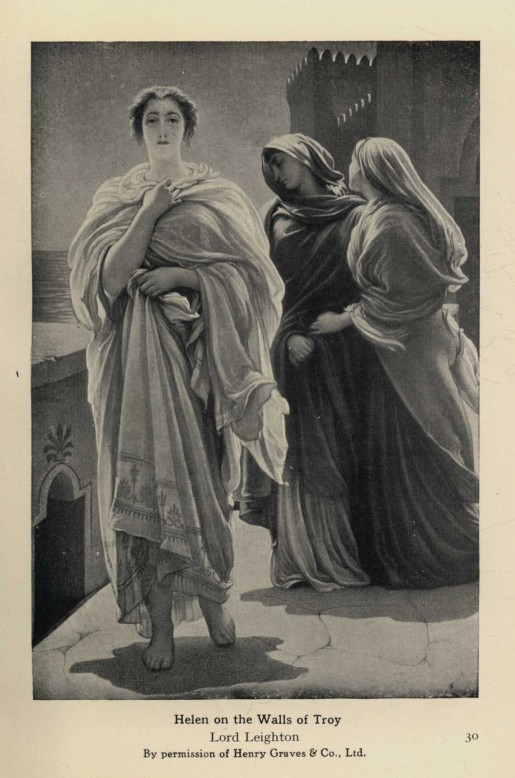
When she heard that, a great longing came into the heart of Helen for her Spartan home and her former lord. With one tearful glance at the speaker she rose from her seat, veiled her face, and made her way to the high tower above the gate where Priam was sitting with the elders of Troy. The shrill, piping voices[2] of the old men struck upon her ears as she stepped out upon the turret; and when they saw her they put their heads together, and whispered their admiration of her wondrous loveliness. "How fair, how very fair she is!" murmured one white-bearded veteran. "Is she not worthy to be the arbitress of life and death to a whole generation of heroes! Nevertheless let her depart, and breed no further mischief to us and our children."
Then Priam called to her, and beckoned her with a courteous gesture to take her place by his side. "Come hither, dear daughter," he said, "where thou canst see thy former husband, and thy kinsfolk and friends. I blame thee not at all because of this war which the gods have brought upon me in mine old age. Now tell me," he continued, pointing with his finger towards the Greek army, which lay in full view upon the plain, "who is that stately man to whom all the other chieftains seem to pay homage? Ne'er saw I one of so kingly a mien."
"I dread thy presence, father," answered Helen, glancing in the direction indicated, and then casting down her eyes. "I tremble before thee, kind as thou art, for I feel all the wrong which I have done unto thee and thine. And as touching him of whom thou askest, that is Agamemnon, son of Atreus, lord of a wide empire, a righteous king, and a valiant warrior. Once I called him brother," she added, with a sigh.
"'Tis then as I thought," rejoined Priam, "for there is sovereignty in his look. And who is he who stands next to Agamemnon, in stature less than he, but broader of shoulder and deeper of chest? Methinks he is like a stately ram, who stalks majestic before the flock as they go to pasture."
"That is Odysseus, son of Laertes," answered Helen, "bred in the rugged isle of Ithaca. All Greece cannot show his equal in wisdom and eloquence."
"Lady," said Antenor, an elder of high rank. "herein thou hast spoken the very truth. I entertained him of whom thou speakest as my guest when he came hither on an embassy with Menelaus, and I heard them both speaking before the assembly of the Trojans. When they stood up together Menelaus was by far the taller; but when they were seated there was greater dignity in Odysseus. Then as to eloquence, Odysseus bore away the palm from all—though Menelaus spoke both fluently and to the purpose. At first, when Odysseus rose to speak, we wondered to see how ungracefully he stood, leaning heavily on his sceptre, with eyes fixed upon the ground. He seemed a very churl, unskilled in all courtesy and the arts of civil life. But when he lifted up his mighty voice, and his words floated about us like the snowflakes of winter, we knew that we were listening to a divinely gifted man."
At Priam's request Helen named the other chieftains of the Greeks, Ajax and Idomeneus, and the rest; and when the recital was ended she remained gazing wistfully at the dense masses of fighting men who sat waiting on the plain. "I cannot see them," she murmured sadly: "they are not there." "Of whom speakest thou?" asked Priam. "Of Castor and Polydeuces," she answered, "the bold rider, and the stout boxer, my own brothers, born of the same mother with me. Perchance they sailed not in the fleet to Troy, or perchance they have remained behind in the camp, in sorrow for their sister's shame."
Helen on the Walls of Troy. Lord Leighton. By permission of Henry Graves & Co., Ltd.
Ah! Helen, thy brothers are lying where shame and sorrow can reach them no more, sleeping in their quiet graves, in Lacedæmon, their native land.
III
While Priam was still conversing with Helen, a herald entered with the startling news that his presence was required in the field, to settle the conditions of the single combat between Paris and Menelaus. Some natural pangs he felt, when he heard of the danger which threatened his son. Nevertheless he set out at once, taking with him the victims required for the sacrifice. When he came to the open space between the two armies he found all things ready for the solemn rite. The chiefs stood waiting in a circle, and in their midst was Agamemnon, who acted as priest. The heralds mingled two portions of pure[3] wine in a bowl, and poured water over the hands of the chieftains. Then Agamemnon drew a sharp knife, which hung at his girdle by his ponderous sword, and cutting off a few hairs from the foreheads of the victims gave them to the heralds to distribute among the princes. When this was done, amidst a general hush he uttered this solemn prayer: "Father Zeus, Lord of Ida, most glorious, most mighty, ye rivers, and thou earth, and ye dread powers beneath, who take vengeance after death on all those who swear a false oath, be ye all the witnesses and guardians of our treaty. If Paris slays Menelaus he shall keep Helen for his wife, with all her goods; but should Paris fall Helen shall go back to Menelaus, her lawful lord. Let the war be decided by the issue of this combat, and Heaven defend the right!" Therewith he cut the throats of the victims, and laid their quivering bodies on the ground. Then the drink-offering was poured, with this awful imprecation on those who should break the treaty: "If any man violate our sworn oath, may his brains be poured out, even as this wine, and may his wife and children be sold into bondage."
Priam now took his departure from the field, for he could not bear to see his son in deadly combat with Menelaus. When he was gone, Hector and Odysseus measured out the ground for the duel, and shook the lots in a helmet, to see who should be the first to cast his spear; and the lot fell on Paris. Meanwhile Paris was putting on his armour; for he had come lightly equipped as an archer into the field.
The two rivals took their stand on either side, clad in their brazen harness, and armed with sword and spear. And first Paris cast his spear, which struck upon the shield of Menelaus, and did him no harm. Then Menelaus lifted up his spear, and murmured a prayer to Zeus: "Grant me, O King, to take vengeance on him who brought dishonour on my home, where he dwelt as my honoured guest." As he spoke, he flung his good ashen spear, which clove its way through the shield of Paris, and tore his tunic close to his side; but Paris swerved aside and escaped a wound. Before he could recover himself Menelaus was upon him, sword in hand, and struck him with all his force upon the helmet; but once more fortune favoured the Trojan, for the blade was shivered on the ridge of the helmet, and Menelaus grasped a useless hilt. "Curse on thee, treacherous steel!" cried he, and, seizing Paris by the helmet, began to drag him towards the ranks of the Greeks. This time he would have succeeded, and taken his enemy captive, had not the strap which held the helmet given way under the strain, so that the brazen headpiece came away empty in his hand.
Menelaus flung the helmet towards his friends, and picking up his spear turned again upon his cowardly foe, with purpose to slay him. But Paris was nowhere to be seen: an invisible hand had caught him up, and carried him away from the righteous hand of the avenger. For Aphrodite, the soft goddess of love, had been hovering near to protect her favourite. She it was who had caused the helmet strap to break, and now she saved him a second time, and bore him swiftly to his house in Troy. There he was presently visited by the lovely Helen, who, though she scorned him in her heart, was drawn thither by a fatal spell which she could not resist; and in the sunshine of her smiles he soon forgot dishonour and defeat.
All this time Menelaus was raging about the field, like a tiger robbed of his prey, and calling upon the Trojans to surrender the recreant to his vengeance; and they would gladly have done so, if they had known where to find him, for they hated him worse than death. And Agamemnon, amid general applause, demanded the surrender of Helen, according to the terms of the treaty.
The Breaking of the Truce
I
The gods were met in full assembly in their golden palace, pledging one another in full cups of nectar, and looking down upon the great drama which was being enacted on the plains of Troy. Then Zeus began to speak, casting a sly glance at his fair consort, Hera: "Menelaus has two stout backers among the gods, Hera, Queen of Argos, and Athene, strong to defend. But they seem to have renounced his cause, for they have suffered Aphrodite to steal away Paris when death stared him in the face. 'Tis well, then, Menelaus has the victory, and naught remains but to give back Helen, and put an end to the war."
At this most unwelcome proposal Athene frowned angrily at her father, but said nothing; Hera, however, could not contain her wrath, and raised her voice in indignant protest: "Out upon thee, son of Cronos, what a word hast thou spoken! Is this to be the end of all my toil and my sweat, when I travelled without ceasing, until my steeds were well-nigh foundered, to gather this host against Troy? Do as thou wilt; but know this, that, if thou doest this thing, not one of us shall praise thee, no, not one."
"What strange passion possesses thee?" answered Zeus, in tones of displeasure, "Why harbourest thou this deadly rancour against Priam and the sons of Priam? Methinks thou couldst find it in thy heart to go down into the city, and feast on the raw flesh of the men of Troy, until thou hadst devoured them all. Howbeit, let there be peace among us; I give thee leave to work thy will upon this king and his people; only remember that I have yielded to thee in this, and when I am minded to destroy some city which is dear to thee stand not thou in my way. For I love the towers of holy Ilios, and they that dwell therein, for they have paid me faithful worship, with meat-offering and with drink-offering, with reverence and with prayer."
"Take Argos," replied the impetuous Hera. "Take Sparta or Mycenæ, the three choicest jewels in my crown; burn, waste, and destroy them, if such be thy pleasure. Only grant me this boon, and let me wreak my fury upon Troy. If thou consentest to this, lay thy command upon thy daughter, Athene, that she may go down among the Greeks and Trojans, and make an end of this detested truce."
Zeus nodded in token of approval, and Athene, who was only waiting for the signal, shot down from Olympus like a falling star, and alighted in the space between the two armies. Arrived there, she put on the form of Laodocus, a noble Trojan youth, and went in search of Pandarus, a famous bowman, and a favourite of the archer-god Apollo. And when she had found him, she spake unto him in this wise: "Bold son of Lycaon, art thou man enough to do a great deed, and win praise and reward from all the Trojans, but especially from Paris? If thou art, take thine arrows and thy bow, and aim a shaft at Menelaus, having first vowed a vow to Apollo that when thou returnest to thy home among the rich pastures of Ida, thou wilt offer him a sacrifice of lambs, the firstlings of the flock."
So spake Athene, tempting him; and he hearkened unto her in his folly, and began to take the cover from his bow. It was a powerful weapon, formed from the horns of a great ibex, which he himself had brought down by a skilful shot long ago. The horns, each sixteen palms in length, were set firmly in a solid bridge, and tipped at each end with gold. Resting the lower end of the bow against his foot, he leaned upon it, and strung it, and laying it down took off the lid of his quiver, and selected an arrow. Then he took up the bow again, and set the arrow on the string. His companions, who had been covering him with their shields while he was making his preparations, now stepped aside, and he, having made his vow to Apollo, lifted up his bow, drew the arrow to his ear, and shot. The bow twanged loud and clear, and the arrow leapt hissing towards the Grecian ranks.
Then ill had it fared with thee, Menelaus, had not Athene been standing at thy side, to guard thee from fatal hurt. And as a mother brushes a fly from the face of her babe, lying in sweet slumber on her lap, so Athene suffered not the arrow to reach any vital part, but guided it to the place where the plates of his corslet met at his side. Through the girdle pierced the shaft, through the brazen corslet, and through the taslet which covered his loins; the point just grazed the surface of his flesh, and the red blood began to flow, staining his thighs, and trickling down to his ankles.
When Agamemnon saw his brother wounded and bleeding, he ran to his side, and taking him by the hand began to deplore the evil issue of their treaty. "Must thy life pay the forfeit for the perjured men of Troy, who have trampled our covenant underfoot? I know indeed that vengeance will overtake them in the end from the hands of Zeus, whose name they have taken in vain; yea, well I know that the day shall come when holy Ilios shall fall, involved with all her people in one common doom. But what will that avail, if I lose thee, my brother? My army will desert me, for they cannot fight without a cause, and thou art the cause which brought them hither. Troy's doom will be wrought by other hands, and I shall go back to Argos, a beaten man, leaving thy bones to rot in a foreign grave."
"Speak not so loud," said Menelaus, when Agamemnon paused at last; "thou wilt cause a panic in the army. There is no ground for alarm; the wound is not deep. Send for Machaon, the skilled leech, that he may draw out the arrow, and stanch the flow of blood."
Then Agamemnon was comforted, and sent Talthybius the herald to bring the leech, who was a son of Asclepius, the most famous physician of those times. After some delay, Machaon came to the place where Menelaus was standing, leaning on his brother's arm, and surrounded by an anxious group of his friends. With firm but gentle hand the leech drew out the arrow, and, removing the prince's armour, exposed the wound to view. Then he applied healing herbs, and bade the patient be of good cheer, for his hurt was but slight.
II
The truce having been broken by the treacherous act of Pandarus, both sides prepared for an immediate assault. Agamemnon, as soon as he was assured that his brother was in no danger, summoned his chariot, and, bidding the driver keep within call, went on foot up and down the ranks of the Greeks, encouraging those whom he saw pressing forward to the attack with promises of favour and reward, and upbraiding those who hung back with taunts and rebukes. His heart rejoiced when he saw the towering form of Ajax, who was hurrying to battle, followed close by a stout troop of spearsmen, with shield pressing on shield, and bristling spears. Near him was Idomeneus, the grizzled captain of the Cretans, with his comrade, Meriones, at the head of a numerous and well-appointed troop. And after these he came to the men of Nestor, who were receiving instructions from their veteran leader how to bear themselves in the battle. "Keep your ranks," he was saying, "and fight shoulder to shoulder, the horsemen in the van, and the infantry ready to support them behind. And let no one be carried away by his zeal to engage singlehanded with the enemy, for union is strength, and weakness comes of division."
These were the foremost, but there were others, and among them some of the most valiant leaders in the army, whose station was more remote, and who had not yet heard of the breaking of the truce. One of these was Diomede, and when Agamemnon found him standing inactive, he rebuked him harshly, reminding him of his father's prowess, and calling him an unworthy son. The young chieftain deigned no answer to the unmerited reproach, but at once put his men in motion to join the encounter.
The whole army was now advancing, rank pressing on rank, and column on column, like the waves rushing landward along a wide-watered shore. The Greeks came on in silence, broken only by the short, sharp words of command; but the Trojans, whose army was made up of a motley throng of many nations, rushed to the onset with multitudinous cries, like ewes at milking-time in the folds of a wealthy sheep master, when they hear the voices of their lambs. On the Trojan side was Ares, and on the side of the Greeks stern-eyed Athene, with whom were seen Panic and Flight, and insatiable Strife, who is small of stature at the beginning of a fray, but grows and grows as the feud proceeds, until her head presses against the sky as she stalks along the earth.
Then the air was rent with a deafening crash, as the two armies met, and shield was dashed against shield, and brazen armour was dinted by spear and axe and sword. Shouts of triumph arose, and cries of anguish, as the wild mêlée swayed to and fro, and the ground ran with blood. As two torrents descending from copious springs high up in the mountains, and swollen high by winter rains, mingle their waters with a roar at a place where two glens meet—such was the roar which went up to heaven, at the conflict of those mailed hosts.
Among the many victims of that bloody day, some are singled out for especial mention. One of these was Simocisius, a tall and comely youth, so named because he was born on the banks of the Simocis, when his mother went to visit her parents on their farm. Ajax marked him as he came on, and smote him in the breast with his spear; and down he fell, like a tall poplar, which rears its stately height in a meadow by the riverside, until it is hewn down by a wheelwright to make a felly for a chariot; and there it lies seasoning on the banks of the stream. So lay the young Simocisius, and Ajax stripped him of his armour. While he was thus engaged, Antiphus, a son of Priam, flung a javelin at him, but, missing him, struck down Leucus, a comrade of Odysseus, who had laid hold of the corpse to hale it away. Odysseus was exceeding wroth at the fall of his comrade, and stepping forward he flung his spear, and smote Democoon, a natural son of Priam, in the temple. The Trojan champions fell back before him, and the Greeks rushed forward and gained possession of the dead. Apollo, who sat watching the battle from the citadel of Troy, was indignant when he saw the Trojans give ground, and shouted to them in a loud voice, crying: "Up, ye horsemen of Troy, and fly not from these Greeks, for their flesh is not of stone or of iron, to resist the thrust of your spears. Now is your time, while Achilles is absent, chewing the cud of his ire among the ships."
The Trojans rallied at the cry of the god, and the battle was resumed with fresh fury on both sides. It was no child's play, no holiday tilting, which was seen that morning on the Trojan plain, but the dire and dreadful game of war, with Ares and Athene for players, and the blood of heroes for the stakes.
The Exploits of Diomede
I
Agamemnon's taunts had sunk deep into the heart of Diomede, and he went into battle with a stern resolve to vindicate his manhood in the eyes of all Greece. A fierce light blazed from his helm and shield as he rushed, like a living engine of destruction, into the thickest of the fight. The first to feel the weight of his arm was a young Trojan named Phegeus, son of Dares, a priest of Hephæstus. Mounted on the same car with his brother Idæus, he drove furiously at Diomede, who was fighting on foot, and aimed a blow at him with his spear; but the weapon went wide of the mark, and the next moment he rolled from his car, pierced through the breast by the spear of Diomede. Idæus sprang to the ground and fled, leaving car and horses as a spoil to his brother's slayer.
While Diomede was disposing of his booty, the Greeks pursued their advantage, and there was not a chieftain of name among them who failed to slay his man. Then fell Scamandrius, a famous Trojan hunter, and the favourite of Artemis, pierced in the back by the spear of Menelaus, and Phericlus, whose father, Tecton, had built the fatal ships which bore Paris and his retinue to Greece, and many more, of whose names there is no record.
Back to the field came Diomede, sweeping all before him like a river in flood, which breaks down dyke and dam, and covers the smiling fields with ruin. So impetuous were his movements as he darted to and fro in pursuit of the flying Trojans, that it was hard to see on which side he fought; but, wherever he passed, his path was strewn with Trojan dead.
At last he received a check from Pandarus, the archer whose treacherous hand had broken the truce an hour or two before. Watching him from a safe distance, Pandarus shot an arrow, which pierced clean through Diomede's right shoulder, staining his corslet with blood. Loud was the joy of Pandarus when he saw the success of his archery: "Turn again," he shouted, "ye horsemen of Troy! Back to the fray, every one! The bravest of the Greeks is wounded unto death."
The boast of Pandarus was premature, for the wound was not severe, though sufficient to disable the hero's arm for the moment. Diomede drew back out of the press, and with the assistance of Sthenelus, his charioteer, drew out the arrow which was galling his shoulder. Then he stood apart and prayed to Athene, the patron goddess of his mighty father, Tydeus. And she heard him, and came and stood before him in all her divine majesty, and said: "Take heart, son of Tydeus, for I am ever near thee, and I have put into thy heart all the valour of thy sire. And I have taken from thine eyes the darkness which before lay upon them, that thou mayest look upon the gods and know them, face to face.[1] If thou seest any of the other gods, avoid them, and presume not to fight against the children of heaven; but if Aphrodite, Jove's froward daughter, comes into the battle, have at her, and strike, and fear nothing."
Athene vanished as she spoke, but Diomede felt her influence working powerfully within him, and in an instant the flow of his blood was stanched, and he felt no more pain from his wound. Then like a lion who has been grazed by the shepherd's spear as he leaps into a lonely sheepfold, and is but provoked to new rage by that slight wound, so that he falls upon the helpless flock, and gluts himself with carnage, while the shepherd cowers away in terror—so Diomede returned with new fury to the slaughter, and drove the Trojans in rout before him. Like hammer on anvil, so rained his strokes among the ranks of the foe. With one blow he sent his spear through the breast of a tall Trojan; with the next his keen falchion shore oft the arm and shoulder of another. Leaving these where they lay, he went in pursuit of Abas and Polyidus, the sons of Eurydamas, a famous seer and interpreter of dreams. Often had they listened to their father's lore, and brought their dreams to him to expound unto them. But the worst dream they ever had now came upon them; and when they awoke they were on the banks of the Styx. Yet another Trojan father had cause to mourn that day—Phænops, a man of wealth, who sent two sons, the children of his old age, to the war. But never again did his aged eyes brighten to behold the face of his children, and all his wealth was divided among strangers.
When Æneas observed the havoc which was wrought by the arm of Diomede he went to Pandarus, and said to him: "Where is thy boasted skill in archery, that thou sufferest this man to hew down our ranks, and never liftest thy bow against him? Come, shoot me an arrow at the breast of Diomede, and first utter a prayer to Zeus, that we may know if the gods are indeed against us."
"If that be Diomede," answered Pandarus, "there is something divine in this frenzy of his; methinks he is some god, who has put on the likeness of Diomede. But now, I aimed an arrow at him, and struck him fairly in the right shoulder. I thought that he was already a passenger to Hades, but, lo! he comes forth stronger and more terrible than before. In an evil hour I took my bow from the wall, when I came to fight on the side of Priam; and I hearkened not to my father's words when he bade me fight like the rest with chariot and with horses, whereof he had goodly store. Twice have I drawn my bow this day against the noblest of the Greeks, Menelaus, and Diomede, and struck them fair, and made their blood to flow; but it hath naught availed. If ever I get safely home again, I will offer my head to be severed from my shoulders by the meanest churl, if I do not break this accursed bow of mine in pieces, and burn it with fire."
"This is idle talk," answered Æneas. "We must meet this man face to face and hand to hand if we would stay his fury. Come, mount my car with me, that thou mayest see of what mettle are these steeds of mine, unrivalled in flight or in pursuit. If thou wilt, take the reins, and I will stand by thy side to wield the spear; or if thou preferrest it, I will drive and thou shalt fight."
"Drive thou," replied Pandarus, mounting by the side of Æneas, "so that if there be need of hasty flight, the steeds may not fail us, knowing their master's hand." "Thou sayest well," said Æneas, and, lashing the horses to a gallop, drove rapidly towards the place where Diomede was fighting.