Front matter (continued 2)
Reading edition
"Back, Diomede!" shouted Sthenelus, in alarm, when he saw them approaching. "I see two mighty men coming against us—Pandarus, son of Lycaon, and Æneas, whose mother is the goddess Aphrodite. Mount the car, and let us retreat."
"How darest thou name retreat to me," answered Diomede sternly, "I scorn thy counsels, and will go to meet these champions even as I am, on foot; both of them shall not return alive. And now mark my words, and do as I shall bid thee: if these twain fall beneath my spear, leave thou the horses which thou art driving, and, having mounted the car of Æneas, drive with all speed to the rear. For these steeds are of blood divine, descended from those which Zeus gave unto Tros as a recompense for the loss of Ganymede his son. If we can capture them it will be a splendid prize."
So saying, he turned to meet the Trojan chieftains, who were now close at hand. Pandarus held his weapon ready poised, and when he came within throwing distance he cast his lance, crying: "Take that, bold son of Tydeus! Perchance I shall have better luck with the spear." The weighty spear, thrown by no feeble hand, pierced through the shield of Diomede, and struck against his breastplate, but there stopped short, without inflicting a wound. "Thou hast no luck to-day, Sir Pandarus," said Diomede, smiling grimly. "Now see how thou likest the taste of Grecian steel," and as he spoke he hurled with all his force, right in the face of Pandarus. The keen point struck him just beneath the eye, and passing downwards clove through his tongue at the root, and came out under his chin; and the false Trojan fell with a crash on the plain, and died as he fell.
Æneas had now but one thought—to save his comrade's body from outrage at the hands of the Greeks; for it was the cruel custom of those days to mutilate the bodies of slaughtered enemies. Valiantly he took his stand, bestriding the fallen Pandarus, holding his shield before him, and armed with two spears. But Diomede picked up a huge stone, and flung it at Æneas; and the jagged missile struck him on the hip, just at the socket of the thigh, bruising the sinews and lacerating the flesh. Æneas sank down on one knee, sick and giddy with the pain of that dreadful blow; and that would have been his last hour had not his goddess mother perceived his evil plight, and come to her son's relief. Swiftly she flew to the place where he lay, and, throwing her white arms about him, bore him from the field, covered by the folds of her robe.
Sthenelus had not forgotten his friend's command, and as soon as he saw the car of Æneas deserted he made fast the reins of his own steeds to the chariot rim, and mounting the Trojan car drove at a gallop towards the rear. Meeting a comrade he gave the captured chariot into his charge, and returned with all speed to the support of Diomede, who was in hot pursuit of the tender goddess and her wounded son. Presently he caught her in the midst of the press, and, thrusting with his spear, wounded her on the hand, in the thick part of the thumb. The ichor[2] flowed forth in a purple stream, and stained her immortal vestments, wrought for her by the Graces; and with a loud shriek she let fall her son, who was picked up and borne to a place of safety by Apollo.
"Hast thou had enough of war, daughter of Zeus?" shouted Diomede as she fled; "go and make war on cowardly women—they are thy proper prey."
II
The beautiful, tender goddess of love, who was a stranger to wounds and pain, was found by Iris wandering about the battlefield in a distracted state, with livid face and shaking limbs. Iris took her by the hand, and brought her to the place where Ares was sitting, outside the roar and tumult of battle. When she saw her brother, Aphrodite fell on her knees before him, and begged him to lend her his car, and Ares having readily consented, she mounted the golden chariot with Iris, and was driven through the air till she came to Olympus. There she sought her mother Dione, who received her with sweet words of comfort, and asked who had handled her so roughly? "It was that unmannerly Greek, the son of Tydeus," answered Aphrodite pettishly, "for the Greeks have left off butchering the Trojans, and are making war on the gods."
"Take heart, my child," said Dione, "and be not overmuch dismayed, for many of us, the children of heaven, have suffered at the hands of mortals, for whose sake we afflict one another. Ares was bound and held captive by the giant sons of Aloeus, and would have perished in his bonds, had not Hermes stolen him away. Hera was wounded in the breast with an arrow by Hercules; and Hades came groaning to Olympus, hurt in the shoulder by the same presumptuous hand. And thou hast suffered through the spite of Athene, who set on the son of Tydeus to assail thee. Rash fool! He knows not that he who fights with gods is doomed to an early grave. Let him take heed lest the young wife whom he left at home in Argos be made a widow untimely, and rouse her household at dead of night, weeping and wailing for her fallen lord."
Then she laid a healing finger on her daughter's wound, and the hand was made whole, and the bitter pangs were stilled. Athene had been watching the scene, and now she said mockingly to her father: "Be not wroth, dread sire, at what I shall say! Surely Aphrodite hath been seeking to beguile some Grecian dame on behalf of her darling Trojans, and amidst her soft caresses has scratched her slender hand on the pin of the lady's brooch."
Zeus smiled at his daughter's words, and calling Aphrodite to him he took her in his fatherly arms and said: "Not for thee, my child, are wars and fightings; leave these to Ares and Athene, and keep to thine own province of love and marriage."
III
When Diomede saw his prey snatched from him a second time he was very wroth, and followed close on Apollo, who was bearing Æneas towards the city. Three times he sprang upon the god, and three times Apollo hurled him back; and he was preparing to make a fourth assault, when Apollo rebuked him sternly, and bade him stand off. Remembering the words of Athene, who had warned him not to meddle with any other god save Aphrodite, Diomede drew back, and Æneas was carried in safety to the shelter of the citadel.
Apollo was highly incensed at the presumption of Diomede, and leaving Æneas in good hands he hastened back to the battlefield, and roused Ares to take up the cause of insulted heaven, and chastise the impious man who twice that day had pointed his weapon against the person of a god. Ares readily took up the challenge, and putting on the likeness of a Trojan he flung himself in the path of the panic-stricken fugitives, shouting: "Where are the sons of Priam, and why suffer they the people to be slaughtered like sheep?"
"Hearest thou what he saith?" cried Sarpedon, the giant leader of the Lycians, to Hector, who had been dismayed, like the rest, by the prowess of Diomede. "What art thou doing, thou and thy brethren, that ye leave the brunt of battle to be borne by your allies? Have we not left home and country, our wives and our little ones, to pour out our blood in defence of thy city?—and wilt thou not play thy part, when honour and duty call thee—when the very stones of thy streets cry aloud to thee to be the first in the onset, the last to retreat?"
Stung by Sarpedon's reproaches, Hector leapt from his car, and exerted all his authority to rally the flying Trojans. By his efforts the flight was checked, and the Trojans wheeled their chariots and returned to the charge. The ranks of the Greeks grew white from the clouds of dust thrown up by their chariot wheels as they came on like a whirlwind, with Ares in their van. Presently, to the equal delight and amazement of the Trojans, the princely form of Æneas was seen glittering among the foremost champions; and his step was as light, and his arm as firm, as when the fight began. They would have learnt, if they had asked, that this was the work of Apollo; but they had no time to question him, for by this time the storm of battle was raging with redoubled fury.
Like clouds which lie heavy on the mountain-tops, when all the winds are sleeping, so steadfast stood the Greeks to abide the shock of that charge. And Agamemnon strode up and down the armed files, crying as he passed: "Stand firm, and play the man! Before you lies the path of honour, but behind is shame and defeat."
Long the contest swayed to and fro with doubtful issue, and many a Greek, and many a Trojan, named or unnamed, received the wages of the sword. At last Diomede, whose vision had been purged by Athene, recognised Ares under his disguise; then even he began to lose heart, and cried out to the Greeks: "We must retreat! Ares is fighting against us. Fall back upon the ships, keeping your faces to the foe." And slowly, step by step, disputing every inch of ground, the Greeks began to retire.
Hitherto Hera and Athene had remained inactive spectators of the struggle: but when they saw that the tide of battle had turned they resolved to make a vigorous stand against the victorious career of Ares. With her own hand Hera harnessed the steeds to her royal car, which was the work of no mortal artist, with its brazen wheels and axle of iron. The body of the car was cunningly wrought with bands of gold and silver; the pole was a solid bar of silver, and the yoke was of gold. Meanwhile Athene was arming herself for the conflict. First she put on a coat of mail, not to be pierced by any mortal weapon; on her head she placed a helmet, glittering with symbols of war and death; then she grasped her shield, the immortal ægis, of "ethereal temper, massy, large, and round," on which were pictured Panic and Strife, Defence and Pursuit, and all the dread powers whose realm is the battlefield; and in the midst glared the Gorgon's head, with its awful eyes, which freeze the blood and paralyse the limbs.
Having asked and obtained permission of Zeus, they mounted the car, Hera guiding the fiery coursers of heaven, and Athene standing, spear in hand, at her side. In another moment they drew up before the cloudy portals of Olympus, which are given in charge of the mystic Daughters of Time, to open and to shut. Wide flew the gates, with muttered roar, at the summons of the queen of heaven; and forth they leapt into the void and cavernous vault of air. Far as a man can see into the dim distance, when he stands on some skyey peak and gazes across the purple sea—so wide is the space traversed by the heavenly steeds at a single stride.
When they came to the place where Simoeis and Scamander mingle their waters in one stream, they drew up their car, and dismounted, leaving the steeds in charge of the river-god Simoeis, whose banks put forth ambrosial herbs for them to feed upon. Then, walking delicately, like a pair of doves,[3] but with no tender thoughts in their breasts, they went and joined the ranks of the Greeks, where they stood at bay round Diomede, like boars or lions hard pressed by the hunters. Standing in their midst, Hera took the form and the voice of Stentor, whose shout was as the shout of fifty men. "Shame on you, ye Greeks!" she thundered. "As long as Achilles fought among you, the Trojans never ventured beyond their gates; but now they are fighting at the very confines of your camp."
Diomede had drawn back from the fighting-line, for his arm was lamed by the wound which he had received from Pandarus, which now began to stiffen and grow painful. In this state he was found by Athene, just as he was lifting up his shield strap to wipe away the blood from his shoulder. Laying her hand on the yoke of his car she said: "The son of Tydeus is most unlike his sire, who was little of stature, but mighty of heart. With him I needed the curb to restrain his fiery spirit, which prompted him to fight against any odds. But thy sluggish nature ever wants the goad. Say, art thou weary, or art thou afraid?"
"It is not fear that has made me shrink," answered Diomede. "I am but obeying thy behest, when thou forbadest me to resist any god, save only Aphrodite. And thou seest Ares is lending aid to the Greeks."
"Fear neither Ares, nor any other god," replied Athene. "Mount thou thy car with me, and thou shalt see whether this turncoat, this fickle, furious, bloodthirsty god of war, will brook thy onset when I am by thy side.
Thereupon she thrust down Sthenelus from the chariot, and taking his place beckoned to Diomede to mount with her. Diomede obeyed, and the beechen axle groaned beneath the weight of the hero and the goddess. Athene plied the lash, and drove straight at Ares, who was stooping to strip off the armour of a Greek champion whom he had just slain with his own hand. The goddess had put on the helmet of Hades, which made her invisible to the eyes of Ares; and he, when he saw Diomede coming against him, left off stripping the corpse, and charged with levelled spear. But Athene caught the weapon by the shaft, and turned the point aside. Then Diomede thrust at Ares with his spear, Athene aiding him, and wounded him in the side. And as the roar of ten thousand men in the full fury of battle, so was the roar of Ares when he felt that wound.
Like a heavy thundercloud, which hangs black and threatening when heaven is overcast, and a storm is brewing on a sultry day, such appeared the giant form of Ares as he fled darkling across the sky to Olympus; and when he reached the seat of the gods he sat down near Zeus, his father, and showed him the immortal blood flowing from his wound. "What thinkest thou," he said, speaking in a pitiful voice, "of these deeds of violence? Thou art the author of this wound; for it is thy weak indulgence which makes thy daughter, Athene, so violent and unruly. Nothing but the speed of my feet saved me from worse outrage."
But the injured Ares found scant sympathy from his father. "Come not to me," he said sternly, "with thy whining complaints. Blame thy mother for what thou hast suffered; for to her thou owest the froward temper which makes thee the most hateful to me of all my children. Nevertheless I will not leave thee in pain, for thou art my son, the child of my wedded love. Were it not so, I would have found thee a place in the dungeons where the Titans groan." Then he laid his commands upon Pæan, the god of healing, who sprinkled powerful remedies on the wound, which gave instant relief. Swift as is the action of the fig-juice when it falls with eager droppings[4] into milk, and turns it to curd, so quickly closed the wound under the skilful hands of Pæan. And when he had bathed, Ares sat down, hale and whole, by his father's side.
The Battle Continued: Hector and Andromache
I
Having driven Ares from the field, Hera and Athene returned to Olympus, leaving the battle to be decided by human strength and valour. Soon the numbers and prowess of the Greeks began to prevail, and the Trojans were gradually forced back towards their walls. At this critical moment Hector, who hitherto had played but a secondary part in the battle, was suddenly inspired with almost superhuman courage and energy, and by his example the Trojans were saved from a general rout. Having allayed the panic, he left the other leaders to make head against the enemy, and went himself into the city, with the purpose of ordering a general sacrifice and supplication, to avert the anger of Athene.
Both armies were growing weary of the long struggle, and during Hector's absence the work of slaughter ceased for a time by mutual consent. Diomede alone kept the field, and stalked about in the space between the two armies, eyeing the ranks of the Trojans, and seeking for a foeman worthy of his steel. Glaucus, the Lycian captain, marked his defiant attitude, and strode forward undaunted to the encounter. When they were met in the middle of the plain, Diomede accosted him with haughty mien, and said: "Who art thou, bold sir, that hast dared to match thyself with me? Unhappy are the parents whose sons affront my might.[1] If thou be a god, I will not meddle with thee, for I fear to lift my hand again to fight with the sons of heaven. But if thou art of the race of men, that live by bread, come on, and I will give thee to thy doom. But first tell me thy name and thy race."
"Valiant son of Tydeus," answered Glaucus, "why askest thou my race? As the leaves which clothe the woods in spring, to be scattered by autumn winds, such are the generations of men: one riseth up, and another is passing away. Nevertheless, if thou desirest to know my race, know that I am sprung from the line of Sisyphus, through my grandsire Bellerophon, who came as an exile to Lycia, banished from his native Corinth by a woman's spite. For, while he was dwelling as a guest in the house of Prœtus, King of Corinth, the Queen Anteia poisoned her husband's ears against him, because he had refused to be her partner in crime, and Prœtus believed her lying tale, and sought opportunity to destroy Bellerophon. So he sent him on an embassy to the King of Lycia, the father of Anteia, and gave him a sealed packet to take with him. Bellerophon set sail, and after a fair voyage he landed in Lycia, and went up to the palace of the King. Then for nine days the King made good cheer, and invited the highest in the land to meet his noble guest; and on the tenth day he asked concerning the business which had brought him to Lycia. Bellerophon gave him the packet, and he opened it privately, and found within it a folded tablet, whereon were written these words: Bellerophon is a traitor, and hath sought to bring dishonour on our house: he must die.
"When he had read the message from his son-in-law the King was wroth, and devised means to compass Bellerophon's death. First, he bade him slay the Chimæra, a dreadful monster, with the head of a lion, the body of a goat, and a long coiling tail like a vast serpent. The gods helped Bellerophon to slay this monster, and the King then sent him to fight against the Solymi, a fierce and warlike tribe. But neither they nor the Amazons, with whom also the King bade him fight, could work any mischief on that valiant champion. Yet a fourth time the King tried to take his life, and sent an ambush of picked men to slay him by treachery on his way back to Lycia; and Bellerophon killed them all.
"Being now assured that his guest was the favourite of heaven, the King retained him in his house as an honoured guest, and gave him his daughter to wife; and he received a fair appanage of cornland and vineyard, and three children were born to him, one of whom, Hippolochus, is my father. Thus have I told thee my lineage and my race."
Diomede had listened with deep attention to the Lycian chieftain's story, and when he had heard him to the end he came forward with outstretched hands and cordial words of greeting: "Thou art a friend," he said, "of my father's house, for Œneus, my grandsire, long ago welcomed Bellerophon as his guest, and entertained him for many days. I have still among my treasures a golden cup which Bellerophon gave to his host as a parting gift. Therefore let us remember the ancient tie which connects our families, and avoid each other's spears when we meet in the press of battle. And let us now change armour, that all these may know that we are friends, both we and our fathers."
So for a while that knightly pair stood with hand clasped in hand, and gazed into each other's faces with eyes of kindness, joined for a few brief moments by an ancient tie of amity, but soon to be parted by national feud. Then Glaucus took off his golden armour, and gave it to Diomede, without grudging, though he received in exchange armour of brass.
II
We must now follow Hector on his errand of piety to the town. As he entered the gates, an anxious crowd of Trojan women pressed round him, with eager questions about brothers, husbands, or sons. He put them gently aside, bidding them pray to the gods, and made his way through the streets until he came to the vast pile of the royal palace, where dwelt Priam and his fifty sons and twelve daughters, with their wives and husbands. Hecuba, his mother, saw him coming, and hastened to meet him, taking with her Laodice, the fairest of her daughters. "What has brought thee hither, my son?" said she, holding his hand, "is it that the Trojans are hard pressed by the Greeks, and thy spirit moved thee to go up to Jove's holy temple and pray? Wait awhile, till I bring thee a cup of wine, that thou mayest pour a drink-offering and then take a comfortable draught, to refresh thee after thy sore toils."
"I will drink no wine, mother," answered Hector, "lest I dull my spirit, and unnerve mine arm. Neither may I pour a drink-offering with hands defiled by blood and the soil of battle. But go thou to the temple of Athene, thou and the venerable mothers of Troy, and take with thee a robe, the largest and the most precious which thou hast, that thou mayest lay it on the knees of the goddess, as an offering meet for her. Do this, and vow a sacrifice of twelve yearling heifers that have never felt the goad, if so be that she will take pity on us and our wives and little ones, and save us from the fury of Diomede. As for me, I go to find Paris, and rouse him to play a man's part among the defenders of Troy."
Having despatched his mother on that bootless errand, Hector went to visit Paris in his luxurious home, which was built on the same hill where stood the palace of Priam. Clad in all his brazen mail, and carrying in his hand a spear eleven cubits long, he crossed the threshold, and passed on to Helen's bower, where Paris was sitting, with his armour strewn around him, fitting new feathers to his arrows. The great warrior stood awhile, gazing in silence at his unworthy brother; then smiling bitterly he said: "I perceive that thou art wroth with thy poor countrymen seeing that thou leavest them to perish, while thou art dallying here. Rouse thee, Paris," he added, changing his tone; "the flames of war, which thou hast kindled, are blazing round our walls. Shake off this unmanly sloth, and play the man for once."
"Hector, I feel the justice of thy reproaches," answered Paris. "But it was sorrow, not anger, that kept me in my chamber. But away with regrets! My turn will come, and I am resolved to go back to the battle, urged thereto both by Helen's entreaties and by thy biting words. Wait while I don my armour—or go thou first, and I will overtake thee."
Hector turned to go, without answering a word; but Helen, who was present with her handmaids, laid her hand upon his arm, and said: "Leave me not thus, dear brother! Kill me not by thine accusing silence! Unhappy that I am, the sport and victim of evil powers, given over to perdition from my birth! And if I needs must sin, could I not at least have sinned for a man, and not have wrecked my life for a caitiff like this, without conscience, without heart? But sit thee down, Hector, and rest awhile, for on thee lies heaviest the burden which has been laid upon thy city for my sake, and for the sake of Paris, an ill-starred pair, whose evil fate shall be a theme of song in days to come."
"Seek not to detain me, Helen," answered Hector gently; "my duty calls me hence, and I must join my faithful comrades, whom I left in the toil and heat of the fray. Thither am I bound, when I have taken one look—it may be for the very last time—at my house, and my wife, and my little child. Look thou that Paris keeps his word, and joins me before I quit the town."
With hasty step Hector left the house, and went to his own home, which was close by. Learning there from a handmaid that Andromache had gone with her child and his nurse to watch the battle from the tower of the citadel, he went back to look for her there. As he ascended the steep path which led to the tower, the quick ear of Andromache recognised his footstep, and she ran to meet him, followed by the nurse, who carried the little Astyanax, a lovely boy, fair as the morning star, the sweet pledge of their wedded love. She clasped her husband's hand, and said, with a look of fond reproach in her tearful eyes: "Rash man, it will be thine undoing, this hardy spirit of thine! At thee every spear is pointed, when thou goest into battle, and soon, very soon, the Greeks will take thy life. Then who shall be my defender, and who shall guard thy child, when thou art gone? I shall be left alone in the world, for all my kith and kin have perished. My father, Eëtion, was slain by Achilles, when he sacked my native city, the stately town of Thebes; and his tomb lies in the shadow of a fair grove of elms, planted there by the nymphs to do him honour. Seven brothers I had, who grew up with me in my home; and they were slain by Achilles in a cattle raid, and one grave received them all. My mother Achilles released for gold, and she went back to her father's house; but she also is no more, slain by the gentle shafts of Artemis.
Hector's Farewell. Friedrich Preller, Jr. By permission of F. Bruckmann, Munich
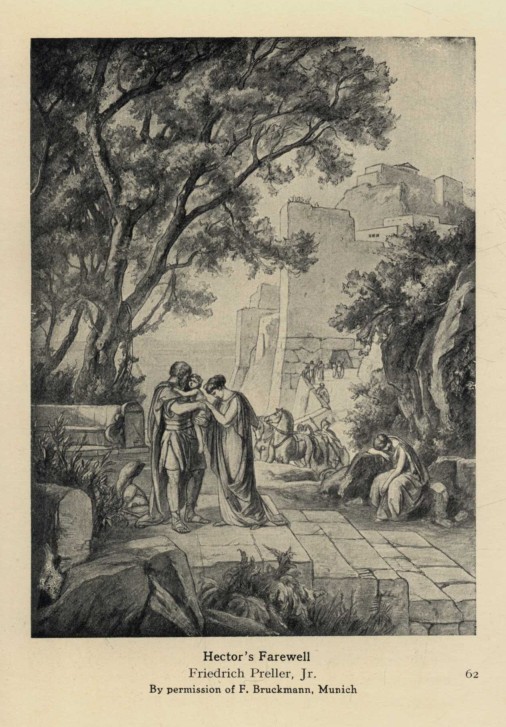
"Hector, thou art my father, my mother, my brother, my husband, my life, my all! Leave me not to perish in lonely widowhood with a fatherless child. Call the people within the walls, and fight no more in the open plain. Why wilt thou hazard thy life against such fearful odds?"
"Dear love, it cannot be," answered Hector sadly; "what would my brethren say, if I bade them skulk like cowards behind their walls? No; I must go where honour calls me, though I know that Troy is doomed with all her sons. Yea, the day shall dawn when temple and tower shall go down, and these streets shall run with Trojan blood. Then many a noble dame shall be led away captive, and among them—bitter, bitter thought!—thou shalt go, to eat the hard bread of bondage, and do menial service under a haughty mistress. Methinks I see thee, stooping under thy burden, as thou bearest water from some Grecian spring, while men point the finger at thee, and cry in scorn: 'Hail, Andromache, wife of Hector, Troy's bravest champion!' May death overtake me, and hide me deep in darkness and the grave, before ever I see thee dragged into slavery by ruffian hands."
A long silence followed, broken only by the sobs of Andromache, who was overpowered by the dreadful picture conjured up by her husband's words. At last Hector beckoned to the nurse, who had been standing a little apart, to bring him the child, and stretched out his arms to receive him; but the little one clung crying to his nurse's breast, affrighted by the brazen helmet and its nodding plume. His father and mother exchanged a loving smile, and Hector removed his helmet, and, laying it on the ground, took the boy in his arms, kissed him, and fondled him, and then put up this prayer to heaven: "Father Zeus, and all ye gods, grant that this, my child, may be strong and valiant in fight, even as I am, and win him honour among the Trojans; and may his mother's heart be glad when he comes back from the war laden with the spoils of the foe."
Then he gave the child to his mother, who pressed him to her bosom with a tearful smile. "Now I must leave thee," he said, with a tender gesture: "and mourn not overmuch for me. I shall not die before my day: every man has his appointed time, be he noble or base. Thou hast thy tasks, I mine; let us both play our part bravely, and leave the rest to heaven."
With many a pause and many a backward glance Andromache left him, and went back to her house, with her heart full of sad foreboding. When she was gone, Hector remained standing for awhile, lost in sorrowful thought. He was about to turn away when he heard the clatter of hurrying feet, and Paris came running up, glittering in his new-burnished armour, and tossing his plume, like some wanton, stall-fed steed. For he was a stout fellow, though a coward at heart, and was full of vigour and animal spirits after his long rest. "Who is the laggard now?" cried the gay holiday soldier, with a loud laugh. "Art thou ready to go, or shall I wait for thee awhile?"
"Forget my harsh words," answered Hector mildly. "I was vexed on thy account, when I saw thee hanging back, and heard the Trojans speak evil of thee. Let us forget our quarrels, and fight side by side for hearth and home; perhaps we may yet live to see happier days."
Second Battle: Repulse of the Greeks
I
The result of the first day's fighting had been all in favour of the Greeks, but, as many had fallen on both sides, a truce was made by mutual consent for the next day, to enable both armies to bury their dead. By the advice of Nestor the Greeks dug a trench and threw up a rampart for the defence of their camp, and by the zealous labour of that vast multitude the work was finished on the same night.
Zeus had not forgotten his promise to Thetis, and on the morning of the third day he summoned all the gods to council, and thus declared his will: "Hear me, all ye gods and goddesses, and let none dare to cross my purpose. I forbid any among you to take part in the battle to-day, and if any disobey me I will take him and fling him into Tartarus, the black and gloomy pit, as far beneath Hades as heaven is above the earth. Then shall ye learn how much mightier am I than ye all together."
Without waiting for question or reply, the lord of Olympus mounted his car, and swept along his airy road until he came to the mountain-range of Ida, overlooking the Trojan plain. There he halted and took his station on Mount Gargarus, the highest peak of Ida, from which he had a complete view of Troy and the Grecian camp.
Forth sallied the rival hosts, and soon the clash of arms rang through the cool morning air, as Greek grappled with Trojan in deadly conflict. All through the long hours, until noon, the issue remained doubtful; but when the sun stood at the zenith Zeus lifted a pair of golden scales, and weighed the fates of Greeks and Trojans; and the scale which held the fate of the Greeks sank down, heavy with defeat and disaster. Then Zeus thundered with a mighty peal from Ida, and hurled his bolt among the thronging ranks of the Greeks; and they were sore amazed, and pale Fear gat hold of them. Not one among them dared to stand his ground, neither Ajax, nor Idomeneus, nor Agamemnon himself. Only Nestor lagged behind, for he was hindered by the fall of one of his horses, which had been pierced through the brain by Paris with an arrow. Nestor sprang down, and began cutting through the traces with his sword; and while he was thus engaged, Hector came thundering past in hot pursuit of the Greeks, and seeing Nestor's plight turned aside to slay him. Diomede saw the old man's danger, and lashing his horses to a gallop drove instantly to his aid. "Mount, mount," he cried, "with me, and leave to my squires these sorry steeds of thine. Take thou the reins, and we will see if we can check the onset of the Trojans, and arrest Hector's destroying arm."
Nestor was not slow to obey the summons, and mounting by the side of Diomede he drove straight at Hector. Then Diomede flung his spear, and struck down Hector's charioteer, and, pursuing his advantage, he fell fiercely on the broken columns of the Trojans, scattered in wild pursuit of the enemy. Already the Greeks were beginning to rally, when Zeus hurled a second bolt, which crashed down before the feet of the horses of Diomede. "We must fly," said Nestor; "heaven is against us," and wheeling the affrighted steeds he followed the main body of the Greeks, who were now in full retreat towards the ships. That was a bitter moment for the gallant Diomede, when he heard the exulting voice of Hector, calling him coward, minion, woman. But peal after peal came from the frowning peak of Ida, now wrapped in black clouds; and that proud spirit was forced to bow to a higher power.
"On, Trojans, on!" shouted Hector, pushing on at full speed to head the pursuit. "Zeus favours our cause, and the Greeks are doomed. Neither walls, nor moat, nor all their sorry devices, shall stay our fury, but we will burn their ships and cut them off to a man." So on they sped, driving the Greeks before them across the plain, even to the very gates of the camp. Here the leaders turned at bay, and Agamemnon succeeded by desperate efforts in restoring some order in the panic-stricken host. Foremost among the defenders of the camp were Ajax, the greater and the less, Idomeneus and his comrade, Meriones, Diomede, and Teucer the half-brother of the greater Ajax. Teucer especially, who was a famous archer, did splendid service to the Greeks in that dreadful strait. Crouched behind the vast orb of his mighty kinsman's shield he watched his opportunity, and shot down man after man as the Trojans came rushing to the assault.
"Well done, brave bowman!" cried Agamemnon, who was standing near, as the eighth victim to Teucer's skill bit the dust. "Now aim an arrow at yonder mad dog"; and he pointed at Hector, who was leading the attack. Again the bow twanged, but this time he missed his mark, and instead of Hector struck another son of Priam, who was fighting by his brother's side. And as droops the poppyflower in a fair garden plot, heavy with its seed-pod, and drenched with the summer rains, so drooped that comely head, oppressed by the weight of its helmet.
"Nine have I slain," cried Teucer, in triumph. "Now let me see if my tenth arrow will bring down this noble quarry"; and once more he pointed a shaft at Hector's breast. But a second time the arrow went amiss, and pierced through the heart of Hector's charioteer. Cebriones, Hector's brother, succeeded to this dangerous office, thus twice left vacant on one day; while Hector himself sprang to the ground, and picking up a stone hurled it at Teucer, who was just fitting another arrow to his bowstring. The stone struck Teucer on the collar-bone, breaking the bowstring, and paralysing his arm. Ajax sprang forward to cover his injured brother, who was carried, groaning with pain, to the shelter of the ships.
The fall of Teucer struck fresh dismay into the Greeks, who now shrank back behind their defences, Hector following them close, and cutting down the stragglers, like a hound hanging on the flanks of a wild boar. When the last man had passed the barriers the gates were shut, and Hector was left outside, glaring with baffled rage.
II
Deep was the wrath of Hera when she saw her darling Greeks driven like sheep before the exultant Trojans, and huddled in wild disorder behind their ramparts. As the voice of Hector rang out above the din, like a trumpet sounding the charge, she rocked herself with fury in her seat, and at last, being able to contain herself no longer, she cried to Athene: "I will not endure it! Come what may, I will save my Greeks from perishing by the hands of that mad Trojan."
"It is the hand of Zeus," answered Athene, "that hath brought these foul deeds to pass, in fulfilment of the promise which he made to Thetis, when she clasped his knees, and besought him to honour her son. Graceless, thankless god! Did I not serve him day and night, when I watched like a mother over Heracles, his favourite son, and saved him from a thousand perils? And this is my reward, to be crossed in all my designs, and robbed of my just revenge, by him, my false father, who fools me with his caresses, and calls me his dear, grey-eyed maid! But go thou and harness our steeds, while I put on my armour, and we will try whether Hector will blench or not when he sees my spear flashing among the dykes of war,[1] and the Trojans falling thick and fast, to glut the dogs and vultures with their fat and their flesh."
Not a minute elapsed before the rebellious goddesses were equipped for battle, and ready to swoop like eagles on the heads of the hated Trojans. But Zeus had been watching their movements, and summoning Iris he sent her with a stern, imperious message to his mutinous wife and child. Prompt at his command, Iris sped on her rainbow wings to Olympus, and met the angry pair as they were issuing from the gates. "Are ye mad?" she said, confronting them with warning looks. "Listen to my message, and get ye back the way ye came. Thus saith the son of Cronos, and his words shall surely come to pass: he will maim the swift steeds which draw your car, and blast you with his lightnings, and shatter your chariot wheels, and for ten long years ye shall not be healed of the wounds from those corrosive fires. Then shall thou learn, thou grey-eyed maid, what it means to fight with thy sire."
Both Hera and Athene knew full well how far they might presume on the indulgence of Zeus, and without another word they turned back to Olympus, unyoked their steeds, and with quaking hearts joined the company of the gods. Soon after, the monarch of Olympus entered, and took his seat on his exalted throne; for he had returned from Ida when his business for the day was ended. Not a word, not a look, did he receive in greeting from his wife and daughter; but he knew their thoughts, and said: "Why sit ye thus dismayed, Hera and Athene? It cannot be that ye are wearied from doing battle with the Trojans, against whom ye have so dire a grudge, for ye were seized with trembling before ever ye had looked into the face of war. And well for you that it was so!—or your warring should have had a fearful end."
Athene remained cowed and silent, but the shrewish Hera, though she too was scared by her husband's anger, could not hold her peace, but muttered a few words of complaint and remonstrance, of which only the words "faithful Greeks" and "unmerited disaster" were audible. But Zeus was in no mood for contradiction, and he cut her short with this peremptory announcement of his purpose: "To-morrow, if thou wilt, thou shalt see thy 'faithful Greeks' plunged yet deeper in 'unmerited disaster.' They shall have no respite from slaughter and defeat until the swift-footed son of Peleus shall once more be roused to arms. Go then, and fill heaven and earth with thy rage and thy fury—go down to Tartarus, if thou choosest, and tell thy wrongs to the demons who dwell in that sunless den."
III
Night fell at last, bringing relief to the sore-stricken Greeks, and compelling the reluctant Trojans to suspend their attack on the camp. Hector drew off his forces, and pitched his camp by the riverside. This was a sign of great confidence on the part of the Trojans, who hitherto had rarely ventured outside their walls, and had always returned to the city at nightfall. But now the besiegers had become the besieged, and active preparations were made for a campaign in the open field. Orders were sent to the city for supplies of corn and wine and cattle to victual the camp, and the elders of Troy were warned to keep a vigilant watch during the night, to guard against surprise.
When these measures of prudence were completed, Hector, who had been the leading spirit through all this eventful day, summoned the Trojan chieftains to a council of war. High and proud was his glance, as he stood leaning on his tall spear, with its point of tempered bronze and its socket of gold; for he dreamt of nothing less than the total rout and discomfiture of the Greeks. And he found ready hearers in the leaders of the Trojans and their allies, who read in his looks an augury of triumph and victory. "This day," he said, "I thought to have destroyed the Grecian fleet and army, and to have offered thanks to the gods of our country in the Trojan citadel. For this time night has saved them from utter ruin; but the blow is only delayed, not averted, and to-morrow we will set the finish to this glorious work. Let every man now get to his supper with good heart and hope, and look ye to it that numerous fires be lighted in the camp, sufficient to illuminate all the country round, as far as to the fleet. For I fear that these hounds will try to escape under cover of night, and I would not that they should leave us without some token of our loving-kindness—some deep mark in their flesh from Trojan arrow or spear to remember us by when they reach their homes in Greece. If they abide here till to-morrow, the better for us, and the worse for them! Then shall Diomede, the mighty son of Tydeus, pay the price of the lives which he has taken, and to-morrow's sun shall behold him lying stiff and stark, with all his comrades heaped in slaughter around him."
Having listened to the words of their great captain, the leaders dispersed to their several quarters to carry out his orders. And the swift southern night came down, wrapping sea and land in shadow. But soon the realm of darkness was invaded by the flame of a thousand fires. Thick as are the stars which cluster round the moon on a windless summer night, gladdening the shepherd's heart as he keeps his lonely vigil among the hills, so thick shone the fires of the Trojans in the space between the river and the ships. By every fire sat fifty men, and their horses stood near at hand, tethered to the cars, cropping their barley and waiting for the dawn.
The Embassy to Achilles
I
So the Trojans held their bivouac, and whiled away the time with drinking, and music, and song. Far other were the feelings of the cowed and beaten Greeks. Many a warrior lay sleepless on his uneasy couch, tossed on a troubled sea of anxiety and dread. Among the leaders there was no thought of rest, and they soon received a hasty summons to attend a council in Agamemnon's quarters. Small comfort had they to receive from the lips of their king, who was utterly broken and cast down, and had nothing to advise but instant flight. A long silence followed his despairing words, and the first to speak was Diomede, whose young and elastic spirit made him a bright exception amid the general despondency of his comrades. Indignantly rejecting the cowardly counsels of Agamemnon, he avowed his intention of remaining and carrying on the war with his single troop, if all the rest of the Greeks deserted their posts. His bold words rekindled the courage of the rest, and they all joined their voices in a fixed resolution to remain and fight out their quarrel to the last.
"'Tis well," said Nestor, who was the next to speak. "Thou art a proper youth, young son of Tydeus, worthy to take the lead in council and in fight. But now listen to an old man's advice. The Trojans are holding their leaguer within sight of our gates, and may make an onfall at any moment; therefore let a watch be set by the moat outside the camp, and let this charge be given to the young men. We, the elders, have a graver matter to consider—how we may end the lamentable feud which has brought division among us, and made us an easy prey to our enemies."
The matter thus obscurely hinted at by Nestor was, of course, the quarrel between Achilles and Agamemnon; and as soon as the watch was set, and left under the charge of Antilochus, Nestor's eldest son, the old King of Pylos reopened the debate with these words: "To thee, mighty son of Atreus, I will address myself, for thou art the vicegerent of Zeus, and holdest the sceptre of righteousness which thou hast received from his hands. Great is thy place, and high the trust imposed in thee—even the lives and fortunes of all this people. Therefore will I speak roundly with thee, concealing nothing which is in my heart. Thou hast erred, great sovereign, thou hast erred grievously, in putting public dishonour on the bravest and most illustrious champion in all thy host. It is thine act which hath brought us to this pass; and it is for thee to make restitution, that he may cease from his sore anger, and incline his heart unto us again."
Far from showing any resentment at Nestor's plain speaking, Agamemnon freely confessed his fault. "I have sinned," he said, "yea, I have sinned grievously, in the great blindness of my heart. But, thanks be to heaven! I am both able and willing to atone for the wrong which I have done. Attend, while I declare unto you the ransom which I will pay unto Achilles to wipe out the stain upon his honour. Vessels of silver will I give him, and vessels of bronze, ten talents of gold, and twelve steeds, all prizewinners, which have won me much wealth by the speed of their feet. Also I will give him seven women, my bondservants, skilled in all manner of needlework, whom I won at the sack of Lesbos; and with them shall go Briseis, who, since I took her from him, has lived in all honour with the ladies of my retinue. And if ever the gods grant us to capture the city of Priam he shall have a shipload of treasure, and twenty Trojan ladies, the noblest and the fairest, as his share of the spoil. Moreover, when we return home from the war, he shall be as a son of my house, and I will give him one of my daughters in marriage, without money and without price,[1] and will add a rich dower besides. And he shall be a prince of my land, and lord of seven fair cities, honoured and obeyed as a god by those that dwell therein. Surely, if he hath a human heart, he cannot turn away from me, his monarch, and his elder, when I come to him with full hands, beseeching him to forgive."
The King's magnificent offer drew warm words of praise from the chiefs, and nothing now remained but to choose those who were to be entrusted with this important embassy. At the suggestion of Nestor it was decided to send Phœnix, an aged noble, who was connected with Achilles by close ties of early affection, Odysseus, and the greater Ajax. After a few words of warning and counsel from Nestor, they were despatched forthwith to the tent of Achilles, and with them went two heralds, to give greater solemnity to their mission.
II
So together they passed along the level sand, with many a prayer to Poseidon, lord of the sea, that they might easily persuade the mighty heart of Æacides.[2] And when they came to the tents and ships of the Myrmidons, they found Achilles sitting at the door of his tent, and soothing his troubled spirit with song, and the clear music of a harp, which he had taken among the spoil of Eëtion's city. Opposite to him sat Patroclus, the most beloved of his comrades, waiting until Achilles should have finished his lay, whose theme was the deeds of famous men. And they came and stood before him, with Odysseus at their head. When Achilles saw them he gave a cry of surprise, and sprang from his seat, harp in hand; and Patroclus rose up with him. Then, greeting them with a courteous gesture, he said: "Welcome, dear friends! Most welcome are ye of all the Greeks, even in this hour of my displeasure. Be seated. I know why ye have come hither—sore indeed is the need." So saying, he led the way into the tent, and as soon as they were seated he called to Patroclus, saying: "Set forth the largest bowl, and open the oldest cask of wine, to do honour to the dear guests who have come under my roof."
[2] Grandson of Æacus, the father of Peleus.
Therewith he placed a table, in the light of the fire, and on it he laid the loin of a sheep and another of a fat goat, and the chine of a hog. Automedon, his squire, held the meat, and Achilles with his own hands cut it into slices, spitted it, and roasted it over the glowing embers. When all was ready, they feasted sumptuously, and drank of the rich wine which Achilles poured out without stint. The banquet being ended, Ajax made a sign to Phœnix; but Odysseus took the word from him, and, rising with a full cup in his hand, pledged Achilles, and said: "I drink to thee, son of Peleus, and thank thee for thy good cheer. Never have I tasted choicer fare, not even in the tent of Agamemnon himself. But, alas! my noble host, we have little heart for feasting and making merry, for we stand on the very brink of ruin, and thou alone canst save us. The Trojans have pitched their camp before our very gates, and it will not be long before they sweep us into the sea. Zeus hath openly taken sides with our foes, and affrights us with thunders and with lightnings; and Hector, full of mad presumption, is breathing out threatenings and slaughter against us. I fear—yea, I fear exceedingly—that the god will accomplish his threats, and that we are indeed doomed to perish in the land of Troy, far from our native Argos. Up, then, and gird thee to the fight, if thou art minded to save the sons of Greece, even in the eleventh hour. If thou wait longer the mischief will be done, and thou wilt repent of thy stubbornness too late. Remember the words of thy father, Peleus, when he sent thee to the war: 'My son, thou art very strong, but this good gift thou owest to heaven. Do thou curb thy haughty spirit, and turn thee to thoughts of kindness, if thou wouldst be honoured of old and young.' Thou hast forgotten the good words of thy father, and given place to malice and uncharitableness. Quit this froward mood, and mark while I tell thee the brave gifts which Agamemnon offers as the price of thy good will."
Accordingly Odysseus went on to recite the whole tale of the royal bounty, and when the list was complete he wound up his speech by appealing at once to the humanity, the pride, and the ambition of Achilles. "If thou despisest Agamemnon and his gifts, take pity on thy poor countrymen, who will honour thee as a god, and glorify thee as their preserver. And now thou mayest slay Hector, for assuredly he will not refrain from thee in the frenzy which possesseth him, boasting that there is none to match him among all the Greeks who sailed to Troy."
Odysseus resumed his seat, and amidst a breathless silence Achilles rose up and began to speak, calmly at first, but rising in passion as he proceeded. "Most noble son of Laertes, I will answer thee bluntly and to the purpose, that ye may know my mind, and may not come hither on this errand again. For hateful to me, even as the gates of death, is the man who hides one thing in his heart, and speaks another. Hear, then, what I have to say. Neither Agamemnon, nor all the Greeks together, shall turn me from my purpose. I have fought—thou knowest how I have fought—against the common foe; and what my reward hath been thou knowest also. Like a mother bird, who flies to and fro, never weary, never resting, carrying morsels to her nestlings, while she remains empty herself, so have I passed my days in war and bloodshed, and my nights in sleepless watchings, putting my life in jeopardy, for the sake of another man's wife. Twelve cities have I sacked, sailing the sea in my ships, and eleven on land, within the realm of Troy. First the toil, which was mine, and after that the spoil, which was his. I brought it all, and laid it at his feet, and he kept the greater part by far, giving me back a little—a very little—for all my pains. And that little he hath taken away. Let him keep it, and joy go with it! I loved the maid Briseis, yea, dearly I loved her! Thinketh he that he alone and his brother love their wives? She was my prize, my bride: he hath torn her from mine arms, and that foul deed I will never forgive.
"And as to the gifts which he offers, let him know that I came here to fight for honour, not for pelf. He hath denied mine honour, and now he would bribe me to erase that dark record with a purse of gold. But I will not be bribed. Away with his gifts! I value them not a straw. Not though he offered me ten times and twenty times as much—all the wealth that he hath, or ever shall have—not for all the riches of Egyptian Thebes, which sends forth ten thousand warriors, with chariots, and with horses, from its hundred gates—no, not for treasures unnumbered as the sands and dust of the earth—could he buy pardon of me, until he hath suffered the full penalty of the outrage which devours my heart.
"Long ago my mother gave me the choice of two diverse fates—short life with honour, or long life without a name. Mine honour is lost—therefore I will cling to my life, and live it out to the end. Thy miser king holds that men's lives are to be bought and sold, as the lives of sheep and oxen; but herein he is mistaken again. Wealth may be won, and lost, and won back again, seized by the strong hand, or heaped up slowly by plodding industry; but the breath of our life cannot be called back again, when once it hath passed the door of our lips. Therefore I am determined to end my days in peace and quietness among my own people, and quit these brawls, which concern not me. And I counsel all the rest to do the same, for it is clear that Troy's overthrow is not to be wrought by you.
"Ye have heard my answer; go tell it to the chiefs, and bid them be assured that they have naught to hope from me."
Deep was the disappointment of the three envoys, as they followed the wild eloquence of that fierce and implacable man. For a long time not a word was spoken, for it seemed vain to argue against such passion and pride. At last the venerable Phœnix rose feebly from his place, and in a voice broken with sobs and tears began a discourse of immense length, full of tender personal reminiscence and old-world legend. This old man had a curious history. Born to wealth and power, he became an exile in his youth, having been cursed by his father, whom he had bitterly provoked in the course of a family feud. In consequence of the curse he remained a childless man, and, finding a new home in the land of Peleus, he lavished more than a father's tenderness on Achilles, Peleus' infant son.
These incidents from his own life, which he dwelt on with the fond garrulity of an old nurse, furnished a copious theme to Phœnix in the first part of his harangue. "I little thought," he said, "when I set thee on my knee, a little, helpless babe, and fed thee with choice morsels of meat, and held the cup to thy lips, and thou wouldst spill the wine over my gown in thy childish weakness—I little thought to see thee grow up to be so pitiless and inflexible, more hard to move than the gods themselves, whom we approach with prayer and sacrifice, and with bended knees. Beware of the vengeance which waits upon a stubborn and unforgiving heart. Swift and strong is the dread goddess Ate, who prompts man to give and take offence; but Penitence is an old and wrinkled goddess, who goes halting behind her, to heal the mischief; and if he who is wronged will not listen to her voice he himself becomes the offender, and the whole guilt of the quarrel rests on his head. Hearken thou, therefore, to her gentle pleading, and receive the bountiful gifts of Agamemnon, or the day will come when thou wilt take thy sword perforce, and fight the battles of the Greeks without reward."
Achilles listened with manifest impatience to the rambling appeals of Phœnix; and when at length the old man had finished, he replied briefly: "I seek no reward but the favour of Zeus, which I have, and shall not cease to have as long as the breath of life is in me. Vex me no more with thy vain repinings; my purpose is fixed, and it is for thee to choose whether thou wilt be friends with Agamemnon or with me. If thou art on my side remain here for the night, and to-morrow we will consider whether we will go or stay."
The conference was brought to a close by a few words from Ajax, whose frank and soldierly heart was hot with indignation at the vindictive temper of Achilles. Turning to Odysseus, he said: "Noble son of Laertes, let us be going. Words are wasted on this fierce and froward man. Surely he has a heart of stone, which no kindly thought, no gentle memory of ancient comradeship, can soften. All the homage of his countrymen, all the loving-kindness of his friends, are as dirt beneath his feet. Many a man hath accepted a price for the blood of a son or brother slain, and suffered the slayer to remain unharmed in the land; but thou, Achilles, hast scorned the most princely offers for the sake of one captive maid. O yet at last be moved! Bring not scorn upon us, thy guests, thy friends, but give us a gentle answer to take back to our countrymen in their dire need."
These manly and moving words had some effect on Achilles, half maddened as he was by wounded pride. Yet still he would not yield, though his answer showed that he had not been in earnest when he spoke of abandoning the war. "Thou hast spoken well, Ajax," he said, "and there is much reason in what thou sayest. But my heart boils with rage when I think of the contumely which was heaped upon me before the eyes of all Greece, as though I were some beggared and nameless outcast; and I will not put on mine armour again, until I see the smoke arising from the Grecian ships, and Hector drawing near to my galleys with sword and fire. Then, methinks, his career of victory will end."
After this final declaration of his purpose by Achilles, Ajax and Odysseus took their leave, and returned to the assembled chieftains, who still sat anxiously awaiting the result of the mission. Phœnix remained behind, having resolved to cast in his lot with Achilles.
The Night Raid on the Trojan Camp
I
Uneasy lay the head of Agamemnon the King that night, and, thick as lightnings which herald the storm, thronging cares shot through his brain, forbidding all repose. As often as he opened his eyes he saw the red gleam of the Trojan watchfires; and the hum of the armed multitude, mingled with the strains of flute and pipe, filled his ears. After an hour of weary tossing he left his couch, and wandered out into the camp, until he came to the quarters of Menelaus, and, finding him also afoot, he sent him to call up Ajax and Idomeneus, and went himself to summon Nestor, intending to hold a midnight council, and devise some plan of relief in this hour of general depression and dismay.
On the way he was joined by Diomede and Odysseus, and when they all met it was resolved to pay a visit to the sentinels and see if they were faithful to their trust. When they came to the place where the pickets were stationed, outside the barriers, they found the whole troop keeping watch and ward with sleepless vigilance, like dogs in charge of a sheep-fold when they hear a lion prowling without. Every man was on the alert, with his face towards the Trojan leaguer, as if expecting an instant attack. Nestor's long experience of war now enabled him to make a suggestion which led to one of the most famous adventures in the whole course of the war. "Is there one among you bold enough," he said, "to go and spy out the movements of the Trojans in their camp, and bring back a report of what they design against us? 'Twould be a noble enterprise, and would bring both fame and profit to him who should accomplish it."
There was a short pause, and then Diomede declared himself willing to undertake this perilous adventure, "But will not one of you go with me?" he asked. "Two heads are better than one, and I may find myself in a strait in which I should need a comrade's help and advice."
Six of the leaders at once offered to accompany Diomede, and among these were Menelaus, Odysseus, and Antilochus, the captain of the outpost, who was especially eager to go. "Choose him whom thou thinkest best fitted for the task, without respect to rank or birth," said Agamemnon, in fear lest he should name Menelaus for his companion. "Well, then," answered Diomede, "I choose Odysseus, the hardiest and the shrewdest spirit among us all, and the darling of Athene. With him at my side I will go through fire and water without scathe."
"A truce to thy praises," said Odysseus, "and let us away, for the night is far spent, and the day is at hand."
II
Lightly armed and equipped, the stout-hearted pair passed out of the light of the watchfires, and set their faces towards the Trojan camp. Just as they were starting they heard the cry of a heron flying on the right, and Odysseus was glad, for he knew it was a sign sent by Athene, promising success to their journey. Murmuring a prayer, they stepped forward boldly, like two lions bound on a midnight foray, and crossed the battlefield of yesterday, over corpses and broken armour and pools of blood. Suddenly Odysseus came to a halt, and laying his hand on Diomede's arm whispered: "I hear a footstep as of one coming this way, whether to spy out our camp, or to plunder the dead, I know not. Let us allow him to go by us, and then spring upon him as he passes."
Crouching down among the heaps of slain, they waited until the man had passed in the direction of the ships, and then leapt from their ambush and gave chase. When he heard them he hesitated a moment, doubting whether they were friends or foes; then, recognising them as Greeks, he bounded away at full speed, Odysseus and Diomede following hard behind, like two hounds on the track of a doe or hare. But the fellow was a fleet runner, and would have been fairly driven into the hands of the Greek sentinels, if Diomede had not raised his spear, and sent it whizzing close to the ear of the fugitive, crying as he did so: "Halt! whoever thou art, or my next cast shall bring thee down."
Then the wretch was afraid, and stood still, in obedience to the summons, with knees knocking together and chattering teeth; and the two Greeks ran up, panting for breath, and seized him by the arms. Weeping with terror he began to beg for his life. "Make me your prisoner," he faltered, "and I will pay you a heavy ransom, for my father's house is full of silver and gold, and vessels of iron,[1] choicely wrought, and he will pay you a heavy price when he hears that I am alive."
"Have no fears for thy life," said Odysseus; "only answer me truly, and thou art safe. Why art thou wandering here in the dead of night? Art thou on an adventure of thine own, or did Hector send thee to spy out the Grecian camp?"
"It was Hector who beguiled me to commit this folly," answered the captive, whose name was Dolon; "for he bribed me with a great bribe, promising to give me the steeds of Peleus' haughty son, if I would go down to the fleet, and bring back information whether you were preparing to fly from our shores in the night."
"Thou art ambitious, I see," replied Odysseus, smiling. "Bold must be thy heart, and firm thy hand, if thou wouldst drive the steeds of Æacides, which are of no mortal breed. But tell me now, and answer me truly, where is Hector stationed in the Trojan camp, and in what order have the others pitched their tents?"
"Hector and the chiefs," answered Dolon, still shaking with mortal dread, "have their quarters by the tomb of Ilus, and round them lie the native Trojans, keeping good watch. The allies are encamped about them, in no fixed order, and they are all asleep. On the very outskirts of the camp lie the Thracians, and Rhesus their king; and if ye are minded to make an onfall on their leaguer ye may do it in safety, and win a rare prize. For Rhesus hath a pair of milk-white coursers, unmatched in strength and speed, and a car richly adorned with silver and gold. Likewise he hath a suit of golden armour, fit for the gods to wear. And all this ye may win without a blow. Now leave me in the custody of your comrades, or bind me fast here, that ye may know when ye return whether I have spoken the truth."
But that night was to afford a second instance of broken faith, hardly less infamous than the first. Having tempted this poor caitiff to betray his comrades by promising him his life, they now gave him the traitor's wage. "Thou must die, Dolon," said Diomede coldly, "for all thy good news. Thou art a foe, delivered into our hands, and thou shalt never spy upon us or fight with us again." Dolon clung to him with cries of anguished entreaty, pleading for his life; but Diomede, with one downward stroke of his sword, swept off his head, which rolled, with lips still moving, in the dust. Then stripping off his armour, he hung it in a tamarisk tree, and, having marked the place, went forward with Odysseus in the direction of the Thracian camp.
When they came to the quarters of Rhesus, they found him lying in the midst of his men, with his famous steeds standing near, tethered to their car. All the troop was sleeping heavily, for they were newly arrived at Troy, and had travelled far and fast the day before. "There he is," whispered Odysseus, "and these are his steeds, a glorious pair! Now to work! Slay me a score of these sluggards while I loose the steeds."
Thereupon Diomede drew his sword, and struck right and left like a headsman, until he had slain some dozen of the sleeping Thracians; and, as he proceeded, Odysseus dragged the slaughtered men out of the way, to make a path for the horses, which were young, and unused to such sights. Diomede's last victim was the giant Rhesus, who was breathing heavily, and dreaming of his home; but a Grecian blade cut short his dreams, and his fleet coursers now found a new master. While Diomede was thus busy, Odysseus untethered the steeds, and coupling them together by their harness drove them out of the camp, striking them with a bow which he carried; for he had forgotten to take up the whip. Diomede still lingered, meditating some final act of daring, to crown the night's adventure. Beneath him lay the corpse of Rhesus, and his golden armour, and he was hesitating whether to take these, or slay a few more Thracians, when Odysseus gave a low whistle, warning him that it was time to be going. The next moment he heard the sound of hurrying footsteps, and, perceiving that the alarm had been given, he joined Odysseus, and mounting one of the horses seized the other by the bridle, and rode at a rapid trot towards the sea. Odysseus ran by his side, holding on by the harness, for he was no rider,[2] but a swift and enduring runner.
[2] Riding was little practised among the Homeric heroes.
They had no sooner departed than a wild commotion arose behind them in the awakened Thracian camp, but increasing their pace they soon reached the spot where they had left the unhappy Dolon, and, having paused for a moment to take up his armour, they hurried forward, and before long they were within hail of the Grecian outposts, where the whole company of the leaders was still assembled, anxiously awaiting their return.
Nestor was the first to hear the sound of the horses' feet, and thinking that the Trojans were attacking he ran to raise the alarm. But he was soon reassured when he heard the voice of Diomede, followed a moment later by the arrival of the hardy adventurers with their splendid booty. Joyful were the greetings on both sides, and when the story of that great exploit had been briefly told they all dispersed to their quarters, to snatch a few hours of sleep before the toils of the coming day.
The Brave Deeds of Agamemnon: Reverses of the Greeks
In the still hours of the dawn the Greeks were startled from their slumbers by a loud and fearful cry, which came from no mortal lips, but from Eris, the dread goddess of strife, who had been sent down by Zeus to give the signal for battle. The first to obey that awful summons was Agamemnon; for this was to be his great day, and his heart was aflame with the lust of slaughter. Springing from his couch he began to don his armour. First he put on his greaves, which were made of pliant white metal, with ankle pieces of silver. Then he took up his corslet, with a glance of pride, for it was of choice and costly workmanship, cunningly fashioned of thin strips or courses of metal. Ten courses were of blue steel, and ten of gold, and twenty of tin; and round about the corslet wound three serpents, wrought in divers colours, like the rainbow, with their heads meeting where the corslet narrowed at the neck. His sword glittered with golden ornaments, and the scabbard was of silver, and the baldric of gold. On his shield, which had ten circles of brass, were twenty bosses of white tin, and in the centre a boss of blue steel; and it bore an image of the Gorgon's head and the dreadful faces of Rout and Panic. Attached to it was a silver strap, bearing the device of a serpent with three heads.
Glittering in this gorgeous panoply, brandishing two spears, and raising his battle cry, Agamemnon rushed to the gates of the camp, and placed himself at the head of his bravest champions, who were mustering there with the flower of the Greek army, prepared for the expected attack. They had not long to wait; hardly had they set their ranks in order, when the Trojans appeared on the summit of the slope which ran down to the shore. And like a star which appears and disappears on a stormy night, when the sky is covered with scudding clouds, so glittered the mailed form of Hector, as he ranged in and out among the advancing columns, marshalling his men to the fight.
Then like two lines of reapers working together on opposite sides of a deep field of wheat or barley, so met Greeks and Trojans on the plain before the camp, and war's dread harvest began. None of the gods were present, save only Eris, whose savage heart was glad when she smelt the smell of blood. And Zeus sat apart on a lonely peak, looking down upon Troy and the Grecian fleet and the two warring nations in the space between.
Until the hour of noon the battle was waged with equal fortune on both sides. But just at the time when a woodman in some mountain glen breaks off his labour to prepare his midday meal, having
The Brave Deeds of Agamemnon: Reverses of the Greeks
I
In the still hours of the dawn the Greeks were startled from their slumbers by a loud and fearful cry, which came from no mortal lips, but from Eris, the dread goddess of strife, who had been sent down by Zeus to give the signal for battle. The first to obey that awful summons was Agamemnon; for this was to be his great day, and his heart was aflame with the lust of slaughter. Springing from his couch he began to don his armour. First he put on his greaves, which were made of pliant white metal, with ankle pieces of silver. Then he took up his corslet, with a glance of pride, for it was of choice and costly workmanship, cunningly fashioned of thin strips or courses of metal. Ten courses were of blue steel, and ten of gold, and twenty of tin; and round about the corslet wound three serpents, wrought in divers colours, like the rainbow, with their heads meeting where the corslet narrowed at the neck. His sword glittered with golden ornaments, and the scabbard was of silver, and the baldric of gold. On his shield, which had ten circles of brass, were twenty bosses of white tin, and in the centre a boss of blue steel; and it bore an image of the Gorgon's head and the dreadful faces of Rout and Panic. Attached to it was a silver strap, bearing the device of a serpent with three heads.
Glittering in this gorgeous panoply, brandishing two spears, and raising his battle cry, Agamemnon rushed to the gates of the camp, and placed himself at the head of his bravest champions, who were mustering there with the flower of the Greek army, prepared for the expected attack. They had not long to wait; hardly had they set their ranks in order, when the Trojans appeared on the summit of the slope which ran down to the shore. And like a star which appears and disappears on a stormy night, when the sky is covered with scudding clouds, so glittered the mailed form of Hector, as he ranged in and out among the advancing columns, marshalling his men to the fight.
Then like two lines of reapers working together on opposite sides of a deep field of wheat or barley, so met Greeks and Trojans on the plain before the camp, and war's dread harvest began. None of the gods were present, save only Eris, whose savage heart was glad when she smelt the smell of blood. And Zeus sat apart on a lonely peak, looking down upon Troy and the Grecian fleet and the two warring nations in the space between.
Until the hour of noon the battle was waged with equal fortune on both sides. But just at the time when a woodman in some mountain glen breaks off his labour to prepare his midday meal, having wearied his hands with holding the axe, the Greeks made a vigorous charge, and broke through the Trojan line. Agamemnon fought in advance of all the rest, and recognising among the enemy two sons of Priam, who had formerly been taken captive by Achilles and let go for a ransom, he slew them both, and stripped off their armour. And as a lion slays two hapless fawns, while their dam, who is feeding near, flies sweating with terror from the onslaught of the mighty beast, so the Trojans saw their young princes slain, but were helpless to aid them, being themselves hard pressed by the victorious Greeks.
Like a famished lion who has broken into a sheep-fold, and ravages the flock, so fell Agamemnon on the huddled masses of the Trojans, striking about him with sword and spear. Presently he had an opportunity of gratifying his private revenge; for right before him, impeded by the press, he saw the two sons of Antimachus, a Trojan who was bribed with gold by Paris to oppose the restoration of Helen. There they stood helpless, both together in one car, holding out their hands in supplication, and begging him to spare their lives. "There is no mercy for such as you," cried Agamemnon fiercely. "Did not your father, in the hearing of all the people, advise the murder of my brother, Menelaus, when he came on an embassy to Troy? Die, and pay for your father's treachery." With that he thrust down one of them with his spear, and the other, who turned to fly, he slew with his sword, lopping off head and arms, and spurning the trunk with his foot, so that it rolled like a log along the ground. Then, raising his battle cry, he plunged into the thick of the fight, where the main body of the Trojans were flying before the Greeks, horse and foot mingled together in headlong rout. And as a fire sweeps through the dry brushwood, borne onward by the wind, and leaving a black waste behind, so thick and fast fell the Trojans before Agamemnon; and many an empty car went rattling over the field, borne hither and thither by its affrighted steeds, whose master was lying where he fell, until the vultures assembled to the banquet at eventide.
Across the plain they sped, past the tomb of Ilus and the wild fig-tree, making straight for the city, and as they came to the gates they turned at bay, and waited for those who were still flying before Agamemnon and the Greeks.
"Now haste thee, swift Iris!" said Zeus to the maiden messenger of heaven, "and bear this message to Hector. As long as he sees Agamemnon foremost in the slaughter, let him hold back, and leave the others to stem the tide of war; but when Agamemnon receives a wound, as he shall do soon, then let Hector take the lead again, and drive the Greeks back upon their ships."
Hector duly received the message, as he was rallying his men to defend their gates; and in obedience to the command of Zeus he retired from the front, and waited for the promised relief. He had not long to wait. Presently Agamemnon was assailed by Iphidamas, a son of Antenor, one of the chief men of Troy, who charged at him, spear in hand, and thrusting with all his force struck him full on the breastplate. But the spear point was turned on the tempered metal, and Agamemnon, seizing the shaft, dragged the weapon from his hands, and smote down the tall champion with a blow of his sword. But as he was stooping to strip the armour from the corpse, Coön, the brother of Iphidamas, crept up to his side, and drove his spear clean through Agamemnon's forearm.
Though grievously hurt Agamemnon turned on his assailant, and cut him down; and having thus avenged himself he still fought on, dealing havoc among the Trojans with his spear and his sword, and with heavy stones. But presently his blood ceased to flow, and his arm grew stiff, as the wound began to close. Being now in dreadful pain, he could fight no longer, and summoning his chariot he left the field, and drove at full speed back to the camp.
II
"Forward, men of Troy!" shouted Hector, rushing to the front. "Agamemnon is sorely wounded, and Zeus has promised us the victory." And as a hunter cheers on his hounds against a lion or wild boar, so Hector encouraged his Trojans, by word and by action, to assail the Greeks; and like a black squall which leaps suddenly on the Ægæan, he himself led the assault, strong in the support of Zeus, and confident of victory.
Diomede marked him as he moved his way through the Grecian ranks, and stood to oppose him, poising his spear. The weapon flew, and struck him on the helmet, but rebounded from the massive brazen ridge, and dropped on the ground. Hector, though unwounded, was hurled back by that ponderous stroke, and sank, half-stunned, on one knee, leaning on his hand. Following up his advantage, Diomede rushed forward to regain his spear; but meanwhile Hector had recovered from his faintness, and escaped in his chariot to the rear. "Again thou hast avoided death at my hands, thou dog!" shouted Diomede after him. "But I will slay thee yet." And he stooped to take the armour from a Trojan whom he had killed.
Leaning against a stone pillar, the monument of Ilus, an ancient King of Troy, stood the gay archer Paris; and when he saw Diomede kneeling by the fallen Trojan he took steady aim, and launched an arrow, which pierced through Diomede's right foot, and pinned him to the ground. "Thou art hit," he cried, springing from his ambush with a loud laugh. "Would that my shaft had cloven thy very heart! So should I have given a breathing space to the Trojans, who cower before thee like bleating goats before a lion."
"Out on thee, cowardly bowman!" answered Diomede, with scorn. "Thou fightest thy battles from a safe distance, and shunnest the push of sword or spear. And now thou art boasting aloud over this pinprick, which harms me not at all. There is no force in the blow from a coward's arm. But the touch of my weapon means death, and they who feel it need no second stroke. Their last bed is the bare, cold ground, and vultures perform their obsequies."
Notwithstanding these bold words, the wound was severe, and as soon as Odysseus, who ran to aid his friend, had drawn out the shaft, Diomede was obliged to retire from the battlefield.
As Odysseus was about to join the ranks of the retreating Greeks he found himself hemmed in by a party of Trojan spearsmen, who surrounded him with a circle of bristling points. Then as a wild boar issues from his shady lair, foaming and champing his teeth, and charges down upon the hounds and hunters who have beset the covert, so sprang Odysseus on his assailants, and in a moment four of them lay writhing at his feet. The last of these, a young noble named Charops, found an avenger in Socus, his brother, who thrust so vigorously at Odysseus with his spear that the point clave through shield and corslet, and made a long ragged wound in his side. Socus, in his turn, who fled as soon as the blow was struck, was gored in the back, between the shoulders, by the spear of Odysseus. But that sage and valiant warrior was now in deadly peril; for when the Trojans saw his blood flowing, as he drew out the lance from his corslet and shield, they fell upon him like one man, with wild cries of triumph. Slowly he gave back before them, shouting aloud to his friends to come to his rescue. Three times he cried, and his voice reached the ears of Menelaus, who hurried to his relief, bringing with him the mighty Ajax, son of Telamon.
They came not a moment too soon, for Odysseus was hard beset by his clamorous foes, who crowded round him, like jackals round a tall antlered stag which has been wounded with an arrow, and has fled to the shelter of the woods: but while the jackals are yelping about him, up comes a great bearded lion, and scatters the jackals, and makes the stag his prey. So when the towering form of Ajax appeared, as he advanced with his huge orbed shield, the Trojans abandoned their intended victim, and fled in dismay. Menelaus took the wounded man by the hand, and led him to the place where his chariot was waiting, leaving Ajax occupied with a fresh column of Trojans, who came pouring to the attack when they saw their friends routed. Then mightily raged the sword of Ajax, falling like a flail on the heads of his foes, and man and horse went down before him.
All this time Hector had been fighting in another part of the field, at the extreme left of the line of battle, where the Greeks were led by Nestor and Idomeneus. A lucky shot from the bow of Paris disabled Machaon, who, besides being a stout fighter, was the most skilful leech in the Greek army. "We must save him at any cost," said Idomeneus to Nestor. "A skilful physician is worth a whole troop of spearsmen. Mount thou thy car, and carry him with all speed to the camp." Nestor did as he was advised, and Idomeneus was thus left to bear the brunt alone.
Just at this moment Cebriones, Hector's charioteer, came galloping up with the news that the main body of the Trojans was suffering severely from the attack led by Ajax. As the departure of Nestor and Machaon had left him little to do in this part of the field, Hector at once mounted his chariot, and directed his course towards the spot where Ajax was fighting. Right between the warring lines he drove, trampling over corpses, helmets, and shields; and steeds and car were spattered with blood. Soon he was joined by a strong troop of Trojan warriors, and Ajax found himself assailed by a storm of missiles. Then even that mighty man felt a touch of fear, and throwing his shield behind him he began slowly to retire, halting at every step, and striking down some too daring assailant. Like a lion who has been driven off from a herdsman's steading with javelins, and with stones, and with burning brands, yet will not leave the place, but prowls near all night, lusting after the flesh of the fat beeves—so Ajax, though hard beset, drew back reluctantly, inch by inch, before the clamour and fury of his foes. Dogged he was, and hard to stir from his place, like some big greedy ass who has found his way into a deep field of corn, and will not budge till he has filled his belly, though assailed by a laughing crowd of children, who rain blows on his back and ribs,—even so the blows rained upon Ajax, who was encumbered by the weight of the spears which had pierced his shield. At last, the Greeks advanced to his succour in close array, and joining their ranks he wheeled once more and faced the thronging Trojans.
III
The tide of battle had thus turned again, and the Greeks were being driven steadily back upon their camp. The roar of the conflict reached the ears of Achilles, who was standing near his ship, peering out eagerly over the Trojan plain; and at the same moment he saw Nestor driving past in his chariot, bringing with him the wounded Machaon. Then he called to Patroclus, and bade him go and inquire who the injured man was. "I think," he added, "that it was Machaon; but the car passed me in a flash, and I saw not his face. Methinks the hour of my revenge is near, for the Greeks are in a sore strait." Ah! son of Peleus, thy revenge is indeed near, but thou little dreamest how dearly thou wilt pay for that bitter morsel.
When Patroclus reached the tent of Nestor he found the venerable King of Pylos sitting with Machaon, waiting while a handmaid prepared for them a slight refection. The woman drew a table before them, and on it she placed a brazen dish, with onions, and honeycomb, and barley cakes. Then she took a massive cup, embossed with gold, resting on a double base, and having four golden handles, each one of which was wrought in the form of two doves, which seemed to be feeding from the cup. In this vessel she prepared a posset, pouring in a rich red wine, into which she sprinkled cheese of goats' milk and white barley meal. And when the posset was ready she set it on the table, and bade them drink.
The cup was very weighty, and a strong hand was needed to lift it to the lips; but Nestor raised it easily, old as he was, and was about to take a draught, when, looking up, he saw Patroclus standing at the door of the tent. Replacing the goblet on the table, Nestor rose to greet him, and taking him by the hand invited him to enter. But Patroclus hesitated, wishing to return at once with the required information to his friend, whose impatient and exacting mood he knew and feared. "I was sent," he said, "to ask the name of the wounded man, and I see that it is Machaon. Achilles waits for an answer, and I dare not keep him waiting." Nevertheless, he lingered awhile, and listened to the long harangue of that "old man eloquent," who soon wandered, according to his wont, into a long story of his youthful prowess, when he lived as the sole survivor of twelve sons in the house of his father Neleus. "But why," he asked, when that theme was exhausted—"why should Achilles inquire about one wounded Greek? He knows not the extent of our mischances, nor how much cause we have to mourn. Diomede, the valiant son of Tydeus, is stricken with an arrow, Agamemnon also is wounded, and likewise Odysseus. Will Achilles now be satisfied, or is he waiting until our ships are consumed with fire, and all of us put to the sword? Would that this arm of mine were as of yore, when I was the bulwark of my father's house, and of all my people. But Achilles puts forth his might and his valour only for his own honour and glory, and cares not though his country perish. Canst thou do nothing with him? Remember the charge which Menœtius, thy father, gave thee, when we were sojourning, I and Odysseus, in the house of Peleus. We came thither to summon thee and Achilles to the war, and ye were both fain to go. And these were the parting words of Menœtius to thee: "My son, Achilles, is far mightier than thou, but thou art the elder, and it is for thee to guide him, and counsel him for his good. Be wise, and be kind, and he will obey thee."
"Ah! take those words to heart, and reason with that wilful youth. If he is obeying some oracle from Zeus, which forbids him to go into battle, at least let him send thee to lead the Myrmidons in his stead, and let him lend thee his armour, that the Trojans may be affrighted when they see thee, thinking that Achilles has arisen. Thus, at least, we shall get a little respite, and gain time to breathe."
Pondering deeply on the last words of Nestor, which were to prove so fatal to himself, Patroclus hastened back on the way to his own quarters. But he was to be delayed a second time: for as he was passing the tent of Odysseus he met Eurypylus, one of the bravest of the Greeks, who came limping towards him, being wounded in the thigh by an arrow. He was a pitiful sight, begrimed with dust and sweat, and bleeding copiously from his wound. And Patroclus groaned in spirit when he saw him, for he was cut to the heart to find so many of his comrades disabled. "Woe is me!" he said, with a glance of pity, "to see thee thus. But tell me, how goes the day?"
"We can keep the field no longer," answered Eurypylus. "The Greeks must retire behind their barriers. But thou seest how grievously I am hurt; take me with thee to thy tent, and cut the arrow out of my thigh, and when thou hast washed my wound with warm water, lay thereon some of the powerful simples which Achilles received from the wise centaur, Chiron. For of the two leeches of the army one, Machaon, is in need of a physician himself, and Podalirius, the other, is fighting in the front."