Front matter (continued 3)
Reading edition
"I am in haste," said Patroclus, "howbeit, I will not leave thee in this state"; and, supporting the wounded man in his arms, he guided him slowly to his tent, and seating him on a couch of bulls' hides played the part of physician with such skill and success that the blood was stanched, and the sharp pain allayed.
The Attack on the Grecian Camp
The Greeks were now driven back upon their defences, and a furious struggle ensued for the possession of the walls. The battle was no longer a succession of duels, such as we have witnessed hitherto, but a desperate contest for life and death, in which high and low, nobles and commons, had to take their share. As before, Hector took the lead, and tried to force his way across the moat, and up the steep slope on the other side, which was topped by a wall of stone, and a stiff fence of palisades. Again and again he rushed at the yawning moat in his car, but each time his horses refused the leap, and stood neighing and trembling, with their hoofs planted at the brink.
At last, perceiving that he was wasting his strength to no purpose, he changed his method of attack, and leaving his car in charge of a squire prepared to lead the assault on foot. Some time was lost while he was collecting a picked body of men to follow him, and instructing them how to proceed; and while he was taking his measures, Asius, a captain of the allies, made a bold attempt to carry the Greek position at a single blow. Disregarding Hector's orders, he remained in his chariot, called to his troop to keep close behind him, and drove rapidly round the line of the wall, looking for a weak point where he might hope to force an entrance. He succeeded beyond his hopes; for on the extreme left of the camp he found a gate which was still open to admit any stragglers who might have been left behind in the flight of the Greeks. With a shout of triumph he drove straight at the open gateway, with all his company following pell-mell. But just as he was about to cross the portals he found himself confronted by a pair of gigantic brothers, who stood like two mighty oaks deep-rooted on a mountain top, ready to dispute the way. They were well supported by the defenders who lined the walls, and a hail of stones and javelins rattled down on the shields of Asius and his men, who were driven back with loss and compelled to retire out of range. The gates were then closed and barred, and for this time the camp was saved.
Meanwhile the Trojans under Hector's command were still hesitating on the brink of the moat. For a strange portent had occurred, which gave them pause, just as they were rushing to the assault. On the left hand of the army they saw an eagle soaring high in the air, holding a huge serpent in his talons, which writhed and struggled to escape. And indeed the eagle had met his match, for suddenly the serpent drew back his head, and darting forward bit his captor in the breast. The eagle gave a scream of pain, and dropping the serpent, which fell in the midst of the Trojans, flew
The Attack on the Grecian Camp
The Greeks were now driven back upon their defences, and a furious struggle ensued for the possession of the walls. The battle was no longer a succession of duels, such as we have witnessed hitherto, but a desperate contest for life and death, in which high and low, nobles and commons, had to take their share. As before, Hector took the lead, and tried to force his way across the moat, and up the steep slope on the other side, which was topped by a wall of stone, and a stiff fence of palisades. Again and again he rushed at the yawning moat in his car, but each time his horses refused the leap, and stood neighing and trembling, with their hoofs planted at the brink.
At last, perceiving that he was wasting his strength to no purpose, he changed his method of attack, and leaving his car in charge of a squire prepared to lead the assault on foot. Some time was lost while he was collecting a picked body of men to follow him, and instructing them how to proceed; and while he was taking his measures, Asius, a captain of the allies, made a bold attempt to carry the Greek position at a single blow. Disregarding Hector's orders, he remained in his chariot, called to his troop to keep close behind him, and drove rapidly round the line of the wall, looking for a weak point where he might hope to force an entrance. He succeeded beyond his hopes; for on the extreme left of the camp he found a gate which was still open to admit any stragglers who might have been left behind in the flight of the Greeks. With a shout of triumph he drove straight at the open gateway, with all his company following pell-mell. But just as he was about to cross the portals he found himself confronted by a pair of gigantic brothers, who stood like two mighty oaks deep-rooted on a mountain top, ready to dispute the way. They were well supported by the defenders who lined the walls, and a hail of stones and javelins rattled down on the shields of Asius and his men, who were driven back with loss and compelled to retire out of range. The gates were then closed and barred, and for this time the camp was saved.
Meanwhile the Trojans under Hector's command were still hesitating on the brink of the moat. For a strange portent had occurred, which gave them pause, just as they were rushing to the assault. On the left hand of the army they saw an eagle soaring high in the air, holding a huge serpent in his talons, which writhed and struggled to escape. And indeed the eagle had met his match, for suddenly the serpent drew back his head, and darting forward bit his captor in the breast. The eagle gave a scream of pain, and dropping the serpent, which fell in the midst of the Trojans, flew swiftly away.
All stood amazed, and doubt and fear crept into their hearts when they saw the monster writhing at their feet. At last Polydamas, a warrior who was famed for his skill in augury, turned to Hector, and said: "My prince, the sign is against us; and as the eagle was stricken, when he strove to carry the dappled snake to his young, so shall we also be stricken, if we persist in our assault on the Grecian stronghold. Let us draw off our men, lest we be found fighting against the gods, and bring upon ourselves rout and disaster."
"Polydamas," answered Hector, with bended brows, "if thou hast no better counsel than this thou hadst better hold thy peace, for the gods have marred thy wit. Vain man! knowest thou not that we came hither under a sure promise from Zeus? Are we to obey his voice, or shall we be cowed by the flapping of a wing? What care I for any fowl that flies east or west, while I stand under the favour of heaven's high lord? To the patriot all omens are good, when his country summons him to her defence. A truce to thine idle prate! Thou hast naught to fear, whether we fight or fly, for thou art never seen on the perilous edge of battle. But keep thy cold counsels for thine own coward heart, or I will find means to lock thy lips for ever."
Thereupon he sprang forward towards the wall, and all his men followed, raising a deafening shout. And from the glens of Ida there came a rushing mighty wind, which bore a blinding cloud of dust into the faces of the Greeks, and hindered them in the work of defence. The Trojans had now crossed the moat, and were striving with all their force to break down the wall. Some tugged at the battlements, and tried to pull them down, while others brought levers to overthrow the projecting buttresses. On the other side the Greeks fought stubbornly, making a fence with their shields along the line of the wall, and keeping up a shower of javelins and stones.
Foremost in the defence were the greater and lesser Ajax, who hurried up and down the battlements, encouraging, rebuking, and threatening. "Stand fast!" they cried. "This is no time for flinching. Let every man do his part, whether he be weak or strong. Your lives are in your own hands."
As on a winter day, when Zeus has lulled the winds to sleep, and all the air is thick with flying snowflakes, until mountain top and jutting promontory, green field and black ploughland, level shore and rocky bay, are all hidden under the same dazzling mantle, whose fringe touches the cold, grey sea—so thick flew the missiles on either side, rattling down uninterruptedly on battlement and helmet and shield.
Conspicuous among the allies of the Trojans were Glaucus and Sarpedon, the leaders of the Lycians. They were bosom friends, of one heart and one mind; and the night before they had discoursed earnestly together on the duties and privileges of their rank. The words of Sarpedon on this occasion are ever memorable. "I need not tell thee, Glaucus," he said, "why we twain are honoured above all the rest with the highest seats, the costliest fare, and cups ever full, and why a fair domain of corn-land and olive ground and vineyard was set apart for us on the banks of Xanthus. As we have received freely, so freely must we give, sparing not even our heart's blood in the service of those to whom we owe all we have. Let us be no sluggard kings, first in the feast and last in the fray, but, as we are foremost in privilege, so let us be foremost in peril. Man walketh as a vain shadow, and all his steps are encompassed by death; die he must, ere many days are passed—herein he hath no choice—but, unless he hath the soul of a slave, he will choose death with honour."
Acting in the spirit of these noble words, Sarpedon, with Glaucus at his side, and all the chivalry of Lycia at his back, now made a determined attack on the part of the wall where Menestheus, the captain of the Athenians, was directing the defence. Menestheus, feeling that he was ill provided to sustain the onset of these two famous captains, raised his voice to summon Ajax to his succour; but his cry was drowned by the tremendous din of the battle which was raging around him, and the thundering blows which the Trojans were now raining upon the gates. So he sent an urgent message by a herald, begging Ajax to come to his relief. Ajax responded promptly to the call, and joined the men under Menestheus, bringing with him Teucer, his half-brother, who was now sufficiently recovered from his wound to take part in the defence.
On came the storming party, with Sarpedon at their head, and they were already beginning to swarm up the battlements, when the arrival of Teucer and Ajax gave them a check. Lifting up a ponderous stone, which he found lying loose by the wall, Ajax dashed out the brains of a stout Lycian, whose knee was already on the rampart, and down he toppled, plunging headforemost, like a diver, into the moat; and at the same moment a lucky shot from Teucer's bow struck Glaucus in the arm. Incensed to see his comrade wounded, Sarpedon redoubled his efforts, and grasping one of the battlements with both hands he wrenched it from its place, and sent it crashing to the ground. But, being fiercely attacked by Ajax and Teucer together, he was compelled to draw back a little, and wait for support. "On, Lycians!" he shouted. "Why loiter ye behind? I cannot win the wall alone."
The Lycians rallied to the voice of their prince, and the battle was renewed with fresh fury on both sides. Up the steep bank they swarmed again, and strove with all their might to drive back the defenders from their battlements. But the Greeks would not yield an inch, and besiegers and besieged held their ground stubbornly in that grim controversy, like two farmers who stand, with measuring-lines in their hands, disputing hotly about a few inches of ground, on the boundaries of their fields—or like an honest labouring woman, who holds the scale in even balance, weighing the wool which she has spun to win a scanty wage wherewith to buy her children bread.[1] So in even balance hung the fray, and many were the wounds given and received in back or in breast, until the battlements ran with blood.
But the chief honour of the day was reserved for Hector, who was the first to set foot within the fortress of the Greeks. While the battle was still raging on the wall, he made his way to the main entrance of the camp, which was defended by stout oaken gates, fast closed with massy bolt and bar. In front of the gates lay a huge stone, such as two men could hardly lift in these less heroic days. Lifting the mighty boulder, he carried it, easily as a shepherd carries a fleece, close up to the gates. Then, planting his feet firmly, he heaved that ponderous mass above his head, and flung. Like a thunderbolt flew the enormous missile, dashing through panel and bolt and bar. The gates, torn from their hinges, fell inward, and over the ruins sprang Hector, with brow black as night, and death in his glance. Terribly gleamed his brazen armour as he leapt upon the foe, with a lance in each hand. None save the gods could have dared to face him in that hour of triumph and victory. The Trojans poured in behind him, or leapt down from the wall, now deserted by the panic-stricken Greeks, who fled with one accord to the shelter of their ships.
Poseidon aids the Greeks
I
The promise which Zeus had made to Thetis seemed now on the point of being fulfilled, and accordingly Zeus, by whose direct interference alone the Trojans had been able to work such havoc among the Greeks, relaxed his attention, and left the rival armies to fight out the issue between them, never dreaming that any of the gods would venture to act against his express command.
But Poseidon, his brother, and second only to Zeus himself in power, was a staunch ally of the Greeks, and was bitterly indignant that they should suffer defeat at the hands of the hated and despised Trojans. As long as the eye of Zeus was on the battlefield he dared not interfere; but as soon as he saw his great brother engaged elsewhere he left his seat on the island of Samothrace, where he had been overlooking the battle, and sped on his way to Ægæ, his sacred city on the shores of the Gulf of Corinth. The mountains bowed their heads, and the trees vailed[1] their high tops, beneath the immortal feet of Poseidon, the King. In three steps he reached his goal, and entered his shining, golden palace, built in the cool depths of that glassy bay. There he bade harness his brazen-footed steeds, and mounting the car drove it across the waters. The charmed billows parted to make him a path, and round him played the dolphins, and other huge children of the deep, as his wheels passed unwetted over that heaving, liquid floor. So on they bounded, until they reached the shores of Troy.
The Greeks were still flying before the victorious Trojans, who pressed them hard, with furious uproar, when suddenly there appeared among them one like unto Calchas, the prophet, in form and in voice. "Take heart, comrades!" said he, addressing himself to Ajax, who, with his namesake, was still heading the defence; "we shall beat them yet, if only we can quench the fury of that madman, Hector, who bears himself like a son of Zeus. Have at them, and thrust them back from the ships!"
His words were common, but they were uttered by a god, and breathed a mysterious influence, which was aided by a light touch from the staff which he bore. Instantly a strange lightness and vigour entered into their limbs, and when the pretended Calchas vanished as abruptly as he came, they knew that the words which they had heard were spoken by no mortal lips.
Without pausing for a moment, Poseidon continued the work which he had begun. From rank to rank, from leader to leader, he flew, inspiring, encouraging, entreating; and wherever he passed a new fire was kindled in every breast, so that they who but a moment before had given up all for lost now thought with shame of their faintheartedness, and rallied to the call of their leaders, resolved to conquer or die.
Where Ajax and his namesake fought were mustered the choicest troops in the Greek army. Shoulder to shoulder, and knee to knee, they stood, making a firm fence with shield overlapping shield, and bristling with a forest of spears. "Stand fast!" shouted Ajax, as Hector came on with headlong rush, like some huge rock, which hangs threatening on a steep mountain-side, until it is undermined by a winter torrent, and thunders down the slope until it has spent its force and lies motionless on the plain. So Hector hurled himself with fury against the solid phalanx of the Greeks, but spent his fury in vain on that hedge of iron, and could not break through it, for all his rage.
II
Idomeneus, the leader of the Cretans, had been absent some time from the battle, attending to a wounded comrade, and when he left him he went to his tent, to replace part of his armour, which had been damaged in the fight. On reaching his quarters he was met by Meriones, his second in command, who had gone to fetch a fresh spear, having broken his own on a Trojan shield. "What doest thou here, Meriones?" he asked. "Art thou wounded, or bringest thou some message to me?"
"I came to fetch a spear," answered Meriones; "my own was broken in the fight." "Spears there are in plenty in my tent," said Idomeneus, "and helmets, and shields, and burnished corslets—the spoils of many a vanquished Trojan." "And in mine too there is no lack of such," replied Meriones. "But thy tent was nearer. Thou knowest best whether I do my devoir on the field of honour or not."
"I have seen thee prove thy manly worth," said Idomeneus. "Thou needst not remind me. I have noted thy bearing in the long cold hours of the night, when thou wast one of a picked company lying in ambush, and waiting for the dawn. This is the sternest, sharpest test of valour and endurance. Mark then the coward, how he flushes, and then pales, shifting uneasily from one foot to another, as he cowers in his place, with chattering teeth and wildly beating heart, and mark the hero, crouched, like a good hound, motionless and silent, ready to spring at his enemy's throat. None ever passed through that sharp ordeal with more honour than thou. And in open battle thy face is ever to the foe, and thy scars are all in front. But enough of this: here stand we bragging of our prowess, while our comrades are encompassed by the flames of war. Let us away, and show our manhood by deeds, not words."
Like murderous Ares when he arms him for battle in the savage land of Thrace, and by his side goes Terror, his son, whose fierce eyes appal the stoutest heart, so rushed Idomeneus back to the field, with Meriones, his trusty friend. "Let us make for the left of the fighting line," cried Idomeneus. "On the right the Trojans are weaker, and in the centre fights Telamonian Ajax, a pillar of strength, the equal of Achilles in all save speed of foot. On the left the need is sorest, with most room for a leader of note."
As on a wild and gusty day, when two clouds of dust are whirled together by conflicting winds, so met the Greek and Trojan columns, with clash of shield and glitter of spear, when Idomeneus and his comrade returned to the field. Not in vain had Idomeneus boasted of his deeds of war. Many a Trojan went down that day before his spear; and the first of them was Othryoneus, who was lately come to Troy, and was a suitor for the hand of Cassandra, the fairest of Priam's daughters. Great was the price which he had promised to pay for his bride. "Give me thy daughter," he said, "and I will drive these Greeks out of the land." But the lance of Idomeneus cut short his wooing, and down he fell with a sounding crash. "Is it thou, gallant bridegroom?" shouted Idomeneus, as his helmet fell off, exposing his face. "How wilt thou keep thy bargain with Priam now? That wager is lost, but come with me, and we will find thee a fair partner yet. Thou shalt have the fairest of Agamemnon's daughters, if thou wilt aid us to sack the stately city of Troy. How likest thou the terms?"
Thus insulting his fallen foe, Idomeneus began to drag him away by the foot, intending to spoil him of his armour. While thus employed, he was confronted by Asius, who came on foot against him, his squire following close with the chariot, so that he felt the hot breath of the horses on his shoulders. But Idomeneus was too quick for him, and pierced him, as he stood with weapon poised, in the throat, driving the point clean through his neck. Like an oak, or poplar, or tall pine, hewn down on a mountainside to make a ship's timber, so fell that proud champion, and lay in his blood at his horse's feet, moaning and clutching at the dust. The charioteer was dumfoundered by his master's fall, and dropped the reins in his terror; and while he stood thus, with staring eyes and gaping mouth, Antilochus thrust him through with his spear, and leaping into the car drove off with his prize.
Idomeneus was now fiercely assailed by a formidable antagonist, in the person of Deiphobus, a brother of Hector, and one of the bravest of the Trojans. Idomeneus crouched low as he saw him coming with brandished spear; and the weapon passed over him, just grazing the rim of his shield, but found a victim in another Greek, who was advancing to his support, and received the point in his breast. Down he went, and Deiphobus cried exultingly: "Not unavenged falls Asius, but I have given him a companion on his journey to the shades."
Thus saved from his peril, the stout old Cretan glared about him, looking for another mark for his spear; and he found one in the young Alcathous, who was married to a daughter of Anchises, and was thus closely related to Æneas. The youthful prince, being new to the work of war, was bewildered by the roar and tumult of the struggle which was raging around him, and stood, overpowered by sudden panic, within close range of the Cretan captain's lance. "Sleepest thou, pretty lad!" shouted the grim veteran, "I will wake thee from thy slumber." And he clove him through the breast with his spear, which stilled the last beatings of his heart.
"Three Trojans for one Greek!" shouted Idomeneus. "Art thou content, Deiphobus? Come hither, and I will add a fourth. It will be glory enough for thee to die by the hand of Idomeneus, whose grandsire was Minos, the very son of Zeus."
Deiphobus deemed it prudent to decline the challenge, and he went in search of Æneas, to inform him of his kinsman's fall. Æneas was loitering in the rear, for he had a grudge against Priam, which chilled his ardour for the battle. But when he heard that Alcathous was slain his heart burned to avenge him, and he hurried to the front, where he was joined by Paris and a strong band of Trojans. Idomeneus, on his part, was reinforced by the arrival of Meriones, Antilochus, and Ascalaphus, a son of Ares, with their followers; and so the fight raged on, and many a stout warrior went down to swell the muster-roll of death.
There fought Helenus, the prophetic son of Priam, armed with bow and arrows, and wielding a mighty falchion, tempered in a Thracian forge. With one blow of that trenchant blade he shattered the helmet of a Greek warrior, a friend of Menelaus, and laid him at his feet, stunned and bleeding. Menelaus sprang to his friend's relief, and flung his spear at Helenus; and at the same moment Helenus shot an arrow, which struck the prince on the breastplate, but rebounded as beans or pulse rebound from the winnower's shovel, while the spear of Menelaus pierced him through the left hand, pinning it to the bow. Helenus retired, trailing the spear after him, until a comrade drew it out, and bound up the wounded hand with a woollen sling, which he took from his squire.
Menelaus was now attacked by another Trojan chieftain, who, after making an abortive thrust with his spear, took in his hand an axe, which hung inside his shield, and, swinging the weapon over his head by its long shaft of olive-wood, leapt upon him with a fierce cry. But before the blow could descend he received a fearful wound in the forehead, from the sword of the Spartan king, and fell backwards in the dust. "So may all the Trojans perish!" cried Menelaus, setting his foot on the breast of his prostrate foe. "Ye have robbed me of my wife; ye have plundered my treasure, after receiving generous welcome under my roof. And now ye come hither to burn our fleet, and butcher us in our camp. Great sire of heaven, men praise thy righteousness, and call thee wise above all gods and men: how then canst thou lend thy countenance to these bloodthirsty robbers, whose pastime is murder, whose joy is to betray?"
Menelaus. Vatican, Rome
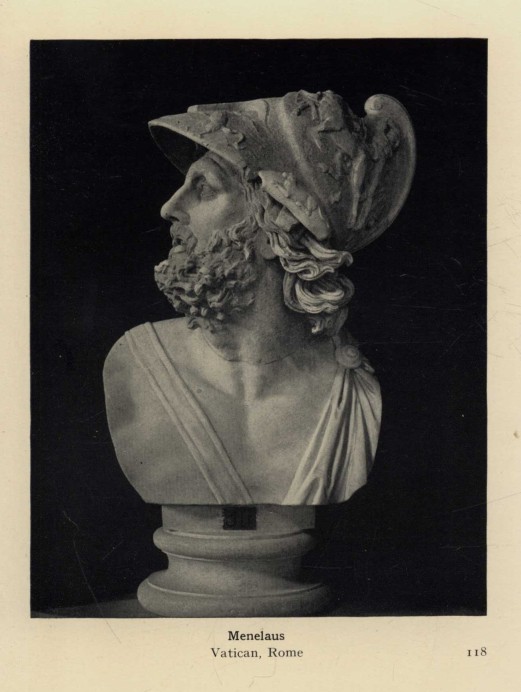
Carried away by his eloquence, Menelaus failed to observe that he was threatened by a new assailant. This was Harpalion, son of the King of Paphlagonia, who charged at him, lance in hand. Menelaus was just in time to receive the blow on his shield, and before Harpalion could recover his weapon he was transfixed by the spear of Meriones, and lay writhing like a worm on the ground, until he was borne, groaning, from the field by his attendants, followed by his weeping father.
Paris was wroth at the fall of the Paphlagonian prince, who was his friend and guest, and he drew his bow at a venture, and slew Euchenor, the son of a famous seer, who dwelt in Corinth. Often his father had prophesied to him that he was destined to die either by a wasting disease, or on the battlefield at Troy. He chose a warrior's death, and found it on that day, by the hand of Paris.
III
In the other part of the camp, near the main gate, where Hector had first effected an entrance, the Greeks were still fighting with indomitable spirit under Telamonian Ajax, and his namesake, the son of Oileus. These two held together, and battled side by side, like two stout oxen yoked to the same plough, and toiling from dawn till sunset, while the sweat streams without ceasing from the roots of their horns: so stood they side by side, and bore the brunt, all through that long and bitter fray. And behind them were arrayed the bowmen and slingers of Locris, whose captain was the lesser Ajax, and kept up such a shower of arrows and leaden bullets that the Trojans at length began to waver, and broke their ranks.
When Polydamas, the wisest head among the Trojans, saw that the great assault, which had begun so boldly, was beginning to flag, he called Hector aside, and said to him: "Hector, thou art strong of hand, but weak of head. Seest thou not that we are wasting our valour, by fighting thus in scattered parties, with no settled plan of attack? Now, hearken to me, and do as I shall say, if thou wouldst not have us driven back in shameful rout upon the town. Gather all our parties into one strong phalanx, and charge with them all at once on one point in the Grecian line. Thus, and thus only, may we hope to prevail, outnumbered as we are by two to one."
Hector saw that the advice was good, and, leaving Polydamas to hold the Greeks in check, he went in search of Asius, Deiphobus, and the rest, who were fighting on the left. Sore were the gaps which now appeared in that gallant company, and many a hero, whom he called by name, was lying cold in death. Gathering such as remained, he formed them into one body with those whom he had left in the charge of Deiphobus, and with the powerful column thus formed made repeated charges, which were sustained with undaunted firmness by Ajax and his men.
Zeus is beguiled by Hera
I
While the battle swayed to and fro, and the Greeks were enabled by Poseidon's aid to hold their own against the Trojans, Zeus was sitting on a lonely peak of Ida, wrapped in a high celestial reverie. Hera saw the uxorious king from her place of outlook on Olympus, and, noting his abstracted mood, she resolved to play him a trick. So she went to her chamber, which her son Hephæstus had made for her, and opened the door with a private key, which she always kept by her, so that none might invade her apartment in her absence. Having locked herself in, she began to make her toilet with peculiar care. First, she washed her person with ambrosia, and anointed herself with a fragrant oil, so rich and rare that, when she lifted the lid of the casket in which it was stored, a divine perfume filled earth and heaven with sweetness. Then she dressed her lustrous hair, and put on a wondrous robe, which Athene's own hands had wrought for her, clasping it to her bosom with golden brooches. A rich girdle confined her robe at the waist, and in her ears she hung earrings of costly pearl; and when she had put on her sandals, and thrown a glittering veil over her head, she went forth smiling in triumphant beauty, like a bride adorned for her husband.
Having thus prepared the whole battery of her charms, she went in search of Aphrodite, and when she had found her she drew her apart from the other gods, and said: "Wilt thou grant me a boon, dear child, or wilt thou deny me in anger, because I favour thine enemies, the Greeks?" "Name thy request, great queen of heaven," answered Aphrodite, "and I will grant it, if I can."
Concealing her real purpose, the cunning Hera replied: "I am bound on a journey to the ends of the earth, to visit the ancient deity Oceanus, and Tethys, his wife, who have long been parted by a bitter quarrel. If I can bring them together in love and kindness I shall do a good deed, and repay part of the great debt of gratitude which I owe them. Therefore, lend me, I pray thee, the mighty talisman which thou hast, whereof neither man nor god can resist the powerful spell."
"It becomes me not," answered Aphrodite, "to deny thee in this, for thou art the consort of high Jove." And therewith she took from her bosom an amulet, in which there was a mysterious virtue, able to soften the hardest heart, and turn it to thoughts of love and tenderness. There dwelt persuasion and sweet endearment, the eloquence of silence and the witchery of sighs. "Take it," she said, "and hide it in the folds of thy robe. Armed with this, thou wilt accomplish all thy desire."
Hera smiled her thanks, and taking the amulet sped away on her errand, which carried her, not, as she had pretended, to the distant dwelling of Oceanus, but to Lemnos, the Ægæan isle, the home of sleep. Arrived there, she sought out the drowsy god, and found him nodding in his shadowy cave. "Monarch of men and gods," she began, "Immortal Sleep, thou hast done me good service in the past, and I think thou wilt not fail me now. I would have thee lock fast the eyes of Zeus in slumber deep and long. Ask me not why, but do it, and I will give thee a golden throne, wrought, with a footstool, by Hephæstus, my son, whereon thou mayest sit in state like the Olympian king himself."
"Ask me aught else," answered Sleep, lifting his heavy eyes with a look of fear, "only ask me not to lay Zeus in slumber against his will. Hast thou forgotten what wild work he made when, at thy entreaty, I shed my power upon him, and lulled his wits in a deep trance, that thou mightest wreak thy malice on his favourite, Heracles? Then didst thou raise a storm, which drove Heracles far out of his course, when he was on his voyage from Troy. But when thy lord awoke, and saw what thou hadst done, he fell to buffeting all the gods in Olympus, who had hidden me from his sight. And soon they must have delivered me to his vengeance, and I should have been undone, but an ancient and venerable deity, even Night herself, came to my aid, and besought him to pardon me; and so he did, for he would not offend the august goddess, primeval Night."
"Go to," said Hera. "This is a far smaller thing than that of which thou speakest. All I desire is an hour of respite for mine afflicted Greeks. Come, do as I bid thee, and thou shalt have Pasiphaë, one of the Graces, for thy wife, and so fulfil the dearest of thy desires."
Then Sleep was glad, and answering said: "Swear to me, by the inviolable waters of Styx—placing one hand on the earth, and the other on the sea, that all the nether gods may be our witnesses—swear that thou wilt give me Pasiphaë for my bride."
Hera took the oath required, calling by name all the Titans that dwell in Tartarus. Then together they flew across the sea to Troyland, and paused not till they reached the wooded hills of Ida. Upwards then they soared, over the forest-clad slopes, and there was the sound of a going in the tree tops as they passed. And when they came to the peak where Zeus was sitting, Sleep disguised himself in the form of a swift, and hid himself in the branches of a tall fir-tree. But Hera went and stood in the presence of her lord.
As soon as the god saw her he was struck with wonder at her surpassing beauty, and his heart overflowed with tenderness, as in the old days when first he made her his bride. And the little swift shot down from the tree, and come flitting round the monarch's head. "Dear lady of my love," said he, "sit down by me awhile, and let us hold sweet converse together." So down she sat by his side, and took his hand, and beguiled him with her false blandishments. Like two simple lovers they seemed, caught in sly Cupid's silver net—he the sovereign of earth and heaven, and she, his imperious queen. And swiftly the subtle influence of Sleep came over him, and down he sank overpowered, couched on a soft bed of crocus and hyacinth and violet, which the earth put forth to bear up his sacred person; and on him rested a canopy of golden cloud, that he might slumber unobserved.
II
Safe now from the observation of Zeus, Hera descended swiftly to bear the news to Poseidon, and urge him to redouble his efforts on behalf of the Greeks. Having brought her message, she returned to Ida, and remained watching by the side of Zeus, ready to give warning when he awoke.
Poseidon was not slow to seize the occasion thus offered. Suddenly, as the Greeks were preparing to receive a furious charge from the enemy, there appeared in their van a gigantic warrior, clad from head to foot in mail of proof, and wielding a sword which flashed and burned with an awful light. "On, Greeks, on!" he shouted; and his voice was as the sound of many waters. "Down with them, even unto the ground, that Hector may know that there is more than one Achilles among us." And the two armies met, with a crash which was echoed by all the caverns of Ida, and recoiled again, each solid phalanx reeling from that tremendous shock.
Into the space thus left sprang Hector, and hurled his spear at Ajax, who was stepping forth to meet him. The weapon struck him on the breast, just at the point where the shield strap, heavily studded with metal, was crossed by the baldric of his sword; and this double barrier, backed by the corslet, proved an effectual defence. Hector fell back, vexed at his ill-fortune, and, as he was retiring, Ajax picked up one of the stones which were lying around, to serve as props for the ships, and flinging it struck him on the back of the neck, just above the rim of his shield. It was no maiden's hand which had aimed that blow, and Hector was sent spinning like a top. And as an oak reels and staggers when struck by the bolt of Zeus, and topples headlong to earth, a blackened and shattered trunk, so fell the mighty Hector, crushed under the weight of his shield, which was pressed down upon him by the ponderous stone.
When they saw him fall, the Greeks rushed forward, hoping to make him their prisoner. But the bravest of the Trojans and their allies—Sarpedon, Æneas, Glaucus, and Polydamas—interposed their shields, giving time for the others to lift him up and carry him to the place where his car and horses were waiting. Carefully they placed his senseless body on the chariot, and drove him towards the city, until they came to the ford of Scamander. There they halted, and, laying him on the bank, dashed water in his face. Presently he looked up, and leaning forward on his hands began to vomit blood. Then darkness came over his eyes, and he fell back again in a swoon.
Now that Hector was down, the Trojans had no course left to them but to retreat. They still fought valiantly, and the Greeks had to pay dear for their success. But slowly and surely they were being driven back from the camp.
The Last Battle by the Ships
Hera was watching the action with such eagerness that she had forgotten her charge, and was startled by the angry voice of Zeus, who had awakened suddenly, and was looking down upon her with lowering brows. "This is thy work," he said sternly, pointing to the Trojan plain, where Hector lay senseless, and his comrades were beginning to fly. "Wilt thou never be schooled to obedience, or what harder lesson lackest thou yet? Dost thou remember the time when I hung thee in chains in the cold vault of ether, with two anvils at thy feet, and all the gods together were powerless to relieve thee? This was thy reward for thy evil devices against my son, Heracles; but that shall be mirth and laughter compared with the rod which thou shall feel if thou cease not from thy mutiny against my sovereign will."
Then Hera was sore afraid, and she answered submissively: "I swear by earth and heaven, and by the down-falling waters of Styx, the greatest and most awful thing by which a god may swear—yea, by thy sacred head I swear it, and by the holy bond which unites us—it was not by my devices that Poseidon first began to aid the Greeks, but he was led thereto by the thoughts of his own heart. And, by my advice, he will give way to thee."
Somewhat appeased by her humility, Zeus replied: "If that be so, and thou art willing to heal the mischief thou hast done, go and send hither Iris and Apollo, that they may receive my commands. And understand me once for all—I will not cease from my rage and my fury against the Greeks, nor suffer any of the gods to aid them, until the vengeance of Pelides is accomplished, and the oath fulfilled which I sware unto his mother, Thetis, when she touched my knees and besought me to honour her son."
Swift as is the glance of the mind when some great traveller revolves all his wanderings in thought, and murmurs to himself: "Would that I were in this place or that!" naming some distant scene which he hath visited, so swiftly flew Hera with her lord's message. When she reached Olympus she found all the gods seated together, drinking their nectar from golden cups. Smiling with her lips, but bending her dark brows in a gloomy frown, she said, as she eyed that festal gathering: "Ye are making good cheer, I see! And ye will be cheered the more when I tell you what Zeus intends. Ay, drink deep!" she continued, turning to Ares, who was just draining a full cup, "thou hast need of comfort, for thy son is slain." And she named a Greek, Ascalaphus, son of Ares, who had been slain by Deiphobus in the battle.
When he heard that, the god of war groaned with grief and anger, and crying: "I will avenge him!" rushed to seize his arms. But Athene hastened after him, and finding him already equipped for battle she snatched the spear from his hand, and took the helmet from his head, saying: "Madman, wilt thou undo us all? Go back to thy place, lest the wrath of Zeus descend upon the whole company of the gods, and on thee the first. Better men have fallen than this son of thine, and we must look to our own safety, and leave mortals to their fate."
While Athene was occupied in restraining the frenzy of Ares, Hera despatched Iris and Apollo to receive the commands of Zeus. So they went forthwith to Ida, and found Zeus sitting in the place where he had slept, with the golden cloud still hanging above his head. Zeus was well content that his wilful consort had been so prompt in his business, and he commanded Iris to go down to the fleet, and warn Poseidon to leave the battlefield. "And thus and thus shalt thou say unto him," added Zeus, instructing her in the very words which she was to use.
Iris descended to earth, walking delicately along her rainbow bridge, and, having found Poseidon among the warring Greeks, she said to him: "Thus saith Zeus, our sovereign lord and king: 'Let Poseidon leave the battlefield, and depart to Olympus, or to his own watery realm. And if he will not obey me I will come myself, and fight against him, face to face. Let him avoid my hands, for he knoweth that I am far mightier than he, and higher in station and in dignity.'"
"What!" answered Poseidon, swelling with injured pride. "Am I my brother's slave, that he sends me this haughty summons? I am no subject of his, but his peer, holding a third part in our divided empire. For three sons were born unto Cronos—Zeus and Hades and myself. And when Cronos ceased to reign we cast lots between us, and Zeus obtained the throne of heaven, I of the sea, and Hades of the underworld; but the earth, and wide Olympus, were left common to us all. Therefore I bid him keep to his own domain, and not meddle with me, for I will not live under his laws, nor bow to his rod, which he may keep for his sons and daughters."
"Is this, then, the answer which I must carry back to Zeus?" asked Iris gravely. "Oh, reflect a little! Enter not into an unnatural feud with thine elder brother."
"'Tis wisely said," replied Poseidon. "Thou art a discreet messenger, and knowest how to season thy words with courtesy. 'Twere ill, as thou sayest, to stir up the demon of domestic strife among us. Therefore I will depart, and leave him to work his will. But, since he has used threats, let him hear this from me: if he seeks to avert the doom of Troy, he will find a cold welcome when he joins the circle of the gods in Olympus."
It was not without relief that Zeus heard of Poseidon's submission; for he had feared that he would be obliged to engage in a fearful struggle, which would have confounded earth and heaven. This danger being removed, he sent Apollo, armed with his own shield—the awful ægis, clothed with attributes of terror—commanding him to heal Hector of his hurt, and bring him back to battle. Like a falcon stooping on his quarry, Apollo shot down from Ida's peak, and alighted at the ford of Scamander, where Hector was still lying. By this time the stricken man had recovered from his swoon, and was gazing in bewilderment around him.
One touch from that potent hand, one word from those immortal lips, sufficed to banish all the effects of the fearful blow which had left Hector as weak as a child. Bounding to his feet, he cried: "Lead on, mighty god! I fear no perils with thee at my side," and like a gallant war horse, that smelleth the battle afar off, he ran at full speed to rejoin the Trojans, who were now flying tumultuously from the camp. And as when a troop of hunters with their hounds have started a royal stag, and chased him with wild halloo to the thick covert of a tangled wood; then suddenly they shrink back with cries of dismay, for they see a lion standing in the path: so panic fell upon the Greeks in the midst of their triumph, when they saw Hector returning to battle, full of vigour and courage, though they had already counted him among the dead.
On poured the Trojans, Hector and Apollo leading the van, and the Greeks gave ground before them, scared by the dread ægis, which Apollo shook in their faces, crying his terrible cry. At first they yielded slowly, keeping their ranks, and attempting some defence; but soon the retreat became a rout, and the moat was filled with a struggling multitude, seeking the shelter of the wall and the ships. "Kill, kill!" cried Hector fiercely. "Pause not to strip the dead, but slay the men, and burn their ships. Let me but see anyone skulking behind for plunder and he dies by my hand."
With that he lashed his horses, and drove straight across the moat, the Trojans following him in dense column. In front strode Apollo, trampling down the sides of the moat as he went, and making a path broad as the farthest cast of a spear. Then he hurled himself on the wall, and overthrew it, as easily as a child destroys with his feet a castle of sand which he has raised in sport on the margin of the sea.
Like a towering billow, which topples down upon a ship, crushing her bulwarks and flooding her with brine, so rushed the Trojans in a torrent over the wall, and fell upon the hindmost row of ships; and the Greeks on their side mounted the decks, and thrust at their assailants with long boarding-pikes, which lay ready to hand.
Foremost among the defenders was seen the giant form of Telamonian Ajax; and by his side fought Teucer, whose bow had already done such good service to the Greeks. But just as Teucer was aiming an arrow at Hector his bowstring snapped, and the arrow dropped harmless to the ground. "Fate is against us to-day," he cried; "it was a new string, the stoutest and the best I had, which I fitted to my bow this very morning."
"Go quickly," answered Ajax. "And arm thyself with shield and spear; there is no room here for thine archery to-day." And Teucer went and armed himself, and returned with all speed to his mighty brother's side.
Hector was overjoyed when he saw Teucer's mishap, which he hailed as the direct act of Zeus himself. "On, Trojans!" he shouted; "on, ye men of Lycia! Zeus is fighting on our side. Now is the great day of vengeance, after all the weary years when we were penned within our walls like sheep."
"Why flinch ye?" cried Ajax, in his turn, to the Greeks. "Know ye not that we must conquer or die to-day? Or will we reach home on foot, if ye suffer your ships to be burned? Come, join the wild dance to which Hector summons us. Fight, and we will drive out this rabble yet; but if ye falter we shall surely perish."
Again the Greeks rallied to the well-known voice of Ajax, and drew up in close order before the ships, barring Hector's way. But the finger of Apollo had touched him, filling his breast with a divine frenzy. Foaming and glaring with rage, he flung himself on the solid phalanx, and cut down a tall champion of Mycenæ, making a gap in the line. Before the Greeks could close their ranks the Trojans were among them, hewing them down as a woodman hews a path through the forest. Forward and still forward they pressed, driving the Greeks before them, and compelling them to retire from the first line of ships.
Then nothing but the tremendous valour of Ajax could have saved the Greek army from total rout and ruin. Active as a panther, in spite of his huge bulk, he sprang from deck to deck, wielding an enormous boarding-pike and striking down the Trojans, as they advanced with lighted torches to set fire to the ships. Like a practised rider, who yokes together four horses, and drives them at a gallop along a level highroad, leaping from one steed to another as he goes—so Ajax shifted his ground from one ship to another, dashing down Trojan after Trojan, and shouting to the Greeks to come to his support.
It was a grim and desperate struggle. There was no shooting of arrows, no casting of javelins now, but foot to foot, and hand to hand, they fought, with axe, and sword, and spear. At last Hector forced his way to a beautiful galley, which had brought Protesilaus[1] to Troy, and laying his hand on the high, fanlike ornament of the stern he shouted: "Bring a torch, that I may be the first to kindle the fire which shall burn these accursed ships, which came here for our destruction, but shall now serve as a pyre for their crews."
Achilles sends Patroclus to Battle
I
Patroclus had been long detained by Eurypylus, whose wound was severe, and demanded all his skill. But when the roar of battle drew nearer and nearer, and he heard the voice of Hector calling for a torch, he would delay no longer, but sprang up and ran in headlong haste to the quarters of the Myrmidons. There he found Achilles still sitting before his tent, and listening to the mingled cries of triumph and dismay which came from the distant scene of conflict. When Patroclus saw him, he came and stood by his side, and lifted up his voice, and wept.
"Why weepest thou, Patroclus," asked Achilles, "like a little maid, who runs by her mother's side, plucking her by the gown, and looking into her face with tearful eyes, begging to be carried? What means this melting mood? Hast thou ill news of thy father, or of mine, or are these tears for the Greeks, now perishing by their own transgression?"
"Ah! son of Peleus," answered Patroclus, with a pitiful sigh, "take not my words amiss, but I am sore afflicted for the sake of my countrymen. Their best and noblest are grievously wounded, and the leeches are busy about them; and those that remain can no longer make head against the foe. Can nothing move thee? What avails all thy splendid manhood, if thou wilt sit idle here, until thine arm is palsied with age? Oh! yet at last relent, if thou art indeed the son of gentle Thetis, and not some savage changeling, born of the rocks, and nourished by the sea! If thou wilt not go to the field thyself, at least let me put on thine armour, and lead the Myrmidons to aid our friends in their dreadful strait."
For some time Achilles answered nothing, and it was evident that a sore struggle was passing in his breast. At last he looked up, and said with an effort: "Thou hast prevailed, son of Menœtius, though I vowed that I would never cease from mine anger until the fire had reached my own ships. When I think of the foul outrage—— But enough! Down, down, rebellious pride!" He paused, frowning, and grinding his teeth; for the fierce fit had come on him again. Then, mastering himself, he continued: "Thou shalt have my armour, and lead the Myrmidons to battle. But take heed to what I shall say, and let not thine ardour carry thee too far, but when thou hast driven the enemy out of the camp lead thy men back, and be not tempted to fight in the open field, lest thou rob me of mine honour, and leave naught for me to do. Remember this, and have a care for thyself, for they have a mighty ally on their side, even Apollo."
While they were thus conversing, Ajax was still keeping up an unequal struggle against an overpowering force. The Trojans surrounded the ship on which he was fighting, and plied him with a shower of missiles, which rattled on his helmet, and threatened every moment to bring him down. His left shoulder ached with holding his shield, which was thrust back upon him by a dozen spears at once. Yet still he fought on, with his breath coming in heavy gasps, and the sweat pouring from every limb. Then Hector aimed a blow with his sword, and cut off the head of the pike which Ajax was wielding. Thus left without a weapon, Ajax was compelled at last to retreat, and the Trojans rushed forward, and set fire to the ship.
Achilles saw the smoke rising, and cried: "Arm thee, Patroclus. Make haste! I will go and call up the Myrmidons." Patroclus hurried to the tent, and put on the armour of Achilles—the greaves and starry corslet, the helmet and vast orbed shield—and girded on his great comrade's sword. Only the spear of Achilles he took not, for no arm in all the host, save only the arm of Achilles, could wield that ponderous beam of ash, toughened by many a storm on the windy slopes of Pelion, where it grew.
Meanwhile Automedon, Achilles' charioteer, was yoking to the car the two immortal steeds—Xanthus and Balius—offspring of the West Wind, and nourished on the meadows by the shores of Oceanus. And with them went as a trace horse the mortal courser, Pedasus, which Achilles had taken among the spoils when he sacked the city of Eëtion.
When the Myrmidons heard their leader's voice calling them to arms, they rushed forth from their tents, like thirsty wolves which have gorged themselves with the flesh of a tall stag, and now hasten, with bloodstained chaps and lolling tongues, to slake their thirst in a deep mountain pool. With like eagerness arose the hardy veterans, whose warlike spirit had been fed high by their long repose; and proud was the glance of Achilles, as he glanced down the armed files, marshalled under five famous captains, five times five hundred men. When all were standing silent at their posts he addressed them briefly, and said: "Now is the time to make good the threats which ye uttered against the Trojans, during all the long time of my wrath. Remember how ye murmured against me because I suffered you not to go unto battle. 'Hard-hearted son of Peleus,' ye would say, 'surely thy mother nourished thee with gall, and therefore art thou so ruthless to thy loving comrades, keeping them here in inglorious ease.' See that your deeds are as valiant as your words, and let the Trojans feel the weight of your arm this day."
Firm and close as blocks of stone, fitted together by a master-builder to be the wall of some great house, so stood the warriors in that invincible column, shield leaning on shield, and man on man; and in the van were seen the tall figures of Patroclus and Automedon, two leaders with one heart. Then Achilles went to his tent, and brought forth a golden goblet, a gift from his mother, and sacred to the service of Zeus. Having purified it with sulphur, and washed it with fresh water, he cleansed his own hands, and filling the bowl with wine returned to the open space before the tent. Then lifting up his eyes to heaven he poured the drink-offering, and prayed thus to the king and lord of Olympus: "O thou, whose ancient dwelling is in wintry Dodona, where thy chosen priests serve thee day and night with fasting and prayer, as thou hast lent thine ear to my former petition, and grievously afflicted the Greeks for my sake, so grant me once more my heart's desire. Let thine eyes rest with favour on my noble comrade, and give him honour in the battle. And when he hath driven the Trojans from the camp bring him back safe, with his armour, and all this company, to our tents."
So prayed he in his ignorance, having yet to learn that Zeus is a jealous god, dispensing his gifts with unequal hand, two evil for one good.
II
Like a swarm of wasps which have their nest by the roadside, and being ever provoked by wanton children wreak their vengeance on some harmless wayfarer; so flew the Myrmidons to join the fray, and soon the Trojans felt their sting. "For Achilles and for honour!" shouted Patroclus, as he hurled his spear, and struck down Pyræchmes, the savage leader of a wild mountain tribe from northern Greece. The rude clansmen fled when they saw their leader fall, and soon the panic spread to the whole Trojan army, and they too fled, leaving the burning ship, the flames of which were soon quenched by a score of eager hands. Like a cloud which lies heavy on a mountain top, and is then suddenly rent and dispersed, revealing all the long range of countless hills, peak beyond peak, far away to the distant sea, with green glades between, and above the boundless chasm of sky, up to the dazzling zenith: so was dispersed that cloud of Trojans which had hung about the ships, and the Greeks saw the fair face of Hope again.
But the end of that long and bloody day was still far off. Outside the barriers the Trojans rallied again, and a fearful slaughter ensued. There the sword of Patroclus bit deep, making dire havoc among the ranks of the Lycians, until Sarpedon, their leader, incensed by the slaughter of his men, sprang from his car, and threw himself in the way, to arrest that destroying hand.
Like two vultures, which tear each other with beak and claw, fighting with loud screams on a lofty crag, so leapt the two champions, the Lycian and the Greek, upon each other, uttering loud their battle-cry.
When Zeus saw his son Sarpedon about to engage in deadly combat with Patroclus he was filled with pity, for he knew that the Lycian chieftain was going to his doom. "How sayest thou, Hera," he began, "shall I save him, and waft him away in a cloud to his fair domain in Lycia, or shall I leave him to his fate?"
"That must not be," answered Hera. "His thread is spun, and his life is forfeit; shouldst thou annul that decree it will be an evil example to the other gods, who will forthwith all seek to avert the stroke of fate from their sons, of whom many are fighting in the fields of Troy. If thou wouldst do him honour, send Death and gentle Sleep to bear him softly, after he has fallen, from the battlefield, and bring him to his kinsfolk in Lycia, that they may pay him the rites which are due to the mighty dead."
"Thou hast persuaded me," answered Zeus, bowing his immortal head in sorrow. And he caused a rain of blood to fall upon the earth, in sad tribute to the heroic spirit which was about to pass away.
While this debate was proceeding, the struggle had already begun. In the first cast of their spears both warriors missed their aim. Patroclus slew the comrade of Sarpedon, while Sarpedon's lance struck Pedasus, the mortal steed, in the shoulder, and he fell dead. His immortal companions plunged wildly, striving to break away from the yoke when they saw their comrade slain. But Automedon cut the traces by which the slaughtered steed was attached to the car; and, being rid of their sad burden, Xanthus and Balius were once more obedient to the rein.
Again the heroes flung their spears, and the weapon of Sarpedon flew over his antagonist's left shoulder. But the spear of Patroclus sank deep into Sarpedon's breast, and he fell, writhing in his death agony, and sending forth loud groans, like a bull when he feels the lion's claws tearing his flanks. So raged Sarpedon in the pangs of death, and rolling his eyes he sought the familiar face of his beloved Glaucus. "Friend of my heart!" he cried, "valiant Glaucus, companion of all my toils, now must thou prove thy manly worth. Rally round thee the stoutest of the Lycians, and let not thy foot go back, or thy hand cease from slaying, until thou hast saved my body from the Greeks. To thee I shall be a reproach, and a hanging of the head, even unto thy life's end, if thou leave me, a rifled and dishonoured corpse, in the hands of the foe."
Even as he spoke, death stopped his breath and darkened his eyes. And Patroclus set his foot on the corpse, and drew forth his spear, while the Myrmidons took possession of the empty car with its affrighted steeds.
Glaucus was in dire distress when he heard his dying comrade's voice. But he was disabled by the wound which he had received in scaling the wall. Nursing his injured arm, he prayed aloud to Apollo: "Hear me, O King, whether thou art now in Lycia or in Troy; for thine ear is ever open to the cry of need, however far away. My hand is maimed, and my arm is burning with sharp pains, so that I cannot wield my spear, though Sarpedon is fallen, and his father hath forsaken him. So forsake thou not me, but heal my wound, and give me back my strength, that I may save his body from outrage."
Apollo heard, and granted his prayer, and straightway the flow of his blood was stopped, and he felt in his body that he was healed of his hurt. Then Glaucus was glad, and he made all haste to do his comrade's bidding. First he called to the men of Lycia to do battle for their slaughtered captain, and then he went to rouse the Trojan leaders to do their duty by their great ally. Finding Hector engaged in another part of the field, he reproached him for his neglect. "Hast thou forgotten," he asked indignantly, "what thou owest to us, who have come on a far journey to shed our blood for thee and thy country? Cold lies Sarpedon, chief pillar of thine allies; come, friends, and help us to save his corpse, or ye will be shamed for ever."
This was bitter news for the Trojans, who reverenced Sarpedon as the chief corner-stone of their defence; and they rushed with one accord to avenge his death. Patroclus on his side summoned the bravest of the Greeks to his aid, and the whole fury of the struggle was now centred in the place where the dead Sarpedon lay.
The first who fell in this new battle was a friend of Patroclus, who years ago had found a new home in the house of Peleus, having been banished from his own country for the murder of his cousin. He was now struck down by a stone from the hand of Hector; and Patroclus, in his anger at his comrade's death, made so furious an assault that the Trojans gave way before him about the length of a spear's cast. Then Glaucus advanced again, and slew Bathycles, a man of high note among the Myrmidons; and Meriones on the other side killed Laogonus, the priest of Idæan Zeus. Æneas, ever famed for his piety, hurled his spear at Meriones, hoping to avenge the fall of that sacred head; but Meriones stooped low, and the spear flew over his head, and sunk deep in the ground, with quivering shaft, just behind him. "The Cretan can dance, I see!" shouted Æneas; "he comes from a land of dancers." "Thou shall dance to my piping, before thou hast done," answered Meriones derisively. "Thinkest thou that we owe thee a life for every cast of thy spear?" "Peace!" said Patroclus, rebuking him. "We must fight with our swords, not with our tongues, if we would do aught worthy here."
Thick and fast rained the blows, on shield and helmet and mailed breast, as the two armies closed again, and the sound was as of an army of woodmen plying their axes together in a deep mountain glade. In the midst lay the lifeless Sarpedon, covered from head to foot with javelins, and blood, and dust, so that his dearest friend could not have recognised his face. Like flies buzzing round a milk pail, so thronged the Greeks and Trojans round the body.
Zeus sat watching the battle, pondering in his heart what measure of glory he should mete out to Patroclus before he laid him low by the arm of Hector. At last, having taken his resolve, he caused a coward spirit to enter into Hector's heart, and the Trojan captain wheeled his car, and fled towards the city. The panic spread to the other Trojans, and the Lycians, and they retreated, leaving the body of Sarpedon in the hands of the Greeks, who despoiled it of its armour, and were about to do it further dishonour when a higher power intervened. In the very act of violating the dead, they saw their lifeless victim snatched from them by an invisible hand; for Apollo had received the commands of Zeus, and bore away the soiled and blackened body to the riverside, where he washed it clean, anointed it with ambrosia, and gave it, robed in immortal raiment, into the charge of Sleep and Death, for safe and speedy conveyance to Lycia.
III
High dreams of triumph arose in the heart of Patroclus when he saw the enemy flying, and, forgetting the earnest injunction of Achilles, he bade Automedon lay on the lash, and followed in hot pursuit. Even to the very walls he drove; but then he found awaiting him one mightier than Hector, even Apollo himself, who shook the ægis in his face, and warned him back. Patroclus retired a little, and while he hesitated Apollo went to the gates of the city, where Hector was lingering, in doubt whether to continue the battle, or to withdraw behind the walls.
"What doest thou here, son of Priam?" said the god; "come with me, and I will show thee where the path of glory lies." When he heard Apollo's voice, Hector's courage returned, and he commanded Cebriones, his charioteer, to drive back to the battlefield. Avoiding the other Greeks, Hector made straight for the place where Patroclus had been left standing by Apollo. Patroclus came to meet him, holding his spear in his left hand, while in his right he grasped a jagged stone. And as the car approached, he flung the stone with all his force, and struck Cebriones on the forehead, shattering the bones. The reins dropped from his hands, and without a single cry he fell from the car, striking the ground with his head. "How bravely the man tumbles!" cried Patroclus. "He would make a rare diver, and earn a good wage by bringing up oysters from the sea. I perceive that the Trojans can dance, as well as the Cretans."
Thereupon he leapt upon the prostrate charioteer, and Hector sprang forward to defend his comrade's body. So there they met, like two hungry lions fighting for the carcass of a stag; and the Greeks and Trojans thronged on either side to their support, like two winds from opposite quarters, which shatter the boughs of beech and ash in a mountain forest. All the ground about the corpse was set thick with javelins and arrows, and heaped with the stones which crashed upon corslet and shield. And there lay the giant Trojan, while the battle raged above him, mighty and mightily fallen, and all his horsemanship forgot.
Never had the arm of Patroclus dealt such havoc among the foemen's ranks as then; for his doom was near, and Zeus gave him honour in this, his latest hour. Thrice he made an onset, fierce as the god of war himself, and thrice he slew nine men. But when for the fourth time he sprang to the encounter, Phœbus made after him, and smote him on the back with his open hand. Patroclus reeled and grew dizzy, like one who has received a sunstroke. Then Apollo struck the helmet from his head, and it rolled clattering among the horses' feet, that mighty brazen helm, whose plumes, now soiled with dust and gore, had once waved above the princely brow of Achilles. The spear was shivered to pieces in his hand, and his shield slipped from his shoulder to the ground. And as he stood thus, defenceless and amazed, a Trojan, whose name was Euphorbus, wounded him between the shoulders with his spear. The blow was not mortal, and Patroclus drew back, to mingle with the press; but Hector followed after him, and drove his spear deep into his side. And as a lion overpowers a wild boar, fighting with him in the lone mountains for the possession of a little spring, and slays him by his might, so slew Hector the valiant son of Menœtius, and stayed the ravage of the Trojan ranks.
"Ah! Patroclus," said he, gazing in triumph on the dying hero, "thou thoughtest this day to have taken our city by storm, and led captive the women of Troy. But they have in me a defender who is too strong for thee. Vain man! Achilles, I doubt not, bade thee bring back to him the bloody spoils of Hector, and now thou liest slain by Hector's hand."
"Boast not," answered Patroclus faintly. "It is small glory for thee to have slain the slain. I received my death blow from Apollo and Euphorbus, not from thee. And thine own fate shall overtake thee soon, when thou shalt die by the hands of Æacides."
Even as he spake the shadow of death fell upon him, and his soul took wing for the realm of Hades, bewailing her lot, leaving all that beauty and manly bloom.
The Fight for the Body of Patroclus
I
Menelaus was the first to mark the fall of Patroclus, and he came with a rush and stood over his body to defend it, like a young mother of the herd when she stands lowing plaintively over her calf, the first that she has borne. Shield on shoulder and spear in hand he stood, glaring defiance at the foe; and Euphorbus, the Trojan who had dealt the first blow at Patroclus, took up the challenge, addressing Menelaus with these haughty words: "Make way, son of Atreus, and leave me to take my lawful spoil. 'Twas I that wounded Patroclus first, and his armour belongs by right to me. Back, or thou shalt die the death."
"If big words could kill," answered Menelaus, with scorn, "then wert thou and thy brethren the most dreaded warriors of all thy nation; for there are no such windy braggarts in Priam's army. Away with thee, if thou wouldst have breath left in thee to boast again."
But Euphorbus, though a boaster, and a mere novice in war, was no coward. He thrust manfully at Menelaus, who parried the blow with his shield, and then, striking in his turn, and throwing all his weight into the stroke, drove his spear into Euphorbus' throat, so that the point came out at the back of his neck. Down he went, and his armour clattered upon him, and his love locks, curiously adorned with gold and silver, were dabbled with blood. As when a man tends carefully a green olive-shoot, in some sheltered spot, near a gushing fountain-head; and now it is a comely tree, just bursting into blossom, and lightly rocked by all the airs of heaven: then comes a sudden tempest, and uproots it from the soil, and all its promise is marred: so stricken and cut off in the dawn of his manhood lay that gallant lad. And as a lion comes down from the mountains, trusting in his might, and strikes down a young heifer feeding in a meadow, the fairest of the herd, breaking her neck with his mighty teeth, and then glutting himself with her blood and her flesh; and the herdsmen with their hounds stand apart, making great uproar, but not one dares to interrupt him in his meal: so dared not one of the Trojans to stand against Menelaus face to face.
Hector, who after slaying Patroclus had gone off in pursuit of the car of Achilles, was recalled from that fruitless chase by the tidings of Euphorbus' death. With a loud cry of rage he turned back, and hastened to the place where the young Trojan lay, side by side with Patroclus. Menelaus stayed not to abide his coming, but fell back upon the ranks of his comrades, and there halted, and scanned the fighting line, looking for the great Telamonian Ajax. Observing him at last on the extreme left of the battle, he ran up to him, crying eagerly: "Make haste, Ajax, and aid me to recover the body of Patroclus, that we may carry it back, naked as it is, to Achilles; for the armour Hector has taken already."
So together they went, and stood side by side over the body of Patroclus; and Hector in his turn shrank back, when he was confronted by the towering form of Ajax, with his massive, sevenfold shield. But he took with him the armour, and gave it to two of his men to carry to the city.
Glaucus was full of anger when he saw Hector quail before Ajax, and he reproached him bitterly, calling him faint-hearted, and false to his great office. "It is a thankless task," he said, "to fight under such a leader. Henceforth let the Trojans make shift to defend their city without our aid, for we of Lycia at least will fight their battles no more. Basely hast thou dealt with us, after all our good service, leaving our great captain Sarpedon in the hands of the Greeks. If ye of Troy had the spirit of men, ye would aid us to capture the body of Patroclus, that we might keep it to exchange for Sarpedon's corpse. But thou art a prudent warrior, and fearest the face of Ajax, knowing him to be a far better man than thou art."
"O folly of the wise!" answered Hector scornfully. "'Tis Glaucus can talk thus, who hath the rarest wit, as we are told, among all the men of Lycia. Come and stand by me, and thou shall see if I fear the face of Ajax, or any other Greek. But first I will put on the armour of Achilles, which was given, men say, by the gods, as a wedding gift to his father Peleus." And with that he ran and overtook the men who were carrying the spoils of Patroclus towards the city, and taking off his own armour began to put on that of Achilles.
Homer hymning the Fall of Troy. (Baron H. de Triqueti)
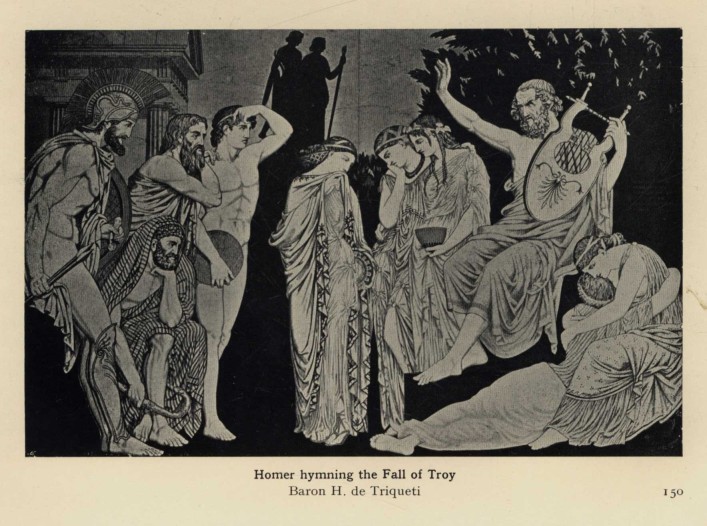
When Zeus beheld him thus gaily equipping himself in the spoils of the mighty, he shook his head, and spake thus to his own heart: "Ah! wretch, thy triumph will be short lived, and the hand of doom is stretched out already to take thee. But thou shall have thine hour, and Andromache shall hear of thy deeds, though never more shall she welcome thee returning from battle."
He said it, and confirmed it with a nod, and forthwith the very demon of war entered into the heart of Hector, and with a fierce cry he ran back to the field, glittering in the armour of Pelides, which seemed to have been wrought for himself, so well it fitted his limbs.
Even the great Ajax felt a cold touch of fear as Hector bore down upon him, with the most famous warriors of Troy and Lycia at his back. "We are lost," he said to Menelaus, "unless we can get some other succour to beat back this tempest of war." Then, raising his voice, he shouted: "To the rescue, ye captains and princes of the Greeks! Let not Patroclus become a prey to dogs in the streets of Troy." His cry was heard, and soon he was joined by Idomeneus, and Meriones, and the lesser Ajax.
Like the roar of the advancing tide, when it meets the torrent waters at the mouth of the mighty river, such was the shout of the Trojans as they rushed to the onset. And the Greeks stood firm to meet them, making a fence with their shields over the body of Patroclus. At the first shock of that tremendous charge they were forced to give ground a little, and one of the Trojans fastened a thong to the ankle of the corpse, and began to drag it away. But he had not gone far when Ajax sprang upon him, and with one blow of his sword shivered his helmet, and clave him to the chin. This gave time for the Greeks to rally, and the battle was renewed in that narrow space round the body of Patroclus, where many a valiant deed was wrought, and many a hero bit the dust, fighting for the possession of a helpless corpse. Over this struggling mass of warriors in the centre of the field was spread a thick curtain of darkness, for Zeus had ordered it so, while the rest of the Greeks and Trojans were fighting in the broad sunlight. Far away on the border of the fight were Antilochus, the son of Nestor, and his brother, who had not yet heard that Patroclus had been slain.
But in that dark kernel of the battle the ruthless tug of war went on. There was no stay, no pause, while they hewed, and thrust, and strove, till the blinding sweat poured down into their eyes, and their knees shook with weariness. As when a master currier gives to his journeymen a great bull's hide, well drenched with fat, to be stretched, and they stand in a circle, and tug with all their might, straining it equally on all sides, until all moisture departs from it, and the fat penetrates to every pore; so they tugged the body between them, this way and that, the Trojans haling it towards the city, and the Greeks towards their camp. "Die, ye Greeks!" cried Ajax, who was fighting like twenty men; "die, rather than give up the body to the Trojans."
II
After the fall of Patroclus, Automedon had driven his car out of the press of battle, flying from the fury of Hector. When Hector was recalled from the pursuit, Automedon strove in vain to stir his horses from the spot where he had halted. In vain he plied the lash, in vain he coaxed and threatened; still as a monumental pillar on a tomb they stood, with their heads drooping to the earth, and their glossy manes streaming over their eyes, while the hot tears dropped fast in the dust, as they wept for the gentle prince, whom they had borne so often to battle.
Zeus pitied them in their sorrow, and spake thus within himself: "Ah! hapless pair, why did we give you to a mortal master, while ye know neither age nor death? What part or lot have ye with human misery, or with man, the most wretched thing that breathes and moves on earth? But Hector shall never mount the car behind you, or put the bit in your mouths—I will not suffer that. Be strong, and bear your driver safe, until the battle be done."
Therewith, he breathed new vigour into the steeds, and they shook the dust from their manes, and galloped lightly with the car back to the fighting lines. Singlehanded, Automedon could take no part in the hand-to-hand battle with the Trojans, and for some time he contented himself with making rapid charges with his chariot, swooping down here and there, like an eagle pouncing on a flock of geese, and easily avoiding every attack. At last he found a helper in a comrade named Alcimedon, and handing the reins to him he dismounted himself to fight on foot.
When Hector saw the car of Achilles in charge of a strange driver he called to Æneas, and said: "See, there are the steeds of Æacides, ill-guided, and ill-defended; let us not miss the occasion to win so glorious a prize." So together they went, Æneas and Hector, and two other Trojans, in high hope to slay Automedon, and take the car. But Automedon, uttering a prayer to Zeus, flung his spear, and slew Aretus, one of his assailants; and before Hector, who missed his cast at Automedon, could come to close quarters with his sword, Ajax interposed, and drove him back.
The arrival of Automedon had interrupted the struggle for the possession of the body of Patroclus; but it was resumed with new fury on both sides, and the Greeks now received a new ally in the person of Athene, who obtained permission from Zeus to bring aid to her old allies. Disguised in the form of the aged Phœnix, she went and stood by the side of Menelaus, and said to him: "Courage, son of Atreus! We shall win the battle yet, and save the noble comrade of Achilles from the foeman's hands."
"Ah! Phœnix," answered Menelaus, "I would that Athene would put strength into my arm; then might I, as far as it is now possible, retrieve the bitter loss which we have suffered this day."
Athene was glad that he had named her before any other god, and she filled him with an indomitable spirit, and gave him the stubborn courage of a fly, which returns again and again to the attack, in its fierce desire for blood. And, seeing a good mark for his spear in the back of a flying Trojan, Menelaus flung, and pierced him in the waist. The man whom he slew was Podes, a son of Eëtion, and a friend and boon companion of Hector. Provoked beyond measure by the death of his comrade, Hector led such a determined charge against the Greek centre that even the bravest began to flinch; and to affright them the more there came a deafening peal of thunder from the heights of Ida, now wrapped in a pitchy cloud.
The first to fly was Peneleos, the bravest of the Bœotians, whose shoulder had been cut to the bone by the spear of Polydamas. Then Idomeneus, coming to succour a wounded Greek, broke his spear on Hector's breastplate, and it would have gone hard with him had not Cœranus, a Cretan, driven up to the rescue in the car of Meriones; for Idomeneus had come to the field on foot, leaving his own car in the camp. The brave Cœranus paid for this good service with his life, sustaining a fearful thrust from Hector's spear, which struck him just at the angle of the jaw, and severed his tongue at the root. He fell from the car, and dropped the reins on the ground; but Meriones picked them up, and gave them to Idomeneus, who drove off at full speed towards the ships.
Thus deprived of his bravest supporters, Ajax cast a glance of dismay at Menelaus, who was still fighting at his side, and said: "Alas! even a blind man might see that Zeus himself is aiding the Trojans. Every weapon of theirs finds its mark, let it be hurled by ever so weak a hand; but our spears fall idle to the ground, one and all. Yet, abandoned though we are, let us take thought how we may save the body of Patroclus, and ourselves return alive to gladden the eyes of our faithful comrades, who methinks are in sore distress, thinking that the might and the murderous hands of Hector shall no more be stayed until they have hurled destruction on our fleet. Also I would fain despatch a messenger to bear the bitter tidings to Pelides, who dreams not that his beloved Patroclus has perished. But I cannot see anyone to whom I might deliver this charge, for men and steeds alike are covered by thick darkness. Dread sire of heaven, at least from darkness deliver the sons of Greece! Bring back the day, and give us the sight of our eyes. Slay us, if die we must—but slay us in the light!"
Zeus had compassion on that brave man in his agony, and forthwith the thick cloud of darkness was removed, and the sun shone out, and all the field of battle was disclosed to view. "Now haste, Menelaus," said Ajax. "Go thou, and find Antilochus, who is very dear to Achilles, and bid him carry this message, which none other may dare to bring."
Menelaus was very reluctant to leave his place among the defenders of Patroclus. Slowly, and with many a backward glance, he turned to go, like a lion who is driven off at dawn by a shower of javelins and burning brands, after he has prowled all night round the stalls where fat oxen are housed. "Ah! remember," he said earnestly, pausing once more, "remember how dear, how gentle he was to us all, this poor Patroclus, who now lies cold in death. Forsake him not, but stand by him till I come back."
After this fervent appeal he made all haste, and ran along the fighting line, looking about him with a piercing glance, like an eagle soaring high in the heaven, who spies out a hare as she crouches in the shadow of a thicket. So did the keen eye of Menelaus soon discern where Antilochus was fighting, on the extreme left of the field. "Dire is the news I bring," said Menelaus, halting by his side: "Patroclus is slain, Hector has his armour, and thou art chosen to tell Achilles of his loss, that if it be possible he may yet save the body."
With parted lips, and eyes staring with horror, Antilochus stood gazing at the bringer of the message of woe. Then dashing the tears from his eyes, and drawing a deep sobbing breath, he flung down his shield and sped away on his mournful errand.
"I have sent him," said Menelaus, when he had returned with all speed to the defenders of the fallen Patroclus. "I know not what Achilles will do—he cannot fight without armour. But to our task." "The Trojans have drawn off a little," answered Ajax. "Now is the time: do thou and Meriones take the corpse on your shoulders, while I and my brother-in-arms hold the foe in play."
Without a moment's delay Menelaus and Meriones hoisted the body on their shoulders and began to carry it towards the camp: which when the Trojans saw, they raised a great shout, and rushed after, like hounds attacking a wounded wild boar; but as the hounds are scattered when the great brute wheels to the charge, so fled the Trojans before the determined stand of Ajax and his comrade.
But only for a moment: on they came again, fierce as a mighty conflagration, which sweeps through the streets of a town, driven before the gale, while the houses melt away like wax in the flames: with like furious uproar came horse and foot hard at their heels, as they bore the body from the field. But stoutly and stubbornly they plodded on with their burden, panting and sweating like a pair of mules which drag a heavy beam down a rugged mountain path: and behind them those two doughty champions opposed an impassable barrier to the Trojans, like a long wooded mountain spur, which hurls back the fierce assault of a swollen stream, and cannot be broken.
Yet even now the issue seemed doubtful; for just as the bearers reached the barriers of the camp Hector and Æneas led a vigorous charge, scattering the Greeks as a hawk scatters a noisy mob of starlings or daws.
The News is brought to Achilles
I
"Why tarries Patroclus so long?" asked Achilles of himself, as he sat waiting by his tent. "Alas! I fear that he hath disobeyed me, and lost his life by his rashness. Did not my mother tell me that the noblest of the Greeks should fall in battle with the Trojans while I lived?" His alarm increased when he saw straggling parties of the Greeks entering the camp, with every sign of panic and defeat. Presently the roar of the struggle drew nearer and nearer, and he had just determined to rush to the ramparts, and learn the worst, when Antilochus came running up, and in broken accents panted out his dreadful message.
As when a thunderbolt descends, laying low some giant of the forest, so fell the mighty Pelides, laid prostrate beneath that stunning blow. Then that proud head, which had never bowed to mortal man, was defiled with dust, and those heroic limbs, the very mould of manly strength and beauty, grovelled and writhed on the ground. He tore his hair, cast ashes on his head, and moaned like a wounded beast in his agony. And all the handmaids whom he had taken in war gathered round him, wailing and beating their breasts; for sorrow was their portion, and their tears were ever ready to flow. By his side knelt Antilochus, holding his hands, in fear lest he should do violence to his life.
Then Achilles shook off the grasp of Antilochus, and started to his feet with a fearful cry, glaring wildly, like one about to do some desperate act. But just at this moment a sound of female voices came floating over the placid sea, and Thetis glided into his presence, with all her band of Ocean nymphs attending. Achilles flung himself down again when he saw her, with a fresh burst of grief; and kneeling by him she embraced him tenderly, and weeping cried: "O child of my sorrow, what new cause of mourning hath reached thee now? Hath not Zeus fulfilled his promise, and avenged thine honour?"
"What avails his promise, or the fulfilment thereof?" answered Achilles, groaning bitterly. "What care I for honour, if I must pay for it with the life of my best beloved? He lies in his blood, and Hector, his slayer, has taken the glorious armour which the gods gave to Peleus when they made thee his unwilling bride. 'Twas a woeful match, for thee and for me, and soon thou shall reap the bitter fruit, for Hector must die by my hand, to appease the ghost of Patroclus, and thou hast told me that, when Hector falls, my own end is not far off." A mournful silence followed, broken only by the sobs of Thetis, who knew her son had pronounced his own doom. Then Achilles burst out again, in louder and angrier tones: "But let me die, when that task is done! What has life been to me?—a burden to myself, and a curse to others! Here have I lain, like a useless trunk, encumbering the sod, and left my comrades to perish, and given him, the very light of mine eyes, to be a prey to the spoiler. Accursed, and thrice accursed, be the spirit of strife, which trickles, sweeter than honey, into the hearts of men, and rises up again, in words more bitter than gall!—even as Agamemnon provoked me to fierce anger, which now comes back upon me, with thrice envenomed sting. But past is past—we will speak no more of that. My fate calls me to vengeance—and after that the grave. Then away, soft visitings of love and gentle sorrow! And thou, fond heart, become a stone! I will strew with havoc the path which leads me to mine enemy, and the streets of Troy shall be filled with lamentation, and women wailing for their dead."
"I know that I cannot shake thy purpose," answered Thetis sadly, "and it shall be as thou hast said. But unarmed thou canst not go into battle. Remain here therefore until my return, and by to-morrow's dawn I will bring thee such armour as never mortal wore."
II
While these events were passing, the struggle over the slain Patroclus raged fiercer than ever. Slowly the Greeks were driven back to the very gates of their camp, and at the eleventh hour that pitiful prize which had cost so much blood would have fallen into the hands of the Trojans, had not Hera intervened and sent Iris to summon Achilles to the rescue.
"Rouse thee, son of Peleus!" said Iris, appearing at his side. "Hector hath sworn to set the head of Patroclus on the battlements of Troy, and he will accomplish his threat if thou sittest idle here."
"How can I go unarmed to the field?" answered Achilles. "I know of none whose armour I might wear, save only Ajax, and he is fighting at the front."