Part 2 — PART II
Reading edition
BALLADS
BALLADS
GENERAL INTRODUCTION
In 1817 the Danish botanist, Hans Kristjan Lyngbye visited the Faroes, where he became acquainted with "the learned Svabo" as he calls him, and also with Johan Henrik Schrøter, a clergyman on Suderø, himself a keenly interested ballad collector, and, incidentally, the first to make a collection of Faroese folk-tales in prose. Partly from these men, and partly from oral recitations and material supplied by Provost Hentze, Lyngbye was able to gather together a considerable body of Faroese ballads which, with the support and encouragement of Bishop P. E. Müller, he published at Copenhagen in 1822, under the title of Færöiske Kvæder om Sigurd Fofnersbane og hans Æt.
The tradition started by Svabo and Lyngbye was carried on by V. U. Hammershaimb, himself a native of the Islands and a great lover of Faroese folk-lore. During the years 1847-8, and again in 1853, he visited the Faroes expressly to study the dialects, and to collect the native ballads and folklore, which he published under the title of Færöiske Kvæder in the Nordiske Literatur-Samfund, the Antiquarisk Tidsskrift, etc.
Like Svabo, Hammershaimb eventually returned and settled on the Faroes; but unfortunately, owing to the pressure of his administrative duties, he was never able to spare time for a final revision of his collection, though urged repeatedly to the work by his friend Svend Grundtvig. Ultimately, however, when Grundtvig himself undertook to make an exhaustive critical edition of the Faroese ballads in all their variant forms, Hammershaimb placed all his material in his hands.
II. The Faroe Islands are probably the only place to be found in Western Europe where ballads are still sung to the accompaniment of the dance. The dance and song, it must be confessed, are gradually losing their original character, while the ballads are often long and unwieldy, sometimes, as in the Ballad of Ívint Herintsson, running to five divisions (Tættir) and over three hundred and fifty verses. The verses are frequently chanted in a solemn recitative, while the ballad tunes tend to be confined chiefly to the refrains. The method of supplying the melody, however, is subject to almost endless variation. Sometimes old native folk tunes are attached to special ballads, e.g. in the case of Vi hugged mid kaarde; sometimes native ballads are sung to Danish folk melodies and refrains as, e.g. Grindevisen, sung to the tune of the Danish Burmand holder i Fjældet ut. Sometimes in the Faroese repertoire, Norse ballads are found complete with their own melodies, e.g. Sømandsviserne, or sung to Danish folk-tunes, e.g. Zinklars Vise. Most curious of all is the method not infrequently resorted to in modern times of singing native ballads, often of modern origin, to the tunes of the Protestant Psalmody—a custom which may have had its origin in the common practice of singing both ballads and psalms on all momentous occasions, such as on the night of a wedding, or before starting on a big fishing expedition. The Islanders have little idea of tone or melody and do not sing well; and eye-witnesses of some of the ballad dances at Thorshaven aver that the tunes sound less like dance music than melancholy dirges. In Folkesangen paa Færøerne (Færøske Kvadmelodier), pp. 85-140, Thuren has published a large number of original ballad tunes. The characteristic motifs of folk tunes are traceable throughout, as well as their elusive qualities. Thus we find, side by side with airs based on the ordinary major and minor scales, others which, like mediaeval church music, are based on a 'modal' or 'gapped' tonal system. Indeed traces of the pentatonic scale are not infrequently met with, especially in the tunes attached to the earlier ballads. The majority of Faroese melodies, however, have only one gap and have more in common with the system of notation found in Gregorian music than with the pentatonic scale of many Hebridean lays. A further characteristic of folk music which appears in most Faroese airs is the curious form of close which rarely occurs on the tonic. Not infrequently the theme ends on the leading note or supertonic which strikes the ear with a perpetual surprise, the cadence leading one to anticipate a repetition rather than a conclusion of the air. The reason is that these tunes, like many folk songs from Somerset, the Appalachians and the Hebrides, were 'circular,' that is, formed for continuous repetition to suit the lengthy nature of the songs and ballads.
To us bold men great joy it is To slay a whale!
The dance is always accompanied by song, but instrumental music has never been in use on the Faroes. The time and character of the dance are indicated at the beginning of the ballad by the precentor. This post of honour was originally much sought after and some precentors were famous over the islands for their special rendering of certain ballads, some of which were family possessions in the old days.
When a ballad is concluded, one of those who are taking part straightway begins on a new one, the dance frequently continuing uninterrupted, even when the song is ended. The precentor must have a strong voice and great powers of endurance as the ballads are often very long. He is generally of a lively disposition with some dramatic power, so that by imitating his gesticulations the dancers give character and individuality to the ballad. Thus in the refrain to the Death-Song of Ragnar Loðbrók:
We struck with the sword
the dancers stamp on the floor and clap hands together; but they are solemn and silent during the singing of a sorrowful ballad such as
Queen Dagmar lies sick, etc.
The dancing-ground was an oblong space.... The drummer with the singers generally struck up a song, but sometimes the dancers sang a refrain or called for a song by name. Each song seemed to be associated with its own particular dance and to be accompanied by some story or incident which was illustrated by the movements of the dancers.
Nothing remains but a few names of things and two or three remnants of songs which one old man can repeat;
and further on he continues:
Ein er ríman ur Íslandi komin, Skrívað í bók so breiða.
("This story is come from Iceland, written in a book so broad.")
And Tröllini í Hornalandum:
Verse 1. Frøðíð er komið frá Íslandí Skrívað í bók so víða etc. Verse 2. Frøðið er komið frá Íslandi Skrívað í bók so breiða etc. Verse 3. Frøðið er komið frá Íslandi Higar ið skald tað tók, Havið tær hoyrt um kongin tann, Íð skrívaður stendur í bók?
("This poem has come from Iceland, brought hither by a skald. Have you heard of the king about whom this book is written?")
Eina veit eg rímuna, Íð inni hevir ligið leingi.
(I know a rhyme (or Ríma?) etc.)
and Rísin í Holmgarð also begins:
Eg veit eina rímuna, Íð gjörd er um Virgar sterka.
Many other instances might be quoted.
The ballads are not rude, rustic travesties of older more dignified stories; though some, perhaps many, of the older stories may survive among the ballads. They are for Denmark in the thirteenth and fourteenth centuries what the older heroic lays of the Poetic Edda had been before them in the Northern lands. They take the place of earlier heroic poetry.
Whatever the nature of their connection with the ballads of the surrounding lands, the Faroese ballads are no isolated growth. They exhibit all the main characteristics of the ballad type, especially of the Danish, Norwegian and Icelandic ballads. Crude and inartistic they often are compared with the best of the Danish and even the Scottish ballads. The Ballad of Hjalmar and Angantyr has little to recommend it beyond its simplicity and naïveté, the 'quaintness' of primitive literature; the Ballad of Arngrim's Sons exhibits a curious lack of skill in the manipulation of the theme, and perhaps we are justified in assuming that two earlier ballads or perhaps tættir have been imperfectly welded. The Ballad of Nornagest is bald to a fault and lacks inspiration; and all alike show an imperfect artistry in diction.
INTRODUCTION TO GRÍPLUR I
The Gríplur, some twenty stanzas of which are given below, represent this stage in the development of Icelandic literature. It may be observed that, like other Rímur, they are the work of educated people—a fact which makes the wretched quality of much of the verse all the more striking, especially when they are contrasted with the ballads, which are, at least in most cases, the work of the unlettered. Unattractive however as they appear to the modern mind, it has been thought advisable to include a short extract from them here because it seems possible that in some cases the Faroese ballads may have derived their material from Iceland through the intermediate stage of the Rímur rather than from the Saga direct.
GRÍPLUR I°
9. Olaf was a mighty Prince Who governed Hörthaland. The brave folk dwelling along the coast He guarded with his hand. 10.° Gnöthar-Asmund, the Prince's father, A peerless man was he; By many a battle he reft from Kings Their land and territory. 11. In the stern of the King's ship Kari stood, And of heroes many another; In strength of limb had he never a peer; And Örnulf was his brother. 12. The King and his warriors reddened their swords In the blood of wicked men; But no man travelling with merchandise Got any hurt from them. 13.° The Prince brought joy to his followers' hearts, With Draupnir's beautiful blood. A franklin who better were named a burgess Beside the princes stood. 14. Grip was a man who stirred up strife, Eager with blade for slaughter. This hero's wife was a good woman: Of Hrok the Black was she daughter. 15. Grip and Gunnlöth, his good wife, They had nine sons in all: (Clever verses are made about them) And Hrök did they every one call! 16. Hromund was a son of Grip, Eldest of the brothers was he; His heart knew never aught of fear, Nor faltered his valiancy. 17. Hrolf must I add, Högni, Haki and Gaut, And Thröst with the other five; Angantyr and Helgi whose lot it was In the fortunes of war to thrive. 18. Logi was youngest (a tiny lad) Of the sons of the worthy pair; Hromund alone sallied forth to fight in battle, And the rest stayed at home where they were. 19. The hero feared neither fire nor sword When shields clashed in the fray; His shoulders were broad, and shining his hair. And kindly and keen was his eye. 20. He never fled or deserted the host, But poured forth darts on the shield;— Faithful and true in courage was he As a hero should be in the field. 21. His wicked foe did he slay with might— He knew no fear of pain; And all his noble courage and valour From his kinsman Hrök did he gain. 22. Two villains were there with the King, Deep-versed in magic arts. I swear those brothers Bild and Vali Both had evil hearts! 23. The King of Vali council takes, And a sad mistake made he; A name had he gained for courtesy and valour, But he never donned byrnie. 24. Less trusty warrior in the field I never look to find;— False he was and treacherous,— Full of deceit his mind. 25. The Prince's troop, the Niflung men, Along Norway's coast did sail, Until they came to the Skerries of the Elf,— Nor did their courage fail. 26. The troop had prepared for a mighty battle, And against a promontory Olaf's men in their warships there Lay at anchor in the bay. 27. "Over the Island do ye go,"— Thus to Kari spoke he,— "To see if ye come on the vikings' ships, And if they are like to fight fiercely." 28. Kari and Ornulf, clothed and armed, With shield and polished blade Examine the coast, and hastily A search through the island made. 29. Six tall warships soon they see, Under the sea-cliffs lay they; And a 'Dragon' carved in wondrous wise Beside the warships lay.
INTRODUCTION TO THE FAROESE BALLAD OF NORNAGEST
The Ballad of Nornagest was published for the first time by Lyngbye in 1822 in Færöiske Kvæder om Sigurd Fofnersbane etc. In his visit to the Faroes in 1847-8, Hammershaimb took down the ballad from oral recitation at Sumbø. He afterwards collated his version carefully with those of Svabo, Schrøter and Lyngbye, and published the result in Færöiske Kvæder, Vol. i, Copenhagen, 1851. This is the version of the ballad translated below.
Lyngbye points out that Nornagest has become a well-known character in modern Faroese legend. We certainly note his popularity in the ballads, which is no doubt due to his association with Sigurth in the original story. In some ballads he appears as a companion in arms of the latter and even as a great warrior himself. He it is who rides with Sigurth and Virgar to meet the giant in Holmgarth (cf. Rísin í Holmgarðum, v. 33), and in Ragnarlikkja (cf. v. 39 ff.) "the fierce Nornagest" sails with Sigurth, Brand, and Virgar to slay the King of Girtland; and so too in other stories.
Many similar folk-tales are known from Icelandic and Danish sources as well as from many parts of Europe and Asia.
The air to which the following ballad is sung will be found on pp. 117, 118 of Thuren's Folkesangen paa Færøerne.
Nornagests Rima
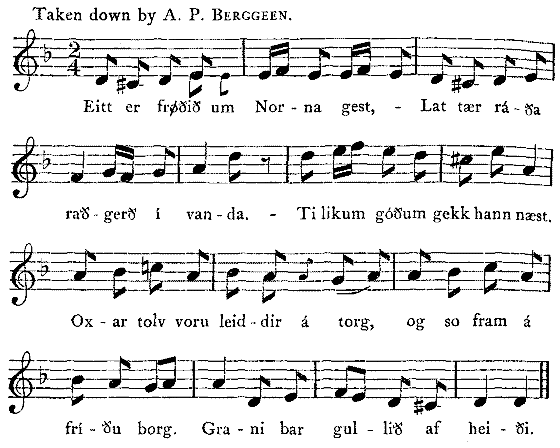
THE FAROESE BALLAD OF NORNAGEST°
1. A Ballad there is of Nornagest, Refrain:—Be ready with a plan in trouble!— In manly virtues among the best. Refrain:—Every lad should do so! 2. Twelve oxen were led to the market square, And onward thence to a castle fair. 3. The King he thought to hew them to earth, And with courage and joy did he sally forth. 4. The King he struck such a mighty blow That the blood from the wounds did swiftly flow. 5. All the oxen fell down dead, And the axe sank deep that he brandished. 6. All men praised his princely blow: The blood from the wounds did swiftly flow. 7. A man there came with crutches twain: With these he steadied himself amain. 8. The King to the man full mildly spoke:— "O why, and O why, dost thou praise not my stroke?" 9. "O Sire, thou struckest full manfully; But I saw a finer stroke in days gone by. 10.° "Of Sigurth's deeds hast thou heard the worth,— The mightiest champion of men on earth! 11. "Leaf and grove did tremble and quake When Sigurth clove in sunder the snake. 12. "This may you tell of Sigurth the bold:— 'He was mightiest of all men in days of old.' 13. "This can I tell of Sigurth's fame:— 'I know no hero with eyes so keen.' 14. "Leaf and grove did tremble and shake When Sigurth clove in sunder the snake. 15.° "A noble man was Högni, I ween, Full well did I know his ugly mien. 16.° "Rich, brave and gentle was Gunnar enow, Wise too, and Gunnhild was like him, I trow. 17. "Wise too, and Gunnhild was like him, I trow. Of heroes like him are there all too few. 18. "My father he had a homestead fair: Herds of cattle were pastured there. 19. "And horses I tended as I sat in the wood.— And blithest my heart when the weather was good! 20. "One and all in their saddles they ride, Childe Sigurth, and Högni, and Gunnar beside. 22. "Over the mire-pit rode all and one.— I was a lad, and I looked thereon. 23. "First sprang Gunnar's horse forthright. Gunnar measured his leap aright. 24. "Högni's horse sprang after then. Fast stuck Grani in the fen. 25. "The last to spring was Sigurth's steed. Sigurth had given him so heavy a feed! 26. "Grani floundered in the fen: His saddle girth brake in pieces twain. 27. "Down from their saddles each did glide,— Childe Sigurth, and Högni, and Gunnar beside. 28. "They dragged at the noble steed amain; But Sigurth pulled hardest the bridle rein. 29. "'Oft have I leapt o'er the pit aright By day and eke in the murky night. 30. "'O Guest, a service of thee I pray:— Wash from my courser the mire away. 31.° "'The saddle buckle which broke 'neath me— The same, O Guest, will I give to thee.' 32. "Forth they rode to a river then. No-one was there to look to the men. 33. "I washed his poitrail and breast for him, His thigh, his leg, and each long limb. 34. "The noble courser I made full clean. Then Sigurth took me for his horse-swain. 35. "So rode we forth to Fafnir's lair. Like the sun's own beams did the gold shine there. 36. "From Sigurth's steed did I draw a hair, Of wondrous length and beyond compare. 37. "The hair in the tail of Grani hung, —Well-nigh a foot and a fathom long. 38. "Well-nigh a foot and a fathom in height. And it shone and gleamed like silver so bright. 39. "In days gone by, full far have I strayed, Nor found I my candle and span of days." 40. The King he gave him pole and boat, And directed the old man on his road. 41. "In the Land of the Franks is a lake broad and wide Where thy candle and span of days do bide." 42.° Long and long dived the courteous man Before he came his candle upon. 43. Körnar the priest baptised him anon. When the candle burnt out his life was done. 44. When the light in the lanthorn had burnt away, Refrain:—Be ready with a plan in trouble!— Then ended too his own life's day. Refrain:—Every lad should do so!
INTRODUCTION TO THE BALLAD OF HJALMAR AND ANGANTYR
The following ballad was taken down by Hammershaimb from oral recitation in Westmanhavn in 1846, and published at Copenhagen in 1855 in Færöiske Kvæder, Vol. ii. He took down a second version of the same ballad, but consisting of only nineteen stanzas, at Sumbø in 1847, which he published in the Antiquarisk Tidsskrift, 1849-50. This second version differs slightly from the one given in our text. In it Arngrim is said to have twelve sons of whom Angantyr was the youngest. Hjalmar is not expressly stated to have been a brother of Angantyr, as he is in our version and in the Danish ballad Angelfyr and Helmer the Warrior (cf. p. 188 ff.). Moreover Angantyr is the first to learn of the franklin's daughter, and he forthwith builds a ship and sails away alone; and it is only later that Hjalmar also hears of her and sets sail, thus reaching the spot when Angantyr has already landed. More colour is given to the maiden's choice in the second version by the additional detail that
Hjalmar leapt so lightly to land, He made no footprint on the sand.
This, however, it is to be noted, is the regular formula by which the landing of the hero is described in the Faroese ballads. Cf. Lokka Táttur, v. 78.
The air and refrain to this ballad are given on p. 124 of Thuren's Folkesangen paa Færøerne.
The Ballad of Hjalmar and Angantyr
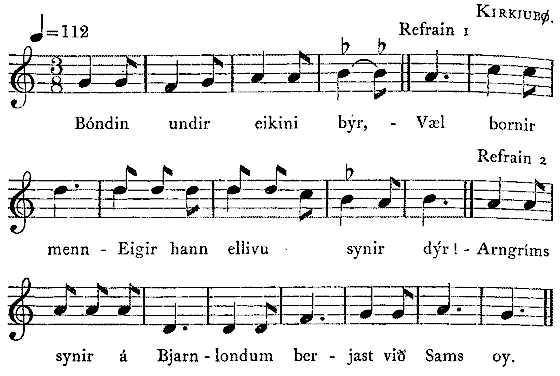
THE BALLAD OF HJALMAR AND ANGANTYR°
1. A man lived up in a high oak-tree, Refrain:— Ye well-born men!— Eleven warlike sons had he. Refrain:— Arngrim's Sons from Africa, They fought, they fought on Samsø. 2.° He had eleven sons so dear,— The champions Hjalmar and Angantyr. 3. A ship, a ship did these warriors man, And swift 'fore the wind was the course she ran. 4.° They hoisted their sail to the mast so high: They had faith in their strength and their valiancy. 5.° Their anchor they cast in the white, white sand. Hjalmar hastily sprang to the land. 6.° Their anchor they cast in the white, white sand. And Angantyr eagerly sprang on the strand. 7. Angantyr eagerly sprang on the strand. Up to his knees he sank in the sand. 8. "I drew my hose from my legs so bare To hide the sand from my lady fair!" 9. In the garden they busked them in cloaks of skin, And so went up to the franklin sitting there within. 10.° "Here sittest thou, franklin, drinking thy wine: I beg that thy daughter so fair may be mine!" 11. When Hjalmar stood before the board, Angantyr straight took up the word.— 12. "Here sittest thou, franklin, drinking thy wine: I beg that thy daughter so fair may be mine!" 13. In sorry plight was the franklin then, For there at the board stood two mighty men. 14. "No choice so hard will I ever make; The maiden herself must choose her mate." 15. "No choice so hard shall be made by thee: The warrior Hjalmar shall wed with me. 16. "With Hjalmar the Brave would I wedded be, Who is so lovely and fair to see." 17. "O franklin! Lend me a trusty blade, We two must fight for the hand of the maid." 18.° "O franklin! Lend me a sharp penknife: Each of us surely must lose his life." 19.° They fought their way forth of the hall. They bellowed louder than any troll. 20. Till they reached a river they fought amain, Down on their knees and then up again. 21. Down on their knees and then up again Refrain:— Ye well-born men!— Till stiff and dead lay those champions twain. Refrain:— Arngrim's Sons from Africa, They fought, they fought on Samsø.
INTRODUCTION TO THE DANISH BALLAD OF ANGELFYR AND HELMER THE WARRIOR
Other close verbal parallels, surely indicative of cross-relationship or of a common source, are afforded by a comparison of certain passages of the Danish ballad and the Faroese Ballad of Arngrim's Sons. Thus v. 5 of the Danish is practically identical with v. 74 of the Faroese, and we may compare v. 9 of the shorter Ballad of Hjalmar and Angantyr. May we also compare v. 6 of the Danish with v. 79 of the longer Faroese ballad; v. 8 with v. 81; v. 10 with v. 84; v. 14 with v. 79? Conventional as many of these phrases are, the identity can hardly be accidental in all cases.
From all these changes, and especially from the transference of names and places, it is obvious that the Danish version of the story is considerably more remote from the Saga than either of the two Faroese versions. At the same time, the absence of any reference to Samsø or any other Danish locality renders it highly improbable that its divergences are due to any (Danish) local tradition independent of the Saga.
On the whole it would seem that at an early date (fifteenth or early sixteenth century?) a ballad had been made from this portion of the Saga, either directly or through the intermediate stage of a lost rhymed version; and that it was composed in the Faroes themselves or in Iceland or some other region—the Orkneys and Shetlands are a possible suggestion—and acquired by the Danes not very long afterwards.
ANGELFYR AND HELMER THE WARRIOR°
1. Offue he dwelt in Uthiss-kier, Both rich and bold was he; And when two sons were born to him, He vowed they should warriors be.
Refrain: But the tempest from the North
Lashes dark and troubled billows
2. It was Young Helmer the Warrior; He bade them saddle his steed: "I Ride to Upsala this day, The King's daughter to wed."
3. Then up and spake Young Angelfyr, Where he stood in scarlet so red: "O never shalt thou this eventide To the lovely maid be wed!"
4. Then up and spake Young Angelfyr: He bade them saddle his steed: "I will gallop today to Upsala, Till the earth is rent with my speed."
5. Out of doors in the castle-court They busked them in cloaks of skin, And so went they to the hall gallery, Where the King of Upsala sat within.
6. In came Young Helmer the Warrior, And stood before the board; "O King, I pray thee, give me thy daughter,— I wait thy friendly word."
7.° In there came Young Angelfyr, And gold shone on his hand: "O King, I pray thee, give me thy daughter And quit thee from this thy land."
8. Long and long stood the King of Upsala, And pondered silently, How those heroes who stood before him He might answer fittingly.
9. It was the King of Upsala, And he spake this word theretil: "I give my daughter to that man only Who has won him her goodwill."
10. "I give thee thanks, my father dear, That the choice thou lay'st on me; I give myself to Young Helmer the Warrior, For a noble man is he.
11.° "I will not wed me to Angelfyr: For he is half a troll;— So is his father, and so his mother, And so are his kinsfolk all."
12. Then up and spake Young Angelfyr As he stood and pondered there: "We both will take us forth to the courtyard, And fight for the maiden fair."
13. It was the King of Upsala, And answered he forthright: "O the swords they be keen, and the lads they be bold, And may measure them well in a fight."
14. Then up and rose Young Angelfyr Where he his sword out drew; And up rose Young Helmer the Warrior, Whom he to the earth did hew.
15. Offue he stands in Uthiss-kier And far and wide looks he: "O somewhere is Helmer suffering pain, For I feel such woe in the heart of me."
16. Offue he stands in Uthiss-kier And looks o'er the wide, wide heath: "O what can be harming my two sons today, And why are they both so wroth?"
17. It was Offue in Uthiss-kier; He sprang on his red-roan steed. And so came he to the King's courtyard, Ere Helmer was dead indeed.
18.° "O hearken, hearken, Young Helmer, Beloved son of mine: Thy noble sword from out thy hands Why didst thou list to tine?"
19. "Eight are the mortal wounds I bear, They are both deep and sore; And had I only one of them I could not live an hour."
20. O it was Offue in Uthiss-kier, And he his sword out drew;— And O it was Young Angelfyr Whom down to the earth he slew.
21. "Lie thou there, Young Angelfyr, And bleed till thou art dead; So woeful was I in my heart When I saw how Helmer bled.
22. "Lie thou there, Young Angelfyr, And lose thy life-blood all. So woeful was I in my heart When I saw Young Helmer fall."
Refrain: But the tempest from the North Lashes dark and troubled billows On the gleaming waste of sand.
In ms. B of the Ballad of Angelfyr etc., vv. 1-11 correspond pretty closely to ms. A; but vv. 12-18 are different:
12. Alff he stood in Odderskier, And listened over the field; Then could he hear so far away Where his sons their swords did wield. 13. Up then rose Alff in Odderskier; He sprang on his red-roan steed; And came he so to Upsala Ere both the warriors were dead. 14. "O hearken, hearken, Young Helmer, Beloved son of mine: Why does the life blood from thy head In streams come running down?" 15. It was Young Helmer the Warrior, And his father answered he: "My brother Angelfyr could not have the maid, And therefore he wrought this ill to me. 16. "My body is pierced with fifteen wounds, All tainted with poison full sore; And had I only one of them I could not live an hour." 17. It was Alff in Odderskier, And an oak he uprootéd; He struck with the oak Young Angelfyr, Till he lay on the earth stone dead. 18. Now both these warriors are lying dead, And dead lie they in their grave; And the King he is ready to give his daughter To the man whom he himself will have.
INTRODUCTION TO THE FAROESE BALLAD OF ARNGRIM'S SONS
The Ballad of Arngrim's Sons was first taken down by Svabo towards the close of the eighteenth century. He never published it, but his ms. (iii. 9) is preserved in the Royal Library at Copenhagen. In 1848 V. U. Hammershaimb took the ballad down again from oral recitation on Sandø and published it in the Antiquarisk Tídsskrift, 1849-1851 (Copenhagen, 1852). He had, however, consulted Svabo's version, for he says in the prefatory note to the ballad:
It is entirely confused in Svabo's version in the Royal Library. I have therefore kept to the version which I got on Sandø, which in the main points agrees with the Saga. Only in the conclusion and two other passages have I followed Svabo's version.
By 1855, however, it would seem that his view had changed. In his prefatory note to the Ballad of Arngrim's Sons, published in Nordiske Oldskrifter, vols. 18-19, Part II (Copenhagen, 1855), he writes:
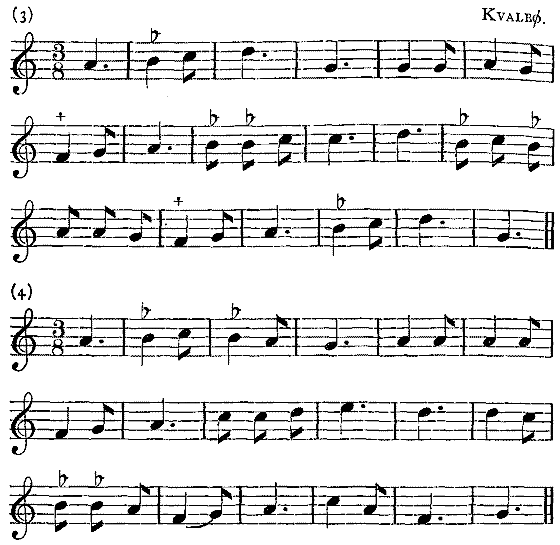
The air to which the following ballad is sung on the Faroes has been transcribed and printed by Thuren in Folkesangen paa Færøerne, pp. 132, 133.
The Ballad of Arngrim's Sons
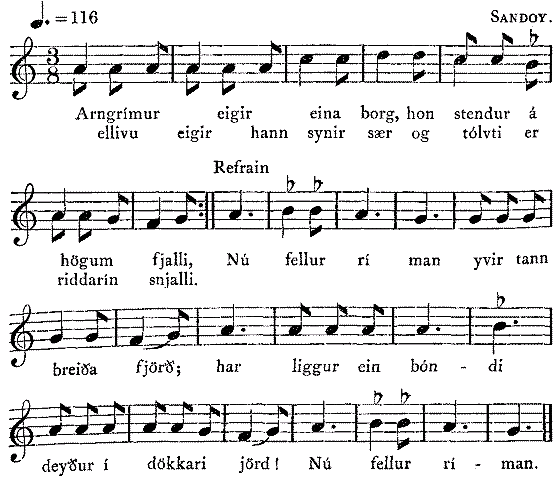
Variations of Refrain of The Ballad of Arngrim's Sons
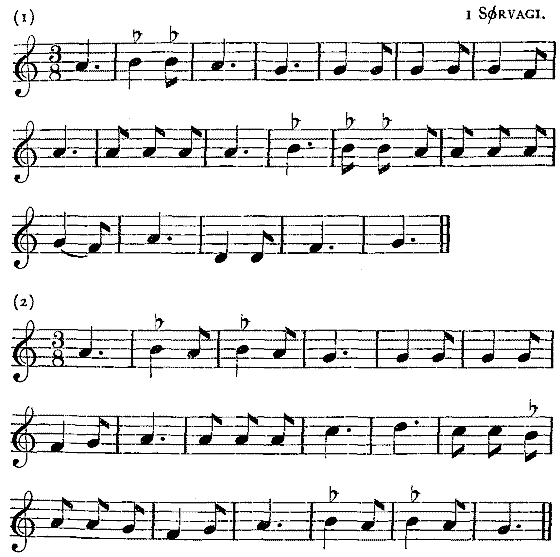
THE BALLAD OF ARNGRIM'S SONS.°
1. High on a lofty mountain Does Arngrim his castle hold; He has eleven noble sons, And his twelfth is a champion bold. Refrain: Noble men are sailing now from Norway, And a fair breeze bears them o'er the wave. 2.° He has eleven noble sons, Each skilled to wield his brand; And mightiest of all is Angantyr Who comes from Bjarnaland. 3.° He has eleven noble sons, Beneath oak-trees live they; And Angantyr lives with them there And a warrior bold is he. 4.° Arngrim and the Earl's lady, Children so fine had they— Their daughter was named Hervik, Who governed land and fee. 5. This maiden was named Hervik, 'Fore all men I declare, She tilted in the tourney When the lads were playing there. 6. She tilted in the tourney Among the lads so strong. Then blood was up and blood was shed Ere she had played her long. 7.° Down then sat the lads there; Angry were they each one.— "Better than fighting us so fiercely Go 'venge thy father anon!" 8.° Water she cast on her armour; She list no longer to fight, But went and stood before her mother, With cheeks all red and white. 9.° "O hearken, hearken my Mother dear, The truth from thee would I know.— Was my father slain in battle Or did he die on straw?" 10.° "No truer tale can I tell to thee, My daughter whom I love: He fell before the bold Örvarodd To the South in Isan's Grove. 11. "I can tell thee no truer, my daughter dear Than I tell as here I stand;— He fell before the bold Örvarodd To the South in Isan's Land." 12. She took her quickly to a chest Which guarded gold and fee; She drew a shirt from out the chest, And flung it on Hervik's knee. 13.° She drew a shirt from out the chest, All bloodstained where it had lain.— "Here may'st thou see the very same shirt In which thy father was slain." 14.° Up then rose Hervik the Earl's daughter And manned ship hastily; Its cables were of shining gold, All twisted cunningly. 15. Up then rose Hervik the Earl's daughter, And decked her ship so fine, And bade them store within the hold Both ale and costly wine. 16. Tarred were the masts, And black was the ship in hue; The masthead was of the red, red gold, And the sun shone on it too. 17. Tarred were the masts; The ship it was quite new; The golden weather-cock spun aloft, And shone amid Heaven's own blue. 18. Tarred were the masts, The beams scored wondrously; Stem and stern were of red, red gold, And so was the sail on high. 19. All in the middle of the ship's deck The colour shone so fair Where Hervik, the Earl's daughter, Sat on the platform there. 20.° She hoists aloft her silken sail, Striped gold on a scarlet ground, Nor ever once does she strike it again Till she comes to Isan's Land. 21. She hoists aloft her silken sail, (The like will scarce be found) Nor ever once does she strike it again Till she comes to Isan's ground. 22. Forth when Hervik's frigate Touched the fair land, Cast she forth her anchor Into the white, white sand. 23.° Cast she down her anchor Into the white, white sand; And the first was Hervik the Earl's daughter To spring with her foot to land. 24. The first was Hervik the Earl's daughter To spring with her foot to land, And with her Hjalmar her brother Close at her right hand. 25.° There a huntsman met her; He had hunted herd and fee: "O why art thou so sorrowful, As a troll had been hunting thee?" 26. Then up stood Hervik the Earl's daughter, Her good sword out she drew, And with it she clove the huntsman And him in sunder slew. 27. Three cross roads are bending, And one can she descry; Hervik has gone straight forth to the barrow Wherein her father doth lie. 28.° Hervik has gone straight forth to the barrow Where her father lies dead and cold. Little recks she of fear or favour, Though quake now fell and fold. 29. Then up and spake the voice of Arngrim, And these words first spake he:— "O where are my eleven sons gone, Since daughters are visiting me?" 30. "I pass not for my eleven brothers, Or where they share their fee. No treasure have I, save only Hjalmar, Hither brought with me. 31. "O haste thee, haste thee, my noble Father The good brand to give me; Or shall I set fire here to this barrow, And burn it over thee?" 32. Full woe was the champion Arngrim That she should wreck his grave. He seizéd Tyrfing in both his hands And to his daughter gave. 33. He gave to her the sword then Was wonderfully made.— The length of it was eighteen ells, And poisoned was its blade. 34. He gave to her the sword then Was wonderfully made. No leechcraft could avail the man Was wounded by its blade. 35.° All in the middle of the garden She clad her in cloak of skin; She busked her in a cloak of fur, And entered the high hall within. 36.° She busked her in her cloak of fur And entered the high hall belive, Where Örvarodd sat before the board With a hundred men and five. 37.° "O welcome, welcome, Hervik, Hither now to me Mead or wine shalt thou have to drink As liefest is to thee." 38. "O little to me is thy mead, Örvarodd, And little to me thy wine. Today I have come to thy high hall, And a different errand is mine. 39. "O little to me is thy mead, Örvarodd, And little to me thy beer; For a different errand did I busk me When I left my home to come here. 40. "I busked me and came from Sweden To fight in this thy land. Stand up! Stand up! Thou bold Örvarodd, Stand up, and arm thy band!" 41. It fell full early on a morning tide, Before the sun rose high, Bold Örvarodd had a hundred men and twelve Accoutred royally. 42. Bold Örvarodd had a hundred men and twelve Accoutred royally. Then up rose Hervik, the Earl's daughter, To meet them gallantly. 43. Up then rose Hervik, the Earl's daughter, So doughty in the fight. She blew a blast on her golden horn, And struck to left and right. 44. It was Hervik, the Earl's daughter, So gallantly she rode;— She clove to the shoulders every knight Who forth against her strode. 45. She clove to the shoulders every knight Who forth against her strode, Till only Örvarodd and his two companions Survivors of the army stood. 46. Under the castle gateway The King crept fearfully.— "Now mercy, mercy, sweet Hervik, I pray thou'lt give to me!" 47. "Just so much is the sweet mercy Thou now shalt get of me As thou gavest to my noble Father When thou slew'st him felonly!" 48. "Just so much is the sweet mercy Thou now shalt win of me As thou gavest to my noble Father When thou slew'st him cruelly!" 49. That was Hervik, the Earl's daughter, To draw her sword was fain. She has slain the warrior Örvarodd And cut him in pieces twain. 50. She has slain the warrior Örvarodd And cut him in pieces twain, And all his men so brave and true She has heaped on his corse amain. 51. Up then rose Hervik, the Earl's daughter; Through the greenwood gan she ride; But hawk or hound made never a cry In the greenwood by her side. 52.° She hoists aloft her silken sail, Striped gold on a scarlet ground; Nor ever once does she strike it again Till she reaches far Uppland. 53. Forth when Hervik's frigate Touched the fair land, Cast she forth her anchor Into the white, white sand. 54. Cast she forth her anchor Into the white, white sand; And forthwith her brother Angantyr Came riding down the strand. 55. She gave to him the sword then Was wonderfully made.— The length of it was eighteen ells, And poisoned was its blade. 56. She gave to him the sword then Was wonderfully made.— No leechcraft could avail the man Was wounded by its blade. 57. Angantyr sits in his high seat, And with his men spake he!— "O where will I get a make to myself? This thought has been long with me." 58. One and all they hung their heads, And never a word spake they, Save Hjalmar his brother, and better were it He had held his peace that day. 59. "I can no truer tell thee, But and thou list to hear: The King of Upsala has a daughter, And she is passing fair. 60.° "The King of Upsala has a daughter As lovely as the sun. Her cheeks they are as red and white As blood on driven snow. 61. "The King of Upsala has a daughter: Of many is her fame the word. Her throne it is of the red, red gold, And stands at the King's own board." 62. "O gin the maiden be so fair, And gin she be so fine, I swear an oath, though ill betide, To call that maiden mine. 63. "O long and long will the journey be O'er breaker but and billow; But I go forth to Upsala, Hjalmar, And thou, my brother, must follow." 64. Then up spake Hjalmar the warrior, And straightway answered he: "The bird feels joy when he spies a corpse, And so do I follow thee!" 65. Up then rose him Angantyr, And manned ship hastily. Its cables were of shining gold All twisted cunningly. 66. Up then rose him Angantyr, And decked his ship so fine, And bade them store within the hold Both ale and costly wine. 67. He hoists aloft his silken sail, Striped gold on a scarlet ground Nor ever once does he strike it again Till he comes to Uppsaland. 68.° Forth then when his frigate Touched the fair land, Cast he down his anchor Into the white, white sand. 69.° Cast he down his anchor Into the white, white sand. And Angantyr was the first to light With his foot to land. 70. Angantyr was the first to light With his foot to land, And by him Hjalmar his brother, Close at his right hand. 71. By him Hjalmar his brother Close at his right hand; Truly is it told to me He sank to his knees in sand. 72. Up they went from the sea-shore, Those men of wealth and worth; The rollers brake, and the earth it shook As they set their ships in berth. 73. Up they went from the sea-shore, In their clothes of scarlet so fair; Their helmets were of burnished gold, And no man did they fear. 74. All in the middle of the garden They clad them in cloaks of skin; They busked them in their cloaks of fur And entered the high hall within. 75. They busked them in their cloaks of fur And entered the high hall belive, Where the King of Uppland sat at the board With a hundred men and five. 76. Hjalmar went into the high hall With silk embroidered hood. His cheeks were red as lobster's claws, His eyes were like the dove. 77. Angantyr has do'en him to the high hall, 'Twas the custom in days gone by; And all in a word did he hail the King And ask for the maid truly. 78. Angantyr stands on the hall floor, Offers him greeting there;— "Now hail be to thee, bold King of Uppsaland, Give me thy daughter fair!" 79. Then up and spake the bold Hjalmar, Before the broad board he stood:— "O King, I pray thee, give me thy daughter Who is so fair and good." 80. Up then rose the bold Hjalmar, Before the broad board sat he:— "O King, I pray thee, give me thy daughter Who is so wise and fair to see." 81. Long in sorrow sat the King And silently pondered. What he should answer the two fierce warriors, Who stood before the board. 82. Up then rose the King of Uppsaland; Angry and wroth was he: "My lady daughter shall come to the hall And for herself reply." 83. They have led his daughter to the hall, Attended fittingly; And Hjalmar's face grew red and pale As in the high-seat sat he. 84. "Now thanks and thanks to my noble father Who gave this choice to me. Hjalmar the champion from Uppland, He shall my husband be. 85. "I will not wed me to Angantyr: He is so vile a troll; So is his father and so his mother, And so are his kinsfolk all." 86. "Come forth, come forth, thou bold Hjalmar For ne'er so brief a tide. To battle on an island make thee bowne; She shall not be thy bride." 87. Then up and answered Odd the Young: "Once more we are fighting here. You shall go against Arngrim's Sons, And I against Angantyr." 88.° "We two, Angantyr and I, Shall fight with mighty strife; I would not that lady Ingibjörg hear That I sought to flee for my life. 89. "We two, Angantyr and I, Shall meet in a mighty gripe, And long will lady Ingibjörg wait Ere she hear that I shrank for my life." 90. Out then spake the Young Odd, And pondered heavily; "O gin thou go'est against Angantyr, Thou choosest thy death truly." 91. All the sons of Arngrim Rode up the river shore A-tightening of their shield-straps Till they could tighten them no more. 92. All the sons of Arngrim Rode through the plain so green; A league and a league you could hear on the stones The clang of their spears so keen. 93. All the sons of Arngrim, Angry were they in mood. Little recked they for weapons, But tore up clubs of stout oakwood. 94. All the sons of Arngrim Rode up the river strand. It is the young Odd will lose his life, For Hjalmar is not at hand. 95. Odd rode against the Sons of Arngrim, His noble weapons proved he so, And he slew all the eleven brothers Yet never dealt he a second blow. 96. Angantyr and the bold Hjalmar On the island combated. All their followers who manned the ship Are lying now stone dead. 97.° Hjalmar then struck Angantyr, So lay he at his feet. "O Hjalmar, give me now a drink, For it comforts the meanest wight." 98. "A drink from out my drinking horn I give thee willingly; But hearken, Angantyr my brother, Today have I surely conquered thee." 99. O he held the horn before his lips, —He the noble warrior,— And O it was the heathen dog Who stabbed him under the helmet there. 100. It was the warrior Hjalmar, He drew his sword amain; He has cleft his brother Angantyr And cut him in pieces twain. 101. Odd came home at eventide A-riding on the strand, And saw where Hjalmar had sat him there, Marred by the poisoned brand. 102. Odd came home at eventide, Where Hjalmar leant his back on a stone; "O why art thou so wondrous pale, And what has brought thee to make such moan?" 103. "My corslet he has piercéd, He has scathed my skin so white; The poison smeared upon the blade My heart will surely smite." 104. "Thou didst put thy faith in thy corslet, All made of shining steel; But here stand I in my shirt only, And yet no wound I feel. 105. "Thou didst put thy trust in thy corslet, All made of silver bright; But here stand I in my shirt only, And got no wound in the fight. 106. "Thou did'st put thy trust in thy corslet, All made of silver white; But here stand I in my shirt only Which sword could never bite." 107. Then up and spake the Warrior Hjalmar. The first word he did say Was "Hearken and hearken now Young Odd, And bear me hence away." 108. Then up and answered the Young Odd, He gazed on the rocky ravine: "This fight, O Hjalmar, if thou list to hear Has gone as I had foreseen." 109. He drew the gold ring from his arm; Speech could he utter still; Bade carry it to the lady Ingibjörg, And bade him fare him well 110. He drew the gold ring from his arm; All floating was he in blood. He sent it to the lady Ingibjörg, That maid so fair and good. 111. She died of grief for Hjalmar— She the noble maid; I swear an oath upon my honour There lives none of whom the like can be said. Refrain: Noble men are sailing now from Norway, And a fair breeze bears them o'er the wave.
INTRODUCTION TO THE FAROESE RIDDLE BALLAD (GÁTU RÍMA)
The Gátu Ríma was first taken down in Suderø by a clergyman, Schröter, early in the nineteenth century, and is preserved in the archives of the Early Text Society in Copenhagen. Unfortunately Schröter was only able to obtain the Ballad in a fragmentary form, and he has left us only a Danish translation of what he found. In his travels on the Faroes in 1847-1848 Hammershaimb made strenuous efforts to get the entire version, but curiously enough only succeeded in getting a version (of course in the original Faroese) which corresponds closely in length and content with Schröter's. He published this version first in the Antiquarisk Tídsskrift, 1849-1851, and later Færöiske Kvæðer, vol. ii. (Copenhagen, 1855). The translation given below is taken from the ballad as printed in Færöiske Kvæðer.
GÁTU RÍMA.°
1. Guest goes wandering from the hall, Silent and blind is he; Meets he with an eldern man All with hair so grey. 2. Meets he with an eldern man, All with hair so grey; "Why art thou so silent, Guest the Blind, And wherefore dost thou stray?" 3. "It is not so wonderful Though I of speech am slow; For riddles have brought me to an evil pass, And I lose my head tomorrow. 4. "It is not so wonderful Though mournful am I and slow; For riddles have brought me to an evil pass, And I lose my life tomorrow." 5. "How much of the red, red gold Wilt thou give to me, If I go in before King Heithrek And ask thy riddles for thee?" 6. "Twelve marks of the red, red gold Will I give to thee, If thou wilt go in before King Heithrek, And ransom my head for me." 7. "Go thou into thy courtyard And look to thy dwelling, thou, While I go in before King Heithrek, And ask him riddles now." 8. "Thirty are the riddles And one will I propose ... (Riddles lost.) 9.° (First two lines lost.) Thunder is the red drum Which beats over all the world." 10. "O hearken now, Heithrek my King, Where dost thou know the neighbours, Both of whom use the same door, And neither one knows the other?" 11. "My thought and thy thought, No neighbour is one to other; Both of them use the same door, Yet neither knows the other." 12. "O hearken now, Heithrek my King, Where dost thou know the brothers Who roll far away on the outer reefs, And have neither fathers nor mothers?" 13. "The Western flow and the Eastern flow, Well may they be called brothers; They roll far away on the outer reefs And have neither fathers nor mothers." 14. "O hearken now, Heithrek my King, And what can this be now?— Soft as down and hard as horn, And white as glistening snow!" 15. "Hear thou this now, Guest the Blind; This riddle I understand.— The sea it is both soft and hard, And flings white spray upon the land." 16. "O hearken now, Heithrek my King, Where does the sapling grow,— Its root is turned towards high Heaven, And its head turned down below?" 17. "The icicle on the high crags, No sapling it is I trow, Yet its root is turned towards high heaven, And its head turned down below." 18. "O hearken now, Heithrek my King, Where does that forest grow,— It is cut on every holy day, And yet there is wood enow?" 19. "The beard which grows on each man's chin, No forest is that I trow, Though shaved on every holy day, And yet there is wood enow." 20. "O hearken now, Heithrek my King, Where dost thou know the brothers,— Both of them live in the same hall, And have neither fathers nor mothers?" 21. "Turf clods and brimstones, Neither of the twain are brothers. Both of them live in the same hall, And have neither fathers nor mothers." 22. "The sow she wanders to her sty, She wallows on the green, green earth. The boar he grunts and the little pigs squeak, And each makes music with his mouth." 23. "O well do I know thy riddle, And well it shall be spoke; The hammer is raised in every smithy, And falls with even stroke." 24. "O well do I know thy riddle, Though thereof no boast make I. It is Othin who rides upon his steed, By land and eke by sea. 25. "O well do I know thy riddle, Yet of wisdom I make no display. Othin he rides upon his steed By night and eke by day." 26. Othin has turned into a wild fowl, And flown out from the hall; And therein King Heithrek has been burnt, He and his nobles all. 27. Othin has turned into a wild fowl, And has flown far out to sea; He has burnt King Heithrek in his hall, And all his company.
INTRODUCTION TO THE SHETLAND BALLAD OF HILDINA
This ballad has been discussed above, pp. 39 and 164 f. It was taken down by George Low in the course of a visit made by him to the island of Foula in the Shetlands in 1774. He was entirely ignorant of the language, and had apparently no idea as to the meaning of the actual words, though the general drift of the ballad was explained to him by the islander, William Henry, from whom he obtained it (cf. p. 164). As very few remains of the dialect have been preserved, apart from the ballad, the interpretation presents great difficulties. The following translation of the first twelve stanzas is made from the corrected text given by Dr M. Hægstad in his edition of the Hildina contained in Skrifter udgivne af Videnskabsselskabet i Christiania, 1900 (Historisk-Filosofiske Klasse, ii).
THE SHETLAND BALLAD OF HILDINA°
1. It was the Earl from Orkney, And counsel of his kin sought he, Whether he should the maiden Free from her misery. 2. "If thou free the maid from her gleaming hall, O kinsman dear of mine, Ever while the world shall last Thy glory still shall shine." 3. Home came the king, Home from the ship's levy The lady Hildina she was gone, And only her stepmother there found he. 4. "Be he in whatever land, This will I prove true, He shall be hanged from the highest tree That ever upward grew." 5.° "If the Earl but come to Orkney, Saint Magnus will be his aid, And in Orkney ever he will remain— Haste after him with speed." 6. The King he stood before his lady, And a box on her ear gave he, And all adown her lily white cheeks The tears did flow truly. 7. The Earl he stood before Hildina, And a pat on her cheek gave he,— "O which of us two wouldst thou have lie dead, Thy father dear or me?" 8. "I would rather see my father doomed, And all his company, If so my own true lord and I May long rule in Orkney. 9. "Now do thou take in hand thy steed, And ride thou down to the strand; And do thou greet my sire full blithely, And gladly will he clasp thy hand." 10. The King he now made answer— So sore displeased was he— "In payment for my daughter What wilt thou give to me." 11. "Thirty marks of the red gold, This to thee will I give, And never shalt thou lack a son As long as I may live." 12. Now long stood the King, And long on the Earl gazed he:— "O thou art worth a host of sons; Thy boon is granted thee."
It will be seen that up to this point, in spite of the loss of the names, there can be little doubt that the subject of the ballad is the story of Hethin and Högni. After this however the narrative deviates from any other known version of this story. It would rather seem that—as in the German Kudrun—two stories, originally distinct, have been brought together in one poem.
NOTES°
The numbers refer to chapters (sagas) and strophes (ballads, etc.)
THE THÁTTR OF NORNAGEST°
The Tháttr of Nornagest. A tháttr is a portion (episode) of a longer saga, in this case the Saga of Olaf Tryggvason which is found in the Flateyjarbók.
I.° King Olaf Tryggvason, one of the most famous kings of Norway (r. 995-1000). He compelled the country to accept Christianity. For accounts of his life and times, see the Story of Olaf Tryggvison in the Heimskringla, vol. i, pp. 221-378; and also the longer Saga of King Olaf Tryggwason, translated by Sephton.
Trondhjem, originally the name, not of a town, but of the entire district round the Trondhjem Fjord.
A man came to him. Cf. the Saga of Olaf Tryggvason (Heimskringla), ch. 71.
Guest. Here a pun is intended, the word Gestr in Icelandic signifying a 'guest' as well as a 'stranger.'
The Contentious. The word in the text, 'þingbítr,' seems to mean 'sharp in debate,' and to refer to his ready wit and astuteness in litigation.
Guest said that he had been prime-signed. To 'prime-sign' signified to make the prima signatio or sign of the Cross over a person, preliminary to baptism. People so 'prime-signed' were admitted to certain parts of the Mass and to social intercourse in Christian communities. See the Saga of Egil Skallagrimsson, ch. 50 "King Athelstan [of England] was a good Christian.... He asked Thorolf and his brother to let themselves be prime-signed; for this was a common practice with both merchants and soldiers who took service under Christians. Men who were prime-signed had free intercourse with both Christians and heathens, and followed whatever religion they liked best. Thorolf and Egil did as the King asked them, and both were prime-signed."
Svein Forkbeard, King of Denmark from 986 (?) to 1014, and of England also during the last year of his life.
The Emperor Otto, i.e. Otto II, 973-983.
Dane-work, i.e. the Danish Wall still partially preserved, which divided Jutland from the land of the Saxons and stretched from near the city of Slesvig to the marsh-land along the River Treene.
King Harold Gormsson appears to have reigned for about fifty years and to have died probably in 986. He was nick-named Harold 'Bluetooth' (or perhaps 'Blacktooth'). About 974 he fought the Emperor Otto II, and Earl Haakon of Norway aided him. Both Harold and Haakon were forced to accept Christianity, but Haakon afterwards renounced it.
Earl Haakon the Heathen, i.e. Earl Haakon the Great, or the Bad, who ruled over Norway, 975-995.
Guthmund. Cf. the Saga of Hervör and Heithrek, ch. 1. See also Saxo Grammaticus, Dan. Hist., pp. 346-349, where Guthmund is described as a magician dwelling in the land of the Perms. But see Glasisvellir, below.
Glasisvellir. Cf. the Saga of Hervör and Heithrek, ch. 1. For the name of the tree or grove called Glasir beside Othin's abode in Valhalla, see Skáldskaparmál, ch. 34: "Glasir stands with golden foliage before the halls of the God of Victory." See also Bjarkamál in Forna, str. 3.
II.° Ulf the Red was standard-bearer to Olaf Tryggvason at the Battle of Svöld (cf. the Saga of Olaf Tryggvason, Heimskringla, ch. 56), where he slew great numbers of the enemy.
The Bay, i.e. Christiania Fjord and the adjacent coasts.
King Half. See Hálfssaga, ch. 10; and Flateyjarbók, 11, pp. 136, 137. King Half had a chosen band of warriors numbering about sixty, who were subject to strict discipline and rules which Professor Craigie (The Icelandic Sagas, p. 94) suggests were modelled on those of the Jómsvíkings. For instance, "It was one of their customs always to lie off the ends of promontories. Secondly, they made a rule of never pitching tents on their ships and never clewing up the sail on account of bad weather." The incident referred to in the text is not mentioned in the Saga.
No halls had been built in Norway. The writer probably means to contrast the stone halls of his own day with the wooden structures of earlier times.
The Harping of Gunnar, a lost poem. The legend here referred to is told in Völsunga Saga, ch. 37 (and elsewhere), doubtless from an old lay.—'King Attila had Gunnar cast into a pit full of snakes ... and his hands were tied. Guthrún sent him a harp, and he was so skilful in harping that he could play it with his toes; and he harped so well that hardly anyone had ever heard such skilful playing, even with the hand. So beautifully did he play that all the snakes were lulled to sleep except one horrible big adder which crept up to him and stung him to the heart. Thus he perished with great courage.'
Gunnar, the son of Gjúki, is the central figure both of the Norse story and of the German Nibelungenlied, in which he is called Gunther. In reality, he was overthrown and killed by the Huns in 437, after which the Burgundians moved from the Rhine to the district now known as Burgundy.
The Ancient Wiles of Guthrún. It is generally believed that this is the name of another lost heroic poem. But the title may possibly mean The Adventures of Guthrún, in which case the poem referred to may be the well-known Ancient Lay of Guthrún (Guðrúnarkviða hin forna). This latter poem is alluded to in ch. 9 below under the title of Guðrúnarræða.
IV.° The Land of the Franks, the Rhineland. As far back as the fifth century the Franks occupied that region—to the north of the Burgundians.
Sigurth the son of Sigmund. The story of Sigurth the Völsung is related in Völsunga Saga.
Hundingsbani, i.e. 'Slayer of Hunding.' See Völsunga Saga, ch. 9.
V.° It chanced one day that, etc. Chapters 5 and 6 are mainly taken from the poem Reginsmál of which strophes 13-26 are quoted in our text. Reginsmál is the first poem of a trilogy dealing with the early adventures of Sigurth. The two remaining poems Fáfnismál and Sigrdrifumál are used only in the last two sentences of ch. 6.
Yngvi is a name of the god Frey, from whom the kings of Norway and the early kings of Sweden were believed to have sprung.
Fafnisbani, i.e. 'Slayer of Fafnir.' Cf. ch. 6 infra. See also Völsunga Saga, ch. 18.
The Imperial Power had not, etc. This may mean either the refounding of the Western Empire by Charlemagne, a.d. 800, or possibly the gaining of the Imperial throne by Otto I, King of the Germans, in 962.
VI.° Sigurth prepared for battle, etc. An account of this battle is given in Völsunga Saga, ch. 17.
The sea-king's steed. The text has Ræfils hestum, lit. 'Ræfil's horses.' Ræfil was a legendary sea-king. The names of such characters are frequently used in 'kennings' (i.e. poetic circumlocutions) like this.
Hnikar, a name of the god Othin in the Grímnismál (str. 47) and elsewhere.
The Moon's sister. The text has systur Mána, 'Máni's sister,' i.e. the sun. Máni, the old word for the moon, is preserved in Iceland only in a mythological sense, the ordinary word in use for moon being tungl. Máni and Sól (the sun) were brother and sister. See Vafþrúþnismál, str. 23; also Gylfaginning, ch. 11, 12.
Order their array, lit. 'draw up a wedge-shaped column'—a favourite battle-formation, the origin of which was ascribed to Othin. Stumbling is bad luck, etc. So Wilken (gloss. s.v. fyrir, 2.) Vigfússon and Gering transl. 'It is an ill thing to outrun one's luck.'
Friesland. In early times the Frisians occupied a much greater extent of coast than now, reaching from the boundary between Holland and Belgium on one side to beyond the mouth of the Weser on the other—apart from the Frisians inhabiting the west coast of Slesvig.
The 'blood-eagle' was a form of vengeance practised by the heathen Scandinavians in battle when anyone captured the slayer of his father. The ribs were cut in the shape of an eagle, and the lungs torn out through the opening. The Northumbrian King Ella (Ælla) is said to have been put to death in this way by the sons of Ragnar Lothbrók. Cf. the Saga of Ragnar Loðbrók and his sons, ch. 18; also the Tháttr of Ragnar's Sons, ch. 3.
Hugin and Munin were Othin's attendant ravens who gave him information. See Grímnismál, str. 20; Gylfaginning, ch. 38; Ynglingasaga (Heimskringla), ch. 7.
The story of Sigurth Fafnisbani. The whole story of the loves of Sigurth and Brynhild is related in the Völsunga Saga, ch. 20-32. It is uncertain whether the reference here is to the Völsunga Saga as we have it or to an earlier form of the story.
VII.° Gjuki is mentioned under the form Gebica in the Lex Burgundionum (c. 500 a.d.). Nothing more is known of him from historical sources; but he is mentioned in Skáldskaparmál, ch. 41, Völsunga Saga ch. 25, and in the Edda Poems, as the father of Gunnar and Guthrún. His name appears also (as Gifica, Gibicho, etc.) in the Anglo-Saxon poem Widsiþ, the Latin poem Waltharius, and in several early German poems.
Sigurth Hring, a legendary king of Sweden and Denmark, and the father of Ragnar Loðbrók. His story is related at length in a fragment of the Skjöldunga Saga; and he is probably identical with the Sigifridus who is mentioned in several Frankish Chronicles under the year 812 as carrying on hostilities against another Danish King Anulo.
The sons of Gandalf were in constant hostility with King Harold the Fairhaired and his father. They owned Alfheimar and Vingulmörk along the Swedish coast of the Kattegat. Cf. the Story of Halfdan the Black (Heimskringla), ch. 1, 4; also the Story of Harold the Fairhaired (Heimskringla), ch. 1 etc.
Gunnar and Högni. The story of the relations of Gunnar and Högni with Sigurth is told in Völsunga Saga, ch. 26 f.
Jarnamotha. The locality is unknown. There were large forests in Holstein in the Middle Ages called 'Iarnawith' and 'Isarnho'; cf. Müllenhoff, Deutsche Altertumskunde, v, p. 122.
hazlewood poles had been set up, etc. The verb hasla, used in the sense of 'to challenge (to a pitched battle),' means, lit. 'to enhazle' a battlefield, i.e. to mark out the space reserved for a pitched battle with hazel poles. Cf. the Saga of Egil Skallagrímsson, ch. 52.
The Kurir were the people of Courland (perhaps Lithuanians). The Kvænir were the Finnish inhabitants of the northern portion of what is now Sweden. King Alfred, in his translation of Orosius, inserts an original account of Norway and the neighbouring regions which was given to him by a Norwegian called Ohthere. It is there stated that beyond the mountains which bound the northern part of Norway was 'the land of the Cwenas.' Cf. also the Saga of Egil Skallagrímsson, ch. 14.
Starkath, the ideal warrior of old time in the North. Probably originally a historical figure, he became the centre of much legendary matter, and, as often happened in such cases, he was even credited with the composition of many poems, notably that on the Battle of Brávöll—an event which probably took place long after his time. In Saxo Grammaticus, Dan. Hist., pp. 246-258, he corresponds to the unnamed "Old Warrior" mentioned in Beowulf, l. 2041 ff.
Fenhring, in Hörthaland in Norway, not far from Bergen.
Lund, the old ecclesiastical capital of Denmark, situated in Skaane in the extreme south of Sweden. Not only Skaane, but also the neighbouring provinces (Halland, etc.) belonged in early times to Denmark.
VIII.° Starkath had committed a foul murder. For this story see Saxo Grammaticus, Dan. Hist., p. 314 ff. Saxo says that the rule of King Ali or Ole was so hateful to the Zealanders that twelve of their generals resolved to put him to death, bribing Starkath to join them. Although a personal friend of Ole, Starkath agreed to do so, and murdered him in his bath. He afterwards repented bitterly, "and to atone for his crime slew some of those who had inspired him to it."
Travels. I have followed the reading ferða, 'travels,' adopted by Wilken, not frænda, as in the Fornaldar Sögur, ed. by Ásmundarson. The latter would read: "The King wanted him to tell him much more about the history of his relatives."
IX.° Germans say, etc. For the German story of the murder of Sigurth see the Nibelungenlied, str. 985 ff.
Guthrúnarrætha. This is no doubt the poem commonly called Guðrúnarkviða hin forna, the opening of which narrates how Sigurth's horse came home riderless.
Brynhild and the ogress chanted, etc. The following lay is found in the Edda Poems under the title of Helreið Brynhildar ('The Hell-ride of Brynhild').
From the Land of the Romans, lit. 'From Valland'—the 'land of the Valar,' i.e. the Celts or Romans. Here the reference is doubtless to the Roman territories on the west bank of the Rhine. In the Nibelungenlied, Gunther (i.e. Gunnar) is represented as reigning at Worms. Cf. p. 232 below.
Assigned me a home, etc. In the Codex Regius of the Edda Poems this passage runs as follows: "The courageous king had my swan-form and those of my eight sisters carried beneath an oak."
Hjalmgunnar. See Sigrdrifumál, the prose following str. 4. "She (i.e. Sigrdrifa) said that two kings were fighting. One was called Hjalmgunnar. He was old at that time, but a very great warrior, and Othin had promised him victory; but the other was called Agnar, the brother of Autha, whom no being would protect. Sigrdrifa (who was a valkyrie) slew Hjalmgunnar in battle, but Othin pierced her with a sleep-producing thorn in punishment for this," etc.
Fafnir was the serpent who guarded the gold hoard on Gnítaheið till Sigurth slew him and carried off the treasure.
All too long, etc. In the Codex Regius of the Edda Poems this passage runs as follows: "For far too long a time (? for ever) will women and men be born into the world to overwhelming sorrow."
The Sons of Lothbrok. Ragnar Lothbrók was a famous king who flourished about the middle of the ninth century, and who, according to legend, obtained his name ('Shaggy Breeks') from the shaggy trowsers which he wore when he went to attack a serpent. His various exploits are told in the Saga of Ragnar Lothbrók, and in the Tháttr of the Sons of Ragnar, and also by Saxo Grammaticus, Dan. Hist., pp. 368-380, etc. Among his other adventures he is said to have invaded Northumbria, but he was defeated by King Ella (Ælla) and thrown into a snake-pit, where he "died laughing," as we are told in a late poem (Krakumál or the 'Death-song of Ragnar Lothbrók'). His death was afterwards avenged by his sons who invaded England in 866. Practically nothing historical is known of Loðbrók himself, though the achievements of his sons, both in the British Isles and on the continent, are of great historical importance.
In the neighbourhood of the Alps. In 856, Björn Ironside, a son of Ragnar Lothbrók, with Hástein his chief lieutenant, invaded France, and during the years 859-862 made expeditions to Spain, Africa, the south of France, and Italy, capturing Pisa, Luna, etc. There can be no doubt that in their invasion of Italy in 860 the real objective was Rome; but for some unknown reason they returned without approaching it. According to Scandinavian tradition, when they entered Luna they were under the impression that it was Rome, and returned satisfied that their aim was accomplished.
Vifilsborg. This place is identified by Wilken with the modern Avenches in the Canton Vaud (Switzerland).
Make their way there, lit. 'pass over (the mountains) thither.'
X.° Eric, a famous King of Sweden in the time of Harold the Fairhaired, King of Norway, in the latter half of the ninth century. He is frequently referred to in the Sagas and regarded as the typical great Swedish King of the past.
Upsala, i.e. Old Upsala, the ancient capital of the Swedish kingdom, a few miles from the modern city.
King Harold the Fairhaired, said to have been born c. 850 and to have succeeded as King of Vestfold c. 860. His conquest of Norway was practically completed at the Battle of Hafrsfjörth (c. 872). He is said to have retired in 930 and died c. 933.
King Hlothver, i.e. Louis I, King of the Franks and Emperor, 814-840.
The Saxons inhabited a large part of north-west Germany and Holland; but the name Saxland is often used in a wider sense, i.e. the German part of the Empire.
Nornagest, i.e. 'Gest (or guest) of the Norns.' The Norns were represented in Scandinavian mythology as women with the power of shaping human destiny. See Helgakviða Hundingsbana, 1, str. 2; Gylfaginning, chs. 15, 16; Saxo Grammaticus, Dan. Hist., p. 223; the Saga of Burnt Njál, ch. 156. Similar beliefs occur in Greek stories about the Fates (Κλὥθες) e.g. the late Greek legend of the birth of Meleager. Cf. p. 13 above.
XII.° Three hundred. I have used round figures here as elsewhere. Strictly the Norse 100 is 120.
THE THÁTTR OF SÖRLI°
I. Vanakvisl. The opening sentence may be compared with Ynglingasaga, ch. 1, in the Heimskringla. From this it appears that Vanakvísl is the River Don, though strictly kvǐsl means the fork (delta) of a river.
Æsir and Vanir, two sets of Scandinavian deities; but the references to the River Don and Asia are due to the learned speculations of later times, suggested partly by the resemblance of Asia and Æsir. According to Ynglingasaga, chs. 1-4, there was war between the Æsir and the Vanir, which was concluded by an exchange of hostages. The Vanir gave to the Æsir three of their leading people—Njörth and his children Frey and Freyja. Othin made Njörth and Frey temple-priests, and Freyja a temple-priestess. What is said about Freyja here is not mentioned in Ynglingasaga; but from the poems of the Edda it is clear that she was the Aphrodite of northern mythology.
Asgarth. For a description of Asgarth, the home of the Æsir, see Gylfaginning, chs. 2, 9, 14, etc.
Men in Asia called Alfregg, etc. For Dvalin, cf. the Saga of Hervör and Heithrek, ch. 2 and note.
Lived in a rock; cf. Völuspá, str. 48.
Necklace. For the Brísingamen, Freyja's treasure, see Thrymskviða, str. 12, etc. Cf. also Beowulf, l. 1199.
II.° Nal, i.e. 'Needle.'
Loki. See Gylfaginning, ch. 33; and the Edda Poems, passim.
So much favoured by the great good fortune of his lord. Cf. Laxdæla Saga, ch. 40 'Mun konungr [i.e. Olaf Tryggvason] vera giftudrjúgr ok hamingju-mikill.'
III.° Frithfrothi, the mythical peace-king of the Danes. See Skáldskaparmál, ch. 43. He is often split up into two different characters, as by Saxo Grammaticus. (See especially Dan. Hist., Book v, which gives an account of the great Frothi.)
Erling and Sörli. Their story is told in the Saga of Sörli the Strong (Fornaldar Sögur, iii.).
Skerries of the Elf. Rocky islands near the mouth of the Göta Elv not far from Göteborg.
IV.° Halfdan, surnamed Brönufóstri. See the Saga of Sörli the Strong, ch. 11, where he is represented as King of Sweden.
Roeskilde, the old capital of Sjælland, now the ecclesiastical capital of Denmark.
Ellithi. See the Saga of Thorstein Vikingson (passim), and the Saga of Friðjóf the Bold (passim).
Gnoth. The ship Gnoth belonged to Ásmund, who was called after it 'Gnoðar-Ásmund.' Cf. the Saga of Egil and Asmund, ch. 17; and the Saga of Grím Loðinkinni, ch. 3. See also the Saga of Hromund Greipsson, ch. 1.
Long Serpent, i.e. the warship of Olaf Tryggvason.
As is told in the poem, etc. The poem is now lost.
The poem of which he is the subject. The Saga here quotes a difficult and obscure stanza which I have omitted.
Högni ... went raiding in the Baltic, etc. In Widsið l. 21, Högni is said to have ruled the Holmryge, i.e., no doubt, the Rugii on the coast of Pomerania.
V.° Hjarrandi is the name of Hethin's father in all the Norse forms of the story; but originally this would seem to have been the name of Hethin's minstrel—the Hôrant of Kudrun, and the Heorrenda of Deor.
Serkland, i.e. Africa, 'Saracen Land.' It is only in this story that Hethin is said to come from here. Saxo Grammaticus calls him a Norwegian. Cf. also Widsiþ, l. 21, which gives the name of an unknown people.
Göndul, the name of one of the Valkyries. See Völuspá, str. 31; Hákonarmál, passim; Skáldskaparmál, chs. 2 and 47.
VI.° Heithrek Ulfham. For Heithrek Ulfham see the Saga of Hervör and Heithrek, ch. 16.
VII.° She asked him. I have followed Rafn's text. The Reykjavík ed. apparently has a misprint here—hann for hón.
He thrust the Queen down in front of the prow, etc. The murder of the Queen is peculiar to this saga.
VIII.° This harrowing torment continued, etc. A good deal has been written on the subject of the Unending Battle, which many writers believe to have been of mythological origin. Very often, however, it appears in local traditions. See Frazer's Pausanias, vol. ii, p. 443 (the reference to the Battle of Marathon), where a considerable number of parallels are given. See also Panzer, Hilde-Gudrun, p. 328. Cf. p. 43, note i above.
Olaf Tryggvason. See the Tháttr of Nornagest, ch. 1 and note.
IX.° Jarnskjöld. Cf. Fornmanna Sögur, vol. iii, p. 125 ff. (Saga of Olaf Tryggvason).
Glance of his eye, etc. Literally, "He has the ægishjálmr." This is a poetical expression for a glance inspiring terror.
THE SAGA OF HROMUND GREIPSSON°
I. Gnothar-Asmund, i.e. Asmund of the Gnoth, who was so called from his ship 'Gnoth' (cf. p. 230 above). For an account of him see the Saga of Egil and Asmund (in Fornaldar Sögur, vol. iii), especially ch. 17. He is mentioned also in the Saga of Grím Loðinkinni, ch. 2. A different account of Olaf's family is given in Göngu-Hrólfs Saga, ch. 38.
Garthar in Denmark. The geography of the story is by no means clear. Elsewhere in this saga Olaf's realm would seem to be situated in Sweden, while references in other works, e.g. Landnámabók, i, ch. 3, Hversu Noregr Bygthist, ch. 2 (Fornaldar Sögur, ii, p. 7) etc., point to Norway, especially the provinces of Thelamörk and Hörthaland, as the home of Hromund and his family.
Hromund. According to Landnámabók, i, ch. 3, Ingolf and Leif, the first settlers in Iceland (a.d. 874) were the great grandsons of Hromund Greipsson. This would seem to show that he lived in the second half of the eighth century. See also the Saga of Halfdan Eysteinsson, ch. 1.
Bild and Voli. For these names, see Introduction to this saga, p. 59, and the note to Mistletoe below.
Ulfasker. A corruption of Elfasker. Cf. Gríplur, str. 25, and note to Skerries of the Elf, p. 229 above.
Dragon, a common term for a large type of warship in the Viking Age.
Scoundrels. The text has Blámenn, i.e. lit. 'Black men', negroes. But in the Romantic Sagas, owing probably to the influence of stories relating to the Saracens, pirates are described as Blámenn, even in stories relating exclusively to the North. Cf. The Ballad of Hjálmar and Angantyr (refrain), p. 184, above.
II.° I am going to be Othin's guest, is a euphemism for 'be slain,' and is equivalent to 'go to Valhalla,' the abode of slain warriors which belonged to Othin. See the Saga of Egil Skallagrímsson, ch. 81, where Thorgerth, Egil's daughter, says that she will have no supper till she "sup with Freyja."
No blade would wound Hröngvith. It is not uncommon to hear that a warrior, usually an unsympathetic character, was immune through spells from wounds inflicted by weapons; cf. Beowulf, l. 804, where this is stated of Grendel.
III.° Hebrides. The word Suthreyjar, here translated Hebrides, properly means all the islands off the west coast of Scotland. The modern form of the word is Sodor, surviving in the name of the diocese of 'Sodor and Man.'
Ghosts. It will be seen from the context that the word draugr here translated 'ghost,' is in reality the animated corpse of the dead man. This is a common feature of Norse stories (e.g. the Saga of Grettir the Strong, ch. 18).
IV.° Valland, i.e. France, lit. the 'Land of the Valar,' i.e. of the Celts or Romans. In Anglo-Saxon literature the French are sometimes called Galwalas, i.e. the 'Walas (Welsh) of Gaul'. See also the Tháttr of Nornagest, ch. 9 and note.
And he added, etc. Are we to assume a lacuna here? The composition of this saga is however far from perfect. In certain passages (e.g. at the beginning of this chapter) one is inclined to suspect that someone has tried to combine two different texts of the story.
Finger nails, etc. Cf. the physiological fact of the growth of the finger nails after death, and the legend of Charlemagne according to which his beard grew through a stone table after his death.
Gunnlöth. Other documents appear to make Hromund a Norwegian, and this is what we should gather from Landnámabók quoted above (p. 231, note). See Hversu Noregr Bygðist, ch. 2.
Mistletoe, the name of the sword again connects this story with that of Balder who is stated in Völuspá, str. 32 and Gylfaginning, ch. 49 to have been killed by a piece of mistletoe.
V.° Dagny, the wife of Ingjóld, who was the friend of Grím Lothinkinni. See the Saga of Grím Loðinkinni, ch. 3.
Hálogaland. See Hervarar Saga, ch. 1 and note; and also the Sagas of Ketil Hæng and Grím Loðinkinni.
Voli and Bild, etc. At this point the writer of the saga has omitted part of the dialogue in which Olaf threatens to hang Hromund. Cf. Gríplur, p. 383, str. 20, 21.
VI.° Helgi is known elsewhere as Helgi Haddingjaskati, e.g. in the short text called Hversu Noregr Bygðist, ch. 2 (Fornaldar Sögur, ii, p. 7). According to the prose at the end of Helgakviða Hundingsbana ii, Helgi Haddingjaskati and Kara were reincarnations of Helgi Hundingsbani and Sigrún, the hero and heroine of this poem. Their story was given in a poem called Káruljóð which is now lost. See however Vigfússon and Powell, Corpus Poeticum Boreale, vol. i, pp. 129 and 130.
On the frozen surface of Lake Vener. This story is perhaps taken from that of the battle related in Skáldskaparmál, ch. 43 and Ynglingasaga, ch. 33. Cf. Beowulf, l. 2392 ff.
Kara. For the form Lara which appears in the printed editions see p. 62, note, above. In the prose at the end of Helgakviða Hundingsbana ii, Kara is called a valkyrie.
VIII.° Hagal. The story of Hagal and Blind is given also at the beginning of Helgakviða Hundingsbana ii; but here the person disguised as a grinding-maid is Helgi, the hero of the poem.
X.° Who was also called Bavis; cf. Helgakv. Hund. ii, str. 2, where he is called Blindr enn bölvísi ('skilled in harmful doings').
SAGA OF HERVÖR AND HEITHREK°
I. Finnmark, i.e. the northernmost part of the Scandinavian Peninsula.
Jötunheimar, i.e. the homes of the jötnar or giants. This name occurs frequently in Norse stories, though it is not elsewhere connected with Finnmark.
Ymisland, i.e. the land of Ýmir; see below.
Halogaland, i.e. the northern part of Norway stretching from about lat. 65° as far as Finnmark.
Guthmund. Cf. the Tháttr of Nornagest, ch. 1 and note.
Glasisvellir. Cf. the Tháttr of Nornagest, ch. 1, and note.
Fields of immortality, i.e. lit. 'Fields of the not dead' (ódainsakr). Cf. the Saga of Eiríkr Víðförla, ch. 1, and the Saga of Hálfdan Eysteinsson, ch. 1. See also Saxo Grammaticus, Dan. Hist., p. 129.
Höfund. The name means lit. 'Judge.'
Ymir, i.e. the old 'Rime-giant,' the first being created out of Chaos, from whom the giants sprang; cf. Völuspá, str. 3; Vafþrúþnismál, str. 21; Grímnismál, str. 40; Hyndluljóð, str. 33; Gylfaginning, chs. 5-8.
Starkath Aludreng. See Gautreks Saga, ch. 3, according to which this Starkath is the grandfather of his more famous namesake, for whom see the Tháttr of Nornagest, ch. 7 and note. See also Saxo Grammaticus, Dan. Hist., pp. 224, 225.
Elivagar. See Vafþrúþnismál, str. 31; Gylfaginning, ch. 5; Hymiskviða, str. 5.
Alfheimar, a name given to the region between the Gøtaelv and the River Glommen, in the south-east of Norway (now mainly in Sweden). The royal family of this region is frequently mentioned in the history of Harold the Fairhaired and his father, and also in the stories of Sigurth Hring. See the Tháttr of Nornagest, ch. 7 and note.
Ey-grim Bolm, i.e. 'Grim of the Island of Bolm.'
Arngrim. See Saxo Grammaticus, Dan. Hist., p. 203 ff.
Berserk. See Ynglingasaga, ch. 6.
II.° Dwarfs. Cf. the story of Svegðir in Ynglingasaga, ch. 15.
Dvalin is the name of a dwarf in Völuspá, str. 11, 14; Hávamál, str. 143, and in other of the Edda poems. It is, in fact, the typical name for a dwarf. Cf. also Gylfaginning, ch. 14, and Skáldskaparmál, ch. 3, 57. Dulin does not occur elsewhere, though Durin is found in Völuspá, str. 10.
Standing in the doorway of the stone, etc. Cf. Völuspá, str. 48.
Your sword, etc. Cf. Skáldskaparmál, ch. 49. "Now I have drawn Dáinsleif, which the dwarfs made and which must cause a man's death every time it is drawn, and never fails in its stroke."
Tyrfing. It has been suggested that this name is derived from tyrfi, 'resinous fir-tree,' owing to its flaming like resinous fir-wood. In early times it was customary for swords to be called by names ending in -ing. Cf. the swords Hrunting in Beowulf, l. 1457, etc., Nagling, ibid., l. 2680, and Mimming in Waldhere, l. 3, etc., etc.
Perms. The text has um Bjarmaland 'in the land of the Bjarmar,' i.e. the Beormas of Ohthere's Voyage in Alfred's translation of Orosius. It is generally reached, not as here, apparently, by the Baltic, but by voyages round the North Cape. The name is generally supposed to be connected with Perm, and in early times may have comprehended the Zyrianians, as well as the Permians proper and the Votiaks. There is some evidence from place-names that this group of languages was once spoken as far west as the White Sea. Cf. Abercromby, The Pre- and Proto-historic Finns, p. 10 f.
Svafrlami. The text (H) followed by the Reykjavik edition here has Sigrlami—which can hardly be right. Rafn's ed. reads Svafrlami.
Twelve sons. For Arngrim's Sons, Cf. Hyndluljóth, str. 23, 24; Saxo Grammaticus, Dan. Hist., pp. 203-205; Saga of Örvar Odd, ch. 14.
Twins. See the Saga of Harold the Fairhaired (Heimskringla), ch. 18, where again we find twins both receiving the same name.
Mistletoe. A sword of the same name occurs in the Saga of Hromund Greipsson (see above).
Hrotti. Cf. Hrunting, the sword of Hunferth in Beowulf, l. 1457 etc. See also the note to Tyrfing, p. 235.
III.° Yule, a festival of heathen times, approximately at Christmas, but rather later.
Feast, lit. 'At the Bragi-cup.' The custom of making vows in connection with these toasts was carried on into Christian times, an interesting example being found in the Saga of Olaf Tryggvason (Heimskringla), ch. 39. See also the Saga of Haakon the Good (Heimskringla), ch. 16; and Helgakviða Hjörvarðssónar, str. 32.
Angantyr made a vow. In the Royal MS. (see p. 79) it is Hjörvarth who makes the vow and subsequently claims the bride.
Yngvi is the family name of the early Swedish kings. Collectively the early Swedish royal family were called Ynglingar. Cf. Ynglingasaga, ch. 20.
Never did he, etc. Compare what is said of Högni's sword in Skáldskaparmál, ch. 49.
Samsø. The fight at Samsø is described in another ms. of this saga (which is translated in the appendix to Part I, p. 145 ff. above and which contains also the Death-song of Hjalmar), as well as in the Saga of Örvar Odd, ch. 14, and in Saxo Grammaticus, Dan. Hist., p. 205. The Island of Samsø is situated half way between Jutland and Sjælland.
IV.° Exposing the child, etc. For the custom of exposing infants, especially girls, at birth, so as to cause their death, see the Saga of Gunnlaug Ormstungu, ch. 3, the Saga of Finnbogi Rammi, etc. A similar custom prevailed in Ancient Greece. Cf. Plato, Rep. v, 461; Aristophanes, Clouds, l. 530 f.
Sprinkled with water. Sprinkling a child with water when a name was given to it appears to have been customary in heathen times. Cf. the Saga of Harold the Fairhaired (Heimskringla), ch. 40; the Saga of Haakon the Good, ch. 12; the Saga of Egil Skallagrimsson, ch. 31; Völsunga Saga, ch. 13.
She grew up, etc. Cf. the description of the later Hervör in ch. 10.
Here is a poem, etc. The poem is probably earlier than the Saga in its present form. Heusler (Eddica Minora, p. xxi) refers it to the early part of the twelfth century.
I will give you my necklace, etc. Note the discrepancy between the poem and the prose at this point. In the former it would seem to be Hervör who offers a necklace, and this is what we should expect.
Foolish is he who comes here alone, etc. Cf. J. M. Synge, The Aran Islands, iii: "We went up on the dun, where Michael said he had never been before after nightfall, though he lives within a stone's throw.... These people make no distinction between the natural and the supernatural."
V.° Ghosts, i.e. the animated corpses of the people buried there.
Nor other kinsman. There is a lacuna in the text of the ms. at this point.
VI.° Bring up the child, etc. It was customary for men in high station to send their children to be brought up and educated in the houses of relatives and friends.
Reithgotaland is here explained as Jutland; but in ch. 9, Heithrek's subjects are described as Gotar, i.e. Goths; and in the latter part of the Saga, from ch. 12 onwards, the subject is clearly a war between the Goths and Huns. The earliest occurrence of the word (in the Swedish Inscription of Rök; cf. also Vafþrúþnismál, str. 12) gives not Reithgotaland, but Hraithgotaland, which suggests that the name may be connected in some way with Hrethgotan, a name applied to the Goths in Anglo-Saxon poetry.
VII.° Divination. The phrase means literally, 'The casting of bits of wood at the sacrifice.' Cf. Tacitus, Germania, ch. 10.
Every second man. annanhvárn, apparently for annanhvern.
Hall of the Dís. It is not clear who the dís was, as the word is used rather loosely for supernatural female beings. Another reference to the Hall of the Dís occurs in Ynglingasaga, ch. 33. One of the goddesses (Freyja?) may be meant; or it may be the guardian spirit of the family.
VIII.° Land of the Saxons. Cf. the Tháttr of Nornagest, ch. 10 and note.
Sifka and Hlöth. The names here mentioned, together with Heithrek and Angantyr, are believed by some scholars to recur in Widsiþ, l. 116, where we find
Heaðoric and Sifecan, Hliðe and Incgenðeow,
mentioned as being among the followers of Eormenric. These names clearly come from Gothic tradition, but the passage would seem to suggest that Sifeca was a man, the Sibich of the German poems. Cf. Chambers, Widsith, p. 32. For the name Lotherus in Saxo, see note to ch. 12, p. 242.
Holmgarth, i.e. Novgorod.
IX.° Wendland, i.e. the 'Land of the Slavs' (Anglo-Saxon Weonodland). After the expansion of the Slavs, from the fifth century onwards, this term came to denote an enormous expanse of country, including the coast of Eastern Germany, to which it is applied in the account of the voyage of Wulfstan in Alfred's translation of Orosius. In earlier times, when the Goths still occupied Poland and Galicia, the Slavs were restricted to the regions east of these countries.
His horse fell dead. Here the point of the story seems to be missed, or at least not clearly expressed. According to Höfund's fifth maxim (see ch. 6), Heithrek was not to ride his best horse when he was in a hurry.
X.° They had a daughter. From our text it would appear that Hervör was the daughter of Sifka; but the end of ch. 9 is probably a late addition to the text. In the text printed by Rafn, Hervör is expressly stated to be a daughter of Hergerth.
Ormar is presumably to be identified with the Wyrmhere mentioned in Widsiþ, l. 119, in connection with the war waged by the Goths against the Huns in defence of their ancient fatherland, round the forest of the Vistula.
Gestumblindi. For this curious name, cf. the Gestiblindus Gothorum rex mentioned by Saxo Grammaticus, Dan. Hist., p. 198 ff.
In the King's retinue there were seven men, etc. In the text (a) of this saga printed in Rafn's edition (Fornaldar Sögur, i, p. 462), there are said to be twelve men here. This is no doubt the right figure, twelve being the regular number in the judicial councils of the North, whether historical or legendary. Thus, e.g. in the Saga of Olaf the Holy (Heimskringla), ch. 96 we read of a council of twelve sages (spekingar), whose duty it was to advise the Swedish king, especially in the administration of justice. Similar councils existed in the Danish settlements in England. Thus Lincoln and Stamford had each a council of twelve (cf. Stubbs, Const. Hist., i, p. 106, and n. 4). We may compare the twelve priests who officiated in the sacrifices at Mæren (cf. the Saga of Olaf the Holy, Heimskr. ch. 115), and the story of the twelve gods who were appointed by Othin as temple priests (hof-goðar) to keep up the sacrifices and administer justice among men; cf. Ynglingasaga, ch. 2 (Hyndluljóð, str. 30; Gautrekssaga, ch. 7). In the Irish Lay of Magnus Barelegs, the Norwegians are referred to as Clann an dá ċoṁairleaċ déag ('children or clan of the twelve councillors'). Cf. Laoiḋ Maġnius Moir (Reliques of Irish Poetry, by Charlotte Brooke, Dublin 1789, p. 274).
King Heithrek worshipped Frey. One text quoted by Rafn (Verelius) has Freyja for Frey. The boar appears in stories relating to both these deities, e.g. Gylfaginning, ch. 49; Skáldskaparmál, ch. 35; Hyndlulióð, str. 5, 7.
XI.° I would that I had that, etc. On these riddles see Heusler, Eddica Minora, p. xc ff.; 'Diealtnordischen Rätsel' in Zeitschrift des Vereins für Volkskunde, xi, p. 117 ff.; Tupper, Modern Language Notes, 18, p. 103; The Riddles of the Exeter Book, p. lii, etc. In the original the riddles are all in verse, while the King's answers, except the refrain with which they begin ("Your riddle is a good one," etc.) are in prose.
You went over a bridge, etc. The metrical text given by Rafn (Fornaldar Sögur, i, p. 466), has: "A bird flew above thee, a fish swam beneath thee, thou did'st go over a bridge." The prose text given on the same page has: "Thou did'st go over a bridge, and the course of the river was beneath thee, but birds were flying over thy head and on both sides of thee, and that was their road."
Delling's doorway. Delling (perhaps from an obsolete word dallr, 'bright, shining') is mentioned in Vafþrúþnismál, str. 25, as the 'father of Day.' Possibly he may originally have been a personification of day itself. The expression "before Delling's doorway" occurs also in Hávamál, str. 160, where it has been thought to mean 'at sunrise.' See also the genealogy in Hversu Noregr Bygðist, ch. i (Fornaldar Sögur, ii, p. 6), where a certain Svanhild is said to be the daughter of Day, the son of Delling, and of Sól (i.e. the sun), the daughter of Mundilfari (cf. Gylfaginning, ch. ii).
Wolves are always struggling for it. See Gylfaginning, ch. 12 (from Grímnismál, str. 39).
He who made it, etc. I have followed Heusler's reading and read er for ker and þó or sjá for þá.
Laying their eggs. For verja read verpa.
Have no husbands. For eigu, read eigut, as on p. 121.
Game of chess. The text has hneftafl, i.e. a game having certain features in common with chess which was played in Iceland till the introduction of the latter, probably in the thirteenth century. Game-pieces have been discovered in Iceland which were probably used for this game. Some are plain and hemispherical in shape, others are shaped with a man's head or a dog's head. For a full and interesting description of hneftafl see H. J. R. Murray, A History of Chess, Oxford, 1913, Appendix I, 'Chess in Iceland,' pp. 443-446.
Ægis meyjar. Ægir or Hlér, the husband of Rann, is a personification of the sea; but the kennings 'Ægir's daughters,' 'Ægir's steed,' etc. for 'billows' are common in poetry. See Helgakviða Hundingsbana ii, str. 29, and Bragar-ræður, ch. 55 (included in Brodeur's translation of the Prose Edda as Skáldskaparmál, ch. i).
Reefs. For brimserkum, read brimskerjum.
Ocean-path. For brim-reiðar, read brim-leiðar. The passage is possibly corrupt.
That is the hunn. This stanza is difficult to interpret as we have no clear information as to the character of the game. It would seem that like the game of the Welsh tawlbwrdd, it was played between sides composed, the one of sixteen 'fair' (white) men, the other of a King (called hnefa or hunn) and eight 'dark' (black) men. Cf. note to Game of Chess above. See also Murray, A History of Chess, Oxford 1913, Appendix I, 'Chess in Iceland,' pp. 443-446.