THE ARTS AND THEIR DISTRIBUTION. (continued 3)
Reading edition
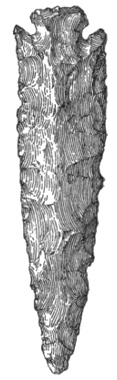
Fig. 236.—Stemmed chipped flint, slender, with small stem.
O. Long; slender; thin; short, small stem; convex base; notched upward from the corners of the base; short barbs. The type shown in figure 236 is from Loudon county, Tennessee, and other specimens come from eastern Tennessee and southeastern Arkansas.
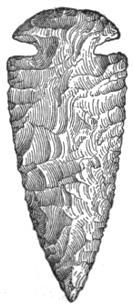
Fig. 237.—Stemmed chipped flint, oval outline, notched.
P. Convex edges and base; sometimes, though very seldom, the edges are nearly straight; the typical, leaf-shape implement, except for the notch, which is always worked in from the widest part of the specimen at right angles to the axis. The base is invariably polished, even in the smallest specimens. From Licking county (figure 237) as well as from Miami valley and throughout central Ohio; Kanawha valley; eastern Tennessee; southwestern Illinois; northeastern Alabama; southern Wisconsin; and about Savannah, Georgia.
Q. Edges less convex than the last, sometimes straight; the notches are worked in nearer the base, going in an angle of about 45 degrees, instead of perpendicular to the middle line or axis. Sometimes the blade is of uniform thickness until very close to the edges, which are worked off in a double chisel-edge. Very few of these, or of group P, are small enough for arrows. Usually symmetrical and well finished; the base always polished, but whether from use or to add to the utility of the specimen can not be determined. From Miami valley, Ohio; Keokuk, Iowa; southwestern Wisconsin; and eastern Tennessee.
R. Differing from the two last described only in being longer, and in having the stem always come to a point by either convex or concave lines, instead of being regularly convex; base never polished. From Kanawha valley, West Virginia, and central Arkansas.
S. Edges usually straight, sometimes concave, rarely convex; notched in deeply from edges; seldom barbed; stem nearly always wider than the blade, and large. Base convex; occasionally somewhat concave with rounded corners, and nearly always polished. Some (including all from the Savannah collection) are beveled and a few have blunt and rounded points, apparently broken specimens reworked. From less than an inch to nearly 3 inches long. Even among the very small ones, some have the base polished.
An implement of this form, or of any form in which the stem is wide or with very long tangs, and especially with concave base, would be well adapted for hunting purposes. The wide stem would allow firm attachment to a shaft, whether as an arrow or a spear, and at the same time would be very difficult to withdraw from a wound. The shaft would impede the flight of an animal pierced by the weapon, particularly in weeds or bushes; though greater force would be required with these than with the more slender points to make them effective.
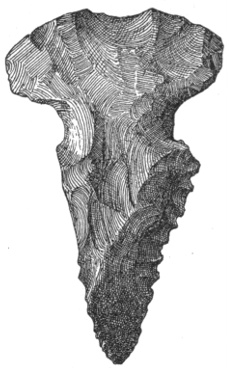
Fig. 238.—Stemmed chipped flint.
The type delineated in figure 238 is from Warren county, Ohio, and the form is well represented also in Scioto and Miami valleys, Ohio; western North Carolina; Kanawha valley; eastern Tennessee; southern and southwestern Wisconsin; southeastern and southwestern Arkansas; northeastern Kentucky; northeastern Alabama; and about Savannah, Georgia.
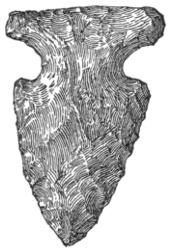
Fig. 239.—Stemmed chipped flint, notched, very wide stem.
T. Convex edges; base straight, or slightly convex or concave, with square corners, and nearly always polished; stem as wide as the blade or wider. Some rather slender, others as wide as long. Very few are beveled, except those from Savannah, all of which are thus made. From three-fourths to 2¼ inches long. Found in eastern Tennessee; Kanawha valley (including the specimen shown in figure 239); western North Carolina; southern and southwestern Wisconsin; South Carolina; southwestern Arkansas; Miami valley, Ohio; and in the vicinity of Savannah.
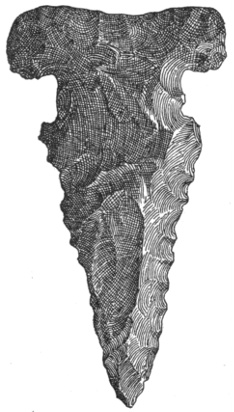
Fig. 240.—Stemmed chipped flint, notched, very wide stem.
U. Edges usually straight, sometimes convex; base regularly concave, or rounding off into a convex curve at the corners, and nearly always polished. The stem in all is wider than the blade. Those from Savannah are all beveled, and but few of them have polished bases. The type, illustrated in figure 240, is from Kanawha valley, and others come from Kanawha valley; southern Wisconsin; Scioto valley; eastern Tennessee; southwestern Illinois; and Savannah, Georgia.
V. Edges convex, seldom straight, never concave; usually well finished; base concave; notch worked in from the edge above the corner so as to leave the upper portion of the tang parallel to the lower, or base; corners square. Few are beveled. The length is from 1 to 4 inches, the width also varying considerably; some are widest at or near the middle of the blade, others are as wide at base as at any other part.
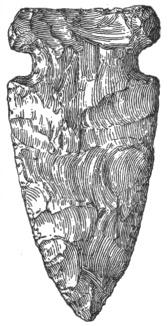
Fig. 241.—Stemmed chipped flint.
The form is illustrated in figure 241 (Union county, Illinois). The distribution is wide, including southwestern Illinois; northwestern and southwestern Georgia and Savannah; northeastern Kentucky; Kanawha valley; South Carolina; northwestern Alabama; eastern Tennessee; eastern and southern Wisconsin; western and central North Carolina; southeastern and southwestern Arkansas; Miami valley, Ohio; Keokuk, Iowa; and Union county, Mississippi.
W. Edges usually convex, sometimes straight; notched in on the edges above the corners; base concave; some slender, others broad. Somewhat resembling the two preceding types, but more roughly made. From 1 to 4 inches long. Represented by material from western and central North Carolina; Kanawha valley; eastern Tennessee; northeastern Alabama and Coosa valley, as well as from Miami valley, Ohio.
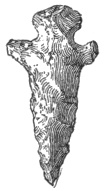
Fig. 242.—Stemmed chipped flint, projecting shoulders.
X. Small; very slender; convex edges, with wing-like barbs or shoulders; stem slightly expanding by curved lines. This rather rare type, shown in figure 242 (from Ouachita county, Arkansas), is known from northeastern and southwestern Arkansas, as well as eastern Tennessee, and Savannah, Georgia.
Y. Edges mostly straight, in a few convex; base straight, convex, or concave, in some specimens of each being polished; notched in on the edges just above the corners, notches usually slight; always widest at base. A few, including all from Savannah, are serrated or beveled. Very few are over an inch and a half long. They are nearly always thick. One from Kanawha valley has the point worn perfectly smooth and the edges polished half way to the base, showing use as a drill. Points of this form would make the countersunk holes so common in gorgets and other flat stones.
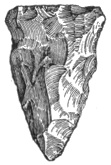
Fig. 243.—Stemmed chipped flint.
This form is widely distributed. The type (figure 243) is from Lawrence county, Ohio. Its range includes Miami and Scioto valleys, Ohio; northwestern Georgia and Savannah; eastern Tennessee; Kanawha valley; southwestern Illinois, and Brown county in the same state; western North Carolina; Coosa valley, Alabama; southwestern Arkansas; South Carolina; northeastern Kentucky; and eastern Wisconsin.
Z. Very rough finish; blade more or less worked by first chipping (there being usually no secondary chipping) to convex edges; base generally the natural surface of the nodule or pebble from which the implement was made; notches worked in roughly on the edges. They were probably knives or spears, or in some cases celts or chisels, though none show polish. With these are placed a few that seem to be the points of larger rough implements, broken and having notches worked in the fragments. A typical form, shown in figure 244, is from Mississippi county, Arkansas. It occurs also in northeastern Arkansas; Scioto valley, Ohio; western Tennessee; southwestern Illinois; and Kanawha valley, West Virginia.
Perforators.
CHARACTER AND USES.
The implements variously classed by different writers as awls, drills, needles, rimmers or reamers, and the like, seem to represent a graded series, and as no distinction can be made in the different kinds, if, indeed, there is any room for distinction, they are grouped under one term, “perforators.”
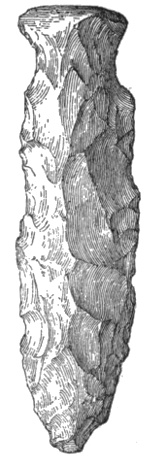
Fig. 244.—Stemmed chipped flint, very rough.
Very few of the specimens could be used as drills, as most of them are too thin; only those with a rhomboidal or triangular section would seem adapted to this purpose, and the majority even of these seem too fragile. It is more probable that drilling was done with a stick or horn, with sand as a cutting medium, except in the thin tablets of slate or similar stone and in shells. The thicker flints would answer very well for this purpose, and the countersunk holes appear to indicate such an instrument. For sewing, bone would be more easily worked, and better suited than flint. The double-pointed slender specimens may have been used for bait-holders in fishing; bone implements of a similar shape, with a hole drilled at the middle for attaching a line, have been seen in use among the Indians of Florida.
Some such implement was no doubt used in the manner of a burin, especially in making the fine lines on the ornamented shells or stones; certain flints in the collection may have served such a purpose.
Lubbock considers it proved that the stone of which ornaments, carved axes, etc., are made could be worked with flint, and that the engraving on the Scotch rocks, even on granite, was executed with this material;174 and Bushmen are known to use triangular pieces of flint for cutting figures in rocks.175 Evans176 observes that there are five ways of making holes in stone, viz.: (1) Chiseling or picking, with “picks,” “celts,” or “drills” of flint or other stone; (2) boring with a solid borer, as wood, hard or soft, or horn with sand and water; (3) grinding with a tubular grinder, as horn, cane, elder, etc., with sand and water; (4) drilling with a stone drill, e.g., of flint or sandstone; (5) drilling or punching with metal. It should be remembered that there are no evidences of the use of any metal except copper for economic purposes by the aborigines of the United States; and nearly everything of this material seems to have been ornamental in character. Bancroft says that the Nootka, in boring in wood, use a bird-bone drill worked between the hands,177 while according to Schumacher, the Santa Barbara Indians chip out rough disks of shell, pierce them with a flint drill, and enlarge the hole with a slender, round piece of sandstone.178 The Atlantic coast Indians drilled shell beads with a nail stuck in a cane or stick, rolling the drill on their thighs with the right hand, and holding the shell in the left;179 and the southern Indians, according to C. C. Jones, pierced shell beads with heated copper drills.180 Evans has found that ox-horn and sand make good borers,181 while low tribes on the Amazon make crystal tubes an inch in diameter and up to 8 inches long by rubbing and drilling with a flexible shoot of wild plantain, twilled between the hands, with sand and water;182 and Tylor expresses the opinion that such operations are not the result of high mechanical skill, but merely of the most simple and savage processes.183
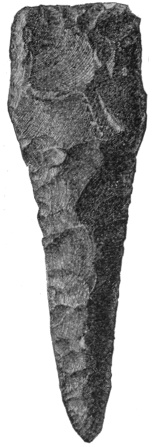
Fig. 245.—Perforator, not stemmed.
STEMLESS FORMS.
A. Base straight or nearly so; edges straight and parallel, sometimes half the length from the base, thence with concave curve which is reversed near the end to give a blunt point; these, usually the wider ones, are always thin, and were probably knives. The smaller ones, resembling the small triangular arrows except for the sharpened upper end, may have been for arrowheads, though the sharp points would have served well as awls or needles. Many of the smaller ones seem to be made from small broken arrowheads; exemplified by the specimen from Montgomery county, North Carolina, shown in figure 245. The collection includes material from western and central North Carolina; eastern Tennessee; Kanawha valley; northeastern Alabama; South Carolina; Keokuk, Iowa; and Savannah, Georgia.
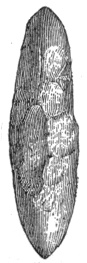
Fig. 246.—Perforator, not stemmed, double pointed.
B. Slender, somewhat larger about the middle and tapering to a point at each end, or regularly and gradually decreasing from base to point. Some are undoubtedly arrowheads, as they are too blunt or too thin to have been used for piercing. Others show marks of use which could have been produced in no way except by drilling in stone. The specimen illustrated in figure 246 (from Kanawha valley) shows this to a marked degree, while that shown in figure 247 (from Nicholas county, Kentucky) is without such indications. The distribution of this form is wide, including Kanawha valley; northeastern Kentucky; southwestern Illinois; southwestern Arkansas; southwestern Wisconsin; Coosa valley, Alabama; northwestern and southwestern Georgia, and Savannah; eastern Tennessee; and Scioto valley, Ohio.
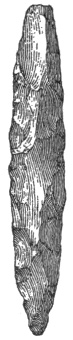
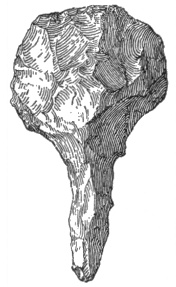
Fig. 247.—Perforator, not stemmed, double pointed.
Fig. 248.—Perforator, not stemmed, rough base.
C. With the base very large in ratio to the point or piercer; sometimes the entire implement is worked smooth or thin, again it is the natural fragment or chip of stone entirely unworked except a point flaked on one part or edge. The piercer varies from one-fourth of an inch to two inches in length. It could have been utilized only as an “awl” or “needle,” the base being held by the thumb and finger. This variable form is represented in figure 248 (from Lawrence county, Ohio). It comes from Scioto valley; Kanawha valley; western and central North Carolina; northeastern Kentucky; Keokuk, Iowa; southwestern and southeastern Arkansas; eastern Tennessee; and Savannah, Georgia.
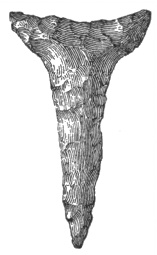
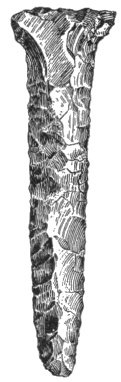
Fig. 249.—Perforator, not stemmed, expanding base.
Fig. 250.—Perforator, not stemmed, expanding base.
D. Piercer thin and slender; base thin, expanding to a wing-like projection on each side. Very few are strong enough to have been used for drilling even in soft material, but they are excellent for piercing leather or similar substances. The expanding wings would make them good points for hunting and fishing arrows, as they would have great penetrating power and be very difficult to extract from a wound, while allowing very firm attachment to a shaft. The type, shown in figure 249, is from Kanawha valley. Other specimens come from the same locality, and also from southwestern Illinois, and Brown county in the same state; eastern Tennessee; Keokuk, Iowa; Scioto valley, Ohio; northeastern Kentucky; southern Wisconsin; and Savannah, Georgia.
E. With slight expansion at the base. These may be thick or thin, wide or narrow, and, according to their different forms, might be used as drills, piercers, or arrowheads. A good example (presented in figure 250) is from Kanawha valley, West Virginia. It is found also in northeastern Kentucky, northeastern and southeastern Arkansas; eastern Tennessee; southwestern Illinois; and southwestern Wisconsin.
All of the foregoing perforators are without stems, unless the larger portion left at the base may be considered as such.
STEMMED FORMS.
The form of the stem and shoulders among perforators is often the same as in the stemmed arrowheads, etc., previously described.
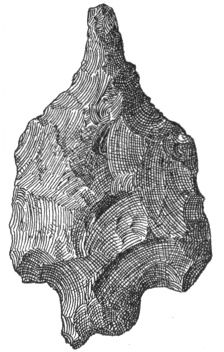
Fig. 251.—Perforator, stemmed.
A. Stem usually tapering; shoulder more or less defined; never barbed; blade wide at the part next to the stem, tapering rapidly by concave lines to a sharp point. Probably spearpoints or large arrowheads with the blade worked to a point. The type, shown in figure 251, is from Kanawha valley.
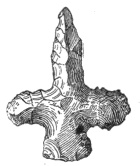
Fig. 252.—Perforator, stemmed, very wide shoulders.
B. Slender point; wide wings or shoulders; stem straight or nearly so; the implement having the form of a cross. Some are less than an inch long, and very delicately worked, while others reach 3 inches in length, and are thick. Some from Savannah have very broad stems. There is a good example (figure 252) from Ouachita county, Arkansas, and others from southwestern Arkansas; western North Carolina; and Savannah, Georgia.
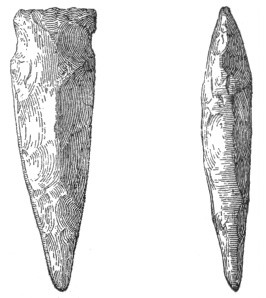
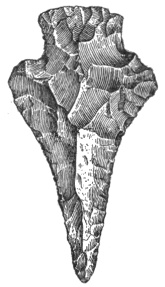
Fig. 253.—Perforator, stemmed.
Fig. 254.—Perforator, stemmed.
C. Narrow and thick almost of a diamond or round section; stem expanding or straight; with slight shoulders, sometimes slightly barbed. Some of the thinner ones, probably arrows, have a lenticular section; a few are triangular in section. This form is well suited for drilling, and many of the specimens show marks of such use, especially the one illustrated (figure 253), the edges of which are striated almost the entire length. This is from Mason county, Kentucky; and the distribution of the type includes Kanawha valley; Scioto valley, Ohio; eastern Tennessee; northeastern Alabama; western and central North Carolina; southeastern and northeastern Arkansas; Brown county, Illinois; South Carolina; and northeastern Kentucky. Thus the type is common and its geographic range broad.
D. Long, slender point; shoulders wide or slightly barbed; stem straight, tapering, or expanding; edges straight or concave. Some would make good piercers for soft material, but very few could be used as drills. A majority would be good arrowheads. Some have the edges smooth, but if this was caused by drilling it must have been done in enlarging holes already made, since the implements so marked are very thin. The faces of the blades show no polish or smoothness, such as might result from use as knives. The specimen illustrated (figure 254) is from Madison county, Alabama; others from northeastern Alabama and Coosa valley; Scioto valley, Ohio; eastern Tennessee; western and central North Carolina; southwestern Arkansas; Kanawha valley; and Savannah, Georgia.
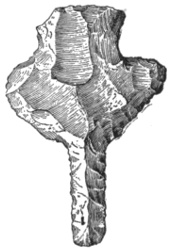
Fig. 255.—Perforator, stemmed, with cutting point.
E. Stem may be of any form; wide shoulders; never barbed; point or piercer narrow, well worked, with edges parallel its entire length, and terminating in a cutting edge instead of a point. This form (shown in figure 255) is found only in the collection from Savannah, Georgia.
Blunt Arrowheads, or “Bunts.”
Certain arrowheads have the end opposite the base rounded or flattened instead of pointed. Commonly, both faces are worked off equally, to bring the edge opposite the middle line of the blade, though sometimes it may be a little to one side. The stem and base are of any form found in the common patterns of arrowheads. Few are barbed, though many have shoulders. For the most part, they are probably made from the ordinary spearpoints or arrowheads and knives that have had the points broken off, though some seem to have been intentionally made this way originally. A few are smooth or polished at the ends, as though used as knives or scrapers; but most of them have no marks except such as would result from being struck or shot against some hard substance; even this being absent in many of them, as in the specimen represented in the accompanying figure.
Jones says that crescent-shaped arrows were used by southern Indians for shooting off birds’ heads,184 and it is known that chisel-shape arrows were much used during the Middle Ages.185
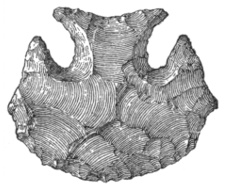
Fig. 256.—Blunt arrowhead, or “bunt”.
This type of aboriginal implement or weapon is shown in figure 256, representing a specimen from Savannah, Georgia. Other examples come from eastern Tennessee; Kanawha valley; western North Carolina; southern and southwestern Wisconsin; southwestern Illinois; Scioto valley, Ohio; and Savannah, Georgia.
Scrapers.
STEMMED.
The same remarks as to form and method of making apply to stemmed scrapers as to blunt arrows, except that the chipping of the end is always from one face so as to produce a chisel edge. This edge is frequently smooth or polished from use. They would answer very well for smoothing down articles made of wood, or for cleaning hides in tanning; they would also serve excellently for removing scales from fish, and as they are usually abundant in the vicinity of good fishing places, they were no doubt employed for this purpose.
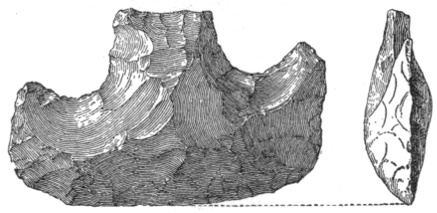
Fig. 257.—Stemmed scraper.
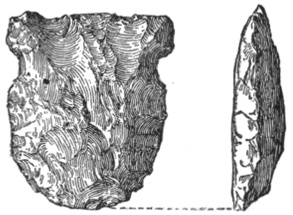
Fig. 258.—Stemmed scraper.
The material in the Bureau collection is represented by the specimens shown in figures 257 and 258, from Savannah, Georgia, and Dane county, Wisconsin, respectively. Other examples come from southern Wisconsin; southwestern Illinois; Kanawha valley, West Virginia; northeastern Kentucky; Miami valley, Ohio; central North Carolina; eastern Tennessee; and Savannah, Georgia.
STEMLESS.
A few quotations regarding the use and mode of manufacture of stemless scrapers may be given:
According to Evans, they are made by laying a flake flat side up on a stone, and chipping off around the edge with a hammer. The point struck must rest directly on the under stone, and but a thin spall is struck off at each blow.186 Leidy observed that the Shoshoni by a quick blow strike off a segment of a quartz bowlder in such a way as to form a circular or oval implement flat on one side, convex on the other, which is used as a scraper in dressing buffalo hides;187 and according to Knight the Australians obtain, in exactly the same way, specimens which they use as axes.188 Peale remarks that while hides are green they are stretched on the ground and scraped with an instrument resembling an adze;189 and Dodge says more explicitly that when the stretched skin has become hard and dry, the woman goes to work on it with an adze-like instrument, with a short handle of wood or elkhorn tied on with rawhide; holding this in one hand, she chips at the hardened skin, cutting off a thin shaving at every blow.190
The scrapers of this class in the Bureau collection are as follows:
A. Chipped over the entire surface to the form of the ordinary celt, except that the scraping edge is in the same plane with one face. Some have a scraping edge at each end. In a few the flat or straight face is chipped off slightly, bringing the edge toward the middleline; but this was probably done after the implement had become broken or blunted from use. When there is any polish, it is always on the flat face, showing use as an adze, or, possibly, as a plane. Varying much in width, some measuring almost the same in either direction, while others are more like the “chisel” celts, though the position of the cutting edge shows their use.
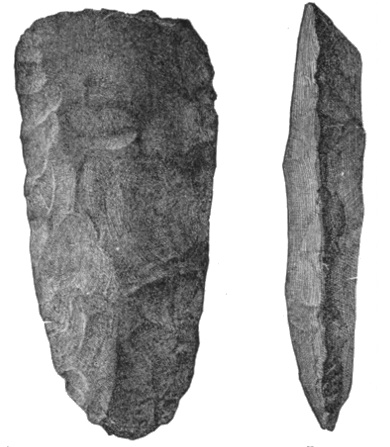
Fig. 259.—Stemless scraper, celt form.
A typical specimen (figure 259) is from Jackson county, Illinois; others come from Brown county and the southwestern part of the state generally; from northeastern Kentucky; Keokuk, Iowa; southwestern Wisconsin; eastern Tennessee; and central Ohio.
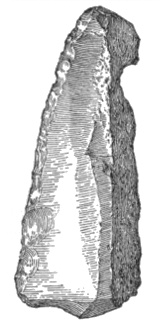
Fig. 260.—Stemless scraper, flake.
B. Flakes or spalls, chipped always from the concave side of the fragment. Some of the smaller specimens, usually those of somewhat circular outline, are chipped nearly, or in some cases entirely, around the edge. Figure 260 represents a specimen from Mason county, Kentucky. Others come from northeastern Kentucky; eastern Tennessee; Holt county, Missouri; Kanawha valley; southwestern Wisconsin; Miami valley, and central Ohio; Coosa valley, Alabama; Union county, Mississippi; and Savannah, Georgia.
Cores.
The generally accepted name “cores” is applied to the blocks from which are struck off the flakes to be next described.
Dr. Gillespie191 claimed that objects of this kind were made so intentionally, and that the flakes are simply the refuse or waste material. He gives six reasons for this belief, but an examination of the objects themselves would show that he is in error. That some might have been used as scrapers may be true, but very few are suited for such work, and not one shows the least mark of wear that could result from this use.
The specimens in the Bureau collection, with perhaps half a dozen exceptions, are from the aboriginal quarries at Flint ridge, in Licking county, Ohio, or of the material so abundant at that place.
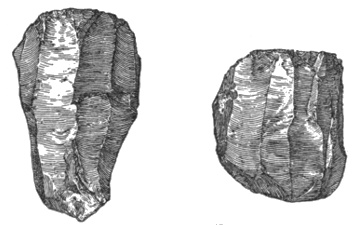
Fig. 261.—Cores.
All are small, few being of a size to furnish flakes over three inches long. The flakes were undoubtedly struck off by means of stone hammers, hundreds of which are to be found about the quarries, or removed by pressure, many showing the bulb of percussion, others being perfectly smooth on the flat face. Usually all the flakes were obtained from only one side of the core until it became too small to work (figure 261). Occasionally they were chipped from opposite sides, leaving the core of a conical or cylindrical shape (as represented in figure 262).
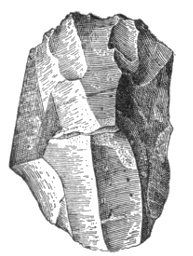
Fig. 262.—Core.
Cores and finely chipped implements of the Flint ridge stone have been taken from the mounds in Kanawha valley, West Virginia, and Scioto valley, Ohio, showing that the mound-builders are to be credited with at least a part of the great amount of work done in those localities; but it seems a mistake to say, as some authors have done, that the “turtlebacks” found in caches in southern Illinois are from the same source, as the stone is entirely different, and occurs abundantly in the vicinity in which the specimens are found.
Flakes.
The use to which were put the narrow, thin flakes so abundantly found in many parts of the world has caused some discussion. Schoolcraft says that the Dakota bleed patients by scarifying with these flakes; or sometimes one is fixed into the end of a piece of wood, held over a vein, and driven in as far as the wood will let it go,192 the use being similar to that of the modern fleam. Harpoons in the Kurile islands are made of bone, with a deep groove along each side; in these grooves thin and sharp flat flakes are fastened with gum.193 According to Evans, similar flakes were used for scraping,194 just as broken glass is used among modern woodworkers. Flakes have been found in the Swiss lakes in wooden handles in the fashion of Eskimo knives; also in Australia with skin wrapped around one end to protect the hand.195
All the flakes in the Bureau collection are small, few of them being over three inches long. They are found elsewhere with a length of over a foot; but the nature of the flint occurring in the United States is seldom such as to allow flakes to be struck off equaling in size those found in Europe.
Evans says that blows with a pebble will form just such flakes as those produced by an iron hammer; the blows must, however, be delivered in exactly the right spot and with the proper force. Cores sometimes show markings of hammers when struck too near the edge. Flakes can be produced by using a pebble as a set or punch and striking it with a stone. The use of a set was probably the exception rather than the rule, for great precision may be obtained simply with a hammer held in the hand. The Eskimo use a hammer set in a handle to strike off flakes, or strike them off by slight taps with a hammer of jade, oval in shape, about 2 by 3 inches, and secured to a bone handle with sinew.196
According to Tylor, the Peruvian Indians work obsidian by laying a bone wedge on the surface of a piece and tapping it until the stone cracks;197 while the Indians of Mexico hold a piece of obsidian 6 or 8 inches long between their feet, then holding the crosspiece of a T-shape stick against the breast they place the other end against the stone and force off a piece by pressure.198
Nilsson says that the Eskimo set a point of deer horn into a handle of ivory and drive off splinters from the chert,199 and Redding saw a Cloud river Indian make flakes thus: Holding a piece of obsidian in his hand, he placed the straight edge of a piece of split deer horn, four inches long and half an inch in diameter, at a distance from the edge of the stone equal to the thickness of the arrow he wished to make; then striking the other end with a stone he drove off a flake.200 Schumacher observed that the Klamath Indians heat a stone and break it into fragments at a single blow.201
According to Stevens the Shasta Indian lays a stone anvil on his knee, and holding on the anvil the stone which he is working,202 strikes off a flake one-fourth of an inch thick with a stone hammer; but Powers says the Shasta Indians heat a stone and allow it to cool slowly, which splits it into flakes,203 and Bancroft that they place an obsidian pebble on an anvil of stone and split it with an agate chisel to the required size.204 The Shoshoni or Snake Indians of the northwest work in the same way,205 and certain California Indians strike off flakes from a mass of agate, jasper, or chalcedony with a stone hammer,206 while the Apache break a bowlder of hornstone with a heavy stone hammer having a twisted withe for a handle.207
Schoolcraft says experience has taught the Indians that some varieties of hornstone (flint) are less easily fractured than others, and that the conchoidal form is found best in softer varieties; also that weathered fragments are managed with greater difficulty than are those freshly quarried.208
Evans points out that in making gunflints much depends upon the condition of the stone as regards the moisture it contains, those that have been too long exposed on the surface becoming intractable, and there is also a difficulty in working those that are too moist. Some of the workers, however, say that a flint which has been some time exposed to the air is harder than one recently dug, yet it works equally well.209
It is related that in former times white hunters in Ohio and Kentucky, when they needed a gunflint, would select a fragment from the surface, where practicable, and soak it in oil for several weeks “to make it tough;” otherwise it would shatter to fragments when struck.
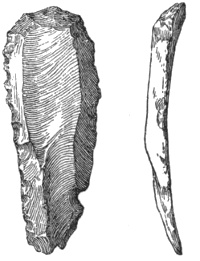
Fig. 263.—Flake, chipped for scraper.
Frequently the large flat spalls knocked from blocks or chunks of flint in shaping them, or in obtaining pieces to work, are of such form that very little additional labor converts them into serviceable scrapers, knives, spears, or arrows. A number of such pieces are found in the collection. These, however, are not considered in the flakes now to be described:
A. Edges bluntly chipped (from the concave side) for use as scrapers. They may or may not have notches for attachment to a handle. An example from Kanawha valley, West Virginia, is shown in figure 263. Others come from southwestern Arkansas; Kanawha valley; Miami and Scioto valleys, and central Ohio.
B. Trimmed only enough to give a general leaf shape, the faces being left unchanged; for use as knives or arrowheads, most of them being exceedingly small; notched, or with continuous edges. This form is represented by the specimen from Licking county, Ohio, illustrated in figure 264. It is found in central Ohio; northeastern Arkansas; Coosa valley, Alabama; eastern Tennessee; and western North Carolina.
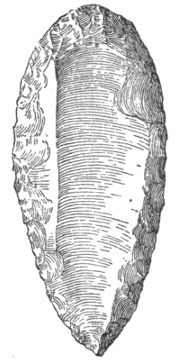
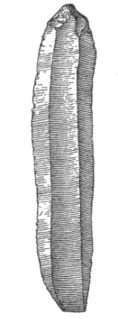
Fig. 264.—Flake, chipped for knife or arrow head.
Fig. 265.—Flake, slender, probably for lancet.
C. Long, slender, with three or four facets on one face, caused by others having been struck off above. The edges are as keen as broken glass, and the points are usually quite sharp. In a great many the points have been worked off by fine, secondary chipping. When this is done, it is always at the end which was struck in knocking off the flake. In some cases it may be due to the shattering effects of the blow; but in many specimens the evidence is plain that it was done afterward for the purpose of making a sharper point. Some flakes of this kind have notches for attachment to a shaft, probably for arrows; such specimens, however, are without the secondary chipping, and the notches are at the end opposite the one struck.
A good example, shown in figure 265, is from Kanawha valley, and there are others from the same locality, as well as from Miami valley, Ohio; and Union county, Mississippi.
Miscellaneous Forms.
From the Savannah collection there are several forms of chipped flints which, while resembling the foregoing in various ways, present characters which make it necessary to place them by themselves; and while containing a majority of the types described above, this collection has many that have no counterpart from any other section visited by the Bureau collectors. Some of these unique specimens of aboriginal art are among the following:
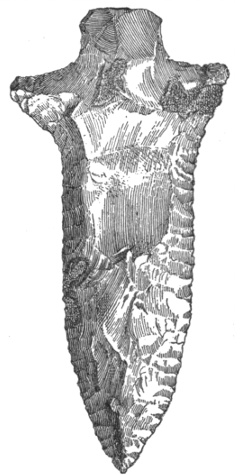
Fig. 266.—Stemmed chipped flint.
A. Edges double curved, expanding to a wide point at the shoulder; stem straight or tapering; base either straight or slightly convex. The type of the group is quite well represented in figure 266.
B. Edges concave; base and stem straight; very wide projections or wings at the shoulders, going in by straight or curved lines to the stem (illustrated in figure 267).
C. Edges concave, changing to convex at the shoulders, and curving around to the stem, which is straight or slightly expanding; base straight or very slightly convex (figure 268).
D. Convex edges, widening into greatly expanding barbs; base straight; stem expanding by straight lines (figure 269).
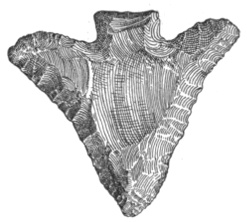
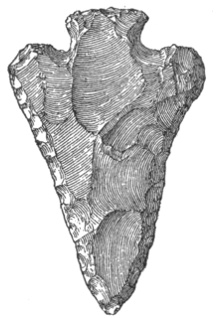
Fig. 267.—Stemmed chipped flint, winged.
Fig. 268.—Stemmed chipped flint.
E. Broad; double-curved edges; notched in from the base, and barbs worked so as to be narrowest near the blade, with the ends straight or round; stem expanding by straight lines; base straight (figure 270).
F. Edges nearly straight to the barbs, which are worked off to a point toward the stem; base convex and wide; stem expanding by curved lines (figure 271).
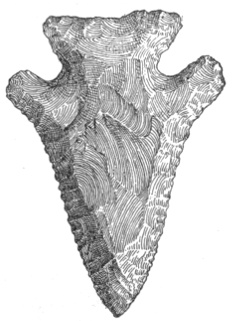
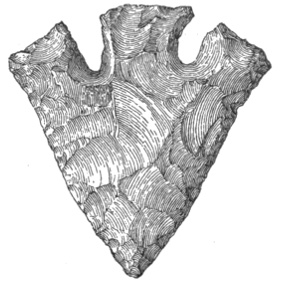
Fig. 269.—Stemmed chipped flint, barbed.
Fig. 270.—Stemmed chipped flint, broad.
G. Rather slender; base nearly straight, either convex or concave; stem rapidly expanding; notched in from the corners, making long slender barbs which project beyond the line of the edges (as illustrated in figure 272). The same form comes from Dougherty county, southwestern Georgia, as well as from Savannah.
H. Straight or convex edges; base straight or slightly convex; stem to one side of the center, leaving one barb longer and larger than the other (figure 273).
I. Triangular, notched in from the bottom; barbs extend down even with the base, or the base is sometimes worked back, leaving it shorter than the barbs; some are beveled (figure 274). The same form is found in southwestern Georgia.
J. Broad; straight edges; base straight or concave; stem straight or expanding; long, rounded barbs (figure 275).
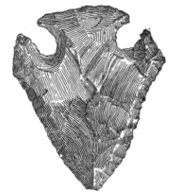
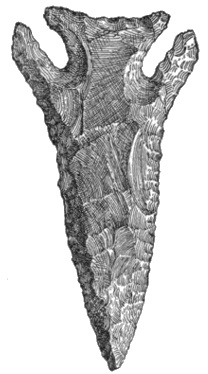
Fig. 271.—Stemmed chipped flint.
Fig. 272.—Stemmed chipped flint, slender.
K. From Arkansas county, Arkansas, there is an implement of basanite or black jasper, of the general type of figure 180 or 182, the point being broken off. The base has been worked down to a sharp edge, the stem highly polished on both faces. This polish does not extend to the faces of the blade, but both edges are rubbed smooth so far as they now extend. Whether the implement was originally pointed and used as a knife or spear, this sharp edge being given the stem after it was broken, or whether it was so made in the first place, can not be determined. Like the various forms with polished base, the specimen seems to indicate a manner of mounting or of use the reverse of what would be expected. It is shown in figure 276.
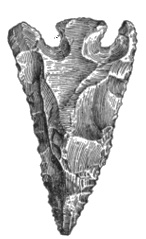
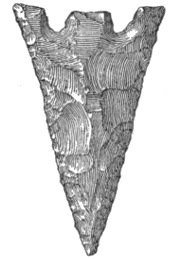
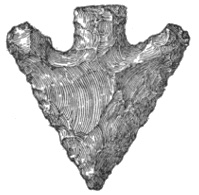
Fig. 273.—Stemmed chipped flint.
Fig. 274.—Stemmed chipped flint, triangular.
Fig. 275.—Stemmed chipped flint.
Figure 277 shows an implement from Licking county, Ohio, somewhat of the form of figure 205, except that it is wider and much thinner. It is worn smooth on each edge for ¾ inch from the point, the point itself being quite blunt. This probably results from use as a knife or drill; though, if due to the latter cause, the material on which it was used must have been quite soft or thin. Similar wear is seen on implements from the same locality of the form of figures 176 and 223, but this article is smaller than those represented by the figures.
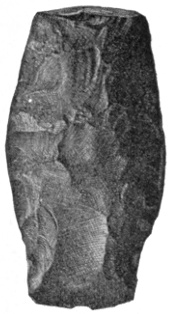
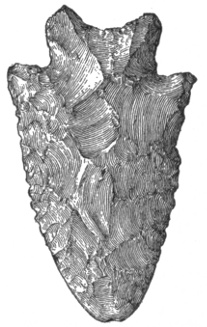
Fig. 276.—Chipped flint, with sharp-edged stem.
Fig. 277.—Stemmed chipped flint, point blunted from use.
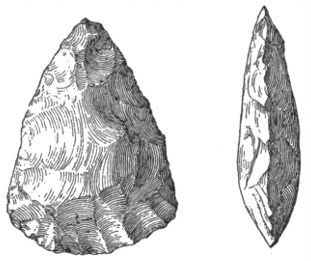
Fig. 278.—Stemmed chipped flint.
In figure 278 is shown a small knife of the pattern so common in specimens mounted in antlers, from the Swiss lake dwellings. In outline it resembles the arrowheads having straight edges and a convex base; but the side view shows the purpose for which it was made. Similar pieces are found throughout central Ohio, and along Ohio river from the Kanawha to the Miami.
Notes on beveled Flints.
In the beveled flints the side-chipping producing the bevel is always to the left, as may be seen in figure 235; only one exception to this has been found. It has been supposed that this is done to give a rotary motion to an arrow. Morgan210 says that “arrowheads are occasionally found with a twist to make the arrow revolve in its flight;” and the same statement has often been made by others. It may be objected, however, that very few of these beveled specimens are small enough for arrowheads; and modern archers have shown that the shape does not affect the flight of the arrow.
Schoolcraft,211 Powers,212 Morgan,213 and Cheever214 say that the modern Indians sometimes have a spiral arrangement of the feathers on their arrow to produce a rotary motion or “rifling.” This rotary motion is supposed to keep the arrow in a straight course, as without it a deviation from the direct line would tend constantly to increase. But as showing that the rotary motion is not always desired, Dodge says that sometimes the blade, in regard to the string notch, is set so as to be perpendicular, to go in between the ribs of game; again, so as to be horizontal, to go in between the ribs of an enemy.215
The beveled flints were probably used for skinning game, as they are better fitted for this than for anything else, and would serve such purpose better than almost any other form of the smaller chipped flints. The bevel is such as would be necessary if the implement were held in the right hand and pulled toward the user.
There are a great many specimens in the collection, both in the ground or pecked and in the chipped implements, which can not be classified with any of the objects herein described; but they are to be considered as due rather to individual whims than as representative of a type.