THE ARTS AND THEIR DISTRIBUTION. (continued 2)
Reading edition
Plummets.
The specimens known as plummets vary considerably in form, size, and degree of finish, indicating diversity of purpose, and different writers have assigned to them various uses.
According to Abbott, one of these relics was found at Salem, in a mortar.83 Stevens says, quoting from Schoolcraft, that the Pennacook Indians used sinkers very much like a plummet in shape.84 In Florida very rough plummets with deep grooves are found in the shell mounds, which were no doubt used as sinkers. The Indians of southern California use them as medicine stones to bring rain; the Eskimo use similar stones as sinkers, but have them perforated at the end. The larger objects of this form may have been used as pestles.85 They might be made very efficient in twisting thread, as they revolve for a considerable time when set in motion.

Fig. 111.—Spud.
The general form is ovoid, sometimes quite slender, sometimes almost round; the ends may be either blunt or pointed. They may be grooved near the middle or near either the larger or smaller end. Some have two grooves, some are only partially grooved, while others have the groove extending lengthwise. There are forms that differ somewhat from this description, but such are rare.
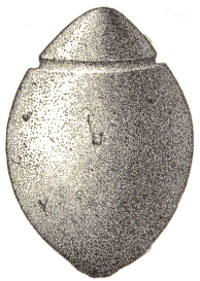
Fig. 112.—Plummet, grooved near one end.
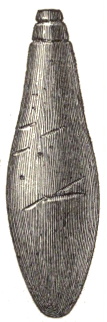
Fig. 113.—Plummet, double-grooved.
Many small and otherwise unworked waterworn pebbles and pieces of steatite pots from southeastern Tennessee and from Montgomery county, North Carolina, have grooves near the middle or near one end; they were probably applied to some of the uses for which plummets were intended.
The plummets in the Bureau collection may be grouped as follows:
A. Grooved near smaller end. The types are illustrated in figure 112 (sandy limestone, from a mound in Catahoula parish, Louisiana), and figure 113 (hematite, double grooved, with notches cut in various places, from a mound in Kanawha valley, West Virginia). Other specimens are, one from Arkansas county, Arkansas, of sandstone, and one each from Brown and Randolph counties, Illinois, both of hematite.
B. Grooved near larger end. A good example, of hematite, is from Kanawha valley, West Virginia, with a second groove partially around the middle.
C. Grooved near the middle. The class is represented by a beautiful specimen (figure 114) of hematite, with the groove much polished and irregular, and a deep notch cut in one end, from Ross county, Ohio. Another specimen, from Kanawha valley, West Virginia, is a double conical implement of hematite, elliptical in section with both ends ground off on flatter sides only.
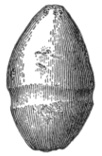
Fig. 114.—Plummet, grooved near middle.
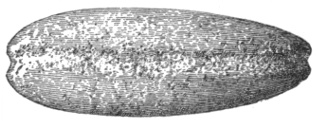
Fig. 115.—Plummet, grooved lengthwise.
D. Grooved lengthwise. This class includes a plummet of quartzite, from Yellowstone park (figure 115), and another of hematite, much shorter than the Yellowstone specimen and with blunt ends, from Kanawha valley, West Virginia.
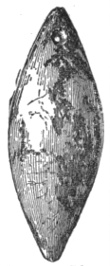
Fig. 116.—Plummet, grooveless, perforated.
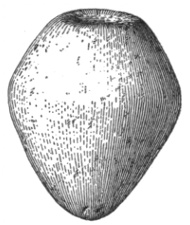
Fig. 117.—Plummet, double cone in shape.
E. Grooveless. A good specimen (figure 116) is of quartz and mica, elliptical in section, pointed at ends with one end perforated, from Yellowstone park; another, from Randolph county, Illinois, of hematite, rough, perhaps unfinished.
F. Double cone, with one end ground off flat and hollowed out. The type (figure 117) is of granite, one of three from Savannah, Georgia.
G. Top flattened and hollowed out; sides incurving to the middle; lower half a hemisphere. The class is represented by figure 118 (quartzite, from Randolph county, Illinois), and figure 119 (sandstone, from Adams county, Ohio). From Kanawha valley there is one of hematite, similar in form to the last.
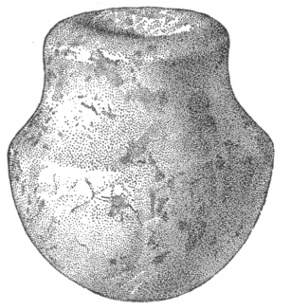
Fig. 118.—Plummet.
H. Ovoid, with the smaller end ground off flat.86 A good specimen of this class (figure 120) is of magnetite, from Caldwell county, North Carolina. From Savannah, Georgia, there are two of sandstone, both smaller than the type and rough; from Kanawha valley there is one of quartzite, nearly half ground away, leaving almost a hemisphere; and from eastern Tennessee there are one of magnetite and one of quartzite, the latter nearly round.
I. Cylindrical. A unique specimen, from a mound in Loudon county, Tennessee, is illustrated in figure 121. It is of sandstone; a short cylinder with incurved sides, each end terminating in a blunt cone.
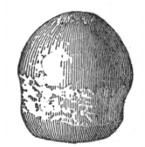
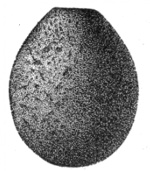
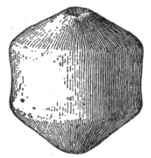
Fig. 119.—Plummet.
Fig. 120.—Plummet, end ground flat.
Fig. 121.—Plummet.
Figure 122 represents a piece of smoothly dressed steatite from Desha county, Arkansas, with a two-thirds round section, the ends rounded, with a groove near one end, which may be classed with the plummets. There are pieces of sandstone from the same locality which connect this pattern with the simpler “boat-form” stones, except that the flat side is ground smooth instead of being hollowed. This is only one of numerous examples where the shapes of implements whose “typical forms” seem utterly dissimilar merge into one another so gradually that no line of demarkation can be drawn.
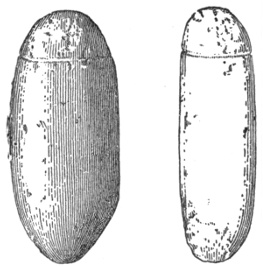
Fig. 122.—Plummet, cylindrical.
Cones.
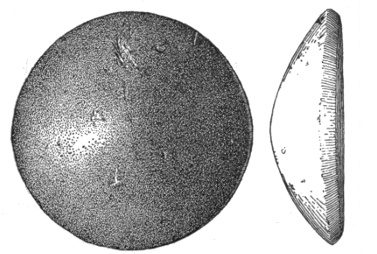
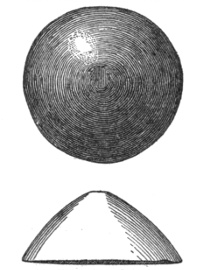
Fig. 123.—Cone.
Fig. 124.—Cone.
The relics known as “cones” have the base flat and the side curving slightly; usually the curve extends regularly over the top, but sometimes the apex is rubbed off flat. The conic surface may form an angle with the base, or the line of junction may be rounded into a curve. They vary considerably in thickness, some being nearly flat, others having a height equal to the diameter of the base. One of steatite from Savannah, as also one of sandstone from Kanawha valley, has a slight pit or depression on the flat side. Among the best examples are one (figure 123) of steatite from Bradley county, Tennessee, and another (figure 124) of hematite from Loudon county, in the same state; one (figure 125) of compact quartzite from a mound in Ogle county, Illinois, and a fourth specimen (figure 126) of granite from Kanawha valley, West Virginia. The distribution is as follows:
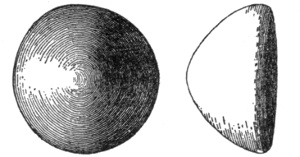
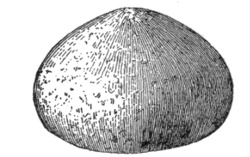
Fig. 125.—Cone.
Fig. 126.—Cone.
District. A B C D E
Eastern Tennessee 3 4
Ogle county, Illinois 1
Savannah, Georgia 1
Haywood county, North Carolina 1
Kanawha valley, West Virginia 1 1 1
KEY: A = Steatite. B = Hematite. C = Compact quartzite. 11 D = Granite. E = Sandstone.
Hemispheres.
Hemispheric stones, like the cones, can receive a name only from the form and not from any known or imagined use to which they could have been applied.
All such specimens in the collection, except one, are from Kanawha valley, and of hematite; many if not most of them have been ground down from the nodule, and were probably paint stones originally; at least, the material rubbed from them was used as paint while the maker had their final form in view. One, however, has been pecked into shape and is entirely without polish. In all, the base is flat and varies in outline from almost a circle to a narrow ellipse. A section of the stone parallel to either axis of the base varies from a little more to a little less than a semicircle. Typical forms, both from Bracken county, Kentucky, are illustrated in figure 127.
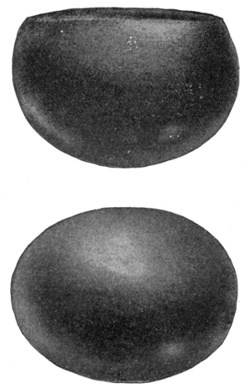
Fig. 127.—Hemispheres.
The specimen, illustrated in figure 128 (yellow quartz, from a mound in Kanawha valley) is intermediate between cones and hemispheres. The sides are polished, while the flat bottom and rounded top are roughened. As it has faint red stains, it may have been used as a paint-muller.
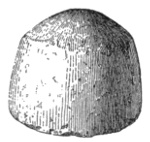
Fig. 128.—Hemisphere.
Paint Stones.
The articles known as paint stones scarcely come under the head of implements. Some of the hematite pieces are incipient celts, hemispheres, or cones; but most of them were used merely to furnish paint, at any rate until rubbed down quite small. They are of every degree of firmness, some being as brittle as dry clay, others like iron. Most pieces in the collection are from Kanawha valley, but others are from southeastern Tennessee, northeastern Arkansas, and Caldwell county, North Carolina. From the last-named section, as well as from Chester county, South Carolina, and McMinn county, Tennessee, come pieces of graphite more or less rubbed; and one has been sent in from Elmore county, Alabama.
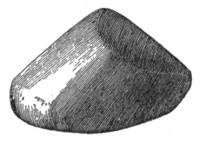
Fig. 129.—Paint stone.
The specimen illustrated in figure 129, from a mound, is a good example of the manner in which the harder hematite was ground.
Ceremonial Stones.
Functions and Purposes.
The so-called “ceremonial stones” are variously subdivided and named by different writers. They are supposed to have been devoted to religious, superstitious, medical, emblematic, or ceremonial purposes; to be badges of authority, insignia of rank, tokens of valorous deeds, or perhaps some sort of heraldic device; in short, the uses to which they might, in their different forms, be assigned, are limited only by the imagination.
According to Nilsson the ancient Scandinavians wore “victory stones” suspended around their necks,87 and the Eskimo wear charms and amulets to bring success in fishing and hunting.88 Adair (1775) says that the American Archi-magus wore a breastplate made of a white conch-shell, with two holes bored in the middle of it, through which he put the ends of an otter-skin strap and fastened a buck-horn button to the outside of each.89 An explanation of the purpose of many of the smaller perforated stones also may be found in Nilsson’s remark90 that the small ovoid or ellipsoid ones were used as buttons; a string being tied to the robe at one end, run through the hole and tied in a knot.
The various Indians of Guiana in their leisure hours often fashion highly ornamental weapons and implements which they never use except ceremonially, but keep proudly at home for show.91
So, too, the Yurok and Hupa Indians of California, as well as some of the tribes of Oregon, have very large spearheads or knives, which are not designed for use, but only to be produced on the occasion of a great dance. The larger weapons are wrapped in skin to protect the hand; the smaller ones are glued to a handle. Some are said to be 15 inches long.92 The Oregon Indians believed the possession of a large obsidian knife brought long life and prosperity to the tribe owning it.93
Some of the wild tribes of the interior have something which they regard as the Jews did the Ark of the Covenant. Sometimes it is known; again it is kept secret. The Cheyenne had a bundle of arrows; the Ute a little stone image, and the Osage a similar stone.94 The Kiowa had a carved wooden image, representing a human face; the Ute captured it, and the Kiowa offered very great rewards for its return; but the Ute, believing the Kiowa powerless to harm them so long as it was retained, refused to give it up.95
The North Carolina Indians, when they went to war, carried with them their idol, of which they told incredible stories and asked counsel;96 and as a token of rank or authority, the Virginia Indians suspended on their breasts, by a string of beads about their neck, a square plate of copper.97 These were worn as badges of authority. The native tribes, from our first acquaintance with them, evinced a fondness for insignia of this kind.98
Simply for convenience the ceremonial stones in the Bureau collection will here be divided into two general classes. The first, comprising those pierced through the shortest diameter, will be called gorgets, which name, like that of celt, has no particular meaning, but is in common use. The second class will comprise all others, which will have some name that may or may not be suitable to their form, but by which they are usually called. In this class are included boat-shape stones, banner stones, picks, spool-shape ornaments, and bird-shape stones, as well as engraved tablets or stones.99
Gorgets.
The relics commonly called gorgets have been found in Europe; they may be convex on one side, concave on the other, and are supposed to be for bracers.100 It is said that the Miami Indians wore similar plates of stone to protect their wrists from the bowstring.101 Herndon and Gibbon remark that a gold ornament in shape like a gorget, but not pierced, is worn on the forehead by some of the Amazon Indians.102 According to Schoolcraft the so-called gorgets were sometimes used as twine-twisters;103 but Abbott holds that while some may have been twine-twisters, or may have been used for condensing sinews or evening bowstrings (that is, reducing the strings to a uniform diameter), most were simply ornaments, as they are generally found on the breast of a buried body.104 Stevens is even more conservative, holding that they were neither twine-twisters nor devices for condensing sinews or evening bowstrings, as they show no marks of wear in the holes.105
Some writers suppose the gorgets to have been shuttles; but this supposition can hardly be entertained, although it is true, according to Chase, that the Oregon Indians passed thread with a curved bone needle.106 As twine-twisters they would be about as awkward as anything that could be devised. As to evening bowstrings, it would seem that if a string were too large in places to pass through a hole it could not be pulled through; pounding and rolling the wet string with a smooth stone, or some such means, would be the remedy. The bracer theory is plausible; but no one seems ever to have seen a gorget used for this purpose.
Few of the gorgets in the Bureau collection show such marks of wear around the edges of the hole as would be made by a cord; but the majority are thus worn at the middle, where the hole is smallest. Some specimens among every lot are not perforated, or only partially so; the drilling seems to have been the last stage of the work. The hole is almost always drilled from both sides, and the few in which it goes entirely through from one side would probably have had it enlarged later from the other. A number are fragments of larger gorgets, the pieces having been redrilled.
Some of the specimens have various notches and incised lines, the latter being sometimes in tolerably regular order; but there is not the slightest indication that these marks had any meaning or were intended for any other purpose than to add to the ornamental appearance of the stone.
If they were to be worn at the belt or on any part of the dress they could easily have been fastened by a knotted string, or if the wearer desired he could have an ornamental button of some kind. If suspended around the neck, in order to make them lie flat against the breast they probably had a short cord passed through the perforation and tied above the top of the object, the suspending cord being passed through the loop thus formed.
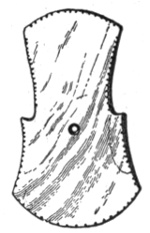
Fig. 130.—Gorget.
The principal division is into group A with one hole and group B with two holes, though in many cases this forms the only difference between two specimens.
A. General outline rectangular, or perhaps slightly elliptical, sometimes with one end somewhat narrower than the other, or with one end rounded off, or with the corners slightly rounded. Perforation commonly near one end. The form is represented by the specimen with two perforations illustrated in figure 133, which otherwise fully answers the description. The argillite specimens have the broader ends striated as though used for rubbing or scraping, but in other respects conform to those of other materials. The materials are generally the softer rocks, as shown in the accompanying table:
District. A B C D E
Eastern Tennessee 2 3 2 3
Wilkes county, North Carolina 1
Knox county, Ohio 1
Kanawha valley, West Virginia 7 2
KEY: A = Steatite. B = Slate. C = Sandstone. D = Schist. E = Argillite.
A related type is rectangular or with incurved sides (forming either a regular or broken curve) and rounded ends, and differs in having the perforation near the center. The same pattern sometimes has two holes. It is illustrated in figure 130 (striped slate, from a mound in Kanawha valley, West Virginia). There are also from the same place one each of slate, cannel coal, and clay slate, and from eastern Tennessee one each of slate, shale, and clay slate.
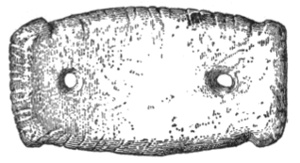
Fig. 131.—Gorget(?).
There are a number of small pebbles, thin and flat, with a hole drilled near the edge, from southeastern Tennessee, North Carolina, and southeastern Arkansas. One of these, from Caldwell county, North Carolina, is of banded slate; the others are of clay slate or sandstone. Two of them have straight and zigzag lines on both faces, and notches around the edge.
Allied to these are a number of pieces of flat stone from southeastern Tennessee, Kanawha valley, and North Carolina, with the faces partially rubbed down smooth, the edges being untouched. They are of slate, talc, or argillite.
From southeastern Tennessee and North Carolina there are several pieces of steatite, which may have been for sinkers. Some have a hole near one end, others a hole at each end, while still others are not perforated. All have been worked over the entire surface, and some of them are well polished. One of these is represented in figure 131.
B. Gorgets with two holes. Of these there are several subdivisions, differing more or less widely in form. They are as follows:
1. Thick, with both the sides and the ends incurved or reel-shape; faces flat or slightly convex. This form is represented by the specimen shown in figure 132, from a mound, Knox county, Ohio. There is another from the same place, a third from Kanawha valley, and a fourth from Butler county, Ohio; all of green slate.
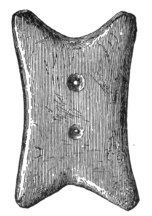
Fig. 132.—Gorget, reel-shape.
2. Rectangular, or with sides or ends, or both, slightly curved, either convex or concave; faces flat. Shown in figure 133 (green slate, from a grave in Kanawha valley, West Virginia).
District. A B C D E F
Nicholas county, Kentucky, with ends V-shaped 1
Kanawha valley, West Virginia 11 3 3
Eastern Tennessee 6 1 1 1
Ogle county, Illinois 1
Forsyth county, Georgia 1
Haywood county, N.C. 1
Davidson county, N.C. 1
Chautauqua county, N.Y. 1
KEY: A = Slate. B = Limestone. C = Sandstone. D = Shale. E = Argillite. F = Fine quartzite.
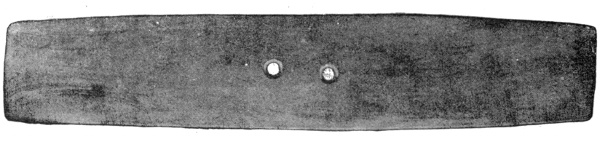
Fig. 133.—Gorget.
3. Widest at middle, with single or double curve from end to end; very thin; both sides flat.
District. A B C
Kanawha valley, West Virginia 1 4
Davidson county, North Carolina 1
Savannah, Georgia 1
Eastern Tennessee 5 1
KEY: A = Slate. B = Sandstone. C = Schist.
4. Same outline but thicker; one face flat, the other convex. Represented by figure 134 (shale, from Jackson county, Illinois). The distribution of the form is as follows:
District. A B C D E F G
Eastern Tennessee 2 3 1 1
Haywood county, North Carolina 1 2
Davidson county, North Carolina 1
Savannah, Georgia 2 2
Kanawha valley, West Virginia 1
Jackson county, Illinois 1
Desha county, Arkansas 1 1
KEY: A = Sandstone. B = Slate. C = Schist. D = Steatite. E = Talc. F = Argillite. G = Shale.
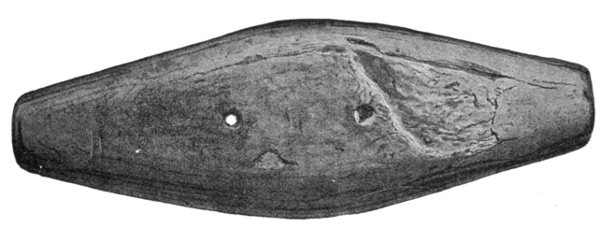
Fig. 134.—Gorget.
5. Same outline, but quite thick, approaching the “boat-shape” stones in form. In some the flat side is slightly hollowed out. A majority of them are not perforated. The type (figure 135) is of sandstone, from a mound at Adelphi, Ohio.
There are also, from Butler county, Ohio, Kanawha valley, West Virginia, and Savannah, Georgia, one each of slate; from Ross county, Ohio, two, and from Kanawha valley, and Cocke county, Tennessee, one each, all of sandstone. There are two (of sandstone and slate) from Kanawha valley, which differ from the others in having the sides parallel, giving them a semicylindrical form.
The pattern of the specimen illustrated in figure 136 (striped slate, from Butler county, Ohio, of which a number have been found in that state), may be classed between the gorgets and the boat-shape stones. The shorter end of the object has, sometimes, a projection or enlargement at the top, apparently for suspension, although no perforated examples have been found.
Banner Stones.
Under the head of “banner stones” are placed ornaments having the ends at right angles to the perforation. The hole is drilled in a midrib, from which the faces slope by either straight or curved lines to the edges. The two halves of the stone are symmetrical. In most specimens one face is flatter than the other, even plane in some cases. Some specimens are finished to a high polish, before the hole is started; others have the hole completed with the exterior more or less unfinished. The specimens in the Bureau collection may be classified as follows:
A. Rectangular or trapezoidal, with sides and ends sometimes slightly curved inward or outward.
B. Reel-shape.
C. Crescentic.
D. Butterfly pattern.
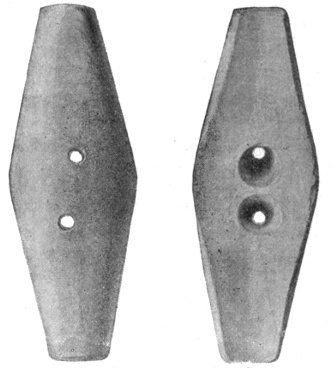
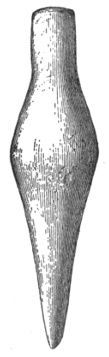
Fig. 135.—Gorget, boat-shape.
Fig. 136.—Gorget resembling boat-shape stone.
The last three varieties may be considered as only modifications of the simple rectangular banner stones. By rounding off the corners of the articles or dressing them to sharp points, by cutting away portions from the sides or by trimming away the central portions at either or both ends of the perforations, all these different forms may be produced.
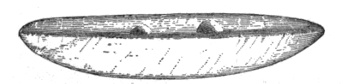
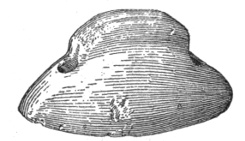
Fig. 137.—Banner stone.
Fig. 138.—Banner stone.
A. A typical specimen is illustrated in figure 137. It is of slate, and was taken from a mound in Kanawha valley, West Virginia. Another good example, shown in figure 138, is of sandy slate, from a grave in Monroe county, Tennessee. The geographic range of this type is wide, though the objects are not abundant.
District. A B C D E F
Montgomery county, North Carolina 1 1
Kanawha valley, West Virginia 2
Hancock county, Illinois 1
Savannah, Georgia 1 3 1 1
Eastern Tennessee 2 1 1 1
KEY: A = Granite. B = Steatite. C = Slate. D = Sandstone. E = Compact quartzite. F = Diorite.
B. The reel-shape banner stones are somewhat variable, but are fairly illustrated in figure 139, representing a specimen of argillite from Sevier county, Tennessee.
A related form has the middle cut from one end, leaving two horn-like projections extending parallel with the hole. An example of this form, shown in figure 140, is of banded slate, from a mound in Kanawha valley, West Virginia.
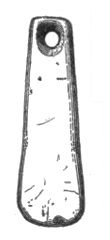
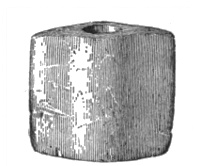
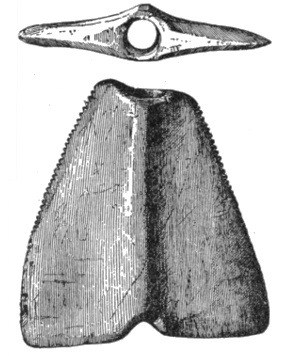
Fig. 139.—Banner stone, reel-shape.
Fig. 140.—Banner stone, with horn-like projections.
Fig. 141.—Banner stone, crescent-shape.
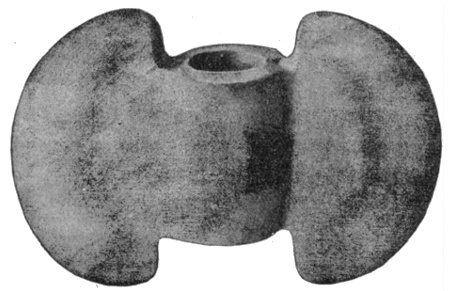
Fig. 142.—Banner stone, crescent-shape
C. The crescentic banner stones might better be termed “semilunar,” since most of them are flat at one end and curved at the other. Occasionally one has both ends curved and parallel, the sides also slightly curved, making the article reniform. Others have the ends straight and parallel, with the sides curved or like the zone of a circle. Two have a midrib for the hole, with the sides dressed down quite thin, as with the butterfly gorgets. All were finished in form before the drilling was done, though some had not received their final polish. The type is illustrated in figures 141 (steatite, from northwestern North Carolina), 142 (pagodite, from Rhea county, Tennessee), and 143 (sandstone, from Jefferson county, Tennessee). The last form is sometimes called a perforated ax, but the material and fragile make exclude it from every class except the ceremonial stones.
District. A B C D E F
Savannah, Georgia 1 1 1
Western North Carolina 2 1
Montgomery county, North Carolina 1
Kanawha valley, West Virginia 2
Eastern Tennessee 1 2
KEY: A = Steatite. B = Slate. C = Granite. D = Reddle. E = Pagodite. F = Talc.
D. The “butterfly” gorgets are so named from their resemblance to a butterfly with expanded wings. The sides or wings are usually quite thin, either semicircular or like a spherical triangle in outline. The perforated mid-rib is shorter than the wings and carefully worked. A good example, shown in figure 144, is of ferruginous quartz from Monongahela, Pennsylvania, and that illustrated in figure 145 is of banded slate from Kanawha valley. There is also one of the latter material from Lewis county, Kentucky.
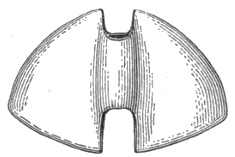
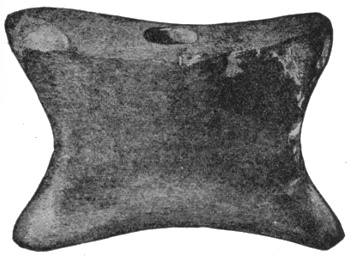
Fig. 143.—Banner stone, crescent-shape.
Fig. 144.—Butterfly banner stone.
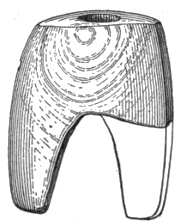
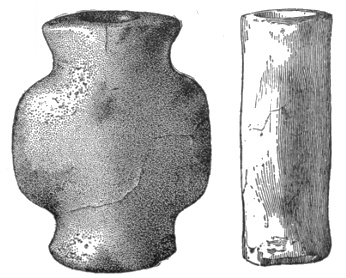
Fig. 145.—Butterfly banner stone.
Fig. 146.—Banner stone.
An aberrant form is elliptical in section at the middle, round or nearly so at the ends, the sides expanding rapidly from end to middle by double curves. It is represented by figure 146 (ferruginous quartz, from Kanawha valley, West Virginia), and by a specimen of quartzite from Union county, Mississippi.
Boat-shape Stones.
There are two types of relics, perhaps ceremonial, for which no use has been determined, and which are named from their general resemblance to the form of a boat. They are as follows:107
A. With flat face more or less hollowed, sides triangular and parallel. A number are not perforated. The type is shown in figure 147 (striped slate, from Davidson county, North Carolina).
District. A B C D E F
Davidson county, North Carolina 1
Southeastern Arkansas 1 2 1
Savannah, Georgia 1
Eastern Tennessee 1 1 1
KEY: A = Compact quartzite. B = Slate. C = Sandstone. D = Porphyry. E = Barite. F = Steatite.
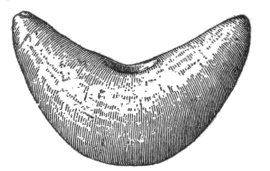
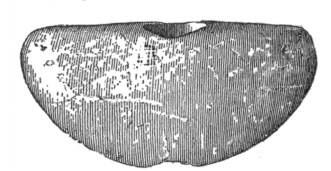
Fig. 147.—Boat-shape stone.
Fig. 148.—Boat-shape stone.
B. Coming to a point at each end; flat side, deeply hollowed; perforations near the ends, with a groove between them in which the suspending cord rested. Some have a flattened projection in which the groove is made. The type (figure 148) is of steatite, from a grave in Sullivan county, Tennessee. The distribution is as follows:
District. A B
Central North Carolina 3
Eastern Tennessee 2 1
Savannah, Georgia 1
KEY: A = Steatite. B = Slate.
Picks.
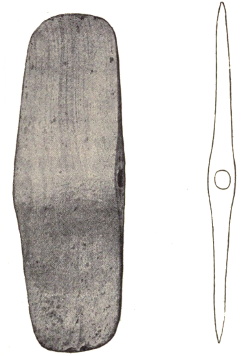
Fig. 149.—Pendant.
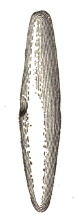
Fig. 150.—Pick.
The relics known as picks from their form and not at all from their function vary considerably in size. Not all are perforated. A good example, shown in figure 150, is of striped slate, from Knox county, Ohio. There are also in the collection, from Union county, Mississippi, one specimen of greenstone; from Jackson county, North Carolina, one of slate, and from Montgomery county, North Carolina, one each of steatite and slate. The last named is the half of a larger one that was broken at the part drilled, and has had a hole drilled near the larger end of this fragment, which has not been reworked.
Spool-shape Ornaments.
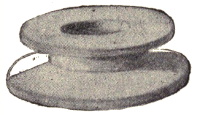
Fig. 151.—Spool-shape ornament.
Relics of spool shape, probably ornamental rather than industrially useful, are not uncommon in copper, though very rare in stone. The specimen shown in figure 151 is of sandstone, from Jackson county, Arkansas. There are also, from Prairie and Lonoke counties, one each of sandstone, and from Jackson county two of the same material; from Clark county there is one of pinkish slate, with the stem drilled between and parallel to the faces, the others with stems drilled lengthwise.
Bird-shape Stones.
Stone relics of bird form are quite common north of the Ohio river, but are exceedingly rare south of that stream. A good example, shown in figure 152, is of granite, from Vernon county, Wisconsin, and the collection embraces another specimen, of sandstone, from Kanawha valley, West Virginia.
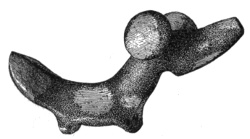
Fig. 152.—Bird-shape stone.
According to Gillman, bird-shape stones were worn on the head by the Indian women, but only after marriage.108 Abbott109 quotes Col. Charles Whittlesey to the effect that they were worn by Indian women to denote pregnancy, and from William Penn that when squaws were ready to marry they wore something on their heads to indicate the fact. Jones110 quotes from De Bry that the conjurers among the Virginia Indians wore a small, black bird above one of their ears as a badge of their office.
Shaft Rubbers.
The shaft of an arrow is straightened by wetting and immersing it in hot sand and ashes, and bringing into shape by the hand and eye. To reduce the short crooks and knobs it is drawn between two rough grit stones, each of which has a slight groove in it; coarse sand is also used to increase the friction.111
Again, a rock has a groove cut into it as wide as the shaft and two or three times as deep. Into this the crooked part of the shaft is forced, and by heating or steaming becomes flexible and can be easily made straight, which shape it will retain when dry.112
A somewhat different device for the same purpose appears in the Bureau collection. It is illustrated in figure 153 (of fine sandstone); there was another part to correspond with that shown. The specimen is from Monongahela, Pennsylvania.
Tubes.
As the use of stone tubes by the Indians has given rise to considerable discussion, the following references to the various ways in which they have been employed may help to settle it.
Schoolcraft observed that the Dakota Indians used a horn tube in bleeding; one end was set over the cut, and the other vigorously sucked.113 Powers says that the Klamath Indians use tubes for smoking,114 while H. H. Bancroft says that the Acaxees of Mexico employ “blowing through a hollow tube” for the cure of disease,115 and also that the Indians of southern California inhale smoke of certain herbs through a tube to produce intoxication.116 According to C. C. Jones the Florida and Virginia Indians used reeds in treating diseases by sucking or blowing through them, and also used them in cauterizing; and he observes that the Indians of Lower California employed similar processes, using stone tubes117 instead of reeds. Hoffman illustrates the removal of disease through the agency of a tube of bone by a Jĕs´sakīd´ or medicine-man of the Ojibwa.118 Read calls attention to the fact that the old Spanish writers describe a forked wooden tube, the prongs being inserted in the nostrils, while the other end was held over smoldering herbs, and suggests that the Indians may have used stone tubes in the same way.119
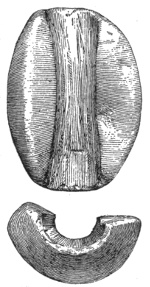
Fig. 153.—Shaft rubber.
The Indian mode of inhaling smoke would produce the same result, whether drawn through the mouth or into the nostrils.
The use of stone tubes for astronomical purposes, which has been discovered by some imaginative writers, is, of course, absurd; nevertheless they are useful in viewing distant objects on a bright day, especially when looking toward the sun.
Nearly all of the tubes made of soft material with tapering perforation seem to have been gouged rather than drilled. Schumacher observes that the California Indians drilled their tubes from both ends and enlarged the hole from one end by scraping, the mouthpiece being made of a bird bone stuck on with asphaltum.120
There are five classes of stone tubes in the collection of the Bureau, as follows:
A. One end flattened and expanding into a wing on either side. This class is illustrated by figure 154 (from Kanawha valley, West Virginia). The corners of this specimen have been trimmed off; the typical form is indicated by the dotted lines. There are also from the same locality one of quartzite, and from Ross county, Ohio, one of sandstone.
B. Conical; the bore more tapering than the exterior. Represented by the specimen shown in figure 155, of sandstone, from a mound in Kanawha valley, West Virginia.
District. A B C D
Sevier county, Tennessee 1
Savannah, Georgia 1
Western North Carolina 1 1
Kanawha valley, West Virginia 2 1
KEY: A = Sandstone. B = Steatite. C = Slate. D = Clay slate.
C. Hour-glass shape, usually but not always with a narrow ring or projection around the smallest part. Exterior with gently curving outlines; the perforation is usually in the form of a double cone, with the points at the smallest part of the tube, which may or may not be midway between the ends. A good specimen, illustrated in figure 156, is of steatite, from Sevier county, Tennessee.
D. Of nearly uniform diameter inside and out; section circular, elliptical, or flattened on one side. This form is exemplified by figure 157, a specimen from North Carolina. There are also one each from Caldwell, Haywood, and Montgomery counties, North Carolina, all of slate.
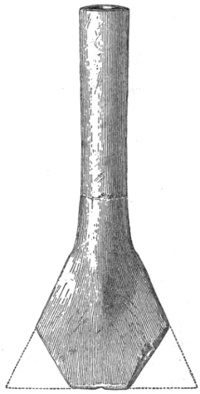
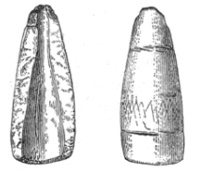
Fig. 154.—Tube, one end flattened.
Fig. 155.—Tube, conical.
E. Round or elliptical in section, ¾ to 2½ inches long; probably beads. The collection includes specimens from Bradley county, Tennessee, of steatite; from Savannah, Georgia, of ferruginous sandstone; and from Union county, Mississippi, of jasper.
Pipes.
So much has been written concerning pipes that few references seem necessary, and none will be given except from Col. R. I. Dodge, who, after an experience of many years among the Plains Indians, says that the latter have different pipes for different occasions, as the medicine pipe, peace pipe, council pipe, and a pipe for common use. Each is sacred to its own purpose.121
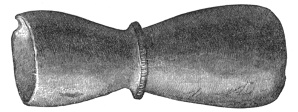
Fig. 156.—Tube, hour-glass form.
In an article so highly prized by its owner, great pains would be expended to give an ornamental appearance to one which would be used on important ceremonial occasions; and it would be carved or worked in a manner gratifying to its maker or the one for whom it was intended. This fact, and the statement quoted above, will explain the great variety in form from a limited area. Still, in some sections of the country there are certain types that prevail, and may be in some cases peculiar to these localities; such, for instance, are the long stemmed pipes from western North Carolina and eastern Tennessee.
In many pipes of soft stone the bowl is gouged out instead of drilled.
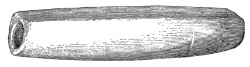
Fig. 157.—Tube, cylindrical.
The pipes in the Bureau collection embrace the following classes:
A. Stem with an elliptical or somewhat triangular section; the bowl near one end, leaving a projection in front; stem hole in long end. The form is shown in figure 158. From Caldwell county, North Carolina there are two similar pipes of steatite. Another, from Preston county, West Virginia, differs only in having the stem hole in the short end.
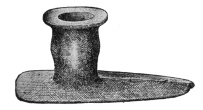
Fig. 158.—Pipe, flat base.
B. Same form of stem; no projection in front, the bottom of the stem curving up gradually into the front of the bowl. This type is represented by figure 159 (of steatite, from a mound in Loudon county, Tennessee). There are also, from Kanawha valley, West Virginia, an example of talcose slate, and from Caldwell county, North Carolina, one of steatite.
C. Stem having a midrib in which the hole is bored. One of steatite, from Caldwell county, North Carolina, has a prow; the others have not. Another of steatite from Loudon county, Tennessee, has a slender projection below the bowl, as if for a handle. The axis of the bowl and that of the stem meet at any angle between 100° and 170°. Figure 160 represents a typical specimen, of steatite, from a mound in Sullivan county, Tennessee. There are also, from Caldwell county, North Carolina, and Kanawha and Preston counties, West Virginia, one each, and from Sullivan county, Tennessee, two, all of steatite; and there is an example from Kanawha valley, West Virginia, of material not identified.
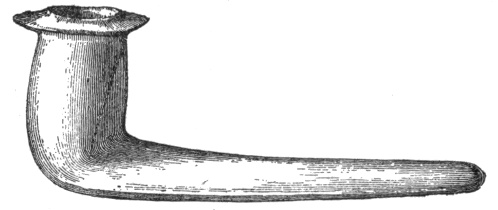
Fig. 159.—Pipe.
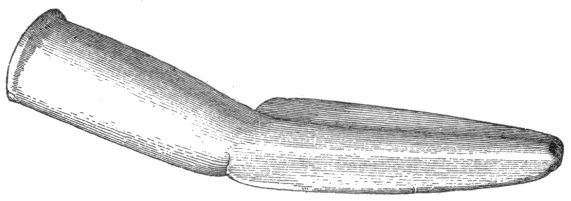
Fig. 160.—Pipe.
D. With bowls and stems either round or square; very large. A good example (figure 161) is of red sandstone, from southeastern Missouri; it is the only pipe in the entire collection of the Bureau on which is shown any attempt at ornamentation. From Jefferson county, Tennessee, and Savannah, Georgia, there are one each, of steatite.
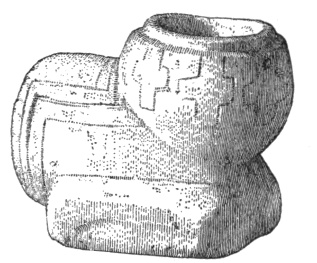
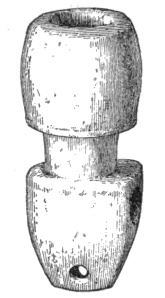
Fig. 161.—Pipe, ornamented.
Fig. 162.—Pipe.
E. Cylindrical bowl, with a square-edged groove around it near the middle, below which the bottom has a somewhat celt like form, with stem hole in one side. A small hole is drilled near the edge at the bottom, probably for the purpose of suspending feathers or other ornaments. The type is represented by figure 162 (of limestone, from Crawford county, Wisconsin). Pipes of the same form are found also in central Ohio.

Fig. 163.—Pipe, long-stemmed.
F. Round stem from one-half inch to 10 inches long; bowl at extreme end, set on at various angles from nearly a right angle to almost a straight line. Good examples are illustrated in figure 163 (steatite, from Caldwell county, North Carolina) and 164 (also of steatite, from a mound in Monroe county, Tennessee). The other specimens in the collection are distributed as shown in the table:
District. A B
Eastern Tennessee 4 7
Caldwell county, North Carolina 22
Chester county, South Carolina 1
KEY: A = Sandstone. B = Steatite.
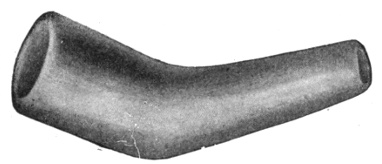
Fig. 164.—Pipe, short-stemmed.
G. Same form of stem, short, with flange around the top of the bowl. Represented by one of sandstone, from a mound in Monroe county, Tennessee (figure 165), and three of sandstone and two of marble from eastern Tennessee.
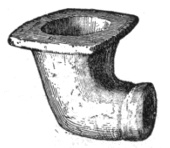
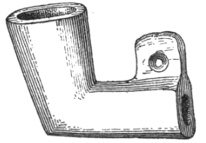
Fig. 165.—Pipe.
Fig. 166.—Pipe.
H. Small, stem more or less squared, bowl upright. There are two examples of this class from Monroe county, Tennessee, each having a flat projection or ridge on top of the stem, which is perforated for attachment of ornaments. The type, represented in figure 166, is of clay slate, from Monroe county, Tennessee. It will appear from the following table that the distribution of this form is limited:
District. A B C
Savannah, Georgia 1
Eastern Tennessee 1 1 2
Western North Carolina 3
KEY: A = Sandstone. B = Clay slate. C = Steatite.
I. Egg-shape bowl, stem hole in the side. One from Bradley county, Tennessee, of argillaceous limestone, has a hole drilled from end to end, but no stem hole. It may have been made so intentionally, or the drilling may have been carried too far and the specimen left unfinished. The type is of barite, from Sevier county, Tennessee (shown in figure 167). Another specimen, from McMinn county, Tennessee, is of argillaceous limestone.
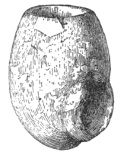
Fig. 167.—Pipe.
J. Form like last, with a flange around the top of the bowl. A typical specimen, shown in figure 168, is of steatite, from Loudon county, Tennessee. There are, also, from Preston county, West Virginia, one of sandstone, and from Caldwell county, North Carolina, two of steatite.
K. Bowls egg-shape, but quite long and sometimes rather pointed at the bottom; stem hole in the side. This class includes the following: From Savannah, Georgia; Roane county, Tennessee; and Adams county, Ohio, one each of sandstone; from Holt county, Missouri, one of micaceous sandstone; from Kanawha valley, West Virginia, one of indurated red clay, possibly catlinite; and from Caldwell county, North Carolina, three of steatite.
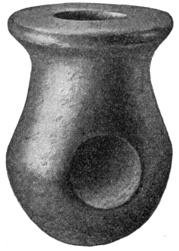
Fig. 168.—Pipe.
Chipped Stone Articles.
Materials and Manufacture.
The chipped implements in the Bureau collection, are nearly always made of some form of flint or similar chalcedonic rock, as it is easily chipped and can be brought to a keen edge or point. Sometimes quartz, quartzite, argillite, or even a more granular rock is used; but this is infrequent, and is due to the scarcity of the more desirable material.
In the spades and hoes first to be considered the flaking seems to have been by percussion mainly, if not entirely; the same method appears to have been employed in obtaining flakes from blocks, to work into the smaller implements. Some of the processes used in making them will be hereinafter described.
Spades.
It must be admitted that most Indians depended largely on agriculture for subsistence; some historical works that represent them as barbarous hunters, depending entirely on the chase, will, on the same page perhaps, relate how Virginia and New England pioneers were saved from starvation by supplies of corn, beans, and pumpkins obtained from the Indians. This being the case, some method of cultivation was necessary.
It is not to be inferred that “cultivation” implies all that is now meant by the term; the Indian seems merely to have worked the hill in which his corn was planted and not the whole surface of the field, a shallow hole being scooped out in which the grain was dropped, and as the stalk became larger the dirt was heaped up around it. The remains of many “Indian old fields” in various parts of the country show this, there being no long ridges as in cornfields of the present day, but only a great number of these detached hills. The great scarcity of implements suitable for such work argues nothing, for in most parts of the country stone easily worked and adapted to the purpose is unobtainable.
There are a few flint deposits found in southern Illinois in which the material occurs in nodules that can be made with even less work than a piece of wood into suitable implements; and in the country which may be considered as belonging to this archeologic district the flint hoes and spades are tolerably abundant. In other portions of the country, wood, the shoulder blades of large animals, and musselshells perforated for attachment to a handle, were formerly used; the shells are frequently found, but the other materials have long since disappeared.
Early observations on the industries of the aborigines are significant. Thus, according to De Forest, the Connecticut Indians used spades rudely constructed of wood, or of a large shell fastened to a wooden handle;122 and Palmer123 figures a hoe made of horn, 14 by 5 by one-fourth inches, in a wooden handle 5 feet long, which is split and slipped over the smaller end; such, with others of wood and stone, were used among the Utah Indians before iron was introduced. Dawson holds that they were probably prepared in large numbers for the planting time, when the whole tribe mustered to till the fields, and that when the work was over they were gathered and hidden in some safe place until the next season.124 This may have been the case to some extent, but the specimens found in these hiding places seldom have marks of use, and it is more probable that they were the property either of persons living at a distance or of an individual manufacturer in some particular village, being thus concealed for safe-keeping until there was a demand for them or, perhaps, to await a convenient time for transportation. A sedentary tribe would have no more reason for hiding this than any other kind of property.
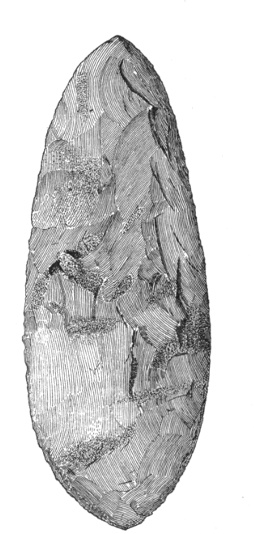
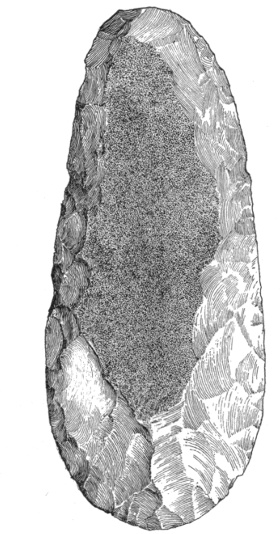
Fig. 169.—Chipped spade with pointed ends.
Fig. 170.—Chipped spade with rounded ends.
The chipped implements known as spades are frequently found buried in large numbers. Two caches were disclosed by high water in 1884, near Caseyville, Kentucky, containing, respectively, 57 and 75 specimens from 6 to 13 inches long.
The most common form is that having an oval or elliptical outline, with the ends either coming to a point or rounded. Long use of those having pointed ends would wear them off until they approached the others in form; but so many of both patterns show no evidence of use that this distinction must be considered intentional. The principal varieties are as follows:
A. Those with pointed ends. Figure 169 represents a typical specimen of yellow flint, from Union county, Illinois.
District. A B
Southwestern Illinois 2 2
Southeastern Arkansas 2
Cheatham county, Tennessee 1
Union county, Mississippi 1
KEY: A = Yellow flint. B = Grey flint.
B. Those with the ends rounded. Represented by figure 170 (yellow flint, from Union county, Illinois).
District. A B C D
Southwestern Illinois 2 2
Cheatham county, Tennessee 1
Lauderdale county, Tennessee 1
Polk county, Tennessee
Lauderdale county, Alabama 4
Craighead county, Arkansas 1
A = Yellow flint. B = Grey flint. C = Brown flint. D = Argillite.
A specimen from Jackson county, Illinois, has had a portion of the edge broken squarely. The polish over this fractured surface shows that it was long used after breaking without being rechipped to a sharp edge. This indicates usage only in loose ground, as it evidently would be quite difficult to force the square, broken part into a hard soil or tough sod.
The specimens from Polk county, Tennessee, are pecked or chipped, or both, and are quite roughly made. They are neither scratched nor polished, and may be unfinished implements of some other class, though agreeing closely with the flint spades in shape and size.
C. A modification of the last form has the upper portion chipped away along the sides until it is ovoid, with a blunt point, leaving the lower part a regular curve. An example, shown in figure 171, is of grayish brown flint, from Scott county, Missouri. There are also one each from Mississippi county, Missouri, and Hopkins county, Kentucky, of the same material.
D. Like the above, but much shorter in ratio to the width, and with a flatter curve. The type, figure 172, is of yellow flint, from a mound in Obion county, Tennessee. There are also three from Union county, Illinois, one of them with almost the same dimensions.
E. Semicircular outline, with sides notched for securing the handle, as in arrowpoints and spearheads. Represented by figure 173, showing a specimen of gray flint from a mound in Mississippi county, Arkansas. There are four additional specimens, all from Union county, Illinois.
F. A related form, also notched for attachment of handle. Figure 174 represents an example of yellow flint, from Poinsett county, Arkansas, the only one of this shape in the collection.
From Jackson county, Illinois, there is a series beginning with a small scraper and a small scraper-like celt, and passing gradually into the large spades or digging-tools, there being a number of intermediate forms and sizes. Two specimens, only 6 inches long, have the glazed surface so characteristic of these implements, which could have been produced only by long-continued use in digging.
From a workshop at Mill creek, Union county, Illinois, there are a large number of pieces in every stage of work. Among them can be made series of all the different types here given, from the nodule in its natural state to the completed implement. Near by is a flint deposit showing extensive aboriginal quarrying.
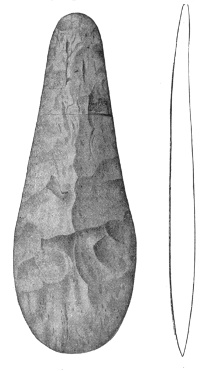
Fig. 171.—Chipped spade, ovoid.
Dawson,125 in speaking of these implements, says: “The rudest of all rude implements, similar to the paleoliths of Europe, were used by the more settled and civilized agricultural nations.” While the majority of them are rude, simply because there was no necessity for elaborate work or fine finish in tools of this class, yet there are many specimens (as, for example, the one shown in figure 171) which in symmetry and workmanship will compare favorably with the larger specimens of other types, due regard being had to the fact that the coarse flint of which they are usually made does not admit of the most delicate execution.
Turtlebacks.
The singular name “turtleback” is suggested instantly on seeing a specimen of the class so designated by Abbott and others. As commonly used, it refers to rude or unfinished leaf-shape implements of any size, which may be found in great abundance almost anywhere. It is used here, however, to denote more especially the disks or almond-shaped pieces of flint or chert sometimes found cached in considerable numbers.
Perkins126 records the discovery of such caches in Vermont; an exceptional case, as they are seldom found outside of the Mississippi valley. The southern portion of Illinois has furnished more than any other section; those found there are almost invariably made from nodules of bluish gray hornstone, the concentric lines being strongly marked.127
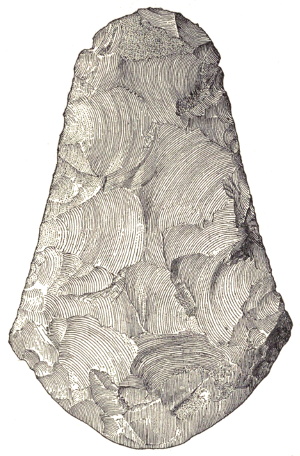
Fig. 172.—Chipped spade.
The Bureau has secured a large number from southern Illinois, ranging from 3½ to 7½ inches in length, some nearly circular, others having a length nearly twice the breadth. All have secondary chipping around the edges. Many of the larger ones and most of the smaller have the edges more or less worn or polished in such manner as would result from use as knives or scrapers. A typical specimen is shown in figure 175.
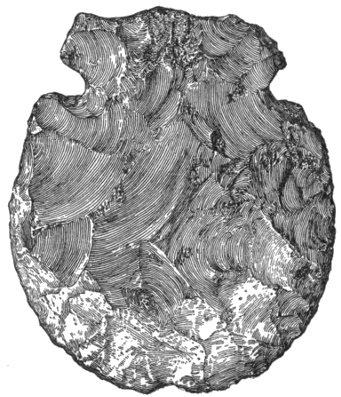
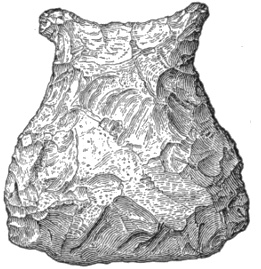
Fig. 173.—Chipped spade, showing handle notches.
Fig. 174.—Chipped spade.
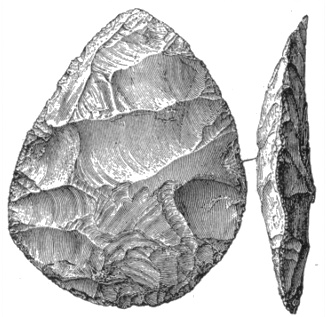
Fig. 175.—Chipped disk, or “turtleback.”
Stevens128 denies in strongest terms that these relics are unfinished implements, saying it is the worst possible form into which flint could be chipped for carrying or for future work. On the other hand, Cheever129 says the Indians of California usually carry a pouch of treasures, consisting of unfinished arrowheads or unworked stones, to be slowly wrought out when they are industriously inclined. Catlin, too, observed that the Apache sometimes carry bowlders of hornstone a long distance to obtain material for arrowheads;130 and according to im Thurn, the various Indian tribes of Guiana have each their special manufacture and exchange with other tribes.131 Tylor says:
Till lately the Patagonians, when they came on their journeys to a place where suitable flint or obsidian was to be found, would load themselves with a supply of lumps to chip into these primitive currier’s scrapers.132
Both Jewitt133 and Evans134 say that stones of this character were used as sling-stones; but there is no evidence that North American Indians ever used slings. Speaking of similar stones, Tylor remarks:
They were used either as knives or scrapers; with the curved side upward (or out) there would be no danger of cutting a hide in skinning game, and they could be used to cut up the flesh; while by putting the pointed end in the handle they could be used as scrapers.135
The smoothed edge in so many specimens substantiates the last statement, while the theory that they are unfinished implements finds support in the fact that nearly all the nodules from which they are made have an ellipsoid form, and the present shape of the implement would result from chipping away the useless weathered surface to lessen the weight.
Smaller chipped Implements.
Materials and Modes of Manufacture.
In the remaining portion of this paper, which will treat of the smaller chipped implements, a plan somewhat different from that of the preceding part will be followed.
As already stated, these specimens are almost invariably made of some form of flint; this term including chalcedony, basanite, jasper, chert, hornstone, and similar rocks. So common is its use that the term “flints” is gradually being adopted as a name for all the different classes of arrowheads, knives, drills, etc. The exceptions are not numerous enough to justify separate classification, so no tables of material will be used. Further, the great abundance of such relics in all portions of the country makes useless any allusion to the number from any particular locality; about the only limitation to their discovery is the amount of time and care which one chooses to give.
Before entering on the description, some quotations may be given in regard to methods of making these chipped implements.
According to Evans, the Mexican Indians take a piece of obsidian in the left hand and press it firmly against the point of a small goathorn held in the right, and by moving it gently in different directions they chip off small flakes until the arrow is complete;136 they also cut a notch in the end of a bone, into which the edge of the flake is inserted and a chip broken off by a sideways blow.137 According to the same author, the Eskimo sometimes set the flake in a piece of split wood. The arrow is roughly chipped by blows with a hammer, either direct or with a punch interposed, and is then finished by pressing off fine chips with a point of antler set in an ivory handle.138 Not only leaf-shape barbed arrows, but also ones either with or without the stem, can be produced by pressure with a point of antler; the former, however, are the more easily made, and were probably earlier in use.139
The Plains Indians lay the flat side of a flake of obsidian on a blanket, or other yielding substance, and with a knife nick off the edges rapidly. In their primitive state they probably used buckskin instead of the blankets, and pointed bone or horn instead of the knife.140
The Apache holds the flake or flint in his left hand, places his punch at the point where the chip is to be broken off, and it is struck by an assistant, thus knocking a chip from the under side; the flake is then turned and the process repeated, until the arrow is complete. The stone is held in the hand, as it can not be chipped on a hard substance.141 A punch observed by Catlin in use by these Indians was a whale tooth 6 or 7 inches long, with one round and two flat sides. The Fuegians, according to the same authority, use a similar process and make as fine implements.142
The Eskimo make a spoon-shaped cavity in a log, lay the flake over it, and press along the margin, first on one side and then on the other, like setting a saw, until they form two sharp serrated edges. The working tool is a point of antler firmly bound into a piece of ivory. The same plan is used by widely separated peoples.143
Nilsson, in chipping out gun flints with a stone hammer, found it necessary to have the point operated on lie immediately above a point that rested on the rock “anvil” which he used.144
The Veeard or Wiyot of California used a pair of buck-horn pincers tied together with a thong at the point; they first hammered out the arrowhead in the rough, and then with these pincers carefully nipped off one tiny fragment after another.145 The Klamath cover the hand with a piece of buckskin to keep it from being cut, and lay a flake along the ball of the thumb, holding it firmly with the fingers. With a point of antler from 4 to 6 inches long, they press against the edge, thus removing scales from the opposite side; they turn the flake around and over frequently, to preserve symmetry.146
The Shasta Indian lays a stone anvil on his knee, holds the edge of the flake against it, and with his stone hammer chips off flakes, finishing the base first, and gently chipping the whole arrow into shape. Both obsidian and glass are used.147 The Shoshoni Indians used the same process.148
A Pit River Indian has been seen to make a very sharp and piercing arrow from a piece of quartz, with only a piece of round bone, one end of which was hemispherical with a small crease in it (as if made by a thread) one-sixteenth of an inch deep. The arrow was made by pressing off flakes by main strength, the crease being to prevent the bone from slipping, and affording no leverage.149 John Smith (1607) says of the Powhatan Indian:
His arrowhead he maketh quickly, with a little bone, of any splint of stone or glass.150
The Cloud River Indian used two deer prongs, one much smaller than the other, the points ground to the form of a square, sharp-pointed file. He had also some pieces of iron wire tied to sticks and ground in the same manner; these were better than the deer horn, because harder, and not needing to be sharpened so often. The flake was held firmly in the left hand, guarded by a piece of buckskin; he pressed off chips with the larger tool, turning the arrow end-for-end when done on one side, so as to keep the edge opposite the middle line. The notches for barbs were worked out in a similar manner with the smaller tool.151
Some of the California Indians prefer agate and obsidian for their implements, as the close grain admits more careful working. They use a tool with its working edge shaped like a glazier’s diamond (apparently a piece of bone or antler with a square-cut notch on the side); the flake is held in the left hand, while the nick in the side of the tool is used to chip small fragments.152 Peale makes similar statements, and adds that the notches are of different sizes to suit the different stages of work.153
The Klamath Indians, according to Schumacher, have a slender stick 1½ feet long, with a piece of sea-lion tooth, or antler, fastened to the end of it. Holding one end under the arm to steady it, they take a flake in the left hand, wrapped in a piece of buckskin so as to leave only the edge exposed, and by pressure with the point of the tool break off flakes as large as necessary, the last being quite fine, to give sharp edges to the arrow. The notches are worked out by means of a point of bone 4 or 5 inches long, without a shaft.154 Chase gives a similar account, but says that iron points have now taken the place of the bone or horn points formerly used.155
It may not be out of place in this connection to give a few quotations in regard to the length of time required for making an arrowhead.
According to the Marquis de Nadaillac, the Mexicans could turn out a hundred flint knives (probably only unworked obsidian flakes) an hour,156 while Crook says that the Plains Indians with only a knife for nicking off the edges, will make from fifty to one hundred arrows in the same period.157 Chase found that a Klamath Indian required five minutes to complete a perfect arrowhead;158 though Stevens observes that a Shasta Indian spent an hour in chipping one from a flake of obsidian,159 and Lubbock states that the most skillful Indian workmen can not hope to complete more than a single arrow in a day’s hard work.160 Powers also speaks of the aborigines of California as "using that infinite patience which is characteristic of the Indian, spending days, perhaps weeks, upon a single piece;161 and Tylor notes “that utter disregard of time that lets the Indian spend a month in making an arrow.”162
The last two references are probably to the large and finely worked pieces used for ceremonial or ornamental purposes.
Classification of the Implements.
The only practicable division of the greater part of the smaller flints is into stemmed and stemless, the former having a prolongation at the base for firmer attachment to a shaft or handle, the latter being of a triangular or oval shape. The stemmed implements may be barbed or not, and the stem either narrower or broader toward the end.
The name “arrowhead” so commonly applied, fits only the minority of specimens, as none but the smaller ones could be so used; the larger are too heavy. The longest stone arrowpoint in the extensive collection of arrows in the National Museum measures two and five-eighths inches in length and is narrow and thin. An arrowpoint two inches in length is seldom seen. The larger specimens were probably knives and spearheads; but it would be difficult to assign any certain use for a particular type, the markings on so many indicate usage for which their shape would seem to render them unsuitable. It is probable that a single specimen served a variety of purposes.
Wood, bone, and shell were also used to a considerable extent, in the manufacture of implements for which flint would seem much better adapted. Thus for fish spears the southern Indians used canes, sharp-pointed, barbed, and hardened in the fire,163 while knives were formerly made of flint or cane; these are still used when the hunting knife has been lost.164 The California Indians had arrows tipped with hard-pointed wood for common use, and with agate or obsidian for war.165
The accompanying diagram (figure 176) will render plain the different terms used in the following descriptions:
Fig. 176—Diagram, explaining terms. a Point. b Edge. c Face. d Bevel.166 e Blade. f Tang. g Stem. h Base. i Notch. k Neck. m Barb, or shoulder.
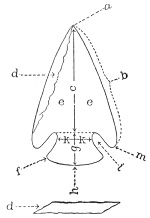
The only difference between barb and shoulder is that the barb is prolonged toward the base. The shoulder is called squared or rounded according to whether the edge of the implement makes an angle or a curve where drawn in to form the stem.
In the stemless specimens the base is the end opposite the point.
A tapering stem means one narrowing toward the base; straight, one whose sides are parallel; and expanding, one which is widest at the base.
Stemless Flints.
CHARACTERS AND USES.
The stemless flints are triangular or oval in outline. For convenience they will be divided into those small enough for arrowpoints (not above 2½ inches long) and those which are too large for such purpose. The latter reach to the length of 7½ inches. They are chipped to a sharp edge all around. The ratio of width to length varies from 1:4 to 4:5.
These objects were mostly for use as knives, scrapers or spearheads. Some of the thicker ones were spikes for clubs. Abbott167 mentions three triangular jasper implements 3 to 4 inches long from graves, associated with fragments of large bones which showed plainly that they had been used for clubs, and the Iroquois are known to have used a club with a sharp-pointed deer-horn about four inches long inserted in the lower side. Schoolcraft168 illustrates a pointed stone with a square section (apparently of the class usually called “picks”), mounted in a club which is curved at the end to let the spike set in the end at a right angle to the handle; and Brickell observes that the North Carolina Indians used clubs or long poles, in the ends of which were fastened artificially sharpened stones, or horns of animals.169 Morgan also notes that among the Iroquois rows of arrow-shaped chert heads about two feet in extent have been found lying side by side. They were set in a frame and fastened with thongs, forming a species of sword.170 According to Tylor the Mexicans had a similar sword, with obsidian teeth gummed in holes in a war club,171 and Bourke observed at Taos pueblo a similar weapon with iron teeth.172 But the number of specimens found mounted indicates that most of them were used as knives or scrapers.
LARGER IMPLEMENTS.
A. With base and edges straight or slightly convex; corners square. The type illustrated in figure 177 is from Montgomery county, North Carolina. Similar forms come also from eastern Tennessee; central and western North Carolina; southwestern Illinois; Miami and Scioto valleys, and central Ohio; southwestern Wisconsin; northeastern and southwestern Arkansas; northeastern and northwestern Alabama, and Coosa valley in the same state; Kanawha valley, West Virginia; northeastern and central Kentucky; and Savannah, Georgia.
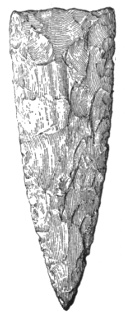
Fig. 177.—Triangular chipped flint.
B. Base straight or nearly so; edges parallel most of the length, curving abruptly to a point; usually with one face less convex than the other, even quite flat, giving a plano-convex section; medium size. The specimen shown in figure 178, from Kanawha valley, West Virginia, is representative. Other examples come from eastern Tennessee; central North Carolina; northwestern Alabama; Kanawha valley; and southwestern Illinois.
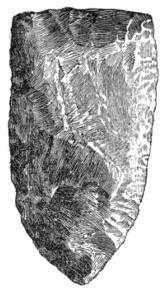
Fig. 178.—Chipped flint.
C. Base straight or nearly so; corners square or slightly rounded; edges convex, curving gradually and regularly to the point; usually widest about one-third of the way above the base; varying much in width, and in length from 6½ inches down to the arrowpoint. A few of the largest have the edges slightly expanding at their junction with the base, for firmer attachment to a handle. The type is figure 179 (from Loudon county, Tennessee). Other specimens are from eastern Tennessee; central and western North Carolina; Kanawha valley; Keokuk, Iowa; Miami and Scioto valleys, and central Ohio; eastern, southern, and southwestern Wisconsin; northeastern Arkansas; central and northeastern Kentucky; northwestern Georgia, and Savannah; southwestern Illinois; and Coosa valley, Alabama.
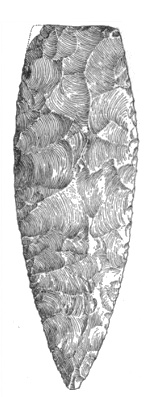
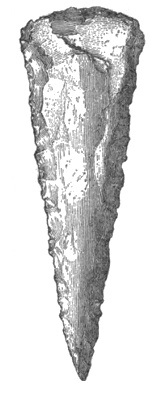
Fig. 179.—Chipped flint.
Fig. 180.—Chipped flint, somewhat bell-shape.
D. Narrow and thick; up to 6 inches long; convex base; edges straight to the base, where they expand somewhat, giving the implement a bell shape. The largest specimen in the lot (figure 180) has both faces polished almost the entire length, a feature absent from all the others. This example is from Caldwell county, North Carolina. The form is found also in central and western North Carolina, eastern Tennessee, northeastern Kentucky; Kanawha valley; and northeastern Arkansas. Few of the flints occur in the collection except from the two localities first mentioned, where they are moderately abundant.
E. Elliptical outline; some very thin, others resembling celts. One from Kanawha valley has the projecting facets and ridges on one face very smooth from use, those on the other being still sharp, as when first chipped. The one figured has the edge worn smooth entirely around, seemingly from use as a cutting tool, the ends being most worn. Represented by figure 181 (from Dane county, Wisconsin). Found also in southern and southwestern Wisconsin; eastern Tennessee; northeastern Arkansas; central and western North Carolina; Brown county, Illinois; Kanawha valley; and South Carolina.
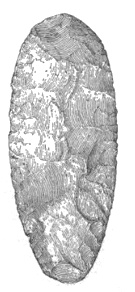
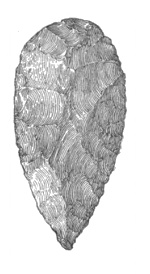
Fig. 181.—Chipped flint, elliptical outline.
Fig. 182.—Chipped flint, leaf-shape or oval outline.
F. With the outline a continuous curve from the point entirely around, the base being regularly rounded. This is the model of the pointed oval or leaf-shape flint. Sometimes one face is flatter than the other, being less worked, or in a few cases the unaltered flat side of a flake. Usually they are quite symmetrical, but occasionally one edge is more curved than the other. The type illustrated in figure 182 is from Vernon county, Wisconsin. Other specimens are from western and central Wisconsin; eastern Tennessee; Miami and Scioto valleys, and central Ohio; southwestern Illinois; Kanawha valley; northeastern Kentucky; northeastern and southwestern Arkansas; northwestern and northeastern Georgia, and Savannah.
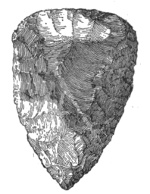
Fig. 183.—Chipped flint.
G. With convex edges and slightly convex base; being a medium between the triangular and the leaf-shape. Some are quite narrow and thick, others wide and thin; the former probably clubs or spearheads, the latter knives. A good example, shown in figure 183, is from Savannah, Georgia. Others are from central Arkansas; central Ohio; eastern Tennessee; Kanawha valley; central North Carolina; southern Wisconsin; northwestern Georgia, and Savannah; northeastern Alabama; and South Carolina.
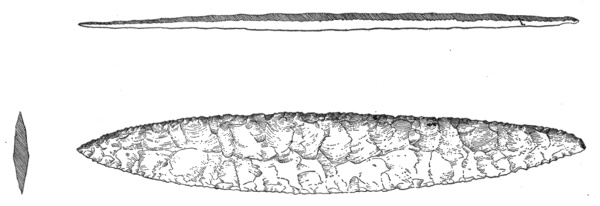
Fig. 184.—Chipped flint, large, pointed elliptical outline.
H. Pointed at each end; mostly elliptical, though sometimes widest near one end; from 5 to 12 inches long. Nearly all are thin and finely worked, with sharp edges. One from Cheatham county, Tennessee, has a deep notch on each edge about one-third of the way from one end, this end being somewhat rounded. The type (figure 184) is from Lonoke county, Arkansas. Other specimens are from central Arkansas, southwestern Illinois, northern and eastern Tennessee.
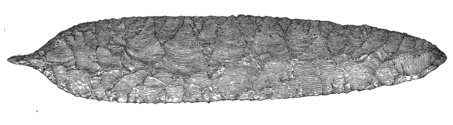
Fig. 185.—Chipped flint, large, long sharp point.
I. A similar pattern, but having one end continued into a narrow point, shown in figure 185, is from Bartow county, Georgia. Another of the same kind comes from Loudon county, Tennessee.
J. Similar to group H, but with the edges straight for more than half the length, probably to afford a more convenient hold for the hand. The form is shown in figure 186, representing a specimen from Mississippi county, Arkansas. Others are from northwestern Georgia, southwestern Illinois, and northeastern Arkansas. There are a few similar in method of chipping to those of group I, but smaller and very narrow, from eastern and western Tennessee and northeastern Arkansas.
K. Double-pointed or lenticular in outline; quite symmetrical; from 2 to 4 inches long; thin and well worked. Represented in northeastern Arkansas; South Carolina; central and western North Carolina; eastern Tennessee; Scioto valley, and central Ohio; Kanawha valley; and northwestern Georgia.
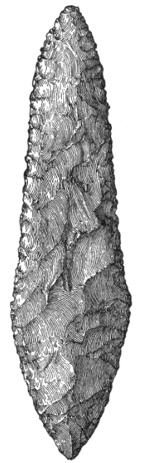
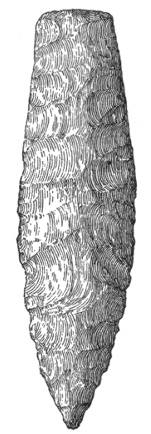
Fig. 186.—Chipped flint, large.
Fig. 187.—Chipped flint.
L. With straight or concave base; edges diverging by straight or slightly convex lines for about half the length from the base, then curving to the point. There is considerable variation in the relative width of these, as well as the amount of concavity at the base. None with this outline of the edges has a convex base. From 2 to 6 inches long. The form is illustrated by figures 187 (from Lawrence county, Ohio), and 188 (from Blount county, Tennessee). In addition to the specimens figured, there is material in the collection from Scioto valley, Ohio; central and western North Carolina; Keokuk, Iowa; Brown county, Illinois; eastern Tennessee; northeastern Alabama, and Coosa valley in the same state; Kanawha valley; South Carolina; southern Wisconsin; and Savannah, Georgia.
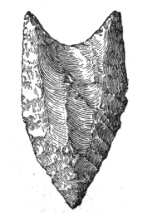
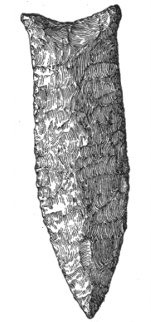
Fig. 188.—Chipped flint.
Fig. 189.—Chipped flint, with shoulders.
M. A modification of the last form in which the edge expands just at the base, forming a point at each corner or shoulder. Illustrated in figure 189. The specimen figured is from Forsyth county, Georgia. Others are from northwestern Georgia, and Savannah; eastern Tennessee; northeastern Kentucky; southwestern Wisconsin; and Kanawha valley.
SMALLER OBJECTS.
Small triangular or oval arrowpoints, differing from those previously described in being too small for any similar uses, few of them being so much as two inches in length, and varying from that size to not more than half an inch. Nearly all are very thin, though some of the narrower ones may have a diamond or thick lenticular section. Some are very slender, so much so that they are usually classed as perforators; others are equilateral. Both the base and edges may be straight, convex, or concave. A few have a shallow notch in each edge just above the corner; nearly all, however, have both base and edge continuous.
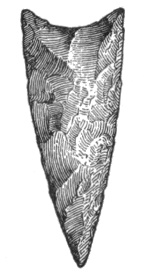
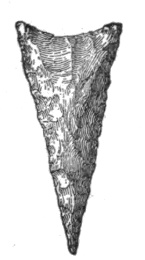
Fig. 190.—Chipped flint, small.
Fig. 191.—Chipped flint, triangular.
The groups and subdivisions which have been recognized among the smaller chipped flint objects in the Bureau collection may be enumerated as follows:
A. Concave base. The concavity may vary from almost a straight line to one-third the length of the flint. Usually symmetric, as in figures 190 and 191, though sometimes one tang or barb, if it may be called such, is longer than the other, as in figure 192. A very few have beveled or serrated edges.
1. Convex edges. The type, shown in figure 190, is from Jefferson county, Tennessee. Other specimens are from eastern Tennessee; Union county, Mississippi; northwestern Georgia, and Bibb county and Savannah in the same state; central and western North Carolina; Miami and Scioto valleys and central Ohio; Kanawha valley, West Virginia; South Carolina; and southwestern Arkansas.
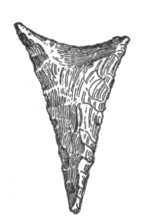
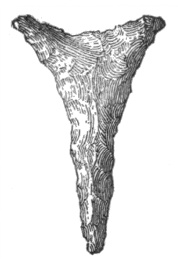
Fig. 192.—Chipped flint, asymmetric.
Fig. 193.—Chipped flint, concave edges.
2. Straight edges, as in the specimen illustrated in figure 191, from Ouachita county, Arkansas. Similar specimens are found in northeastern and southwestern Arkansas; western and central North Carolina; Kanawha valley; eastern Wisconsin; northwestern Georgia, and Savannah; eastern Tennessee; South Carolina; southwestern Illinois; Union county, Mississippi; and northeastern Kentucky.
3. Concave edges. This abundant form is illustrated in figures 192 (Cherokee county, Georgia), 193 (Caldwell county, North Carolina), and 194 (Washington county, Virginia). Other specimens are from northwestern Georgia and Savannah; central and western North Carolina; Kanawha valley; eastern Tennessee; northeastern Kentucky; southwestern Arkansas; South Carolina; Union county, Mississippi; and Coosa valley, Alabama. This subdivision of group A is abundant, as well as widely distributed.
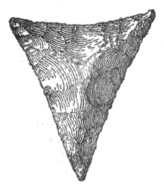
Fig. 194.—Chipped flint, triangular.
B. With straight bases. These are all small, the broad ones being short and the long ones slender. Most of them are both short and narrow.
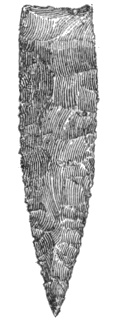
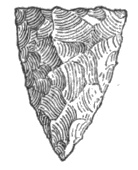
Fig. 195.—Chipped flint, small.
Fig. 196.—Chipped flint, short, convex edges.
1. Convex edges as in figures 195 (McMinn county, Tennessee) and 196 (Bradley county, Tennessee). The form is widely distributed, being represented by specimens from eastern Tennessee; northeastern, southwestern, and southeastern Arkansas; Scioto valley, Ohio; northeastern Kentucky; northwestern Georgia and Savannah; Kanawha valley; Union county, Mississippi; Holt county, Missouri; northeastern Alabama, and Coosa valley in the same state; southern and southwestern Wisconsin; and western North Carolina.
2. Straight edges. Exemplified by the specimen shown in figure 197, from McMinn county, Tennessee. Found also in eastern Tennessee; northeastern Arkansas; Coosa valley, Alabama; Union county, Mississippi; Kanawha valley; Miami and Scioto valleys, Ohio; eastern, southern, and southwestern Wisconsin; western and central North Carolina; Bartow county and Savannah, Georgia; South Carolina, and northeastern Kentucky.
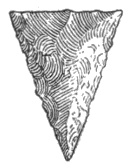
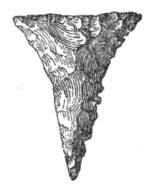
Fig. 197.—Chipped flint, triangular.
Fig. 198.—Chipped flint, concave edges.
3. Concave edges, as in figure 198 (from Bledsoe county, Tennessee). Other examples of this class are from eastern Tennessee; Scioto valley, Ohio; northeastern and southwestern Arkansas; Kanawha valley, West Virginia; northeastern Kentucky; western and central North Carolina; northeastern Alabama; southwestern Illinois; and Savannah, Georgia.
C. Convex bases. Less abundant than the preceding, and the forms representing it are less variable. Its sub-groups are as follows:
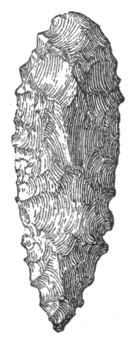
Fig. 199.—Chipped flint, convex base.
1. Convex edges. Some of these have a slight reverse curve at the base, giving a slight barb or shoulder. A few are widest at or near the middle, with bases somewhat pointed, but most of them are widest at the junction of the base and edges. They are mostly of the leaf-shaped type, but quite small. Figure 199 (Mississippi county, Arkansas) is a good example. Others are from northeastern and southwestern Arkansas; northeastern Alabama and Coosa valley; Kanawha valley, West Virginia; eastern Tennessee; western and central North Carolina; northwestern Georgia; eastern Wisconsin; southwestern Illinois, and Miami valley, Ohio.
2. Edges concave or nearly straight. There are very few of this form, as nearly all with the base convex have the edges also convex. The type (figure 200) is from Lawrence county, Ohio; others are from Miami and Scioto valleys, Ohio; Kanawha valley; and southeastern and southwestern Arkansas.
Two exceptional forms, which may be considered modifications of the triangular, come from eastern Tennessee and western North Carolina. The first, which is pentagonal, is shown in figure 201; the second, a medium between a perforator and a deeply serrated, triangular arrowpoint, is shown in figure 202.
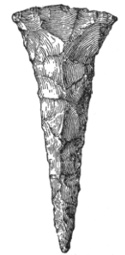
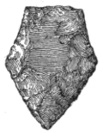
Fig. 200.—Chipped flint, edges concave.
Fig. 201.—Chipped flint, pentagonal.
While it is likely that the smaller flints, last described, were intended for arrows, it can not be stated with confidence whether they were for use in war or in hunting. It is said that some of the western Indians used barbless arrows with, long, tapering blades, firmly attached to the shaft, for hunting, while for war barbed arrows, only slightly attached, were employed.173
In many arrows with triangular points in the National Museum the sinew with which the flint is fastened to the shaft is brought over the corner or shoulder in such a way as to bind the point as firmly as could be done if it were barbed or stemmed, so that when the shaft is drawn from a wound the point must come with it. If an arrowhead of this form were inserted in a shaft, which was then wrapped behind the flint, the latter would remain in the wound when the shaft was withdrawn.
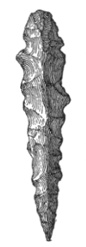
Fig. 202.—Chipped flint, narrow and thick.
There is no reason for supposing that only the larger points were used for war purposes; the greater penetrating power of the thin, sharp ones would seem to fit them especially for such work, and it is probable that the smaller straight or tapering-stemmed flints (next to be described) were also utilized for this purpose, as they could be easily detached. Those with expanding stem may have been used for hunting, as they could be permanently fastened to the shaft.
Stemmed Flints.
The abundant and variable material of this class may roughly be grouped by form into two divisions, in the first of which the stem is tapering or straight, while in the second the stem is generally expanding.
STRAIGHT OR TAPER STEMS.
A. Square or rounded shoulders; stem concave at base; edges usually convex, rarely straight or concave. Nearly all are of quartzite or coarse flint, roughly worked, the one illustrated (figure 203) being above the average, and are mostly from western North Carolina and the adjacent portions of South Carolina and Tennessee. All of them exceed three inches in length. Those from Savannah, Georgia, are usually much wider relative to the length than the specimens in the Bureau collection from other localities.
The specimen figured is from Montgomery county, North Carolina; others are from western and central North Carolina; Kanawha valley; eastern Tennessee; South Carolina; Coosa valley, Alabama; and northwestern Georgia and Savannah.
B. Similar to the last, except that the base is straight or convex, instead of concave. Large size, and nearly all of rough finish; mostly of argillite or flint, a few of quartzite. Varying considerably in width, as well as in thickness, some having almost a diamond section, others wide and thin, the latter generally having the edges worked quite sharp. Some are made from a large flake which has been dressed on one side only. One from Montgomery county, North Carolina, has the end opposite the stem worked round and sharp, similar to the blunt arrowheads, but its size excludes it from this class. From Savannah there are several which are chipped very thin, and smoothly finished, but they are exceptional; some from this locality are very large, reaching 5 by 3 inches, while others are almost as wide as they are long.
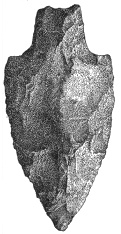
Fig. 203.—Chipped flint stemmed, barbless.
The specimens of this form are chiefly from western and central North Carolina; eastern Tennessee; South Carolina; southwestern Georgia, and Savannah; eastern Wisconsin; southwestern Arkansas; southwestern Illinois; northwestern Alabama and Coosa valley in the same state; Kanawha valley, West Virginia; and central Ohio.
C. Of the same general form as the last, but much smaller, and finely worked. Most seem to be intended for arrowheads. The specimen illustrated in figure 204 is from Caldwell county, North Carolina; others are from South Carolina; western and central North Carolina; Union county, Mississippi; eastern Tennessee; Coosa valley and Tuscaloosa, Alabama; Miami valley, Ohio; Kanawha valley; northwestern and southwestern Georgia and Savannah; and southeastern Arkansas.
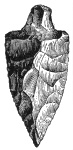
Fig. 204.—Chipped flint, stemmed, barbless.
D. Convex edges; stem usually tapering with straight base, though it is noticeable that some are straight with convex base. Resembling the last in form, but slender; from 1¾ to 4¼ inches long. From western and central North Carolina; Kanawha valley, West Virginia; and Savannah, Georgia.
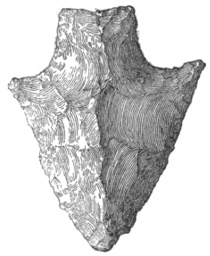
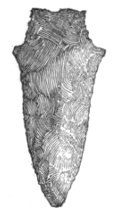
Fig. 205.—Chipped flint, expanding shoulder.
Fig. 206.—Chipped flint, double-curved edges.
E. Differing from specimen shown in figure 203, in having the edges expand at the shoulders in a projection or point, and varying more in size, some being small enough for arrowheads. All from Savannah (including the example shown in figure 205) are of smoother finish than those from other sections, and are usually larger, ranging from 2½ to 4½ inches long. There are some from this locality with base straight or convex. Found also in western and central North Carolina; Kanawha valley; South Carolina; eastern Tennessee; Coosa valley and northeastern Alabama; Brown county, Illinois; northeastern, southeastern, and southwestern Arkansas; and southwestern Georgia.
F. Edge having a double curve, being convex toward the point, and curving outward at the shoulders. Few of them are barbed, though many have the shoulder much expanded. Base sometimes convex or concave, but more often straight; in a few it is somewhat pointed. In most of the smaller specimens the base is notched, but of these none are over 2½ inches long. Stem tapering or expanding, rarely straight. A few have the base rubbed smooth and dull, or even polished (this feature appears in other forms, as noted); it seems to result from use as a knife or scraper, but the implement as a whole does not appear to be adapted to such use. None of them are over 3½ inches long, except a few from Savannah; all from there are wide, but from other places the longer ones are all narrow.
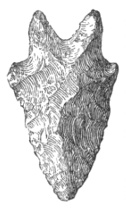
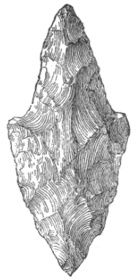
Fig. 207.—Chipped flint, double-curved edges.
Fig. 208.—Chipped flint, convex edges, long, tapering stem.
The specimens illustrated (figures 206 and 207) are from Madison county, Alabama, and Kanawha valley, respectively. Others are from northeastern Alabama and Coosa valley; eastern Tennessee; northwestern and southwestern Georgia and Savannah; Kanawha valley; Catahoula parish, Louisiana; western and central North Carolina; southwestern Illinois and Brown county in the same state; South Carolina; southwestern Arkansas; and Miami valley, Ohio.
G. Convex edges; sharp points; stem always long and tapering; base somewhat pointed, or outline of whole stem forming a regular curve. Some slightly barbed, but mostly with only a small shoulder. The specimens vary much in size, and also in delicacy of workmanship. Classed by function the group would probably be divided among several. The example shown in figure 208 is from Jackson county, Illinois. Others come from southwestern Illinois; eastern Tennessee; South Carolina; Kanawha valley; northeastern, southeastern, and southwestern Arkansas; western and central Arkansas; and southern Wisconsin.
H. Similar to group G, save that the edges are straight while the stem is somewhat shorter. All the specimens are small. Found in western North Carolina; Kanawha valley, West Virginia; South Carolina; and southeastern Arkansas.
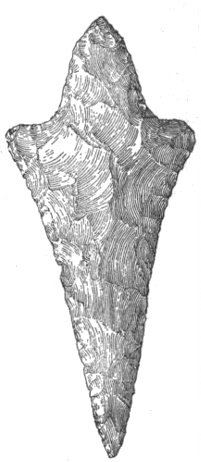
Fig. 209.—Chipped flint with long, tapering stem.
I. Differing from group G in having concave sides; none are barbed, and some have very wide shoulders. Nearly all are large. Two from Savannah have the base straight, all the others being of the common type. The type (fairly exemplified in figure 209) is from Union county, Illinois, and others come from southwestern Illinois; southwestern Arkansas; South Carolina; western North Carolina; Kanawha valley, West Virginia; eastern Tennessee; and Savannah, Georgia.
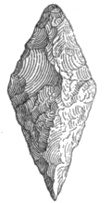
Fig. 210.—Stemmed chipped flint, diamond or lozenge shape.
J. Lozenge or diamond shape; the four edges straight or nearly so, varying a little toward convexity or concavity. In some the base does not come to a point but is rounded or truncated; sometimes, though seldom, there is a slight shoulder. From 1¼ to 3½ inches long. A typical example, shown in figure 210, is from Chester county, South Carolina. Additional material is from South Carolina; Kanawha valley; Brown and Ogle counties, Illinois; eastern Tennessee; western North Carolina; Bibb county and Savannah, Georgia; southeastern and southwestern Arkansas; Union county, Mississippi; and Coosa valley, Alabama.
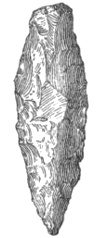
Fig. 211.—Stemmed chipped flint.
K. Edges usually convex, sometimes nearly straight, gradually rounding off into the stem, which may be straight, tapering, or slightly expanding; base straight or slightly convex. All of these are narrow, mostly thick, and none over two inches long. The type (figure 211) is from Bledsoe county, Tennessee; others are from eastern Tennessee; western and central North Carolina; Coosa valley, Alabama; northwestern Georgia; eastern, southern, and southwestern Wisconsin; Kanawha valley, West Virginia; South Carolina; Brown county, Illinois; and northeastern and southeastern Arkansas.
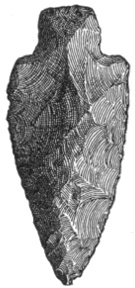
Fig. 212.—Stemmed chipped flint.
L. Edges convex, a very few being straight; shoulders square or somewhat rounded, in two or three somewhat expanding. Stem usually straight, sometimes tapering; base straight or convex. Varying much in size and relative width, being from 1¼ to 4½ inches long, and from ¾ to 2½ inches wide; some slender, others broad. Nearly all are quite roughly made. Illustrated in figure 212 (from Cherokee county, Georgia).
Like many other forms of small chipped implements, the distribution in this type is wide. It comes from northwestern Georgia and about Savannah; Kanawha valley, West Virginia; Miami valley, Ohio; southwestern Illinois; western and central North Carolina; eastern Tennessee; northeastern Alabama and Coosa valley in the same state; and southwestern Arkansas.
M. Convex edges; sharp points; very slight shoulders; stem tapering by curved lines; base convex or somewhat pointed. All made of quartz, quartzite, or coarse flint, and differing from the following group only in being very slender and, owing to the material employed, much more roughly finished. Found in western North Carolina, in South Carolina, and in southwestern Arkansas.
N. Convex edges; remarkably symmetrical outline; most specimens finely finished; slight shoulders; tapering stem, with convex base, the whole stem having a quite regularly curved outline. From 2 to 4½ inches long.
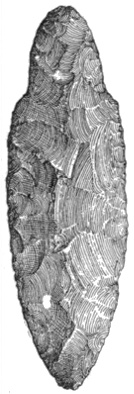
Fig. 213.—Stemmed chipped flint, ovoid.
The type which is shown in figure 213 is from Dane county, Wisconsin. This group also is widely distributed, being found in southern and southwestern Wisconsin; northeastern Kentucky; southwestern Illinois; Miami and Scioto valleys, Ohio, and the central part of the same state; northeastern, central, and southeastern Arkansas; western North Carolina; and Kanawha valley.
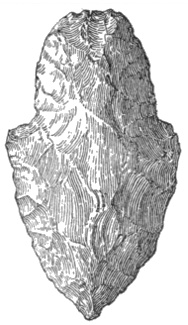
Fig. 214.—Stemmed chipped flint, short blade.
O. Differing from group N only in having longer stems and shorter blades, the latter sometimes less than an inch. Illustrated in figure 214 (from Kanawha valley). Found also in Scioto valley and in central Ohio; southwestern Wisconsin; southwestern Arkansas; and southwestern Georgia.
P. Convex edges; square shoulders; stem forming a quite regular and continuous curve, slightly expanding in some specimens. The one shown in figure 215, from Kanawha valley, West Virginia, has the most symmetric outline of any specimen in the entire collection. There are other specimens from Kanawha valley, and also from northeastern Kentucky; Miami valley, Ohio; Washington county, Pennsylvania; eastern and western Tennessee; southwestern Illinois; and southeastern Arkansas.
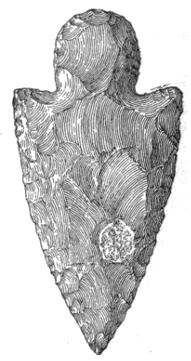
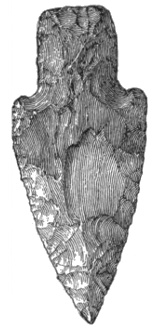
Fig. 215.—Stemmed chipped flint, symmetric outline.
Fig. 216.—Stemmed chipped flint.
Q. Similar to group P except that stem and base are straight. They are symmetric and well finished, vary more in size than those of the last group, being from 1¼ to 4¼ inches long, the others not reaching either of these limits.
The type (figure 216) comes from Knox county, Ohio, and other specimens from Miami valley and central Ohio; Keokuk, Iowa; northeastern Kentucky; Kanawha valley; eastern and western Tennessee; eastern, southeastern, and southwestern Arkansas; eastern and southwestern Wisconsin; northwestern Georgia; and southwestern Illinois.
R. Edges generally convex, sometimes straight; base straight or convex, only rarely concave; shoulders usually square, sometimes rounded; stem expanding by straight lines. From less than an inch to 3½ inches long, mostly about the medium.
The form, which resembles that shown in figure 216 in a general way, is widely distributed, its range including Keokuk, Iowa; Miami and Scioto valleys, Ohio; Bibb county and Savannah, Georgia, as well as the northwestern part of the state; eastern Tennessee; Kanawha valley, West Virginia; southeastern and southwestern Arkansas; southwestern Illinois, and Brown county in the same state; northeastern Kentucky; southern and southwestern Wisconsin; western and central North Carolina; and northeastern Alabama.
S. Differing from group Q in having the blade short, stem long (in some cases longer than blade), and only slight shoulders. Base somewhat convex in a few specimens; from an inch to 2¼ inches in length. From Kanawha valley; northwestern Georgia; Miami and Scioto valleys, Ohio; southwestern Arkansas; southern Wisconsin; and northeastern Alabama.
Beginning with those of group N and ending with those last described, all the best worked and most finely finished specimens are from Kanawha valley, West Virginia; northeastern Kentucky, and the central and southern parts of Ohio.
T. Convex edges; square shoulders; slender; very long and slender tapering or straight stem, coming almost to a point at the base. Illustrated in figure 217 (from Kanawha valley). Others are from central North Carolina; Kanawha valley; southwestern Arkansas; and Catahoula parish, Louisiana. The specimens from the two latter districts have the stem wider and less pointed than the others.
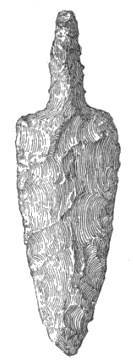
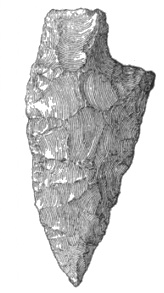
Fig. 217.—Chipped flint, with very long, slender stem.
Fig. 218.—Stemmed chipped flint, with but one barb or shoulder.
U. With one large, much expanded shoulder, the other being absent or very slight; both edges convex, or one convex and the other straight; stem sometimes straight, but usually tapering, being almost pointed in some; base usually convex, sometimes straight, rarely concave. A specimen from Ross county, Ohio, has the base deeply notched; it seems to have been symmetrical originally, and one barb or shoulder being broken, to have had that edge dressed down. Many were thus reworked, but in most cases it is evident that the form is original. Some are slender, others broad.
The type shown in figure 218 is from Bowie county, Texas. Other examples are from southwestern Arkansas; Catahoula parish, Louisiana; Scioto valley, Ohio; Kanawha valley; western and central North Carolina; eastern Tennessee; South Carolina; northeastern Alabama; as well as from northwestern Georgia and about Savannah.
EXPANDING STEMS.
In this class of flints the stem is expanding, unless the contrary is stated. The majority of specimens having barbs belong to this class; while those with straight or tapering stem usually have only square or rounded shoulders, the barb seldom appearing.
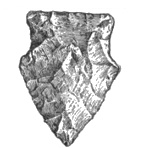
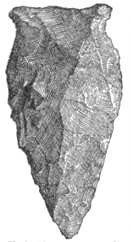
Fig. 219.—Stemmed chipped flint, short.
Fig. 220.—Stemmed chipped flint.
A. Short and broad; base usually straight, sometimes convex, rarely concave; notched in from edges to form the stem; very seldom with well-defined shoulders, and never barbed. The type, illustrated in figure 219, is from Kanawha valley, West Virginia. Found also in northeastern Kentucky; western North Carolina; northwestern Georgia and about Savannah; eastern Tennessee; Coosa valley, Alabama; and Union county, Mississippi.
B. Edges convex, seldom straight; base straight or rarely convex or concave; notched in on edges close to base, so as to leave a slight tang; thin and well worked; from an inch to 2¼ inches long. All from Savannah have concave bases; a few are notched so as to have slight shoulders, and they are somewhat larger than from other localities. They fit better in this group, however, than in any other. A typical example, shown in figure 220, is from Montgomery county, North Carolina. Others are from central North Carolina; eastern Tennessee; southwestern Illinois; various localities in South Carolina; and about Savannah, Georgia.
C. Roughly made; unsymmetrical, seemingly made hastily; of various patterns, including all the common shapes. Nearly all with convex edges, few straight, none concave. Base straight or concave, often the natural surface or fracture of the stone. Sometimes made from the tip of a broken larger specimen. From 1 to 5 inches long; slender or wide; usually thick, except when made from a thin flake. Edges notched just at the base in some, leaving a slight tang; others have the corners chipped out. This group is quite variable in size and in character of workmanship, as well as in form. The material also is variable.
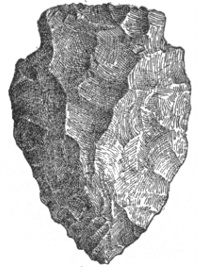
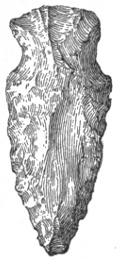
Fig. 221.—Stemmed chipped flint, roughly made.
Fig. 222.—Stemmed chipped flint.
The types (figures 221 and 222) are, respectively, from Bledsoe and Polk counties, Tennessee. The range includes eastern Tennessee; Kanawha valley; western North Carolina; eastern and southwestern Wisconsin; northeastern Alabama and Tuscaloosa valley; South Carolina; southwestern and northeastern Arkansas; central Ohio and Scioto valley; northeastern Kentucky; and southwestern Georgia, as well as Savannah.
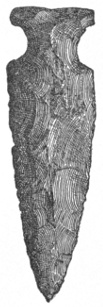
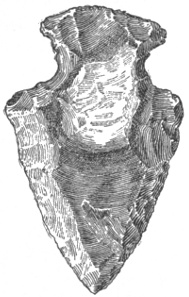
Fig. 223.—Stemmed chipped flint.
Fig. 224.—Stemmed chipped flint, edges convex.
D. Edges convex, rarely straight; base straight or convex; slender; from 1¼ to 4 inches long; usually thin; deeply notched, with edges worked close to base, leaving the latter as wide as the blade, or nearly so. This form could be quite firmly attached to a shaft or handle. It is illustrated by figure 223, representing one of the specimens from Kanawha valley. It is found also in southwestern Illinois and Brown county in the same state; eastern, southern, and southwestern Wisconsin; western and central North Carolina; eastern Tennessee; northwestern Georgia; central Ohio and Scioto valley; southeastern Arkansas; northeastern Kentucky; and Coosa and Tuscaloosa valleys, Alabama.
E. Edges convex; base straight or convex; shoulders square or rounded; stem expanding by curved lines. A few are small enough for arrows, but most of them are large or of medium size. The specimen from Vernon county, Wisconsin, illustrated in figure 224, is representative. The group is characteristic of southwestern Wisconsin; Kanawha valley; central Ohio and Scioto valley; western and central North Carolina; eastern Tennessee; southeastern and southwestern Arkansas; southwestern Illinois; South Carolina; Coosa valley, Alabama; and Savannah, Georgia.
F. Edges straight or convex; long barbs, sometimes reaching to the base; stem straight or slightly tapering; base straight, or very slightly convex or concave, usually well finished. One barb is sometimes longer than the other, or the stem may be to one side of the center line. Sometimes made of a flake, the flat side being left untouched.
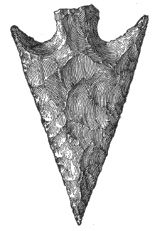
Fig. 225.—Stemmed chipped flint, with long barbs.
The type shown in figure 225 is from Madison county, Alabama. It is found generally in northeastern and northwestern Alabama, and also in eastern Tennessee; Kanawha valley; Keokuk, Iowa; Holt county, Missouri; southwestern Illinois and Brown county in the same state; northwestern Georgia and about Savannah; southeastern and southwestern Arkansas; northeastern Kentucky, and western and central North Carolina.
G. Similar to the last, but with stem expanding by straight or curved lines; base always straight in larger specimens, sometimes convex or concave in smaller ones. Barbs varying in length, short in some and reaching nearly to the base in others. From three-fourths to 3¾ inches in length, and varying much in width.
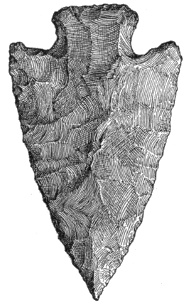
Fig. 226.—Stemmed chipped flint.
Figure 226 represents a typical example from Jackson county, Illinois. The range, which is quite wide, includes southwestern Illinois; northeastern, southwestern, and southeastern Arkansas; Miami and Scioto valleys, and central Ohio; southern and southwestern Wisconsin; western and central North Carolina; eastern Tennessee; South Carolina; northeastern Kentucky; Kanawha valley; and Savannah, Georgia.
H. Wide blade; short; convex edges; square shoulders or slight barbs; base convex or concave; stem broad and expanding by curved lines; generally thick. Those with convex base are all of medium size, while those with concave base range from an inch to 4 inches in length.
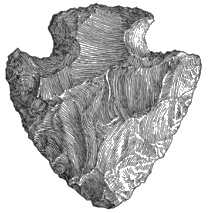
Fig. 227.—Stemmed chipped flint.
The form is indicated in figure 227, representing a good specimen from Dane county, Wisconsin. It is found over southern Wisconsin; northeastern Alabama and Coosa valley; southwestern Illinois and Brown county in the same state; central North Carolina; northwestern Georgia and about Savannah; eastern Tennessee; Miami and Scioto valleys, Ohio; Kanawha valley; southwestern Arkansas; South Carolina; and Keokuk, Iowa.
I. Edges parallel, or nearly so most of the length, with abrupt curve to the point; base straight or slightly convex; stem expanding by straight or curved lines; notched in from the corners of the base giving long barbs, which, in a few, project slightly beyond the line of edges; thin; well worked; from 2 to 4 inches long.
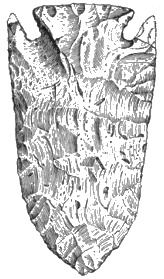
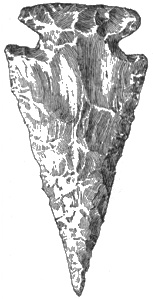
Fig. 228.—Stemmed chipped flint, broad point.
Fig. 229.—Stemmed chipped flint, slender point.
The specimen illustrated in figure 228 is from Dane county, Wisconsin, and there are several others from southern Wisconsin; southwestern Illinois; Scioto valley, Ohio; and Kanawha valley, West Virginia.
Fig. 230.—Stemmed chipped flint.
J. Edges convex or sometimes straight; base straight or slightly convex. Notched in on the edges, leaving the stem nearly or quite as wide at the bottom as the blade; corners of the base square or slightly rounded. Mostly small, suitable for arrows, though a few are larger, up to 3¼ inches. A few of these have the base polished. Some of the small ones are made of flakes having the natural, conchoidal shape and worked on one side only. Typical forms, shown in figures 229 and 230, are from Kanawha valley, and Nicholas county, Kentucky, respectively. The distribution extends also over southern and southwestern Wisconsin; Miami valley, Ohio; Holt county, Missouri; northeastern Kentucky; Brown county, Illinois; southwestern Arkansas; Coosa valley, Alabama; eastern Tennessee, and about Savannah, Georgia.
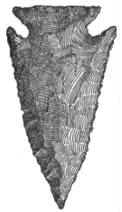
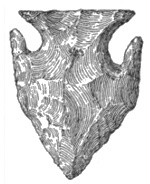
Fig. 231.—Stemmed chipped flint.
Fig. 232.—Stemmed chipped flint, thin.
K. Straight or convex edges (a few serrated or beveled); base straight, sometimes polished; notched in from the corners so as to give sharp barbs, with wide stem expanding by straight lines. Medium size. Illustrated in figure 231 (Bradley county, Tennessee). Found in eastern Tennessee; southwestern Illinois; Scioto valley; Kanawha valley; South Carolina; and about Savannah, Georgia.
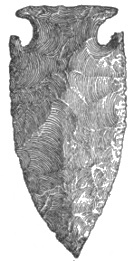
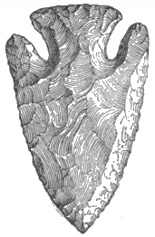
Fig. 233.—Stemmed chipped flint.
Fig. 234.—Stemmed chipped flint.
L. Very thin; well worked; usually quite symmetrical; base straight or slightly concave; stem expanding by curved lines; with shoulders or barbs; base with sharp tangs. Some specimens quite slender, others almost as wide as long. Few are above two inches in length. The edge is sometimes a broken line instead of a regular curve. The form is shown in figures 232 and 233, representing specimens from Lawrence county, Ohio, and Loudon county, Tennessee, respectively. Others are from Kanawha valley; Miami and Scioto valleys, Ohio; eastern Tennessee; western and central North Carolina; Union county, Mississippi; northeastern Kentucky; and southwestern Illinois.
M. Convex edges; usually quite symmetric; base generally straight, although sometimes convex or concave; stem expanding by straight or curved lines, and notched in from the corners by a narrow notch whose sides are parallel. Sometimes beveled (or feathered). The barb as well as the notch of the same width throughout its entire length. The type (figure 234) is from Knox county, Ohio, and similar forms come from central Ohio; Kanawha valley; western North Carolina; southern Wisconsin; southwestern Illinois; South Carolina; eastern Tennessee; and Savannah, Georgia.
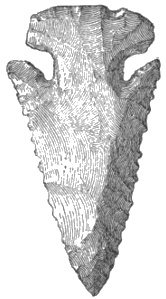
Fig. 235.—Stemmed chipped flint.
N. Straight, or rarely convex, edges; base straight or slightly curved, with rounded corners; notched in on the edges above the corners, with sharp barbs. Nearly every specimen is beveled, and some are serrated. Base polished in many of them even when slightly concave. A good example from Ross county, Ohio, is represented in figure 235. Others are from Miami and Scioto valleys and elsewhere in Ohio, as well as from Kanawha valley; eastern Tennessee; northwestern Alabama; southwestern Georgia, and about Savannah in the same state. The style of chipping is frequently such as to give serrated edges, as in the specimen figured.