STEAM
Reading edition
When a given weight of a perfect gas is compressed or expanded at a constant temperature, the product of the pressure and volume is a constant. Vapors, which are liquids in aeriform condition, on the other hand, can exist only at a definite pressure corresponding to each temperature if in the saturated state, that is, the pressure is a function of the temperature only. Steam is water vapor, and at a pressure of, say, 150 pounds absolute per square inch saturated steam can exist only at a temperature 358 degrees Fahrenheit. Hence if the pressure of saturated steam be fixed, its temperature is also fixed, and vice versa .
Saturated steam is water vapor in the condition in which it is generated from water with which it is in contact. Or it is steam which is at the maximum pressure and density possible at its temperature. If any change be made in the temperature or pressure of steam, there will be a corresponding change in its condition. If the pressure be increased or the temperature decreased, a portion of the steam will be condensed. If the temperature be increased or the pressure decreased, a portion of the water with which the steam is in contact will be evaporated into steam. Steam will remain saturated just so long as it is of the same pressure and temperature as the water with which it can remain in contact without a gain or loss of heat. Moreover, saturated steam cannot have its temperature lowered without a lowering of its pressure, any loss of heat being made up by the latent heat of such portion as will be condensed. Nor can the temperature of saturated steam be increased except when accompanied by a corresponding increase in pressure, any added heat being expended in the evaporation into steam of a portion of the water with which it is in contact.
Dry saturated steam contains no water. In some cases, saturated steam is accompanied by water which is carried along with it, either in the form of a spray or is blown along the surface of the piping, and the steam is then said to be wet. The percentage weight of the steam in a mixture of steam and water is called the quality of the steam. Thus, if in a mixture of 100 pounds of steam and water there is three-quarters of a pound of water, the quality of the steam will be 99.25.
Heat may be added to steam not in contact with water, such an addition of heat resulting in an increase of temperature and pressure if the volume be kept constant, or an increase in temperature and volume if the pressure remain constant. Steam whose temperature thus exceeds that of saturated steam at a corresponding pressure is said to be superheated and its properties approximate those of a perfect gas.
As pointed out in the chapter on heat, the heat necessary to raise one pound of water from 32 degrees Fahrenheit to the point of ebullition is called the heat of the liquid . The heat absorbed during ebullition consists of that necessary to dissociate the molecules, or the inner latent heat , and that necessary to overcome the resistance to the increase in volume, or the outer latent heat . These two make up the latent heat of evaporation and the sum of this latent heat of evaporation and the heat of the liquid make the total heat of the steam. These values for various pressures are given in the steam tables , pages 122 to 127 .
The specific volume of saturated steam at any pressure is the volume in cubic feet of one pound of steam at that pressure.
The density of saturated steam, that is, its weight per cubic foot, is obviously the reciprocal of the specific volume. This density varies as the 16 ⁄ 17 power over the [Pg 116] ordinary range of pressures used in steam boiler work and may be found by the formula, D = .003027 p .941 , which is correct within 0.15 per cent up to 250 pounds pressure.
The relative volume of steam is the ratio of the volume of a given weight to the volume of the same weight of water at 39.2 degrees Fahrenheit and is equal to the specific volume times 62.427.
As vapors are liquids in their gaseous form and the boiling point is the point of change in this condition, it is clear that this point is dependent upon the pressure under which the liquid exists. This fact is of great practical importance in steam condenser work and in many operations involving boiling in an open vessel, since in the latter case its altitude will have considerable influence. The relation between altitude and boiling point of water is shown in Table 12 .
The conditions of feed temperature and steam pressure in boiler tests, fuel performances and the like, will be found to vary widely in different trials. In order to secure a means for comparison of different trials, it is necessary to reduce all results to some common basis. The method which has been adopted for the reduction to a comparable basis is to transform the evaporation under actual conditions of steam pressure and feed temperature which exist in the trial to an equivalent evaporation under a set of standard conditions. These standard conditions presuppose a feed water temperature of 212 degrees Fahrenheit and a steam pressure equal to the normal atmospheric pressure at sea level, 14.7 pounds absolute. Under such conditions steam would be generated at a temperature of 212 degrees, the temperature corresponding to atmospheric pressure at sea level, from water at 212 degrees. The weight of water which would be evaporated under the assumed standard conditions by exactly the amount of heat absorbed by the boiler under actual conditions existing in the trial, is, therefore, called the equivalent evaporation “from and at 212 degrees.”
The factor for reducing the weight of water actually converted into steam from the temperature of the feed, at the steam pressure existing in the trial, to the equivalent evaporation under standard conditions is called the factor of evaporation. This factor is the ratio of the total heat added to one pound of steam under the standard conditions to the heat added to each pound of steam in heating the water from the temperature of the feed in the trial to the temperature corresponding to the pressure existing in the trial. This heat added is obviously the difference between the total heat of evaporation of the steam at the pressure existing in the trial and the heat of the liquid in the water at the temperature at which it was fed in the trial. To illustrate by an example:
In a boiler trial the temperature of the feed water is 60 degrees Fahrenheit and the pressure under which steam is delivered is 160.3 pounds gauge pressure or 175 pounds absolute pressure. The total heat of one pound of steam at 175 pounds pressure is 1195.9 B. t. u. measured above the standard temperature of 32 degrees Fahrenheit. But the water fed to the boiler contained 28.08 B. t. u. as the heat of the liquid measured above 32 degrees Fahrenheit. Therefore, to each pound of steam there has been added 1167.82 B. t. u. To evaporate one pound of water under standard conditions would, on the other hand, have required but 970.4 B. t. u., which, as described, is the latent heat of evaporation at 212 degrees Fahrenheit. Expressed differently, the total heat of one pound of steam at the pressure corresponding to a temperature of 212 degrees is 1150.4 B. t. u. One pound of water at 212 degrees [Pg 117] contains 180 B. t. u. of sensible heat above 32 degrees Fahrenheit. Hence, under standard conditions, 1150.4 - 180 = 970.4 B. t. u. is added in the changing of one pound of water into steam at atmospheric pressure and a temperature of 212 degrees. This is in effect the definition of the latent heat of evaporation.
Hence, if conditions of the trial had been standard, only 970.4 B. t. u. would be required and the ratio of 1167.82 to 970.4 B. t. u. is the ratio determining the factor of evaporation. The factor in the assumed case is 1167.82 ÷ 970.4 = 1.2034 and if the same amount of heat had been absorbed under standard conditions as was absorbed in the trial condition, 1.2034 times the amount of steam would have been generated. Expressed as a formula for use with any set of conditions, the factor is,
F = H − h –––––––––– 970.4 ( 2 )
Where H = the total heat of steam above 32 degrees Fahrenheit from steam tables,
h = sensible heat of feed water above 32 degrees Fahrenheit from Table 22 .
In the form above, the factor may be determined with either saturated or superheated steam, provided that in the latter case values of H are available for varying degrees of superheat and pressures.
Where such values are not available, the form becomes,
F = H − h + s ( t sup − t sat ) –––––––––––––––––––––––––––––––––– 970.4 ( 3 )
Where s = mean specific heat of superheated steam at the pressure existing in the trial from saturated steam to the temperature existing in the trial,
t sup = final temperature of steam,
t sat = temperature of saturated steam, corresponding to pressure existing,
( t sup − t sat ) = degrees of superheat.
The specific heat of superheated steam will be taken up later.
Table 19 gives factors of evaporation for saturated steam boiler trials to cover a large range of conditions. Except for the most refined work, intermediate values may be determined by interpolation.
Steam gauges indicate the pressure above the atmosphere. As has been pointed out, the atmospheric pressure changes according to the altitude and the variation in the barometer. Hence, calculations involving the properties of steam are based on absolute pressures, which are equal to the gauge pressure plus the atmospheric pressure in pounds to the square inch. This latter is generally assumed to be 14.7 pounds per square inch at sea level, but for other levels it must be determined from the barometric reading at that place.
Vacuum gauges indicate the difference, expressed in inches of mercury, between atmospheric pressure and the pressure within the vessel to which the gauge is attached. For approximate purposes, 2.04 inches height of mercury may be considered equal to a pressure of one pound per square inch at the ordinary temperatures at which mercury gauges are used. Hence for any reading of the vacuum gauge in inches, G, the absolute pressure for any barometer reading in inches, B, will be (B - G) ÷ 2.04. If the barometer is 30 inches measured at ordinary temperatures and not corrected to 32 degrees Fahrenheit and the vacuum gauge 24 inches, the absolute pressure will be (30 - 24) ÷ 2.04 = 2.9 pounds per square inch.
[Pg 118]
TABLE 19 FACTORS OF EVAPORATION CALCULATED FROM MARKS AND DAVIS TABLES Feed Temp- erature Degrees Fahren- heit Steam Pressure by Gauge 50 60 70 80 90 100 110 120 130 140 150 160 170 180 190 200 210 220 230 240 250 32 1.2143 1.2170 1.2194 1.2215 1.2233 1.2233 1.2265 1.2280 1.2292 1.2304 1.2314 1.2323 1.2333 1.2342 1.2350 1.2357 1.2364 1.2372 1.2378 1.2384 1.2390 40 1.2060 1.2087 1.2111 1.2131 1.2150 1.2168 1.2181 1.2196 1.2209 1.2221 1.2231 1.2241 1.2250 1.2259 1.2267 1.2274 1.2282 1.2289 1.2295 1.2301 1.2307 50 1.1957 1.1984 1.2008 1.2028 1.2047 1.2065 1.2079 1.2093 1.2106 1.2117 1.2128 1.2137 1.2147 1.2156 1.2164 1.2171 1.2178 1.2186 1.2192 1.2198 1.2204 60 1.1854 1.1881 1.1905 1.1925 1.1944 1.1961 1.1976 1.1990 1.2003 1.2014 1.2025 1.2034 1.2044 1.2053 1.2061 1.2068 1.2075 1.2083 1.2089 1.2095 1.2101 70 1.1750 1.1778 1.1802 1.1822 1.1841 1.1859 1.1873 1.1887 1.1900 1.1911 1.1922 1.1931 1.1941 1.1950 1.1958 1.1965 1.1972 1.1980 1.1986 1.1992 1.1998 80 1.1649 1.1675 1.1699 1.1720 1.1738 1.1756 1.1770 1.1785 1.1797 1.1809 1.1819 1.1828 1.1838 1.1847 1.1855 1.1863 1.1869 1.1877 1.1883 1.1889 1.1895 90 1.1545 1.1572 1.1596 1.1617 1.1636 1.1653 1.1668 1.1682 1.1695 1.1706 1.1717 1.1725 1.1735 1.1744 1.1750 1.1760 1.1766 1.1774 1.1780 1.1786 1.1792 100 1.1443 1.1470 1.1493 1.1514 1.1533 1.1550 1.1565 1.1579 1.1592 1.1603 1.1614 1.1623 1.1633 1.1642 1.1650 1.1657 1.1664 1.1671 1.1678 1.1684 1.1690 110 1.1340 1.1367 1.1391 1.1411 1.1430 1.1448 1.1462 1.1477 1.1489 1.1500 1.1511 1.1520 1.1530 1.1539 1.1547 1.1554 1.1562 1.1569 1.1575 1.1581 1.1587 120 1.1237 1.1264 1.1288 1.1309 1.1327 1.1345 1.1359 1.1374 1.1386 1.1398 1.1408 1.1418 1.1427 1.1436 1.1444 1.1452 1.1459 1.1466 1.1472 1.1478 1.1484 130 1.1134 1.1161 1.1185 1.1206 1.1225 1.1242 1.1257 1.1271 1.1284 1.1295 1.1305 1.1315 1.1324 1.1333 1.1341 1.1349 1.1356 1.1363 1.1369 1.1375 1.1381 140 1.1031 1.1058 1.1082 1.1103 1.1122 1.1139 1.1154 1.1168 1.1181 1.1192 1.1203 1.1212 1.1221 1.1230 1.1239 1.1246 1.1253 1.1260 1.1266 1.1272 1.1278 150 1.0928 1.0955 1.0979 1.1000 1.1019 1.1036 1.1051 1.1065 1.1078 1.1089 1.1099 1.1109 1.1118 1.1127 1.1136 1.1143 1.1150 1.1157 1.1163 1.1169 1.1176 160 1.0825 1.0852 1.0876 1.0897 1.0916 1.0933 1.0948 1.0962 1.0975 1.0986 1.0997 1.1006 1.1015 1.1024 1.1033 1.1040 1.1047 1.1054 1.1060 1.1066 1.1073 170 1.0722 1.0749 1.0773 1.0794 1.0813 1.0830 1.0845 1.0859 1.0872 1.0883 1.0893 1.0903 1.0912 1.0921 1.0930 1.0937 1.0944 1.0951 1.0957 1.0963 1.0969 180 1.0619 1.0646 1.0670 1.0691 1.0709 1.0727 1.0741 1.0756 1.0768 1.0780 1.0790 1.0800 1.0809 1.0818 1.0826 1.0834 1.0841 1.0848 1.0854 1.0860 1.0866 190 1.0516 1.0543 1.0567 1.0587 1.0606 1.0624 1.0638 1.0653 1.0665 1.0676 1.0687 1.0696 1.0706 1.0715 1.0723 1.0730 1.0737 1.0745 1.0751 1.0757 1.0763 200 1.0412 1.0439 1.0463 1.0484 1.0503 1.0520 1.0535 1.0549 1.0562 1.0573 1.0584 1.0593 1.0602 1.0611 1.0620 1.0627 1.0634 1.0641 1.0647 1.0653 1.0660 210 1.0309 1.0336 1.0360 1.0380 1.0399 1.0417 1.0432 1.0446 1.0458 1.0469 1.0480 1.0489 1.0499 1.0508 1.0516 1.0523 1.0530 1.0538 1.0544 1.0550 1.0556
[Pg 119]
The temperature, pressure and other properties of steam for varying amounts of vacuum and the pressure above vacuum corresponding to each inch of reading of the vacuum gauge are given in Table 20 .
TABLE 20 PROPERTIES OF SATURATED STEAM FOR VARYING AMOUNTS OF VACUUM CALCULATED FROM MARKS AND DAVIS TABLE Vacuum Ins. Hg. Absolute Pressure Pounds Temperature Degrees Fahrenheit Heat of the Liquid Above 32 Degrees B. t. u. Latent Heat Above 32 Degrees B. t. u. Total Heat Above 32 Degrees B. t. u. Density or Weight per Cubic Foot Pounds 29.5 .207 54.1 22.18 1061.0 1083.2 0.000678 29 .452 76.6 44.64 1048.7 1093.3 0.001415 28.5 .698 90.1 58.09 1041.1 1099.2 0.002137 28 .944 99.9 67.87 1035.6 1103.5 0.002843 27 1.44 112.5 80.4 1028.6 1109.0 0.00421 26 1.93 124.5 92.3 1022.0 1114.3 0.00577 25 2.42 132.6 100.5 1017.3 1117.8 0.00689 24 2.91 140.1 108.0 1013.1 1121.1 0.00821 22 3.89 151.7 119.6 1006.4 1126.0 0.01078 20 4.87 161.1 128.9 1001.0 1129.9 0.01331 18 5.86 168.9 136.8 996.4 1133.2 0.01581 16 6.84 175.8 143.6 992.4 1136.0 0.01827 14 7.82 181.8 149.7 988.8 1138.5 0.02070 12 8.80 187.2 155.1 985.6 1140.7 0.02312 10 9.79 192.2 160.1 982.6 1142.7 0.02554 5 12.24 202.9 170.8 976.0 1146.8 0.03148
From the steam tables , the condensed Table 21 of the properties of steam at different pressures may be constructed. From such a table there may be drawn the following conclusions.
TABLE 21 VARIATION IN PROPERTIES OF SATURATED STEAM WITH PRESSURE Pressure Pounds Absolute Temperature Degrees Fahrenheit Heat of Liquid B. t. u. Latent Heat B. t. u. Total Heat B. t. u. 14.7 212.0 180.0 970.4 1150.4 20.0 228.0 196.1 960.0 1156.2 100.0 327.8 298.3 888.0 1186.3 300.0 417.5 392.7 811.3 1204.1
As the pressure and temperature increase, the latent heat decreases. This decrease, however, is less rapid than the corresponding increase in the heat of the liquid and hence the total heat increases with an increase in the pressure and temperature. The percentage increase in the total heat is small, being 0.5, 3.1, and 4.7 per cent for 20, 100, and 300 pounds absolute pressure respectively above the total heat in one pound of steam at 14.7 pounds absolute. The temperatures, on the other hand, increase at the rates of 7.5, 54.6, and 96.9 per cent. The efficiency of a perfect steam engine is proportional to the expression ( t - t 1 )/ t in which t and t 1 are the absolute temperatures of the saturated steam at admission and exhaust respectively. While actual engines only approximate the ideal engine in efficiency, yet they follow the same general law. Since the exhaust temperature cannot be lowered beyond present practice, it follows that the only available method of increasing the efficiency is by an increase in the temperature of the steam at admission. How this may be [Pg 120] accomplished by an increase of pressure is clearly shown, for the increase of fuel necessary to increase the pressure is negligible, as shown by the total heat, while the increase in economy, due to the higher pressure, will result directly from the rapid increase of the corresponding temperature.
TABLE 22 HEAT UNITS PER POUND AND WEIGHT PER CUBIC FOOT OF WATER BETWEEN 32 DEGREES FAHRENHEIT AND 340 DEGREES FAHRENHEIT Temp- erature Degrees Fahren- heit Heat Units per Pound Weight per Cubic Foot Temp- erature Degrees Fahren- heit Heat Units per Pound Weight per Cubic Foot Temp- erature Degrees Fahren- heit Heat Units per Pound Weight per Cubic Foot Temp- erature Degrees Fahren- heit Heat Units per Pound Weight per Cubic Foot 32 0.00 62.42 89 57.00 62.13 146 113.86 61.27 203 170.95 60.05 33 1.01 62.42 90 58.00 62.12 147 114.86 61.25 204 171.96 60.02 34 2.01 62.42 91 59.00 62.11 148 115.86 61.24 205 172.96 60.00 35 3.02 62.43 92 60.00 62.09 149 116.86 61.22 206 173.97 59.98 36 4.03 62.43 93 60.99 62.08 150 117.86 61.20 207 174.97 59.95 37 5.04 62.43 94 61.99 62.07 151 118.86 61.18 208 175.98 59.93 38 6.04 62.43 95 62.99 62.06 152 119.86 61.16 209 176.98 59.90 39 7.05 62.43 96 63.98 62.05 153 120.86 61.14 210 177.99 59.88 40 8.05 62.43 97 64.98 62.04 154 121.86 61.12 211 178.99 59.85 41 9.05 62.43 98 65.98 62.03 155 122.86 61.10 212 180.00 59.83 42 10.06 62.43 99 66.97 62.02 156 123.86 61.08 213 181.0 59.80 43 11.06 62.43 100 67.97 62.00 157 124.86 61.06 214 182.0 59.78 44 12.06 62.43 101 68.97 61.99 158 125.86 61.04 215 183.0 59.75 45 13.07 62.42 102 69.96 61.98 159 126.86 61.02 216 184.0 59.73 46 14.07 62.42 103 70.96 61.97 160 127.86 61.00 217 185.0 59.70 47 15.07 62.42 104 71.96 61.95 161 128.86 60.98 218 186.1 59.68 48 16.07 62.42 105 72.95 61.94 162 129.86 60.96 219 187.1 59.65 49 17.08 62.42 106 73.95 61.93 163 130.86 60.94 220 188.1 59.63 50 18.08 62.42 107 74.95 61.91 164 131.86 60.92 221 189.1 59.60 Temp- erature Degrees Fahren- heit Heat Units per Pound Weight per Cubic Foot Temp- erature Degrees Fahren- heit Heat Units per Pound Weight per Cubic Foot Temp- erature Degrees Fahren- heit Heat Units per Pound Weight per Cubic Foot Temp- erature Degrees Fahren- heit Heat Units per Pound Weight per Cubic Foot 51 19.08 62.41 108 75.95 61.90 165 132.86 60.90 222 190.1 59.58 52 20.08 62.41 109 76.94 61.88 166 133.86 60.88 223 191.1 59.55 53 21.08 62.41 110 77.94 61.86 167 134.86 60.86 224 192.1 59.53 54 22.08 62.40 111 78.94 61.85 168 135.86 60.84 225 193.1 59.50 55 23.08 62.40 112 79.93 61.83 169 136.86 60.82 226 194.1 59.48 56 24.08 62.39 113 80.93 61.82 170 137.87 60.80 227 195.2 59.45 57 25.08 62.39 114 81.93 61.80 171 138.87 60.78 228 196.2 59.42 58 26.08 62.38 115 82.92 61.79 172 139.87 60.76 229 197.2 59.40 59 27.08 62.37 116 83.92 61.77 173 140.87 60.73 230 198.2 59.37 60 28.08 62.37 117 84.92 61.75 174 141.87 60.71 231 199.2 59.34 61 29.08 62.36 118 85.92 61.74 175 142.87 60.69 232 200.2 59.32 62 30.08 62.36 119 86.91 61.72 176 143.87 60.67 233 201.2 59.29 63 31.07 62.35 120 87.91 61.71 177 144.88 60.65 234 202.2 59.27 64 32.07 62.35 121 88.91 61.69 178 145.88 60.62 235 203.2 59.24 65 33.07 62.34 122 89.91 61.68 179 146.88 60.60 236 204.2 59.21 66 34.07 62.33 123 90.90 61.66 180 147.88 60.58 237 205.3 59.19 67 35.07 62.33 124 91.90 61.65 181 148.88 60.56 238 206.3 59.16 68 36.07 62.32 125 92.90 61.63 182 149.89 60.53 239 207.3 59.14 69 37.06 62.31 126 93.90 61.61 183 150.89 60.51 240 208.3 59.11 Temp- erature Degrees Fahren- heit Heat Units per Pound Weight per Cubic Foot Temp- erature Degrees Fahren- heit Heat Units per Pound Weight per Cubic Foot Temp- erature Degrees Fahren- heit Heat Units per Pound Weight per Cubic Foot Temp- erature Degrees Fahren- heit Heat Units per Pound Weight per Cubic Foot 70 38.06 62.30 127 94.89 61.59 184 151.89 60.49 241 209.3 59.08 71 39.06 62.30 128 95.89 61.58 185 152.89 60.47 242 210.3 59.05 72 40.05 62.29 129 96.89 61.56 186 153.89 60.45 243 211.4 59.03 73 41.05 62.28 130 97.89 61.55 187 154.90 60.42 244 212.4 59.00 74 42.05 62.27 131 98.89 61.53 188 155.90 60.40 245 213.4 58.97 75 42.05 62.26 132 99.88 61.52 189 156.90 60.38 246 214.4 58.94 76 44.04 62.26 133 100.88 61.50 190 157.91 60.36 247 215.4 58.91 77 45.04 62.25 134 101.88 61.49 191 158.91 60.33 248 216.4 58.89 78 46.04 62.24 135 102.88 61.47 192 159.91 60.31 249 217.4 58.86 79 47.04 62.23 136 103.88 61.45 193 160.91 60.29 250 218.5 58.83 80 48.03 62.22 137 104.87 61.43 194 161.92 60.27 260 228.6 58.55 81 49.03 62.21 138 105.87 61.41 195 162.92 60.24 270 238.8 58.26 82 50.03 62.20 139 106.87 61.40 196 163.92 60.22 280 249.0 57.96 83 51.02 62.19 140 107.87 61.38 197 164.93 60.19 290 259.3 57.65 84 52.02 62.18 141 108.87 61.36 198 165.93 60.17 300 269.6 57.33 85 53.02 62.17 142 109.87 61.34 199 166.94 60.15 310 279.9 57.00 86 54.01 62.16 143 110.87 61.33 200 167.94 60.12 320 290.2 56.66 87 55.01 62.15 144 111.87 61.31 201 168.94 60.10 330 300.6 56.30 88 56.01 62.14 145 112.86 61.29 202 169.95 60.07 340 311.0 55.94
[Pg 121]
The gain due to superheat cannot be predicted from the formula for the efficiency of a perfect steam engine given on page 119 . This formula is not applicable in cases where superheat is present since only a relatively small amount of the heat in the steam is imparted at the maximum or superheated temperature.
The advantage of the use of high pressure steam may be also indicated by considering the question from the aspect of volume. With an increase of pressure comes a decrease in volume, thus one pound of saturated steam at 100 pounds absolute pressure occupies 4.43 cubic feet, while at 200 pounds pressure it occupies 2.29 cubic feet. If then, in separate cylinders of the same dimensions, one pound of steam at 100 pounds absolute pressure and one pound at 200 pounds absolute pressure enter and are allowed to expand to the full volume of each cylinder, the high-pressure steam, having more room and a greater range for expansion than the low-pressure steam, will thus do more work. This increase in the amount of work, as was the increase in temperature, is large relative to the additional fuel required as indicated by the total heat. In general, it may be stated that the fuel required to impart a given amount of heat to a boiler is practically independent of the steam pressure, since the temperature of the fire is so high as compared with the steam temperature that a variation in the steam temperature does not produce an appreciable effect.
The formulae for the algebraic expression of the relation between saturated steam pressures, temperatures and steam volumes have been up to the present time empirical. These relations have, however, been determined by experiment and, from the experimental data, tables have been computed which render unnecessary the use of empirical formulae. Such formulae may be found in any standard work of thermo-dynamics. The following tables cover all practical cases.
Table 22 gives the heat units contained in water above 32 degrees Fahrenheit at different temperatures.
Table 23 gives the properties of saturated steam for various pressures.
Table 24 gives the properties of superheated steam at various pressures and temperatures.
These tables are based on those computed by Lionel S. Marks and Harvey N. Davis, these being generally accepted as being the most correct.
[Pg 122]
TABLE 23 PROPERTIES OF SATURATED STEAM REPRODUCED BY PERMISSION FROM MARKS AND DAVIS “STEAM TABLES AND DIAGRAMS” (Copyright, 1909, by Longmans, Green & Co.) Pressure, Pounds Absolute Temperature Degrees F. Specific Volume Cu. Ft. per Pound Heat of the Liquid, B. t. u. Latent Heat of Evap., B. t. u. Total Heat of Steam, B. t. u. 1 101.83 333.0 69.8 1034.6 1104.4 2 126.15 173.5 94.0 1021.0 1115.0 3 141.52 118.5 109.4 1012.3 1121.6 4 153.01 90.5 120.9 1005.7 1126.5 5 162.28 73.33 130.1 1000.3 1130.5 6 170.06 61.89 137.9 995.8 1133.7 7 176.85 53.56 144.7 991.8 1136.5 8 182.86 47.27 150.8 988.2 1139.0 9 188.27 42.36 156.2 985.0 1141.1 10 193.22 38.38 161.1 982.0 1143.1 11 197.75 35.10 165.7 979.2 1144.9 12 201.96 32.36 169.9 976.6 1146.5 13 205.87 30.03 173.8 974.2 1148.0 14 209.55 28.02 177.5 971.9 1149.4 15 213.0 26.27 181.0 969.7 1150.7 16 216.3 24.79 184.4 967.6 1152.0 17 219.4 23.38 187.5 965.6 1153.1 18 222.4 22.16 190.5 963.7 1154.2 19 225.2 21.07 193.4 961.8 1155.2 20 228.0 20.08 196.1 960.0 1156.2 22 233.1 18.37 201.3 956.7 1158.0 24 237.8 16.93 206.1 953.5 1159.6 26 242.2 15.72 210.6 950.6 1161.2 28 246.4 14.67 214.8 947.8 1162.6 30 250.3 13.74 218.8 945.1 1163.9 32 254.1 12.93 222.6 942.5 1165.1 34 257.6 12.22 226.2 940.1 1166.3 36 261.0 11.58 229.6 937.7 1167.3 38 264.2 11.01 232.9 935.5 1168.4 40 267.3 10.49 236.1 933.3 1169.4 42 270.2 10.02 239.1 931.2 1170.3 44 273.1 9.59 242.0 929.2 1171.2 46 275.8 9.20 244.8 927.2 1172.0 48 278.5 8.84 247.5 925.3 1172.8 50 281.0 8.51 250.1 923.5 1173.6 52 283.5 8.20 252.6 921.7 1174.3 Pressure, Pounds Absolute Temperature Degrees F. Specific Volume Cu. Ft. per Pound Heat of the Liquid, B. t. u. Latent Heat of Evap., B. t. u. Total Heat of Steam, B. t. u. 54 285.9 7.91 255.1 919.9 1175.0 56 288.2 7.65 257.5 918.2 1175.7 58 290.5 7.40 259.8 916.5 1176.4 60 292.7 7.17 262.1 914.9 1177.0 62 294.9 6.95 264.3 913.3 1177.6 64 297.0 6.75 266.4 911.8 1178.2 66 299.0 6.56 268.5 910.2 1178.8 68 301.0 6.38 270.6 908.7 1179.3 70 302.9 6.20 272.6 907.2 1179.8 [Pg 123] 72 304.8 6.04 274.5 905.8 1180.4 74 306.7 5.89 276.5 904.4 1180.9 76 308.5 5.74 278.3 903.0 1181.4 78 310.3 5.60 280.2 901.7 1181.8 80 312.0 5.47 282.0 900.3 1182.3 82 313.8 5.34 283.8 899.0 1182.8 84 315.4 5.22 285.5 897.7 1183.2 86 317.1 5.10 287.2 896.4 1183.6 88 318.7 5.00 288.9 895.2 1184.0 90 320.3 4.89 290.5 893.9 1184.4 92 321.8 4.79 292.1 892.7 1184.8 94 323.4 4.69 293.7 891.5 1185.2 96 324.9 4.60 295.3 890.3 1185.6 98 326.4 4.51 296.8 889.2 1186.0 100 327.8 4.429 298.3 888.0 1186.3 105 331.4 4.230 302.0 885.2 1187.2 110 334.8 4.047 305.5 882.5 1188.0 115 338.1 3.880 309.0 879.8 1188.8 120 341.3 3.726 312.3 877.2 1189.6 125 344.4 3.583 315.5 874.7 1190.3 130 347.4 3.452 318.6 872.3 1191.0 135 350.3 3.331 321.7 869.9 1191.6 140 353.1 3.219 324.6 867.6 1192.2 145 355.8 3.112 327.4 865.4 1192.8 150 358.5 3.012 330.2 863.2 1193.4 155 361.0 2.920 332.9 861.0 1194.0 160 363.6 2.834 335.6 858.8 1194.5 Pressure, Pounds Absolute Temperature Degrees F. Specific Volume Cu. Ft. per Pound Heat of the Liquid, B. t. u. Latent Heat of Evap., B. t. u. Total Heat of Steam, B. t. u. 165 366.0 2.753 338.2 856.8 1195.0 170 368.5 2.675 340.7 854.7 1195.4 175 370.8 2.602 343.2 852.7 1195.9 180 373.1 2.533 345.6 850.8 1196.4 185 375.4 2.468 348.0 848.8 1196.8 190 377.6 2.406 350.4 846.9 1197.3 195 379.8 2.346 352.7 845.0 1197.7 200 381.9 2.290 354.9 843.2 1198.1 205 384.0 2.237 357.1 841.4 1198.5 210 386.0 2.187 359.2 839.6 1198.8 215 388.0 2.138 361.4 837.9 1199.2 220 389.9 2.091 363.4 836.2 1199.6 225 391.9 2.046 365.5 834.4 1199.9 230 393.8 2.004 367.5 832.8 1200.2 235 395.6 1.964 369.4 831.1 1200.6 240 397.4 1.924 371.4 829.5 1200.9 245 399.3 1.887 373.3 827.9 1201.2 250 401.1 1.850 375.2 826.3 1201.5 [Pg 124]
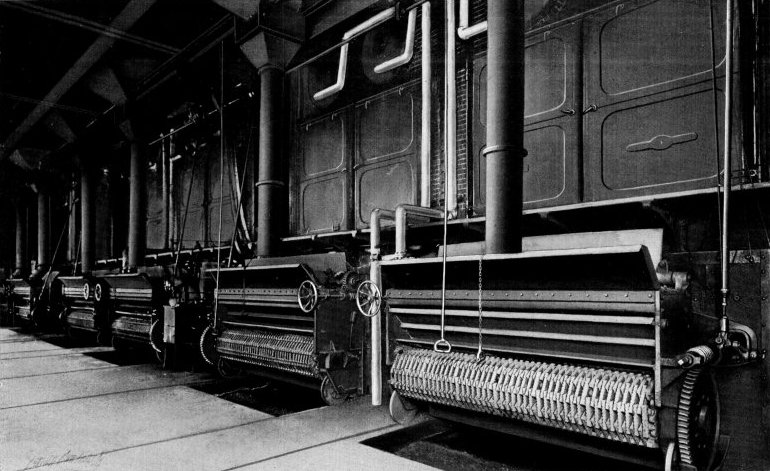
Portion of 6100 Horse-power Installation of Babcock & Wilcox Boilers Equipped with Babcock & Wilcox Chain Grate Stokers at the Campbell Street Plant of the Louisville Railway Co., Louisville, Ky. This Company Operates a Total of 14,000 Horse Power of Babcock & Wilcox Boilers
[Pg 125]
TABLE 24 PROPERTIES OF SATURATED STEAM REPRODUCED BY PERMISSION FROM MARKS AND DAVIS “STEAM TABLES AND DIAGRAMS” (Copyright, 1909, by Longmans, Green & Co.) Degrees of Superheat Pressure Pounds Absolute Saturated Steam 50 100 150 200 250 300 5 t v h 162.3 73.3 1130.5 212.3 79.7 1153.5 262.3 85.7 1176.4 312.3 91.8 1199.5 362.3 97.8 1222.5 412.3 103.8 1245.6 462.3 109.8 1268.7 10 t v h 193.2 38.4 1143.1 243.2 41.5 1166.3 293.2 44.6 1189.5 343.2 47.7 1212.7 393.2 50.7 1236.0 443.2 53.7 1259.3 493.2 56.7 1282.5 15 t v h 213.0 26.27 1150.7 263.0 28.40 1174.2 313.0 30.46 1197.6 363.0 32.50 1221.0 413.0 34.53 1244.4 463.0 36.56 1267.7 513.0 38.58 1291.1 20 t v h 228.0 20.08 1156.2 278.0 21.69 1179.9 328.0 23.25 1203.5 378.0 24.80 1227.1 428.0 26.33 1250.6 478.0 27.85 1274.1 528.0 29.37 1297.6 25 t v h 240.1 16.30 1160.4 290.1 17.60 1184.4 340.1 18.86 1208.2 390.1 20.10 1231.9 440.1 21.32 1255.6 490.1 22.55 1279.2 540.1 23.77 1302.8 30 t v h 250.4 13.74 1163.9 300.4 14.83 1188.1 350.4 15.89 1212.1 400.4 16.93 1236.0 450.4 17.97 1259.7 500.4 18.99 1283.4 550.4 20.00 1307.1 35 t v h 259.3 11.89 1166.8 309.3 12.85 1191.3 359.3 13.75 1215.4 409.3 14.65 1239.4 459.3 15.54 1263.3 509.3 16.42 1287.1 559.3 17.30 1310.8 40 t v h 267.3 10.49 1169.4 317.3 11.33 1194.0 367.3 12.13 1218.4 417.3 12.93 1242.4 467.3 13.70 1266.4 517.3 14.48 1290.3 567.3 15.25 1314.1 45 t v h 274.5 9.39 1171.6 324.5 10.14 1196.6 374.5 10.86 1221.0 424.5 11.57 1245.2 474.5 12.27 1269.3 524.5 12.96 1293.2 574.5 13.65 1317.0 50 t v h 281.0 8.51 1173.6 331.0 9.19 1198.8 381.0 9.84 1223.4 431.0 10.48 1247.7 481.0 11.11 1271.8 531.0 11.74 1295.8 581.0 12.36 1319.7 60 t v h 287.1 7.78 1175.4 337.1 8.40 1200.8 387.1 9.00 1225.6 437.1 9.59 1250.0 487.1 10.16 1274.2 537.1 10.73 1298.1 587.1 11.30 1322.0 Degrees of Superheat Pressure Pounds Absolute Saturated Steam 50 100 150 200 250 300 60 t v h 292.7 7.17 1177.0 342.7 7.75 1202.6 392.7 8.30 1227.6 442.7 8.84 1252.1 492.7 9.36 1276.4 542.7 9.89 1300.4 592.7 10.41 1324.3 65 t v h 298.0 6.65 1178.5 348.0 7.20 1204.4 398.0 7.70 1229.5 448.0 8.20 1254.0 498.0 8.69 1278.4 548.0 9.17 1302.4 598.0 9.65 1326.4 70 t v h 302.9 6.20 1179.8 352.9 6.71 1205.9 402.9 7.18 1231.2 452.9 7.65 1255.8 502.9 8.11 1280.2 552.9 8.56 1304.3 602.9 9.01 1328.3 75 t v h 307.6 5.81 1181.1 357.6 6.28 1207.5 407.6 6.73 1232.8 457.6 7.17 1257.5 507.6 7.60 1282.0 557.6 8.02 1306.1 607.6 8.44 1330.1 80 t v h 312.0 5.47 1182.3 362.0 5.92 1208.8 412.0 6.34 1234.3 462.0 6.75 1259.0 512.0 7.17 1283.6 562.0 7.56 1307.8 612.0 7.95 1331.9 85 t v h 316.3 5.16 1183.4 366.3 5.59 1210.2 416.3 6.99 1235.8 466.3 6.38 1260.6 516.3 6.76 1285.2 566.3 7.14 1309.4 616.3 7.51 1333.5 90 t v h 320.3 4.89 1184.4 370.3 5.29 1211.4 420.3 5.67 1237.2 470.3 6.04 1262.0 520.3 6.40 1286.6 570.3 6.76 1310.8 620.3 [Pg 126] 7.11 1334.9 95 t v h 324.1 4.65 1185.4 374.1 5.03 1212.6 424.1 5.39 1238.4 474.1 5.74 1263.4 524.1 6.09 1288.1 574.1 6.43 1312.3 624.1 6.76 1336.4 100 t v h 327.8 4.43 1186.3 377.8 4.79 1213.8 427.8 5.14 1239.7 477.8 5.47 1264.7 527.8 5.80 1289.4 577.8 6.12 1313.6 627.8 6.44 1337.8 105 t v h 331.4 4.23 1187.2 381.4 4.58 1214.9 431.4 4.91 1240.8 481.4 5.23 1265.9 531.4 5.54 1290.6 581.4 5.85 1314.9 631.4 6.15 1339.1 110 t v h 334.8 4.05 1188.0 384.8 4.38 1215.9 434.8 4.70 1242.0 484.8 5.01 1267.1 534.8 5.31 1291.9 584.8 5.61 1316.2 634.8 5.90 1340.4 Degrees of Superheat Pressure Pounds Absolute Saturated Steam 50 100 150 200 250 300 115 t v h 338.1 3.88 1188.8 388.1 4.20 1216.9 438.1 4.51 1243.1 488.1 4.81 1268.2 538.1 5.09 1293.0 588.1 5.38 1317.3 638.1 5.66 1341.5 120 t v h 341.3 3.73 1189.6 391.3 4.04 1217.9 441.3 4.33 1244.1 491.3 4.62 1269.3 541.3 4.89 1294.1 591.3 5.17 1318.4 641.3 5.44 1342.7 125 t v h 344.4 3.58 1190.3 394.4 3.88 1218.8 444.4 4.17 1245.1 494.4 4.45 1270.4 544.4 4.71 1295.2 594.4 4.97 1319.5 644.4 5.23 1343.8 130 t v h 347.4 3.45 1191.0 397.4 3.74 1219.7 447.4 4.02 1246.1 497.4 4.28 1271.4 547.4 4.54 1296.2 597.4 4.80 1320.6 647.4 5.05 1344.9 135 t v h 350.3 3.33 1191.6 400.3 3.61 1220.6 450.3 3.88 1247.0 500.3 4.14 1272.3 550.3 4.38 1297.2 600.3 4.63 1321.6 650.3 4.87 1345.9 140 t v h 353.1 3.22 1192.2 403.1 3.49 1221.4 453.1 3.75 1248.0 503.1 4.00 1273.3 553.1 4.24 1298.2 603.1 4.48 1322.6 653.1 4.71 1346.9 145 t v h 355.8 3.12 1192.8 405.8 3.38 1222.2 455.8 3.63 1248.8 505.8 3.87 1274.2 555.8 4.10 1299.1 605.8 4.33 1323.6 655.8 4.56 1347.9 150 t v h 358.5 3.01 1193.4 408.5 3.27 1223.0 458.5 3.50 1249.6 508.5 3.75 1275.1 558.5 3.97 1300.0 608.5 4.19 1324.5 658.5 4.41 1348.8 155 t v h 361.0 2.92 1194.0 411.0 3.17 1223.6 461.0 3.41 1250.5 511.0 3.63 1276.0 561.0 3.85 1300.8 611.0 4.06 1325.3 661.0 4.28 1349.7 160 t v h 363.6 2.83 1194.5 413.6 3.07 1224.5 463.6 3.30 1251.3 513.6 3.53 1276.8 563.6 3.74 1301.7 613.6 3.95 1326.2 663.6 4.15 1350.6 165 t v h 366.0 2.75 1195.0 416.0 2.99 1225.2 466.0 3.21 1252.0 516.0 3.43 1277.6 566.0 3.64 1302.5 616.0 3.84 1327.1 666.0 4.04 1351.5 Degrees of Superheat Pressure Pounds Absolute Saturated Steam 50 100 150 200 250 300 170 t v h 368.5 2.68 1195.4 418.5 2.91 1225.9 468.5 3.12 1252.8 518.5 3.34 1278.4 568.5 3.54 1303.3 618.5 3.73 1327.9 668.5 3.92 1352.3 175 t v h 370.8 2.60 1195.9 420.8 2.83 1226.6 470.8 3.04 1253.6 520.8 3.24 1279.1 570.8 3.44 1304.1 620.8 3.63 1328.7 670.8 [Pg 127] 3.82 1353.2 180 t v h 373.1 2.53 1196.4 423.1 2.75 1227.2 473.1 2.96 1254.3 523.1 3.16 1279.9 573.1 3.35 1304.8 623.1 3.54 1329.5 673.1 3.72 1353.9 185 t v h 375.4 2.47 1196.8 425.4 2.68 1227.9 475.4 2.89 1255.0 525.4 3.08 1280.6 575.4 3.27 1305.6 625.4 3.45 1330.2 675.4 3.63 1354.7 190 t v h 377.6 2.41 1197.3 427.6 2.62 1228.6 477.6 2.81 1255.7 527.6 3.00 1281.3 577.6 3.19 1306.3 627.6 3.37 1330.9 677.6 3.55 1355.5 195 t v h 379.8 2.35 1197.7 429.8 2.55 1229.2 479.8 2.75 1256.4 529.8 2.93 1282.0 579.8 3.11 1307.0 629.8 3.29 1331.6 679.8 3.46 1356.2 200 t v h 381.9 2.29 1198.1 431.9 2.49 1229.8 481.9 2.68 1257.1 531.9 2.86 1282.6 581.9 3.04 1307.7 631.9 3.21 1332.4 681.9 3.38 1357.0 205 t v h 384.0 2.24 1198.5 434.0 2.44 1230.4 484.0 2.62 1257.7 534.0 2.80 1283.3 584.0 2.97 1308.3 634.0 3.14 1333.0 684.0 3.30 1357.7 210 t v h 386.0 2.19 1198.8 436.0 2.38 1231.0 486.0 2.56 1258.4 536.0 2.74 1284.0 586.0 2.91 1309.0 636.0 3.07 1333.7 686.0 3.23 1358.4 215 t v h 388.0 2.14 1199.2 438.0 2.33 1231.6 488.0 2.51 1259.0 538.0 2.68 1284.6 588.0 2.84 1309.7 638.0 3.00 1334.4 688.0 3.16 1359.1 220 t v h 389.9 2.09 1199.6 439.9 2.28 1232.2 489.9 2.45 1259.6 539.9 2.62 1285.2 589.9 2.78 1310.3 639.9 2.94 1335.1 689.9 3.10 1359.8 Degrees of Superheat Pressure Pounds Absolute Saturated Steam 50 100 150 200 250 300 225 t v h 391.9 2.05 1199.9 441.9 2.23 1232.7 491.9 2.40 1260.2 541.9 2.57 1285.9 591.9 2.72 1310.9 641.9 2.88 1335.7 691.9 3.03 1360.3 230 t v h 393.8 2.00 1200.2 443.8 2.18 1233.2 493.8 2.35 1260.7 543.8 2.51 1286.5 593.8 2.67 1311.6 643.8 2.82 1336.3 693.8 2.97 1361.0 235 t v h 395.6 1.96 1200.6 445.6 2.14 1233.8 495.6 2.30 1261.4 545.6 2.46 1287.1 595.6 2.62 1312.2 645.6 2.77 1337.0 695.6 2.91 1361.7 240 t v h 397.4 1.92 1200.9 447.4 2.09 1234.3 497.4 2.26 1261.9 547.4 2.42 1287.6 597.4 2.57 1312.8 647.4 2.71 1337.6 697.4 2.85 1362.3 245 t v h 399.3 1.89 1201.2 449.3 2.05 1234.8 499.3 2.22 1262.5 549.3 2.37 1288.2 599.3 2.52 1313.3 649.3 2.66 1338.2 699.3 2.80 1362.9 250 t v h 401.0 1.85 1201.5 451.0 2.02 1235.4 501.0 2.17 1263.0 551.0 2.33 1288.8 601.0 2.47 1313.9 651.0 2.61 1338.8 701.0 2.75 1363.5 255 t v h 402.8 1.81 1201.8 452.8 1.98 1235.9 502.8 2.14 1263.6 552.8 2.28 1289.3 602.8 2.43 1314.5 652.8 2.56 1339.3 702.8 2.70 1364.1
t = Temperature, degrees Fahrenheit.
v = Specific volume, in cubic feet, per pound.
h = Total heat from water at 32 degrees, B. t. u.
[Pg 128]
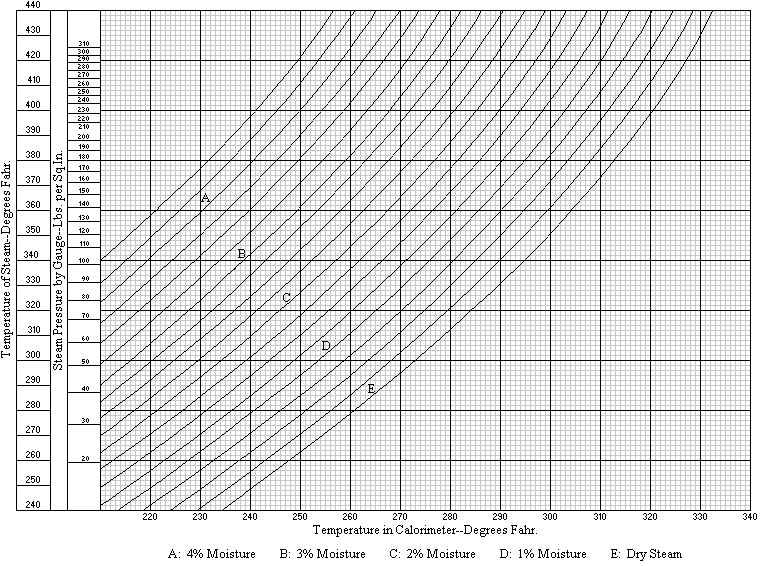
Fig. 15. Graphic Method of Determining Moisture Contained in Steam from Calorimeter Readings
[Pg 129]