PROPERTIES OF WATER
Reading edition
Pure water is a chemical compound of one volume of oxygen and two volumes of hydrogen, its chemical symbol being H 2 O.
The weight of water depends upon its temperature. Its weight at four temperatures, much used in physical calculations, is given in Table 10 .
TABLE 10 WEIGHT OF WATER AT TEMPERATURES USED IN PHYSICAL CALCULATIONS Temperature Degrees Fahrenheit Weight per Cubic Foot Pounds Weight per Cubic Inch Pounds At 32 degrees or freezing point at sea level 62.418 0.03612 At 39.2 degrees or point of maximum density 62.427 0.03613 At 62 degrees or standard temperature 62.355 0.03608 At 212 degrees or boiling point at sea level 59.846 0.03469
While authorities differ as to the weight of water, the range of values given for 62 degrees Fahrenheit (the standard temperature ordinarily taken) being from 62.291 pounds to 62.360 pounds per cubic foot, the value 62.355 is generally accepted as the most accurate.
A United States standard gallon holds 231 cubic inches and weighs, at 62 degrees Fahrenheit, approximately 8 1 ⁄ 3 pounds.
A British Imperial gallon holds 277.42 cubic inches and weighs, at 62 degrees Fahrenheit, 10 pounds.
The above are the true weights corrected for the effect of the buoyancy of the air, or the weight in vacuo . If water is weighed in air in the ordinary way, there is a correction of about one-eighth of one per cent which is usually negligible.
TABLE 11 VOLUME AND WEIGHT OF DISTILLED WATER AT VARIOUS TEMPERATURES [12] Temper- ature Degrees Fahren- heit Relative Volume Water at 39.2° = 1.000 Weight per Cubic Foot Pounds Temper- ature Degrees Fahren- heit Relative Volume Water at 39.2° = 1.000 Weight per Cubic Foot Pounds Temper- ature Degrees Fahren- heit Relative Volume Water at 39.2° = 1.000 Weight per Cubic Foot Pounds Temper- ature Degrees Fahren- heit Relative Volume Water at 39.2° = 1.000 Weight per Cubic Foot Pounds 32 1.000176 62.42 160 1.02337 61.00 290 1.0830 57.65 430 1.197 52.2 39.2 1.000000 62.43 170 1.02682 60.80 300 1.0890 57.33 440 1.208 51.7 40 1.000004 62.43 180 1.03047 60.58 310 1.0953 57.00 450 1.220 51.2 50 1.00027 62.42 190 1.03431 60.36 320 1.1019 56.66 460 1.232 50.7 60 1.00096 62.37 200 1.03835 60.12 330 1.1088 56.30 470 1.244 50.2 70 1.00201 62.30 210 1.04256 59.88 340 1.1160 55.94 480 1.256 49.7 80 1.00338 62.22 212 1.04343 59.83 350 1.1235 55.57 490 1.269 49.2 90 1.00504 62.11 220 1.0469 59.63 360 1.1313 55.18 500 1.283 48.7 100 1.00698 62.00 230 1.0515 59.37 370 1.1396 54.78 510 1.297 48.1 110 1.00915 61.86 240 1.0562 59.11 380 1.1483 54.36 520 1.312 47.6 120 1.01157 61.71 250 1.0611 58.83 390 1.1573 53.94 530 1.329 47.0 130 1.01420 61.55 260 1.0662 58.55 400 1.167 53.5 540 1.35 46.3 140 1.01705 61.38 270 1.0715 58.26 410 1.177 53.0 550 1.37 45.6 150 1.02011 61.20 280 1.0771 57.96 420 1.187 52.6 560 1.39 44.9
[Pg 97]
Water is but slightly compressible and for all practical purposes may be considered non-compressible. The coefficient of compressibility ranges from 0.000040 to 0.000051 per atmosphere at ordinary temperatures, this coefficient decreasing as the temperature increases.
Table 11 gives the weight in vacuo and the relative volume of a cubic foot of distilled water at various temperatures.
The weight of water at the standard temperature being taken as 62.355 pounds per cubic foot, the pressure exerted by the column of water of any stated height, and conversely the height of any column required to produce a stated pressure, may be computed as follows:
The pressure in pounds per square foot = 62.355 × height of column in feet.
The pressure in pounds per square inch = 0.433 × height of column in feet.
Height of column in feet = pressure in pounds per square foot ÷ 62.355.
Height of column in feet = pressure in pounds per square inch ÷ 0.433.
Height of column in inches = pressure in pounds per square inch × 27.71.
Height of column in inches = pressure in ounces per square inch × 1.73.
By a change in the weights given above, the pressure exerted and height of column may be computed for temperatures other than 62 degrees.
A pressure of one pound per square inch is exerted by a column of water 2.3093 feet or 27.71 inches high at 62 degrees Fahrenheit.
Water in its natural state is never found absolutely pure. In solvent power water has a greater range than any other liquid. For common salt, this is approximately a constant at all temperatures, while with such impurities as magnesium and sodium sulphates, this solvent power increases with an increase in temperature.
TABLE 12 BOILING POINT OF WATER AT VARIOUS ALTITUDES Boiling Point Degrees Fahrenheit Altitude Above Sea Level Feet Atmospheric Pressure Pounds per Square Inch Barometer Reduced to 32 Degrees Inches Boiling Point Degrees Fahrenheit Altitude Above Sea Level Feet Atmospheric Pressure Pounds per Square Inch Barometer Reduced to 32 Degrees Inches 184 15221 8.20 16.70 199 6843 11.29 22.99 185 14649 8.38 17.06 200 6304 11.52 23.47 186 14075 8.57 17.45 201 5764 11.76 23.95 187 13498 8.76 17.83 202 5225 12.01 24.45 188 12934 8.95 18.22 203 4697 12.26 24.96 189 12367 9.14 18.61 204 4169 12.51 25.48 190 11799 9.34 19.02 205 3642 12.77 26.00 191 11243 9.54 19.43 206 3115 13.03 26.53 192 10685 9.74 19.85 207 2589 13.30 27.08 193 10127 9.95 20.27 208 2063 13.57 27.63 194 9579 10.17 20.71 209 1539 13.85 28.19 195 9031 10.39 21.15 210 1025 14.13 28.76 196 8481 10.61 21.60 211 512 14.41 29.33 197 7932 10.83 22.05 212 Sea Level 14.70 29.92 198 7381 11.06 22.52
Sea water contains on an average approximately 3.125 per cent of its weight of solid matter or a thirty-second part of the weight of the water and salt held in solution. [Pg 98] [Pg 99] The approximate composition of this solid matter will be: sodium chloride 76 per cent, magnesium chloride 10 per cent, magnesium sulphate 6 per cent, calcium sulphate 5 per cent, calcium carbonate 0.5 per cent, other substances 2.5 per cent.
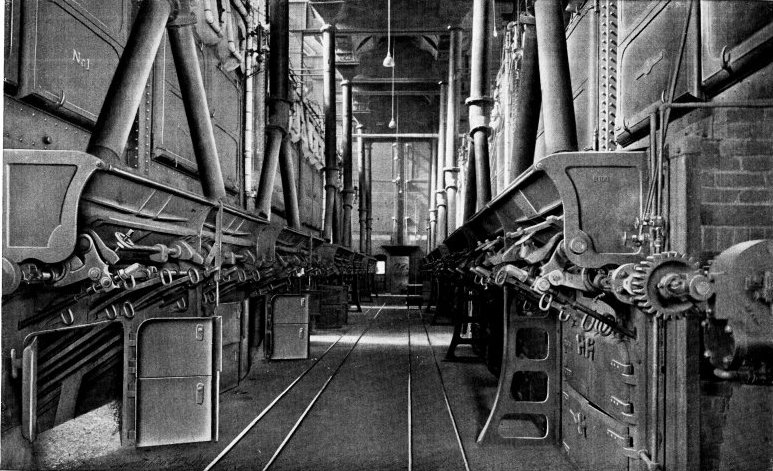
7200 Horse-power Installation of Babcock & Wilcox Boilers and Superheaters at the Capital Traction Co., Washington, D. C.
The boiling point of water decreases as the altitude above sea level increases. Table 12 gives the variation in the boiling point with the altitude.
Water has a greater specific heat or heat-absorbing capacity than any other known substance (bromine and hydrogen excepted) and its specific heat is the basis for measurement of the capacity of heat absorption of all other substances. From the definition, the specific heat of water is the number of British thermal units required to raise one pound of water one degree. This specific heat varies with the temperature of the water. The generally accepted values are given in Table 13 , which indicates the values as determined by Messrs. Marks and Davis and Mr. Peabody.
TABLE 13 SPECIFIC HEAT OF WATER AT VARIOUS TEMPERATURES MARKS AND DAVIS From Values of Barnes and Dieterici PEABODY From Values of Barnes and Regnault Temperature Specific Heat Temperature Specific Heat Temperature Specific Heat Temperature Specific Heat Degrees Fahrenheit Degrees Fahrenheit Degrees Centigrade Degrees Fahrenheit Degrees Centigrade Degrees Fahrenheit 30 1.0098 130 0.9979 0 32 1.0094 50 122 0.9980 40 1.0045 140 0.9986 5 41 1.0053 55 131 0.9985 50 1.0012 150 0.9994 10 50 1.0023 60 140 0.9994 55 1.0000 160 1.0002 15 59 1.0003 65 149 1.0004 60 0.9990 170 1.0010 16.11 61 1.0000 70 158 1.0015 70 0.9977 180 1.0019 20 68 0.9990 75 167 1.0028 80 0.9970 190 1.0029 25 77 0.9981 80 176 1.0042 90 0.9967 200 1.0039 30 86 0.9976 85 185 1.0056 100 0.9967 210 1.0052 35 95 0.9974 90 194 1.0071 110 0.9970 220 1.007 40 104 0.9974 95 203 1.0086 120 0.9974 230 1.009 45 113 0.9976 100 212 1.0101
In consequence of this variation in specific heat, the variation in the heat of the liquid of the water at different temperatures is not a constant. Table 22 [13] gives the heat of the liquid in a pound of water at temperatures ranging from 32 to 340 degrees Fahrenheit.
The specific heat of ice at 32 degrees is 0.463. The specific heat of saturated steam (ice and saturated steam representing the other forms in which water may exist), is something that is difficult to define in any way which will not be misleading. When no liquid is present the specific heat of saturated steam is negative. [14] The use of the value of the specific heat of steam is practically limited to instances where superheat is present, and the specific heat of superheated steam is covered later in the book.
FOOTNOTES
[Pg 100]