XX KENNEY’S ROYAL FLUSH
Reading edition
“It’s a most surprisin’ thing,” said old man Greenhut as he set the bottles away behind the bar, “that folks don’t seem to ’preciate the importance o’ bein’ persistent. Now, that there Si Walker, ’t just come in here an’ took a drink an’ went out ’thout sayin’ a word to no one, is a bright an’ shinin’ example o’ never doin’ nothin’ worth while, ’cause he don’t never stick to it. Gits discouraged like an’ sets down an’ thinks about it, when if he’d on’y spit on his hands an’ take a fresh grip he mought come out a four-time winner. Why, I tell you that man might ’a’ been a justice o’ the peace an’ married the Widow Baker with four hundred acres o’ good farm land, no end o’ stock an’ utensils, an’ money in the bank, on’y fer that fatal habit o’ his o’ not stickin’ to it. Just give up, he did, ’cause he got beat out in two ’lections an’ wouldn’t run fer office no more, an’ when the widow said no three or four times, he ’lowed she didn’t want him an’ got out o’ the game, when the blame fool’d oughter knowed that all she wanted was a man with gumption enough to keep on courtin’.”
The old man turned his back for a moment, while he slyly poured a little water into a whiskey bottle in which the liquor was running low, and then placing it with the other bottles he came out to his favourite seat by the window and sat smoking for some minutes.
“Beats all,” he said, after awhile, “how folks lets go like that. Don’t seem to have no sense o’ religion. The Good Book says, ‘Go to the ant,’ you sluggers. Consider her ways and be wise. Now, there ain’t no p’ints about a ant that’s worth considerin’, ’cept their almighty stick-to-it-iveness. Stands to reason, it means fer us to keep peggin’ away till we git there. ’F Si Walker’d on’y pegged like the ants does, he mought ’a’ been rich an’ respected.
“There was Pete Kenney that dropped off’n a boat here some thirty year ago an’ just stayed. There didn’t seem to be no reason why he should ’a’ come here in the first place, or why he should ’a’ stayed after he arrove, but he did. Some said he must ’a’ dropped on to the boat by accident somewheres up the river, an’ the captain put him off at the first landin’, him not havin’ the regulation fare in his jeans. However ’twas, he come, an’ he remained. More’n that, he’s well fixed now an’ pays taxes.
“There warn’t no reason fer it, fer as anybody could see, ’ceptin’ Pete’s all-fired persistency. He was a bright enough sort o’ man an’ might ’a’ settled down in business fer himself, fer he got a job as bartender down to the hotel an’ made money. They do say as how a steady, industrious bartender in a hotel where there’s a good run o’ business an’ a boss that drinks some himself, can have a saloon of his own in a few years, an’ I reckon it’s pretty near true. I kept bar in a hotel myself when I was young.
“That wa’n’t Pete’s lay, though. Pete used to say that there was one way of establishin’ yourself in life that laid over any other, an’ that was to hold a royal flush in a good stiff game o’ draw-poker. Then, he says, it’s on’y a question o’ how much the others has got to inspire their confidence, an’ how much they has to bet with that fixes the amount to be gathered in, so’s’t a man can retire an’ be respectable fer the rest of his natural life.
“Some on us reasoned with Pete at times about this. We told him that royal flushes was sca’ce game, an’ that four of a kind was good enough fer a careful player to get rich on, but Pete ’lowed that a royal flush was the on’y thing a man could be dead sure of. Seems he’d had four queens beat when he was young, an’ he’d l’arned consid’able caution from th’ experience.
“ ‘As to a royal flush bein’ sca’ce,’ Pete says, ‘it stands to reason that a man’s goin’ to get it sometime, if he plays long enough. Stick to it,’ he says, ‘an’ sooner or later yer goin’ to git a royal flush. The on’y thing needed is to stick to it.’
“Consequences was that Pete, havin’ found his theory of business success, devoted himself to the workin’ on it out, with a persistency that would ’a’ growed wool on a nigger’s heel ’f he’d devoted hisself to that particular form of effort. Why, Pete’d give his nights an’ days to poker. He never allowed business to interfere with a game, long’s he’d money to play with.
“Just naturally his theory of the game interfered with his general success. Mostly it does interfere, I’ve noticed, when a man gets theories in his head an’ plays the game different f’m the ordinary run o’ people. These here sharps that figgers out some particular thing in the game as bein’ a dead certainty, always loses money on it, for you can say what you like about the great American game, but it certainly does beat anything else for the preponderance of uncertainty that has to be calculated on, whenever you have a dead sure thing in your mind—all excepting a royal flush, as Pete used to say with ondeniable wisdom.
“Pete’s mind bein’ fixed, so to speak, on that royal flush, you can see for yourself that it warped his judgment on the question o’ drawin’ cards. Many a time I’ve seen him split a pair of aces, an’ draw three cards to a ace an’ queen, or ace an’ ten o’ the same suit. Once I even seen him split two pairs, aces an’ queens, an’ draw two cards to the ace, queen an’ jack o’ diamonds, an’ Joe Hooker says he seen the blamed ijjit split three kings to draw to three hearts just because they was court cards o’ the same suit. An’ the first card he picked up in the draw was the fourth king. Shows how a man’ll overlook the blessin’s o’ Providence right in his fist, reachin’ out after things he hain’t no reason to hope for in the natural course of events. Stands to reason a man’ll lose money defyin’ fate with such monkey-shines as them.
“ ‘Twasn’t no use to argue with Pete, though. He were as obstinate as a mule an’ stuck to his notion o’ gettin’ a royal flush like a sick nigger sticks to the Methodist Church. You couldn’t persuade him. One day I says to him, ‘Look a’ here, Pete, a royal flush is most onquestionably a good piece o’ property, but what show hev you got o’ gettin’ one. You put me out o’ patience. Look at the pots you might ’a’ scooped with two pairs an’ three of a kind if you’d only drawed like a Christian,’ says I, ‘instead o’ puttin’ your trust in strange gods, an’ sacrificin’ your good chips an’ the principles o’ the game in a strange an’ foolish endeavour. It’s flyin’ in the face o’ Providence,’ I says to him, ‘an’ you’ll go down to your grave unhonoured, unwept, an’ unhung if you persist in it. More’n that,’ I says, ‘you’ll be dead broke all the days o’ your life.’
“But you couldn’t convince him. ‘There’s four royal flushes in the deck, ain’t there?’ says he, ‘an’ them five cards is just as likely to come as any other five, ain’t they? An’ if there’s anything certain in this here world o’ trouble an’ oncertainty, ’tis that a man’ll get ’em sometime, if he keeps on tryin’. An’ say! When I do get ’em if the Lord spares me till that happy day, I won’t do anything but swat the gang.’
“ ‘The Lord can spare you easy enough,’ says I, disgusted, ‘an’ so can the community if you go on tryin’ to break up our national institutions by propagatin’ sich revolutionary idees. It’s worse’n anarchy,’ I says. ‘It’s ridiculous.’
“But there wa’n’t no movin’ of him, an’ we just had to leave him to the error of his ways, an’ what we thought was the inevitable vengeance of heaven. An’ the boys calculated that bein’ as how he was a self-app’inted vessel o’ wrath, an’ bound to be skinned in the game as long as he continnered to play it, it was a sort o’ missionary work to assist in the skinnin’. Most of ’em devoted themselves to the missionary work, too, with such holy zeal that Pete was broke most of the time.
“He was good grit, though. Nobody never heard him complain, for he seemed to be sustained by a calm confidence in that royal flush, an’ every time he went broke he’d go back to work as chipper as a catfish an’ stick to it till he had a stake to sit into the game with.
“That was another thing I used to talk to him about, while I was trying to show him the error of his ways. ‘Supposin’ you do get a royal flush sometime,’ I says, ‘how can you expect to get a legitimate profit out of it, if you go broke all the time trying to get it? You won’t have no money to bet with,’ I says.
“But all he ever said to that was, ‘Oh! the Lord will provide. You don’t suppose things is goin’ to be so ordered, do ye, that heaven’s richest blessin’ would come to a man, an’ him not have the means to back it up?’ Which was next door to blasphemy as I told him frequent, but he on’y smiled. An’ when the time come, as it did finally, when his faith was justified, an’ he reaped the reward o’ persistency, it were developed that he had good reason to smile, for he had provided for that there contingency with a wisdom compared to which the guile o’ the sarpent was as the babblings o’ babes an’ sucklin’s. Oh! Pete was a polished article even if we did size him up for a deluded fanatic all them years.
“It went on for a matter o’ fifteen year or more, an’ Pete’s royal flush come to be a standin’ joke in town. Fellers would laugh about it every time he set into a game, an’ it were esteemed a great piece o’ wit for some feller to say, ‘I’ll bet a thousand to one in town lots that Pete won’t get a royal flush to-night.’ ’Course, nobody ever took it up, but everybody’d laugh, an’ Pete would laugh with ’em, for he was good-natured, an’ he’d say, ‘I’ll get it sometime, boys, if I don’t to-night.’
“An’ he did. If ever a man won success by long-continued, persistent strugglin’ for it, Pete Kenney did, an’ things fell out about as he’d always said they would. It were a pretty good game from the first, for there was a couple o’ crossroads gamblers who’d come to town lookin’ for blood, an’ it happened that there was two planters just back from New Orleans with their crop money in their pockets, an’ they was lookin’ for excitement. One of ’em knowed Pete an’ liked him an’ ast him to join in the game that was started just about the time they got off at Arkansas City here, an’ Pete havin’ a hundred in his clothes, just naturally did.
“He played lucky from the start. It happened, fortunately, that he didn’t get a chance to make one of his fool draws more’n once in half an hour or so, an’ as his play outside o’ that was fairly good he managed to scoop in some rattlin’ good pots on flushes an’ fulls, besides two or three that he took in on deuces and nerve, or some sich hand.
“Anyhow, he had near a thousand in front of him when there come a big jack-pot with fifty in it before it was opened. Pete sat next to the dealer an’ he passed, havin’ on’y a king, jack, an’ ten o’ clubs, an’, o’ course, not bein’ permitted to open under the rules. The next man opened it for fifty, the next three come in, an’ Pete raised it a hundred. That was his fool play. Whenever he’d see a show for a royal flush he used to play as if he had it, for fear he wouldn’t get the good of it when it did come.
“Well, it worked pretty well. One of the crossroads professionals dropped out, but the other one had a seven full, pat, an’ after the two planters had come in, he raised Pete another hundred. Pete came back at him with another and one of the planters dropped. The other had a four flush and he stayed. The gambler, for some reason, didn’t raise again, but simply saw the raise, and there was thirteen hundred dollars in the pot.
“In the draw Pete got the ace an’ queen o’ clubs. I suppose if I’d a caught them cards under the circumstances, I’d a dropped dead, but Pete never turned a hair. There was al’ays a kind of a drop to the left side of his face an’ it looked a little droopier than usual, for a minute, but he gave no other sign, and the others thought he had three of a kind at the most. The planter filled his flush, an’ so Pete had two good hands to play against, which was as much as anybody could expect. He had about six hundred on the table to bet with, besides, and more’n that, he had resources that nobody at the table knew about.
“The planter sat next to the opener, who dropped out, and as it was his first bet and he had a flush, he pushed up a hundred, not carin’ to go too heavy against the gambler who had stood pat and who had stood the third raise before the draw. The gambler raised, of course, pushin’ up three-fifty.
“Things was a-goin’ Pete’s way, but he never grinned. What he had to do was to make the others think he was bluffing, so he studies his cards careful for awhile an’ then says, sort o’ desperate-like an’ sudden, ‘I’ll see that, an’ I’ll go you two-fifty better,’ an’ he pushes his pile to the middle of the table, barrin’ fifteen or twenty dollars he had in loose change.
“The planter’s flush was king high, so he saw it, but didn’t raise, an’ the gambler raised it five hundred, thinking that Pete would drop out. ‘That’s more than your threes are worth, I reckon,’ he said, with a sneer, but Pete never answered him. He studied his cards awhile longer and then said, pretty slow, ‘I haven’t got the cash to see you, but I’ve got the deeds to some property here that’s pretty valuable, an’ if you’ll take that for security, I’ll raise you a thousand.’
“He pulled some law papers out of his pocket as he spoke and laid them on the table, but the gambler spoke up, very nasty, an’ says: ‘I ain’t buyin’ no property without looking at it, an’ money is the on’y thing that talks in this game.’
“Pete looked at the planter, but he shook his head. ‘I wouldn’t mind as far as I am concerned,’ he said, ‘but there is an objection made. I don’t see how I can help you.’
“ ‘Very well,’ says Pete, pretending to look troubled, ‘then I’ll have to ask for a few minutes’ time till I can get some money to play with. Sam,’ he says to the nigger that was bringing them drinks, ‘take these papers over to Mr. Stevens an’ ask him if he will loan me ten thousand dollars on them.’
“Then there was a little wrangle. The other gambler who had dropped out objected to the delay, but the two planters spoke up for Pete and the gambler who held the full house said he was willin’ to wait while the gentleman got some more money, as he was goin’ to win it anyhow, so Sam went over to Mr. Stevens’s house. Stevens bein’ the president of our bank an’ a gentleman with proper sporting habits.
“Some of us that was lookin’ on was guessin’ for fair. We never knowed o’ Pete havin’ no property, an’ we thought he was bluffin’, but we couldn’t see just how he reckoned he could work it, or what he expected to do. I says to myself, ‘I reckon he’s caught that royal flush, but what this move means is more’n I know.’ Anyhow, there warn’t nothin’ to do but wait, an’ I waited as all the others did, for it looked as if there’d be some fun.
“Pretty soon Mr. Stevens came back with the nigger, an’ says, ‘What’s this mean, Pete? The nigger says you want to borrow ten thousand dollars.’
“ ‘Yes, I do,’ says Pete.
“ ‘Well,’ says Stevens, ‘you can have the money on these deeds, of course, if you’ll come to the bank to-morrow, but you—’
“ ‘I want it now,’ says Pete, interruptin’, an’ as he spoke he picked up his cards from the table where they had been lying, an’ holdin’ ’em kind o’ careless, just so that Stevens could see ’em, but pretendin’ not to notice that they could be seen.
“ ‘Oh!’ says Stevens, ‘you want the money to play with, do you? But certainly you ain’t goin’ to bet on that hand?’
“ ‘You’ll oblige me,’ says Pete, pretendin’ to get in a terrible rage, ‘by sayin’ nothin’ about my hand. It may not be the strongest hand in the deck, but it’s the best one out. Besides, it’s my own business what I do with the money. The question is whether you’ll let me have it.’
“Oh, yes,’ says Stevens, ‘I’ll let you have it, all right. That is, I’ll give you my personal check.’
“I reckon that’s good,’ says Pete, an’ so it was, for everybody on the river knowed Stevens.
“It was the neatest play I ever expect to see, for them papers wasn’t worth the ink that was on ’em. It seems that Stevens had come to know about Pete always playin’ for a royal flush, an’ had joked him about it, knowin’ Pete pretty well an’ likin’ him as a man gets to like a bartender that treats him right, an’ Pete had got him to promise to lend him all the money he needed to play with, whenever he should get the royal flush.
“ ‘BUT CERTAINLY YOU AIN’T GOIN’ TO BET ON THAT HAND?’ ”
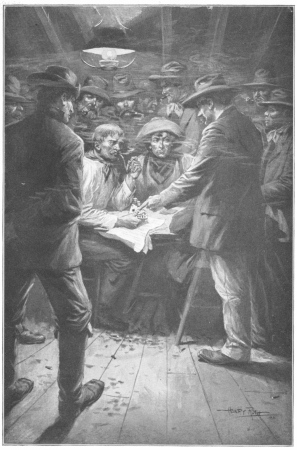
Then when Stevens came over to lend him the money if he really had the cards, him knowin’ that the deeds was a bluff, he was sport enough and liked Pete well enough to help him along with his little remark about not betting on that hand.
“Of course, when they heard that, the other players thought sure he was bluffing, an’ Pete coaxed ’em along till he cleaned up $18,000. Then he invested the money, an’, as I said, become a respectable taxpayer. It all shows what a man can do by stickin’ to what he has to do in this world.”
THE END.
L. C. Page and Company’s Announcement List of New Fiction
Carolina Lee
By Lilian Bell, author of “Hope Loring,” “Abroad with the Jimmies,” etc.
With a frontispiece in colour from an oil painting by Dora Wheeler Keith
$1.50
A typical “Lilian Bell” book, bright, breezy, amusing, philosophic, full of fun and bits of quotable humour.
Carolina is a fascinating American girl, born and educated in Paris, and at the beginning of the story riding on the top wave of success in New York society. A financial catastrophe leaves her stranded without money, and her only material asset an old, run-down plantation in South Carolina. In the face of strong opposition she goes South to restore the old homestead and rebuild her fortunes. Complications speedily follow, but, with indomitable faith and courage, Carolina perseveres until her efforts are rewarded by success and happiness.
The Cruise of the Conqueror
Being the Further Adventures of the Motor Pirate. By G. Sidney Paternoster, author of “The Motor Pirate,” etc.
With a frontispiece by Frank T. Merrill $1.50
One of the most fascinating games to childhood is the old-fashioned “hide-and-seek,” with its scurrying for covert, its breathless suspense to both hider and seeker, and its wild dash for goal when the seeker is successful. Readers of “The Motor Pirate” will remember the exciting game played by the motor pirate and his pursuers, and will be glad to have the sport taken up again in the new volume.
In “The Cruise of the Conqueror,” a motor-boat enables the motor pirate to pursue his victims in even a bolder and more startling way, such, for example, as the hold-up of an ocean steamer and the seizure for ransom of the Prince of Monte Carlo.
The Passenger from Calais
A Detective Story. By Arthur Griffiths.
Cover design by Eleanor Hobson $1.25
A bright, quickly moving detective story telling of the adventures which befell a mysterious lady flying from Calais through France into Italy, closely pursued by detectives. Her own quick wits, aided by those of a gallant fellow passenger, give the two officers an unlooked-for and exciting “run for their money.” One hardly realizes till now the dramatic possibilities of a railway train, and what an opportunity for excitement may be afforded by a joint railway station for two or more roads.
It is a well-planned, logical detective story of the better sort, free from cheap sensationalism and improbability, developing surely and steadily by means of exciting situations to an unforeseen and satisfactory ending.
The Golden Arrow
By T. Jenkins Hains, author of “The Black Barque,” “The Windjammers,” etc.
With six illustrations by H. C. Edwards $1.50
Another of Captain Hains’s inimitable sea stories, in which piracy, storm, and shipwreck are cleverly intermingled with love and romance, and vivid and picturesque descriptions of life at sea. Mr. Hains’s new story describes the capture on the high seas of an American vessel by a gang of convicts, who have seized and burned the English ship on which they were being transported, and their final recapture by a British man-of-war.
The Treasure Trail
By Frank L. Pollock.
Library 12mo, cloth decorative $1.25
This is a splendid story of adventure, full of good incidents that are exceptionally exciting. The story deals with the search for gold bullion, originally stolen from the Boer government in Pretoria, and stored in a steamer sunk somewhere in the Mozambique Channel. Two different search parties are endeavouring to secure the treasure, and the story deals with their adventures and its final recovery by one party only a few hours before the arrival of the second.
The book reads like an extract from life, and the whole story is vivid and realistic with descriptions of the life of a party of gentlemen adventurers who are willing to run great odds for great gains.
There is also “a woman in the case,” Margaret Laurie, who proves a delightful, reliant, and audacious heroine.
Miss Frances Baird, Detective
By Reginald Wright Kauffman, author of “Jarvis of Harvard,” etc.
Library 12mo, cloth decorative $1.25
A double robbery and a murder have given Mr. Kauffman the material for his clever detective story. Miss Baird tells how she finally solved the mystery, and how she outwitted the other detective at work on the case, by her woman’s intuition and sympathy, when her reputation for keenness and efficiency was hanging in the balance.
The Idlers
By Morley Roberts, author of “Rachel Marr,” “Lady Penelope,” etc.
With frontispiece in colour by John C. Frohn $1.50
The London Literary World says: “In ‘The Idlers’ Mr. Morley Roberts does for the smart set of London what Mrs. Wharton has done in ‘The House of Mirth’ for the American social class of the same name. His primary object seems to be realism, the portrayal of life as it is without exaggeration, and we were impressed by the reserve displayed by the novelist. It is a powerful novel, a merciless dissection of modern society similar to that which a skilful surgeon would make of a pathological case.”
The New York Sun says: “It is as absorbing as the devil. Mr. Roberts gives us the antithesis of ‘Rachel Marr’ in an equally masterful and convincing work.”
Professor Charles G. D. Roberts says: “It is a work of great ethical force.”
Stand Pat
Or, Poker Stories from Brownsville. By David A. Curtis, author of “Queer Luck,” etc.
With six drawings by Henry Roth $1.50
Mr. Curtis is the poker expert of the New York Sun, and many of the stories in “Stand Pat” originally appeared in the Sun. Although in a sense short stories, they have a thread of continuity, in that the principal characters appear throughout. Every poker player will enjoy Mr. Curtis’s clever recital of the strange luck to which Dame Fortune sometimes treats her devotees in the uncertain game of draw poker, and will appreciate the startling coups by which she is occasionally outwitted.
The Count at Harvard
Being an Account of the Adventures of a Young Gentleman of Fashion at Harvard University. By Rupert Sargent Holland.
With a characteristic cover design $1.50
With the possible exception of Mr. Flandrau’s work, the “Count at Harvard” is the most natural and the most truthful exposition of average student life yet written, and is thoroughly instinct with the real college atmosphere. “The Count” is not a foreigner, but is the nickname of one of the principal characters in the book.
The story is clean, bright, clever, and intensely amusing. Typical Harvard institutions, such as the Hasty Pudding Club, The Crimson, the Crew, etc., are painted with deft touches, which will fill the soul of every graduate with joy, and be equally as fascinating to all college students.
Selections from L. C. Page and Company’s List of Fiction
WORKS OF
ROBERT NEILSON STEPHENS
Each one vol., library 12mo, cloth decorative $1.50
The Flight of Georgiana
A Romance of the Days of the Young Pretender. Illustrated by H. C. Edwards.
“A love-story in the highest degree, a dashing story, and a remarkably well finished piece of work.”—Chicago Record-Herald.
The Bright Face of Danger
Being an account of some adventures of Henri de Launay, son of the Sieur de la Tournoire. Illustrated by H. C. Edwards.
“Mr. Stephens has fairly outdone himself. We thank him heartily. The story is nothing if not spirited and entertaining, rational and convincing.”—Boston Transcript.
The Mystery of Murray Davenport
(40th thousand.)
“This is easily the best thing that Mr. Stephens has yet done. Those familiar with his other novels can best judge the measure of this praise, which is generous.”—Buffalo News.
Captain Ravenshaw
Or, The Maid of Cheapside. (52d thousand.) A romance of Elizabethan London. Illustrations by Howard Pyle and other artists.
Not since the absorbing adventures of D’Artagnan have we had anything so good in the blended vein of romance and comedy.
The Continental Dragoon
A Romance of Philipse Manor House in 1778. (53d thousand.) Illustrated by H. C. Edwards.
A stirring romance of the Revolution, with its scene laid on neutral territory.
Philip Winwood
(70th thousand.) A Sketch of the Domestic History of an American Captain in the War of Independence, embracing events that occurred between and during the years 1763 and 1785 in New York and London. Illustrated by E. W. D. Hamilton.
An Enemy to the King
(70th thousand.) From the “Recently Discovered Memoirs of the Sieur de la Tournoire.” Illustrated by H. De M. Young.
An historical romance of the sixteenth century, describing the adventures of a young French nobleman at the court of Henry III., and on the field with Henry IV.
The Road to Paris
A Story of Adventure. (35th thousand.) Illustrated by H. C. Edwards.
An historical romance of the eighteenth century, being an account of the life of an American gentleman adventurer of Jacobite ancestry.
A Gentleman Player
His Adventures on a Secret Mission for Queen Elizabeth. (48th thousand.) Illustrated by Frank T. Merrill.
The story of a young gentleman who joins Shakespeare’s company of players, and becomes a friend and protégé of the great poet.
WORKS OF
CHARLES G. D. ROBERTS
Red Fox
The Story of His Adventurous Career in the Ringwaak Wilds, and of His Final Triumph over the Enemies of His Kind. With fifty illustrations, including frontispiece in color and cover design by Charles Livingston Bull.
Square quarto, cloth decorative $2.00
“Infinitely more wholesome reading than the average tale of sport, since it gives a glimpse of the hunt from the point of view of the hunted.”—Boston Transcript.
“True in substance but fascinating as fiction. It will interest old and young, city-bound and free-footed, those who know animals and those who do not.”—Chicago Record-Herald.
“A brilliant chapter in natural history.”—Philadelphia North American.
The Kindred of the Wild
A Book of Animal Life. With fifty-one full-page plates and many decorations from drawings by Charles Livingston Bull.
Square quarto, decorative cover $2.00
“Is in many ways the most brilliant collection of animal stories that has appeared; well named and well done.”—John Burroughs.
The Watchers of the Trails
A companion volume to “The Kindred of the Wild.” With forty-eight full-page plates and many decorations from drawings by Charles Livingston Bull.
Square quarto, decorative cover $2.00
“Mr. Roberts has written a most interesting series of tales free from the vices of the stories regarding animals of many other writers, accurate in their facts and admirably and dramatically told.”—Chicago News.
“These stories are exquisite in their refinement, and yet robust in their appreciation of some of the rougher phases of woodcraft. Among the many writers about animals, Mr. Roberts occupies an enviable place.”—The Outlook.
“This is a book full of delight. An additional charm lies in Mr. Bull’s faithful and graphic illustrations, which in fashion all their own tell the story of the wild life, illuminating and supplementing the pen pictures of the author.”—Literary Digest.
Earth’s Enigmas
A new edition of Mr. Roberts’s first volume of fiction, published in 1892, and out of print for several years, with the addition of three new stories, and ten illustrations by Charles Livingston Bull.
Library 12mo, cloth, decorative cover $1.50
“It will rank high among collections of short stories. In ‘Earth’s Enigmas’ is a wider range of subject than in the ‘Kindred of the Wild.’ ”—Review from advance sheets of the illustrated edition by Tiffany Blake in the Chicago Evening Post.
Barbara Ladd
With four illustrations by Frank Verbeck.
Library 12mo, gilt top $1.50
“From the opening chapter to the final page Mr. Roberts lures us on by his rapt devotion to the changing aspects of Nature and by his keen and sympathetic analysis of human character.”—Boston Transcript.
Cameron of Lochiel
Translated from the French of Philippe Aubert de Gaspé, with frontispiece in color by H. C. Edwards.
Library 12mo, cloth decorative $1.50
“Professor Roberts deserves the thanks of his reader for giving a wider audience an opportunity to enjoy this striking bit of French Canadian literature.”—Brooklyn Eagle.
“It is not often in these days of sensational and philosophical novels that one picks up a book that so touches the heart.”—Boston Transcript.
The Prisoner of Mademoiselle
With frontispiece by Frank T. Merrill.
Library 12mo, cloth decorative, gilt top $1.50
A tale of Acadia,—a land which is the author’s heart’s delight,—of a valiant young lieutenant and a winsome maiden, who first captures and then captivates.
“This is the kind of a story that makes one grow younger, more innocent, more light-hearted. Its literary quality is impeccable. It is not every day that such a heroine blossoms into even temporary existence, and the very name of the story bears a breath of charm.”—Chicago Record-Herald.
The Heart of the Ancient Wood
With six illustrations by James L. Weston.
Library 12mo, decorative cover $1.50
“One of the most fascinating novels of recent days.”—Boston Journal.
“A classic twentieth-century romance.”—New York Commercial Advertiser.
The Forge in the Forest
Being the Narrative of the Acadian Ranger, Jean de Mer, Seigneur de Briart, and how he crossed the Black Abbé, and of his adventures in a strange fellowship. Illustrated by Henry Sandham, R. C. A.
Library 12mo, cloth, gilt top $1.50
A story of pure love and heroic adventure.
By the Marshes of Minas
Library 12mo, cloth, gilt top, illustrated $1.50
Most of these romances are in the author’s lighter and more playful vein; each is a unit of absorbing interest and exquisite workmanship.