XII A STRANGER AND FOND OF POKER
Reading edition
The Mississippi River packet City of Natchez had been tied up at the levee in Arkansas City for possibly half an hour. The passengers who wanted to go ashore had gone, all but one, and the roustabouts were struggling with the freight under the inspiring influence of the mate’s energetic comments.
Possibly because of their terrified condition, resulting from the mate’s flow of language, but more probably because of their total indifference to consequences, they paid no attention whatever to a short, red-headed gentleman who might perhaps have been born in Ireland, and who came strolling from the direction of the boat’s barroom toward the single gangplank, now in use by the freight department.
Even as they paid no attention to him, he paid none to them, but approached the gangplank somewhat unsteadily, with the evident intention of going ashore. The mate’s attention for the moment was fixed on some point at the other side of the deck, or it is a moral certainty that he would have interposed language of sufficient strength to arrest the belated passenger’s progress.
As it happened, however, there was none to warn him of his danger, and he stepped in debonair fashion on the sloping gangplank, serenely unconscious of the fact that four huge darkies were coming behind him, bearing a case of goods on their shoulders that must have weighed something like a thousand pounds.
It is an open question whether they saw that he was in their way, but it is absolutely certain that they recognized no obligation on their part to shout a warning. On they came, jog-trotting along till they were only a single pace behind him, when he either tripped or slipped, and, staggering, seemed about to fall. Had he fallen and so tripped the rousters, the matter would have been serious indeed.
Just as he lost his balance, a sinewy hand was stretched forth from somewhere in the darkness, for it was late at night, and catching the tottering gentleman by the lapel of his coat, gave him such a mighty and overmastering yank that he darted forward on the double-quick for thirty or forty feet, and fell all in a heap on the levee. As he lay there, he was hopelessly undignified in appearance, but he was out of the path of the roustabouts.
Quite as if nothing whatever had happened, he looked up at his unknown preserver, who could now be seen indistinctly, and said in a conversational tone:
“Sure, Oi do be think (hic) thinkin’ the citizens o’ this (hic) this town is domned hard oop fer popu (hic) population. Does yez git ivery (hic) iverybody ashore, loike (hic) iverybody (hic) does yez—”
Here his voice trailed off to a murmur, and it seemed probable to the tall, powerful man who stood over him that he was likely to go to sleep where he lay if something were not done promptly. Promptness, however, was a prominent characteristic of Mr. Joseph Bassett, the sheriff of the county, and the stranger speedily arose, a wetter and a soberer man—likewise an angrier.
With these various considerations Joe Bassett was no whit concerned excepting that the fact of the stranger having been aroused made his own duty somewhat easier of performance. As the short man began sputtering in a peculiarly red-headed fashion, Joe calmly interrupted him.
“It’s ag’in the law, stranger, f’r any galoot f’m off’n a boat fer to go an’ git hisself killed on the levee in Arkansas City by a packin’-case or any other murderous weepin in the hands o’ roustabouts or anybody else. ’Pears to me you must be a stranger in these parts. Ever been into a town of any size afore?”
The short man continued to sputter as if nothing had been said, so Joe looked at him with mild curiosity for a moment, and then said:
“Hyer now. That’ll be about enough. I’d ought for to arrest you for disturbin’ the peace o’ them roustabouts, but if you’ve got money enough to settle a hotel bill, I reckon I might better take you there. Have ye?”
“Oi have,” said the little man.
“What’s your name?” asked the sheriff, presuming on his official position to disregard a point of strict etiquette in the community.
“Mostly they do be callin’ me Stumpy, whin Oi’m at home in Brownsville,” said the little man, whose wrath seemed to have cooled as the water dripped off his face. “Av thot’s a good enough name for Brownsville, sure it’ll do here.”
“Come along then, Stumpy,” said the sheriff, good-naturedly, as he linked his arm in the little man’s and steadied his steps toward the hotel across the street.
The landlord had no scruples against dispensing red liquor to any man who was in the company of the sheriff, and it came about that the three had sundry drinks which Stumpy paid for with great cheerfulness before going to bed.
Soon after he had done this, Mr. Bassett dropped in at old man Greenhut’s saloon, and after some irrelevant remarks reported the presence of a stranger in town.
“What’s he like?” demanded Greenhut.
“Well, he’s red-headed an’ I reckon he’s Irish, but ’pears like he had some money. He didn’t flash no wad, but he ain’t no ways mean with his loose change.”
“You can’t al’ays tell,” said old man Greenhut. “The Good Book says, ‘Him that hath, keeps, an’ f’m him that hath not, the loose change ofttimes leaks.’ Still, it’s worth lookin’ into. Some o’ you boys had better be up to the hotel when he gets round. Maybe he might have a likin’ f’r draw-poker.”
Accordingly, it happened that when Stumpy came down to the hotel barroom next morning in search of an appetite, he discovered a couple of strangers there who were by no means unsociably disposed. Further, he discovered that they were Jake Winterbottom and Sam Pearsall by name, citizens of Arkansas City, who esteemed it a privilege to make strangers acquainted with the resources of the place in the way of sports and pastimes.
Several of these were mentioned, but it appeared that horse-racing was out of season, and there had been no cock-fights arranged for the day. In fact, the only amusement available, so far as these two could say, was a quiet game of draw which was likely to be started at any hour in Greenhut’s back room.
“Gintlemen, Oi’m wid yez,” said Stumpy. “We do be playin’ dhraw-poker in Brownsville whiles, but it’s more f’r th’ spoort we play nor the money.”
Mr. Winterbottom and Mr. Pearsall heartily agreed that the game ought always to be played for sport rather than for money. In fact, they said, the game was always played in Greenhut’s place for sport. Sometimes, when the players got warmed up, the stakes grew rather large, but usually it was a small game carried on for amusement and the promotion of Greenhut’s bar trade.
“Has he a bar?” demanded Stumpy.
They assured him that he had an excellent bar, and Stumpy demanded that they should all three go forthwith to Greenhut’s. As neither of the others had any objection, they were soon sampling Greenhut’s liquor.
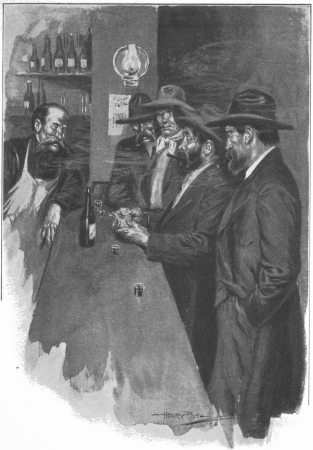
In paying for the drinks Stumpy showed a roll of respectable size containing at least a few fives and tens, so no one showed any reluctance in joining the game which Stumpy himself proposed, and five players presently bought chips in the back room, Bassett and Plunkitt joining the two who had invited the stranger in.
“One o’ th’ most interestin’ stories in the Good Book,” remarked old man Greenhut to the little group that remained with him in the front of the saloon, “is that there yarn about the ravens that fetched food to Joseph when his brethren pitched him in a pit. Nobody knowed where them ravens come from, but they fetched Joseph so much
“IN PAYING FOR THE DRINKS STUMPY SHOWED A ROLL OF RESPECTABLE SIZE.”
corn inside o’ seven year’t him an’ his family fed on it f’r seven year more.
“ ‘Pears like there’s ravens comin’ f’m up the river, an’ f’m down the river, to feed Arkansas City. This here bird is a trifle off colour for a raven, but his wad looks good.”
In the back room things were not quite satisfactory. A table stakes game was started and each man bought five dollars’ worth of chips. The local talent considered this small, but Stumpy said they always began the game that way in Brownsville, and they deferred to his preference, remembering that it was always possible to buy more chips and so increase the size of the possible bet.
Presently, however, it appeared that there were other peculiarities in the Brownsville game, or at least in the game Stumpy played. He refused to come in, hand after hand, with no apparent impatience at the chipping out process, even when he was forced to buy his second five. Then, suddenly, he came in without looking at his hand, and when he was raised, pushed his whole pile into the pot.
Winterbottom had three sevens, and he saw the bet unhesitatingly. Pearsall had nothing, but he put in his money on the theory that his chance was as good as any man’s who had not looked at his hand. The sheriff, with one pair, considered it a fair gamble, and Plunkitt came in to be sociable.
On the draw Stumpy stood pat, still without looking at his cards, which lay face down in front of him. Winterbottom drew two without bettering, and neither of the others improved his hand.
As Winterbottom had opened, he bet a blue chip on the side, which the sheriff called, having kings, and the other two laid down. Stumpy, being all in, was not affected by the side betting, and let his cards remain on the table.
Winterbottom, being called, showed his three sevens.
“That’s good,” said the sheriff, showing his kings, and they all looked at Stumpy.
“Sure, Oi don’t know,” he said, drolly, “but Oi do be thinkin’ maybe Oi’ll bate thim others,” and he turned his cards over one at a time.
The first four were diamonds, and he looked at Winterbottom.
“Have yez anny propositions?” he asked, with a grin.
“I reckon not,” said Winterbottom.
“Oi thought maybe ye’d be afther wantin’ to shplit th’ pot. Sure, thim diamonds is mighty pretty.”
“Go on,” said Jake, impatiently.
“Oh! Very well,” said Stumpy, and he turned another diamond.
It gave him nearly sixteen dollars as against the ten he had put in, and after counting it carefully he said he guessed he’d quit.
At this there was a chorus of protest. “Do you mean to say you’ve got four North American citizens to waste half an hour for you to win six dollars?” demanded Pearsall.
“It’s what I call a dirty trick,” said Plunkitt.
“Aisy, now, aisy,” said Stumpy. “Oi told yez Oi play this game fer spoort, an’ Oi’ve had all the spoort Oi’m loikely to have. Thim things don’t happen twice. Yez needn’t look dangerous. Oi’ll not foight yez, on’y wan at a toime. Oi’m Oirish, but Oi’m not Oirish enough for that. Yez’ll all have another dhrink with me.”
And that was all the Arkansas City players accomplished with Stumpy.
After he had gone on his hilarious way, old man Greenhut looked after him indignantly, and said:
“I reckon them ravens that fed Joseph must ha’ been some other breed. They sure wa’n’t red-headed blackbirds.”