Volume 13 — Chapter XVI.
Reading edition
LEADING THE ARMY.
On the 13th of April, 1776, Washington was in New York, which now promised to be the center of operations. Here he remained four or five months, making one visit meanwhile to Philadelphia, at the request of Congress, which wished to confer with him. He was busy increasing and strengthening the army and erecting fortifications.
That spring and summer saw a rapid change in men's minds regarding the war with England. Washington no longer thought it possible to obtain what the colonies demanded and still remain subject to England. He was ready for independence, and when Congress issued its declaration, Washington had it read before the army with great satisfaction.
Not long after the declaration of independence, an English fleet arrived in New York Bay, bringing a large body of troops, under the command of Lord Howe, who, with his brother Admiral Howe, had been appointed commissioners to treat with the Americans. In reality, they only brought a promise of pardon to the rebels. It was very clear to Washington that the British Government had not the slightest intention of listening to the grievances of the colonies with a desire to redress them; but that they meant by these proposals to distract the colonies if possible and build up a party there that would oppose the action of Congress. There was a little incident attending the arrival of the commissioners that showed the feeling which prevailed.
One afternoon, word came that a boat was coming to head-quarters, bringing a messenger from Lord Howe with a communication. Washington had noticed that the British, whenever speaking of him or other American officers, had refused to regard them as officers of the army; they were simply private gentlemen who had taken up arms against the King. Now Washington knew that while it was in itself a small matter whether he was addressed by people about him as General Washington or Mr. Washington, it was not at all a small matter how Lord Howe addressed him. That officer had no business with George Washington, but he might have very important business with General Washington. Accordingly, he called together such of the American officers as were at head-quarters to consult them in regard to the subject, and they agreed entirely with him. Colonel Reed was directed to receive the messenger and manage the matter.
Accordingly, he entered a boat and was rowed out toward Staten Island, whence Lord Howe's messenger was coming. The two boats met half-way, and Lieutenant Brown—for that was the name of the messenger—was very polite, and informed Colonel Reed that he bore a letter from General Howe to Mr. Washington. Colonel Reed looked surprised. He himself was an officer in the continental army, and he knew no such person. There-upon Lieutenant Brown showed him the letter, which was addressed, George Washington, Esq. Colonel Reed was polite, but it was quite impossible for him to bear a letter to the commander of the American army addressed in that way. The lieutenant was embarrassed; as a gentleman and an officer he saw he was in the wrong. He tried to make matters better by saying that it was an important letter, but was intended rather for a person who was of great importance in American councils than for one who was commanding an army.
Colonel Reed continued to refuse the letter, and the boats parted. Presently, however, Lieutenant Brown came rowing back and asked by what title Washington chose to be addressed. It was quite an unnecessary question, Reed thought. There was not the slightest doubt as to what General Washington's rank was. The lieutenant knew it and was really very sorry, but he wished Colonel Reed would take the letter. Colonel Reed replied that it was the easiest matter in the world; it only needed that the letter should be correctly addressed. And so they parted.
Five days later, an aide-de-camp of General Howe appeared with a flag and asked that an interview might be granted to Colonel Patterson, the British Adjutant-General. Consent was given, and the next day Washington, with all his officers about him, received Colonel Patterson, who was very polite, and addressed him as "Your Excellency," which did quite well, though it was dodging matters somewhat. He tried to explain away the affair of the letter and said that no impertinence was intended, and he then produced another, addressed to George Washington, Esq., etc., etc.
Evidently, Lord Howe thought he had invented a capital way out of the difficulty. Et cetera, et cetera! Why, that might cover everything,—General-Commanding, Lord High Rebel, or anything else this very punctilious Virginia gentleman might fancy as his title. It would save Washington's pride and relieve Lord Howe's scruples. Washington replied coolly, Yes, the et cetera implied everything, but it also implied anything or nothing. It was meaningless. He was not a private person; this letter was meant for a public character, and as such he could not receive it, unless it acknowledged him properly. So Colonel Patterson was obliged to pocket the letter and try to cover his mortification and to deliver the contents verbally.
Perhaps all this sounds like very small business. In reality it meant a great deal. Were Washington and other officers rebels against the King, or were they the officers of a government which declared itself independent of the King? Lord Howe gave up trying to force Washington into the trap, and wrote to his government that it would be necessary in future to give the American commander his title; and Congress, to whom Washington reported the matter, passed a resolution approving of his course and directing that no letter or message be received on any occasion whatsoever from the enemy, by the Commander-in-Chief or by other commanders of the American army, but such as should be directed to them in the characters they respectively sustained. Little things like this went a great way toward making the people stand erect and look the world in the face.
The Americans needed, indeed, all the aid and comfort they could get, for it was plain that they were at a great disadvantage, with their half-equipped troops stationed some on Long Island and some in New York, between the North and East rivers, surrounded by Tories, who took courage from the presence of a large British force in the bay. Washington used his best endeavors to bring about a strong spirit of patriotism in the camp which should put an end to petty sectional jealousies, and he felt the sacredness of the cause in which they were engaged so deeply that he could not bear to have the army act or think otherwise than as the servants of God. He issued a general order which ran as follows:——
"That the troops may have an opportunity of attending public worship, as well as to take some rest after the great fatigue they have gone through, the General, in future, excuses them from fatigue duty on Sundays, except at the ship-yards, or on special occasions, until further orders. The General is sorry to be informed that the foolish and wicked practice of profane cursing and swearing, a vice heretofore little known in an American army, is growing into fashion; he hopes the officers will, by example as well as influence, endeavor to check it, and that both they and the men will reflect, that we can have little hope of the blessing of Heaven on our arms, if we insult it by our impiety and folly; added to this, it is a vice so mean and low, without any temptation, that every man of sense and character detests and despises it."
The time was now at hand when the army would be put to a severe test, and Washington was to show his generalship in other and more striking ways. The battle of Long Island was fought August 27, 1776, and was a severe blow to the American army. Washington's first business was to withdraw such of the forces as remained on Long Island to the mainland, and unite the two parts of his army. He had nine thousand men and their baggage and arms to bring across a swift strait, while a victorious enemy was so near that their movements could be plainly heard. Now his skill and energy were seen. He sent verbal orders for all the boats of whatever size that lay along the New York shore up the Hudson and on the East River to be brought to the Brooklyn side. He issued orders for the troops to hold themselves in readiness to attack the enemy at night, and he made the troops that defended the outer line of breastworks to have all the air of preparation as if they were about to move at once upon the enemy. All this time it was raining and uncomfortable enough, for the soldiers were unprotected by tents or shelter of any kind, save such rude barriers as they could raise. They kept up a brisk firing at the outposts, and the men who held the advanced position were on the alert, expecting every moment orders to advance.
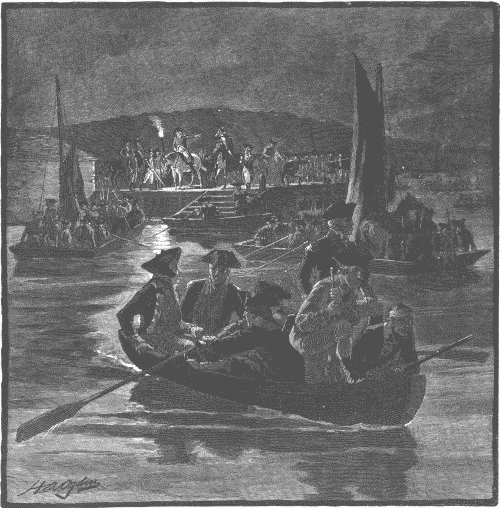
THE RETREAT FROM LONG ISLAND.—WASHINGTON DIRECTING THE PASSAGE OF THE AMERICAN ARMY ACROSS THE EAST RIVER, AT NIGHT.
Then they heard dull sounds in the distance toward the water. Suddenly at about two o'clock in the morning a cannon went off with a tremendous explosion. Nobody knew what it was, and to this day the accident remains a mystery. But the soldiers discovered what was going on. A retreat instead of an advance had been ordered. The order for an advance was intended to conceal the plan. Washington was on the shore superintending the embarkation of the troops. Some had gone over; when the tide turned, the wind and current were against them; there were not enough boats to carry the rest. To add to the confusion one of the officers blundered, and the men who had been kept in front to conceal the movement from the British were ordered down to the Ferry. For a while it looked as if the retreat would be discovered, but it was not, and when morning came the entire army had been moved across to New York, and not a man in the British army knew what had been done. It was a great feat, and Washington, who had not closed his eyes for forty-eight hours, and scarcely left the saddle all that time, again showed himself a masterly general.
He had now to show the same kind of ability the rest of the autumn. It requires one kind of generalship to lead men into battle and another to lead them on a retreat away from the enemy. With a large fleet in the harbor, it was clear that the British could at any time destroy New York and any army that was there. Accordingly, Washington withdrew his army up the island. The British followed. They could transport troops on both sides of the island, by water, and could prevent the Americans from crossing the Hudson River into New Jersey. They began to land troops on the shore of East River not far from where the Thirty-fourth Street Ferry now is. Some breast-works had been thrown up there and were held by soldiers who had been in the battle of Long Island. They seem to have been thoroughly demoralized by that defeat, for they fled as soon as they saw the British advancing, and other troops which had been sent to reënforce them were also seized with panic and fled.
Washington heard the firing in this direction and galloped over to the scene. He met the soldiers running away and called on them to halt. But they were overcome by fear and had lost their self-command. They paid no heed to him, and Washington, usually cool and self-possessed, was so enraged by their cowardly behavior that he flew into a transport of rage, flung down his hat, exclaiming, "Are these the men with whom I am to defend America!" and drawing his pistols and sword in turn, rushed upon the fugitives, trying to drive them back to their duty. He had no fear of danger himself, and he was within a short distance of the British, riding about furiously, when one of his aids, seeing the danger, seized the horse's bridle and called his commander to his senses.
To cover the army, Washington posted his forces across the narrow upper part of the island, from Fort Washington on the Hudson to the Harlem River, and here he kept the British at bay while his men recovered their strength and were ready for further movements. Meanwhile, across the Hudson River from Fort Washington, another fort, named from General Lee, had been built, and Washington had posted General Greene there. It was evident that with the British in force, with an army and navy, it would be impossible to hold New York or the Hudson River, and it was also clear that should Washington's army be defeated there, the British would at once move on Philadelphia, where Congress was sitting. With New York commanding the Hudson River and with Philadelphia in their hands, the British would have control of the most important parts of America.
Washington saw also that there was hard work before him and that it would be impossible to carry on the war with an army which was enlisted for a year only, and he bent his energies toward persuading Congress to enlist men for a longer period. He had to organize this new army and to superintend countless details. His old habits of method and accuracy stood him in good stead then, and he worked incessantly, getting affairs into order, for he knew that the British would soon move. Indeed, it is one of the strange things in history that the British, with the immense advantage which they had, did not at once after the battle of Long Island press forward and break down the Continental army in a quick succession of attacks by land and water. It is quite certain that Washington, in their place, would not have delayed action.
At the end of October, Washington occupied a position at White Plains, in the rocky, hilly country north of New York. Step by step he had given way before General Howe, who had been trying to get the American army where he could surround it and destroy it. Washington, on the other hand, could not afford to run any risks. He wished to delay the British as long as possible, and not fight them till he had his new army well organized. There was a battle at White Plains, and the Americans were forced back; but Washington suddenly changed his position, moved his men quickly to a stronger place, and began to dig intrenchments. He was too weak to fight in the open field, but he could fight with his spade, and he meant to give Howe all the trouble he could. He expected another attack, but in a day or two there were signs of a movement, and he discovered that the enemy was leaving his front.
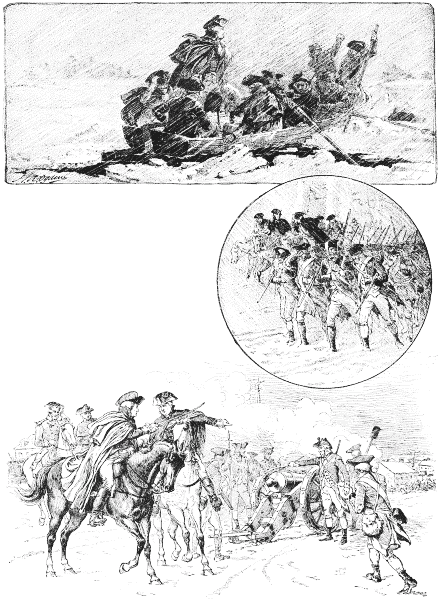
CROSSING THE DELAWARE.—THE MARCH TO TRENTON. —WASHINGTON DIRECTING THE ARTILLERY AT TRENTON.
He was not quite certain what Howe's plans might be, but he was quite sure he would move on Philadelphia. Meanwhile he kept watch over Fort Washington, and gave orders that it should be held only so long as it was prudent, but that in case of extreme danger, it should be given up and its garrison cross the river to Fort Lee. He himself with all but the New England troops, crossed the river higher up, at King's Ferry. The New England and New York troops he posted on both sides of the river to defend the passes in the Highlands, for it was of great importance to have open communication between Philadelphia and New England. A division also was left under General Lee at White Plains, who was to be ready to join Washington when it became necessary.
General Greene, who was in command at Fort Lee, on the New Jersey side of the Hudson, hoped to keep Fort Washington, on the New York side, which was also under his command. He hoped to keep it even after the British had begun to lay siege to it. Washington was obliged to leave this business to Greene's discretion, for he was occupied with moving his army across the river, higher up, and if the fort could have held out, they might have been able to prevent the British from crossing to New Jersey. But Greene counted on a stouter defense than the men in the fort gave, and when Washington at last reached Fort Lee it was only to see from the banks of the river the surrender of Fort Washington with its military stores and two thousand men. It was a terrible loss; and, moreover, the capture of that fort made it impossible to hold Fort Lee, which was at once abandoned.
Now began a wonderful retreat. The English under Lord Cornwallis, with a well-equipped army, and flushed with recent victory, crossed over to New Jersey and began moving forward. They were so prompt that the Americans left their kettles on the fire in Fort Lee as they hastily left. Washington, with a small, ragged, discouraged army fell back from the enemy, sometimes leaving a town at one end as the British entered it at the other; but he broke down bridges, he destroyed provisions, and so hampered and delayed the enemy that they made less than seventy miles over level country in nineteen days.
Meanwhile the British general was issuing proclamations calling upon the people of New Jersey to return to their allegiance, and promising them pardon. Many gave up and asked protection. It seemed as if the war were coming to an end, and that all the struggle had been in vain. The American army, moreover, had been enlisted for a short term only, and before the end of December most of the men would have served their time. General Lee delayed and delayed, and Washington himself was harassed and well-nigh disheartened; but he meant to die hard. One day, when affairs looked very dark, he turned to Colonel Reed, who was by him, and said, drawing his hand significantly across his throat: "Reed, my neck does not feel as though it was made for a halter. We must retire to Augusta County in Virginia, and if over-powered, must pass the Alleghany Mountains."
But Washington was made for something more than a guerilla chieftain. He had put the Delaware River between his army and the British, who were now scattered over New Jersey, going into winter quarters, and intending, when the river was frozen, to cross on the ice and move upon Philadelphia. Suddenly, on Christmas night, Washington recrossed the river with his little army, making a perilous passage through cakes of floating ice that crunched against the boats, surprised a large detachment of Hessians near Trenton, and captured a thousand prisoners. Eight days later he fought the battle of Princeton. Within three weeks he had completely turned the tables. He had driven the enemy from every post it occupied in New Jersey, except Brunswick and Amboy, made Philadelphia safe, and shown the people that the army, which was thought to be on the verge of destruction, could be used in the hands of a great general like a rod with which to punish the enemy.
Men were beginning to see that here was one who was a true leader of men.
On the day after the victory at Trenton, Congress, "having maturely considered the present crisis, and having perfect reliance on the wisdom, vigor and uprightness of General Washington," passed a resolution that "General Washington shall be, and he is hereby, vested with full, ample, and complete powers to raise armies, appoint officers, and exercise control over the parts of the country occupied by the army." Washington had been constantly checked by the necessity of referring all questions to Congress and to his generals. Now he was to have full power, for he had shown himself a man fit to be trusted with power.
(To be continued.)