Volume 13 — RIDDLES FOR VERY LITTLE FOLKS.
Reading edition
Who knows what a riddle is? A riddle is something to be guessed. Well, here is a riddle in a picture, all about pretty painted bridges.
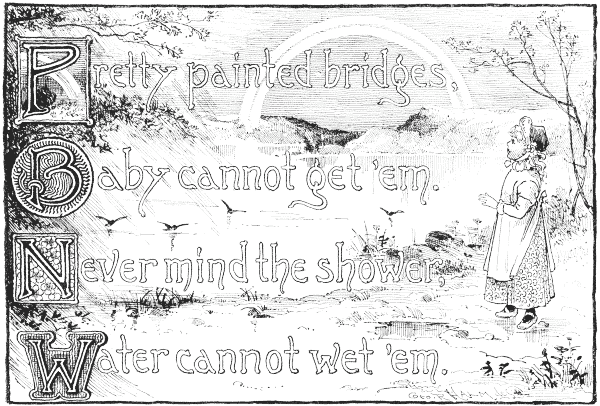
Who can guess it? The bridges are not real bridges, and they are not really painted,—yet every summer we see them. Now, what kind of bridges are they? Nobody over seven years of age need try to guess these riddles.
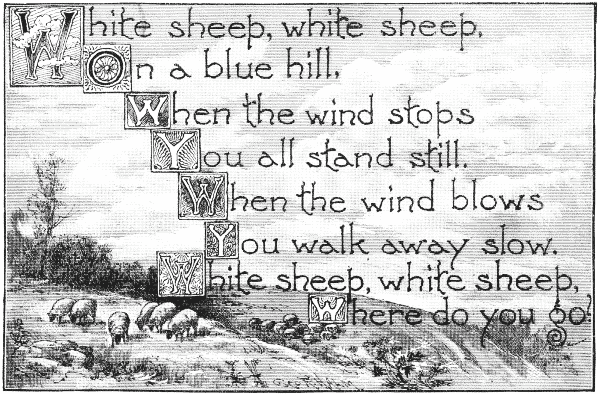
Now you shall have another riddle,—this time about sheep, but they are not the real sheep shown in the picture. On almost any sunny day you can see the kind of sheep that this riddle means. Many of these riddle sheep are white as snow, and they keep moving, moving, when the wind blows. Did you ever see them? Perhaps if you look out of your window now you may see some of the same sort. But it must be at noon time, or in the morning when the sky is blue, or when you wake up in the night and see the moon softly stealing in and out among them. Do not look for them when it is time for little folk to say "good-night!" Then these sheep sometimes change into bright red and yellow banners stretching across the sky and floating over the place where the sun is going to sleep.
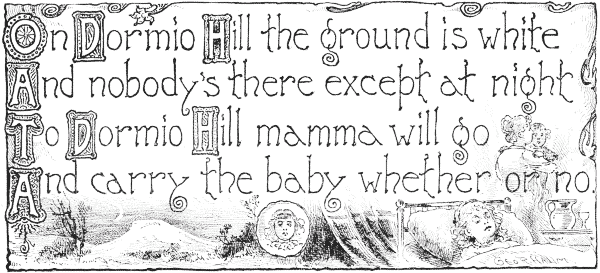
And now comes the very last riddle,—about Dormio Hill. What can the white ground of Dormio Hill be? It is in the land of Nod, and if you wish to find it, I do believe the Sand-man can take you to the very spot.
And who is the Sand-man? Ah, that is another riddle which Mamma can answer for you.
We will open the meeting this month, my hearers, with "A Bumble Grumble" sent to you by my friend Harold W. Raymond.
A bumble-bee sat on the wild-rose tree, And grumbled because he was big and fat; "Just look at yon butterfly light," quoth he, "I wish I were airy and graceful like that! O ho! I know 'Tis hard to be heavy, and huge, and slow!" A mischievous boy the butterfly caught, And in his rough grasp it fluttered and died. Sir Bumble his dagger drew out, and thought That his end had come; but he boldly cried: "Come on! My son; This stinger and I weigh nearly a ton." "You'll have to excuse me, sir," said the lad, "I know the weight of your little barbed spear. Were your logic less pungent I'd be most glad To meet you in conflict and vanquish you here. Good-day! I'll say; For I fear 'twould unhealthy prove to stay." The bumble-bee laughed a stitch in his side When he saw the youngster in full retreat; Then he stretched himself in a new-born pride And threw out his chest with martial conceit. "Dear me!" Said the bee, "'Tis easy to see An ounce of sting Is better than yards of butterfly-wing."
And now you shall have a story that isn't in verse, though there's poetry in it. "Turn about is fair play," and this will interest you in the butterflies.
PRETTY DUSTY WINGS.
Dear Jack: Please let me tell you this true story:
Dusty Wings is the name of a charming little pet of mine; and he is so curious a thing to have for a pet, that if it were not for his name, I don't believe you could ever guess what he is.
One day in the early part of November, as I sat by the window, I noticed lying on the piazza a beautiful butterfly, with his gorgeous wings outspread. He was apparently stunned by the cold, as he did not attempt to fly away when I went to pick him up. I brought him into the warm room, when he soon became very lively.
His body is dark brown, covered with fine hairs, which look like feathers when put under a magnifying glass. The wings show all the colors of the rainbow, arranged in the most artistic manner. The wings themselves are transparent, like those of a fly, and the color is given to them by fine scales, which come off very easily. The antennæ which grow from each side of the head are black and white.
Although you all have probably seen many butterflies as beautiful as my pet, I don't believe you ever watched one eat, and that is a very interesting process. Dusty Wings alights on my finger and clings to it as if he really loved me. I then put a drop of sugar in front of him. Immediately a long trunk (it is hollow, like an elephant's) unwinds and feels about until it finds the liquid, which gradually disappears; and then Mr. Dusty Wings slowly coils his trunk around and stows it away in a vertical opening in the center of his head. The trunk is so delicate that when it is coiled up, it looks like a fine watch-spring. If he has not had enough, he lets me know by waving this trunk in the air. The first time I fed him, he seemed shy and only ate very little; now he is not at all afraid.
I made him a house with plenty of air-holes, and there he stays most of the time on a warm corner of the mantel. I do not like to let him out very often to fly about, as I am afraid he might be stepped on. If I wear a flower he will crawl up my dress until he comes to it, and there he will stay, showing that he has not forgotten his old life.
Yours sincerely,
Ada C. Ashfield.
TREES THAT RAIN.
Memphis, Tenn., January 10, 1886.
Dear Jack: I thought some of your readers might be able to answer my question.
There had been no rain here for about three weeks; it was in the fall, and our school went to see a tree that had been raining for two or three days; this tree was a sycamore. I saw two more trees that rained. One was a box-elder, and the other an elm. The elm was in the woods. The drops tasted like water, and dried up as quickly.
Can any one explain this to me?
Your constant reader,
Julia S.
All look out, my friends, for raining trees, and report the results of your observations. I've seen no such instance in my meadow as the one Julia describes. But you all may go searching the groves and the books, and see what you can discover.
SHOOTING STARS.
New York, March 1, 1886.
Dear Jack: I frequently have read of shooting stars, but never of anything like this that I saw. About four summers ago, I was staying at a village on Long Island. One evening as I was about to go into the house, I glanced up at the heavens. Myriads of stars were shining brightly, but no moon. As I was looking directly overhead, there was a sudden, intense light, and a star burst into fragments. The pieces slid a short distance and then disappeared, as all shooting stars do. The utter noiselessness of the whole occurrence made it even more impressive and startling. Will you please ask your readers whether they ever have seen such a thing or read of anything like it?
Yours respectfully,
Susan A.
COASTING IN AUGUST.
Gardiner, Maine.
Dear Jack: I meant to have written to you before, telling how we boys coast in August, as I was reminded of it by reading the story about coasting down the grass-covered hills, in St. Nicholas for August, 1885.
Along the Kennebec river are many huge ice-houses. The ice is sent away in big ships in summer. It is raised high in the air and swung on a sloping plank which reaches to the ship's deck. Block after block is dispatched in this way very quickly. We boys used to get pieces of old carpeting and put on the ice. Then each boy would seat himself on a carpet-covered block of ice, and, in something less than a wink, we would find ourselves on the ship. We did this, the boys and I, till our mothers found it out. Then we stopped.
Your constant reader,
John W.
MORE ABOUT TURTLES.
Dear Jack: I saw some letters about turtles in your department, and so I thought I would write to you about something I noticed. I have a small turtle, and I have seen that the shell scales off in little pieces just the shape of the divisions on its back. It shuts its eyes by raising the lower lid. Has any one else noticed the first peculiarity?
Your reader,
W. I. L.
A FISH THAT WEAVES ITS NEST.
Mr. C. F. Holder, I hear, is to tell you in the June St. Nicholas about some fishes and their young, so this is a good time to show you this letter from my friend Ernest Ingersoll, concerning a fish that weaves its nest.
Dear Jack: Among the small fishes that inhabit the streams and ditches along the Atlantic coast of the Northern States, is the four-spined stickleback. Like the rest of the sticklebacks, this species makes a nest in which the eggs are deposited. The male fish makes the nest himself and defends it with great spirit. It is about half an inch high and three-eighths of an inch in thickness. It is composed of stalks of water-weeds and small stuff of that kind, bound together by a glutinous thread which the fish spins out from a gland in his body, and which is wound round and round the nest to bind it together. It frequently happens, however, that in poking apart the straws with his nose this living bobbin will pass his body through the nest and back again, thus weaving the thread he reels out into the substance of the nest and sewing it tightly together.
Yours truly,
Ernest Ingersoll.
A CLEVER HUMMING-BIRD.
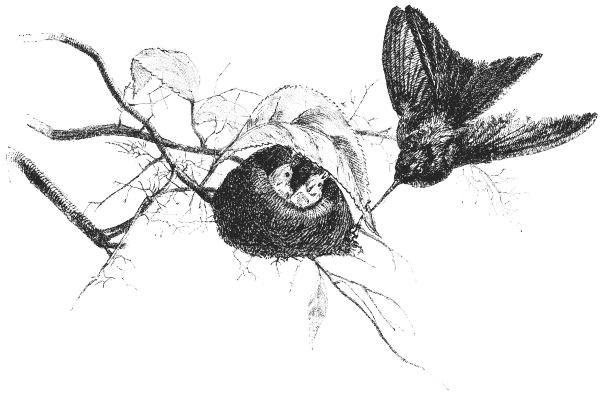
You all remember, I am sure, "Robin's Umbrella," which was described and shown to you from this pulpit two months ago. Now I'll tell you about the way in which a clever humming-bird shielded her little ones from the rain. There they were, a nestful, and the rain beginning to fall. The people who had watched the nest out of their window were concerned about the young birds, but the mother-bird evidently was prepared for the emergency. Near the nest grew a large leaf,—it was a butternut tree,—and on one side of the nest a small twig stuck out. When the drops began to fall, she came quickly, and with many tugs pulled the leaf over the little nest, for a roof, and hooked it by the twig on the other side, which held it firmly.
Thus the half-feathered babies were kept as dry under their green roof as if their house had been built by a carpenter, like the sparrow-houses all around on the trees.
When the rain was over, the mother came back and unhooked the leaf.