Volume 13 — The Agassiz Association
Reading edition
SIXTY-SECOND REPORT.
IMPORTANT NOTICE.
The Agassiz Association is now so large, so widely known, and so firmly established, that, in order to protect ourselves from the annoyance of frivolous persons who, taken by the novelty of the idea, seek to join us just for the fun of the thing, and then drop away after a few weeks, we have decided to make the gates of admission swing just a trifle less easily. The following circular will, therefore, be sent hereafter to all who seek admission. It will be seen by every one that its requirements are sufficiently liberal:
"PLEASE READ EVERY WORD CAREFULLY.
"The Agassiz Association is a Society for the observation of nature. It is composed of 'Chapters,' which, apart from the common name, constitution, and badge, are free to follow their own pursuits under the direction of the President of the A. A. The smallest number recognized as a Chapter is four, but after a branch has once been admitted, and has continued active for six months, it is not then cut off, though its membership should decline below four.
"There is no entrance fee for Chapters, nor any charge for registration, or for the advertising of 'Exchanges' in St. Nicholas. There are no assessments, nor any "dues." The special classes, occasionally conducted by eminent scientists, are freely open to all members. The only necessary expense is 54 cents for the A. A. Hand-book. Engraved charters can be obtained for $1.25 each, as many Chapters and individual members wish them, but there is no obligation to purchase them. As we make no charges, we appreciate generous orders for the little hand-books, whose sales about cover the expenses of our enormous correspondence—usually nearly every member is glad to secure a copy. Individuals who join us without organizing a Chapter, are charged a fee of 50 cents in addition to the price of the Hand-book.
"Kindly fill out the inclosed application form and card (excepting 'No. of Chapter'), and return them at once. Then, if accepted, the certificate, number, and letter will be sent. It must be made one of your by-laws that your Secretary send to the President a carefully prepared report at least once a year, and should you at any time be compelled to disband, immediate notice must be sent and the charter returned.
"The St. Nicholas magazine is our only official organ, and it should be found on the table of every Chapter; this, however, is not compulsory. In the November, 1885, issue of St. Nicholas, will be found full directions for the annual reports, which are required from every Chapter.
"Badges are no longer to be had from Mr. Hayward, but should be ordered through the President.
"APPLICATION FOR A CHARTER.
"We, whose names are on the accompanying card, hereby petition to be recognized as a Chapter of the Agassiz Association. We accept the constitution, we agree to the conditions of membership as explained in the circular from which this form has been detached, and we faithfully promise to do our best work in our several branches of study, and in all ways heartily to support and further the interests of the General Association. Respectfully
____________________________ Secretary."
The only new conditions are the agreement to send an annual report, and to send immediate notice, in case of disbanding. Failure to do the latter causes untold confusion throughout the whole Society, as the disbanded Chapters continue, sometimes for years, to be addressed by the active ones.
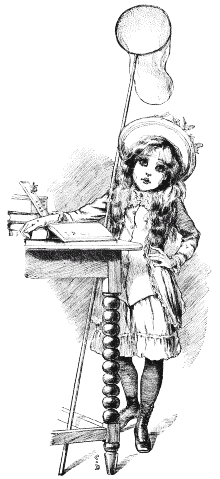
YOUNG NATURALIST CLASSIFYING HER FIRST SPECIMEN:
"Poly-omma-tus pseu-darg-io-lus!—Gracious! if a little one like that has such a dreadful name, how can I ever remember the big ones!"
NOTES.
Important as are the proceedings of our Chapters, as set forth in their "reports," they must not be allowed to crowd out the records of personal observation, which we have presented until lately under the heading—"Notes." We suggest, therefore, that all Chapters forward promptly to the President whatever items of interest come to their notice from time to time, without waiting for the formal annual report of the Chapter's progress. The most important results of your observations should also be incorporated in your annual report, as being of quite as much general interest as the condition of your treasury. We intend to devote a large share of this page to these "Notes," during the months of July and August, when no Chapter reports are due.
REPORTS FROM THE FOURTH CENTURY.
314, Lancaster, Pa. (A). With the Bedford, Pa., Chapter, we have exchanged at least seven thousand crystals of iron pyrites, for minerals, fossils, etc. Our egg, mineral, fossil, and shell cabinets are all pretty well filled with labeled specimens. We now propose to take up Botany, and desire to collect and mount at least four hundred specimens. Until another year has elapsed, we hope to pursue our studies of the myriad mysteries with which nature has surrounded us.—Edw. R. Heitshu.
320, Peoria, Illinois. We like geology better than the other sciences. We have several fine localities in which to seek specimens, and we go searching for them whenever we get a chance. We have several fine trilobites, corals, and other fossils. We are very much pleased with the A. A., and are delighted when we read of the good work it has done.—James A. Smith.
339, Salt Lake City (A). We are progressing very nicely. At the second or third meeting after our summer vacation, it was announced that the type of a defunct newspaper had come into the possession of one of the members, and it was suggested that the Chapter publish a monthly pamphlet.
The suggestion was carried into effect; two members were elected editors and compositors combined. Friends kindly subscribed, and counting $5 generously given by Dr. E. Evans, enough money was raised to buy a cabinet eight feet high and three and one-half feet wide. We are trying to get a library. Two of us are building large boats to take trips and explore Great Salt Lake. We have questions, two-minute talks, papers, select readings, and criticisms.
We mean to try to make this the most successful year of our existence.—Arthur Webb, Sec.
350, Neillsville, Wis. The dawning spring wakens us all. We are planning a trip through Colorado, New Mexico, and Arizona, which is to last all next winter.—M. F. Bradshaw.
354, Litchfield, Conn. Our departments of ornithology and zoology exhibit the best results. Many new specimens have been added, and great improvement has been made in preserving them. The library has been increased.—Lewis B. Woodruff.
355, North Adams, Mass. At present we have seventeen active and eleven honorary members. We have questions distributed at each meeting which the members are expected to answer at the following meeting. We try to have at least one good essay each week, and occasionally a lecture. Our cabinet is pretty well filled.—M. Louise Radlo.
365, Hyde Park, Illinois. There have been fifteen regular and three special meetings during the past year. September 18, 1885, Mr. John F. Gilchrist was elected president, and Mr. S. D. Flood vice-president of the Chapter. Since March 27, 1885, there have been 125 specimens presented. The total number now in the cabinet is 1000. With the aid of the Board of Education, we have purchased a microscope valued at $100. The literary exercises have consisted, as a rule, of debates on subjects in natural science.—Blanche Longmire, Sec.
374. Three of us have revived our Chapter. We devote ourselves to science instead of arguing parliamentary nonsense, as we used to do. We have come to the conclusion that if we want to apply ourselves to science we must drop parliamentary discussions.
Here is an example of our latest resolutions: "Resolved, That any member who does not do his share in the scientific work, or by unseemly mirth distracts the attention of the meeting, shall, after three reprimands by the president, be expelled from the Chapter."
It is hoped by this and other cast-iron resolutions, to banish levity, and meet together as sober, earnest workers. We'd rather have three earnest workers than thirty that take no interest.—Frank E. Cocks.
378, Ambler, Pa. Our Society is now composed of about sixty members, the teachers and scholars of Sunnyside School. We hold fortnightly meetings; the exercises consist of referred questions, presentation of specimens, readings, occasional debates, and the reading of the Sunnyside Naturalist by the editor. The officers are: Pres., Mary McCann; V. P., Helen Styer; Sec., Carrie A. Lukens; Treas., Anson Smith; Editor, John H. Rex. We seem to be more interested in mineralogy and entomology than in any other branches.—Carrie A. Lukens, Sec.
382, Brooklyn, N. Y. (F). This is our fourth year. We have eight active and eight honorary members. Meetings have been held weekly without interruption, except for summer vacations. Geology has been our subject during the greater part of the time. Each year we go a little farther into it. Our collection, while not large, is by no means a poor one, and our pleasure is enhanced by examination of actual specimens. We have all been benefited by our study, and have now an intelligent general idea of geology. We have received very kind attention from the President of the "Brooklyn Entomological Society," who is an enthusiast in plants and insects. No Chapter is more interested than ours in the growth and success of the entire Association.—D. A. Van Ingen, per B. S.
386, Pine City, Minn. We think that keeping live animals is more profitable than only stuffed skins, as we have a live owl, and find it more interesting to watch him than to watch a skull and claws which belonged to another owl. We have, of insects, 980 species; minerals, 110; stuffed birds, 6; animals, 2; heads, 4; skulls, 6; miscellaneous, 20. Total, 1128; and 1018 of them are native in Minnesota.—Ernest L. Stephen.
387, Baltimore, Md. (E). After your kind letter the members took courage and determined, under all circumstances, to continue the club. Our greatest difficulty was in securing a place to meet. In our despair we went to the President of our University (Johns Hopkins), who showed great interest in us, yet could not give us a room under his roof. We then decided to store our collection (which amounts to packing them on my own shelves, in the modest little room known in our family as "Ned's Den"), and accept the invitation of one of our young lady members to meet in her study. This we have been doing ever since.—Edward McDowell, for the Secretary.
395, Montreal (A). Since the organization of our Chapter on January 5, 1883, a wonderful change has taken place. Then only six individuals met to discuss the advisability of organizing a branch here; to-day we have a large collection and a good attendance at the meetings.
Each session of this branch commences on the first Friday in October of each year and closes about the 15th of June of the following year. In this period we usually hold eighteen regular meetings. So far this session, we have had six regular meetings at which a number of excellent papers have been read; among them might be mentioned the following: Origin of Life, by Rev. E. King, M. A.; two papers on Botany, by H. McAdam, Esq.; New and Variable Stars, by W. H. Smith, Esq., President of the Astro-Meteorological Association; Our Insect Friends and Insect Foes, by Rev. T. W. Fyles; Electricity, by Prof. J. T. Donald, B. A.; and Health, its Importance and its Laws, by Dr. Desrosiers, M. D. These papers were fully illustrated with diagrams, specimens, and experiments.
Our collection is steadily increasing, and numbers about 7000 specimens at present, neatly arranged in ninety-two drawers contained in two large cabinets, and an upright glass case, which latter contains the mounted birds and mammals. Our little library, which contains only scientific publications, is nicely arranged in a book-case for the purpose. It includes about 150 volumes and many pamphlets unbound.
One very encouraging feature in our work has been that many of our young people who previously took but little interest in the study of nature have now gained a liking for the study, and a number have made private collections and are carefully studying the different forms in which they are specially interested. One member has carefully studied the life history of H. luna, one of our large bombyces, while another has been studying the flora of the Island of Montreal, and another is devoting his time to chemistry. This latter subject has been acknowledged by many of the members to be the fundamental and most fascinating study, and the one most elevating to the mind, as it can not fail to lead a student from nature to nature's God, and I confidently believe the science which tends towards that is the study which will eventually take first place in the scientific world.—W. D. Shaw, Secretary, 34 St. Peter Street, Montreal, Canada; Thos. Patton, Pres.
398, Roseville, N. J. Our Chapter has been divided into four sections, each having its own Chapter, and in turn instructing the club on its special subject. We have purchased a few standard books, a book-case, and a very handsome cabinet, which we have nearly filled with fine specimens. The leading events of the season have been a social party, and a debate on the comparative utility of wood and iron. We will never say die.—Sara Darrach, Secretary.
400, Fargo, Dakota. We have rented a fine suite of rooms. We have eighteen members, and the prospect of as many more. We have a cabinet full of specimens, and are prepared to exchange minerals, shells, Indian relics, etc., with other chapters. We are settled now, and are doing good hard work. With best wishes for yourself and the A. A.—Frank Brown, Sec. Box 1769.
DELAYED REPORTS.
262, Denver (B). It has been a long time since any report has been made by this Chapter, and we have been so far separated that we could not do much for the A. A.; but we hope to do better in the future. About one-half the members have been living in the East for two years, while the rest of us were here. We were united a little over a year ago, and since then there has been a great deal of sickness among us, ending disastrously; but for all that, we have had quite a mass of correspondence with other Chapters in all parts of the country, and have also done some exchanging of specimens which has resulted very favorably for us, and, we think, for those to whom we have sent specimens. We have now a very nice cabinet, well filled with specimens which we value very highly, and we shall soon have to get another, as we have room for no more specimens. We hope to do some good work in the future in mineralogy, which is our particular branch of study.—Ernest L. Roberts, Sec. Box 2272.
295, Boonville, N. Y. Our Chapter ran down for a long time, but a few months ago we started it anew and in earnest.
We now have seven active members, and two honorary. We expect more to join at our next meeting. We meet once a week at the houses of members.
Not long ago we went to see an old geologist's cabinet of specimens. He has a great many. He said when he first commenced collecting he lived in an old log-house, and his first cabinet was a log split in two, with a board, that was used for a walk to the spring, nailed on it. If all the members of our Chapter were half as earnest to collect and preserve specimens as he was, we should have some lively times.—W. S. Johnson, Sec.
AN INVITATION.
The New England Meteorological Society invites the assistance of members of the Agassiz Association in New England and Eastern New York, in the observation of thunder-storms during the summer months. Records are wanted of the time of the beginning of rain and of the loudest thunder for every thunderstorm in all parts of New England. More complete records, giving temperature and direction of wind are welcomed from those who will make them. Instructions and blanks will be furnished, on application to
W. M. DAVIS, Sec. N. E. M. S.,
Cambridge, Mass.
EXCHANGES.
Minerals, curiosities, and fossils, for same. Send for list. E. G. Conde, Schenectady, N. Y. (Sec. 891).
Pressed orange-blossoms, orange-wood, Japan plum-wood, fig-wood, Florida moss and other Southern curiosities, for labeled bird-skins, eggs, or nests. Write first.—Percy S. Benedict, 1243 St. Charles Street, New Orleans, La.
Cocoons of the Cecropia and Promethea moths, for cocoons of other moths.—3646 Vincennes Av., Chicago, Ill.
Pressed flowers.—Miss Alice Grass, Sec. 323, Bryan, Ohio.
First-class bird-skins, for Southern skins or eggs. Write first.—L. M. Davies, 203 Newell St., Cleveland, Ohio.
Botanical specimens, for same. Send lists.—Theo. Kellogg, De Pere, Wis.
NEW CHAPTERS.
No. Name. No. of Members. Address.
950 Swarthmore, Pa. (A) 8 Maria W. Flagg.
951 Cleveland, O. (E) 4 L. M. Davies, 203 Newell St.
952 West Troy, N. Y. (A) 13 Geo. F. P. Michaelis, Watervliet Arsenal.
953 La Porte, Ind. (C) 5 Mrs. A. C. Loomis, Box 1069.
954 Copenhagen, N. Y. (A) 5 L. L. Lewis, Box 174.
955 Ridgefield, Conn. (A) 5 Roger C. Adams.
956 Alleghany, Pa. (B) 5 A. D. Roessing, W. P. R. R. Depot.
DISSOLVED.
412 Syracuse, N. Y. (C) B. Burrett Nash.
165 Plymouth, Conn (A) 4 W. C. Talmadge.
390 Chester, Mass. (A) W. J. Stanton.
REORGANIZED.
597 Lawrence, Kansas (B) 4 F. L. Wemple, 1109 Tenn. St.
323 Bryan, Ohio (A) 8 Miss Alice Grass.
Address all communications for this department to the President of the A. A.,
MR. HARLAN H. BALLARD,
Principal of Lenox Academy, Lenox, Mass.