Part 1 — THOMAS FRANCIS MEAGHER.
Reading edition
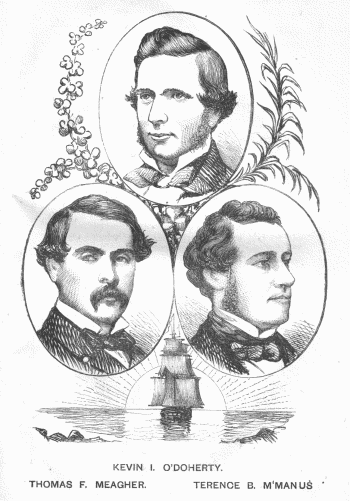
Early in 1846, when the Repeal Association was still powerful and great, and ere yet the country had ceased to throb to the magic of O'Connell's voice, there rose one day from amongst those who crowded the platform of Conciliation Hall, a well-featured, gracefully-built, dark-eyed young gentleman, towards whom the faces of the assembly turned in curiosity, and whose accents when he spoke, were those of a stranger to the audience. Few of them had heard of his name; not one of them—if the chairman, William Smith O'Brien be excepted—had the faintest idea of the talents and capacities he possessed, and which were one day to enrapture and electrify his countrymen. He addressed the meeting on one of the passing topics of the day; something in his manner savouring of affectation, something in the semi-Saxon lisp that struggled through his low-toned utterances, something in the total lack of suitable gesture, gave his listeners at the outset an unfavourable impression of the young speaker. He was boyish, and some did not scruple to hint conceited; he had too much of the fine gentleman about his appearance, and too little of the native brogue and stirring declamation to which his listeners had been accustomed. The new man is a failure, was the first idea that suggested itself to the audience: but he was not; and when he resumed his seat he had conquered all prejudices, and wrung the cheers of admiration from the meeting. Warming with his subject, and casting off the restraints that hampered his utterances at first, he poured forth a strain of genuine eloquence, vivified by the happiest allusions, and enriched by imagery and quotations as beautiful as they were appropriate, which startled the meeting from its indifference, and won for the young speaker the enthusiastic applause of his audience. O'Brien complimented him warmly on his success, and thus it was that the orator of Young Ireland made his debut on the political platform.
Meagher was not quite twenty-three years of age when his voice was first heard in Conciliation Hall. He was born in Waterford of an old Catholic family, which through good and ill had adhered to the national faith and the national cause; his school-boy days were passed partly at Clongowes-wood College, and partly under the superintendence of the Jesuit Fathers at Stoneyhurst in Lancashire. His early years gave few indications of the splendid wealth of genius that slumbered within his breast. He took little interest in his classical or mathematical studies; but he was an ardent student of English literature, and his compositions in poetry and prose invariably carried away the prize. He found his father filling the Civic Chair in Waterford, when he returned from Stoneyhurst to his native city. O'Connell was in the plenitude of his power; and from end to end of the land, the people were shaken by mighty thoughts and grand aspirations; with buoyant and unfaltering tread the nation seemed advancing towards the goal of Freedom, and the manhood of Ireland seemed kindling at the flame which glowed before the altar of Liberty. Into the national movement young Meagher threw himself with the warmth and enthusiasm of his nature. At the early age of twenty we find him presiding over a meeting of Repealers in his native city, called to express sympathy with the State Prisoners of '43, and he thence-forward became a diligent student of contemporary politics. He became known as an occasional speaker at local gatherings; but it was not until the event we have described that Meagher was fairly launched in the troubled tide of politics, and that his lot was cast for good or evil, with the leaders of the national party.
Up to the date of secession Meagher was a frequent speaker at the meetings of the Repeal Association. Day by day his reputation as a speaker extended, until at length he grew to be recognised as the orator of the party, and the knowledge that he was expected to speak was sufficient to crowd Conciliation Hall to overflowing. When the influence of the Nation party began to be felt, and signs of disunion appeared on the horizon, O'Connell made a vigorous effort to detach Meagher from the side of Mitchel, Duffy, and O'Brien. "These young Irelanders," he said, "will lead you into danger." "They may lead me into danger," replied Meagher, "but certainly not into dishonour."
Against the trafficking with the Whigs, which subsequently laid the Repeal Association in the dust, and shipwrecked a movement which might have ended in the disinthralment of Ireland, Meagher protested in words of prophetic warning. "The suspicion is abroad," he said, "that the national cause will be sacrificed to Whig supremacy, and that the people, who are now striding on to freedom, will be purchased back into factious vassalage. The Whigs calculate upon your apostacy, the Conservatives predict it." The place beggars, who looked to the Whigs for position and wealth, murmured as they heard their treachery laid bare and their designs dissected in the impassioned appeals by which Meagher sought to recall them to the path of patriotism and duty. It was necessary for their ends that the bold denouncer of corruption, and the men who acted with him, should be driven from the association; and to effect that object O'Connell was hounded on to the step which ended in the secession. The "peace resolutions" were introduced, and Meagher found himself called on to subscribe to a doctrine which his soul abhorred—that the use of arms was at all times unjustifiable and immoral. The Lord Mayor was in the chair, and O'Brien, John O'Connell. Denis Reilly, Tom Steele, and John Mitchel had spoken, when Meagher rose to address the assembly. The speech he delivered on that occasion, for brilliancy and lyrical grandeur has never been surpassed. It won for him a reception far transcending that of Shiel or O'Connell as an orator; and it gave to him the title by which he was afterwards so often referred to—"Meagher of the Sword." He commenced by expressing his sense of gratitude, and his attachment to O'Connell, "My lord," he said:—
"I am not ungrateful to the man who struck the fetters off my limbs while I was yet a child, and by whose influence my father, the first Catholic that did so for two hundred years, sat for the last two years in the civic chair of my native city. But, my lord," he continued, "the same God who gave to that great man the power to strike down one odious ascendency in this country, and who enabled him to institute in this land the laws of religious equality—the same God gave to me a mind that is my own, a mind that has not been mortgaged to the opinion of any man or set of men, a mind that I was to use and not surrender."
Having thus vindicated freedom of opinion, the speaker went on to disclaim for himself the opinion that the Association ought to deviate from the strict path of legality. But he refused to accept the resolutions; because he said "there are times when arms alone will suffice, and when political ameliorations call for 'a drop of blood,' and for many thousand drops of blood." Then breaking forth into a strain of impassioned and dazzling oratory he proceeded:—
"The soldier is proof against an argument—but he is not proof against a bullet. The man that will listen to reason—let him be reasoned with. But it is the weaponed arm of the patriot that can alone prevail against battalioned despotism.
"Then, my lord, I do not condemn the use of arms as immoral, nor do I conceive it profane to say that the King of Heaven—the Lord of Hosts! the God of Battles!—bestows his benediction upon those who unsheath the sword in the hour of a nation's peril. From that evening on which, in the valley of Bethulia, he nerved the arm of the Jewish girl to smite the drunken tyrant in his tent, down to this our day, in which he has blessed the insurgent chivalry of the Belgian priest, His Almighty hand hath ever been stretched forth from His throne of Light to consecrate the flag of freedom—to bless the patriot's sword! Be it in the defence, or be it in the assertion of a people's liberty, I hail the sword as a sacred weapon; and if, my lord, it had sometimes taken the shape of the serpent, and reddened the shroud of the oppressor with too deep a dye, like the anointed rod of the High Priest, it has at other times, and as often, blossomed into celestial flowers to deck the freeman's brow.
"Abhor the sword—stigmatize the sword? No, my lord, for in the passes of the Tyrol it cut to pieces the banner of the Bavarian, and, through those cragged passes, struck a path to fame for the peasant insurrectionists of Inspruck! Abhor the sword—stigmatize the sword? No, my lord, for at its blow a giant nation started from the waters of the Atlantic, and by its redeeming magic, and in the quivering of its crimsoned light the crippled colony sprang into the attitude of a proud Republic—prosperous, limitless, and invincible! Abhor the sword—stigmatize the sword? No, my lord, for it swept the Dutch marauders out of the fine old towns of Belgium—scourged them back to their own phlegmatic swamps—and knocked their flag and sceptre, their laws and bayonets, into the sluggish waters of the Scheldt.
"My lord, I learned that it was the right of a nation to govern itself, not in this hall, but on the ramparts of Antwerp; I learned the first article of a nation's creed upon those ramparts, where freedom was justly estimated, and where the possession of the precious gift was purchased by the effusion of generous blood. My lord, I honor the Belgians for their courage and their daring, and I will not stigmatize the means by which they obtained a citizen-king, a chamber of Deputies."
It was all he was permitted to say. With flushed face and excited gesture John O'Connell rose, and declared he could not sit and listen to the expression of such sentiments. Either Mr. Meagher or he should leave the Association; O'Brien interceded to obtain a hearing for his young friend, and protested against Mr. O'Connell's attempts to silence him. But the appeal was wasted, O'Brien left the hall in disgust, and with him Meagher, Duffy, Reilly, and Mitchel quitted it for ever.
Meagher's subsequent career in Ireland is soon told. He was a regular attendant at the meetings of the Confederation, of which he was one of the founders, and the fame of his eloquence, his manly appearance, and the charms of his youthful frankness contributed immensely towards the growth of the new organization. He always acted with O'Brien, whom he loved in his inmost soul, but he was respected and admired by every section of nationalists, the Mitchelites, the Duffyites, and we might even say the O'Connellites. When the country began to feel the influence of the whirlwind of revolution which swept over the continent, overturning thrones and wrecking constitutions as if they were built of cardboard, Meagher shared the wild impulse of the hour, and played boldly for insurrection and separation. He was one of the three gentlemen appointed to present the address from Ireland to the French Republican government in 1848; and in the speech delivered by him at the crowded meeting in the Dublin Music Hall before his departure, he counselled his countrymen to send a deputation to the Queen, asking her to convene the Irish parliament in the Irish capital. "If the claim be rejected," said Meagher, "if the throne stand as a barrier between the Irish people and the supreme right—then loyalty will be a crime, and obedience to the executive will be treason to the country. Depute your worthiest citizens to approach the throne, and before that throne let the will of the Irish people be uttered with dignity and decision. If nothing comes of this," he added, "if the constitution opens to us no path to freedom, if the Union be maintained in spite of, the will of the Irish people, if the government of Ireland insist on being a government of dragoons and bombadiers, of detectives and light infantry, then," he exclaimed in the midst of tumultuous cheering, "up with the barricades, and invoke the God of Battles!"
While the Republican spirit was in full glow in Ireland, Meagher astonished his friends by rushing down to Waterford and offering himself as a candidate for the post left vacant in parliament by the resignation of O'Connell. By this time the Confederates had begun to despair of a parliamentary policy, and they marvelled much to see their young orator rush to the hustings, and throw himself into the confusion and turmoil of an election contest. Que le diable allait il faire dans cette galere muttered his Dublin friends. Was not the time for hustings orations, and parliamentary agitation over now? Meagher, however, conceived, and perhaps wisely, that he could still do some good for his country in the House of Commons. He issued a noble address to the electors of his native city, in which he asked for their support on the most patriotic grounds. "I shall not meddle," he said, "with English affairs. I shall take no part in the strife of parties—all factions are alike to me. I shall go to the House of Commons to insist on the rights of this country to be held, governed, and defended by its own citizens, and by them alone. Whilst I live I shall never rest satisfied until the kingdom of Ireland has won a parliament, an army, and a navy of her own." Mitchel strongly disapproved of his conduct. "If Mr. Meagher were in parliament," said the United Irishman, "men's eyes would be attracted thither once more; some hope of 'justice' might again revive in this too easily deluded people." The proper men to send to parliament were according to Mitchel, "old placemen, pensioners, five pound Conciliation Hall Repealers." "We have no wish to dictate," concluded Mitchel in an article on the subject, full of the lurking satire and quiet humour that leavened his writings, "but if the electors of Waterford have any confidence in us, we shall only say that we are for Costello!"
"Costello" was defeated, however, but so was Meagher. The Young Ireland champion was stigmatized as a Tory by the Whigs, and as a rebel by the Tories; if the people, as Mitchel remarks had any power he would have been elected by an overwhelming majority, but the people had no votes, and Sir Henry Winston Barren was returned. Meagher went back to Dublin almost a convert to Mitchel's views, leaving Whig, Tory, and West Briton to exult over his discomfiture.
We have already seen what Meagher did when the guage of battle was thrown down, and when "the day all hearts to weigh" was imagined to have arrived, we have seen how he accompanied O'Brien in his expedition from Wexford to Kilkenny, and thence to Tipperary; and how on the morning of July 29th, 1848, he left O'Brien at Ballingarry, little dreaming of the tragedy which was to make that day memorable, and expecting to be able to bring reinforcements to his leader from other quarters before the crisis came. He failed however in his effort to spread the flames of insurrection. The chilling news of O'Brien's defeat—distorted and exaggerated by hostile tongues—was before him everywhere, and even the most resolute of his sympathisers had sense enough to see that their opportunity—if it existed at all—had passed away. On the 12th day of August, 1848, Meagher was arrested on the road between Clonoulty and Holycross, in Tipperary. He was walking along in company with Patrick O'Donoghue and Maurice R. Leyne, two of his intimate friends and fellow-outlaws, when a party of police passed them by. Neither of the three was disguised, but Meagher and Leyne wore frieze overcoats, which somewhat altered their usual appearance. After a short time the police returned; Meagher and his companions gave their real names on being interrogated, and they were at once arrested and taken in triumph to Thurles. The three friends bore their ill fortune with what their captors must have considered provoking nonchalance. Meagher smoked a cigar on the way to the station, and the trio chatted as gaily as if they were walking in safety on the free soil of America, instead of being helpless prisoners on their way to captivity and exile.
Meagher stood in the dock at Clonmel a week after O'Brien had quitted it a convict. He was defended by Mr. Whiteside and Isaac Butt, whose magnificent speech in his defence was perhaps the most brilliant display of forensic eloquence ever heard Within the court in which he stood. Of course the jury was packed (only 18 Catholics were named on a jury-panel of 300), and of course the crown carried its point. On the close of the sixth day of the trial, the jury returned into court with a verdict of "guilty," recommending the prisoner to mercy on the ground of his youth.
Two days later he was brought back to the dock to receive sentence. He was dressed in his usual style, appeared in excellent health, and bore himself—we are told—throughout the trying ordeal, with fortitude and manly dignity. He spoke as follows:—
"My lords, it is my intention to say a few words only. I desire that the last act of a proceeding which has occupied so much of the public time, should be of short duration. Nor have I the indelicate wish to close the dreary ceremony of a state prosecution with a vain display of words. Did I fear that hereafter, when I shall be no more, the country I tried to serve would speak ill of me, I might, indeed, avail myself of this solemn moment to vindicate my sentiments and my conduct. But I have no such fear. The country will judge of those sentiments and that conduct in a light far different from that in which the jury by whom I have been convicted have viewed them, and by the country the sentence which you, my lords, are about to pronounce, will be remembered only as the severe and solemn attestation of my rectitude and truth. Whatever be the language in which that sentence be spoken, I know that my fate will meet with sympathy, and that my memory will be honoured. In speaking thus, accuse me not, my lords, of an indecorus presumption in the efforts I have made in a just and noble cause. I ascribe no main importance, nor do I claim for those efforts any high reward. But it so happens, and it will ever happen so, that they who have lived to serve their country—no matter how weak their efforts may have been—are sure to receive the thanks and blessings of its people. With my countrymen I leave my memory, my sentiments, my acts, proudly feeling that they require no vindication from me this day. A jury of my countrymen, it is true, have found me guilty of the crime of which I stood indicted. For this I entertain not the slightest feeling of resentment towards them. Influenced as they must have been by the charge of the Lord Chief Justice, they could perhaps have found no other verdict. What of that charge? Any strong observations on it I feel sincerely would ill-befit the solemnity of this scene; but I would earnestly beseech of you, my lord—you who preside on that bench—when the passions and the prejudices of this hour have passed away, to appeal to your own conscience, and ask of it, was your charge what it ought to have been, impartial and indifferent between the subject and the crown? My lords, you may deem this language unbecoming in me, and perhaps it may seal my fate; but I am here to speak the truth, whatever it may cost—I am here to regret nothing I have ever done, to regret nothing I have ever said—I am here to crave with no lying lip the life I consecrate to the liberty of my country. Far from it. Even here—here, where the thief, the libertine, the murderer, have left their foot-prints in the dust—here, on this spot, where the shadows of death surround me, and from which I see my early grave in an unanointed soil open to receive me—even here, encircled by these terrors, that hope which first beckoned me to the perilous sea on which I have been wrecked, still consoles, animates, and enraptures me. No; I do not despair of my poor old country—her peace, her liberty, her glory. For that country I can do no more than bid her hope. To lift this island up—to make her a benefactor to humanity, instead of being, as she is now, the meanest beggar in the world—to restore to her her native powers and her ancient constitution—this has been my ambition, and this ambition has been my crime. Judged by the law of England, I know this crime entails upon me the penalty of death; but the history of Ireland explains that crime and justifies it. Judged by that history, I am no criminal, you (addressing Mr. M'Manus) are no criminal, you (addressing Mr. O'Donoghue) are no criminal, and we deserve no punishment; judged by that history, the treason of which I stand convicted loses all its guilt, has been sanctified as a duty, and will be enobled as a sacrifice. With these sentiments I await the sentence of the court. I have done what I felt to be my duty. I have spoken now, as I did on every other occasion during my short life, what I felt to be the truth. I now bid farewell to the country of my birth—of my passions—of my death; a country whose misfortunes have invoked my sympathies—whose factions I sought to quell—whose intelligence I prompted to a lofty aim—whose freedom has been my fatal dream. To that country I now offer as a pledge of the love I bore her, and of the sincerity with which I thought and spoke, and struggled for her freedom, the life of a young heart; and with that life, the hopes, the honours, the endearments of a happy, a prosperous, and honourable home. Proceed, then, my lords, with that sentence which the law directs—I am prepared to hear it—I trust I am prepared to meet its execution. I shall go, I think, with a light heart before a higher tribunal—a tribunal where a Judge of infinite goodness, as well as of infinite justice, will preside, and where, my lords, many many of the judgments of this, world will be reversed."
There is little more for us to add. Meagher arrived with O'Brien, O'Donoghue, and M'Manus in Van Dieman's Land in October, 1849, and escaped to America in 1852. He started the Irish News in New York, which he enriched by personal recollections of the stirring scenes in which he participated; but his career as a journalist closed abruptly with the outbreak of the war of Secession, when he raised a Zouave Company to join Corcoran's 69th Regiment, with which he fought gallantly at Bull's Run. Every one remembers how the gallantry of the Irish regiment in which Meagher served, saved the Federal forces from annihilation on that field of disaster. Subsequently he raised and commanded the Irish Brigade, which won imperishable laurels throughout the hard-fought campaigns that ended with the capture of Richmond. When Mr. Johnson became President of the United States, he appointed Meagher to the position of Governor of Montana Territory, in the far West, a post which he held until his death.
His end was sad and sudden. One dark wild night in July, 1867, a gentleman suddenly disappeared from the deck of the steamer on which he was standing, and fell into the great Missouri, where it winds its course by the hills of Montana. The accident was too sudden for availing assistance. A sudden slip, a splash, a faint cry, a brief struggle, and all was over; the hungry waters closed over him, and the rapid rolling current swept away his lifeless corpse. The finished scholar, the genial friend, the matchless orator, the ardent patriot was no more. Thomas Francis Meagher was dead.